







Abstract
Early adulthood is a critical period during which real-world adjustment sets the stage for lifelong well-being. However, little is known about how the emotional quality of parental relationships may help or hinder adjustment. This longitudinal study investigated (a) changes in mother and father emotional support and psychological control during early adulthood, (b) whether such changes predicted young adults’ educational and occupational adjustment, and (c) whether these associations occurred indirectly through young adults’ depressive and anxiety symptoms. Participants were 240 youth assessed at four time points over a 6-year period. Multilevel modeling showed that on average, parental emotional support increased and psychological control decreased over time. Latent growth curve mediation analyses revealed significant direct associations between parental emotional support and psychological control and adjustment outcomes as well as indirect effects through mental health symptoms. Findings particularly highlight the negative effects of parental psychological control on young adults’ academic and occupational adjustment.
Keywords
Obtaining an education and establishing a successful career are salient tasks for 18- to 29-year-olds, often referred to as young or emerging adults (Arnett, 2004; Bell, Allen, Hauser, & O’Connor, 1996). However, today’s youth are facing challenges settling into adult roles due to shifting socioeconomic conditions, such as the need for postsecondary education to gain employment. The North American economic downturn that began in 2008 has amplified the economic struggles of youth, further extending the transition to adulthood and prolonging reliance on parents (Bernard, 2013). Growing evidence shows that parents have responded to the elongated transition to adulthood by continuing to provide financial and residential supports well into early adulthood (Fingerman, Miller, Birditt, & Zarit, 2009).
Yet parents may influence young adults through a variety of mechanisms, including the emotional quality of their relationships and their capacity to influence the mental health of young adults (Settersten, 2005). Less research has investigated nonmaterial aspects of parent–youth relations during the contemporary transition to adulthood, or how these relate to young adults’ ability to establish themselves in age-salient developmental domains. More research is needed to inform aspects of the quality of parent–youth relationships that can be helpful or hurtful for accomplishments in early adulthood.
Parental Emotional Support
Parents may offer continued or increasing levels of emotional support as young adults navigate the lengthy and potentially stressful transition to adulthood. Emotional support is defined as “the extent to which personal relationships are perceived as close, confiding, and satisfying” (Slavin & Rainer, 1990, p. 409). Its key components include the provision of care, empathy, trust, respect, acceptance, and listening (Colarossi & Eccles, 2003). Research shows that closeness with and emotional support from parents increases during the transition to adulthood (Lefkowitz, 2005; Thornton, Orbuch, & Axinn, 1995). Longitudinal research by Thornton, Orbuch, and Axinn (1995) found that young adults’ reports of parental emotional support increased from ages 18 to 23, with greater increases in ratings of mother support. The authors noted that mothers may be perceived as more warm, nurturing, and understanding—which are central to emotional support—compared to fathers, due to traditional gendered parental roles. Another longitudinal study of 918 ninth-, 10th-, and 11th-grade high school students who were followed for 2 years showed that only the oldest grade cohort reported increases in perceived parental emotional support (Aseltine & Gore, 1993). Young adults may seek out—or parents may offer—greater emotional support as young men and women navigate this often stressful transition. More emotionally supportive relationships may also develop as young adults take on similar occupational, financial, marital, and other roles and responsibilities to their parents, contributing to greater commonality, equality, and mutual understanding (Arnett, 2004).
Emotional support has been linked to positive adjustment in recipients, and it may facilitate young adults’ adjustment in real-world domains (Fass & Tubman, 2002). One study found that parents provided emotional support to young adults more frequently than they gave them advice, practical support, or financial support (Fingerman et al., 2009). In a review of the literature on family influence, Whiston and Keller (2004) found that emotional support, encouragement, autonomy support, and attachment were linked to 18- to 25-year-olds’ career development and maturity, vocational identity, career-related abilities, and choice of occupation. Parents’ provision of social support (e.g., advice/information, expressions of caring and love) has also been associated with higher grade point averages in college students after controlling for aptitude and other variables (Cutrona, Cole, Colangelo, Assouline, & Russell, 1994). Themes from qualitative research suggest that parental support is often overlooked as a resource that facilitates young adults’ occupational adjustment (Murphy, Blustein, Bohlig, & Platt, 2010; Schultheiss, Kress, Manzi, & Glasscock, 2001). Furthermore, half of the young adults interviewed by Murphy, Blustein, Bohlig, and Platt (2010) emphasized the key role of maternal support in facilitating an adaptive transition to work, providing further evidence that emotional support from mothers may be especially salient in young adulthood.
Parental Psychological Control
The emotional quality of parent–youth relationships may also be strained by prolonged transitions to adulthood. In response to parents’ own distress about young adults’ financial dependence, job instability, or limited choices, some parents may attempt to push young adults into making what they consider good decisions for young adults’ futures. When this becomes pressure to control, intrude on, or manipulate young adults’ thoughts and feelings in exchange for maintaining attachments to parents, it is referred to as psychological control (Barber & Harmon, 2002). For example, intrusive methods may include excessive intrusion into the young adult’s psychological world; manipulative methods may include invalidation when noncompliance with parents’ expectations occurs; and constraining methods may include limiting verbal interactions (Barber, 1996; Schaefer, 1965).
Overall, little is known about patterns of parental psychological control in young adulthood. One longitudinal study of Belgian college students found significant interindividual variability in perceived levels of parental psychological control, although intraindividual ratings were stable across a 2.5-year period from ages 18 to 21 (Luyckx, Soenens, Vansteenkiste, Goossens, & Berzonsky, 2007). It is possible that once parents use psychologically controlling strategies they use them steadily, reflecting an enduring component of parental hostility (Barber & Harmon, 2002). A cross-sectional study that included young adults in its sample (mean age 20 years, range = 15–22 years) found that age and sex were not related to parental psychological control; however, young men and women who lived with their parents reported significantly higher levels of mother and father psychological control compared to those who lived independently (Leondari & Kiosseoglou, 2002). Thus, it is also possible that parental psychological control diminishes as young adults establish greater independence and move toward more adult roles (Aquilino, 2006).
Parental psychological control is believed to hinder healthy autonomy development by restraining independent expression, psychological autonomy, identity, and competence (Barber, Bean, & Erickson, 2002). Although relatively little is known about the effects of parental psychological control in early adulthood, one study found that fathers’ use of strategies such as ending discussions and exerting pressure for adolescents to agree with their positions at age 14 was associated with lower occupational prestige at age 25 (Bell et al., 1996). Cross-sectional research has also shown that parental psychological control is associated with lowered self-esteem, restricted identity formation, and poor emotional regulation in young adults (Leondari & Kiosseoglou, 2002; Luyckx et al., 2007; Manzeske & Stright, 2009). Thus, parental psychological control may impede young adults’ positive adjustment during the transition to adulthood.
Links Among Parental Emotional Support and Psychological Control, Mental Health Symptoms, and Adjustment
Complicating parenting of young adults, youth who are struggling with the stresses of educational, occupational, and financial difficulties in early adulthood may be vulnerable to mental health problems like depression and anxiety. National survey data from the United States show that the age of onset for mental health concerns increases sharply from ages 18 to 29, and a recent longitudinal study of Canadian youth found that anxiety and depressive symptoms (for males only) increased from adolescence to early adulthood (Costello, Copeland, & Angold, 2011; Leadbeater, Thompson, & Gruppuso, 2012). Those with mental health concerns may elicit greater emotional support from parents, or their symptoms may enhance parents’ efforts to manipulate and control their behavior.
Extensive research shows that both parental emotional support (e.g., Colarossi & Eccles, 2003; Leadbeater, Kuperminc, Blatt, & Hertzog, 1999) and psychological control (e.g., Barber, 1996; Schleider, Vélez, Krause, & Gillham, 2014) are associated with depressive and anxiety symptoms in children and adolescents. Studies have also linked positive parental emotional support to fewer depressive symptoms and more happiness in young adult samples (Hefner & Eisenberg, 2009; Pettit, Roberts, Lewinsohn, Seeley, & Yaroslavsky, 2011). For example, one longitudinal study found that increases in parental emotional support were uniquely associated with decreases in depressive symptoms across a 2-year period (Aseltine & Gore, 1993).
Symptoms of depression and anxiety also have important implications for young adults’ academic and occupational success. Depressive and anxiety symptoms can contribute to impairments in functioning that are especially detrimental as young adults attempt to establish themselves in salient adult domains. For example, depressive symptoms have been associated with failure to attend and delayed entry into postsecondary schooling, lower academic achievement, and career uncertainty in young adult samples (Fletcher, 2008; Rottinghaus, Jenkins, & Jantzer, 2009; Salmela-Aro, Aunola, & Nurmi, 2008). Other research has shown that anxiety symptoms are also related to compromised academic (e.g., low exam performance and overall course grades) and occupational (e.g., decreased work productivity, absenteeism, less developed career-related identities) adjustment (Hoffman, Dukes, & Wittchen, 2008).
Current Study
This study examined changes in parental emotional support and psychological control, mental health symptoms, and stage-salient educational and occupational outcomes using longitudinal data from a community sample of young adults. First, changes in young adults’ perceived levels of mother and father parental emotional support and psychological control over a 6-year period were examined. Second, the direct and indirect effects of parental emotional support and psychological control on young adults’ educational and occupational adjustment through changes in young adults’ depressive and anxiety symptoms were tested.
Given the pattern of increasing closeness and mutuality in young adult–parent relationships identified by past research, we expected that emotional support from both parents—but especially mothers—would increase over time (Aseltine & Gore, 1993; Aquilino, 2006; Lefkowitz, 2005; Thornton et al., 1995). Conversely, we expected that on average, parental psychological control would decrease over time as young adults established greater autonomy independence from their parents (Aquilino, 2006; Boykin, Allen, Stephenson, & Hare, 2009). Young adult sex differences in the patterns of change in parental emotional support and psychological control were not expected (Leondari & Kiosseoglou, 2002; Manzeske & Stright, 2009). We further predicted that mother and father emotional support would be positively related to young adults’ educational and occupational adjustment, and parental psychological control would be negatively related to adjustment. Although some research has raised the possibility of differential maternal and paternal influences on young adults’ adjustment (Murphy et al., 2010), little research has examined this to date. Hence, our examination of sex differences in the effects of mother and father emotional support and psychological control on young adults’ adjustment were exploratory in nature.
Finally, we expected mental health symptoms to partially explain the associations between mother and father emotional support and psychological control and young adults’ educational and occupational adjustment. Specifically, we expected that mother and father emotional support would be negatively associated and psychological control would be positively associated with young adults’ depressive and anxiety symptoms. Higher levels of depressive and anxiety symptoms were expected to be negatively associated with educational and occupational adjustment. Sex was expected to moderate some of the proposed indirect effects in consideration of sex differences in mental health symptoms. Specifically, indirect effects through depressive symptoms were expected to be more likely for young women than men, given females’ greater vulnerability to depressive symptoms (Leadbeater et al., 1999).
Method
Participants
Data were derived from the longitudinal Victoria Healthy Youth Survey (V-HYS). Eligible participants (aged 12–18 years) were recruited from a random sample of private telephone listings in a medium-sized Canadian city (see Leadbeater et al., 2012 for details). This study used data collected at four separate time points beginning in 2005 (Time 1; T1), when an ample number of participants entered the early adult years. Subsequent data collection occurred every 2 years, specifically in 2007 (T2), 2009 (T3), and 2011 (T4). Analysis of variance (ANOVA) did not reveal any significant differences between participants who dropped out or remained in the longitudinal study. Participants who indicated that one or more of their parents had died were excluded from the analyses. At T1, participants identified the following relationships with their father figures: 91% biological fathers; 6% stepfathers; 1% adoptive fathers; and <1% each of mother’s boyfriend, brother-in-law, and other father figure. Two individuals had no father figure. Participants reported the following relationships with their mother figures: 98% (n = 534) biological mothers, 1% adoptive mothers, and <1% each of stepmother and other mother figure.
The final sample for this study included 240 participants (122 females) at T1, 221 (121 females) at T2, 191 (102 females) at T3, and 200 (105 females) at T4. The mean age of participants was 19.43 years (standard deviation [SD] = 0.85; range = 18–21) at T1 and 25.99 years (SD = 0.87; range = 24–27) at T4. Their ethnic makeup was 84% European Canadian, 5% Asian or Asian Canadian, 5% biracial, 2% Aboriginal, and 4% other ethnicities.
With respect to family demographics, 43% of parents were separated or divorced at T1. By T4, this value increased to 46%. Five percent of mothers and 8.0% of fathers did not complete high school, 18.3% of mothers and 17.3% of fathers completed high school only, 2.5% of mothers and 14.3% of fathers completed vocational school (e.g., trade school), 19.2% of mothers and 12.7% of fathers attended some college or university, and 55.0% of mothers and 47.7% of fathers completed college or university. Participants also reported their parents’ job titles, which were scored using the Hollingshead Occupational Status Scale (Hollingshead, 1975). Scores on the Hollingshead spanned the maximum possible range from 1 to 9 (M = 5.98, SD = 1.96 for mothers; M = 5.72, SD = 2.09 for fathers). The most frequently occurring (modal) occupational status score was 8 for mothers and 4 for fathers. Of mothers, 14.4% received a score that fell in Categories 1 to 3, 41.9% received a score in Categories 4 to 6, and 43.7% received a score in Categories 7 to 9 (7.4% of mothers were homemakers). Of fathers, 16.9% received a score that fell in Categories 1 to 3, 43.3% received a score in Categories 4 to 6, and 39.8% received a score in Categories 7 to 9. Parental education and Hollingshead scores were standardized and summed to create a composite measure of socioeconomic status (SES), as direct data regarding parental income were not collected (Miller & Taylor, 2012). For comparison purposes, two SES groups were created based on average/above average and below average SES scores.
Procedure
Participants gave written consent to participate at each assessment. A trained interviewer administered the V-HYS in individual interviews that took place in participants’ homes or another private location. Interviews lasted 2 hr, on average. Items dealing with sensitive issues (i.e., mental health symptoms) were collected using a self-report questionnaire. Participants received a gift certificate at each interview.
Measures
Parental emotional support
Participants answered parent-related survey items with reference to the individuals they considered to be their mother and father (e.g., biological, adoptive, step, foster, or other parental figure). At each of the four assessments, mother and father emotional support were assessed using items from Schaefer’s (1965) Children’s Report of Parent Behavior Inventory (CRPBI). Participants rated how much they felt five statements were like their mother and father separately (e.g., “My mother/father is a person who is able to make me feel better when I am upset”) on a 3-point scale (0 = not like him or her, 1 = somewhat like him or her, or 2 = like him or her). The CRPBI is a frequently used inventory of perceptions of parenting and has demonstrated good internal consistency (Barber, Stolz, Olsen, Collins, & Burchinal, 2005; Desjardins & Leadbeater, 2011). Cronbach’s αs for this study ranged from .72 to .83.
Parental psychological control
Mother and father psychological control were assessed using Barber’s (1996) Psychological Control Scale—Youth Self-Report (PCS-YSR). At each of the four assessments, participants rated how well 8 items described their mother and father separately (e.g., “My mother/father is a person who is always trying to change how I feel or think about things”) on a 3-point scale (0 = not like him or her, 1 = somewhat like him or her, or 2 = like him or her). The PC-YSR is another widely used scale with supported psychometric properties and good internal consistency (Barber, 1996; Leondari & Kiosseoglou, 2002). Cronbach’s αs for this study ranged from .74 to .80.
Depressive and anxiety symptoms
Depressive and anxiety symptoms were assessed using the Brief Child and Family Phone Interview (Cunningham, Boyle, Hong, Pettingill, & Bohaychuk, 2009). At each of the four assessments, participants rated the frequency with which they experienced six depressive symptoms and six anxiety symptoms on a 3-point scale (0 = never, 1 = sometimes, 2 = often). This scale has shown good internal consistency (Desjardins & Leadbeater, 2011; Leadbeater et al., 2012). Cronbach’s αs for depressive symptoms ranged from .80 to .84 and for anxiety symptoms ranged from .76 to .81.
Educational adjustment
Educational adjustment was evaluated in terms of educational problems, types, and abilities. Educational problems were assessed using 2 items from the Adolescent Perceived Events Scale (APES; Compas, Davis, Forsythe, & Wagner, 1987). At each of the four assessments, participants were asked whether in the last 12 months they (a) had trouble with teachers at school and (b) failed a course (0 = no, 1 = yes for each problem). Responses to these items were summed to create an index of educational problems (range = 0–8). Final scores were coded on a 4-point scale (0 = 0 problems, 1 = 1 problem, 2 = 2 problems, 3 = 3 or more problems). Type of education completed was coded as 0 = less than high school; 1 = high school diploma; 2 = 2-year degree, diploma, or certificate; and 3 = 4-year bachelor degree or higher. Educational abilities were assessed using items from the Youth in Transition Survey (Statistics Canada, 2007). At T4, participants were asked “How would you rate your …” writing, reading, communication, problem solving, mathematical, and computer abilities on a 5-point scale (0 = poor, 1 = fair, 2 = good, 3 = very good, and 4 = excellent). Responses to the items were summed to create an index of self-perceived educational abilities.
Occupational adjustment
Occupational adjustment was assessed in terms of occupational problems, employment status, occupational satisfaction, and occupational stress/worry. Occupational problems included 2 items from the APES (Compas et al., 1987). In particular, at T2–T4, participants were asked whether in the last 12 months they (a) had trouble with supervisors at work and (b) were fired from a job (0 = no, 1 = yes for each problem). Responses to these items were summed to create an index of occupational problems (range = 0–6). Final scores were coded on a 3-point scale (0 = 0 problems, 1 = 1 problem, 2 = 2 problems, and 3 = 3 or more problems). Employment status was assessed using young adults’ reports of their current employment status on a 3-point scale: 0 = not employed, 1 = employed part-time (<30 hr/week), 2 = employed full-time (≥30 hr/week). Occupational satisfaction was assessed at T4 using the question, “Considering all aspects of your [current or most recent] job, how satisfied were/are you with it?” on a 4-point scale (0 = very dissatisfied, 1 = dissatisfied, 2 = satisfied, and 3 = very satisfied; Statistics Canada, 2007). When participants held multiple jobs, mean satisfaction scores were used. Occupational stress/worry was assessed using responses to 2 items at T4. The first question asked, “How significant a source of stress is work for you?” on a 4-point scale (0 = not at all significant, 1 = not very significant, 2 = somewhat significant, and 3 = very significant; American Psychiatric Association, 2008). The second question asked, “How often do you worry about finding or keeping a job?” on a 3-point scale (0 = never, 1 = sometimes, and 2 = often; Cunningham et al., 2009). Following T. D. Little (2013), the narrower scale was converted to the metric of the wider scale and responses to the 2 items were summed.
Statistical Analysis
Changes in parental emotional support and psychological control
Using HLM 7 software (Raudenbush, Bryk, & Congdon, 2004), multilevel modeling (MLM) was used to assess how young adults’ reports of parental emotional support and psychological control changed over time and whether these changes differed across sex and SES (Singer & Willett, 2003). Separate models were used to assess changes in the parenting variables across time. Time-in-study was measured as years since the T1 assessment for each individual. Minimal data were missing across all variables (<5%), and Little’s Missing Completely at Random (MCAR) test showed that data were missing completely at random, χ2(937) = 927.54, p = .58 (R. J. A. Little, 1988). MLM results provided estimates of two individual growth parameters: an initial level value or “intercept,” and a rate of change value or “slope” (Singer & Willett, 2003). Full information maximum likelihood (FIML) estimation was used to reduce bias due to missing data. Estimates of robust standard errors were also provided. Several time-invariant (i.e., baseline age, sex, parental divorce/separation, and SES) and time-varying (i.e., full-time student status, employment status, and living with or without parents) covariates were entered at level 2 to test for between-person differences in individual growth parameters.
Direct and indirect effects of parental emotional support and psychological control on adjustment
Using AMOS 21 software (Arbuckle, 2012), models investigating direct and indirect effects were conceptualized using a latent growth curve (LGC) mediation model framework (Cheong, MacKinnon, & Khoo, 2003; Fritz & MacKinnon, 2012). This analytic method assesses within-person changes to understand how intervening mechanisms exert their influence over time. Specifically, it estimates how well the models linking changes in parental emotional support and psychological control to the adjustment outcomes through intervening changes in depressive and anxiety symptoms fit the observed data (Hayes, 2009). This framework also simultaneously estimates direct and indirect pathways, thus capturing any direct effects that remain after accounting for the effects of the intervening variables. In this study, the educational and occupational adjustment outcomes were tested in two separate models. Intercept and slope scores for parental emotional support and psychological control obtained from the multilevel models were saved and used as observed variables in the LGC models. In addition to the direct and indirect paths of interest, each model included correlations between (a) the intercepts and slopes of mother and father emotional support and psychological control, (b) the intercepts and slopes of depressive and anxiety symptoms, and (c) the educational and occupational adjustment variables. Model fit (using χ2, comparative fit index [CFI], and root mean square error of approximation [RMSEA]) was evaluated using established guidelines (T. D. Little, 2013). Multigroup analysis was used to examine sex and SES differences in all models (Byrne, 2010). SES was not significant in the HLM and LGC analyses, so it was dropped from the models.
Indirect effects were estimated using the product of the two unstandardized regression coefficients linking (a) the intercepts and slopes of mother and father emotional support and psychological control to the slopes of depressive and anxiety symptoms and (b) the slopes of depressive and anxiety symptoms to the educational and occupational adjustment variables (Cheong et al., 2003; Hayes, 2009). Bootstrap estimation (specifically, 2,000 bootstrap samples) was used to obtain a robust distribution of coefficients (Byrne, 2010; Hayes, 2009). Additional follow-up analyses were conducted as a more conservative test of indirect effects. Specifically, 95% confidence intervals (CIs) for unstandardized indirect effects were calculated to determine whether 0 fell within the confidence range, in which case the indirect effect could be 0 (MacKinnon, Lockwood, Hoffman, West, & Sheets, 2002). Zero did not fall within the 95% CI for any of the indirect effects reported in this study. For clarity, the unstandardized CIs for the indirect effects are not reported but are available upon request.
Results
Descriptive Statistics
Table 1 shows means and SDs of mother and father emotional support and psychological control, and young adults’ depressive and anxiety symptoms. Repeated measures ANOVA showed that females reported higher mean levels of mother emotional support at T2, T3, and T4 (ps ≤ .05) and father emotional support at T4 (p = .05) compared to males. There were no sex differences in the ratings of depressive or anxiety symptoms. Paired samples t-tests revealed that significantly higher levels of mother emotional support than father emotional support were reported at each assessment (ps = .01). Mean differences between mother and father psychological control were not significant. Mean anxiety symptom ratings were significantly higher than depressive symptoms (ps = .01).
Means (and Standard Deviations) for the Parental and Mental Health Variables.

With respect to the educational adjustment variables, 6% of participants completed less than high school; 44% completed high school; 14% completed a 2-year degree, diploma, or certificate; and 36% completed a 4-year degree or more. Fifty-five percent of participants did not identify any educational problems, 26% experienced one problem, 12% experienced two problems, and 7% experienced three or more problems. The mean rating of participants’ perceived educational abilities was 16.88 (SD = 3.49). With respect to the occupational adjustment variables, 13% of participants were not employed, 7% were employed part-time, and 80% were employed full-time. Forty-one percent of participants did not identify any occupational problems, 26% experienced one problem, 21% experienced two problems, and 12% experienced three or more problems. In terms of occupational satisfaction, 33% of participants were very satisfied, 57% were satisfied, and 10% were dissatisfied. Finally, the mean rating of participants’ occupational stress/worry was 2.58 (SD = 1.55).
Table 2 shows Pearson’s correlations, which were in the expected directions. Parental emotional support and psychological control were negatively correlated (mothers’ rs = −.28 to −.50; fathers’ rs = −.41 to −.50). Depressive symptoms were negatively correlated with mother emotional support at each time point (rs = −.19 to −.27) but with father emotional support at T3 only (r = −.15). In addition, depressive symptoms were positively correlated with mother psychological control at each time point (rs = .26 to .38) and with father psychological control at T1 and T4 only (rs = .20). Anxiety symptoms were negatively correlated with mother emotional support at T1, T2, and T3 (rs = −.14) and with father emotional support at T3 only (r = −.16). In addition, anxiety symptoms were positively correlated with mother psychological control (rs = .22–.34) and father psychological control (rs = .18–.23) at all time points. Depressive and anxiety symptoms, emotional support, and psychological control were occasionally but not consistently correlated with the educational and occupational outcomes.
Pearson’s Correlations for the Parent and Mental Health Variables and Sex at T1, T2, T3, and T4.
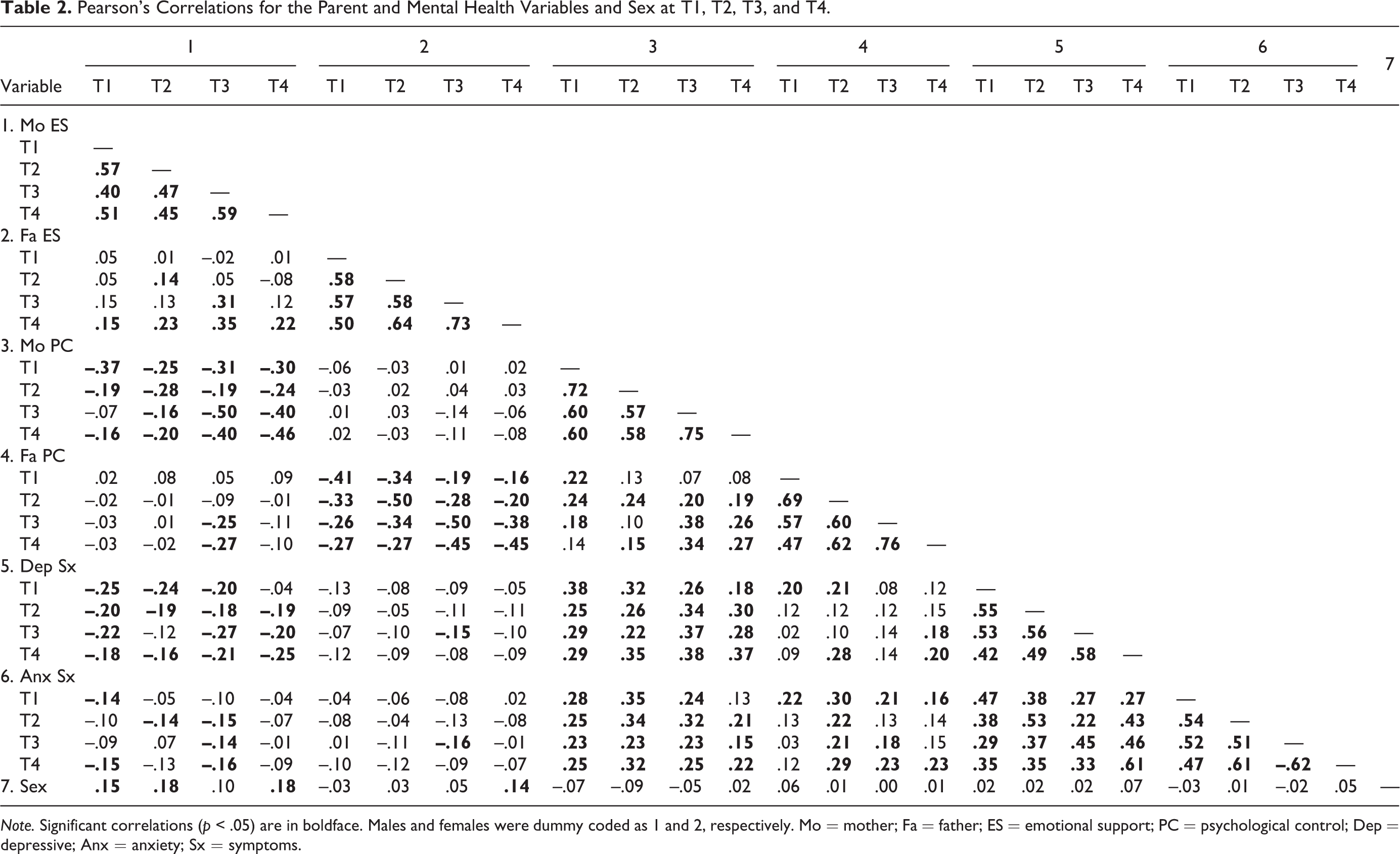
Note. Significant correlations (p < .05) are in boldface. Males and females were dummy coded as 1 and 2, respectively. Mo = mother; Fa = father; ES = emotional support; PC = psychological control; Dep = depressive; Anx = anxiety; Sx = symptoms.
Changes in Parental and Mental Health Variables
Table 3 shows results from the MLM models of change in young adults’ reports of parental emotional support and psychological control and depressive and anxiety symptoms. On average, emotional support from mothers and fathers significantly increased over time, whereas mother and father psychological control significantly decreased over time. Sex differences were significant; females had both higher initial levels of mother emotional support (b = .48, p = .01) and greater increases in father emotional support (b = .08, p = .05) than males. The overall decrease in mother psychological control was also attenuated for females (b = .10, p = .04). Parent divorce was associated with lower initial levels of father emotional support (b = −.74, p = .01). The decrease in father psychological control was attenuated for young adults who lived with their fathers (b = .10, p = .04). On average, young adults’ depressive symptoms tended to decrease over time (b = −.06, p = .06). Anxiety symptoms decreased significantly over time (b = −.12, p = .01), but the decrease in anxiety symptoms (b = .11, p = .05) was attenuated for young adults with divorced parents. There were no quadratic effects over time for any of the study variables.
Fixed Effects and Variance–Covariance Estimates for Univariate Models of Change in Parental and Mental Health Variables Over Time.
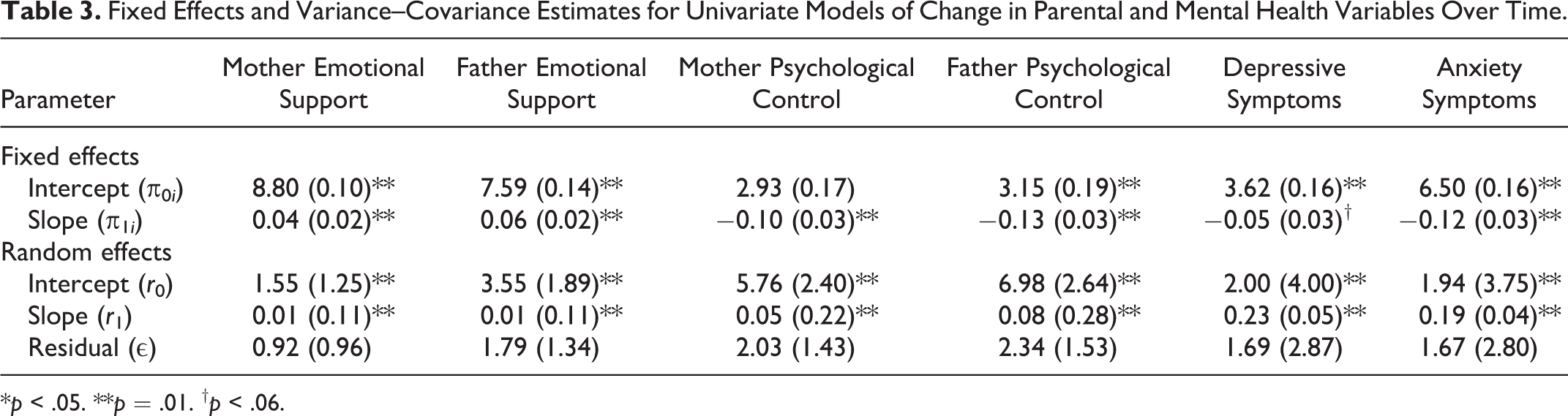
*p < .05. **p = .01. †p < .06.
Educational Adjustment: Direct and Indirect Effects of Parental Emotional Support and Psychological Control
Figure 1 shows the estimated model examining the direct and indirect effects of mother and father emotional support and psychological control on educational adjustment variables. The fully unconstrained baseline model showed that the hypothesized model provided an excellent fit to the data for males and females, χ2(44) = 60.33, p = .05, CFI = .99, RMSEA [CI] = .04 [.00, .06]. The constrained model, in which pathways were held equal across sex, provided a poorer fit, Δχ2(46) = 68.74, p = .02; ΔCFI = .013. Thus, results for males and females are presented separately.
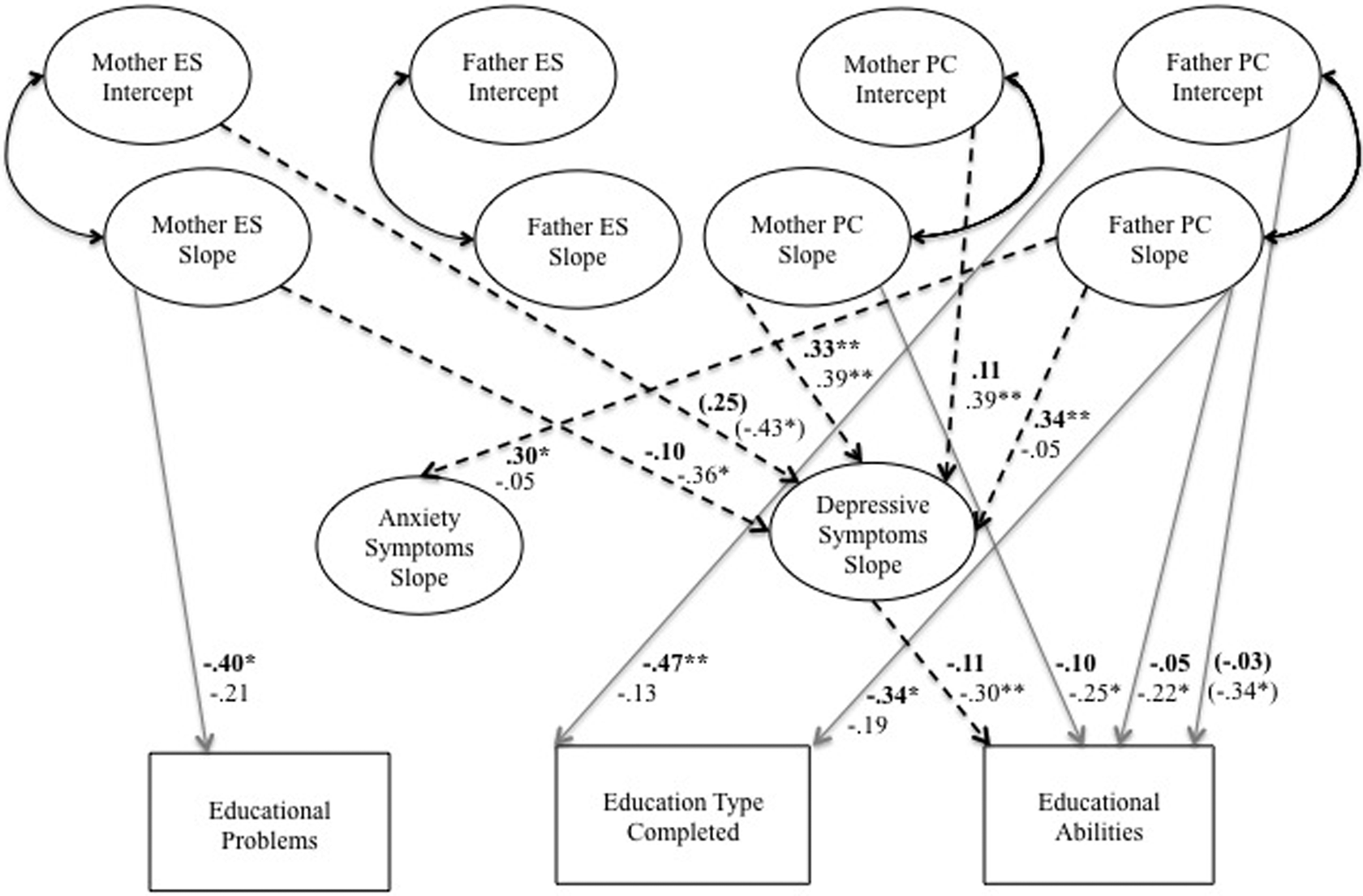
Educational adjustment: direct and indirect effects. Solid arrows show direct effects; dashed arrows show indirect effects. Standardized coefficients appear to the right of paths. Results for females are in boldface. Coefficients in parentheses indicate significant differences by sex for a given path. For clarity, nonsignificant paths and depressive/anxiety symptom intercepts are not shown. *p < .05. **p = .01.
Indirect effects
For females, decreases in father psychological control were associated with decreases in anxiety symptoms (b = .30, p = .03). However, changes in anxiety symptoms were not associated with any educational adjustment variables. Decreases in both mother psychological control and father psychological control were associated with decreases in depressive symptoms (b = .33 and b = .34, ps = .01, respectively). However, changes in depressive symptoms were not associated with the educational adjustment variables. Thus, no indirect effects occurred for females.
For males, four parental variables were associated with changes in depressive symptoms. Specifically, higher initial levels and increases in mother emotional support were associated with fewer depressive symptoms (b = −.36, p = .04 and b = −.43, p = .01, respectively), whereas lower initial levels and decreases in mother psychological control were associated with fewer depressive symptoms (bs = .39, ps = .01). In turn, decreases in depressive symptoms were associated with higher perceptions of educational abilities (b = −.30, p = .01). Thus, four indirect effects occurred for males. Specifically, higher initial levels of and increases in mother emotional support were associated with higher educational abilities through depressive symptoms (bs = .11 and .13, respectively), and lower initial levels of and decreases in mother psychological control were associated with higher educational abilities through depressive symptoms (bs = −.12). No parent variables were associated with changes in anxiety symptoms, nor were anxiety symptoms associated with any of the educational adjustment variables for males.
Direct effects
Accounting for indirect pathways, there were six statistically significant direct effects from the parental variables to the educational adjustment variables. For females, increases in mother emotional support were associated with fewer educational problems (b = −.40, p = .05). Lower initial levels and decreases in father psychological control were associated with higher education type completed (b = −.47 and b = −.34, ps = .01, respectively). For males, decreases in mother psychological control were associated with higher perceived educational abilities (b = −.25, p = .05). In addition, lower initial levels and decreases in father psychological control were associated with higher perceived educational abilities (b = −.34, p = .01 and b = −.22, p = .05, respectively).
Together, the direct and indirect effects in the educational adjustment model accounted for 21% of the variance in young adults’ educational problems, 18% of the variance in their educational problems, and 31% of the variance in the type of education completed by young adults.
Occupational Adjustment: Direct and Indirect Effects of Parental Emotional Support and Psychological Control
Figure 2 shows the estimated model examining the direct and indirect effects of mother and father emotional support and psychological control on occupational adjustment. Comparison of fully unconstrained and constrained models showed that the pathways did not significantly differ by sex, Δχ2(56) = 69.26, p = .11; ΔCFI = .008. Thus, the final model was estimated using combined data from males and females, and it provided an excellent fit to the data, χ2(23) = 28.73, p = .19, CFI = 1.00, RMSEA [CI] = .03 [.00, .06].
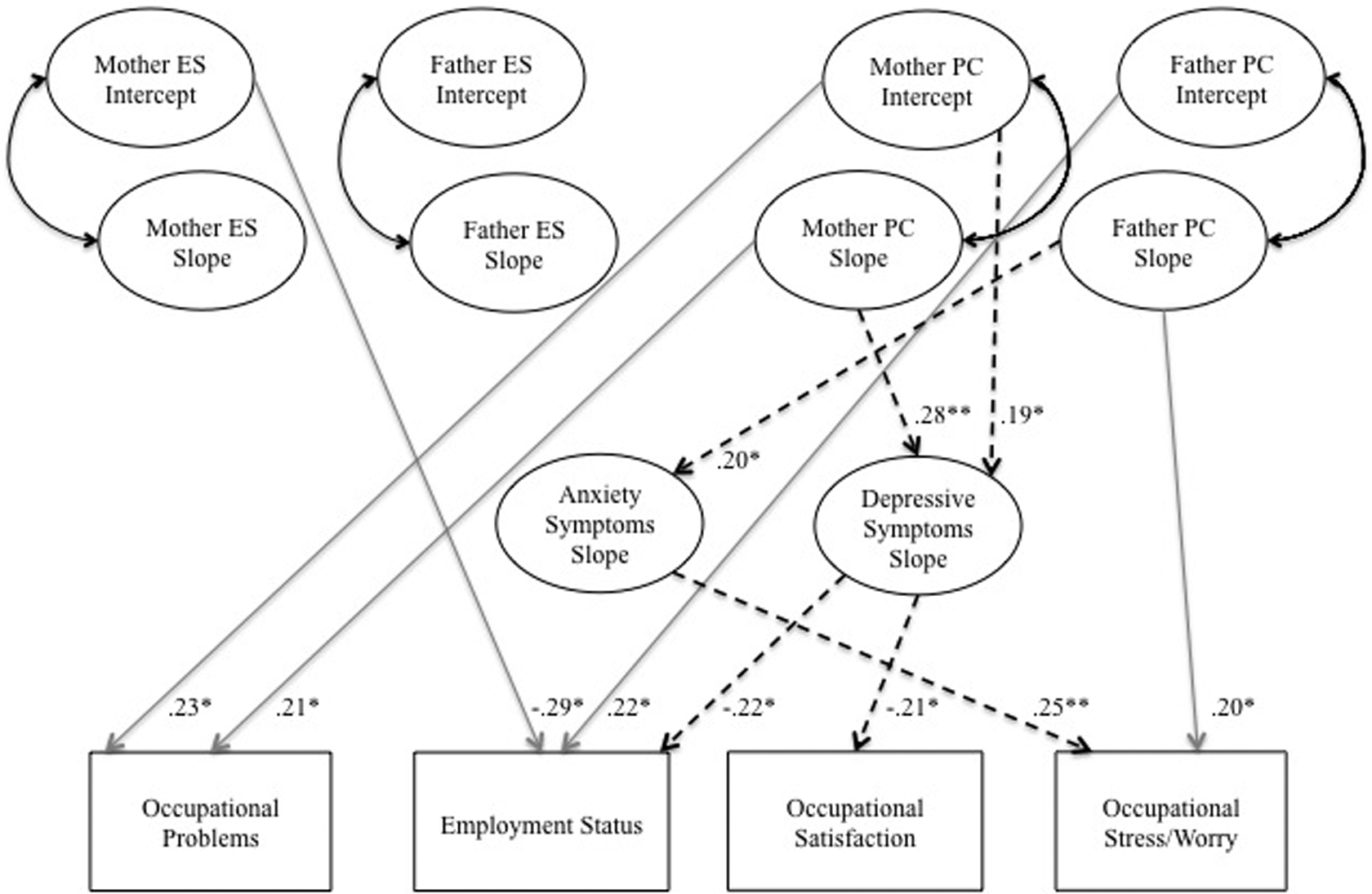
Occupational adjustment: direct and indirect effects. Solid arrows show direct effects; dashed arrows show indirect effects. Standardized coefficients appear to the right of paths. Results are based on combined data from males and females. For clarity, nonsignificant paths and depressive/anxiety symptom intercepts are not shown. *p < .05. **p = .01.
Indirect effects
Lower initial levels and decreases in mother psychological control were associated with decreases in depressive symptoms (b = .19, p = .04 and b = .28, p = .01, respectively). In turn, decreases in depressive symptoms were associated with higher employment status (b = −.22, p = .01) and greater occupational satisfaction (b = −.21, p = .01). Thus, lower initial levels (b = −.04) and decreases (b = −.06) in mother psychological control were indirectly associated with higher employment status through depressive symptoms. In addition, lower initial levels (b = −.04) and decreases (b = −.06) in mother psychological control were indirectly associated with higher occupational satisfaction through depressive symptoms.
Decreases in father psychological control were associated with decreases in anxiety symptoms (b = .20, p = .04). In turn, decreases in anxiety symptoms were associated with lower occupational stress/worry (b = .25, p = .01). Thus, decreases in father psychological control were indirectly associated with less occupational stress/worry through anxiety symptoms (b = .05).
Direct effects
Accounting for indirect pathways, there were five statistically significant direct effects from the parental variables to the occupational adjustment variables. Both lower initial levels and decreases in mother psychological control were associated with fewer occupational problems (b = .23, p = .02 and b = .21, p = .03, respectively). Higher initial levels of mother emotional support were associated with lower employment status (b = −.29, p = .03), whereas lower initial levels of father psychological control were associated with lower employment status (b = .22, p = .02). Lastly, decreases in father psychological control were associated with lower occupational stress/worry (b = .20, p = .01).
Together, the direct and indirect effects in the occupational adjustment model accounted for 16% of the variance in young adults’ occupational problems, status, and satisfaction and for 32% of the variance in young adults’ occupational stress/worry.
Discussion
Our findings show that the emotional quality of parent–youth relationships undergoes significant changes during early adulthood. Consistent with previous research, we found that young adults feel more emotionally supported by parents over time (Aseltine & Gore, 1993; Fingerman et al., 2009; Thornton et al., 1995). Young women showed greater increases in father emotional support compared to young men. Previous research has found that adolescent girls report less emotional support from fathers than boys do (Colarossi & Eccles, 2003). However, in early adulthood, fathers may play key roles in more objective (e.g., financial support for education) versus personal or relational domains, and it is possible that daughters become more receptive to fathers’ support as they face important educational and occupational decisions (Desjardins & Leadbeater, 2011).
Effects of Parental Emotional Support on Educational and Occupational Adjustment
Consistent with past research, we found evidence for direct and indirect links between greater emotional support and better youth adjustment—but only for mothers (Fass & Tubman, 2002; Murphy et al., 2010; Schultheiss et al., 2001). Young adults reported higher levels of maternal than paternal emotional support, which is consistent with the findings for younger samples (Colarossi & Eccles, 2003; Thornton et al., 1995). In general, youth report greater involvement with and disclosure to mothers and view their mothers as warmer and more accepting and understanding than fathers (Williams & Kelly, 2005). For young adult women, increases in mother emotional support protected against experiencing problems at school. Young women with more emotionally supportive mothers may be more likely to go to them for support, reassurance, or practical advice when difficulties arise. In turn, high-quality emotional support may be helpful in guiding them to mitigate academic problems. Although women might seek support from other sources, such are friends, mothers’ life experiences and intimate knowledge of their daughters may make maternal emotional support especially salient. Conversely, those who perceive their mothers as emotionally unsupportive are less likely to seek out their assistance when struggling, possibly contributing to cascading academic problems.
High initial levels and increases in mother emotional support were associated with fewer depressive symptoms for young adult men, which is consistent with extensive research linking maternal emotional support to depressive (but not anxiety) symptoms (Aseltine & Gore, 1993; Colarossi & Eccles, 2003; Hefner & Eisenberg, 2009; Pettit et al., 2011). Males report greater emotional closeness with mothers compared to fathers; however, they also report less emotional closeness with mothers relative to females (Williams & Kelly, 2005). While young men have the potential to grow more distant from parents as they establish greater independence, those who maintain close emotional ties with their mothers and perceive them as emotionally supportive may be uniquely protected from developing depressive symptoms, and in turn more likely to develop healthier and more positive evaluations of their abilities.
The positive effects of maternal emotional support are not ubiquitous, however. For both young men and women, higher initial levels of emotional support from mothers were associated with higher unemployment, suggesting that young adults with high levels of emotional support may not be encouraged to work. Alternatively, it is possible that greater emotional support was elicited by—or offered to—youth who were already struggling with finding employment (Fingerman et al., 2009). Young adults who seek out greater emotional support from mothers may also seek less support from other sources, such as close friends or romantic partners. Other young adults may view their receipt of high maternal emotional support as nonnormative, viewing themselves as more dependent and less competent than peers (Fingerman et al., 2012).
Effects of Parental Psychological Control on Educational and Occupational Adjustment
This is among the first studies to demonstrate that on average, mother and father psychological control decline over time, which matches the developmental patterns of increasing autonomy and independence that begins during adolescence and continues through early adulthood (Boykin et al., 2009). However, average decreases in mother psychological control were less steep for young women. Mother–daughter relationships can be uniquely intimate but also conflictual, so it is possible that when psychological control occurs, it is more robust in mother–daughter dyads (Smetana, Metzger, Gettman, & Campione-Barr, 2006). Another consideration is that parents may continue to more closely monitor daughters than sons during early adulthood, and greater awareness of daughters’ activities may provide mothers with more opportunities to use psychological control strategies (Pettit et al., 2011).
Additionally, the average decrease in father psychological control was less steep for young adults who lived with their fathers, which supports past findings (Leondari & Kiosseoglou, 2002). Fathers may play a central role in certain autonomy processes, and it is possible that some fathers struggle to parent effectively as they see their children taking longer to achieve traditional markers of independence (Boykin et al., 2009). Young adults’ continued residential (and financial) dependency may also increase parental stress, negatively impacting the quality of their interactions with youth. Furthermore, shared accommodations offer greater knowledge of young adults’ activities (as well as more frequent opportunities to interact with them), perhaps facilitating fathers’ use of psychological control.
The effects of parental psychological control were consistently negative, contributing to a growing literature showing that psychological control is associated with poor adjustment in early adulthood (Leondari & Kiosseoglou, 2002; Luyckx et al., 2007). The present findings extend past research by demonstrating the effects of psychological control on young adults’ adjustment in educational and occupational domains. Mother and father psychological control were negatively associated with a wide range of young adults’ adjustment outcomes, including lower perceived academic abilities, lower educational achievement, more problems in the workplace, and more stress and worry about work. Psychologically controlling parents send a message to young adults that they are not making effective choices, and any attempts to do so will have negative implications for their relationships with parents. When young adults’ own psychological needs and contributions are undermined, their perceived competence is reduced and overly negative self-perceptions are fostered (Barber et al., 2002; Luyckx et al., 2007). These young adults may have difficulty pushing forward to achieve salient developmental milestones, falling behind peers who are not subjected to the same form of parental control.
Changes in young adults’ depressive and anxiety symptoms partially explained some of the associations between parental psychological control and adjustment, with mother psychological control and depressive symptoms playing prominent roles. Consistent with expectations, lower mother psychological control was associated with fewer depressive symptoms in male and female young adults. Conversely, maternal psychological control, when present, devalues young adults’ thoughts and feelings, contributing to a cluster of depressive symptoms that in turn is associated with diminished work satisfaction and lower employment status. Symptoms such as fatigue or hopelessness could contribute to difficulty performing at work as well as to lower motivation and fewer goals. Ultimately, these mental health symptoms contribute to a greater likelihood of being unemployed or underemployed. Lower initial levels and decreases in mother psychological control and depressive symptoms were associated with higher perceived educational abilities for young men, which is consistent with cognitive models linking positive (or negative) views about the self to depressive symptomatology (Beck, 2011). Finally, lower levels of father psychological control contributed to decreases in young adults’ anxiety symptoms and negative adjustment. Hence, diminishing levels of paternal intrusiveness and constraint may liberate young adults from potentially debilitating employment-related stress and worry. On the other hand, young men and women who feel incompetent and insecure as a result of ongoing parental psychological control may become overly fearful about their ability to do things competently and to succeed.
There was one exception to the pattern highlighting the benefits of diminishing parental psychological control: Lower initial levels of father psychological control were associated with lower employment status for young adults. While this is just one finding, it raises the possibility that parental psychological control could guide youth behavior in adaptive directions. Some young adults may make choices—such as whether to pursue further education—to appease controlling parents. Without such parental demands, some youth may flounder. However, it is important to note that increases in father psychological control across early adulthood were not ultimately associated with greater employment status, suggesting that any initial positive effects of psychological control were short-lived. Rather, our results lend support to the view that decreasing parental psychological control has positive effects on young adults’ healthy adjustment.
Limitations and Conclusions
Several of the associations between parent emotional support and psychological control and young adults’ adjustment were not explained by mental health symptoms. Thus, there are other unexplored mechanisms that would further elucidate our findings. For example, research with adolescents has linked parental psychological control to externalizing problems, and it is possible that increases in psychological control during early adulthood may contribute to oppositionality, aggression, or substance problems, which in turn could have negative implications for adjustment (see Barber & Harmon, 2002). As suggested earlier, it is possible that youth with more mental health symptoms may elicit or seek out greater parental emotional support. Similarly, depressive or anxiety symptoms could elicit greater parental psychological control in some families. While this study focused on the analysis of directional pathways flowing from parent emotional support and psychological control to mental health symptoms based on theory and the literature reviewed, it is also possible that depressive and anxiety symptoms could influence the emotional quality of parent–youth relationships (and, in turn, real-world outcomes). Thus, future research could examine the opposite direction (or bidirectionality) of these associations.
The sample in this study was primarily European Canadian and many parents were college or university educated; future research is needed to determine whether the current findings can be generalized to other ethnic and educational groups. Additionally, all data were self-reports; mono-method variance may have enhanced the reported associations. For example, negative cognitive biases could cause those with elevated depressive symptoms to report lower parental emotional support or poorer adjustment. Finally, although this study’s sample size meets commonly accepted guidelines regarding statistical power, it is possible that some of the analyses (i.e., multigroup models) were limited by power considerations.
This research contributes to the literature highlighting the continued importance of parent–youth relationships during early adulthood. Each educational and occupational outcome assessed in this study was associated with the emotional quality of parent relationships either directly or indirectly, demonstrating the power of parental influences. Results suggest that young adults benefit from increasing levels of maternal emotional support during the transition to adulthood, and this is especially true for young men. Thus, mothers should be aware of the potential benefits of their continued emotional support on young adults’ educational and occupational adjustment. In addition, the majority of the findings point to the beneficial effects of reduced parental psychological control during the transition to adulthood. Our results consistently showed that diminishing parental psychological control promotes young adults’ psychological wellness (buffering depressive and sometimes anxiety symptoms) and functioning in age-salient domains.
Interventions may be needed to help parents be aware of psychologically controlling strategies in order to decrease their use and help prevent mental health and adjustment problems in early adulthood. Similar interventions for parents of high school students may help mitigate the detrimental effects of parental psychological control before early adulthood (and may also reach a larger pool of parents). Furthermore, high school–based curricula can teach youth to recognize problematic parental relationship patterns and to seek support from high school– or university-based counseling centers when needed. Such supports can help alleviate youth’s depressive and anxiety symptoms and bolster their self-esteem. It is also clear that young adults who experience elevated depressive and anxiety symptoms—regardless of the reasons why—are more likely than their peers to struggle in school and at work. Thus, campaigns and other efforts that aim to improve youth mental health can have extensive real-world consequences and should be supported.
Footnotes
Acknowledgments
We are grateful to all youth who participated in this research.
Author Contribution
T. Desjardins contributed to conception, design, analysis, and interpretation; drafted the manuscript; critically revised the manuscript; gave final approval; and agrees to be accountable for all aspects of work ensuring integrity and accuracy. B. J. Leadbeater contributed to conception, design, acquisition, and interpretation; critically revised the manuscript; gave final approval; and agrees to be accountable for all aspects of work ensuring integrity and accuracy.
Declaration of Conflicting Interests
The authors declared no potential conflicts of interest with respect to the research, authorship, and/or publication of this article.
Funding
The authors disclosed receipt of the following financial support for the research, authorship, and/or publication of this article: The Healthy Youth Survey study has been financially supported by grants from the Canadian Institute for Health Research (#CAR-43275, #RAA-79917; Operating Grant #192583).