







Abstract
Asian and Latinx emerging adults in the United States typically hold stronger values and expectations regarding their duty to support and respect their families than their White peers. Yet, research has not fully explored how meeting familial expectations is associated with psychological well-being in these populations. This study examined ethnic-racial differences in perceptions of meeting familial expectations and their relation to depressive symptoms and self-esteem (i.e., positive and negative self-image) in Latinx, Asian, and White emerging adults. Participants were 1,223 students (51% female, mean age = 19.2) recruited from a state university in southern California. Results found that meeting familial expectations regarding personal responsibility was negatively associated with depressive symptoms only for Asian youth, and with negative self-image for all groups; however, the association was stronger for Asians. Further, meeting familial academic expectations was positively associated with positive self-image and negatively associated with negative self-image for Latinx and Asian youth.
Emerging adulthood is characterized by a period of transition during which youth in the United States are expected to attain three major goals—being responsible for oneself, making decisions independently, and becoming financially independent (Arnett, 2003), a process that may vary by race/ethnicity (Syed & Mitchell, 2013). Given these societal expectations, this transitional period has been associated with increased risk for multiple health and mental health outcomes, especially in minoritized groups who encounter cultural stressors, such as acculturative stress and discrimination (Rivas-Drake & Stein, 2017). Both depression and poor self-esteem have been established as key risk factors that may present challenges for youth during the transition to emerging adulthood and persist well into midlife (Orth et al., 2012; Substance Abuse and Mental Health Services Administration, 2017).
As they transition to adulthood, Latinx and Asian individuals report higher levels of familial obligations and expectations than their White peers (Fuligni & Pedersen, 2002). For these young adults, psychological well-being may be uniquely linked to how they perceive their role fulfillment within their family and community. Yet, how perceptions of meeting familial expectations are associated with depressive symptoms and self-esteem in these populations remains relatively unexplored. This paper seeks to address this gap in the literature by examining the relation between perceived fulfillment of familial expectations and depressive symptoms and self-esteem (i.e., positive and negative self-image) in a sample of Asian, Latinx, and White (non-Latinx) emerging adults.
Emerging Adulthood in Asian and Latinx Cultures
Emerging adults from Asian and Latinx backgrounds engage in identity explorations and self-development like their White American counterparts, but often do so with narrower boundaries, which are dictated by their sense of obligation to their parents (Arnett, 2010; Phinney & Baldelomar, 2011). For Asian and Latinx emerging adults, familial shared values and goals are central and guide individuals’ values, behaviors, and attitudes (Fuligni, 2007). As a result, life satisfaction may result from being successful in their social roles and obligations, as well as avoiding failures in these areas (Markus & Kitayama, 1991). Thus, transitioning to adulthood is more closely tied to behaviors that reflect obligations and duties toward others. For example, conceptions of the transition to adulthood held by emerging adults from ethnic minority groups in the U.S. differ when it comes to complying with norms and providing for family role transitions pertaining to getting married, finishing school, and finding employment (Arnett, 2003). This suggests that for ethnic minority youth a successful transition involves more attention to familial expectations.
Moreover, during adolescence and emerging adulthood, bicultural identity development is more pronounced for ethnic minorities (e.g., Latinx and Asians; Phinney, 2006). Specifically, Latinx and Asian emerging adults living in the United States are expected to find a balance between their ethnic and national identities, a process that is often centered around tension between family interdependence and independence from their families (Farver et al., 2002). This conflict between adhering to family expectations and building their autonomy can lead to parent-child conflict (Alexander et al., 2020) and depression (Romero et al., 2007).
Further, during the emerging adulthood period, experiences of emotions (e.g., depressive symptoms, self-esteem) may be more closely aligned with the fulfillment of filial obligations for Asians and Latinxs. For example, filial obligations have been linked with greater happiness, joy, and pride in Asian and Latinx samples (Kiang, 2012; Stein et al., 2019). Extending this to negative affect, this suggests that depressive cognitions and self-esteem for Latinx and Asian emerging adults may be more linked to individuals’ perceptions of themselves and how they function within their families, compared to White emerging adults from more independent cultures for whom these obligations play a less central role (Fuligni, 2007) and for whom these cognitions are more linked to how they view themselves and their own individual expectations (Kirsh & Kuiper, 2002; Leary & Baumeister, 2000).
Familial Expectations in Latinx and Asian Offspring
For Latinx and Asian emerging adults, higher levels of obligation to the family are typically associated with a higher emphasis on the importance of education and greater academic motivation (Fuligni, 2001). Between the ages 19-21 years, there is an increased sense of obligation to support, respect, and assist the family (Fuligni & Pedersen, 2002). Fuligni et al. (1999) found that Asian and Latinx youths’ attitudes of treating their elders with respect and following parental advice were typically in line with their families’ attitudes. However, they also found the importance of supporting family in the future declined in young adulthood across generations, even though these attitudes remained higher for Asian and Latinx youth when compared to their White peers.
Although this internalized sense of responsibility and obligation typically serves as a motivator for young adults, in certain contexts, family obligations and family assistance behaviors can also be detrimental and a source of risk (Fuligni et al., 1999; Telzer, 2012; Velez, 1989). In particular, discrepancies between family expectations and actual behaviors might contribute to depressive symptoms in youth (Céspedes & Huey, 2008). The literature suggests that Latinx and Asian emerging adults may feel pressure to meet not only their own, but also their family’s expectations, which may magnify their psychological distress (e.g., depressive symptoms, low self-esteem) if they are failing in these domains.
The current study seeks to understand whether perceptions around meeting familial expectations are differentially associated with depressive symptoms and self-esteem across ethnic-racial groups. We hypothesized that failing to meet familial expectations would be positively associated with depressive symptoms and negative self-image to a stronger degree for Latinx and Asian emerging adults than for White emerging adults. We also expected that meeting familial expectations would be positively associated with positive self-image to a stronger degree for Latinx and Asian emerging adults than for White emerging adults.
Method
Participants and Procedures
Participants were 1,223 emerging adults (sample characteristics shown in Table 1). Most participants (85.2%) were recruited from a psychology subject pool (i.e., lower-division, general education class), 3.4% from an upper-division, general education, family studies class, 2.6% from campus groups, and 8.8% from a snowball sample on campus.
Sample Characteristics.
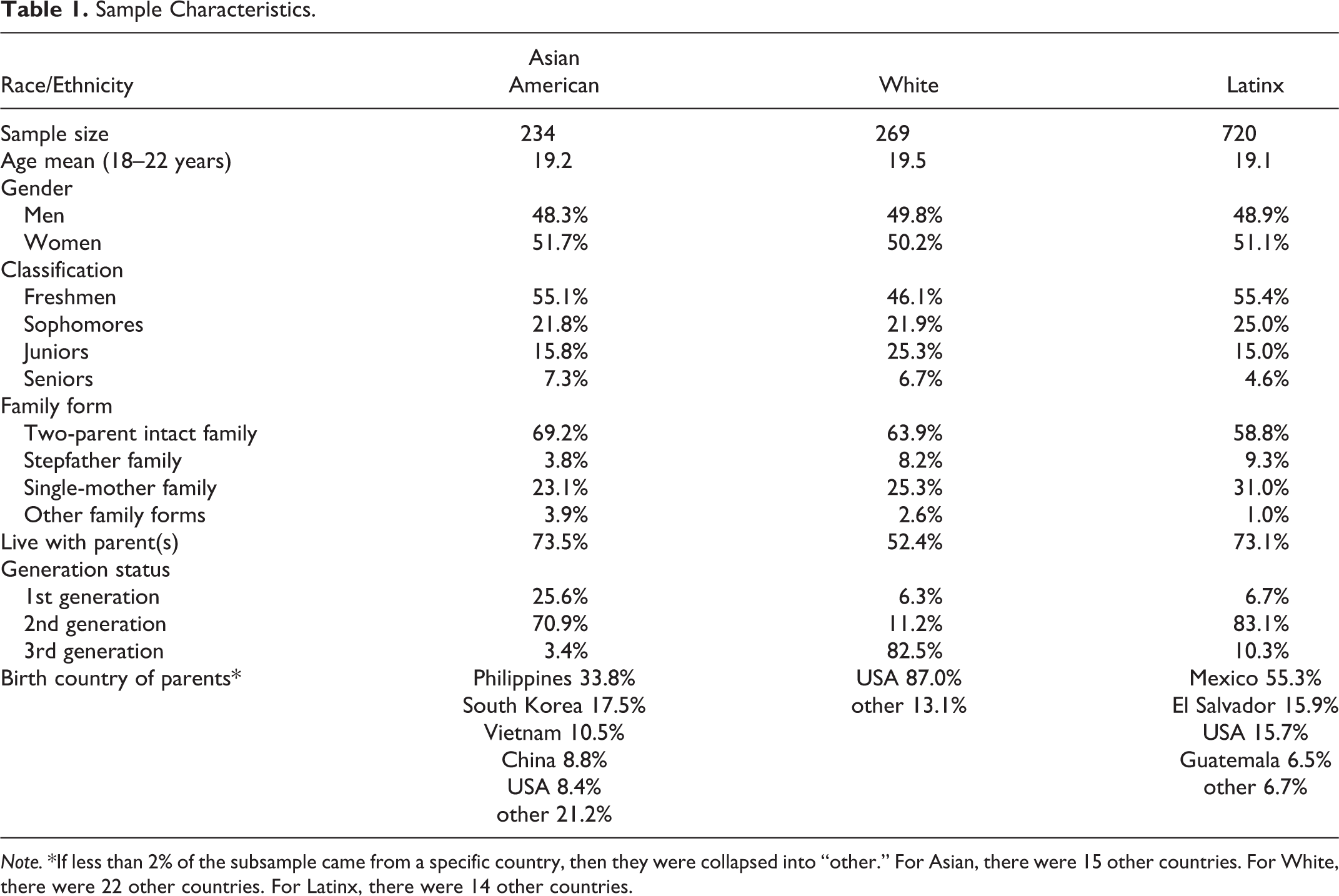
Note. *If less than 2% of the subsample came from a specific country, then they were collapsed into “other.” For Asian, there were 15 other countries. For White, there were 22 other countries. For Latinx, there were 14 other countries.
Measures
Self-esteem
Self-esteem was specified by two latent factors: 5-item positive self-image and 5-item negative self-image, as studies of ethnic minority youth suggested bidimensionality in the Rosenberg Self-Esteem Scale (Farruggia et al., 2004; Supple et al., 2013). Response options ranged from 1 = strongly disagree to 4 = strongly agree. Composite reliabilities were .80 for positive self-image and .76 for negative self-image.
Depressive symptoms
Depressive symptoms were specified with 6 items loading onto a single latent factor from the 10-item revised version (Kohout et al., 1993) of the Center for Epidemiologic Depression scale. Preliminary analyses suggested the removal of four items as they had small factor loadings. Participants rated frequency of symptoms in the past week with 0 = rarely or none of the time (less than 1 day) to 3 = Mostly or almost all the time (5-7 days). The composite reliability for this scale was .75.
Meeting familial expectations
Students’ perceptions of meeting familial expectations were assessed by three latent variables: (1) respect to dating (e.g., “Ask their [parents] approval before starting a dating relationship”; 6 items), (2) academic/career (e.g., “Making good grades”; 2 items), and (3) being responsible (e.g., “Not making problems for the family”; 4 items). The items are loosely based on the Living up to Parental Expectation Inventory (Wang & Heppner, 2002). Response options ranged from 1 = strongly disagree to 4 = strongly agree. The composite reliabilities for the three subscales were .78 for dating, .81 for being responsible, and .64 for academic success. In addition, a three-factor CFA model demonstrated an adequate fit to these data.
Analytic Plan
Structural equation modeling (SEM) was conducted in Mplus version 7.4 (Muthén & Muthén, 1998–2017). Missing data were addressed using full information maximum likelihood (FIML). We first established the measurement reliability and validity of the latent variables representing depressive symptoms, positive and negative self-image, and three factors representing meeting familial expectations. After validating the measurement model/factor structure, we considered the measurement equivalence across the three pan ethnic groups. Subsequent to establishing measurement equivalence, we then compared structural coefficients across groups to determine whether or not associations between the three meeting familial expectations factors and the three outcomes varied across ethnic-racial groups. The raw data, analysis code, and materials used in this study are not openly available but are available upon request from the corresponding author. No aspects of the study were pre-registered.
Results
Prior to comparing differences across groups, we established strong measurement invariance across the three groups (the results of these analyses are available in an appendix within the Open Science Framework at https://osf.io/j8upd/files/). These tests constrained item factor loadings and intercepts to equality and were compared to models with all parameters freely estimated. The key difference of relevance for this study was metric or weak invariance which finds that factor loadings are comparable across groups (necessary for comparing path coefficients across groups). Results suggested partial measurement invariance. The familial expectations items were invariant with respect to factor loadings (metric invariance); however, one self-esteem item and one depression item were non-invariant across groups (“I wish I could have more respect for myself”, and “I felt that everything I did was an effort”, respectively). The final analytical model constrained all factor loadings to equality except for those that varied across groups. As such, the measurement model demonstrated partial measurement equivalence across factor loadings, which is sufficient to avoid bias when comparing structural coefficients across groups (Steemkamp & Bumgartner, 1998). The fit of the final model forcomparison of structural coefficients was, χ2(1,043) = 1,931.531, p < .001, CFI = .93, RMSEA = 0.04), and this model specified all factor loadings constrained (but two) and all item intercepts freely estimated across groups.
Ethnic Differences in the Relationships between Familial Expectations and Psychological Well-being
To test for differences in patterns of associations across groups, we conducted multigroup SEM and imposed equality constraints on the paths from meeting expectations to the outcomes. Although the fully constrained model demonstrated a good fit to these data (χ2 = 1,969.38, df = 1,061, CFI = .93, RMSEA = .04), the change in chi-square indicated that constraining structural paths to equality resulted in a significant decrement to model fit (Δχ2 = 37.85, df = 18, p = .004), suggesting that the regression paths were not similar across groups. Subsequent analyses were conducted to identify the source of the specific statistical differences among groups, and four paths were identified (see Table 2). With these four paths freed (but all others constrained to be equal across groups), the final model did not significantly differ from the baseline model (Δχ2 = 8.125, df = 14, p = .88). The differences in structural coefficients centered on three themes: (1) meeting familial expectations regarding personal responsibility was more relevant to predicting outcomes among the Asian respondents in this study, (2) meeting familial expectations regarding academic achievement was most relevant for the Latinx and Asian respondents, and (3) meeting expectations regarding dating were similarly unrelated to outcomes across all three groups.
Structural Model Estimates by Group.
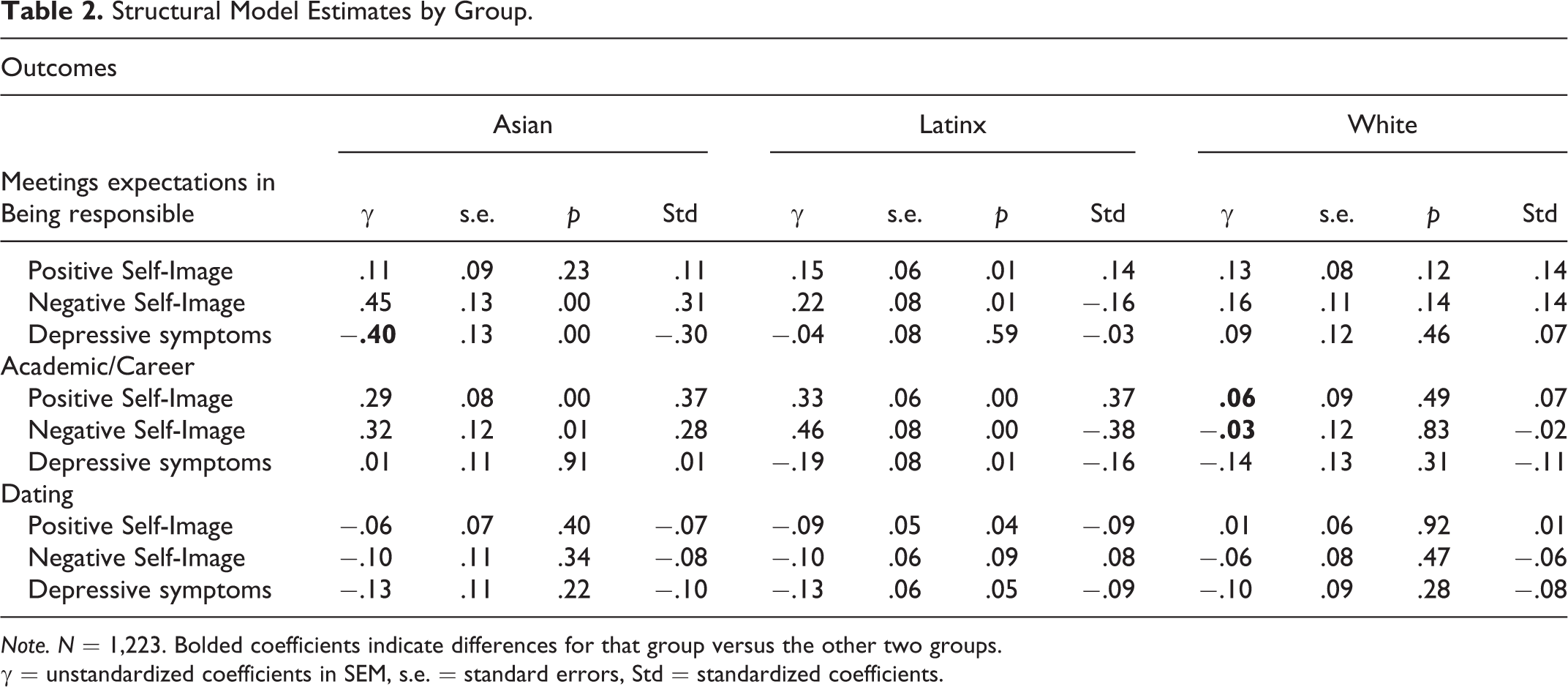
Note. N = 1,223. Bolded coefficients indicate differences for that group versus the other two groups.
γ = unstandardized coefficients in SEM, s.e. = standard errors, Std = standardized coefficients.
Specifically, meeting familial expectations regarding personal responsibility was negatively associated with depressive symptoms only for Asian respondents (B = −.40, p < .001), but not for White (B = .09, p = .46) and Latinx (B = −.04, p = .59) respondents. This same predictor was also negatively associated with negative self-image in all of the groups; however, the association was stronger for Asian respondents (B = −.45, p < .001) compared to White (B = −.16, p = .14) and Latinx respondents (B = −.22, p < .01). Latinx and Asian respondents were more similar in terms of associations between meeting familial expectations regarding academic achievement and the outcomes. For example, meeting familial academic expectations was positively associated to positive self-image for Asian (B = .29, p < .01) and Latinx (B = .33, p < .001) respondents, but not for White respondents (B = .06, p = .49). Similarly, meeting academic expectations was negatively associated to negative self-image among Asian (B = −.32, p < .01) and Latinx (B = −.46, p < .001) respondents, but not among White respondents (B = −.03, p = .83).
Discussion
The current study sought to add to extant literature by examining the role that perceived familial expectations play in the psychological adjustment of emerging adults from Latinx, Asian, and White backgrounds. Results from this study suggest familial expectations continue to be important in the well-being of emerging adults across ethnic-racial groups, but failing to meet milestones and family obligations may uniquely place Asian and Latinx emerging adults at risk for depressive symptoms and poor self-esteem. Although, familial obligations have a protective effect for youth and are linked to positive outcomes, some studies highlight the negative effects familial expectations and pressure to succeed can have for these youth (Naumann et al., 2012; Oishi & Sullivan, 2005). This study also elucidates the need for more nuanced examination of family expectations, as our study found that expectations surrounding personal responsibility and academic achievement seem to be more salient and significant for psychological functioning in Latinx and Asian emerging adults, than White emerging adults. Additionally, our study did not find significant differences in regard to meeting familial expectations around dating across the groups. These results point to the importance of examining the relation of self-esteem and depressive symptoms in the context of meeting familial expectations in helping youth make successful transitions into adulthood.
Specifically, our study found that meeting expectations around personal responsibility was related to positive self-image for Asian and Latinx emerging adults, but not White emerging adults. This is consistent with past literature highlighting the importance of filial obligation and responsibility, as well as perceptions of expectations for both Latinx and Asian youth (Fuligni et al., 1999; Yoon & Lau, 2008). However, failing to meet familial expectations around personal responsibility (e.g., making parents proud) was related to depressive symptoms for Asian participants only. This lends support to studies that find family obligations both contribute to and buffer against depressive symptoms in Asian American youth, depending on contextual factors facilitating or preventing role fulfillment (Juang & Cookston, 2009; Yoon & Lau, 2008). Further, consistent with hypotheses, results showed that failing to meet familial expectations about academics was associated with negative self-image for both Asian and Latinx emerging adults, but not White youth. Extant literature suggests that for Asian and Latinx youth, academic motivation stems primarily from the feeling of responsibility they have to succeed for the well-being and future of the family (Zhou & Bankston, 1998), and their desire to make their parents and family proud (Stein et al., 2019). Thus, the negative effects of failing in this domain might pose greater risk for these emerging adults, especially those in a college context. Lastly, familial expectations regarding dating did not differ significantly across groups. These results support extant literature that cautions researchers against relying on commonly held notions and stereotypes when studying ethnic minority youth (Syed & Mitchell, 2013). Being aware of these expectations and the psychological effects of failing to meet them can be important in supporting students as they adjust to critical transitions in emerging adulthood, such as attending college.
Results from this study have implications for clinical settings, where understanding the role that family processes play in emotional functioning can be important for treatment outcomes. For Latinx and Asian emerging adults, the effects of not meeting expectations in these domains might be amplified as these perceived failures represent not only individual, but also familial, failures. Thus, it may be especially important to discuss and target family expectations and obligations when treating poor self-esteem and depressive symptomatology due to the saliency of these across their lives.
Future Directions and Limitations
Despite notable strengths, the current study has some limitations. The sample consisted of college students, mostly freshman, who may be more acculturated and presumably already meeting familial expectations of seeking higher education. Additionally, a majority of the sample was living with parents, a living arrangement that may magnify the pressure to meet familial obligations. Thus, future studies should include a more diverse sample of emerging adults, including those not enrolled in college and those living independently to clarify associations found. Moreover, given the data are self-reported with only a single time of measurement, it is possible that depression and self-esteem may have influenced perceptions of meeting familial expectations. Future studies should examine this association longitudinally to provide a stronger conclusion. Further, the majority of participants in this study identified as 2nd generation; thus, it is important that future studies examine generational status more closely, as this has been shown to affect familial obligation attitudes and behaviors (Juang & Cookston, 2009). Additionally, given the overrepresentation of students of Filipino (33.8% in Asian American sample) and Mexican (55.3% in Latinx sample) descent in our study, results may not be generalizable and future studies including more representative and diverse samples are needed to further clarify these associations. Nonetheless, this study is a first attempt at understanding the importance of family in forming self-concept and well-being for Latinx and Asian emerging adults.
Footnotes
Authors’ Note
The institutional review board at a public university in Southern California approved the project. The university is designated as a Hispanic Serving Institution and an Asian American and Native American Pacific Islander-Serving Institution. Andrea L Kulish's is now affiliated with Nemours duPont Hospital for Children.
Author Contributions
Yesenia Mejia has contributed to the conception and design of the study, drafted manuscript, critically revised the manuscript, gave final approval, and agrees to be accountable for all aspects of work ensuring integrity and accuracy. Andrew J. Supple has contributed to analysis and interpretation, critically revised manuscript, gave final approval, and agrees to be accountable for all aspects of work ensuring integrity and accuracy. Gabriela L. Stein has contributed to the conception and design of the study, critically revised the manuscript, gave final approval, and agrees to be accountable for all aspects of work ensuring integrity and accuracy. Scott W. Plunkett has contributed to acquisition and interpretation, critically revised the manuscript, gave final approval, and agrees to be accountable for all aspects of work ensuring integrity and accuracy. Andrea L. Kulish has contributed to the conception of the study, critically revised the manuscript, gave final approval, and agrees to be accountable for all aspects of work ensuring integrity and accuracy.
Declaration of Conflicting Interests
The author(s) declared no potential conflicts of interest with respect to the research, authorship, and/or publication of this article.
Funding
The author(s) received no financial support for the research, authorship, and/or publication of this article.

Open Practices
The raw data, analysis code, and materials used in this study are not openly available but are available upon request to the corresponding author. No aspects of the study were pre-registered. Data and materials for this study have not been made publicly available. The design and analysis plans were not preregistered.