







Abstract
Employing narrative inquiry, this paper examines how 30 Mexican and Central American young adults (ages 21 to 34) who immigrated without a parent as teenagers—the unaccompanied 1.25 generation— experienced the subjective feeling of adulthood. Structural realities pushed the unaccompanied 1.25 generation into early adult roles, independence, and social responsibility. In many cases, attainment of “adult” roles, independence, and even social responsibility was not followed by the subjective feeling of adulthood. Instead, the feeling of adulthood emerged in gendered ways, was gradual, and resulted from seeing themselves as competent, mature, and capable of thoughtful decision-making. Moreover, in some cases, traumatic events led some to early identification with adult status or disrupted their identification with adulthood. Their experiences support the idea that becoming an adult is an internal process, and raises questions on how independence and social responsibility are experienced by marginalized youth and incorporated into their sense of adulthood.
At 15, I didn’t think about myself. I thought about my parents, and I thought about my sisters. The day has to come when someone has to take the reins and contribute, contribute to the family.
Rafael, quoted above, is one of the numerous unaccompanied 1.25 generation immigrants—those who immigrate unauthorized as teenagers and make the journey to the United States without a parent—living in the United States. At the age of 15, Rafael crossed the border clandestinely to provide for his parents and siblings in Mexico. The day after arriving, his job search began. Within two weeks, Rafael found a restaurant job working six days a week from 9:00 a.m. to 7:00 p.m. Describing how he allocated his earnings, Rafael stated, “a check for rent, another to pay the bills, another to send to Mexico, and another to dress myself and eat.”
Adulthood has traditionally been defined through the attainment of five major role transitions or markers: leaving the parental home, completing school, entering full-time work, getting married, and becoming a parent (Settersten, 2012). Arnett (2000), however, contends traditional role markers “have little to do with” how young people view adulthood (pg. 472). Rather, Arnett argues, character qualities—or internal criteria—are connected to adulthood (Arnett, 2000, 2004). The top internal criteria include accepting responsibility for one’s actions, making independent decisions, and financial independence from parents (Arnett, 2000, 2004).
Both through the lens of role markers and internal criteria, Rafael reached adulthood at the age of 15. He left home, ended schooling, started working full-time, decided to immigrate, and became financially independent. In reality, however, we know little about how marginalized young people come to see themselves as adults. This is despite broad recognition within the field of emerging adulthood on the importance of understanding how adulthood is conceptualized and experienced across social locations (Arnett, 2016; Syed & Mitchell, 2013). In the absence of knowledge on their subjective experiences, marginalized youth are assumed adults due to early role transitions. For example, commenting on teenage immigrants such as Rafael, Rumbaut & Komaie (2010) remark “the decision to migrate” marks “a definitive adult transition” (pg. 50). Indeed, for teenage arrivals, immigrating often leads to early entry into permanent adult roles (Martinez, 2019; Rumbaut & Komaie, 2010) and financial independence (Martinez, 2019). It remains largely unexplored, however, how the structural forces thrusting them into early roles are incorporated into their sense of adulthood. This paper employs narrative inquiry to examine how the Mexican and Central American unaccompanied 1.25 generation experienced the feeling of adulthood and consider how their experiences fit with the role markers and internal criteria.
The Unaccompanied 1.25 Generation
Unaccompanied 1.25 generation immigrants sit at the intersection of several marginalized identities which create a host of challenges as they become adults. The 1.25 generation—defined as minors who immigrate between the ages of 13 to 17 (Rumbaut, 2004)—arrive at a point in the life course when young people begin making decisions about schooling, work, and family formation that have implications for their adult pathways. As they engage in life-shaping decisions, 1.25 generation immigrants must also navigate learning a new language and culture.
In addition to immigrating at a key juncture in the life course, their transition to adulthood is complicated by exclusionary immigration laws. They lack permission to live and work in the United States, which positions them as disposable low-wage workers who are barred from social services and live under the constant fear of deportation (De Genova, 2002; Menjívar & Abrego, 2012). Although sharing the experience of immigrating during their teens, wide variation exists within undocumented 1.25 generation immigrants in the reasons for immigrating and family circumstances at arrival (Diaz-Strong, 2020). These, in turn, impact the challenges legal exclusion creates as they enter adult roles (Diaz-Strong, 2020). Legal exclusion disrupts the college aspirations of 1.25 generation youth whose family circumstances allow them to enroll in U.S. K-12 schooling. Conversely, legal exclusion is experienced in gendered ways among those whose family circumstances do not permit school enrollment (Diaz-Strong, 2020). Positioned as providers, exclusionary laws expose non-school enrolled 1.25 generation men to exploitative working conditions (Diaz-Strong, 2020). For non-enrolled women, gender norms and oppression constrain their autonomy, and immigration policy—by limiting their ability to work and creating fear of calling the police—exacerbates their vulnerability to intimate partner violence (Diaz-Strong, 2020).
Finally, the young people discussed here are unaccompanied minors. Unaccompanied minors are defined as children who make the journey to the United States without a parent. A vast majority of unaccompanied minors are members of the 1.25 generation. Indeed, in fiscal year 2018, 84% of apprehended unaccompanied minors were between the ages of 13 to 17 (Office of Refugee Resettlement, n.d.). Similar to other 1.25 generation youth, unaccompanied minors immigrate for multilayered reasons including violence, abuse, poverty, family, and opportunity (UNCHR, 2014). The circumstances prompting their migration often push them to make “adult” transitions such as leaving home, entering the workplace, becoming financially independent, and getting married during their teenage years (Martinez, 2019; Diaz-Strong, 2020).
In navigating structurally imposed early transitions unaccompanied minors may lack relational supports. This is because family separation is a fact for unaccompanied minors. In some cases, unaccompanied minors immigrate to reunite with a parent after years of separation. For others, migration involves separating from their parents who remain in the country of origin. Stressed family supports impact their incorporation experiences, pathways to adulthood, and educational trajectories (Allard, 2015; Canizales, 2019; Diaz-Strong, 2020; Jefferies, 2014; Martinez, 2019). For example, despite Plyer v. Doe, which protects the right of undocumented immigrants to K-12 education, unaccompanied 1.25 generation immigrants encounter significant barriers to enrolling and completing K-12 schooling because they lack information, guidance to enroll, and the economic support to prioritize schooling over work (Allard, 2015; Diaz-Strong, 2021; Jefferies, 2014; Martinez, 2019).
The combined vulnerabilities of immigrating at a critical point of the life course, under the constraints of legal exclusion, and lacking family supports situate this population as highly marginalized youth. Accordingly, understanding how they come to see themselves as adults may elucidate how structural forces shape this period of the life course and extend knowledge on the salience of roles and internal criteria to conceptualizations of adulthood.
Role Markers versus Internal Criteria
The five roles marking the transition to adulthood have shifted over time (Arnett, 2000; Settersten, 2012). In the United States, and other industrialized countries, the age when people marry, become parents, and settle into adult roles has increased and created “a distinct period of the life course” known as emerging adulthood (Arnett, 2000, p. 469). In contrast to views of adulthood emphasizing role transitions, Arnett (1997) asserts the criteria “most important in marking the transition to adulthood” are internal or “intangible, gradual, psychological, and individualistic” (pg. 15). Various studies have examined the relationships between roles, internal criteria, and identification with adulthood and, acknowledging the importance of structural forces, paid attention to social location (Arnett, 2016; Bynner, 2005; Hendry & Kloep, 2007; Johnson et al., 2007; Settersten, 2012; Syed & Mitchell, 2013). Yet, much of this work remains quantitative or draws on open-response survey questions and despite addressing diverse groups, vis-à-vis the unaccompanied 1.25 generation, focus on relatively advantaged populations.
Role Markers and Adult Status
Despite extended transitions to adult roles, some scholars contend roles remain relevant to young people’s understanding of adulthood (Benson & Furstenberg, 2006; Eliason et al., 2015; Johnson et al., 2007; Shanahan et al., 2005). These scholars emphasize the opportunity to delay entry into adult roles—or experience emerging adulthood—is not uniformly available (Benson & Furstenberg, 2006; Johnson et al., 2007; Settersten, 2012; Shanahan et al., 2005). Accordingly, emerging adults might assign little meaning to role markers because they have not experienced those transitions (Benson & Furstenberg, 2006). Roles, however, may “foster feelings of adulthood in those who have experienced them” (Johnson et al., 2007, pg. 245).
Several studies have concluded roles remain pertinent to identifying as an adult (Benson & Furstenberg, 2006; Eliason et al., 2015; Johnson et al., 2007; Shanahan et al., 2005), and that these connections hold across race, ethnicity, and socioeconomic status (Benson & Furstenberg, 2006; Johnson et al., 2007). For instance, based on a national longitudinal study, Johnson et al. (2007) found role transitions predicted the perception of adulthood across racial/ethnic groups. An analysis of longitudinal data, composed mostly of working-class African Americans, showed 48% of 21-year-olds felt adult, and that role attainment was associated with adult identification (Benson & Furstenberg, 2006). Finally, examining five different role attainment trajectories, Eliason et al. (2015) found those who attained the markers were more likely to feel adult.
Among the markers, marriage and parenthood possessed the strongest connections to adult identity in several studies (Benson & Furstenberg, 2006; Eliason et al., 2015; Shanahan et al., 2005). Additionally, two studies found financial independence—an internal criteria—was associated with feeling adult; the authors conclude that both roles and internal criteria are relevant to identifying as adult (Benson & Furstenberg, 2006; Shanahan et al., 2005). None of these studies examined the connection between roles and adult identification among immigrants.
Internal Criteria
Arnett’s assertion that internal criteria matter more than role markers has also received support with samples across race, ethnicity, and class (Arnett, 2003; Horowitz & Bromnick, 2007; Katsiaficas, 2017; Katsiaficas et al., 2015; Lowe et al., 2013; Nelson & Chen, 2007; Nelson et al., 2004). Moreover, the criteria most important across diverse groups are those connected to self-sufficiency, including accepting responsibility for one’s actions, financial independence, and making independent decisions (Arnett, 2003; Horowitz & Bromnick, 2007; Katsiaficas, 2017; Katsiaficas et al., 2015; Lowe et al., 2013; Nelson & Chen, 2007; Nelson et al., 2004).
Only two studies have focused specifically on immigrant-origin (1st, 2nd, and 3rd generation) young people. Employing group interviews (Katsiaficas et al, 2015) and open-response questions (Katsiaficas, 2017), these studies find independence and responsibility for one-self are important criteria for adulthood among immigrant-origin community college students. Moreover, although most immigrant-origin students had not met the traditional markers of adulthood, they felt moderately adult (Katsiaficas, 2017). The subjective sense of adulthood also did not vary by immigrant generation or racial/ethnic group (Katsiaficas, 2017).
In addition to criteria related to self-sufficiency, social responsibility has been deemed central to how racially and ethnically diverse people view adulthood (Horowitz & Bromnick, 2007; Katsiaficas, 2017; Katsiaficas et al., 2015; Lowe et al., 2013; Nelson et al., 2004). Becoming less-self oriented ranked fourth in conceptions of adulthood among college students in China (Nelson et al., 2004). Immigrant-origin students, Katsiaficas et al. (2015) show, emphasize responsibility for others in their view of adulthood. Social responsibility may be more relevant to racially and ethnically diverse youth because of cultures that place a higher value on collectivism (Arnett, 2003; Katsiaficas et al., 2015; Nelson et al., 2004). Indeed, immigrant-origin youth possess a strong sense of family obligation (Fuligni, 2007). Consequently, as immigrants come into adulthood they simultaneously navigate responsibility for family members and their community while also growing in independence (Katsiaficas et al., 2015).
Gender Differences
Gender norms shape the transition to adulthood and have led to differences in the attainment of role markers (Fussell & Furstenberg, 2005). Historically, men entered work roles earlier than women, and women married and had children earlier than men (Fussell & Furstenberg, 2005). In the more recent decades, however, “young women’s lives have come to appear more like men’s lives” in their work status and delay of family formation (Fussell & Furstenberg, 2005, pg. 54). Nonetheless, gender likely influences the transition to adulthood and the subjective feeling of adulthood in important ways (Mahaffy, 2003).
Gender analysis of existing studies with racially and ethnically diverse young people find various similarities in how men and women view adulthood. Compared to White respondents, ethnic minorities were more likely to view family financial responsibility and caring for children as relevant (Arnett, 2003). Yet, the relevance of these criteria did not vary by gender (Arnett, 2003). Likewise, among immigrant-origin community college students, the salience of independence did not vary by gender (Katsiaficas, 2017). Similarities notwithstanding, studies also point to potentially meaningful differences. Despite comparable engagement with family and community responsibilities, Katsiaficas (2017) found women were more likely to link financial responsibilities and responsibility for self and others to feeling adult. Lowe et al. (2013) also found women were more likely to report responsibility for others as criteria for adulthood.
The emerging picture, though mixed, suggests both men and women value independence and that social responsibility may be more salient for women. Controlling for and identifying gender differences, however, fails to elucidate how unequal social structures shape disparate experiences (Mahaffy, 2003). Additionally, the narrowing of gender gaps in role attainment (Fussell & Furstenberg, 2005) may not apply to unaccompanied 1.25 generation immigrants. We know, for example, that gender structures the migration process—including the decision to immigrate (Espinosa & Massey, 1997; Diaz-Strong, 2020), the institutions immigrants interact with (Hondagneu-Sotelo, 1994; Menjivar, 2000), and how 1.25 generation immigrants experience legal exclusion (Diaz-Strong, 2020). Gender, then, might more strongly shape the subjective feeling of adulthood of unaccompanied 1.25 generation immigrants.
Overall the relevance of both roles and internal criteria to the attainment of adulthood find support across race/ethnicity and class. Combined, marriage, parenthood, and financial independence emerge central to the subjective feeling of adulthood, and studies with immigrant populations highlight social responsibility as salient. Additionally, social responsibility may be more relevant as a criteria for adulthood among women.
Role Markers and Adult Status of Unaccompanied 1.25 Generation Immigrants
Regardless of legal status, teenage arrivals transition to roles earlier than immigrants entering before 13-years old (Rumbaut & Komaie, 2010). Drawing on census data, Rumbaut & Komaie (2010) reveal that among Mexican immigrants ages 18 to 24, only 12.4% of those immigrating after the age of 12 lived with their parents compared to 43.8% of younger arrivals (Rumbaut & Komaie, 2010). Likewise, only 4.7% of older arrivals were full-time students compared to 23.1% of those immigrating before the age of 13 (Rumbaut & Komaie, 2010).
The prevalence of role attainment, however, does not elucidate the meanings attached (Settersten, 2012). The large gap existing on the experiences of immigrants and marginalized populations means the connections between roles and adulthood are not based on their lived experiences and hampers efforts to support these young people. Except for a study by Martinez described in the following section, how the unaccompanied 1.25 generation experience the subjective feeling of adulthood has not been examined. Studies with immigrant samples are based on community college students who have not attained the markers (Katsiaficas, 2017; Katsiaficas et al., 2015). Additionally, these employ mainly surveys (Arnett, 2003; Benson & Furstenberg, 2006; Johnson et al., 2007; Nelson & Chen, 2007; Nelson et al., 2004) and open-response prompts (Katsiaficas et al., 2015; Lowe et al., 2013). The only study drawing on qualitative methods uses group interviews (Katsiaficas et al., 2015). These methods, however, are not conducive to providing in-depth understandings of young people’s experiences.
Martinez’s (2019) qualitative study provides crucial insights into the meanings of role attainment and adult identification among 1.25 generation immigrants. Martinez’s (2019) sample includes 50 recently arrived Mexican unaccompanied teenage migrants and 18 considering migration. Despite engaging in adult roles, such as living independently and providing for their families, they were “decidedly ambivalent” about their adult status (pg. 182). Most met at least three role markers, but about half identified as adolescents because they lacked experience and confidence, felt immature, and delayed family formation (Martinez, 2019). For the others, the feeling of adulthood was tied to their migration experiences and the roles they took on in the process (Martinez, 2019). As Martinez (2019) states, “youths most associated their feelings of adulthood with leaving home and, more specifically, crossing the U.S.-Mexico border, becoming financially independent” as well as “supporting their families back home” (pg. 181).
Martinez’s (2019) important work begins to challenge the link between the role markers and the subjective feeling of adulthood among marginalized immigrant youth as a meaningful portion rejected adult status despite meeting the markers. Martinez (2019) does not discuss internal criteria, but the reasons provided for rejecting adult status suggest these matter. I build on Martinez’s (2019) work in several ways. While Martinez’s (2019) participants are recently arrived teenagers, I speak to young adults who immigrated as teenagers and retrospectively capture how they came to see themselves as adults. I also consider the relevance of the role markers and internal criteria and illuminate gender differences in how unequal social structures shape the subjective feeling of adulthood among unaccompanied 1.25 generation immigrants.
The Current Study
This paper draws from a study examining the pathways to adulthood of 40 Mexican and Central American 1.25 generation young adults. The potential for a segment of participants to engage in adult roles as teenagers and interest in their feeling of adulthood was present when the study was conceptualized. Here, I focus on the 30 unaccompanied participants because the structural circumstances prompting their migration thrust them into early adult roles. The paper’s overarching aim is to examine how amid structural forces, unaccompanied 1.25 generation immigrants came to see themselves as adults. To that end, I examine the salience of role markers and internal criteria to their feeling of adulthood and identify gender differences.
Methods
The study employed narrative inquiry which prioritizes data in the form of stories and holds that through storytelling individuals create an ordering process to their experiences that assign meaning and produce identity (Chase, 2005; Ochs & Capps, 1996). I operate from the assumption that narratives and the self are intricately intertwined and that storytelling does not necessarily produce factual recounting of events. Rather, narratives are constructions of events or “versions of reality” as opposed to “truth” or objective facts (Ochs & Capps, 1996, pg. 21). Nonetheless, narratives provide insight into the lived experience and how people see themselves in the world. In other words, stories tell us who people are, and how they became that way.
Positionality
I occupy a space where my identities create closeness and distance from my participants. On one hand, as a 1.5 generation formerly undocumented Latina, I carry intimate experience and knowledge related to legal status. Yet, over the years, my educational attainment and acquired citizenship and class privileges have distanced me from the day-to-day challenges and fear faced by the undocumented community. Hence while I consider myself a member of the immigrant community, I recognize I live a different reality. As described in the analysis section, throughout the data collection and analysis process, I reflected on the biases and blind spots my identities create as well as the ways these identities deepen the work.
Participants
Participants consist of 30 Mexican and Central American young adults who immigrated unauthorized between the ages of 13 to 17 and made the journey without a parent. The study was conducted in Illinois and included participants living in the Chicagoland area. The sample includes 19 male and 11 female participants; 18 were Mexican, 6 Honduran, 5 Guatemalan, and 1 was Salvadoran. Participants’ age at the time of the interview ranged from 21 to 34 with a mean age of 27. At the time of arrival, the mean age was 15. Although all entered without a parent, 10 reunited with a parent. Thirteen participants enrolled in high school after immigrating and 10 transitioned to college. All entered unauthorized, but 7 benefited from Deferred Action for Childhood Arrivals (DACA). DACA provides temporary work permits but is not a pathway to legalization. One participant obtained permanent legal status and another possessed a non-DACA temporary work permit. Twenty-six of the interviews were conducted in Spanish.
Participants were recruited through personal and organizational contacts. I drew on established relationships with individuals who met the sampling criteria and asked my contacts to share the study’s information. I also reached out to religious institutions, social service organizations, immigration legal service providers, and immigrant advocacy organizations and attended 13 know your rights workshops where I shared information about the study. Finally, incorporating a snowball strategy, after the completion of each interview, participants were asked to provide my contact information to others in their networks.
Procedures
The procedures of the study were approved by an Institutional Review Board. In line with narrative inquiry, I viewed participants as people with stories to tell and developed the interview to elicit storytelling (Chase, 2005). Rather than a set of interview questions, the interview consisted of six discussion domains: 1) their pre-migration experiences, 2) their immigration journey, 3) their experiences after arriving in the United States, 4) their transition to adulthood, 5) the impact of their legal status, and 6) their current life and future aspirations. For each domain, I posed a broad opening question, listened closely to the participants’ story, and followed up with questions emerging from their story. After following their lead, I inquired about areas of interest to the project that were not raised by the participant.
This paper draws largely from the transition to adulthood discussion domain which began with the following opening question: “When in your life did you start feeling like an adult?” All participants were asked this question. Due to the semi-structured nature of the interview, follow-up questions varied. In all cases, however, I probed for details on the reasons provided for feeling adult and inquired about emerging disconnections between the roles and internal criteria.
Interviews were conducted between September 2016 and June 2017 and took place in public spaces (libraries, parks) or the home of the participant. To protect participants’ confidentiality, verbal consent was obtained and participants were asked to identify a pseudo name. Interviews ranged between 45 minutes to 3 hours, and participants received a $30 gift card. Interviews, which were conducted either in English or Spanish, were audio-recorded and professionally transcribed in the language used. For this paper, I translated any quotes that were originally in Spanish. Pre-interview memos captured my assumptions and biases prior to the interview and supported reflexivity and trustworthiness (Ahern, 1999). Likewise, post-interview memos enhanced trustworthiness by documenting the analytical process. These were used to summarize the participant’s story, capture emerging insights and questions, and document information about the physical surroundings and non-verbal communication.
Data Analysis
The analysis, which was approached deductively and inductively, was conducted in several steps and incorporated measures to enhance trustworthiness. First, I listened to and read each interview transcript. Through this process, I kept a running analytical memo on areas of interest to study and on novel insights, patterns, and themes (Saldaña, 2016). The initial codebook was created using the running analytical memo and the post-interview memos. After creating the initial codebook, I coded eight transcripts via ATLAS.ti and revised the codebook. The eight transcripts selected represented the four pathways to adulthood identified for the overall research project (two from each group) and captured varied backgrounds (i.e. gender, family circumstances, school enrollment, etc.). Referred to as text sampling, this process allowed for inductive comparison of selected participants representing emerging patterns (Mishler, 1990). The preliminary codebook was applied to the other transcripts with codes adjusted, added, or combined as needed. Throughout, I continued capturing my evolving interpretations via running analytical memos; a process that strengthens the trustworthiness of the interpretations (Saldaña, 2016). Lastly, the steps outlined resulted in several readings and opportunities for engagement with each transcript (Mishler, 1990).
The preliminary codebook consisted of 25 codes related to their subjective feeling of adulthood. Through the coding process, similar codes were combined for a total of 14 codes. For example, codes related to responsibility for siblings and responsibility for other family members were combined into social responsibility/responsibility for others. Appendix A lists the final codes and the number of participants who provided those reasons. The reasons are not mutually exclusive as participants often listed more than one. Additionally, I created a timeline for each participant detailing the age when they reached the role markers and started to felt adult. The insights described emerged through comparing the timeline, age when they felt adult, and the text of the reasons provided. Although focused on their subjective feeling of adulthood, I regularly returned to the participants’ full transcript to keep their broader story present. Returning to the story supports the trustworthiness of narrative data by ensuring the analysis reflects participants’ stories as opposed to de-contextualized responses (Chase 2005).
Findings
In this section, I discuss when unaccompanied 1.25 generation immigrants started to feel adult and gender differences in the reasons provided. Regardless of gender, internal criteria mattered more than role markers to claiming adult status. Nonetheless, the feeling of adulthood was not necessarily followed by the internal criteria identified in the literature, including financial independence and social responsibility. Moreover, regardless of role attainment, traumatic events led some to early identification with adult status or disrupted their identification. I begin with the experiences of men and then discuss those of women. I nuance the role of attaining independence and financial responsibility for young men’s adult status and the role of parenthood and social responsibility for women’s feeling of adulthood. In both cases, I highlight the role of traumatic events in prompting or disrupting feeling adult.
Unaccompanied 1.25 Generation Men
Independence and financial responsibility
Among the 19 unaccompanied 1.25 generation men, 11 lacked the physical presence of a parent once in the United States. The remaining eight either reunited with a parent or lived with a family member who took on a parental role. I focus on the 11 unaccompanied men without parental supports because their experiences challenge understandings of how role entry and internal criteria related to self-sufficiency influence marginalized populations’ identification with adulthood. As I show, none of these young people felt adult upon becoming independent and financially responsible for themselves and their families.
Daniel immigrated and became financially independent at 14-years-old. In Mexico, Daniel saw little opportunity to move out of poverty. “I do not want that life for me,” Daniel remembers thinking. In the United States, Daniel lived with his older brothers but was responsible for part of the rent and bills, for his expenses, and for sending remittances. “I no longer depended on dad, on mom. Only I knew if I ate or did not eat,” explained Daniel. It would take having a child, however, for Daniel to feel adult. I began to feel [adult] practically from the age of 20…When my child was born, I took on that role of father and that responsibility. It was no longer just my own and my partner’s, but that of a child. It is where everything begins to change.
For Daniel parenthood changed “everything.” Interestingly, immigrating alone and becoming independent did not create a subjective shift toward adulthood. Daniel’s response as to why he did not feel adult earlier is instructive. Daniel starts by listing the internal criteria often provided as evidence of adulthood and then switches to discussing the vulnerability encountered when lacking guidance. I arrived in this country at 14. Well, I was no longer dependent on anyone. I already lived as an adult—I was not—but I was already responsible for my expenses, was responsible for me, I was responsible for my consequences, my actions. There are people that start drinking and driving in a drunk state. When one is here alone those years, if there is no one to pull the reins, then it is very easy to derail and go the wrong way. Very, very easy.
Although Daniel “lived” like an adult, he is clear he “was not.” Independence with little supports, Daniel explains, creates precarious situations. Daniel ultimately ties the feeling of adulthood to the role of parenthood. Previous role transitions and financial independence did not provoke the feeling of adulthood because he lacked someone to “pull the reins.”
Luis also became financially independent after immigrating. Seeing “no other way” to “survive” and “help” his parents, Luis left Guatemala at 16-years-old. In the United States, he first lived and shared the rent with his uncle and later with friends. Those early years, Luis explained, were difficult economically and emotionally. First of all, [it was hard] economically. Second, because I also did not have my family. Like, you know, when you are used to living with family, and then you separate, and you are a minor. All of that is completely hard and difficult.
Luis was 18 before feeling subjectively adult. When I was 18, I had two years [of experience]. I already had ideas of what to do, what things to do, and more or less I could make decisions. Because when I was 16, I still had to ask what to do, and what not to do. So like then, I still needed help.
Luis needed to feel competent in his decision-making before feeling adult; the sense of competence developed gradually. When asked why financial independence did not lead to feeling adult, Luis stated: “at that time, it is not that I felt [adult], but that I had to do it [become independent] because the circumstances obligated me to do it.” In other words, financial independence when forced by structural realities did not signal attainment of adulthood.
Competence in decision-making was also provided by Rafael, whose quote opened the paper, as evidence of adulthood. Although Rafael engaged in life-shaping decision making at 15-years-old, he was 24 before feeling adult. As he describes, independent decision-making and overall independence were not sufficient to feel adult. Because at the age of 17, at 19, 20, and 21, you are a person who cannot make decisions for yourself. And if you make decisions, sometimes you do not know if you make the right ones.…Or you feel you’re being independent, and yes, yes you are, but not as it should be.…You make a decision, and you do it just because it came to your mind. You never think about it. It worked out, great. It went badly, oh well. What happens happens. And now no. You think first and then you act.
A clear age pattern when participants felt adult was not evident. Rather, the pattern was a period of learning was needed before claiming adult status. Manuel, for example, became financially responsible for himself at age 10. Extreme poverty led 10-year-old Manuel to leave his rural home in Guatemala for work in the city. He returned to visit his family periodically and bring them money. Manuel felt adult at 12-years-old. [I felt adult] at 12-years-old, at 12-years-old. I look back and think, when I was 12-years- old I have made deals, big deals. And I say at 12-years I did these deals because I already felt responsible. So you feel already more mature.
As a young boy, Manuel’s job was to find customers and negotiate prices for a bus referred to as a combi. These negotiation skills, not moving out, working full-time, becoming financially independent, or assisting his family financially, led Manuel to experience himself as an adult.
Combined we see autonomy, financial independence, and even financial responsibility for family, did not lead to the subjective feeling of adulthood. Feeling adult, rather, required feeling capable, thoughtful, and competent—in other words mature—to handle the responsibilities forced unto them by structural imperatives such as poverty and lack of opportunities. Moreover, intertwined with their narratives of feeling adult was the vulnerability created by lacking relational supports and guidance as they navigated their structurally forced independence.
Exposure to trauma
In contrast to feeling adult some years after becoming financially independent, the experiences of two men whose sense of adulthood was difficult to pin down are instructive. Neither provided an age when they felt adult nor connected adulthood to role markers. In both cases, traumatic events influenced their feeling of adulthood. Yefry’s early life experiences were overly difficult. Yefry’s mother passed away when he was 3-years-old, and he did not know his father. After Yefry’s mother passed, the five siblings, of which Yefry was the youngest, moved from their rural town in Honduras to the city looking for work. Nine-years-old at the time, the city exposed Yefry to gang violence; he was assaulted five times and constantly “invited” to join gangs. In sixth grade, gang members caught him on his way to school. They showed him a gun and knife and took his cell phone and school supplies. When Yefry arrived at school, he proceeded to take two exams; he “failed” both because his knowledge “evaporated” with the events of the morning. At the age of 15, Yefry followed his sister to the United States.
When I asked Yefry to tell me when he felt adult, rather than providing an age, he listed key moments in his life. Since my mother died. From the moment I had to leave my village and go to the capital. From the moment my sister, technically my mother, had to emigrate to here and I stayed there…The moment when I made the decision, to say, you know what I want to take the risk, I want to take the risk of going to look for something better…When did I stop being a child? No, it’s something I do not have the answer to.
Yefry cannot provide an age when he started to feel adult. Rather he lists a series of traumatic and transformational moments. These events are about loss: the loss of his mother, his village home, and his oldest sister to migration. Underneath this loss is a dearth of structural support available to the siblings; they were left to survive on their own. These survival options, in turn, exposed Yefry to further hardship and to violence. In light of the persistent challenges faced by Yefry, the subjective feeling of adulthood feels impossible to define and was not connected to completing school, entering the labor market, or other demographic transitions.
When we spoke, 22-year-old Yefry was working full-time and was living with his sister in the United States. Despite seemingly always feeling adult, he had yet to meet all the markers. Jesus, on the other hand, met all the markers but at 24-years-old did not identify as an adult. Jesus immigrated at the age of 17. En route, Jesus experienced thirst, hunger, was exploited by smugglers, traveled in the back of trucks filled to capacity where he struggled to breathe and feel his legs, and ran from immigration officials who had guns drawn. As he describes, it is a journey he would not undertake again. I would not go through again everything I went through. Maybe right now I am telling you because I have already forgotten a little and the fear begins to go away. But when you arrive, you arrive like traumatized. I don’t know how you arrive. You say, “Damn, I could have died and no one would even know.”
Jesus, at 24-years-old, was married and had a 4-year-old child. In every way, Jesus met the markers of adulthood and the internal criteria. Yet, Jesus did not subjectively feel adult. As Jesus explains, a lack of a coherent identity impacted his claim to adult status. Because I came here very young, and I always thought I would return. And because I am still here, I stayed with that feeling that I am going to return, and I will continue my life there, how it was. It’s like I put a pause over there.…Like it’s paused and when I return it [my life] will return.…I feel like I am a different person. Here I am living my life, and like I am going to arrive to Mexico someday the same age [17-years-old].
Jesus feels disconnected from who he was in Mexico and who he is in the United States; he is left with the lingering feeling he will return to that 17-year-old boy someday. When asked if there were any moments when he feels adult, Jesus responded, “No, truthfully, I do not feel like an adult.”
In Yefry’s case, traumatic events resulted in early identification with adulthood. Conversely, Jesus’ traumatic migration experiences disrupted his sense of adulthood. In both cases, the disconnection to role markers and emphasis on internal criteria in the form of transformations, or lack of transformation, is evident.
1.25 Generation Women
Social responsibility and constraints to autonomy
Among the unaccompanied 1.25 generation women, 3 lived with a parent after they arrived in the United States. The remaining 8 either lived with their spouse or other family members such as siblings. In the process of immigrating, these young women often ended schooling, married, became parents, and started working full-time. From a perspective of role markers, we would expect them to feel adult when they entered these roles. In terms of internal criteria, we would expect increased social responsibility—stemming from marriage and parenthood—to thrust them into feeling adult. As I will show, the experiences of unaccompanied 1.25 generation women both support and complicate these views of adulthood.
Of the traditional markers, parenthood has been theorized to inescapably propel young people into adulthood because it forces an orientation away from the self toward others (Arnett, 2000, 2004). Indeed, quantitative studies have found a strong relationship between parenthood and identification with adulthood (Eliason et al., 2015; Shanahan, 2005). For my participants, however, the connection between the responsibilities of parenthood and the sense of adulthood was more complex than identified in the literature. As I will show, a tension was present between social responsibility and autonomy or independence
Among the 8 women who were parents, 4 connected the feeling of adulthood to parenthood. Fernanda, for example, felt adult at 17-years-old when she became a parent and was “clear” about her responsibilities. Likewise, Patricia, one of the young women who reunited with a parent, felt adult at 18-years-old when she became a mother. The transition to motherhood, as Patricia recounts, aligned with various other transitions, including increased independence. Since I had my son, I thought, I will not bother my mother. I decided to leave, to make my life with him [her partner]. But I have always been of the idea that with him or without him I am capable. We have always been together. I have worked, and I am very responsible in my job, thank God. I feel very proud that I do not miss my work, I do not put excuses in my work. So, I’ve always been independent, and even more after I had my son.
Throughout Patricia’s description, she weaves in a narrative of increased sense of independence and confidence in her self-sufficiency. Thus, parenthood—in combination with greater independence—propelled her into adulthood.
The responsibilities of parenthood, however, did not always result in increased autonomy and independence. Rather, some women navigated constraints to their autonomy even as their social responsibilities increased. Zafiro, for instance, immigrated at 17-years-old to work, save money, and return to Mexico. Within four months of arriving she entered into a long-term relationship, and by 25-years-old had four children. We would expect Zafiro to claim adult status when she started living with her partner or at 19-years-old when she had her first child. Certainly, after having four children Zafiro would be assumed adult. Yet, she did not experience herself as an adult until she was 26 and her children’s father was deported. As Zafiro explains, his deportation forced her to assume responsibilities beyond the day-to-day care of her kids. I did not take care of anything other than worrying about the kids studying at school, that they were fine, that they had food made, clean clothes. Outside of that, I didn’t worry about anything when my children’s father was here.…And I think after that [when he was deported] I started [to feel adult]…. Because if I didn’t do it, he would do it. Whether the pediatrician, the dentist, he would take us. Yes, for everything, it was him. And after [he was deported], it was all me. It was a very sharp change.
Despite substantial responsibility for her young children, Zafiro felt isolated from the responsibilities of adulthood and lacked independence as she relied heavily on her children’s father. Rather than a supportive relationship where tasks were divided between equal partners, Zafiro was in a controlling relationship. “I am just beginning to be the real me,” 32-year-old Zafiro explained. She goes on to explain that previously she “always” was “dependent on others to do things.” Now, Zafiro does not have to “ask for permission” or worry her partner will say “no” or “get mad.” Moreover, his deportation was emotionally shattering, creating a “very sharp change” in her psyche.
Similar to Zafiro, Arely’s independence was constrained and she did not feel subjectively adult after becoming a parent. By the age of 16, Arely married, became pregnant, and followed her spouse to the United States. By the age of 18, Arely had a second child and met all the markers of adulthood. Although at 13-years-old Arely felt somewhat adult because she “started to like boys,” she also felt carefree and consequently not an adult: “You don’t worry about anything at that time other than failing the exam or failing the year.” The carefreeness ended when Arely endured a physically abusive and controlling relationship. “You are no longer his wife, but you are his property,” Arely explained. Despite these challenges and the responsibilities of parenthood, Arely’s “maturity” emerged “little by little.” As she recalls, at 22-years-old she realized she was fully “mature” when she reversed course on a potential affair. I met someone [a man] at work. At that moment, I think I desired a moment of excitement.…I was 22-years-old, and I thought, “am I going to leave [the marriage]?” I think that if in that moment I didn’t have that sense of maturity, I would have said “so what.” But ultimately I knew and I know that my children are my priority, and that if I did something crazy I could lose them.…It’s when one says, “okay, I’m mature.”
Arely saw herself as a mature person, an adult, because of the decision to choose her children over “a moment of excitement.” It was not becoming a parent, a point of increased responsibility, which led her to feel adult. Neither was it marriage, work, or any other measurable marker.
In a couple of cases parenthood was the final role marker propelling 1.25 generation women to feel adult. The impact of constrained autonomy was also evident in these cases. Despite meeting most other role markers, gendered constraints meant it was parenthood which was the final marker. Such was the case with Daphne who felt adult when she became a parent at age 25. She left Honduras when she was 15 and lived with her older. She never enrolled in U.S. schooling and started working at 16-years-old. When she was 19, she moved out of her brothers’ home to live with her partner. Both Daphne’s brother and her partner constrained her autonomy. Her brother was very “strict” and kept her from attending night school, and the four years with her physically abusive partner was a “very bad life.” Despite engaging in adult roles for years, it was not until parenthood, when her “mind changed a lot,” that she felt adult.
The experiences of unaccompanied 1.25 generation women suggest social responsibility, a salient criteria identified in the literature, is intertwined with autonomy and independence. For Patricia, the responsibilities and independence brought on by parenthood led her to feel adult. Severe constraints to their independence, conversely, kept Zafiro and Arely from feeling adult despite significant responsibility. Finally, participating in adult roles under constraints to their autonomy, parenthood was the final marker that propelled young women to claim adult status.
Exposure to trauma
A couple of young women connected traumatic events to their subjective feeling of adulthood. Similar to the men, these cases poignantly illustrate the significance of internal criteria as opposed to role markers. In the case of Liliana, the feeling of adulthood came early and was connected to traumatic experiences which fundamentally transformed her view of the world. Liliana’s parents fled extortion threats from organized crime when she was 8. She remained in Guatemala with her grandmother and two younger sisters. When the threats continued, the family sought help from the government at which point the children were placed in an orphanage. The orphanage experience thrust Liliana into adulthood at the age of 10. It was a big shock for me when they took me to the orphanage. When I remember that moment, I call it “my training ground,” because in that orphanage many injustices occurred.…So I feel that I opened my eyes to the world in which I lived, and to all the injustices, to everything that is happening. I say that was my transition from child to adult. Because my parents left and it was my responsibility, I was the oldest. I would say, “I have to be well, I have my sisters.” And so I took on that burden. When I left there, my grandmother, because she always became very hysterical, very stressed by everything that happened. So it was I who had to keep my siblings motivated and help them.
Combined, the shocking experience of the orphanage and responsibility for her siblings, led Liliana to subjectively feel adult. From a demographic standpoint, however, Liliana does not meet any of the markers of adulthood. When Liliana was 15, her mother returned to Guatemala and the family fled back to the United States; the family separated upon crossing the border and Liliana spent a month in a child detention center before reuniting with her parents at 16-years-old. When we spoke, 21-year-old Liliana lived with her parents, attended college full-time, and was not working except for some babysitting and tutoring. She fits an emerging adulthood framework as she experienced a delay between the end of adolescence and settling into permanent roles. Liliana’s traumatic early life circumstances, however, pushed her to understand injustice and “take on the burden” of being strong for her siblings. These internal transformations, as opposed to traditional markers, moved her to subjective adulthood.
Although Liliana fled gang threats, the more common type of violence facing unaccompanied 1.25 generation women was gender-based violence. Gender-based trauma then was also implicated in how 1.25 generation women experienced role entry and came to see themselves as adults. Laura, for example, married and immigrated at 16-years-old following her spouse. Rather than marriage itself, it was the suffering Laura endured in the relationship which caused her to feel adult. Indeed, when “the blows” started Laura grew up “very rapidly.” By the age of 18, the abuse made her feel old. “Let’s say that at 18, I already felt like twenty-something,” Laura explained. Although Laura’s feeling of adulthood aligned with marriage, it was enduring the trauma of abuse which thrust her into adulthood.
Discussion
Deeply rooted structural forces and oppression—which create displacement, poverty, oppression, and violence—thrust unaccompanied 1.25 generation immigrants into early adult roles, independence, and social responsibility. Amid these realities, unaccompanied teenage arrivals came to see themselves as adults in ways that do not fully align with the traditional markers or the main internal criteria.
The experiences of unaccompanied 1.25 generation men complicate the connection between role markers as well as internal criteria related to self-sufficiency. They did not identify leaving home, working, or becoming financially independent as leading them to feel adult. In all cases, the feeling of adulthood emerged a few years later when they felt capable of handling their independence and financial responsibilities. The experiences of unaccompanied 1.25 generation women, on the other hand, suggest social responsibility is intertwined with autonomy and independence. For some women, the responsibilities and independence of parenthood led them to feel adult. Conversely, severe constraints to their autonomy kept others from feeling adult despite significant social responsibility. For others, after years of engaging in adult roles under constraints to their autonomy, parenthood was the final marker propelling them to adult status. Traumatic events, for a small but important group of men and women, were tied to their identification or lack of identification with adulthood. These stories further illustrate the significance of internal transformations to becoming adult.
Implications for Marginalized Youth’s Adulthood Status
The experiences of unaccompanied 1.25 generation immigrants carry implications for how we understand the transition to adulthood of marginalized populations. The traditional markers assume role entry leads to feeling adult. Arnett’s (2000, 2004) work contests this view for emerging adults and shows internal criteria matter more to conceptions of adulthood. For marginalized youth who lack the opportunity to delay entry into adult roles, however, the connection between the traditional markers and adulthood has endured.
My findings indicate internal criteria also matter to how marginalized youth experience becoming adults and beg us to reconsider how adult status is assigned. Although quantitatively identifying differences in the attainment of role transitions are imperative because these point to structural inequality in opportunities, these differences are not sufficient to make claims about adult status for marginalized young people. As my findings, and those of Martinez’ (2019) study with a similar population indicate, immigrants who enter adult roles as teenagers do not automatically see themselves as adults. Accordingly, I urge caution in using role transitions to mark adult status. Indeed, I do not find that “the decision to migrate” marks “a definitive adult transition” (Rumbaut & Komaie, 2010, pg. 50). None of my participants identified the decision to immigrate as leading them to feel adult. Deciding to immigrate and the transitions which follow are critical events in the life course of the unaccompanied 1.25 generation; however, the meaning of these transitions and the developmental processes which ensue are complex.
The consequences of how unaccompanied 1.25 generation immigrants are framed—children, adolescents, or adults—are not trivial. When structurally created role transitions define “adulthood,” then marginalized populations can be framed as adults and denied supports and protections. For example, the immigration court system treats unaccompanied minors as adults who are threats to national security and fails to provide accommodations for their age (Heibrink, 2014; Terrio, 2015). I am not suggesting these young immigrants be categorized as emerging adults; they do not fit within the overall pillars, often do not delay entry into permanent roles, and experience a starkly different reality. However, although lacking the privileges associated with emerging adulthood, unaccompanied 1.25 generation youth experienced an internal process of becoming adults. In most cases the process remains gradual; in others, traumatic events create abrupt transformations early in the life course or disrupt the sense of adulthood. Similar to emerging adults, an in-between experience exists as they transition to adulthood. While societal delays in the role markers shape the in-between feeling for emerging adults, for my participants, inequality, oppression, and legal exclusion produced gendered pathways into early adult roles with little guidance, supports, and legal protections. This structurally created in-between status means they engaged in adult roles even as they did not experience themselves as adults.
Insights into how unaccompanied 1.25 generation immigrants come to see themselves as adults can inform how service providers support this population. Pushed into adult roles they did not feel ready cognitively and experientially for adulthood. Evidently present across their experiences was the lack of supports available as they navigated entry into adult roles and traumatic experiences. Young men lacked guidance as they transitioned to independence and financial responsibility and young women transitioned to social responsibility under constraints to their autonomy. We must also remember, however, that unaccompanied minors are not passive but agentic social actors whose contributions to their families are necessary, valuable, and imbued with social and personal meaning (Heidbrink, 2014, Heidbrink, 2020; Terrio, 2015). Accordingly, educators, mental health providers, and child welfare staff must engage them as agentic actors, understand their goals and needs, and provide them with resources, guidance, and supports as they navigate their structurally imposed transition to adulthood while also working toward addressing social inequality and oppression.
Implications for Emerging Adulthood Theory & Future Research
The experiences of unaccompanied 1.25 generation immigrants suggest that the subjective feeling of adulthood emerges within a delicate balance between independence, social responsibility, and a sense of maturity and self-efficacy. Their experiences deepen and complicate how internal criteria related to self-sufficiency and social responsibility are understood within the field of emerging adulthood.
Identified in the literature as the main internal criteria leading to adult status, self-sufficiency—including financial independence and making independent decisions—did not lead 1.25 generation men to feel adult. Accordingly, the field of emerging adulthood must consider how self-sufficiency is attained. Various possible scenarios toward independence exist. On one end of the spectrum, young people are gradually guided and supported into independence and financial responsibility. On the other end, they are abruptly thrust into independence and financial responsibility with little to non-existent guidance and support. The findings suggest that whether young people experience independence as a gradual developmental landmark versus as a survival mechanism matters to how they come to see themselves as adults. Accordingly, the process of attaining self-sufficiency and the connections to the subjective feeling of adulthood cannot be understood outside of structural forces.
The findings also nuance our understandings of how marginalized youth experience increased social responsibility. Scholars have emphasized the importance of social responsibility to how racially and ethnically diverse young people conceptualize adulthood (Horowitz & Bromnick, 2007; Katsiaficas, 2017; Lowe, et al., 2013; Nelson et al., 2004). Moreover, some studies suggest social responsibility is more salient for women (Katsiaficas, 2017; Lowe et al., 2013). I find that the connection between feeling adult and social responsibility intertwines with autonomy and independence. When gender oppression constrains women’s independence and ability to make decisions, then increased social responsibility may not prompt feeling adult. There also seems to be an intersectional nature to how marginalized youth come to see themselves as adults. While 1.25 generation men did not feel ready for their early and abrupt independence, gender oppression hindered many women from obtaining these milestones even as they navigated significant social responsibilities. The emerging adulthood field should further examine the relationships between independence and social responsibility and how social structure shapes this dynamic and leads to divergent conceptions of adulthood.
The findings also draw attention to the role of traumatic events in how young people come to see themselves as adults. Other studies also document the importance of traumatic events. Lowe et al. (2013), for instance, found 8% of participants described feeling like an adult when experiencing stressful life events. Although most of my participants experienced hardships which could be classified as traumatic events, only a few connected these to feeling adult. The present study was not designed to study the role of trauma, and the small group of individuals connecting traumatic events to adulthood does not permit teasing out why it was relevant in some cases and not others. The role of traumatic events, however, is highly pertinent for the 1.25 generation and likely other marginalized populations. As one study shows, two-thirds of Central American minors who arrived later in childhood encountered at least one traumatic event (Cleary et al., 2018). Future research should consider how young people—across social locations—incorporate traumatic events into how they conceptualize and experience becoming adults.
Finally, the findings suggest a deeper qualitative exploration is warranted of how marginalized young people come to see themselves as adult. There is no survey long enough to capture all the intricate moments when young people feel transformed into adults. Moments such as when Liliana’s eyes were opened to injustice, when Arely decided to stay in a marriage, when Rafael felt capable of making thoughtful decisions, when Manuel’s negotiation skills prompted him to feel adult, or the slew of hardships which robbed Yefry of childhood and adolescence. The assertion that emerging adulthood constitutes a distinct stage has been criticized for reinforcing normative stages of development based on white middle-class populations (Bynner, 2005; Hendry & Kloep, 2007). Qualitative work is needed to prevent normalizing and elevating one path to adulthood and promote a deeper understanding of how social inequality shapes divergent pathways and experiences of adulthood.
Limitations
The retrospective nature of this study creates some limitations. The stories told by participants are subject to change as the narratives we tell shift over time, including what we recall in the moment and center as significant. As it relates to the subjective feeling of adulthood, it is conceivable that my participants’ view of adulthood and how they experienced feeling adult has changed with time. In other words, if I had spoken to them when they first arrived and entered into adult roles, they might have storied their subjective feeling of adulthood differently. It is impossible to know, for example, if the age when they claimed adult status would have shifted if I spoke to them when they first entered adult roles. I remind the reader, however, that half of the teenage migrants in Martinez’s (2019) study did not identify as adults. More importantly, their narratives provide vital knowledge about their meaning making in light of their lived realities. Hence, although I do not make claims that the ages and reasons they provided for adulthood are fixed, I contend their stories provide crucial insights into the process of becoming adult among marginalized populations. Moreover, this study is limited by the relatively small size of the subgroups—such as financially independent men and young mothers. Larger sample sizes would enable additional comparisons and insights.
Conclusion
The Mexican and Central American unaccompanied 1.25 generation transitioned to adult roles early due to a dearth of opportunities and with little guidance and supports. Internal criteria mattered more than role transitions to how they came to see themselves as adults. Yet, financial independence, making independent decisions, and responsibility for oneself and others did not necessarily result in the subjective feeling of adulthood. Despite transitioning to independence and financial responsibility as teenagers, their subjective feeling of adulthood emerged gradually as they experientially gained competence, maturity, and decision- making skills. The transition to social responsibility and other adult roles, for young women, occurred under constraints to their autonomy; these constraints, at times, prevented them from feeling adult. Moreover, regardless of role attainment, traumatic events led some to early identification with adult status or disrupted their identification with adulthood. These findings suggest caution in assigning adult status to marginalized youth based on demographic transitions, raises questions on how independence, social responsibility, and traumatic events are experienced by marginalized youth, and foregrounds the role of social inequality and oppression in shaping how people come to see themselves as adults.
Footnotes
Appendix A
Reasons Provided by the Unaccompanied 1.25 Generation for Feeling Adult.
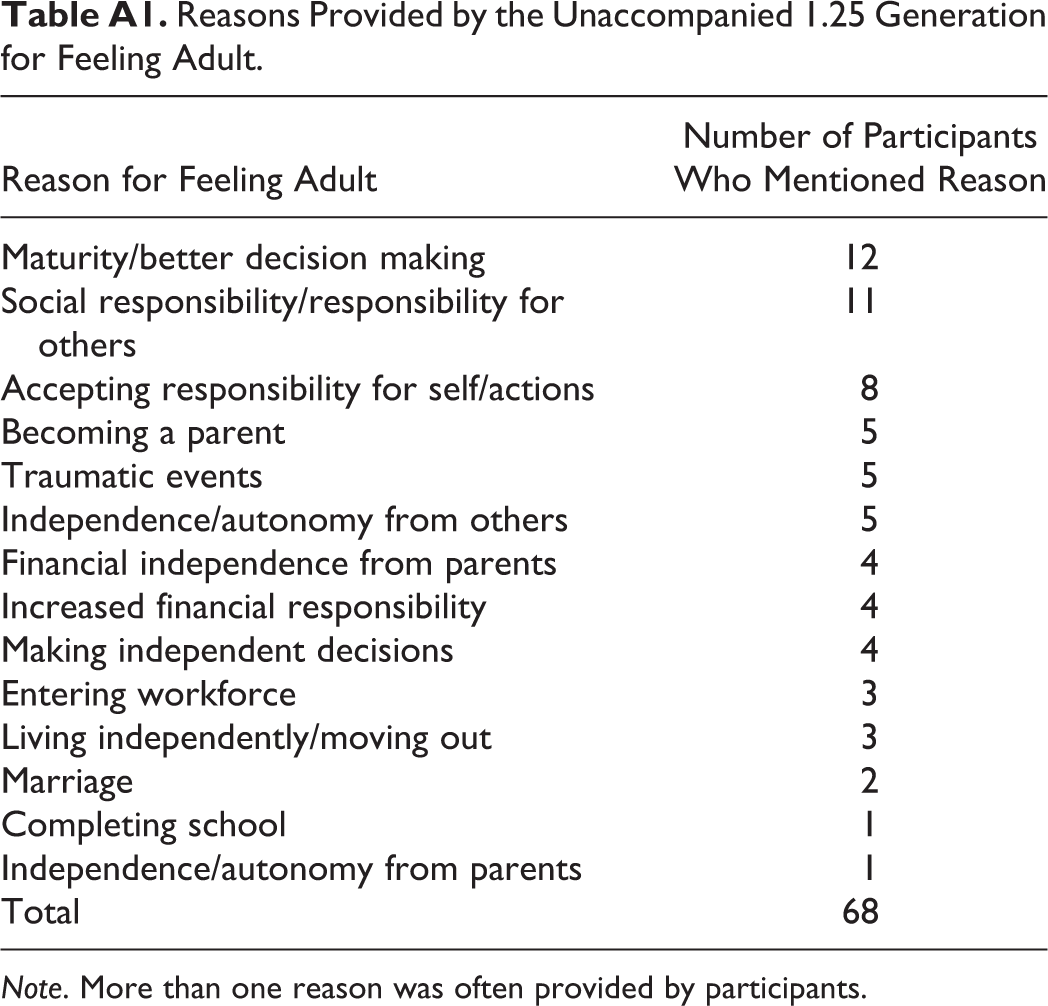
| Reason for Feeling Adult | Number of Participants Who Mentioned Reason |
|---|---|
| Maturity/better decision making | 12 |
| Social responsibility/responsibility for others | 11 |
| Accepting responsibility for self/actions | 8 |
| Becoming a parent | 5 |
| Traumatic events | 5 |
| Independence/autonomy from others | 5 |
| Financial independence from parents | 4 |
| Increased financial responsibility | 4 |
| Making independent decisions | 4 |
| Entering workforce | 3 |
| Living independently/moving out | 3 |
| Marriage | 2 |
| Completing school | 1 |
| Independence/autonomy from parents | 1 |
| Total | 68 |
Note. More than one reason was often provided by participants.
Acknowledgments
I would like to thank Sonya Leathers and the anonymous reviewers for their thoughtful feedback and suggestions which improved this article. I am also grateful for the support provided by Roberto Gonzales, Angela García, and Sydney Hans through all stages of the research project. Most of all, I am deeply appreciative of the participants who shared their stories and made this work possible.
Author Contribution
Daysi Ximena Diaz-Strong has contributed to conception, design, acquisition, analysis, and interpretation; drafted the manuscript; critically revised the manuscript; gave the final approval; and agreed to be accountable for all aspects of work ensuring integrity and accuracy.
Declaration of Conflicting Interests
The author declared no potential conflicts of interest with respect to the research, authorship, and/or publication of this article.
Funding
The author received no financial support for the research, authorship, and/or publication of this article.

Open Practices
The raw data, list of questions, coding manual, and other materials used in the study are not openly available for download but may be requested to the corresponding author. This study did not use a pre-registration plan for data collection or analysis. Data and materials for this study have not been made publicly available. The design and analysis plans were not preregistered.