







Abstract
Friendship-related stress is an understudied factor that may explain variation in coping-motivated and socially-motivated drinking among emerging adults. This study examined chronic and episodic friendship stress as predictors of drinking levels and motivations among emerging adults transitioning to post-college life. College drinkers reported drinking motives and alcohol consumption daily for 30 days using an Internet-based diary in college and five years later (N = 897, 54.2% women, Mage = 24.6 at follow-up, 86.0% White). Post-college, participants completed by phone the UCLA-Life Stress Interview assessing chronic and episodic friendship/social life stress. Chronic friendship/social life stress was positively correlated with mean levels of post-college drinking-to-cope motivation and was negatively related to post-college heavy drinking and social drinking motivation. Emerging adults experiencing friendship stress are more likely to use alcohol as a coping mechanism, elevating their risk for alcohol-related problems. Those with low friendship stress may require public health interventions around the risks of heavy drinking.
Introduction
Much of the scientific literature on alcohol use among emerging adults focuses on drinking during college, yet, for some, problematic drinking continues to occur after graduation (Krieger et al., 2018; Littlefield et al., 2010a; Skrzynski & Creswell, 2020). The immediate post-college years are an important and understudied transitional period for emerging adults marked by new responsibilities and changing social contexts. Although many young adults begin to mature out of heavy alcohol use during this stage, others continue to engage in problematic drinking that puts them at greater risk for alcohol use disorders later in life (Lee & Sher, 2018). Some evidence points to the role of stress (Littlefield et al., 2010b; Perkins, 1999), especially interpersonal stress (Armeli et al., 2022), in continued problem drinking during the maturing out process. However, studies examining interpersonal stressors during this life stage tend to focus on romantic relationships (Stroud et al., 2011; Temmen & Crockett, 2020) as opposed to individuals’ broader social lives. Given that social influences are key determinants of drinking among young adults (Borsari & Carey, 2001), it is important to examine whether the stressfulness of transitional events occurring within the broader social domain helps explain variation in post-college drinking. Thus, the goal of the current study is to examine the unique influences of chronic and episodic friendship-related stress in predicting college to post-college changes in drinking levels and motivations.
Chronic Friendship/Social Life Stress and Drinking to Cope
Chronic life stress is defined as ongoing conditions in important role areas including intimate relationships, close friends, job, school, finances, and family relationships (Hammen, 1997). Research on chronic interpersonal stress typically combines ongoing conditions within intimate relationships, close friends, and family relationships and indicates interpersonal stress plays a key role in worsening depressive symptoms among emerging adults (Hammen, 2003; Herzberg et al., 1998). Including intimate relationship stress in this broader stress has prevented researchers from understanding the unique effects of friendship and social life chronic stress in this population. Chronic stress in the friendship and social life domain is defined as ongoing stressful conditions that occur over extended periods of time including the absence of friends, existence of poor quality friendships, instability within friendships, conflict among friends, and isolation from peers (Hammen, 1997).
Although interpersonal stress (broadly defined) has been linked to drinking to cope among emerging adults (Armeli et al., 2021), there is a lack of research specifically focused on chronic friendship stress and alcohol use. Related literature indicates that the relationships between social processes involving friends or peers and alcohol use are complex. Borsari and Carey (2006) conceptualized a theoretical model in which multiple distinct pathways linked friendship-related factors with increased alcohol use among young adults. One of these pathways indicates that lacking quality friendships (one component of chronic friendship stress) can lead to increased alcohol use. Emerging adults rely heavily on their close friends to satisfy their social needs, which include companionship, emotional support, and intimate disclosure. Some emerging adults perceive alcohol consumption as an effective strategy to cope with the loneliness and emotional pain caused by the lack of quality friendships (Arpin et al., 2015; Borsari & Carey, 2006; Skrzynski & Creswell, 2020).
Drinking to cope is a cause for concern among emerging adults because it is uniquely predictive of drinking-related problems controlling for drinking levels (Cooper et al., 2016). However, increased drinking to cope does not necessarily go hand in hand with greater drinking frequency or heavy drinking because young adults tend to drink more regularly and in larger quantities in social settings compared to solitary contexts (O’Hara et al., 2015). Borsari and Carey’s (2006) model provides a second parallel pathway in that alcohol use increases when it is an integral part of normative peer interactions. The literature highlights a complex process in which factors that are related to or overlap with the concept of chronic friendship stress may increase drinking to cope but may not necessarily result in other problematic behaviors such as heavy drinking.
Drinking Levels and Other Drinking Motivations
Heavy drinking more often occurs in social contexts with friends and peers who drink (Kuntsche et al., 2017) and it has been consistently shown that emerging adults are more likely to drink heavily when their friends drink (Borsari & Carey, 2006; Hamilton et al., 2020). It follows that emerging adults with rich post-college social lives and many friends may, therefore, drink more frequently and engage in more heavy drinking. Some young adults might choose social roles that allow them to maintain or replicate college social heavy drinking contexts instead of roles which would require them to reduce their drinking behaviors (Yamaguchi, 1990). Post-college examples of these contexts might include after-work happy hours and daytime drinking events such as bottomless brunches or social sports leagues (Ward, 2011). Young adults who socialize less frequently tend to engage in less alcohol use (Staff et al., 2010). Thus, chronic friendship stress might be unrelated or even negatively related to frequent drinking and heavy drinking because people who lack close friends or experience instability in their social lives may have fewer opportunities to socialize at bars or parties and engage in heavy drinking.
Compared to the possibility that chronic friendship/social stress might increase drinking to cope motivation, its effects on other drinking motivations such as social, conformity, and enhancement are less clear. For example, social motivations for drinking reflect a desire to improve a social gathering or make a party more fun and are associated with more social drinking and greater likelihood of party attendance (O’Hara et al., 2015). Emerging adults who lack close friends and are not included in social groups may be less likely to report social motivations as reasons for drinking if they do not regularly attend parties or gatherings. They may also report fewer enhancement motivations since drinking may be less fun and pleasurable if individuals do not have a good social life to enjoy the perceived benefits of alcohol use. On the other hand, emerging adults with higher chronic friendship stress may have a stronger desire to drink alcohol to improve a social gathering if they feel uncomfortable or excluded. They also may feel more pressure to fit in with friends or peers they wish they were closer to and, therefore, report more conformity motivations. Social drinking could be a strategy used to improve what they consider to be an inadequate social life, to feel belongingness with peers, or a way to make new friends or build social bonds with colleagues or acquaintances (Borsari & Carey, 2006; Hamilton & DeHart, 2017). Similarly, enhancement motivations for drinking could be a response to friendship stress if there is an overlap with drinking to cope (i.e., individuals are drinking because it is fun and as a way to cheer themselves up).
Discrete Friendship Stressors and Alcohol Use
Whereas chronic friendship stress reflects ongoing friendship stress over a longer period of time, post-college emerging adults may also experience discrete or episodic friendship-related events. Paykel (1997) developed a comprehensive list of friendship-related events and these include conflict with a friend, the dissolution of friendship, a close friend moving away, the death of a friend, and friends’ significant life events that could lead to changes in relationships (e.g., getting married, having a baby). It remains unclear to what extent these discrete social processes are risk factors for problematic alcohol use. Emerging adults who experience distress as a result of discrete friendship stressors might drink to cope with the resulting negative emotions but may drink less overall if drinking was an integral part of that friendship and the stressor results in reduced contact with that friend (Borsari & Carey, 2006). If someone’s social life deteriorates after negative friendship events, or if their friendship changes as a result of their friend’s significant life event, their drinking levels may decrease as they socialize less frequently. Discrete friendship stressors may also promote social drinking or enhancement motivations. If a young adult no longer socializes with a friend regularly because of a negative friendship event, they may feel the need to strengthen their other social relationships or develop new ones and one way to do this is by having fun while drinking.
Emerging adults may be affected differentially by discrete friendship stressors depending on their levels of chronic friendship stress. For example, the dissolution of a friendship can vary in stressfulness depending on the length and closeness of that friendship as well as someone’s existing friendship network (Vieth et al., 2022). To the degree that individuals suffering from high chronic friendship stress have poor social support, the social support buffering hypothesis would point to a moderating effect in which individuals with high social support from other friends would not be as severely impacted by a conflict or other negative friendship event (Cohen & Wills, 1985). This would align with our previous research focused on romantic relationship stress that found a buffering effect of low chronic romantic stress on relationship dissolution (Armeli et al., 2022).
On the other hand, the threat to a close friendship, whether from conflict, distance, death/illness, or differences in life stages, is likely to cause more emotional pain than a threat to a less meaningful friendship. Young adults use their best friends as a safe haven of comfort, support, and reassurance (Markiewicz et al., 2006). Individuals with low chronic friendship stress might feel more distress if the person they usually go to for reassurance and support is either permanently or temporarily unavailable. At the other end of the spectrum are young adults with very high chronic friendship/social life stress who have likely experienced social exclusion if they have no close friends and severe social problems. Research on social exclusion provides evidence for an analgesia effect in that people who have experienced high levels of social rejection and exclusion are unable to feel emotional pain in the social domain (DeWall et al., 2011). The effect of a friendship conflict or dissolution may, therefore, have a weaker effect on drinking to cope for young adults with high chronic stress because they feel less emotional pain as a result of the friendship stressor.
The Present Study
Prior literature indicates there may be complex relationships between friendship-related life stress and problematic alcohol use during emerging adulthood. Few studies, however, have specifically focused on the post-college period of emerging adulthood, a crucial transition period for maturing out of problem drinking. Furthermore, much of the research examining interpersonal stress among young adults has focused narrowly on romantic relationships and the role of friendships has been understudied. In the current study, we examined life stress associated with friends and social lives as predictors of drinking levels and motivations among emerging adults transitioning from college to post-college life.
We expanded upon previous research in several ways. Using a semi-structured interviewer-based protocol, we assessed both chronic and episodic friendship-related stress. Post-college chronic stress associated with friendships and social lives was marked by the continuous absence and instability of close, confiding friends, poor social lives, and frequent conflict with friends over a prolonged period of time. Post-college episodic stress was assessed through the same interview by probing for details and context surrounding discrete friendship events such as an argument or friendship dissolution. This approach is modeled after the (Brown & Harris, 1978) “contextual threat” method. Interviews that include contextual information are considered superior to other approaches for stress assessment, such as event checklists or brief appraisal measures (Dohrenwend, 2006; Monroe, 2008), and allowed us to incorporate into our models non-self-report (i.e., rater-based) assessments of the severity (i.e., stressfulness) of discrete events. We also furthered research by measuring daily drinking levels and motivations for 30 days both in college and five years later. Measuring alcohol use motivations at the daily level reduces recall error and bias (Ekholm, 2004). Additionally, controlling for college levels of drinking and motivations enabled us to control for individual differences in alcohol outcomes during college (Staff et al., 2010).
We predicted that high chronic friendship/social life stress and more severe episodic friendship stressors would be associated with higher DTC motivation. We also hypothesized that chronic friendship/social life stress would moderate the relationships between episodic friendship stressors and DTC motivation. One possibility for the direction of the interaction is that highly stressful episodic events would have a stronger positive association with DTC motivation among emerging adults with high chronic friendship/social life stress. Consistent with the social support buffering model (Cohen & Wills, 1985), if emerging adults have few close, quality friends to begin with, a conflict or dissolution would be more negatively impactful than it would be for someone who has many other close friends to rely on. The other possibility is that the threat to a close friendship (e.g., conflict, dissolution) could be more impactful to those with low chronic stress because those friendships are higher quality and satisfy more of their social needs such as comfort and reassurance (Markiewicz et al., 2006). As a result, a conflict or dissolution would result in a bigger loss for that person than it would for someone with low quality friendships or severe social problems, who might be unable to feel emotional pain due to a history of social exclusion (DeWall et al., 2011).
Our hypotheses regarding the effects of friendship/social life stress on drinking frequency, heavy drinking, social drinking, conformity, and enhancement motivations were more exploratory. On one hand, emerging adults with many friends and rich social lives, and thus low chronic friendship stress, may be more likely to participate in post-college social drinking contexts where drinking is more likely to occur. They may also have more opportunities to attend parties and social gatherings and therefore be more likely to report social drinking motivations. On the other hand, emerging adults with high chronic friendship/social life stress might engage in more drinking and report more social drinking motivations as a way to improve their social lives, gain friends, and facilitate social bonds in social contexts where drinking is the norm.
Methods
Participants and Procedure
Participants were moderate to heavy drinking college students at a large eastern state university who were originally recruited for a larger study of college student alcohol use and daily experiences between 2007–2011 (Armeli et al., 2014). Participants were recruited from the Psychology Department research pool and campuswide broadcast emails and flyers; they needed to have consumed alcohol at least twice in the past month and had not received treatment for alcohol use. For Wave 2 (6-year follow up, between 2012–2017), only participants (N = 1141) who at Wave 1 reported at least one heavy drinking day (≥ 4 drinks for women and ≥ 5 drinks for men) in both a 30-day retrospective assessment and a 30-day daily diary reporting phase (each assessment covering two different time points in college) were eligible. Given the focus on changes in drinking from college life to post-college life, participants also needed to have graduated or to no longer be working towards an undergraduate degree (additional details about Wave 2 recruitment are included in Armeli et al., 2018). The institutional review board approved all procedures.
At both time points, participants first logged on to a secure website where they provided informed consent and completed a baseline survey including demographic information. Approximately two weeks later, participants completed the 30-day daily diary portion of the study in which alcohol use and drinking motives were assessed. In Wave 1, daily surveys were completed each day between 2:30 pm and 7:00 pm; in Wave 2, daily surveys were completed each day between 4:00 pm and 8:30 pm. These time windows were selected to coincide with most participants’ naturally occurring end of school/workday but before typical evening activities begin (including drinking). In addition, at Wave 2 we assessed life stress in the past year for all participants using the UCLA Life Stress Interview (LSI; Hammen, 1991; Hammen et al., 1989), which was conducted by phone; completion times for the interview ranged from 45 to 90 minutes. The LSI was completed once the baseline survey was done, but several weeks before the daily diary phase.
We obtained complete data (i.e., baseline survey, daily diary, and UCLA LSI data) from 897 participants (78.6% of the eligible participants who completed Wave 1 also completed Wave 2). Out of all respondents who completed the Wave 2 study, 93% met the minimum adherence of 15 daily diary days. In the final sample, daily diary completion adherence (ranging from 15–30) was high: participants completed, on average, 27.97 (SD = 3.28) daily surveys during college and 29.50 (SD = 1.21) surveys post-college.
The final sample was 54.2% women, predominantly White (86.0%) with a mean age of 19.2 years (SD = 1.3) during college and 24.6 years (SD = 1.3) post-college. At Wave 2, the majority were employed full-time (74.1%), 95.7% had completed their bachelor’s degree, 41.0% were enrolled in a graduate program, and 68.7% reported total family income of $50,000 or higher. Only 4.6% were married and 1.3% had children.
We compared our final sample to the remainder of the initial 1141 participants contacted for Wave 2. Our final sample was not different in terms of age, t (1, 1139) = −0.42, p = .68), but did differ in terms of sex, χ2 (1) = 16.50, p < .001, and race/ethnicity (White vs. others), χ2 (1) = 9.02, p = .003. Individuals not included in our analyses were more likely to be men (60.2% of excluded vs. 45.7% of completers) and minorities (21.3% of excluded vs. 13.5% of completers).
Measures
Friendship and Social Life Chronic and Episodic Stress
We used the UCLA Life Stress Interview (UCLA LSI) to measure friendship and social life chronic and episodic stress (Hammen, 1991; Hammen et al., 1989). The LSI gathers information about whether specific stressful events occurred, the surrounding circumstances which might modify the stressfulness of such an event, and a rating of the severity of stress caused by that event made by an independent rating team. The interview includes specific rules for defining both chronic stress and episodic stressful events in each domain.
Chronic Stress
Interviewer training procedures are detailed in Armeli et al. (2022). For the friendship domain, interviewers probed for the following information across a prolonged period of time: existence of a close, confiding relationship; quality (closeness, confiding, reciprocal, trusting), location (nearby); how frequent are arguments, how resolved; availability (frequency of contact, how often they speak or visit each other). Interviewers then rated chronic stress using the following 5-point scale (using half-point increments): 1 (presence of exceptionally high quality, close, confiding friendship – mutually satisfying, reciprocal, good conflict resolution ability, mutual disclosure in many areas and comforting, mutual loyalty and trust, stable), 2 (presence of a good quality, close, confiding friendship – mutual disclosure in some areas and comforting, can trust with most things, reciprocal, satisfying, stable), 3 (presence of a close, confiding, friendship – although may be unstable at times, some trouble with conflict resolution OR presence of only a moderately close friendship that is fairly stable and nonconflictual), 4 (presence of a poor quality friendship – unstable, uncertain about trustworthiness, not reciprocal OR presence of only a moderately close friendship that is sometimes unstable or conflictual), and 5 (Absence of a close, confiding, friendship – no one they feel close to or confide in).
For the social life domain, interviewers probed for information across a prolonged period of time about participants’ number of friends, number of activities, type of activities, conflict of interest or morals, frequency and resolution of conflict, and popularity. Interviewers then rated chronic stress using the following 5-point scale (using half-point increments): 1 (exceptional social life – many good friends, very popular and engages in frequent social activities outside school, gets along well with others, no conflict), 2 (good social life with some close friends, engages in average number of social activities, good quality of social contacts with no significant problems with peers), 3 (average popularity but has some conflicts with peers or difficulty making and keeping friends), 4 (serious social problems – somewhat isolated from peers and spends much time alone. Some acquaintances but lacks stable friendships or has one or two friends but frequent conflicts), and 5 (severe social problems with no friends, totally isolated from peers or frequent conflicts and fights, rejected by peers).
We took the mean of participants’ friendship and social life chronic stress scores to create a composite chronic friendship/social life stress variable. We chose this approach to simplify our analytical models and because the variables were moderately correlated (r = .42, p < .001). To establish reliability, we selected a random sample of 98 participants (∼10% of the sample) and had a second rater read the interviewer’s description of the interview and rate the chronic stress levels across the close friendship and social life domains; intra-class correlation (ICC) across all social and friendship ratings was .69, indicating moderate to moderate-good inter-rater reliability.
Episodic Stress
During the interview process, interviewers asked about specific negative life events in the friendship and social life domain in the past year (Paykel, 1997). Details on how the independent rater teams coded these episodic stressors can be found in Armeli et al. (2022). Events were assigned a severity score using a 6-point scale: 0 (non-event), 1 (no significant threat or negative impact), 1.5 (some stress), 2 (mild impact), 2.5 (above a mild impact), 3 (moderate impact), 3.5 (above a moderate impact), 4 (marked impact), 4.5 (above a marked impact), and 5 (a very severe event, maximal negative impact or threat). 1 When participants reported more than one episodic friendship stressor in the same category, the highest severity score was used.
To establish reliability, a subset of 447 randomly chosen episodic events (across all life domains, ∼10% of 4478 total events) were rated independently by two teams; the intra-class correlation (ICC) was .73, indicating good interrater reliability. There were 540 discrete events reported in the friendship and social life domain. The stress ratings for all episodic events within this domain were summed in line with LSI scoring recommendations (Hammen, 1997). The most common episodic stressful events within this domain were a friend moving away or participant moving away from their friend (34.0% of events), the death or serious illness or injury of a friend (12.5%), a friend getting engaged, married, or having a baby 2 (12.5%), a problem or conflict with a friend (10.6%), and a friendship dissolution (8.9%).
Drinking Motivations
On each of the 30 daily diary days, participants logged in to a secure Internet-based daily survey to report their drinking behaviors for the previous evening (after they completed the prior day’s survey) and today (up to the reporting time). On days when participants reported alcohol use, they were asked to report their reasons for drinking using a slightly modified version of Cooper’s (1994) Reasons for Drinking scale. Participants were asked whether they drank for the following reasons (responding with a 3-point scale [0 = no, 1 = somewhat, 2 = definitely]). DTC motivation (7-item scale) was assessed with “to forget my ongoing problems/worries,” “to feel less depressed,” “to feel less nervous,” “to avoid dealing with my ongoing problems,” “to cheer up,” “because I was angry,” and “to feel more confident/sure of myself.” Social drinking motivation (2-item scale) was assessed with “to make party or gathering more fun” and “to improve party or gathering.” Conformity drinking motivation (2-item scale) was assessed with “because my friends pressured me” and “to fit in with a group I like.” Enhancement drinking motivation (2-item scale) was assessed with “because I like the pleasant feeling” and “to have fun.”
We calculated the mean of the drinking motivation items to create the respective scale score for each drinking episode, and then we calculated the mean of these values across all drinking occasions (daytime and nighttime) occurring during the 30 reporting days. Individuals who did not drink across the entire daily diary period also got a value of zero for each motive scale. We evaluated reliability of these person-level composites consistent with Nezlek’s (2017) approach using HLM software (Raudenbush, 2004): DTC motivation, .84 at Wave 1 and .86 at Wave 2; social motivation, .72 at Wave 1 and .76 at Wave 2; conformity motivation, .78 at Wave 1 and .82 at Wave 2; and enhancement motivation, .75 at Wave 1 and .84 at Wave 2.
Drinking and Heavy Drinking Proportion
The number of days on which participants had at least one drink was summed and then divided by the total number of days reported, resulting in a score reflecting the proportion of days participants engaged in any drinking. On each of the 30 daily diary days, participants received a binary score of 1 (heavy drinking day) or 0 (not a heavy drinking day) based on the number of drinks they reported during the daytime and nighttime and their sex (≥ 4 drinks for women and ≥ 5 drinks for men) (NIAAA, 2023). In the initial questionnaire, participants were asked “Are you male or female?” which did not explicitly distinguish between gender and sex assigned at birth. The number of heavy drinking days was summed for each participant and then divided by the total number of days reported, resulting in a score reflecting the proportion of days participants engaged in heavy drinking.
Data Analysis
We used multiple regression analyses to test our hypotheses regarding the effects of post-college chronic and episodic friendship/social life stress in predicting mean daily levels of post-college DTC motivation, social motivation, conformity motivation 3 , enhancement motivation, drinking, and heavy drinking. All models controlled for sex (men = 0, women = 1), age post-college, and the level of the dependent variable during college. We first entered control variables (step 1) and then chronic stress and episodic stress as predictors to examine unique effects on each dependent variable (step 2). We created a product term multiplying chronic stress by episodic stress and entered this term into each model at step 3. All analyses were conducted in SPSS and we used the PROCESS Macro to test moderation (Hayes, 2017). The hypotheses and analysis plan for this secondary data analysis were pre-registered 4 on the Open Science Framework at https://osf.io/n6faw.
Results
Descriptive Statistics
Descriptive Statistics and Bivariate Correlations Among Study Variables.
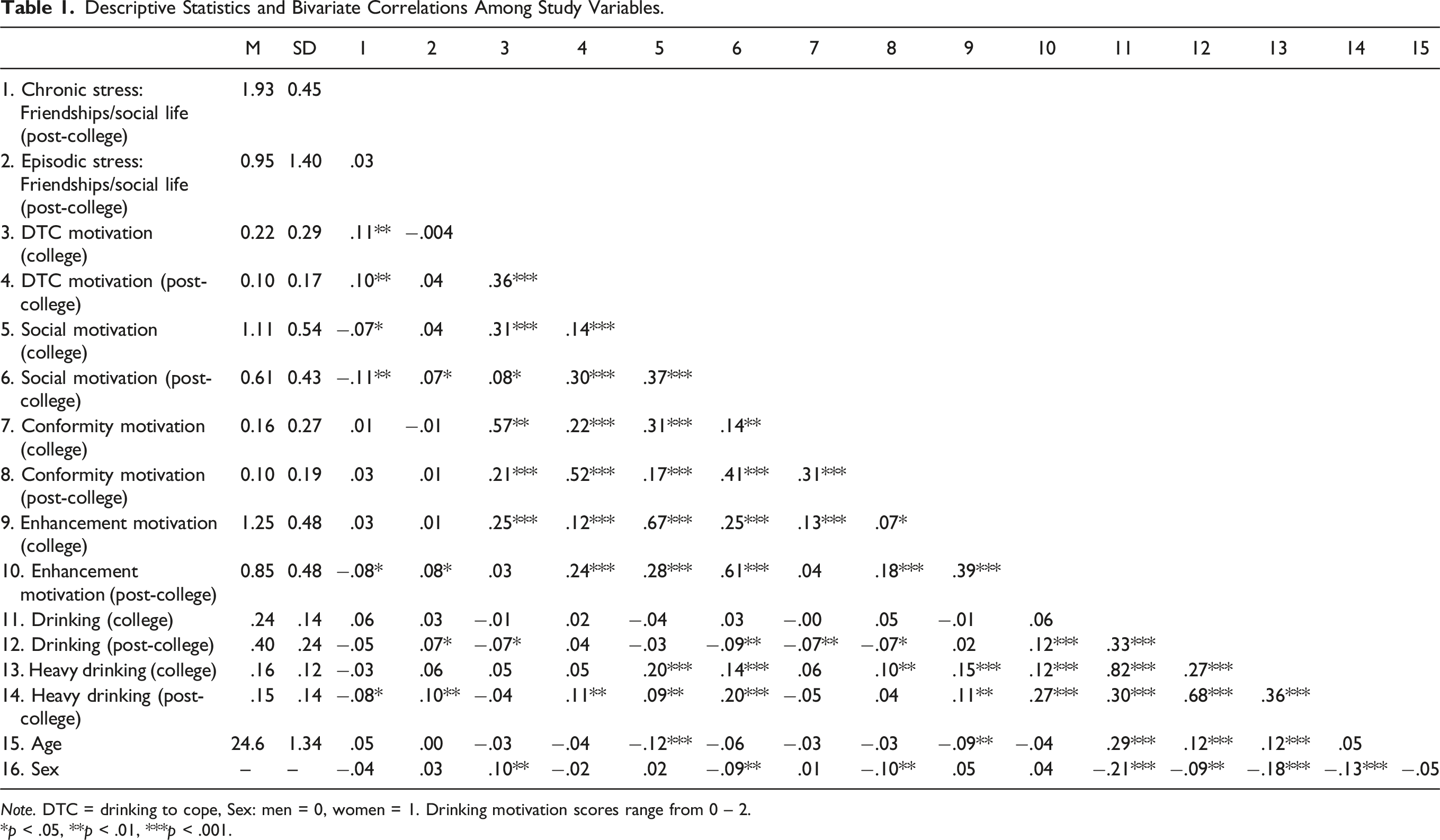
Note. DTC = drinking to cope, Sex: men = 0, women = 1. Drinking motivation scores range from 0 – 2.
*p < .05, **p < .01, ***p < .001.
As shown in Table 1, post-college DTC (M = 0.10) and conformity (M = 0.10) drinking motivations were the least commonly endorsed. Post-college social (M = 0.61) and enhancement (M = 0.85) drinking motivations were most commonly endorsed. Post-college, participants engaged in drinking on average 40% of reported days (compared to 24% during college) and in heavy drinking on average 15% of the reported days (compared to 16% during college).
Bivariate Correlations and Linear Multiple Regression Models
Correlations among study variables are presented in Table 1. As predicted, the composite chronic friendship/social life stress variable was positively correlated with post-college DTC motivation. Regarding our exploratory hypotheses, chronic friendship/social life stress was negatively correlated with post-college social drinking motivation, enhancement motivation, and heavy drinking. Episodic friendship stress was positively correlated with post-college social motivation, enhancement motivation, drinking frequency, and heavy drinking. Post-college conformity motivation was not significantly correlated with chronic or episodic stress. There were no sex differences in chronic stress or episodic stress. Men reported higher social drinking and conformity motivation post-college and higher drinking frequency and heavy drinking at both time points. While women reported higher DTC motivation in college, there were no differences in post-college DTC.
Multiple Regression Analyses for Drinking Motivations.
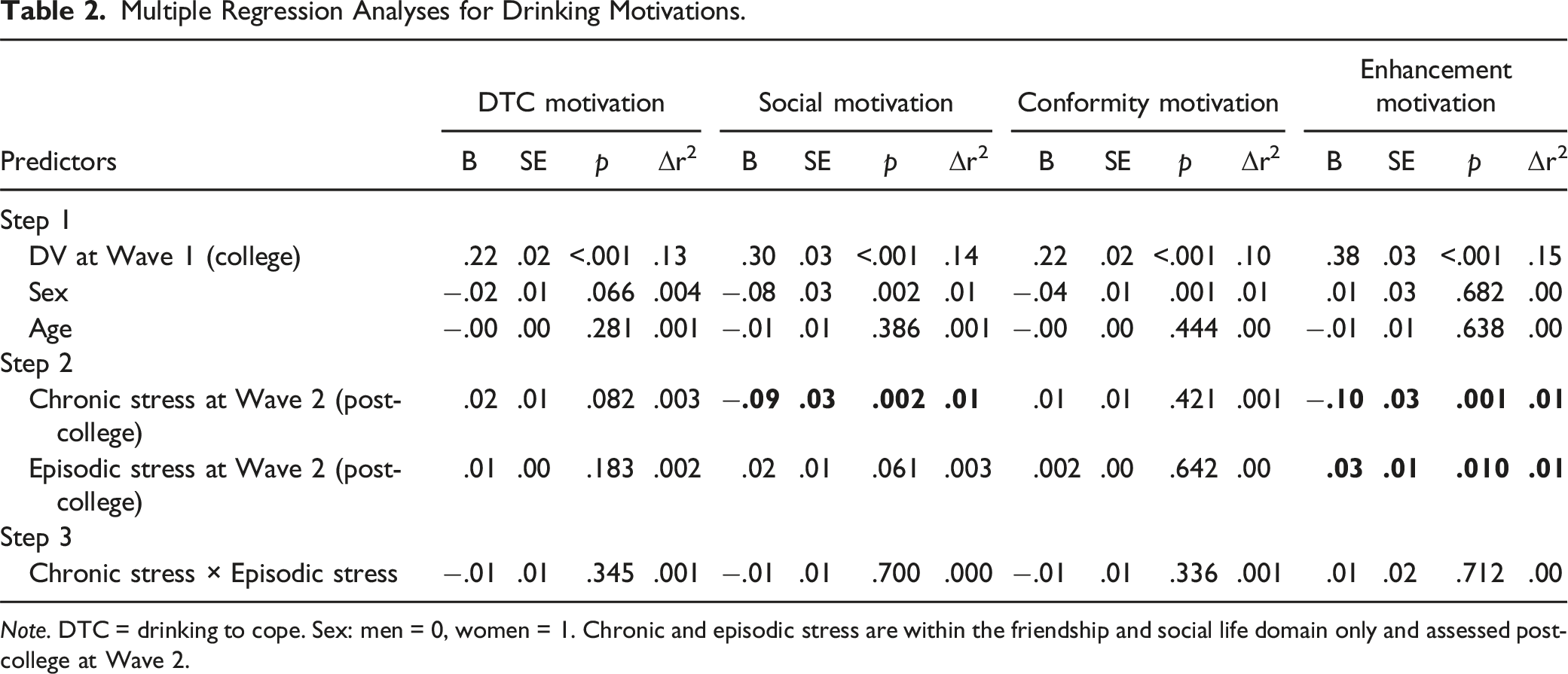
Note. DTC = drinking to cope. Sex: men = 0, women = 1. Chronic and episodic stress are within the friendship and social life domain only and assessed post-college at Wave 2.
Multiple Regression Analyses for Drinking Levels.
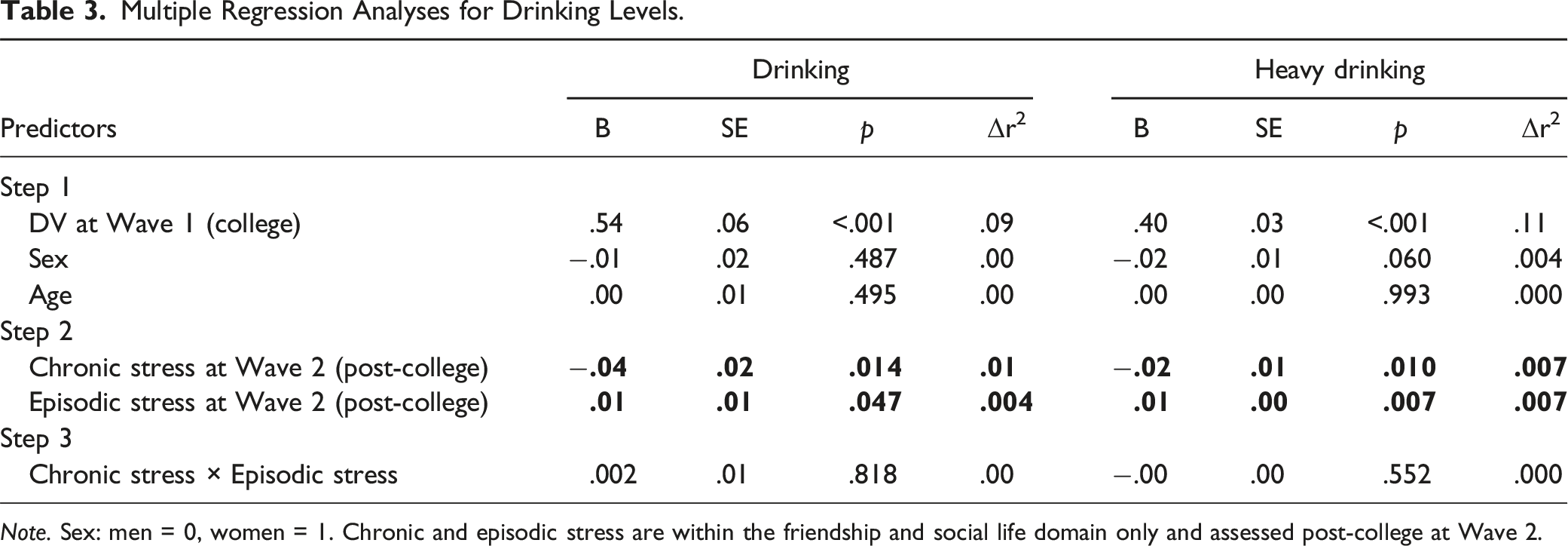
Note. Sex: men = 0, women = 1. Chronic and episodic stress are within the friendship and social life domain only and assessed post-college at Wave 2.
Supplemental Analyses
Given the moderate positive correlation between DTC motivation and social motivation and their opposite signed associations with chronic friendship stress, we examined possible suppression effects (MacKinnon et al., 2000). Specifically, we controlled for the post-college levels of these motives in step 1 of the regressions shown in Table 2. Controlling for post-college social motivation, chronic stress was now a unique predictor of post-college DTC motivation (b = .039, SE = .013, p = .002, Δr2 = .008). Controlling for post-college DTC motivation, chronic stress remained a unique predictor of post-college social motivation (b = −.112, SE = .032, p < .001, Δr2 = .011), albeit slightly larger in size. No other substantive changes occurred in the models 6 .
Discussion
The current study extends prior research on stress and alcohol use among emerging adults by examining the effects of chronic and episodic friendship-related stress on post-college drinking levels and motivations. We found that both chronic and episodic friendship and social life stress had modest effects on drinking motives and levels but no evidence of an interactive effect between chronic and episodic friendship stressors.
Our findings provide several new insights into the social processes that might underlie alcohol use in this crucial transitional period. Our study revealed that chronic friendship/social life stress was positively associated with post-college drinking to cope motivations. Although this effect was no longer significant in our initial model including relevant covariates, it was uniquely significant after controlling post-college social motivation. This seems to be driven by the opposite signed associations between chronic friendship stress and the two motives, i.e., a suppression effect. Specifically, chronic friendship/social life stress seems to reduce the levels of social motivation taking place. This is possibly due to the interpersonal nature of the stress. For example, emerging adults may have fewer instances of drinking with friends when they are experiencing interpersonal problems. Whereas, as predicted, friendship stress was positively related to coping motives (bivariately). The shared variance (and positive association) between social and coping motivation could reflect drinking to reduce inhibitions in social situations. Not removing this common variation possibly attenuated the effect of chronic friendship/social life stress on coping motivation.
The complexity of these processes was further highlighted by results showing that chronic and episodic friendship/social life stress was differently associated with other drinking motives and levels. Chronic friendship/social life stress was negatively associated with post-college social and enhancement motivations, drinking frequency, and heavy drinking post-college. These findings support the notion that emerging adults with close friendships and active social lives – i.e., low friendship/social chronic stress – have more opportunities to socialize at parties and gatherings, are more motivated to have fun while drinking with friends, and consume more alcoholic drinks. This result is consistent with previous findings that heavy drinking tends to occur in social contexts (Kuntsche et al., 2017). In contrast, episodic friendship stress was positively associated with post-college social and enhancement motivations, drinking frequency, and heavy drinking. Chronic stress and episodic stress were not significantly correlated, illustrating how individuals with low chronic friendship/social life may still experience negative friendship events that cause stress. Our findings suggest that although experiencing these discrete stressors may result in increased drinking behaviors to feel connected to other friends or lift one’s mood, these friendship issues are not chronic, and therefore participants do not engage in drinking as a coping mechanism.
Our findings can also be interpreted in the context of previously documented complex relationships between loneliness and alcohol use, given that our conceptualization of high chronic friendship stress seems to reflect, to a large degree, loneliness. Individuals with high chronic friendship/social life stress tend to have few close friendships, experience conflict with friends, and are isolated from peers. Young adults with fewer close friends, negative friendship qualities, and less social support tend to report higher loneliness (Schwartz-Mette et al., 2020; von Soest et al., 2020). Loneliness has been found to predict both increased alcohol use in solitary settings and decreased alcohol use in social settings across time (Arpin et al., 2015). Recent daily diary research suggests a non-linear effect in which people tend to drink more on days when they either feel much lonelier than usual or much less lonely than usual (Bragard et al., 2022). Although the current study did not examine day-level associations as in Arpin et al. (2015) and Bragard et al. (2022), our findings are somewhat consistent with this prior research. Among individuals with higher chronic friendship stress, coping-motivated drinking was higher, consistent with the association between high levels of loneliness and drinking. Among individuals with lower chronic friendship stress, enhancement- and socially-motivated drinking was higher, consistent with the association between low levels of loneliness and drinking. The current findings highlight the complexity of the relationships between social processes and alcohol use.
We did not find support for the interactive effects of chronic and episodic stress on drinking among this population. These generally null findings were understandable given the extremely low frequency and severity of episodic stressors, thus limiting our ability to detect multiplicative effects. Future studies will need to oversample individuals experiencing interpersonal problems to explore potential interactive effects. A key takeaway from the current study is that emerging adults transitioning to post-college do not seem to be exhibiting stressful problems within the friendship domain at a high level.
Limitations
Several additional limitations of the current study should be acknowledged. The timing of our key measurements might have played a role in attenuating any real effects. As is standard in the life stress literature, interviewers asked about chronic and episodic friendship stress in the past year and participants subsequently completed the daily diary study from which drinking outcomes were assessed. With the possibility that friendship stressors occurred as much as a year prior to reported alcohol use and motivation, it is possible that the associations in the current study are weaker than the true effects of these events on drinking. One possibility would be for future research to repeatedly evaluate individuals over this time period (e.g., monthly assessments over a year) to be able to match the occurrence of major stressors and proximal drinking outcomes. The reliability ICCs for chronic/episodic stress were also moderate, possibly due to the low between-person variability in stress observed in the current sample.
Our study aims and sampling methods limit the generalizability of our findings. This was a normative sample of emerging adults who had attended college, as per our goal to study post-college drinking. The sample was also majority White, despite efforts to recruit participants from diverse racial and ethnic backgrounds. Although study attrition from Wave 1 to Wave 2 was low, our estimates may be biased given the exclusion of Wave 1 participants who did not complete Wave 2. Wave 2 non-completers were more likely to be male and from a racial/ethnic minority background. We deemed missing data imputation would add uncertainty and assumptions between completers and non-completers given our predictors and outcomes were both measured at Wave 2. However, this limits the generalizability of the study.
Despite these limitations, our study contributes new findings to the literature on the post-college transition. The findings underscore the importance of considering both chronic and episodic stress in assessing the complex relationship between friendship and social life stress and alcohol use.
Implications
Our findings have several implications for clinical and public health settings. Different types of interventions may be required to promote maturing out of problematic drinking among emerging adults. Having low chronic friendship stress is somewhat protective against coping-motivated drinking, so the importance of maintaining close, quality friendships during emerging adulthood should be emphasized. Emerging adults with high chronic friendship stress are more likely to use alcohol as a coping mechanism, and this puts them at higher risk for AUD. Emerging adults with quality friendships and rich social lives post-college, who may not be obvious targets for clinical intervention, may require distinct public health interventions around the risks of heavy drinking. In addition to the deleterious health effects of frequent heavy drinking episodes, a continuation of the heavy drinking characteristic of college social contexts may be a sign that emerging adults may struggle to transition to adult social roles.
Footnotes
Declaration of Conflicting Interests
The author(s) declared no potential conflicts of interest with respect to the research, authorship, and/or publication of this article.
Funding
The author(s) disclosed receipt of the following financial support for the research, authorship, and/or publication of this article: This research was supported by grants P60-AA003510 and 5T32-AA007290-37 from NIAAA.
Transparency and Openness Statement
The raw data contained in this manuscript are not openly available due to privacy restrictions set forth by the institutional ethics board. The analysis code and materials used in this study are not openly available but are available on request to the corresponding author. The analyses were pre-registered at  .
.