






Abstract
The distinction between tangible and intangible cultural heritage (CH) is problematic for modeling interactions between material and immaterial expressions of the arts and culture. This hinders capturing changes in CH objects in their cultural contexts, necessary to understand their social functions and symbolic meanings. This paper addresses this problem twofold. First, after providing a theoretical-historiographical overview of the concepts of framing and historical time, the present paper proposes a historical frames system consisting of reference frames and historical frames. A model of historical frames allowing for spatiotemporal views of storylines is discussed in more detail. Second, a framework of ontological modules is provided that expresses the historical frames by extending existing ontologies. As most interactions between tangible and intangible CH are less defined, particular attention is paid to the modeling of ephemeral events. The model is designed using five types of such interactions in a case study of the late 12th century reliquary shrine of St. Servatius in Maastricht and the festivities around it. The outcomes are four modules describing 1) functions of objects in context, 2) frames capturing different temporal events, in particular ephemeral events, 3) the evolution of material and immaterial objects, and 4) peculiarities of ephemeral events and objects.
Keywords
Introduction
Although UNESCO defines culture as a set of spiritual, material, intellectual, and emotional features of a society or social group, it distinguishes between tangible and intangible cultural heritage (CH). 1 This distinction is reflected in semantic web studies, in which the focus of the modeling is foremost on the tangible (see the domain standard CIDOC-CRM), less on the intangible, and rarely or not on the interactions between the two. The lack of modeling of interactions between tangible and intangible CH is problematic (Hou et al., 2022). The relevance of CH objects can only be grasped through the analysis of the socio-cultural contexts in which they existed. The description of such contexts provides them with the societal functions and meanings that lead to their recognition as objects that reflect the cultures and (historical) identities of certain social groups (Brodie, 2014). Furthermore, such objects traverse different cultural systems over time, which may provide them with new physical appearances, functions, and meanings. Whereas they may be involved in established immaterial cultural practices of long duration, such as religious festivities, their physical appearance and meaning are sometimes deeply changed by ephemeral events of short duration or arbitrary decisions, such as the restoration of an object. This implies that we should consider not only immaterial CH in this context, but, more broadly speaking, every type of activity that interacts with the CH object as well. The CH catalog entries and ontology models based on them primarily focus on the description of the physical characteristics of the artwork for use in museum contexts. However, with the cited UNESCO definition of culture in mind, such models are far too narrow. Technologies such as the semantic web offer opportunities to model in an encompassing way such complex relations between objects and the events that relate to them. To the best of the authors’ knowledge, a study on how interactions between CH objects and immaterial practices and their evolution over time can be semantically modeled does not exist yet. To fill this gap, this paper presents theories of frames to underpin ontologies that enable expressing objects in their (immaterial) contexts over time. Frames theories are chosen as a modeling reference for this purpose because computer and artificial intelligence applications demonstrated that they can be useful for capturing semantic information related to the concepts or objects observed.
Our research questions can be formulated as follows: RQ1: Can frame theories help to grasp the interactions of a CH object with its immaterial cultural context(s)? RQ2: How can an ontological model represent the relation and mutual influence of a CH object with its socio-cultural, immaterial context(s)? RQ3: How can we model the regular or irregular recurrence of immaterial practices over time, which involve the use of CH objects, and invest them with new meanings or functions? RQ4: How can a model represent the core practices that contribute to the identification of a certain context as a set of recognizable practices (e.g., the set of beliefs and practices that are recognized as being “catholic” in Maastricht over centuries)?
To address these questions, the contribution is twofold. First, a theoretical-historiographical overview is provided of the concept of framing in computer science, artificial intelligence, and communication sciences. This is followed by a discussion of the concept of historical time in cultural and art historical studies. These concepts are synthesized as the historical framing problem. On this basis, we propose a theoretical framework (RQ1) in which frame concepts are used to represent and analyze the storyline of objects over time. Secondly, a framework of ontological modules is introduced that formalizes the proposed theoretical framework (RQ2-4). It is further developed and tested on a case study of the late 12th-century reliquary shrine of St. Servatius in Maastricht and the festivities around it. This case was chosen as a golden example for its richness.
The reliquary shrine, the so-called Chest of Distress named after its proclaimed function of protecting the population of the city in times of emergency, has a rich history of immaterial practices spanning over centuries. The chest, together with other reliquaries, is carried around in the Septennial Pilgrimage Processions since the Middle Ages and surrounded by various musical, theatrical, and literary manifestations. It allows for addressing the complexity of the immaterial events related to a CH object occurring in real scenarios. Indeed, practices related to the Chest present a range of different characteristics concerning their duration, (ir)regular recurrence over time, or the impact of brief ephemeral events on the conceptual and/or material aspects of the CH object. By choosing this case, we aim to ensure that the ontology addresses the actual complexity of intangible CH practices surrounding CH objects. To this aim, the case is used to study five types of interactions between tangible and intangible CH observed in historical frames, namely:
Interactions between tangible and intangible CH in events that recur regularly (type 1) or irregularly (type 2) over time (Sections 9.1 and 9.2) Events in the restoration process leading to changes to the function (type 3) or the iconographic program (type 4) of CH objects in context (Sections 9.3 and 9.4) Ephemeral events that provide meaning to material objects through immaterial practices (type 5; Section 9.5)
In particular, attention is paid to the impact of these interactions that lead to transformations of functions and meanings of CH objects.
The resulting framework of ontological modules describes 1) social and cultural functions of objects in context, 2) frames capturing the context(s) of CH objects, including cultural traits, immaterial CH, and ephemeral events, 3) the evolution of material and immaterial aspects of CH objects, and 4) peculiarities of ephemeral events and objects.
The paper is structured as follows. Section 2 introduces the motivation of our work. Section 3 provides an overview and analysis of conceptualizations of frames in multiple disciplines of computer science and the humanities. Then, the proposed theoretical framework is illustrated in Section 4, followed by a presentation of the case study (Section 5). The requirements for the proposed ontological models are described in Section 6. This is followed by Section 7 providing a state of the art in modeling CH contexts, frames, and immaterial culture in the Digital Humanities. The ontological modeling is formalized as a Framework of Modules, as illustrated in Section 8. Section 9 demonstrates their application to the case study. Finally, Section 10 summarizes the conclusions, discussion, and future work.
Motivation
Historians of the arts in the widest sense of the word are interested in questions of how cultural artifacts function in society and which roles they play in specific cultural groups. They study what historical meaning these objects have in these roles and how this is expressed. The historical, socio-cultural contexts in which CH objects must be understood also determine what needs to be preserved and protected as CH, both tangible and intangible. The distinction between the two still has a big impact on the semantic modeling of the arts and culture. Although, since the UNESCO 2003 Convention for the Safeguarding of the Intangible Cultural Heritage, there has been a growing interest in its modeling, the focus is still centered on objects and aims at organizing material-based knowledge (Hou et al., 2022). In addition, in many cases, material and immaterial CH expressions interact, such as in urban rites, festivals, or processions. The mentioned Septennial Pilgrimage Procession of St. Servatius, for instance, shows interactions between material objects, such as reliquaries, and ephemeral events like reading poems, singing hymns, and saying blessings. These interactions change over time. Changes in temporal events can, in some cases, be well defined, but in others are very fuzzy. Such changes are therefore not always easy to capture. Furthermore, ephemerality is of particular interest in the art historical domain, in which every object created with the intention of not lasting in time is called ephemeral. When considering the past, the impact of ephemerality becomes particularly evident for scholars trying to reconstruct events such as celebrations of an ephemeral nature, including the creation and usage of objects that often did not survive through time. In such situations, reports of events, which may include visual and textual descriptions, are often the only piece of evidence that allows scholars to reconstruct ephemeral objects and events.
A context expresses a historical, socio-cultural situation in which a cultural object exists. It is the cultural context that provides meaning and values for objects. This context is shaped by a system of beliefs and practices around objects (Anderson, 1995; Brodie, 2014). Often, context is not only fuzzy but also in continuous flux. Changes in context lead to the assignment of new values to objects and to transformations of culture. Historians of the arts try to identify salient historical traits of cultural contexts to describe and explain the material or immaterial aspects of cultural objects. This is not only necessary for a better understanding of cultural objects, but also to safeguard their values in legal and ethical ways as part of a cultural whole (Brodie, 2014). For that reason, CH historians, archeologists, etc., try to frame cultural objects in their contexts. The selection of a frame or multiple frames to capture, describe, and interpret the various concepts of culture, religion, social practices, taste, style, etc., is not value-free. This selection has a great impact on how artifacts are defined and explained. Following Ted Nelson (Nelson, 1993), we call this The Framing Problem. Previous studies in logic, linguistics, and artificial intelligence formalized the concept of frames to express the relation between objects and contextual knowledge (e.g., DOLCE ontology (Gangemi et al., 2002), FrameNet (Ruppenhofer et al., 2016), Fluid Construction Grammar (Steels, 2011)). Therefore, the concept of frame is deemed relevant for formalizing the contexts of CH objects in which interactions between tangible and intangible CH take place. A historical frames system with two components, reference frames and historical frames, is proposed for future applications in modeling and artificial intelligence in CH and the digital humanities. This frame system is intended to support alternative experiments in machine learning and computer vision to produce readings of cultural images that go beyond stylistic categories and include social and cultural aspects of works of art (Wasielewski, 2023).
Theoretical-Historiographical Background
The distinction between tangible and intangible CH was mentioned as problematic for modeling interactions between material objects and immaterial expressions in their cultural contexts. Before modeling these interactions, one needs to examine which properties are to be assigned to these objects and expressions in their contexts. Previous studies (Baroncini, 2024; van den Heuvel, 2024) modeled artworks in context based on the views of art-historians Erwin Panofsky and Henri van de Waal. For modeling the topic, the visions of Panofsky and Van de Waal, since they consider visual artworks only, are too limited in scope in comparison to the UNESCO global definition of culture. Art-historical approaches must be enhanced with methods that examine cross-cultural issues in the art.
The Anderson’s model (see Figure 1) puts objects in the context of practical and social functions based on belief systems. Leuthold (2011) proposes to create a comparative framework in which Western and non-Western art is organized and integrated into a common area of study without privileging the theories and traditions of a particular culture. From his discussion of how to frame these cross-cultural traits, it becomes clear that the modeling of interactions between tangible and intangible CH requires a better understanding of the working of frames.

Tom Anderson, A Model for Cross-Cultural Examination of Works of Art (Anderson, 1995). The object in three concentrically ordered contexts of 1 practical, 2 social functions, and 3 belief systems. National Art Education Association.
In his Literary Machines (Nelson, 1993), Ted Nelson explains the framing problem from the need of the user to get a grip on the complexity of crisscrossed links in hypertext/media. He proposes frames that allow users to create their own closed contexts from larger complexes of materials. The question of how computers can understand and do justice to the complexity of human culture is probably the biggest challenge in artificial intelligence (Wasielewski, 2023). Many studies in that domain refer to the work of Marvin Minsky. Minsky (Minsky, 1974) conceived the frames as a means of better understanding the functioning of human intelligence. Frames are frameworks stored in human memory that represent information about a stereotyped situation (e.g., a catholic religious celebration), including further information about it and how to use the frame. Minsky recognized various types of frames, each with different functionalities and several types of information attached to it. The frame itself, in his view, is a network of nodes and relations. They have a hierarchical organization in which the top levels of a frame are fixed and represent things that are always true about the supposed situation (e.g., a catholic mass involves a priest), while the lower levels must be filled in with specific instances or data (e.g., a catholic mass takes place in a church). These frames (connected networks in themselves) are linked into frame systems. Minsky’s notion of transformations between frames of a system consisting of frames that can be visual or non-visual is highly relevant for the proposed ontological modeling of objects and expressions of material and immaterial CH. The different frames of a system describe the transformations between one frame and another. These transformations from frame to frame represent the effect of moving from place to place but not in time, which is essential for our model of historical frames.
Formalizations of Historical Time
For scholars and curators interested in the creation and history of cultural artifacts, it is important that frames capture not only the effects of moving from place to place but also from time to time. For that reason, a very early discussion of a frame conceptualized for use in historical disciplines is left for last. It concerns Panofsky’s interpretation of the role of frames in the description of works of art in historical time (Panofsky, 2004). Panofsky’s reference frames are relational systems in/between which dynamic connections can be established. His notion of frames of reference is based on a model of theoretical physics that weaves spatial and temporal elements together in a space-time continuum (Targia, 2023). This latter notion is relevant for our discussion of the class Spacetime Volume in CIDOC-CRM. 2
However, Panofsky’s notion of frame of reference, based on a holistic space-time continuum as an indivisible unified structure, does not include the modeling of the impact of events of different durations in various places of material and immaterial CH objects and expressions in their contexts. The need for historically informed conceptualizations of time was underlined in another study (van den Heuvel & Zamborlini, 2021) based on (Frank, 2019; Kubler, 1962; Shaw, 2010, 2013). It resulted in a preliminary model with some types of synchronous and asynchronous/diachronic views (network in cross-section, longitudinal, kaleidoscopic) on historical time in storylines. Important for the proposed model is Kubler’s formal and systematic approach towards the understanding of artifacts as part of a system based on formal relations. Kubler describes this system as a historical network of formal sequences that gradually change over time. In the cross-section, they show a cluster of traits in a network, and in the long section, the sequences have a fiber-like structure of temporal stages (Kubler, 1962). Kubler did not include an image of formal sequences of durations in his book, but his mental image must have looked like Jensen’s 3D semantic timeline visualization (Jensen, 2006, p. 99, figure 4). Our visualizations of Historical Time Frames are inspired by Kubler and Jensen’s 3D timelines.
Exploring Temporal Interactions Between Tangible and Intangible Cultural Heritage
Hou et al. (2022) argue convincingly that, despite the growing number of digital research initiatives since the UNESCO 2003 Convention for the Safeguarding of Intangible Cultural Heritage, most interventions are still centered on objects and are directed at preserving material-based knowledge. In their state-of-the-art article on digital intangible CH, they observe that the challenge faced now is to find efficient methods to document sources of ephemeral aspects of intangible heritage (Hou et al., 2022, p. 2). One of the requirements for archiving intangible cultural expressions is to create models that combine standardized computational frameworks with fine-grained narratives. These narratives can be anecdotal, oral, embodied, shared, and adapted to various audiences. This framework contextualizes narratives of different intangible aspects of cultural expression that evolve over time. It resonates in the proposed model of historical frames because it combines interactions between material and immaterial cultural objects that evolve over time. However, ephemeral events in tangible and intangible CH are still approached separately. Probably for their non-visual, immaterial characteristics, such events are less recognizable. Beginnings and, in particular, the endings of these ephemeral events are not clear-cut. Up to now, they can only be documented by information objects in CIDOC-CRM.
A Historical Frames System
Based on a previous study van den Heuvel and Zamborlini (2021) on modeling synchronic, diachronic, and kaleidoscopic views on evidence-based Golden Agents (GA) storylines, a historical frames system is proposed. Moreover, it is underpinned by the description of the historical framing problem sketched above (see Section 3.1). This system consists of two interrelated frames: reference frames and historical frames.
Representation, observation, and understanding are human activities that take place in spacetime. Patterns herein can be recognized based on pre-knowledge, past experiences, and future expectations. This reference frame is briefly discussed. The requirements for the historical frames are described in more detail. Their functionalities and applications are described in five different types of interaction between tangible and intangible CH (Figures 2 and 3).

Visualization of Historical Frames System Longitudinal, Kaleidoscopic and Short Cut Views of Storylines in Spacetime: Historical Frame and Reference Frame. Created by Charles van den Heuvel. Available at Zenodo (DOI: 10.5281/zenodo.20393679). Licensed under CC BY 4.0.

Visualization of Historical Frames System. Short Cut and Longitudinal Views of Storylines from the St. Servatius case in Spacetime: Historical Frame with Reference Frame. Created by Charles van den Heuvel. Available at Zenodo (DOI: 10.5281/zenodo.20393679). Licensed under CC BY 4.0.
Inspired by the studies of Panofsky, Minsky, and recent studies in artificial intelligence, these reference frames are read as means to recognize and (re)organize existing and new information. This information is based on common-sense knowledge or shared experiences. The general features of knowledge and experience allow for the contextualization of existing and new information. These features are recognizable in systematic recurring patterns. However, these can also be filled in/enhanced with more associative information. A common-sense/pre-knowledge frame depends on context and is domain-specific. A surgeon will read a visual image of a body differently from an art historian, although there might be some overlaps in observation. This implies that there are multiple common-sense/pre-knowledge reference frames possible, depending on different contexts.
These frames might be very comprehensive or have a much smaller scope, focused on details. Frames can stand next to each other, partially overlap, or become part of another. Moreover, humans’ common sense/ pre-knowledge depends not only on contexts but also on the dynamics herein. These frames are continuously shaped by changes in material and immaterial expressions in their contexts or by the interactions between them. An example of a reference frame already implemented in other domains is the Description and Situation Ontology Design Pattern (ODP) (Gangemi & Mika, 2003), in which the description refers to the pre-knowledge used for a certain interpretation of the observed situation.
Annotation
New insights based on information coming from the historical frames and the dynamics in pre-knowledge/common sense frames presuppose annotations of these frames. This results in updates of the reference frames.
The Historical Frames: Spatiotemporal Views of Storylines
To gain more grip on temporal aspects of interactions between material and intangible cultural expressions, the historical frames can be used in three different types of views to observe and analyze storylines in time. These views are based on a previous study van den Heuvel and Zamborlini (2021) in which the potential role of historically informed time conceptualizations was explored to model storylines in CH. The first is the 2D shortcut view of things in context at one moment in time, represented as a two-dimensional static network. This allows for synchronic views. The second is the 2D longitudinal view of things over time (without representing the contextual relations between them) as a fiber-like structure of temporal stages. This allows for asynchronous/diachronic views The third is the 4D kaleidoscope view. It combines the shortcut and longitudinal views of a multidimensional network connecting links of past and even future events of a thing. This allows for combinations of synchronic and diachronic views of things (here understood as material and immaterial) in context and over time.
These synchronic, diachronic, and kaleidoscopic views on GA storylines are reused here in a wider context using historical frames. These frames support observations of temporal relationships between material and immaterial works in their cultural contexts. Following the UNESCO definition of culture, these cultural contexts can vary in nature: “the spiritual, material, intellectual, and emotional features of a society or social groups”.
3
These historical frames allow us to view these works from multiple spatiotemporal perspectives. This can be seen as an addition in support of the class
Functionalities of Historical Frames
To better describe the aims and characteristics of historical frames, some of their intended functionalities are described. These are aimed at capturing the interactions between immaterial and material aspects of CH in relation to time.
F1: Historical frames allow for the analysis of material and immaterial works of art in their cultural contexts.
F2: Historical frames can handle cultural contexts that differ in nature, such as spiritual, material, intellectual, and emotional.
F3: Historical frames can handle different types of time, astronomical and historical.
F4: Historical frames can handle objects that represent historical and fictional events.
F5: Historical frames allow for viewing cultural artifacts from multiple spatiotemporal perspectives.
F6: Historical frames allow for analyzing and representing different modes of time: synchronic, diachronic, kaleidoscopic.
F7: Historical frames allow for analyzing and representing temporal sequences and spatial boundaries in the real world.
F8: Historical frames allow for analyzing and representing temporal sequences and spatial boundaries in fictional worlds.
F9: Historical frames allow for analyzing and representing different boundaries of space and time: well-defined (geographical and temporal coordinates dates, hours, etc.) and fuzzy ones (ephemeral events in spacetime).
F10: Historical frames can represent the evolution of tangible and intangible CH in storylines.
F11: Historical frames can be represented as multimodal networks.
F12: Historical frames can be compared with reference frames and updated/enhanced via the annotation frame.
To explain the application of historical frames, five types of interactions of events of a different duration are explored in the case study of the Chest of Distress and the Drinking cup of St. Servatius.
This exploration, together with an analysis of the impact of these interactions on the evolution and change of meaning of cultural objects in context, serves as a point of departure for the module framework (Section 8) and the Case study in models (Section 9).
Case Study
The Chest of Distress of Maastricht in Tangible and Intangible Ephemeral Events
The Chest of Distress is a 12th-century reliquary kept in the basilica of St. Servatius in Maastricht (Netherlands). It is a wooden box covered with copper plates and adorned with glass and gemstones. According to legend, it holds the relics of this saint. It is named the Chest of Distress because, in times of war, plagues, or other threats, it was carried around the city to ask for forgiveness and protection (Margry et al., 2000). The first documentation of such an event goes back to 1409; the last one, albeit less public, was during the Covid epidemic. Furthermore, the Chest of Distress figures every seven years in a pilgrimage procession in Maastricht. In 1958, it was decided to restore the shrine. The box with sloping roofs adorned with gilded plates is a direct reference to the Domus Aurea, the golden house. It is a representation of the holy kingdom, the new Jerusalem of pure gold that opens its gates to those saved on the day of the Last Judgment (Ahsmann, 2017; Timmers, 1962). In addition, the stones on the shrine supported the iconographical program around the Last Judgment. They refer to the foundations of the city walls of New Jerusalem. The short gable sides of the shrine represent, on one end, Christ in the role of Pantocrator, that is, as ruler on the throne. The other end shows Servatius between angles. One of them hands the bishop’s staff, which signifies that God has sent him to become a bishop. During the restoration process, a committee of experts proposed several interventions that would significantly change the iconographical program of the Chest of Distress (Kroos, 1985). For instance, after long debates about replacing the St. Servatius bishop’s staff with a pilgrim’s staff, it was finally decided to give him no staff at all. The iconographical program remained recognizable, albeit somewhat diluted. More drastic were decisions to replace the glass stones with precious Antique and Byzantine gemstones and to remove the votives attached by the pilgrims and inhabitants to the Chest of Distress. When the restoration in 1962 was completed, the reliquary was esthetically enriched, but with a loss of devotional and popular cultural meaning. This case is used to demonstrate the framing of historical events to get a better understanding of the impact of changes in the use and meaning of CH objects in their contexts over time.
Interactions Between Tangible and Intangible Cultural Heritage in Regular Recurrent Events of Long Duration and Ephemeral Events
The first documented Septennial Pilgrimage Procession took place in 1371. Since then, it has reoccurred regularly until the Reformation. This custom was reinstated in 1874 and continued with more or less regular intervals of seven years until today. The Chest of Distress is carried around the streets of Maastricht in these processions as part of a train of relic holders (Figure 4). It is surrounded by all kinds of ephemeral musical and theatrical manifestations.

Chest of Distress in the regular recurrent event of the Septennial Pilgrimage Procession in Maastricht. Photo Charles van den Heuvel.
Events of a very ephemeral nature during these processions are, for instance, the swinging of liturgical incense holders. The odors they spread enhance the religious and spiritual experience of the objects carried in the procession.
Apart from these recurrent rites in the public events of the Septennial Pilgrimage Processions or in more private devout practices of the pilgrims, there are regular recurrent events that are unique in content. Since the 20th Century, often a specific theme was attached to the septennial events for which special displays and costumes were designed. For instance, in 1962, after its restoration, the Chest of Distress was carried around again in the septennial procession with the telling theme: Proclaiming the Riches of Christ. The artist Jerôme Goffin designed the costumes and the floats around this theme 4 .
Since its first documentation in 1491, the Chest of Distress came several times out of the Basilica of St. Servatius to let the inhabitants of Maastricht say prayers for the protection against wars, epidemics, and other threats to the city (Figure 5).

Drawing of two lost marble panels representing the Normans setting fire to the St. Servatius church with praying canons and the Chest of Distress carried around during a state of emergency. Philippe van Gulpen ca.1840, HCL Maastricht (The Netherlands) - LGOG Drawings and Prints LGOG 416.
In the guidelines for the restoration, it was stipulated that the temporarily removed votive heads of around 1450 would be attached to the Chest of Distress again. However, in the final meeting on 5 January 1962, it was suddenly decided not to replace them anymore. The votive heads symbolized the public role of the Chest of Distress, expressing the gratitude of the inhabitants of Maastricht for protecting their city. The esthetic arguments, rather than the original function of the Chest of Distress, had prevailed. The instant decision to remove the votive heads changed the public role and the devotional meaning of the reliquary shrine permanently (Figure 6).

Votive heads before (above) and after (below) the restoration of 1962. In the middle restoration drawing by J. Spenger of 1958, with votive heads still present. Instant decision on 5 January 1962 to remove them resulted in a permanent change of the popular function of the Chest of Distress. Composition by Charles van den Heuvel based on photographs Treasury of the Basilica of Sint Servatius, Maastricht (The Netherlands).
It was mentioned above that the bishop’s staff of St. Servatius was removed. It has an important meaning in the iconographic program because it was handed by an angel to Servatius on the authority of God. By removing this staff, this authoritative role became less prominent (Figure 7).

Servatius with and without bishop’s staff held by an angel at his right side before and after restoration Treasury of the Basilica of Sint Servatius, Maastricht (The Netherlands).
Furthermore, it was decided to embellish the top of the Servatius’ side with an antique gem that was bought for the occasion (Figure 8). This addition replaced crystal-glass stones that, according to popular belief, had purifying power.

Empty setting for missing crystal glass stone (left), Byzantine cameo head added during the restoration of 1962 to embellish the Chest of Distress but with loss of popular meaning. Treasury of the Basilica of Sint Servatius, Maastricht (The Netherlands).
Several ephemeral events take place during pilgrimages not only in the organized urban tour but also in more intimate devotional expressions of pilgrims. Pilgrims visiting the basilica of St. Servatius not only could observe devotional objects but were also allowed to touch them or interact with them in different ways. One of the highlights was drinking from Servatius’ Drinking Cup (for the first time documented in 1433), from which, according to legend, the saint drank himself. It was offered to him by angels sent from heaven during his pilgrimage (Figure 9). The testimony of such an event can be found in the diary of the artisan Arent Willemsz of the northern part of the Netherlands, who visited Maastricht on his pilgrimage to Jerusalem (Koldeweij, 1985; Langereis, 2025). A canon showed the pilgrims the “drinking cup of which Sint-Servaas used to drink, which gave many people health, and we drank from this glass ourselves” (Langereis, 2025, p.17).

Ephemeral event of drinking from Servatius’s cup that, according to legend, was handed to him by angels during his pilgrimage. The legend and the custom of pilgrims drinking from it for healing provided new meaning to the Roman drinking vessel of the 1st century (left). Placement of the Servatius’s drinking cup in a chalice during a restoration of 1626/27 for the protection of the object for future use (right). Treasury of the Basilica of Sint Servatius, Maastricht (The Netherlands).
After a mea culpa, mea culpa, they were shown several relics of St. Servatius and “the gilded shrine that in times of disasters was carried around by the canon through town to beg for mercy and the people were blessed with Servatius’ key to heaven”(Langereis, 2025, p.17). The drinking cup was long believed to be from the fourth century, since it was given to the saint during his lifetime (Tagage, 1976). However, during one of its restorations, it came to light that it was actually a Roman drinking cup from the 1st Century A.D. Apparently, many pilgrims drank from it because, around 1625, it was decided to restore the glass cup that had gradually fallen into pieces. At the same time, a painting was commissioned that is not known anymore but had the text: “Effigies scyphi divi Servatii ad vivum anno MDCXXV” (translation: “The image of the cup of Saint Servatius taken from life in the year 1625”) (Koldeweij, 1985, p.220). The restoration took place in the years 1626/27, and the cup was placed in a chalice to protect it. By the end of the nineteenth century, when the Septennial Procession was reinstated, the drinking cup was occasionally made part of the processions (Koldeweij, 1985, p.228). Furthermore, during the daily presentation of some of the reliquaries and sacred cloths from the dwarf gallery of the church, pilgrims were invited to drink from the cup. 5 This usage remained in place, and it is reported that in 1918, after so many people had sought protection against the Spanish Flu by drinking from the cup, it needed to be restored. Once again, the restoration came with a new painting. The painting by an unknown Mosan artist represents the cup handed to St. Servatius by angels. In 1935, the cup received a new holder and was placed in a small shrine where it could be seen from all sides (Figure 9). In 1972, the cup was professionally restored in Mainz and, after its return, placed again in the Servatius Basilica Treasury (Koldeweij, 1985).
Following this rich case study, competency questions are formulated that a formal model of interactions between tangible and intangible cultural aspects should be able to address. They are based on the functionalities of the historical frames proposed above. The competency questions successively deal with contextual features of an object and the evolution of an object. Furthermore, they address the function and iconological meaning of cultural objects, and finally, their roles in recurrent and unique ephemeral events.
Contextual features (F1, F2, F4, F7, F9, F11)
Q1: What is the historical frame of the object in its original context (i.e., the context in which the object was created)?
Q2: What is the historical frame in which the object acquired a new meaning or function?
Q3: What are the historical frames that the object traverses?
Q4: What are the beliefs and ideas related to a historical frame?
Q5: To what culture do the traits observed in a historical frame belong?
Q6: What is the relationship between different instances of historical frames (e.g., frames including others, overlaps, etc.)?
Q7 What are the time and space coordinates observed by the historical frame?
Q8 What is the duration of the ephemeral event observed by the historical frame?
Evolution (F10)
of the physical object
Q9: What are the physical variations of the object?
Q10: What is the material intervention that modifies the object?
Q11: What is the immaterial intervention that modifies the object?
of the function
Q12: What are the different functions that the object acquires in different contexts?
Q13: What is the change in function due to material or immaterial interactions?
of the iconographical meaning
Q14: How did the iconography vary over time?
Q15: How did the change in iconography affect the function/meaning of the object?
Q16: What is the change in iconographic meaning due to material or immaterial interventions?
Recurrent and unique ephemeral events (F7)
Q17: What are the traits of a recurrent event present on every occasion?
Q18: What are the functions that objects have in the context of recurrent events?
Q19: What are the specific features that occur in a unique event (e.g., the procession that took place in 1881)?
To formally represent the complex interactions of cultural frames with immaterial practices as exemplified by the case study, the model should address different requirements. We list them according to four thematic areas that will be addressed by single modules:
function of the object in relation to immaterial aspects. The CH object may change its function according to its context(s). This can range from a cultural context to unique or repeated events. As immaterial CH events are complex objects that may occur once or multiple times at regular or irregular intervals, the relations between the function of the object and such ephemeral characteristics should be addressed as well. Therefore, the sub-requirements for representing the function of the object are:
representing the nature of the objects’ function the function should be related to the context in which such a function occurs the model should allow for specifying the immaterial events in which particular functions take place (e.g., a religious parade) the model should include the representation of the (ir)regular recurrence or uniqueness of ephemeral events in which the object acquires a function contextual features: the model should represent the interactions of a CH object with one or multiple contexts it traverses it should establish a relation between the contemporary culture, beliefs, and ideas relevant to the understanding of the object and the object itself it should be possible to specify both the time and space coordinates of the context(s) in which the objects are observed different levels of granularity in the description of the context(s) should be included. This also applies to overlapping relations with other contexts physical and conceptual evolution the model should include the description of physical (e.g., a restoration) and conceptual (i.e., change of iconography, meaning, function) evolutions of the object it should relate such variations to the events causing them it should include a representation of the versions of the object ephemerality: the model should describe which events or objects are considered ephemeral it should include descriptions of fuzzy time periods, which start and end present approximation, open-ended periods, and indeterminacy it should include means to indicate the order in which events occur, even in the absence of time indications
Furthermore, we define the purpose, scope, and usage of the ontology according to the Ontology Requirements Specification Document (ORSD)(Suárez-Figueroa et al., 2009), illustrated in Table 1.
Modeling Requirements According to the Ontology Requirements Specification Document (ORSD).

In this section, we illustrate how the state-of-the-art ontologies address the identified requirements. Specifically, we focus on the representation of the socio-cultural context(s) of CH objects and how they are framed within them, how space and time are represented in ontologies and the description of intangible heritage.
Description of the Socio-Cultural Context
In the DH domain, context is often intended to provide the provenance of information. In this sense, HiCO, the Historical Context Ontology (Daquino & Tomasi, 2015) represents contextual information on hermeneutical claims by scholars based on sources’ criticism and interpretation processes.
6
Several solutions are provided in the literature to express the provenance of assertions.
7
This includes CIDOC-CRM’s
In this study, the aim is to connect and contextualize cultural artifacts with deeper immaterial aspects of culture. Only a few ontologies have sought to model culture. Although CIDOC-CRM does not provide a further definition of culture, the Visual Resources Association (VRA) Core ontology
8
includes a class to describe the culture from which the item originates. The integration of artifacts with the social context is provided by the Semantic Data for Humanities and Social Sciences (SDHSS) extension of CIDOC-CRM (Beretta, 2024). This extension focuses on social representations as systems of values and beliefs. These systems are modeled as collections of propositional objects, types, and information objects that represent the content of social representations of a given group. The Art and Architectural Argumentation Ontology (AAAo)
9
allows to represent social facts as negotiated and agreed-upon knowledge within a community, whose status can change over time. Although it is a valuable model for expressing the values and meaning of CH objects for certain communities, it considers only time-related variations in an agreement status, and not place. Both are necessary in cross-cultural contexts. Further ontologies that address the topic of cultural values are ValueNet (Asprino et al., 2024; De Giorgis et al., 2022) and ICON, an ontology for artistic interpretations (Sartini et al., 2023). ValueNet addresses the description of moral and social values towards the modeling of commonsense knowledge. Following Fillmore’s frame theory (Fillmore, 2008) and DOLCE’s Description&Situation ODP, it models societal values as abstract descriptions, which then occur in concrete situations. In the current project, the class
Another aspect relevant to the modeling is the function that a CH object acquires in different socio-cultural contexts or events. Several ontologies and ODPs have been proposed to represent the variation of roles taken on by people over time (Goy et al., 2018; Peroni et al., 2012; Presutti et al., 2008). CIDOC-CRM suggests modeling a change of an object‘s function through an
Framing the Object in Its Context(s)
In the context of this work, frames are in, the first place, intended to temporarily isolate objects or phenomena and their contexts to observe them in more detail. They are used to observe historical events. Several ontologies address observation as an object of study. Among them, the CRMsci extension of the standard CIDOC-CRM
11
focuses on scientific observation in various fields, including the conservation of CH. In particular, the class
More relevant among foundational ontologies is the Description&Situation pattern included in the foundational ontology DOLCE. 12 The description of this pattern defines concepts to create views on “relational contexts” from a set of observations (Gangemi & Mika, 2003). The DnS ODP relies on Minsky’s and Fillmore’s frame semantics theory (Fillmore, 2008; Lazzari et al., 2024; Minsky, 1974; Sullivan, 2023).
With the intended usage of frames in mind to observe interacting storylines of objects in context(s) from historical perspectives, the CIDOC-CRM class
Time, Space, and Spacetime in CIDOC-CRM and Foundational Ontologies
As introduced in Section 3.1, the unity of spacetime in the observation of cultural and art historical phenomena is particularly relevant. After all artifacts in different geographical areas (e.g., Italy, the Netherlands) consistently vary in the same time period (Panofsky, 2004). Nevertheless, some foundational ontologies, such as the Unified Foundational Ontology (UFO), the Basic Formal Ontology (BFO) (Arp et al., 2015), and DOLCE, provide a fundamental distinction between endurants, namely objects defined in space that maintain their identity over time, and perdurants, whose identities are defined by the participation of those objects in a moment of time (i.e., events) (Gangemi et al., 2002). This distinction is represented 1) in DOLCE through
BFO defines its entities as relating not only to time but also to space through a unity of spacetime regions. In particular, they define processes as “a temporally extended continuum, a spacetime worm, stretched out in and through the single unified container that is the entirety of spacetime” (Galton, 2018). Time regions are defined as the projection of spacetime regions on the temporal dimension. Although the ontology is intended to be applied mainly to the biological domain, the unity of spacetime in its formalization is of interest for the modeling of spacetime in the current paper.
A similar conception of unity of space and time appears in CIDOC-CRM through the top-level class
Tangible and Intangible Cultural Heritage
The models developed in the context of the conservation and restoration subdomains of CH are intended to support professionals in their practice. However, they are less suitable for describing the impact of decision-making in removing or adding parts of physical objects on the changes in function and evolution of meaning of restored works in context.
In the above, it was argued that the methods and tools directed at intangible CH practices are still oriented toward objects and focus on the preservation of material-based knowledge (Hou et al., 2022). This is still reflected in existing ontological models. Most models of intangible CH deal with temporal aspects in musical genres or dance movements separately. However, they do not address the interactions over time between material and immaterial cultural expressions (Lombardo et al., 2016; Skaug & Aalberg, 2024). The Drammar ontology describes the core features of drama plays, including tangible and intangible aspects. Other models concern spatiotemporal statements regarding the physical presence of artists and exhibitions (Carboni, 2025; Rodríguez-Ortega, 2024). The same applies to the Library Reference Model (LRMoo) ontology, the CIDOC-CRM extension that expresses the Functional Requirements for Bibliographic Records (FRBR) model. This ontology has the interesting
Particularly relevant for the modeling of the temporal characteristics of ephemeral events are two studies that discuss the development of ODPs representing recurrent social situations or events, as immaterial practices that often recur over time. These ODPs, based on the famous horse races held twice a year between the “contrade” of Siena, the Palio (Carriero et al., 2021), and on the Umbria Jazz festival (Carriero et al., 2019), describe well-defined, regularly recurrent events over a long period of time. They exclude, therefore, irregularly occurring events with fuzzy and ephemeral boundaries. Nevertheless, the Art and Architecture Thesaurus (AAT) of the Getty Research Institute provides helpful definitions for ephemeral art forms and temporary structures used in intangible CH. 15 Fuzzy descriptions of time periods can be represented through the Extended Date/Time Format (EDTF) Specification created by the Library of Congress. 16 In particular, the qualifiers expressing uncertainty, approximation, and open-ended periods are useful in the context of the description of uncertainty related to ephemeral events (see Section 8.4). Nevertheless, the specification is not compatible with the XSD time format used as a standard for RDF data. This issue is addressed by the EDTF Ontology, 17 which allows the description of temporal entities with the EDTF specification (Shaw, 2022) by extending the Time Ontology. 18
Currently, no ontology addresses the problem of framing in an encompassing way a CH object in the interaction with its socio-cultural context. Only separate modeling solutions are offered for parts of the issue. Attention has been given to the interpretation act (HiCO, ICON) of certain facts and on the scientific observation and inference processes (CRMsci, CRMinf). However, the question of isolating meaningful relations between material and immaterial CH practices to represent their interactions and modifications over time has not been addressed yet. ValueNet, AAAo, and SDHSS merely focus on the descriptions of socially or culturally relevant facts. However, they do not provide the means to frame these contextual facts together with the cultural objects in space and time. For the concept of framing as intended in this work, the representation of a part of the spacetime is relevant. Nevertheless, the topic is addressed in current ontologies only in relation to concrete applications in georeference systems (CIDOC-CRM’s Spacetime Volume and the CRMgeo Extension). For this reason, the current work aims at filling this gap by providing means to describe material and immaterial CH interactions and their evolution through the spacetime continuum.
Models: A Framework of Modules
After having introduced the historical frames system in Section 4, we will first explain its working in the context of the case study described in Section 5. This allows us to visualize some of its functionalities before creating an ontological framework. Figure 2 visualizes the three different spatiotemporal views of storylines explained in Section 4 in general. Figure 3 visualizes in the rounded squares left and right above, two different 2D views of events in two storylines. The first deals with the story of Servatius’ Chest of Distress, and the second one with his Drinking Cup. The two top-and bottom rounded squares at the left-hand side with 2D longitudinal views allow us to compare these two storylines over time. They are made up of parallel lines that, in some cases, are not continuous. These continuous and broken lines express respectively the duration of events and intervals between them. In three chosen years in spacetime SP1881, SP1908, and SP1962 (darker orange), we can observe the co-occurrence between events in these storylines. In those years, for instance, both the Chest of Distress and the drinking cup were present in the Septennial Pilgrimage Procession (see the chain of rhomboids, each standing for seven years), but we cannot see how these objects and their contexts are connected. The rounded squares on the right show snapshots of two of three of these years, 1881 (bottom) and 1962 (top), in networks. They show which events in each year had a meaningful relationship with each other, but not whether this lasted a long time or was interrupted in regular or irregular intervals. For example, based on the legend of Servatius, there is a relationship between the iconographies of the cup and the Chest of Distress expressed by the light green dots. However, we cannot read from this network representation that the iconography of the cup started to evolve in the 19th century, while the change in the iconographic program of the chest occurred between 1958 and 1962. For the reason that both iconographies are related to the story of Servatius, they are part of overlapping networks, indicated by the dotted line in green projected over the two rounded squares. The dark green and yellow dots standing, respectively, for the drinking cup in the chalice and in a shrine are each connected to these overlapping networks with the drinking cup and its iconography. However, they are not directly linked to each other because in the first case, people could drink from the cup, while in the second one, no tactile interaction with it was possible anymore. These 2D representations of temporal durations/intervals and network relationships at particular moments in time are visualized in abstract form in the 4D image that is diagonally projected in Figure 2. The 4D visualization combines three-dimensional space with time in a spacetime volume in which the interactive events between these storylines take place in history. These events run through various types of frames, overlapping, separated, or within each other. These frames stand perpendicular to the storylines to analyze particular interactions between material and immaterial CH at chosen moments of time. Next to these representations of frames of historical time, the rectangles in blue with undulating outlines represent reference frames. These reference frames are based on fuzzy pre-knowledge and common sense. For example, there is a long history in which relics are carried around in processions. Those processions often occur at regular intervals and are not seldom combined with other non-religious festivities such as kermesses. Such pre-knowledge is useful for recognizing meaningful patterns that can be expressed in networks as a base for further modeling. Here, a first attempt is made to translate part of this framework system, the historical framework, into an ontological framework of modules illustrated in Sections 8.1–8.4. The prefixes of the reused ontologies and the newly created classes and relations are listed in Table 2. The modeling is based on the characteristics of the five types of interactions between the tangible and intangible CH of the selected case study. This enabled defining the competency questions (Section 5.2) to verify whether existing ontologies could meet the requirements (Section 6).
List of Prefixes.

List of Prefixes.
As some solutions could be covered by existing ontologies, they are extended only if needed in separate modules, following a modular compositional method. The reused solutions, along with the proposed extension, are illustrated in detail in the following sections. Each module addresses a specific task, following the requirements groups stated in Section 6. They are integrated through relations in a unique final framework for observing interactions between material and immaterial objects in their cultural contexts. This choice is motivated by the fact that the chosen ontologies (CIDOC-CRM, DOLCE, and the GA storyline model, developed in UFO) are based on different principles. This might potentially be a challenge to align them. Therefore, no common alignment of classes is provided, but they are related by their properties. SAMOD (Peroni, 2016), an agile methodology for ontology development was followed because it divides the modeling process into iterations. Each module was developed through a separate iteration and tested by performing the relevant competency questions (Section 5.2) over data describing the St. Servatius case.
The framework consists of four modules, namely, Object in Situation, Historical Frame, Evolution, and Ephemerality, which are described in more detail below. The project code and documentation are provided on GitHub.
19
The ontological framework was assigned a permanent URI namespace to guarantee the sustainability of the resource over time: https://w3id.org/chint/ontology/ leads to the raw ontology file https://w3id.org/chint/docs/ leads to the ontology documentation https://w3id.org/chint/development/ leads to the Github repository illustrating the development
20
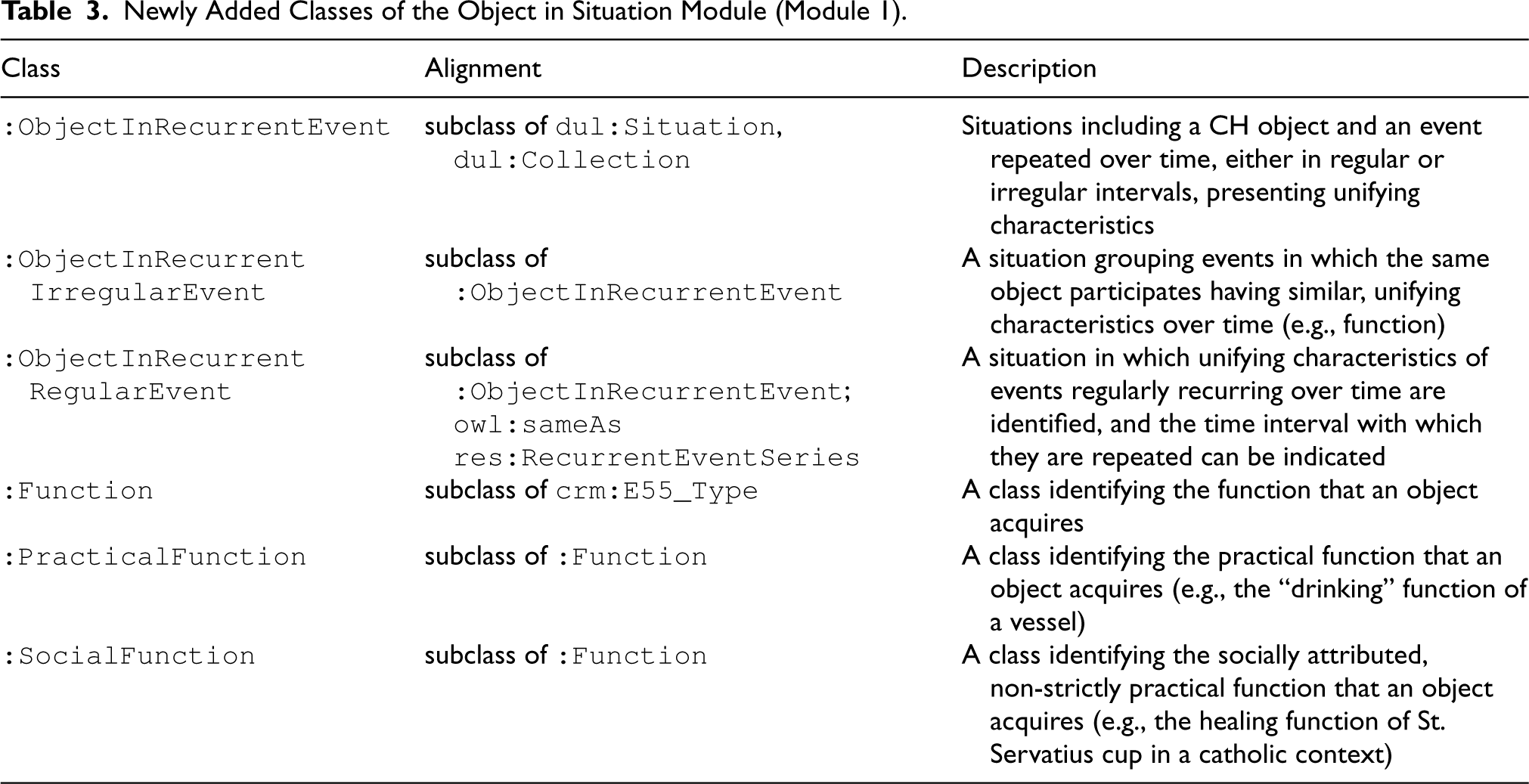
The Object in Situation module (See Figure 10 and Tables 3 to 5
21
) addresses the group of requirements R1, concerning the function of the object in relation to a context and/or immaterial practices. To this aim, it is based on the theoretical model of Anderson illustrated in Section 3. This describes the object within the belief system that gives it its specific functions and meanings. It reuses the solution proposed by the AAAo ontology to represent the function ascribed to an object by a community, namely, the class

Module expressing a function an object acquires during a specific cultural event or in events repeated over time in a historical frame. New classes are marked in yellow. Created by Sofia Baroncini. Available at Zenodo (DOI: 10.5281/zenodo.20393679). Licensed under CC BY 4.0.
Newly Added Classes of the Object in Situation Module (Module 1).
Reused Classes in the Object in Situation Module (Module 1).

Properties of the Object in Situation Module (Module 1).

In the module, the context in which the function is observed can be specified with different levels of detail, namely, as a spatiotemporal frame, a single event, or a series of events recurring over time. The first option describes the context in a wide sense by using the class
The class
The Historical Frame module, presented in Figure 11 and Tables 6 and 7, is intended to relate the object under observation to the cross-cultural system. We identified such a system in Anderson’s model and included it in the historical frame definition provided in Section 4. Furthermore, it is addressed in the group of requirements R2. Mostly based on CIDOC-CRM, it integrates a class from the ICON ontology, namely

Module extending CIDOC-CRM and ICON to represent an historical observation Frame which put in relation observed CH objects with immaterial, socio-cultural aspects coexisting in spacetime and influencing the object. Created by Sofia Baroncini. Available at Zenodo (DOI: 10.5281/zenodo.20393679). Licensed under CC BY 4.0.
Classes of the Historical Frame Module (Module 2).

Properties of the Historical Frame Module (Module 2).

The module is centered around the class
The properties inherited from
A Historical Frame can express the traits of a specific or multiple culture(s) (
Finally, the module is integrated with further properties. The property
The proposed modeling allows us to frame the context(s) of the CH object with different levels of granularity (requirement 2.4). For instance, the Historical Frame can identify periods in which cultural traits are recognized over long periods of time such as the religious culture of Maastricht from the Middle Ages till today. However, the Historical Frame can also be subdivided into smaller ones. These subdivisions allow for grouping more specific aspects of the culture in that period, such as the mentioned ephemeral expressions in Maastricht in the year 1962. Such smaller frames may include specific cultural traits and events that are not necessarily represented in the larger historical frame. In this way, the historical frame reflects two of the three types of observations defined in the GA storyline model (van den Heuvel & Zamborlini, 2021) presented in 4.3. Historical Frames with a long duration over time and space (e.g., the Frame observing the culture of Maastricht from the 14th Century to today) combine the contextual traits that are always true for the whole considered period. The Historical Frame in this form is a kaleidoscopic view over the storylines of the objects and their contextual immaterial features (e.g., devotion for the Chest of Distress). At the same time, the relationship
Furthermore, single separated frames, or on the contrary, multiple overlapping frames can be recognized. For example, the historical frames of the thematic processions that occur uniquely include special features (e.g., temporary constructions, plays written for the occasion) that vary from time to time. Such frames do not overlap with each other but fall within the overall frame of the culture of Maastricht, in which the recurrent traits of the Chest’s procession are also included. Cultural events can also be observed in a wide overlapping frame that encompasses separate frames such as the alternate use of liturgical objects by two completely different religious communities (e.g., the Catholic and the Protestant ones, in the same place and period). 24
Historical Frames must not be confused with Reference Frames. The latter deal with common sense pre-knowledge used by the observing agent. This resembles the definition of
The module to express the evolution of material and immaterial objects and their functions (group of requirements R3) combines AAAo with CIDOC-CRM and GA Storylines. It describes three types of evolution, namely the evolution in function and in the material and immaterial aspects of the object in question (Figure 12 and Tables 8 and 9).

Module to describe the evolution of the functions of the object and its material and immaterial aspects. Created by Sofia Baroncini. Available at Zenodo (DOI: 10.5281/zenodo.20393679). Licensed under CC BY 4.0.
Newly Added Classes and Properties of the Evolution Module (Module 3).

Properties of the Evolution Module (Module 3).

To represent the change of function, the class
The physical evolution of the cultural object is represented by reusing and extending CIDOC-CRM. The activities determining a physical change of the object are already addressed by the model, namely:
Nevertheless, an extension is needed to register immaterial changes that affect the immaterial part of the object, namely, the visual representation (
In this way, CIDOC-CRM’s domain-specific representations of modifications of CH can be combined with the AAAo description of a function status to describe both (im)material and functional changes of a CH by proposing a minimal extension only.
The evolution of material and immaterial variations of the object can be modeled by reusing the GA model of storylines (van den Heuvel & Zamborlini, 2021) (requirement R3.1). The storyline is defined herein as a chain of events (perdurants) in which the observed CH object participates. Although not yet formalized in OWL (see future work), the model is reused here to trace the temporal evolution of objects. As storylines can encompass all objects that have a persistent identity throughout time (i.e., endurants), all material and immaterial entities can be included in a storyline by reusing the relation
Nevertheless, some issues arise when aligning
Whereas historical frames allow for observing objects in situations or storylines in distinct event types based on frequencies in duration, ephemeral events are far more fluid and fuzzier.
This module describes how some characteristics of ephemeral events can be captured (group of requirements R4). It reuses existing models without proposing new classes or properties, as the requirements can be already satisfied by state-of-the-art solutions. This can be done by reusing the class

Module to express the characteristics of ephemeral events by reusing existing ontologies. Created by Sofia Baroncini. Available at Zenodo (DOI: 10.5281/zenodo.20393679). Licensed under CC BY 4.0.
In CIDOC-CRM, the class
Indeed, the duration of a temporal entity can be expressed through a
As for many ephemeral events, a start or end is not known, qualitative relations between time entities are fundamental to establish the sequence in which they occur (requirement R4.3). As suggested in van den Heuvel and Zamborlini (2021), Allen’s property can be used for this purpose. This is implemented in the Time Ontology. Whereas multiple types of relation within time entities exist, the
Nevertheless, the general scope of the class
Reused Classes of the Ephemeral Module (Module 4).

Reused Properties of the Ephemeral Module (Module 4).

In Section 5.1, five types of interactions were described between tangible and intangible CH. Furthermore, it was explained how historical events and objects related to the cult of St. Servatius could be analyzed in historical frames. This was done with the intention of getting a better understanding of changes in the use and meaning of CH objects in context over time. These five types of interaction are discussed here in more detail through the description of the case study with the ontological modules proposed in Section 8.
Interactions Between Tangible and Intangible Cultural Heritage in Regular Recurrent Events of Long Duration and Ephemeral Events
Historical frames. A

Modeling of the regular recurrent event of the Chest of Distress in pilgrimage procession, including the specific event of the 1962 procession (case 1). Created by Sofia Baroncini. Available at Zenodo (DOI: 10.5281/zenodo.20393679). Licensed under CC BY 4.0.
Recurrent events. Recurrent events can be modeled through the
Specific events and ephemeral objects. Following the Recurrent Situation Series ODP, the recurrent event class is related to specific events which are making part of it through the relation
The traits can be modeled with CIDOC, indicating that the
The objects, which have an ephemeral nature, as they are intended to be used only for that occasion, are specified as ephemeral through the relation
The event identifying the procession consists of (
In the popular culture of Maastricht, there are cultural practices that do not recur regularly over time, but have a specific meaning and function. The Chest of Distress is brought out and carried through the streets of Maastricht to protect its inhabitants in times of danger. Although a regular interval cannot be defined, the act acquires a particular function and meaning, based on defined unifying characteristics at these occasions. In this section, the irregular recurrent event of the Chest brought out of the basilica on these occasions is represented (see Figure 15). The observed object, that is, the Chest, is related to the

Modeling of the recurrent irregular events of procession of the Chest of Distress in cases of emergency (case 2) and the ceremony of drinking from St. Servatius’s vessel as a healing practice (case 5). Created by Sofia Baroncini. Available at Zenodo (DOI: 10.5281/zenodo.20393679). Licensed under CC BY 4.0.
Similarly to the previous example, the
During the restoration in 1962, many decisions were taken that modified the function and iconographical meaning of the Chest of Distress (see Section 5). Among them, the votives added in 1450 ca., expressing the strong popular devotion for the Chest of Distress, were removed. In addition, the glass stones, symbolizing eternal salvation, were removed and replaced with precious stones with esthetic functions. These events contributed to the change of the function of the Chest from a devotional to a more esthetic one, although the role of protection remained present in the processions. In this section, the focus is on modeling the removal of motives and the addition of gemstones as part of the actions that resulted in a change in function (see Figure 16).

Modeling of the change of function of the Chest of Distress from a devotional to an esthetic one due to changes made during the restoration process (case 3). Created by Sofia Baroncini. Available at Zenodo (DOI: 10.5281/zenodo.20393679). Licensed under CC BY 4.0.
Events that result in physical changes of the object. In the described example, physical changes of adding or removing parts of the Chest led to a change in the object’s function, without affecting its identity (i.e., the object remained identifiable as the “Chest of Distress”). For this reason, the chest is modeled as a unique instance of
Function of the object and its changes over time. In this case, the specific parts of the object added or removed were characterized by the overall function of the chest. For this reason, two classes identifying the votive (
Historical Frames. To indicate to which cultural context the actions belong, four historical frames are specified. The first one identifies the religious and popular culture of Maastricht from the 14th century to today. It is characterized by an
Storyline. A
The event of the restoration of 1962, illustrated above, brought significant changes in the iconography and iconological meaning of the Chest. One of the most relevant variations concerns the scene on the short gable representing St. Servatius between angels. As described in Section 5.1, originally one of the angels was giving the bishop’s staff to St. Servatius. This action was crucial in legitimizing the role of bishop acquired by the saint. It implied that this role was given to Servatius by God himself, via the intervention of the angel. As a consequence, the removal of the staff had a considerable impact on the symbolic message that it expressed.
In Figure 17, the specific scene in the gable on the short side is modeled as a feature (

Modeling of the change of iconographical meaning of the scene representing St. Servatius as a bishop as a consequence of the restoration performed in 1962 (case 4). Created by Sofia Baroncini. Available at Zenodo (DOI: 10.5281/zenodo.20393679). Licensed under CC BY 4.0.
The relation
Both the immaterial (
The last case of interaction presented here is the acquisition of meaning and function through the healing ritual of drinking from the St. Servatius cup illustrated in Section 5.
According to the belief (the event is not considered to be historical from a non-Catholic perspective due to inconsistencies in historical sources), St. Servatius drank from a cup, which was identified as the 1st-century AD Roman vessel discussed here. Hence, the Roman vessel, which originally had a sole practical function, obtained a new healing function in the religious context from the 14th century onward. This meaning comes into being when believers drink from it, usually during an intimate ceremony. In this case, a believed fact had a long-lasting impact on the cup’s function in the upcoming centuries. One of the many occasions in which the drinking ceremony took place was during the Spanish flu of 1918 (Figure 15).
Such a recurring situation can be represented through an
Furthermore, an instance of
This modeling allows for relating a function to specific groups of events while identifying relevant cultural traits through the Historical Frame class. Indeed, the historical frame in which the recurrent event is situated includes the belief that St. Servatius drank from that cup. It is modeled as a belief, related to the believed thing through the newly added
Conclusions, Discussion, and Future Work
Conclusions
This paper explored, based on a theoretical-historiographical overview of the concepts of frame and historical time, the creation of a system of historical frames to analyze, interpret, and annotate interactions between material and immaterial expressions of the arts in their cultural contexts. A concrete outline of a historical frame model based on evidence-based storylines was presented as a step toward solving the complex Historical Framing Problem. Modules were proposed to describe the various functions, cultural traits, ephemeral events, and the material and immaterial evolution of the object. A historical frame as part of this system was modeled in more detail to demonstrate how it could be used to capture spatiotemporal views, in particular of ephemeral events in interactions between tangible and intangible CH. Based on this historical frame model and tested against five types of such interactions in a case study of changing functions and iconographies of material objects in the cult of St. Servatius, four ontological modules were developed. These modules: 1 Object in Situation, 2 Historical Frame, 3 Evolution, and 4 Ephemeral in Tangible and Intangible Cultural Heritage, integrated existing ontological solutions based on CIDOC-CRM and/or DOLCE. Extensions were proposed to model different (ir)regular recurrent, unique, and ephemeral events, their functions, their relations with immaterial culture, and their evolution over the timespace volume.
Discussion
The proposed ontological modules have been tested through the descriptions of five cases of interaction between tangible and intangible CH present in the rich example of the St. Servatius’ Chest of Distress.
Historical Context
The
The introduction of a historical frame into the discourse as a spacetime unity is a novelty presented in this paper. It is considered to be fundamental in the CH hermeneutic discourse, as divergent cultural expressions and artistic solutions may be provided at the same time, but in different places. Little research has been done on the spacetime unity in the discourse concerning endurants and perdurants in ontologies. Up to now, in many models, space and time have been treated separately, resulting potentially in inconsistencies in ontologies (e.g., the temporal classes of CIDOC-CRM
Evolution of the Material and Immaterial Part of the Object
The evolution of the physical object was represented through the reuse of CIDOC-CRM classes that indicate the processes of adding and removing parts and the transformation of an object. These classes were integrated in 8.3. In the same module, a new class was introduced to indicate the conceptual variation that changes the visual representations of a CH object, providing multiple versions of it. Being defined as perdurants, the events modifying the conceptual and physical aspects of the object can be declared as part of a
Evolution of the Object Function
A new module 8.1 was introduced to represent the specific functions, practical or social, that objects have in certain situations based on the AAAo ontology. The class
Traits of Recurrent and Unique Events
Custom solutions to include functions and events that recur regularly or irregularly, with extended patterns over time, have already been proposed for the description of regular events or situations (Carriero et al., 2019, 2021). The adopted solution allows the identification of a unique identity of a collection of events, independently of the definition of the frequency with which they are repeated over time. Each participating event can be described according to its peculiar characteristics. In this way, immaterial ephemeral practices, such as processions, can be described according to their persisting characteristics. Moreover, single events can be enriched with traits that are characteristic for them separately but not for the whole collection (e.g., a theme of the procession in a specific year).
Ephemeral Events and Objects
The contribution provided a first exploration of the nuances of the concept of ephemeral and how it can be represented with the currently available ontologies (Section 8.4). Ephemeral events, intended as events of short duration, loosely characterized by fuzzy or uncertain time limits, can be described with CIDOC-CRM classes. These classes already address uncertainty and fuzziness in both E5 Events and the time spans that characterize them. Indeed, the
Fuzzy and uncertain limits over time can be further emphasized with the EDTF Specification for times. Nevertheless, the ETDF Ontology provides a mapping between such a specification and the Time Ontology. It follows the XSD format, standard for RDF, but is still a draft. Furthermore, the subtle differences in representations of time between CIDOC-CRM, DOLCE, and the Time Ontology make it difficult to provide a fully compliant solution to express uncertainty not only in the classes representing time but also in the computable time intervals delimiting them.
Another nuance of ephemeral grasped in the model is the definition of ephemeral as a type of CH objects, which are created for a unique occasion and not made to last over time. In this case, the ephemerality of objects (and related events) can be grasped through controlled vocabulary terms. Such modeling constitutes a first solution towards a more consistent ontological representation of CH ephemeral objects.
Future Work
Four modules were created through the combination and extension of standards (CIDOC-CRM and DOLCE) with classes of AAAo, ICON, the Time Ontology, Storylines, the EDTF Ontology, and Odeuropa to represent relevant aspects of the interactions between tangible and intangible CH. Common alignments have not yet been incorporated to avoid potential inconsistencies between the ontologies used. Alternatively, classes aligned with different ontologies are related in the model through properties. The proposed ontological framework can be further integrated with recently released ontologies that address the representation of social facts, such as the Semantic Data for Humanities and Social Sciences (SDHSS), an extension of CIDOC, which is also based on DOLCE. This may integrate our model with more detailed information on the societal traits considered to be relevant in the framed context(s). Furthermore, we envision conducting research to realize a new model of storylines that includes 1) spacetime unity and 2) socio-cultural characteristics.
Interactions between objects of tangible and intangible CH were presented as storylines that often could be well defined in spacetime, but in other cases, such as in ephemeral events, were fuzzy. This implies that in the storylines, elements of uncertainty are introduced. With the aim in mind to use historical frames to analyze and present evidence-based histories, further research is foreseen. This research is intended to establish how the historical frame system can be connected to ontological models of uncertainty. These models must be able to deal with various types of uncertainty, such as in vagueness ontologies (Alexopoulos et al., 2014; Ghorbel et al., 2019), but also with the different phases in which uncertainty can occur.
Although the problem of uncertainty in the temporal modeling of interactions between tangible and intangible CH cannot be solved immediately, further research and modeling is foreseen in the short term. 27 Future work includes furthermore additional alignments with existing ontologies and extensions of tangible and intangible CH interactions models based on more interdisciplinary case studies (e.g., material culture, anthropology, social sciences).
Author contributions
The authors contributed to this paper as follows. Charles van den Heuvel is responsible for the conceptualization and writing of the motivation part, the theoretical historical overview, the historical frame system, and the case study (Sections 2, 3, 4, 5). Sofia Baroncini is responsible for the competency questions, the requirements, and related works (Sections 5.2, 6, and 7). She conceived and developed the proposed ontological models, therefore responsible for Sections 8 and 9. Both authors are responsible for the introduction and conclusions 1 and 10. We would like to thank Veruska Zamborlini (DH Lab Humanities Cluster K.N.A.W.), Bruno Sartini (y.digital), and Stefano de Giorgis (Vrije Universiteit Amsterdam) for their feedback on some of the presented ontological models.
Footnotes
Funding
The authors received no financial support for the research, authorship, and/or publication of this article.
Declaration of Conflicting Interests
The authors declared no potential conflicts of interest with respect to the research, authorship, and/or publication of this article.
