







Abstract
The purpose of this paper is to investigate the information systems (IS) assimilation level of an enterprise system in the post-implementation phase, through the lens of IS governance mechanisms and IS support structures, impacted by the socio-cognitive processes. The research follows a qualitative approach and builds on semi-structured interviews with enterprise system stakeholders in large public sector organizations in India. The study posits that high levels of IS governance mechanisms and high levels of IS support structures lead to a high level of IS assimilation only in the presence of higher level socio-cognitive processes. A not-so-higher level of socio-cognitive fabric results in low or moderate IS assimilation levels in spite of high levels of IS governance and/or IS support structures.
Despite close to a couple of decades of IS research on enterprise systems, IS assimilation is still an enigma for practitioners and academicians. The generalizability of the results of this study may be applicable to any public organization in a developing country, like India, which are using enterprise system solutions but are yet to reap the potential benefits. The results present a way forward for practitioners to ensure optimal resources and focus for the triad- IS governance, IS support structures and socio-cognitive processes.
Keywords
Introduction
Several organizations worldwide have implemented enterprise systems to integrate their core business and operational processes. Enterprise systems are complex systems that require active participation from various stakeholders. Gartner (2020) projects annual spending on enterprise systems software to grow by 8.8% in 2021 from the estimated $465 billion in 2020. The Indian economy itself witnessed massive adoption of enterprise resource planning (ERP) solutions by both public and private sectors during the 1990s due to globalization. Organizations typically commit a large chunk of their precious resources to adoption, implementation and post-implementation support of the enterprise systems. However, very few organizations derive the business benefits commensurate with their investments, and still fewer among those assimilate the full potential of the enterprise system. According to the Panorama Consulting Group (2020), the average benefits (such as reporting and visibility, operational efficiency, and technology updates 1 ) realization from ERP systems during the post-implementation phase 2 is just 37% in large multi-national organizations. 3 In light of such meagre realization of benefits (Jasperson et al., 2005; Motiei et al., 2015), it is important to understand how organizations can achieve better assimilation of their enterprise systems.
Several studies (e.g., Lane et al., 2016; Mu et al., 2015) have examined the challenges of effective information systems (IS) governance mechanisms (such as scanning of stakeholders’ needs, requirements gathering, evaluation mechanisms, planning, action and monitoring, faced by IS teams) in the post-implementation phase. Similarly, several studies (Arasanmi et al., 2017; Hwang & Krackhardt, 2020; Janah & Mayesti, 2020) find IS support structures (such as service desk support, help desk, online support, document support, online repository support, training, inter-group interactions, power users, peer support, cross-organizational interactions and top management support) crucial for effective handling of the post-implementation challenges. Most of these studies have examined IS governance and IS support structures without considering their overall influence on IS assimilation. However, previous studies (e.g., Ruivo et al., 2012) argue that the post-implementation phase requires both support structures and IS governance mechanisms to handle the dynamic business requirement and complexity in large manufacturing organizations. Apart from these two, it is also important to examine the social dimensions of alignment between business and IT at the operational level. Several studies (e.g., Curtis et al., 2017; Heshan et al., 2016; Lychnell, 2020; Yu & Zellmer-Bruhn, 2018) argue that socio-cognitive processes (such as the process of drawing novel distinction, greater attention to the present moment and sensitivity to context) also play a role in the enterprise systems assimilation. Socio-cognitive processes edict that an individual’s experience and interaction with the environment shapes his/her knowledge. This encompasses the group-level shared knowledge and beliefs, thereby influencing interpretation, action and organizational outcomes. Therefore, socio-cognitive processes influence the way enterprise systems would assimilate in an organization. However, very few studies (e.g., Schlosser et al., 2015) have examined their effect on downstream long-term organizational benefits. Most studies focus on improving public services and transparency, and very few target organizational performance (Pang et al., 2014).
Therefore, in this study, we examine how IS governance and support structures, along with the socio-cognitive processes, influence the assimilation of enterprise systems in large public sector organizations. We examine public sector organizations as they face greater challenges in enterprise systems assimilation compared to private sector organizations (Dawson et al., 2016, p. 1182). According to Dawson et al. (2016), private sector organizations derive a 40% greater return on investment from their enterprise systems because of effective governance mechanisms compared to public sector organizations (Goh & Arenas, 2020). The post-implementation phase of enterprise systems in public sector organizations is the most-challenging phase because the support structures and governance mechanisms that are generally available during the adoption phase are mostly absent. On top of that, the dynamic business needs and increased expectations of stakeholders make assimilation more complex. Therefore, since the dynamics of operations in a public sector organization differs considerably from other organizations (Obeidat & North, 2014), it would be interesting to examine the factors, such as IS governance and support structures, that influence IS assimilation in such organizations. Very few studies have examined enterprise systems assimilation in Indian organizations (Nandi & Vakkayil, 2018). Of those few, most have examined successful implementation and initial use, immediately after going live (Syed et al., 2018). None among these have examined IS assimilation in the thick of the post-implementation phase, especially three-four years after implementation, when the long-term organizational benefits tend to accrue (Seddon et al., 2010).
The primary research question we examine is as follows: What effect do IS governance mechanisms and support structures have on the assimilation of enterprise systems in large public sector organizations in India? We also examine how the socio-cognitive processes interact with the IS governance mechanisms and support structures to influence IS assimilation. We use the qualitative approach to better understand IS assimilation processes and their antecedent multidimensional phenomenon, namely governance mechanisms, support structures and socio-cognitive processes. Moreover, these constructs cover a blend of technological, business and social aspects, making the quantitative approach challenging. In such cases, the qualitative approach helps better interpret the shared understanding among stakeholders.
Literature Review
The literature lacks examination of enterprise systems assimilation using the combined theoretical lens of IS governance and support structures. Their role in influencing enterprise systems assimilation seems obvious, and there have been a few studies to this effect. For example, Taylor et al. (2020) examined the positive relationship between IS adoption and routinization, and how the relational governance mechanisms affect this relationship. Similarly, Ann Sykes (2015) explored the influence of support structures on employee-level outcomes. Most of the empirical studies in the IS domain in the last decade have corroborated that most organizations are still far from realizing the long-term organizational benefits from their IS implementation (Seddon et al., 2010; Wortmann et al., 2019). We now explore deeper into the existing research on the individual constructs of our study.
Research on IS Assimilation
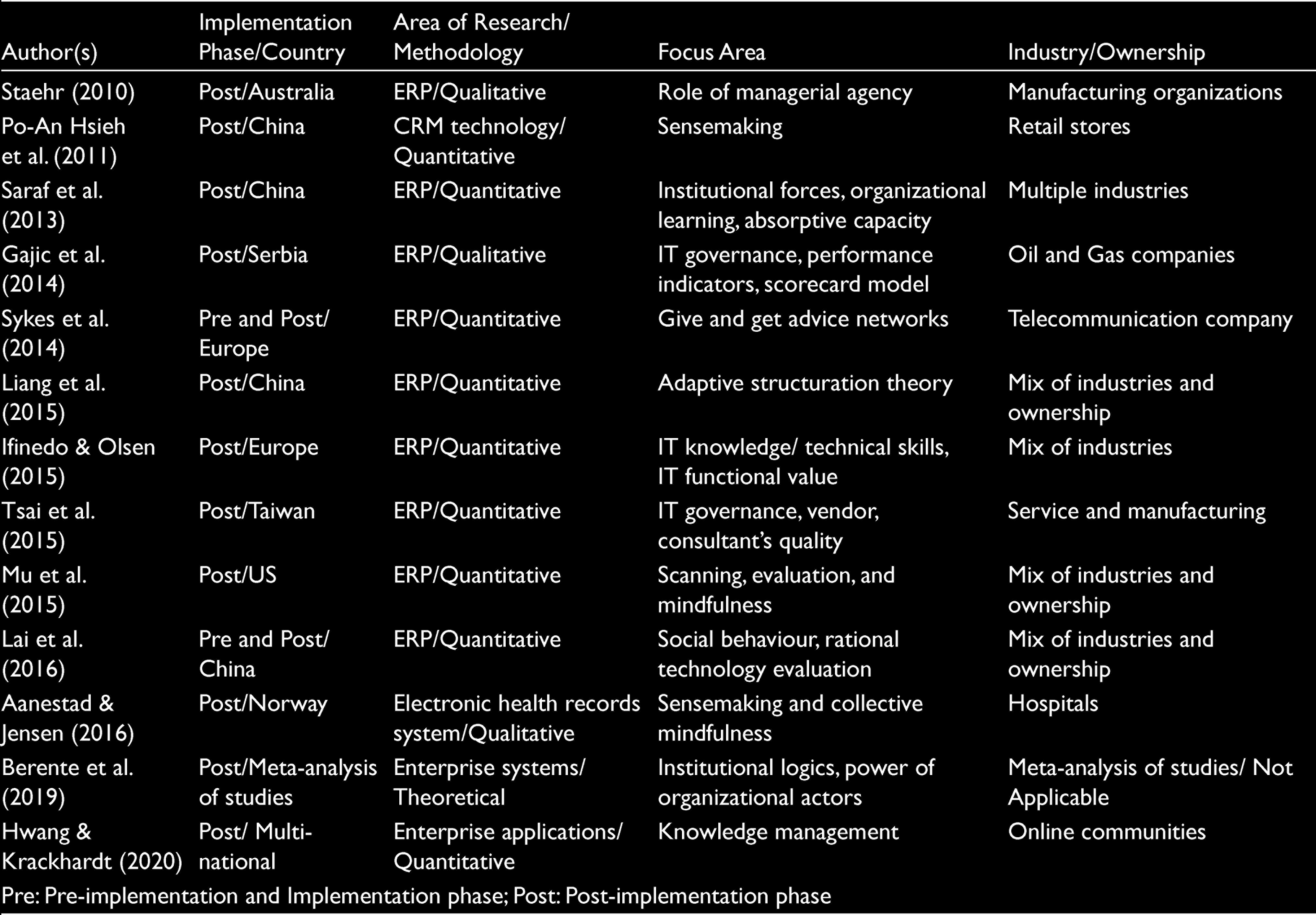
Scholars have defined the term IS assimilation in different ways depending on the phase—adoption, implementation and post-implementation—of the ERP lifecycle (Sternad et al., 2011). Several studies have measured IS success in terms of higher quality data for decision-making, efficiency gains in business processes (Saeed et al., 2010), better coordination among different units (Gattiker & Goodhue, 2005), the impact of ERP on business activities like planning and decision-making (Huigang et al., 2007), information quality, system quality, organizational impact, individual impact (Sedera & Gable, 2010), improved management decision-making (Staehr, 2010), extended use (Po-An Hsieh et al., 2011), users’ satisfaction and users’ individual benefits (Hsu et al., 2015), performance indicators (Gajic et al., 2014), and extent of routinization and infusion (Maas et al., 2018). Performance effects in the post-implementation are best evaluated based on the long-term organizational benefits (Seddon et al., 2010), measured by the extent of integration within and across an organization, process optimization initiatives undertaken, and the richness and depth of management IS. Moreover, little research has been conducted into examining the performance effects of IS governance in the public sector (Pang et al., 2014) in Indian organizations. We propose to measure the IS assimilation by examining the extent of integration within and across systems, the extent of process optimization initiatives, improved access to information, and business improvement projects undertaken, to make a quantum jump in business and process efficiencies. These measures indicate the long-term organizational benefits that organizations derive from enterprise systems implementation. While the literature and theories on IS implementation are abundant, only a few studies (e.g., Holland & Light, 1999; Markus & Tanis, 2000) have critically examined IS assimilation in the post-implementation phase. Table 1 identifies the factors that affect IS assimilation in the post-implementation phase based on the literature review on IS studies in the last decade.
Table 1 shows that most of the studies on enterprise systems, covering the post-implementation phase, are undertaken in organizations belonging to developed nations (such as the United States, European countries, Taiwan, and China). Research lacks examination of IS governance’s performance effects in the public sector (Pang et al., 2014) in Indian organizations. Most IS governance studies are in the private sector, where the aim is profit maximization, unlike the aim of public good in public sector organizations (Tonelli et al., 2017). Similarly, the presence of steering committees and strategic coordination groups in the private sector aids IS assimilation that for most cases is not applicable to public sectors, which face issues, starting from resource allocation due to conflicting goals of officials to lax control mechanisms. Furthermore, public sector organizations offer significantly different challenges than private sector organizations owing to their bureaucratic hurdles, technological inertia, operational and managerial inefficiencies, integration challenges, underutilization of systems and resources (Ravasan & Rouhani, 2014).
Research on IS Assimilation.
Also, most of the studies have taken a cross-sectional view of post-implementation success by using a quantitative approach. However, a qualitative approach offers tremendous opportunities to explore the finer nuances of enterprise systems assimilation in depth. In-spite-of many studies in this domain, enterprise systems assimilation is still at significantly low levels, and the current literature offers a partial explanation of the factors that affect the assimilation levels. One needs to juxtapose the organizational dynamics with the individual and group dynamics to develop an integrated and holistic understanding of IS assimilation. The public sector enterprises contribute significantly to the GDP in many developing countries, including India, and operate in many crucial industries (Arundel et al., 2019). Therefore, we propose to carry out a qualitative study on IS assimilation in India’s public sector organizations, based on the organizational level factors, namely IS governance mechanism and IS support structures, and the socio-cognitive processes.
IS Governance Mechanisms
IS governance focuses on transforming IS to meet the present and future demands of a business and its stakeholders. IS governance mechanisms refer to managerial practices, organizational structures and systems, shared information infrastructure and relational mechanisms for shared learning and communication between IT and business to nurture and sustain an organizations’ strategies and objectives (Benaroch & Chernobai, 2017). IS governance mechanisms can profoundly impact the realization of IT strategy and can play a key role in the fusion of business and IT (Dawson et al., 2016).
Several studies have examined the impact of IS governance mechanisms on firm performance. Scholars have emphasized the importance of social-alignment between business and IT through formal (regular meetings) and informal integration mechanisms (cross-functional activities). Svahn et al. (2017), for example, stressed ingenious governance practices by following a trade-off between control and flexibility to recognize creativity and differentiation over existing authority structures and managerial practices. Constantinides and Barrett (2015) examined the governance mechanism from a bottom-up perspective with a thrust on collective actions, where self-imposed rules and regulations govern multiple governing units. Lane et al. (2016) stressed the importance of the requirements gathering process in the IS delivery process to capture the different stakeholders’ views and their salience to the business value and IS delivery. Similarly, Mu et al. (2015) emphasized the stakeholders’ needs and evaluation mechanisms for effective assimilation of ES. Christianson (2019) examined the process of feedback mechanisms and posited that more effective teams detect and identify the issues early on and provide timely feedback before any severe consequences take place. Table 2 presents a recent review of relevant IS governance literature.
Research on IS Governance.
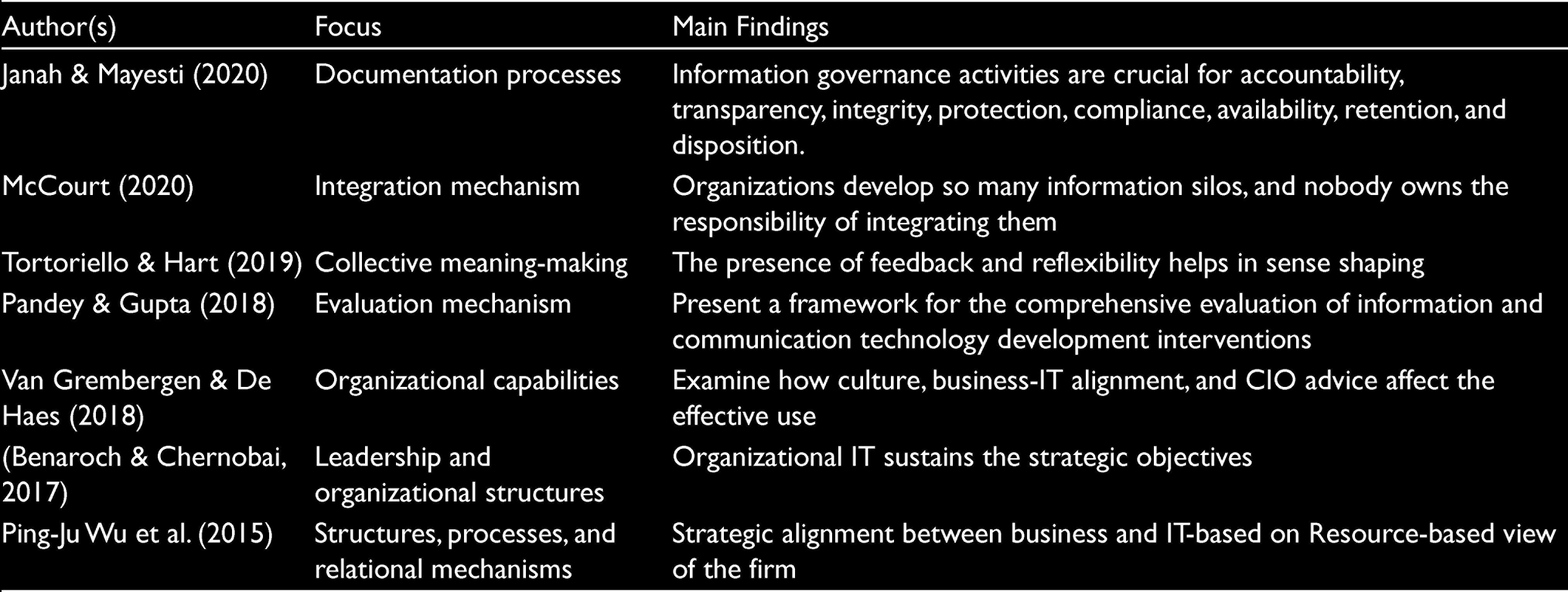
To realize the long-term organizational benefits from enterprise systems implementation, we measure IS governance mechanisms using its sub-themes, namely scanning business requirements, evaluation, action, monitoring, sharing, learning, and organizational rules and procedures.
IS Support Structures
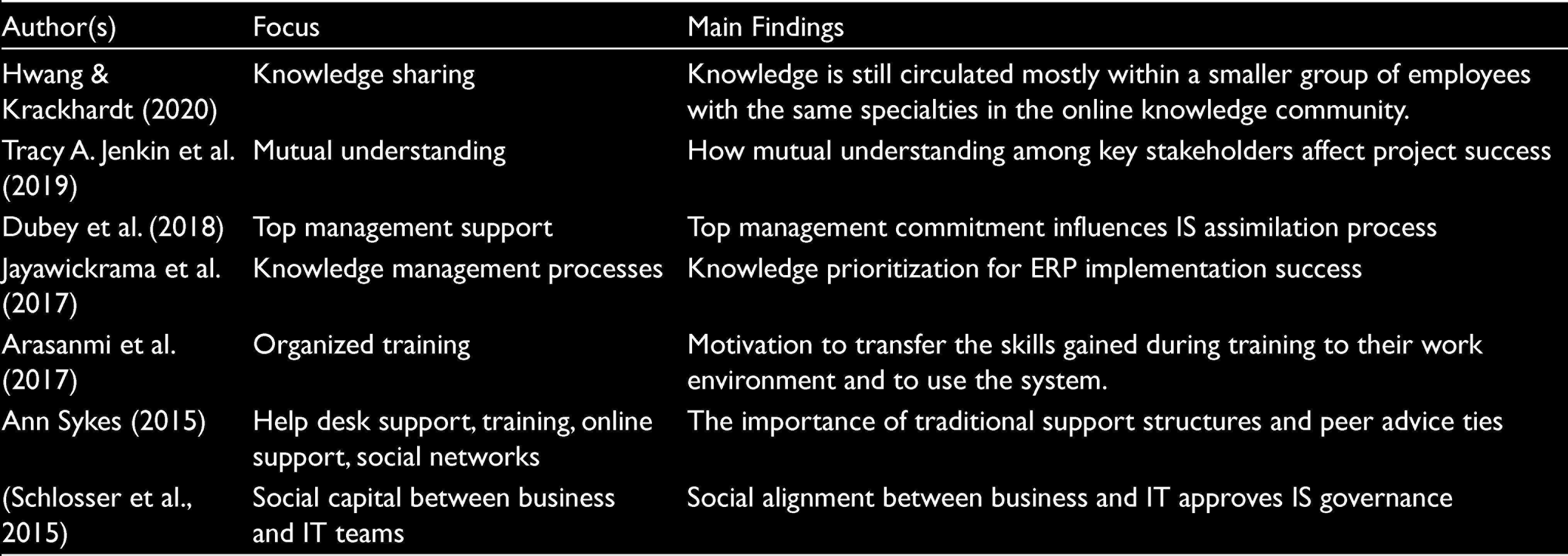
IS support structures help stakeholders provide the necessary information to interact better and to network and work effectively with the enterprise system. Previous research work has examined the support structures that significantly influence the IS assimilation organizations. These include helpdesk, service-desks support, online support (Ann Sykes, 2015), functional and technical documentation (Limoncelli, 2018), training (Retana et al., 2018), inter-organizational and cross-organizational interactions (Beck et al., 2019), top management support (Dubey et al., 2018), subject matter experts (Gordon, 2020) and online repository (Hyun Kim et al., 2016). For example, Ann Sykes (2015) analysed the effect of the traditional support structures, such as training, helpdesk support, online support and peer advice, on the long-term success of enterprise systems. Puhakainen and Siponen (2010), on the other hand, studied the importance of training methods to stimulate systematic cognitive processing. Similarly, Esendemirli et al. (2015) explored the importance of inter-group interactions in improving departmental performance using enterprise systems. Scholars (e.g., Liang et al., 2007; Staehr, 2010) carried out similar studies to investigate managerial agencies’ role in achieving business benefits from ERP systems. Mooradian et al. (2006), for example, studied the links between individual factors and knowledge sharing among peer groups and their effect on organizational learning. According to Vasile and Simion (2019), support documents and online repository support are crucial in the effective assimilation of enterprise systems. Another important support structure is the social networks in an organization. Various social structures in work settings, such as advice networks, communication mechanisms and friendship networks (Ann Sykes, 2015, p. 476), are crucial elements in transmitting information and resources. We propose to measure the support structures processes related to helpdesk/service desk facilities, interaction/collaboration opportunities, training mechanisms, knowledge management processes, documentation mechanisms, organizational learning capabilities and availability of core team functional members. Table 3 presents a recent review of relevant IS support structures literature.
IS Support Structures.
Socio-cognitive Processes
Due to various stakeholders’ conflicting goals and resource allocation disputes in public sectors (Dawson et al., 2016), IS governance mechanisms do not work even though most decisions are top-to-bottom. Therefore, no one takes responsibility for the extended and emergent use of the enterprise system. The pressing business needs and the continual influx of issues require an organization to be receptive to its stakeholders’ needs and expectations. Organizations should be agile enough to challenge the existing norms of behaviour and provide innovative solutions to tide over the pressing business demands. Therefore, it is important to understand the IS governance mechanisms’ role on enterprise systems assimilation within the socio-cognitive content.
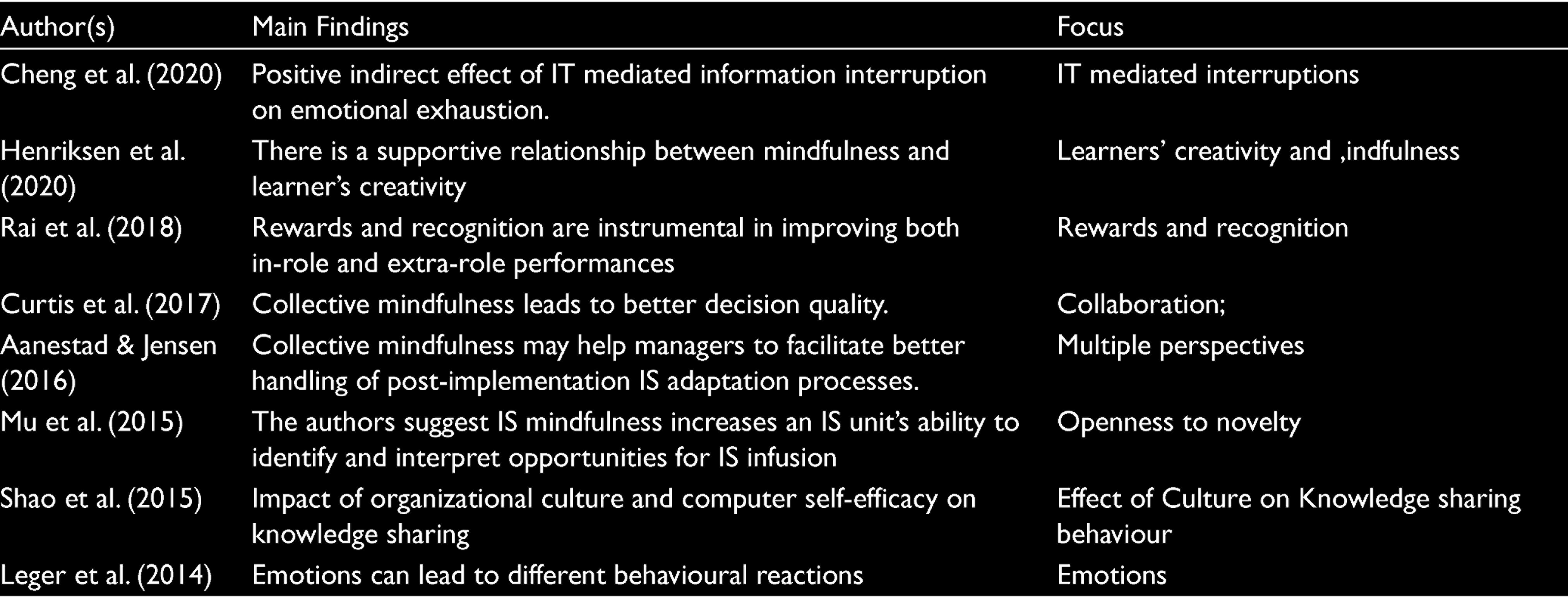
Socio-cognitive processes refer to how individuals or team cognitively process information to achieve a common understanding of the issues, willingness to critically reflect upon existing norms and practices, and the social construction of knowledge through interpretation of experience and action (Olesen, 2014; Zaman et al., 2018). Various micro-processes (such as personal innovativeness in IT, discursive abilities, cognitive abilities, collaboration, and social and emotional engagement) and macro-processes (such as organizational culture, rules and procedures, formalization and centralization) influence the behaviour, which in turn shapes the socio-cognitive processes. Focusing on the cognitive aspects of enterprise systems projects, Tracy A Jenkin et al. (2019) emphasized the importance of mutual understanding in successful project delivery and assimilation. Xixi et al. (2013) found that intrinsic motivation and personal innovativeness influence enterprise systems’ innovative use in the post-implementation phase. Sun (2012) used the adaptive system concept to explain how people switch from automatic thinking to active thinking upon encountering novel situations or discrepancies. According to Maitlis and Lawrence (2007), discursive abilities enable leaders and stakeholders to articulate persuasive accounts of challenges, which helps the team undertake transformative projects, thereby effecting significant organizational changes. Beaudry and Pinsonneault (2010) posit that emotions experienced early in the implementation phase affect use in the post-implementation phase. Table 4 presents a recent review of relevant socio-cognitive literature.
Research on Socio-cognitive Processes.
Based on the earlier discussion, we can conclude that the existing studies on IS governance, support structures and socio-cognitive processes focus on some individual or combinational aspects of construct rather than taking a holistic view. The systemic complexity of enterprise systems, coupled with the post-implementation phase’s socio-cognitive challenges, can be better understood through the lens of IS governance mechanisms and support structures to bring about long-term benefits to organizations.
Research Methodology
We used the qualitative approach in this study (Yin, 2012) using semi-structured interviews. We developed a semi-structured interview questionnaire to collect data from 22 executives belonging to five large public sector organizations in India. The interview protocol is available in Annexure 1. There are 33 central public sector enterprises in India that operate in the manufacturing sector. We covered five organizations belonging to four public sector enterprises from the maharatna, navratna and miniratna categories. The Government of India categorizes Indian public sector enterprises into these three categories based on their average turnover and profitability in the past few years. The Maharatna and Navratna status imparts greater operational and financial autonomy to a company, thereby enhancing its board’s powers to make financial decisions. The boards can also structure and implement schemes relating to personnel and human resource management and training. Our selection of organizations represents various organizations ranging from steel manufacturing and marketing to oil manufacturing and marketing, power manufacturing and copper manufacturing. We collected data from key informants from multiple departments, such as the IS core-team, top management team and IS end-users belonging to different functional levels in these organizations. Table 5 presents a brief detail of the organizations interviewed in this study.
Details of Organizations Studied.
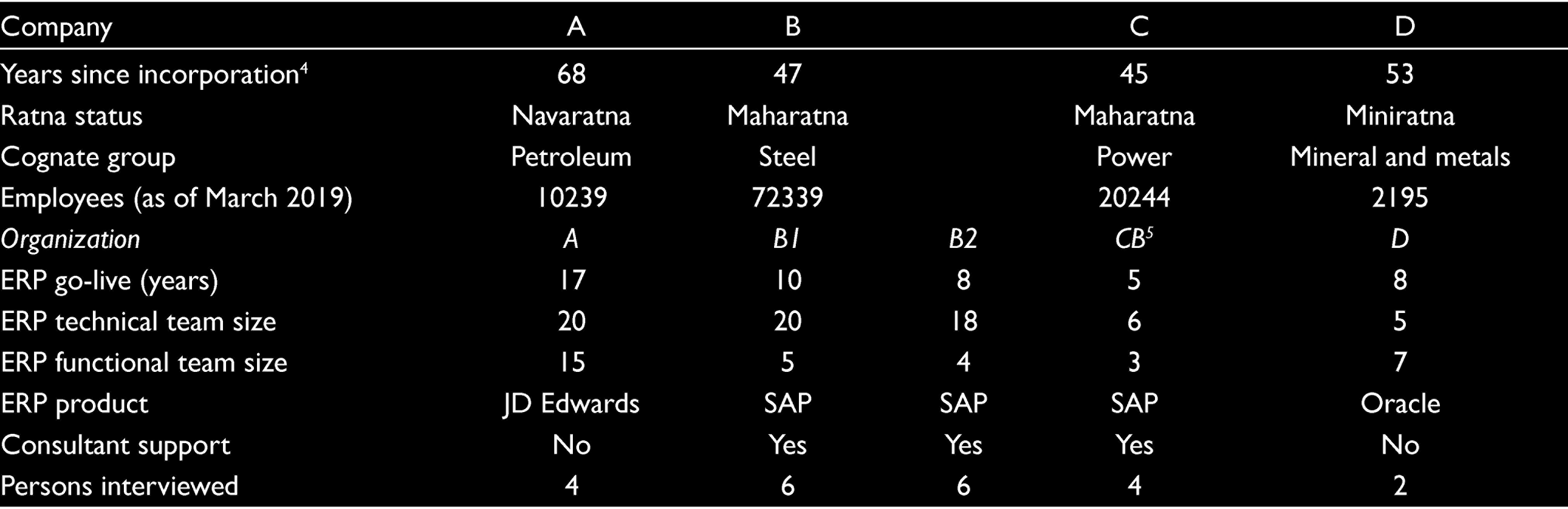
Organization A is an oil refining and marketing organization. Organization B1 is an integrated steel plant of company B. B2 is the marketing division of company B and is primarily responsible for steel products’ marketing. Organization CB is a power-producing organization and is a joint-venture of two public sector organizations. Organization D is a copper ore mining and refining organization. We conducted interviews with the different IS core team members and end-users who handle the core areas of Materials Management, Sales and Distribution, and Production Planning, Quality Management, Finance and Controlling, Assets Maintenance, Suppliers Relationship Management (SRM), Business Intelligence (BI), and Master Data Management. We recorded the interviews with due permission from the respondents. Each interview session was of 45 minutes on average.
Data Analysis and findings
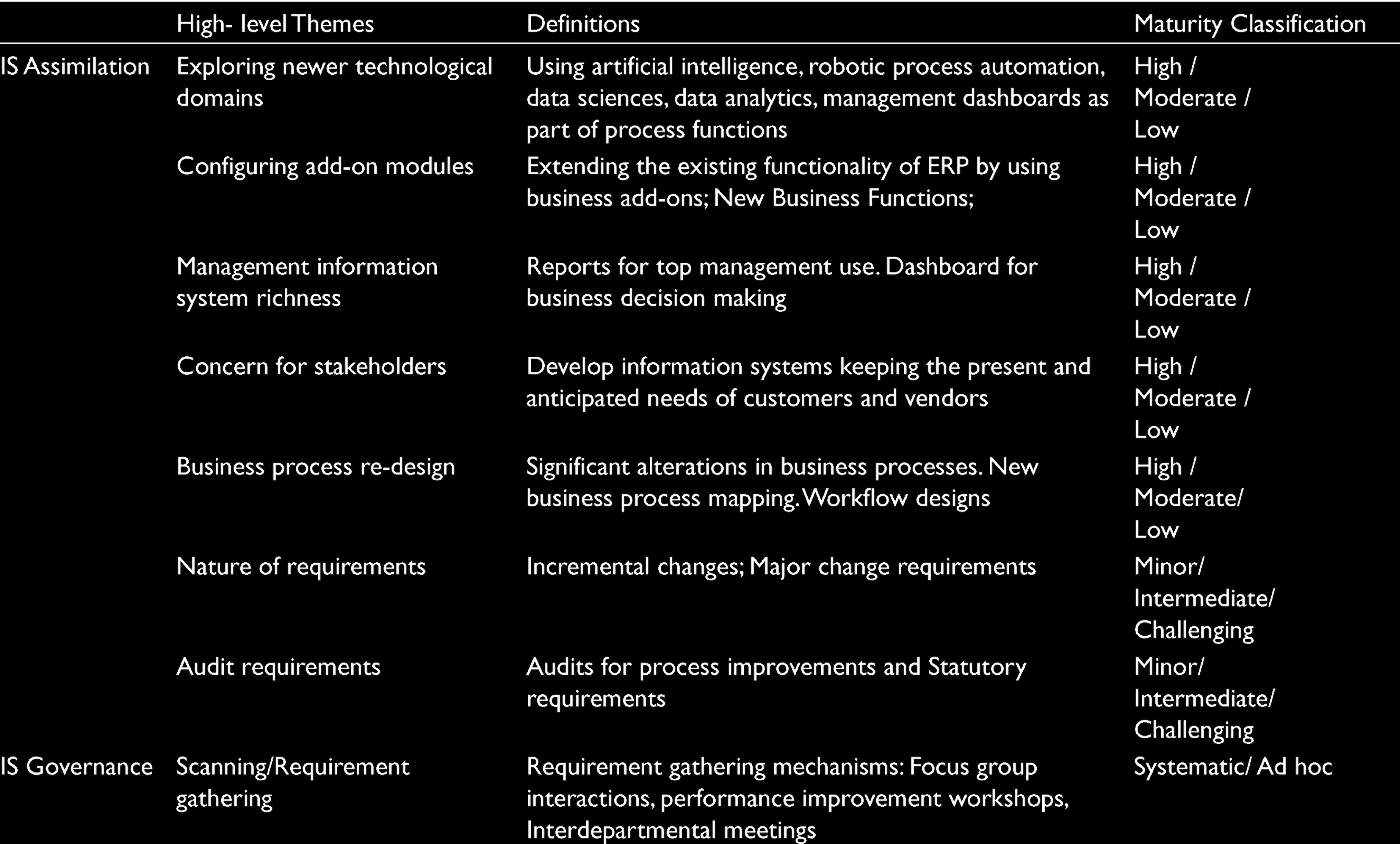
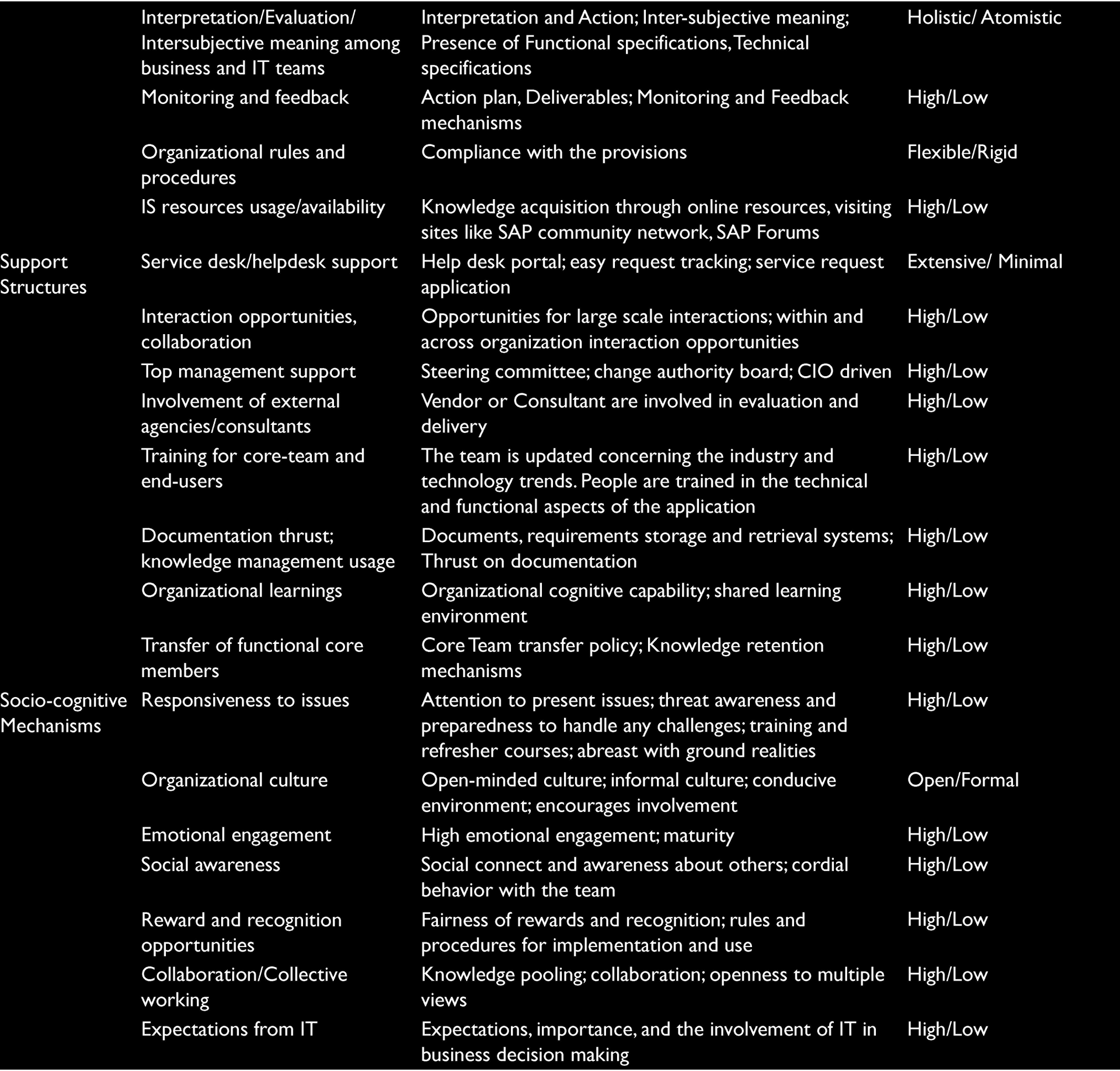
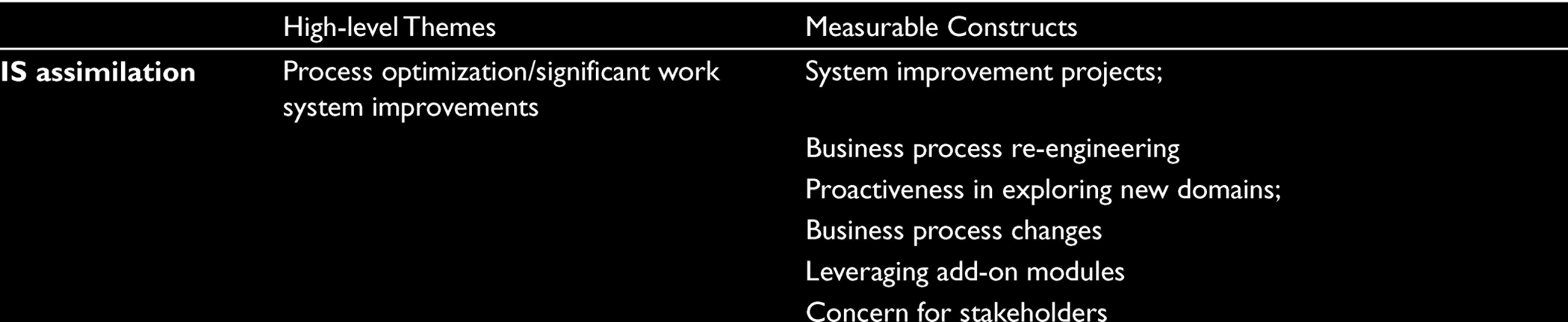
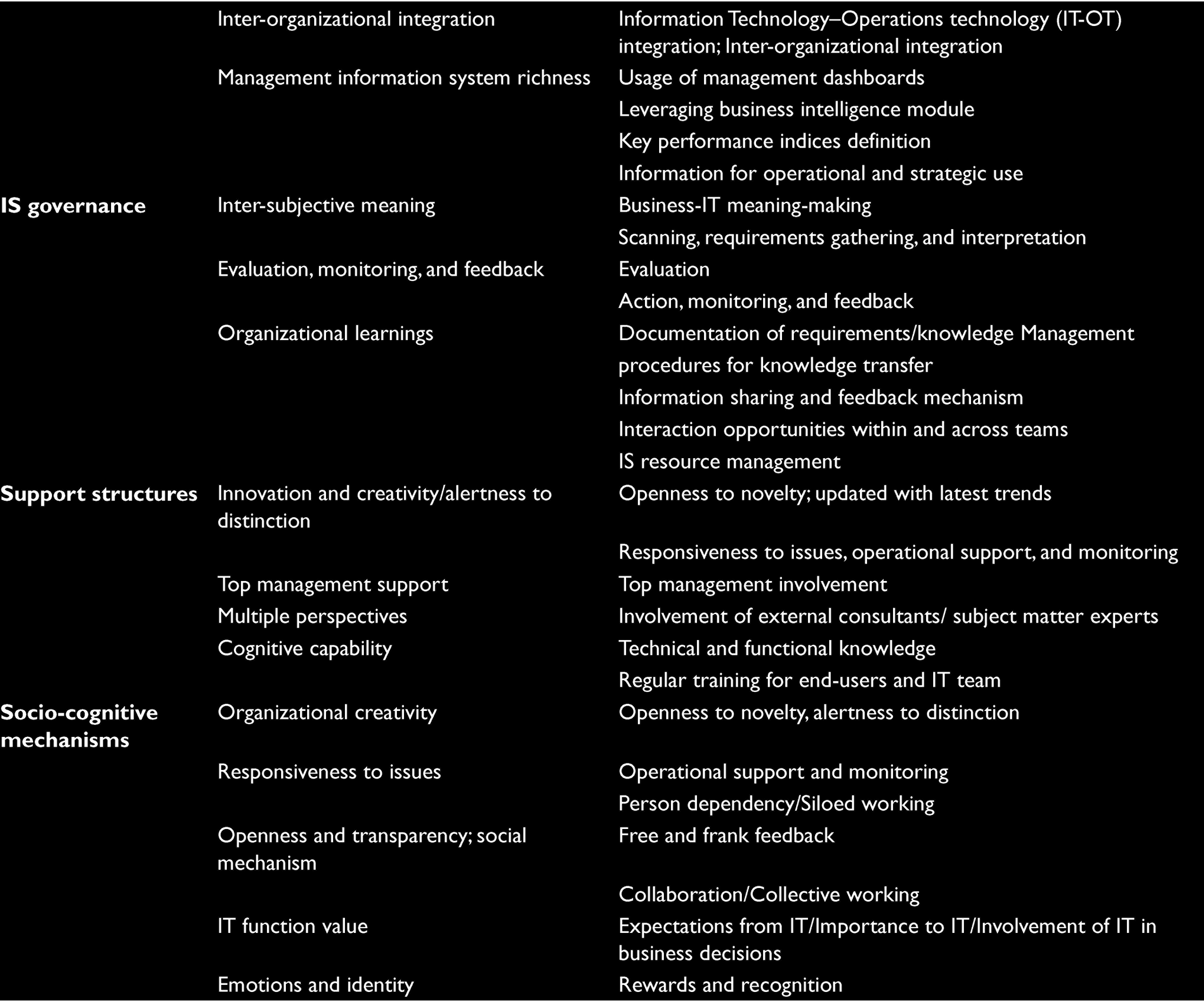
We manually transcribed the interviews and coded them using NVivo 12 software. We derived the themes from the existing literature on IS assimilation, IS governance mechanisms, support structures, and socio-cognitive processes and we generated new ones from the interview. An iterative process of coding, decoding, and re-coding helped firm up the final themes, which resulted in a rich collection for data analysis. Table 6 presents the definition of the themes and the classification of their maturity levels. Annexure 2 presents the measurable constructs corresponding to the high-level themes.
Definition of the High-level Themes.
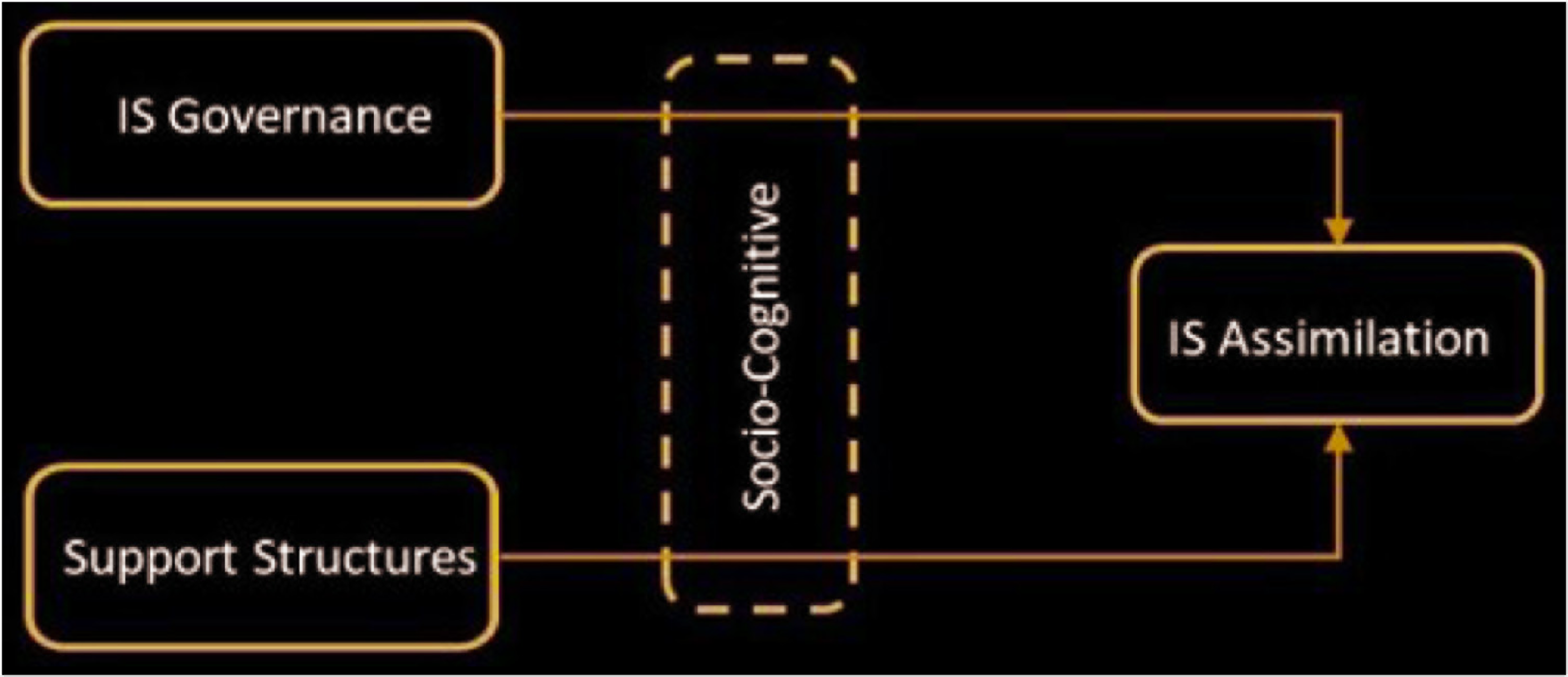
We formulated a broad research framework for evaluating IS assimilation level, using IS governance mechanisms and support structures along with the socio-cognitive processes as shown in Figure 1.
IS Assimilation Themes
We could decode the following themes regarding IS assimilation from the interviews.
Exploring newer technological domains: Some organizations have proactively adopted the latest technological trends and technologies such as Robotic Process Automation (RPA) processes and Artificial Intelligence (AI). They have also explored innovative solutions to streamline customer and vendor experiences while most others have not initiated any significant improvements.
Right now, we are trying to work out something on artificial intelligence, machine learning, robotic processes automation. (DGM [IT, Sales Distribution], Org A.
Many places we are not using standards. Secondly, whatever was implemented at the time of implementation, has remained basically the same. (Senior Manager [Finance], Org B1.
Configuring add-on modules: Most of the organizations have implemented add-on modules, such as SRM, BI, Advance Planner and Optimizer (APO) and customer relationship management (CRM). But only a select few organizations were using these modules to their full potential.
As a user, I am not finding the SRM system to be user-friendly to start with. Of course, it is powerful, but with regard to public sector usage, sometimes it is cumbersome. (DGM [Purchase, Materials Management], Org B1.
So, through BI analysis, we can dissect some of the data, and as for BI reports, what management wants, we are giving. (DGM [IT], Org B2.
Inter-organizational integration: A few organizations pursued integrating the enterprise system for inter-organizational information exchanges and information technology-operations technology (IT-OT) integration. In contrast, others have not yet thought about these improvements.
We have integrated our Lab’s information management system for the shipment results with our ERP. We can connect shipment with the quality. (Chief Manager [IT, Production Planning], Org A.
I am not aware of any inter-organizational data inter-change, but nothing constructive has been done. That’s why the process we are following is still the same as when SAP was implemented in 2010. (Senior Manager [Finance, Finance, and Costing], Org B1.
Management information system richness: A few organizations exploit BI systems’ functionality for crucial management decision-making and benchmark their performance against industry standards. However, others are content with poor information quality and MIS reports’ restricted use for operational and strategic decision-making.
In sales also, we have different reports to compare my performance with industry performance. Our business intelligence (BI) module has industry figures also. (Chief Manager [IT, Sales and Distribution], Org A.
I would like to say that we are planning to implement a business intelligence (BI) module. Presently, some implementation is there, but it’s not fully functional. It’s just a basic report for working managers. (Assistant General Manager [IT, Sales and Distribution], Org B1.
Concern for stakeholders: Some organizations demonstrate concerns towards their key stakeholders, such as vendors and customers, by widening their technological offerings to increase their convenience.
So, we are actually working on developing mobile applications, which are primarily meant for our vendors, and the idea is that they should be able to get the complete details of all their transactions. (DGM [IT, Materials Management], Org A.
Like, for silly requests, we are going to IT, like, we need one more column for this particular report, so they are generating and giving. So, for those small queries, they should give us in self-service type. (Senior Manager [Marketing, Sales and Distribution], Org B1.
Business process re-design: Most of the organizations did not undertake business process reengineering but mapped the essential operational activities as per the existing workflows. However, very few challenged the status-quo and experimented with new processes and work system improvements.
Yes, one of the biggest advantages of bringing-in the crude procurement on the digital platform is that because the final ranking is automated, we get the ranking generated within two hours. (DGM [IT, Materials Management], Org A.
I would say there are not many requests regarding process changes…mainly, the requirements are changed in the formats of reports or forms. (Senior Manager [IT, System integration and Administrator], Org D.
Nature of requirements: Most of the organizations facilitated the internal stakeholders by providing operational support with minor improvements or incremental changes to the existing processes, but others took the challenging assignment and completed it.
So, if there are certain issues with respect to the market—somewhere the market share is going down—so that’s an external thing affecting the business, which in turn is affecting us. We try to figure out which technology will solve this issue. (DGM [IT, Materials Management]), Org A.
So, it came that ok, we have to reduce the paper consumption. So, to cater to that requirement, we have developed a system for online note-sheet and files. (Manager [IT, Plant Maintenance], Org CB.
Audit purpose: Most organizations undertook audits mandated by the government. Organizations are not proactive in looking for ways and means to improve their existing systems.
IS Governance themes
Existing literature has identified the IS governance mechanisms, such as requirement gathering (Lane et al., 2016), environment scanning (Mu et al., 2015), interpretation (Plambeck & Weber, 2010), evaluation (Pandey & Gupta, 2018), planning, action monitoring (Benaroch & Chernobai, 2017), and organizational rules and procedures (de Vaujany et al., 2018), IS resources (K.-C. Chang & Seow, 2016) that are the foundation for the effective administration of enterprise systems. We could decode the following themes regarding IS Governance from the interviews.
Scanning/Requirement gathering: Organizations must process information from and about their environment, which is likely to affect organizational activity and performance. However, the level of maturity widely varied across organizations.
We also use the enterprise project management (EPM) tool, where we adopt this work breakdown structure (WBS) structure where the complete project is broken down. (DGM [IT, Materials Management], Org A.
Yes, I suppose the application development team just keeps a register of the requirements in which they enter the requirements that were sent to them from the end user. (Senior Manager [IT], Org D.
Interpretation/Evaluation/Intersubjective meaning among business and IT teams: One of the most common issues mentioned by most organizations is the challenge in developing a shared interpretation between the functional, business and IS personnel, and to assess its relevance to the organization. However, a few organizations have set this as their strength.
So, we put it on the internet, and we keep it updating it on the internet, like issue closed, work in progress, etc. This is the kind of transparency. (GM (IT, CIO), Org B2.
So, they [IT team] don’t really understand the role they are supposed to play in this whole thing is…. That’s why the negative thing about emerging technologies and a lot of confusion. (Senior Manager [Finance, Finance and Costing], Org B1.
Monitoring and feedback: Some organizations have implemented external tools such as enterprise project management (EPM) for managing IS projects and software development life cycle (SDLC) management for establishing a repository of all functional and technical documents. Similarly, some organizations are using a few web applications, such as a self-service portal, to engage the stakeholder for monitoring IS issues and projects.
There is no such system-defined monitoring. We have to follow up with the ERP team’ manually. (Senior Manager [Finance, Finance and Controlling], Org B1.
And every day, we are monitoring the incidents, and it is being raised through the concerned functional group, whether is related to MM or FI. (DGM [IT]-IT Head, Org CB.
Organizational rules and procedures: The rules and procedures in a public sector organization require compliance with the provisions, which sometimes makes them cumbersome and difficult to implement in enterprise systems. Ambiguity in interpretation further complicates the matter. However, some organizations overcome it by aligning themselves, while others remain struggling.
But in the public sector, we have many procedures. Compliance with procedures is a big problem in ERP. (DGM (Purchase, Materials Management), Org B1.
Here, I mean, if you can convince your boss and he finds merit in whatever you are doing, it is just a matter of creating a proposal, getting the funds, doing the tendering, going ahead, and doing the execution… (DGM (IT)-IT Head, Org CB.
IS resources: Availability of IS resources is an issue in some organizations because IS’s role in overall functioning is still not etched out.
High means… it is very high expectations from IT, but things are like, that, in our organization, we have limitations regarding fund allocations. (AGM [IT]-IT Head, Org D.
See, we have some people who are only handling the day-to-day issues, we are having some people who are handling projects job, so set of people are different. (Chief Manager [IT, Sales and Distribution], Org A.
Support Structures Themes
Scholars have studied support structures, such as help-desk(Ann Sykes, 2015), service-desks support, functional and technical documentation (Scott, 2008), training (Schlosser et al., 2015), information sharing (Li et al., 2020), inter-organizational and cross-organizational interactions (Thiede et al., 2018), top management support (Dubey et al., 2018), online support mechanisms (Hwang & Krackhardt, 2020), documentation, and online repository (Hyun Kim et al., 2016). We could decode the following themes regarding support structures from the interviews.
Service desk/helpdesk support: Some organizations have implemented service desk applications to capture end-users issues or seek new requirements. It provides a common medium to understand the end-user requirements and establish a communication channel with them.
Mostly, in my case, it is the personal touch, and my products are my module standard products. From time to time, I interact with them. (DGM [IT, Plant Maintenance], Org B1.
All users have the access they can raise the incident either through the employee self-service portal or through ERP login. They can attach the screenshot, that way. (DGM [IT]-IT Head, Org CB.
Interaction opportunities, collaboration: The positions and interests of various stakeholders, such as the business interests of the top management team and the operational requirements of the end-users, need to be acknowledged. Communication among participants broadens one’s perspective, which encompasses the learning and experiences of others.
We sometimes give our frank opinion, but at the cost of your relationship. I do say, but it has cost me a lot. (Senior Manager [Finance, Finance and Costing], Org B1.
Besides that, we are always a party to their business council meets. So, there also we present what we would like to do as an IS initiative. So, it’s always a joint decision. (Chief Manager [IT, Sales and Distribution], Org A.
Top management support: Top management’s involvement is the prime driver in stimulating the organization to take up challenging assignments and carry out innovative developments. We observe a mixed involvement of top management.
Being in this trade, the top management team keeps interacting with different transporters and customers. Suppose, if some customers say that they have given his feedback and there is no response from the IT team, then it will be an awkward face on us. (Chief Manager [IT, Sales and Distribution], Org A.
As far as I see, it is very rare that top management gets into all this kind of things unless there is some issue that has not been sorted it out. (Senior Manager [IT, System Integration and BASIS], Org D.
Involvement of external agencies/consultants: Consultants and solution providers are aware of the external world and carry information that is generally inaccessible to the individual organizations. However, some organizations depend solely on them while in-house IT skills get waned.
Yes, I mean, this year, we have placed a contract with KPMG to study the existing systems. So they are doing a thorough study, finding out loopholes, if any. (DGM [IT, Material Management], Org B2.
Actually, when we have signed this contract with our vendor, it has become a bit easier. So, we usually have one person on whom we depend for the solution to our issues. (AGM [IT, Material Management], Org B1.
Training for core-team and end-users: Enterprise systems, being complex systems, demand continuous refresher training for the end-users and the core-team alike. However, most organizations have ignored this important process of knowledge enrichment.
Usually, what happens, we have formal training sessions, you can say we have continued this process for many years. (DGM [IT, Sales and Distribution], Org B2.
I feel that all the functional people in this ERP department should be given proper training regarding the configuration and other things. (Manager [IT, Materials Management], Org CB.
Documentation; knowledge management: One of the shortcomings noticed in most organizations is the absence of proper documentation in the post-implementation phase. Most organizations hardly make use of knowledge management processes.
We have an issue tracker. So, any issue which comes, it is mentioned there. Any change in the program that we do, it is mentioned there. (DGM [IT, Materials Management], Org B2.
So, like you are asking about knowledge repository? No, we don’t have an online knowledge repository, but we do sometimes document what activity we are going to perform. (Senior Manager [IT, System Integration and BASIS], Org D.
Organizational learnings, and technical and functional knowledge: Most organizations have expressed concerns regarding poor technical and functional knowledge as one of the prime roadblocks towards enterprise systems assimilation.
So, what is happening, every time we are running behind the technological schedule. People are on a better platform than us. We are basically getting into the platform when it is almost into the stage of obsolesce. (Senior Manager [Finance, Finance and Costing], Org B1.
Whether you talk of unified communications through Cisco jabber where you can share your screens, make a video call, and all that, or you may talk about the digitization in various processes, we use them all… (Chief Manager [IT, Sales and Distribution], Org A.
Transfer of functional core members: Core teams, especially the functional team members, are being transferred back to their parent departments without proper knowledge transfer.
The people who were looking after the Suppliers Relationship Management module were suddenly transferred to the plant. There was, as such, no knowledge transfer. We could not utilize whatever hard work they had done. (AGM [IT, Materials Management], Org B1.
Socio-cognitive Factors Themes
The existing literature has identified the socio-cognitive factors, such as organizational culture (Shao, 2019), personal innovativeness in IT (Xixi et al., 2013), responsiveness to issues (Heshan et al., 2016), discursive abilities (Brown et al., 2017), cognitive abilities (Pirson et al., 2018), collaboration (Smolander et al., 2021), social and emotional engagement (Mueller et al., 2019), expectations from IT (J. Y. T. Chang et al., 2019) that can have a profound impact on the organization. We could decode the following themes regarding socio-cognitive factors from the interviews.
Organizational culture: Organization culture plays a significant role in shaping the behaviour of the people. Working in the public sector is quite bureaucratic, which, when coupled with laxity and poor discipline, becomes a cause for concern.
My boss has told me about this job. I will do that. I will not look beyond that. (AGM [IT, Materials Management], Org B2.
So, this is something which is really unique to our organization that it gives a lot of autonomy, a lot of freehand, as far as pursuing your innovative dreams are concerned. (Manager [IT, Plant Maintenance], Org CB.
Responsiveness to issues; Operational support/monitoring: Responsiveness denotes the speed and quality of support to stakeholders in their operational work, on account of changing business conditions, operational issues or customer interactions.
So, any issues which are coming, even before the users are apprising us, we are aware of and usually the action starts immediately, the moment we find that there is an issue. (DGM [IT, Sales and Distribution], Org A.
My workforce has reduced; my work has increased. So, I don’t have much time to monitor all the activities. (Senior Manager [IT, System Integration and BASIS], Org D.
Social awareness: Social awareness plays a significant role in developing a collective synergy of the teams. Opportunities for social gatherings and informal interaction within and outside the office help bring the best out of the people (Quaglia et al., 2015).
Informal settings are best for these kinds of discussions where people can freely and frankly discuss whatever comes to your mind when we are actually thinking of development. (DGM [IT, Sales and Distribution], Org A.
I have seen persons who generally don’t want to hear to the problems because the first thing to solve a problem is to accept that there is some problem. (DGM [Purchase, Materials Management], Org B1
Emotional engagement: Employee engagement means the emotional commitment the employees exhibit for their organization. It is concerned with emotions and feelings towards the team members and organizational stake-wholders. Cultural values and behaviours affect the feelings and emotions of colleagues and peers.
It’s like, my team, we work like my family, so I am very closely related to my people. (Manager [IT, Materials Management], Org CB.
From my perspective, emotions, to some extent, are OK, but you have to be logical. If people are emotional, I think it is not good for the individual as well as for the team. (Senior Manager [IT, System Integration and BASIS], Org D.
Reward and recognition opportunities: A culture of continuous recognition and appreciation keeps the team morale high and brings about more productive work.
See, frankly speaking, there is very little scope for rewards if you see from the company’s position. But recognition is one which we look for. DGM [IT, Materials Management], Org B2.
Every year, I mean, General Manager award is there, like every year, around 15th Aug & 26th Jan, people are awarded for their excellent contribution. DGM [IT]-IT Head, Org CB.
Collaboration/Collective working: Enterprise systems thrive on collaborative practices. The inter-dependence of modules requires a free exchange of knowledge and information across functional and technical experts.
Team pooling helps, but there are only a few contributors in team pooling, headcounts are more. (AGM [IT, Materials Management], Org B1.
Yes, say, for example, if it’s a new business scenario, then the IT team and business team both sit together for any configuration-related issue. (DGM [Purchase, Materials Management], Org A.
Expectations from IT: Most of the organizations mentioned the IS team’s low expectations and the little importance to the IS department vis-à-vis other prime manufacturing departments.
To be very frank, we are a mining organization. So, our bread and butter is mining. IT is just a service that is there to help you out in easing your work… (Senior Manager [IT, System Integration and BASIS], Org D.
Top management is well aware of IT’s potential, and they are always very demanding about getting new things from the system… (DGM [IT]-IT Head, Org CB.
Summary of the Findings
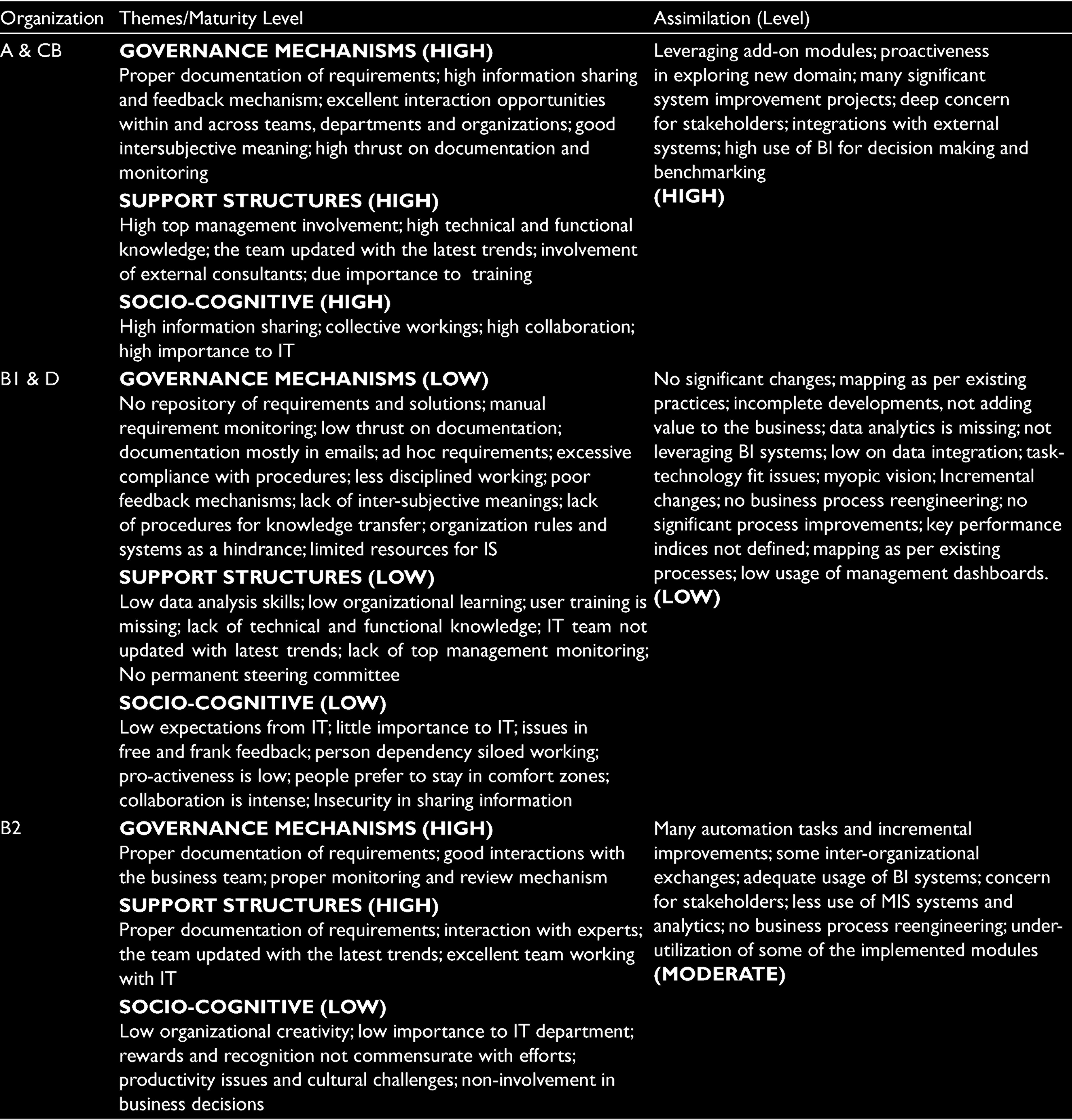
Based on the analysis, we present the summary of the themes related to our study’s constructs in Table 7. The summary of the findings have been displayed using the maturity levels High, Moderate and Low. For uniformity of classification, the levels such as Systematic, Open, Extensive, Flexible and Challenging are grouped with High levels of maturity and the levels such as Adhoc, Formal, Minimal, Rigid and Minor are grouped with Low level of maturity. Intermediate has been grouped with Moderate level of maturity. In organizations A and CB, we can infer that the maturity levels of IS governance mechanisms, support structures and socio-cognitive processes were at high levels. We could also infer that the IS assimilation level was relatively high. On the other hand, in organizations B1 and D, IS governance and support structures mechanisms’ overall maturity levels were low, including the maturity level of socio-cognitive processes. We could infer that the level of IS assimilation was considerably low. However, in organization B2, the maturity levels of IS governance and support structures were high, but the socio-cognitive processes were low. Interestingly, the level of IS assimilation was moderate. Table 7 summarizes our analysis of the overall findings.
Summary of Findings.
Discussion and Implications
All the firms in our study are large central public sector enterprises belonging to the Government of India. Past research has concluded that large public sector organizations in India have demonstrated low IS success levels (Goh & Arenas, 2020). However, our research has brought forth that large public sector organizations can also achieve higher assimilation levels by adopting better IS governance mechanisms and institutionalizing better support structures. The presence of favourable socio-cognitive processes enhances such assimilation.
The firms A and CB, which have high levels of IS governance mechanisms and high levels of support services, demonstrate higher assimilation levels when the socio-cognitive processes are high. Similarly, in firms B1 and D, where the IS governance mechanisms, support services and socio-cognitive processes were all low, the IS assimilation level is also low. However, in firm B2, in-spite-of high levels of IS governance mechanisms and high level of support services, it has shown moderate assimilation levels. On further analysis, it became clear that the socio-cognitive processes play a critical role in the process.
We also analyzed the data from an industry’s perspective. We found that firm A, which belongs to the oil industry, has shown high IS assimilation levels. Similarly, the firm CB, a joint venture of two companies (B and C) belonging to a different industry, has a better assimilation level than the organization B1, which belongs to company B alone. We can attribute such differences among the firms to the influence of industry-level factors. Surprisingly, we found that the two firms B1 and B2, even though belonging to the same parent organization, show different IS assimilation levels. Therefore, we posit that individual and organizational level social mechanisms rather than industry-level mechanisms affect the assimilation level. Hence, we assert that organizational-level processes such as IS governance mechanisms and support structures better explain the IS assimilation of enterprise systems in organizations. The socio-cognitive processes manifest as individual and organizational factors that operate at the firm level and act as essential levers for IS assimilation.
Implications for Research
Despite a very long tradition of IS research in enterprise systems assimilation, the long-term organizational benefits are still low in most public sector organizations. This study explores new antecedents of IS assimilation by looking at it through the combined lens of IS governance mechanisms, support structures and socio-cognitive processes, and it derives valuable insights out of it. Our research work has confirmed the positive association of IS governance mechanisms and support structures with IS assimilation in the post-implementation phase. Our research posits that both IS governance mechanisms and support structures are crucial for higher IS assimilation levels. Further, our study asserts that socio-cognitive factors play a significant role in deciding IS assimilation level. Despite mature governance and excellent support structures, IS assimilation was still moderate because of the socio-cognitive influence. We need to explore further the plausibility of a moderating relationship played by socio-cognitive processes. In public sector organizations, the significance of relational IS governance mechanisms (such as inter-subjective meanings) over procedural and structural mechanisms (such as rules/procedures and steering committees respectively), highlight the importance of well-developed support structures along with socio-cognitive processes as a significant dimension to be explored in the quest of IS assimilation. Studies can also explore the symbiotic relationship between relational IS governance mechanisms and support structures. This paper has identified a rich set of themes corresponding to the IS assimilation, governance mechanisms and support structures in large Indian public sector enterprises, which shall form a bedrock for further research in this domain.
Implications for Practice
Regarding managerial implications, public sector organizations can use these findings to pay special attention to the IS governance and support structure strategies to align them with their long-term vision and short-term commitments. These are important but not sufficient to realize the full benefits of enterprise system implementations. Managers need to give special attention to the socio-cognitive processes, which manifest as individual and organizational social mechanisms that affect IS assimilation in the organizations. For instance, organizations may critically reflect upon their existing norms and practices of human resource management and adopt mindfulness-based initiatives as part of the training interventions. They may also analyze the individual and organizational factors that aid in the assimilation process and may suitably reframe their policies, organizational rules, procedures, and managerial practices and systems to align it on similar lines as that of other organizations that are leveraging the IS benefits. Our research work shall help organizations plan and enact interventions such as process improvement workshops and shop improvement projects to fulfil the demands of various stakeholders, both within and across units and at different levels, to achieve better IS assimilation.
Limitations of the Study
This study’s results can be generalized to similar organizations in India and possibly across all public sector enterprises in developing countries. A more exhaustive sampling covering at least two firms from each of the primary industry segments could have resulted in better generalizability of the findings. This would have helped in contrasting the phenomenon across different industries. During our purposeful sampling at a firm level, it was impossible to cover individuals from all the functional areas, such as the IS core team, end-users, top management, IS consultants, and all the organizations’ functional levels. Had it been possible, a dyadic analysis between IS users and their corresponding business counterparts could have given an accurate picture of the assimilation for triangulation purposes. Access to Chief Operation Officer or Chief Executive Officer in the organization could have enriched the study with an overview of governance mechanisms, support structures and socio-cognitive processes from the top management’s perspective. As a result, we were unable to gain a holistic opinion of all the stakeholders to determine the organizations’ assimilation level.
Conclusion
This study’s results reveal that some organizations with better organizational procedures for requirements gathering, evaluation, monitoring and feedback communication mechanisms, and excellent support structures can benefit more from their enterprise systems implementation. Similarly, organizations with better socio-cognitive and emotional engagement with stakeholders have shown higher assimilation levels. Our firm-level analysis has helped us contrast the IS success phenomenon across firms and has identified the themes enacted through the individual and organizational social mechanisms, thereby impacting the IS assimilation.
Like other organizations in the private sector, large public sector organizations in India face an ever-changing business environment and unpredictable challenges that require constant attention and interventions. It encompasses the entire sphere of the expectation-planning-action-feedback gap, which occurs due to breakdowns, discrepancies, surprises or opportunities. Such gaps present a challenge to decision-makers at all levels in making sense of the data. Further research based on IS mindfulness and IS sensemaking perspectives should help understand the complex phenomenon of IS assimilation.
The socio-cognitive process is an emerging organizational behaviour that is gaining attention in IS studies. Heightened awareness about the emerging situation and attentiveness to the present moment effectively handle the dynamic complexities and the continuous influx of requirements and issues. Cognitive elements, such as personal innovativeness in IT, emotional engagement and attentiveness, play a pivotal role in understanding the enterprise systems assimilation conundrum. We suggest that further studies using the lens of IS sensemaking shall help identify and strengthen the organizational processes related to IS governance and support structures, which are crucial for IS assimilation. Further research using both these lenses together shall also help identify the triggers, facilitators and hindrances, which affect the IS assimilation in organizations.
Footnotes
Declaration of Conflicting Interests
The authors declared no potential conflicts of interest with respect to the research, authorship and/or publication of this article.
Funding
The authors received no financial support for the research, authorship, and/or publication of this article.
Semi-structured Interview Questionnaire
IS Assimilation
What is your overall assessment of success of ERP in your organization? What major new initiatives or process innovations have been completed in the last few years or are planned in the near future? Has any inter-organizational data integration been pursued? Are you aware of the unfulfilled requirements during the initial implementation? Have any third-party or government audits done on your ERP implementation? What are the challenges in carrying out the recommendations? What is the general nature of requirements?
IS Governance Mechanism
What are the mechanisms for the generation of IT requirements? How do you convey your ERP-related expectations/requirements to the IT team? What opportunities are available to you to express your opinions/ thoughts or seek others’ opinions about the work system improvements/strategic initiatives in ERP? Do technology and business teams understand each other requirements? What are the challenges? What is the mechanism for documentation of requirements and processes? What are the mechanisms/procedures for the evaluation of the requirements? What is the procedure for monitoring progress? Do you have an ERP steering committee to review the progress? What are the mechanisms for capturing the stakeholder feedback during and after development?
Support Structures
Is there some formal committee within your department or steering committee for the finalization of requirements? Do you involve external consultants/solution experts to review the system and recommend scope for improvements? How are the communication and interactions in briefings and meetings? How often do you have the opportunity to participate in large-scale interactions within the organization? Are there opportunities for cross-organization interaction? What are the mechanisms for inter-organizational knowledge/best-practices sharing? Are people encouraged to express different views?
Socio-cognitive Processes
Are you able to give free and frank feedback towards improvements in systems/processes? What crosses your mind before expressing your thought in the presence of your superiors? How curious are you about the new features or the unexplored features in ERP? Do you like accepting challenging ‘stretch’ assignments. Have you experimented with any new thing in ERP? Are you aware of how your contemporary organizations are putting the use of ERP in their work? What is the mechanism for the escalation of issues/ requirements? Can the issues be moved directly to the experts bypassing the hierarchy? Do the team pool-in/ deep dive their knowledge to provide solutions to the challenges? How is the knowledge assimilation capability of your teams/department? Is the team up-to-date with the new technological features? How does the team respond to novel situations? How often do you challenge the status quo? Are you able to suggest reliable alternatives?
Mapping of High-level Themes With the Measurable Constructs.
| High-level Themes | Measurable Constructs | |
|
|
Process optimization/significant work system improvements | System improvement projects; |
| Business process re-engineering | ||
| Proactiveness in exploring new domains; | ||
| Business process changes | ||
| Leveraging add-on modules | ||
| Concern for stakeholders | ||
| Inter-organizational integration | Information Technology–Operations technology (IT-OT) integration; Inter-organizational integration | |
| Management information system richness | Usage of management dashboards | |
| Leveraging business intelligence module | ||
| Key performance indices definition | ||
| Information for operational and strategic use | ||
|
|
Inter-subjective meaning | Business-IT meaning-making |
| Scanning, requirements gathering, and interpretation | ||
| Evaluation, monitoring, and feedback | Evaluation | |
| Action, monitoring, and feedback | ||
| Organizational learnings | Documentation of requirements/knowledge Management | |
| procedures for knowledge transfer | ||
| Information sharing and feedback mechanism | ||
| Interaction opportunities within and across teams | ||
| IS resource management | ||
|
|
Innovation and creativity/alertness to distinction | Openness to novelty; updated with latest trends |
| Responsiveness to issues, operational support, and monitoring | ||
| Top management support | Top management involvement | |
| Multiple perspectives | Involvement of external consultants/ subject matter experts | |
| Cognitive capability | Technical and functional knowledge | |
| Regular training for end-users and IT team | ||
|
|
Organizational creativity | Openness to novelty, alertness to distinction |
| Responsiveness to issues | Operational support and monitoring | |
| Person dependency/Siloed working | ||
| Openness and transparency; social mechanism | Free and frank feedback | |
| Collaboration/Collective working | ||
| IT function value | Expectations from IT/Importance to IT/Involvement of IT in business decisions | |
| Emotions and identity | Rewards and recognition |