







Abstract
Despite a plentiful supply of organic food in emerging economies, consumers are slow to adopt sustainable organic food behaviors. India is one of the top five nations in the world in terms of the total amount of agricultural land that is certified as organic, but the domestic organic consumption in the country itself is really sparse. Using the framework of the theory of reasoned action, this investigation explores how customers’ perceived values (health and hedonic values) influence their attitude toward purchasing organic food. Also, it elaborates on the moderating effect of media exposure to food safety issues to know its strength in the attitude–intention relationship. This research utilized PLS-SEM to analyze the structural relationships among the constructs, with 202 responses from consumers in India. The study found the strongest influence of hedonic value over health value and subjective norms on the green purchase attitude of consumers. To the best of our knowledge, this is the first study that investigated the moderating effect of media exposure on food safety issues on consumers’ attitude–intention relationship in a developing nation context. The study highlighted that people who have regularly been exposed to food safety related issues around them are more willing to buy organic food. Thus, it contributes to a more robust attitude–intention relationship among customers toward the purchase of organic food.
Introduction
The quest for organic food has skyrocketed in the past decade worldwide, as people become more health conscious and curious about where their food comes from (Liang et al., 2022). In addition, consumers also ensure that their food selections significantly address their health issues or health-related goals (Silchenko & Askegaard, 2020). Recently, it has been apparent that in addition to health concerns, a hedonistic or "me-centric" aspect is rapidly becoming a criterion for buying decisions in organic food consumption in developed nations (Anisimova, 2016). However, developing nations are also not lagging behind in considering hedonistic motives as an important basis for forming decisions on sustainable food (Ghali, 2020; Ghazali et al., 2017). Thus, consumption of organic food items is not just confined to only health-conscious individuals (Mohammed, 2021). There are certain other factors that also drive individuals to consume organic food in developing economies (Kirmani et al., 2022). It also involves emotional and psychological considerations that go beyond the product’s use (Basha & Lal, 2019). Furthermore, when nutritious organic food is socially valued by society and peer groups, consumers are more prone to buy it for themselves and their families (Nandi et al., 2017; Shin et al., 2018). Therefore, organic food choices are gaining momentum day by day (Roh et al., 2022).
As per a recent survey conducted by Willer et al. (2022), the total retail sales of organic products were around 121 billion euros in the year 2020 around the globe, and developed countries acquired around 90% of the total retail sales (Kashif et al., 2021). Among the developed nations, United States organic product market recorded an unprecedented sale of 49.5 billion euros as a single market in 2020, Germany was at second place (15 billion euros), France at third place (12.7 billion euros), and the whole of Asia with recorded sales of 12.5 billion euros (Willer et al., 2022). On the other hand, India is among the top five nations in the world regarding the total amount of agricultural land that is certified as organic (Willer et al., 2022), but the domestic organic consumption in the country itself is really sparse. The number of organic producers in India is the greatest worldwide, accounting for almost 1.6 million organic producers, followed by Thailand with 97,000 organic producers (Willer et al., 2022). In addition to this, India is among those Asian countries which export organic food to the developed nations like the USA, EU, Canada, and Switzerland and is left with a domestic sale worth only 3.0 lakh metric tons (Agricultural and Processed Food Products Export Development Authority, 2018). As a result, the Indian organic food market is still in its infant stages and is not considered as a viable option by the entirety of the population (Dangi et al., 2020; Kautish et al., 2022; Paul et al., 2016; Yadav & Pathak, 2016). Furthermore, it seems a paucity of theoretical and empirical research on organic food buying behavior in growing economies, such as India as compared to affluent nations (Kirmani et al., 2022; Kushwah et al., 2019). Furthermore, most research studies have not paid attention to research on how customer perceptions of value affect organic food purchase attitude in India, as most researchers have focused mostly on marketing aspects such as product labels, retail store reputation (Nandi et al., 2017), product knowledge (Manohar et al., 2012), trust in certification (Dangi et al., 2020), availability and price (Singh & Verma, 2017), sales promotion, and store environment (Husnain et al., 2019). In addition to this, existing studies in India mostly focused on general green buying behavior such as general green products (Jaiswal et al., 2021; Kirmani & Khan, 2018; Paul et al., 2016; Yadav & Pathak, 2017); general organic food buying behavior with no clarification on the type of organic food products (Basha & Lal, 2019; Kirmani et al., 2022; Matharu et al., 2021; Singh & Verma, 2017). It is important to define that consumers’ preferences for each category of green products may be quite different. For example, consumers may value functionality more in electric vehicles, whereas the same consumers may value hedonistic experiences more in organic clothing choices. In order to fill this need and to bring more clarity regarding specific consumer values behind choices of organic food, it was decided to focus on organic fruits and vegetables (OF&V) as a subset of organic food within the framework of green products for this specific research (Jose et al., 2020; Kamboj & Kishor, 2022; Nandi et al., 2017).
A lot of studies explored the behavioral inconsistencies among consumers toward organic food buying by including moderating variables such as availability (Mohammed, 2021), uncertainty (Teng & Lu, 2016), personal values (Hansen et al., 2018), social desirability (Hwang, 2016), food-related personality traits (Chen, 2007), and future orientation (Chekima et al., 2017). Nevertheless, Kushwah et al. (2019) emphasized that media exposure to food messages can act as a unique motive behind purchasing organic food among emerging nations. Although the media has a significant role in molding consumers’ perceptions regarding organic food, its effectiveness is magnified when it is linked to food-related concerns (Palen, 2008). Pham et al. (2019) emphasized that media exposure to food messages such as food safety issues have a strong influence on consumers’ attitude toward organic food. You et al. (2020) elaborated that perceptions of people are certainly shifted positively toward organic food when they are exposed to food-related issues via mass media like TV, radio, YouTube, Facebook, etc. Therefore, we argue that media exposure to food safety issues will strengthen the association between green purchase attitude (GPA) and green purchase intention (GPI) toward organic food. So far as we know, it is the first investigation that looked at how media coverage of food safety issues affects the association among consumer attitudes and intentions in a developing country.
For this research, the theory of reasoned action (TRA) has been chosen as a theoretical lens, as it has been proved to be a valuable theory in predicting consumers’ green purchase intentions throughout the world. Several scholars from developed nations have investigated green consumption behavior with the TRA approach globally, such as recycling behavior (Davies et al., 2002), electric vehicles (Nosi et al., 2017), green purchase consumption (Coleman et al., 2011), and green products (Liu et al., 2017), while research focusing on the TRA approach to predict organic food consumer behavior specifically in emerging economies like India is really scanty (Kamboj & Kishor, 2022; Kautish et al., 2022; Paul & Rana, 2012). In an effort to broaden the scope of the traditional TRA, we incorporated customer-perceived values (health and hedonic values) as a component of the current research model alongside the subjective norms, GPA and GPI, which are not being significantly exploited in the Indian scenario. In order to fill the gap between attitude and intention, this study explored the moderating effect of media exposure on food safety issues within the attitude-intention link, which is considered a novel contribution of this research. With the above backdrop from the existing literature as a starting point, this research will provide solutions to the questions posed:
What are the dimensions of customer-perceived values and how do these dimensions influence the green purchase attitude of consumers? Which customer-perceived value is the most triggering predictor of green purchase attitude among consumers? How does media exposure to food safety issues moderate the relationship between green purchase attitude and green purchase intention of consumers?
The findings of the research will suggest new and quick ways to stimulate consumers by reconstructing the market strategies among existing and prospective consumers in the fastest growing organic food market in India. Following outline constitutes the framework of this article. First, it will discuss the theoretical framework for the research model and hypothesize the relationship between variables. Second, methodology, data analysis, and findings will be highlighted. Finally, theoretical and managerial implications as well as some potential future research directions have been outlined.
Theoretical Background and Research Hypotheses
Several scholars have investigated green consumption behavior by utilizing the TRA framework. TRA was originally developed by Fishbein and Ajzen (1975), which claims that a person’s choice to adopt or not to adopt a particular behavior is dependent on his/her intention, which is reflected by his/her willingness or readiness to perform a given behavior. Accordingly, the key construct in the TRA model is behavioral intention, that is, willingness or readiness to adopt the behavior that is influenced by behavioral attitude and subjective norms. According to Ajzen (1991), attitude is a mechanism that helps an individual to develop a subjective evaluation of the asked behavior, whereas subjective norms refer to perceived societal influence to do or refrain from performing certain behaviors. Numerous academics have examined and supported Fishbein and Ajzen’s approach in diversified contexts, including recycling attitude (Davies et al., 2002), electric vehicles (Nosi et al., 2017), green purchase consumption (Coleman et al., 2011), green products (Liu et al., 2017), etc., while research in organic food, specifically in the Indian markets by using the TRA approach, are really sparse (Kautish & Sharma, 2019; Paul & Rana, 2012; Paul et al., 2016). Therefore, TRA has been chosen as the theoretical lens for this research.
Customer-perceived Values
In today’s competitive and rapidly changing consumer world, consumer values have become the most important determinant in predicting complex consumer behavior. Some perceived values may be more important to consumers than other dimensions of values (Zauner et al., 2015). Customer-perceived value is an evaluative judgment of products or services and showed a balance among advantages as well as disadvantages offered by them (Zeithaml, 1988). Several researchers conceptualized customer-perceived value as a multi-dimensional construct and found a significant relationship between its dimensions and attitudes toward a specific product (Ghali, 2020; Sweeney & Soutar, 2001; Zauner et al., 2015). Sheth et al. (1991) laid down the foundation by associating perceived values with social, emotional, functional, epistemic, and conditional values to predict the cognitive and affective states of consumer behavior. Moreover, Sweeney and Soutar (2001) found the association of perceived value not only with functional and quality aspects, but also showed the influence of enjoyment and pleasure (emotional value) and social pressure (social value) on consumption behavior. A recent study by Ghali (2020) found a significant impact of perceived values (hedonic and utilitarian) on the customers’ disposition to pay for organic food in Tunisia. Several scholars have reported the thrust of perceived health value in determining the consumers’ GPA in both emerged and emerging nations (Bauer et al., 2013; Ghazali et al., 2017; Kamboj & Kishor, 2022; Molinillo et al., 2020; Paul et al., 2016). Molinillo et al. (2020) highlighted the strong impact of perceived health awareness of consumers on the regularity of buying organic food in Brazil. Health consciousness has been emerged as an influential predictor of organic consumption behavior among millennials in Vietnam (Pham et al., 2019). So, this study suggests two customer-perceived values about health and hedonism that could affect GPA toward organic food in a growing economy.
Perceived Health Value
Organic food is acclaimed for its superior quality, delicious flavor, and natural, chemical-free safe products (Smith & Paladino, 2010). Those people who place a high priority on their health are more likely to exercise discretion about the foods they buy (Homer & Kahle, 1988). A systematic literature review by Nandi et al. (2017) proclaimed that the main reasons people buy organic food are for their fitness and wellness. According to Lithuanian research by Kavaliauske and Ubartaute (2014), consumers viewed organic food as being of high quality and nutritious, and as a consequence, they were willing to shell out more money for it. In previous studies, it appears to be the most powerful motivator for Indian customers to select organic food (Kamboj & Kishor, 2022; Paul et al., 2016). Health is being remained the topmost priority among consumers in both emerged and emerging countries (Bauer et al., 2013; Ghazali et al., 2017; Kamboj & Kishor, 2022; Molinillo et al., 2020; Pham et al., 2019). Consequently, the following hypothesis is put forth for consideration:
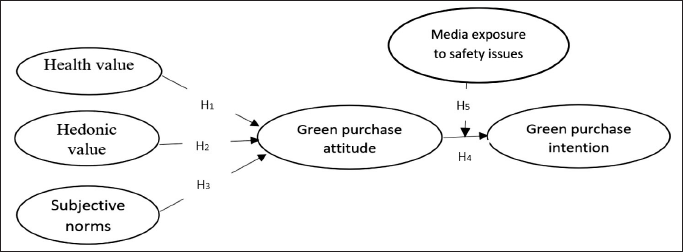
H1: Perceived health value has a positive influence on GPA of consumers towards organic food.
Perceived Hedonic Value
Hedonic value of organic food refers to the satisfaction and happiness one feels after eating it (Ghazali et al., 2017; Kamboj & Kishor, 2022). It indicates the sense of joy that may be obtained from the organic food due to its flavor, quality, and natural state (Maehle et al., 2015). Ghali (2020) determined hedonic value to be the biggest predictor of attitude in the context of Tunisia regarding organic olive oil. The author claimed that consumers are more interested in hedonic and emotional aspects of their food shopping experience nowadays. Therefore, hedonic aspects must be fully exploited to boost organic food consumption among consumers (Mohammed, 2021). The feelings of happiness from doing good work for society as well as for personal well-being influence consumers to cultivate an attitude of openness and acceptance towards organic food (Kamboj & Kishor, 2022; Wang et al., 2019). Hence, from the literature review, the following hypothesis is put forth for consideration:
H2: Perceived hedonic value has a positive influence on GPA of consumers towards organic food.
Subjective Norms
It refers to social or societal obligation that may be assumed by larger community including friends, peers, and family (Roh et al., 2022). People are becoming increasingly interested in purchasing organic food, not just for themselves but also for their families, if it is considered a socially desirable act as per societal norms (Nandi et al., 2017). TRA assumes subjective norms as an influential indicator of behavioral intention. The fear of social acceptance may enhance organic food consumption when they are being judged by their peers (Basha & Lal, 2019; Han et al., 2010; Tarkiainen & Sundqvist, 2005; Taylor & Todd, 1995). Although it has been studied in the Indian context and no significant association between subjective norms and behavioral attitudes has been found (Dangi et al., 2020; Yadav & Pathak, 2016), we argue that it may have an impact on GPA when investigating customer perceived values (Basha & Lal, 2019). On the basis of above premises, the following hypothesis is put forth for consideration:
H3: Subjective norms have a positive influence on GPA of consumers towards organic food.
Relationship Between Green Purchase Attitude (GPA) and Green Purchase Intention (GPI)
Attitude and intention are considered vital antecedents of consumer behavior in the domain of behavioral sciences (Dangi et al., 2020; Nandi et al., 2017; Paul et al., 2016). Numerous research has established a favorable association between attitude and intention (Basha & Lal, 2019; Kamboj & Kishor, 2022; Kirmani et al., 2022; Nasir & Karakaya, 2014; Roh et al., 2022; Schäufele & Hamm, 2018; Smith & Paledino, 2010; Sultan et al., 2020). A plethora of research has been done to judge the magnitude of attitude on the consumers’ intention for a wide variety of sustainable offerings, including general organic food behavior (Basha & Lal, 2019; Sultan et al., 2020), organic fruits & vegetables (Kamboj & Kishor, 2022), organic personal care products (Ghazali et al., 2017), eco-friendly shellfish (Wang & Somogyi, 2019), organic vegetables (Mohd Suki, 2018), fair-trade coffee (Maaya et al., 2018), and organically grown apples (Yamoah & Acquaye, 2019), organic olive oil (Ghali, 2020). Apparently, the following hypothesis is put forth for consideration:
H4: Consumers’ GPA has a significant influence on consumers’ GPI towards organic food.
Moderating Effect of Media Exposure to Food Safety Issues
Food safety issues and concerns are closely related to the green purchase attitude toward organic food, as people are much more concerned about the type of food they eat than ever before (Pham et al., 2019; Silchenko & Askegaard, 2020). The increasing number of food-related scandals and people’s strong concern for food safety have exponentially raised the popularity of organic food all over the globe (Wilcock et al., 2004). Consumers now use social media platforms in addition to television, radio, newspapers, etc., to learn more about healthy food choices, including organic food (You et al., 2020). Pham et al. (2019) found a direct positive relationship between media exposure to food safety issues and consumers’ purchase attitudes regarding organic food. According to Palen (2008), victims of food crises are now able to join social media to share their own experiences, which has led to changes in the cognitive, emotional, and intellectual behavior of consumers regarding food safety. Therefore, media coverage of food-related issues has a strong influence on consumers’ buying decisions, as it may change their perceptions and increase their propensity to consume organic food (You et al., 2020). Pham et al. (2019) stressed the need to push food-related scandals via mass media, as it appears to raise both customers’ interest and willingness to spend money on organic food. Kushwah et al. (2019) also identified media exposure to food messages as a unique contributor that may affect the behavioral intention of consumers, especially in emerging nations. Thus, the present study tries to explore its strength of influence on the association between customers’ GPA and GPI toward organic food. Consequently, the following hypothesis is put forth for consideration:
H5: Media exposure to food safety issues significantly moderates the link between GPA and GPI.
Figure 1 depicts a research model developed in accordance with the stated objectives and established relationships.
Conceptual Framework.
Research Methodology
This study focused on the Delhi NCR region of India, as it is considered one of the most advanced organic markets (Chandra & Rossman, 2020). A total of 350 structured online questionnaires were offered to respondents. The questionnaire was pre-tested, and a pilot survey was also performed with 30 respondents. Because of their high demand, organic fruits and vegetables were selected, as a more specific category of organic food in India (Nandi et al., 2017). Data from respondents ranging from 18 to 70 years were gathered via non-probabilistic purposive sampling method (Paul et al., 2016). One initial question was asked whether they knew about organic food or not to scrutinize valid respondents for this study (Pham et al., 2019). Data were purely collected through online mode via Google forms due to COVID-19 complexities during April to May 2021, and no physical contact was made with the respondents. The aims of research were explained to participants beforehand and were asked to share their opinions regarding organic food consumption. On ethical grounds, during data collection, participants’ identities and personal information were kept confidential. Also, no incentives were offered to the respondents, and they participated voluntarily.
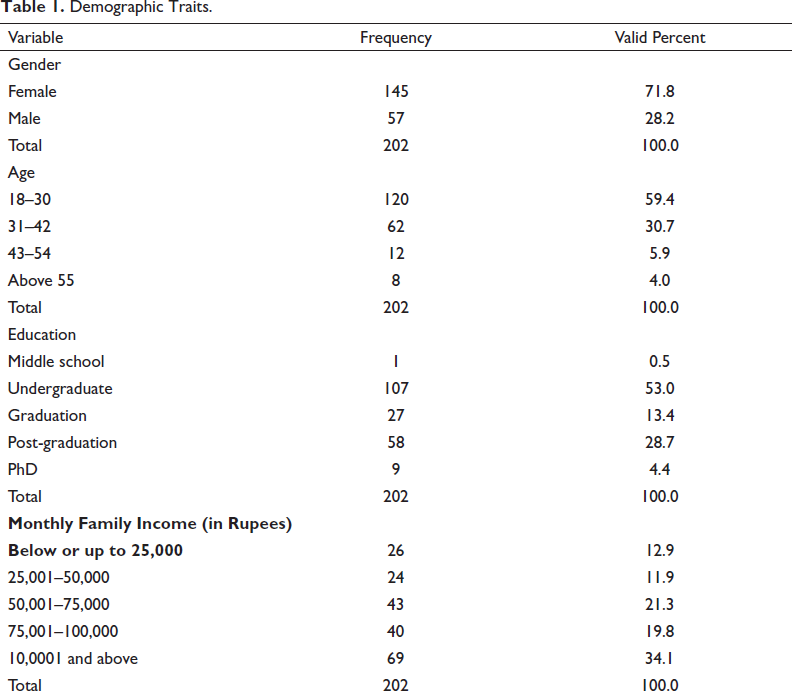
Data were gathered from 220 respondents, and finally, 202 valid responses were operationalized for data analysis after removing outliers and missing values. The study also utilized G*Power software to confirm the sample size threshold (Hair et al., 2019), which posited 89 responses, sufficient for this research. Table 1 highlights the respondents’ demographic characteristics.
Demographic Traits.
Measures
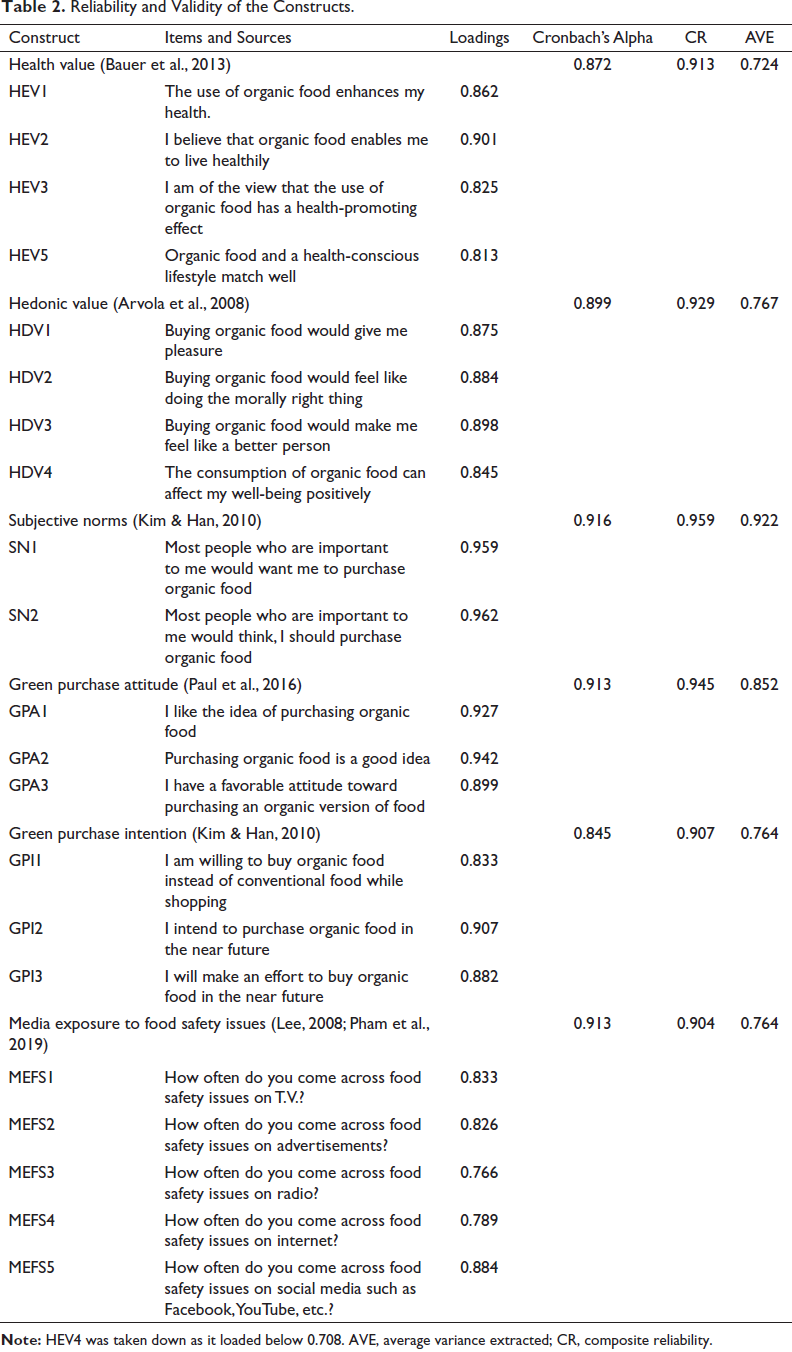
The established and validated reflective constructs were utilized for the study. The study employed five items to investigate health value (Bauer et al., 2013); four items to assess hedonic value from Arvola et al. (2008); subjective norms through two items by Kim and Han (2010); green purchase attitude with three statements given by Paul et al. (2016) and green purchase intention with three statements by Kim and Han (2010). A seven-point scale was employed for all questions, where 1 demonstrates “strongly disagree” and 7 indicates “strongly agree.” Media exposure to food safety issues was measured by five statements adapted from Lee (2008) and Pham et al. (2019). In particular, this construct was explored by asking questions on a scale ranging from 1 to 7, with 1 defined as “never” and 7 defined as “always.” Table 2 summarizes the proposed constructs and their underlying statements along with their validity and reliability.
Reliability and Validity of the Constructs.
Data Analysis
We employed PLS-SEM (partial least squares structural equation modeling) to assess the research model hypotheses. PLS-SEM has been used a lot in the domain of social sciences, especially in marketing management (Ali et al., 2018; Hair et al., 2012; Kautish et al., 2022), due to its better predictive relevance, higher statistical power, and suitability for testing theoretical models from a prediction perspective. Data were analyzed using the measurement model and structural model in PLS-SEM as per the recent guidelines suggested by Hair et al. (2019). Since the answers were given by the participants themselves, there might be chances of common method bias (CMB) in this particular research. As demonstrated by Podsakoff et al. (2003), Harman’s single factor test was utilized to control CMB. Therefore, this study has no CMB issues as a single factor explained only 48.18% of the variance, which was below the suggested limits, that is, 50%.
Research’s Measurement Model
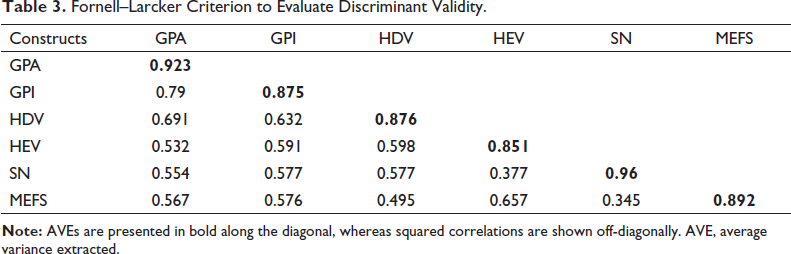
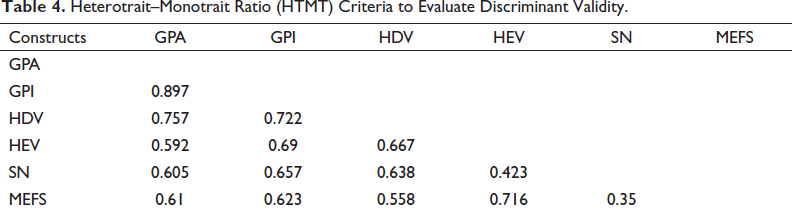
To evaluate measurement model’s indicator reliability, convergent validity, discriminant validity, and internal consistency reliability, a confirmatory factor analysis was carried out. Hair et al. (2019) suggested that convergent validity’s threshold of average variance extracted (AVE) must be more than 0.5, factor loadings must be above 0.708, and values for composite reliability (CR) and Cronbach’s alpha coefficient (α) must be above 0.7. Table 2 summarizes the results within the threshold limits. The Fornell–Larcker criterion was utilized to measure discriminant validity (Fornell & Larcker, 1981). The square roots of the AVEs for the constructs are more than the construct’s correlation along the diagonal, as described in Table 3. Together with the Fornell–Larcker criterion, we utilized a method that is considered to be neoconservative and it is called the heterotrait–monotrait ratio of correlations (HTMT) (Ali et al., 2018; Henseler et al., 2015). The findings show that the values of HTMT are less than 0.85 or 0.9, as suggested by Henseler et al. (2015) in Table 4.
Fornell–Larcker Criterion to Evaluate Discriminant Validity.
Heterotrait–Monotrait Ratio (HTMT) Criteria to Evaluate Discriminant Validity.
Structural Model
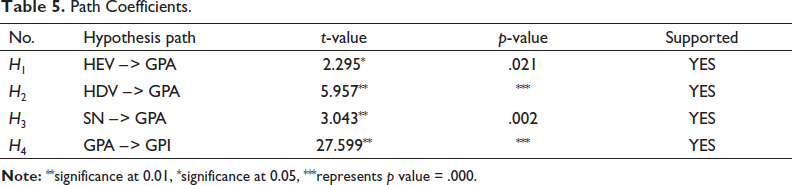
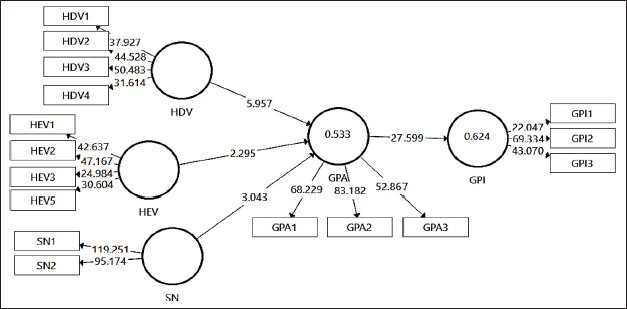
Before the evaluation of the structural model, we checked the issue of multicollinearity suggested by Hair et al. (2019). Therefore, we checked the values of variance inflated factor (VIF) among the constructs and all values were within the prescribed limits of 3.3 (Hair et al., 2019). Further, five hypothesized relationships were tested by employing Smart PLS 3.0. Table 5 and Figure 2 display the findings of the path coefficient, which shows hedonic value (β = 0.457, p < .01), health value (β = 0.175, p < .05), and subjective norms (β = 0.225, p < .01) are significantly associated with GPA toward organic food, contributing 53.3% of variance (R2) in GPA. Therefore, H1, H2, and H3 were supported. Furthermore, GPA (β = 0.79, p < .01) is significantly associated with GPI, contributing 62.4% of variance (R2) in green purchase intention. Hence, H4 is supported. Furthermore, Q2 values for endogenous constructs, that is, GPA (Q2 = 0.443) and GPI (Q2 = 0.469) were both more than zero (Hair et al., 2019), demonstrate that the model has adequate predictive significance.
Path Coefficients.
Structural Model Without Moderator.
Moderation Analysis
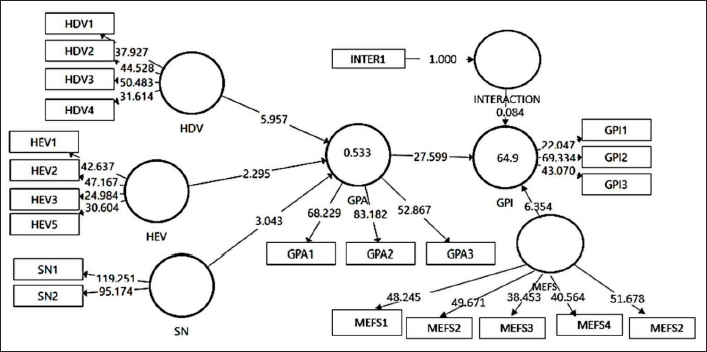
The interaction effect was estimated to assess the moderating influence of media exposure to food safety issues on the link between GPA and GPI by employing the product indicator approach (Hair et al., 2019; Henseler & Chin, 2010), described in Table 6 and Figure 3. The interaction effect of media exposure to food safety issues on GPI is statistically influential (β = 0.084, p < .01). The relevance of interaction effect is reflected by a change in R2 for dependent variable. When media exposure to safety issues was included as a moderator in the model, the R2 of GPI increased by 2.5% (R2 without moderator = 62.4%, R2 with moderator = 64.9%). In addition to this, the effect size (f2) of the moderator was also assessed, and f2 value of 1.45 shows a substantial effect size (Kenny, 2016). Hence, it is evident that media exposure to food safety issues significantly moderates the link between GPA and GPI toward organic food, supporting H5.
Path Coefficients.

Structural Model with Moderator.
Discussion
The results demonstrated that both customer perceived values, that is, hedonic and health values, exhibit, a strong influence on GPA toward organic food consumption. Although these two customer perceived values do not have the same intensity of influence on attitude, the results posit that hedonic value has a higher impact as compared to health value, which is supported with the findings of Ghazali et al. (2017) and Kamboj and Kishor (2022). It suggests that consumers feel more happiness when they do something good for their own well-being or for society and eventually develop a favorable mindset (Ghali, 2020). The findings showed that green purchase attitudes for organic food are driven by health value, which agrees with the research of Ghazali et al. (2017), Bauer et al. (2013), and Kamboj and Kishor (2022). However, the connection among health value and GPA is not very influential in comparison to hedonic value. Still, the findings could give new insights to marketers to exert more effort to promote organic food’s health benefits. The study emphasized that subjective norms played an influential role in forming an optimistic attitude toward buying organic food. The findings are identical with the results shown by Roh et al. (2022). The reason behind this could be the collectivistic nature of Indian people who share their opinions, ideas, grievances, and thoughts with peer groups, friends, and family. However, the finding contradicts some other studies, such as Smith and Paladino (2010) and Testa et al. (2019), which claim that social pressure has no influence on shaping consumers’ attitudes toward organic purchase. The results also demonstrated a favorable and strong connection GPA and GPI, echoing those of Kamboj and Kishor (2022), Sultan et al. (2020), and Ghazali et al. (2017). It is demonstrated that those who view organic food in a favorable manner were shown to be more interested to buy organic food items. Furthermore, this research posited that media exposure to food safety issues is an influential factor in influencing consumers’ buying decisions. This discovery entitled marketers to use food safety issues related information in their strategic plans to make people more aware of food incidents and issues that can harm their health. Hence, the idea can be communicated to consumers that it would be better to opt for organic food choices as an investment in health in the long run.
Implications
A number of theoretical and managerial conclusions were made as a consequence of this study. First of all, from a theoretical perspective, there are rare studies that investigated perceived values such as hedonic and health value especially in the light of emerging economies (Ghazali et al., 2017; Kamboj & Kishor, 2022). Therefore, this study would enhance and contribute to the existing knowledge of perceived values toward organic food buying behavior. Second, TRA has been extensively used for recycling behavior (Davies et al., 2002), electric vehicles (Nosi et al., 2017), green purchase consumption (Coleman et al., 2011), green products (Liu et al., 2017), etc., although a few scholars have targeted Indian organic food markets (Basha & Lal, 2019; Kamboj & Kishor, 2022; Kautish et al., 2022; Matharu et al., 2021; Paul et al., 2016). Furthermore, existing research in India aimed at general green purchasing behavior rather than specific green product categories (Jaiswal et al., 2021; Kirmani & Khan, 2018; Yadav & Pathak, 2017). This remains the same even in organic food, as consumers might have been influenced by different perceived values while thinking about different sub-categories (Kamboj & Kishor, 2022; Kirmani et al., 2022; Matharu et al., 2021). Therefore, this research focused on organic fruits and vegetables to be more specific organic food under the framework of green products in India (Jose et al., 2020; Kamboj & Kishor, 2022). Furthermore, this research will bridge the theoretical gap by investigating the core attitudinal component, that is, behavioral intention, with an enhanced version of TRA using customer-perceived values, especially in the rapidly growing market in India. Finally, to the finest of our knowledge, this study is the rare and pioneer studies that has explored the significant influence of media exposure on food safety issues between GPA and GPI. Although Pham et al. (2019) stressed the significant direct effect of media exposure to food messages on the behavioral intentions of consumers, it has not been tested as a moderator in existing organic food studies. Furthermore, several qualitative studies have highlighted the uniqueness of this variable, and various scholars have expressed a desire for more empirical evidence (Hjelmar, 2011; Kushwah et al., 2019). Hence, this study has proved vital in finding the strong impact of media exposure on food safety scandals and issues in strengthening the connection between attitude and intention of consumers.
From a managerial perspective, to begin with, marketers can utilize hedonic values by creating special banners of organic food in retail stores with emotional and attractive visual appeals in order to make their shopping experience joyful. Therefore, marketers must harness the power of hedonism in Indian organic food market to attract more customers to this segment. Second, this research confirmed the presence of influence of health value on GPA, but people’s faith about the health advantages of organic food are still not as robust as their beliefs about the hedonic value of such foods. In order to foster a more positive attitude toward organic food consumption, marketers should undertake educational initiatives on social media platforms to conduct educational campaigns about the perceived health advantages of consuming them. Third, the research also confirmed the influence of social pressure from friends, family, and society in helping form an optimistic attitude toward organic food. It means marketers should exploit this opportunity by exerting healthy social pressure on potential customers to give organic food a try. Additionally, this study indicated a greater likelihood that individuals who have a favorable mindset of organic food will purchase it eventually. Therefore, marketers should efficiently utilize perceived hedonic and health values with a pinch of fear of social acceptance among peer groups to spark more interest to buy organic food in emerging markets. Furthermore, marketers should focus on food scandals and issues on low-cost media platforms to help attract more people to buy organic food. This can create fear or anxiety in people’s minds, which can lead to more early adoption and acceptance of organic food instead of traditional or non-organic food, which helps raise awareness.
Limitations
There are a few flaws in this research as well. First, a survey approach is used in this study, which has its own set of constraints. As a result, more reliable results may be obtained by combining qualitative approaches (ElHaffar et al., 2020) and longitudinal research (Caniëls et al., 2021) to get a more comprehensive and deeper understanding of organic food consumer behavior. Second, the results acquired cannot be applied uniformly across the country, as the chosen sample is not a representative sample on the demographical ground. In addition, future studies may look at other customer-perceived values, such as safety and environmental value, using the TRA approach in future research. Furthermore, this research primarily focused on organic fruits and vegetables, while consumers’ attitudes toward other categories of organic food may differ. Therefore, researchers may aim on different categories of organic food, such as organic tea, organic pulses, organic milk, etc., to get a broader picture of influential determinants in various organic food categories. Finally, future research can be directed toward the exploration of more unique moderators like habits of consumers, availability, etc., which may influence the attitude-intention link.
