







Abstract
This article is an account of how the British Council in Pakistan has sought to improve its gender balance. The organization has seen a marked change in its staff profile in recent years. As recently as 2013, there was a stark gender imbalance, with women accounting for barely a quarter of all staff. Further, statistical analysis showed that this picture was skewed according to the office, the pay grade and the department.
This case study outlines the research undertaken by the HR team. The findings are presented in this case study. It then describes the actions taken to increase the number of women and to address their underrepresentation in key positions. It concludes with the evaluation of the effectiveness of these management interventions resulting in evidence-based managerial decision making, strategic vision and institutionalization of best practices.
This undertaking on gender balancing was deemed integral to the development of a new strategic vision for the British Council in Pakistan. The research challenged several assumptions. It showed that the existing gender imbalance was not a result of cultural factors. Instead it demonstrated that the British Council’s pay and benefits were uncompetitive in the job market.
The last three years have seen profound changes in the scale of the organization’s ambitions, its risk appetite, how it operates and its culture. These changes have coincided with a marked increase in women at every level of the organization. The case study emphasizes how equal opportunities and diversity became integral to these strategic changes. It charts how the demographics of British Council teams have altered since 2012 and how this has affected organizational culture. Finally, it presents the continuing challenges that the British Council faces in recruiting, retaining and promoting the best talent available.
From Pakistan’s Independence to the Present Day—The British Council in Pakistan
The British Council opened its first office in Pakistan in 1947. We still pursue the same objective. We seek to develop a better understanding and build trust between Pakistan and the UK in both countries. We work primarily with young people and those who influence opinion. We are a not-for-profit social enterprise. All of the money we generate in Pakistan is spent in Pakistan fulfilling our charitable objectives in education, civil society, the arts and English-language development. However, the ways in which we achieve this has changed remarkably over the nearly 70 years that we have worked in Pakistan.
Historically the British Council in Pakistan was synonymous with our network of libraries. Whilst these were greatly valued by our members, a decision was made to close them in 2001 due to security concerns. Notwithstanding this, we have grown and diversified significantly over the last 13 years. Our turnover has increased fourfold in this time—our income was nearly $50 million in 2013–2014. Last year, we reached nearly 40 million Pakistanis through the broadcast and digital media. We deliver our services to millions more through a network of partner organizations. And we harbour ambitions to increase the scale of our work further. Table 1 provides an overview of some of the British Council’s business activities in Pakistan.
To fulfil these commitments and to realize our ambition, we knew that we had to keep pace with the profound social changes in the country. Nearly half of Pakistan’s university students are women—a figure that has more than doubled in the last 20 years (BusinessWeek, 2011). Likewise, the country is characterized by its youthfulness, with two-thirds of the population being under 30 (British Council, 2009b). However, there was a shared belief among our leadership team that our staff profile did not reflect this. We remained steadfastly male, middle-aged and metropolitan. We knew that we had to change if we wanted to tap into the country’s burgeoning talent.
Abridged Overview of some of the British Council’s Business Activities in Pakistan

The Director’s View and the Dearth of Data
Peter Upton was appointed the Country Director in Pakistan in 2012. Throughout his British Council career, Peter had been cited as one of the organization’s most prominent champions of equal opportunities. In his previous country director roles in Africa and East Asia, he had adopted measures to improve the diversity of our workforce.
In Peter’s first month in Pakistan, he visited each of our offices in Islamabad, Lahore and Karachi to speak with our 200 colleagues individually. Peter learnt a great deal from these conversations—both in terms of our systems and our existing culture. However, he was concerned by the lack of accuracy and sophistication in our HR data management. Moreover, his first impressions of our staff profile in Pakistan were less than favourable. His initial assessment highlighted four factors—each of which had implications for our gender balance. He outlines this view:
Firstly, the inadequacies of our management data meant that we could not understand conclusively either our staffing or our structure. Secondly, the routes for career progression for talented colleagues were unclear. This was especially true for female colleagues. Thirdly, our staffing model was overwhelming dominated by low paid, lower value administrative posts and this was at the expense of creating the higher value, better paid and more skilled roles that were required for us to be a high performing team. This “bottom heavy” structure was also thwarting opportunities for promotion. Finally, we needed more flexibility for new colleagues to come in and help us address the changing dynamics of our work in digital, in opening our new libraries, and in thought leadership for our work in English, education, society and the arts.
Peter’s concerns were primarily that our existing staff model was too inflexible. In turn, this inflexibility meant that we were creating too few opportunities to retain our best performing colleagues and to attract new talent, and that these trends were most noticeable for women. Peter was struck by how we seemed “ageist, sexist and elitist, and yet not entirely effective” in our approach. Peter led the development of a new strategy for the British Council in Pakistan. This “New Vision” strategy focused on how we could increase the scale and impact of our work. For Peter and the management team, the people element of this strategy was instrumental to adapt to the changing external environment in Pakistan. He explains:
We had devised an ambitious strategy for growth. We needed to bring in new people to ensure we had the necessary skills to deliver, to provide flexible work force planning and also to reward people. Our previous staffing model had led to an ossified, archaic structure that was ill-equipped to deal with these new demands. It was a great structure for the 1970s but it now seemed 40 years out of date.
Prior to 2012 the HR data held was scarce and unreliable. With Peter’s appointment, there came a renewed commitment to evidence-based decision making. He also insisted on the systematic reporting of this data.
I found that there was a disconnect between our policies, our processes and the data. This meant that we were often flying blind in our management decision making. We were too reliant on making assumptions and being intuitive. It also meant that we were trapped in a cycle of repetitive behaviour, some of which was negative. We know that our people are our lifeblood of what we do. We wanted to be a smarter organization, and an agile organization, but also one that empowered its people. The reason why we needed to change our systems is simple—without this we couldn’t develop a high performing, high trust team culture.
Peter asked the HR team to conduct a thorough review of our staffing. Tanzeela Hussain, our HR Director, welcomed this more empirical approach. Tanzeela reasoned that this was essential to determine our exact staffing structure and how this contributed to our staff costs. And we were determined that we would incorporate a better understanding of our diversity into this HR management system.
One in Four: The Initial Assessment
It was relatively straightforward to undertake a gender-based headcount. Through this we established that 26 per cent of our colleagues were women across all levels of the organization. However, this headline figure belied the truer picture of our gender balance. As we started to collate the data, it became strikingly obvious that the distribution of women was skewed. We had a strong female representation in some areas and almost a complete absence in others, as Table 2 shows. The underrepresentation was most prominent in our examinations department, which accounts for almost half of our staff.
This distorted distribution continued when we analyzed the gender ratios by pay grade. Most of our female colleagues were concentrated in low- to middle pay grades, with too few women represented in our senior management team. Only three of 11 most senior roles were held by women in February 2012. One of Peter’s first initiatives was to expand a newly configured “Senior Leadership Team”. This increased the number of women represented to eight of the 17 leadership positions by July 2013, which is shown in Table 3.
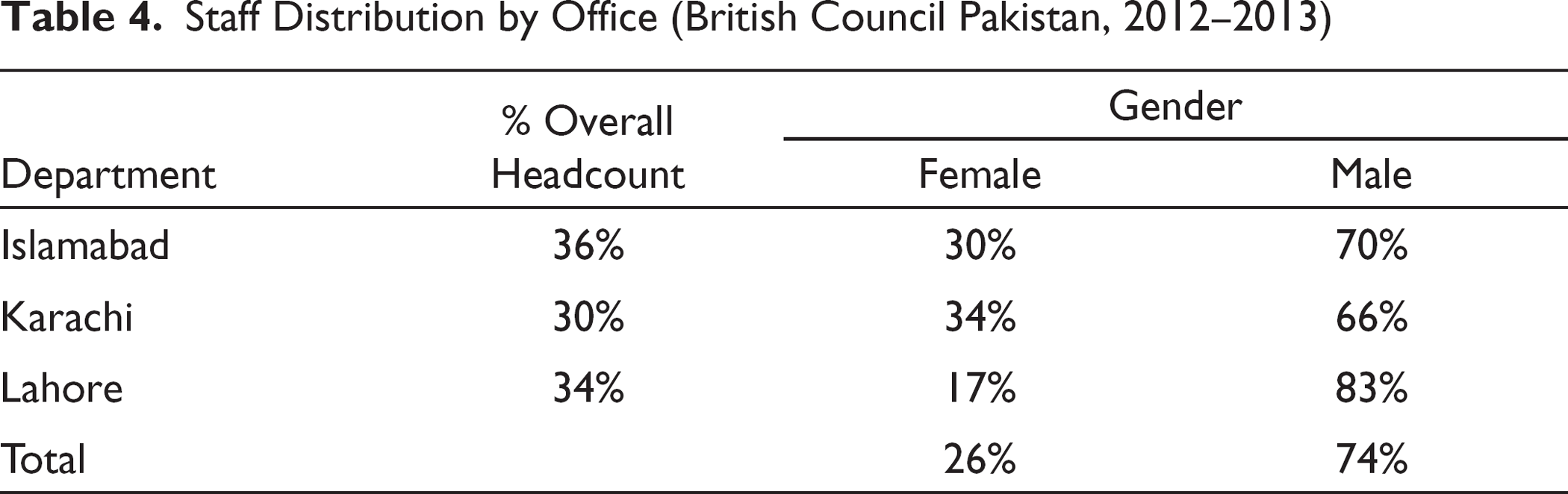
We also noted that the gender balance differed according to each office (see Table 4). We were conscious that these ratios were contributing factors in the different office cultures in Lahore, Islamabad and Karachi. We knew from a series of internal grievances that had been raised that there had been examples of misogynistic behaviour in Lahore. This clearly contravenes our organizational values and our Code of Conduct (British Council, 2009a). We feared that if these trends continued it would inculcate chauvinism in our teams. We knew that improving our gender balance in Lahore would be critical to countering this.
Staff Distribution by Department (British Council Pakistan, 2012–2013)

Staff Distribution by Pay Grade (British Council Pakistan, 2012–2013)

Staff Distribution by Office (British Council Pakistan, 2012–2013)
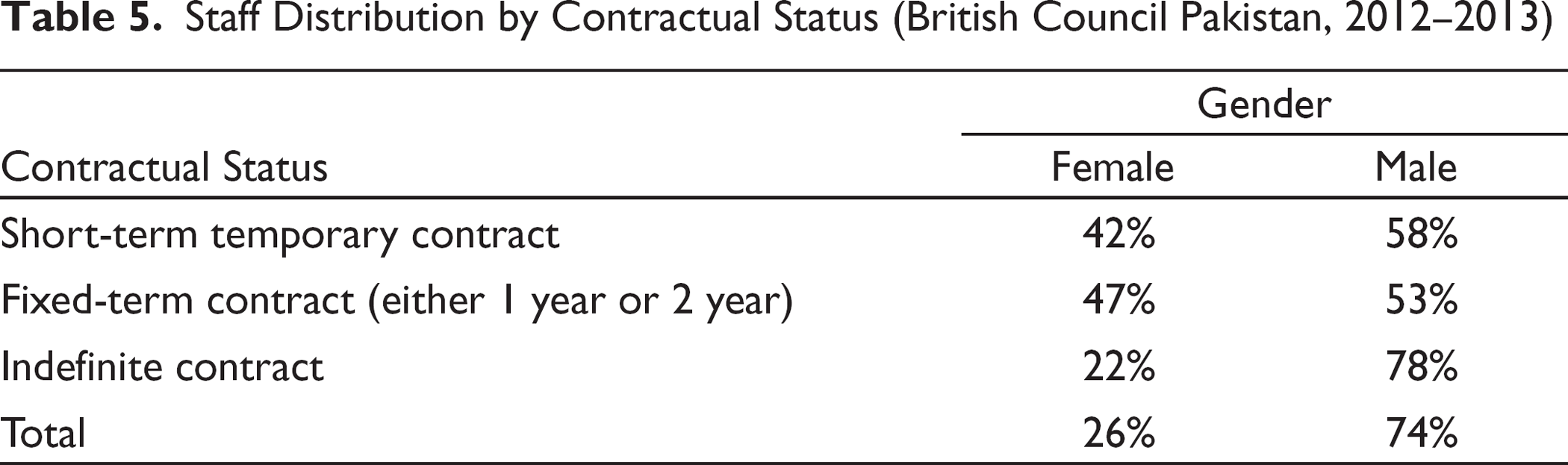
A fourth variable also became apparent. We noted that the gender distribution differed according to one’s contractual status. As Table 5 shows, women were far more likely to hold either short-term temporary positions or fixed-term contracts, which are often project based. The overwhelming majority of our indefinite contracts are for positions in our examination and business support services teams. This has significant implications in redressing the gender balance in the longer term.
Staff Distribution by Contractual Status (British Council Pakistan, 2012–2013)
In summary, we wanted a genuine gender balance across our teams, with proportional representation in each department, each office and at each pay grade. We set the target that women must account for 40 per cent of our teams across the British Council Pakistan. Although this seems like an arbitrary target, we felt that this is an important threshold to ensure our staffing profile was balanced.
Determining the Problem—Developing the Research Methodology
Whilst the initial data collation helped in identifying the problems, we recognized that these issues were only symptomatic and that further research would be required to determine the causality of this underrepresentation. We discussed this at length with colleagues to identify possible reasons why we have such an acute imbalance. We chose to examine several propositions, each of which had been suggested as a cause:
We appoint too few women. Female colleagues are more likely to leave the organization than their male counterparts. It is a cultural expectation for women to give up work in Pakistan either when they get married or when they are expecting their first child. These are therefore the most common reasons why female colleagues leave. Our terms and conditions of employment are ill-suited to women. The gender imbalance is common for Pakistan (and should therefore be accepted).
We realized that we would need to devise a methodology that explored each of these propositions in turn. Fseeha Rizvi proposed a research methodology with four elements. First, a detailed ratio analysis to ascertain the gender balance at each stage of recruitment cycle to determine where there were the greatest impediments—namely for applications received, shortlisted candidates, appointments and promotions to each pay grade. Second, a quantitative review of recent exit surveys to determine why female employees were leaving the British Council. Third, a qualitative survey of female colleagues to ascertain their satisfaction with our pay, benefits and organizational culture. Finally, a benchmarking exercise with similar organizations, as this would reveal whether our gender balance was comparable with our comparators and competitors in the Pakistan job market.
This research was invaluable and it has informed much of our subsequent decision making.
Drawing Conclusions
This helped frame our value proposition as an employer. Moreover, they articulated clearly the challenges they faced in their work with us. The only tricky issue we encountered was an accusation by a male colleague that we were being discriminatory for only targeting female staff! However, we explained the reason behind this survey and he understood its importance. The research took several months to conduct and collate. The results were published in the Gender Research Report (British Council, 2013).
Proposition 1: We appoint too few women
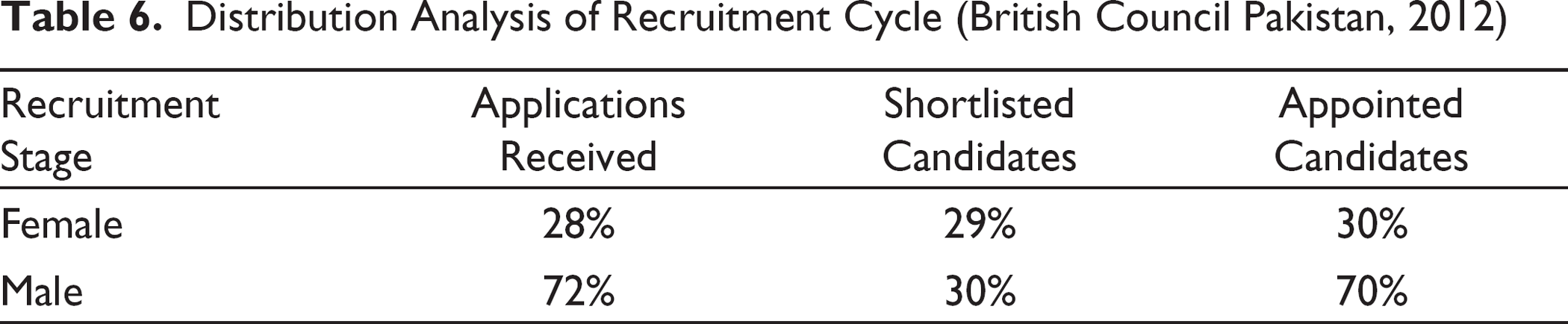
By examining each stage of the recruitment cycle, we found that the ratios actually improved marginally at each stage of the recruitment cycle (see Table 6). It was clear that the biggest difficulty that we faced was in attracting sufficient applications from women. Moreover, as shown in Table 3, the ratio of women increased at each pay grade of the organization. We felt that there was meritocratic progression through the organization and that this was borne out by 47 per cent of our senior leadership roles being held by women. However, we realized that redressing the gender imbalance would be impossible without doing more to market our jobs to women candidates.
Propositions 2: Female colleagues are more likely to leave the organization than their male counterparts
Proposition 3: It is a cultural expectation for women to give up work in Pakistan either when they get married or when they are expecting their first child
We reviewed the previous year’s exit interviews in an attempt to identify any patterns or trends in why both male and female colleagues were leaving the British Council. These reasons are summarized in Table 7. Of the employees that left in 2011–2012, the most commonly cited reason for leaving was to pursue a better job opportunity elsewhere. This was similarly applicable for both men and women. Furthermore, only three female colleagues, 12 per cent of those that had left in the previous year, resigned because they were getting married or having a baby. This is a marginal factor in our female turnover and this evidence disproved the notion that these were the most common reasons for leaving.
Distribution Analysis of Recruitment Cycle (British Council Pakistan, 2012)
Reasons for Staff Departures 2011–2012

We examined the exit survey responses in more detail to highlight possible causes of employee satisfaction and dissatisfaction. Overall, most colleagues, both men and women, were very positive about their experience of working for the British Council. All the female respondents stated that they would recommend us as an employer to others. Most colleagues had originally joined because of the external reputation of the organization and its working environment. We asked these leaving colleagues what they appreciated most about their experience in working for us. They cited the fairness of our policies, including our commitments to equal opportunities and diversity, opportunities for staff development and the work environment as the three most valued aspects. However, it was our salary that was cited as the high dissatisfaction among the leaving female staff members. The second most commonly cited reason was a lack of management support, with one female leaver said “there might be a bit of discrimination against females, but I could be wrong” (British Council, 2013).
Proposition 4: Our terms and conditions of employment are ill-suited
Together with the review of our exit-survey responses, we wanted to gauge the opinions of our current female colleagues. We designed a survey to determine what motivates women to work for us and the extent and nature of any possible discrimination at work. We identified 21 female colleagues at different pay grades, from different departments and from different offices to provide the representative sample.
The survey was designed to assess how inclusive our working environment felt to employees, whether we demonstrate equal opportunities through our recruitment and selection and whether we supported this through a fair approach to one’s work/life balance.
We were reassured that our policies and values seemed to be upheld and that these were recognized by colleagues. There was a unanimous sense that working for the British Council is “safe and comfortable”. Similarly, an overwhelming majority felt that we upheld our commitment to equal opportunities and diversity. Discouragingly though, 10 per cent of colleagues had experienced some form of gender discrimination, or sexual harassment, at work (either first hand or witnessing it happen to another colleague). We do not know when these instances happened but this remained a serious concern for our management team.
The more pronounced differences in opinion were in relation to our pay and benefits. Nearly 30 per cent of respondents felt that our salaries were uncompetitive with the market and nearly half believed that our benefits did not take into account the other personal commitments that they had. We probed these findings and the two most common points raised were that colleagues felt that the medical benefits were discriminatory against non-married staff and/or those with parents as dependents.
We sought to correlate these findings with how much colleagues valued each of these motivating factors. It was notable that once again approximately 30 of those surveyed felt that pay was a highly important motivator. This reaffirmed a need to ensure that our pay and benefits were comparable to the market. However, the more salient motivating factors were our work environment and that our work felt meaningful.
We used this data, and the data for the exit surveys, to help reframe how we could market our jobs to external candidates.
Proposition 5: The gender imbalance is common in Pakistan
In our initial discussions, several colleagues had asserted that our gender imbalance was only to be expected in Pakistan and that there was nothing untoward about three-quarters of our staff being male. The International Labour Organization’s economic data would support this assertion. According to the ILO, less than 25 per cent of women are part of the formal economy in Pakistan (Gilani, 2013). This underrepresentation is amplified at senior managerial levels with only 5 per cent of board-level positions being held by women in the country (Ahmad-Keijzer, 2013). However, we refused to accept this received wisdom. We wanted to benchmark our gender balance with the best organizations to work for in Pakistan.
Our benchmarking proved difficult. There is no immediately obvious comparator for the British Council. Therefore, we decided to measure ourselves against the supposed best private sector employers in Pakistan. Rozee.pk is one of the country’s most popular online job portals and each year they publish an annual report of the most reputable employers (Express Tribune, 2013). Some of the companies publicised their gender ratios. For the others, we contacted their HR departments and asked if they would share the information with us. Most of the companies responded. According to this data, the British Council compared favourably with many organizations (and this supported the proposition). However, we still felt that our gender balance was unsatisfactory (Table 8).
Gender Benchmarking with Rozee Top 10 Companies to Work for in Pakistan

Gender Benchmarking with Sector Comparators

We also sought to compare ourselves against other organizations working in our sectors. We looked at the ratios for a sample of leading international non-governmental organizations (INGOs), embassies and aid agencies.
We drew two conclusions from our benchmarking (Table 9). First, our gender balance was slightly worse than similarly orientated organizations in Pakistan and it was better than many of the largest private sector companies. Second, however, this data dispelled the notion that we should just accept our current gender balance. It showed that women now account for more than a third of the workforce at some of the leading organizations in the country. Moreover, we could now point to how women held certain positions in these organizations that are customarily held by men in Pakistan (including as drivers, in manual roles and in specific skilled technical roles). This laid bare the falsehood that certain jobs were unsuitable for women. And it strengthened our resolve to improve the gender balance throughout our organization.
The Balancing Act—Trying to Redress our Gender Balance
Our research showed that our benefits package needed revising. This was equally applicable for both men and women in the organization. We framed our organizational restructuring around the need to be more competitive in the job market. We increased the number of senior posts, creating more opportunities for promotion and salaries were increased on average by more than 40 per cent across the board to meet market standards. The improved pay and conditions for all staff has helped attract a higher calibre of candidate for our vacancies.
More tellingly, the research demonstrated unequivocally that we needed to increase the number of female applicants for our vacancies. We recognized that there is no simple solution to this problem and that this would require a longer-term approach.
We were adamant that we would not adopt positive discrimination methods to appoint women. We felt strongly that this would be self-defeating. We felt that this would demean any appointment being based on one’s gender rather than one’s talent. Furthermore, positive discrimination negates our corporate policy for equal opportunities.
Instead we decided to adopt a series of positive actions to help improve representation. First, we changed how we marketed our vacancies through a number of different initiatives. We enlisted a recruitment agency that specialized in recruiting women to help identify possible candidates. We reviewed and revised many of our job descriptions to present the roles more accurately. In doing this, we reemphasized our values, our commitment to equal opportunities and our supportive working culture, which were considered our best-selling points for female colleagues in our research. We also asked some of our more senior female colleagues to act as role models for the career opportunities afforded for women in the British Council (British Council, 2014).
Second, department heads were made accountable for the gender balance in their teams. Each department was expected to have women account for at least 40 per cent of its staff by 2015. This target required managers to look beyond their existing recruitment practices. And this target had the greatest implications for our senior managers in our examination and business support services departments. By ensuring that managers were individually responsible for their targets, we have seen a universal investment in our efforts to recruit more women.
Third, emboldened by this challenge, our HR team scrutinized how we were recruiting. In the British Council, it is expected that our short-listing and interviewing panels comprise both men and women and that they include colleagues from different departments. However, we soon realized that this was not being adhered to. As a result, certain institutional biases had crept into our recruitment and selection. All-male panels were appointing people in their own image, with similar qualifications and from similar backgrounds. We did not find evidence of widespread discrimination. However, there were a small number of instances of colleagues appointing candidates that scored lower in their interviews. When asked why they had chosen the notionally weaker candidates (all of whom were male), the panellists’ responses were largely that they felt they were better equipped to cope with the demands of the role. This unconscious bias perpetuated the myth that women were either incapable of, or unwilling to, perform certain tasks, or a sense that we should not ask women to carry out these roles, especially if they required some manual labour. This led one acerbic-tongued colleague to comment that “there is a fine line between chivalry and chauvinism”. We have since tightened our practices to ensure that our interview panels are more diverse and that we appoint the best-performing candidate.
Critically, we now analyze and report on staff profile continually. Had we just undertaken this as a standalone exercise then we would have risked the slow and inexorable slide back to our original position. Our systematic reporting has so far prevented any reversion to our previous practice and it has ensured that we remain committed to improving gender balance.
Half-way There: The Progress to Date
Since embarking on this exercise in the summer of 2013, we have seen a marked increase in women at every level of the British Council in Pakistan. As stated above, women now account for almost half of our senior leadership positions. We have increased the number of women in the organization by over 30 per cent (so that women now account for 34 per cent of our overall headcount). Tables 10, 11 and 12 enumerate the changes that have taken place. Since March 2013, the gender ratio of our new appointments has been finely balanced (54:46 male to female). The most notable increases have been seen in our examinations teams and in our Lahore office. We have doubled the number of women working in our examination department and we have increased the number of women working in Lahore by more than 40 per cent.
At the same time as these changes to our gender balance, we have also seen the average age of our staff fall. There are clear indicators that these demographic changes have led to a culture change in the organization. We have seen a significant difference in the look and feel of the organization from women only accounting for a quarter of our staff, to now when they make up more than a third of our teams. Several colleagues have testified to this culture change. This is further borne out by senior managers asserting that the team dynamics have improved and that it is more collegial and supportive now.
Our success over the last 18 months can be attributed to three main factors. First, the thoroughness of our research helped diagnose the nature and extent of the problems we faced. Second, by embedding this as part of the “New Vision” strategy, we ensured that our commitment to a better gender balance would be instrumental to the changes enacted. Third, and arguably most importantly, we have institutionalized our approach to analysis and reporting. Peter contends that these changed have “challenged the existing hierarchies in our offices—both those that were visible and those that were invisible. This was at odds with the culture in Pakistan and the culture in our offices. However, it was the only way in which we could foster a greater meritocracy.”
Staff Distribution by Department (British Council Pakistan, December 2014)

Staff Distribution by Pay Grade (British Council Pakistan, December 2014)

Staff Distribution by Office (British Council Pakistan, December 2014)

The efforts undertaken by our leadership team and our HR colleagues have been vindicated. Not only have the research and interventions galvanized the culture change that we had aspired to, but they have also helped drive an improvement in our performance. It is notable that a significantly disproportionate number of our female colleagues achieved the highest performance ratings last year.
Challenges for the Future
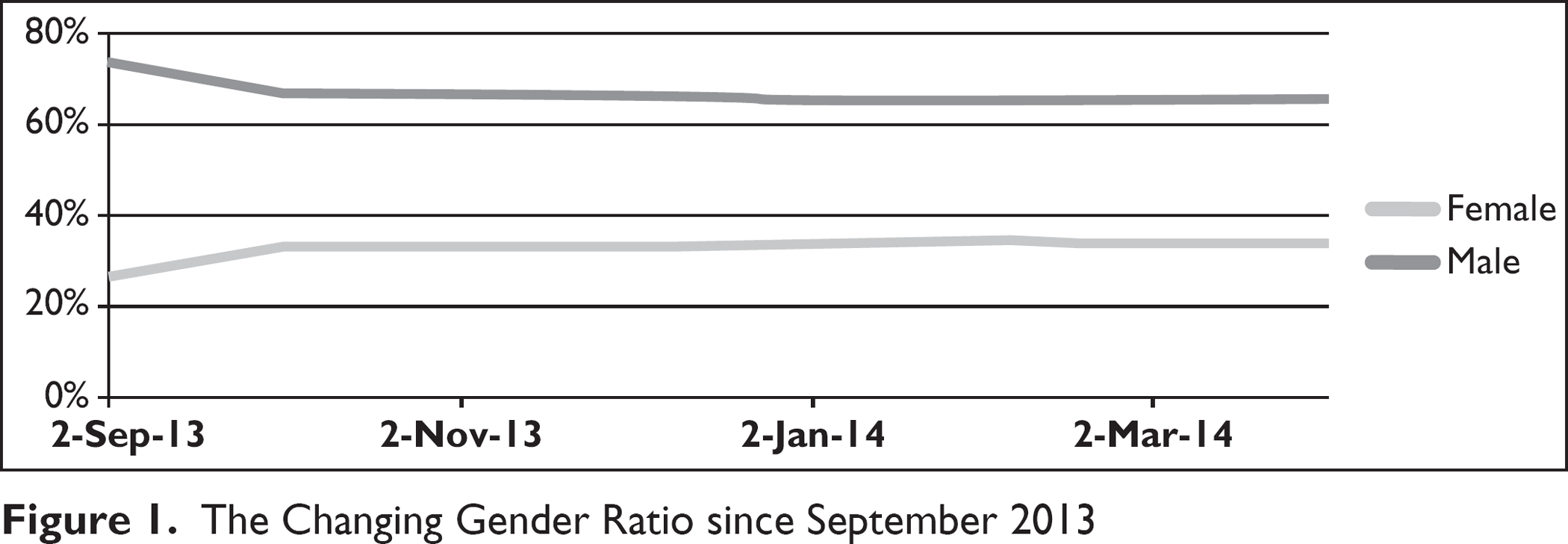
Despite the creditable progress that we have made so far, we are still determined to improve the gender balance further and our target of 40 per cent female representation remains. However, we recognize that we face a series of continuing challenges. First, much of our initial success was due to how we took advantage of the organizational restructure. We have seen a “plateau” in our gender ratio since then (see Figure 1). We know that we need a renewed push to improve this.
Second, attracting female candidates for certain roles remains difficult. A number of recent recruitment exercises for finance, IT and business operations managers received very few applications from women. We need to work closely with our recruitment partners to ensure we that we proactively encourage women to apply for roles in our most underrepresented departments. Third, although we have seen an 8 per cent increase in the ratio of women on indefinite contracts (see Table 13), there is still a marked discrepancy in the gender balance for our longer term positions. We recognize that this ratio will be the most challenging to redress. However, we will continue to monitor this closely.
Finally, and after a 13 year hiatus, the British Council is once again opening libraries and cultural centres to the public in Pakistan. As we embark on this exciting new chapter for our work, we know we must be as reflective of the diversity of Pakistan as possible. Peter concludes that the main risk that we face is that
…we become acceptant that the progress that we have made so far is sufficient and that we become complacent as a result. You can never afford such complacency when thinking about your people. This change cannot just be owned by a small group of senior colleagues in our organization. This must cut through every aspect of our work and through every one of our teams.
The Changing Gender Ratio since September 2013
Staff Distribution by Contractual Status (British Council Pakistan, 2012–13)

For this, proactive leadership is paramount. We must remain resolutely committed to improving the gender balance of our teams.