







Abstract
Abstract
This article reviews the international evidence on the impact of automation on employment and interprets the Indian experience in light of such evidence. It argues that the apocalyptic notion that one faces large-scale technological unemployment either in India or globally is exaggerated. On the other hand, the romantic notion that new technology–especially in the form of on-line work–will create a new era of prosperity in India driven by digitally-enabled micro-entrepreneurs is unlikely to materialize. This does not mean that new employment opportunities created by digital platforms should be shunned. They should be carefully nurtured by novel regulatory frameworks that seek to improve wages and working conditions for the growing community of online workers in India. This should be complemented by adequate investments in digital infrastructure.
Introduction
There is a sizeable literature that has emerged in recent years on the impact of automation on jobs and livelihoods. This is being ushered by new technology that manifests itself in various forms. Salient examples include robotics, artificial intelligence and the rise of digital platforms that facilitate independent work across national borders. Scholars, yearning to attach a suitable epithet to these epochal developments, have come up with a variety of terms. Some call it “industry 4.0,” others the “new globalization” and yet others “the machine age.” A significant part of the literature pertaining to this epoch has focused on estimating and assessing the technical feasibility of automating activities and tasks that are currently being performed by people. Notable examples of such assessments include Frey and Osborne (2013), McKinsey Global Institute (2017) and The World Bank (2016). These exercises usually find that a large proportion of work—ranging across routine and cognitive tasks—currently undertaken by people can, at least in principle, be automated. Both developed and developing countries, including India and other South Asian countries, are vulnerable to automation. Evidence of this nature fuels “automation anxiety” and thus prompts one to ask, Is India and other countries in a similar situation facing the threat of large-scale technological employment?
The answer, at least based on first principles, is not obvious. 1
This discussion draws on Islam (2015).
It should also be noted that the mere possibility of labour-displacing automation does not mean that automation will actually take place. There are inevitably economic, societal, legal and regulatory constraints that can create long lags between the availability of modern technology and its adoption and diffusion. One estimate suggests that it might take many “decades” before automation becomes a global force and that too is subject to “significant uncertainty” (McKinsey Global Institute, 2017, p. 13).
Perhaps one of the most noted cases of robust optimism concerning the impact of new technology on the future of work is the recent work of Sundarajan (2016, 2017). He argues that any loss of formal employment will be offset by the rise of millions of micro-entrepreneurs who will be empowered by digitally enabled technology. In this framework, India is particularly well suited to such transition to new forms of work because it has displayed distinct competitive advantage in the adoption and diffusion of digital technology. Is this really the case? This research note offers a critical appraisal.
Impact of Automation on Employment: International Evidence and Its Implications
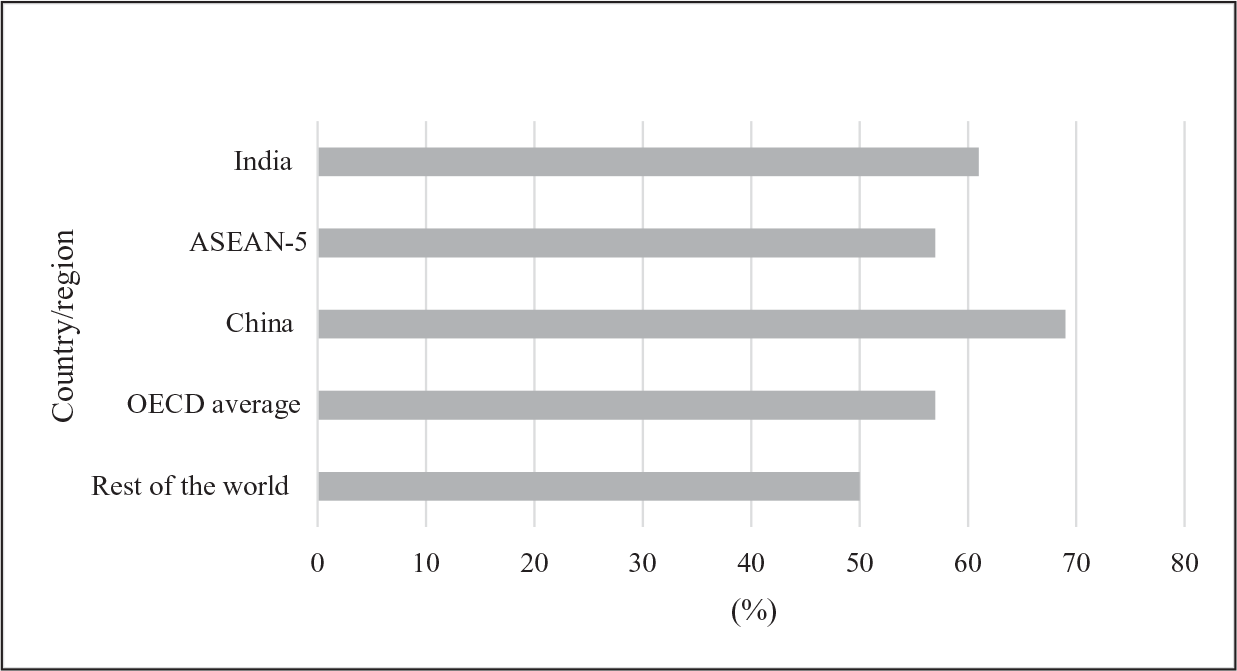
The notion of “automation anxiety” that lies at the root of an apocalyptic vision that machines will destroy millions of jobs is neatly captured by Figure 1. As shown, the most populous developing countries—China, ASEAN-5, India—have a higher risk of joblessness due to automation (57–69%) than either the “rest of the world” (50%) or the Organization for Economic Cooperation and Development (OECD) countries (57%).
Yet, one should exercise caution in interpreting these numbers. The statistics merely show that it is, in principle, possible for a significant proportion of current work undertaken by people to be replaced by machines. Hence, the estimates reveal theoretical possibilities, not actual outcomes.
One should also emphasize that in developing countries in general and South Asia in particular, the challenge is not too much use of modern technology but too little use of it. 2
This discussion draws on Verick (2017).
Even in the modern manufacturing sector, the use of technology most closely associated with “industry 4.0,” namely robots, is rather modest in India, especially when judged from an international perspective. Global statistics suggest that two industries, automobiles and electronical/electronics, account for 66 per cent of the global supply of industrial robots. 4
Executive Summary, International Federation of Robotics, https://ifr.org/downloads/press/Executive_Summary_WR_2017_Industrial_Robots.pdf
It seems that one should move away from apocalyptic notions of large-scale technological unemployment in an Indian and South Asian context and focus instead on the ways in which modern technology can be harnessed to create new and productive employment opportunities. Does the rise of digitally enabled independent work that characterizes the “sharing economy” hold promise? Are there ways in which the adoption and diffusion of modern technology can fortify the living standards of the poor and the vulnerable? The next section offers some pertinent reflections.
Harnessing Modern Technology to Create New Employment Opportunities: Implications for India
About 20 years ago, Malone and Laubacher (1998, p. 146) reflected on the “dawn of the e-lance economy.” They drew attention to “… electronically connected … e-lancers” who then “… join together into fluid and temporary networks to produce and sell goods and services.” At the time the article was written, Internet connectivity was rather low—around 90 million people worldwide. Malone and Laubacher (1998) speculated that the “e-lancers” would accelerate in growth and size and might even become the norm with the greater spread of Internet connectivity.
Since then, more than 53 per cent of the of the world’s population (around 4 billion people) are connected to the Internet, although there is a persistent digital divide. 5
The “e-lance” community has certainly expanded. Not surprisingly, a sizeable literature has grown up trying to understand this relatively new form of work and employment. There are various terms used to describe this evolving feature of the labour market: the “sharing economy,” the “gig economy,” the “platform economy,” “digitally enabled independent work,” “digital labour” and “online labour.” In the discussion that follows, these terms will be used interchangeably.Sundarajan (2016, 2017) is probably among the most influential scholars making the case that the “sharing economy” propelled by a community of “micro-entrepreneurs” and working through digital platforms has transformed—and will continue to transform—the world of work as we know it. He even suggests that one might be witnessing the “end of (formal) employment.”
One can readily think of iconic examples of the digital economy that “commercialize” personal assets, whether they pertain to transportation (Uber), short-term accommodation (Airbnb), buying and selling of goods (Amazon) or freelance labour platforms (Upwork). The absolute numbers are impressive. Airbnb, for example, has more than 2 million users; Upwork has 12 million registered freelancers. 6
All figures cited here are from Sundarajan (2017)
Sundarajan (2017, p. 10) argues that the “sharing economy” holds a great deal of promise for countries such as India where “full-time institutional employment is not yet dominant and traditional economic institutions vary in effectiveness.” In such situations, economic exchange through credible and reputable digital platforms can “stimulate a self-employed and entrepreneurial population … and raise… living standards.”
There are, it appears, governments in the developing world that have embraced digital labour as an innovative strategy of employment creation. Graham, Hjorth, and Lehdonvirta (2017, p. 138) draw attention to the case of Malaysia where the government intends to “… enable the bottom 40 per cent income earners to leverage microwork and online freelancing for sustaining a living.” In the case of India, the government is on record stating that it would like to cultivate a community of “job creators” rather than “job seekers.” 7
Retrieved from https://www.livemint.com/Politics/Ea1eidOU5hJTYVqyc1JU0J/Govt-wants-to-create-job-creators-not-job-seekers-Narendra.html
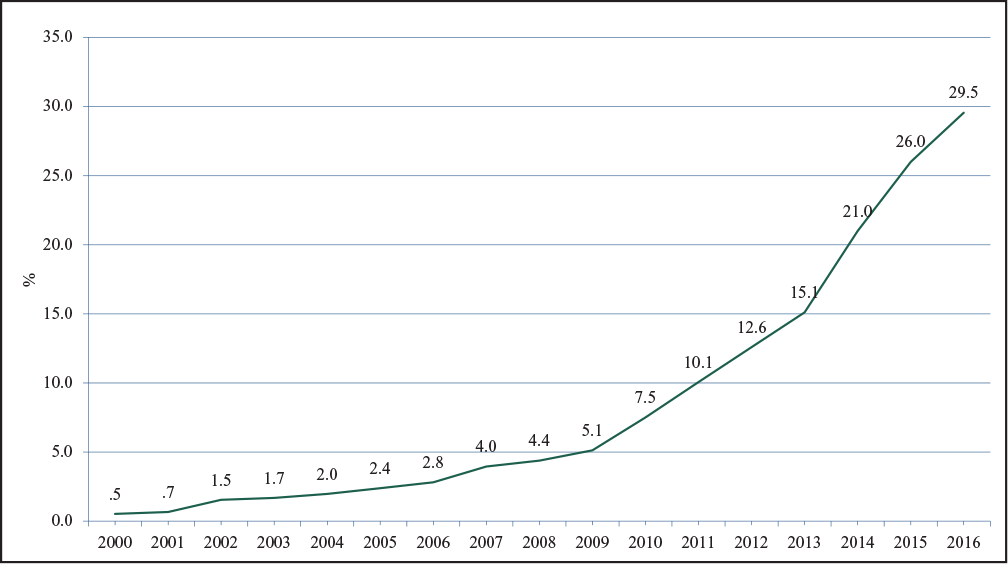
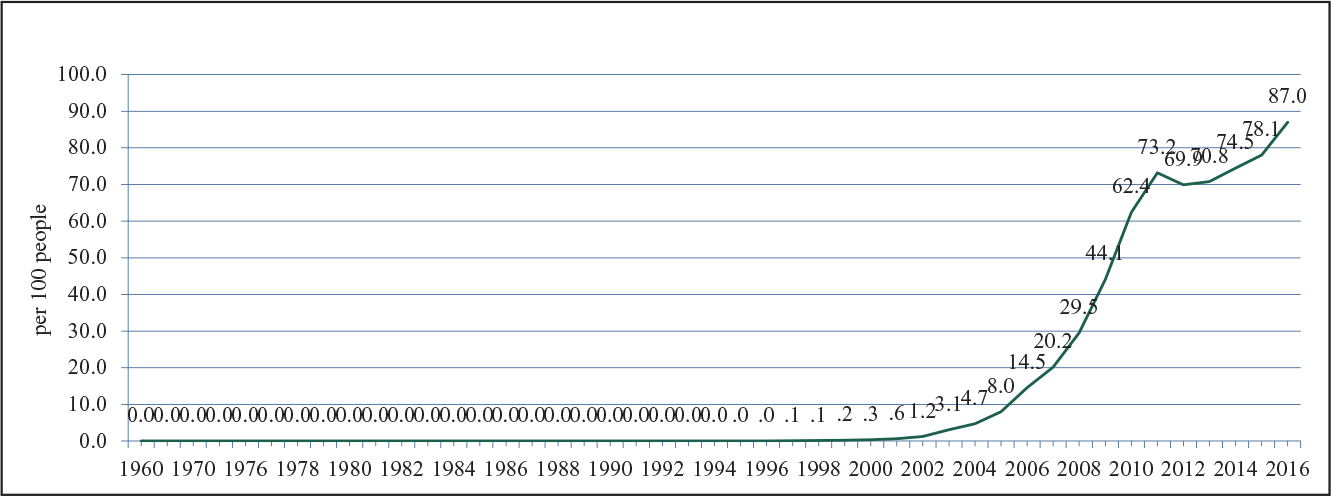
At first glance, India seems well placed to reap the potential dividends from the employment of digital labour. There has been impressive growth in both Internet connectivity and mobile phone usage, including smartphones—see Figures 2 and 3. India has become the world’s largest supplier of “online labour” based on an “online labour index” (OLI) created by the Oxford Internet Institute. 8
Retrieved from http://ilabour.oii.ox.ac.uk/online-labour-index/
As the creator of the OLI concludes:
The largest overall supplier of online labour according to the data is the traditional outsourcing destination India, which is home to 24 percent of the workers observed. India is followed by Bangladesh (16%) and United States (12%). Pakistan is also among the top four countries in terms of OLI.
Different countries’ workers focus on different occupations. The software development and technology category is dominated by workers from the Indian subcontinent, who command a 55 per cent market share. 9
Retrieved from http://ilabour.oii.ox.ac.uk/where-are-online-workers-located-the-international-division-of-digital-gig-work/
There are also success stories from small Indian firms in traditional industries, such as textiles, expanding rapidly and gaining access to the lucrative US market through the use of established digital platforms, most notably Amazon. 10
Retrieved from New York Times, https://www.nytimes.com/2017/11/26/technology/amazon-india-merchants.html?emc=edit_mbau_20171127&nl=&nlid=73601048&te=1&_r=0
Despite the fact that India is the largest supplier of online labour, and despite some success stories, one should be wary of the hype surrounding the “gig” economy and the hope invested in it as an important vehicle for employment creation in developing countries. There is much that needs to be known. As Healy, Nicholson, and Pekarek (2017, p. 243) point out: “The quantity of popular commentary and speculation vastly exceeds the quality and depth of the evidentiary base …” (Healy et al., 2017).
Some studies that have evaluated the market for digital labour in selected developing countries based on surveys of online workers and transactions in leading online platforms find a mixed picture. There are, on the one hand, “… important and tangible benefits for a range of workers, (but) there are also a range of risks and costs that unduly affect the livelihoods of digital works” (Graham et al., 2017).
Such circumspect observations are complemented by an OECD study. It concludes that:
(Much) work in the platform economy is carried out in small units and irregularly. Platform workers may therefore have multiple jobs, work long hours and under high stress … In addition, such work frequently has no social security coverage, can be terminated at will, and wages are low due to a high level of competition. While platform work has created many opportunities for workers in emerging economies, it has also risked engendering a “race to the bottom” in both pay and working conditions. Moreover, it is likely that a great deal of work remains undeclared, fomenting the informal economy.
11
OECD (2017, p. 14), Graham et al. (2017) note that most of the respondents in their survey did not pay taxes.
A recent study of the US labour market systematically examines wage differentials among “virtual” workers and workers located in physical workplaces with comparable tasks and occupations by drawing on US labour statistics. The author finds that “virtual” workers consistently earn less than workers in physical workplaces in comparable tasks and occupations. 12
Dunn (2017). A New York Times report highlights the negative consequences of the ride-share services on wages and working conditions of taxi drivers, https://www.nytimes.com/2018/08/09/nyregion/uber-nyc-vote-drivers-ride-sharing.html
See Weiner (2016).
Returning to the case of India, the size of digital labour is probably rather small relative to the vast size of the labour force. Not much is known about wages and working conditions. What is also not known with any degree of reliability is the extent to which the gig economy is a primary or supplementary source of income and as a way of making a transition to the formal labour market. 14
A study in the United States suggests that more than 80 per cent of Uber drivers use this role to supplement their incomes. See Hal and Krueger (2015).
Media reports do not seem to paint a positive picture of the conditions faced by some types of workers that form part of this new wave of “micro-entrepreneurs.” Consider, for example, the case of the 900,000 “driver-partners” for Uber and Ola in India. 15
For Uber in particular India has turned out to be the biggest market in Asia. However, expansion of this kind of business is constrained by the low level of car ownership in India. Not surprisingly, both Uber and Ola have instituted car loan programmes for their driver-partners as a means of increasing car ownership which then can be converted into a commercial asset. However, loan repayments form a major part of the expenses of maintaining a car. This drives down the income of Uber and Ola drivers. Discontent has broken out among Uber driver-partners leading to temporary stoppages of the ride-hailing service. 16Conclusion: Some Policy and Regulatory Issues
In conclusion, one should not downplay the tangible benefits that flow from the evolution of new work opportunities enabled by digital technology. It does however suggest the need to engage more critically with the future of the platform economy and the way it will shape the world of work.
To start with, systematic evaluations of wages and working conditions in such non-standard forms of employment are required. This will enable policymakers and regulatory authorities to devise appropriate policy interventions, such as amending labour laws to cover wages and working conditions in the platform economy. The challenge is to reduce the incidence of precarious work in the digital economy while preserving the benefits that flow to consumers in the form of lower prices and wider options.
In the specific case of India, and South Asia in general, there is the additional challenge of investing adequately in digital infrastructure. Expanding the domain of the digital economy will inevitably be constrained by poor and inadequate infrastructure. Despite phenomenal growth, Internet connectivity is low in India, reaching 26 per cent of the population vis-à-vis 43 per cent of the population in the developing world. Both the government, through its public investment and outreach programmes, and the private sector have a role to play in improving Internet connectivity and digital literacy.
A promising example of the complementary role that can be played by the private sector is “Internet Saathi” which is the product of a partnership between Google and Tata Trust. The programme started last year with the aim of:
building thousands of female trainers in rural India who ply dusty roads on retrofitted bicycles, go from village to village and train women in how to use smartphones and the Internet. Currently, over 2.5 million women in 60,000 villages across 10 states have been trained by 18,000 Saathis
17
How successful and durable this programme is going to be remains to be seen. At this stage, the biggest hindrance is insufficient Internet connectivity which underlies the need for government intervention.
Finally, one should focus on the broader question of how electronic technology can stimulate other activities that have the potential to reach the poor and the vulnerable. A good example is financial inclusion which seeks to bring the unbanked—typically low-income groups—into the formal financial system at reasonable cost. Current evaluations suggest that financial inclusion is well correlated with growth and employment while acting as a vehicle for reducing particular forms of informality, such as purely cash-based transactions.
As is well known, mobile phone banking, pioneered in Kenya, has become an important element of digital financial inclusion. Mobile phone text messages enable the conduct of banking transactions. India is well placed to further the goal of financial inclusion through digital means, given that mobile phone ownership is widespread (87% coverage). This, together with the government’s current emphasis on “digital India,” has created a conducive environment for further promotion of digital financial inclusion. Currently, between less than 3 per cent of the Indian population have a mobile account and just about 1 per cent use the Internet for financial transactions. Hence, there is huge scope for improvement in this sphere. 18
Declaration of Conflicting Interests
The author declared no potential conflicts of interest with respect to the research, authorship and/or publication of this article.
Funding
This article is benefited from funding support provided by ILO, India.