







Abstract
Over the last decade, gamification has garnered substantial focus across industry and academia, including research across diverse domains like education, healthcare and business. In recent times, research has increasingly explored its application in human resource management (HRM), including recruitment, training and performance management. In spite of its significance, there has been a scarcity of effort to evaluate the expanding research. In order to synthesise the body of research on gamification in HRM, this study performs a systematic literature review utilising the Theory-Context-Characteristics-Methodology (TCCM) review framework. This study offers an in-depth comprehension of the pertinent theories used in the literature, contexts (countries and areas of application), characteristics (key variables) and methods (research approach, research design, data collection method and data analysis method) employed in gamification research within HRM. The review of 82 studies identifies potential gaps and suggests fertile areas for future research. By synthesising existing literature, the review advances scholarly understanding of gamification in HRM and highlights implications for both academic discourse and practical implementation.
Keywords
Introduction
Employee engagement has emerged as a strategic necessity for organisations aiming to maintain productivity, creativity and retention in this digital era. However, the level of engagement persists at an alarmingly low rate. According to Forbes (2024), drawing on Gallup’s 2023 State of the Global Workplace, only 15% of employees at a global level are actively engaged, resulting in an estimated annual loss of $500 billion. This persistent disengagement underscores the essence of innovative human resource management (HRM) strategies to revitalise and restore motivation and engagement. One of these strategies is gamification, defined as ‘the use of game design elements in non-gaming contexts’ (Deterding et al., 2011). Although gamification was initially viewed as a new phenomenon, it has evolved into an effective management strategy that boosts motivation, learning and performance. According to Gartner (2017, 2022), gamification has entered the ‘slope of enlightenment’ phase, indicating greater maturity, practical relevance and strategic adoption across industries. Such advancements highlight the increasing popularity of gamification as a viable strategy to enhance meaningful employee engagement, particularly among younger generations and more digitally savvy workforces, especially in emerging South Asian countries such as India (Jain & Dutta, 2019).
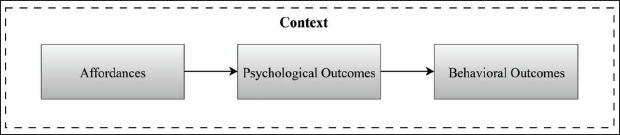
Gamification can be conceptualised by three major aspects: (a) the gamification affordances embedded in a system or service, (b) the psychological outcomes caused by the gamification affordances and (c) the behavioural outcomes driven by the psychological outcomes and these components are implemented in a specific context (Hamari et al., 2014) (see Figure 1). The affordances encompass game mechanics or elements, such as points, badges, leaderboards, stories/narrative, challenges and competition, that structure a gameful experience within a specific context (Koivisto & Hamari, 2019). Psychological outcomes reflect the experiential states, such as enjoyment, motivation or flow, whereas behavioural outcomes represent observable actions, including engagement, job satisfaction, knowledge sharing and performance (Liu & Zhou, 2025; Vakeel et al., 2025). Based on this conceptualisation, the majority of gamification research in HRM has analysed the influence of game design elements on employee attitudes and behaviours in areas like recruitment (Allal-Chérif et al., 2021), training (Loia et al., 2025) and performance management (Bizzi, 2023). Despite rapid scholarly growth in this domain over the last decade, the literature remains conceptually fragmented, lacking integration of theoretical perspectives within human resource (HR) functions. Given the growing organisational emphasis on digital engagement and the effectiveness of gamification in enhancing learning and motivation, a substantial volume of research now warrants a systematic literature review (SLR) to integrate and synthesise these diverse insights.
Conceptualisation of Gamification Based on Hamari et al. (2014).
Over the past decade, review articles have explored gamification within various organisational and HRM domains. Appendix A provides a summary of these existing review articles and clarifies their scope relative to the present study. Murawski (2021) offers an initial synthesis of gamification research in HRM, particularly regarding areas of application, outcomes, design approaches and associated risks. Thomas et al. (2022) review gamification primarily in human resource development (HRD) contexts, including learning, performance, wellness and related emerging areas. Although these reviews provide valuable foundations, the field remains fragmented across functional and conceptual boundaries. As research in this field continues to expand significantly, a cohesive approach is essential to integrate theoretical perspectives, contextual applications, study characteristics and methodological approaches, thereby elucidating the influence of gamification on HRM procedures and performance in diverse organisational settings. To address this gap, the study employs the Theory–Context–Characteristics–Methods (TCCM) framework (Paul & Criado, 2020; Paul & Rosado-Serrano, 2019) to systematically map the conceptualisation and application of gamification in HRM, thereby guiding future research directions. In this light, the present study aims to investigate the subsequent research questions:
RQ1: How has the literature on gamification in HRM progressed in terms of theories, research context, characteristics and methods?
RQ2: What future research directions can be undertaken in this area by future scholars?
This study makes a substantial contribution to the literature by providing a systematic synthesis of research on gamification in HRM and by clarifying how the field has evolved conceptually, contextually and methodologically. Based on a structured review protocol, it consolidates peer-reviewed studies and provides an overview of the literature, outlining the annual publication trend and leading journals contributing to this field. The literature is organised across four dimensions: theories, contexts, characteristics and methods. First, the study identifies and classifies the applied theories into three broad categories: motivational, behavioural and learning theories. It further maps the research across countries and functional application of gamification throughout the employee life cycle, synthesises the key antecedents, mediating mechanisms, boundary conditions and outcomes investigated in the literature, and classifies the studies based on research approach, design, data collection methods and analysis techniques. Building on this synthesis, the study suggests future research directions and discusses the theoretical and practical implications, especially for South Asian countries like India. In doing so, it addresses the lack of a systematic assessment of gamification’s evolution in HRM, thereby advancing theoretical development in the domain.
The remaining article is structured as follows: Research Methodology, Findings, Future Research Directions, Conclusion and Implications.
Research Methodology
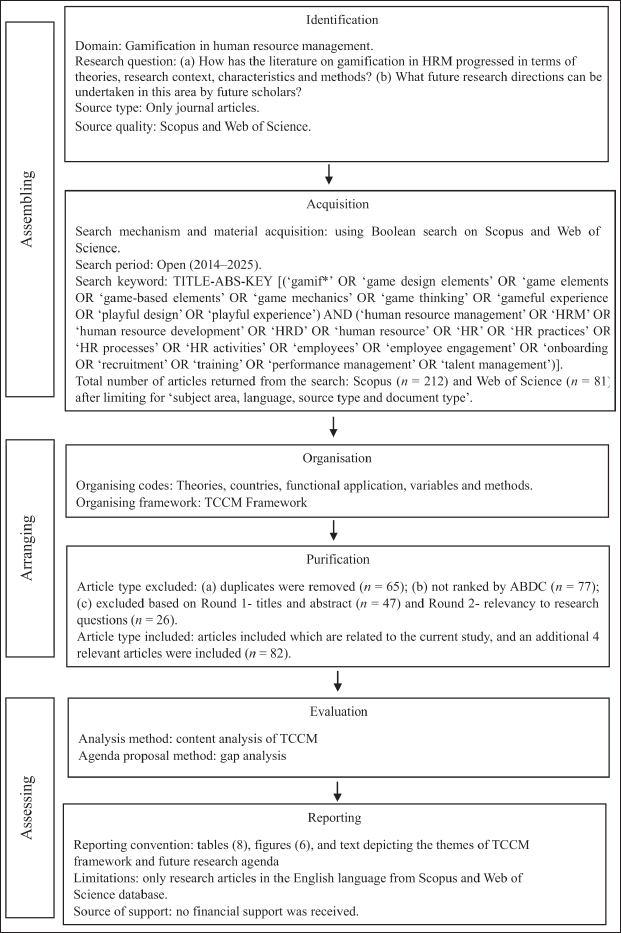
The study aims to provide a comprehensive literature review of the current body of research on gamification in HRM, based on the TCCM framework. Additionally, we have employed the ‘Scientific Procedures and Rationales for Systematic Literature Reviews’ (SPAR-4-SLR) protocol (Paul et al., 2021) to develop a comprehensive and transparent systematic review. The protocol consists of three stages: assembling (identification and acquisition), arranging (organising and purification) and assessing (evaluation and reporting). These sub-stages are subsequently discussed and summarised in Figure 2.
SPAR-4-SLR Framework for Systematic Literature Review.
Stage 1: Assembling
The first stage of the SPAR-4-SLR protocols is ‘assembling’, which includes identifying and acquiring source material for the systematic review. In the identification stage, this review is guided by the research questions presented in the introduction section by RQ1 and RQ2. Databases such as Scopus and Web of Science were utilised in this study. The acquisition sub-stage employed the following Boolean search operators, incorporating the specified keywords in the databases:
TITLE-ABS-KEY [(‘gamif*’ OR ‘game design elements’ OR ‘game elements’ OR ‘game-based elements’ OR ‘game mechanics’ OR ‘game thinking’ OR ‘gameful experience’ OR ‘playful design’ OR ‘playful experience’) AND (‘human resource management’ OR ‘HRM’ OR ‘human resource development’ OR ‘HRD’ OR ‘human resource’ OR ‘HR’ OR ‘HR practices’ OR ‘HR processes’ OR ‘HR activities’ OR ‘employees’ OR ‘employee engagement’ OR ‘onboarding’ OR ‘recruitment’ OR ‘training’ OR ‘performance management’ OR ‘talent management’)].
Before assembling the data set for the current study, only peer-reviewed English-language journal articles were included, limited to the ‘Business, Management and Accounting’ subject area. The literature was not restricted by publication year, as gamification research gained traction from 2011 onwards. Finally, a total of 293 research publications were retrieved using inclusion and exclusion criteria from two databases: Scopus (212 articles) and Web of Science (81 articles).
Stage 2: Arranging
The second stage of the SPAR-4-SLR protocol, ‘Arranging’, comprised two substages: organising and purification. All the identified articles were screened and coded independently by two authors using the TCCM framework. The authors then curated the Excel sheet to organise the analysis, ensuring transparency and minimising subjectivity. In the purification stage, 293 articles were screened, and 65 duplicates were eliminated. Among these, 151 ABDC-ranked journal articles were selected to ensure quality. The screening process involved two rounds: round 1 (titles and abstracts) eliminated 47 articles that were unrelated to HR functions or non-organisational settings (e.g., gamification in educational or student-learning settings), and round 2 further eliminated 26 articles that did not fit the research question. The backward and forward citation search was conducted to reduce the chances of excluding necessary studies, whereby four more articles pertinent to the study’s scope were incorporated, culminating in a final data set of 82 articles for SLR, as shown in Figure 2.
Stage 3: Assessing
In the last stage of the SPAR-4-SLR protocol, the data set of 82 articles was analysed and reported using the TCCM framework to assess and analyse the literature. Inclusion and classification of studies were verified independently by both authors, with any disagreements resolved by discussion and consensus. Double screening and iterative discussions were carried out to ensure validity and reliability, and the coding system was improved through multiple rounds of review to maintain analytical rigour. Each paper was categorised by theories, study context, characteristics and methodological approach using a structured Excel-based extraction template, aligned with the TCCM framework. Thematic patterns were synthesised through content analysis and gap identification to formulate a structured future research agenda using the TCCM framework. The findings, including theories, contexts, characteristics and methods, are presented through tables, figures and text.
Findings
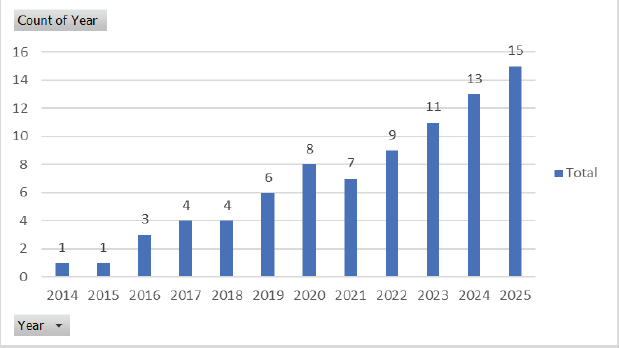
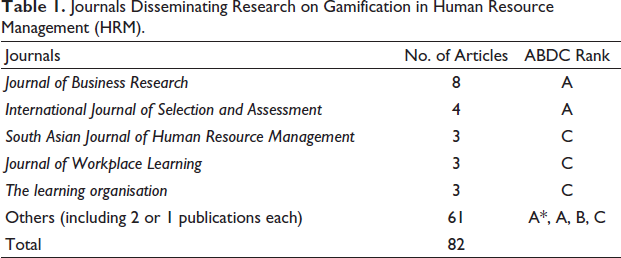
Figure 3 depicts the annual breakdown of 82 articles on gamification in HRM, with 67.07% (55/82) of the articles published in the past 5 years, indicating increasing fascination in this area of research. These articles are disseminated across 54 journals indexed in either Scopus or Web of Science (see Table 1), which shows the increasing significance of gamification in HRM research in diverse areas of scholarly interest. The findings derived from the review of 82 articles are guided by the TCCM framework and are presented in the subsequent sub-section.
Publication Trend of 82 Papers.
Journals Disseminating Research on Gamification in Human Resource Management (HRM).
Theories
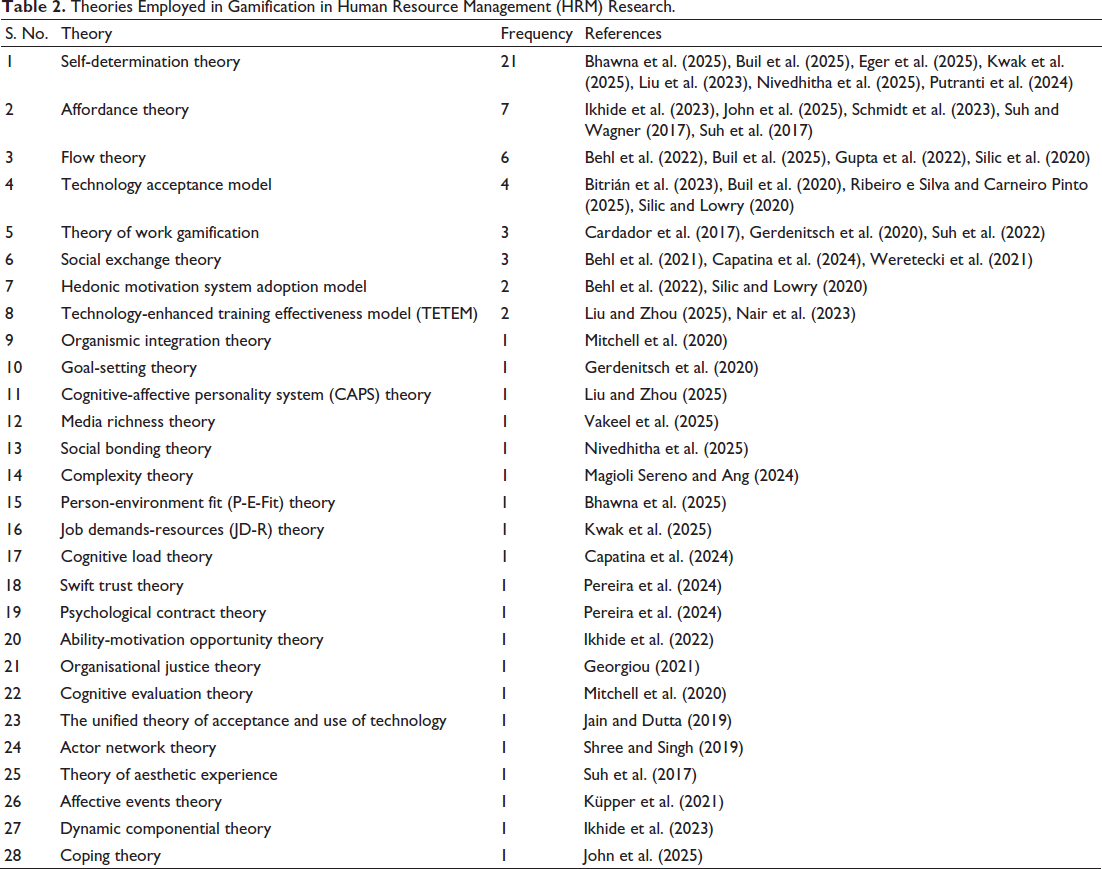
Out of the 82 studies reviewed, a total of 28 theories were found, demonstrating the abundance of theoretical frameworks applied in gamification within HRM. Out of these, the researcher identified eight major theories used in more than one study, whereas 20 theories were applied only once (see Table 2). For analytical clarity, these theories are categorised into three primary foundations (Krath et al., 2021): (a) motivational theories, (b) behavioural theories and (c) learning theories (see Table 3).
Theories Employed in Gamification in Human Resource Management (HRM) Research.
Classification of Theories Used to Explain Gamification in Human Resource Management (HRM) Research.
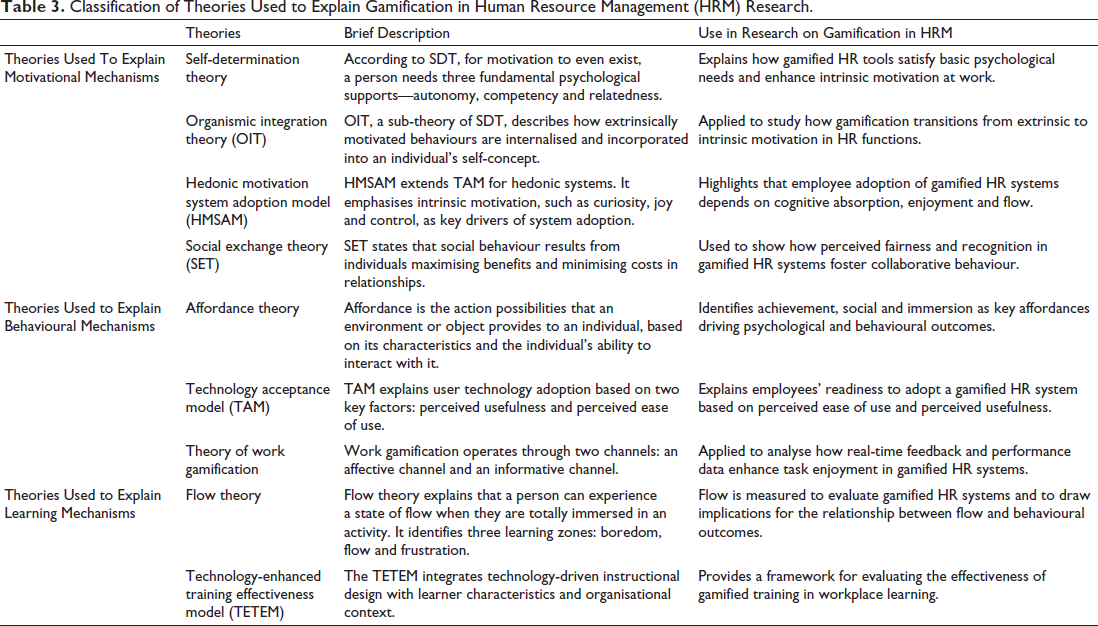
Theories Used to Explain Motivational Mechanisms
Motivational theories are fundamental in HRM gamification research in explaining employee engagement. Self-determination theory (SDT), by Ryan and Deci (2020), explains how game elements like customisation enhance autonomy, achievements and badges build competence and competition or collaboration foster relatedness (Buil et al., 2025; Nivedhitha et al., 2025). Collectively, these mechanisms describe the way gamified HR systems develop intrinsic motivation in workplace contexts. Organismic integration theory (OIT), a sub-theory of SDT, further refines this view by explaining how extrinsic incentives such as points, badges and recognition are internalised, shifting from controlled motivation (external and introjected forms of extrinsic motivation) to more autonomous forms of motivation (identified and integrated forms of extrinsic and intrinsic motivation), transforming external pressures into self-regulated form of motivation (Mitchell et al., 2020). Complementing these perspectives, social exchange theory posits that motivation is grounded in reciprocity dynamics. When employees perceive fairness and value in gamified systems, they are more likely to reciprocate with collaborative behaviours (Capatina et al., 2024; Weretecki et al., 2021). Regarding hedonic factors, the hedonic motivation system adoption model (HMSAM) underscores the importance of cognitive absorption, enjoyment and curiosity, demonstrating that beyond utility, gamified HR systems succeed when they are experienced as engaging and pleasurable (Silic & Lowry, 2020).
Theories Used to Explain Behavioural Mechanisms
The behavioural mechanisms of gamification in HRM are based on theories that explain adoption, action possibilities and sustained behaviour within gamified frameworks. Affordance theory conceptualises game elements as motivational affordances, as they provide certain action possibilities that facilitate user behaviour (Huotari & Hamari, 2017). Gamification incorporates a variety of affordances, categorised into achievement, immersion and social (Koivisto & Hamari, 2019). These affordances, when integrated within a system or service, drive positive psychological outcomes and, in turn, desired behavioural outcomes. The technology acceptance model (TAM) highlights behavioural intention, indicating that employees’ readiness to adopt gamified systems depends on perceived usefulness and perceived ease of use (Bitrián et al., 2023; Ribeiro e Silva & Carneiro Pinto, 2025). Other theories, such as the theory of work gamification, elucidate the impact of gamification on behaviour through informational mechanisms that provide real-time feedback to enhance performance, and affective mechanisms that make tasks more engaging and play-like (Gerdenitsch et al., 2020; Suh et al., 2022).
Theories Used to Explain Learning Mechanisms
The learning mechanisms of gamification in HRM primarily draw on the technology-enhanced training effectiveness model (TETEM), flow theory and many other theories. TETEM asserts that training inputs, including design, trainee characteristics and organisational context, affect outputs such as learning and transfer, making it a significant framework for analysing the effectiveness of gamified training (Landers & Armstrong, 2017). Empirical evidence demonstrates that gamification enhances learner motivation, reactions and knowledge retention; nevertheless, the results are contingent upon contextual and individual moderators, including organisational culture and prior game experience (Liu & Zhou, 2025; Nair et al., 2023). Flow theory provides a psychological framework that elucidates how employees attain optimal states of immersion when task difficulty corresponds with their skills, thereby enhancing learning. Recent studies indicate that flow in gamified learning improves employee engagement during digital transition (Behl et al., 2022), while flow experiences in recruitment and training promote enjoyment and employer attractiveness (Buil et al., 2025).
Context
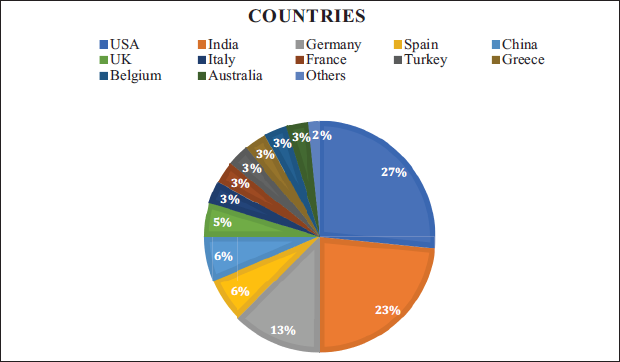
This section discusses the contexts and settings of various research studies undertaken globally. We reviewed the literature on gamification across countries (see Figure 4) and its functional application within HRM (see Figure 5), mapping these studies by the stages of the employee lifecycle to offer a systematic understanding of how gamification is applied across diverse HR functions.
Countries Contributing to Gamification Research in Human Resource Management (HRM).
Functional Application of Gamification in Human Resource Management (HRM).

Countries Publishing on Gamification in Human Resource Management
Figure 4 shows that studies on gamification in HRM have been conducted across 22 countries. Among the 82 reviewed studies, the USA is the primary contributor (17 studies), followed by India (15 studies) and Germany (eight studies). India is the only South Asian country, signifying its growing interest in technology-driven HRM practices. There are several European nations, such as Spain and China (four studies each) and the UK (three studies), with substantial contributions. Notably, the research is mostly performed in a single-country context, and only a few studies have taken multiple countries into account (e.g., Capatina et al., 2024; Eger et al., 2025).
Functional Application of Gamification in Human Resource Management
Training and Development
The training and development phase is the most extensively explored, with 35 studies demonstrating how gamification enhances training outcomes. TETEM evidence demonstrated that well-designed gamified training improves engagement and knowledge acquisition when aligned with learner characteristics and organisational context (Loia et al., 2025; Nair et al., 2023). Flow-based studies show that balancing task difficulty and skills encourages immersion, persistence and retention (Behl et al., 2022). Research also indicates that training success is better mediated by intrinsic than by extrinsic motivation, though extrinsic motivation may be effective when external rewards are internalised (Mitchell et al., 2020). This shows that points and badges cannot work alone unless embedded within training designs that promote internalisation and align with the organisational context. Affordance-based studies highlight how leaderboards and role-visibility mechanisms enhance collaboration and well-being (Kwak et al., 2025; Suh et al., 2017). These findings prove gamification as a credible tool for HRD; however, excessive gamification intensity may undermine autonomy and hinder desired outcomes.
Performance Management and Talent Management
In the performance and talent management phase, 12 studies show how gamification transforms appraisal, feedback and development into engaging and data-driven systems (Bizzi, 2023). Work gamification leverages technology to deliver real-time performance data while enhancing task enjoyment. Research shows it operates through two mechanisms: the informational channel, which enhances visibility and comparability of performance data, and the affective channel, which increases enjoyment and motivation (Cardador et al., 2017). Further research indicates that work gamification enhances enjoyment and productivity, particularly for individuals in leadership roles (Gerdenitsch et al., 2020). An affordance perspective on creative performance suggests that the same elements can foster autonomy, competency and relatedness, or feel controlling, so outcomes depend on the alignment between design and users (Ikhide et al., 2022, 2023). Talent processes could be improved by integrating assessments into gamified systems that link performance with social value, motivation and participatory involvement (Galanti & Fantinelli, 2025).
Engagement and Retention
In the engagement and retention phase, 21 studies indicate that gamification enhances long-term commitment by incorporating meaningfulness, social relatedness and stimulation into HRM practices. Organisation-wide systems demonstrate enhanced job satisfaction and engagement when clear goals, feedback and recognition are integrated into routine tasks (Gupta et al., 2022; Silic et al., 2020). Gamification enhances knowledge sharing while reducing counterproductive behaviours such as cyberloafing, in the context of knowledge management (Capatina et al., 2024; Nivedhitha et al., 2025; Suh et al., 2022). In metaverse settings, studies demonstrate that gamification improves job satisfaction up to an optimal level, beyond which excessive intensity diminishes its benefit. This non-linear S-shaped effect is reinforced by strong online social connectedness (for instance, too many competitive features may overwhelm employees) (Vakeel et al., 2025). Among gig workers, game elements foster psychological ownership and self-leadership, minimising turnover intentions (Behl et al., 2021; Gautam et al., 2024; Mao et al., 2024; Pereira et al., 2024). Nevertheless, poorly designed or excessively controlling designs may compromise autonomy and well-being (Hammedi et al., 2021; Landers, 2019). Overall, gamification enhances engagement and retention most effectively when it is contextually relevant and socially meaningful rather than relying on superficial rewards.
Characteristics
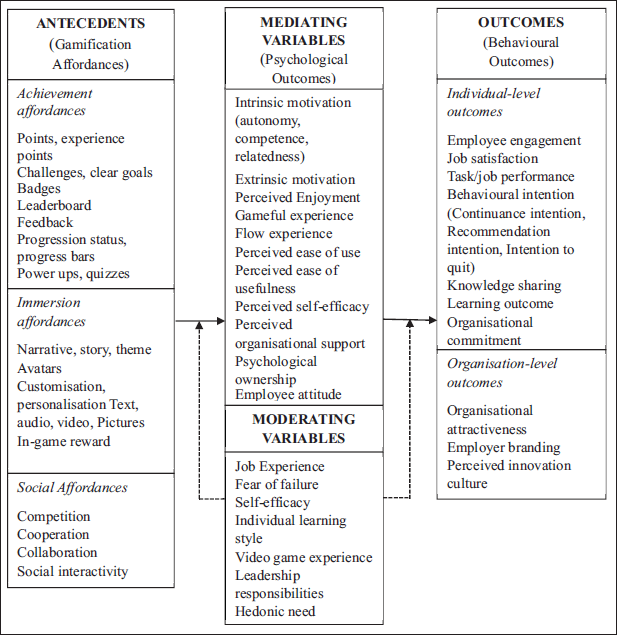
The study adopts Hamari et al.’s (2014) framework to classify antecedents, mediators, moderators and outcomes in gamification research. Gamification affordances, design features integrated into gamified systems, serve as antecedents that initiate user interaction and influence psychological outcomes that operate as a mediating mechanism for behavioural outcomes. This classification offers a comprehensive synthesis of current literature and constructs a conceptual framework (see Figure 6) that consolidates all the variables.
An Integrative Overview of the Variables Used in the Empirical Research Papers.
Antecedents
Affordances are conceptualised as antecedents in HRM gamification research, as they define how employees interact with gamified systems. From the reviewed studies, 17 distinct affordances were identified and categorised into achievement, immersion and social affordance (see Table 4) (Koivisto & Hamari, 2019). Achievement affordances were most prevalent, stimulating mastery and goal through game elements such as points, leaderboards, badges, challenges and feedback, being the most prominent in the literature. These elements are commonly used in training to boost motivation and sustain engagement (Liu et al., 2023; Liu & Zhao, 2025). For example, points and goals provide immediate progress indicators, whereas leaderboards and badges encourage recognition and competition (Buil et al., 2020; Kwak et al., 2025). Nonetheless, these effects are not inherently positive; challenges enhanced enjoyment, whereas feedback and goals did not consistently influence attitudes (Bitrián et al., 2023). It suggests the necessity of designing achievement affordances contextually rather than relying on generic points, badges and leaderboards (PBL).
Antecedents Employed in Reviewed Papers.
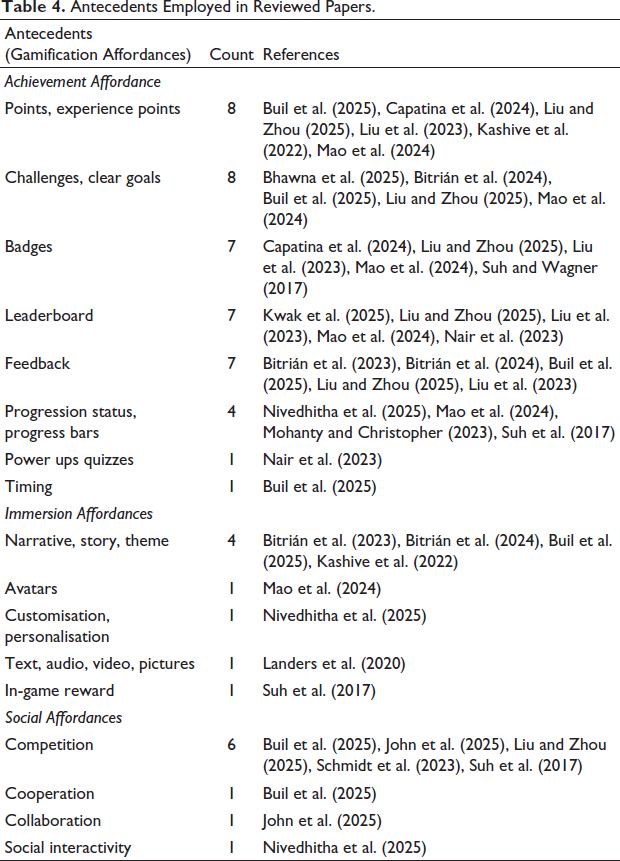
Immersion affordances, however less prevalent, sustain engagement by fostering hedonic and aesthetic experiences (Landers et al., 2020; Suh et al., 2017). Narratives/story/theme, avatars and personalisation/customisation enhance cognitive absorption and facilitate flow states by aligning difficulty and skill (Buil et al., 2025; Nivedhitha et al., 2025). Simultaneously, social affordances contextualise gamification within collective and comparative frameworks. Competition was the most prominent, driving motivation by comparing performance (Schmidt et al., 2023), while collaboration and interactivity facilitated knowledge sharing and teamwork (John et al., 2025). However, over-competitiveness without cooperative elements can reduce inclusivity and long-term retention.
Mediating Mechanisms and Boundary Conditions
Gamification leverages psychological outcomes as mediators to elucidate the impact of design affordances on HRM behaviours (see Table 5). Intrinsic motivation, based on autonomy, competence and relatedness (SDT variables), consistently predicts enhanced engagement and learning more effectively than extrinsic motivation, which diminishes in effectiveness when rewards are not internalised (Mitchell et al., 2020; Putranti et al., 2024). Affective states, including perceived enjoyment and flow experience (flow theory), enhance task immersion and sustained engagement (Suh et al., 2017). The gameful experience, defined as a positive psychological state, emerges as a necessary yet underexplored mediator linking gamification affordances to desired behavioural outcomes (Koivisto & Hamari et al., 2019; Schmidt et al., 2023). In digital HRM systems, gamification improves perceived ease of use and perceived usefulness (TAM variables), hence reinforcing attitudes towards gamified platforms and adoption (Buil et al., 2020). Other mediators, such as self-efficacy (Silic & Lowry, 2020), perceived organisational support (Bizzi, 2023), psychological ownership (Mao et al., 2024) and employee attitude (Buil et al., 2020), link gamified platforms to positive HRM outcomes.
Mediating and Moderating Variables Employed in Reviewed Papers.
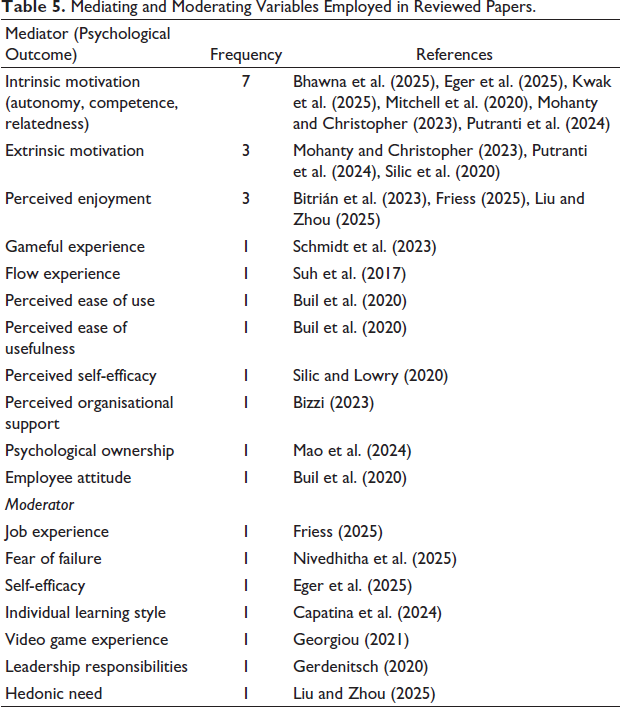
In HRM gamification research, boundary conditions are crucial for examining how individual and role contexts affect outcomes (see Table 5). Job experience strengthened the positive effect of gamified virtual sales training (Friess, 2025), while fear of failure weakened the relationship between gamification affordances and training, highlighting that competitive or progress-focused designs may be counterproductive for trainees with high levels of fear (Nivedhitha et al., 2025). Leadership responsibilities moderated work gamification influence on enjoyment and productivity, with role differences influencing how elements were received (Gerdenitsch et al., 2020). Similarly, hedonic need intensified the relationship between gamified training and enjoyment, which indirectly affected knowledge and attitudes. Need for achievement strengthened the role of goal commitment in improving knowledge, skills and abilities (Liu & Zhou, 2025). Evidence on self-efficacy and prior video-game experience as moderators is limited; studies have considered them as boundary conditions, but the effects of these factors remain unclear (Eger et al., 2025; Georgiou, 2021).
Outcomes
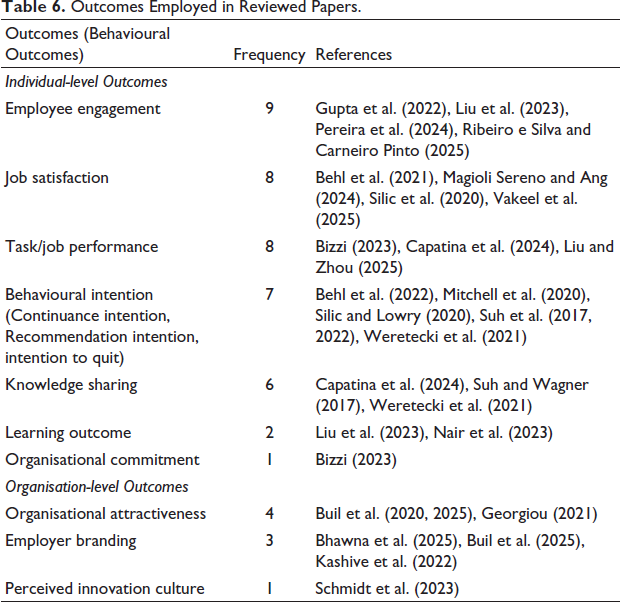
Following Hamari et al. (2014), behavioural outcomes are treated as the outcome variables in gamification research. We categorise these outcomes into individual-level outcomes and organisational-level outcomes (see Table 6) as gamification first affects person-level attitudes and behaviours, which then aggregate into organisation-level outcomes.
Outcomes Employed in Reviewed Papers.
Individual-level Outcomes
At the individual level, gamification consistently enhances employee engagement, the most frequently examined outcome in HRM contexts (Gupta et al., 2022; Pereira et al., 2024). Game mechanics such as points, challenges, badges and leaderboard stimulate intrinsic motivation and sustain employee involvement in training and development activities, leading to deeper immersion (Silic & Lowry, 2020) and continuance participation (Behl et al., 2022). Gamification enhances job satisfaction by transforming work and training more engagingly (Vakeel et al., 2025) and improves task performance through better knowledge retention (Capatina et al., 2024) and skill transfer (Liu & Zhou, 2025). It also strengthens positive behavioural intentions such as continuance intention (Suh et al., 2022) and recommendation intention (Buil et al., 2020), though effects on intention to quit are inconsistent (Behl et al., 2021). Furthermore, gamification enhances knowledge sharing (Weretecki et al., 2021) and learning outcomes (Liu et al., 2023) through the integration of reward and collaboration mechanisms that incentivise contribution, while supportive and fair designs can foster organisational commitment (Bizzi, 2023). These outcomes collectively validate gamification’s capacity to enhance motivation, learning and workplace behaviour.
Organisational-level Outcomes
At the organisational level, gamification improves employer branding (Buil et al., 2025; Kashive et al., 2022) and organisational attractiveness (Georgiou, 2021), particularly in recruitment, where game-based assessments and challenges enhance applicants’ perceptions of the firm as innovative and employee-centric (Buil et al., 2020). Beyond recruitment, gamified HR practices have demonstrated the ability to strengthen a perceived innovation culture (Schmidt et al., 2023), as employees view engaging and well-designed systems as indicators of openness and creativity (Küpper et al., 2021). These findings indicate that individual-level outcomes emphasise performance and attitudes, while organisational-level outcomes broaden gamification’s significance to strategic areas, establishing it as both a motivational instrument and a catalyst for employer branding and cultural transformation.
Methods
This section outlines the methodological trends observed across the reviewed studies (see Table 7). First, the majority of studies employed an empirical approach (70.73%), indicating the significance and demand for conceptual and review work in developing constructs, theory and synthesising evidence to guide later empirical research. Second, the research design reflects a dominant reliance on quantitative design by researchers, accounting for 51.22% of the reviewed sample. This emphasis suggests a need for more qualitative and mixed-methods studies to provide richer insights into the field.
Methodology Employed in 82 Papers.
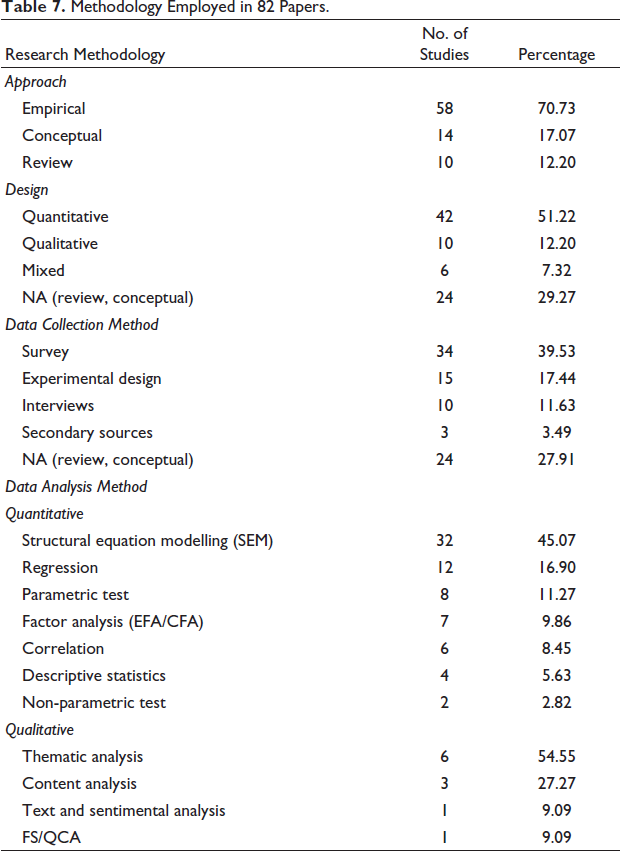
Third, surveys are the predominant method of data collection (39.53%), followed by experimental designs, interviews and secondary data analysis. Fourth, in respect to data analysis, structural equation modelling (SEM) was the most popular technique appearing in 45.07% of the reviewed studies, followed by regression, parametric tests such as ANOVA/ANCOVA/MANOVA, t-test and post-hoc, factor analysis and correlation. Besides, non-parametric tests such as the Mann–Whitney U test, Kruskal–Wallis test and descriptive statistics have also been frequently used. Other methods for qualitative design, such as thematic analysis, content analysis, text and sentiment analysis and fuzzy-set qualitative comparative analysis, indicate potential areas for future research adopting qualitative data analysis methods.
Future Research Direction
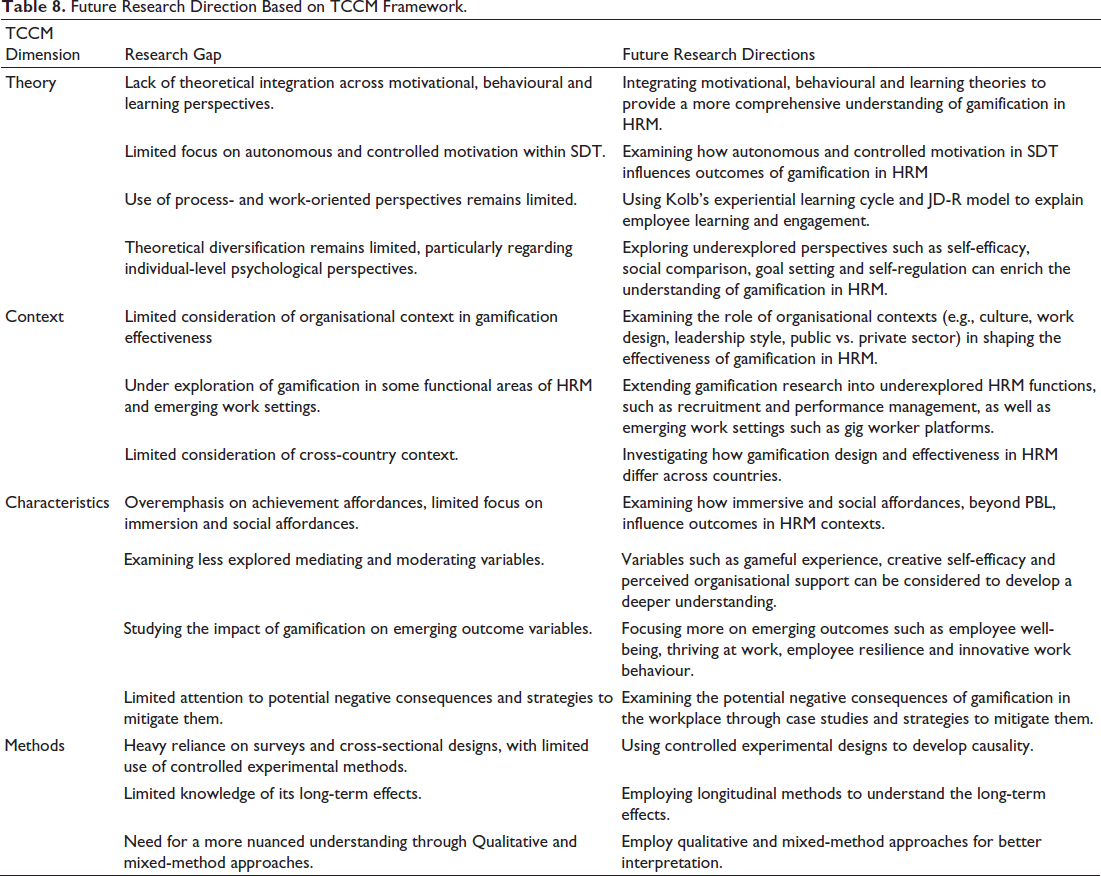
The preceding section has described the existing state of gamification research in HRM. This section outlines the gaps identified through a comprehensive review of the 82 articles by using the TCCM framework (see Table 8).
Future Research Direction Based on TCCM Framework.
Theory
Gamification research in HRM primarily draws on motivation, behavioural and learning theories, yet these mechanisms are often applied in isolation, hindering the development of a holistic theoretical understanding. Future research should integrate these theories to explain the mechanism of how gamification affordances influence psychological and behavioural outcomes in HRM (Armstrong & Landers, 2018; Ikhide et al., 2023). SDT is the most widely used theory; however, research has primarily focused on intrinsic motivation and overlooked autonomous and controlled motivation, which are subdivisions of extrinsic motivation. Future research should refine the application of SDT by systematically examining both autonomous and controlled motivation (proposed by OIT) in gamified HRM settings (Buil et al., 2020; Magioli Sereno & Ang, 2024). Further theoretical development may also emerge from process- and work-oriented perspectives, such as Kolb’s experiential learning cycle and the JD-R model, which can help explain employee learning, engagement and behavioural adaptation in gamified settings (Kwak et al., 2025). In addition, individual-level psychological perspectives such as self-efficacy, social comparison, goal-setting and self-regulation offer promising avenues for broadening the theoretical base of gamification studies in HRM (Krath et al., 2021).
Contexts
The context in which gamification is applied significantly influences its effectiveness. Future studies should account for the organisational context in which gamification is applied, moving beyond one-size-fits-all assumptions. Gamification affordance design must fit the organisational context, as the effectiveness of game elements is often based on factors such as organisational culture, climate, work design, leadership style and public versus private (Hammedi et al., 2021; Landers, 2019; Nair et al., 2023). For instance, a competitive leaderboard may enhance engagement in a collaborative environment but prove counterproductive in highly individualistic settings. The review indicates that gamification has been predominantly studied in HR functions such as training and engagement, while areas such as recruitment and performance management remain underexplored (Friedrich et al., 2020). Investigating gamified approaches in these functions, such as candidate assessments or performance feedback systems, offers valuable opportunities. Future research may also extend gamification beyond traditional HRM settings to emerging forms of work such as gig worker platforms (Behl et al., 2021; Pereira et al., 2024). As many studies focused on the Western region (e.g., the US and Europe), future researchers can conduct cross-cultural studies in emerging economies (e.g., South Asian countries).
Characteristics
Understanding the characteristics of gamification elements is crucial for optimising HRM outcomes. Future research on gamification design should move beyond the dominant focus on achievement affordances such as PBL (the ‘holy trinity’ of gamification). While these features have been extensively studied, other categories of affordances, such as immersive (e.g., narratives, avatars, personalisation) and social affordances (e.g., competition, collaboration, interactivity), remain underexplored (Armstrong & Landers, 2018; Koivisto & Hamari, 2019). Examining these affordances can clarify which features most effectively foster desired behavioural outcomes in HRM contexts. Greater attention is also needed to underexplored mediating mechanisms and boundary conditions, such as gameful experience, creative self-efficacy and perceived organisational support (Bitrián et al., 2024; Bizzi, 2023; Landers et al., 2019; Schmidt et al., 2023). Information systems literature on gamification suggests that gameful experience emerges as a critical precondition for successful gamification (Huotari & Hamari, 2017). Despite the growing relevance of psychological mechanisms in gamified HRM systems, limited knowledge exists regarding how employees perceive, experience and respond to these mechanisms in different HRM contexts. Future research should also examine emerging outcomes such as employee well-being, thriving at work, employee resilience and innovative work behaviour. However, existing studies focus more on the positive outcomes of gamification in the workplace. Therefore, greater attention is needed to the potential negative and adverse effects of gamification (such as stress, burnout, addiction, privacy and over-competitiveness) and strategies for mitigating them (Hammedi et al., 2021).
Methods
Methodological advancements are crucial for robust future research in gamification. Most of the existing studies of gamification in HRM are based on cross-sectional surveys and case studies, with limited longitudinal studies to determine its long-term effects. Lack of controlled experimental designs limits the capacity to establish causality and to identify which game elements are most efficient in influencing HR outcomes (Nivedhitha et al., 2025). Comparative analyses of several gamification applications and control groups can elucidate the most effective game elements and enhance gamified HRM procedures for better outcomes. Employing a mixed-methods study can enhance the understanding of the impact of gamification (Behl et al., 2021). Future studies should prioritise qualitative methodologies like focus groups and in-depth interviews to provide comprehensive insights into the dynamics of gamification in HRM (Putranti et al., 2024).
Conclusion
Theoretical Implications
The current study enhances the theoretical comprehension of gamification in HRM by offering a comprehensive synthesis of theories, research context, characteristics and methods (TCCM) employed in the existing literature. The review enhances theoretical understanding by categorising the existing theories into three categories: motivational, behavioural and learning theories. Through this categorisation, future scholars can integrate different theories to get a more elaborate understanding of gamification research in HRM. Further, the review shows that gamification in HRM should not be understood merely as a set of application tools across different functions, but as a mechanism-driven process through which specific affordances shape psychological and behavioural outcomes. Based on Hamari et al. (2014)’s conceptualisation of gamification, the study proposes an integrated framework that synthesises the variables studied in the empirical papers (see Figure 6), offering a consolidated representation of how gamification affordances influence psychological and behavioural outcomes within HRM systems. This framework not only advances the theoretical coherence of gamification research but also provides a structured foundation for future empirical testing through rigorous methods such as longitudinal, experimental, qualitative or mixed-method approaches, enabling scholars to explore causal inference and contextual richness. This comprehensive study would reduce the conceptual fragmentation, standardise the notion of gamification in HRM and provide future research directions. The gaps identified by the TCCM framework will facilitate future researchers in pursuing interesting research topics to advance gamification research in HRM.
Practical Implications
This research offers three key practical implications for HR professionals and organisations of South Asian countries such as India, where resource constraints, socio-economic diversity and uneven digital readiness shape the adoption of technology-driven HR practices. First, organisations should adopt gamification selectively and strategically rather than as a universal HR solution. In particular, gamification is likely more effective in HR functions that rely on repeated interaction, feedback and participation. Second, HR practitioners should move beyond a narrow reliance on PBL and design gamified systems that provide meaningful affordances such as achievement, immersion and social. The success of gamification depends on how effectively game elements offer these affordances to employees. For instance, badges or points are of little value if they fail to evoke a genuine sense of achievement. HR practitioners should move towards a more holistic portfolios that incorporate immersive features (e.g., narratives, avatars, personalisation) and social features (e.g., cooperation, collaboration, team challenges) to achieve the desired behavioural outcomes. Third, the successful implementation requires ensuring contextual fit and long-term sustainability. Gamification strategies must be aligned with organisational culture, work design and culturally localised designs in South Asian countries like India, while ensuring fairness and inclusivity. For organisations in India and similar settings, the review suggests that the practical value of gamification lies not in mechanically adding game elements, but in designing context-sensitive HR interventions that support learning, engagement and sustainable employee outcomes.
Footnotes
Acknowledgement
The authors extend their thanks to the academic community for providing a conducive environment for intellectual exploration and growth. Additionally, the authors appreciate the resources and facilities made available to them during this research. Further, the authors would like to thank the editor and all the reviewers for their reviews.
Data Availability
The data sets generated during and/or analysed during the current study are available from the corresponding author on reasonable request.
Declaration of Conflict of Interests
The authors declared no potential conflicts of interest with respect to the research, authorship and/or publication of this article.
Ethical Approval and Informed Consent
This article does not contain any studies with human or animal participation. There are no human participants in this article, and informed consent is not required.
Funding
The authors received no financial support for the research, authorship and/or publication of this article.
Supplementary Material

References
Supplementary Material
Please find the following supplemental material available below.
For Open Access articles published under a Creative Commons License, all supplemental material carries the same license as the article it is associated with.
For non-Open Access articles published, all supplemental material carries a non-exclusive license, and permission requests for re-use of supplemental material or any part of supplemental material shall be sent directly to the copyright owner as specified in the copyright notice associated with the article.
