







Abstract
Does the ethnoracial composition of local labor markets influence informal regulation of employment opportunities? To address this question, we link Census data on racial composition with survey data on unsolicited job leads in the 23 largest U.S. metro areas. The aim is twofold: (1) to operationalize three distinct conceptualizations of ethnoracial composition (general diversity, co-ethnic presence, and particularistic representation), and (2) to examine the influence of each at two distinct levels of local labor markets (the metropolis as a whole and occupational segments within each respective metropolis). Logistic regression results reveal that the odds of receiving unsolicited job leads do not vary by metro-level composition, but they do increase significantly with shares of white workers in local occupational segments. These results suggest that racial preference and privilege scale up to influence how employment opportunities are socially regulated in and across local occupational fields.
A long line of research has explored the role of personal networks in facilitating and regulating labor markets (Fernandez, Castilla, and Moore 2000; Granovetter 1974; Lin 2001). These earlier studies offer a critical insight: employment opportunities are not simply allocated through supply and demand regulated by price. Rather, job matching is a social process in which actors are linked to jobs, often through personal relations that socially regulate employment information. To date, most research on this subject has focused on how these relations and associated information vary by individual characteristics such as race and ethnicity and what this variation means for processes of social closure (for recent reviews, see Castilla, Lan, and Rissing 2013; McDonald et al. 2013). Although this work continues to be invaluable for improving sociological understanding of labor market stratification, it pays insufficient attention to how and to what extent the ethnoracial character of local labor markets influences the likelihood of such social regulation.
This line of questioning is important not only for improving understanding of local contingencies in labor market regulation (Peck 1996) but also for illuminating how race and ethnicity help structure local institutions and markets. To investigate these dynamics, we identify three types, or dimensions, of ethnoracial composition that prior research suggests help to structure local labor market processes and outcomes: general diversity among major groups (i.e., how racially balanced, or numerically integrated, the local market is), ingroup presence (i.e., how large a numerical presence one’s own group constitutes), and particular-group representation (i.e., how well represented particular groups are—such as whites, blacks, and Latina/os). We refer to these three types of ethnoracial composition, or structure, as general diversity, co-ethnic presence, and particularistic representation, respectively. We examine their operation at two nested levels: (1) within the metro labor market as a whole and (2) within broad occupational segments within the local market.
Operationalizing local labor markets at these two distinct levels is sociologically important because workers are simultaneously embedded in multiple, overlapping social fields. While many have argued that the ethnoracial structure of cities and metro areas as a whole influences access to informal job information (e.g., Wilson 1987), others have emphasized the importance of racial composition within occupations (e.g., Kornrich 2009; Waldinger 1995). To date, however, there has been little comparative analysis of how the informal flow of job information is shaped by ethnoracial presence at the metro level and within respective local occupational segments. Consequently, little is known about how these different dimensions of local labor markets affect the ways in which local workers obtain information about job opportunities.
We examine these issues empirically through a unique survey on network-based job finding behavior in metro areas containing the 23 largest cities in the United States. These data measure unsolicited information about job opportunities that workers receive through routine conversations and everyday life. The survey responses have been linked to Census data, which allow for measurement of ethnoracial composition of respective metro areas in addition to broad occupational segments within each of these areas. Findings help to pinpoint how and to what extent different types of ethnoracial composition work at different levels of local labor markets to informally regulate the opportunities present to different groups.
Race, Place, and Unsolicited Job Leads
The voluminous literature on social networks and job finding contains many studies linking informal job finding practices to the ethnoracial characteristics of job seekers (e.g., Parks-Yancy 2006; Reingold 1999) and their social connections (e.g., Fernandez and Fernandez-Mateo 2006; Stainback 2008). These studies raise concerns about the extent to which members of historically marginalized groups are able to effectively mobilize their networks to find jobs, particularly when these individuals reside in high-poverty urban environments (Elliott and Sims 2001; Smith 2007). Another line of research has examined the relationship between ethnoracial composition and wage inequality, revealing that the economic and job attainment prospects of historically marginalized groups is inversely proportional to co-ethnic concentration in areas where they live (Johnson, Pais, and South 2012; Kornrich 2009; Tomaskovic-Devey and Roscigno 1996).
The mechanisms that generate these inequities, however, are largely assumed: results imply that exclusionary hiring practices and social closure enforcement may be more severe in places where many people of historically marginalized racial and ethnic groups reside (Cohen and Huffman 2007; Huffman and Cohen 2004). While the barriers that minorities face in these contexts could be due to direct employer discrimination, they could also be due to a lack of access to job information through personal connections due to embeddedness in these contexts. The possibility here is not only that one’s race and ethnicity influences access to informal job information but also that the ethnoracial composition of local labor markets further influences the extent to which informal regulation of job information occurs.
Learning more about how ethnoracial context influences the flow of job information is therefore critical for understanding labor market stratification. In addition to examining these dynamics generally, the present study contributes to previous research on networks and ethnoracial job finding by focusing specifically on receipt of job information rather than taking the conventional approach of focusing just on successful job matches. As others have noted (e.g., Fernandez et al. 2000), the conventional approach is problematic because it ignores informal regulation that does not result in new employment. To understand such regulation fully, it is better to examine differential access to information about job openings, independent of the outcome of respective leads. Moreover, access to job information is more a matter of in-degree than out-degree—that is, information received rather than sought (cf. McDonald and Day 2010). Consequently, the receipt of unsolicited job leads serves as a critical indicator of employment information access, which is conceptualized here to be a function not only of individual characteristics but broader labor market structures.
Below, we elaborate on three types, or dimensions, of ethnoracial composition that prior research suggests influences local market structures and, by extension, informal access to employment information. These conceptualizations hinge on the extent to which ethnoracial compositions exert a general, relative, or particularistic influence on local labor market dynamics, net of individuals involved. As will become apparent, a diversity of expectation abounds within as well as across the three dimensions, inviting operationalization at more than one level of local labor markets.
Three Dimensions of Ethnoracial Composition
General Diversity
Both classic and contemporary sociological research offer clues as to how racial diversity might affect network-based exchange. The conflict and group threat literature implies that, as the local environment becomes more heterogeneous, job seekers will use network contacts of their same race and ethnicity over formal means of job finding. Essentially, the threat of competition from outgroups intensifies as their numbers rise (Blalock 1973; Blumer 1958). Increased urban diversity could, therefore, lead to greater informal market regulation and opportunity hoarding within racial and ethnic groups. This line of thinking is also consistent with tenets of urban sociology’s subcultural theory of urbanism (Fischer 1982). Broadly, this theory contends that larger, denser urban areas produce subcultural affiliations, institutions, and interactions that fracture local populations into smaller, more inwardly oriented groups. In this way, urban areas do not homogenize or alienate local residents, as classic theories worried. Rather, they create and reproduce local social divisions as well as the network ties that sustain and inform them. This dynamic would imply that informal regulation of labor market opportunities would be greatest in social contexts that are most heterogeneous.
Alternatively, classic modernization theories suggest that increasing heterogeneity and rationalization in cities will lead to a breakdown of clan-like exchanges as interaction between groups decreases “othering” and perceived competition (Weber 1922). The decreased competitiveness and increased trust in heterogeneous environments would seemingly reduce the need for information hoarding via informal exchange (cf. Allport 1954; Fischer 1982; Simmel 1971; Wirth 1938). This line of research implies that one would find the least amount of informal regulation of employment information in the most diverse cities, as individuals reduce their hoarding opportunities within families and ethnic groups.
More recent research on diversity takes a different tack. Robert Putnam’s (2007) work on cities suggests that increased racial heterogeneity leads people to become less trusting of others. As such, increased diversity leads people to “hunker down” and stop interacting, both within and across racial and ethnic groups. Ironically, this unique take on diversity implies a similar conclusion about networking behavior as modernization theory: that people are more individualistic in diverse environments and are, therefore, less likely to engage in network-based job behaviors, resulting in more formal local markets.
Each of the above explanations suggests that the diversity of the local social environment has a uniform, or general, effect on job information access for members of all racial and ethnic groups—either encouraging or reducing it to more or less the same extent for all involved.
Co-ethnic Presence
In addition to general effects of ethnoracial diversity highlighted above, existing sociological literature suggests that having more ingroup, or co-ethnic, members in place facilitates informal job regulation for members of these groups. As such, this dimension of ethnoracial composition is more relative, or egocentric, than the uniform effects of general racial diversity discussed above.
Social psychological theorists posit that humans innately categorize people to more efficiently move through the social world (S. T. Fiske 2009), developing schemas based on stereotypes, norms, and previous interactions with others for most achieved and ascribed categories, including race and ethnicity (A. P. Fiske 1992; Taylor et al. 1978). These schemas form the basis of our relational identities as we mentally align ourselves with an ingroup of others who share the same social categories. Both consciously and subconsciously, people view ingroup members as warmer and more competent than people of other social categories (outgroup members) and are more likely to help ingroup members due to a sense of communality that will benefit them as a member of the group (A. P. Fiske 1992; S. T. Fiske et al. 2002; Massey 2007). Thus, networks are more likely to be composed of homophilous others (McPherson, Smith-Lovin, and Cook 2001; Mollenhorst, Völker, and Flap 2008).
Ingroup favoritism generates an unequal distribution of resources as more prominent groups tend to hoard resources among themselves (Avent-Holt and Tomaskovic-Devey 2010; Massey 2007; Parkin 1974; Tilly 1999; Weber 1922). Kanter’s (1977) classic study of a corporation provides one of the best known examples of opportunity hoarding by a dominant group. Valuable resources, including advice and information about opportunities in the internal labor market, passed frequently among dominant group members (white men) within the firm, significantly disadvantaging token members of the collective. These findings are bolstered by micro-interactionist accounts of exchange (Ridgeway 1997; Schwalbe et al. 2000) that reveal that status distinctions and “othering” processes can lead to significant benefits enjoyed by dominant group members.
Yet, at the same time, research into ethnic enclaves reveals that groups with lower social status can also employ opportunity hoarding when their numbers dominate social milieus. These racial and ethnic enclaves are common in many cities and highlight the role that social networks play in informal job regulation for historically disadvantaged racial groups and newer immigrant populations (Kasinitz and Rosenberg 1996; Marrow 2011; Portes and Jensen 1989; Portes and Sensenbrenner 1993; Waters 2009). The informal regulation of race/ethnic segmented labor markets through ingroup closure can also become self-reinforcing, as ingroup benefits draw more group members to the area in ways that further enhance and extend such ingroup dynamics. This dynamic can also happen within local occupational segments, as Wingfield (2009) demonstrates in research on black women who form information-sharing networks across local beauty salons. These lines of research imply that, regardless of their own race, workers gain more informal access to information about job openings when they are members of more numerically dominant groups, which is often easier to achieve within specific occupational segments than in the labor market as a whole.
Particularistic Representation
The above perspectives notwithstanding, ethnoracial composition may also have a particularistic influence on the informal regulation of job information. Here, we consider how the regulation of job information may not be affected by diversity per se or by the presence of racially similar others, but rather by compositional effects that are specific to ethnoracial groups and shaped by historical patterns of intergroup relations. These compositional effects derive from two types of labor market embeddedness: (1) the supply networks of workers and job seekers and (2) recruitment networks of employers (Granovetter and Tilly 1988). We discuss these two types of embeddedness in turn, as they lead to different predictions.
A focus on supply networks draws attention to the ways that informal job information is regulated via race and ethnic variation in the propensity to share information among others. Sandra Smith’s (2005, 2007) seminal research on job sharing behavior shows that blacks are often reluctant to provide information about job opportunities with friends and family members. She finds this behavior to be especially common in high-poverty, black-concentrated neighborhoods. Black workers in these contexts are reluctant to provide help because a long history of racial discrimination by employers has placed them in a precarious position in the labor force, wherein their own employment could be jeopardized if they vouch for someone who is later perceived to be a problem (Smith 2007). Increasing representation of blacks in a local labor market might, therefore, be associated with less access to job information through personal networks.
Latina/o workers, though, tend to display opposite tendencies. Survey research on job finding practices generally shows that Latina/os are the most likely of all ethnoracial groups to obtain employment via information received from personal contacts (Falcon 1995; Green, Tigges, and Diaz 1999). Moreover, Smith’s (2010) comparison of black and Latina/o service workers contrasts the former group’s reluctance to help others find jobs to the latter group’s willingness to pass along information about job opportunities. These studies paint Latina/os as avid networkers relative to members of other race/ethnic groups. Thus, an increasing representation of Latina/os within local labor markets is likely to be associated with greater access to job information through personal networks than an increasing concentration of either blacks or whites.
An alternative perspective focuses on the role of employer recruitment in regulating job information. From this perspective, one would expect to find the greatest informal access to job information in white-dominated social contexts. In general, socially reproduced inequalities tend to favor whites over other groups, especially in the labor market (S. T. Fiske et al. 2002; Massey 2007; Tilly 1999). These inequalities are reflected broadly in the fact that whites dominate better jobs, while members of historically marginalized groups are more likely to be found in lower-status positions, even when employed within the same occupations and workplaces as whites (Tomaskovic-Devey 1993; Tomaskovic-Devey, Thomas, and Johnson 2005). These categorical inequalities are frequently traced to racialized job queues (Thurow 1969) through which employers not only rank workers by race and ethnicity but also typically prefer white workers over others (Kmec 2006; Kornrich 2009).
We argue that the preference for white workers coincides with a preference for network-based hiring to yield greater informal regulation in white local contexts. Most employers prefer to hire workers through employee referrals and social networks (Miller and Rosenbaum 1997) to find “established players with track records” (Waldinger 1995:555). Networks serve as a good (and cheap) source of information about the quality of potential new hires, which helps to minimize the risk associated with hiring decisions (Granovetter and Tilly 1988; Kanter 1977). Recruitment of workers through personal networks is especially common when filling high wage positions (Granovetter 1974; McDonald 2015). Employers put forward more time and effort to informally recruit workers from preferred candidate pools to fill those top jobs (Granovetter and Tilly 1988). Employers are, therefore, likely to spread word of job openings in white-dominated labor markets, while turning to formal advertising and less intensive recruitment efforts to recruit in other social contexts (cf. McDonald and Day 2010; Stainback and Tomaskovic-Devey 2012). Consequently, local labor markets that contain greater proportions of white workers should have greater access to unsolicited information about job openings.
By contrast, minority local contexts may not be sources of or targets for informal job recruitment in the same way that white contexts are, which places incumbents of these minority contexts—regardless of their own individual race and ethnicity—at a significant disadvantage for learning about new and possibly better employment opportunities. The lack of access to informal job information should be especially strong in black-concentrated environments. Blacks consistently fall near the bottom of the labor queue and benefit the least from networking (Elliott and Sims 2001). Blacks living in predominantly black areas lack access to high-status contacts that might have information to share about jobs (Rankin and Quane 2000; Wilson 1987), especially openings that others might want (Gowan 2011). Many employers go out of their way to avoid recruiting black workers to fill job openings, often relying on stereotypes about work ethic (Kasinitz and Rosenberg 1996; Kirschenman and Neckerman 1991; Moss and Tilly 1996). Within organizations, black workers are often relegated to peripheral positions that are not central to the functioning of firms, which results in informal isolation (Collins 1989, 1993, 1997). Latina/os are likely to experience similar information isolation, although perhaps not as severe as for blacks. Employers tend to prefer Latina/os and other race/ethnic groups over black workers for most positions (Kasinitz and Rosenberg 1996; Waldinger and Lichter 2003; Waters 2009), although once employed, information about new and better employment opportunities is likely to be relatively scarce.
This focus on recruitment networks and attendant racial privilege, therefore, implies that informal exchange of job information should increase with the share of whites in the local labor market—as employers rely on networks to alert and attract preferred workers—and decline with the share of ethnoracial minorities, net of basic qualifications. In this sense, white-dominated labor markets come to operate as well-connected information highways, wherein job leads flow relatively freely, bringing more opportunities to enter and exit different jobs. By contrast, minority-dominated employment contexts operate more as information cul-de-sacs, wherein occupants, once employed, have difficulty learning about and, thus, accessing other job opportunities.
If these dynamics do indeed operate, however, it raises the question of whether incumbency in ethnoracially particularistic contexts applies to all group members or only to members of preferred racial and ethnic groups. In other words, might the information benefits associated with working in a white-dominated labor market apply to all members or only to white workers in those white-dominated contexts? Likewise, do the information disadvantages of working in a minority context fall solely on minority incumbents? Our analysis examines each of these possibilities alongside the overarching effects of particularistic ethnoracial representation. We also study these relationships across different levels of labor market aggregation, a point that we turn to next.
Two Levels of Local Labor Markets
As previous studies have shown (e.g., Cohen and Huffman 2003a, 2003b; Kornrich 2009), the role that ethnoracial composition plays in shaping local stratification processes depends not just on its conceptualization but also on its level of aggregation, or operation. Arguments presented above vacillate between such levels of aggregation, analyzing informal job matching in cities, neighborhoods, labor markets, and workplaces (e.g., Fernandez and Fernandez-Mateo 2006; Green et al. 1999; Kmec 2006; Marsden 2001; Petersen, Saporta, and Seidel 2000; Royster 2003). Our goal is to understand how the different dimensions of ethnoracial composition highlighted above influence (or structure) the informal regulation of local labor markets at two distinct levels.
One level is that of the local metropolis as a whole. With this operationalization, common in prior research, all residents of a metro area are loosely assumed to be within commuting distance of the same general set of employment opportunities, all else equal. Another way to operationalize the local labor market is to focus on broad occupational segments within respective metro areas. The logic here is that not all workers residing in the same metro area work in the same labor market; instead, they occupy and interact within broad occupational segments for which they are loosely qualified and affiliated. Occupational contexts can display unique characteristics in different metro areas. For example, occupational sex segregation varies substantially across metro areas and contributes to unique gender stratification outcomes (Cohen and Huffman 2003a, 2003b). Because prior research and theory are weak on which of these two levels—metro or metro-occupational—is most salient for understanding structural influences of race and ethnicity on job networking, we examine the three dimensions of ethnoracial composition discussed above at both levels. The aim is to gain deeper understanding of how racial and ethnic dynamics influence the social regulation of local labor markets by pinpointing the exact type and level of greatest observed influence.
Data and Method
We use data from the Job Search 2002 survey to examine the different dimensions of ethnoracial influence discussed above on job information receipt. Telephone surveys were administered to respondents selected from the 23 largest primary metropolitan statistical areas (PMSA) using random digit dialing. 1 The survey only included individuals who were employed (full-time, part-time, or temporary leave) at the time of the survey (n = 685). 2 We limited the sample to white, black, and Latina/o respondents and made additional deletions for missing data on the variables used in the analysis. 3 These omissions resulted in a final sample of 642. The descriptive statistics for this sample are presented in Table 1.
Descriptive Statistics.
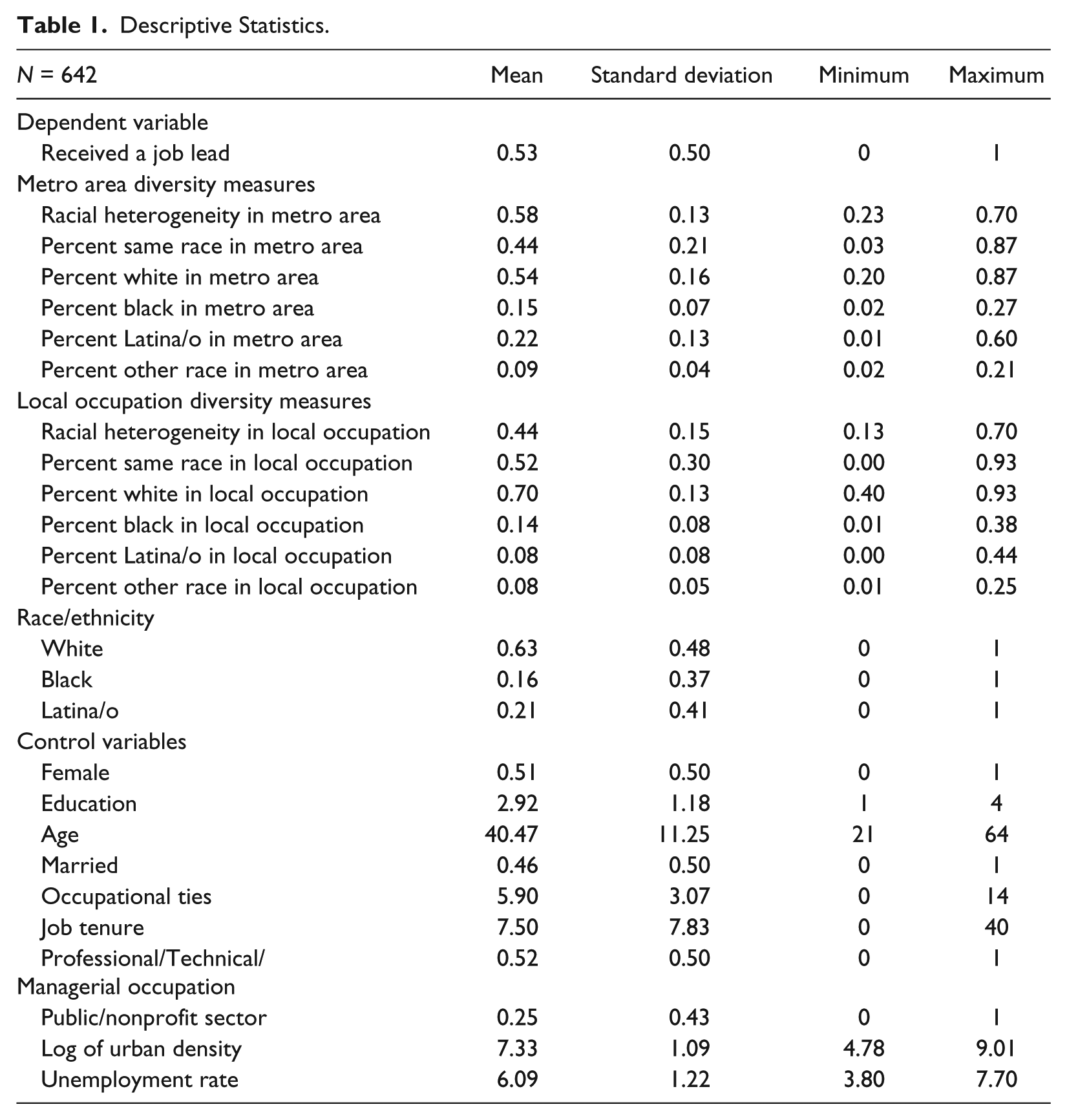
The dependent variable is a binary indicator of having received an unsolicited job lead: “Now I would like you to think of the last 12 months, did anyone mention job possibilities, openings or opportunities to you, without your asking, in casual conversations? (This may include face-to-face, telephone, e-mail, fax, etc.).” As indicated in Table 1, roughly half (53 percent) of the respondents claimed to have received such information in the last year. Note that this measure refers specifically to unsolicited job leads (“without your asking”) and is, therefore, not predicated on an active job search on the part of the respondent.
Measures of metro-level racial composition come from 2000 Census data for all residents in each PMSA. 4 General racial diversity in each metro area is measured through use of the Blau index, which is equal to 1 minus the sum of the squared proportions for each major ethnoracial category (white, black, Latina/o, and other race). In essence, the Blau index reverses the Herfindahl homogeneity index to produce a continuous measure of heterogeneity (Blau 1977). Lower values, therefore, represent less diverse (more ethnoracially homogeneous) metro areas, and higher values indicate more diverse (less ethnoracially homogeneous) metro areas. Our indicator of co-ethnic presence contains the proportion of individuals in a metro area that are the same race as the respondent. Finally, variables for particularistic composition (white, black, Latina/o, and other race) are measured simply as the proportion of local workers in each category. The percentage white variable displays considerable variability, ranging from 20 percent white (Miami, Florida) to 87 percent white (Minneapolis, Minnesota). Percentage black ranges from 2 percent (Orange County, California) to 27 percent (Atlanta, Georgia). 5 Percentage Latina/o ranges from 1 percent (St. Louis, Missouri) to 60 percent (Miami, FL). The lowest value for percentage “other race” is 2 percent (Miami, Florida) and the highest is 21 percent (Oakland, California). Other race is necessary to include in the models to ensure that percent white serves as the reference category.
We also linked the survey data to the 5 percent micro-sample Integrated Public Use Microdata Series. (IPUMS) of the 2000 Census. When aggregated to the metro level, these data allow us to measure ethnoracial diversity within each respondent’s broad occupational segment and within the metro area in which they reside. The 11 occupational segments include the following: executive and managerial, professional, technical, sales, administrative support, protective services, other services, construction and craft, production, transportation, laborers, and farm workers. The local occupational measures mirror those for the metro area. We used the Blau index for race heterogeneity and percentage same race for co-ethnic presence. Specific percentages for each ethnoracial group in a local occupation segment are used to measure particularistic representation.
The Job Search Survey data are used to measure each respondent’s race/ethnicity with dummy variables for black and Latina/o, with white as the reference category. Race/ethnicity of individual respondents serves two purposes in the analyses. First, the inclusion of these dummy variables allows us to control for individual characteristics that could confound our estimation of contextual level effects on the informal regulation of job information. Second, we use these variables to analyze the intersection of individual and structural influences by testing for distinctiveness in the ways that racial and ethnic groups may experience those contexts in different ways.
To account for differential receipt of job leads across levels of aggregation, we include several respondent-level control variables. Gender is measured with a dummy variable for female. Education is based on each respondent’s highest degree received and coded into four categories: 1 = less than high school degree, 2 = high school degree, 3 = some college, and 4 = four-year college graduate. Age is measured in years and ranges from 21 to 64. Marital status is indicated by a dummy variable for married.
We also control for network, job, and metro area characteristics that might influence the receipt of job leads. We calculated the occupational extensity of each respondent’s social network using the position generator method (Lin, Fu, and Hsung 2001). Respondents were asked if they knew someone in each of 14 occupations. 6 We then summed the number of occupations in which a respondent affirmed they knew someone. This is an important variable to include as a control, for several reasons. Observed ethnoracial composition effects could be spurious due to variation in the expansiveness of personal networks across respective labor market contexts. Specifically, job lead receipt within a given context could be due to the size of incumbents’ networks rather than to the availability of information within that context. Likewise, some occupational contexts may receive more job leads because work in these occupations involves connections with people from a more heterogeneous set of occupations. 7 Controlling for respondent variation in occupational connections helps to account for these possibilities and allows us to refine our assessment of the independent influence of ethnoracial context on job lead access net of individual job network extensity.
Receipt of information about jobs could also be influenced by time spent working in the same establishment, which we measure in years using the job tenure variable. Professional, technical, and managerial workers also tend to have greater access to information and broader boundaries for locating jobs outside their respective cities and markets. Therefore, we include a dummy variable for respondents in professional, technical, and managerial occupations. Job sector (public and nonprofit = 1; private = 0) is an important control to include, as well, because racial and ethnic minorities are better represented in the public and nonprofit sectors, which could influence their chances of receiving job information.
In addition, we control for population density of a metro area, which is likely to be associated with both ethnoracial diversity and with job lead receipt. Population density is calculated by dividing the number of people residing in the metro area by its respective land area. We transformed this variable to its logarithmic value to account for the right skew of the original distribution. Finally, we control for unemployment rate (from March 2002, via the Current Population Survey) to account for variability in access to job opportunities across metro areas.
The data do not conform to standard regression assumptions because they contain multiple levels of aggregation: individual respondents are nested within metro areas. 8 Therefore, we model the relationship between job lead receipt and ethnoracial diversity using logistic random-intercept models, which allows us to estimate a city-specific error term alongside the standard individual-level error. 9 All models are estimated with robust standard errors.
Results
Table 2 presents the exponentiated regression coefficients (odds ratios) associated with the probability of receiving a job lead versus receiving none. Values above 1 indicate positive relationships, whereas values below 1 indicate negative relationships. Before discussing key findings, it is useful to review how the control variables are related to receipt of job leads. We find no significant gender difference in the likelihood of receiving job leads. We also observe no significant educational or marriage advantage in job leads. Age is negatively and significantly associated with the odds of receiving job leads, whereas the coefficients for job tenure are not statistically significant. Not surprisingly, individuals with the broadest occupational networks are more likely than others to receive unsolicited information about job openings. Similarly, people working in professional, technical, and managerial occupations are roughly twice as likely as others to receive unsolicited job leads. The odds of receiving job leads is unaffected by the type of sector in which individuals work. Urban density is positively related to job leads, but the relationship is significant in only one of the models. The unemployment rate is not associated with the receipt of job leads.
Odds Ratios From Logistic Regression of Job Leads on Metro Area and Local Occupation Diversity.
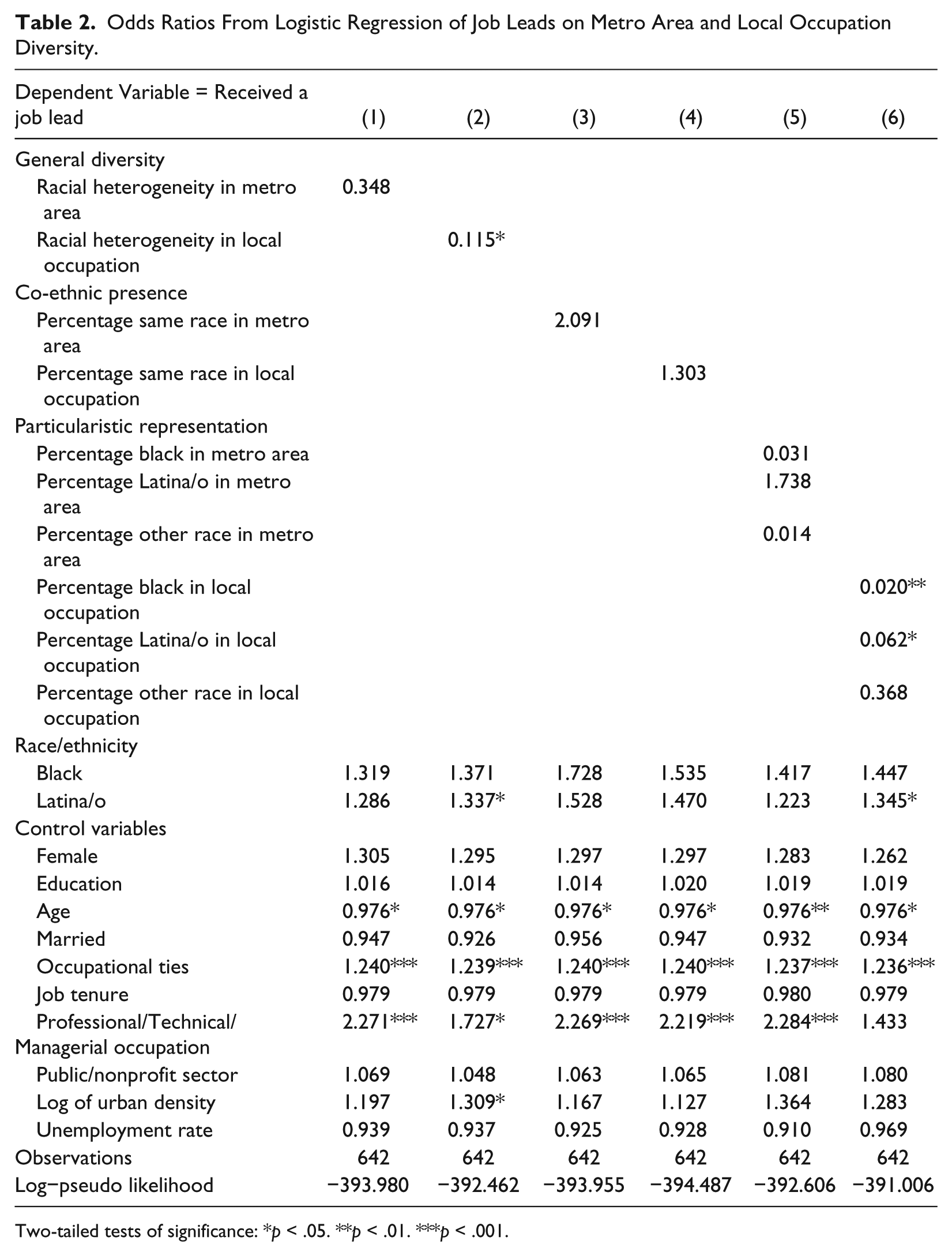
Two-tailed tests of significance: *p < .05. **p < .01. ***p < .001.
Net of the above controls (as well as the metro and local diversity measures described later), race and ethnicity of individual respondents appears to be only modestly related to the unsolicited receipt of job leads. Latina/os tend to receive significantly more job leads than whites, ceteris peribus, but the difference is statistically significant in only two of the models. Interestingly, blacks’ likelihood of receiving job leads is no less than that of whites.
Turning now to the contextual variables, Model 1 includes our measure for racial heterogeneity at the metro leveland show that it is not significantly related to the odds of receiving a job lead during the last year. By contrast, results for Model 2 indicate that racial diversity at the local occupational level is negatively and significantly related to the odds of receiving an unsolicited job lead. More precisely, odds of receiving such a lead in a fully balanced, or heterogeneous, occupational segment are about 89 percent lower, 100 × (1 − .115) = 88.5, than odds of receiving such a lead in a local occupational segment that contains members of only one major ethnoracial group, all else equal. This finding supports notions that local diversity reduces the flow of information, but more at the occupational than metro level as a whole.
Models 3 and 4 display results from corresponding analyses of co-ethnic presence. Findings here offer no support for the co-ethnic presence hypothesis. The proportions of same-race individuals in a metro area and in a local occupational segment are not significantly associated with odds of hearing about an unsolicited job lead while employed. We also tested for nonlinear effects for these variables by including a squared term for co-ethnic presence in additional models, but these coefficients were not statistically significant at the metro level or local occupational level.
Tests for particularistic representation are presented in Models 5 and 6. In Model 5, the coefficients for percent black, percent Latina/o, and percent other race in the respective metro area are not statistically significant. However, in Model 6, indicators of ethnoracial composition in local occupations are significantly associated with unsolicited job leads. Specifically, as percent black in a local occupation increases, odds of workers receiving unsolicited job leads decline precipitously. More precisely, the odds of hearing about a job lead in a local occupational segment that is entirely black is 98 percent lower, 100 × (1 − .020) = 98, than the odds of hearing about a job in a local occupational segment that has no black workers. The relationship between percent Latina/o in a local occupational segment and job leads is also negative, although not quite as steep. Workers in fully Latina/o local occupational segments have 94 percent lower odds, 100 × (1 − .062) = 93.8, of receiving unsolicited job leads than workers in local occupations devoid of Latina/os. 10
To illustrate further, Figure 1 shows how the predicted probabilities of receiving a job lead vary across local occupational segments with different ethnoracial compositions, net of other variables included in Table 2. Note that these estimates are included only for percentage values that are observed in our study. The upper left panel of the figure shows that the probability of receiving an unsolicited job lead is greatest in local occupations that contain the largest proportion of whites. For example, a person who is in a local occupational segment that is only 20 percent white has a 25 percent probability of receiving an unsolicited job lead. However, someone in an 80 percent white local occupational segment has a 60 percent probability of receiving a job lead. By contrast, highly concentrated black and Latina/o local occupational segments offer relatively few opportunities for informally learning about job opportunities. The probability of job leads receipt declines from 63 percent in occupations with almost no black workers to 33 percent in occupations approaching two-fifths black concentration. Similarly, although not quite as dramatic, the chances of receiving an unsolicited job lead decline from 57 percent in non-Latina/o local occupations to 32 percent in local occupations where Latina/os exceed 40 percent. These results are suggestive of how ethnoracial composition influences informal access to job leads through particularistic representation operating at the level of local occupational segments—not through metro-level dynamics or through general diversity or co-ethnic presence operating within occupational segments in general.
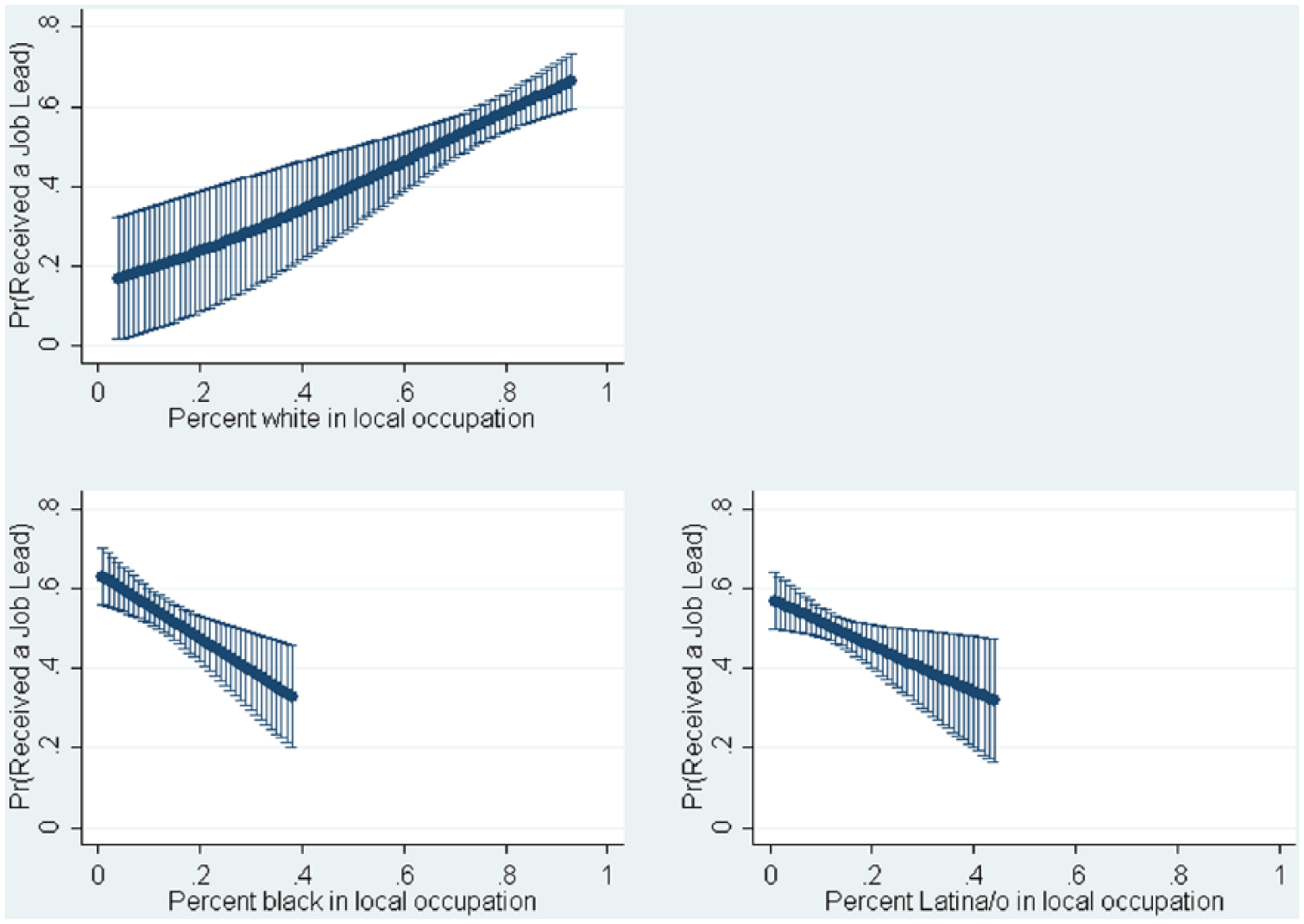
Predicted probabilities for receiving a job lead by race/ethnic composition of local occupation.
To test these findings further, we used an exhaustive set of interaction terms to examine the extent to which informational benefits associated with embeddedness in white local occupational segments are confined only to white incumbents. We also examined the extent to which informational deficits associated with embeddedness in black and Latina/o local occupational segments are confined only to blacks and Latina/o incumbents. None of the respective interactions proved statistically significant for these or other individual-by-context interaction terms. These results are instructive because they indicate that the information benefits of being in a predominantly white local occupation are not confined to white workers. Likewise, white, black, and Latina/o workers all have similarly reduced odds of hearing about job openings when working in local occupational segments dominated by historically marginalized ethnoracial groups.
Next, we tested additional interactions for the other forms of ethnoracial composition. Findings indicate that the effects of general diversity do not vary significantly across race and ethnic categories of respondents, either at the metro or local occupational level. However, a respondent’s race and ethnicity does appear to moderate the relationship between co-ethnic presence and job leads at the local occupational level. When interacting these two variables, we find that odds of unsolicited job leads decline as co-ethnic presence in local occupations increases for blacks and Latina/os, but the opposite occurs for whites. These findings parallel and reinforce those found in Table 2 and displayed in Figure 1 for particularistic representation: as percent black or Latina/o increases within a local occupational segment, odds of unsolicited job leads decline.
To further illustrate this central finding, we returned to the unadjusted data to plot the relationship between unsolicited job lead receipt and proportion white in two very different occupational segments (service and professional) in four of the largest metro areas in our sample (Boston, Chicago, Los Angeles, and New York). Figure 2 reveals the positive relationship between proportion white and job lead receipt. Professional occupations within each city have a higher concentration of white workers and greater access to informal job leads. However, the relationship between local ethnoracial composition and job leads receipt is not merely a function of the status difference between professionals and service workers generally. The service sector in Boston, for example, offers even greater informal access to job leads than the professional sector in New York. This pattern appears to be attributable to the relatively large percentage of white workers in the Boston service sector (77 percent). These findings offer additional support for the finding that job market information tends to be regulated by particularistic representation within local occupational segments.
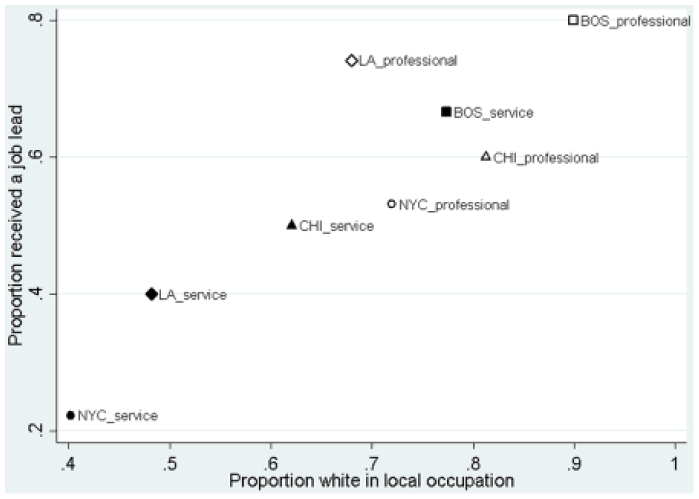
Observed proportions of workers receiving unsolicited job leads, by city and occupation.
Discussion and Conclusion
The present study used a unique data source that allows for a multilevel examination of how various dimensions of ethnoracial diversity within local labor markets affect informal regulation of job opportunities. Findings reveal that informal regulation of job leads is strongly associated with the presence of whites in local occupational segments. By contrast, membership in black- and Latina/o-dominated local occupations is associated with significantly lower odds of receiving job leads. These patterns persist even after controlling for human capital (education and job tenure) and social capital characteristics (network extensity). The results are also unexplained by occupational status, as our analysis controls for employment in professional, technical, and managerial jobs. Our supplementary illustration in Figure 2 also shows how the same occupational segment can operate differently in different metro areas, depending on its local racial composition. The results, therefore, suggest that the informal regulation of job information is structured by the ethnoracial composition of local labor markets, especially at the occupational level. Below, we offer our thoughts on how and why this dynamic might operate.
To begin with, our findings offer no support for metro-level diversity effects. The lack of empirical support at this level raises questions about both classic and contemporary claims regarding the general impact of urban modernization and diversification on social exchange and interaction. Alternatively, the results could be interpreted to suggest that metro area measures are too highly aggregated to detect network effects in individual labor market. Job search chains are highly localized: one study reports less than 1 percent of U.S. workers having found their jobs through job contact chains of more than two individuals (Chen 2013). Job information networks that span across entire cities are, therefore, likely to be rare. A focus on metro diversity at more restricted levels of aggregation might offer more support for the hypotheses. The lack of metro findings might have also been impacted by the relatively small number of level 2 units (23 metro areas) in our study. Simulations of multilevel data reveal that smaller N sizes at level 2 have little impact on the reliability of parameter estimates, but standard error estimates from models with 50 or fewer level 2 units may be biased (Bell et al. 2010; Maas and Hox 2005). With data from more metro areas, the relationship between metro-level diversity and job leads might prove statistically significant. Unfortunately, we know of no other existing data sources that allow us to test this possibility.
In addition, our results regarding the paucity of access to job leads in black-dominated local occupations is consistent with Smith’s (2005, 2007, 2010) research on “defensive individualism” among African Americans. This behavior could have some impact on job lead receipt in black-dominated occupations, but we are hesitant to put much confidence in this explanation due to some inconsistencies apparent in the data. First, black compositional effects are statistically significant only at the local occupational level and not at the metro level. Why defensive individualism would be apparent in local occupational contexts but not metro contexts seems puzzling. Second, the reluctance to provide job finding assistance is described as a race-specific response to economic and social conditions, yet the information deficits associated with embeddedness in local black occupations are shared by all occupants of those contexts, not just blacks. Furthermore, the defensive individualist phenomenon has only been confirmed among a small set of workers under very specific conditions. Recent evidence from national survey data shows that African Americans are significantly more likely than whites to assist others with job finding in general. It is only under the specific condition of concentrated black poverty where defensive individualism emerges (Hamm and McDonald 2015). Those conditions do not match well with our broad sample of currently employed workers. Taking all of these factors into account, disparate mobilization fails to fully account for the patterns observed in the present study.
The supply networks perspective is even more difficult to defend in light of the null findings at the metro level and the information deficits at the local occupational level for Latina/o concentration. How can one reconcile these findings in light of the frequent characterizations of Latina/os as avid networkers in the job market? This incongruity may speak to the subtle but important distinctiveness between supply and recruitment networks. As Granovetter and Tilly (1988: 191) have noted, supply and recruitment networks “connect, but are almost never identical.” One might expect frequent mobilization of resources to translate into greater local access to resources, but the results presented here suggest that this may not always be the case. Previous research on Latina/os has focused almost exclusively on the mobilization of network assistance through active job search (Falcon 1995; Green et al. 1999; Portes and Jensen 1989; Smith 2010), rather than on unsolicited receipt of job information once employed. Although Latina/o supply networks may help active job seekers to find employment, as ethnic enclave research suggests, the results presented here imply that once employed, Latina/o supply networks do not effectively tap into employers’ recruitment networks. Any advantage that these Latina/o supply networks have over the supply networks of blacks appears to be dwarfed in comparison to their disadvantage relative to white privilege and preference in employer recruitment networks.
Although the data do not allow for a direct test of the mechanisms driving these relationships, our results imply that recruitment (rather than supply) networks seem to operate as the more salient link between the ethnoracial structure of local labor markets and informally regulated job information. Employer preference for hiring white workers combines with their preference for relying on social networks to recruit talent. Employers focus their informal recruitment strategies on preferred candidate pools to identify established and certifiably talented workers (Granovetter and Tilly 1988; Waldinger 1995). The racialized character of local occupational segments, therefore, plays a prominent role in informal recruitment, with white-dominated occupational settings serving as prime recruitment targets. Employers also maintain an expressed preference for recruiting employed workers as opposed to the unemployed (Eriksson and Rooth 2014; Gangl 2004, 2006; Sharone 2013), which underscores the importance of ethnoracial composition in occupational segments rather than in metro areas as a whole.
A corollary to this interpretation is that employer preferences for white workers seemingly result in a lack of readily available information about employment opportunities for workers in local, minority-dominated occupations. However, we suspect that not all of the information deficit in minority occupations is due to explicit targeting of white occupations. Rather, it is likely that workers who are employed in white occupational segments are better positioned to hear about employment opportunities through interpersonal communication. Collins’s (1989, 1993, 1997) research has illustrated how minority workers are often employed in jobs that are peripheral to the main functions of organizations. This form of structural isolation, en masse, could contribute to the information deficits shown here. We are unable to effectively test this possibility here, although it serves as an intriguing possibility for future research. 11
Variation in informal access to employment opportunities across occupational segments also draws attention to broader concerns about ethnoracial power dynamics across local labor markets. Informal access to employment through social network connections is a form of economic rent that can limit the pool of potential applicants and generate wage premiums above market equilibrium (Sorensen 2000). Network-based rent seeking appears to be most prominent among local occupations that are heavily dominated by whites and least common in occupations where historically marginalized ethnoracial groups are present in higher numbers. Networking behavior therefore appears to operate as a social closure practice, limiting access to employment in the most highly sought after occupational fields. 12 Overall, this behavior implies two distinct logics governing the regulation of access to high- and low-quality employment: network-based sponsorship in white occupational segments and formal competition for jobs among minority occupational segments.
One of the more fascinating findings from the present study is that sharing information about job opportunities in local labor markets is linked to the ethnoracial structure of those markets rather than to the race and ethnicity of individual workers embedded in those contexts. For example, embeddedness in predominantly white local occupations affords greater access to unsolicited job leads for all workers in those occupations, not just white incumbents. Similarly, information deficits associated with working in a local minority-dominated occupation extend equally to whites and minority occupants as well. These findings dovetail with recent research that finds that maintaining predominantly white-male networks results in a significant advantage in the receipt of unsolicited job leads—not only for white males but also for women and racial minorities (McDonald 2011). The fact that co-ethnic presence fails to significantly predict job lead receipt further implies that racial and ethnic disparities in information access are better explained by network segregation than by race-targeted assistance. More precisely, the hoarding of job opportunities appears to be more strongly linked to information sharing among friends and acquaintances in racially segregated occupations than in information sharing among same-race individuals within those contexts. Of course, these findings only speak to the ways that people provide and receive job leads and, therefore, do not rule out the possibility of overt racial discrimination in other aspects of the hiring process.
The present study is limited by a number of factors that deserve attention in future research. First, our analysis of job leads is useful in that it serves as an indicator of job information access, but the measure does not allow us to account for job lead quality. To the extent that marginalized groups receive lower quality job leads (see, for example, Huffman and Torres 2002; Smith 2007; McDonald 2011; McDonald, Lin, and Ao 2009), the employment prospects for individuals embedded in black and Latina/o occupational fields may be even more dire than suggested here. Future research might, therefore, extend the present analysis by examining the extent to which minority occupational contexts suffer from a job lead quality deficit in addition to a job lead access deficit. A focus on quality rather than access might also reveal the kind of discriminatory treatment within ethnoracial contexts that we tested for here but were unable to detect.
Second, the relatively small size of our sample hinders our ability to explore specific metro and occupational contexts in detail. We cannot examine neighborhood diversity, as information on the Census tract or block group of the respondents is not available in the primary survey data set. Residential segregation by race and ethnicity remains strong throughout most urban areas, and these patterns contribute to segregated social and employment networks. The influence of diversity on information access is perhaps more closely linked to neighborhood diversity (Smith 2007; Wilson 1987). The broad occupational categories we deploy due to sample size may serve as another source of imprecision. Future research should consider analyzing data that allow for the disaggregation of these categories to examine narrower specifications and conceptualizations of occupational niches.
Third, the present study focused only on employed workers and, therefore, the results should not be generalized to workers who are unemployed or out of the labor force. Future research should consider ways of testing the extent to which access to job leads is similarly disadvantaged for nonemployed workers embedded in ethnoracial minority occupational fields. Any such tests will need to overcome the problem of determining the occupational field in which nonemployed workers reside. Furthermore, these results do not speak to the amount or quality of interracial interaction within workplaces, which are likely to uniquely influence the informal regulation of job leads.
Despite these limitations, the results presented here enhance our understanding of the influence of ethnoracial diversity on informal regulation of local labor markets. Overall, the job information benefits of embeddedness in local, white-dominated occupational fields—coupled with the information deficits of embeddedness in local, minority occupational fields—highlight how access to employment opportunities continues to be guided by white preference and privilege, regulated through network mechanisms, and linked to distinctive historical circumstances and ethnoracial power dynamics.
Footnotes
Acknowledgements
We thank Nan Lin for providing us with access to these data. We also thank Anna Manzoni for providing her expert advice regarding the statistical modeling.
Authors’ Note
Survey data used in the analysis come from the 2002 Job Search Survey. Earlier versions of the article were presented at the Social Capital Workgroup at Duke University and at the American Sociological Association’s (ASA) 2014 annual meeting. The article benefited from the helpful suggestions provided by participants at those presentations, most notably from discussant Mark Granovetter at ASA.
Declaration of Conflicting Interests
The author(s) declared no potential conflicts of interest with respect to the research, authorship, and/or publication of this article.
Funding
The author(s) disclosed receipt of the following financial support for the research, authorship, and/or publication of this article: This study was supported by funds from the Department of Sociology and Anthropology at North Carolina State University.
Notes
References
Supplementary Material
Please find the following supplemental material available below.
For Open Access articles published under a Creative Commons License, all supplemental material carries the same license as the article it is associated with.
For non-Open Access articles published, all supplemental material carries a non-exclusive license, and permission requests for re-use of supplemental material or any part of supplemental material shall be sent directly to the copyright owner as specified in the copyright notice associated with the article.
