







Abstract
In this article, we examine intersections of race, sexuality, and socioeconomic status (SES) in people’s experiences with police contact in Chicago. Utilizing representative data concerning police contact as well as sexual and racial identification, we examine variations in police contact for respondents occupying different racial, sexual, and economic social locations. In so doing, we examine the case of an urban area often lauded for progress in sexual minority rights to quantitatively evaluate disparities in the experiences of sexual minorities occupying different racial and sexual positions in society. In conclusion, we draw out implications for (1) developing intersectional analyses of contemporary sexual minority experience; (2) understanding the ways race, sexuality, and SES shape experiences with police contact even in settings deemed more progressive than the broader society; and (3) the ways in which incorporating an analysis of bisexuality into mainstream social science complicates existing assumptions and theories.
Background
Research investigating sexual minority experience with mainstream institutions has proliferated in recent years (see Schrock, Sumerau, and Ueno 2014 for review). Researchers have noted substantial gains alongside lingering sexual inequalities in familial (Fields 2001; Mathers, Sumerau, and Ueno 2015; Scherrer, Kazyak, and Schmitz 2015), educational (Adams 2011; Grant, Mottet, and Tanis 2011; Ueno, Roach, and Peña-Talamantes 2013), marital (Bernstein and Taylor 2013; Heath 2012; Powell et al. 2010), and religious (McQueeney 2009; Moon 2004; Sumerau 2017, Sumerau, Cragen, and Mathers 2015) institutions. However, as Buist and Stone (2014) noted, sexual minorities’ experiences with the criminal justice system have received much less attention. Given historical and contemporary policing of lesbian, gay, and bisexual (LGB) people, LGB people’s overrepresentation in prisons (see Meyer et al. 2017 for review), and contemporary studies documenting significant anti-LGB bias among many police (see, for example, Bernstein and Kostelac 2002; Bernstein, Kostelac, and Gaarder 2003; Hunt, Moodie-Mills, and Center for American Progress and United States of America 2012), this oversight appears especially striking compared with scholarly efforts concerning other institutional spheres (Ball 2014). Consequently, little is known about the ways LGB people experience contact with the police, or the ways such experiences vary in relation to race, class, gender, or sexualities (see also Herek 2009; Meyer et al. 2017). In addition, less is known about how LGB racial minorities or bisexual people in general experience institutional spaces due to scholars’ nearly exclusive focus on lesbian and gay (Monro, Hines, and Osborne 2017) and white (Moore 2011) sexual minorities to date.
The present article uses data from the 2014 Chicago Area Study (CAS) (Filindra, Kaplan, and Krysan 2014), a representative sample of the Chicago Core Based Statistical Area (CBSA), to investigate LGB people’s contact (voluntary and involuntary) with police as well as sexual, racial, and socioeconomic status (SES) variations in these experiences. As an urban area with a documented history of LGB marginalization wherein recent studies note significant gains for many sexual minorities (Ghaziani 2015), Chicago provides a useful case of LGB experience at the present stage of American society. As such, we utilize this case to explore three research questions:
Intersectionality and the Disaggregation of LGB Experience
To understand disparities in police contact within LGB populations, we draw on intersectionality. As a theoretical framework, intersectionality orients scholarly attention to the ways the experience of common social institutions may vary as a result of one’s location within multiple, interlocking systems of oppression and privilege (Collins 2002, 2005; Crenshaw 1989). Thus, any one form of inequality (i.e., heterosexism) cannot be fully understood without exploring how it intersects with and reinforces other forms of inequality (e.g., racism). As such, researchers must attend to the fact that people exist within multiple locations of advantage and disadvantage that continuously shape their experiences and outcomes, and, thus, face the differential effects of each of these intersecting systems throughout their personal and social endeavors. Of particular concern is the coexistence of multiple forms of disadvantage within one life wherein an individual marginalized in one system (i.e., a racial minority) may also be oppressed by another system (i.e., a bisexual racial minority). For example, analyses of LGB people utilizing national or aggregated samples may mask unique burdens LGB people of color face due to racial discrimination within specific regional contexts or settings (Worthen 2013). At the same time, such samples may erase the dilemmas bisexual people face due to monosexist and biphobic discrimination in predominantly LG settings (Monro et al. 2017).
This is not to say that individual social locations do not matter. Robust literatures demonstrate, for example, that race matters deeply for understanding criminal justice patterns, incarceration rates, and the impact of police on racial minority communities (see Reskin 2012 for review). Similarly, bountiful literatures note the impact of SES on policing, the likelihood of arrest, and overall contact with police (see South and Messner 2000 for review). Furthermore, public health researchers have noted especially strong links between sexuality and likelihood of incarceration and overall police contact (see, for example, Meyer et al. 2017 for review). Rather than suggesting individual social locations do not matter, an intersectional approach focuses on the ways these individual social locations operate with other social locations (i.e., race, sexuality, and SES, for example) to exert even greater effects on the opportunities, resources, and outcomes of people (Grollman 2012). In this regard, our approach here focuses on the ways already established important factors in police contact (race, sexuality, and SES) may work together to simultaneously create varied experience within a given population (LGB people) and a specific social setting (Chicago).
To this end, we focus on diversity and intersecting social locations within LGB communities. In light of disparities previously noted within such communities, some scholars have stressed the importance of examining how sexual minorities of different racial, classed, gendered, and sexual identifications experience better or worse outcomes than others (see, for example, Bryant 2008; Cragun and Sumerau 2015; Duggan 2004). Such attempts have revealed, for example, that bisexuals typically experience worse health outcomes and lesser social acceptance than LG people (Eisner 2013; Jeffries 2014; Worthen 2013), LGB racial minorities often face disproportionate harassment and discrimination in relation to white LGB people (Collins 2005; Grant et al. 2011; Moore 2011), LGB gender minorities—both ciswomen and transgender people—experience added disadvantage due to sexism within (Mathers et al. 2015; Sumerau 2012) and beyond (Padavic and Butterfield 2011; Sumerau et al. 2016) LGB communities, and heterosexism operates in different ways in separate regional contexts (Barton 2012). These insights reveal the importance of drawing out intersectional disparities within LGB experience and related to specific contexts and encounters (see also J. Ward 2008).
As Worthen (2013) argued, research to date typically focuses on either one constituency of sexual minority communities (i.e., white lesbian women, black bisexual men, or Hispanic gay trans people) or treats LGB populations as a uniform group (i.e., LGB people’s experiences of racism, sexism, heterosexism). Few studies compare segments of LGB populations or disaggregate LGB groups for the purposes of analysis (Monro et al. 2017). When such strategies are employed, however, researchers typically find as much or more variation within LGB populations as between LGB and heterosexual populations (see, for example, Cragun and Sumerau 2015; Schrock et al. 2014; Worthen 2013). Furthermore, studies focused on specific areas often find different levels of exposure to and marginalization by heterosexism (Barton 2012) and/or monosexism (Moss 2012) that often get masked by analyses utilizing aggregated, national data sets (see also Worthen 2013). As a result, many questions remain unanswered concerning disparities within contemporary LGB experience.
In this article, we address one such question—what types and levels of police contact do sexual minorities of different races and sexualities experience—to demonstrate the usefulness of intersectional approaches to contemporary LGB experience. To this end, we utilize Chicago as an illustrative case of an area with both a long history of LGB progress and marginalization, and an urban area containing a racially, sexually, and economically diverse LGB population. In this way, our case allows us to overcome two limitations of existing LGB studies. First, our use of a specific case allows examination of intersections often masked by national surveys that rely upon the aggregation of LGB cases across the nation (Worthen 2013). Second, our use of a representative sample from a prominent urban area—in both heterosexual and LGB history—allows us to extend work on disparities within LGB groups that has, thus far, been limited to small qualitative case studies (see, for example, Berkowitz 2011; McQueeney 2009; J. Ward 2008). This case allows examination of disparities within LGB experience between national and local data sets while maintaining attention to social context and utilizing of a broader sample of LGB people.
LGB Marginalization and Contact with Police
Although it receives less discussion in sociological scholarship to date, interactions with law enforcement have and continue to be an especially salient aspect of American LGB history and experience (Warner 1999). In fact, policing specifically targeted at sexual and gender nonconformity within LGB populations and locations has a long and prominent history in the United States (Meyer et al. 2017). This history, however, has never been uniform, but, rather, has existed in more or less frequent cases related to intersections of race, class, gender, and sexual identity. As Warner (1999) noted, the criminalization of LGB people and practices has generally focused more heavily on LGB gender nonconformists, LGB people of color, bisexuals and other sexually fluid people, drag performers, transgender and nonbinary people, openly nonconformist LG groups and establishments, public displays of sexual promiscuity, outward displays of sexual and gender fluidity, and assertions of nonmonogamy (see also Chauncey 1995; D’Emilio and Freedman 1997; Hutson 2010). Rather than uniform, such patterns reveal ongoing attempts to penalize open nonconformity to existing race, class, gender, sexual, romantic, marital, and other social norms at given times (Butler 1990).
Although sociologists have primarily left the penalization of sexual and gender fluidity (but see Moss 2012) and nonmonogamy (but see Schippers 2016) unexplored to date (see also Monro et al. 2017 for calls to change this pattern found in 50 years of social science research), much research has demonstrated disparities in the experiences of sexual and gender minorities who violate, for example, dominant notions of family (Berkowitz 2011), sexual restraint (Rose 2005), heterosexism (McQueeney 2009), patriarchy (Barton 2012), white normativity (Moore 2011), and cisnormativity (Westbrook and Schilt 2014) in recent years. At the same time, however, these studies have rarely incorporated police contact or other aspects of the criminal legal system into their analyses of LGB marginalization and resistance (but see Westbrook and Schilt 2014). However, scholars working in other social scientific fields and from queer perspectives have often highlighted similar disparities in police conduct related to LGB existence, experience, and visibility (see Meyer et al. 2017; Worthen 2013 for reviews).
As noted in such studies, the criminalization of sexual minorities dates back to the enforcement of antisodomy laws established during the formation of this nation (Warner 1999). In the twentieth century, however, attention primarily shifted to a combination of criminalization and the pseudoscientific articulation and diagnosis of homo and bi sexualities as pathological illnesses that should be treated and removed from individuals and society. These processes were further affirmed in the 1940s when mainstream American religions began offering similar moral condemnations of sexual and gender nonconformity, and suggesting such “sin” would destroy the fabric of society (Cragun, Williams, and Sumerau 2015). In so doing, legal, religious, and scientific—especially medical and psychological—authorities sought to remove “vulgarity” and “perversion” (which they argued LGB people represented) from the public domain. At the same time, American authorities utilized prior laws and these scientific and religious discourses to restrict the types and forms of sexual-romantic activity that could be allowed in public (Warner 2002). Through these interconnected processes, heterosexuality, monosexuality, and cisnormativity were established as the public ideal of the nation (Stryker 2008), and sexual expression was relegated to private, domestic spheres of life. In the century following, sexual minorities—and especially those deemed more “obviously” queer—have been systematically excluded from public life and punished upon sight by police forces and the state (see also Bernstein and Kostelac 2002; Bernstein et al. 2003; Hunt et al. 2012; for similar experiences among transgender people of varied sexual identities, see Stanley and Smith 2015).
Within this context, legally recognized public displays were limited to only those following heteronormative and mononormative rules (i.e., only other sex attracted, monogamous, static desire for one type of body or genitals, reproductive desire, and limited to distinct masculine and feminine rules; see Schrock et al. 2014). These norms were enforced through legal means wherein police were given responsibility to regulate private and public expressions of sexuality and desire through laws targeting sexual minorities (Warner 2002). These laws included prohibitions against sodomy, oral sexual activities, group sex, Bondage Dominance Sadism and Masochism (BDSM), and public sexual activities as well as strict notions of cisnormative masculine and feminine dress and ordinances prohibiting the congregation of LGB people for social and political purposes (see also Bernstein 2002; Stryker 2008; Warner 1999). As a result, relationships between police and LGB people as whole—as well as groups within the broader population—developed in a hostile, even abusive, manner over the course of American history (Bernstein et al. 2003; Lombardi et al. 2001).
While severe police regulation of LGB establishments (i.e., bars, community centers, and support groups) began to decline after the series of riots and protests throughout the 1960s—often involving and/or instigated by racial minority, transgender, and sexually and gender-fluid LGB people—that culminated in the Stonewall Riots in New York City in 1969 (Armstrong and Crage 2006; Stryker 2008), policing of sexualities in public space continues to this day via zero tolerance and public decency ordinances passed throughout the nation. It also continues in prisons where LGB people are overrepresented at similar levels to racial minorities (Meyer et al. 2017), and where women’s incarceration has regularly included policing and penalizing homo/bi sexualities (Freedman 1996; Rafter 1990). Likewise, even though police enforcement was limited and inconsistent for decades, anal sexual activities—and, thus, some aspects of homo and bi sexualities—were not fully decriminalized in the United States until the 2003 Supreme Court case of Lawrence v. Texas, and recent news reports reveal that arrests for consensual same-sex activities continue in parts of the United States. Furthermore, police regulation of LGB existence in public continues unchecked at present via “quality of life” laws that allow police to detain people for standing around, congregating, or otherwise existing in public in any way that “seems” suspicious to the police officer in question (Mogul, Ritchie, and Whitlock 2011). In fact, these “quality of life” laws allow police to target any group deemed “disorderly” or “indecent” in relation to dominant social norms (Myers, Forest, and Miller 2004). While scholarship has rarely examined LGB police contact specifically, “quality of life” laws suggest this may be a major issue at present.
Broadly speaking (see Alexander 2012; Schrock et al. 2014 for a review), existing analyses suggest sexual and racial minorities, as well as low-income individuals, are often targeted by public authorities for “appearing suspicious” or “abnormal.” Hunt et al. (2012), for example, found that sexual and gender nonconforming youth are significantly overrepresented in juvenile justice systems due to “minor offences” wherein they posed no threat to property or personhood (see also Meyer et al. 2017). Likewise, countless criminological analyses reveal that racial minorities—regardless of sexualities—are overwhelmingly more likely to be incarcerated than their white peers (Alexander 2012; Kempf-Leonard 2007; Rocque 2011), and much more likely than whites to regularly experience unwanted contact with the police (Sampson 2012). Studies also find consistent anti-LGB (Bernstein 2002) and antiracial minority bias (Alexander 2012) embedded in police officer opinions and attitudes, police procedures and processes, and legal enforcement patterns. Despite gains in other institutional spheres, such studies suggest LGB—and especially LGB racial minority—police contact may be an important area in need of scholarly attention.
In this article, we begin the process of subjecting intersections between LGB sexual, racial socioeconomic location, and police contact to such attention. Specifically, we ask how LGB police contact compares with heterosexual police contact in terms of frequency, and what specific variations in LGB police contact may be revealed by comparing LGB people who occupy different racial, economic, and sexual social locations? To this end, it is important to note some ways our case—Chicago—provides an optimal opportunity for such an analysis (see Sampson 2012 for similar observation vis-à-vis race and SES). Chicago has a long history of explicit regulation of LGB expression, including regular raids on establishments continuing into the 1980s (de la Croix 2012), and like many urban areas, represented a kind of battleground for LGB people throughout the twentieth century. At the same time, however, Chicago has long served as a destination for LGB migration from harsher rural areas and smaller cities. In fact, such migration created enclaves—or gayborhoods—wherein some types of LGB expression became, to an extent, normal in the city (Lamble 2013).
More recently, scholars have deemed these efforts largely successful in integrating some LGB people more fully into Chicago’s social and economic structures (Lamble 2013). Neighborhoods like Boystown, for example, have been nationally recognized as havens for LGB people wherein some (generally white, lesbian/gay, and economically privileged) sexual minorities may access more positive relationships with the city. In fact, utilizing these developments within Chicago as a primary example, some scholars have argued that LGB communities have entered a new era of welcome and affirmation wherein LGB enclaves and safe spaces are no longer necessary in urban areas (Ghaziani 2015). Although such studies have left relationships with the police unexplored in their analyses, they suggest that Chicago represents an urban context wherein sexual liberation—at least to an extent—has already arrived. The use of Chicago in our analysis provides an opportunity to evaluate remaining disparities in LGB experiences—like contact with the police—within a social context noted for the significant social and political gains of some LGB people in recent years.
Data and Method
Data
This article uses data from the 2014 CAS (Filindra, Kaplan, and Krysan 2014). The CAS was developed in 2004 by faculty at the University of Illinois Chicago (UIC). The data set is an innovative combination of funding and methodological training designed to facilitate research critically examining issues related to public policy for the city. The process is designed to disseminate empirical information about the city’s population to residents and leaders for consideration in the establishment of legislation and public service programs.
Data for the CAS are collected through the professional firm GfK Knowledge Networks. Representative samples from both the Chicago CBSA and the State of Illinois are collected for use. Individuals were randomly selected via address-based sampling begun by GfK in 2009. Address-based sampling provides a statistically valid sampling method with a published sampling frame of residential addresses that covers approximately 97 percent of U.S. households. The 2014 sample had a total sample size of 1,794 residents of the state of Illinois. However, in this article, we limit the sample to respondents with valid responses on all covariates and who reside in the CBSA, which results in a final sample of 1,184 for analyses.
Measures
Contact with police
The dependent variable “contact with police” refers to respondents’ self-reported contact with police during the past five years. In the 2014 CAS, respondents were asked, “We are interested in how much contact people have had with the police. In the past five years, have you (please select all that apply).” Response options included reported a crime, attended a meeting where crime prevention was discussed with police, been questioned by the police for any reason, been on probation or parole, served time in jail and/or prison, been the victim of a crime, requested more police presence in your neighborhood, made a complaint about police misconduct or brutality, and none of the above.
In this article, the dependent variable is coded two ways and includes all respondents who answered the relevant question whether or not they had contact with the police. First, we coded it as a continuous count variable with each reported contact coded as yes (1) or no (0) and summed the values to create an overall police contact variable. Second, we divided responses into voluntary (i.e., reported a crime, attended a meeting, and requested more police presence) and involuntary (i.e., questioned by the police, probation, or parole; served time in jail and/or prison; made a complaint about police) contact (Decker 1981). Both voluntary and involuntary contacts were also treated as continuous count variables. The response category “been the victim of a crime” was excluded because it may or may not involve contact with police.
Sexual identity
Sexual identity was measured by asking respondents, “in terms of your sexuality, do you consider yourself to be” with the following five response categories: exclusively heterosexual, mostly heterosexual, bisexual, mostly homosexual, or exclusively homosexual. Drawing on insights from analyses of sexual variation (Worthen 2013), we collapsed these options into the following three categories for analyses: heterosexual (exclusively heterosexual), bisexual (mostly heterosexual, bisexual, and mostly homosexual), and gay/lesbian (exclusively homosexual). In so doing, our sample mirrored reported proportions of heterosexual, homosexual, and bisexual populations in nationally representative surveys (see the General Social Survey listing of sexual orientation responses from 2008 to present).
Covariates
Six covariates were included that are standard in existing research on policing and minority communities (Rocque 2011). These covariates include race, age, sex, education, household income, and partisanship. Race was self-reported and coded as a categorical variable with three categories: white (referent), Black, and Hispanic. Other racial categories and mixed-raced individuals were not included in this analysis because of very low response numbers. Sex of respondents was a self-reported dichotomous variable with two response categories: male (referent) and female. Education was measured categorically with three response options: bachelor’s degree or higher (referent), some college, high school diploma or less. Age was measured as a categorical variable with four responses: 18 to 29 (referent), 30 to 44, 45 to 59, and 60+ years old. Household income was measured as a continuous variable with 19 income categories. The distribution of income was top-coded and ranged from less than US$5,000 to US$175,000+. Partisanship was measured by asking respondents, “Do you consider yourself a Democrat, Republican, Independent, or something else.” Responses were coded into three categories: Democrat (referent), Independent, and Republican.
Analytic Strategy
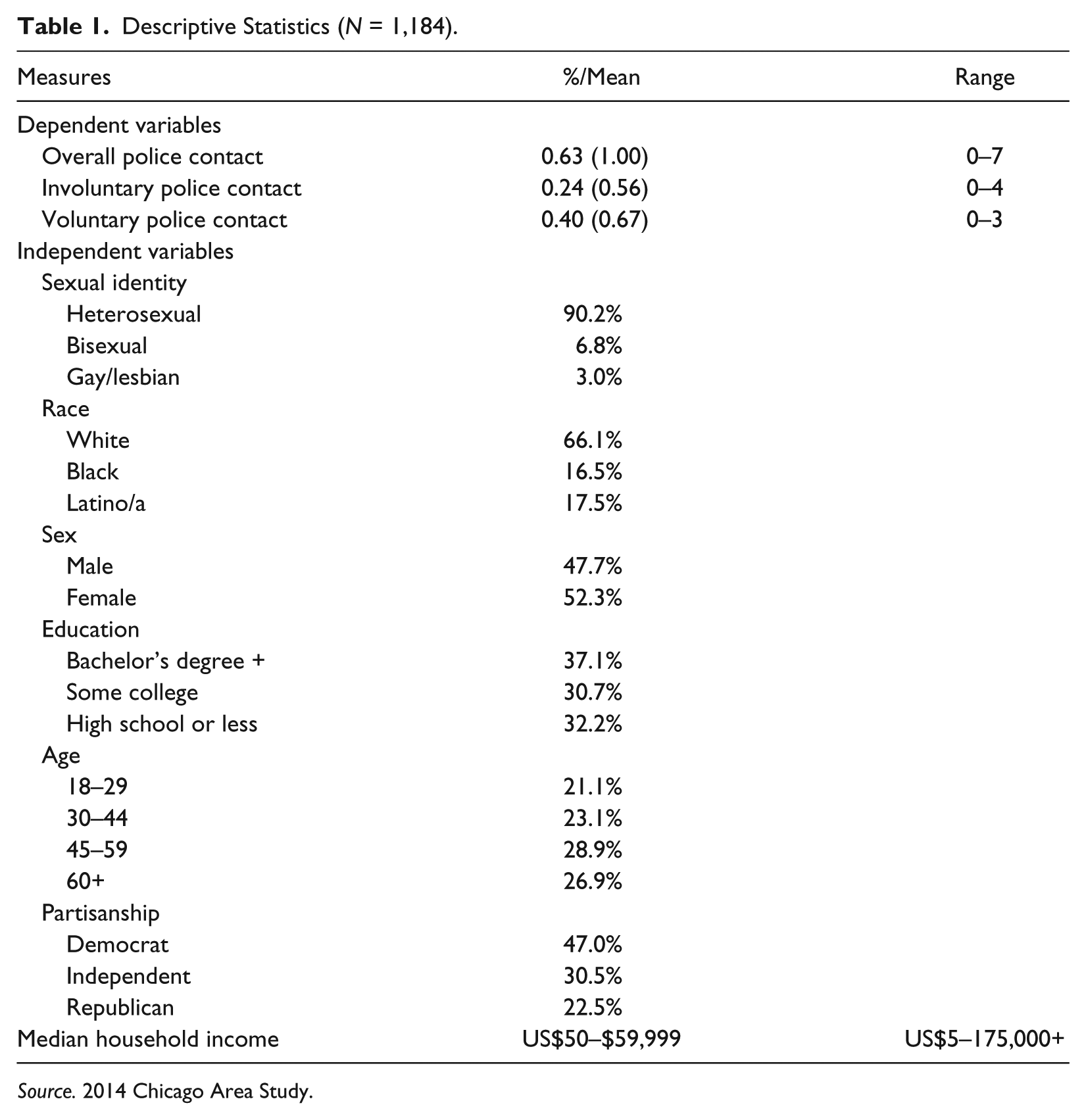
First, we present descriptive statistics for the analytic sample (summarized in Table 1) and then results from negative binomial regression models (Tables 2–4) that account for overdispersion in our overall, involuntary, and voluntary police contact dependent variables. All analyses are weighted for the Illinois portion of the Chicago Metropolitan Statistical Area (CMSA).
Descriptive Statistics (N = 1,184).
Source. 2014 Chicago Area Study.
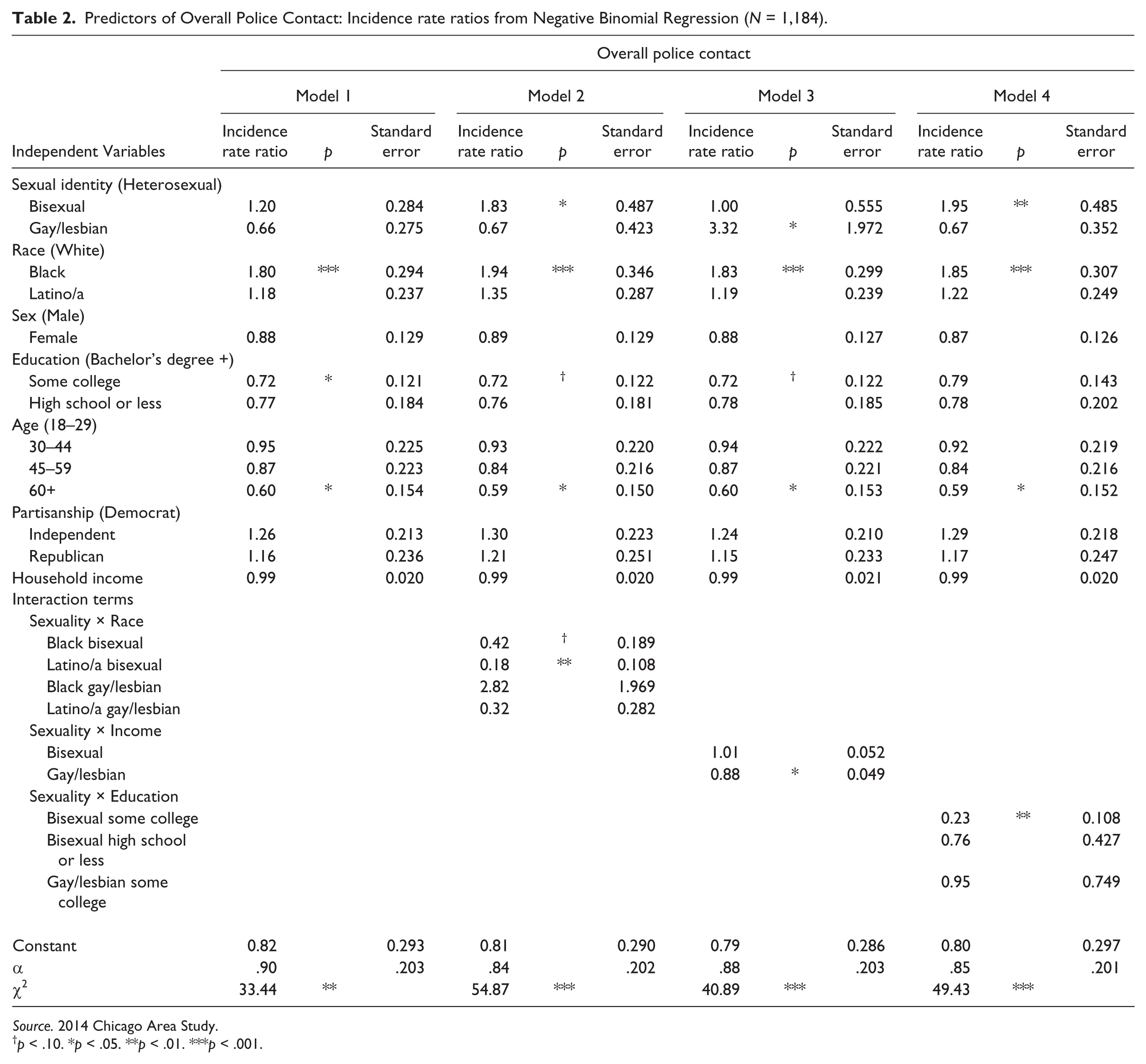
Predictors of Overall Police Contact: Incidence rate ratios from Negative Binomial Regression (N = 1,184).
Source. 2014 Chicago Area Study.
p < .10. *p < .05. **p < .01. ***p < .001.
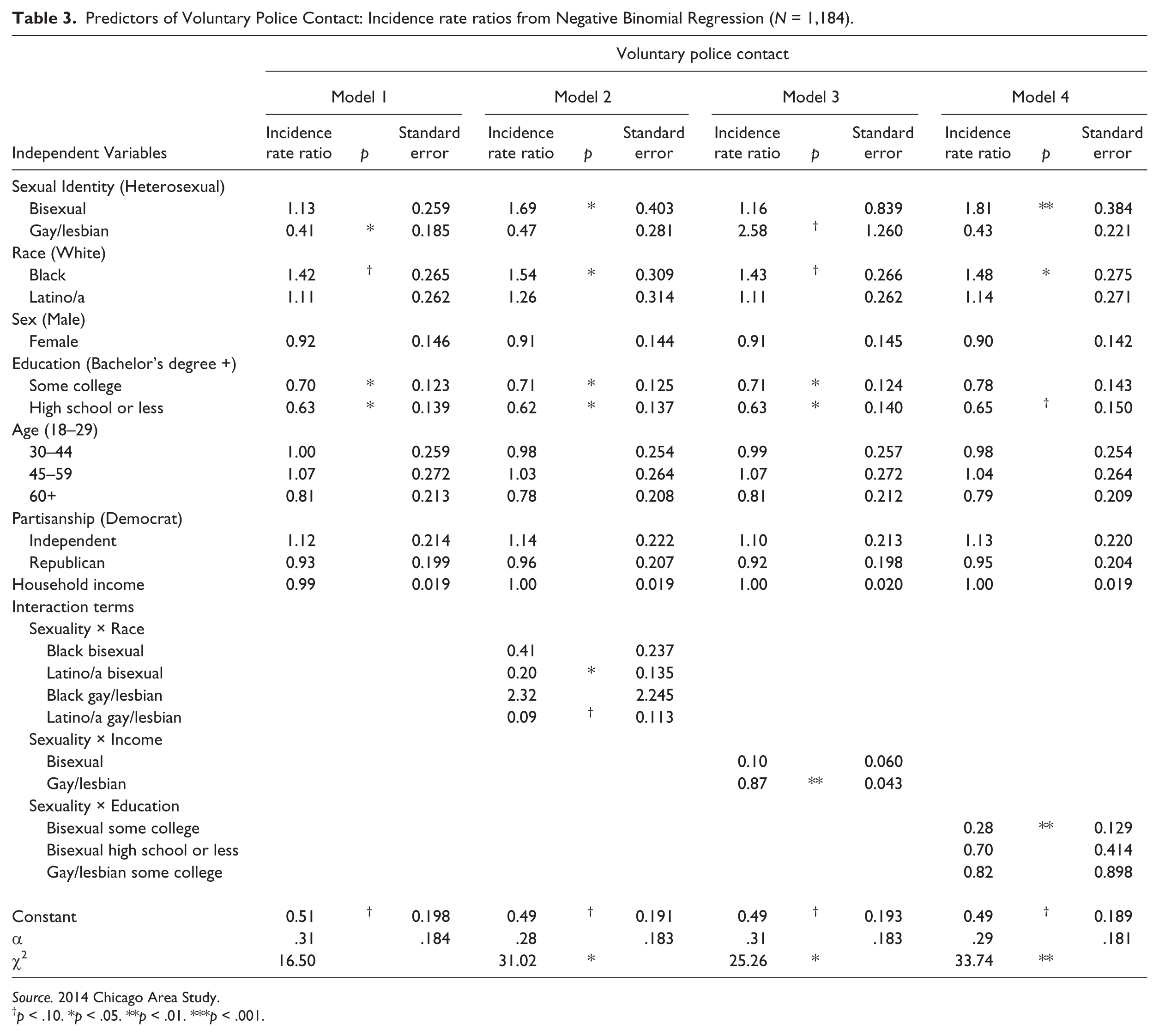
Predictors of Voluntary Police Contact: Incidence rate ratios from Negative Binomial Regression (N = 1,184).
Source. 2014 Chicago Area Study.
p < .10. *p < .05. **p < .01. ***p < .001.
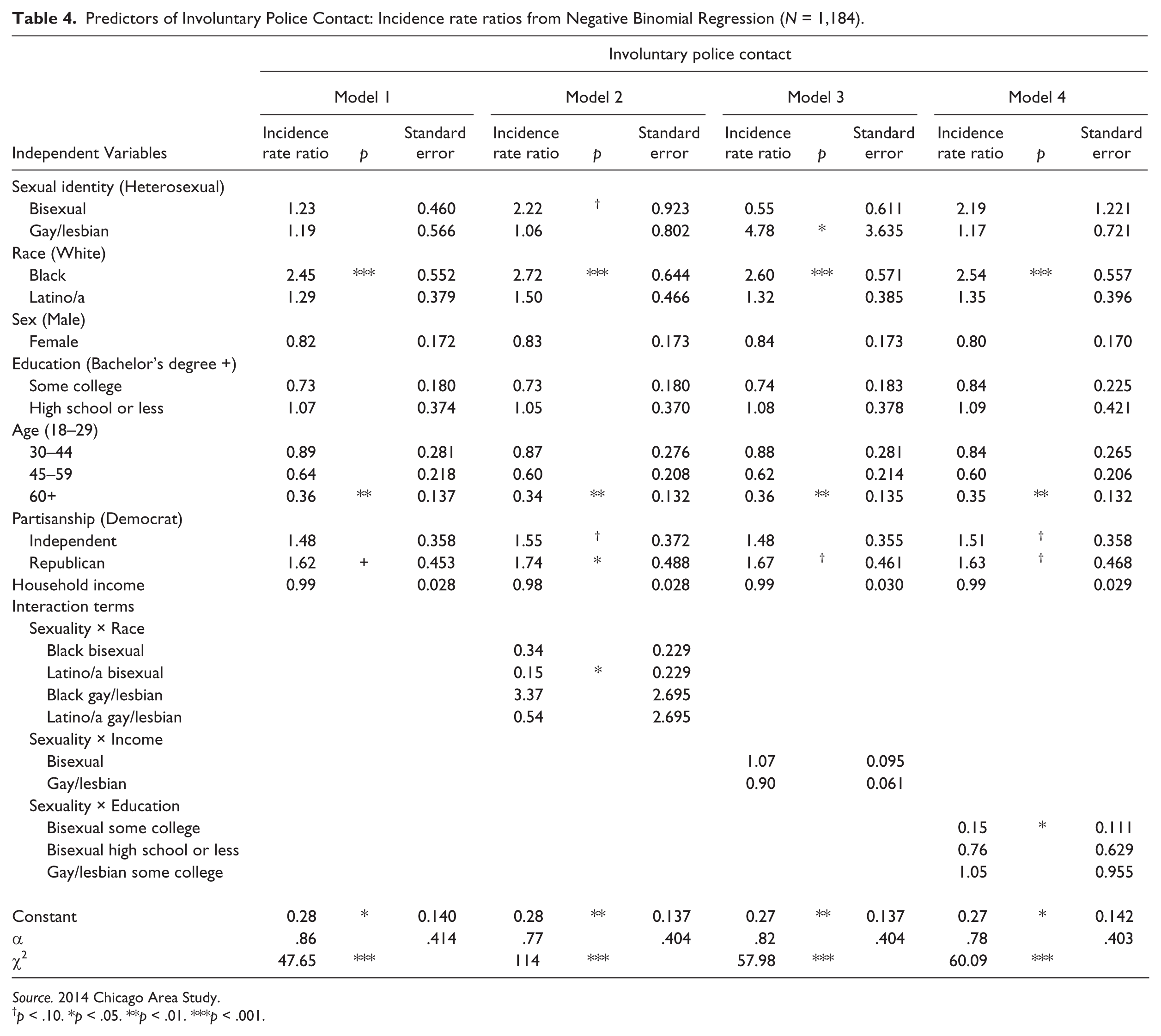
Predictors of Involuntary Police Contact: Incidence rate ratios from Negative Binomial Regression (N = 1,184).
Source. 2014 Chicago Area Study.
p < .10. *p < .05. **p < .01. ***p < .001.
The baseline models (Model 1 for each type of contact) controlled for sexual identity, race/ethnicity, sex, education, age, partisanship, and household income. In Model 2 for each dependent variable, we added interactions between sexual identity and race. Model 3 for each dependent variable presents interactions between sexual identity and income. Finally, Model 4 for each dependent variable presents interactions between sexual identity and education. No repondants reported highschool or less education and a gay/lesbian identity therefore no results are reported for that category. For all three dependent variables, we also tested for the interaction effects of sexual identity with sex, and partisanship on each type of police contact, which were insignificant and, therefore, not included here. Results for all models are presented as incidence rate ratios (IRRs), the exponentiated form of the beta for negative binomial regressions.
Results
Descriptive Statistics
The final sample for our analysis consisted of 1,184 cases (Table 1). In terms of overall police contact, respondents had a mean of 0.63 (1.00), with larger numbers indicating higher levels of police contact (range = 0–7). Involuntary police contact ranged from 0 to 4 with a mean of 0.24 (0.56) interactions. Voluntary police contact ranged from 0 to 3 reported contacts, with a mean of 0.40 (0.67) interactions.
Within the overall sample, heterosexual respondents made up 90.2 percent of cases. Bisexual respondents comprised 6.8 percent, and gay/lesbian respondents made up 3 percent of the total sample. The majority of the sample identified as female (52 percent), and just over one-third of respondents had a bachelor’s degree or higher level of education (37 percent) while 31 percent reported some college, and another 32 percent reported a high school diploma or less. In terms of racial identification, 66 percent of the sample identified as white, 16 percent as Black, and another 17 percent as Hispanic. In terms of age, our respondents were well dispersed with 21 percent 18 to 29 years old, 23 percent 30 to 44 years old, 29 percent 45 to 59 years old, and about 27 percent over 60 years of age. Almost half of our sample identified as Democrats (47 percent), 31 percent as Independents, and 23 percent as Republicans. Finally, the median annual income in this sample was between US$50,000 and US$59,000.
Dimensions of Overall Police Contact
As detailed in Table 2, we regressed total reported contact with police by sexual identity while controlling for personal and sociodemographic characteristics.
In Model 1, LGB respondents were no more likely than heterosexuals to report differing levels of overall police contact. Black respondents, however, were 80% more likely to report overall police contact than white counterparts (p < .001). In addition, respondents over 60 years of age showed lower expected rates of overall police contact (IRR = 0.60, p < .05) compared with younger respondents.
In Model 2, we examined the interaction of race and sexuality across overall police contact. Compared with whites and heterosexuals, bisexual (IRR = 1.83, p < .05) and Black (IRR = 1.94, p < .001) identification each significantly increases incidence rates for overall police contact. However, this effect for bisexual-identified people was weaker for both Black and Latino respondents wherein Black bisexual respondents (IRR = 0.42, p < .10) and Hispanic bisexual respondents (IRR = 0.18, p < .01) showed lower expected rates of police contact than their white bisexual counterparts. Age also decreased the expected rate of police contact for those over 60 (IRR = 0.59, p < .05).
In Model 3, we examined the interaction of sexuality and income. Again, Black respondents had higher rates of overall contact (IRR = 1.83, p < .001), and age decreased the expected rate of police contact for those over 60 (IRR = 0.60, p < .05). Also in this model, being gay or lesbian and having a low income (less than US$5,000 a year; IRR = 3.32, p < .05) was associated with higher overall police contact. Although income did not (on average) affect levels of overall expected police contact for all respondents, the interaction of sexuality and income shows income matters differently for gays and lesbians. The effect of income on all police contact weakens the effect of being gay or lesbian, with higher levels of income decreasing likelihood of contact (IRR = 0.88, p < .05).
Finally, in Model 4, we examined the interaction of sexuality and education. Once again, Black respondents had significantly higher rates of overall contact (IRR = 1.85, p < .001), and age decreased the expected rate of overall police contact for those over 60 (IRR = 0.59, p < .05). Although education did not (on average) affect levels of overall police contact, the effect of education worked differently for bisexuals. Bisexuals with a bachelor’s degree or higher showed greater overall police contact (IRR = 1.95, p < .01). Having attended some college (IRR = 0.23, p < .01) versus having a bachelor’s degree weakened the effect of being bisexual on overall expected police contact.
Dimensions of Voluntary Police Contact
Moving to distinguishing between types of police contact, sexual identity did emerge as a predictor of voluntary police contact, in our baseline model (Table 3, Model 1).
Gay/lesbian respondents had significantly lower rates of expected voluntary contact than their heterosexual peers (IRR = 0.41, p < .05), but bisexual respondents were no more likely than their heterosexual counterparts. Black respondents were marginally more likely than white respondents to report voluntary contact (IRR = 1.42, p < .10). Compared with respondents with a bachelor’s degree or higher education, those with some college (IRR = 0.70, p < .05) and high school or less education (IRR = 0.63, p < .05) had lower rates of expected voluntary contact.
Model 2 explored variation in racial and sexual interactions within voluntary police contact. White bisexuals, in contrast, are significantly more likely (69 percent) to have voluntary interactions with police (p < .05), and black heterosexuals are 54 percent more likely to have voluntary interactions with police (p < .05). Once again, this effect varied across race wherein both Hispanic bisexuals (IRR = 0.20, p < .05) and Hispanic gay/lesbian respondents (IRR = 0.09, p < .10) had significantly lower expected rates of voluntary interactions with police. Education also decreased expected rates for those reporting some college (IRR = 0.71, p < .05) and those with a high school diploma or less (IRR = 0.62, p < .05).
In Model 3, we examined the interaction of sexuality and income with voluntary contact. Black respondents had marginally higher rates of expected voluntary contact (IRR = 1.43, p < .10) and among all respondents, lower education decreased expected rates of voluntary contact for those reporting some college (IRR = 0.71, p < .05) and those with a high school diploma or less (IRR = 0.63, p < .05) compared to those with a bachelor’s degree or higher. In this model, being gay/lesbian with a low income (less than US$5,000/year) was associated with marginally higher voluntary police contact (IRR = 2.58, p < .10). Although income did not (on average) affect levels of expected voluntary police contact, the effect of income weakens the effect of being gay/lesbian, with increased levels of income decreasing likelihood of voluntary contact (IRR = 0.87, p < .01).
Finally, in Model 4, we examined the interaction of sexuality and education on voluntary contact. In this model, Black respondents (IRR = 1.48, p < .05) and bisexuals with a bachelor’s degree or higher (IRR = 1.81, p < .01) had significantly higher rates of voluntary contact. While levels of education did not (on average) affect levels of voluntary police contact, decreases in education decreased the likelihood of voluntary contact but only among bisexuals with some college (IRR = 0.28, p < .01).
Dimensions of Involuntary Police Contact
Turning to an examination of involuntary police contact (Table 4), sexual identity was not a significant predictor in our baseline model (Model 1).
Both bisexual and gay/lesbian respondents were no more likely to report involuntary police contact than heterosexual respondents. Once again, however, Black respondents were much more likely (145%) to encounter involuntary police contact (IRR = 2.45, p < .001) than their white peers. As with overall police contact, respondents over 60 years old had lower expected rates of involuntary contact (IRR = 0.36, p < .01). Furthermore, Republicans in this sample were marginally more likely than Democrats to report involuntary contact (IRR = 1.62, p < .10).
In Model 2, we found similar variation in racial and sexual predictors of involuntary police contact. White bisexual (IRR = 2.22, p < .10) respondents experienced a marginally significant increase and Black heterosexual (IRR = 2.72, p < .001) respondents experienced a significant increase in overall incidence rates for involuntary police contact. Although being Latino did not (on average) affect levels of involuntary police contact, Latino bisexuals had significantly lower expected rates of involuntary police contact (IRR = 0.15, p < .05). Once again, age decreased the expected rates of involuntary contact for those over 60 (IRR = 0.34, p < .05).
Model 3 examined the interaction of income and sexuality with involuntary contact. Although income did not (on average) affect levels of involuntary police contact, gay/lesbian respondents reported significantly higher rates of involuntary contact (IRR = 4.78, p < .05) compared to their heterosexual counterparts. The increase in involuntary contact for Black respondents remained significant in this model (IRR = 2.60, p < .001), as did the decrease in involuntary contact for those over 60 years of age (IRR = 0.36, p < .01).
Finally, in Model 4, we examined the interaction of sexuality and education with involuntary contact. Education (on average) was not associated with levels of involuntary police contact. Differences did exist for bisexuals with some college education, which decreased the likelihood of involuntary contact (IRR = 0.15, p < .05), but only among this group. Once again, we found significant increases in involuntary contact for Black respondents (IRR = 2.54, p < .001) and significant decreases for all respondents over 60 years of age (IRR = 0.35, p < .01).
Discussion
Despite the proliferation of research concerning sexual minority experience, many gaps in the literature remain. Generally, scholarship to date relies upon national samples that downplay contextual disparities in LGB experience, aggregated data sets treating LGB people as a cohesive whole in contrast to observations of actual LGB people in society, or qualitative case studies with limited generalizability across populations. As such, little is known about variation within and between LGB communities or the ways LGB people occupying different racial, class, gender, or sexual social locations experience similar social patterns (but see Cragun and Sumerau 2015; Worthen 2013).
The present article contributes to this line of scholarship by examining disparities in the ways different LGB people experience police contact in a specific social context. Focusing on a representative sample of residents in an urban area often lauded for progress in LGB relations, we show that social development concerning LGB people—progressive or regressive—is by no means uniform. In addition, we demonstrate some ways sexuality, race, and SES influence LGB people’s contact with police. Our results reveal significant, though nuanced, racial, sexual, and economic disparities in the level of police contact LGB people may expect in contemporary America. In addition, our findings add to recent recognition that existing scholarship on LG Americans does not necessarily translate into knowledge concerning the lives of white bisexual (Jeffries 2014), racial minority LGB (Moore 2011), or low-income LGB populations even in a setting often deemed an example of the progress of sexual minorities over the past century.
The present study offers two key findings. First, our results reveal the importance of expanding approaches to LGB experience to uncover potential sexual disparities embedded within contemporary institutional spheres. In this regard, our findings echo recent assertions that social scientists must move past exclusively LG-focused studies and aggregated data sets of LGB people to make sense of contemporary LGB experience (Monro et al. 2017). Furthermore, whereas research to date primarily focuses on public opinion (Worthen 2013), same-sex marriage debates (Loftus 2001), religious debates (Cragun et al. 2015), education (Grant et al. 2011), and families (Powell et al. 2010), LGB experiences within other institutional spheres, such as the criminal legal system, have received considerably less attention. Our analysis echoes calls for more systematic scrutiny of historical and ongoing tension between police and sexual minorities in America (Ball 2014; Buist and Stone 2014).
The second key finding is that LGB police contact—voluntary, involuntary, or both—is varied even in urban areas considered to be LGB friendly. While exploring this pattern with single measures, as is common in current survey research, typically masked such variation, interactions of race, sexuality, and SES consistently revealed disparities. LGB respondents who reported more police contact were significantly more likely to be disadvantaged in relation to existing sexual (i.e., one is only gay or straight, mononormativity; Monro et al. 2017) and racial (i.e., the ongoing marginalization of people of color in American society; Alexander 2012) and economic disparities. Even in cases where respondents could theoretically adopt normative practices, some LG—and theoretically some bisexual with different sex partners at times or overall—respondents still faced greater likelihood of police contact. These findings are consistent with scholarship noting LGB overrepresentation in prisons as more overall contact may facilitate such outcomes (Meyer et al. 2017) and scholarship utilizing intersectionality, as disparities arise from different social locations within a specific social group (Collins 2005).
Research that examines only single dimensions (i.e., comparing respondent outcomes in race, and then again in sexuality or some other location) may mask the influence of multiple, interlocking systems of oppression (i.e., comparing respondents as simultaneously racial, sexual, and economically situated beings; Grollman 2012). It may not necessarily be race, sexuality, or economic situation that facilitates the most negative outcomes in a given case (though each may do so independently in many cases; see Alexander 2012; Cragun and Sumerau 2015; Worthen 2013); rather, it may be specifically racialized sexual identifications, sexualized racial identifications, or sexualized economic situations (Collins 2005; Duggan 2004; Moore 2011). Scholars may, thus, need to explicitly examine both singular and multiple dimensions of personhood to capture empirically sound portraits of contemporary social experience. To this end, intersectional frameworks will be required for unpacking the ways different systems of advantage and disadvantage operate within and beyond minority communities while continuously shaping the specific experiences of individuals occupying multiple social locations.
The present study also raises questions missing from current theorizing about sexual and racial intersections. Due to the overwhelming focus on monosexual populations (i.e., lesbian/gay/heterosexual only) in existing social science (Monro et al. 2017), for example, existing scholarship would render our finding counterintuitive that Hispanic bisexuals have lower likelihood of involuntary police contact than white bisexual counterparts and that Hispanic and Black bisexuals have lower overall contact with police than white bisexual counterparts. Existing studies would suggest racial or economic status would trump sexual identification in police contact in the case of bisexuals the same way it has often been shown to for monosexuals in previous studies (see, for example, Moore 2011; Schrock et al. 2014; Worthen 2013). Especially considering the visibility of race and the at least potential invisibility of sexuality (Moore 2011), one would assume the opposite finding based on existing sexual and racial research. Existing racial theories predicated upon almost entirely monosexual experience, within and beyond sociology, leave no way to account for intersectional differences like this that may emerge as bisexuality begins to be incorporated into broader social science (Monro et al. 2017).
However, if we, as Moss (2012) suggested, adopt a bisexual lens and incorporate findings concerning bisexual populations from other disciplines, at least two potential explanations emerge. First, medical research demonstrates that, unlike their monosexual counterparts, bisexual people—regardless of race—often experience income, employment, and health care disparities similar to people of color (Jeffries 2014), and, thus, our findings may represent similar economic conditions white bisexuals share with monosexual people of color. Second, research exploring bisexual experience consistently reveals that—due to patterns of monosexism present in both LG and heterosexual spaces (Monro et al. 2017)—bisexuals (like many people of color) generally lack safe public spaces for interaction enjoyed by monosexual people to varying degrees (Eisner 2013). Whereas heteronormativity in the case of heterosexuals and (at least a few) safe spaces for LG people may limit their police contact to varying degrees, bisexual people are devoid of these resources for the most part, and thus may be more likely to spend time in public spaces where they stand out as deviant.
While there may be many other explanations for such findings, we offer these hypotheses both to demonstrate how documented information about bisexuals typically missing from mainstream social science to date—such as bisexual economic patterns and the effects of monosexism—may quickly render racial and sexual findings counterintuitive from a monosexual perspective that are intuitive through a bisexual lens. Our findings, thus, give more weight to recent observations and critiques of the monosexual bias embedded in mainstream social science (see also Eisner 2013; Monro et al. 2017; Moss 2012). We would argue that our study, in combination with such critiques, may serve as an opportunity for expanding mainstream social science—and sociology specifically—beyond a mononormative focus and establishing a systematic study of the social experiences, disparities, and outcomes of bisexual people in contemporary society (see also Cragun and Sumerau 2015).
These findings also reveal problems with single-variable-based interpretations of social patterns (see also Grollman 2012). There is a large body of research focused on relationships between only race (Reskin 2012), only SES (South and Messner 2000), only sexuality (Worthen 2013), and this or that social phenomena. In relation to studies of policing and crime, many studies reveal powerful relationships between each of these factors, but taken in isolation from each other, scholars may determine that race, SES, or sexuality matters more in most or all cases. In so doing, however, these efforts simplify the empirical realities people face wherein each being is always part of many different social locations (Collins 2002). Our findings in relation to bisexuality and race, as well as our analysis more broadly, echo recent calls for quantitative sociology to move beyond single-variable explanations (Sumerau et al. 2017; Grollman 2012). In so doing, we may be able to unpack nuances erased by seeking to separate social experience into independent and distinct single-identity variables (Crenshaw 1989).
Although this article makes significant contributions to the study of LGB variation and experience, it has a few limitations. First, these data are a representative sample of an urban area wherein LGB groups have been very active and achieved significant gains. As a result, care should be taken when extrapolating our findings to other social contexts with differing levels of LGB political representation, varied advances in LGB treatment, and other LGB historical legacies (Ghaziani 2015). Second, while our sample size provides sufficient statistical power for this analysis, having larger numbers of gay/lesbian respondents (particularly those with low levels of education as well as racial minorities) may allow for more nuanced interactional findings than those possible in this study. Third, the present study relies on self-reports of police contact to demonstrate variation in LGB institutional experience, but does not offer any reflection or response from police. More systematic analyses utilizing multiple methodologies and samples would be necessary before drawing any concrete conclusions about contemporary LGB relationships with the police. Next, the CAS (like most contemporary social surveys; see Nowakowski et al. 2016; Westbrook and Saperstein 2015) does not possess comprehensive gender variables, and, thus, it is not possible to explore what effect nonbinary or transgender experience might have on LGB or heterosexual police contact with this data set. Finally, the present study does not contain measures of visibility, and, thus, there is no way to disaggregate police contact in relation to whether or not LGB respondents appeared more or less conventional in relation to heterosexual respondents.
Despite these limitations, the present article offers some of the first analyses concerning intersectional disparities within LGB populations. It also extends our understanding of the varied institutional contexts wherein sexualities may become relevant (Ball 2014), and provides the first attempt to tease out racial, economic, and sexual variation in relation to contact with the police. The findings from this study highlight some ways that past research on LGB contact with mainstream institutions (1) may mask important variation due to overreliance on national and aggregated populations of LGB people removed from context and identity, (2) overlooks the importance of police in the historical struggle for sexual rights, and (3) has yet to incorporate the experiences of white bisexual people, LGB people of color, and low-income LGB people into social scientific theorizing. In light of previous research suggesting important and nuanced intersections between race, sexualities, SES, and other social identifications, future research is necessary to tease out all the ways LGB contact with mainstream institutions may vary in relation to different social locations and environmental contexts. As argued by Queer scholars (Duggan 2004; Warner 1999), it is crucial for researchers to examine both intersections between sexual and other identity claims, and transformations in the ways society structures the experiences and outcomes of sexual minorities over time.
Footnotes
Declaration of Conflicting Interests
The author(s) declared no potential conflicts of interest with respect to the research, authorship, and/or publication of this article.
Funding
The author(s) received no financial support for the research, authorship, and/or publication of this article.