







Abstract
Executive Summary
Refugee women in Uganda, face systemic challenges that undermine their ability to achieve economic autonomy despite their resilience. Drawing on testimonies from 39 respondents at the Nakivale Refugee Settlement, this study examines how personal agency, institutional support, and community-based systems interact to shape economic empowerment within Uganda’s refugee policies. The narratives were analyzed thematically through the lens of the right to stay, migrate, and return framework, while allowing respondents’ voices to challenge and refine its assumptions. Findings show that while women demonstrate self-determination through entrepreneurial initiatives and collective savings groups, their autonomy is constrained by gendered inequalities, limited access to financial resources, and insufficient institutional support. Women consistently described fear of gender-based violence and economic insecurity as decisive factors shaping mobility decisions, underscoring that migration is perceived less as opportunity than as survival necessity. Existing programs such as microfinance and savings groups provide short-term relief but fail to enable business scaling, leaving women confined to survival strategies. The study critiques the right to stay framework, arguing that autonomy cannot be fully realized without addressing structural constraints and gendered barriers. Policy implications include expanding access to larger loans, integrating business training and financial literacy, and strengthening community-based support systems. Ultimately, the respondents’ experiences compel a feminist refinement of the right to stay: autonomy must be understood as relational, structurally contingent, and gendered, with dignity rather than survival at the heart of the right to remain.
Keywords
Introduction
The global refugee crisis has reached unprecedented levels, with over 123.2 million people forcibly displaced worldwide due to persecution, conflict, violence, human rights violations, or events severely disrupting public order (UNHCR 2024). Among these, 42.7 million are refugees, with women and girls accounting for 49 percent and children for 40 percent of the total refugee population (ibid.). Refugee women face unique vulnerabilities, including gender-based violence, economic insecurity, and limited access to education, healthcare, and employment opportunities. Uganda remains the largest refugee-hosting country in Africa. According to UNHCR and the Office of the Prime Minister, by November 2025 Uganda hosted 1,932,134 refugees and 35,052 asylum seekers, a total of 1,967,186 persons of concern (UNHCR 2025; UNHCR and Government of Uganda, Office of the Prime Minister 2025). This represents a substantial increase from the 1.4 million reported in 2020. The growth is driven primarily by displacement from South Sudan and the Democratic Republic of Congo, alongside smaller influxes from Burundi and Somalia. The rising numbers have direct implications for settlement conditions. Humanitarian funding has not expanded at the same pace as arrivals, leading to reduced food rations, overcrowded schools, and overstretched health services. Land allocations per household have shrunk, and tenure insecurity has worsened as settlements absorb more families than originally planned. These pressures reinforce the survival-oriented livelihood strategies documented in Nakivale, where women rely on petty trade, savings groups, and small plots of cultivation. Uganda’s progressive refugee policies, such as granting refugees freedom of movement, access to land for farming, and the right to participate in economic activities, provide significant opportunities for refugees to rebuild their lives (Ronald 2022).
Despite these generous policies, refugee women still face significant barriers that prevent them from fully exercising their agency in making informed decisions about their futures. While they are granted economic opportunities and access to community support, gendered restrictions and social norms often constrain their autonomy. As a result, many refugee women feel compelled to migrate or return, not by choice, but due to the lack of resources and opportunities to build sustainable livelihoods. This study examines how Uganda’s refugee policies and community support systems shape the decisions of refugee women to stay, and how these factors intersect to either enable or limit their autonomy and empowerment.
Research on refugee resilience, particularly women’s resilience (Hawkes et al. 2021; Maung et al. 2021; Al-Dajani 2022; Bikorimana and Nziku 2023; Borges 2025), has grown significantly in recent years, with a focus on the diverse socio-economic strategies employed by displaced women. Many studies show that women in refugee settings engage in entrepreneurial ventures, small-scale agriculture, and informal sector activities as ways to support their families and restore a sense of normalcy (Senthanar et al. 2021; Aman et al. 2024; Pinduka and Makuyana 2025; Lenshie et al. 2025). These strategies are not merely reactive responses to survival needs but also reflect women’s attempts to regain autonomy in an environment where their opportunities are severely limited.
While much of the literature emphasizes economic self-reliance as central to empowering refugee women, few studies examine the interaction between state policies and community-based support systems in shaping women’s ability to make autonomous decisions about staying in the host country versus migrating. Uganda’s refugee policies are often praised for granting refugees access to land, the right to work, and social services, which allow them to contribute to both individual livelihoods and community development (Zhou, Grossman, and Ge 2023). However, these policies, despite their empowering potential, often do not account for the gendered experiences that significantly affect women’s agency in migration decisions. The gendered nature of resilience is frequently overlooked, despite the fact that mobility restrictions, cultural norms, and unequal access to resources constrain women’s autonomy in making migration decisions. This study addresses these gaps by exploring how Uganda’s refugee policies, when combined with community support, either foster or limit women’s ability to make autonomous decisions about their futures.
This study positions itself within feminist scholarship on refugee livelihoods and gendered agency in displacement. Existing research has established that refugee women often rely on entrepreneurial and informal economic activities to sustain their families and assert agency under constraint, as shown in studies of displaced women’s informal enterprises in Jordan (Al-Dajani, Carter, and Williams 2016), scoping reviews of refugee women’s entrepreneurship across multiple contexts (Al-Hamad et al. 2024), distributive analyses of Uganda’s self-reliance policy that highlight both opportunities and structural limitations for women’s economic inclusion (Omata 2022) and reports on gender dynamics in Uganda’s refugee settlements by the Norwegian Refugee Council (Mathie 2024). However, these studies tend to analyze women’s resilience strategies in isolation from the structural policies and community support systems that shape them. At the same time, critiques of Uganda’s self-reliance policies highlight both their progressive potential and their limitations, particularly in failing to address gender-specific barriers. What remains underexplored is how refugee women’s agency is simultaneously enabled and constrained by the intersection of state policy and community-based support systems. This paper contributes to this literature by bridging feminist analyses of refugee livelihoods with critiques of self-reliance policies, applying the “right to stay, migrate, and return” framework to show how autonomy is negotiated within Uganda’s settlement system. In doing so, it advances debates on gendered agency under constraint and offers a sharper understanding of the conditions under which refugee women can exercise the right to stay.
The “right to stay, migrate, and return” framework, developed by Kerwin, Hare, and Rivero Fuentes (2025), provides an important lens for understanding these issues. While the framework has been extensively applied in the contexts of migration and return, its application to the right to stay — particularly in refugee contexts — remains underexplored. The framework emphasizes the voluntary nature of migration, recognizing that states must create conditions that allow refugees to make autonomous decisions about whether to stay, migrate, or return. This study aims to fill this gap by examining how Uganda’s refugee policies and community support systems foster the right to stay for refugee women, enabling them to make informed and empowered decisions about their futures. This study addresses the following research question: How do Uganda’s refugee policies, in conjunction with community-based support systems, shape refugee women’s decisions to stay? How do these factors intersect to either enable or limit their autonomy and resilience? By applying the “right to stay, migrate, and return” framework, this research will explore how state policies and community networks contribute to refugee women’s ability to stay, thus expanding the understanding of autonomy within the migration context.
Refugee agency and autonomy are shaped by tensions between voluntariness and coercion, resilience and vulnerability, and self-reliance and protection. The right to stay, migrate, and return framework provides a lens for examining these dynamics, while the empirical material from Nakivale highlights how autonomy is exercised under structural constraint. Insights from scholarship on agency-under-constraint, immobility, and forced migration show that women’s experiences of staying are less about free choice than about tactical survival strategies. The findings therefore not only apply the framework but also refine it, demonstrating how empirical realities challenge assumptions of voluntariness and extend its relevance to contexts of protracted displacement.
Qualitative interviews were conducted with refugee women in various settlements across Uganda. Participants were selected through purposive sampling to ensure a diverse range of experiences, including variations in age, educational background, and length of stay in Uganda. The interviews explored how women navigate their socio-economic challenges, the role of state policies in shaping their opportunities, and how community networks contribute to their decision-making processes. The study also assessed how the long-term sustainability of resilience strategies, such as entrepreneurship and economic self-reliance, impacts refugee women’s decisions to stay or migrate.
From a practical standpoint, the findings will offer actionable insights for policymakers, humanitarian organizations, and NGOs on how to design gender-sensitive, sustainable interventions that foster self-reliance, economic independence, and the right to stay for refugee women. These interventions will ensure that refugee women can make informed, autonomous decisions about their futures, whether that means staying in Uganda or migrating, based on empowered choices rather than coercion or lack of opportunity.
Theoretical Framing
The right to stay, migrate, and return framework offers a robust lens for critically examining the migration dynamics of refugee women in Uganda, with autonomy at its core. Articulated by Pope Francis (2023), earlier popes, and scholars such as Carens (2010) and Ottonelli and Torresi (2022), the framework challenges the prevailing reality of forced movement. It emphasizes the responsibility of states and other actors to create conditions that allow individuals to choose whether to stay, migrate, or return based on aspirations for security, economic opportunity, family well-being, and dignity.
Recent scholarship underscores that this teaching spans several papacies and is deeply rooted in Catholic Social Teaching (CST). Kerwin (2025) highlights how CST draws from biblical narratives, early Christian experience, and successive papal pronouncements to articulate migration as a matter of human dignity and agency. He shows that the Church’s framework of freedom — the right to stay, migrate, and return — is not only a contemporary emphasis of Pope Francis but part of a longer doctrinal trajectory that insists states must establish conditions for flourishing, create secure migration pathways, and facilitate voluntary return. This continuity situates Pope Francis’s articulation within a broader Catholic tradition that consistently prioritizes the poor, marginalized, and displaced, while challenging exclusionary nationalism and coercive migration control.
This conceptualization departs from restrictive migration management policies that limit freedom and reinforce narrow notions of sovereignty. As Kerwin, Hare, and Rivero Fuentes (2025) highlight, Pope Francis’s articulation of freedom underscores that the decision to stay or migrate should be voluntary and grounded in agency. Yet this idealized vision of autonomy frequently collides with the lived realities of displacement, where choices are constrained by political instability, economic insecurity, and gendered marginalization. For refugee women in Nakivale, decisions are rarely the product of unconstrained agency; rather, they are negotiated within structures of vulnerability and scarcity that limit the possibility of genuine choice.
Thus, while Pope Francis’s vision reflects an aspirational standard, it risks oversimplifying the tactical survival strategies that refugee women must adopt in contexts of protracted displacement. The framework’s normative appeal is powerful in its insistence on dignity and freedom, but its practical application requires grappling with the structural inequalities that shape refugee women’s lives. In Uganda, for example, gendered barriers such as exclusion from land ownership, limited access to financial resources, and marginalization in decision-making processes undermine the possibility of genuine autonomy. Addressing these constraints is essential if the right to stay, migrate, and return is to move beyond aspiration and become a lived reality for refugee women.
The framework stresses human dignity and freedom in migration decisions. It challenges discourses that portray migrants as passive victims and places agency at the center of migration narratives. Catholic social teaching, through the principle of subsidiarity (Gerschutz-Bell 2022), reinforces that decisions should be made by those most directly affected. Agency, in this study, is defined as the capacity to act within and navigate structural constraints, rather than the absence of those constraints. Autonomy refers to independent decision-making; empowerment to processes that expand resources and capacity; resilience to coping and adaptation under stress. Agency, by contrast, is the enactment of choices within constraints, where decisions are shaped by structures but not wholly determined by them. This distinction clarifies that agency is not synonymous with empowerment or resilience, though it may intersect with them in practice. The contribution of this study does not lie in redefining agency, but in showing how refugee women’s agency in Nakivale is exercised tactically under constraint, thereby refining the “right to stay, migrate, and return” framework. Yet scholarship on agency under constraint and immobility (Carling 2002; Brun 2016; Schewel 2020) shows that agency is often exercised through navigation of constraints rather than free choice. This analysis therefore engages debates around voluntariness and coercion, resilience and vulnerability, and self-reliance and protection, situating refugee women’s experiences within these wider theoretical conversations.
In Uganda, home to over 1.4 million refugees, the right to stay is central. The self-reliance strategy (SRS) provides land access, the right to work, and opportunities to self-settle. These policies are progressive compared to many host countries, but they do not always enable refugee women to make free and informed decisions about their futures, revealing the limits of voluntariness in practice. Gendered barriers such as economic dependence, cultural norms, and limited access to resources restrict autonomy. As de Haas (2021) argues, even frameworks that emphasize agency must account for inequalities that severely constrain women’s choices. Evidence from Uganda shows that while the right to stay is formally upheld, its application is undermined by gendered power structures.
Uganda’s SRS, introduced in 1999, was one of the earliest national refugee policies to promote integration and sustainability by granting refugees access to land and encouraging agricultural livelihoods. It anticipated elements later formalized in the Comprehensive Refugee Response Framework (CRRF) and the Global Compact on Refugees (GCR), both of which emphasize host community inclusion, livelihood opportunities, and reduced dependency on humanitarian aid (UNHCR 2003; Government of Uganda and UNHCR 2019; U-Learn Consortium 2025). While Uganda is often presented as a “model” case for self-reliance, testimonies from Nakivale reveal how the SRS’s gender-neutral design reproduces inequalities: men often benefit from land access, mobility, and higher-capital enterprises, while women remain confined to survival-oriented activities and settlement-based services. This divergence underscores a critical tension between international self-reliance agendas and lived realities, showing that global frameworks risk universalizing self-reliance without accounting for gendered inequalities and relational forms of autonomy.
The right to migrate is equally complex. Uganda’s policies permit legal mobility, but women face barriers including gender-based violence, economic insecurity, and unsafe migration pathways. Women in Nakivale consistently described fear of gender-based violence and economic insecurity as the most decisive aspects shaping their mobility decisions. While Uganda’s policy framework formally permits movement, women’s own accounts emphasize survival and safety concerns over opportunity, underscoring that mobility is perceived less as choice than as necessity. For many, migration is not a voluntary pursuit of opportunity but a survival necessity (Battistella 2018). This dissonance underscores the importance of immobility scholarship, which conceptualizes agency as negotiation of blocked or constrained pathways. Migration for refugee women often reflects tactical survival rather than autonomous choice.
Additionally, the “right to return” component of the framework is crucial for those refugees who may wish to return to their home countries once conditions improve. Refugees from South Sudan and Burundi often face insecurity and gendered risks that make repatriation unsafe and unviable (Bohnet and Schmitz-Pranghe 2019). The right to return, therefore, must be understood in terms of a commitment to create and sustain conditions that permit safe, dignified, and sustainable repatriation processes. Return must therefore be understood as conditional upon structural guarantees of safety and dignity, not as an abstract entitlement. Without such guarantees, the right to return remains largely theoretical.
The framework also calls for the state to create the conditions under which individuals can freely make migration decisions. In Uganda, the self-reliance strategy is designed to allow refugees to stay and self-settle. However, these policies often fail to address gender-specific barriers that hinder women’s autonomy. For instance, women are often excluded from land ownership, economic opportunities, and decision-making processes, which restrict their ability to make informed, independent decisions about their futures. Zhou, Grossman, and Ge (2023) argue that while the SRS provides refugees with the opportunity to live self-reliantly, the lack of gendered support systems undermines the potential for true autonomy for refugee women. These structural inequalities must be addressed for the right to stay to become a genuine option for refugee women.
Uganda’s self-reliance strategy is designed to allow refugees to stay and self-settle, but it often fails to address gender-specific barriers. Women are frequently excluded from land ownership, economic opportunities, and decision-making processes. Furthermore, the authors note that while the SRS promotes self-reliance, the absence of gendered support systems undermines autonomy. These findings show that empirical realities must shape theoretical framing rather than being forced to fit it.
While this framework emphasizes individual agency, it also acknowledges the limits of freedom of choice, particularly for refugee women. The “right to stay, migrate, and return” framework may be mischaracterized and misused by states. As Baggio (2025) critiques, governments may adopt this rhetoric to further restrict the rights of migrants under the guise of national sovereignty and border control. For example, states may use voluntary migration rhetoric to exclude refugees or shift migration burdens to neighboring countries, undermining the voluntary nature of migration and the right to stay. This highlights how the framework can be appropriated normatively, and why it must be critically refined to account for coercive state practices as political manipulation can further constrain the autonomy of migrants, especially women, if states exploit the framework for coercive migration management rather than ensuring genuine freedom for refugees.
The global migration system further complicates the realization of the right to stay due to state sovereignty and global inequality. The migration policies of wealthy states often prioritize border control and migration deterrence, exacerbating the vulnerabilities of refugees and displacing responsibility for their protection. De la Torre et al. (2025) stress that the state’s role should be constructive, ensuring that refugees have access to safe, legal migration pathways, and are not restricted by political manipulation. Ultimately, states must not only restrict migration but create inclusive policies that empower refugees — particularly women — to make informed decisions about their futures. This reflection on structural constraints demonstrates the limits of the framework’s voluntarist assumptions.
The “right to stay, migrate, and return” framework advocates a shift in migration policies — from restrictive border control to a focus on individual autonomy and human dignity. By ensuring that migration is a voluntary act, rather than a necessity, the framework argues for gender-sensitive interventions that recognize the specific barriers refugee women face in exercising their migration rights. As Ginsburg (2010) and Battistella (2018) advocate, migration policies must create safe, legal pathways, ensuring that migrant women’s agency is prioritized and protected throughout the migration process. This framework provides a critical lens for examining and strengthening the agency of refugee women in Uganda. It recognizes the need to eliminate the coercive structural realities women face. In Uganda, the framework highlights both opportunities and limits: the right to stay is complicated by gendered constraints, migration is often survival rather than choice, and return is conditional on structural guarantees. Empirical findings therefore refine the framework, challenging its assumptions and extending its relevance to contexts of protracted displacement.
Methods
Study Setting and Participants
The study was conducted in Nakivale Refugee Settlement in Isingiro District, southwestern Uganda. Established in 1958, Nakivale is Uganda’s largest settlement and among the largest globally, hosting over 167,000 refugees across 3 zones and 79 villages. Its population is predominantly female and youthful, with nearly half women and girls, most under 18, making them especially vulnerable. Refugees mainly come from the Democratic Republic of the Congo, Somalia, Burundi, and Rwanda, with smaller groups from other African countries. Administration is overseen by a Settlement Commandant and Refugee Welfare Councils, while services are provided through collaboration between UNHCR, the Ugandan Government, NGOs, and civil society. The economy is largely agricultural, supplemented by petty trade and services, but refugee women face persistent gendered barriers that limit their access to and benefit from livelihood opportunities.
Study Population and Sampling
The study involved female members of Community-Based Social Capital Groups (CSCGs) and their management committees, selected for their direct engagement with community support systems influencing refugee women’s autonomy. Key informants included representatives from UNHCR, NGOs, the Office of the Prime Minister, and local community development officers, chosen for their administrative and training roles in CSCGs. In total, 39 respondents participated, with the sample size determined by theoretical saturation (Creswell 2013; Saunders et al. 2018). A purposive sampling method was used to ensure participants had relevant, in-depth knowledge, enabling the study to capture diverse experiences and provide comprehensive insights into the dynamics shaping refugee women’s resilience and autonomy in Nakivale.
Data Collection
Data were gathered over one year (September 2023–September 2024) using qualitative interviews, workshops, and secondary sources. Semi-structured interviews were conducted with refugee-serving agencies (UNHCR, NGOs, and OPM), CSCG committee members, and community officers, guided by open- and closed-ended questions. Responses were documented through notes and audio recordings, enabling probing and depth.
Three workshops complemented the interviews: an exploratory session to reflect on preliminary findings, a mid-phase session to assess CSCG progress and challenges, and a final evaluation session to review conclusions and participant feedback. These workshops provided collective insights into the role of CSCGs in shaping livelihoods. Secondary data from UNHCR, OPM, and NGOs contextualized the primary findings, particularly regarding Uganda’s Self-Reliance Strategy and refugee governance. The triangulation of interviews, workshops, and secondary sources enabled a robust analysis of how policies and community support systems influence refugee women’s autonomy and resilience.
Ethical Considerations
Ethical clearance was obtained from Bishop Stuart University Research Ethics Committee, with additional approval from the Uganda National Council for Science and Technology (UNCST) and a research permit from the Office of the Prime Minister. All participants received informed consent forms detailing privacy, confidentiality, anonymity, and protection from harm, and were fully briefed on the study’s purpose, procedures, duration, and potential benefits and limitations. Interviews and workshops were audio- and video-recorded, with data securely stored at the university under restricted access. Data ownership remains with the institution, ensuring confidentiality and safeguarding participants’ rights. Respondents were informed of their right to withdraw at any time without consequence and could decline to answer questions they found uncomfortable. Where language barriers arose, trained translators facilitated communication to guarantee accurate and inclusive participation.
Data Analysis
Data analysis was conducted after each phase of collection using thematic analysis, chosen for its capacity to identify and organize patterns relevant to both broad and specific research questions (Coffey and Atkinson 1996). Following the six-step framework outlined by Nowell et al. (2017), interviews were transcribed verbatim and systematically coded to generate themes and subthemes. These were organized and substantiated with direct participant quotations, ensuring that findings were evidence-based, comprehensive, and firmly grounded in lived experiences. This approach provided a rigorous alignment between the data and the study’s objectives.
Findings
Participants Demographic Profile
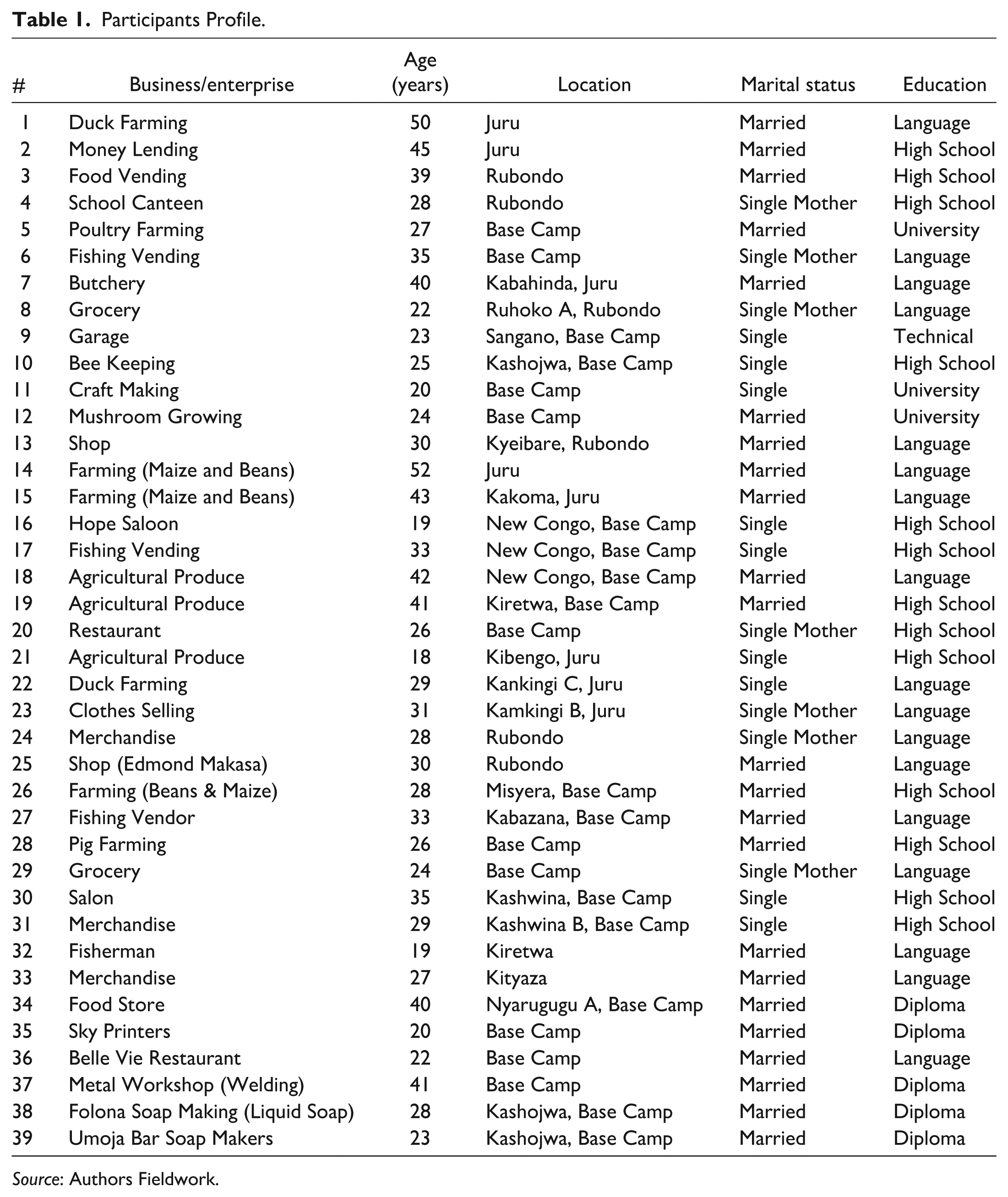
Participants differed in age, marital status, education levels, and business types, offering insights into how personal backgrounds and socio-economic conditions shape entrepreneurial choices. The profiles not only reflect the diversity of enterprises in the area but also highlight the ways in which entrepreneurship functions as a livelihood strategy, a survival mechanism, and a pathway to economic independence (Table 1).
Participants Profile.
Source: Authors Fieldwork.
The majority of entrepreneurs fall within the economically active age range of 20–40 years, indicating that the enterprise sector is largely youth-driven. A smaller group of older participants, particularly those aged 50 and 52 years, are mainly engaged in farming, suggesting that traditional agriculture remains the domain of older individuals. This contrast highlights a generational shift, with younger people gravitating toward more diverse or innovative activities. Married individuals dominate the sample, pointing to enterprises often tied to family livelihood strategies. Single mothers form a notable proportion, especially in food vending, groceries, clothes selling, and restaurants — enterprises that reflect entrepreneurship as a survival mechanism for women-led households. Meanwhile, single youth are often involved in skill-based or innovative ventures, including garage work, craft making, and saloon businesses, showcasing how self-employment supports independence among younger entrepreneurs.
Education strongly influences enterprise choice. Participants with only language literacy or basic schooling are concentrated in farming, vending, and small-scale trading. In contrast, those with higher education (university graduates) pursue specialized or innovative ventures such as poultry farming, mushroom growing, and craft making, which require technical skills and entrepreneurial initiative. The presence of vocational/technical training, seen in garage operations and welding workshops, underscores the importance of hands-on skills in shaping enterprise opportunities.
The enterprises mirror the local economic structure. Agriculture-related businesses dominate, including duck farming, poultry, maize and beans cultivation, beekeeping, and mushroom growing. Alongside these, vending and trading (food vending, fish vending, groceries, and merchandise) provide accessible income sources. Service-oriented and skill-based activities — such as saloons, garages, craft making, and welding — reflect efforts at diversification, especially among younger and more educated entrepreneurs.
Participants Background Stories
The narratives from Nakivale Refugee Settlement reveal that autonomy, as conceived in the right to stay framework, cannot be reduced to an individual choice. One participant, a 47-year-old mother of nine, explained:
Unfortunately, when we reached here, all the children got sick of typhoid and other skin diseases. My children would start complaining . . . they would ask me why they were no longer going to school.
Her family’s economic vulnerabilities were compounded by her husband’s inability to find steady work, forcing him to rely on brick-making for income. In response, she began selling vegetables and later transitioned into the fish trade after observing other women in the community. She noted
I realized there is money in the fish business.
Her entry into the fish trade was not simply an entrepreneurial initiative but a survival strategy shaped by her husband’s precarious brick-making work, the illness of her children, and external support from the Department of Possibility. Autonomy here was structurally contingent, dependent on institutional scaffolding and household dynamics, which challenges the framework’s liberal assumption of autonomy as self-determined (UNHCR 2018; Kerwin, Hare, and Rivero Fuentes 2025).
Similarly, another participant, a trained primary school teacher, fled to Uganda in 2008 after her husband was killed in the conflict. She recalled:
Different men would come and harass me and my children . . . this forced me to get a man to avoid other men from disturbing me.
Despite her qualifications, she was dismissed after resisting sexual advances:
In 2020 I was told that I no longer have a job . . . I knew I had refused a sexual advance by the school head teacher.
Her testimony exposes how gendered violence embedded in labor markets undermines autonomy. Her subsequent creation of a savings group reframes autonomy as collective resilience rather than individual choice:
Three of us sat down and started to think about how our future would be . . . so we started by saving
This example suggests the need to refine the right to stay framework, showing that autonomy must be theorized as gendered and relational, otherwise it risks reproducing exclusions that silence the respondents’ lived realities. This resonates with critiques of Uganda’s refugee self-reliance policies, which highlight how progressive frameworks often fail to address gendered vulnerabilities (Bohnet and Schmitz-Pranghe 2019).
Another woman, a 50-year-old mother of eight, described how she rebuilt her livelihood after displacement:
When I received this money, I did not think of buying household items. I planned to fight hard and invest it in my business so that I get enough profits.
Her narrative demonstrates that the right to stay is meaningful only when economic inclusion is possible. Autonomy here was economically contingent, dependent on access to capital, markets, and supportive institutions. This challenges the framework to move beyond abstract notions of autonomy and recognize the material infrastructures that enable or disable agency, echoing de Haas’s (2021) argument that migration decisions are shaped by the interplay of aspirations and capabilities within structural constraints.
A different participant, who lost all five of her children in war, recalled:
When war broke out, all my 5 children died and I reached here alone . . . I would move to different households and request for food and people were very generous.
Her survival was enabled through community generosity, not individual choice. This challenges the assumption that autonomy is something exercised by individuals in isolation instead pointing to social embeddedness as the condition of agency. Autonomy here was relational, produced through networks of solidarity and mutual aid, compelling the framework to recognize that agency is co-constructed through social ties that mediate vulnerability and resilience (de Haas 2021).
Similarly, a grocery trader explained:
Before the support, my stock was very small and now I can bring 8 bags of rice from basecamp to sell in my shop.
Her testimony underscores that the right to stay is not fulfilled through shelter alone, but through institutional support and economic empowerment. Autonomy was expanded through external intervention, showing that agency is structurally enabled. This challenges the framework to incorporate the role of institutions and NGOs as co-producers of autonomy, rather than treating autonomy as an inherent individual capacity (UNHCR 2018; Gerschutz-Bell 2022).
These narratives compel a critical feminist refinement of the right to stay framework. Autonomy must be conceptualized as relational, structurally contingent, and gendered. The evidence challenges the framework’s boundaries and compels its re-thinking, pushing it to evolve, moving beyond liberal individualist assumptions to incorporate structural, relational, and gendered dimensions of autonomy. By highlighting these insights, the study advances the framework beyond its normative foundations, demonstrating that autonomy is not simply about the freedom to remain but about the capacity to remain with dignity. This refinement strengthens the framework’s analytical robustness and normative relevance, aligning it with contemporary critiques of refugee policy that emphasize socio-economic inclusion and gender-sensitive protection (Bohnet and Schmitz-Pranghe 2019; UNHCR 2018; de Haas 2021; Gerschutz-Bell 2022; Kerwin, Hare, and Rivero Fuentes 2025).
Although this study emphasizes refugee women’s experiences, comparative evidence demonstrates clear gendered divergences in livelihoods and decision-making in Uganda’s settlements. Men generally secure larger plots and greater control over agricultural production, while women cultivate smaller or communal plots, limiting their ability to scale beyond subsistence (Norwegian Refugee Council 2024; UN Women 2025). Male refugees also report greater freedom of movement and access to wage labor outside settlements, including construction, transport, and formal employment. Women’s mobility is constrained by caregiving responsibilities, cultural norms, and safety concerns, confining them to petty trade and informal services (U-Learn Consortium, 2023).
Entrepreneurship patterns reflect these inequalities. Men’s enterprises are more growth-oriented, involving higher-capital activities such as garages, welding workshops, and larger-scale farming. Women’s enterprises remain survival-oriented — food vending, groceries, small restaurants, and craft making — focused on immediate household needs rather than capital accumulation. A randomized trial in Kampala found that cash grants significantly boosted men’s business profits, while women benefited less, and mentorship sometimes worsened outcomes for female entrepreneurs (International Rescue Committee 2025).
Decision-making mirrors these disparities. Men often frame choices to stay or migrate around economic prospects and land access, while women emphasize household survival, children’s education, and solidarity. Women consistently identify settlement policy — land tenure restrictions, limited finance, and shrinking allocations — as the decisive constraint, while men highlight broader economic opportunities and mobility rights. These comparisons show that women’s agency is exercised under tighter structural constraints, compelling a refinement of the “right to stay” framework: autonomy must be theorized as a gendered negotiation of inequality rather than a universal capacity.
Emerging Themes
The findings illustrate the complexities and contradictions of these dynamics, and how they shape both short-term survival strategies and long-term resilience. By using the right to stay, migrate, and return framework, this study positions itself within a critical theoretical debate, exploring whether the right to stay truly allows women to exercise autonomy or whether it is more often constrained by external factors and structural inequalities.
Personal Agency
Personal agency emerges as a key factor in the resilience strategies among the women interviewed. According to the right to stay framework, autonomy and the capacity to make decisions about one’s future are critical to the right to stay. Several participants described taking active steps to shape their socio-economic futures, primarily through participation in Community Savings and Credit Groups (CSCGs), which offer loans that would otherwise be inaccessible. One participant shared:
I borrowed UGX 150,000 from the group and started selling fuel. Initially, I sold one jerrycan, but now I sell over 20 liters per day. I have been able to buy hens for my family and also opened a retail shop for my wife as a side business. (CSCG Participant).
This testimony illustrates how small loans allowed a participant to exercise agency in securing economic stability and diversifying income. However, this agency was still constrained by limited resources. Borges (2025) similarly observes that refugee women often engage in small-scale entrepreneurial ventures to reassert control over their lives in the face of displacement. Despite these efforts, the scale of loans available remained insufficient to allow for large-scale ventures, and participants operated within a cycle of small survival strategies rather than long-term sustainable growth. These accounts challenge the right to stay framework, which assumes autonomy is primarily an individual choice, by highlighting the structural barriers that limit refugee women’s ability to exercise full autonomy
Moreover, the study indicates that personal agency, while powerful, was often reactive rather than proactive, shaped by external constraints such as economic need and gendered violence. This resonates with de Haas (2021), who argues that agency is not a straightforward exercise of choice, but is instead shaped by material conditions and institutional limitations. The women interviewed made decisions to enhance their livelihoods, but those decisions were framed within a context that limited their choices.
Institutional Support
While personal agency played a significant role, institutional support from NGOs, microfinance organizations, and humanitarian agencies was also crucial for enabling resilience. The right to stay framework emphasizes that the right to stay is not merely about physical presence but involves the ability to thrive, which requires access to both resources and opportunities. Among participants, institutional support provided short-term relief but often failed to create the long-term conditions necessary for economic independence. One participant shared.
We have never been trained in financial management or business skills. I use my general knowledge to carry out audits, but we struggle with things like budgeting and planning. (CSCG Participant).
This highlights a significant gap in institutional support — while financial capital is provided, business management and financial literacy training are insufficient. Women who receive loans may be unable to scale their businesses or develop sustainable livelihoods due to a lack of essential skills. Bohnet and Schmitz-Pranghe (2019) point out similar gaps in humanitarian programming, noting that while microloans are a critical intervention, business skills are often neglected, hindering women’s ability to transition from survival strategies to economic independence.
Moreover, participants reported that the short-term nature of institutional support — especially in terms of loan repayment — created additional tensions and conflict within the community. One group leader expressed:
People take money to solve problems, but repayment is hard. It often fuels conflicts between leaders and members (Group Leader)
This reflects a systemic issue within the institutional framework: while loans provided immediate relief, they often failed to address broader structural needs such as access to larger loans, business training, and sustainable financial support. This illustrates dynamics among the respondents, aligning with Omata (2022), who demonstrates that financial resources alone are insufficient to support long-term economic empowerment without comprehensive training, equitable distribution, and institutional follow-up.
Community-Based Support Systems
Community-based support systems, particularly CSCGs, were integral to the resilience strategies of participants in the study. These groups provided a social safety net, allowing women to engage in entrepreneurial activities and take risks they might otherwise avoid. One participant described:
When we receive the group funds, members come up with business ideas. Some buy land for farming, and others use it for their fishing businesses. I used the money to buy a boat and nets, which has helped me earn a steady income (CSCG Participant)
The social capital embedded in these groups allowed participants to trust one another and cooperate for mutual benefit. This finding aligns with Sandberg, Immonen, and Kok (2019), who emphasize the importance of social networks in refugee communities, noting that community solidarity facilitates entrepreneurial risk-taking and helps women overcome individual financial constraints.
However, the finding reveals that these community-based support systems are also vulnerable to internal challenges. Issues such as loan defaults, poor record-keeping, and insufficient savings limit their ability to provide long-term solutions to the socio-economic challenges faced by refugee women. One leader explained:
There are many needs, but the money we save is still too little. People end up dissatisfied because some are unable to get enough loans to meet their needs. (Group Leader).
This underscores the fragility of community-based systems, as limited financial resources and structural issues hinder their effectiveness. Omata (2022) similarly identifies the fragility of informal support systems, noting that while these groups provide short-term relief, their long-term sustainability is often compromised by resource scarcity and organizational challenges.
Long-Term Sustainability
Despite the resilience shown by participants, the sustainability of their strategies must be understood within the structural design of Uganda’s settlement system. Land in Nakivale is allocated on a temporary basis, plots continue to shrink as the population grows, and tenure remains insecure. These conditions restrict the horizon of possible futures and make durable economic independence difficult to attain without fundamental policy change. Even when women demonstrate initiative through savings groups and small enterprises, their capacity to plan beyond immediate survival is constrained by these structural realities.
Within this context, participants’ strategies are best understood as tactical coping rather than pathways to full independence. Rotating savings, diversifying small businesses, and pooling resources help manage immediate risks and stabilize livelihoods in the short run. By contrast, strategic planning — such as investing in larger enterprises, securing land for sustained agriculture, or building intergenerational assets — was largely unattainable given the settlement’s structural limitations.
One Participant Shared
When we plant, the drought sets in, and we don’t yield as expected. It really affects our food security. (CSCG Participant)
This aligns with Baggio (2025), who argue that environmental shocks like drought severely affect the livelihoods of refugees who rely on agriculture. Market instability and price fluctuations further contribute to economic uncertainty, leaving refugee women vulnerable to external shocks. The right to stay framework fails to account for the extent to which these external vulnerabilities limit the long-term sustainability of women’s resilience strategies. Moreover, the lack of access to larger loans or formal financial systems keeps respondents trapped in small-scale survival strategies. One participant concluded:
We are able to survive, but we are not growing. We need bigger loans, better training, and better markets for what we sell (CSCG Participant)
This statement underscores the need for systemic change in refugee policy and practice. Without access to larger loans and better market access, participants cannot scale their businesses and break free from the cycle of poverty. This challenge underscores the need for holistic support systems that go beyond short-term relief and address long-term sustainability.
Conclusion
The findings of this study illuminate the complexities faced by refugee women in Nakivale, showing how their agency and economic resilience are constrained by institutional gaps, gendered vulnerabilities, and external shocks. While men often navigate settlement structures with relative advantage — securing larger plots, greater mobility, and growth-oriented enterprises — women remain confined to survival-oriented petty trade and settlement-based services, with decisions disproportionately shaped by restrictive policies and social norms. These divergences reveal that Uganda’s self-reliance policy, though formally progressive, reproduces inequality in practice.
The right to stay framework, while normatively powerful, requires re-thinking in light of these testimonies. Autonomy emerges not as a universal capacity but as relational, structurally contingent, and gendered — produced through collective practices such as savings groups, dependent on institutional scaffolding, and shaped by unequal power relations. By situating women’s constrained agency alongside men’s comparative opportunities, this study advances a feminist refinement of the framework: autonomy should be understood not as an abstract right exercised by isolated individuals, but as a gendered negotiation of inequality within networks of solidarity and structures of support. This reconceptualization shifts the framework beyond its liberal foundations, placing dignity rather than mere survival at the heart of the right to remain.
The contribution is twofold. Theoretically, it strengthens the analytical depth of the right to stay by embedding feminist insights into autonomy and extending the framework through gendered comparison. Practically, it calls for refugee policy and humanitarian aid to move from short-term relief toward long-term empowerment strategies that address structural inequalities and gendered exclusions. In doing so, the study situates refugees not as passive recipients of aid but as agents whose capacity to remain is negotiated within, and often constrained by, broader political and economic structures.
Policy Implications
Evidence from Nakivale shows that refugee women’s economic strategies are shaped by a combination of individual initiative, household responsibilities, settlement design, and broader policy frameworks. Although women demonstrate resilience through savings groups, petty trade, and small-scale agriculture, their autonomy is constrained by gendered inequalities and structural barriers. Addressing these challenges requires interventions that are tailored to women’s specific circumstances while remaining embedded in family and community networks. The following implications outline concrete actions for NGOs, donors, government, and UNHCR to strengthen women’s livelihoods and to ensure that autonomy is understood as relational and structurally contingent.
In Nakivale, women’s reliance on savings groups provides only small loans, enough to keep businesses afloat but not to expand them. NGOs should strengthen these groups by linking them to microfinance institutions and tailoring financial literacy training to settlement conditions. Donors can support these linkages with targeted funding, while government and regulators must reform banking policies to allow refugees into formal credit systems and address collateral restrictions. Prioritizing women’s savings groups recognizes their central role in household survival and community solidarity.
Women in Nakivale manage risk primarily through petty trade and small-scale agriculture. NGOs can build on these activities with targeted business training and improved market access in sectors where women are already active. Scaling up enterprises or investing in agriculture depends on government action to provide secure land tenure, which current settlement policy does not allow. Trainings should strengthen women’s enterprises while acknowledging the role of men and family networks in enabling or constraining women’s economic activity.
Women face limited mobility, heavy domestic responsibilities, and exclusion from decision-making. NGOs should design training schedules that accommodate childcare and ensure equitable governance structures in savings groups. Donors can prioritize funding for gender-inclusive programming. Embedding gender equity into settlement governance and national refugee policy requires structural reform led by government and UNHCR. These interventions must engage men and community leaders to reduce resistance and broaden support, recognizing that women’s participation is embedded in household and community dynamics.
Although Uganda’s refugee policy grants freedom of movement and the right to work, settlement design restricts livelihood planning. In Nakivale, donor funding remains short-term and project-based, reinforcing coping rather than growth. Donors should commit to longer-term program cycles, while government reform of land tenure and settlement design is needed to create conditions for durable independence. Longer-term funding should back women’s livelihood groups with steady, multi-year support, embedding these initiatives in family and community networks so women are not treated in isolation.
Footnotes
Declaration of Conflicting Interests
The authors declared no potential conflicts of interest with respect to the research, authorship, and/or publication of this article.
Funding
The authors received no financial support for the research, authorship, and/or publication of this article.
