






Abstract
As the U.S. population ethnoracially diversifies in the coming decades, it becomes ever more important to understand how Americans interpret and respond to these population dynamics. Nearly all related scholarship has focused on White people’s sentiments and reactions to the demographic shifts. This study leverages rich, qualitative interviews collected in 2023 with 43 U.S.-born Gen Z adults aged 18 to 26 years identifying as Mexican, Native, or with two or more races in Arizona to address two aims. First, we explore how young adults of color imagine that anticipated ethnoracial population changes will affect their lives. Second, we examine how their present-day ethnoracial and immigration contexts and experiences connect with how they imagine their future. Participants generally hope for decreased systemic racism and greater political empowerment, which will benefit their own lives. Some participants also are optimistic that these shifts will enable them to experience increased ontological security, or feelings of ease, safety, belonging, and trust. Extended case studies indicate that these imagined futures are tied to young people’s current experiences of systemic racism, xenophobia, and the racialization of illegality reinforced at the structural and individual levels nationally and in Arizona. These findings contribute to the sociology of the future and racialized future literatures regarding how White supremacy and systemic racism organizes the past, present, and the future. The results also illustrate the “spillover” harms of racialized immigration policies and practices beyond immigrants to U.S.-born young adults from diverse minoritized communities and from the present to future temporal landscapes.
Introduction
The U.S. Census Bureau estimates that by 2060, the proportion of the country’s population that is non-Hispanic White will decline to approximately 45 percent, while those identifying panethnically as Hispanic or Latino will account for 27 percent, Black or African American people at 13 percent, Asian people at 9 percent, those with two or more races at 5 percent, and American Indian and Alaskan Native and other populations will comprise less than 1 percent each (U.S. Census Bureau 2023). 1 Scholars and mainstream media outlets have devoted significant attention to the anticipated population decline of non-Hispanic Whites and the growth of these other diverse ethnoracial populations, hereafter referred to as ethnoracial diversification (e.g., Chavez 2008; Frey 2018; McConnell 2019; Roberts 2009; Rodríguez-Muñiz 2021). 2
Extensive research, predominantly centering White adults and using experimental methods, has investigated how the U.S. public has interpreted these anticipated ethnoracial population shifts in predominantly negative ways, and their consequences for policy positions and racial or immigration attitudes (e.g., Abascal 2023; Craig and Richeson 2014; Jardina 2019; Levy and Myers 2021; McConnell and Rodríguez-Muñiz 2023a). However, scant literature has explored how other U.S. populations interpret and respond to the nation’s increasing ethnoracial diversification; this work indicates a mix of optimism, pessimism, and other responses, depending on the group (e.g., Abascal 2015; McConnell and Carreon 2024; McConnell and Rodríguez-Muñiz 2023b). Given that the White majority population’s views of and responses to demographic change may not be universal, focusing on the majority group likely masks the substantial ethnoracial differences that likely exist regarding this important U.S. population change.
The present study addresses this lacuna, leveraging rich qualitative data to answer two research questions. First, how do young adults of diverse minoritized ethnoracial identities imagine that the anticipated ethnoracial changes occurring in the United States will impact their own lives? Second, how do their experiences and perceptions of their current ethnoracial and immigration contexts inform how they imagine their future? The study draws from intensive interviews collected in 2023 with 43 U.S.-born Gen Z adults aged 18 to 26 years identifying as Mexican, Native, or with two or more races in Arizona. The inclusion of Native young adults is meaningful; Native individuals rarely appear in U.S.-based scholarship about the future, ethnoracial population change, or international migration (e.g., Leza 2019). Gen Z includes the nation’s youngest generational cohort of adults, those born after 1996 (Parker and Igielnik 2020). Relative to prior generations, Gen Z are more ethnoracially diverse and are on track to be the best educated (Parker and Igielnik 2020). Members of Gen Z will be of prime working ages and voting over the next half century. Thus, their attitudes and behaviors are socially, politically, and economically significant for the country as a whole.
Our aim is to uncover the range of views that U.S.-born Latino, Native, and multiracial young adults have about future ethnoracial diversification, their perceptions about likely impacts on their own lives, and how their current contexts shape how they envision their futures. Our findings reveal that, contrary to scholarship with the White majority (e.g., Abascal 2023; Craig and Richeson 2014; Jardina 2019; Myers and Levy 2018), members of ethnoracial minority groups in Arizona are optimistic about these anticipated demographic changes. Indeed, they express hope that future ethnoracial diversification will positively affect them via reduced systemic racism, enhanced political representation and empowerment, and increased feelings of belonging, safety, and well-being.
Using extended case studies, we further reveal that participants’ imagined futures flow directly from their daily realities of navigating structural and interpersonal enactments of systemic racism and xenophobia. Revealing how sentiments about the future are rooted in participants’ past and present experiences contributes to the sociology of the future regarding how humans’ social locations shape their imagined futures (e.g., Bourdieu 1977; Emirbayer and Mische 1998). The findings also contribute to the racialized future literature about how White supremacy and systemic racism organizes the past, present, and future (e.g., Durham 2024; Ehlers 2023; McConnell and Carreon 2024; Mitchell and Chaudhury 2020). Finally, a large literature illustrates the “spillover” harms of racialized immigration policies and practices far beyond immigrants (e.g., Aranda and Vaquera 2015; Ayón 2018; Flores-González et al. 2024; Leza 2019; Menjívar and Abrego 2012; Romero 2006; Szkupinski Quiroga, Medina, and Glick 2014; Tsosie 2016; Vaquera, Aranda, and Sousa-Rodriguez 2017). Our results illuminate how systemic racism and the racialized U.S. immigration system “spillover” from past and present temporal landscapes into the future and extends beyond Latinos to affect diverse communities of color.
Literature Review
Sociology of the Future and Racialized Futures
Sociologists, demographers, and others have grappled with projections of the future and how people “talk” about and make sense of the future (e.g., Bourdieu 1977; Mische 2009; Tavory and Eliasoph 2013). Humans’ past experiences and familiarity with social relations and social contexts help them anticipate the future (Emirbayer and Mische 1998). Differences in individuals’ social status and position lead to distinct orientations toward the future, which can perpetuate social stratification (Bourdieu 1977). Perceptions of the future can affect human action and social outcomes (Beckert and Suckert 2021; Mische 2009) and how past and future intersect in the present to shape humans’ current sense of belonging (May 2019).
Other scholars insist that intellectual work about the future needs to account for how White supremacy and racial stratification, foundational to many aspects of human action, influence how humans imagine the future (e.g., Ehlers 2023; Mitchell and Chaudhury 2020). For instance, White hegemony requires that Whiteness and White people are centered across all temporal landscapes and that discourses about the future construct and protect Whiteness (Mitchell and Chaudhury 2020). 3 Recent U.S.-based studies centering the voices of Black, Indigenous and People of Color (BIPOC) demonstrate how existing racial stratification constrains how members of ethnoracially minoritized groups imagine the future. For example, Simone N. Durham (2024) illuminates how Black young adults’ position at the bottom of the racial hierarchy and present-day racialized experiences limit their “horizons of possibility for social change” regarding the impacts of the Black Lives Matter movement on U.S. society (p. 540). Another study revealed that some Latino young adults were cautiously optimistic that expected ethnoracial diversification would result in positive outcomes for the nation in the areas of racism, ethnoracial relations, and politics (McConnell and Carreon 2024).
This study offers the first investigation of how American adults envision that their own lives might change as the U.S. population becomes more ethnoracially diverse. Given previous work in the sociology of the future, we expect that young adults’ imagined futures are based on their unique social positions and past experiences. These perceptions of the future are social facts that may shape this young generation’s attitudes and behaviors. Aligning with the racialized futures literature, we expect that their future orientations reflect existing racial stratification and the realities of how White supremacy organizes the past, present and future. Consequently, the study explores how the racialized contexts in which young people of color live become integrated into their imagined futures.
Systemic Racism and Racialized Illegality in the United States and in Arizona
Extensive scholarship has documented how U.S. institutions and laws are founded on and uphold White supremacy and how these racial systems infiltrate all aspects of daily life, increasing the stress and harm on the well-being and bodies of people of color (e.g., Alexander 2010; Bell 1992; Bonilla-Silva 2003; Combs 2022; Vasquez-Tokos 2025). Rooted in the same racist foundations, U.S. immigration policies and enforcement practices enact normalized, seemingly legitimate and state-sanctioned structural, symbolic, and legal violence on immigrants and their loved ones (Menjívar and Abrego 2012). Indeed, contemporary immigration law, the blending of immigration and criminal law, and racialized illegality—the presumption that all people of Mexican and Central American ancestry are undocumented—have had devastating consequences for U.S. Latino communities (e.g., Aranda and Vaquera 2015; Armenta 2016; García 2017; Menjívar and Abrego 2012; Provine 2013; Romero 2006; Sáenz and Douglas 2015).
Race and space are inextricably intertwined (e.g., Lipsitz 2011; Vasquez-Tokos 2025). Arizona is an ethnoracially diverse state that is well known for its draconian immigration laws and joint federal and local immigration enforcement efforts (Provine 2013). 4 For example, in 1997, a Phoenix-area police department and Border Patrol agents carried out sweeps in Latino neighborhoods targeting Spanish speakers and phenotypically Mexican people, ostensibly to detain and deport undocumented immigrants. Colloquially known as the “Chandler Roundup,” the Chandler Police Department and immigration agents were later determined to have violated the civil rights of Mexican Americans and other Latinos (Romero 2006). Maricopa County Sheriff Joe Arpaio engaged in aggressive immigration enforcement activities between 2006 and 2016, including the so-called “crime suppression” sweeps and traffic stops in Mexican neighborhoods that were later determined to have racially discriminated against Latinos (Sterling and Joffe-Block 2021; Provine 2013). In 2010, Arizona Senate Bill SB1070 sparked national and international debate for the power it gave law enforcement to identify and criminalize undocumented immigrants. The U.S. Supreme Court eventually ruled that most provisions of SB1070 were unconstitutional (Provine 2013). Although the “Chandler Roundup,” Sheriff Arpaio’s tenure, and SB1070 occurred before the state’s youngest adults came of age, these events loom large in the collective memory of Arizona Latinos, young and old (e.g., Medrano 2012; Reznick 2020).
Federal, state, and local laws and enforcement practices similarly shape the lives of Native communities in Arizona. Arizona’s 22 federally recognized tribes include the Tohono O’odham Nation, whose ancestral lands cross the U.S.-Mexico border (Hrabik et al. 2024). The U.S. Border Patrol (now U.S. Customs and Border Protection or CBP) have had the authority to conduct arbitrary searches, detain people, and exercise extra-constitutional authority within 100 miles of the U.S. border, covering most of the state’s population (e.g., Flores-González et al. 2024; Leza 2019). Border Patrol agents and local police departments have racially profiled and harassed Native peoples as potentially undocumented (Leza 2019; Sterling and Joffe-Block 2021; Tsosie 2016), resulting in the “illegal deportations” of Tohono O’odham people, among others (Meeks 2020:655). In 2024, the Phoenix Police Department was found to have racially discriminated and violated the civil rights of Native American, Latino, and Black Arizonans (U.S. Department of Justice 2024).
Taken together, local, state, and federal policies and enforcement practices constitute forms of structural and symbolic legal violence (Menjívar and Abrego 2012) that disproportionately harm Mexican and other Latin American immigrants in Arizona, their mixed-status families, and the larger Latino community (e.g., Ayón 2018; Provine 2013; Sterling and Joffe-Block 2021; Szkupinski Quiroga et al. 2014). Recent scholarship reveals that Arizona’s racial and immigration history and current climate constrains U.S.-born Latino young adults’ feelings of belonging and their optimism for the future (e.g., Flores-González et al. 2024; McConnell and Carreon 2024; Muñoz Casarrubias et al. 2024). These policies and practices also render Native communities in Arizona vulnerable to the harmful effects of the law (Leza 2019; Meeks 2020; Tsosie 2016), further exemplifying the “spillover effects” of the U.S. immigration and deportation regime (e.g., Aranda and Vaquera 2015; Menjívar and Abrego 2012). However, even less is known about how this racialized context shapes the lives and worldviews of Native young adults. Thus, the present study explores “spillover effects” among multiple ethnoracially minoritized groups and from past and present temporal landscapes to the future.
Ontological Security
The literature on ontological security emphasizes the significance of individuals’ experiences within their larger social contexts. Ontological security is the human need for safety, trust, confidence, and ease in their identities, societal institutions, and the larger community (Giddens 1991). Humans’ concern with belonging and acceptance begins with infants’ early encounters with the world and how others appraise them and continues throughout life. The reliability, predictability, and tenor of everyday interpersonal interactions shape individuals’ ontological security, because such interactions “sustain attitudes of generalized trust” (Giddens 1991:46). People employ habits and routines as coping mechanisms to deal with existential threats and concerns. Those who are ontologically insecure, who feel existential anxiety, may try to blend in with the larger environment and use other strategies to avoid danger (Giddens 1991:53–54).
Previous scholarship reveals how racial stratification and xenophobia restrict individuals’ ontological security across national contexts. For example, systemic racism and racist encounters in Australia increase the discomfort—the opposite of ontological insecurity—of migrants (Noble 2005), and among Aboriginal peoples, leads to anxiety, feelings of rejection, and exclusion (Hickey 2016). Ethnic and religious minority individuals in Scotland engage in pre-emptive self-surveillance and behavior management as coping mechanisms to reduce their fears regarding what could happen in interactions with others (Botterill et al. 2019:473). 5
Turning to the United States, federal and state-level immigration policies have created stigmatizing legal classifications for people without papers, creating vulnerabilities that lead to invisible legal and symbolic violence for immigrants and their families (Menjívar and Abrego 2012). Harsh immigration laws increase the unpredictability of undocumented immigrant young adults’ lives, eroding their ontological security (Vaquera et al. 2017). Young undocumented immigrants express this ontological insecurity via frustration, loneliness, anxiety about their physical safety, and other negative emotions (Vaquera et al. 2017). The present study explores whether ontological security appears in the imagined futures of ethnoracially minoritized young adults and whether it connects to their present-day racialized experiences.
Data and Methods
Data for this project come from the Arizona Youth Identity Project (AZYIP), a longitudinal mixed-methods study beginning in Fall 2020 (Martin 2024). AZYIP follows U.S.-born young adults (non-Hispanic White, Latino, Native, and people identifying as biracial/multiracial) across large metropolitan areas and smaller communities in Arizona, concentrating on their political identities, activities, and feelings of belonging. Interviewers were matched to participants by ethnoracial and gender identities whenever possible. The AZYIP team assigned unique ID numbers and pseudonyms to all participants; this study provides deliberately vague descriptions of some participants to further protect respondent confidentiality. We have Institutional Review Board approval to analyze these data. In terms of positionality, the authors have Latin American immigrant parents (Colombia or México). The first author is a long-term Arizona resident and the second author is a younger Millennial graduate student and a former member of the AZYIP team who administered some of these interviews. Our backgrounds and experiences helped us interpret participants’ comments about systemic racism and the institutional and interpersonal manifestations of racialized illegality in Arizona.
The study analyzes intensive interview data conducted with AZYIP participants via Zoom from March to June 2023, who answered the following questions: The U.S. Census Bureau projects that in the next 25 to 30 years Latinos, African Americans, Native American, and other racial minorities will make up most of the U.S. population. How will this demographic change impact the U.S? How will it impact you directly?
Some participants were asked a combined version of these questions. The sample was limited to U.S.-born Gen Z young adults (aged 18–26 in 2023) who identified as members of ethnoracially minoritized communities, yielding a sample of 43 participants. Table 1 summarizes the key features of this sample. Most participants identified with a Latin American ancestry, predominantly as Mexican, had immigrant parents, identified as women, Democrats, and had completed some college. References to individual participants in the results include their preferred specific ethnoracial identity (e.g., Mexican) and if Native, their tribal affiliation(s).
Descriptive Statistics for Sample Participants.
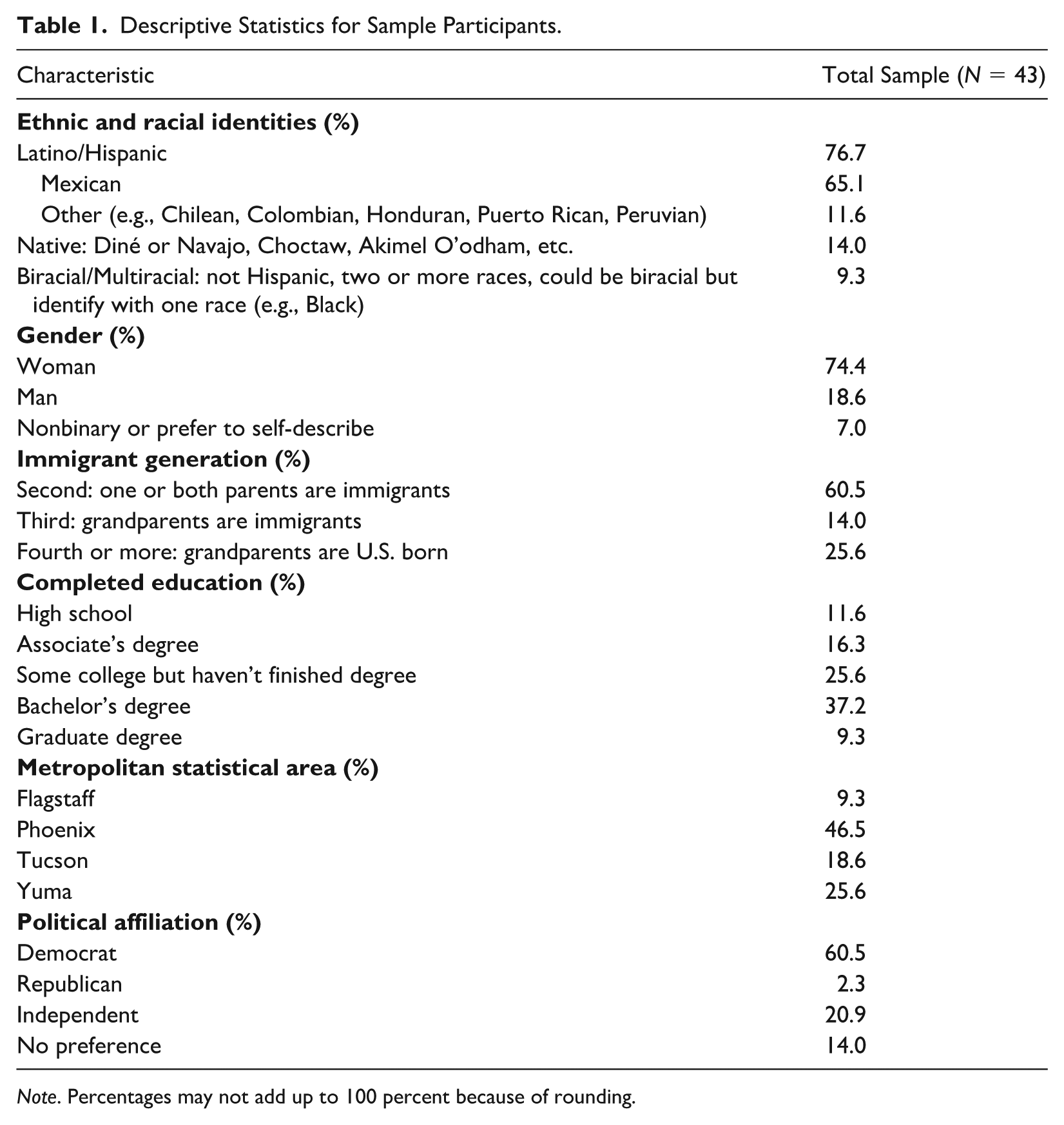
Note. Percentages may not add up to 100 percent because of rounding.
Our analysis of how Gen Z Arizonans of color imagine their own futures relies on an abductive approach grounded in existing literatures and open to theoretical surprises (Timmermans and Tavory 2022). To explore how participants imagine the demographic changes will personally impact them in the future, we used Dedoose to consensus-code responses and discussed each to ensure it met the criteria for a particular code. 6 Participants’ responses about personal impacts could be coded into multiple themes. Consistent with other work about imagined national impacts of ethnoracial diversification (e.g., McConnell and Carreon 2024; McConnell and Rodríguez-Muñiz 2023b), participants’ responses about how the population changes would personally affect them were most likely to relate to systemic racism and politics. The third most common theme relates to ontological security (Giddens 1991). The findings section includes representative quotes demonstrating the three categories’ key features, internal variation, and examples of overlapping themes.
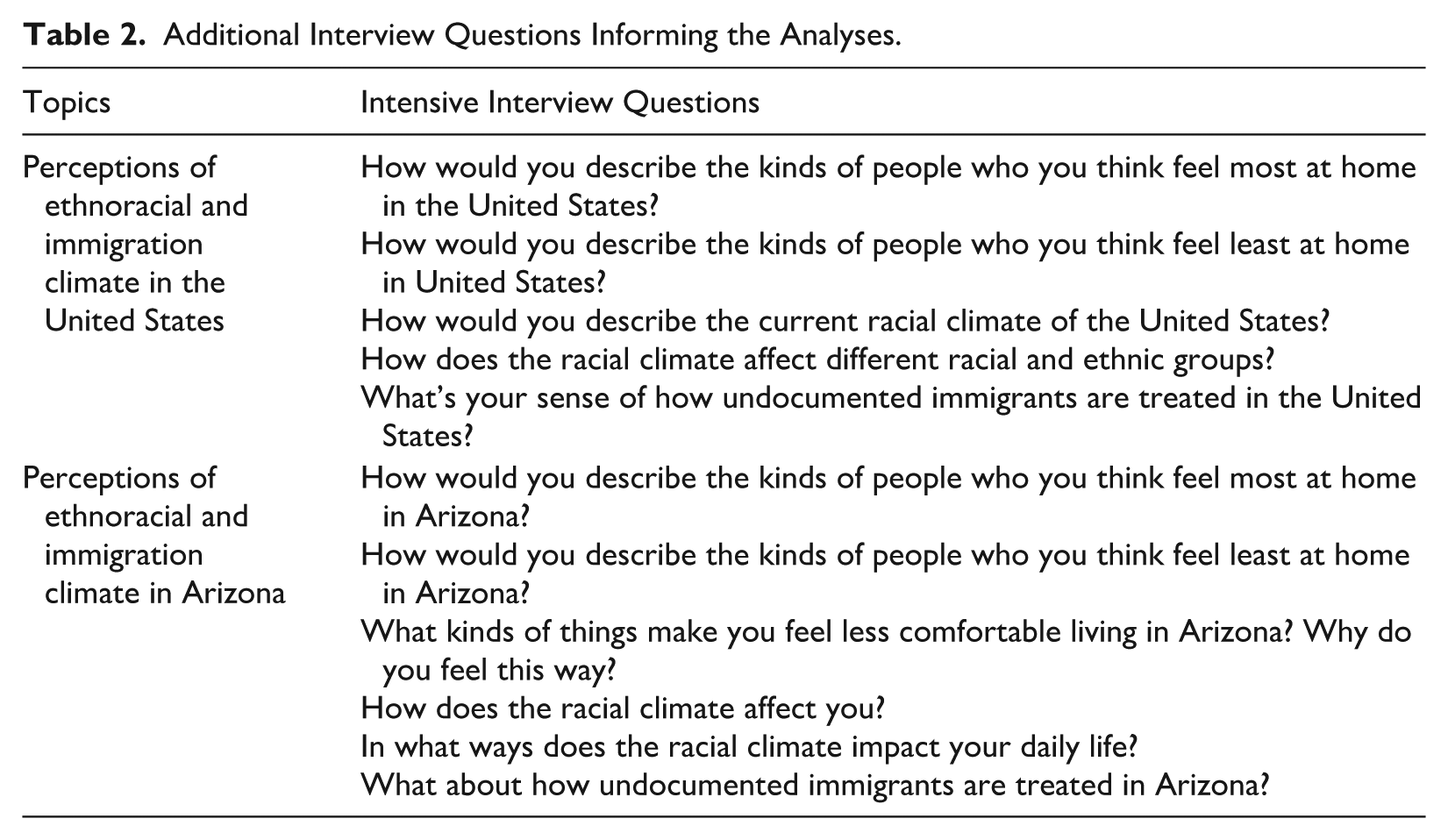
Next, we employed an extended case study approach to examine how participants’ current contexts inform how they imagine their futures. We created separate databases based on which domain participants mentioned (i.e., systemic racism, politics, and ontological security). Participants’ responses coded as multiple themes would appear in multiple databases. In each database, we added a participant’s complete narration of their imagined personal impact and their responses to other interview questions related to the U.S. and Arizona racial and immigration climate. Table 2 lists the additional open-ended interview questions considered in this analysis. This approach illuminated the connections between participants’ current contexts, experiences, and their imagined futures. The findings section includes detailed case studies to center the participants’ voices about their own lives, their concerns, and how they envision their future.
Additional Interview Questions Informing the Analyses.
Results
Systemic Racism and Racialized Illegality in the Future and the Present
Approximately 40 percent of the Latino, Native, and multiracial participants’ responses about how an increasingly ethnoracially diverse nation would affect their lives in the future focused on changes to systemic racism and discrimination. For example, Adam, a 24-year-old Mexican man, imagines the personal impacts as follows: Well, I can only see it benefiting me, right? Because it’s like more of my people . . . . that perceived hierarchy that we all imagine of like race just being leveled out and not being a hierarchy anymore and just kind of being like a culmination, a melting pot, if you will.
Adam imagines a more equitable society that will positively affect him in the years to come. This perspective reflects a narrative of racial progress in which incremental improvements toward racial equity are inevitable (e.g., Bell 1992; Seamster and Ray 2018). As will be shown throughout the findings section, some young people anticipated changes to systemic racism in tandem with other themes.
Many participants offered extensive and detailed commentary about the toxic racial climate in the United States and specifically in Arizona. For instance, Gia, a 26-year-old Diné or Navajo woman, describes what life in Arizona is like: Since the 2016 election, people with more hateful or xenophobic rhetoric and ideas and beliefs have kind of risen from the cracks . . . . I thought Kari Lake, the Republican nominee for governor, was so, like crazy like she’s still claiming that you know, the election was rigged. And it’s just blatant mistruths and misinformation and really reinforcing of just hateful speech . . . . I think the loudest voices, at least in the past few years, have been pretty hateful people and that makes me pretty uncomfortable.
In these comments, Gia explicitly calls out “xenophobic rhetoric” and “hateful speech” expressed by the “loudest” figures in Arizona’s political stage, such as Kari Lake, a former Phoenix TV news anchor who subsequently, but unsuccessfully, ran for Governor and U.S. Senator. Arizona tribal leaders and Native policymakers have sharply critiqued Kari Lake on multiple occasions, including when her campaign manager posted a racist tweet denigrating Native peoples on Indigenous People’s Day in 2022 (Small 2022). Gia imagines a future in which: “we’re going to see a lot more [racial and ethnic] gaps shrinking . . . everything is going to be better for everybody. . . [which will] positively impact me.” Thus, Gia imagines that the demographic shifts will directly affect her life in beneficial ways.
Others spoke frankly about the institutionalization of racialized illegality in Arizona. For example, when asked about how undocumented immigrants are treated in Arizona, Sandra, a 24-year-old Mexican woman, shares, [they] are treated pretty badly. But the crazy thing is you don’t know when someone is undocumented, right? So they’re just treated the same way that everyone else that is Hispanic looking is treated . . . They assume that a lot of the Hispanic community are undocumented or whatever, especially with our sheriff that was doing the worst things ever. Like, that’s pretty bad . . . specifically in Arizona, they’re treated worse.
Sandra is referring to the racially discriminatory actions of Maricopa County Sheriff Joe Arpaio and the Maricopa County Sheriff’s Office (MCSO) (Sterling and Joffe-Block 2021). As she recounts, the presumption by local law enforcement that all phenotypically Latino people in Arizona are potentially undocumented exposes the entire panethnic community to racial discrimination and harm. Racialized illegality also is reinforced and reproduced in Arizona via individual-level harassment of phenotypically Latino individuals in public. For instance, Eve, a 24-year-old multiracial woman of Iranian heritage, says that “people are constantly calling on them [presumed undocumented immigrants], you know, trying to check if people are documented.” Local residents’ surveillance and reporting of presumed undocumented immigrants to immigration authorities are not new activities; they similarly shaped the MCSO’s immigration enforcement agenda in the mid-2000s as well (Sterling and Joffe-Block 2021).
Some participants are explicit about the widespread and problematic effects of the racialized environment for all minoritized ethnoracial groups. For instance, Xaviera, a 25-year-old Mexican woman, says, It [the racial climate] puts different targets on their backs . . . for the Black community, . . . police violence has always been a thing . . . (and) like, citizens going out of their way to, like, police Black people . . . the Latinx community, the same thing as well as being a target for like immigration and documentation . . . the Asian community. I mean, we saw it with COVID-19. Everyone got pretty xenophobic real quick and with the Native American communities, too.
Xaviera’s commentary emphasizes how present-day racism and xenophobia are enforced at the institutional and interpersonal levels to simultaneously increase the vulnerabilities of Black, Latino, Asian, and Native communities, albeit in different ways.
Nearly all participants who anticipated that ethnoracial population shifts would personally affect them via systemic racism imagined that racism would decline in the future. However, Francisco, a 25-year-old man with Mexican immigrant parents, was the exception. He surmises that as populations of color increased, “maybe [it]would negatively hurt our communities because . . . we’re going to be under scrutiny . . . I don’t know if racism will get worse.” Francisco’s skepticism that systemic racism will decline in the future could be due, in part, to the state’s current toxic racial and immigration climate for Latinos, even those born and raised in Arizona. As he says, “living in the state sometimes feels like you always have to justify . . . yourself in a sense . . .” Part of the problem is anti-immigrant rhetoric, which affects him directly as a son of Mexican immigrants: “the way that people talk about people like me and sometimes upset me, could make me angry, or just make me emotional . . . It’s very, like, alienating.” Francisco’s experiences lead him to worry that “racism will get worse” in the future, rather than diminish over time. Although an unusual response among this sample, Francisco’s pessimism about sustained changes to the racial order aligns with previous work (e.g., Bell 1992; McConnell and Carreon 2024; Seamster and Ray 2018).
Anticipated Ontological Security in the Future
Approximately 33 percent of participants anticipate that a more ethnoracially diverse nation will result in more ontological security later in their lives. All such participants identified as women or as nonbinary. For some participants, their hopes for the future concentrated on their “embodied” self (Giddens 1991:56). Catarina, a 24-year-old nonbinary Diné or Navajo person, began their response about the personal impacts of these changes by saying, “I love seeing Brown people around. It makes me feel safer.” Dulce, a 25-year-old woman with Peruvian immigrant parents, imagines, “I think it might give me a little more sense of pride. I might just feel a little safer when I leave my apartment and go to work and go run errands or whatever.” Other participants anticipate positive impacts on their future mental health, such as less anxiety. Lexia, a 24-year-old woman with Mexican immigrant parents, says these demographic changes will affect her, “directly, like I’m going to be a little less stressed out for sure. I’m going to be very, you know, happy to see it.”
Other young adults imagine that in a more ethnoracially diverse future, they will experience more ease and feelings of belonging and acceptance (Giddens 1991; Hickey 2016; May 2019). For instance, Maricela, a 25-year-old nonbinary Akimel O’odham participant, shares, I hope with the expansion or the growth of more people, either in my demographic or the people that I associate within different demographics, that I just feel more comfortable going to different parts of like Arizona necessarily . . . I just hope that I feel more welcome in certain places here.
Maricela envisions feeling “comfortable” and welcomed across the state. Selena, a 24-year old nonbinary gender fluid person of Mexican and European backgrounds, imagines that within 30 years: “The mixed population will grow as well, which would be nice to feel not as alone.” Other participants’ temporal horizons are even further in the future. For instance, Ilana, a 21-year-old Mexican woman, says, . . . I won’t see anything change in my life, but I think maybe for like future generations. They’ll feel more welcomed and not really. Like on the outside, just for the color of their skin. Like, if it’s more normal that you see it everywhere, then you don’t feel as much as an outsider.
Ilana’s hopes for future ontological security center on the authentic integration of her descendants, rather than herself. Vivianne, a 26-year-old woman of Chilean heritage and the only Republican in the sample, imagines similar positive impacts. Vivianne hopes that by the time her future children are born, they will “get to genuinely be who they are in a country that has accepted who they are as themselves.”
Two case studies demonstrate the connections between participants’ current racialized experiences and their imagined futures prioritizing ontological security. The first is River, a 22-year-old Diné or Navajo woman, who envisions the future as follows: I don’t want to say I would be happier, but a little bit . . . Hopefully, I feel like there’s a sense of solidarity between these. I don’t want to say marginalized now that we’re you know, we’re expecting to be lot more than half of the population in the United States. But um, yeah, I think I’d just be a bit more at ease . . .
Her imagined future of being “happier” and “more at ease” tap into both emotional and embodied ontological security.
River’s present-day experiences highlight the individual-level impacts of institutionalized racism, as when she explains what makes her feel uncomfortable in Arizona: . . . police departments, whether it’s in Northern Arizona, like with my own experience in Flagstaff or my experience in Phoenix, those are huge things . . . You feel like in a sense, like kind of targeting, you’re always on your toes at times, like when you’re in downtown Phoenix or in specific areas . . . on the interstate . . .
When asked how the racial climate affects her, she says, As of now, it hasn’t personally affected my daily life. It’s just more of like I’m being more conscientious of like. You know, like just be on high alert of like, what should I be expecting or what should I be listening into and how can I act as an ally to others and how could others act as an ally to me?
Although River begins by saying that the racial climate doesn’t affect her, she immediately pivots to how it does shape her life. Her subsequent statements indicate profound ontological insecurity, particularly a lack of trust in societal institutions and existential risk (Giddens 1991). These feelings of insecurity likely stem from the racially discriminatory activities of law and immigration enforcement agencies targeting Native people in Arizona (e.g., Leza 2019; Tsosie 2016; U.S. Department of Justice 2024). River copes with her ontological insecurity via hypervigilance (“be on high alert”) and searching for potential allies. In future decades, River hopes to experience the ontological security currently missing from her life.
Another participant, Tessa, a 24-year-old Mexican woman, responds to the question about how the increasing ethnoracial diversification of the country will affect her by saying, How will it impact me directly? Hopefully it’ll, I won’t have to constantly . . . have in the back of my mind like . . . am I being paid fairly? Am I being treated fairly? Like I won’t have to always have that question in the back of my head when I’m like approaching anything and everything. Hopefully it’ll translate intov. everything that I do and the work that I do, the hard work that I put in, it’s going to pay off . . . (so) I don’t have to, like, you know, fight and claw and, you know, scream to get my accomplishments acknowledged or to be paid fairly or to be treated fairly.
These comments convey Tessa’s deep mistrust of present-day society and institutions and her frustration at not receiving the acknowledgment and remuneration she deserves. Ontological security helps individuals feel they can achieve their own goals (Giddens 1991). Lacking this security in the racialized climate of the United States and Arizona, Tessa experiences persistent psychological distress (“always have that question in the back of my head”). Consequently, she feels compelled to engage in physically exhaustive efforts to avoid exploitation and mistreatment.
Tessa’s comments about her current life point to many potential sources of threats that reduce her ontological security (Giddens 1991:36). Regarding the U.S. racial climate, she notes, “there’s always kind of like a threat of violence, and it’s not necessarily just like verbally.” Regarding Arizona, Tessa points to a “divide between . . . Mexican-Americans versus like White people,” which became worse and more diffuse during President Trump’s first administration (2017–2020). She recalls that time with vivid language: . . . like the hairs on like the back of my neck were raised all the time when I would, like, walk into like a bar or . . . where there’s like a lot of White people . . . the tensions rose so much between like White people . . . who fucking love Trump and like were like, ‘Yee Ha, to be an American, you need to be White.’ . . . because like in Arizona . . . if you speak Spanish or you like look like us in any way, shape or form, you’re automatically a Mexican. Doesn’t fucking matter if you’re like Dominican, Puerto Rican like and from Guatemala . . . If you’re brown and you talk Spanish or even have like an inkling of it, you’re fucking Mexican . . .
Tessa’s comments reveal how the potential for physical violence and abusive interactions from White Trump supporters in public affects her nervous system. This fear and tension are embodied, raising the hair on the back of her neck “all the time.” Her comments also reveal how interpersonal interactions in public places uphold the racialized illegality that stigmatizes and harms the entire community. In Tessa’s experience, the deliberate conflation of all Latino individuals as “fucking Mexican” highlights the unpredictability and danger of living in the state, even for those with three or more generations in the United States, like herself. Tessa shares, “Arizona growing up was definitely not the best experience for me.” Encountering these present-day challenges, Tessa hopes that as the U.S. population becomes more diverse, she will become more ontologically secure, her efforts “will pay off” and she will achieve her economic and professional goals.
Imagined Political Representation and Empowerment
Approximately 26 percent of the participants imagine that the changing ethnoracial composition of the nation will yield political outcomes that will positively affect them in the future. Xitlali, a 24-year-old Mexican woman, imagines that increasing populations of color in the United States will change politics and improve her own life: Personally, for me. I think we could do some good . . . That is one thing that most like Black, Indigenous, Latino Hispanics . . . just like the whole BIPOC group that we can all relate to. We have all experienced some form of racism . . . Having someone that understands certain things would be beneficial, especially when it comes to like being in office and like making decisions for everyone else.
Xitlali hopes the projected population changes will lead to electing diverse policymakers who have experienced racism, ultimately benefiting her in the future.
Three case studies demonstrate the connections between diverse participants’ current experiences and why they imagine the nation’s population changes will have political impacts that directly affect their futures. All three envision that politics will be an avenue to deal with present-day systemic racism, but express it in different ways. The first, Samara, a 24-year-old queer Black woman, imagines how a more ethnoracially diverse nation will affect her personally: I think that that will lead to more understanding of people like me. So I am, I identify as Black, but I have a White parent . . . there will be more multiracial people . . . that will help with some of the systemic oppression that we face . . . [which] will improve things because inherently we’ll start seeing more BIPOC people in the government . . . it’ll be a good thing.
Samara hopes that the growth of more biracial people will reduce systemic racism, leading to more people of color in politics, with positive impacts on the nation and her own life.
Samara’s optimism for the future directly connects with how she describes the current racial climate of the United States, which is “near Civil War level . . . we’re seeing politicians wanting to bring back lynching and . . . voter suppression is a racial issue.” Samara sees the Arizona climate as equally problematic, sharing, the Confederate flags that I come into contact with make me real uncomfortable and [I] don’t love living here . . . the police brutality here is pretty bad . . . Yes, we just flipped to a blue state.
7
But I don’t think that that necessarily means that the culture here has changed . . . we have a “don’t fence me in” culture that basically translates to, um, White people here don’t want to give up any of their rights . . . in order for other people to gain rights.
Like other participants, Samara recognizes both institutionalized racism via the police and individual-level racial prejudice, in her case symbolized by the display of Confederate flags in Arizona.
8
The current racial climate . . . affects me personally because I’m terrified . . . I hate guns, but I’m thinking about learning to use one just in case because . . . I’m afraid that things are going to get violent. And I constantly have to be careful about how I move about the world because I can’t assume that everybody around me wants me to have rights . . . I feel really unsafe moving about the country and my state because of my race . . .
Samara describes the racial climate in the United States and Arizona as so unpredictable and potentially dangerous that she feels “terrified.” Like River, Samara copes with her current ontological insecurity through hypervigilance about “how I move around the world.” She hopes for a better future based on authentic acceptance of multiracial people like her, more BIPOC political power, and decreased racial oppression.
Another participant, Estrella, a 23-year-old Mexican woman, explains her vision for the future: . . . we might finally be able to see changes being done . . . everyone in power now is old White men . . . to see that change with females and Black people and Mexican people and Indigenous people in roles of power might create the change that we need . . . in my daily life . . . and in the policies, hopefully that will start being passed . . . I don’t think we’ll experience the straightforward racism that is being experienced now because most people are going to be people of color.
With these expected population shifts, Estrella hopes to see both declining racism and increasing political power for multiple marginalized groups, directly affecting her own life.
This utopic future stands in sharp contrast to Estrella’s present reality of rampant xenophobia and racialized illegality. Like other participants, she recounts how Arizonans of Mexican origin are presumed to be undocumented, which leads to dehumanizing interactions in public: . . . people assume you are like, how many videos have we not seen of people in Arizona saying like, “oh, go back to your country” or “oh, let me see your passport,“ things like that . . . It’s very out there . . . very sin vergüenza [shameless]. Like, they’ll just do it, you know?
In her view, the policing of Latino Arizona residents by some non-Latinos has become normalized. As a person of Mexican ancestry, such terrible behavior could be directed toward her, too. Estrella says that Arizona is “very openly racist . . . there’s places where you can’t really go without feeling the stares and things.” Not surprisingly, this climate has affected her personally: . . . during the Trump presidency, it was very scary to go out into public . . . We’re going to go in a public place. Are we going to speak Spanish to each other? . . . It was always having to think about what you were going to do and having to think about where you were going to go . . . It definitely affected our culture and our traditions . . . even like driving my car with reggaeton on loud or like cumbias or something on loud, It was something that I don’t do anymore . . . just me dressing in my like, Mexican wear . . . my skirts from back home or my shirts with like the embroidered and everything on it, it was something that, like I, I would think twice about wearing in public.
For Estrella, every outing in public becomes fraught with tension, uncertainty, and mistrust in others, diminishing her ontological security. She polices her own cultural expression—choice of language, music, and clothing—to reduce the likelihood of harm in public settings. These seemingly invisible effects exemplify the normalization and institutionalization of “legal violence” (Menjívar and Abrego 2012), and the ways that systemic racism, xenophobia, and racialized illegality constrain even the cultural expressions of native-born Latino young people. This hypervigilance and behavior change aligns with how “ontologically insecure” people try to “blend with the environment” to avoid danger (Giddens 1991:53–54). Estrella is more optimistic about her future. She imagines a time in which women and multiple ethnoracial groups hold powerful positions, there are declines in “straightforward racism,” and her daily life will be improved.
Aida, a 21-year-old Mexican woman, envisions future political empowerment for people of color and for herself in great detail: . . . minorities who finally have the platform to have power, would push and fight . . . tackling and advocating for the eradication of racism, discrimination and injustice . . . with the greater presence comes . . . having these dialogues of discrimination within politics, economy, social and political lenses. I think if I saw a larger population minority speaking out, it would make me want to be more active just because starting at a small scale I can only do so much. But, if I rise with my community and other communities who resonate with the idea that they’re a minority, I would feel more empowered to be like this time, we can maybe actually make change if we’re all fighting for the same goal . . . what’s just so discouraging now is not a lot of minorities are put in positions of power . . . So having a larger representation of that and having a large group and then statistically having more minorities in different places would mean a lot to me because then it would empower me to do so much.
Aida hopes that people of color will gain genuine power, allowing her to successfully achieve her own goals and collaborate with others for communal uplift. However, she is skeptical about the likelihood of this future, indicated by conditional language such as “if I saw” and saying, “this time we can maybe actually make change” [emphasis added]. Perhaps Aida sees this future as unlikely or perhaps she believes that apparent gains in racial equality are temporary, as society reconfigures itself to maintain systemic racism that supports White supremacy (Bell 1992:373).
Aida’s current and future temporal landscapes are linked. A U.S.-born daughter of undocumented immigrants from Mexico, Aida explains how the current climate of Arizona affects her daily life: I’m more cautious about like how I drive . . . I watch where I go . . . there’s situations where I decide not to go to a certain place because of course I am a Hispanic. So, if it’s ever in a position where a crime happens and I’m nearby, of course I’m going to be questioned because I am a minority . . . sometimes [I’m] not even going out . . . being at home, you have no fear of whatever can happen outside of your doors in terms of discrimination, injustice, racism. So definitely being cautious, being aware of my surroundings and environment . . . it’s subconsciously affecting what I do, obviously, because I have to be more mindful since I am a minority.
Aida’s comments suggest the many invisible ways that the national and local racialized immigration climate shapes her activities and well-being. Her experiences are consistent with previous Arizona-based research (e.g., Ayón 2018; Menjívar and Abrego 2012; Romero 2006; Szkupinski Quiroga et al. 2014). Living in a state where “discrimination, injustice, racism” are rampant, Aida is unable to predict what will happen outside her home. Consequently, like Estrella and other participants, Aida deals with the toxic racial climate’s effects on her ontological insecurity by modifying her own behavior, including whether she leaves the house at all.
Aida believes that multiple communities of color in the state are politically marginalized, not just her own: Politics don’t favor my culture. So, being in Arizona, there are often times where Mexican Americans or even just Native Americans, even African Americans . . . in political views, aren’t taken with the same respect as those who are Caucasian . . .
As her narrative reveals, there are through-lines between Aida’s current experiences living in a highly racialized and xenophobic environment, the lack of political influence she and others have, and how she envisions her life in the future. Aida feels discouraged, disempowered, and lacks trust in societal institutions, all reasons that could lead her to express cautious language about the future. Nevertheless, she is optimistic that future personal and communal empowerment and liberation will be possible, encouraging her to “rise with my community” and collaborate with other communities of color to achieve permanent transformation.
Discussion and Conclusion
As the U.S. population becomes increasingly ethnoracially diverse over the coming decades, it becomes ever more important to understand how Americans of all ethnoracial identities make sense of and respond to these changes. Yet most scholarship focuses on the White majority’s views about this future. This exploratory study centers how members of ethnoracially diverse populations, specifically U.S. born young adults of Mexican/Latino, Native, and multiracial backgrounds perceive these anticipated demographic shifts. First, we explored how these members of Gen Z, aged 18 to 26 years in 2023, imagine that the increasing ethnoracial diversification occurring over the next three decades will personally affect them. Second, informed by the sociology of the future, racialized futures, and literature about the harmful individual and communal effects of racialized immigration policies and enforcement, we drew on extended case studies to examine how participants’ previous experiences and current contexts are connected with their imagined futures.
The findings reveal that most participants imagine that anticipated U.S. ethnoracial population growth will positively affect their own lives, consistent with emerging research about national impacts (e.g., McConnell and Carreon 2024; McConnell and Rodríguez-Muñiz 2023b). Many of these young Arizonans hope for decreased systemic racism and increased political representation and power in the future. Notably, nearly a third of participants spontaneously imagined future improvements in their ontological security (Giddens 1991), articulated as feelings of safety, belonging, emotional well-being, trust in society, and other positive emotional states.
Extended case studies reveal that young adults of color perceive pervasively hostile racial and immigration climates, nationally and in Arizona. Some participants observe how state actors uphold systemic racism and racialized illegality, which are further reinforced via hostile interpersonal interactions from other residents. Importantly, past events occurring in Arizona and the omnipresent potential for harm—ranging from being stopped by the police while driving to being physically assaulted or insulted in bars, on the streets, or in other public settings—shape their daily activities and their well-being. In response, some young Arizonans of diverse backgrounds engage in coping strategies that involve managing their appearance, behavior, and activities to “blend in” and avoid harm.
The case studies further demonstrate the connections between participants’ present realities and how they envision the changing nation will personally affect them in the future. For instance, Samara’s experiences with present-day racism, enacted institutionally and interpersonally, directly connect with her hopes for a future with less systemic racism and more political representation of BIPOC communities. Another participant, River, feels targeted by the police, leading to hypervigilance and a search for allies that she can trust. These existential concerns reduce the predictability of her environment and decrease her trust in the larger community. River envisions a future in which she experiences solidarity with other groups and feels “just a bit more at ease.”
Taken together, these results contribute to multiple literatures. Contrary to scholarship focused on Whites’ expressions of threat, anxiety, and hostility to national demographic change, our findings indicate that Gen Z Latinos, Natives, and other young adults of color are optimistic about these shifts. Building on the sociology of the future and scholarship about racialized futures, systemic racism, and racialized illegality, the findings illuminate how past and present-day racism and racialized illegality connect with how young people of diverse ethnoracial and immigration backgrounds imagine the future. Note how the presumption of being undocumented, a socially constructed, racialized, and stigmatized category, constrains Tessa, Estrella, and Aida’s present-day lives and shapes how they imagine the future. These findings extend the legal violence framework regarding how local, state, and federal laws and activities normalize and render invisible structural, symbolic, and legal violence on people’s lives (Menjívar and Abrego 2012).
In addition, most sociological research that focuses on legal violence, racialized illegality, and the “spillover effects” of U.S. and state-level immigration policies and enforcement concentrates on contemporary Mexican or other Latino communities. Our findings indicate that the racialized immigration context of the United States and Arizona leads some U.S.-born young adults from diverse backgrounds, including Native young people, to express present-day disempowerment in multiple domains. For instance, some participants articulate profound ontological insecurity at the present time, given their experiences of structural and interpersonal enactments of racism, racialized illegality, and xenophobia. However, they are optimistic that as the nation diversifies, they will experience more security and belonging in the future. Thus, concerns about ontological security “spillover” beyond undocumented youth (Vaquera et al. 2017) to diverse people of color born and raised in the United States. The findings also indicate that contemporary experiences of racial stratification, legal violence, and racialized illegality “spillover” into future temporal landscapes, influencing how the nation’s youngest adults imagine what is possible over their lifetimes.
Despite the study’s empirical and theoretical contributions, there are numerous limitations. Although the rich qualitative data collected in the AZYIP provided important contextual information about participants’ lives, the sample was predominantly of Mexican ancestry with a modest number of Native youth and people identifying with other ethnoracial identities. Most participants were women, had some college education, and self-identified as Democrats. Participants identifying as women or with nonbinary gender identities were more likely to discuss the personal impacts of the current racialized climate and to invoke the theme of ontological security than were men. Studies with larger and more heterogeneous samples could simultaneously consider how ethnoracial identities, gender identities, and other factors such as skin color and the worldviews of immigrant parents (Zamora 2022) might shape how young people perceive their present realities and future selves. Such work could further explore how narratives of racial progress (e.g., Bell 1992; Seamster and Ray 2018) appear in imagined futures. Analyses using more recent data are needed, given the quintupling of CBP and Immigration and Customs Enforcement (ICE) budgets and the dramatic escalation of immigration enforcement activities in Trump’s second term (Chishti, Bush-Joseph, and Putzel-Kavanaugh 2026). Intensified immigration operations in Arizona include ICE targeted raids of Phoenix restaurants in early 2026 (Johnson 2026). These developments may affect how some Gen Z Arizonans now imagine their futures.
Given demographic processes already underway, the U.S. population will continue to ethnoracially diversify for decades to come. Simultaneously, the Gen Z cohort will become more socially, economically, and politically important to the nation. Understanding the factors affecting young Americans’ current lives and how they envision their own futures as the country transforms are essential. This study documents how racial stratification and xenophobia enacted at the structural and individual levels in Arizona shape the everyday lives of U.S.-born individuals of color in myriad harmful and often imperceptible ways. These experiences inform why many of these young adults hope for a future characterized by reduced systemic racism, individual and community-level political empowerment, and safety, belonging and other positive feelings currently missing from their lives. We interpret the findings as a call to action for leaders, policymakers, and other stakeholders in Arizona and nationwide. Supporting future-oriented thinking among diverse young people of color requires changing the material conditions and everyday environments that make imagining a different future feel possible. In addition, more scholarship is needed that examines Americans’ sentiments about U.S. ethnoracial population shifts, the sources of those views, and their social, economic, and political consequences.
Footnotes
Acknowledgements
Arizona Youth Identity Project (AZYIP) data were collected by Principal Investigator Nilda Flores-González and Co-Principal Investigators Angela Gonzales, Emir Estrada, and Nathan D. Martin. We are grateful to Nilda Flores-González, Nathan Martin, and Aaron Thompson for data access and assistance, and to Emir Estrada for preliminary data analysis. Ginetta Candelario, Irasema Coronado, Cynthia Feliciano, Rocío García, Amalia Pallares, Pierrette Hondagneu-Sotelo, and Stella Rouse generously provided feedback on drafts of the paper. We also thank the anonymous reviewers and the Editorial team of the Sociology of Race and Ethnicity. Earlier versions of the manuscript were presented at the 2025 Annual Meeting of the American Sociological Association and the 2026 Annual Conference of the Association for Borderlands Studies. All errors are our own.

Funding
The authors received no financial support for the research, authorship, and/or publication of this article.
Declaration of Conflicting Interests
The authors declared no potential conflicts of interest with respect to the research, authorship, and/or publication of this article.