







Abstract
Abstract
In January 2011, former Israeli Prime Minister Ehud Barak issued a surprising announcement to take four other members of his Labor Party’s Knesset faction with himself to set up a new political party, Haatzmaut (Independence). The conditions under which this split took place illustrate the ways in which the Israeli anti-defection law, passed in the 12th Knesset, incentivizes the behavior of elected legislators who seek to exit from the party that they were elected to represent. This article shows that the anti-defection law cannot keep a legislative party together that suffers from weak internal cohesion. In fact, by imposing numerical criterion (1/3) on prospective party switchers, the anti-defection law prolongs internal disunity, thereby further weakening an already low level of cohesion.
Introduction
In the aftermath of the infamous “stinking trick” and the ensuing wave of legislative defections that brought down Prime Minister Yitzhak Shamir’s National Unity government in 1990, the Knesset passed a new piece of legislation to regulate the inter-party mobility of its Members (MKs) in the future. Since its inception, the anti-defection law has failed to bring down the frequency of party switching in subsequent Israeli legislatures (Nikolenyi 2019). A prime example of the inefficiency of the anti-defection law could be seen in the 18th Knesset (2009–2013), which suffered a particularly high number of switches. This article seeks to shed light on why the anti-defection law failed to guarantee party stability and unity of the Knesset by focusing on the case study of the split in the Labor Party. Specifically, the article argues that the anti-defection law could only prolong and delay, but was ultimately ineffective to prevent the Party’s fissiparous tendencies, precipitated by its poor electoral performance and declining cohesion.
The article starts with a brief overview of the literature on party switching in order to define the key terms and identify the central hypotheses. The next section describes the central elements of the anti-defection legislation that were in effect at the time of the 18th Knesset, followed by a narrative and an analysis of the processes that led to the disintegration of the Labor Party.
Party Cohesion, Discipline, and Party Switching
Given the profound significance of party unity for parliamentary government, conventional wisdom in the legislative and coalition theoretic literatures assumed legislative parties to be unitary actors. This assumption, however, has been brought into question by scholars who point out that political parties vary in their ability to maintain unity of action among their members. The analytical distinction between party cohesion, “the extent to which, in a given situation, group members can be observed to work together for the group’s goal in one and the same way,” and party discipline, “a special type of cohesion achieved by enforcing obedience or … a system of sanctions by which such enforced cohesion is attained” (Özbudun, 1970, p. 305), reminded legislative scholars that party unity could not be taken for granted. Parties may arrive at the legislature with a certain degree of cohesion that is obtained as a result of the party’s own historical, institutional, or sociological characteristics (Hazan, 2003, p. 4), but, at times, party unity needs to be compelled by leaders invoking disciplinary measures (Bowler et al., 1999). The relationship between cohesion and discipline is not linear. Whereas sanctions normally need to be applied only when, and because, cohesion falters (Hazan, 2003), too little or too much cohesion may actually make the use of party discipline either pointless or redundant (Bowler et al, 1999, p. 5).
Party switching, conventionally defined as “any recorded change in party affiliation on the part of a politician holding or competing for elective office” (Heller & Mershon, 2009), is a well-known feature of legislative politics in many states. The impact of a switch on the legislative party system may essentially be of three types: a switch may increase, decrease, or leave intact the degree of partisan fragmentation in the legislature (Laver & Benoit, 2003; Laver & Kato, 2001; Laver & Underhill, 1982; Mershon, 2008; Mershon & Shvetsova, 2013). In turn, changes in the format and the fragmentation of the legislative party system may have further important consequences, including the allocation of portfolios and other coveted legislative positions, such as mega seats (Martin, 2014), among political parties, the composition and the duration of the government. The relative timing of party switches may shed light on why politicians may choose to give up their existing labels and adopt a new one.
Mershon and Shvetsova (2013) break down an inter-election period into three distinct phases, in order to track the temporal distribution of party switches. Drawing on the rational choice assumption that legislators are motivated by office-, vote-, and / or policy-seeking considerations, they distinguish among switches that are related to the formation of a new government (office-seeking switches); those that are related to expectations regarding the next elections (vote-seeking switches); and those that happen in-between (policy-seeking switches). They find that a mid-term conditioning effect encourages legislators to shy away from switching their party label too soon after the last general election or too close to the next one.
Studies on party switching attribute a central role to political institutions as independent variables. Specifically, two sets of institutions have attracted the interest of most scholars: candidate selection methods and the electoral system. As for the former, O’Brien and Shomer (2013) expect that deputies should be less likely to switch when their party has an exclusive or closed method of candidate selection because their nomination and electability is a direct function of their loyalty to the party organization. In contrast, open candidate selection methods encourage prospective legislators to cultivate a personal following, which, in turn, weakens their party’s control over them. However, they do not find compelling empirical support for these expectations. The expected effect of the electoral system on party switching is also ambiguous. According to conventional wisdom, party-centric electoral systems, such as closed-list proportional representation, are more likely to encourage deputies to remain loyal to the party label that got them elected than candidate-centered electoral systems are (Duverger, 1969). More recent scholarship, however, has challenged this view by arguing precisely the opposite. In this vein, Mershon and Shvetsova (2013) expect that in a party-centered electoral system, parliamentarians are not held directly accountable to the electorate which, ceteris paribus, reduces the electoral cost of their disloyalty.
In contrast to candidate selection methods and the electoral system, anti-defection laws have a much more direct effect on party switching because, by definition, they impose a direct cost on the party from where they exit. Yet, in spite of the growing interest in anti-defection rules, very few studies have investigated their effects. Some exceptions include works that look at how anti-defection laws shape the fragmentation of legislative party systems (Nikolenyi, 2014; Subramanian, 2008); how they affect the level and practice of corruption (Yadav, 2012); and how they change legislators’ ability to engage in parliamentary debate and dissent (Khanna & Shah, 2012; Leston-Bandeira, 2009). This lack of scholarly attention to studying what anti-defection laws are meant to achieve, namely to compel and sanction legislative party unity, is unfortunate because the application of such laws can actually help us re-evaluate some existing claims about party cohesion and party unity.
The Israeli Anti-defection Law
The origins of the Israeli anti-defection law can be traced to the events that culminated in the collapse of Prime Minister Yitzhak Shamir’s National Unity government in March 1990 (Nikolenyi, 2019; Nikolenyi & Shenhav, 2015). Given that defectors played a central role in this drama, which paralyzed the Israeli political system for months, and that a massive public outcry subsequently demanded that the political establishment pass political reforms to clean up the country’s political institutions, the Knesset adopted the anti-defection law to impose penalties on prospective defectors unless their party switching met certain carefully designed criteria. The anti-defection law was a combination of four legislative amendments to the (a) Basic Law: The Knesset; (b) to the 1969 Knesset Election Law; (c) to the Basic Law: The Government; and (d) to the 1973 Party Funding Law.
The amendment to the Basic Law: The Knesset stated that a Knesset member who left his /her faction but did not quit the Knesset soon thereafter could not be included in the candidate list for the following election of any party that was represented in the current Knesset. In other words, a disloyal MK would have to join or form a new electoral party if he or she wished to run in the next election. The amendment spoke clearly about individual legislators, and it explicitly exempted party splits from its provision as long as they followed certain specific conditions. This amendment further specified that voting against the party line on a question of confidence, or no confidence, in the government was to be regarded as quitting the party if, and only if, the MK in question received any direct or indirect benefit or compensation for doing so.
The amendment to the 1969 Knesset Election Law identified the precise conditions under which a party split was considered legal. In such cases, MKs who left their parties would not incur the sanctions mentioned earlier. The central provision of this amendment is the 1/3 rule stating that for a party split to be recognized, it would have to involve the secession of at least a third of the total number of the faction’s elected members. In the case of a faction of six MKs, it would mean a minimum of two MKs leaving together. Furthermore, the amendment forbade the conclusion of agreements and promises with regard to the composition of candidate lists prior to 90 days before the date of the next election.
The third pillar of the anti-defection reform was the amendment of the Basic Law: The Government which stipulated that an MK who left his/her faction could not be appointed to the government as a minister or a deputy minister, and that agreements about the allocation of government positions could only be carried out by authorized representatives of factions that were party to the agreement. Finally, the amendments to the 1973 Party Funding Law stated that an MK who left his/her faction would not be granted a share of the faction’s state-provided funding, a part of which was determined on the basis of the number of Knesset members that a party got elected. Once again, however, recognized splits constituted the exception; according to the new legislation, the factions that resulted from a party split would divide among themselves the amount of state funding that had accrued to the original faction according to the new number of their respective MKs. Although several aspects of these legislative amendments have changed over time, the key provisions about the size of a legally permissible defection (the 1/3 rule) and its timing (90 days before the next election) have remained stable (Nikolenyi, 2019).
Electoral Results and Government Formation in the 18th Knesset
Political Parties in the 18th Knesset
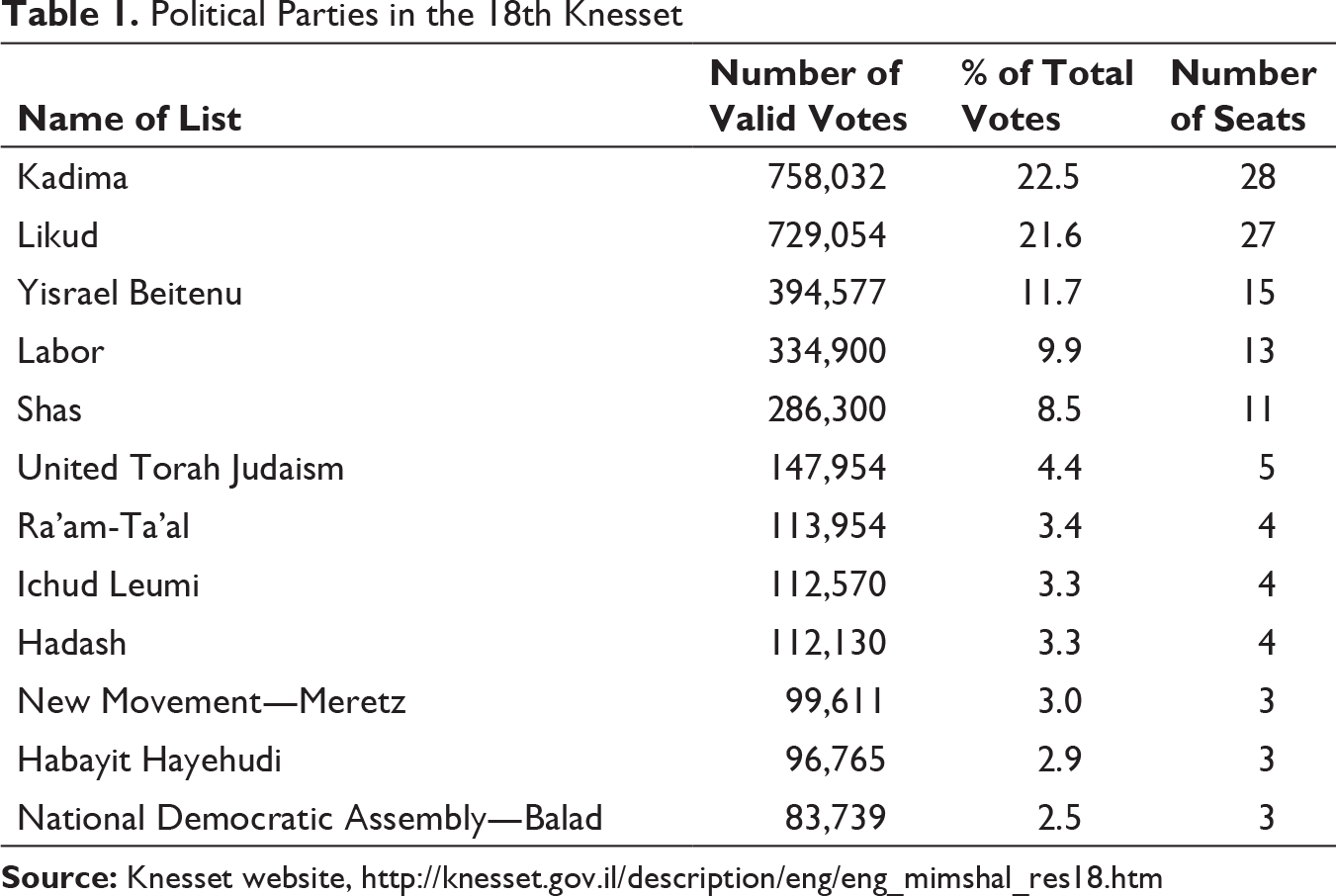
President Shimon Peres waited 9 days after the elections before starting his all-party consultations to determine whom to entrust with the task of forming Israel’s next government. The only party that formally recommended Tzipi Livni, the leader of the largest party in the new Knesset, was her own Kadima, while a 65 MK-strong proto-coalition of Likud, Habayit Hayehudi, Ichud Leumi, Yisrael Beitenu, Shas, and the UTJ recommended Likud’s Benjamin Netanyahu. The remaining five parties, including the Labor Party, chose not to make any formal recommendation. Therefore, President Peres concluded that Likud’s Benjamin Netanyahu had the best chance of forming the next government, and he proceeded accordingly to request him to do so. The coalition formation process was concluded on 31 March when, following a six-hour debate in the Knesset, the new Netanyahu government was presented and invested in office with a vote of 69 in favor and 45 against. The political parties that eventually joined the new coalition and whose MKs voted for the new government were Likud, Yisrael Beitenu, Habayit Hayehudi, Shas, and the Labor Party led by former Prime Minister Ehud Barak.
While the numbers indicated a comfortable majority support for the incoming coalition, there were five Labor Party MKs (Amir Peretz, Opher Pines-Paz, Eitan Cabel, Shelly Yachimovich, and Yuli Tamir) who defied their party’s decision to enter the government and registered their abstention from the vote (Divrei Ha-Knesset, 2008). The insubordination of the five Labor legislators, including a former leader of the party Amir Peretz, served as early indication of the deep divisions in the party. Two days after the election, Barak met with his new caucus and polled them about their preferences regarding the prospects of entering into a Likud-led coalition. In addition to Tamir and Yachimovich, four former Labor ministers in the outgoing government led by Kadima’s Prime Minister Ehud Olmert (Amir Peretz, Ophir Pines-Paz, Eitan Cabel, and Benyamin Ben-Eliezer) took the view that the party should go into opposition with Peretz formally demanding that Barak should resign and allow new leadership primaries to take place immediately if he wanted to participate in the government (Hoffman, 2009a, p. 1). Over the next several weeks, MKs Daniel Ben-Simon and Avishay Braverman also joined the rebel group, which came to constitute a majority (7 out of 13) of the party’s legislative contingent. In spite of the sizable opposition to joining the coalition, Barak appointed a negotiating team and started to explore the conditions under which Labor may enter the new government.
The collision between two camps in the Labor Party, those in favor of going into opposition and those in favor of being in government, came to a head at the meeting of the Labor Central Committee that was convened to vote on the issue on 24 March 2009. Although the vote was in Barak’s favor, with 680 delegates supporting his position and 507 voting against, the meeting showed how divided the Labor Party had become. Ben-Simon and Braverman announced that they would respect the decision of the Central Committee and would vote in support of the formation of a new coalition government including the Labor Party. The other five rebel MKs, however, did not do so and maintained their adamant opposition to joining the government until the investiture vote, and beyond. The Labor MKs who supported Barak were handsomely rewarded as the party received five cabinet portfolios and two deputy ministerships. 1
The Labor minsters in the new government were Ehud Barak, Shalom Simhon, Avishay Braverman, Benyamin Ben-Eliezer, and Isaac Herzog. The two deputy ministers were Matan Vilnai and Orit Noked.
Concurrently with the troubles in the Labor Party, Kadima also faced internal divisions over the issue of joining the government. In this case, however, the party leader, Tzipi Livni, was squarely opposed to the idea of entering the coalition and playing second fiddle to Likud, given that Kadima actually won more seats in the election. The main advocate for government participation was Shaul Mofaz, who narrowly lost the Kadima leadership primary to Livni a few months earlier. At the meeting of the Kadima caucus on 2 March, Livni’s position prevailed and the party decided not to press ahead with coalition talks with Likud (Hoffman, 2009b, p. 4).
Notwithstanding Kadima’s decision to stay in the opposition, the Netanyahu leadership remained adamant in its pursuit of several senior Kadima politicians trying to get them to split, form a new party, and enter the coalition in exchange for lucrative ministerial appointments. The first step in this strategy was the passage of what became (in)famously called the Mofaz law. Proposed as a government bill on 16 June 2009, the new draft legislation set out to establish a new condition for a party split that would specifically make it easier to split a larger political party in the Knesset by stating that a legal split did not have to include more than seven MKs. In other words, a party group of more than 21 MKs could legally suffer a split if seven of its MKs were to leave even though this number would be less than the 1/3 of the party group which would be required of smaller parties. Prior to the second reading of the Mofaz law, the government inserted an additional clause to amend the party funding law according to which a duly recognized and approved splinter party could qualify for state funding if the split took place after the third month of the start of the Knesset’s term rather than after 2 years, as legislated previously. Both amendments were passed with a narrow majority of 63 against 43.
Although Shaul Mofaz emphatically denied any interest in taking advantage of the new legal circumstances and splitting the Kadima faction in the Knesset (Mualem, 2009), the Mofaz law clearly created a new situation, encouraging party splits in the 18th Knesset. On the one hand, it was now going to be easier to split a larger political party and, since the third month after the start of the Knesset term had already expired, the financial repercussions for splitting early were also removed. Interestingly, it would be Labor and not Kadima to suffer the result of the new legislation.
The Labor Split and the Formation of Haatzmaut
In order to weaken the unity among the Labor Rebels, Barak moved quickly to punish its leaders while also making changes to the constitutional structure of the Labor Party that would give him more time to consolidate his position and authority. As a first decisive move, Barak dismissed Eitan Cabel as the party’s Secretary-General and replaced him with his trusted confidante, Weizmann Shiri. Soon thereafter the first crack appeared in the Rebel group as Shelly Yachimovich voiced her public disapproval of the idea of splitting the party while also remaining critical of having the Labor Party support and be a fig leaf to the right-wing government. Next, Barak changed the Labor Party constitution, which would have required the call for a leadership primary within 14 months after an election debacle. It was in Barak’s interest to make sure that this time line was extended so that he could shore up his position in the party against the Rebels. To this end, he called a special party convention in August 2009, where he was able to move the leadership primary to October 2012, just before the next legislative elections. Barak was able to bring about this important change by entering into an agreement with Isaac Herzog, Ophir Pines-Paz, and Avishay Braverman, who all held leadership aspirations and regarded themselves as likely candidates against Barak (Hoffman, Newman, & Sheffield, 2009, p. 1).
In November 2009, the Rebels organized a public meeting where they launched a formal organization, the Democratic Forum, that would act as the extra-parliamentary platform for their activities, and possibly become the nucleus of a future new political party. In addition to the four Rebels, the chairman of the party’s Knesset faction, Daniel Ben-Simon also attended the meeting and expressed his support. However, he stayed short of joining the group as the pivotal fifth member. The new Democratic Forum initiative did not take off and the Rebels started to lose steam. The death blow to their efforts was struck by Ophir Pines-Paz’s sudden decision to quit the Knesset, and political life altogether, in January 2010, soon to be followed by Yuli Tamir in April. The two incoming MKs who replaced them took very different positions on the division within the Labor parliamentary faction. On the one hand, Einat Wilf, who replaced Pines-Paz, was cautiously critical of the party’s performance in the government but remained squarely opposed to any possibility of splitting and formally dividing the party (Hoffman, 2010a, p. 5). On the other hand, Raleb Majadele, who had been a minister in the Olmert government, decidedly followed Tamir’s position and joined the Rebels as soon as he took up his seat (Hoffman, 2010b, p. 9).
Barak’s control over the Labor Party organization started to slip when Hilik Bar, a political protégé of Benyamin Ben-Eliezer’s, succeeded Shiri as the party’s Secretary-General in the fall of 2010 (Hoffman, 2010c, p. 4). This transition reinvigorated the latent opposition to Barak’s leadership, and both Herzog and Braverman started to demand a revision in the timing of the next party convention. Ben-Eliezer, whose relations with Barak soured after the latter’s unsuccessful moves to try and prevent him from becoming the point person of mediating with Turkey amidst the quickly worsening diplomatic relations between the two states, also went on the offensive and made a public demand that the party should get rid of Barak, and its leadership should be assumed by an outside candidate (Hoffman, 2010d, p. 2; Stoil, 2010, p. 10).
The faction chair, Daniel Ben-Simon, also became an outspoken critic of the party leader when Barak failed to intercede on his behalf to be appointed as chair of the Knesset’s Immigrant Absorption and Diaspora Affairs Committee. As per the coalition agreement with Likud, the Labor Party was supposed to receive the rotating chair of this committee. However, prior to allowing Ben-Simon’s appointment, the coalition Chairman, Zev Elkin, demanded that Ben-Simon ought to sign a pledge to support coalition policies in his new role, which he refused to do. Since Barak let this go and did not stand up for Ben-Simon, Likud actually filled the committee chair with one of its own MKs, Danny Danon, on a temporary basis (Hoffman, 2010e, p. 2). Ben-Simon’s hostility against Barak and the government proved to be irreversible, and in early January 2011, he was the single coalition MK who actually voted against the government’s new budget for the next 2 years (Hoffman, 2011a).
Barak’s solution to dealing with the looming crisis was to seize the initiative and by rallying his remaining allies, before their numbers would further dwindle, he split the party under the provisions of the anti-defection law. In the morning of 17 January, he held a press conference announcing the formation of a new party called Haatzmaut (“Independence”), together with four other Labor MKs (Matan Vilnai, Einat Wilf, Orite Noked, and Shalom Simhon), who thus amounted to 1/3 of the party’s Knesset faction. Although Barak could comfortably rely on the support of Simhon, Wilf, and Vilnai, he could not at first take Orite Noked’s support for granted, given the latter’s close ties with Ben-Eliezer. Therefore, he resorted to a trick that ultimately paid off (Karni, 2011a, p. 11). Before approaching Noked, Barak reached out to Ben-Simon with an offer to allow him to secede from the Labor Party and form his own single-MK party group. Since Ben-Simon accepted, and made his decision public very quickly, Barak could approach Noked and inform her that the splinter faction already had four MKs, which was 1/3 of the 12 MKs that would remain in Labor after Ben-Simon’s defection. When Noked agreed to joining Barak’s group, the offer to Ben-Simon was rescinded—leaving the faction chair not only humiliated but also stuck between the two rival camps (Hoffman, 2011b).
The formation of the new party had immediate consequences for the composition of the government because the three Labor ministers who were not part of Barak’s new party (Herzog, Braverman, and Ben-Eliezer) promptly tendered their resignations. In a surprising move, Prime Minister Netanyahu did not reduce the number of portfolios that he was willing to allocate to Barak’s new party even though the Defense Minister was left to lead a rump party of only five MKs as opposed to 13 MKs before. Thus, four of the five Haatzmaut MKs became ministers, with Einat Wilf remaining as the only one without a portfolio; Shalom Simhon replaced Ben-Eliezer as Minister of Industry, Trade, and Labor; Orit Noked replaced Shalom Simhon as Minister of Agriculture and Rural Development; Matan Vilnai was appointed to the newly created portfolio of Minister of Home Front Defense, and Ehud Barak retained his position as Minister of Defense. Although the appointment of the new ministers was easily approved in the Knesset plenum with a vote of 53 in favor and 40 against (Knesset, 2011), the process was not without its excitement; immediately after the vote, a number of Kadima MKs jumped to their feet and started spraying air fresheners at the plenum, crying to clean up Israeli political life.
In spite of its quick rise to power, the new party proved to be very short lived. Four months after its creation in the Knesset, Barak secured an agreement with Avigdor Kahalani according to which Haatzmaut would use Kahalani’s defunct but still registered party, the Third Way, as the platform on which to build the organization of this new party (Karni, 2011b, p. 11). Technically, there was no formal requirement for this step. However, it allowed Haatzmaut to avoid having to go through the laborious process of setting up a new party, collecting the necessary signatures, and formally registering with the Party Registry. Instead of starting this process afresh, the agreement with Kahalani simply led to the Third Way changing its name to Haatzmaut and then let Barak use and control the party as if it had been created anew. In Kahalani’s words, the Third Way was already on the “shelf,” and since he was not interested in returning to active political life, he agreed to Barak lifting it to facilitate the establishment of his new party in exchange for a promise that the Third Way’s raison d’ȇtre of never returning the Golan Heights would be honored. The Kahalani–Barak agreement thus gave birth to the new concept of the “shelf party,” which, as we shall see later, came very handy to a group of defectors from Kadima toward the end of the 18th Knesset.
A few days after the agreement with Kahalani was sealed, Barak convened the first meeting of his new party’s 80-strong governing council in a lavish meeting in Tel Aviv (Karni, 2011c, p. 6). The rules that the new party adopted gave the party leader immense powers over both the organization and the Knesset faction. The party resolved that it would not elect its Knesset candidates through internal primary elections and gave Barak great clout over filling the top slots on the new list. In spite of these early effervescent signs of a new party coming to life, the enthusiasm quickly vanished. Following polls reporting that Barak’s new party would not cross the electoral threshold in the upcoming elections, the Defense Minister announced his retirement from political life 8 weeks before the elections to the 19th Knesset, which, left leaderless, Haatzmaut did not contest (Rudoren, 2012).
Toward an Explanation: Electoral Loss, Intra-party Democracy, and the Anti-defection Law
The splitting of the Labor Party during the 18th Knesset can be explained as a result of the interaction of three variables: the party’s electoral performance; its internal disunity and lack of cohesion reinforced by the democratic leadership and candidate selection processes; and the particular stipulations of the anti-defection law. As shown elsewhere (O’Brien & Shomer, 2013), political parties that experience electoral losses tend to be more prone to suffering the desertion of some of their parliamentarians who will be looking for alternative party labels to increase their chances of returning to office in the next election. The story of the Labor Party is consistent with this explanation. Over a span of 10 years, the Labor Party moved from being the largest party in the Knesset in 1999 with 26 seats to becoming only the fourth largest party in 2009 with exactly half the number of seats—13. The party’s electoral slippage led to bitter internal conflicts, which culminated in the dispute over government participation after the 2009 polls.
The internal divisions that were caused by the decline in the Labor Party’s electoral fortunes were evidently magnified by the intense internal competition that took place in June 2007 for the party chairmanship and in December 2008 for the composition of the party’s list of candidates for the 2009 polls. The leadership primary pitted the incumbent party Chairman, Amir Peretz, against former Chairman, Ehud Barak, who was successfully staging a return to the apex of the party’s leadership. Although defeated in the leadership race, Peretz secured for himself a safe spot in the candidate primaries. As a result, he was reelected to the 18th Knesset where he was able to exert influence as one of the leading voices to criticize Ehud Barak’s policies and strategies. 2
It is further worth noting that Barak inherited the same portfolio, Defense, in the Likud-led coalition government that had been held by Peretz in the previous government prior to his defeat in the Labor elections.
The combination of declining electoral record with internal divisions, reinforced by the competitive processes of leadership and candidate selection, led to the emergence of two rival camps in the Labor Party after the 2009 elections. On the one hand, a number of senior Labor MKs argued that it was better for the party to remain in opposition so as to prepare for the next election with a clean and ideologically consistent record. Since these politicians came from the upper echelons of the party’s leadership, they could take it for granted that they would be listed in high-enough positions on any future candidate list that the party would run in the coming elections. Among others, this group included both Ophir Pines-Paz and Amir Peretz, who had run in the 2007 party leadership primaries, as well as Isaac Herzog, former minister in two previous governments and the winner of the party’s candidate primaries. On the other hand, the party’s new leader, Ehud Barak, insisted that the party should join the government since by doing so he would be able to have access to resources to consolidate and shore up his own position in Labor. Junior Labor MKs (Einat Wilf) and those who entered the Knesset from marginal positions on the list (Orit Noked and Shalom Simhon) were understandably attracted to Barak’s strategy.
The actual timing of the split as well as the composition of the new Haatzmaut faction cannot be understood without reference to the effects of the anti-defection law. It was evident from its very inception that the new coalition government was extremely interested to find ways to drive divisions among and try to break up specific opposition parties in an effort to shore up its position. The passage of the Mofaz law clearly served this purpose by lowering the requirement for the execution of a legal party split that would avoid the punitive sanctions of the anti-defection law. However, what proved to be of even greater relevance and significance for the internal dynamics of the Labor Party was the passage of a compendium amendment to the Mofaz law which removed the 2-year window on the denial of party funding to newly formed party groups, whether or not they satisfied the numerical criterion of the anti-defection legislation. The removal of this temporal restriction meant that the feuding camps in the Labor Party, between the faction that was loyal to party chairman Ehud Barak on the one hand, and those opposed to him on the other, only needed to focus on finding the required number of supporters, 1/3 of the party group, in order to make their position and demands credible. In other words, the inter-party battle was about numbers and not about timing due to the changes that were made to the legislative framework of regulating party switching and defections.
Under the 1/3 rule of the anti-defection law, the pivotal legislator whose support was coveted both by the Rebels and by Barak was a fifth Labor MK who could ensure that either side would be able to defect or threaten to do so with credibility. The mere fact that in the end it was the party chairman and not his detractors who succeeded in finding that fifth MK proves the utmost importance of having access to the offices of government in luring and attracting defectors. Barak was able to ensure cabinet appointment to four of the MKs in his new five-member party group, which was unprecedented, given that Haatzmaut was not even a pivotal member of the governing coalition.
Conclusion
The conditions under which the Labor Party broke up in the 18th Knesset highlight a number of important lessons about the politics of party switching in the Israeli legislature. First and foremost, the episode showed that the anti-defection law that was adopted in 1991 with the putative objective of discouraging party defections was no panacea against party switching by MKs. While the legislation clearly makes it more difficult for MKs to leave or break up their parties, it does not impose a categorical ban on party switching, which a number of other countries that have experimented with anti-defection laws actually do. Therefore, party switching and defections can and do continue unabated.
Second, the case study has also showed the tremendous instability of the anti-defection legislation itself (Nikolenyi, 2018). In the absence of a special majority requirement to change its various provisions, the legislation has been amended on several occasions since its inception. The passage of both the Mofaz law and the compendium legislation to reduce the time frame within which party funding is denied to party switchers in the 18th Knesset serve as evidence for the manipulability of the anti-defection law by an executive that is motivated to encourage defections.
Finally, the case study has also lent evidence to scholarly claims that have linked the prevalence of party switching to parties’ declining electoral performance and the practice of internal candidate primaries. In the case of the Labor Party in the 18th Knesset, these two factors played an unarguably important role in setting the context for internal division and dissent. In the absence of the requirements of the anti-defection law, it is plausible that the split would have happened sooner. As it happened, however, the anti-defection law ended up deepening these divisions and prolonging the intra-party feud as both sides were trying to find the critical fifth MK whose support would swing them above the minimum threshold required by the law.
Before closing, it is important to note that the Labor Party is certainly not unique and alone in suffering from weakening and declining party cohesion. In fact, the reason why the overall number of switches has not declined in the Knesset after the adoption of the anti-defection law must be seen as the result of the more general organizational weakening of Israeli political parties, which was in good part accelerated by the proliferation of increasingly more inclusive candidate selection processes by the main political parties (Hazan, 1997, 1999; Rahat, 2007). Although open and inclusive candidate selection methods provide for internal party democracy, they also ensure that there is a regular supply of political entrepreneurs seeking to cultivate their own political following and agenda rather than that of the party organization. In turn, this makes the internal politics of political parties increasingly more competitive and, as we have seen, also more divisive.
Footnotes
Declaration of Conflicting Interests
The author declared no potential conflicts of interest with respect to the research, authorship, and/or publication of this article.
Funding
The author received no financial support for the research, authorship, and/or publication of this article.