







Abstract
As more students move to distance learning, applying service learning in the “virtual” classroom, e-service-learning, offers unique opportunities. This study’s purpose was to evaluate students’ perceptions of service learning in an asynchronous public health course. The study participants were undergraduate students assigned to work in teams to plan, execute, and evaluate a health education session related to diabetes prevention or management, which was presented during a local employer’s monthly virtual wellness webinar. Students completed an anonymous, voluntary 12-question survey to gage their perceptions of the service learning project, online format, and preparatory tasks. Participants completed the survey 1 month prior to and immediately following the e-service-learning session. Descriptive and parametric statistical analyses were performed. The pre-post-survey response rate was 48% to 52% in a course of 23 students. Findings from this study indicate that students valued e-service-learning, agreeing that the experience will benefit their future career, improved their knowledge compared to a traditional course, increased their interest in health promotion programming, and that the online/web format of the course was NOT a barrier to their learning in the context of the e-service-learning project (question responses averaged 3.6-4.2 on scale: 5 = Strongly Agree and 1 = Strongly Disagree). Students reported stronger agreement that the service learning assignment increased their interest in this field of study (p = .0242) and the online/web format of the course was NOT a barrier to learning (p = .0387) after completing the service learning project compared to before. e-Service-learning presents a mechanism to increase student engagement and deepen learning in online public health coursework.
Introduction
Service learning is a method that allows students to learn by actively participating in well-organized service experiences that address genuine community needs. These experiences are integrated into the academic curriculum and include dedicated time for reflection, enriching classroom lessons by connecting student learning to the community (Cauley et al., 2001). In essence, service learning courses blend academic rigor with real-world projects that students engage in alongside community organizations. This approach fosters a mutually beneficial learning relationship between students and community groups, delivering valuable and informed service to the community (Caspersz & Olaru, 2015). A unique attribute of service learning is its intent to benefit both the student and the service recipient equally, ensuring there is attention on both the service being offered and the learning taking place (Furco, 1996). Students and educators alike value service learning because of its potential for transformative learning, or the ability to transform the student’s perception of self by fostering a new way of thinking about current knowledge (Caspersz & Olaru, 2015).
Experiential education like service learning is a recommended component of undergraduate public health programs (Horigian et al., 2023; Ratnayake & Lederer, 2024; Riegelman et al., 2007; Sabo et al., 2015). Service learning has proven a valuable approach for teaching and learning across disciplines in public health, fostering critical thinking skills as students build connections between theory and practice (Cashman & Seifer, 2008; Pham et al., 2023). When applied to undergraduate education, service learning is known to enhance students’ personal development, academic performance, satisfaction with university experience, leadership, and communication skills, as well as their understanding of racial and cultural issues (Caspersz & Olaru, 2015; Eyler et al., 1999). It also fosters a sense of social and civic responsibility, improves learning of course content, and helps students apply classroom knowledge to real-world situations (Eyler et al., 1999).
Trends in higher education have shown that post-pandemic students are seeking out flexible learning opportunities, such as online distance learning courses. Data from fall 2021 indicated 61% of all undergraduates were enrolled in one or more distance learning course, nearly double the percentage (36%) from fall 2019 (National Center for Education Statistics, 2023). In addition, 28% of all undergraduate students took online courses exclusively in fall 2021 (National Center for Education Statistics, 2023). While service learning education is well established in the “traditional” classroom, service learning in the “virtual” classroom, e-service-learning, offers a unique set of challenges and opportunities (Strait & Sauer, 2004; Waldner et al., 2010, 2012). Further, “extreme e-service-learning,” where both the instruction and service are fully online, is well suited to the online student population but severely understudied (Waldner et al., 2010). The purpose of this project was to evaluate students’ perceptions of an e-service-learning project in a public health, health promotion programming course taught in a fully online, asynchronous format.
Methodology
Sample
Participants in the study were drawn from a convenience sample of an undergraduate, upper-level Health Promotion Programming course taught in the university’s department of public and community health. The course was taught in an online format and was fully asynchronous.
Ethics Review
The Murray State University Institutional Review Board reviewed this study and deemed it to be exempt from full IRB review (IRB#: 24-124) and determined that the research, as described in the protocol form, will be conducted in compliance with the Guidelines for the Protection of human participants.
Background
All students in the course were expected to apply health promotion theories, skills and strategies presented in the course to plan for, conduct, and assess a virtual health promotion event in coordination with the instructor. Students developed the essential components of a health promotion program, including a needs assessment, implementation plan, and program evaluation strategy. In addition, the students completed a reflection narrative of the service learning project. Students were divided into five teams of four to five students based on their health promotion topic of interest. The instructor served as liaison with an employee wellness program coordinator from a local employer. Each student group planned, executed, and evaluated a health education session related to Type II Diabetes prevention or management, which was presented during the employer’s monthly virtual wellness webinar.
The overall course learning goals were tied to the assignments and the health promotion project. Completion of weekly assignments were essential to building the structure of the health promotion project components, which culminated in the health education webinar presentation to staff at a local employer. Students worked individually on assignments, such as an annotated bibliography and literature review on diabetes, evidence-based prevention or management approaches, needs assessment of the community, draft instrument to survey the target population, written goal and objectives for the event, description of theoretical framework, identification of community resources addressing their health topic, development of a draft budget, and promotional or marketing items for the event. In addition, each student generated a logic model outlining inputs, activities, outputs, short-, mid-, and long-term outcomes, and developed an evaluation plan for the event. Lastly, students completed a reflection narrative to address personal and professional growth, community service, and service learning, see Table 1. Students utilized their individual assignments and knowledge gained for their team assignments to design an education session for the webinar, present a draft of this session to the class for peer-review, and incorporate feedback into the final webinar session.
Overview of Schedule, Topics, and Assignments for Health Promotion Programming Course.
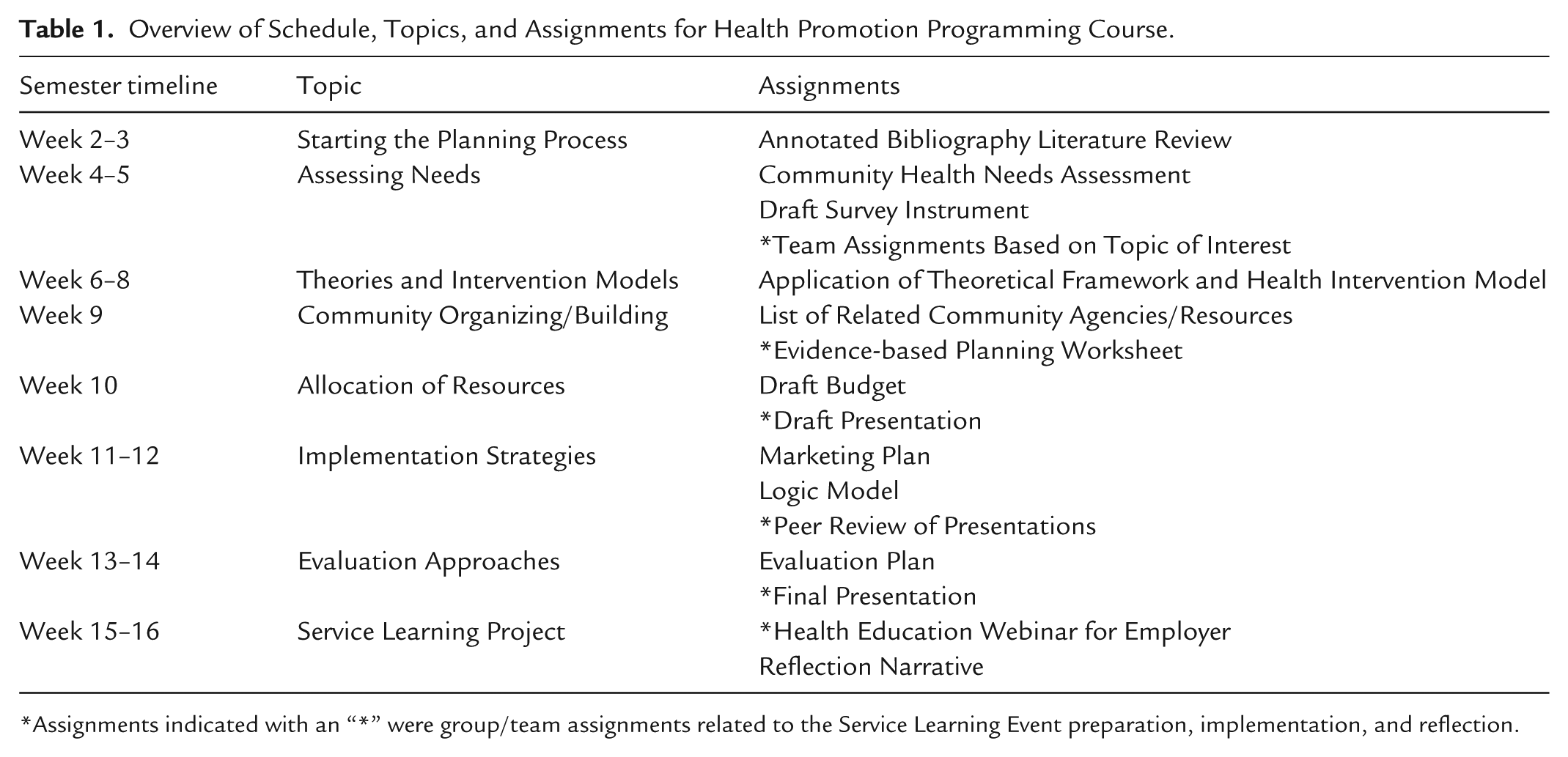
Assignments indicated with an “*” were group/team assignments related to the Service Learning Event preparation, implementation, and reflection.
Survey Instrument Development
The survey instrument was developed by the course instructor to align directly with the course learning objectives and the service-learning project outcomes. Items were designed to capture student perceptions of content mastery, preparation for assignments, applicability of the service-learning experience, and the influence of the online course format. The 10 Likert-scale items reflected key domains emphasized in the course, that is, knowledge acquisition, skill development, career relevance, and engagement, while the two open-ended questions allowed for exploration of perceived barriers and suggestions for improvement.
Data Collection Methods
Involvement in the research study was entirely voluntary with no impact on the student’s performance in the course. As part of the research, students had the opportunity to complete a 12-question survey instrument developed specifically to gage their self-reflections, thoughts, and preferences related to the service learning project, online format, and assigned tasks to prepare for the health promotion event. Ten questions were ranked using a five-point Likert scale, where 5 was strongly agree and 1 was strongly disagree. Two additional open-ended questions focused on roadblocks/problems and recommendations for improvement. A small incentive in the form of five extra credit points (toward a total of 430 points possible in the course) was provided for responding to the survey. If students chose not to participate, another opportunity was provided to earn equivalent extra credit points. Individual student survey responses were anonymous and collected no identifying information.
Statistical Methods
Survey distribution, completion, and evaluation was performed using the Qualtrics Experience Management platform. The study participants were asked to complete the survey 1 month prior to and immediately following the health promotion event to gage their impressions and self-reflection of the service work. Data were retrieved from Qualtrics and descriptive and parametric statistical analyses were performed. Pre- and post-event survey responses were analyzed by t-test.
Qualitative Analysis
Open-ended survey responses were analyzed using a thematic analysis approach. Responses to the two open-ended survey questions were reviewed independently. An inductive coding process was employed, wherein recurrent words, phrases, and ideas were grouped into preliminary codes. These codes were then refined and collapsed into broader themes to capture the range of student experiences. Two investigators independently reviewed the data to ensure credibility of theme identification, and any discrepancies were resolved through discussion until consensus was reached. The final themes represent common barriers, perceptions, and recommendations identified by students regarding the e-service-learning project.
Findings
The pre-event survey was completed by 12 participants, while the post-event survey was completed by 11 participants, for a response rate of 48% to 52%, in a course of 23 students. Both pre- and post-event survey results indicate that, on average, students agreed that: the lectures and assigned reading helped them understand the course material, the lectures and assigned reading helped prepare them for weekly assignments, they felt confident about their knowledge of health promotion programming concepts we have covered, the weekly assignments adequately prepared them for their group health promotion service learning project, the knowledge gained from the service learning project will benefit them in their future career, this class has increased their interest in this field of study, they would like to take other courses that involve service learning experiences, and the online/web format of the course was NOT a barrier to their learning, see Table 2.
Average Student Responses to Pre- and Post-Service-Learning Event Survey (n = 12 for Pre-Survey and n = 11 for Post-Survey).
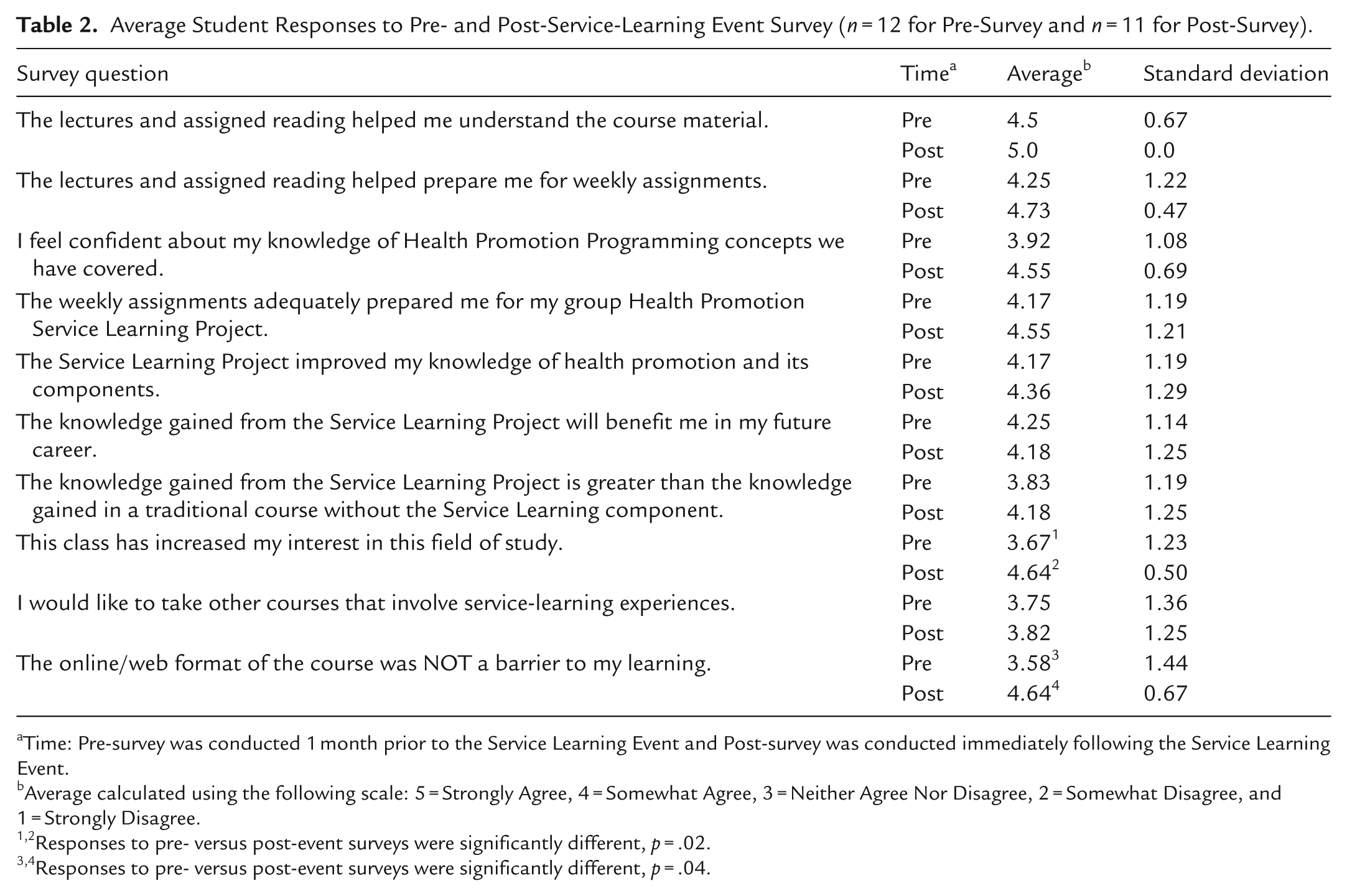
Time: Pre-survey was conducted 1 month prior to the Service Learning Event and Post-survey was conducted immediately following the Service Learning Event.
Average calculated using the following scale: 5 = Strongly Agree, 4 = Somewhat Agree, 3 = Neither Agree Nor Disagree, 2 = Somewhat Disagree, and 1 = Strongly Disagree.
Responses to pre- versus post-event surveys were significantly different, p = .02.
Responses to pre- versus post-event surveys were significantly different, p = .04.
When comparing pre- and post-event survey responses, student responses were not statistically different for most measures. Students, however, reported stronger agreement that the class increased their interest in this field of study (p = .02) and the online/web format of the course was NOT a barrier to learning (p = .04) after completing the service-learning project event compared with responses prior to the event.
Student Reflections
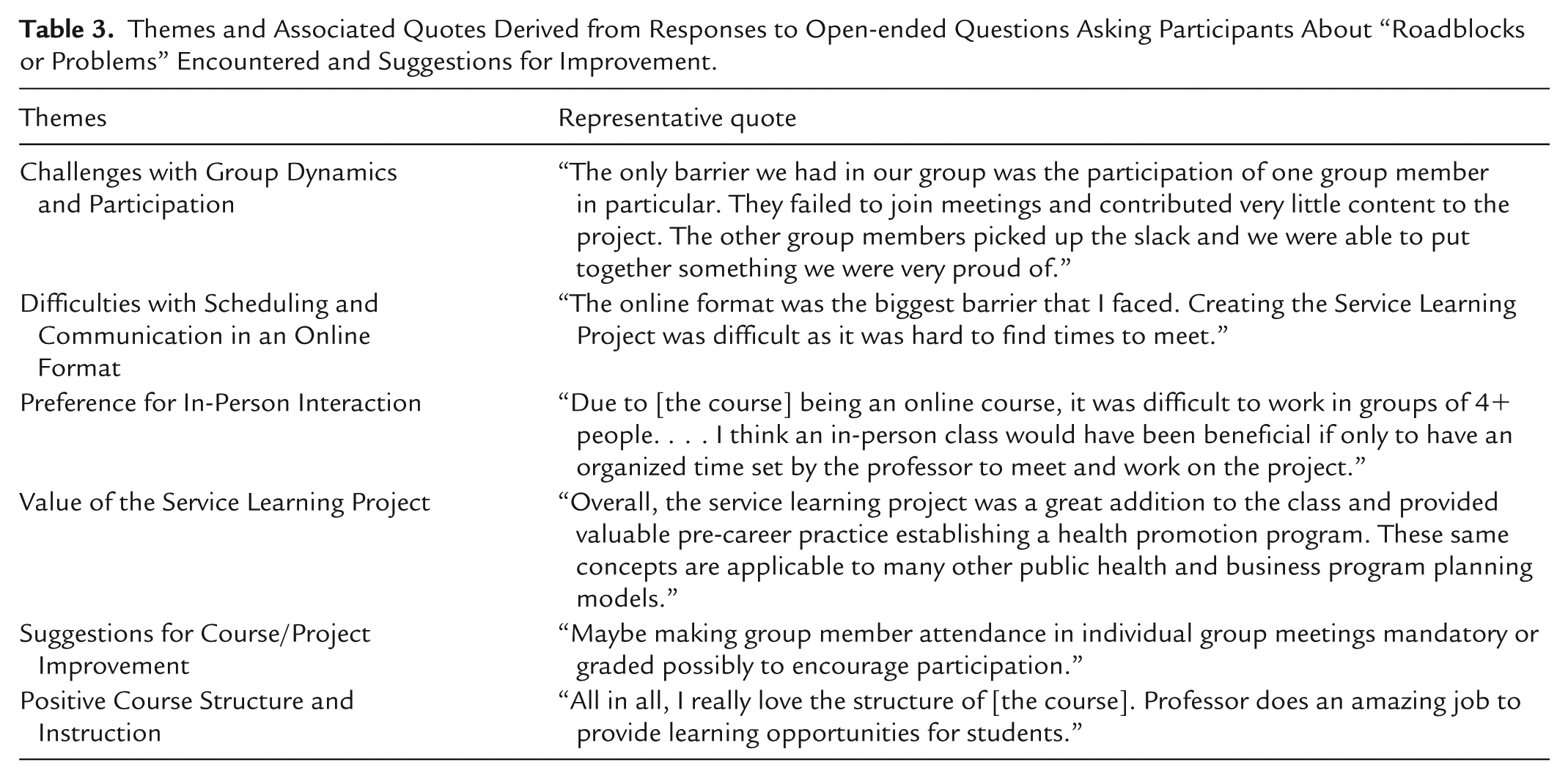
Open-ended student comments were solicited for reflections, roadblocks/barriers, and recommendations for improvement. Analysis of open-ended survey responses revealed six themes that captured students’ experiences with the e-service-learning project (Table 3).
Theme 1: Challenges with Group Dynamics and Participation
Several students noted unequal contributions among team members, with some failing to attend meetings or contribute adequately. This created additional workload for engaged members but also provided real-world practice in problem-solving and collaboration.
Theme 2: Difficulties with Scheduling and Communication in an Online Format
A recurring barrier was coordinating meetings across students’ varied schedules in an asynchronous, fully online class. Students described difficulty reaching peers, missed responses, and challenges building cohesion virtually.
Theme 3: Preference for In-Person Interaction
Multiple comments reflected that the online environment hindered collaboration and that in-person meetings or an in-person course would have made project coordination easier. Some students explicitly recommended offering an in-person version of the course.
Theme 4: Value of the Service Learning Project
Despite barriers, students consistently described the project as meaningful, fun, and professionally relevant. They highlighted the project’s real-world applicability and appreciated its role in preparing them for future health promotion careers.
Theme 5: Suggestions for Course/Project Improvement
Students recommended clearer guidelines for assignments, mandatory group member accountability, and structured instruction on group dynamics (e.g., team development models).
Theme 6: Positive Course Structure and Instruction
Several respondents praised the overall organization of the course, thoughtful scaffolding of assignments, and instructor support. Students described the project as well-integrated with course content and enhancing their learning.
Themes and Associated Quotes Derived from Responses to Open-ended Questions Asking Participants About “Roadblocks or Problems” Encountered and Suggestions for Improvement.
Discussion
The findings from this study support the existing literature on the effectiveness of service learning as a pedagogical tool for public health education, even when implemented in an online, asynchronous format. Students overwhelmingly agreed that the course materials and assignments prepared them for the service learning project, and many perceived direct career relevance in the experience. This aligns with prior studies emphasizing the transformative potential of service learning to foster practical skills and deeper engagement with course content (Cashman & Seifer, 2008; Caspersz & Olaru, 2015). That students reported increased interest in the field and saw future value in the knowledge gained suggests the project successfully bridged the gap between theory and practice, an essential goal in public health training (Eyler et al., 1999; Riegelman et al., 2007).
As online distance learning courses make up an increasing share of undergraduate coursework, e-service-learning presents a mechanism to surmount the constraints of both online learning and traditional service learning. Online courses often make it more difficult to cultivate meaningful experiences for distance learners, especially those opportunities that provide real-world employability skills and engagement within the community (Strait & Sauer, 2004). With online learning, students may be based in different counties, states, or even countries as the institution in which they are enrolled (Strait & Sauer, 2004). Additionally, student disconnect or lack of meaningful interaction with their peers and the instructor is often reported (Phirangee, 2016). With more students seeking out online degrees to better balance busy work and home-life (McGorry, 2012), e-service-learning projects such as the one studied here, where the instruction and service are solely online, can be particularly valuable.
Traditional service learning is often impractical within the online course setting given the geographic constraints of university-affiliated community partners, and a potential student population spread across wide geographic distances. Further, non-traditional students, those often found in online courses, who are balancing work-life-school may find traditional service learning projects too burdensome. The emergence of hybrid service learning projects, where either the instruction or the service is partially online, seeks to help overcome the restrictions of traditional service learning. However, hybrid projects often add to the instructor’s workload, through engagement with multiple community partners and screening students’ work to modify or improve when it falls short (Waldner et al., 2010). This course’s design sought to help overcome the challenge of additional instructor work proofing student submissions before sharing with the community partner. A peer review step for the educational webinar presentation was included prior to the completion of the finished product, as noted in Table 1. Student groups submitted a draft presentation recorded in Zoom during Week 10. During Week 11, their peers utilized a scoring rubric provided by the instructor to evaluate each group’s presentation based on several criteria: organization, content knowledge, development/analysis, grammar and mechanics, style, format, and delivery and visual aids. Students then had 2 weeks to incorporate feedback from the peer reviews into the final presentations due Week 13. This peer review step can be utilized in hybrid or fully virtual service learning projects as a way to not only reduce instructor workload, but also to further engage students in meaningful interaction with one another.
Student disconnect is a common challenge in online, asynchronous courses, and can also be an issue in asynchronous e-service-learning projects with students perceiving a lack of connection with the instructor, their classmates, and the community partner (Currier et al., 2025; Waldner et al., 2010). To better cultivate a collaborative environment, this e-service-learning project was completed within teams. The students were assigned to groups of four to five individuals based on their topic of interest. Overall, student reflections revealed mixed experiences with the online format for group work. While some students appreciated the flexibility and applicability of the service learning project, others cited difficulties coordinating with peers and building engagement in a virtual space. These reflections mirror broader concerns in the literature about the limitations of asynchronous communication and reduced interpersonal interaction in online learning environments (Currier et al., 2025; Strait & Sauer, 2004; Waldner et al., 2012). As one student aptly noted, the structure of the course was strong, but online collaboration remained a challenge. These barriers underscore the need for intentional instructional design in e-service-learning that includes structured team communication protocols, opportunities for synchronous interaction, and scaffolding for group work. In addition, incorporating self- and peer-evaluations could provide a mechanism to assess group members’ flexibility in scheduling meetings and completing tasks, while also promoting accountability and more equitable participation (Brindley et al., 2009; Loughry et al., 2014).
The statistically significant increase in students’ interest in the field of study after the service event indicates the e-service-learning experience contributed to motivational and affective outcomes beyond cognitive learning. This supports the notion that well-designed service learning can foster professional identity development and promote civic engagement (Furco, 1996; Horigian et al., 2023; Ratnayake & Lederer, 2024). Likewise, the finding that students were more likely to agree that the web-based format was not a barrier to learning after completing the project challenges assumptions that meaningful experiential education must occur in face-to-face settings. These outcomes are especially timely given the rise in demand for flexible, online learning environments among undergraduate students post-pandemic (National Center for Education Statistics, 2023).
Beyond academic outcomes, another key factor to consider with e-service-learning is that community service activities, like those performed through service learning, are known protective factors. Protective factors are “individual or environmental characteristics or conditions that promote the health and emotional well-being of children and adolescents” (Centers for Disease Control and Prevention, 2022). Young adults who volunteer in their community have been shown to have stronger community connections, fewer problem behaviors, improved self-esteem, and higher future earnings and socioeconomic status (Kuperminc et al., 2001; Opportunity Nation, 2014). In a time when university campuses are facing what experts call a “mental health crisis” with 70% of students in a recent survey indicating they have struggled with mental health since starting college (Wood, 2024), incorporating protective factors like service learning into the classroom, especially the virtual classroom, is highly valuable.
This study contributes to the limited but growing evidence base on extreme e-service-learning, where both instruction and service activities occur fully online. As more public health programs expand their online offerings, understanding how to preserve student engagement and skill development aspects of service learning in digital formats becomes essential. Faculty must consider how to facilitate student-community partnerships, foster collaboration, and maintain academic rigor in online environments. The use of structured, scaffolded assignments tied to real-world deliverables, as demonstrated in this study, offers one promising model for addressing these needs.
Limitations
While student perceptions in this study support broader use of e-service-learning activities in online courses, some limitations of the study should be considered. First, the study relied on a convenience sample from a single course at one institution, which limits the generalizability of the findings to other academic settings, disciplines, or student populations. The relatively small sample size and moderate response rate also introduce the potential for response bias and reduce statistical power, which may have influenced the stability of the findings. For example, average student survey scores for the item, “The knowledge gained from the Service Learning Project will benefit me in my future career,” decreased slightly from 4.25 to 4.18 between the pre- and post-assessments. Although the magnitude of this change was small and statistically non-significant, its counterintuitive direction may reflect sampling variability, differences in respondent participation across time points, or initial overestimation of anticipated project benefits on the pre-survey. Finally, the absence of a control group with in-person service learning limits the ability to attribute observed outcomes solely to the e-service-learning experience.
Future research should explore strategies to enhance student collaboration in fully online service learning environments and compare these approaches across different course formats, institutions, and student demographics to build a more comprehensive understanding of best practices.
Conclusions
The growth of e-service-learning has not kept pace with the growth of online learners with most online students lacking access to the advantages of service learning (Sneed et al., 2025; Waldner et al., 2012). This study demonstrates that e-service-learning, when carefully designed and implemented within public health curricula, can achieve many of the same pedagogical benefits associated with traditional service learning. Students reported high levels of satisfaction, perceived professional growth, and increased interest in public health as a result of their participation in this virtual health promotion project. Importantly, the findings suggest that e-service-learning is not an inherent barrier to meaningful student engagement or learning, but rather a viable mode of delivery that meets the evolving needs of today’s student population.
Footnotes

Ethical Considerations
The Murray State University Institutional Review Board reviewed this study and deemed it to be exempt from full IRB review (IRB#: 24-124) and determined that the research, as described in the protocol form, will be conducted in compliance with the Guidelines for the Protection of Human Participants.
Funding
The author received no financial support for the research, authorship, and/or publication of this article.
Declaration of Conflicting Interests
The author declared no potential conflicts of interest with respect to the research, authorship, and/or publication of this article.