







Abstract
This article reviews a body of literature that relates to the use of aesthetic, specifically visual, methods in organizational research and management education. Visual methods are associated with a range of benefits for those studying management and organization, including the elicitation of emotional responses, support for reflection and self-reflexivity, making varied forms of knowledge explicit, and in supporting dialogue and collaborative learning. Key implications for management educators are outlined, which include the need to appreciate the nature of aesthetic-visual “knowing” and to evaluate methods with pedagogical criteria, to consider the type of visual “space” educators need to create, to build individuals’ capacities to use visual methods, and to facilitate visual encounters appropriately. A set of practical “starting points” are also identified for management educators, drawn from the author’s teaching practice.
Visual methods such as drawing, work with artifacts, and mapmaking are increasingly the subject of serious discussion in organization research (Buchanan & Bryman, 2011; Margolis & Pauwels, 2011), yet their use in management contexts remains peripheral (Warren, 2009). This is problematic, given their ability to address neglected issues such as emotions and ambiguity in management education (Ewenstein & Whyte, 2007; Morris, Urbanski, & Fuller, 2005). In this research-to-practice insight, I provide a working definition of “visual methods” and review literature that relates these methods to organizational research and management education. Furthermore, I highlight implications for teaching, drawing attention to issues that educators must address in order to make effective use of them.
I define visual methods following Warren (2009) in relation to their use in organizational research as using images as a source of data, means of producing data, or a combination of the two. I also identify visual methods as taking an active, participatory, and collaborative form, where research respondents (or here, students of management and leadership) are involved in what Vince and Warren (2012) term “co-creation” (p. 275). Examples of visual methods include drawing, mind-mapping, collage creation, and responding to displayed images.
In discussing visual methods in organizational research, Warren (2009) draws attention to the ways in which contemporary organizational life is “image-rich, aestheticized and symbolic” (p. 577). This is not a passive background to management and organization—Davison, McLean, and Warren (2012) highlight the way in which the “myriad of images, visuals and signs” in organizational life have an active role in “constructing and performing organizational worlds and in creating particular openings and closings and news spaces and forms of action” (p. 5). This active concept of the visual sits within wider organizational scholarship regarding aesthetics, relating to that which is perceived through the senses (Strati, 2009) where an aesthetic lens highlights new ways of “seeing, looking, gazing, glancing, contemplating” (Edenius & Yakhlef, 2007, p. 194) and supports new forms of reflexivity (Ewenstein & Whyte, 2007). Within this literature, arts-based initiatives or activities in organizations are discussed in terms of their ability to disturb habitual ways of perceiving and understanding and to enable “new distinctions and to shift contexts” (Barry & Meisiek, 2010, p. 1505), enabling participants to give voice to emotional reactions to experiences such as organizational change (Barner, 2008).
These ways of understanding organization and management have begun to appear in management education, although use of visual methods remains apart from what Mack (2012) defines as the “logical-rational” stance of many business schools in which “learning” is primarily an abstract and cognitive matter (Edenius & Yakhlef, 2007). Where they are used, aesthetic approaches to teaching and learning are framed as “encounters” (Mack, 2013) that disturb the cognitive-rational and involve a degree of risk on the part of educator and student (Mack, 2012). For example, Sutherland (2012) powerfully describes the way in which experiences of and reflection by Executive MBA students participating in a choir, involving observation and conducting, engaged them in uncertainties and new forms of reflexivity in aesthetic “workspaces.”
There is only limited literature on specifically visual methods in management education contexts, but it both identifies benefits for students of management and key considerations for educators. For example, Schyns, Tymon, and Kiefer (2012) used students’ drawing as a means to discover their implicit leadership theories, showing how visual methods can be a starting point for reflection. Discussing the drawing activity, authors noted the value of the activity in making tacit knowledge explicit, in avoiding familiar conversations about leadership, and in providing a practical way for students to share meaning. Ward and Shortt (2012) used visual methods as a means of eliciting feedback through participant produced drawings, and they cited the ability of drawings to elicit emotional responses, to “draw out details that might not otherwise have been heard” (p. 439), and to empower students. Research has also emphasized the value of visual methods in exploring emotional recognition and awareness, for instance, where emotional content in paintings was described as part of an activity (Morris et al., 2005), or “Personal maps” of formative life events were reported to facilitate self-reflexivity, interpersonal communication, emotional intelligence, and awareness of diversity within student groups (Litvin & Betters-Reed, 2005). In the latter case, the use of visual methods required an open and affirming classroom community, as well as careful discussion of issues of confidentiality and appropriate levels of personal disclosure. In addition to supporting reflexivity, self-awareness, and dialogue, Baker and Baker (2012) linked visual methods in management education to encouragement of appropriate risk taking in learning and meaningful engagement, emphasizing the link between creative and critical thinking.
Implications
There are a number of implications arising from this body of literature. Several studies (Taylor & Hansen, 2005; Vince & Warren, 2012; Warren, 2009) identify visual methods in organization studies as a form of aesthetic (as opposed to instrumental or logical-rational) appreciation and knowing. Where the logical-rational approach is dominant in management education (Mack, 2012), educators need to identify and resist the hegemony of “intellectual knowing” (Taylor & Hansen, 2005, p. 1213) in their institutions, which may draw them back to questions of “clarity, objective truth and usually instrumental goals” (Taylor & Hansen, 2005) and impede the successful use of visual methods. Instead, educators should see visual methods, as an aesthetic form, as being concerned with both experiential and presentational knowing, working with faculties of perception, empathy, resonance, and expression (Taylor & Hansen, 2005, p. 1213). To engage with visual methods, educators should be convinced of their value as a distinct mode of enquiring and knowing, not simply as a novel tool. At the same time, educators should adopt a critical approach to the adoption of visual methods. Visual methods offer particular ways of seeing, enquiring, and understanding—these may be unique (Ward & Shortt, 2012), but should be considered alongside others. Simply swapping one dominant paradigm (the logical-rational) for another (aesthetic-visual) will not expand educators’ repertoire.
Appreciating the epistemological basis of visual methods is a start for educators, but they become most useful when evaluated as a pedagogical tool. Educators should require visual methods to address the concerns of interpretive pedagogy (Waring & Evans, 2015), which define teaching and learning as a holistic, dynamic activity, enabling those learning (including educators) to critically consider their position in relation to knowledge. When evaluated in these terms, educators can consider how any given visual method supports students’ choice, agency, and capability (Walker, 2005) and avoid any use of visual methods that perpetuate a passive or uncritical role for them. Evaluating visual methods as a pedagogical tool is especially important as visual activities are often found and can be uncritically imported from contexts such as therapy (Rubin, 2016) or art appreciation (Acton, 2008), where their original status, affect, and use may be partly or completely incompatible with pedagogical aims.
Once a visual method (drawing, photo-elicitation, mapmaking, etc.) has been identified and evaluated as a useful and compatible pedagogical tool, educators should consider the sort of “space” (physical, emotional, dialogical) they need to create to foster the effective use of visual methods. A starting point is to see viewing, holding, moving, creating, and discussing the visual as an encounter (Mack, 2013) into which participants bring experiential resources to situations of learning. In this context, participants develop agency as they participate in and are enabled by social processes (Brockbank & McGill, 2007). Spaces for visual methods should therefore offer participants freedom for diverse responses, affirm their contributions, be emotionally “safe” and purposeful, and be constructively aligned (Biggs & Tang, 2011) with planned learning outcomes.
Visual methods position individuals as active participants who may create, respond to, and reconfigure visual forms and artifacts. They require not only appropriate spaces for the use of visual methods but also the capacities and motivations to work in them. Educators therefore need to support those they are working with to see differently (viewing in a heuristic way, rather than to identify facts, for example), talk differently (doing things like engaging in speculative, reflective, and appreciative conversations), and to find new ways of moving and using space to (literally) change perspective and appreciate the material, kinetic, and spatial properties of visual images and artifacts. Part of creating a culture change in the learning situation also involves giving permission for participants to work in these ways. In addition, educators should carefully consider what sorts of visual methods are suitable for participants and are matched to the intended learning outcomes. Warren (2009), for example, identifies that certain free-form drawing activities have the potential to tap into unconscious emotional issues. Following this, it would be naïve to not consider the ways in which any given visual method may stimulate difficult emotions for participants which would be inappropriate or for which they are not equipped to address safely.
Once participants appreciate what can be different about an aesthetic-visual mode of learning, experience a supportive “space” for work with visual images and artifacts, and then develop skills to work in that space, educators must facilitate social and heuristic work with visual methods effectively. Educators who are used to “telling” will need to consider a less directive and controlling style of facilitation, but they should equally avoid completely withdrawing and adopting a passive role. Spencer (2010) argues that visual methods are no more “honest” than others and require “language to explain and give context and definition” (p. 68). Educators therefore need to actively work to “facilitate reflexive dialogue” (Brockbank & McGill, 2007, p. 6). This involves adopting a mode of conversation that is appropriate to the aesthetic-visual paradigm, characterized by qualities such as curiosity, appreciation, and reflection. Educators therefore must also be prepared to “learn with” their class, and to be committed to the sort of emotional, reflexive, and contemplative mode they are asking their students to engage with. This may be one very useful test for ensuring that planned use of visual methods is suitably engaging, accessible, meaningful, and useful for their student groups. In this mode, educators cannot “hide” behind the role of the objective, distant expert but may find visual methods support new sorts of appropriate pedagogical relationships that in turn enhance teaching and learning.
Practical Implications for Teaching
Responding to these implications and planning effective use of visual methods relies on attending to a set of practical considerations. I describe what I consider to be particularly important issues to pay attention to, drawing on my experience in implementing visual methods with students studying an undergraduate leadership and management course in an university in North East England (see Figure 1 and Table 1).
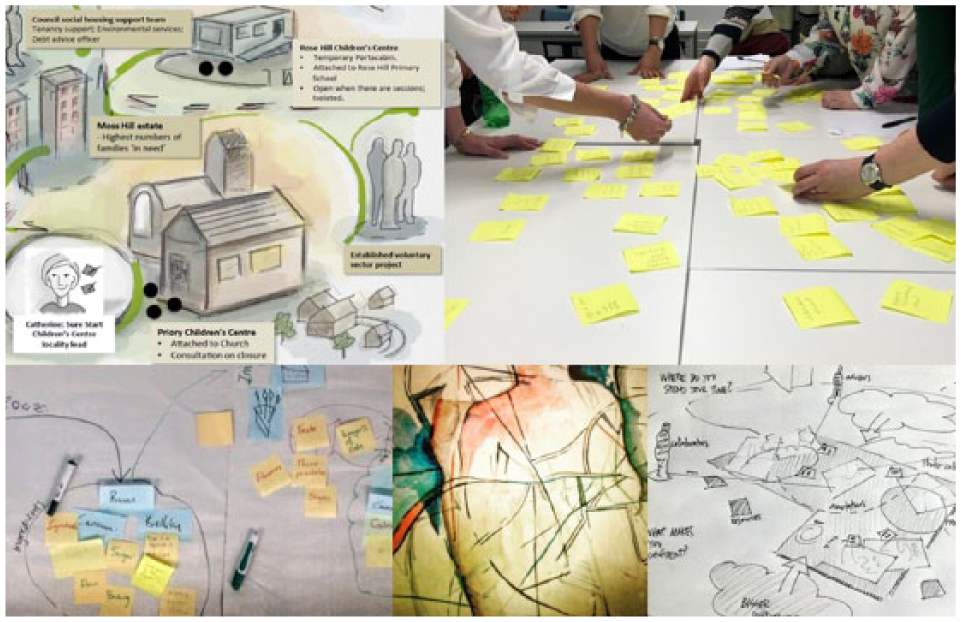
A visual collage of images of visual methods used in the author’s teaching practice with undergraduate students of leadership and management.
Example visual methods used in the authors’ teaching, highlighting insights and implications.
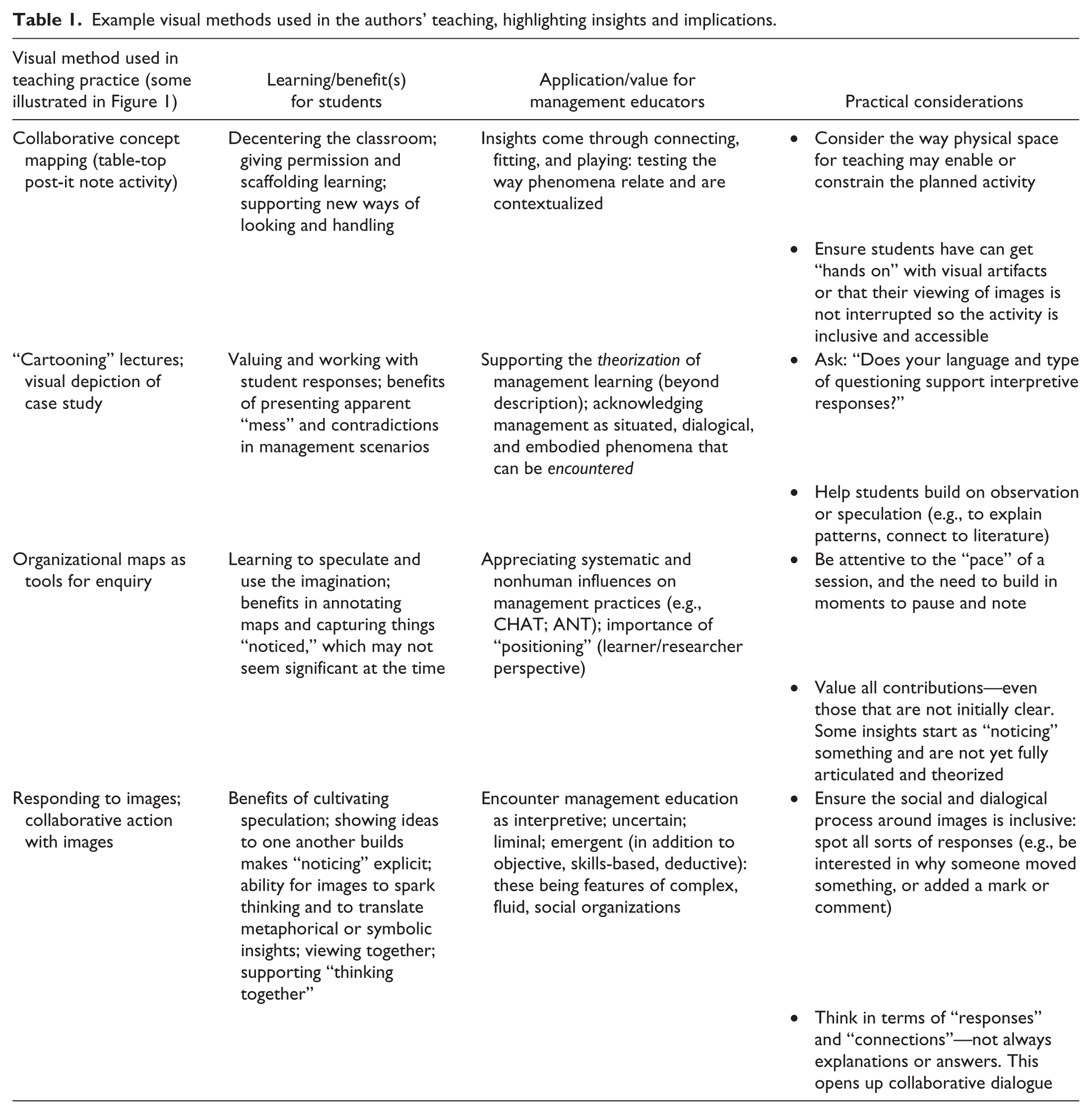
First, educators need to consider the way in which the physical space(s) they teach in enable or constrain the use of visual methods. For example, a tiered lecture theatre may not facilitate the sorts of viewing, browsing, or conversational activities that make particular visual methods effective. In this case, an educator should keep their learning objectives in mind and creatively consider alternative strategies that support different types of interactions with visual materials and participants that work in the space (in this case, perhaps by passing round images and encouraging students to respond to one another’s annotations while they remain seated, or by using a wall as a space to assemble and move images and allowing smaller groups of participants to take turns to work on it). The practical principle here is that visual methods work when participants can interact and use them—participants need space to “get their hands on” visual methods or to properly view images. Positioning a visual-interactive space on a small table with a larger group will simply lead to a frustrated crowd, with interactions with visual methods dominated by a small number of participants who are most confident and mobile. In my experience, most participants need encouragement to respond visually (e.g., make marks, move, annotate) and to talk (e.g., respond, narrate, appreciate, speculate). Furthermore, I have found participants are more likely to do this when I encourage responses, questions rather than demanding “answers,” and when there are diverse options for participants to express these responses to one another. Particular effort should be made to encourage responses that explain, make connections to ideas or evidence in literature, and are reflective and metacognitive (Kaplan, Silver, Lavaque-Manty, & Meizlish, 2013). As with all effective teaching, there is no short cut to developing the effective use of visual methods, but educators interested in the advantages described here can work through the associated considerations and practical options to expand and challenge their own learning and open up new types of enquiry and insights for their students.
Footnotes
Declaration of Conflicting Interests
The author declared no potential conflicts of interest with respect to the research, authorship, and/or publication of this article.
Funding
The author received no financial support for the research, authorship, and/or publication of this article.