






Abstract
Abstract
Research on innovation is up surging in recent years in management literature. Yet empirical research on how innovation types impact the different aspects of small and medium enterprises’ (SMEs’) performance is still under-researched, particularly in emerging economies. This study develops a holistic conceptual model to examine how innovation types impact the various dimensions of SMEs’ performance in the Cape Coast Metropolis of Ghana. The study builds on the dynamic capabilities theory and employs a quantitative research approach via a survey questionnaire and simple random and convenience sampling techniques to select 307 respondents for the analysis. Structural Equation Model Partial Least Square was used to test the hypotheses formulated. Results demonstrate that all the four types of innovation—product, process, organisation and marketing—positively impact SMEs’ performance, but organisational innovation has the has the most considerable effect size. More specifically, findings show that product innovation positively relates to performance in terms of—customer satisfaction, market share, sales and competitiveness; process innovation—speed time to market and competitiveness; marketing innovation—sales, customer satisfaction, market share and competitiveness; and organisational innovation—profit, competitiveness, speed time to market and growth in employment. It is, therefore, recommended that managers at operational and strategic levels in SMEs give distinctive attention to these types of innovation in their business strategies to enhance performance and growth. The government should also provide educational and financial support to help the SMEs in their adoption of innovation. This study theoretically and pragmatically contributes to entrepreneurship and innovation research in emerging economies.
Introduction
This article aims to examine the impact of innovation types on small and medium enterprises’ (hereafter, SMEs) performance in an emerging economy, namely, Ghana. Globally, SMEs are recognised as the backbone of economic growth and development in both developed and emerging economies. As a consequence, a foremost issue dictating policy debate around the world and particularly in Africa has been how to harness and promote economic growth and development through entrepreneurship and small enterprise development. The importance of SMEs to economic development is recognised not only in the arena of their contribution to the growth of national GDP, but also in their reduction of unemployment (Abor & Quartey, 2010).
In Ghana, like in many other emerging economies, the significant role of SMEs in economic development and poverty alleviation is highly underscored. Statistics from the Registrar General Department reveal that nearly about 92 per cent of companies registered in Ghana are small and medium firms, accounting for 85 per cent of manufacturing employment and 49 per cent of the country’s GDP. Additionally, SMEs generate revenue, capacity building to both firms and individuals, investment opportunities, as well as niche professional services (Mensah & Rolland, 2004). Notwithstanding the recognition of SMEs as the catalysts of activity for a country, many of the enterprises fail and do not survive to grow into large corporations (Rammer & Schmiele, 2008).
According to Herrington, Kew, and Kew (2014), the high failure rate among SMEs is due to such challenges as international competition, marketing challenges and financial challenges, among others. Parida, Westerberg, and Frismmar (2012, p. 283) termed this phenomenon as ‘liability of smallness’. Recent studies, however, have shown that SMEs can overcome their ‘liability of smallness’ through innovation (Tucci, Chesbrough, & Piller, 2016). Research shows that innovation can help a firm achieve sustainable competitive advantage and increase living standards in the society (Maier, Brad, Nicoară, & Maier, 2014). In fact, it is argued that due to the recent globalisation of the market and increasing international competition, rapid-changing consumer demand, and ever-changing technologies, SMEs must seek for new, innovative, flexible and creative ways to survive (Malekifar, Taghizadeh, Rahman, & Khan, 2014).
In emerging economies, innovation has been recognised as the main driver for the differences in income variations, productivity, business growth and catch-up in industrial competitiveness (Cantwell & Molero, 2003). To this end, some studies have recognised innovation as a vital driver of firm’s performance in terms of growth and survival (Halim, Ahmad, Ramayah, & Hanifah, 2014; Malekifar et al., 2014). Literature shows that SMEs that engage in innovation projects perform better than their non-innovating counterparts (Westerberg & Wincent, 2008). This goes to suggest that innovation can improve the performance of SMEs. However, some of the studies on innovation found no consistent results of its impact on firm performance. While some studies found positive outcome (e.g., Marquez, 2009; Salim & Sulaiman, 2011), others found a weak link (e.g., Lin, 2007) and some found otherwise (e.g., Atalay, 2013; Sattari, 2013), especially in terms of marketing and organisational innovations. The results from these studies are thus mixed, inconclusive and difficult to generalise.
A recent comprehensive literature review by Ndesaulwa and Kikula (2016) on the phenomenon disclosed that prior research on innovation and its impact on firm performance are mildly limited to the Western, Middle and Far Eastern world, with few empirical evidence in Africa. Due to the scanty research in this area, Ndesaulwa and Kikula (2016), after their review of the extant literature on innovation and firm performance, appealed for more research on the phenomenon especially in Africa where the research fissure is most commonly observed. This study is a response to their wake-up call for more research on the effect of innovation on SMEs performance in Africa.
In the Ghanaian context, scholarly research on innovation has focused on topics such as constraining factors of innovation (Asiedu, 2016), firm-level innovation (Tetteh & Essegbey, 2014), innovation and development of intellectual property (Essegbey et al., 2013), innovation adoption (Domeher, Frimpong, & Appiah, 2014), innovation in the financial sector (Baba, 2014)—just to mention a few. Also, most of these studies considered innovation in different sectors in the Ghanaian economy other than the SMEs sector. In effect, the subject of how innovation links to firm’s performance particularly in SMEs is still under-researched in management literature, particularly in Africa and Ghana. While Osei et al. (2016b) examined the impact of process and product innovation on firm performance in Ghanaian firms, their study considered only two types of innovation (product and process innovation), which does not give a comprehensive account of how the other innovation types of innovation—marketing and organisational innovations—collectively impact firm performance.
Therefore, the present study makes substantial contributions to research in terms of theory, practice and policy. Firstly, the present study contributes to the understanding of the ongoing research and debates on the interrelationship between innovation types and firm performance in SMEs, especially in emerging economies. A large portion of the prevailing studies in the innovation has been largely explored for large enterprises at the industry or firm level in the Western world. This study extends the theory to emerging economies, particularly Ghana. Also, since most of the previous studies did not factor all the innovation types recognised by the Oslo Manual in their conceptual model, this study extends research on the relationship between types of innovation and SMEs’ performance by collectively examining the impact of product, process, market and organisational innovations on SMEs’ performance. Again, the existing body of research on the phenomenon largely considered just the financial dimension of firm performance, without recourse to other performance variables like speed time to market and competitiveness. This study adds to knowledge by addressing these imbalances in innovation literature.
Secondly, the present study makes a significant contribution to the methodological facets of research on SMEs by employing a quantitative research approach and Structural Equation Model-Partial Least Square (SEM-PLS) statistical tool to analyse data collected from 307 SMEs in the Cape Coast Metropolis of Ghana. Prior studies have mainly used SPSS (Statistical Package for Social Sciences) and other statistical tools to carry out their analysis.
Thirdly, the study has several important managerial implications regarding how SMEs managers and owners can develop effective innovation strategies to boost their competitiveness. Through the analysis of the impact of innovation on firm’s performance, the outcome of the study is envisaged to help SMEs managers appreciate how each type of innovation impacts the financial, operational and marketing performance metrics of their organisation. SME managers as well as practitioners would thus understand the ‘size effect’ of the different innovation types on the different constructs of firm performance—marketing, operational and financial. Finally, findings of the study would succour policymakers and stakeholders to appreciate the current trend in the field for policy development and consideration.
The remaining sections of the study are structured as follows: Theoretical background and derivation of hypotheses, methodology, results and discussions, conclusions and managerial implications and limitations and further research.
Theoretical Background and Derivation of Hypotheses
This study adopts the dynamic capabilities theory by Teece, Pisano, and Shuen (1997) as the theoretical lens to examine the nexus between innovation types and SMEs performance in Ghana. The fundamental tenet of this theory is that competitive advantage stems from a firm’s possession of dynamic resources and capabilities. Teece et al. (1997) hinted that in order for firms to succeed and survive in the ever-changing business environment, they must be able to incrementally improve, develop and renew their product or services and processes. This way, the firms will be able to shield themselves against imitation by competing rivals and against technological obsolescence emanating from the lifecycle of the industry wherein they are operating (Teece, 2007; Teece et al., 1997). Dynamic capabilities, according to Teece (2007, pp. 13–19), are those capabilities that ‘enable firms to create, deploy, and protect the intangible assets that support superior and long-run business performance’.
Teece (2007) further postulated that the dynamic capability of firms is different from their underlying micro-foundations such as skills processes, procedures, organisational structures, decision rules and disciplines. The potential benefits from dynamic capabilities, according to Lichtenthaler (2009), hinges on the knowledge accumulation process of the firms which help them to develop, access, redesign and make use of new inside and outside knowledge. The dynamic capabilities will help the firms to be flexible and able to advance, compete and differentiate their products and service substantially from competing rivals. Thus, for SMEs in Ghana to change and adapt to the versatile and turbulent business environment, and to improve their firm performance, they need dynamic capabilities to foster and promote innovation.
Innovation and Business Performance
The term ‘Innovation’ has been differently defined in the literature. However, this article considers only two of them. First, Nightingale (2015) defined innovation as ‘the process that takes an invention, discovery or insight about a new device, processor system to its first successful commercial application. As such, it can apply to new products, processes and services, to new markets, to new sources of supply and to new forms of organisation’ (Nightingale, 2015, p.23). This definition implies that innovation involves the commercialization of invention and discovery. This further implies that there is a distinction between invention, discovery and innovation. Innovation is the output of invention and discovery.
Second, the Oslo Manual (OECD/Eurostat, 2005) defines innovation as ‘the implementation of a new or significantly improved product (good or service), or process, a new marketing method, or a new organisational method in business practices, workplace, organisation or external relations’ (OECD, 2015, p. 46). The present study adopted and adapted this definition, as the present study’s overarching objective is to examine the impact of the four types of innovation identified by the OECD on SMEs’ performance.
Depending on the intensity or degree of innovation, innovation may be incremental or radical (Parida et al., 2012), and also in terms of how it is sourced, it may be open or closed innovation (Chesbrough, 2006). Radical ‘innovation involves new products that result from advances in knowledge/technology while Incremental’ innovations as the improvement of a process or product designs, with or without upgrading of machinery and/or acquisition of new machinery’ (McCormick & Maalu, 2011, p.21). Closed innovation is when a firm uses its own internal resources and knowledge for R&D while open innovation is when a firm opens its R&D frontiers to include external actors through networking and collaboration (Chesbrough, 2006).
Performance is the prospective for future successful execution of planned actions in order to achieve objectives and targets (Lebas 1995). Performance is fairly a broad concept, which may be measured in different ways depending on the user’s need and objective. Performance measurement of a firm may be evaluated using financial and accounting terms such as Return on Equity (ROE), Return on Capital Employed (ROCE), Return on Sales (ROS), profit, etc. (Avci, Madanoglu, & Okumus, 2011) or evaluated using marketing performance variables such as sales, market share, employee productivity, customer loyalty, brand equity, competitiveness, positioning and customer satisfaction (Kotler & Keller, 2012).
According to Ambler and Putoni (2003), market share is a vital performance metric as it is a strong indicator of profitability and cash flow. Research has shown that market share, competitiveness, customer loyalty, speed time to market and sales are strong performance metrics as they indicate adaptation to a versatile and turbulent business environment (Kotler & Keller, 2012; Mavondo, Chimhanzi, & Stewart, 2005). In this light, firms with the innovative capacity would be able to respond to the challenges in the business environment faster and exploit market and products opportunities more effectively and efficiently than non-innovative enterprises (Halim et al., 2014; Malekifar et al., 2014; Marquez, 2009; Westerberg & Wincent, 2008). Studies by Tsourvakas and Riskos (2018), Malekifar et al. (2014) and Calantone et al. (2002) found that innovation capability is a vital determinant of entrepreneurial success and firm performance.
Innovation Types and Performance
The types of innovation identified by the Organisation for Economic Cooperation and Development Oslo Manual (OECD, 2005) formed the conceptual framework of this study. Globally, the manual’s classification of innovation is highly recognised as providing guidelines for defining and evaluating activities of innovation and compilation and use of related data. The manual identifies four types of innovation: product/service, process, marketing and organizational innovations. These are briefly reviewed as follows:
Product innovation, according to Oslo Manual, ‘is the introduction of a good or service that is new or significantly improved regarding its characteristics or intended uses; including significant improvements in technical specifications, components and materials, incorporated software, user-friendliness or other functional characteristics’ (OECD Oslo Manual, 2005, p. 46). This implies that product/service innovation involves the introduction of new or improved product/commodities, new services, new technologies, etc. Product innovation is recognized as the most significant source of structural change as it alerts a mix of products, industry and job within an economy (Osei et al., 2016a). According to Fagerberg (2004), the introduction of new products has a positive influence on the growth of income and employment. The study of Osei et al. (2016a) affirmed that the three dimensions of product innovation according to the Oslo Manual—introduction of a new product, development of new product and improvement of existing product—have a significant positive influence on SMEs performance in terms of sales and increase in a number of employees. In line with the same thought, Egbetoku, Siyanbola, Olamade, Adeniyi, and Irefin (2008) found that product innovations enhance the product quality and competitiveness of Nigerian SMEs. Similarly, Fransen (2013) posited in his study that product innovation has a significant impact on the growth of firm’s turnover/sales. To this end, it can be argued that, when SMEs adopt product innovation, it will have a significant influence on their performance. Hence, the first hypothesis of the study is that:
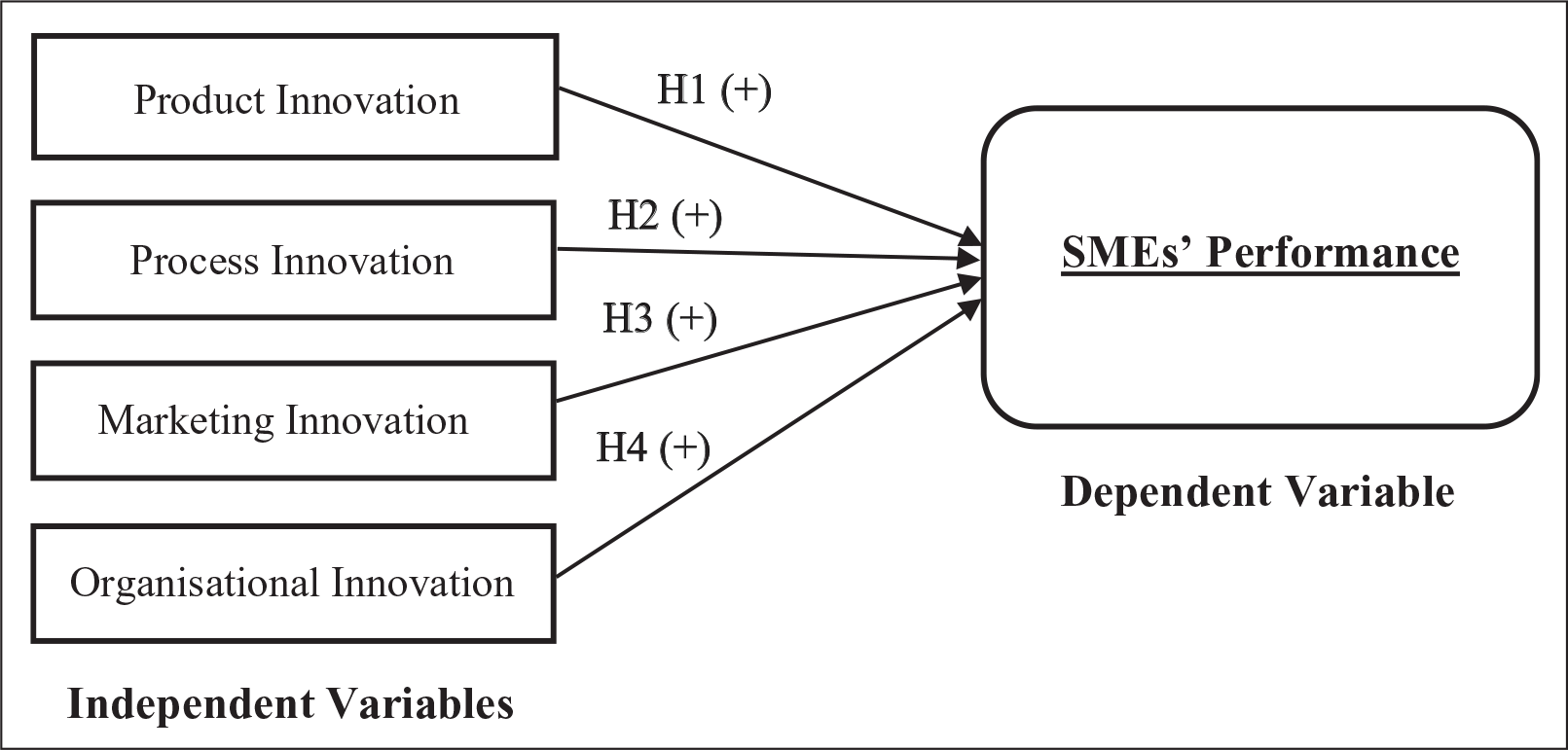
H1: Product innovation has a positive influence on SMEs’ performance
The second type of innovation identified by the Oslo Manual is process innovation. Process innovation ‘is the implementation of a new or significantly improved production or delivery method. This includes significant changes in techniques, equipment and/or software. Process innovations may be aimed to reduce per unit costs of production or delivery, to increase quality, or to produce or deliver new or significantly improved products’ (OECD Oslo Manual, 2005, p.46). According to the manual, process innovation involves new or improved manufacturing techniques, new or improved distribution methods, new/improved techniques, equipment and software. Some researchers have sought to assess the impact of product innovation on performance.
As an example, Osei et al. (2016) found that process innovation in terms of the adoption of new and improved distribution strategy positively impact SMEs’ performance in the areas of cost reduction and higher customer satisfaction. As well, the studies of Oke, Burke, & Myers (2007) and Reichstein & Salter (2006) disclosed that process innovative practices enable SMEs to experience higher growth. Also, Egbetoku et al. (2008) affirmed that process innovation improves a firm's performance in terms of product quality. However, Lin (2007) found the link very weak, stating that the impact of product innovation on firm performance is weak. From the above, it can be argued that effective adoption and implementation of process innovation can enhance SMEs’ performance. Thus, it is hypothesised that:
H2: Process innovation has a positive influence on SMEs’ performance
Marketing innovation is the third type of innovation identified by the Oslo Manual. According to the manual, marketing innovation involves ‘the implementation of a new marketing method involving significant changes in product design or packaging, product placement, product promotion or pricing’ (OECD Oslo Manual, 2005, p. 46). Marketing innovations aim at satisfying customer needs better, opening up new markets, or repositioning the product of the firm to increase sales (Gunday, Ulusoy, Kilic, & Alpkan, 2011). Earlier empirical studies demonstrate that marketing innovation has a positive impact on firm performance.
Further, findings from the studies of Mbizi, 2013; Ngungi, 2013 also found a positive impact of marketing innovation on firm performance. Similarly, the study of Johne (2000) found that marketing innovation increases sales of a firm by surging consumption of product and yielding an additional profit to the firm. Additionally, a study by Ngungi (2013) found that market innovation has a strong positive influence on SMEs growth in terms of sales. However, Sattari (2013) and Atalay (2013) found in their study that marketing innovation has no significant impact on a firm’s performance. Though the findings are mixed and inconclusive, the present author argues that effective adoption and implementation of marketing innovation has a higher tendency to increase SMEs’ performance. Hence, it is hypothesised that
H3: Marketing innovation has a positive impact on SMEs’ performance
Lastly, as per the manual, organisational innovation ‘is the implementation of a new organisational method in the firm’s business practices, workplace organisation or external relations. Organisational innovations have a tendency to increase firm performance by reducing administrative and transaction costs, improving workplace satisfaction (and thus labour productivity), gaining access to non-tradable assets (such as non-codified external knowledge) or reducing costs of supplies’ (OECD, 2005, p.46). The study of Mbizi (2013) disclosed that organisational innovation has a positive influence on firm performance. Similarly, Oke’s (2015) study in British SMEs found that the four innovation types, including organisational innovation, affect diverse aspects of firm performance positively-sales, profit, customer satisfaction, increase in a number of employees, quality products and service.
However, Kuswantoro (2012) contrasted this finding, affirming that no significant and positive link exists between organisational innovation and firm performance. Also, Sattari (2013) and Atalay (2013) found in their study that organisational innovation has no significant impact on a firm’s performance. But, Evan (1984) (in Ndesaulwa & Kikula, 2016) argued that organisational innovation—rather than process and product innovation—is the most vital factor for total sales. Sharing the same view, Makó, Mitchell, and Illéssy (2015) disclosed that organisational innovation could encourage and promote robust organisational learning and skills processes. Further, Community Innovation Survey (CIS 2006) in France found that organisational innovation positively improves performance in terms of product and service quality and response time to customers. Despite the mixed and inconclusive findings, the present author assumes that organisational innovation can improve SMEs’ performance and, thus, hypothesises:
H4: Organisational Innovation has a positive impact on SMEs’ performance
Figure 1 depicts the proposed conceptual framework of the study, describing how the innovation types discussed above would impact SMEs’ performance. The innovation types considered and tested in this study, which serve as independent variables, are product innovation, process innovation, marketing innovation and organisational innovation. The proposed conceptual framework reveals that these innovation types might negatively or positively impact SMEs’ performance, which is considered as the dependent variable in this study, and is measured using seven marketing and financial performance variables, namely profit, sales, customer satisfaction, growth of employees, market share, competitiveness, and speed time to market (Kotler & Keller, 2012; Mavondo et al., 2005).
Methodology
The purpose of this study is to examine the impact of innovation types on SMEs’ performance in the Cape Coast Metropolis of Ghana. Scholars have long popularised two main types of research approaches: qualitative and quantitative. This study employed a quantitative research approach. Thus, the philosophical view that guided the study was the post-positivism or empirical science worldview, which adopts an objective measurement of the reality that exists out there and is found to be more related to quantitative research study (Creswell, 2008). Literature notes that quantitative research approach is suitable when the research seeks to make decisions and to establish conclusions (Malhotra & Birks, 2007). Hence, Saunders and Thornhill (2007) argued that the quantitative approach allows the researcher to test for a relationship between concepts rather than just understand it. The present study found this research more appropriate as the study sought to establish the impact of innovation on SMEs’ performance in Ghana.
Ghana provides a suitable survey context to examine the relationship between innovation types and SMEs performance due to the following reasons. First, the Ghanaian SMEs sector has been recognised as the backbone of the economy and the engine of the private sector. SMEs in Ghana have been respectfully acknowledged as the major contributors of GDP and wealth creation, accounting for 49 per cent of the GDP (Ghana Banking Survey, 2013). The sector, moreover, accounts for 85 per cent of the employment rate in Ghana. Further, Ghana is a country where many entrepreneurship and innovation initiatives like National Entrepreneurship and Innovation Plan (NEIP 2018) and National Science, Technology and Innovation (STI) have been implemented to boost small enterprise development and economic growth. Hence, Ghana presents an important study area to examine how innovation influences firm performance.
Ghana Statistical Service (2003) considers small enterprises as firms with employment size between 5 and 29, and an annual turnover not exceeding US$100,000, and medium enterprises with employment size between 30 and 99, and an annual turnover not exceeding US$1million. However, in Ghana, the most widely cited definition is the classification by Osei, Baah, Tutu, and Sowa (1993). Using the number of employees criterion, the authors classified micro enterprises as firms with less than 5 employees, small firms as those with 5–29, and medium enterprises as those with 30–99 employees. The present author employs the definition by Osei et al (1993) but focused only on the SMEs. To buttress this, the Oslo Manual from which the African Science, Technology and Innovation Indicators innovation survey draw guidelines suggests that firm classification should be measured on the basis of a number of employees to warrant cross-country comparison.
The population in the study consisted of all 2,345 registered SMEs within the Cape Coast Metropolis of Ghana at the time of the study (Registrar Generals Department records, 2017). The study used simple random sampling and convenience sampling approaches to select informants for the study. Simple random approach was used to ensure equal opportunity for each member of the population to be included, while convenience approach was used to select respondents who were available and responsive to the survey questions of the study (Creswell, 2008). Respondents of the study were the owners/managers of the SMEs.
A sample size of 315 was considered for the present study. This figure has been justified as sufficient for a quantitative study in the literature (MacCallum, Widaman, Zhang, & Hong, 1999). The following sample selection criteria were employed to select the respondents for the study. First and foremost, the enterprise must be either a small (i.e., employees between 5 and 29 workers) or medium enterprise (i.e., employees between 30 and 99 workers). Secondly, the enterprise must be duly registered with the Registrar General’s Department. Finally, the enterprise must be operating within the Cape Coast Metropolis of Ghana.
Data were collected using a survey questionnaire. The questionnaire was divided into three main sections: the first section collected demographic information about the respondents and the second section had four broad classifications of variables, namely, product, process, market and organisational innovations while the third section measured the impact of innovation on SMEs’ performance. Survey questions on the innovation types were developed from the Oslo annual (OECD, 2005), while the performance variables were adapted from the studies of Alrubaiee, 2013 and Kotler & Keller, 2012. In this study, performance of the enterprises for the past five years was considered for the analysis of the study.
The main performance variables used were profit, sales, customer satisfaction, growth of employees, market share, competitiveness and speed time to market. These performance indicators have been recognised as strong performance metrics since they indicate adaptation to a versatile and turbulent business environment (Kotler & Keller, 2012; Mavondo et al., 2005). Accordingly, Alrubaiee (2013) opined that marketing and financial performance can be measured using subjective measures instead of objective ones. This study used subjective measures based on the owners/managers opinion on how innovation has impacted their performance for the past five years because it is sometimes difficult to obtain objective financial data from owners and managers of SMEs in Ghana.
There were 27 questionnaire items in all (5 demographic data, 15 innovation questions and 7 performance variables). Respondents were required to examine the sections B and C part of the questionnaire on a four-scale questionnaire (Allen & Seaman, 2007), ranging from no impact to high impact: 1 = No impact; 2 = Little impact; 3 = Moderate impact; and 4 = High impact. Before the administration of the main data, 20 SMEs in the Kumasi Metropolis of Ghana which shared similar characteristics with those in the study area were selected for a pilot study. The pilot data were collected, edited and coded, and analysed through the use of Structural Equation Model Partial Least Square (SEM-PLS) and a Cronbach alpha of 0.89 was achieved, which justified the validity and reliability of the research instrument employed for this study (Allen & Seaman, 2007).
The pilot test enabled the researcher to reword and revise the questions that were not clear to the respondents and to delete those that were not applicable to the setting of the SMEs. The response rate was 97.46 per cent, meaning that of the 315 questionnaires administered, 307 were filled in and returned and were thus used for the final analysis. Data collection took seven months (July 2017–January 2018).
In order to give a propitious description of the informants of the study, the author, in connection with the main objective of the study, collected some demographic information regarding the background of the respondents and their respective businesses. Thus, the educational background of the respondents, number of years in business, sector of the business, number of employees and international trade activities of the firm, which were deemed essential to have an influence on the outcome of the study were collected and analysed. The outcome of the analysis of the study shows that majority of the informants, 175, representing 57 per cent, were first degree holders, followed by Master degree holders, 75 (25.73%); Diploma/HND (Higher National Diploma), 49 (15.96%); and PhD holders (1.30%). The author is thus of the view that this level of formal education received by the respondents will have a significant impact on innovation as he understands that people with formal education are likely to appreciate the importance and processes of innovation to an enterprise. It was shown that majority 164 (53.42%) were in the manufacturing sector while 143, constituting 46.58 per cent, were in the service sector.
It was further shown that 168 (54.72%) of the respondents had employees ranging from 30 to 99 whereas 139 (45.28%) had employees within the 5–29 range. This suggests that the majority of the SMEs could be categorised as medium enterprises rather than small ones. The findings further disclosed that most of the enterprises 107 (34.85%) had been in business for 6–10 years, whereas 78 (25.41%), 76 (24.76%) and 46 (14.98%) had been in business for 1–5, 15 and above, and 11–15 years correspondingly. The author is of the view that the length of years in business will have a circuitous influence on the firm’s tendency to adopt innovation in the long run. Finally, the findings show that majority of the enterprises 293, representing 95.44 per cent, export their products and service to the rest of the world, while 14 (4.5%) sell their outputs domestically. This means that since most of the firms are trading in the international market, they will likely have a high tendency towards innovation orientation. The author expects that this will have an impact on their innovation activities.
Data analysis was done through the use of SEM-PLS. The outcome of the analysis is presented in the following section.
Results and Discussions
Figure 2 displays the structural equation model regarding the relationship between innovation types and SMEs’ performance.
Figure 2: Structural Equation Model for Impact of Innovation Types of SMEs Performance

Validity and Reliability of the Research Model
Latent Variable Correlation Matrix (Discriminant Validity)
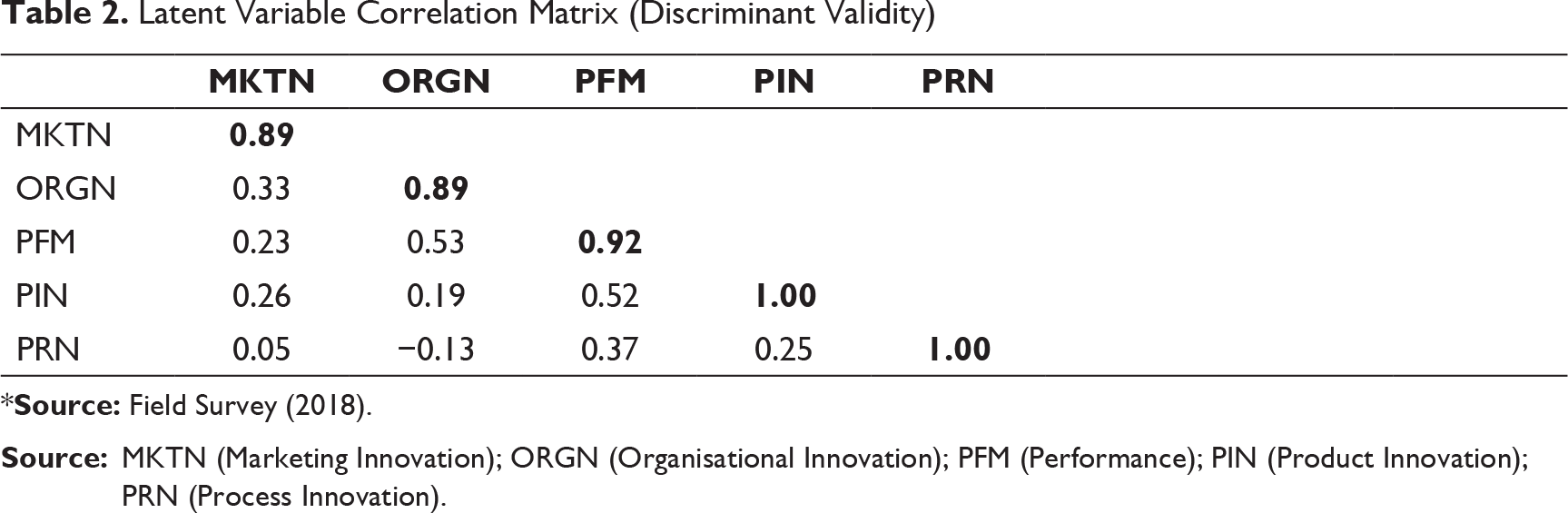
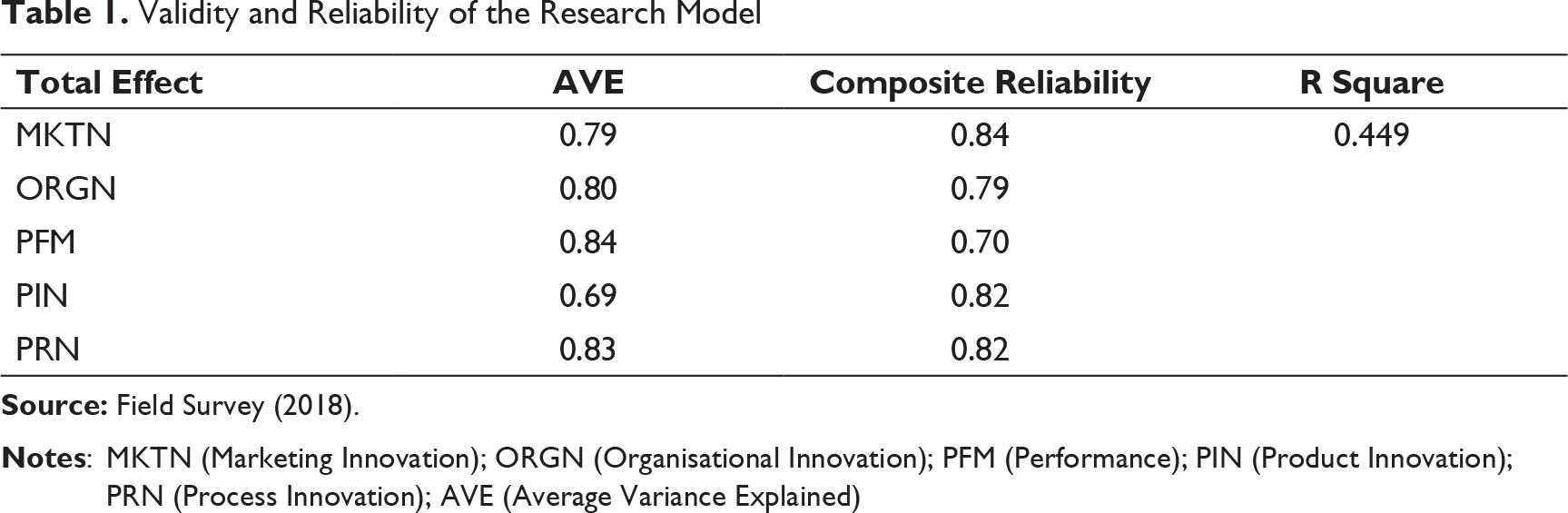
From Table 1, the R-square, which is a measure of goodness of fit, or how the independent variables explain the dependent variable, is 44.9 per cent. This goes to suggest that the innovation types considered in this study account for 44.9 per cent of the variation in business performance of the SMEs surveyed in this study. This means that innovation types partially explain the variability in business performance (Roldán & Sanchez-Franco, 2012). Moreover, the composite reliabilities are shown to be greater than the 0.6 thresholds, signifying that a high level of internal consistency and reliability has been shown by all the latent variables of the study (Hair, Sarstedt, Ringle, & Mena, 2012). Also, the average variance explained (AVE), which is a measure of convergent validity, shows that all the latent variables met the threshold of 0.5 (Fornell & Larcher, 1981). Finally, factor loads of indicators for product innovation (PIN_1, PIN_2 & PIN_3), process innovation (PRN_1 & PRN_2), marketing innovations (MKTN_4), and organisational innovation (ORGN_4) were deleted because they were below the threshold of 0.4 (Roldán & Sanchez-Franco, 2012). Table 2 shows the latent variable correlation matrix.
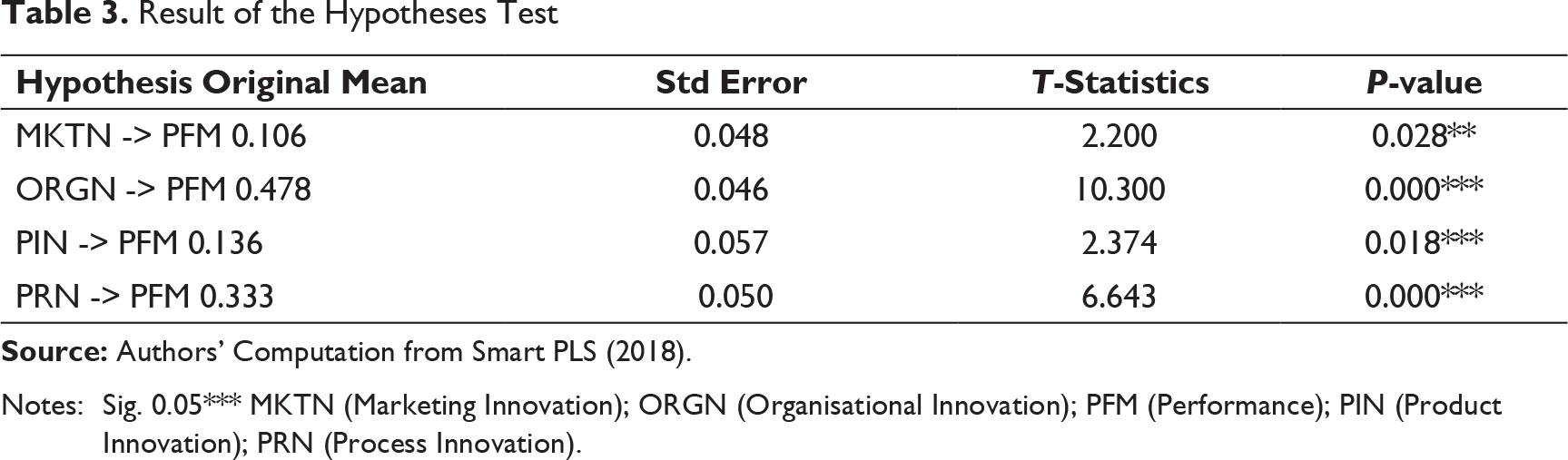
Here again, Table 2 shows that all the latent variables meet discriminant validity, as all the diagonal elements (Bold)–Square Root of the Average Variance Extracted (AVE)–are greater than their corresponding off-diagonal elements in the respective rows and columns (Roldan & Sanchez-Franco, 2012). The result of the SEM-PLS analysis of the relationship between the variables under study is shown in Table 3.
Results of Hypotheses
Result of the Hypotheses Test
Product Innovation and SMEs Performance
The first hypothesis of the study that Product innovation has a positive influence on SMEs’ performance is accepted. As shown in Table 3, the critical p-value of 0.018*** is far lower than the chosen alpha level of 0.05. Thus, the author can reject the underlying null hypothesis that product innovation has no positive link with the performance of an enterprise, and rather, accept the alternate hypothesis that there is a strong positive relationship between product innovation and a firm’s performance. This implies that it is worth investing a firm’s resources and capabilities in product innovation in terms of improvements in technical specifications, components and materials, incorporated software, user-friendliness, or other functional characteristics. The findings, moreover, showed that product innovation strongly influences customer satisfaction, market share, sales and competitiveness of the firm. It goes without saying that this finding corroborates the findings of the studies of Osei et al. (2016a) and Egbetoku et al. (2008) that product innovation enhances firm performance in terms of sales, competitiveness and market share. In addition, the outcome of this study supports the results of Fransen (2013) that product innovation positively impacts the growth of firm’s turnover/sales.
Process Innovation and SMEs Performance
Again, the second hypothesis of the study stated that Process innovation has a positive influence on firm performance. This is supported at a critical p-value of 0.000***. This demonstrates that the present author can reject the underlying null hypothesis that process innovation has no significant influence on firm performance and accept the alternate instead. This connotes that the SMEs’ adoption and introduction of new and significantly improved techniques, equipment and software are significantly enhancing their business performance. The outcome of the study disclosed that process innovation positively impacts SMEs’ performance in terms of speed time to market, profit and competitiveness. The SMEs disclosed that they are enjoying these enhanced performances because their adoption of process innovation is helping them to cut the cost of production, reduce bottlenecks, decrease delivery cost and improve products/services quality. It is worth stating that this finding is consistent with the findings of Osei et al. 2016b, Oke et al., 2007, and Reichstein & Salter, 2006 that process innovation enhances the performance of firms. Since the outcome shows a strong positive relationship between process innovation and firm performance, the present author thus disagrees with the finding of Lin (2007) that process innovation has a weak link with firm performance. The present author, instead, finds that the adoption of process innovation strongly influences SMEs' performance.
Marketing Innovation and SMEs Performance
Moreover, the third hypothesis of the study that Marketing innovation has a positive impact on firm performance is accepted. Table 3 shows a critical p-value of (0.028**), which is less than the chosen alpha level of 0.05. Thus, the present author rejects the underlying assumption of the null hypothesis that marketing innovation has no positive relationship with firm performance, and instead, accept the alternate hypothesis that there is a positive relationship between market innovation and firm performance. This divulges that adoption and implementation of marketing innovation by the SMEs in the areas of product design or packaging, product placement, product promotion or pricing, and new and improved distribution channel is having a significant, positive impact on their firm performance. A step further analysis of the study shows that marketing innovation positively impacts the performance of the enterprises in terms of sales, customer satisfaction, market share and competitiveness. It bears remembering here that the outcome of this study confirms the findings of the studies by Hajar, 2015, Mbizi, 2013, and Ngungi, 2013, that marketing innovation positively and significantly impacts firm performance. Moreover, the result affirms the findings of Johne (2000) and Ngungi (2013) that marketing innovation impacts performance in the areas of sales and profit. However, this finding disagrees with the outcome of the studies of Sattari (2013) and Atalay (2013) that there is no significant relationship between market innovation and firm performance.
Organisational Innovation and SMEs Performance
Finally, the fourth hypothesis of the study argued that Organisational innovation has a positive impact on firm performance. The author finds support for this hypothesis at a critical p-value of (0.000***). Thus, the present author can reject the assumption of the null hypothesis and rather accept the alternate hypothesis that organizational innovation has a positive link with firm performance. This relationship is found to be very strong as it is far less than the chosen alpha level of 0.05. In fact, results show that organisational innovations have a stronger influence on SMEs performance than do the other innovation types—product, process and marketing innovations—tested in this study. This implies that the positive relationship between organisational innovation and SMEs’ performance is very strong. This, moreover, demonstrates that the organisational innovation constructs measured in this study—new and improved business practices (routine, procedures and processes), workplace organisation (human resources practices and coordination between departments), and external relation (supply chain management systems, strategic partnership and collaboration) are positively impacting the performance of the SMEs.
The analysis of the study shows that SMEs are enjoying an enhanced performance from their adoption and implementation of organizational innovation in terms of sales, profit, competitiveness, speed time to market and growth in employment. It was disclosed that SMEs’ organizational innovation enables them to reduce bottlenecks, delays in production, administrative and transaction costs, and improve workplace satisfaction and cost of supplies. The resulting outcome of these innovations is improved profit, speed time to market, competitiveness, and attraction of quality and skilled employees. This finding corroborates the findings of Mbizi (2013) and Oke (2015) that organisational innovation leads to enhanced performance financially and operationally. Again, the finding agrees with the outcome of the study of the CIS (2006) in France that organisational innovation positively improves performance in terms of product and service quality and response time to market/customers. However, the findings disagree with the results of the research by Kuswantoro (2012), Sattari (2013) and Atalay (2013), who found that no significant, positive link exists between organisational innovation and firm performance. The conclusions and managerial implications of these findings are discussed in the following section.
Conclusions
The main objective of the present article was to examine the impact of product, process and marketing, and organisational innovations on SMEs’ performance, a subject which has received limited attention of scholars, particularly in Africa and in emerging economies like Ghana. As the outcome of the study reveals, all the four innovation types considered in this study have a positive impact on the performance of SMEs respecting all the performance metrics considered in this study, but organisational innovation has the greatest effect size. It is, thus, concluded that effective and efficient adoption and implementation of innovation types—product, process, marketing and organisational innovations—have a significant positive impact on SMEs’ performance in terms of sales, competitiveness, customer satisfaction, market share, speed time to market, profit and growth of employees.
Managerial and Policy Implications
The results of this study have various managerial and policy implications. The first implication concerns the importance of the innovation types examined in this study. Results of the study suggest that product, process, marketing and organisational innovations positively impact the performance of SMEs in terms of marketing and financial performance. Therefore, as the dynamic capabilities theory indicates, by adopting these innovation types, SMEs would be able to improve, develop and renew their product or services and processes, which, in turn, would enhance their performance. In relation to the first implication, the second implication relates to the innovation strategies that SMEs should adopt. The findings show that all the four types of innovation are positively related to financial and marketing performance, indicating that, SMEs with their limited resources, can implement any type of the innovation and still improve their performance or achieve sustainable competitive advantage. More to the point, SMEs can implement these innovation types incrementally or gradually to improve their performance. In this sense, owners/managers of SMEs at strategic and operational levels in SMEs should give distinctive attention to the importance of product, process, marketing and organisational innovations for enhanced business performance.
The findings also have some policy implications in that it shows that innovation impacts the performance and development of SMEs’ in Ghana. In fact, SMEs’ are considered a seedbed to innovation and socio-economic development in emerging economies. Thus, for them to contribute significantly to economic growth and development in terms of employment creation and GDP, the national governments must take giant steps to foster, encourage and promote innovation in the sector. More specifically, more technical education must be given to the SMEs by governments and all stakeholders to keep the SMEs informed about the significance of innovation to their enterprise growth in this era of hyper-competition. Also, national governments must offer financial assistance to the SMEs to help them have access to state-of–the-art technologies and facilities needed to compete successfully in the current spate of competition. With these mechanisms in place, SMEs would be able to make a significant and meaningful contribution to the socio-economic development in the economy.
This is one of the few studies ever done in emerging economies on the nexus between innovation types and SMEs performance. Though there are several conceptual studies on the type of innovations, analytical and empirical studies are scanty, particularly in emerging economies. There is, therefore, of theoretical and practical value to examine simultaneously the impact of all the four types of innovation on the performance of SMEs in emerging economies like Ghana. In addition, the few research on the nexus between innovation types and firm performance, which are largely limited to big organisations in the advanced world, did not consider some of the innovation types examined in the present study in their model. Moreover, the performance indicators that were used to measure performance in the present study have not been considered by prior research on the phenomenon.
In effect, the present study makes substantial contributions to knowledge and research on entrepreneurship and innovation as it uses a holistic conceptual framework to offer an in-depth understanding of the interrelationship between innovation types and the performance of SMEs. The quantitative study silmultaneously examines the multiple types of innovation in relation to firm performance and extends the current studies on innovation among SMEs. More specifically, the present study has examined innovation types as well as performance indicators that are often ignored by researchers on the phenomenon. Thus, the results of the present study can be taken as representative for African countries.
Limitations and Future Research
No scientific study is without limitations. The present author acknowledges that the study suffers from some research limitations as a result of the research design adopted, but also that these offer opportunities for further research. Firstly, this study was limited only to the four types of innovation identified by the OECD Oslo Manual, which might have ignored other types of innovation. Future studies should, therefore, examine unexplored and undiscovered types of innovation—like incremental, radical and revolutionary innovations and their relation to SMEs’ performance. Secondly, the study was limited only to SMEs in Cape Coast, Ghana, and as a result, generalization cannot be made to include all SMEs in Ghana. Therefore, future studies should include SMEs in other regions of Ghana.
Finally, the study used only a quantitative study which may not have given the respondents the possibility to explain their views in more detail on the phenomenon. Hence, the present author recommends that more studies, particularly, qualitative research through semi-structured interviews, should be conducted in other parts of Ghana and in Africa to allow for generalisation of the outcome of this study. Despite these limitations, the present author strongly believes that this study contributes to the comprehension of the ongoing studies and debates on the nexus between innovation types and firm performance, adds to SMEs theory and practice, and also offers useful managerial implication for SMEs managers and owners.
Declaration of Conflicting Interests
The author declared no potential conflicts of interest with respect to the research, authorship, and/or publication of this article.
Funding
The author received no financial support for the research, authorship, and/or publication of this article.