






Abstract
Abstract
This research examines factors that influence consumer perceptions of value created by a multichannel system of service delivery. The literature suggests that multichannel integration quality allows firms to benefit from the effect of synergy and complementarity between channels. We investigate the perceived value of multichannel service delivery in the context of retail banking services, where such multichannel systems are omnipresent. We propose and test a model in which multichannel integration quality is an important value driver, such that higher multichannel integration quality leads to greater value perceptions of not only the multichannel system, but also the overall value of the bank as perceived by the customer. Importantly, the complexity of the multichannel system of service delivery, as perceived by customers, moderates the direct effect of channel integration quality on perceived value of the multichannel system, so that in highly complex multichannel systems, channel integration quality will have a stronger effect on the perceived value to customer. Our findings also shed light on the specific factors that contribute to consumer value perceptions of multichannel retail banking services, which has important implications to managers and researchers.
Introduction
With the advancement of technology and the proliferation of mobile devices, the management and marketing of services is increasingly taking place in multichannel environments comprising both physical and virtual channels (Sousa & Voss, 2006). To no surprise, in recent years, many financial service companies, particularly commercial banks, have increased their reliance on customers using various channels interchangeably, and such multichannel service experience has become a rule, rather than an exception (Bain and Company Report, 2014). Nevertheless, companies often focus primarily on maximizing service quality delivered through each individual channel, which may have detrimental effects on the quality of integration of a multichannel system. By carefully synchronizing those channels (e.g., ensuring that both content and customer service journey are consistent across channels), a firm can create superior channel service experience, providing its customers with superior value and fewer reasons to switch to competitors. On the contrary, when channels are not properly integrated, consumers may experience inconvenience accessing channels or even a loss of control in interacting with the firm (Rangaswamy & van Bruggen, 2005). Various studies and anecdotal evidence suggest that customers engage better with their banks using multichannels and that engagement leads to better outcomes for both customers and banks (e.g., Patricio, Fisk, & Cunha, 2003). However, despite the clear potential of a multichannel service delivery to provide superior value and have an overall positive impact on service experience, many customers fail to adopt the multichannel service experience. Specific to the financial services, one-third of customers still rely on a single channel for their banking and other financial needs (IBM report, 2014). Unfortunately, insights into what precludes a customer from fully utilizing a multichannel service system are scarce, at least in part due to being context-specific.
For many consumers, adapting a multichannel system of service delivery requires changing their habitual behaviour, breaking the routine, adjusting service expectations and learning (Neslin et al., 2006). Consumers often do change their habits and consumption-related behaviours when they perceive value in doing so. Thus, one reason for consumer resistance to adopting a multichannel service delivery system is insufficient or unclear perceived value of doing so. Relatedly, service providers often lack understanding of what contributes to their customers’ perceptions of value, and therefore, risk deteriorating customer satisfaction (Mulpuru, 2009) and losing sales (Yellavali, Holt, & Jandial, 2004). Moreover, many firms use the term ‘customer value’ to refer solely to the value that the customer generates for them, rather than the value that they can offer their users. Similarly, much of the empirical research has focused only on the financial value created by the multichannel consumers for the company (e.g., Easingwood & Storey, 1996), while very few studies have addressed the need to understand the company’s role in maximizing perceived value in multichannel environments (Martelo, Barroso, & Cepeda-Carrion, 2013).
In this study, we investigate the value created by multichannel systems as perceived by customers. The literature suggests that multichannel integration quality, ‘a seamless customer experience delivered within and across channels’ (Sousa & Voss, 2006), allows firms to benefit from the effect of synergy and complementarity between channels (Payne & Frow, 2004), leading to successful execution of multichannel strategies for firms. Hence, we propose that beyond the quality of service delivered through each individual channel, multichannel integration quality is one important value driver and is positively related to perceived value created by a multichannel system of service delivery. Specifically, we empirically test and find that higher multichannel integration quality leads to higher perceived customer value of multichannel system in the context of retail banking. Furthermore, we hypothesize a moderating effect of the perceived multichannel complexity and find that in highly complex multichannel systems, integration quality has even a stronger positive effect on the perceived customer value created by multichannel systems and the overall perceived value of a service organization (i.e., a bank).
While the importance of multichannel integration has been recognized by both practitioners and academics, and anecdotal evidence indicates how such integration could help firm performance, to our best knowledge, this is the first study that empirically tests the relationship between multichannel integration quality and customer value. Importantly, our findings also confirm that the impact of multichannel integration quality on customer value and the overall perceptions of firm value grows as channel complexity increases. Unlike most extant research, this study conceptualizes perceived value from the perspective of customer (DeSarbo, Jedidi, & Sinha, 2001), offering novel consumer insights. Overall, the findings of this research have important and relevant implications for both academics and practitioners.
In the remainder of the article, we first briefly discuss perceived customer value and multichannel integration quality as the focal constructs of the research. Next, we develop the research hypotheses. Given the prevalence of the use of multichannel systems in the retail banking sector, our hypotheses are subsequently tested using the data collected from a sample of bank customers. Finally, we discuss the managerial and research implications of this research, as well as indicate its limitations and avenues for future studies.
Perceived Customer Value in Multichannel Systems
The importance of customer value has been extensively studied in the literature, where perceived customer value is defined as the customers’ overall assessment of a product or a service based on their perception of what is received and what is given (Holbrook, 1999). It represents a trade-off between the quality and benefits that they receive relative to the associated sacrifices and costs (Zeithaml, 1988). From the consumer’s perspective, value creation involves increasing the use value and decreasing the exchange value, where the former is the subjective evaluation of consumption benefits by a consumer and the latter refers to the amount that the consumer gives up or sacrifices, including financial costs as well as time, effort and opportunity costs (Bowman & Ambrosini, 2000). The maximum value is created when the use value increases while the exchange value decreases. In recent years, many service firms have developed multichannel systems to offer their services as an attempt to create additional value (Banerjee, 2014). Particularly, more services and additional options have been made available to the customer through various channels, such as retail outlets, telephone, automatic teller machines and the Internet (Rangaswamy & van Bruggen, 2005). Thus, we define perceived customer value of a multichannel system as customers’ overall assessment of the benefits that they receive from using multichannels to fulfil their needs considering the various costs and sacrifices associated with using such channel systems.
The value created in multichannel systems has been mostly studied from the company perspective, investigating how using different formats of multichannel systems can create value for the firms in the form of increased sales and profits (e.g., Verhoef, Neslin, & Vroomen, 2007). Some others examine the individual channel choice by consumers based on the benefits they receive from that channel relative to other channels (Balasubramanian, Raghunathan, & Mahajan, 2005). However, recently, with the rapid shift of the process of value creation from firm-centric view to more customer- and customer experience-based view, the customer value created in multichannel systems has become an important topic for both academics and practitioners. For instance, Hsiao, Yen and Li (2012) propose and show that consumers use multiple channels mainly for the value created by saving their money, time and effort. And Gentile, Spiller and Noci (2007) find that a well-designed multichannel system contributes to the value creation for the customers.
Multichannel Integration Quality
In part due to unprecedented technological innovation in recent years, the financial services industry has and is continuing to experience many new and often challenging developments. Information and communication technologies have particularly disrupted the old ways of doing business with customers, and many new financial instruments have developed across multiple channels to become the norm (Coelho & Easingwood, 2003). In fact, it is highly unlikely that there is a financial organization that relies on a single channel to reach its customers (Chen & Chang, 2010). For example, many retail banks have moved from serving customers in their branches almost exclusively towards delivering services through other channels including Internet banking, which they view as both lowering costs and providing better, and sometimes new, services to their customers (Patricio et al., 2003).
Connecting with customers over multiple channels has been proven necessary, although in some cases, it is not enough to provide companies with a potent competitive advantage (Neslin et al., 2006; Sousa & Voss, 2006). Instead the firms’ ability to provide customers with a consistent experience, whatever channel they use, becomes a critical issue. This consistency is important because many customers have no single favourite channel for dealing with the firm but have instead become multichannel users (Ansari, Mela, & Neslin, 2008). Furthermore, consistency between channels promises to minimize the non-financial costs associated with adopting new channels among customers who otherwise use a single channel (out of habit, for instance). In addition, customers should not only be able to use multiple channels seamlessly but they should also be able to receive consistent product or service-related information through different channels and to easily traverse them without any of their personal information lost across the channels.
To no surprise, therefore, multichannel integration quality has become an important objective and challenge for many multichannel service companies (e.g., Montoya-Weiss, Voss, & Grewal, 2003). Multichannel integration has been defined as ‘the ability to provide customers with a seamless service experience across multiple channels’ (Sousa & Voss, 2006, p. 365). It aims at providing customers with a consistent and seamless service experience as they easily shift from one channel to another (Montoya-Weiss et al., 2003).
Multichannel integration quality becomes particularly important for consumers as they may choose different channels to interact with the same company. Combined, one company’s channels contribute to consumer perceptions of the company as a whole and must be consistent in terms of the type and quality of service provided, as well as the service experience more broadly (Banerjee, 2014). Furthermore, as consumers form expectations for future service experience based on their past encounters with the company (Szymanski & Henard, 2001), only a well-integrated multichannel system promises to meet such expectations regardless of the channel one chooses to use.
In an integrated channel, the customer can take advantage of channel-specific benefits and avoid channel-specific sacrifices throughout their shopping process (Chatterjee, 2010). Such integration reduces the time and effort, among other costs, necessary to utilize multiple channels as part of service search and delivery. For example, high quality channel integration may mean that customer information is synced effectively between channels, and since, as a result, customer information would be readily available via each channel in real time, there would be no need for customers to repeatedly enter their personal information and preferences every time they use a different channel for service search and delivery. Also, a well-integrated multichannel system would present consistent product and price information, facilitating a seamless customer experience, avoiding channel conflict and customer confusion. Such integration of content and layout (when applicable) across multiple channels contributes to a seamless experience and would not only increase the perceived benefits of customer multichannel service experience, but also minimize perceived costs. Hence, when integration quality of a multichannel service delivery system is high (as opposed to low), consumers are likely to perceive greater synergies between the channels and consequently derive higher value from the multichannel service system. Therefore, we formally predict:
H1: There is a positive relationship between multichannel integration quality and the perceived customer value created in multichannel systems.
Multichannel Complexity
Organizational complexity has been discussed in a wide range of literatures. In a very general sense, complexity can be defined as a system made up of a large number of parts that interact in a non-simple way (Simon, 1964). Similarly, Price (1972, pp. 70–77) defined complexity as ‘the degree of structural differentiation’ (p. 70), implying that an organization with lots of departments would necessarily be more complex than one with a few departments. Accordingly, we define multichannel complexity as comprising of two dimensions: (a) channel number (or the total number of channels that are available in a multichannel system for customers to choose from and interact in the process of searching for and delivery of service), and (b) channel variety (or the variety of qualitatively different types of channels that are available in a multichannel system that customers can interact with). Therefore, a highly complex multichannel service system may be described as having many different types of channels. For example, a bank offering a number of both offline (e.g., bank branch and ATM) and online (e.g., website, mobile app) channels would be considered more complex than a bank offering a few offline only channels.
Naturally, the number of channels and/or channel variety are likely to influence the perceived difficulty or ease of utilizing a multichannel system (i.e., adopting multiple channels of service delivery as opposed to using one). As such, ceteris paribus, a company that offers five channels would have greater channel complexity than a company that only offers three channels. Also, channel complexity is further increased when a company simultaneously offers various types of channels that require different skills, resources and abilities from consumers (e.g., traditional and virtual) compared to a company that only offers one type of channel (e.g., either traditional or virtual channel).
More complex multichannel systems with many qualitatively different channels may present a great opportunity to create superior value for customers and a competitive advantage, but also posit a great challenge. Complex multichannel services often require substantial time and effort on the part of consumers in order to derive benefit from a large number of different channels, and consequently, the perceived value to customer may suffer. Importantly, better integration among those channels promises to ease the burden on the customer to make their decisions and complete their transactions. On the other hand, in a less complex multichannel system, which may be comprised of two virtual channels, for example, a website and a smart phone application, the importance of integration lessens as there are only a few channels and they share much inherent similarity. As such, we hypothesize:
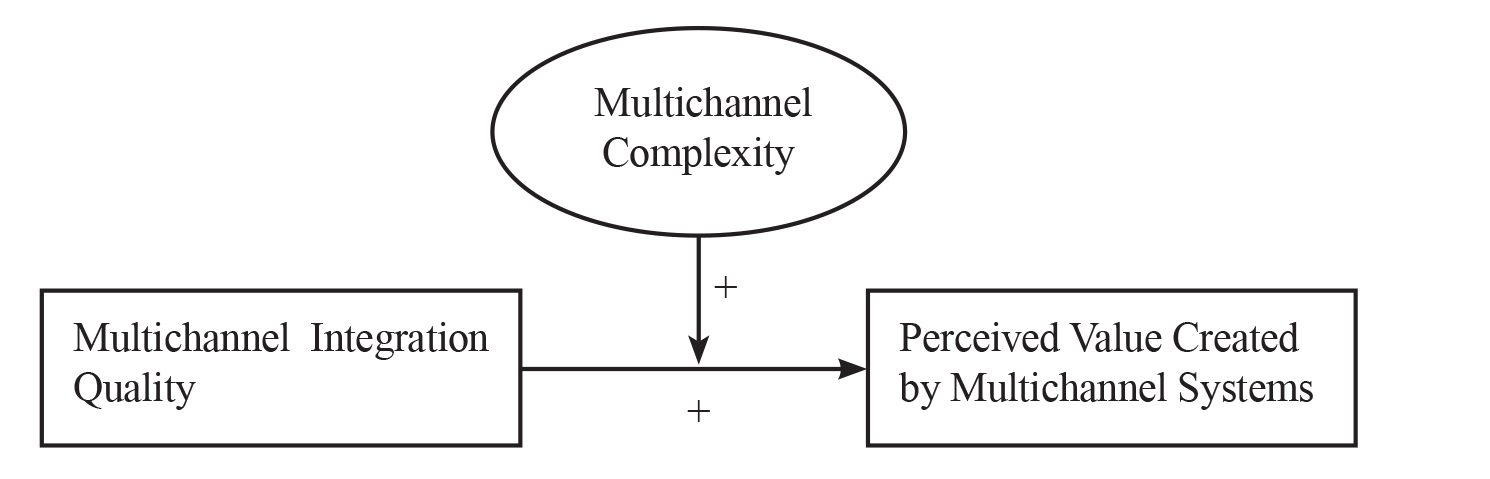
H2: The level of multichannel complexity moderates the relationship between integration quality and perceived value created in multichannel systems, such that higher complexity strengthens the positive relationship while the lower complexity weakens it.
Our conceptual model is depicted in Figure 1.
Study
Participants and Procedure
A random sample of 324 individuals (53 per cent female, average age = 40.1) living in a large US city participated in this online study. The respondents were asked to identify the bank where they have their main account, that is, ‘the bank where your salary or wages are paid into and/or where most transactions take place’. The main account is an important focus of the study because this is where the majority of transactions occur between the customer and bank (Barnes, 1997). Then, given that many participants use multiple channels for their banking needs, they were asked to identify their primary banking channel—the channel that they use most frequently for at least 75 per cent of their bank transactions to manage their checking account (Pont & McQuilken, 2005). Forty-one per cent identified website, 26 per cent chose bank branch/teller, 18 per cent chose ATMs and 12 per cent chose mobile devices including SMS and mobile apps as their main channels. These percentages reflect and approximate the channel preferences for the commercial banking sector more broadly per the industry reports (e.g., EY Global Banking Survey, 2015; McKinsey and Company Retail Banking Insights, 2014). It is also important to note that all the participants in our study were indeed multichannel customers who reported switching between different channels at least sometimes. For example, almost 70 per cent of those who chose website as their main channel also used ATMs from time to time, but not as frequently as they used websites. However, for the purposes of this study, we asked study participants to focus on the main channel used for at least 75 per cent of their interactions with the bank. The study participants used their major banking channels on average 6.4 times per month, ranging from 4.1 to 9.3.
Measures
Scale Items, Reliabilities and Item Loadings

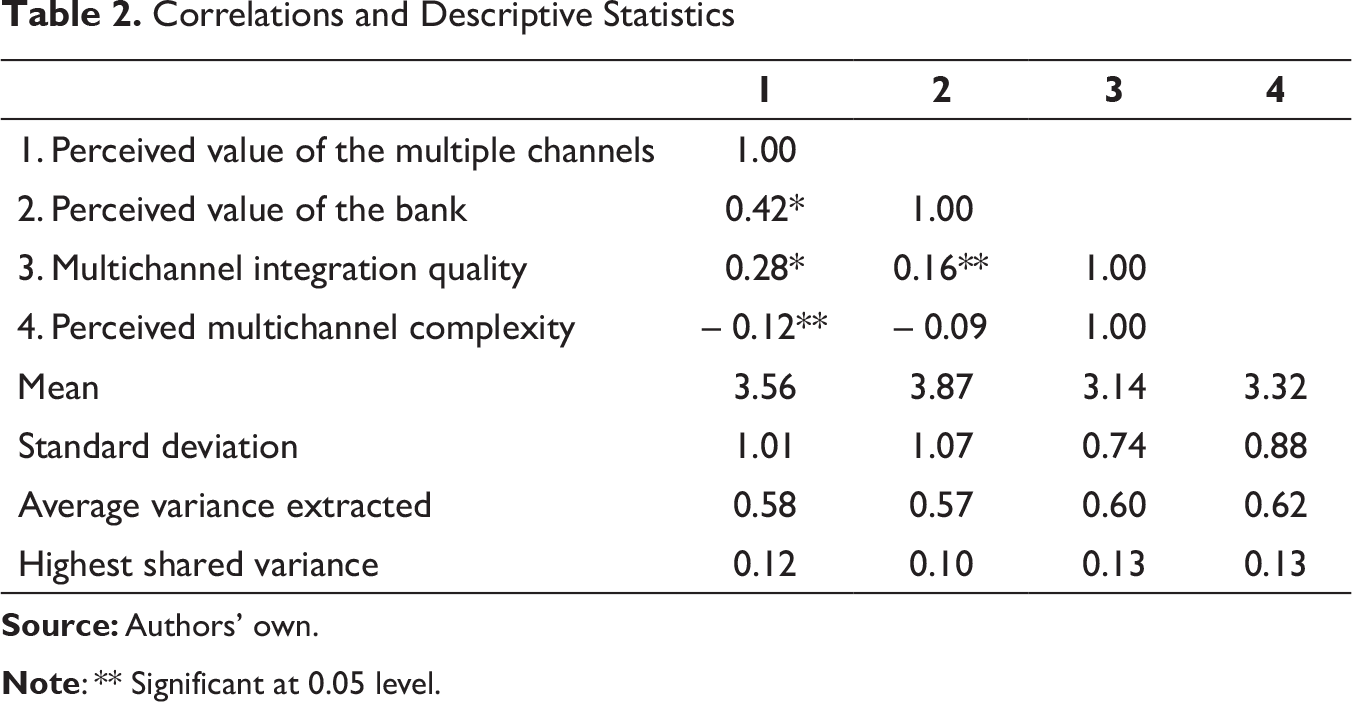
Correlations and Descriptive Statistics
Analysis and Results
A series of regression analyses was conducted to test hypotheses. All the variables were mean-centred to minimize the problem of multicollinearity between the interaction terms and their components in equations where we included the interaction terms. The VIF values (lowest = 2.71; highest = 4.93) were well below the cut-off of 10.
Moderated Regression Analysis Results
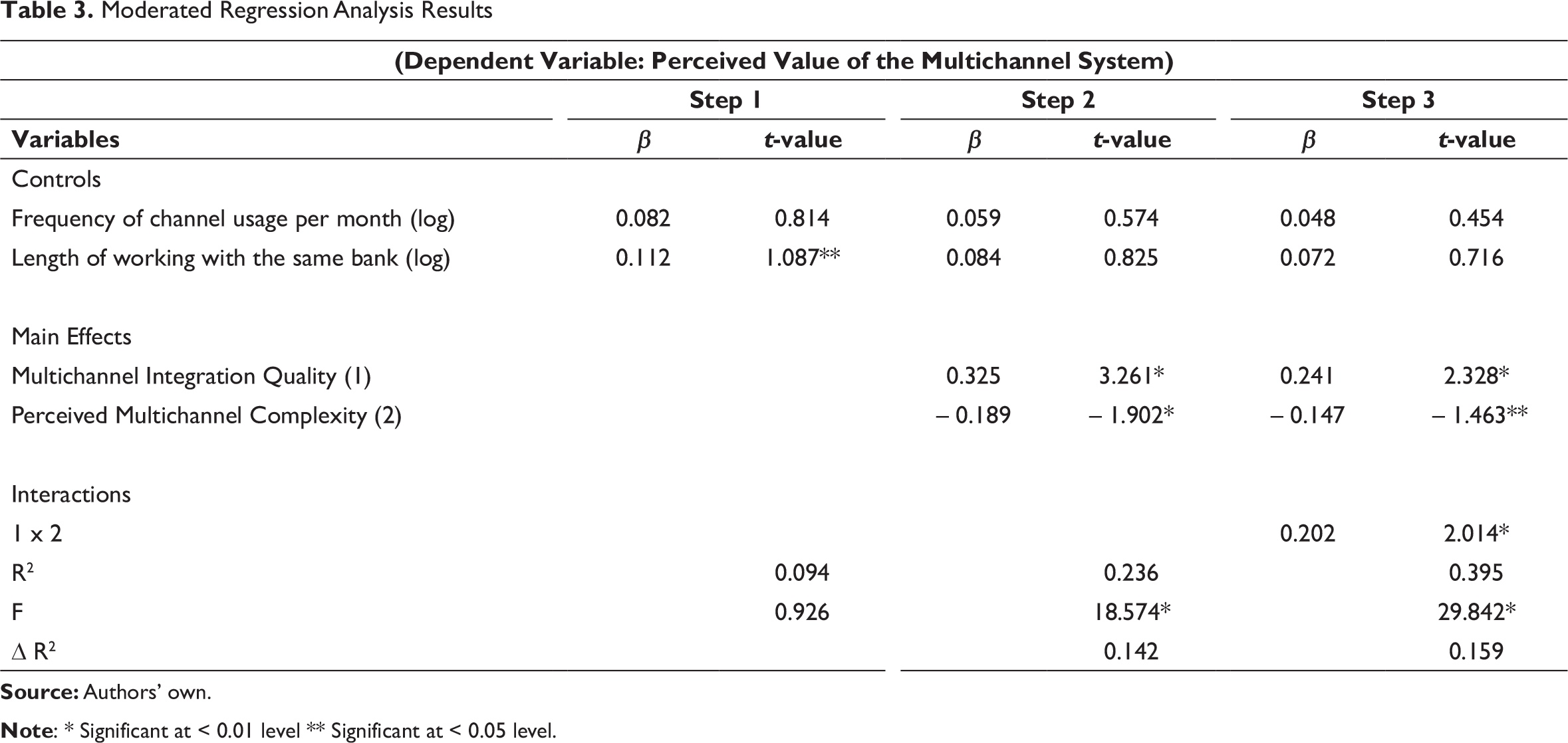
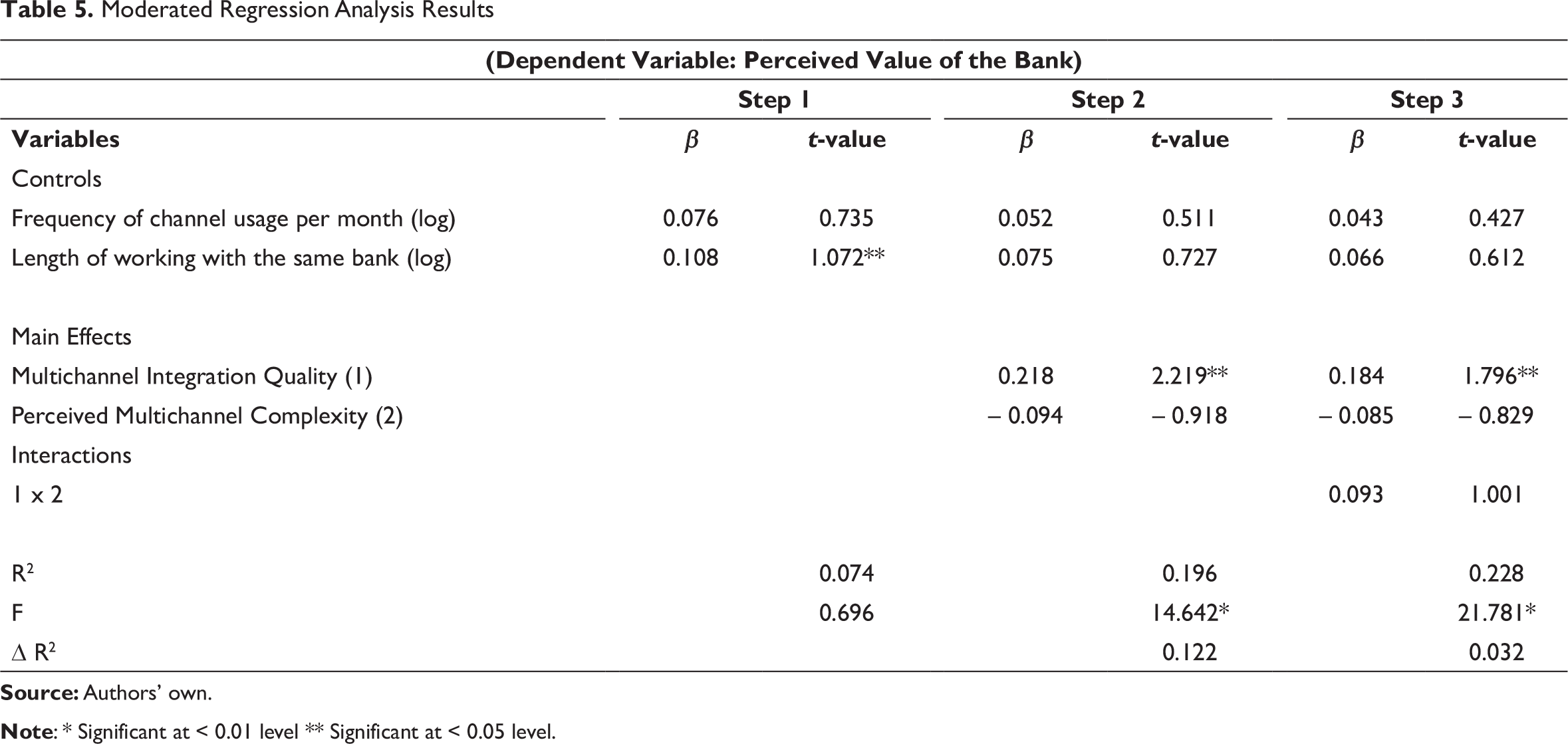
The results of Step 1 showed that relationship length with the bank was the only significant control variable. Frequency of channel usage per month had no significant relationship with the dependent variable. Step 2 provided a significant increase in variance explained over Step 1 (ΔR² = 0.142, p < 0.01). The results show that multichannel integration quality had a significant positive relationship with the customers’ perceived value as created by multichannel systems (β = 0.33, t = 3.261, p < 0.01). Thus, H1 was supported. On the other hand, and consistent with our theory, perceived multichannel complexity (β = – 0.19, t = –1.902, p < 0.01) was found to be negatively and significantly related to perceived value of multichannel systems.
The two-way interaction hypothesis (H2) was tested by observing the incremental variance explained by Step 3 over Step 2. As shown in Table 3, the addition of the two-way interaction of multichannel integration quality with perceived multichannel complexity increased R² by 15.9 per cent in Step 3 over Step 2. More specifically, the interaction (β = 0.20, t = 2.014, p < 0.01) turned out to be positively and significantly related to perceived customer value of multichannel systems, consistent with the hypotheses.
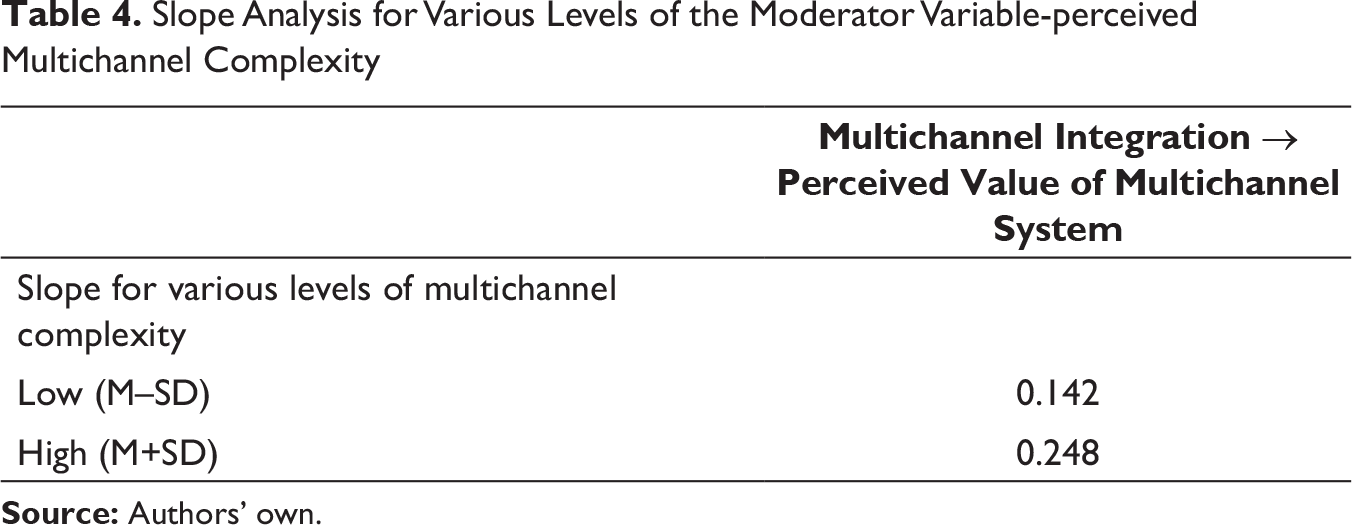
Slope Analysis for Various Levels of the Moderator Variable-perceived Multichannel Complexity
Post Hoc Analysis
Moderated Regression Analysis Results
Discussion and Implications
This research sheds light on how multichannel systems of service delivery may maximize the value they create for their customers. Our findings support both hypotheses and suggest that multichannel integration quality is an important driver of customers’ perceptions of value above and beyond quality of service delivered through each individual channel, created by the multichannel system and the service provider more broadly. Importantly, our findings confirm that multichannel complexity moderates this direct positive effect of multichannel integration quality on the customers’ perceived value as created by multichannel systems. More specifically, when the multichannel complexity is perceived as high, the direct effect of multichannel integration quality on customers’ perceived value of the multichannel system is stronger than when multichannel complexity is perceived as low.
By investigating the relationships among multichannel integration quality, customers’ perceptions of value and multichannel complexity, the current research makes a number of important contributions. Foremost, while multichannel integration quality has been shown to play a strategic role in customer relationship management (Payne & Frow, 2004), to the best of our knowledge, this research is the first effort to focus on the customer’s perspective in analyzing the effects of multichannel integration quality on value perceptions. In fact, most studies have focused on the financial value of multichannel systems (Verhoef et al., 2007), thus not explicitly accounting for customers’ perspective. Given the importance of understanding customer perceptions when creating value for the customers, insights into how consumers experience and evaluate services in multichannel systems promise substantial positive returns when designing successful multichannel systems. Moreover, we show that the complexity of the multichannel system, as determined by the number and variety of channels, plays an important moderating role suggesting that integration quality should be a priority when dealing with multichannel systems that are perceived by customers as particularly complex.
Our findings also have a number of important managerial implications, as they confirm the importance of multichannel integration quality to customers’ value perceptions in the context of retail banking. Although indirectly, study results also imply that promoting and implementing the quality of multichannel integration may lead to a more seamless, synergistic multichannel experience, and motivate consumers to use multichannel systems more. This is particularly relevant given that many firms have instead been developing multichannel systems with the focus on maximizing service quality within channels but without proper integration (Verhoef, 2012).
More specifically, the managerial implications of this research fall into one of two groups: stakeholder-focused implications and channel-focused implications. As part of the first group, we recommend companies engage in a number of activities primarily centred around consumers and employees. Particularly, exploratory research may be used to better understand the sources of consumer resistance to adopting multichannel systems. In this effort, the role of integration quality and multichannel complexity should be examined as potential challenges that stop consumers from using multichannels. Furthermore, companies can connect with their consumers via different social media platforms and provide incentives for adopting their new channels emphasizing the seamless experience across those channels. In the same light, for those consumers who have to choose from many qualitatively different channels when interacting with a firm, and thus may perceive the multichannel system as highly complex, the service provider may want to implement targeted communication activities emphasizing the integration quality of such a system. For example, rather than sending overall expertise assurance letters, emails and reports (Zeithaml, Parasuraman, & Berry, 1988), these communications could point out the consistency of services provided across multiple channels (e.g., comparative waiting/response times). Similarly, after each transaction, a link or verbal cue might be provided to encourage a switch to a different channel and thus enhance the perception of seamless experience across multiple channels. Customized initiatives, however, should not be limited to communication activities. Rather, managers should consider investing in appropriate employee training and technology to facilitate a seamless transition of a customer across channels, especially if that customer uses a relatively high number of different channels. Thus, companies ought to develop communication and employee training programmes that emphasize the importance of integration quality in their multichannel systems. This is particularly relevant for those channels that rely on front line service employees such as bank branches, retail stores and call centres, where the consistency of the information provided to the customers should be highlighted and included as part of training programmes. Therefore, every channel member and employee should be motivated and incentivized to contribute to such integration given its importance for the company value created for the customers.
With regards to the channel-focused implications, first, we suggest that customer information should be readily available across channels and should not have to be re-entered even if a customer does not habitually use a particular channel. Given that having to repeat the same information every time they use a different channel could be perceived as lack of integration by many customers, a proper system in place that minimizes such repetition could help firms avoid these negative perceptions. Furthermore, every individual channel in a company’s multichannel system should have a shared access to customer history and be able to extract and use that information when needed. For example, a customer service representative should be able to access data related to a customer’s online activity on company’s website channel. In the same light, marketing and IT departments in a company should work closely to design a customer experience that is both user-friendly and easily replicated across channels. Making an investment to set up the necessary infrastructure to ensure integration between technologies used by different channel members would help firms improve the overall integration quality in their multichannel system and provide a synchronized customer journey.
In sum, we believe that while examining the relationship between integration quality and customer value provides important insights for the practitioners, the primary contribution of our article is to identify the important role of multichannel complexity in this relationship. Given that it is now a necessity for almost every company to use multiple channels to serve their customers, executives need to better understand both benefits and risks of complex multichannel systems as they strive to maximize the value created for their customers.
Limitations and Future Research
This research has a few limitations. First, we include only one type of complexity, that is, multichannel complexity, as a moderating variable in our model. Future studies may consider including other types of complexity—such as service or product complexity—as potential moderators of the same relationship. In a similar light, this article conceptualizes the complexity from channel structure perspective by focusing on the number and variety of channels used by customers. Future studies may conceptualize complexity as perceived by consumers, in terms of difficulty and ease of use.
Second, this article treats Likert scales as interval inputs into regression analyses to test the hypotheses. Future studies may consider using different measures, either interval or ordinal, and conduct parametric or non-parametric analyses, respectively, to replicate and extend our findings. Finally, this article uses retail banking as the context for its study. In the future, the relationships proposed and tested in this research should be investigated in other service contexts, to either improve generalizability of the findings of this article or qualify them further.