






Abstract
Abstract
To develop a managerially relevant understanding of value and value creation, these phenomena must be analysed on a micro level. Seen from above, they lack a microfoundation. In the present article, value and value creation are discussed from a micro position, based on a service logic (SL) analysis of the service perspective on business and marketing. In the Grönroos-Voima value model of SL, only one value concept—value-in-use—is used, to support theoretical rigour. The customer not only determines value, but is also the value creator. By facilitating customers’ value creation, the firm provides potential value, which evolves as value-in-use during use or consumption. If the actors can establish a platform of co-creation during direct interactions, the service provider’s and the customer’s processes merge into one interactive, collaborative and dialogical process, and then the firm may co-create value with the customer. Theoretical and practical implications are discussed.
Introduction
In the extant literature, and especially in the service literature, value-in-use is considered the central value concept (e.g., Grönroos, 2011; Vargo & Lusch, 2008). Furthermore, value is considered an important goal of marketing (Alderson, 1957; Drucker, 1954; Rust & Oliver, 1994; Sheth & Uslay, 2007). The utility-related value-in-use concept, which Aristotle considered the dominant value concept in his value theory over two millennia ago (Gordon, 1964), has taken over the role of the production-related value-in-exchange concept, which has dominated the management and marketing literature. Value, according to the latter value concept, is materialized at one point of time, during purchase, whereas value-in-use evolves during the whole use or consumption process (Grönroos & Gummerus, 2014). Theoretically, value-in-exchange as a value concept is doubtful. Rather, it is a sales concept. In a value context, it is only an operationalization of potential future value to be realized during the customers’ use of resources purchased.
Value has been defined in several ways, such as benefits against sacrifices (Day, 1990; Woodruff & Gardial, 1996; Zeithaml, 1988), means-ends-models (de Chernatony, Harris & Dall’Olmo Riley, 2000; Gutman, 1982; Peter & Olson, 1987; Rokeach, 1973) or the hedonic appreciation of the consumed object (Holbrook, 1994; Sanchez-Fernandez, Iniesta-Bonilla & Holbrook, 2009). However, in the literature, it is concluded that value is an elusive concept (Carú & Cova, 2003; Özdilek, 2016) and suffers from ‘fuzzy definitional problems’ (Ballantyne, Frow, Varey & Payne, 2011). The purpose of the present article is to analyse value creation and value from the service perspective on marketing and business from a micro-level point of view. To avoid the fuzziness of the value concept, in this analysis, value is defined as making an actor, such as a customer, better off (Grönroos, 2011). However, value can also be destructed (Echeverri & Skålen, 2011; Plé & Chumpitaz Cáceres, 2010), and using a service may be a negative experience, making the user worse off, definitely or temporarily.
The Service Perspective and Value Seen from Different Perspectives
According to the service perspective, all kinds of resources, such as goods and services, are used for a single purpose: to distribute service to customers (and other beneficiaries in the process; Vargo & Lusch, 2008). For the provider, service logic (SL) means that firms support their customers’ everyday processes with offerings whose aim is to enable these customers to reach their goals in life or business in a way that is value-creating for them (Grönroos, 2011). However, service as a perspective and its central phenomenon of value creation can be viewed in several ways, and, for example, analysed from above or from below. Depending on the vantage point, different aspects of the perspective become visible.
Viewing from above, or taking a macro-perspective, and analysing systems of actors in the value-creation process instead of singular actors, one can observe, for example, institutions guiding or restricting value creation. Moreover, seen from above, it can be observed that a whole host of actors, such as firms in various stages in the supply chain and end users, contribute to the value that emerges for the end user and other actors in the process. In service-dominant logic (SDL), this value contribution is metaphorically labelled as co-creation of value (Vargo & Lusch, 2008). However, although a macro-analysis reveals phenomena which are not visible from below, such as the examples mentioned previously; at the same time, micro-level phenomena can only be observed from below and remain disguised for an analysis on a system-of-actors level. The many different ways in which the actors contribute to value cannot be observed from above and, therefore, are not analysed in detail. As observed by Storbacka et al., (2016), defined in a metaphorical, all-encompassing way, ‘value co-creation is difficult to observe empirically’ (p. 3008), and in order to theoretically develop the service perspective further, researchers must pay more attention to the micro-foundations that underpin SDL’s macro-constructs (Storbacka et al., 2016). Foss and Pedersen (2016) offer the following reason for the need of micro-foundations (Felin & Foss, 2005) of macro-phenomena: ‘[M]acro scholars too often work with firm-level constructs which often unclear microfoundations, and proceed as if there are direct causal relations between macro variables (e.g. arguments that capabilities cause performance), where, in fact, the real causal relations involve lower level actions and interactions’ (p. 3).
In spite of its macro-strength pinpointing the contribution of several actors in the value process (compare the value constellation concept in Normann & Ramirez, 1993), as a metaphor, this value co-creation concept fails to guide managerial decision-making. It is not a factual description of co-creation as an interactive, dialogical and collaborative process, where two or several actors work together for a common goal, and, therefore, it lends itself to differing interpretations and cannot be analysed on an actor level. What takes place on an actor level, in contrast to a level of systems of actors, is invisible to macro-analysis. Leroy, Cova and Salle (2013) emphasize the need to avoid the ‘black-boxization of concepts’ (p. 1111). In macro-analysis, the roles and goals of the actors cannot be observed, and even the nature of value as value-in-use is difficult to capture (Grönroos & Gummerus, 2014). Because behavioural prescriptions should not be drawn from metaphors, SDL’s micro-level conclusions are at risk of becoming goods-logic, such as the proposition that firms can only offer value propositions. To be able to draw conclusions about this, interactions must be observable and the nature of interactions clearly understood. As Morgan (1986) warns, there is always also a risk that a phenomenon becomes ‘imprisoned by its metaphor’ (p. 605).
A Micro-level Approach to Value and Value Creation
Viewed from below, on a managerial or micro-level, other aspects of value creation and the value process become visible. In SL, where the service perspective and value creation and value, and their management and marketing implications, are studied on an actor level from the perspective of singular firms, managers and customers (Grönroos, 2011), the value process is studied and analysed from below. The roles and goals of the involved actors as well as the very nature of value as value-in-use, and in what ways the actors contribute to value-in-use, are analysed in detail and put into a managerially relevant framework (Grönroos & Ravald, 2012; Grönroos & Voima, 2013). The Grönroos-Voima value model summarizes the value-creation aspect of the service perspective viewed from below (Grönroos & Voima, 2013).
First, analysing the service perspective from below reveals that the nature of value-in-use is partly different from what is postulated in a macro-analysis. Indeed, value-in-use is determined in an idiosyncratic and phenomenological manner by customers, as suggested by SDL, but how value emerges or is created is not observable in a macro-analysis. For a framework to be relevant to managers, insight into the users’ everyday processes and their social and emotional contexts must be detailed enough (Christensen et al., 2016; Heinonen & Strandvik, 2016), and such insight can only be acquired by viewing from below. The very notion of value-in-use emphasizes the fact that value relates to the use or consumption of resources. Therefore, SL uses the term value-in-use over, for example, value-in-context (Akaka, Vargo & Jensen, 2015) or value-in-social context (Edvardsson, Tronvoll & Gruber, 2010). Of course, value creation and determination always take place in a given context, social or other, and if the context changes, the value may also change. In the field of customer-dominant logic (CDL), Heinonen and Strandvik (2016) discuss the nature of the customer’s context, called the customer ecosystem, and its impact on how value emerges. Replacing use with context disguises the real meaning of value-in-use and may lead to incorrect interpretations and conclusions.
Furthermore, value-in-use means that value emerges during the use of resources. Therefore, value as value-in-use does not exist before the use process commences. As a conclusion, the user, such as a customer, but sometimes also a service-providing firm, for example, when receiving actionable feedback from customers, is the creator of value as value-in-use. Hence, in addition to being the one who determines value, as seen from above, the role of the user is also that of the value creator. By using or consuming resources in a process where he or she uses his or her skills to integrate obtained resources with already existing resources, the user creates value for himself or herself, or for a larger entity, such as a household or an organization. By creating value, the user aims to become better off. However, what are the role and the goal of the service-providing firm?
The Grönroos-Voima Value Model
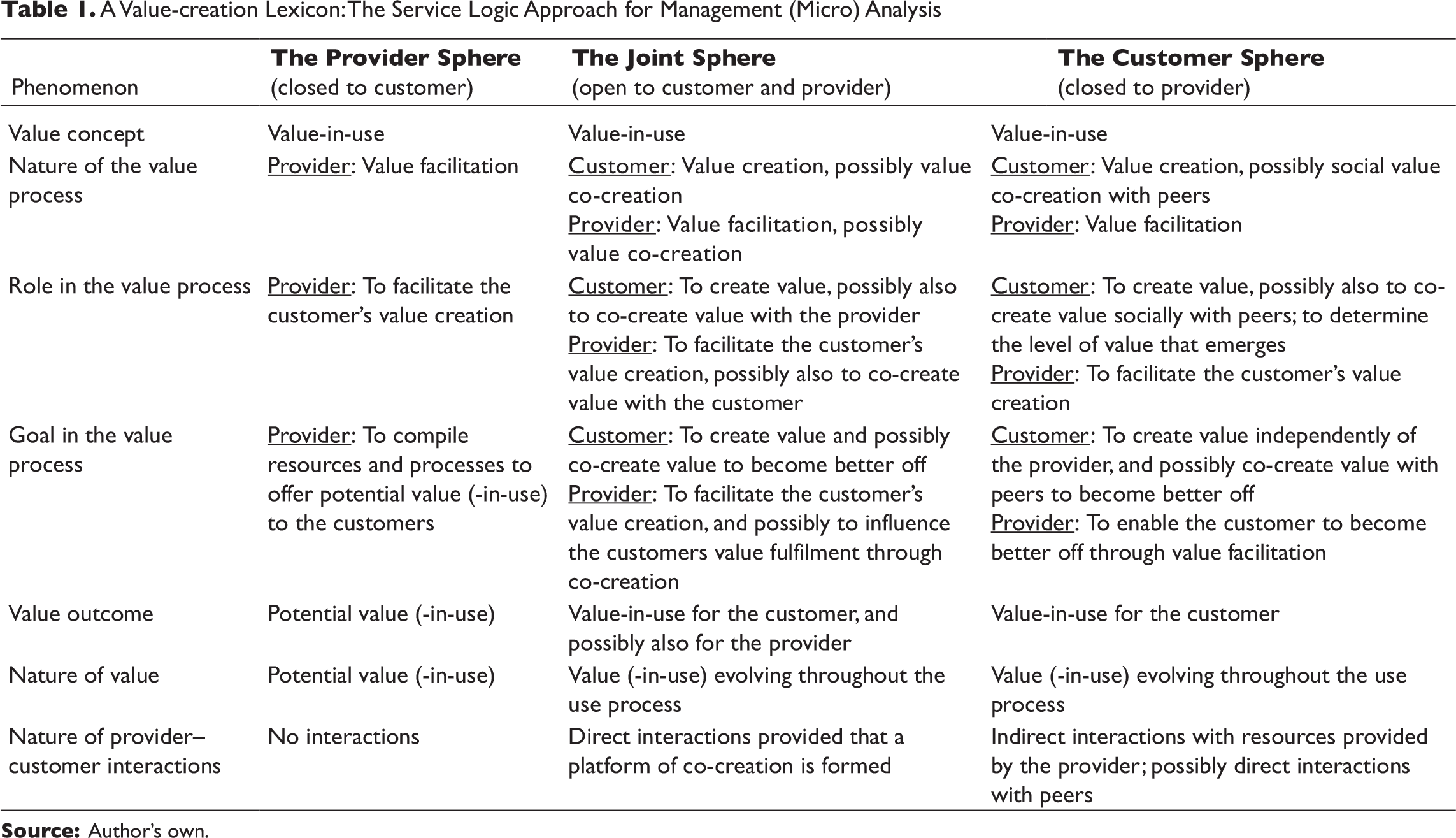
The Grönroos-Voima value model divides the process that leads to value for the customer into three value spheres, namely, a provider sphere closed to the customer, a customer sphere closed to the provider and a joint sphere (Grönroos & Voima, 2013). The model is illustrated in Figure 1. In each of the value spheres, the roles and goals of the provider and customer are different. It is noteworthy to observe that the roles of the actors may change, for example, when the customer as service provider offers feedback and other actionable information to the firm about how its processes could be improved. In such a case, the firm becomes the customer, as shown in Grönroos’s value co-creation model (Grönroos, 2012).

The spheres do not necessarily follow each other in a linear fashion as Figure 1 implies, and the value process can also be iterative. The value process can start with any of the value spheres. For example, a customer’s experience of the value of a holiday tour may begin independent of service providers through his or her mental processes of thinking of destinations, or it may begin during interactions with a travel agency’s office or web page, or when the customer, deliberately or accidentally, bumps into a travel agency’s ad. The experience can be of many different natures, for example, physical, cognitive, affective and emotional (Verhoef et al., 2009), and regardless of the nature of the experience, it may have a value implication for the customer. As the customer journey literature shows, firms and managers must understand the customers’ processes over time during the pre-purchase, purchase and post-purchase processes (Lemon & Verhoef, 2016). Such processes form a journey that may commence long before any actual physical contact between a customer and a service provider is established, and they may continue independent of the service provider, long after such contacts have ended (Norton & Pine II, 2013). The value process relates to this total customer process, and not only to specific touchpoints in the process, as the customer journey literature seems to suggest, but also to, for example, mental reflections between touchpoints.
The Closed Spheres: The Provider and Customer Spheres
In the provider sphere, preparatory actions to enable the customer’s value creation are taken by the firm, but since value as value-in use is created by the customer, no real value is created in this sphere. By compiling resources and developing processes, the firm develops an offering with the potential to be materialized into real value, not at the point of purchase, but as value-in-use during the customer’s consumption and value-creating process. According to SL, the firm’s role in this sphere is that of a value facilitator. The goal is to facilitate the value creation that takes place in the two other spheres. As Christensen et al. (2016) observe, customers have ‘jobs to be done’ (p. 57), and firms must find ways to be of assistance. In a marketing context, Schultz (2016) formulates this in the following way: ‘How can marketers identify the value that customers are seeking to create for themselves and then fill those “value needs”?’ (p. 157).
In the joint and customer spheres, the customer uses resources provided by the firm and integrates them with other needed resources. During this process, value evolves for the customer. In the literature, this is generally called value creation, but in reality, only sometimes is value created instrumentally. Often value emerges for the customer during the consumption process. Although the customer’s value creation takes place in both the customer and joint spheres, these two spheres include distinctly different processes, where the roles and goals of the actors differ.
In the customer sphere, the customer creates value independently of the service provider. The provider cannot directly influence the flow of the value process. The customer unpacks a clean shirt picked up at a laundry and puts it on, or drives a newly bought electric car proud to show off this environmentally friendly choice while driving to his or her destination, or hangs a new piece of art on the wall and feels good every time he or she looks at it or shows it to friends. Although the value process is independent of the firm, it is not necessarily totally independent. The customer may interact with peers on social media or in face-to-face contacts, and the value process may be influenced by these peer-to-peer interactions. In this way, social value co-creation may take place. The customer’s value-related goal in this sphere is to physically or mentally become or feel better off when using the resources bought.
The Joint Sphere: Value Co-creation Opportunities
In the joint sphere, the customer’s value creation is different. In this part of the value process, the two actors meet and interact with each other. In a restaurant, the guest and the waiter may discuss the menu and jointly try to find a solution satisfactory to the guest, or in a laundry, the service employee and the customer may get into a discussion about why a stain could not be fully removed. What may happen in such direct interactions, if the actors allow it, is that the provider’s and the customer’s processes—the firm’s service-providing process and the customer’s consumption and value-creating process—merge into one interactive, collaborative and dialogical process (Grönroos & Gummerus, 2014). The two processes become one, and a platform of co-creation (Grönroos & Gummerus, 2014) emerges. Such direct interactions can be both face-to-face interactions and interactions with smart technologies. If both actors are willing to do it and know how to do it (Kasnakoglu, 2016), the service provider may engage with the customer’s value-creating process and co-create value with him or her at this stage of the value process. If they do not want to or do not know how to do it, no value co-creation takes place, in spite of the existence of a platform of co-creation. In that case, the provider’s role is restricted to continue facilitating the customer’s value creation.
Thus, in the joint sphere, the role of the firm may be that of a value co-creator, where the firm’s goal is to, when needed and appropriate, actively influence the customer’s value-creating process and, thus, his or her value fulfilment. On the other hand, the customer’s role is to be the value creator and perhaps also a value co-creator with the provider. The customer’s goal is the same as in the customer sphere: to use and integrate resources with the aim to become better off. In the joint sphere, the actors may switch roles, and the provider becomes the customer and the customer becomes the service provider of, for example, actionable information and feedback. Viewed from below, from a managerial micro-perspective, co-creation only takes place in direct interactions, provided that a platform of co-creation is formed. In all other situations, the firm can only facilitate the customer’s value creation. This is, of course, not observable from above. Table 1 summarizes a value and value co-creation lexicon.
A Value-creation Lexicon: The Service Logic Approach for Management (Micro) Analysis
Measuring Value
The traditionally used value-in-exchange concept is easy to measure. Because such value is realized through purchase/sales, sales volume is often considered a measure of value-in-exchange. This is an accurate measure of the sales volume, but as what is bought in reality only includes potential value, that is or is not transformed into real value during use, this is a doubtful approximation of value for customers. Value as value-in-use is not as straightforward, and cannot be measured in one straightforward manner.
As demonstrated by Holbrook’s (1994) value typology, value can be perceived in many different ways. Value as value-in-use probably includes an emotional component on some level in most situations. In most B-to-C contexts, value is probably mostly or only a feeling or emotional perception. Such perceptions can only sometimes be measured in monetary terms, such as in the use of financial services. On the other hand, in B-to-B contexts, the use of offerings does have a direct or indirect impact on the customer’s commercial outcome. The offering may help the customer reduce costs in some of its processes or favourably increase the customer’s revenue-generating capacity through increased sales volumes or premium pricing. Although B-to-B value also includes emotion perceptions, for example relating to trust, comfort and attraction, as demonstrated by Grönroos and Helle’s analysis (2010), such commercial effects can be monetized and measured. However, this requires that enough trust exists between the supplier and the customer, and that they are prepared to share their cost and revenue drivers and calculate the effects of the supplier’s offering on the customer’s various processes (Grönroos & Helle, 2010).
In conclusion, value for customers as value-in-use can probably not be assessed with one single measure. In addition to monetary effects, in cases where such effects can be measured, a range of measures relating to how satisfied the customers seem to be with a service provider may be needed. Customer satisfaction, service quality and brand perception assessments are examples of such measures. Other types of measures include the length of customer relationships, customer base turnover and the customers’ willingness to pay, and also employee satisfaction and employee turnover, which often seem to mirror the customer’s attitudes towards a firm.
Marketing Implications of Co-creation: Beyond Offering Value Propositions
From the micro-vantage point, one also observes that the firm can do much more than only offer value propositions. If the actors’ processes indeed merge in the joint sphere into an interactive, collaborative and dialogical process and a platform of co-creation comes into existence, the firm has the opportunity to influence the customer’s value process and how this process develops, and in the end, the customer’s value fulfilment. Because this also may have an impact on the customer’s preferences and future purchasing decisions, it also has fundamental implications for marketing. In the service marketing literature, this part of the marketing process is called interactive marketing (Grönroos, 2015), and the service employees involved in it are termed part-time marketers (Gummesson, 1991). Contrary to how it looks from above in a macro-analysis, as demonstrated in SL, a central marketing implication of the service perspective is that firms are not restricted to make value propositions only. They can move beyond this restriction of conventional marketing models and also influence their customers’ value fulfilment and future purchasing behaviour (Grönroos, 2011). However, when the service perspective is studied from above based on observations of systems of actors, the nature of interactions remains hidden, and these service-logic conclusions cannot be drawn.
It is important for both top management and marketers to realize the width of a firm’s marketing influence on the customers. If they continue to plan and implement the conventional marketing activities, such as advertising, pricing, digital marketing and the like and sales as the only processes and activities that influence the customers’ brand perceptions, problems with low satisfaction with the firm and negative future purchasing behaviour, unsatisfactory brand experiences, negative word of mouth behaviour and discussions on social media, and other unwanted effects can never be avoided or turned around to positive effects. As a consequence, problems with maintaining a wanted sales volume and price level and problems to cope with increasing competition will continue.
Marketing planning, aiming at getting satisfied customer, lasting customer relationships, positive word of mouth and social media effects must be included in the planning of almost all processes of the firm (Grönroos, 2015). Marketing is not only one function anymore but also a customer focus among employees outside the groups of full-time marketing professionals. Therefore, marketing is truly a top management challenge today. The fact that firms indeed are not restricted to make value proposition only but can influence their customers’ value fulfilment through co-creation during direct interactions is an almost revolutionary implication for managers. Understanding this certainly matters.
Theoretical Implications
The micro-level analysis of the service perspective and its central value-creation phenomenon of SL offers both theoretical implications and advice for managerial decision-making. It avoids using metaphorical explanations, from which real-world prescriptions cannot be made, and it is based on a solid micro-foundation. The viewer is not restricted to only observe that many actors contribute to value but can analyse in which capacities and in what ways the involved actors influence the value process. The service provider’s value-facilitating actions can be distinguished from real co-creation, and value facilitation and value creation, the latter including co-creation, can be empirically observed, analysed and managed. How the firm’s and customer’s processes function in reality is the base of this logic.
It offers a rigorous foundation for theoretical analysis and theory development—for example, for further development of the understanding of co-creation and value co-creation in service and of the management and marketing implications of the value process. An important aspect is that SL is firmly grounded in the value-in-use concept and that it only uses one value concept throughout the value process. It does not jump between different concepts, such as value-in-use and value-in-exchange, because according to value-in-use, value exists and can be measured only in the customers’ processes and, consequently, does not exist before such processes have commenced; at the point of purchase, only potential value can exist. There is no value-in-exchange that can be assessed. What customers in a transaction pay for resources can and should, of course, be measured, but this measurement is related to sales, not to value for the customers.
Managerial Implications
Key Managerial Implications of the Service Perspective on Business and Marketing

Managers are advised how to distinguish between planning an offering and executing it, and to pay equally much attention to both. Planning the offering requires solid insight into the customers’ goals in life and business and into the everyday processes which enable them to reach such goals. Part of this planning process may also involve co-creation with customers, for example when customers are engaged with R&D or product/service development processes. However, mostly it takes place in the provider sphere without the presence of customers. Planning the offering aims to create a combination of physical resources, such as products and other tangible items, and processes, such as deliveries, maintenance, personal attention, service recovery and other service activities, and digital services through mobile and Internet interfaces, which by functioning well in the customers’ processes facilitates their value creation.
Planning Offerings to Facilitate Value
Traditionally, executing the offering is often given less attention. However, as explained by promise theory (Calonius, 2006), marketing is about exchanging promises and keeping promises by enabling value fulfilment. Frequently, executing offerings includes direct interactions with customers, and in such interactions, the firm should attempt to engage with the customers’ value creation. In other words, during direct interactions, managers should attempt to make the customers interested in letting the firm help them use the resources and processes provided as well as possible, and perhaps better than they otherwise would have been able to do. For the customers, this is co-creation. It enables the firm to move from pure value facilitation to co-creating value with its customers. However, co-creation opportunities must be forethoughts and planned carefully, not events that occurs as surprises to the managers and service employees.
Managing co-creation opportunities requires an open mind as to the content of offerings and the scope of marketing (Grönroos, 2011). Managers often say, for example, that service technicians and maintenance people are the firm’s best marketers, or, for example, that well-handled recoveries of service failures and quality problems are good marketing. However, far too often such statements remain talk and slogans only and do not lead to an extended understanding of the offering and of how to plan and implement such extended offerings. In spite of these statements and slogans, marketing remains within its conventional borders, and nothing changes. The service perspective, and especially the management-based SL approach, demonstrates that in order to help the customers to reach their goals in a value-creating manner, all everyday processes important to them, such as getting products in time, having maintenance done properly, getting service failures recovered promptly and getting nice and professional attention by service employees, must be successfully supported by the firm, either alone or with network partners. Hence, managers must realize that in the minds of the firm’s customers, the offering is broader compared to how it looks from the firm’s vantage point. For the customers, it is extended to include not only a product or core service but also all other processes which are essential to their value fulfilment. When planning how to facilitate the customers’ value creation, managers must take all such elements into account explicitly. This, of course, requires that the firm has acquired extensive and deep enough customer insight. However, first of all, it requires a broadened mindset.
Executing Offerings and Its Marketing Implications
The extended understanding of the offering has profound marketing implications, which takes marketing far beyond the common wisdom of conventional models. It informs managers about how to extend marketing beyond making promises to customers to also include promise-fulfilling actions during direct interactions with the customers (Grönroos, 2011). The efforts of a service technician and a maintenance engineer are indeed ‘the firm’s best marketing’, and as value-fulfilling actions, they are part of the marketing process. However, they are not full-time marketers and, as such, part of a marketing department. Their main task is to repair and maintain resources provided to customers, but as ‘part-time marketers’ (Gummesson, 1991), when doing their job, they have to pay attention to the customers and be able to communicate with them in a service-oriented and customer-focused way. In the service marketing literature, this is what is called interactive marketing.
Managers must realize that the support of the firm’s many part-time marketers is essential to the success of marketing and, consequently, that marketing is extended far beyond the marketing department. As Gummesson observed (1991), the part-time marketers often outnumber the full-time professionals several times. Moreover, they have direct customer contacts and are present when problems may occur or the customers may have questions to ask. The full-time marketers are seldom in that position.
Managers must accept that it is not enough to plan and manage the marketing activities and processes performed by the marketing professionals. They must pay equal careful attention to how the part-time marketers contribute to the customers’ perceptions of the firm and to their willingness to continue their relationship with the firm, that is, to how they perform in the firm’s total marketing process. However, the part-time marketers cannot be organized together with the full-time marketers responsible for traditional marketing tasks, and in the same way as they are organized. They belong to their own functions and departments. Hence, taking a service perspective, marketing cannot be totally organized, not in a traditional sense at least. The full-time marketers can be organized in their own groups or departments, but the part-time marketers marketing can only be instilled with a customer-focused attitude of mind. This means that well-functioning internal marketing is imperative to successful marketing. However, managers, and especially top management, must realize that internal marketing is a strategic issue as well, and not only a set of tactical activities (Grönroos, 2015).
Furthermore, it is imperative to understand that planning the activities and processes of the marketing department is not the same as marketing planning; it is only planning of the firm’s conventional marketing activities. The marketing aspects of how most business processes function must permeate the planning of those processes. Only then is the firm’s total marketing planned. This is a momentous managerial challenge.
The Marketing Implications of Customer-to-Customer Interactions
Finally, the value process of SL demonstrates the importance of customer-to-customer interactions in the customers’ value sphere. Marketers frequently say that there is no better marketing than word-of-mouth. The Grönroos-Voima value model shows that word-of-mouth indeed is important. In the customer sphere, the value process and a customer’s value creation may be influenced by social value co-creation with his or her peers. Traditional word-of-mouth through face-to-face contacts and C-to-C interactions digitally mediated by the many social media options that are available may even have a decisive impact on a customer’s value fulfilment and, consequently, also on his or her perception of the firm and its solutions, and on his or her future purchasing behaviour. Hence, face-to-face and digitally mediated interactions with a customer’s peers, and of course with other sources as well, influence, favourably or unfavourably, both resales and cross sales as well as sales to new customers (Rao, 2016).
With the growing options for C-to-C interactions and social value co-creation, managers must not neglect their marketing impact. However, managing this marketing task offers considerable challenges. Influencing traditional word-of-mouth in any direct way is more or less impossible. Presence on social media offers opportunities to engage with C-to-C interactions and should be used, but such interference with social media processes is easily considered negative intrusion and must be handled with utmost care. Managers must understand that, in the final analysis, the only working and safe way to manage the marketing impact of word-of-mouth and other C-to-C interactions is to constantly offer impeccable service and to avoid failures and mistakes (Grönroos, 2015).