







Abstract
Abstract
Most of the studies about value creation have been focused on economic and social value. To create value, it is necessary to have a holistic vision that integrates economical, psychological-social and ethical aspects. Likewise, studies have concentrated on the role of top management through the formulation of new strategies, implementation of new technologies, operational models, etc. The influence of supervisors, the first line of command, has not sufficiently been identified in relation to value creation.
Some studies have analysed climate and culture as important factors for employees’ well-being, satisfaction and engagement but little attention has been paid to creating value. We analysed how supervisors strengthen climate and culture in order to create three types of value: ethical, social and economical.
As value creation is a social event always co-created, we utilized an organizational model to present a holistic view for creating value. We collected data from 129 supervisors of large and medium companies through semi-structured interviews to know their perspectives related to: (a) creating employees’ experiences and (b) sharing corporate values. We identified the influence that supervisors exert in relation to climate experiences and corporate culture values, executed a programme for developing a leadership focused on creating value and applied a survey to verify the results achieved.
Introduction
The company’s job is to create superior value for customers in the customers’ mind (Kotler, 2017). We understand customer value as a set of benefits that are delivered versus the price and cost/effort to use them. The customer value equation has two basic numerators: the result the customer expects to obtain and the quality of the experience. These are the benefits contrasted to the price and the cost/effort to obtain them. One of the key levers of value in companies is the definition and delivery of the overall experience for customers as well as for employees (Heskett, Sasser, & Wheeler, 2008). We focus on experiences as crucial factor to deliver both high value and low cost/effort. To create successful experiences for customers, one must first build positive experiences for employees (Mears, 2004). To create experiences for employees, some requirements are needed: (a) capability to deliver value to customers and (b) quality of work life (Heskett, Schlesinger, & Sasser, 2015).
Our questions are: Who create experiences that contribute to generating value for employees? How can they generate that value? Researchers argue that if experiences encourage ownership for employees, the creation of value for customers and their satisfaction/loyalty is favoured (Heskett et al., 2008). Hence, for generating experiences that produce ownership, we have to analyse the psychological–social and ethical needs/expectations that employees manifest in order to foster an attractive and deeper relationship with the company. This way, employee experience must be related to psychological–social–ethical aspects for generating the strongest benefits: meaning of work, learning, satisfaction and loyalty of employees. These benefits cannot be delivered through economic policy, and they favour the economic result for the company as an effect. Companies usually focus on economic value but fail in connecting human aspects: psychological–social, cultural and even ethical. The connection of these aspects is essential to create value, and this is not only achieved through policies/procedures and disruptive technologies but essentially also through consistent behaviours forged by the influence of those who lead at different organizational levels.
Supervisors strongly contribute to the creation of employees’ experiences and thus guide their behaviours/efforts to generate customer value. We define the level of supervision as the basis of middle level, the first line of command. Middle managers, bosses and supervisors are the catalysts of high performance of service employees (Lescano Duncan, 2011), and supervisors, being closer to them, constantly influence their experiences. Human resources policies are necessary but not enough. Middle managers contribute to create value for customers through the orientation of employees’ talent and attitude (Lescano Duncan, 2019), so these managers must provide consistent guidance to supervisors because they in turn orient their subordinates.
We propose the creation of value from a holistic view using a model that allows us to understand the different dimensions that supervisors face. It also lets us analyse how they should create experiences for their subordinates and strengthen the connection among economic, technological, social and ethical aspects in each work team. Value is always co-created because value creation is a socially rooted event (Vargo, Akaka, & Vaughan, 2017); therefore, social and cultural contexts are essential in terms of what value is and how it is created (Akaka, Vargo, & Lusch, 2013). Thus, climate and culture are key social dimensions that are interconnected and influence actors’ behaviours in organizations, as they are also influenced by them. Climate and culture are those foundations in which any key issue is developed within the broader domain of organizational behaviour (Ashkanasy, Wilderom, Peterson, & Mark, 2011). Therefore, it is necessary to analyse the relationships that supervisors maintain with actors for co-creating value.
We identified the problems faced by supervisors and their main needs to: (a) create experiences/behaviours which we consider as focused climate and (b) share corporate/ethical values to generate commitment, which we consider as culture. We used qualitative interviews and survey methodology to determine the reality of supervisors’ work in creating value. Our purpose was to prepare them for strengthening climate and culture in order to create value for employees. The study was conducted between 2014 and 2018, with 129 supervisors of local/international companies.
The Influence of Supervisors
First studies have shown the influence that leadership has on the creation of organizational climate (Campbell, Dunnete, Lawler, & Weick, 1970; James, James, & Ashe, 1990; Lewin, Lippit, & White, 1939; Litwin & Stringer, 1968); however, they did not analyse the role of each organizational level. Fleishman emphasized the boss’ influence on foreman (Fleishman, 1953). McGregor (1960) studied the climate created by supervisor–subordinate relationship, but not for a specific climate. Another study argued that leaders are the source for creating an atmosphere in order to achieve the work done (Likert, 1961). Gilmer (1961) verified that foremen can have more impact than executives. Forehand and Gilmer (1964) identified leadership patterns as one of the important descriptive variables of climate dimensions. Several climate dimensions were proposed, including the proximity of supervision (Forehand, 1968). These studies refer to generic leadership for creating a climate of well-being in order to get better performances, but without a specific orientation of employees’ behaviors and learning. A generic, also called molar, climate has been described as the shared meaning that employees give to the policies/practices/procedures they experience and the behaviours they see that are rewarded, supported and expected (Ehrhart, Schneider, & Macey, 2013).
Other studies have analysed focused climates through leadership oriented towards a particular issue: security climate (Barling, Loughling, & Kelloway, 2002; Zohar, 2002), ethical climate (Mayer, Kuenzi, Greenbaum, Bardes, & Salvador, 2009), climate of diversity (Herdman & MacMilan-Capehart, 2010), climate for initiative (Baer & Frese, 2003; Michaelis, Stegmaier, & Sonntag, 2010), and service climate (Ehrhart et al., 2013), among others. Researchers have demonstrated through several studies that the generic nature of climate is not useful for predicting specific results (Ehrhart et al., 2013), which means that it is more effective create focused climates. The focused climate is understood as the meaning that people at work relate to what they perceive is the focus required for their competencies and energies (Schneider, Macey, & Young, 2006). Focused climates can be divided into two categories—strategic climates and processes climates—the first signalling the degree to which the internal environment emphasizes a specific strategic outcome and the second focused on internal processes that occur as part of the daily functioning of the organization (Ehrhart et al., 2013).
We analysed a climate for creating value that requires the alignment of both categories, as it must be focused on strategic result through internal processes. Hence, it is necessary to use an integrative approach that adequately connects the external strategic–economic aspect with the intra-strategic aspects: psychological–social, cultural and ethical. For this, it is crucial to have a leadership that conducts such integration at each level, not only at the top level. Processes climates do not cause strategic climates but provide the basis on which they can be built (Ehrhart et al., 2013). The great responsibility of middle managers, bosses and supervisors is to connect strategic goals with technological–operational processes through a leadership focused on the creation of three types of value—economic, social and ethical—in each unit (Lescano Duncan, 2019).
Researchers found that a service leadership communicates a high commitment to high levels of service quality, thus contributing to the creation of a service climate (Schneider, Ehrhart, Mayer, Saltz, & Niles-Jolly, 2005). When middle managers developed a service leadership, they contributed to creating a service climate that in turn promoted the generation of value for employees (Lescano Duncan, 2018). Supervisor is the immediate source of information about the behaviour from which employees derive their opinion from organizational goals and policies (Mayer, Nisshil, Schneider, & Goldstein, 2007). Undoubtedly, the influence of a focused leadership starts with the top management, but must be consolidated at the following levels.
‘Culture is created, rooted, evolved and manipulated by leaders’ (Schein, 2010). Culture can be understood as a world of experiences learned and shared, as well as meanings, values and understandings that inform people and which are expressed, reproduced and communicated in part in a symbolic way (Alvesson, 1993). However, the essence of culture is not in the values that leaders and organizations communicate, nor is it in its so-called symbols or artefacts (rituals, dresses, stories, language, etc.); although these are part of the culture, the essence is in the pattern of basic assumptions not easy to discover (Schein, 2010). We use the term real convictions and values 1 to refer to the essence of culture, as they exert the main influence on employees’ behaviour. Hence, leaders at the supervision level are a fundamental factor for sharing real values/convictions with subordinates and thus strengthen a specific culture in each unit.
The real/strong values/convictions come from top managers, but middle managers, bosses and supervisors also have their own convictions/values and assume different positions against the cultural force that comes from the top (Lescano Duncan, 2017). Therefore, much of what happens in an organization can be better understood as a set of sub-cultures operating within the larger context of the organizational culture. These sub-cultures reflect: their functional tasks, the occupation of their members and their unique experiences (Schein, 2010). However, the supervisors–colleagues relationship is also important as the most experienced of supervisors can show ways to do and coordinate the job, and influence the environment for co-creating value.
Leadership communicates culture through various actions—measurement, control and providing a role model—which indicate the orientation in relation to strategic goals (Yagil, 2014). Thus, when taking actions, leaders connect culture with climate, and it demonstrates that climate is a manifestation of culture (Schein, 2010).
Service-Oriented Model
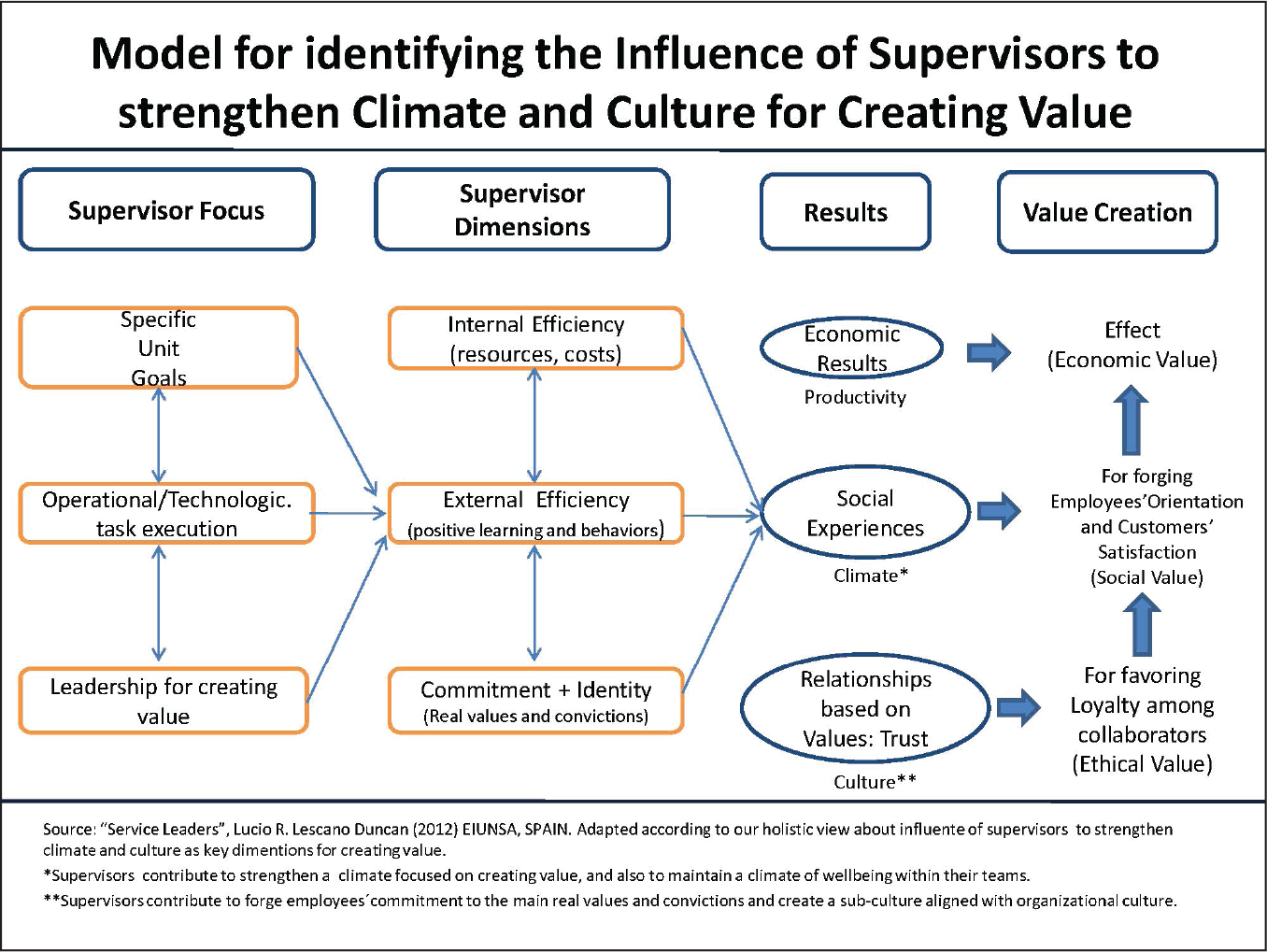
To analyse the main dimensions of supervisors’ work, we use a service-oriented model that connects external strategic with intra-strategic aspects, that is, expected results with expertise for technological–operational tasks, and both with real shared values/convictions (Lescano Duncan, 2012). 2 This facilitates the connection of the three aspects for creating value—economic, social and ethical—which are driven by leaders at the supervision level. In this way, it is possible to forge experiences, behaviours and relationships to promote the co-creation of value for employees and customers with an orientation towards: what should be achieved (economic aspect), how it is achieved (psychological–social aspect) and why it is achieved (ethical/corporate aspect).
In Figure 1, we see supervisors’ focus on three central issues on which they should put their energies: (a) achieve specific goals to obtain external strategic results; (b) execute technological/operational tasks with collaborators; and (c) exert an oriented leadership for aligning economic, social and ethical aspects. To this end, supervisors have to manage three dimensions: (a) promote internal efficiency by properly using resources/costs; (b) foster external efficiency through positive learning that increases the ability to produce and deliver goods/services to internal/external customers; and (c) forge commitment and identity of subordinates. Thus, supervisors contribute to achieving: (a) strategic results and productivity—economic value; (b) social experiences and behaviours that strengthen climate—social value; and (c) relationships based on real values/convictions that strengthen culture and trust among employees—ethical value. The ethical aspects favour loyalty among collaborators and customers, which is the main force to keep solid relationships for co-creating value through attractive social experiences. This way, it is viable to promote positive learning and thereby foster this focused climate that in turn contributes to customers’/employees’ satisfaction.
Model for Identifying the Influence of Supervisors to Strengthen Climate and Culture for Creating Value
Methodology
In the first stage of our work, interviews, related to climate and culture about the main problems supervisors face to create experiences/behaviours and to share values/convictions, were held. The question about their needs was: What are the skills/behaviours you need to develop for creating experiences/behaviours and for generating commitment to corporate values and forging identity? Then, the second stage—analysing data captured and preparing guidelines for developing leadership skills/behaviours—was carried out. In the third stage, a 64-hour programme was executed and individual coaching sessions were scheduled with certified coaches. In the fourth stage, a survey was applied to all participants. In the questionnaire in Appendix A, we see main results about skills/behaviours developed, leadership for generating employee value, actions they are taking to: (a) create experiences/behaviours; (b) foster commitment; and (c) improve relationships with collaborators, factors affecting their efforts, and what they expect from their boss to strengthen climate and culture.
We applied semi-structured interviews to 129 participants of our Effective Team Leaders Programme for analysing their perspectives/motivations (open-ended questions). Participants maintained the position of supervisors in an area/unit: 31 per cent Operational, 25 per cent Customer Service, 19 per cent Sales, 18 per cent Administration and 7 per cent Human Resources/Systems. The majority of participants (74%) had a professional career or were studying for one, and 26 per cent had only technical studies or unfinished studies. We had six groups of 18 supervisors each, and one group of 21 supervisors. We conducted a survey on 115 participants who met the requirements to verify the results achieved.
We followed techniques/procedures required for these methodologies (Malhotra, 2008). According to the number of participants, for processing quantitative and qualitative information, we used the appropriate functions of Excel programme, ensuring the quality of work through analysts with the required knowledge and experience. We highlight responses that were indicated by more than 50 per cent in each group.
Results
Regarding the main problems they face in creating experiences/behaviours, the majority of supervisors from all areas expressed that a big problem is to understand the needs of subordinates. They emphasized that it is difficult to lead them if their abilities and qualities, or even problems, are not sufficiently known. They also said that the real challenge is to motivate them for observing specific behaviours to efficiently achieve the team’s goals. Most supervisors from Administration and Customer Service pointed out that when they do not assign tasks with equity and do not give empowerment, employees feel overwhelmed or show no interest in solving problems and learning more. One supervisor said: ‘I must better understand concerns and needs of my subordinates to be able to effectively guide their talent and behaviour’. Another supervisor said: ‘a critical issue is not to give them the opportunity to develop their potential and it requires dedication and perseverance’.
On the other hand, most of them manifested that a relevant problem is not achieving empathy with subordinates and not showing patience to guide and support them when they need it. One participant mentioned: ‘If I’m not patient and do not control my impulses when facing a problem caused by someone, a tense and negative atmosphere is created’. Sales supervisors stated that their problem lies in the high pressure created from their boss for achieving economic results, which produces a very tense environment. They also pointed out that when they do not receive the information and colleagues from other units show little collaboration, they face problems with customers. A supervisor said: ‘a constant pressure and little stress management of my boss do not favor high performance and efficiency of my subordinates’. Another said: ‘some colleagues do not show commitment to serve customers and do not show speed to provide information and solve problems as a team’.
The majority of supervisors in Operational areas expressed that when they do not devote enough time and attention to the ideas/suggestions of subordinates, they give little importance to learning. Also, when they do not listen and do not attend to the initiatives of their subordinates, and they do not promote their participation to solve problems, misunderstandings and omissions occur when executing tasks and it has an impact on efficiency. Thus, they pointed out that when they do not promote a fluid dialogue, they observe a lack of collaboration and weak efforts to achieve goals. A supervisor said: ‘I should not let myself be influenced by prejudices or past negative experiences and carefully listen to everyone encouraging greater participation’. Another mentioned: ‘I should not miss informal communication opportunities in order to capture any idea for improvement and motivate people to propose changes and suggestions’. Another said: ‘I have to be more persistent to capture any improvement proposal for making the work more attractive and achieve more efficiency optimizing the process’.
Supervisors from all areas commented that if they do not generate new challenges and do not align the team goals with personal goals, it is difficult to create positive experiences and encourage better performance behaviours. They strongly emphasized the need to develop abilities and qualities of their subordinates for strengthening a climate of learning and cooperation.
About the main problems they face in sharing corporate values, supervisors mostly mentioned that if they do not act by giving example and fostering values among their team members, it is hard to build a true commitment. They pointed out that when their actions do not show consistency with company’s values, it is not possible for them to share those values. All agreed on the need to show ethical behaviour as the pillar of their efforts. A supervisor said: ‘It is essential that each supervisor interact with their subordinates showing responsibility and commitment to principles and guidelines of the company’. Another said: ‘If I do not show self-control in stress situations and let myself be influenced by bad moments I cannot make right decisions or give correct example’.
The majority of supervisors from Operations and Customer Service pointed out that the problem is focusing only on operational tasks while forgetting the influence of corporate and ethical values in the day-to-day activity. Supervisors manifested that when workers are not valued and their effort is not recognized, it is difficult that they show behaviours according to company’s values. A supervisor said: ‘Bosses should eliminate double messages and show consistency between their words and actions behaving in accordance with corporate values’. Another supervisor mentioned: ‘We must consider the worker as the main asset and source of profits generation and so seek his constant personal motivation’.
Supervisors in general indicated that trust in relationships with subordinates is a key aspect to achieving their commitment/identification with the team and organization. In that sense, they highlighted that not being sensitive and not meeting the needs of each employee does not favour trust to foster behaviours according to corporate values. A supervisor said: ‘If I do not analyze my decisions and actions and affect the values I’m asking to show, I do not generate commitment in the members of my team’. Another said: ‘If I do not constantly foster values and allow unethical behaviours, I cannot build trust with my collaborators’.
Supervisors indicated that the ability to listen and emotional balance are the main skills they need for creating positive experiences. They also pointed out empathy, team integration and flexibility. One participant said: ‘I need to listen with empathy and dedicate more time to subordinates to understand and know how to guide them’. Another supervisor said: ‘I need to be aware of my reactions and show self-control to create a flexible and collaborative environment’. Customer Service and Sales supervisors emphasized that customer orientation, empowerment and feedback are necessary for forging learning in their subordinates. They said that new technologies facilitate constant coordination and feedback but it is important to identify situations that require personal contact. One supervisor mentioned: ‘It is necessary to understand the problems of internal/external customers to give them effective and personalized solutions, and virtual or personal support when they need it’. Another said: ‘The way to go ahead and achieve results is giving empowerment and feedback to my subordinates accompanying them through the process’. Supervisors from Operations and Administration highlighted leadership and teamwork as crucial skills. A supervisor said: ‘I must align the goals of my people with those of the company and encourage participation and cooperation in my team’. Another manifested: ‘It is essential to ensure that everyone has the conviction of working as a team and trusting the competency of others’.
On the other hand, most of the supervisors expressed that being constant and giving consistent reference are essential behaviours for generating commitment/identity. A supervisor said: ‘If I’m consistent with my actions and words, I can commit team members’. Likewise, supervisors in general pointed out that showing sincerity and justice creates trust for human relationships. Supervisors from Operations, Customer Service and Sales emphasized the need to develop objectivity and resilience as relevant behaviours. A supervisor mentioned: ‘I need to make decisions with more objectivity and being fair to build trust’. Another said: ‘It is vital to learn how to be a reference according to company’s values so subordinates can identify with them’.
Discussion
Supervisors apply practices/procedures and support certain behaviours so they build a meaning that is shared for employees. According to literature, each level of command influences the creation of climate, and the level of supervision can have a greater influence on workers than the executive level. To us, proximity and closeness of supervisors with their subordinates is a key aspect. Now, proximity is not just physically but virtually, so supervisors become influencers for generating constantly efficiency/learning in their collaborators. However, supervisors have to learn how to influence. If they constantly preach and foster a concrete issue, it reflects the strength of a climate. 3 Therefore, their influence is demonstrated in how they apply practices/procedures and how they reference specific behaviours for subordinates. It is a crucial step to build capability to deliver value to customers and strengthen the climate. Thus, we identify basic components that supervisors must take care of: (a) practices/procedures they transmit and (b) behaviours they foster. Employees live an experience by complying with practices/procedures and behave in one way or another according to the orientation/support and latitude they receive to perform their tasks. Supervisors promote internal efficiency (right use of resources) and external efficiency (orientation/learning to serve customers) which favour the consolidation of climate. In Figure 1, we observe that supervisors’ work is focused on the achievement of unit goals, and for this purpose their subordinates carry out specific tasks. There, we identify the supervisor’s influence: how his or her subordinates experience practices/procedures he or she transmits and how subordinates perceive the specific behaviors he or she supports. This influence is vital because it affects the expected effect: the achievement of unit goals—the economic result. Thus, it is necessary that supervisors understand and care for the psychological–social human reality that members live through experiences and behaviours that they foster in each group. Here, the motivational aspects of employees are included (recognition for delivering value, personal development, satisfaction and commitment), as well as the interpersonal relationships they maintain (with boss, colleagues, subordinates). In other words, supervisors forge the quality of work life by fostering an environment that contributes to professional/personal development of subordinates and their emotional health as core benefits.
Through the qualitative interviews, most of supervisors said that the main issue is to clearly know the needs, capabilities and attitudes of their subordinates. It is a priority in order to guide their teams for applying certain practices/procedures. If supervisors know well the needs of their subordinates and adequately attend to them, it is possible to generate an influence. Supervisors also emphasized that it is vital to align subordinates’ goals with the goals of the unit in a way that favours personal motivation, efficiency and learning. Some studies have demonstrated the relevance of this practice (Maister, 2001), that it facilitates the assignment of tasks and generates employee satisfaction in challenging environments. Other studies have shown that performance improves when the immediate boss tries to align workers’ talents with the goals of the company and with the needs of customers (Buckingham & Coffman, 1999). Although climate can generate personal satisfaction, its orientation is not that but fundamentally to provide a meaning of the environment and drive certain behaviours for achieving concrete goals and generate positive learning. If this learning is consistent and constant, it is possible that supervisors strengthen a specific climate.
Studies that we analysed have focused on combining various factors for influencing the creation of climate, considering leadership as essential. First studies analysed a generic climate with leadership creating a positive environment but without specific behaviours. Other studies examined focused climates, which promote specific experiences/behaviours through a leadership oriented on specific issues. But these climates aim at specific issues without consistent alignment with the entire organizational functioning. The basic characteristic of a climate focused on creating value is the consistent alignment between procedures/practices/technological systems and behaviours centred on internal/external customers for generating value to all involved. It requires a harmonic integration among different practices/dimensions that is viable with a leadership focused on the complete vision to create value. It understands the holistic functioning and repercussion of the experiences and learning, and it is devoted to consistently generate benefits for human beings—ethical, social and economic—as an effect.
In that sense, supervisors stated that their lack of empathy and trust in relationships with subordinates affects their effort to foster appropriate experiences/behaviours to achieve unit goals—economic value—and efficiency/learning-—social value. Supervisors pointed out that the only factor of transmitting procedures/practices is not enough, that it is necessary to generate confidence for solving problems and contribute to orient tasks. They also added that trust is crucial for assigning important issues to subordinates and distribute workload in a fair manner. Sales team supervisors highlighted that a high pressure to achieve economic results impedes them in providing positive experiences to subordinates. Supervisors from operational areas mentioned that when they do not pay attention to the ideas/suggestions of their subordinates, their motivation is low and they do not show additional efforts to achieve goals and positive learning. Hence, when they do not listen frequently or do not attend to recommendations, employees do not behave according to expected behaviours.
In general, supervisors said that when they do not give recognition to collaborators and do not help to develop subordinates’ capabilities, it is difficult to generate enough motivation for fostering specific behaviours. Supervisors express as their main challenge the effort to build and maintain interpersonal relationships with subordinates. When supervisors fail in effectively managing relationships, they face hard difficulties for creating adequate experiences and fostering expected behaviours. Sales supervisors included the negative influence of their boss and poor collaboration of colleagues as obstacles. It demonstrates that a supervisor should build positive relationships not just with subordinates but also with their boss and colleagues in order to strengthen certain behaviours for co-creating value. The generation of value requires all actors to be aligned with the same and entire vision.
In relation to generating commitment/identity, most supervisors said that when they do not give a specific example of these values, it is very difficult to share them with subordinates. They added that when they carry out actions that are not consistent with those values, it is not possible to forge employees’ commitment. Hence, when they do not give importance and do not reinforce ethical values when facing special situations, trust is weakened. Thus, their main problem is not building relationships based on trust for forging identity.
Supervisors from Operations and Customer Service indicated that they cannot forge commitment when they are only dedicated to orienting operational/technological tasks. They considered it essential to become a clear reference for applying corporate values and use every occasion, even through virtual tools, to reinforce behaviours.
In Figure 1, we note that leadership is the basis that sustains and forges commitment/identity through its ability to share real values/convictions, which in turn determines relationships based on trust. This is possible if the supervisor is a consistent reference of values that he or she observes in top managers and his or her boss reinforces in the unit. In turn, the supervisor includes his or her own values/convictions, which should be consistent with the values that come from higher levels. This way, in each decision/action, the supervisor communicates in a real/coherent manner that facilitates him or her to strengthen the culture in his or her team. Hence, each supervisor can create a sub-culture according to the occupation/function and unique experiences in each team. A sub-culture is also created at the level of supervision, forged by most experienced supervisors (Schein, 2010), which influences the relationship among supervisors–colleagues, and this reality can strengthen the organizational culture or not. 4 In each group, the supervisors’ focus on what they are interested to achieve and foster/share determines the type of leadership they assume, so it is a key aspect to forge a consistent influence for consolidating a culture in each group. That way, they can strengthen a climate aligned to that culture. A supervisor leader focused on creating value is devoted to effectively achieving results in each dimension of the model that lets him or her deliver value to employees and customers—relationships based on trust and loyalty that favour social experiences and behaviours with efficiency and positive learning that in turn facilitate the achievement of economic results. Through this holistic vision and integrated effort, supervisors can maintain a climate of well-being and strengthen a climate focused on value creation based on a sub-culture that appropriately aligns operational/technological processes and strategic results. Hence, they lead through a harmonic alignment between operational/technological issues and external strategic goals, and between operational/technological issues and psychological/social/ethical aspects.
Supervisors indicated some skills/behaviours they need to develop active listening, emotional balance, empathy, flexibility and the ability to integrate teams. Additionally, Customer Service and Sales supervisors identified customer focus, empowerment and feedback. Supervisors from Operations and Administration identified leadership and teamwork. They also mentioned the need to show sincerity, justice, resilience/patience and objectivity in order to generate commitment/identity. These are personal/soft qualities that reinforce ethical value and build trust/loyalty as a key factor in relationships among collaborators. The ethical aspect at the supervisory level deserves special attention because it constitutes the solid base that favours experiences between employees and customers and contributes to promote social value, which facilitates the achievement of goals in each unit—promoting economic value. When supervisors are not interested in developing their personal qualities related to social and ethical aspects, they can generate actions that affect employees’ motivation and produce a negative learning that in turn can destroy the co-creation of value. Frequently, companies are not aware of the personal qualities supervisors need to develop, and so they do not help them acquire it.
At the end of the process, supervisors stated that they developed skills/behaviours they needed and so are forging a consistent leadership for creating value (see Appendix A).
Supervisors are carrying out specific actions for creating experiences/behaviours; thus, their relationships with subordinates have improved. Also, they are taking actions for improving relations with colleagues, and so facilitating coordination/collaboration and teamwork for co-creating value.
Supervisors indicated that policy and company’s orientation are the main factors that affect experiences/behaviours—climate—(55%) and commitment/identity—culture—(79%). Also, they include attitudes/behaviours of collaborators (54%) for climate, and style of the supervisor’s boss (67%), practices/customs rooted in the organization (56%) and the supervisor’s attitude/behaviour (51%) for culture. It indicates the lack of clear guidelines from the top and middle levels and enough latitude to adequately conduct orientation in each group. Hence, cultural influence descends from the top and continues from the middle-level boss. If there is no consistency in this chain connection, it will be hard for the supervisor to share real/corporate values/convictions. If supervisors cannot harmonize their values/convictions with them, it will be difficult to consolidate a culture in each group.
Supervisors from each area have their own convictions/values according to their occupation/functions. Those from Operations emphasized their effort to improve processes and increase internal efficiency, while those from Customer Service and Sales focused on customer experience, external efficiency and the need to empower staff for solving customer problems and personalize interactions. As each supervisor is focusing on his or her own function, it is an obstacle for co-creating value, but if supervisors from all areas share common convictions/values and consolidate a sub-culture of supervision aligned with organizational culture, the co-creation of value among colleagues at this level will be viable.
Finally, supervisors expect fluid communication and closer relationships with bosses, and coherence between values and behaviours their bosses show, in order to strengthen climate and culture.
Managerial Implications
We consider that real values/convictions that come from top-managers should be aligned with the real values/convictions of middle-managers, and also those values/convictions from middle-managers should be aligned with values/convictions of supervisors. We believe that this alignment is the solid path to connect strategic climates with processes climates. In our study, we learned that many companies maintain a weak relationship between top and middle managers, so it is difficult for middle managers to conveniently support supervisors in co-creating value. Supervisors are the decisive factor for executing processes to achieve strategic results. Hence, they have to forge a focused climate and sustain it through a coherent culture. Now, digital organizations require consistent leadership to cascade down for fostering a new climate/culture characterized by innovation, diversity, efficiency and learning. Thus, first, top managers should reinforce their relationship with middle managers and orient them according to what they expect middle managers do with supervisors.
Second, top managers should understand the relationship of bosses–supervisors for facilitating the development of specific skills and personal/soft qualities they need to co-create value according to the strategy but through a holistic vision (emotional, social, corporate and ethical), not just the operational/technological or economical vision. Thus, middle-manager-bosses should know and support specific supervisors’ skills/behaviours that clearly contribute to creating customer value through frontline/back office employees’ performance, identifying behaviours that destroy it. Bosses should identify critical aspects that supervisors face, allocate enough resources and let them propose, decide and implement convenient improvements in operational processes, forging latitude. Bosses should also understand the relationship supervisors maintain with subordinates for detecting some attitudes/behaviours that can destroy the value their teams are creating. Bosses should dedicate time and support to reinforce the emotional and ethical aspects in interactions with supervisors, orienting them to do the same with collaborators.
Third, top managers should attend to supervisors’ needs/concerns through better-prepared/-oriented middle-manager-bosses in order to facilitate activities for integrating collaborators and contribute to personal development and leadership, which is an essential expectation of supervisors. This way, it is viable to eliminate practices that affect supervisors’ efforts to share corporate values and generate commitment and identity with the organization.
Fourth, top managers must understand how to align the organizational policy through social, corporate and ethical issues in order to give the meaning of work for supervisors, so they can foster experiences/behaviours for achieving economic results as an effect.
Fifth, middle-manager-bosses should act with coherence in order to build a relationship based on trust with supervisors for forging an aligned climate/culture that favours the co-creation of value. For strengthening climate, bosses specifically should foster feedback and promote dialogue for capturing ideas and solutions to new customers’ problems/requirements. Through new technologies, it is possible to exchange ideas and proposals quickly and easily regardless of the place employees are working. For strengthening culture, bosses should show consistent behaviours according to corporate values and recognize supervisors/employees who behave according to ethical/corporate values.
On the other hand, supervisors must understand the attitudes of subordinates, and they must not only focus on the work subordinates are doing but also know how to handle their relationships with them, trying to focus on subordinates’ goals and not just unit goals. Supervisors should create a focused climate according to the tasks/goals/challenges in each work team and harmonize relationships with colleagues for reinforcing a culture of collaboration/efficiency.
Human resources departments should profoundly analyse the reality of the supervisory level for determining the specific actions and support supervisors’ need for strengthening climate and culture, not just prepare them in the technological/operational aspect.
Finally, it is important to evaluate how supervisors’ influence should be adjusted, through the use of new cognitive technologies to determine their impact on efficiency (internal/external), learning and commitment in each work team, as these are key supervisor dimensions for creating value.
Conclusions
Creation of value requires a holistic vision to connect operational/technological work with the strategic dimension, and operational/technological work with ethical/social aspects. If supervisors strengthen culture and climate, they strongly influence strategic, operational/technological and human aspects for creating value.
Supervisors should promote the well-being and focused climates that favour innovation/efficiency, learning and satisfaction of employees. Thus, they can create social value that foster value for internal/external customers. That is the route of their influence to achieve productivity and to generate economic value.
Supervisors should focus on the consolidation of a sub-culture that drives certain employees’ behaviours and commitment. This way, they can strengthen a climate for creating value, reinforce organizational culture and contribute to the co-creation of value with collaborators.
The model used allowed us to order the supervisory work: goals to achieve (economic value), how to achieve them (social value) and why achieve them (ethical/corporate value). This way, it was possible to orient/develop skills/behaviours required by supervisors for exerting a leadership focused on creating value.
Our study has included supervisors from certain organizational areas of large and medium companies. It limits our conclusions for other profiles of supervisors and sizes of companies.
Footnotes
Declaration of Conflicting Interests
The author declared no potential conflicts of interest with respect to the research, authorship and/or publication of this article.
Funding
The author received no financial support for the research, authorship and/or publication of this article.
Notes

Appendix A
1. What skills/behaviours have you developed to strengthen an environment of efficiency and learning (climate), and commitment and identity (culture) in your work team? (In stages 1, 2 we identified skills/behaviours supervisors need to develop for handling problems they face related to climate and culture. In Stage 3 they developed specific skills/behaviours.)