







Abstract
The Journal of Creating Value (JCV) is a Scopus-indexed, peer-reviewed journal that has been published since 2015. Over the last decade, JCV has played a pivotal role in enhancing knowledge creation and sharing among academia and practitioners in its chosen field. This study is an attempt to map the contribution of the journal in terms of classifying impactful authors, current and evolving trends and themes, and set a direction for future researchers and practitioners. The review of the articles published was performed using bibliometric analysis and techniques. A total of 165 articles published during the years 2015 up to 2023 were part of the scope of the study using the Scopus database. Open-source visualization software VOSviewer was used for analysis. Performance analysis and science mapping techniques were employed, and the findings indicate five major themes/clusters. Thirty per cent of the publications are from the USA. Other contributing countries include India, Germany, the Netherlands and the UK. Overall, there are significant global contributions as well. Insightful trends and themes in the field of creating value are documented, which could be a useful resource for prospective researchers.
Introduction
The Journal of Creating Value (JCV) is published by Sage Publications. The founder editor of JCV is Gautam Mahajan, and the journal is promoted by the Customer Value Foundation. The JCV is playing a key role in the advancement of research amongst academia, practitioners and other stakeholders in the ecosystem, thereby co-creating mutual value.
The early issues of the journal focused on establishing the importance of value creation and highlighted the significance of going beyond the traditional customer-centric views of value creation to broaden its scope and include other stakeholders such as employees, partners, shareholders and society. The customers are no doubt the ultimate arbiters of value (Priem, 2007), and studies focusing on customers examine value creation from the demand side. Whereas, a focus on employees tends to examine value creation from the supply side (Hoskisson et al., 1999). Both these perspectives have been captured by various authors whose works were published in this journal.
The journal since its inception has also focused on the underlying theme of ‘overall good and well-being’ which was again reiterated in the 14th issue of the journal. Over the years, the discussion in the research papers published in the journal gravitated towards examining the impact of technological influences on value creation, highlighting the importance of organizational agility, and viewing value destruction as something positive that can lead to more effective value creation strategies. With the onslaught of the pandemic, researchers in their papers discussed the impact of such a crisis on value creation that required re-evaluating some of the existing business purposes. Some scholars and journal editorials emphasized the emergence of design science as a new avenue for creating value and encouraged fellow researchers to work on this.
What is interesting to observe is that the definition and the conceptualization of value creation itself have undergone a change over the years, and this is evident from the discussions in the editorials and the special issues published from time to time. The term ‘creating value’ has become more inclusive and goes beyond merely enhancing customer and shareholder value to include societal well-being.
Many other journals publish articles on ‘creating value’ besides JCV and some of these are Sustainability Switzerland, Industrial Marketing Management, Journal of Business Research, Journal of Business and Industrial Marketing, Journal of Cleaner Production, Management Decision, Technological Forecasting and Social Change and Journal of Business Strategy. None of these other journals have ‘creating value’ as their core as JCV, and therefore, JCV has the added responsibility of showing the path and leading research on creating value that may guide the practice of it. It is with this intention that this bibliometric analysis was taken up to understand the landscape of research being published in this journal and suggest areas for future research so that it can truly become the beacon of light for others to follow.
Methodology
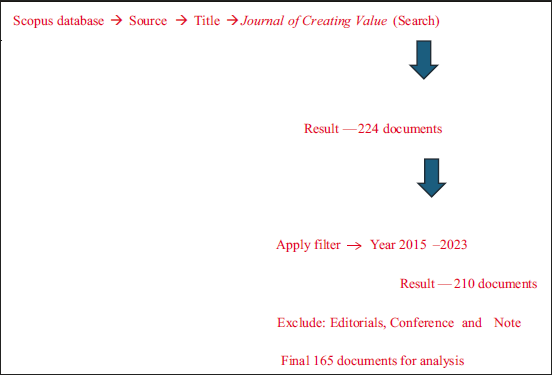
The extant research on value creation in JCV is reviewed by adopting a bibliometric analysis. Bibliometric is an objective quantitative technique to infer its findings. The methodology adopted is used to summarize the current state of research and the emerging themes in the field (Donthu et al., 2021; Mukherjee et al., 2022). During mid-March 2024, we accessed the Scopus database to obtain the bibliography data of the ‘JCV’. Since the bibliometric analysis was on the content of the journal, alternate databases such as Web of Science were not considered for collecting the data for analysis. During the period 2015 up to 2023, a total of 210 documents were published in the journal under the subject area of business management and accounting which included 165 articles, 25 editorials, 19 notes and 1 conference paper. For our analysis, we excluded editorials, notes and conference papers and considered only 165 articles which met the criteria. Figure 1 depicts the search criteria.
Bibliometric analysis has two main techniques, namely (a) performance analysis and (b) science mapping. Network analysis is the sole enrichment technique but has not been made use of in this article. Graphic analysis is done using VOSviewer visualization software (Van Eck & Waltman, 2010).
Search Criteria.
Performance Analysis
The contribution of authors, countries, institutions and journals is captured in a descriptive way. The key performance metrics such as (a) publication-related—total publications (TP) and co-authored publications (CA), (b) citation-related—total citations (TC), average citations (AC) and h-index have been examined and analyzed in this article.
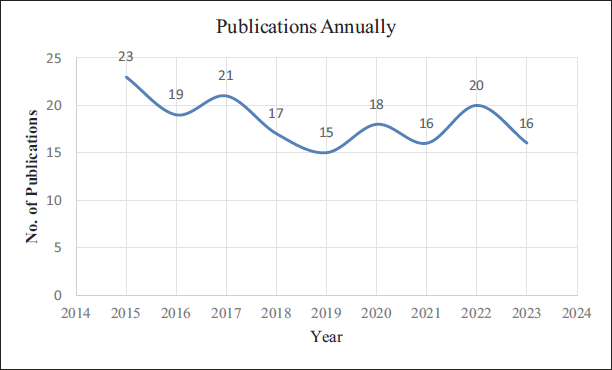
As can be seen in Figure 2, the annual publication trend over the last decade is stable and has oscillated between 15 and 23 articles being published every year since the year of its inception in 2015. Consistently over the years, it has been coming out with two issues each year, indicating there is a steady flow of research in creating value and that the journal is able to attract a good number of researchers to publish their research in this journal. On the other hand, it could also mean that the journal through its publication has been able to create a sustained interest among researchers in this field of value creation. The sustained interest in this field could also be attributed to the special issues that the journal has been able to come up with from time to time. Since 2017, it has come out with eight special issues ranging from ‘service value creation’ to ‘defining and measuring value’. Given the data in Figure 2, it can be said with a certain degree of certainty that the journal provides a consistent platform for researchers and practitioners to disseminate research on creating value. On the other hand, one could also allude that there has been sustained interest among researchers, practitioners and readers in creating value.
Influential Research in JCV
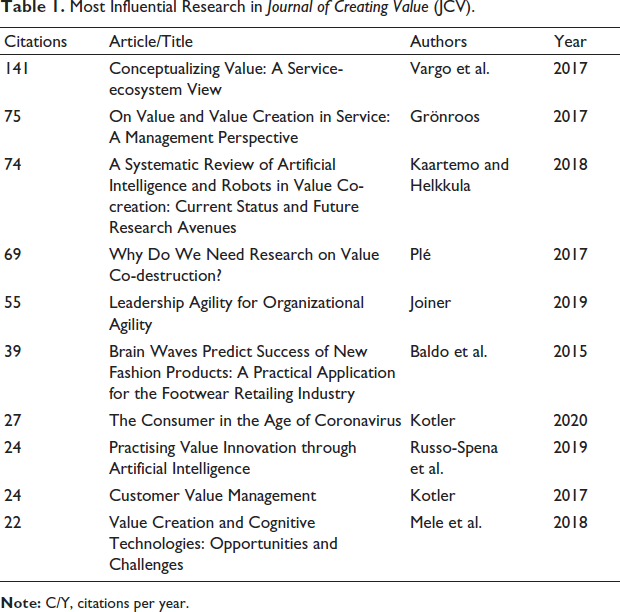
Vargo et al.’s (2017) article ‘Conceptualizing Value: A Service-ecosystem View’ with 141 citations is the most influential article published in JCV, emphasizing ‘the service dominant logics’ conceptualization of value. Grönroos (2017), ‘On Value and Value Creation in Service: A Management Perspective’ (75 citations), discusses the value creation employing the service logic (SL) analysis.
As can be noted from Table 1, the citations range from 22 to 74 and cover topics such as technology in co-creation (Kaartemo & Helkkul, 2018), value co-destruction (Plé, 2017) and artificial intelligence (AI) and innovation (Russo-Spena et al., 2019). A summary of the most influential research in JCV is shown in Table 1.
Most Influential Research in Journal of Creating Value (JCV).
JVC’s Impact on Other Scientific Journals
Citations Trends
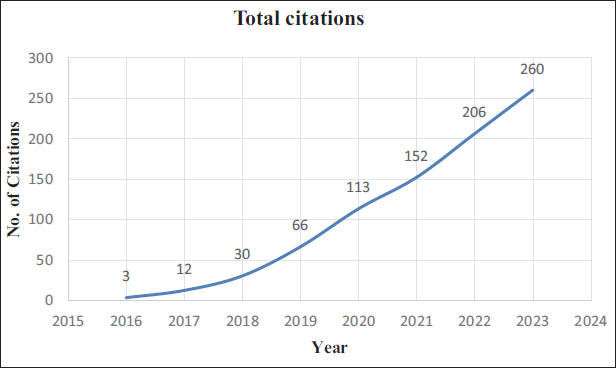
The citation trend reveals that the impact of JCV is growing exponentially as indicated in Figure 3. This can be further enhanced by ensuring that the journal addresses the contemporary trends in value creation.
Influence of JCV Articles on Other Journal Publications
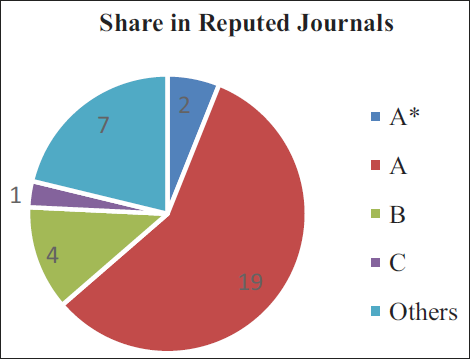
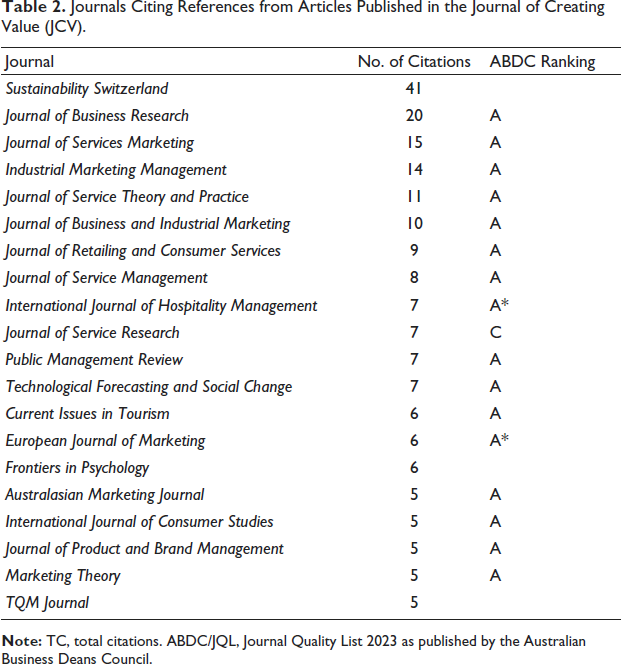
There are 912 articles that cite references from the JCV. The citations are spread across a wide range of journals. A further analysis points to the fact that predominantly the citations are in the A* and A category of classification as indicated by journal quality ranking by the Australian Business Deans Council. This is evidence of the quality of articles published in JCV, their relevance in the current context as well as the rigorous review process that ensures the quality of publications in this journal. Journals frequently citing articles published in JCV are shown in Figure 4 and Table 2.
Journal of Creating Value (JCV) Cited by Other Reputed Journals.
Journals Citing References from Articles Published in the Journal of Creating Value (JCV).
Most Prolific Authors, Institutions and Countries in JCV
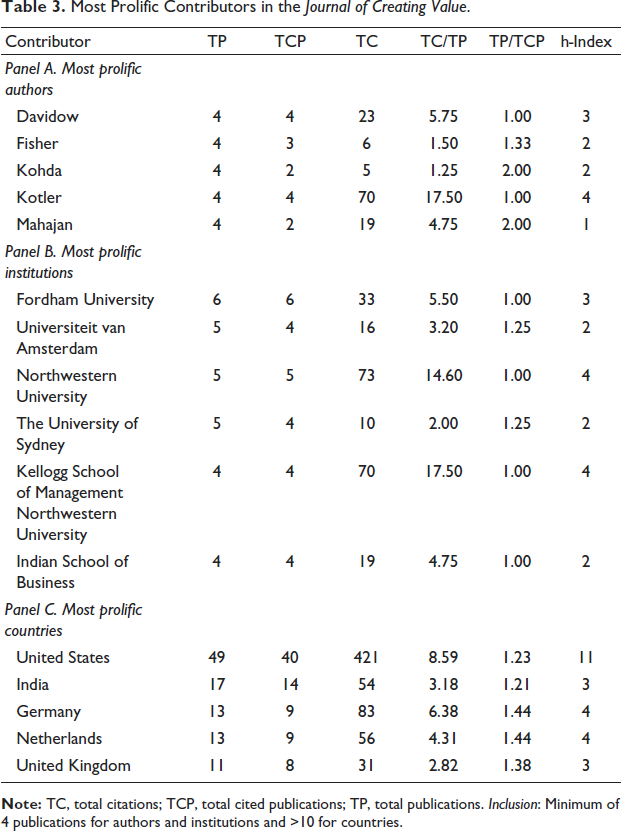
The top five authors in terms of publication are Davidow, Fisher, Kohda, Kotler and Mahajan. The most influential author is Kotler (70 citations). Please refer Table 3, Panel A. Fordham University is the top institution publishing in JCV, followed by Universiteit van Amsterdam (Table 3, Panel B). USA with 49 publications is the top country. India with 17 publications, Germany and the Netherlands with 13 each, and the UK with 11 (Table 3, Panel C). As evidenced by the publications, the journal does have a global audience.
Most Prolific Contributors in the Journal of Creating Value.
Science Mapping
The relationships between the research constituents can be mapped using science mapping (Baker et al., 2021). The analysis can be performed using co-authorship analysis, co-citations analysis and co-word or co-occurrence of keywords (Donthu et al., 2021; Lim & Kumar, 2024; Mukherjee et al., 2022).
Co-occurrence of Keywords
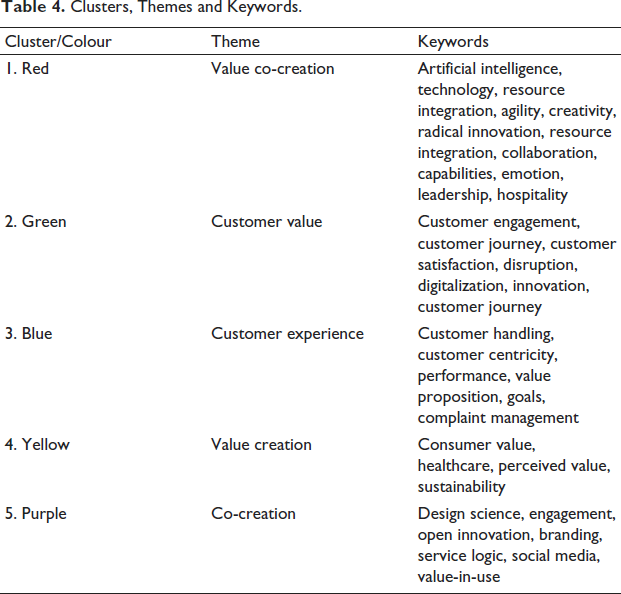
Science mapping was completed using a co-occurrence analysis of all 600 keywords specified across 165 articles in JCV. Eighty-six keywords met the threshold of minimum occurrence of two forming five clusters as depicted in Figure 5 and Table 4. The reason for choosing two and not five as the threshold was to have a sufficient number of keywords for further analysis. To begin with, there were 600 keywords. We checked by applying the suggested threshold level of five, and the number of keywords came down to eight. With just eight keywords, the co-occurrence mapping did not throw up the linkages that are essential for science mapping. We checked with other combinations of 4, 3 and 2, and it was with a threshold of two that generated 86 keywords, which were then seen as sufficient for carrying science mapping.
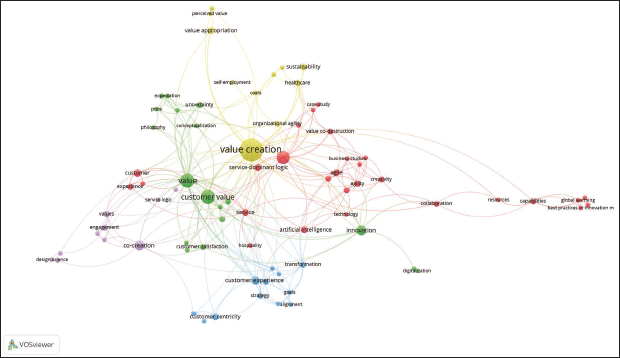
Cluster 1: Value Co-creation
This is the largest cluster consisting of value co-creation research published in JCV. It consists of 28 keywords majorly concentrating on ‘artificial intelligence’, ‘technology’, ‘resource integration’, ‘agile’ and ‘marketing’. It studies ‘agility’ through the perspectives of leadership agility for organizational agility (Joiner, 2019). In the case of new product development, being agile can hasten the product value by incorporating customer feedback (Heisterkamp, 2019). The concept of co-creation through technology was systematically reviewed using an article applying AI and robotics, and the findings indicated the emergence of four themes (Kaartemo & Helkkula, 2018). In a study of the aviation sector, the result indicated that collaboration plays a critical role in nurturing innovation and value creation (Pereira et al., 2021).
Cluster 2: Customer Value
The second cluster with 14 keywords, focusing on ‘customer journey’, ‘customer satisfaction’, ‘customer engagement’ and ‘innovation’. Weinstein (2020) studied the ‘Now Economy’ in the digital marketplace, which is dominated by millennials, and has put forward a conceptual framework for enhancing customer value. Mujahid et al. (2023) through a bibliometric analysis examined the extant research on brand value co-creation and consumer engagement.
Cluster 3: Customer Experience
This cluster has 12 keywords such as ‘complaint management’, ‘complaint handling’, ‘customer centricity’, ‘customer experience’ and ‘value proposition’ amongst others. The predominant theme emanating from this cluster is one of creating customer delight, moving away from just customer experience. In this context, authors suggest ways to address customer grievances and feedback mechanisms (Davidow, 2022). Relationship management and customer experience are metrics explored by Rao (2016). Mahajan (2016) suggests ways through which CEOs can become ‘customeric’—a term used to describe customer centricity.
Cluster 4: Value Creation
This cluster has 11 keywords such as ‘consumer value’, ‘organization agility’, ‘perceived value’, ‘sustainability’, ‘trust’ and ‘value appropriation’ amongst others. The integration of customer feedback in value creation has been studied by Hair et al. (2016). Misra et al. (2022) proposed a theory based on the value perceived by customers. Hollebeek et al. (2023) developed the concept of ‘customer journey value’ (CJV), and Wichmann et al. (2022) outlined the elements of value creation in the platform context.
Cluster 5: Co-creation
This last cluster has 10 items such as ‘branding’, ‘design science’, ‘engagement’, ‘open innovation’ and ‘service logic’ amongst others. Rodrigues and Schmidt (2021) explored how the creative class contributes to a city’s brand identity and the role played by them in delivering the brand message. Brey (2019) proposed a framework for social media value creation. Consumer brand co-creation was studied by Guzmán et al. (2019).
Clusters, Themes and Keywords.
Bibliographic Coupling
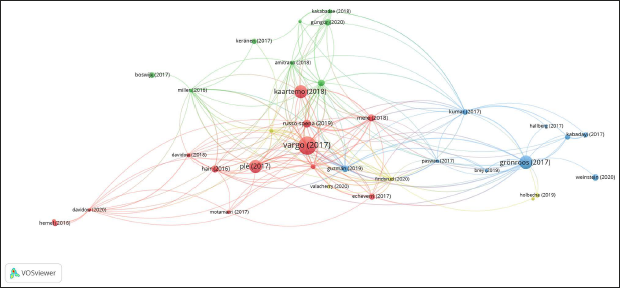
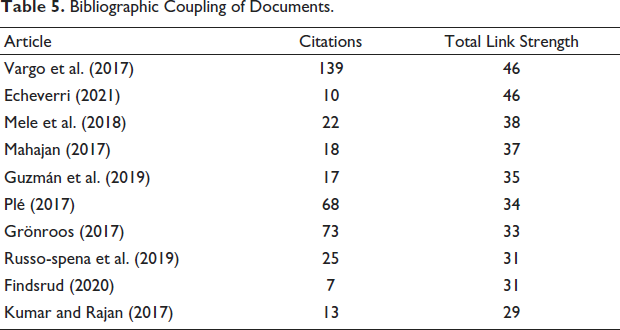
Bibliographic coupling as a technique is used to comprehend the subject matter and the evolving themes, with the underlying basis that two publications share common references. The strength of their relatedness (coupling) becomes more when a publication receives more citations.
Using a document (article) as the unit of analysis, bibliographic coupling was performed, limiting the minimum number of citations to five. Of the 165 documents, 43 met the threshold, forming 4 clusters with 36 items as shown in Figure 6 and Table 5.
Bibliographic Coupling of Documents.
Concluding Remarks and Future Directions for Research
An overview of the published articles indicates that the journal has primarily focused on developing and propagating the concept and practice of creating value among academicians and practitioners. In the initial years, the focus was on bridging the gap between academic insights and their practical applications with the aim of enriching both the scholarly community and the practitioners working in the field of value creation. Gradually over the years, the papers on the role of technology, AI, organizational agility and the impact of pandemics such as COVID-19 on value creation reflect the dynamic nature of the journal and its agility to address current issues and challenges faced by the business community and the society in general. The impact of the pandemic has been significant across the globe as it made business organizations re-evaluate their business purposes.
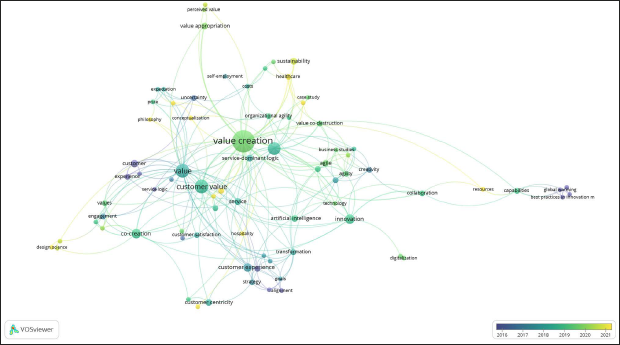
One of the significant highlights of this journal over the past decade has been its ability to come up with special issues highlighting the pressing needs of business organizations and society from time to time in the context of creating value. What is also interesting to observe is that the definition of value creation itself has undergone a change over the years, and this is quite evident from the discussions in the paper and the editorials of the journal. The term has become more inclusive and goes beyond enhancing customer and shareholder value to include societal well-being. Figure 7 gives a visual representation of the emergence of themes over the years.
Given the current emphasis on sustainable development goals (SDGs), it would make sense to focus on SDGs and value creation. Some papers published in the journal in the recent past emphasize the issue of sustainability and focus on food well-being (Tian & Kamran, 2023), and the role of digital platforms in healthcare (Faggini et al., 2021). On the other hand, Keränen (2017) proposed a broader value discourse around sustainability, and Shafer (2022) questioned whether non-governmental organizations (NGOs) can create value and achieve economic sustainability at the same time. The discussion around sustainability and SDGs needs more focused attention along with ethical considerations in value creation. Some of the areas that could be researched on sustainability could include developing strategies for creating long-term value creation that also addresses environmental, social and ethical issues and concerns of not only businesses but the society at large. Research studies could also examine the integration of business and societal concerns by embedding sustainable practices into the supply chain to reduce environmental impact, improve resource efficiency and align with consumer demand for sustainably produced goods. Such an approach could integrate the demand and the supply side of value creation. Such an approach would be aligned with the increasing focus on environmental sustainability, where business organizations across the globe are looking for ways to balance profitability with social responsibility.
In a similar vein, one could also examine value creation in the circular economy. The circular economy is emerging as a sustainable alternative to the traditional linear ‘take-make-dispose’ economy. Researchers can focus on identifying how companies can innovate within this space while creating value for both customers and society.
The other area that may require attention and may create renewed interest among researchers in carrying out empirical research would be clarity on the conceptualization of the constructs related to value creation and their measurement. As of now, very few studies published in the journal have carried out quantitative investigations. The few studies that have used qualitative research methods have largely relied on interviews. A focus on conceptualization and measurement can lead to the development of theoretical frameworks and models that can be empirically validated. This requires a concentrated effort in conceptualizing value creation from different perspectives (demand and supply side), leading to the development of operational definitions, finally culminating in the development of scales and instruments to measure the different aspects of value creation.
Future research could also focus on industry and sector-specific value-creation challenges. One of the special issues focused on an industry-specific need of the tourism, transport and hospitality sectors in the May issue of 2021. Such focus could be extended to other industries and social sectors such as NGOs to understand the unique challenges and opportunities of these with respect to value creation.
Employees play a critical role in value creation from the supply side. A well-engaged workforce that understands the importance of meeting customer needs and at the same time can focus on achieving operational efficiency can significantly enhance value creation within organizations.
Footnotes
Declaration of Conflicting Interests
The authors declared no potential conflicts of interest with respect to the research, authorship and/or publication of this article.
Funding
The authors received no financial support for the research, authorship and/or publication of this article.
