Abstract

Greetings from 490 Prospect Street in New Haven! I began my tenure as executive director of OMSC and editor of the IBMR on August 1, 2016. Carol and I express our sincere thanks to all those who have sent kind words of support or prayed for our transition into this important ministry.
As we ponder the momentous changes our world is facing and what they may signify for our understanding and practice of Christian mission, I want to assure you that we are committed to building on the wonderful legacy of OMSC and seeking ways to sustain and renew this work as we prepare to enter a second century in 2022. Many of you know from firsthand experience that OMSC engages in mission with Christians from all around the world by bringing together ecumenical and evangelical mission practitioners, church leaders, scholars, artists, and laypeople through the IBMR, our residential community, and our educational programs. And all of this activity takes place within five minutes’ walking distance from the Day Missions Library at Yale Divinity School, one of the most extensive collections of mission materials in the world. OMSC’s unique gift is its warm welcome for mission-minded Christians of all traditions and its provision of regular opportunities for sustained conversation, learning, research, and renewal. We believe this work must continue, and we ask for your continued commitment and support as we seek to expand and integrate OMSC’s three core constituencies: (1) IBMR contributors and readers, (2) “alumni” from our residential community, and (3) individuals, churches, and foundations who benefit from and support our mission. We are eager to explore ways OMSC might partner with you, your churches, mission agencies, international networks, seminaries, colleges, and universities.
I was trained as a practical theologian, albeit one with twenty years of college and seminary teaching experience in Japan and a strong personal commitment to intercultural ecclesial, missional, and theological engagement. As I was preparing to take up editorial responsibility for the IBMR, I realized that I would benefit greatly by partnering with some seasoned missiological hands. After consulting with Dana Robert, I approached Frances Adeney, George Hunsberger, and Roger Schroeder, and I am very grateful to report that all three of these esteemed colleagues have agreed to come on board as associate editors for an initial term of three years, beginning with this issue. Frances, George, and Roger will work with me in reviewing and refereeing articles and will join our contributing editors in soliciting submissions and writing an occasional book review. Of course, I will take full responsibility for the results, and I look forward to hearing your honest, critical feedback.
Next, I wish to offer a special word of thanks to Darrell Whiteman, who served as IBMR’s interim editor and OMSC’s interim executive director. Darrell shepherded the transition to SAGE last year, and before his term concluded on June 30, 2016, he had completed all of the preparations for the October, 2016 issue. He even left some pieces in the pipeline, several of which appear here. Thank you, Darrell!
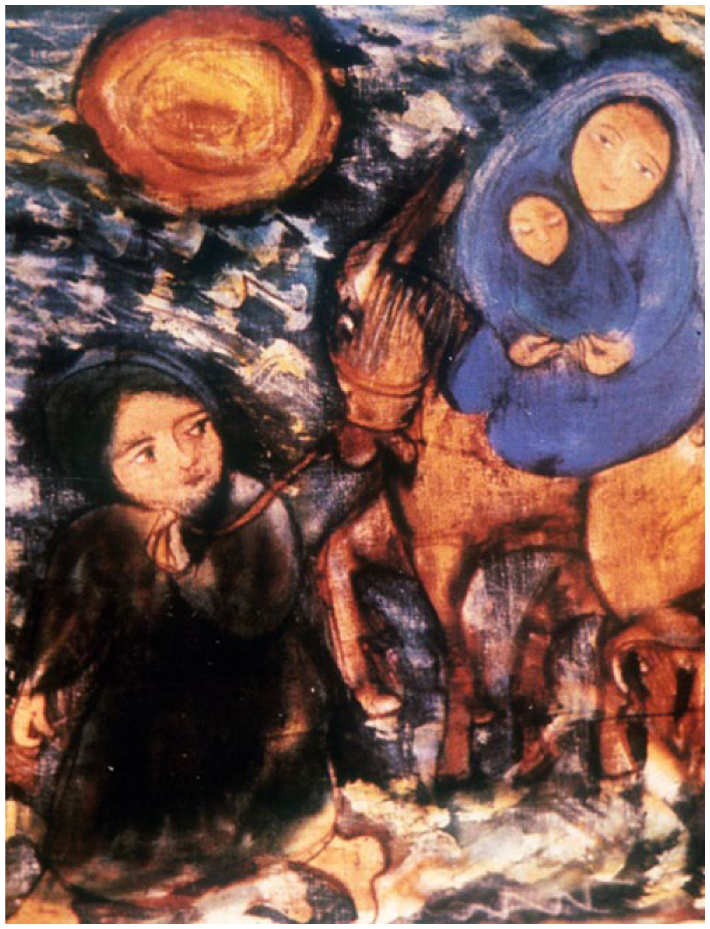
“Flight into Egypt” by Nalini Jayasuriya.
Now to the contributions in this issue. As a fitting lead article for a generation that is witnessing a record number of economic and political refugees and migrants, Stanley John draws our attention to the experience of Indian Pentecostals working in Kuwait and, with help from the theory of “transnationalism,” challenges us to expand our inherited geography and vision of mission. Seung Min Hong offers an evangelical approach to “critical contextualization,” citing ancestors as well as spiritual entities as two key foci for deeper theological engagement with Korean culture. In contrast to contextualization as a theory of the Western academy, Allan H. Anderson provides a summary of the way some Pentecostal missionaries have articulated a form of contextualization “from the people.” Marking the 500-year anniversary of Martin Luther’s publication of his Ninety-Five Theses, Todd Johnson and associates report on the demographics of world Protestantism in the context of world Christianity and other religions, showing how that movement has traveled far and changed dramatically from its origins in Europe. Touching on the embodied spirituality of the Christian Celts, Allan Effa emphasizes the Celtic discernment of divine presence in the natural world and its parallels with Native American spiritualties, suggesting that such traditions might help guide a “biblical ecospirituality” that takes seriously the ecological crisis of our time. As a potential conversation starter, David Lindenfeld provides a brief overview of the literature on the Axial Age and proposes that the missionary movement might be analyzed as a “bridge between axial and non-axial cultures." Rounding out the main section of the January issue is “My Pilgrimage in Mission” by Wesley Richard, a tent-making Mennonite missionary to Japan who interprets his experience in conversation with John Howard Yoder’s model of “migration evangelism.”
Happy reading! We look forward to hearing from you and exploring ways for OMSC to continue to engage in conversations at the cutting edge of Christian mission today.