







Abstract
Stephen Bevans’s six models of contextual theology have been helpful in sorting out different styles of understanding and practicing both historical theology and contemporary contextual theology. While briefly addressing the models themselves, the primary focus of this article is to update the original spectrum utilized by Bevans. Specifically, it seeks to clarify the primary axis to indicate the level of contextualization to a given local context. Second, it adds an additional axis, dividing the models based on relationship to the status quo of the given cultural assumptions, whether of the host culture or established church tradition.
When one takes a message and translates it into another language, important decisions need to be made on the part of the translator. Is it better to focus primarily on keeping the original wording of the text, or is it better to change the words, to best communicate the message in a manner that will aid most in understanding the spirit behind the original text? Which meanings of the original words are emphasized, especially if a word in the first language has multiple connotations and nuances in the new language? Similar questions need to be asked by Christian theologians when applying a theological lens to the various circumstances in which they find themselves. How much do they draw from the images and experiences of the host community, and how much do they need to stay faithful to the original tradition handed down from the global church? How much is the message malleable to the contexts and needs of the hearers, and how much is above local considerations?
In his 1992 book, Models of Contextual Theology, Stephen Bevans outlined five models of how Christians have historically wrestled with many of these questions. For each of these models, as well as giving explanations of the basic philosophy of the model in question, he also offered historical examples of theologians holding to each view. He added a sixth model, along with other updates, in his second edition, which he published in 2002, which is the edition that will be referred to here. The six models were named by Bevans as follows: Anthropological, Praxis, Transcendental, Synthetic, Translation, and Countercultural. According to Bevans, the Anthropological model seeks to preserve the local culture in its theological expression. 1 The Praxis model, while also viewing cultural identity as being central, seeks to bring about social change within that culture. 2 The Translation model focuses on translating the unchanging gospel message (along with the traditional understandings of said message) into the new context, and seeks above all else to be faithful to the content being translated. As such, it is the most likely among the models to remain true to church tradition. 3 The Countercultural model, while also seeking to accurately represent the gospel, treats the cultural assumptions of both local culture and church tradition with skepticism—declaring that the gospel needs to challenge those very assumptions. 4
The remaining two models, Transcendental and Synthetic, were later renamed by other authors. For the sake of this article, the terms used by Michael Moynagh, Conversation for Synthetic and Subjective for Transcendental, will be utilized. 5 The reason why Moynagh’s alternative nomenclature will be used is because his terms better suit the nature of the models themselves, and offer less potential confusion than the originals. The Subjective model, for instance, draws primarily from the personal experience of the theologian, and not so much from the outside world, in an attempt to discern how God is being experienced. While Transcendental (the original term in Bevans) might be understandable because it is through one’s transcendent encounter with the Holy Spirit (thus, not primarily culture or Scripture itself) that is the primary locus of the theological formation, transcendentalism is understood by wider church culture as being religiously suspect as belonging to the New Age spiritualities, whereas using “subjective” as the name of the model indicates the subjective experience (whether transcendent or not) that is central to the model itself.
Likewise, the Conversation model (Synthetic in Bevans) exists as a neutral model that seeks to achieve a balanced synthesis of each of the other models—engaging the primary lenses of each of the others (local and global cultures, Scripture, tradition, personal experience) into a mutually informing conversation. In the original work, Bevans chose to call this model “Synthetic” because of the goal of this model as being a synthesis of the other models. However, confusion arises with this terminology because of the connotations of “synthetic” in contemporary discourse (which more often means “a copy of reality” or “fake imitation”). Additionally, although synthesis does remain the goal, by emphasizing the method in the name (which Bevans does with most of the other models), “Conversation” seems to fit the model better.
However, it is not the models themselves that this present exploration is focusing on, so much as their relationship to one another. In Models of Contextual Theology, Bevans lined each of the models next to one another on a spectrum (see figure 1), between what he referred to as a focus on the present, by which he means the emphasis of these models as relying on the situation and values of the host context, and a focus on the past, which he describes as being the emphasis on Scripture and tradition (along with the home context of the missionary).

Bevans’s original spectrum 6
While it is helpful to view these models as existing on such a spectrum as a way to simplify and explain the concept, the particular spectrum that Bevans utilized is somewhat problematic, which will be the primary subject of the remainder of this article.
Challenge #1: Redefinition of the original spectrum
One of the main weaknesses of the original paradigm is the relationships between the various positions, particularly since multiple models would arguably exist at the same place on the spectrum. For instance, both the Anthropological and Praxis models are highly contextual, whereas both Translation and Countercultural models do not consider the host context as being the primary locus for consideration. That being said, for the Translation model, while it does seek to translate the message of the gospel into the new environment while keeping true to the historical faith, it is also culturally bound. It represents the historical moments and traditions of the home culture of the missionary seeking to translate the gospel into the new environment, which also include the emphases and understandings of those traditions upon the gospel message itself. Related to this, although Bevans places the Subjective model as being among the most context-driven of the models, its relationship with scripture and contextual realities are more nuanced. Rather, both the Conversation and Subjective models are actually more neutral, as they seem to consider the present context and scripture equally, though through differing lenses.
A second problem related to the original spectrum is the nomenclature used for the spectrum itself. Bevans’s original spectrum listed the models to the left of the spectrum as emphasizing the “present” (understood as the current lived experience of a certain circumstance or current issue), while the models on the right emphasized the “past” (i.e., staying close to established understandings of church tradition). He does specifically mention that he prefers speaking of “context” rather than “culture,” because the notion of context can be applied more broadly than culture. 7 While this may be helpful when considering purely how the theology is drawn specifically from previous generations/cultural contexts of Christians for those drawing from the past, versus from the current situation and new context for those drawing from the present, it becomes confusing when considering the descriptions of several of the types that he illustrates. For instance, while the Anthropological model is seen as the most present-oriented model on his spectrum, its very nature is seeking to preserve the traditions of the current culture in the new theological outlook being created (which, in a way, is also an orientation based on past experience for the host culture). Meanwhile, the Praxis model, which Bevans places closer to the center of the spectrum, is very much focused on how the gospel affects the current situation, in hopes of bringing authentic justice and healing to the present circumstance. Meanwhile, the Countercultural model, while drawing primarily on scripture and being critical of the current culture, is also iconoclastic toward the cultural accretions present in much of built-up church tradition.
A better way of viewing the relationship of the models to one another might be to engage the spectrum in conversation with other theories of mission, particularly the translation principle of Lamin Sanneh. According to Sanneh’s theory, the more contextualized the gospel and the more naturalized the church is to a given culture is dependent upon how well it has been translated into the vernacular of the local population. 8 The term “vernacular” denotes not simply the language, although language is a primary indicator of contextualization; it also includes cultural mores and even pathways of understanding the gospel itself—even interpretations that might be seen as suspect by the original missionaries seeking to introduce Christianity into that context. This could be seen in the arguments made by John Travis’s C spectrum, where C1 churches represent Western imports (culturally and linguistically Western), while C5 are so indigenous that the spiritual seekers in that context retain their former religious identities, while also exploring the claims of Jesus. 9 The highly contextualized churches (currently known as “insider movements”) are also considered in greater detail by William Dyrness in his work, Insider Jesus, where he seeks to engage in theological conversation about these high contextual communities, referred to as “insider movements,” in light of both the insights of the Bible and the continual presence of high context movements throughout church history. In particular, how their challenge of the traditional ecclesiologies of Christians from more established settings raises serious questions about theology and the shape and nature of the communities intended by Jesus in the New Testament. One of his central arguments, similar to Sanneh (as well as Andrew Walls 10 ), is that the formation of differing versions of Christianity has been a trend from the beginning of the Christian movement, and because of this, greater sensitivity is needed when considering these other cultural expressions of the faith. 11
In this way, then, one could see one end of the spectrum as placing more emphasis on the home culture, with emphasis on Scripture and established traditions of Christianity, as understood in that home context, whereas the other end of the spectrum emphasizes the beliefs and values of the host culture. Another way to express the different ends of the spectrum would be the level of contextualization into the host context, with “high context” appealing much more to local sensitivities and “low context” indicating a more critical posture. Such a newly imagined spectrum might appear as follows (see figure 2).
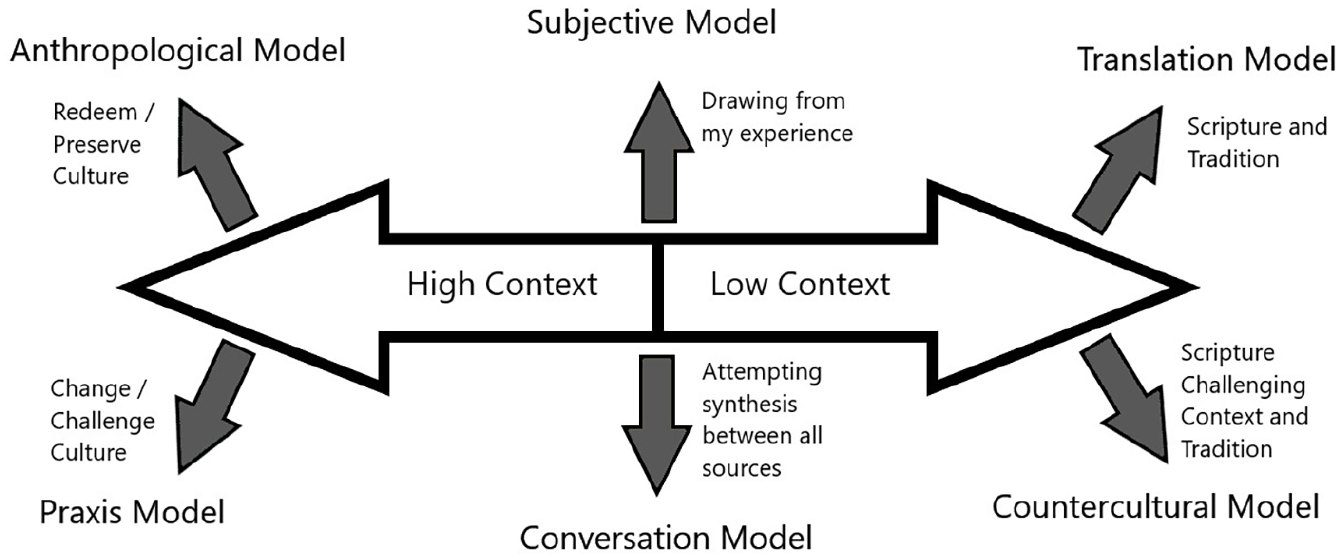
Basic reimagined spectrum. Models realigned according to the level of contextualization into the host context.
As can be seen from this new diagram, the placement of the models becomes clearer. Both Anthropological and Praxis models are highly focused on the values and ideas of the local circumstances, for example, and tend to rely on high contextualization. Both exist at an equal end of the spectrum because of this. What sets them apart is their relationship to the current culture’s status quo. Should its redeemable aspects be preserved at any cost (as in the Anthropological model), or should its perceived injustices be overturned and changed at any cost (as in the Praxis model)? Likewise, the Translation and Countercultural models have a low contextualization to the host culture’s values, for different reasons. The Countercultural model tends to challenge the traditions and viewpoints of both host and home cultures in light of Scripture, even problematic traditions within the church, while the Translation model seeks to translate both the scriptural message and the interpretation of the home culture (i.e., the traditions of the historical, global church, or at least of the denomination/theological tradition of the practitioner) into the new context, thus replacing the values that contradict those they seek to introduce. Similarly, because the basis of the Conversation model is the synthesis and dialogue of the emphases of each of the other models, it exists at the center of the spectrum.
It is the placement of the Subjective model that is slightly different from the original spectrum. According to the original spectrum, this was located as the second highest regarding its relationship to local context. However, with the new structure, it exists closer to the center of the spectrum. The reason for this change is that its relationship to both culture and scripture/tradition exist as secondary, and in dialogue with one another, similar to the Conversation model. The main difference between these two models is in the lens which controls the dialogue. Whereas the Conversation model seeks to intentionally form a synthesis between the factors considered by the other models, thus challenging their own presuppositions, 12 the Subjective model seeks to understand each of these through the lens of personal experience, thus making their own experience the final arbitrator of how the information is processed. 13
Challenge #2: An additional dimension?
While adapting the original spectrum in this way does provide greater clarity, there is another reason for this particular setup, especially when considering the relationships between those at similar poles of the spectrum, for each pair (Countercultural and Translation, Conversation and Subjective, Praxis and Anthropological) also exist in tension with one another, as well as with the other two pairs that they could be contrasted with when considering them on only the one axis. Interestingly, the differences within each pair are also shared differences with the other pairs. The difference lies in the relationship with the status quo of each context (whether home or host), a dynamic existent within “prophetic dialogue,” a notion that Bevans expands on elsewhere, along with Roger Schroeder. 14 Bevans and Schroeder define prophetic dialogue as the tension that exists between the challenge presented by the prophetic value system of the biblical corpus against the opposing values of nonbiblical culture, and a more cordial dialogue which seeks cooperation and integration of values (particularly those values that are in agreement or are mutually appreciated) to build bridges of mutual understanding with its dialogue partner. 15
Other missiologists also explore this tension in their writings. For instance, Andrew Walls elucidates the pilgrim and indigenizing principles, two opposing poles regarding the relationship between the Christian gospel and a given culture. 16 According to Walls, the pilgrim principle, similar to the prophetic side of the prophetic dialogue tension, represents the ways in which the gospel remains alien to culture, and, because of this, shows that the gospel (in its entirety) does not fit completely into the values, mores or beliefs of any given culture. Yet there is also an equal and opposite indigenizing principle, which, similar to the dialogue half of Bevans and Schroeder’s paradigm, infiltrates and blends with the culture as the gospel becomes acclimatized into the new context. This tension is illustrated by Walls through a parable of an interstellar visitor who returns to observe Christianity at various stages in history and notices that each instance seems mutually exclusive in their forms and even interpretation of the gospel message; and yet, in each, certain constants appeared throughout, and which were equally offensive or independent to the individual cultures represented. 17
When comparing the models of contextual theology that Bevans lays out with the pilgrim and indigenizing principles of Walls, an interesting parallel emerges. Three of the models (Anthropological, Subjective, and Translation) seem to emphasize the indigenizing principle (where the gospel embraces or adapts certain beliefs and practices of culture, and where the culture adapts the gospel in its process of adopting the gospel for its own). Meanwhile, the other three (Praxis, Conversation, and Countercultural) operate more within the pilgrim principle, where the status quo is challenged by the claims of the gospel that comes from outside of the local establishment (whether of church tradition, as represented by the Translation model; the subjective assumptions of the theologian, as represented by the Subjective model; or traditional local cultural values, as represented by the Anthropological model).
Because of the tension that exists along both axes (see figure 3), there can be the temptation to view one particular quadrant of the matrix as being superior to its opposing quadrant, or to choose a particular favored model as if it were a personality type, and argue for its exclusive use. For those on the upper half-plane (emphasizing dialogue and indigenizing the gospel into the current reality), the prophetic types of the lower side can seem too iconoclastic and overly pessimistic about human cultures. On the other side, to those on the lower half-plane (emphasizing prophetic challenge and the separation from the values of the world), the dialogue types of the upper side seem either syncretistic or corrupted. Likewise, those preferring high context models may view the low context models as being so alien to the local culture that they insist locals abandon their culture—which goes against the general thrust of the New Testament, which proclaims that Gentile followers did not need to become Jewish in order to belong. On the other hand, those preferring low context models look askance at the high context models, and ask if their practitioners truly believe or practice anything recognizably Christian (based on the traditional beliefs and practices passed down or present in other Christian contexts). However, while this may be tempting, and although I also admit my own personal bias toward the Conversation model, these models work best when in cooperation with the others. According to Bevans, “though each model is distinct, each can be used in conjunction with others. . . . [N]o one model can be used exclusively and an exclusive use will distort the theological enterprise.” 18 Additionally, certain models operate better than others, whether independently or in conjunction with others, in different circumstances and times, much like there are various occasions when different personality types function better.
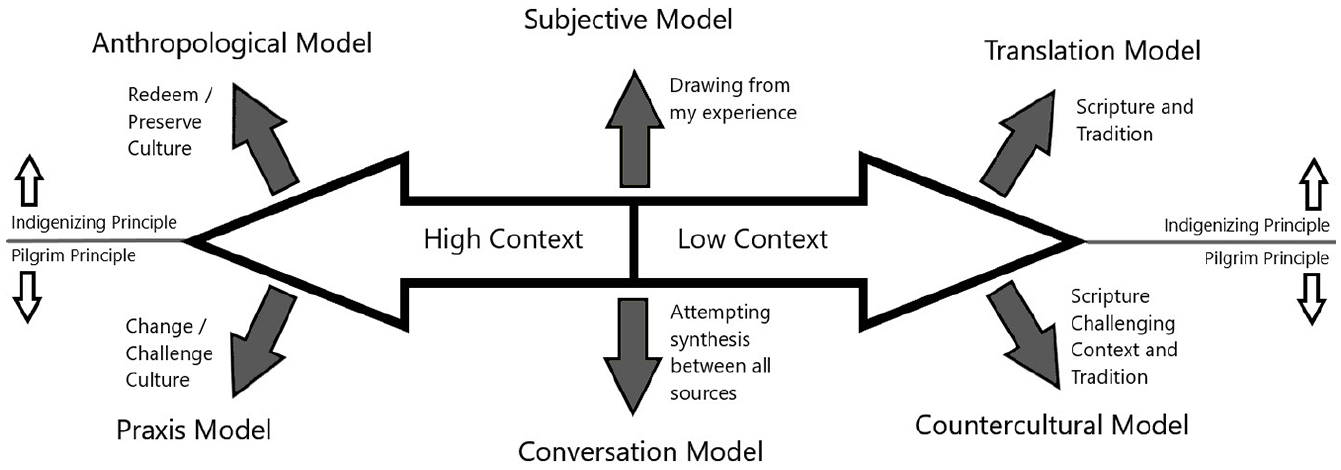
Two-dimensional reimagined spectrum. Integrating the pilgrim and indigenizing principles with the models of contextual theology.
For instance, the Countercultural model works best in situations where critique must be made about a culture from within, or in instances where the current church has syncretized with the wider culture to the extent that it is no longer recognizable, and thus requires prophetic rebuke. The Translation model, according to Bevans, is particularly necessary during moments when ministering to a culture that is completely unfamiliar with the Bible, whether the people have never before heard the gospel, or because the claims of the Bible have been forgotten. 19 The Praxis model, as the model of the activist, is best situated in those situations where drastic change is needed, and where the people forming such theology are either among those experiencing injustice, or those who are actively standing alongside them. Alternately, in the cases where there is not active oppression or desperate circumstances, but a people may have lost (or are on the verge of losing) their sense of cultural identity, such as second or third generation immigrants to a new culture, or the Indigenous peoples around the world, it is at this point when the Anthropological model might make the most sense. It may be argued that the Subjective model could also be helpful in this case, or even in other cases, because true theology develops out of our own searching for God, and the understanding of where we come from as individuals. 20
Regarding the Conversation model, there are multiple times when I could see this as being the best model to use. While it is true that there is a kernel of gospel truth that transcends culture, as the Translationists would put forward, each of us (including the theologian) are also products of our own culture, and as such, we all have blind spots. To quote from Randolph Richards and Brandon O’Brien, “[W]here we stand influences how we read—and ultimately apply the Bible. . . .In whatever place and whatever age people read the Bible, we instinctively draw from our own cultural context to make sense of what we are reading.” 21 That being said, instead of relying on each culture to invent the wheel (or even to forget the wheel of Scripture and theology itself), which might be the temptation for the Anthropological or Praxis models, a better strategy would be to seek the advice and counsel from other times and places that have experienced similar struggles, or who may have valid insights to make about how to respond theologically to the current situation. This is especially true because, while each culture is unique, we all share certain things in common with other cultures. 22 Paul writes to the Corinthians, “No temptation has overtaken you, except what is common to mankind.” 23 Similarly, especially when considering that theology itself is culturally/historically bound, as well as the fact that many of the historic disputes within the church were as a result of cultural and linguistic barriers between different groups, it is at these moments when honest and humble conversations could have prevented (or at least mitigated) the fractious nature of these disputes. For instance, Thomas Cattoi describes the Council of Nicaea, when the various theories and contextual theologies came together seeking a synthesis as a “moment of dialectic.” 24 The unity that would be described as orthodoxy was only possible because the various voices from the different cultures came together and found that middle ground.
To summarize, Stephen Bevans’s six models of contextual theology have been helpful in sorting out different styles of understanding and practicing both historical theology and contemporary contextual theology. Like any good model that seeks to categorize different strategies and patterns, he helps missiologists and theologians to understand those who come from other perspectives, as well as their own. The primary points of revision recommended here in this article are more related to the relationships between the models themselves, updating the nomenclature of the original spectrum utilized by Bevans. Specifically, it first seeks to clarify the first axis to indicate the level of contextualization in a given local culture, thus also resituating models on this axis to better represent their relationship to this question. Secondly, it adds an additional axis, dividing the models based on relationship to the status quo of preferred culture (whether the local host culture, the personal experience of the theologian, or the established church tradition). Each pair of models, as they exist along the spectrum, were considered against one another, to indicate this difference. Finally, humility was recommended regarding the relationship between the preferred model of the practitioner and the others represented, because a variety of situations also calls for a variety of strategies when approaching theology.
One might wonder in conclusion, would we have had as many fractures and splinters throughout church history if the actors would have stopped to truly listen to one another, and allowed one another to address each other’s blind spots? Would Islam have risen to become a world power (which was made partly possible through divisive church politics)? Would the Schism of 1054 have happened? Would the Reformation have caused as much bloodshed as it did? In our own day, which is characterized by increasing tribalism and polarization, is there not benefit to stopping and taking time to listen to one another?
Footnotes
Notes
Author biography