







Abstract
The goal of this article is to provide a fine-grained analysis of international human resource management research that addresses the different perspectives applied in that research. We coded 203 peer-reviewed international human resource management articles published between 2011 and 2018 with content analytical methods guided by the compass of management research developed by Sieben, which is rooted in critical management research. We were particularly attentive to the various discursive orientations international human resource management scholars have adopted, including ideologically critical, poststructuralist, functionalist and interpretive perspectives. We further examined which methods, theoretical perspectives and topics were common within and across different perspectives. This analysis indicated that critical research intending to politicize and question existing structures and ways of organizing is still marginal. Along with the dominance of functionalist and interpretive studies, papers in our dataset commonly use a strategic human resource perspective, are predominantly interested in the human resource management–performance link and focus rather narrowly on multinational corporations and expatriates. Furthermore, while international human resource management scholars increasingly account for the contextual embeddedness of organizations through macro-level theories, they mainly apply institutional perspectives that view organizations as adapting to institutional constraints. We propose a more diverse and reflexive approach – inspired by ideologically critical and poststructuralist perspectives – that may help to overcome these blind spots. Such an approach might, for instance, look at types of organizations other than multinational corporations and individuals other than highly skilled expatriates and might explicitly bring multiple, external stakeholders into the picture. We conclude by suggesting that international human resource management research and practice would benefit from more research diversity which enables more holistic analyses of phenomena, more innovative research and resultant insights, and more space for meta-theoretical reflections.
Keywords
Introduction
Increasing complexities in today’s globalized world – ranging from shifts in political environments to global displacement and migration issues – challenge the ways in which international organizations operate and deal with their employees (Harvey et al., 2011). International human resource management (IHRM) needs to address these challenges and has evolved as an important research field in its own right (Björkman et al., 2012). IHRM can be broadly defined as a scholarly field that examines ‘all issues related to managing the global workforce and its contribution to firm outcomes’ (Björkman et al., 2012: 1). It is historically rooted in and highly interdependent with the field of international management and is thus often assumed to deal with ‘improved utilization of human resources, congruent with organizational strategic objectives’ (De Cieri et al., 2007: 283). Typically, IHRM is divided into three research subfields: comparative human resource management (HRM), HRM in multinational corporations (MNCs) and cross-cultural human resource management (Brewster et al., 2016; Dowling et al., 2013). Over the past decades, scholars have conducted a vast amount of research in these partly overlapping subfields, historically emphasizing two topics: the transfer of HR practices within MNCs, with particular focus on convergence versus divergence in those practices, and the management of expatriates (Al Ariss and Sidani, 2016; Björkman et al., 2012; Lee et al., 2017).
Several scholars have reviewed and structured IHRM research (e.g. Acedo and Casillas, 2005; Al Ariss and Sidani, 2016; Brewster et al., 2016; Clark et al., 1999; De Cieri et al., 2007; Delbridge et al., 2011; Lee et al., 2017), contributing greatly to our understanding of the IHRM field. They have, for instance, outlined the need for more research on underexplored topics such as workforce diversity and international mobility (Al Ariss and Sidani, 2016), and they have made detailed accounts of the above-mentioned subfields of IHRM (Cooke et al., 2017, 2019). Other recent reviewers take a more quantitative approach, including Lee et al. (2017), who provide a thorough analysis of the IHRM literature between 2007 and 2016 via citation, co-citation, network and factor analysis. While these reviews offer an overview of broad patterns in IHRM, they do not offer an in-depth analysis that could assist researchers understand the nature and discursive orientation of specific studies.
In this article, we attempt to address this gap through a fine-grained analysis that is particularly attentive to the different research perspectives, theories, methods and topics applied in IHRM research. To do so, we identified and coded 203 peer-reviewed IHRM articles with content analytical methods. As our guiding analytical framework, we use the compass of management research introduced by Sieben (2007b) to help us characterize each IHRM study by its discursive orientation (ideologically critical, poststructuralist, functionalist and interpretive). Scholars have raised concerns about the domination of IHRM research by managerialist perspectives and universalist assumptions (De Cieri et al., 2007; Delbridge et al., 2011; Janssens and Steyaert, 2012; Peltonen, 2006; Sambrook and Poell, 2014). Addressing those concerns, we seek to investigate whether critical management perspectives, including both ideologically critical and poststructuralist ones, are still rare and to explore their potential for enriching IHRM research.
In view of these objectives, we contribute to the IHRM field in various ways. First, this study illustrates which, and most importantly, how different research perspectives are being used in IHRM research and how they interrelate with choices of topics, theories and methods. Second, we show that the practice and pursuit of more critical research enhances research diversity and helps to identify often neglected, yet important, research issues. By research diversity, we mean not only variety in paradigmatic perspectives and related theoretical and methodological variety, but also the specific choices researchers make, such as what context or actor is studied. Finally, drawing on our findings, we suggest future research avenues that could enhance research diversity and enrich IHRM research and practice.
The article is structured as follows: We first introduce the compass of management research by Sieben (2007b), the analytical framework of our study, and outline its meta-theoretical position. Then, we explain our methods, including search strategy as well as data analysis and coding of articles. An overview of our findings follows, outlining the research perspectives we found applied in IHRM articles as well as related methods and dominant topics and theories. We then discuss and evaluate our findings in light of existing calls for critical research in IHRM and provide directions for future research. Finally, we acknowledge the limitations of our study and offer some concluding remarks.
Theoretical background: a compass for structuring IHRM research
In this study, we use the compass of management research by Sieben (2007a, 2007b) as an analytical framework to review and classify IHRM research. The following outlines its underlying assumptions and meta-theoretical positioning.
Sieben’s (2007a, 2007b) compass of management research has its roots in critical management research and is a modification of Deetz’s (1996) revision of the classical analytical framework of research paradigms by Burrell and Morgan (1979). Within the contentious debate on ‘paradigm incommensurability’ in management and organization studies (cf. Fabian, 2000; Hassard and Kelemen, 2002; Pfeffer, 1993; Scherer, 1998; Whitley, 1984), Burrell and Morgan (1979) take an isolationist standpoint. While they acknowledge the existing diversity of research perspectives in management research, they assume that communication bridging paradigmatic borders is hardly possible. As such, the analytical framework they suggest is a static map with conflicting paradigms that exclude each other and within each of which research is conducted independently (Sieben, 2007b).
In contrast, Sieben highlights possible dynamics and flexibility within and between research perspectives at given times as well as the potential combination of perspectives within single studies or research projects. She follows Deetz’s understanding of research perspectives as ‘discursive orientations’ (Sieben, 2007a: 566) that cannot be viewed as fixed, exclusive categories, but instead as engendering researchers’ discursive moves and struggles (Deetz, 1996). Thus, our approach is ‘politically infused’ (Hassard and Kelemen, 2002: 333) in that we look at ‘the’ IHRM field as a site of knowledge production that is not independent of previously generated knowledge and existing power relations (Foucault, 1980). We presume that research practices, such as choices of topics, methods and theories, are driven not only by ‘neutral’ scholars’ search for scientific progress, but also by their personal interests and strategic choices, often based on taken-for-granted views of reality.
In his seminal work, Pfeffer (1993) makes a similar point, arguing that negotiating a consensus on acknowledged research standards and practices within a field is a political process likely to be determined by a small, powerful elite. Nevertheless, Pfeffer (1993) advocates paradigmatic consensus because it helps to avoid uncertainty about what appropriate or relevant research questions and practices actually are. In more diverse fields, ‘the dispersion in resources, rewards, and activity will be great’ (Pfeffer, 1993: 615), making effective scientific progress more difficult. However, instead of a consensus based on a single paradigm at the expense of research diversity, a promising alternative route is a better integration of different paradigmatic orientations in IHRM (Mendenhall, 1999) and engagement in meta-paradigmatic dialogue (e.g. Mosonyi et al., 2019) that take advantage of the existing research diversity in the field (Schultz and Hatch, 1996).
An important benefit of research diversity is that by adopting various perspectives, scholars can better study complex phenomena and the paradoxes and tensions of organizational life (Gioia and Pitre, 1990; Lewis and Kelemen, 2002). Different perspectives may complement each other to provide a more complete understanding of a phenomenon in IHRM (Mendenhall, 1999), whereas a mono-paradigmatic focus may oversimplify complex reality (Patel, 2017). As a result, theory building may be enhanced by providing ‘multidimensional representation of the topic area’ (Gioia and Pitre, 1990: 596), and more innovative empirical insights are generated (Hassard, 1991; Lewis and Grimes, 1999; Patel, 2017; Romani et al., 2011). In addition, a field that allows for balancing different perspectives does not run the risk of overlooking important research questions, such as ethical and social issues that may otherwise be neglected for more dominant managerial concerns (Romani et al., 2018; Williams, 2017).
With her compass, Sieben (2007a, 2007b) offers a useful tool to account for these advantages. On the one hand, it allows for identifying and recognizing existing tensions, contradictions and similarities among research perspectives without necessarily trying to resolve them. On the other hand, it enables questioning the potential hegemony of certain research traditions (Deetz, 1996) and taken-for-granted choices underlying research practices and identifying previously neglected blind spots. The compass of management research, whose derivation is presented in Sieben (2007b) in more detail, is displayed in Figure 1.
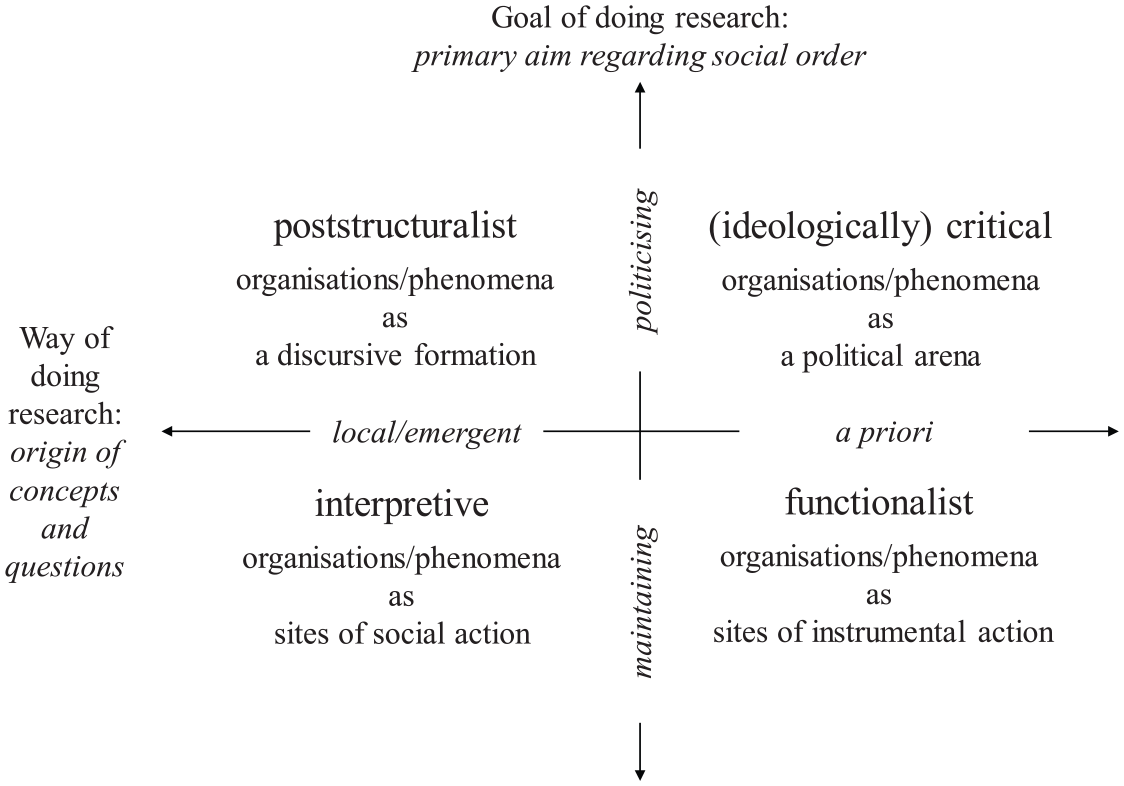
A compass of management research (cf. Sieben, 2007a: 567, 2007b: 108).
The ‘way of doing research’ and the ‘goal of doing research’ are the primary structures in this framework (Sieben, 2007a: 566ff, 2007b: 107ff):
The way of doing research addresses the question of where research concepts and questions come from. On the one side, ‘a priori’ means that concepts are defined before the beginning of the research process, while on the other side, ‘local/emergent’ means that concepts arise within the research process.
The goal of doing research addresses the intention of research questions. The ‘politicizing’ end characterizes studies that criticize existing structures and processes. The ‘maintaining’ end characterizes studies that maintain the social order within organizations and beyond.
The combination of these two dimensions or compass needles produces four research perspectives, which are called ‘poststructuralist’, ‘(ideologically) critical’, ‘interpretive’, and ‘functionalist’ (Sieben, 2007a: 568, 2007b: 105):
Functionalist as well as interpretive studies can be characterized as having the aim of maintaining social order. Functionalist approaches analyse instrumental actions within and from organizations and examine cause–effect relationships, typically using nomothetic methods to explain and predict phenomena. Interpretive studies instead consider organizations as social sites and examine how meaning is constructed in sense-making processes.
Poststructuralist and ideologically critical studies can be characterized as approaches with the aim of questioning and criticizing social orders within organizations. In this article, we refer to these studies broadly as critical. Poststructuralist approaches focus on the interplay of power and knowledge and analyse how discursive practices construct phenomena. Ideologically critical studies also focus on power, but take a more structural approach to relations of power and domination such as those defined by gender or race relations. Here, the focus lies on the power plays between individual and collective actors having their own respective interests and resources in the political arena of an organization or a phenomenon.
Methods
Data collection
To understand the different discursive orientations in IHRM research, we undertook an in-depth content analysis of selected articles. We used the EBSCO database Business Source Premier and included only peer-reviewed articles as a quality control (cf. Andresen et al., 2014). We restricted our search to manuscripts published between 2011 and 2018, choosing Delbridge et al.’s (2011) plea for more critical IHRM research as starting point of our analysis. To obtain a broad range of articles covering the different IHRM research subfields, we chose ‘international’ OR ‘cross*cultural’ OR ‘cross*national’ OR ‘cross*country’ OR ‘multinational’ OR ‘MNC*’ OR ‘global*’ (within the title of an article) as search terms. To establish the connection to HRM, we added ‘human resource*’ OR ‘international HRM’ OR ‘IHRM’ (within the article’s abstracts).
Next, we screened the list of articles regarding their thematic focus. Given the rather general search terms, our first query also included broader international business or management articles that only mentioned relevance and implications for HR (management) but had no dominant focus on (I)HRM. Thus, we excluded such articles. In line with this approach, we also excluded publications that were out of the IHRM scope, such as those focusing on topics like health systems in developing countries or education in the age of globalization. This resulted in a final dataset of 203 articles.
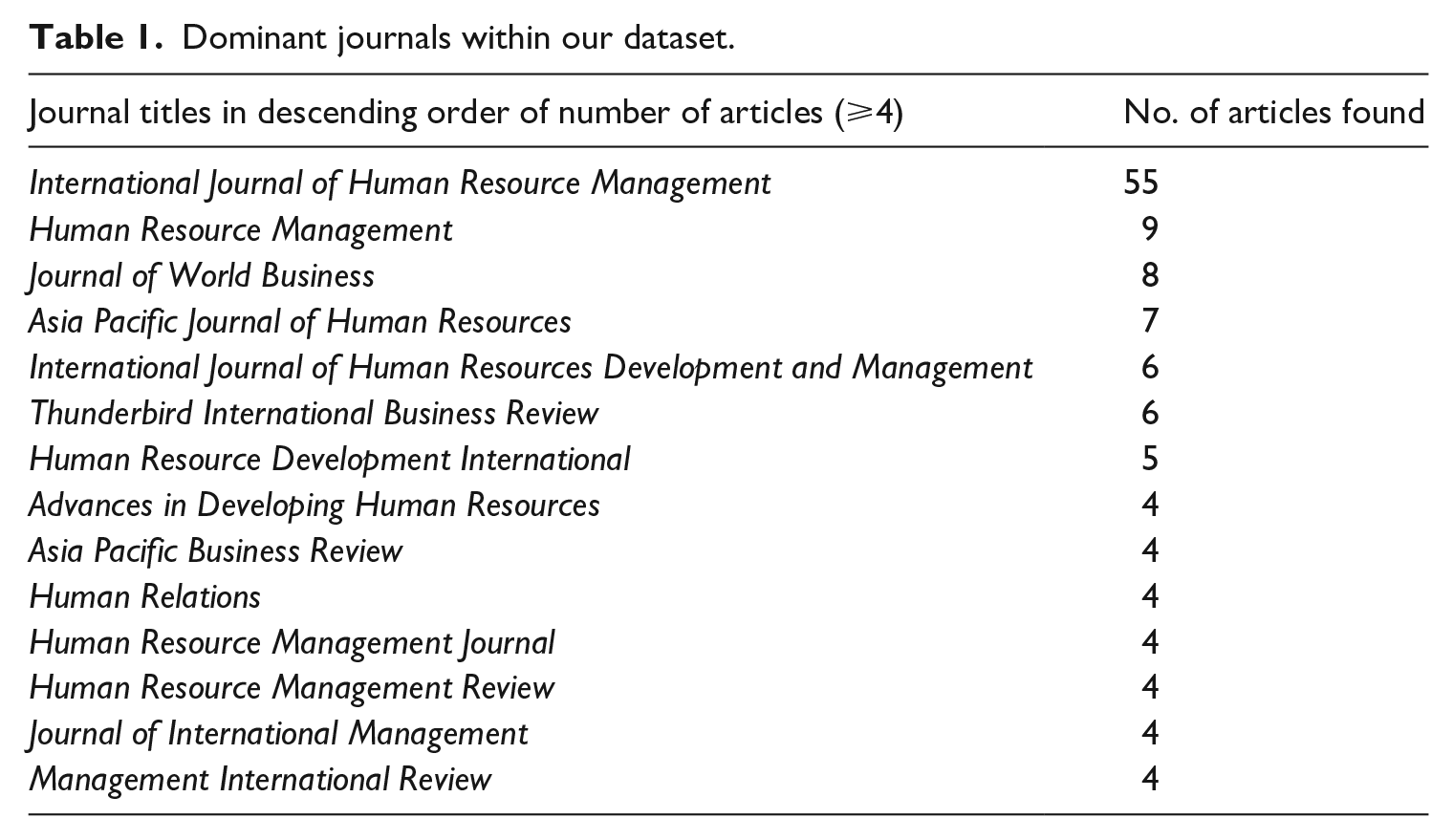
The majority of articles in our dataset were published within the main outlet for IHRM research, the International Journal of Human Resource Management (27.1%). The remaining articles were rather scattered across 70 different journals. Table 1 gives an overview of journals that published at least four articles from our dataset.
Dominant journals within our dataset.
It is important to highlight that we used broad search terms to ensure that our dataset covers all research perspectives and is not restricted to only dominant ones. Following this aim of opening up the IHRM field, we chose not to confine our search terms to specific IHRM (sub)topics (as did, for example, Cooke et al., 2017, 2019), because we could not know beforehand to what extent the research practices of a specific community might shape certain topics and thereby systematically exclude other perspectives. In line with this idea, and in contrast to other approaches (e.g. Andresen et al., 2014; Batt and Banerjee, 2012), we did not restrict our search strategy to specific outlets because journals may be prone to publication biases with respect to matters such as methods and critical theories.
Data analysis
To examine the content of these articles in more detail, we coded them using NVivo software. The process of data analysis was hybrid, combining a deductive with an inductive approach (Fereday and Muir-Cochrane, 2006). It was deductive in nature as we started with a coding system of relatively broad, predefined categories including (1) research perspective, (2) type of study, (3) theoretical perspectives, (4) research topic and (5) international research context. We inductively filled in these broad categories and refined our code system stepwise. All three authors of this article were actively engaged in the coding process and consensually validated coding decisions to increase the credibility of our findings.
Research perspectives
Following Sieben’s (2007a, 2007b) compass of management research, we coded articles as having either a politicizing or a maintaining goal of doing research and either a local/emergent or an a priori way of doing research. When indicated, articles could be coded as including both contrasting dimensions or as in-between these dimensions. This enabled us to classify some of the articles into the four discursive orientations described above. In the case of intersecting goals and/or ways of doing research within an article, we coded it as taking ‘multiple perspectives’. In the case of conceptual studies or reviews, we only coded for the goal of doing research, given that we could not identify the way of doing research. This implies that all conceptual studies or reviews ended up in the category ‘multiple perspectives’ as they typically open up the way for further research without determining a particular perspective.
Type of study
In this category, we differentiated between conceptual studies and reviews, and empirical studies. For the conceptual studies and reviews, we differentiated between papers with an overarching IHRM focus and those with a subfield or topic-specific focus. The empirical articles were classified into qualitative, quantitative and mixed-methods studies and additionally coded for their specific type of data material and analytical procedures.
Theoretical perspectives
Like other scholars, we classify theoretical perspectives according to different levels of analysis. Batt and Banerjee (2012) and Wright and Boswell (2002) differentiate between micro HRM research on the individual or group level and macro HRM research on the organizational level. However, these studies consider the HRM literature, while we focus on international HRM research. To additionally capture approaches conceptualizing the broader national and regional contexts of organizations, we distinguished among three levels of analysis: (1) micro-level theories that address the individual or group level, (2) meso-level theories explaining organizational practices or structures and (3) macro-level theories focusing on the institutional, political, social and cultural environment and the embeddedness of organizations therein. This modification is in line with the classification by Björkman and Welch (2015) for the IHRM field.
Research topics
To analyse the literature in more detail, we also coded for specific research topics addressed in the papers. At first, this resulted in a long list of IHRM issues and topics, which we then aggregated and grouped into broader topic clusters, such as ‘expatriate (management)’, ‘global performance management and rewards’ and ‘international human resource development (HRD), training, and careers’. It is important to note that these topic clusters do not represent distinct categories, but are partly overlapping – that is, the same article could be coded into different categories if it addressed multiple themes.
International research context
In this category, we coded every article for the country context in which data were collected. Furthermore, we took a closer look at the organizational context of each study and coded for the type of organization (MNC or other, for example, nongovernmental organization (NGO)) as well as for the different configurations of home and host country (e.g. US MNC in France or Chinese MNC in Australia).
Results
This section provides an overview of the different research perspectives identified in the analysed articles. In the first part, we outline how certain research perspectives interrelate with type of study (conceptual vs empirical) and choice of methods. In the second part, we describe how certain perspectives interrelate with choice of topics and theoretical approaches.
Research perspectives and type of study
Table 2 provides an overview of the number and percentages of articles within our entire dataset (N = 203) identified for each perspective in the two types of study (conceptual vs empirical).
Research perspectives and type of study in entire dataset.
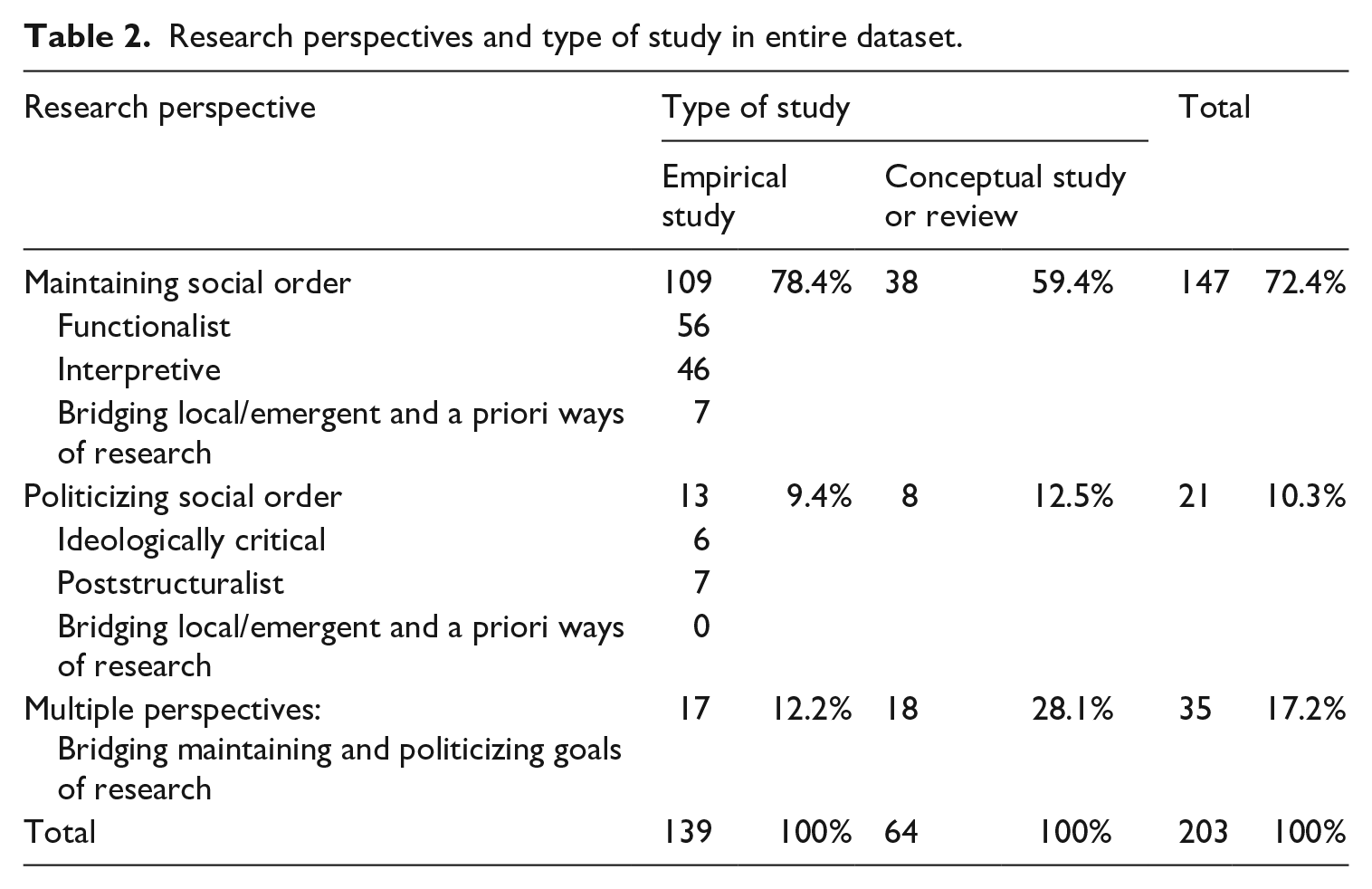
First, it should be noted that we found a large number of conceptual studies and reviews in our dataset (64 out of 203; 31.5%), which is likely to be due to our use of relatively broad search terms. Table 2 visualizes the typical predominance within management studies: IHRM research publications maintaining the social order (72.4%) outweigh both publications that politicize the existing social order (10.3%) and those that bridge maintaining and politicizing perspectives (17.2%).
Within empirical studies, we found a particularly high share of research maintaining the social order (78.4%), with large numbers of functionalist and interpretive studies. In contrast, only a few empirical studies have a clear critical approach (9.4%), including ideologically critical and poststructuralist research perspectives. Some empirical studies take multiple perspectives, bridging maintaining and politicizing research aims (12.2%). One example is the study of Aguzzoli and Geary (2014), who explore the complex dynamics of an HR transfer from a Brazilian MNC to its Canadian subsidiaries from an interpretive perspective and then point out the particular power dynamics that form the rules of the game (ideologically critical).
Conceptual studies and reviews – be they systematic literature reviews outlining research gaps or papers developing conceptual frameworks – do not decisively determine the way of doing future studies. Hence, within this article category, we only coded for the goal of doing research. Again, we detected a predominance of a maintaining perspective (59.4%). While taking up clearly politicizing research goals is also rare within the category of conceptual studies and reviews (12.5%), it is higher than in the empirical studies in our dataset. Studies calling for multiple perspectives that bridge maintaining and politicizing research aims in the future (28.1%) are rather prevalent in the conceptual studies and reviews in our dataset.
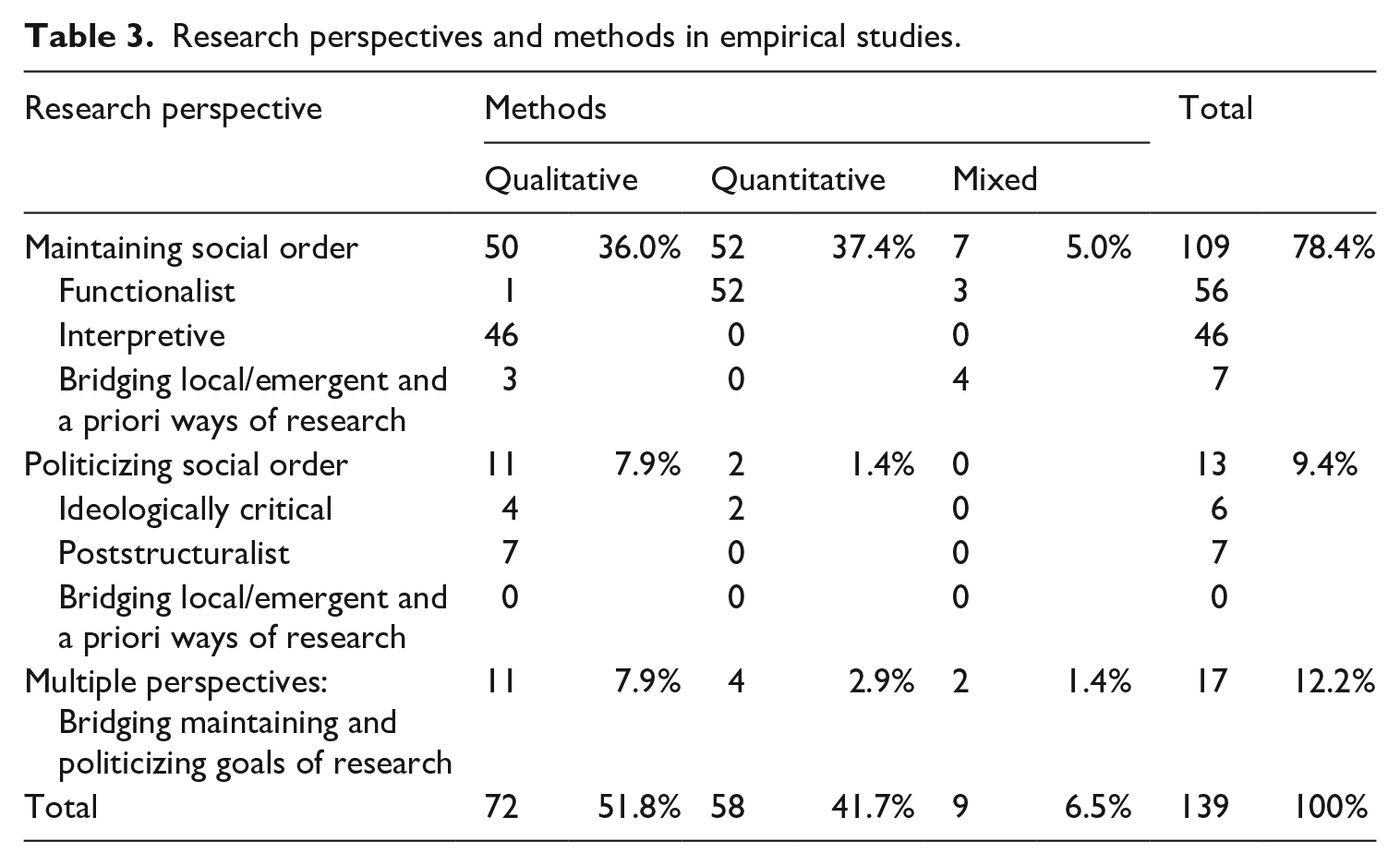
Taking a closer look at the empirical studies (N = 139), we differentiate broadly into qualitative, quantitative and mixed-methods approaches and how applied methods relate to the research perspectives (see Table 3). Quantitative empirical studies with a maintaining goal of doing research (37.4%) slightly outweigh comparable qualitative studies (36.0%). In contrast, both politicizing empirical studies and those with multiple perspectives tend to use a qualitative approach.
Research perspectives and methods in empirical studies.
Research perspectives, topics and theories
In this section, we report on the dominant topics taken up within the empirical studies of our dataset and show how they relate to the research perspectives of interest here (see Table 4). For each topic, we sketch out the research questions raised and the theories applied from the different research perspectives. Given the large number of functionalist and interpretive studies in the data, we outline them and their characteristics mainly exemplarily, while we lay out in more detail the comparably rare studies taking critical perspectives (ideologically critical and poststructuralist).
Research perspectives and dominant topics in empirical studies.
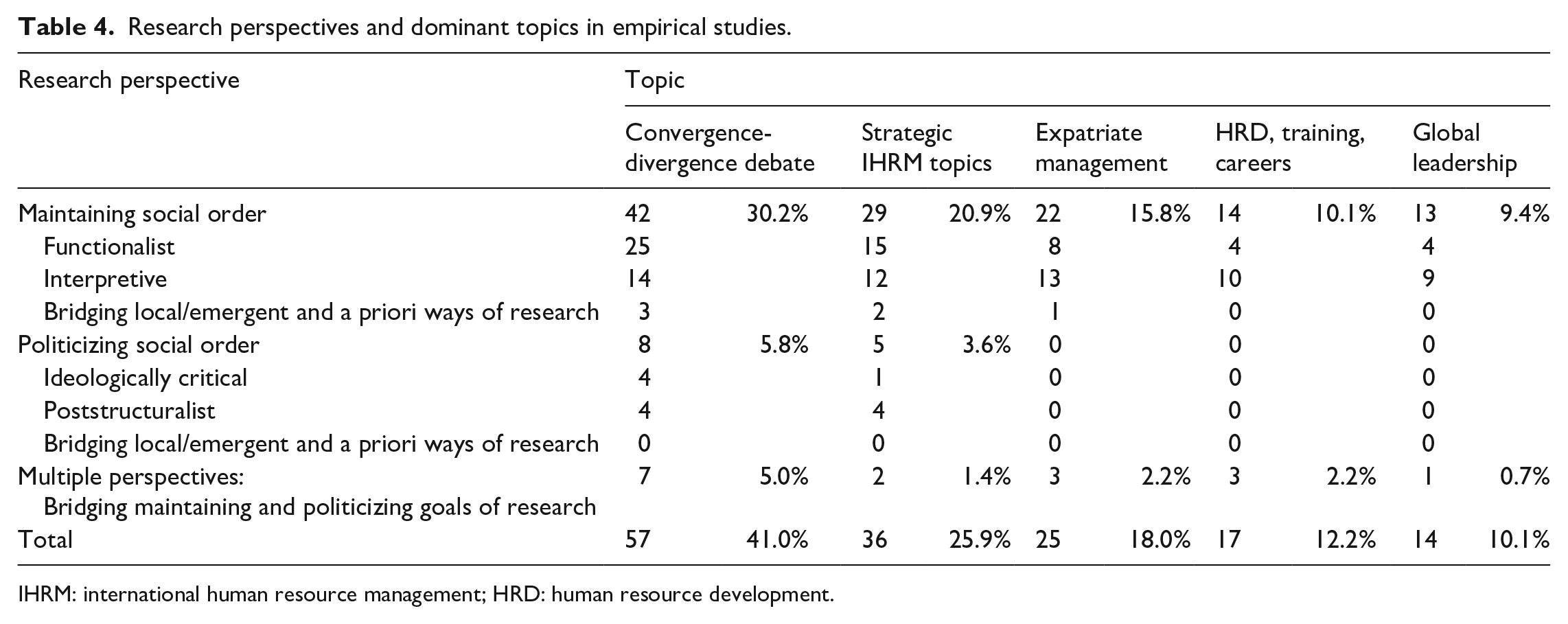
IHRM: international human resource management; HRD: human resource development.
Convergence-divergence debate
As in previous analyses (e.g. Cooke et al., 2017), the most dominant topic turned out to be a debate that has been labelled both ‘standardization-localization’ and ‘convergence-divergence’ and that also raises questions around crossvergence or hybridization of HRM practices. Within our dataset, this topic was investigated from all four research perspectives.
Research from a functionalist perspective was found to address influences on the subsidiary autonomy of MNCs regarding their HRM (e.g. Belizon et al., 2013; Ratković and Orlić, 2015), the degree to which HRM practices are transferred and adapted to subsidiaries’ contexts (e.g. Cocuľová, 2015; Cogin and Williamson, 2014) and comparisons of HR practices in MNCs and local corporations (e.g. Gurkov, 2016; Ma et al., 2016; McGraw, 2015; McGraw and Peretz, 2011; Mohamed et al., 2013; Singh et al., 2013).
Within interpretive studies, the research questions are different. They aim at the reasons and mechanisms behind the evolution of IHRM practices, often with a view towards hitherto underexplored country contexts. For example, through in-depth interviews in multinational enterprises (MNEs) operating in the United Arab Emirates, Haak-Saheem et al. (2017) explore the impact of this peculiar institutional setting on MNEs’ HRM. In his in-depth case study on MNC subsidiaries in Bangladesh, Mahmood (2015) takes a strategic HR perspective to explore how headquarter–subsidiary relationships and HR practices evolve over time in a developing country.
The articles with a maintaining research goal mainly investigated convergence-divergence issues from strategic HR perspectives, applying the resource-based view in many cases (e.g. Davis and Luiz, 2015; Holtbrügge and Mohr, 2011). An organizational capability approach (e.g. Morris and Snell, 2011), contingency perspectives (e.g. Cogin and Williamson, 2014; Mohamed et al., 2013; Smale et al., 2012; Van Hoorn, 2018) and institutional theoretical perspectives (e.g. Belizon et al., 2013; Cox and Warner, 2013; Haak-Saheem et al., 2017; Ma et al., 2016; Prince et al., 2011) were also frequently observed.
Ideologically critical studies addressing convergence-divergence can be characterized by focuses on labour relations, vested interests and resources of different stakeholders in related power struggles, and voices of employees and other stakeholders. Using comparative institutionalist theory, Tüselmann et al. (2015) compare patterns in the use of voice in German, French, and US MNC subsidiaries in the United Kingdom to highlight the evolution of employee voice in the United Kingdom’s private sector. In their study of a multinational worker cooperative, Bretos et al. (2018) show that some HRM practices are transferred into subsidiaries for reasons of efficiency, while core cooperative practices such as broad employee participation are not implemented. From a micro-political theoretical perspective, they underline difficulties in balancing economic and social aspects within the internationalization process and thereby shed light on power relations and vested interests. Fichter et al. (2011) focus on the contested nature of the transfer of labour-related practices, highlighting the role of union federations within global production networks. Yahiaoui (2015) examines the transfer of HRM practices from French MNCs to subsidiaries in Tunisia as a process of hybridization, analysing the interests of various stakeholders and their social interactions from a neoinstitutionalist perspective.
Poststructuralist studies on the topic focus on powerful distinctions between rhetoric and reality and the discursive construction of a ‘globally enabled worker’: Kamoche and Newenham-Kahindi (2012) focus, in their Foucauldian discourse analysis, on the organization-level emergence and rationalization of Western MNCs’ knowledge appropriation regimes in Tanzanian subsidiaries. Jhatial et al. (2014) analyse the rhetorics and realities of HR practices in Pakistan and the impact of colonial laws and administrative practices on the construction of workers’ identities. Alberti and Danaj (2017) show in a similar vein how transnational labour regulation and migration policy shape the categories and experiences of migrants working in British construction and hospitality. Jayawardena (2014) examines, drawing on Foucauldian social theory, how Western HRM discourse becomes localized and informs ‘doing’ and ‘undoing’ HRM in the Global South. He analyses multiple interrelated texts, highlighting rhetoric/reality distinctions in them, and how both culturally specific and sociopolitically formed employment management practices impact women shop-floor workers in Sri Lanka.
To sum up, studies with a politicizing aim seek to problematize the evolution of IHRM discourse and of international regulations and the transfer of IHRM practices. They analyse the power impacts of related discursive shifts and practices as well as the power struggles of different actors in such processes and highlight emancipatory potentials, particularly for employees. In contrast, functionalist and interpretive studies, as well as studies combining these research perspectives (e.g. Jain et al., 2012; Lertxundi and Landeta, 2012), seek to explore and/or explain the conditions and impacts of an effective functioning of the transfer of IHRM systems and policies, and particular HR practices.
Strategic IHRM topics
Another dominant issue is a sort of thematic cluster around strategic issues in IHRM practices. In the functionalist perspective, this includes, for instance, articles on talent management (e.g. Ambrosius, 2016) and on high-performance HRM systems (e.g. Andreassi et al., 2014; Lertxundi and Landeta, 2011) and articles that investigate competitive advantage created through IHRM (e.g. Baughn et al., 2011; Chatterjee, 2017; Chung et al., 2012; Colakoglu et al., 2016). Studies within this perspective investigate the effectiveness of HRM practices and impacts on firm and/or employee performance, job satisfaction and turnover. From an interpretive research perspective, researchers seek to identify new conceptual and emergent themes and insights. For instance, Ananthram and Chan (2013) conducted semi-structured open-ended interviews to explore challenges confronting global HR executives and their strategies to deal with them. Another example is Søderberg (2015), who explores a strategy-as-practice approach to the social agency of HR managers and employees in recontextualizing a ‘glocal’ strategy.
In conjunction with this thematic focus, studies with a maintaining research aim mostly take strategic HR perspectives (e.g. Ambrosius, 2016; Chatterjee, 2017; Chung et al., 2012; Mabey et al., 2012; Merlot and De Cieri, 2012). They also employ institutional perspectives (e.g. Colakoglu et al., 2016; Ma et al., 2016) and cultural theories (e.g. Andreassi et al., 2014; Rodrigues and Sbragia, 2013).
From an ideologically critical perspective, Sablok et al. (2013) show that union presence and the adoption of a strategic HRM (SHRM) approach impact employee voice mechanisms in Australian MNCs. Both Cooke (2012) and Tsai and Yen (2015) bridge maintaining and politicizing perspectives. Cooke’s (2012) study, based on institutional theory and a political economy approach, displays multiple HR implications in a Chinese telecom corporation, namely, human capital development and the employment creation of a globalization strategy, including critical constraints impacting workers. Drawing on neoinstitutionalist theory and focusing on IHRM practices in Taiwan, Tsai and Yen (2015) develop recommendations for a responsible institutional downsizing strategy that may not only enhance the effectiveness of related IHRM practices but also reduce harm to employees.
Related issues are also dealt with from poststructuralist perspectives. Using postcolonial theory, Alcaraz et al. (2012) analyse the strategic implementation of HR information systems by Western MNCs in China as a developing country. They show that micro-processes within transfers of strategic information systems bolster the dominance of Western MNC headquarters and ultimately construct the ‘global “generified employee”’ (Alcaraz et al., 2012: 120). In another critical analysis, Francis et al. (2014) examine IHRM discourse on electronics-enabled HR to highlight its impact on the people involved. Mahadevan and Kilian-Yasin (2017) elaborate on the need for a reflexive HRM on the basis of their analysis of the discourse on Muslim immigrants within a research company in Germany. They show that macro-societal discourses on IHRM have hitherto migrant employees constructed as ‘inferior Muslim Others’ (Mahadevan and Kilian-Yasin, 2017: 1140).
Expatriate management
This third dominant topic is predominantly treated from perspectives aimed at maintaining the social order in organizations. Functionalist studies typically focus on expatriate adjustment, in particular its antecedents and outcomes in terms of job performance, commitment or psychological well-being (e.g. Furusawa and Brewster, 2016; Koo Moon et al., 2012; Schuster et al., 2017). Thereby, they take into account, for instance, the influence of IHRM practices in relation to place of assignment (Furusawa and Brewster, 2016), stressors during international assignments (Rosenbusch et al., 2015) and potential dual organizational commitment towards both a parent country MNC and a host country subsidiary (Nguyen et al., 2013). Within the interpretive research perspective, the experiences of expatriates are examined with a focus on the underlying mechanisms that influence those experiences and expatriates’ performance (e.g. Crowley-Henry and Heaslip, 2014; Santoso and Loosemore, 2013; Shah et al., 2017). Interpretive studies, for instance, explore how culture influences the performance of Chinese expatriates (Lin and Zhao, 2016) or their perceived career success (Yao and Thorn, 2016).
Within studies maintaining the social order, we find a frequent reference to organizational psychology theories such as commitment theory (Nguyen et al., 2013; Rosenbusch et al., 2015), perceived organizational support theory (Shah et al., 2017), socioanalytic theory (Schuster et al., 2017) and social cognitive theory (Lin and Zhao, 2016). Several studies make use of strategic HR perspectives (e.g. Santoso and Loosemore, 2013; Sapouna et al., 2016), and interpretive studies in particular rely on career models (e.g. Shen et al., 2015; Yao and Thorn, 2016).
Regarding this topic, we note that several studies covering multiple research perspectives include a politicizing perspective. Drawing on her in-depth case study of ‘the expat factor’, Shortland (2015) critically examines the influence of the timing of work on women’s decisions to undertake international assignments in the oil and gas industry. Fee and McGrath-Champ (2017), who explore the role of HR in the international aid sector, point out the ethical, strategic and legal responsibilities involved in managing expatriate staff’s safety and security.
Global leadership
In addition, global leaders and global mind-sets represent important topics within the maintaining perspectives. From a functionalist perspective, this topic is addressed by examining, for instance, how global leadership can enhance business performance (Britt and Kreyer, 2011), how the psychological capital of global leaders influences their followers (Story et al., 2013) and what makes up managers’ ‘global mind-set’ (Story et al., 2014). Overall, there is an emphasis in this kind of research on success factors and competencies of global leaders.
Global leadership is also considered within the interpretive perspective, mostly with a focus on the global mind-set of managers (e.g. Ananthram and Nankervis, 2014; Cseh et al., 2013; Rodrigues and Sbragia, 2013; Zhu and Jack, 2017). Related studies deal with the consequences and benefits of a global mind-set and the processes through which it might be developed. In contrast to functionalist investigations, interpretative studies on global leadership focus on managers’ perceptions, are exploratory and/or rely on a social constructivism methodology (e.g. Ananthram and Chan, 2013; Cseh et al., 2013; Pless et al., 2012).
Studies with a goal of maintaining refer, among other theories, to organizational psychology theories, such as psychological capital (e.g. Story et al., 2013, 2014), and to strategic HR perspectives (e.g. Thite et al., 2014). Especially within interpretative studies, we find references to competency models and approaches (e.g. Ananthram and Nankervis, 2014; Cseh et al., 2013) and to conceptions of culture (Ananthram and Chan, 2013; Rodrigues and Sbragia, 2013). One study dealing with this topic uses an institutional perspective, which could be explained by the fact that it considers mind-set ‘as the mechanism of the country-of-origin effect’ (Zhu and Jack, 2017: 1767).
Regarding global leadership, we find one empirical study bridging multiple perspectives: With an interpretive approach and a critical HRD perspective on business ethics and social justice, Williams and Turnbull (2015) explore relevant skills and knowledge for developing globally responsible leaders.
HRD, training and careers
Both latter topics – expatriate management and global leadership – intersect with a thematic cluster around HRD, training and careers, an IHRM practice field that in our dataset gets more research attention than others such as international staffing, performance appraisal and rewards. Within this thematic cluster, the majority of studies can be characterized as interpretive. Related studies seek to explain the sense-making underlying the phenomena under research, again oftentimes in hitherto underresearched contexts. For example, authors explore the evolution of global mentoring relationships in a higher education institution (Sanyal and Rigby, 2017), the underlying values that may bond Sri Lankan global entrepreneurs (Hewapathirana, 2014) and the experiences of international learning programme participants sent to developing countries and how these experiences can help to develop global leadership competencies (Pless et al., 2012). Related theories include learning theories (e.g. Bartel-Radic, 2013), competency models and approaches (e.g. Cseh et al., 2013; Sanyal and Rigby, 2017) and social network theory (e.g. Hewapathirana, 2014).
Also, we find single studies bridging discursive orientations: In her interpretive study on the acquisition of career capital in global careers, Kirk (2016) takes a critical perspective to highlight the ambivalences and tensions of individual and organizational mobility needs and ensuing difficulties regarding workforce diversity and inclusion. Hirt et al. (2017) conduct a case study of a trainee and internship programme of an Austrian bank for university graduates from southeastern Europe. They draw on the typology of diversity strategies by Ortlieb and Sieben (2013) and the framework of individual career competencies by DeFillippi and Arthur (1994) to examine the links between organizational and individual perspectives on developing migrant talent. Through its combination of a resource dependence theoretical perspective on the business logics of organizational diversity strategies and a competency-based view on boundaryless careers, this interpretive study opens up the way for more critical analyses of issues such as the emancipatory potential of HRD for skilled migrants.
Discussion
In this section, we discuss our findings and evaluate existing research diversity in the IHRM field in terms of the (1) theories, (2) contexts and (3) actors it investigates. In light of calls for more critical research in IHRM (De Cieri et al., 2007; Delbridge et al., 2011; Janssens and Steyaert, 2012; Sambrook and Poell, 2014), we identify research gaps, outline the value critical studies often have through ‘broadening the horizon of international HRM’ (Delbridge et al., 2011: 483) and, on that basis, suggest some future research avenues. Finally, we acknowledge the limitations of our study.
Diversity of theories in IHRM research
With respect to the theoretical perspectives, we find that across all IHRM articles in our dataset, applications of micro-level (21.2 %), meso-level (30.0%) and macro-level (31.5%) theories are almost equally common. While (international) HRM research has been criticized in the past as dominated by micro-theories and not sufficiently situating the studied phenomena within their multilayered social contexts (Batt and Banerjee, 2012; Cooke, 2017; Delbridge et al., 2011), the widespread use of macro-level theories in our sample of articles indicates some initial change in this pattern. There seems to be an increasing awareness and consensus among mainstream as well as critical IHRM scholars as to the necessity to take into account the contextual embeddedness of organizations and individuals and related HRM practices and approaches (Al Ariss and Sidani, 2016; Brewster et al., 2016; Delbridge et al., 2011; Farndale et al., 2018; Pauwee, 2009).
However, looking further at the diversity of theoretical perspectives, specific approaches seem to dominate each level. For instance, meso-level research draws mostly on strategic HRM perspectives (above all, the resource-based view), while psychological theories related to motivation or commitment as well as career and competency models dominate micro-level research. For macro-level theories, IHRM scholars draw on institutional perspectives by far most commonly. It must be noted, though, that institutional theory is not a single theory, but instead can be described as a ‘set of varied approaches using the same intellectual brand’ (Alvesson et al., 2019: 1). Hence, we took a closer look at the IHRM articles that referred to institutional theory. In doing so, we found that almost all of these can be categorized as representing ‘the old neo institutionalism’ (Lewis et al., 2019: 317). Their authors ask the almost classic question of how the institutional environment and related pressures shape the HRM practices of local companies or foreign MNCs operating within or across country contexts (e.g. Ayentimi et al., 2018; Ma et al., 2016; Novitskaya and Brewster, 2016; Yahiaoui, 2015).
This view, however, does not take into consideration the impact of human agency and the possibility that organizations actively shape the environments in which they are embedded. Approaches that account for the interplay between structure and agency can be referred to as representing the ‘new neo institutionalism’ (Lewis et al., 2019: 323). They offer fruitful directions for HRM research in that scholars may not only concentrate on existing institutional constraints but instead focus on HR managers as active agents (Farndale et al., 2018) and on, for instance, how they deal with the daily complexities and paradoxes of different value system and competing demands (Lewis et al., 2019; cf. Najeeb, 2013). Only a few studies from our dataset address this research gap by focusing on the role of actors, especially HR managers in subsidiaries and their responses to institutional pressures (Rupidara and McGraw, 2011) or their sense-making about institutional differences (Zheng, 2016). However, more research of that kind is needed to better account for the strategic and political actions involved in the implementation of IHRM practices. Similarly, Brewster et al. (2016) argue that research on HRM in MNCs is largely preoccupied with external influences on the functioning of organizations, while it should give more attention to how organizations and relevant actors in turn impact their environment ‘through the deployment of various power and political resources’ (p. 293).
Diversity of contexts in IHRM research
IHRM research has been criticized for its limitation to the so-called WEIRD (Western, educated, industrialized, rich, democratic) countries (Batt and Banerjee, 2012; Brewster et al., 2016; Delbridge et al., 2011). With respect to this criticism, we clearly see signs of change. The analysed articles addressed diverse contexts and countries covering the entire globe, with a certain emphasis on the BRICS (Brazil, Russia, India, China, South Africa) economies, newly industrialized economies (e.g. South Korea, Taiwan, Singapore) and transitional economies (e.g. Central Eastern European (CCE) countries). This pattern holds among those studies in our sample that explicitly examine MNC practices. Of these 124 studies, almost two-thirds focus on non-Western, developing or emerging countries, be it as home or host countries, while only one-third deal with home/host country configurations between Western developed countries and/or worldwide, not further specified, multinational configurations. This shift in research interest seems to be largely driven by the increasing economic relevance of emerging economies, which can be termed a ‘second wave’ of MNCs (Bonaglia et al., 2007; Chung et al., 2014).
Studies investigating this second wave of MNCs are mostly interested in the ways HRM practices evolve in emerging MNCs (EMNCs) within their home countries (e.g. Ambrosius, 2016; Davis and Luiz, 2015; Horwitz, 2012; Thite et al., 2014). Another focus is how EMNCs operate in other emerging or comparably less developed countries and implications for HR practice transfer (e.g. Adams et al., 2017; Cooke, 2014; Kamoche and Newenham-Kahindi, 2012). Only few notable exceptions look at how practices are transferred from emerging to more industrialized economies; for instance, Aguzzoli and Geary (2014) pose a classic question, but in a reversed setting, asking to what extent the HRM practices of a Brazilian MNC located in Canada are dominated by the Brazilian parent or the institutionally more developed host country environment. Taking an interpretive and ideologically critical perspective, these authors locate ‘the micro-politics of the MNC within a wider macro-political terrain’ (Aguzzoli and Geary, 2014: 604), showing how the focal MNC manages to use its power resources to navigate the host country system and its stakeholders. As such, the authors adopt a more critical approach to studying MNCs, with attention to ‘issues of social relations, contexts, institutions, learning, interest groups, power, authority and exploitation’ (Collinson and Morgan, 2009: 6) that still appears to be far less common in IHRM than a performance-oriented approach. While this example illustrates how the inclusion of critical studies brings in theoretical diversity and interesting empirical insights, it should be noted that the choice of country context in fact seems to be unrelated to the research perspective. Often ‘new empirical fields’ are studied with conventional research questions or ‘old theories’ (cf. Klarsfeld et al., 2019). Hence, it could be a fruitful direction for future research to not only go beyond previously studied national contexts, but also use the new empirical settings to scrutinize the robustness of concepts and theories previously developed in WEIRD contexts.
Diversity of actors in IHRM research
When it comes to the actors involved, critical scholars have pointed out that IHRM research is too narrowly focused on large MNCs (Delbridge et al., 2011). Similarly, HRM research in general has taken a strong interest in large corporations but rarely considered smaller companies or networked organizations (Batt and Banerjee, 2012). Our findings mirror this criticism as MNCs are still by far the dominant type of organization investigated in our sample of articles, which seldom look at small- and medium-sized enterprises (exceptions include Cox and Warner, 2013; Hewapathirana, 2014; Pless et al., 2012) and/or public sector ones. Given mainstream HRM scholars’ primary interest in investigating HRM–performance links (Batt and Banerjee, 2012), this focus on private sector organizations is not surprising. However, it raises the question to what extent IHRM research currently overlooks other types of organizations that may be important both politically and socially, for instance, international NGOs or unions operating across borders. In our dataset, only 11 studies went beyond the private sector by investigating, for instance, multinational nonprofit humanitarian organizations (e.g. Fee and McGrath-Champ, 2017; Merlot and De Cieri, 2012), military organizations (Androniceanu, 2014; Crowley-Henry and Heaslip, 2014) and higher education institutions (Jais et al., 2015; Wilkins et al., 2018). As such, we seek to encourage future IHRM research to build on this emerging research stream that pays more attention to the other organizations, those that do not contribute directly economically, but seek to secure peace and human welfare in a broader sense.
Furthermore, we discovered that almost all of the articles looking at these other organizations were functionalist or interpretive in nature. Researchers chose to study unconventional organizations, but the way and goal of doing research remained conventional in the sense that they examined organizational functioning and efficient implementation of HR practices without questioning underlying structures and mechanisms. One exception is the earlier mentioned ideologically critical study conducted by Bretos et al. (2018), who look at a multinational worker cooperative and critically investigate the reasons behind HRM practice transfer and the power relations that shape this process.
In addition to criticizing its dominant interest in MNCs, scholars have criticized IHRM research for mostly adopting a within-organization perspective. The important roles of social and economic actors external to organizations, including, for instance, transnational organizations such as the European Union, have been overlooked (Delbridge et al., 2011). Fichter et al. (2011) is an interesting exception from our sample, as the authors investigate global union federations as external actors in ‘co-designing employment relations in transnational organizations’ (p. 599), thus advancing understanding of how decent work practices are transferred across national boundaries. In our view, such ideologically critical studies that adopt a political perspective on MNCs are particularly valuable for IHRM because they make the interests, strategies, resources and constraints of multiple stakeholders explicit and so illuminate by whom and how IHRM practices are being shaped in a complex web of interest groups.
Finally, looking at actors on the individual level, in line with HRM research (Batt and Banerjee, 2012), we do still find a strong emphasis in IHRM research on highly skilled (global) managers or professionals, often in their role as expatriates. We find at least some in-group diversity with respect to gender (e.g. Festing et al., 2015; Shortland, 2016) and some other dimensions, such as age (Tempest and Coupland, 2017), sexual orientation (Moeller and Maley, 2018) and religion (e.g. Mahadevan and Kilian-Yasin, 2017; Rao, 2012). However, only two studies in our sample – both poststructuralist – are interested in low-skilled or low-wage workers (Alberti and Danaj, 2017; Jayawardena, 2014). We argue that IHRM research should be more reflexive and pay more attention to the social relations that shape its narrow interest in more privileged groups, while others, especially those dealing with the ‘dark side of globalization’, are neglected or not considered part of ‘the’ IHRM field. One way to overcome this bias would be to adopt more postcolonial theoretical perspectives on the study of IHRM, for example, by ‘examination of raced, gendered, classed subject of IHRM; identification of how the “other” is represented in IHRM [or] representations of readings of IHRM that support the status quo’ (De Cieri et al., 2007: 292). Although De Cieri and her colleagues suggested this shift in research focus over a decade ago, our findings indicate that poststructuralist perspectives in IHRM scholarship still occupy a small niche.
Limitations
The results of this study and its implications should be considered against the background of some limitations. First, we restricted our search to articles identified in the EBSCO database Business Source Premier. This database, one of the most comprehensive and widely used in management research, covers more than 2300 journals. Nevertheless, including further databases (e.g. Cooke et al., 2019) could provide additional results.
Second, we restricted our search to articles published between 2011 and 2018. An enlargement of our dataset to include articles from over a longer time period might deliver further insights. However, this enlargement would have increased our results to an extent impossible to handle within a content analysis. Quantitative analysis, which is more appropriate for handling big data, could be a next step for further research using methods such as co-citation, factor and network analysis. It would be especially interesting to analyse the development of the IHRM research field over a longer time period to get deeper insights into dynamics and historic trends regarding perspectives, themes, theories and methods.
Third, the search terms that we selected were rather broad, and certainly many other papers have been published that address IHRM-relevant topics such as expatriates or specific practices such as talent management without having an explicit label such as ‘human resources’ in title or abstract. Developing such inclusion–exclusion criteria for a literature analysis is certainly a balancing act, yet we deemed this approach more appropriate than confining our search to specific topics or journals that might be prone to publication bias. Certain manuscripts are less likely to be accepted for publication in reputable academic journals dominated by North American and Western European thinking because of choice of topic, geographical context, or findings contradictory to previous empirical results or theoretical concepts in the field (Harrison et al., 2017; Özbilgin, 2004, 2009). Hence, given that our main interest was to cover a diverse set of studies, including those with a more critical theoretical perspective, those addressing social problems and those conducted in non-Western contexts, we considered this search strategy the best possible solution. In future research, reviews could adopt a clearer, single focus on critical studies (as did Romani et al., 2018, for the subfield of cross-cultural management) and, for instance, explicitly search within journals welcoming critical perspectives and/or include ‘critical’ as a search term. This would allow for a more thorough analysis of critical perspectives and their contributions to IHRM.
Finally, it is important to note that our subjective experiences and interests as researchers may well have influenced the coding process and related results. As reflexive researchers, we invite critique about what we have missed or misunderstood. However, we hope that this article adds a piece to the overall puzzle and stimulates more meta-theoretical reflections (Tsoukas and Knudsen, 2005) on what ‘the’ IHRM field actually is or what it should be.
Conclusion
Overall, our findings show that IHRM research is still rather homogeneous and dominated by studies aimed at maintaining the social order, as reflected by their functionalist and interpretive perspectives. Despite previous calls for more critical research in the IHRM field (De Cieri et al., 2007; Delbridge et al., 2011; Janssens and Steyaert, 2012; Peltonen, 2006; Sambrook and Poell, 2014) that scrutinizes and politicizes IHRM practices and their power impacts, ideologically critical and poststructuralist approaches are still exceptions. Yet, this article demonstrates that several benefits go along with the inclusion of more critical studies and hence with enhancing IHRM research diversity. These include (1) more holistic analyses of phenomena, (2) more innovative research and resulting insights and (3) more space for fruitful meta-theoretical reflections.
Regarding the first point, holistic analyses, we observed that IHRM research is currently still fairly dominated by scholarship that uses a strategic HR perspective or the ‘old neo institutionalism’ and focuses on the HRM–performance link or on how the institutional environment shapes HRM practices. These theoretical approaches, with origins in the 1980s (Björkman et al., 2012), serve a long tradition in IHRM research and still play an important role. At the same time, IHRM scholars across various research perspectives agree about the need to use approaches such as contextualization and socially embedded theories to address the complexities of today’s world (Brewster et al., 2016; Delbridge et al., 2011; Farndale et al., 2018; Pauwee, 2009). Yet, like Batt and Banerjee (2012), we find that, despite an increasing use of macro-level theories, most studies only briefly ‘nod to the importance of context’ (p. 1751) and/or take a rather unidirectional interest in how the institutional environment impacts IHRM. In the future, more politicizing studies and studies that bridge multiple perspectives could add to existing knowledge by providing a different angle of analysis that allows for a more encompassing understanding of IHRM phenomena. For instance, researchers could draw not only on institutional theory, but also on (micro)political theories or social theories (e.g. Bourdieu, Foucault) to capture the power relations and social embeddedness of organizations and multiple stakeholders involved in shaping IHRM.
Second, regarding the innovativeness of current research, we still notice that IHRM research rather narrowly focuses on MNCs as organizational actors and global leaders or on expatriates as individual actors. While these are certainly important and legitimate research subjects, they are addressed disproportionately, often at the expense of other urgent matters. Rather neglected subjects include the IHRM practices of international NGOs, the role of (global) unions and how IHRM practices shape the inclusion of less privileged workers. Critical studies more commonly address such seemingly unconventional research questions and topics. Hence, critical studies may enrich the IHRM research agenda by nudging it to incorporate current ethical and social problems to the same degree as managerial problems. In future studies, more innovative research questions and subjects could be chosen to improve our understanding of the complex realities various types of international organizations and their (less privileged) employees face in everyday life.
Finally, various studies in our sample open up multiple research perspectives within a single investigation. While this is an encouraging step towards a more thorough inclusion of diverse perspectives, it is important that these perspectives be reflected and integrated more explicitly in the future. Multiparadigmatic empirical analyses that explicitly adopt various perspectives within a single study are a promising, yet provocative, way forward (Lewis and Kelemen, 2002) and may generate more convincing results via such ‘triangulation’ (Mendenhall, 1999). In any case, employing multiple paradigms challenges our thinking as researchers and makes us understand the different meanings, as well as theoretical and practical implications, that can be derived from competing perspectives and conceptualizations (Deetz, 1996).
However, enhancing research diversity is not an undisputed ideal, and there are several practical barriers to its realization and advancement. More diverse research fields may see inferior access to resources (e.g. grants), reduced influence on policy making, fewer collaborations as a result of communication problems and tedious publication and review processes, and higher rejection rates (Pfeffer, 1993; Tsoukas and Knudsen, 2005). If a research community lacks, for instance, clear standards and criteria, it becomes more challenging for editors to make decisions about the quality of submissions, especially if they are not familiar with the applied methods. As a result, they are more likely to judge a manuscript on the basis of author affiliation or personal contact (Pfeffer, 1993). We agree that these barriers are highly problematic in terms of both impeding scientific progress and creating individual frustration. Yet we believe that the solution is not to enforce consensus, but to overcome barriers by addressing them on a structural level. For instance, academics could ensure that the composition of editorial boards reflects diverse perspectives and competencies or provide additional support mechanisms to facilitate communication in diverse teams. Most importantly, instead of debating who is ‘right’, exploring the experience of truly changing perspective could be an inspiring alternative.
