






Abstract
This study introduces an optimization-based approach to improve the longevity and energy efficiency of wireless sensor networks (WSNs) while ensuring comprehensive target coverage. The suggested method categorizes sensor nodes into separate coverage sets to decrease duplicate data transmission and lower total energy consumption. During each operational period, a single coverage set is active, and a mixed integer linear programming (MILP) model is employed to optimize the selection of cluster heads and multi-hop routing. The model concurrently addresses clustering, routing, and variable sensing radii to enhance energy distribution among nodes. Simulation results indicate that the suggested strategy markedly prolongs network longevity compared to traditional strategies, such as T-LEACH. The analysis of the influence of differing coverage set quantities on network performance indicates that an optimal number of sets achieves a balance between energy conservation and effective coverage. The research presents an enhanced energy consumption model that incorporates both sensing and communication expenses. In comparison to baseline techniques, the proposed framework attains more consistent energy utilization and facilitates extended network operation without compromising monitoring precision. The amalgamation of coverage-aware scheduling, energy-aware clustering, and efficient routing offers a comprehensive solution for extending the lifespan of WSNs, with applicability in energy-limited monitoring applications.
Introduction
Wireless sensor networks (WSNs) consist of a large number of sensor nodes that are deployed in a target environment to collect and transmit data without relying on any pre-established infrastructure (Elhoseny et al., 2017; Mastan Vali, 2024). These networks have gained prominence due to their applicability in scenarios where direct human presence is difficult or infeasible, such as hazardous environments, disaster zones, and remote monitoring systems (Rajab, 2021; Ravikiran & Dethe, 2018).
Despite their broad utility, WSNs face severe limitations primarily rooted in the constrained energy supply of sensor nodes. Every network operation, including sensing, computation, and transmission, consumes energy, making energy efficiency a critical design concern (Alghamdi, 2024; Gounari & Kanzilieris, 2024). Extending network lifetime while ensuring reliable coverage and data delivery has therefore become a central research challenge.
WSNs are typically characterized by features such as homogeneity of nodes, large-scale deployment, and limited or slow mobility. These characteristics differentiate them from other wireless ad hoc networks (WANETs), and highlight the need for specialized energy-aware protocols (Alnawafa & Marghescu, 2018; Jothiprakasam & Muthial, 2018; Wang et al., 2025). Applications of WSNs span a wide range of domains: precision agriculture, where soil and crop monitoring optimizes resource use; environmental monitoring for assessing air, water, or forest conditions; industrial applications for predictive maintenance; and emergency scenarios where rapid deployment of sensors supports decision-making (Yao et al., 2022; Zhang et al., 2025; Zhao et al., 2025).
This study proposes an optimization-based framework that integrates coverage-aware scheduling, clustering, and multi-hop routing to maximize energy efficiency and network lifetime. The approach employs a mixed integer linear programming (MILP) model that optimally determines cluster heads, routing paths, and variable sensing ranges to balance energy consumption across nodes. Simulation results demonstrate that the proposed strategy significantly outperforms traditional approaches such as T-LEACH in terms of both energy conservation and lifetime extension.
Motivation. Existing approaches often address clustering, routing, or coverage in isolation, which leads to imbalanced energy consumption and reduced network lifetime. Moreover, most models overlook the dual impact of sensing and communication energy costs. These limitations motivated our research: to design an integrated, optimization-based framework that achieves balanced energy usage, ensures full target coverage, and prolongs the operational lifetime of WSNs.
The remainder of this paper is organized as follows: Section 2 reviews the related work on clustering, routing, and coverage optimization in WSNs. Section 3 presents the proposed MILP-based methodology. Section 4 provides performance evaluation and comparison with baseline methods. Finally, Section 5 concludes the study and outlines potential directions for future research.
The current study offers a framework of optimization that unifies coverage-aware scheduling, energy-efficient clustering, and routing to enhance the life of WSNs. This study offers a novel formulation of MILP, which optimizes the selection of cluster heads and routing to ensure balanced energy depletion of nodes. Results of experiments demonstrate the effectiveness of the framework by significantly outperforming existing methods, such as T-LEACH, to save energy and extend the life of WSNs. This framework offers practical applicability to real-life scenarios of WSNs to be employed for precision agriculture and environmental monitoring. In addition to this, the quality of all the figures has been enhanced to demonstrate the improvements achieved.
Related Work
Significant numbers of algorithms were proposed in the context of improving the energy efficiency and lifetime of WSNs, mainly in clustering, routing, and coverage optimization schemes.
The clustering approach has been thoroughly explored and proven to be a powerful tool in saving energy in WSNs. Clustering means that the sensor nodes in the network are divided into some groups, and the nodes in each group, called the cluster heads, can aggregate the data and then forward it to the sink node. The low-energy adaptive clustering hierarchy (LEACH) protocol proved that clustering can significantly minimize the communication overhead, hence extending the network's lifetime (Gao et al., 2025). Even more, improvements have been made to the basic LEACH protocol, including the adaptive replacement of the cluster heads according to their energy levels, which can help save energy in the network (Al-Kiyumi et al., 2018). Additionally, the use of multiple layers of clustering and uneven clustering can help save energy in large-scale networks (Liu et al., 2019; Wu et al., 2024).
Energy-efficient routing forms another key area of research. Chain-based routing, where nodes only communicate with their direct neighbors, minimizes the distance of transmission and hence reduces the energy consumption of the network nodes (Liu et al., 2025). Hybrid optimization algorithms, like the dual-phased framework of cluster-based routing that combines the power of both SFO and SHO, have been found to achieve improved packet delivery ratios and energy balances in the network nodes (Saleem & Alabady, 2022). Hybrid meta-heuristic optimization algorithms, like the Zebrafish and Sea Horse Optimization algorithms, have been found to achieve up to 37.95% improvement in network lifetime (Ramaswamy et al., 2024).
Nevertheless, coverage optimization remains an essential problem in WSNs. Redundancy in terms of sensing, where more than one node is used to monitor one target, leads to wastage of energy. To solve this problem, coverage sets have been introduced, where nodes are grouped in disjoint sets, and only one of these sets is considered to be operational at a time (Roberts et al., 2024; Yadav & Sharma, 2023). Scheduling and probabilistic approaches have been introduced to ensure that target coverage is continuous, and only a certain number of nodes have to be operational (Zhang et al., 2025).
Recent research highlights the importance of an integrated optimization strategy, where these issues are solved concurrently for energy efficiency improvement. As an example, topology control and MILP models are utilized for the concurrent determination of the transmission range, locations of the cluster-heads, and data routing (Nivedhitha et al., 2020). Nevertheless, most of these investigations focus on these issues separately, and energy consumption is sub-optimized.
While clustering, routing, and coverage scheduling have been optimized independently, few studies integrate these strategies into a holistic framework. Additionally, most existing models overlook the dual contributions of sensing and communication energy costs to the overall energy consumption. This paper addresses these gaps by introducing a MILP-based multi-hop routing and clustering framework with coverage-aware scheduling, thereby enabling balanced energy consumption, reducing redundancy, and significantly extending the WSN's lifetime.
Methodology
WSNs frequently function in energy-limited settings, where the effective administration of sensing, communication, and processing activities is essential for extending network longevity. A fundamental problem is to guarantee comprehensive coverage of specified objectives while maximizing energy efficiency for data sensing and routing. The arbitrary deployment of nodes, constrained battery life, and disparate transmission ranges result in inconsistent energy consumption and premature node failures, significantly impairing network performance and monitoring continuity. This study tackles the challenge of optimizing network longevity in WSNs by employing a comprehensive strategy that integrates target coverage, clustering, and energy-efficient multi-hop routing. The model presupposes randomly distributed nodes within a two-dimensional area, featuring customizable sensing ranges and predetermined target locations. The primary aim is to ascertain ideal cluster head positioning, node-to-well routing pathways, and energy-efficient coverage configurations, ensuring continuous monitoring of all targets while maximizing the network's operational lifespan. A MILP model is developed to address this multi-objective optimization issue under realistic energy and communication limitations. Furthermore, the measurement model is binary and the nodes’ measurement radius is tunable (Tang et al., 2020). This implies that the node will measure the event if the sensor's distance from the event site is less than the measurement radius; if not, the measurement will not be taken. The amount of time that passes between each subsequent sensor deployment in the targeted area is known as the network's lifetime. Redistributing nodes could be necessary for some reasons, one of which is the dropping of the network's average residual energy below a particular threshold. Additionally, the network's lifespan is split into durational periods, with the same time (T) divided into each period to optimize the number of consecutive periods in each node distribution cycle. Figure 1 shows how the cluster heads receive production data from the nodes and process it before forwarding it to the wells directly or via other cluster heads after compiling and analyzing the data (Jibreel et al., 2022). By default, a list of cluster head and well candidates are used to calculate the number of required cluster heads and wells, as well as their positions.
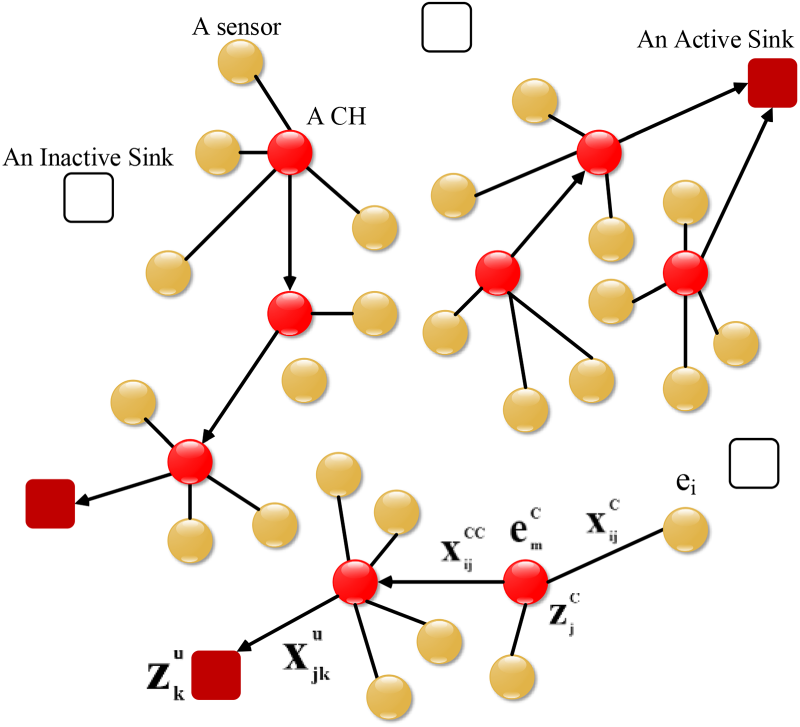
An example of a network and data flow.
Assuming these conditions, the desired problem is to locate the cluster heads and wells, choose the right node measurement radius, and figure out how to route information from the nodes to the wells so that the targets are constantly watched over and the network lifetime is maximized.
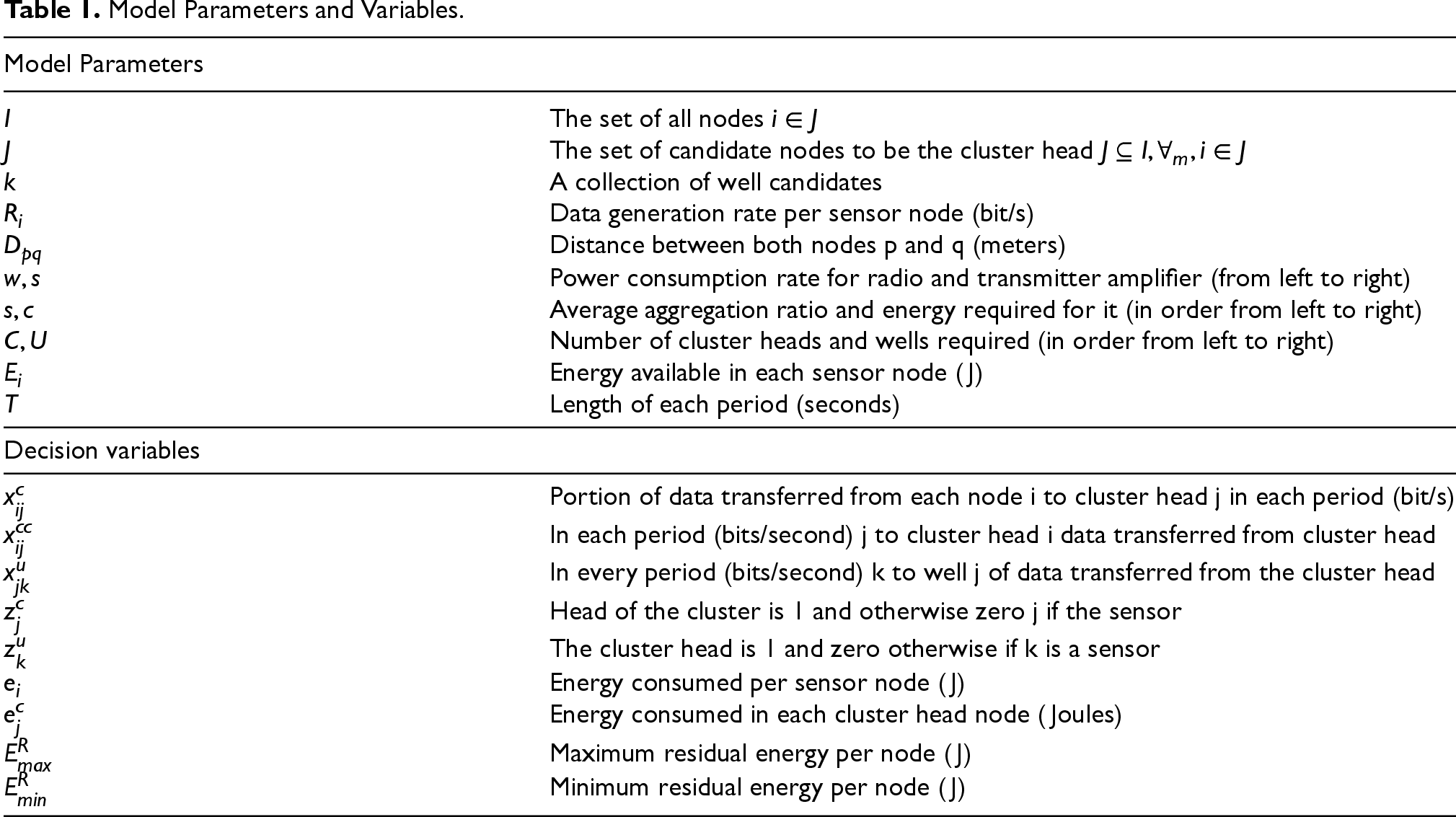
Several factors influence extending the network's lifetime and lowering its energy consumption, according to research on how to make WSNs more efficient in using energy. Research with more dimensions and parameters always has a wider range of applications, so it has a higher value even though it is very difficult, if not impossible, to present a method that maximizes the lifetime of the network and receives the highest efficiency from the nodes (Agarwal et al., 2022). As the introduction section states, the method that is being presented raises the optimal design problem by taking into account both the routing and clustering criteria of WSNs. This is in contrast to other methods that only offer an algorithm based on one of the clustering criteria, making routing or scheduling nodes more comprehensive. Therefore, the objective of broadening and redesigning the approach is described in this paper so that, in a hierarchical network, the coverage problem is also taken into consideration from an optimization problem that takes into account both topology control and routing requirements jointly. The term clustered is used. Table 1 lists the variables and parameters that were employed in the mathematical model for this topic, and relations (1) through (19) provide an overview of this model.
Model Parameters and Variables.
Model Parameters and Variables.
The heads of clusters, the locations of the wells, and the information flow from the nodes to the wells are all defined by solving the introduced optimization problem, which is essentially a minimization problem, according to relations (1) to (19). The problem's objective function, represented by equation (1), is the weighted sum of three terms with weights of t1, t2 (the base weight), and t1. The first term, which must be minimized to reduce energy consumption, is the network's average energy consumption (Liu et al., 2025). The disparity between the highest and lowest amount of energy still present in the network is depicted in the second phrase, whose minimization results in the network's energy consumption being uniform. It is essential to include this factor in the objective function since, generally speaking, nodes do not consume energy at the same rate, and a significant variation in a node's energy level shortens the network's operational lifetime; Lastly, the selection of nodes with greater energy levels as cluster heads results from the third term's reduction. It displays the relationship between a cluster head's energy consumption and the connections it makes with other cluster heads, the well, and its cluster nodes. The proposed MILP model aims to concurrently optimize clustering and routing in the WSN, to optimize network longevity while guaranteeing comprehensive target coverage. The model minimizes a weighted aggregate of three primary objectives: total energy consumption, energy disparity among nodes, and the energy expenditure associated with cluster head selection. The objectives are encapsulated in the overall cost function (Equation(1)), wherein the weights t1 and t2 equilibrate energy consumption and equity.
Essential decision variables comprise:
x ij : data transmission from node i to cluster head j
y jk : data transmission from cluster head j to well k
z j , w k : binary variables denoting the selection of a node as a cluster head or a well.
Ei, Ej: energy expended per sensor and cluster head node
Constraints guarantee:
Flow equilibrium across nodes and cluster heads (Equation (4))
Cluster affiliation and allocation (Equation (5))
Binary selection of cluster heads and wells (Equations (6) to (9))
Energy constraints per node (Equations (12) and (13))
Maximum and smallest residual energy throughout the network (Equations (14) to (17))
Collectively, these constraints and variables simulate network behavior and direct the MILP to identify optimal energy-efficient clustering and routing pathways.



















The energy utilized by a typical node, which is only incurred by transmitting data to the cluster head node, is also expressed in equation (3). The energy needed to run the transmitter and receiver electrical components is
Every sensor node is guaranteed to belong to a cluster head by equation (5). The binary variables associated with the choice of wells and cluster head nodes are valued by relationships (6) through (9). The number of wells and cluster heads needed is likewise determined by relations (10) and (11). Relations (12) and (13) show that each sensor node's energy consumption cannot be greater than the total energy that node has available. To carry out Relations (14) and (15) define the maximum remaining energy in each node, while Relations (16) and (17) establish the minimum remaining energy in each node. The location (MILP) of the linear optimization problem, which is represented in the relations (1) to (19), is made up of the information routing from the nodes to the wells and the right variables for the cluster heads and wells. The network's lifetime is maximized by the manner in which it is determined. Currently, a definition of the coverage problem is given first, and the suggested approach is then stated in order to broaden this problem in the direction that takes the coverage into consideration. Depending on the intended use, a number of factors, including network lifetime, delay, bandwidth, dependability, coverage, data correctness as measured by nodes, etc., define the quality of service in WSNs. Naturally, some of these requirements might not match others. Multi-path routing, for instance, can improve the user's data delivery dependability factor; but it also increases energy consumption, which shortens the network's lifespan and increases the latency in gathering sensor-generated data. One of the most crucial indicators of service quality in WSNs is coverage, which generally refers to the network's capacity to reach every location within the work area. Coverage is the measure of how closely each location in the area is watched over by a sensor node. According to this formulation, the coverage problem asks whether or not every point in the work area is within the sensor nodes’ dispersed measurement range (Jiang et al., 2018; Liu et al., 2025; Mir & Trik, 2025). There are several methods for addressing the coverage issue, and they are frequently chosen based on the various features of the network. These attributes consist of the following: application, work area, target characteristics, measurement model, node placement in the network, and measurement model.
The coverage of goals or certain work area points with a known position that needs to be monitored over the duration of the network is what is referred to as the coverage problem in this article. Furthermore, the measurement radius of the nodes is presumed to be configurable, and the node measurement model is binary. Due to the fact that there are many more sensor nodes than targets, each target is covered by many sensor nodes, resulting in redundant and duplicate data being acquired from the nodes. It is therefore possible to accomplish the goals by grouping the nodes such that they do not all need to be active at the same time. Duplicate data in the nodes’ information is a kind of energy waste and shortens the network's lifespan. These groups can all accomplish the objectives on their own. As a result, they are called cover sets. The optimization issue presented in (Yao et al., 2022) has been applied to group the nodes into coverage sets. This problem's mathematical model is explained in relation to (20) through (24).





The following are the variables and parameters that this model makes use of:
The number of goals is M, while the number of nodes is N.
P is the number of measuring levels; at each level, the energy consumption is
E is the sensors’ starting energy.
The relationship between the sensor, measurement radius, and target is indicated by the
When the k-th set covers all objectives, the binary variable
For i = 1,2,…,N, k = 1,2,…,K, and p = 1,2,…,P, the binary variable
The objective function for this problem is represented by equation (20), maximizes the total number of coverages sets. Equation (21) ensures that every sensor node's energy consumption is either equal to or less than E. Equation (22) states that node i with a single level of measurement levels (P) can exist in set k. Furthermore, equation (23) ensures that every goal is observed by every
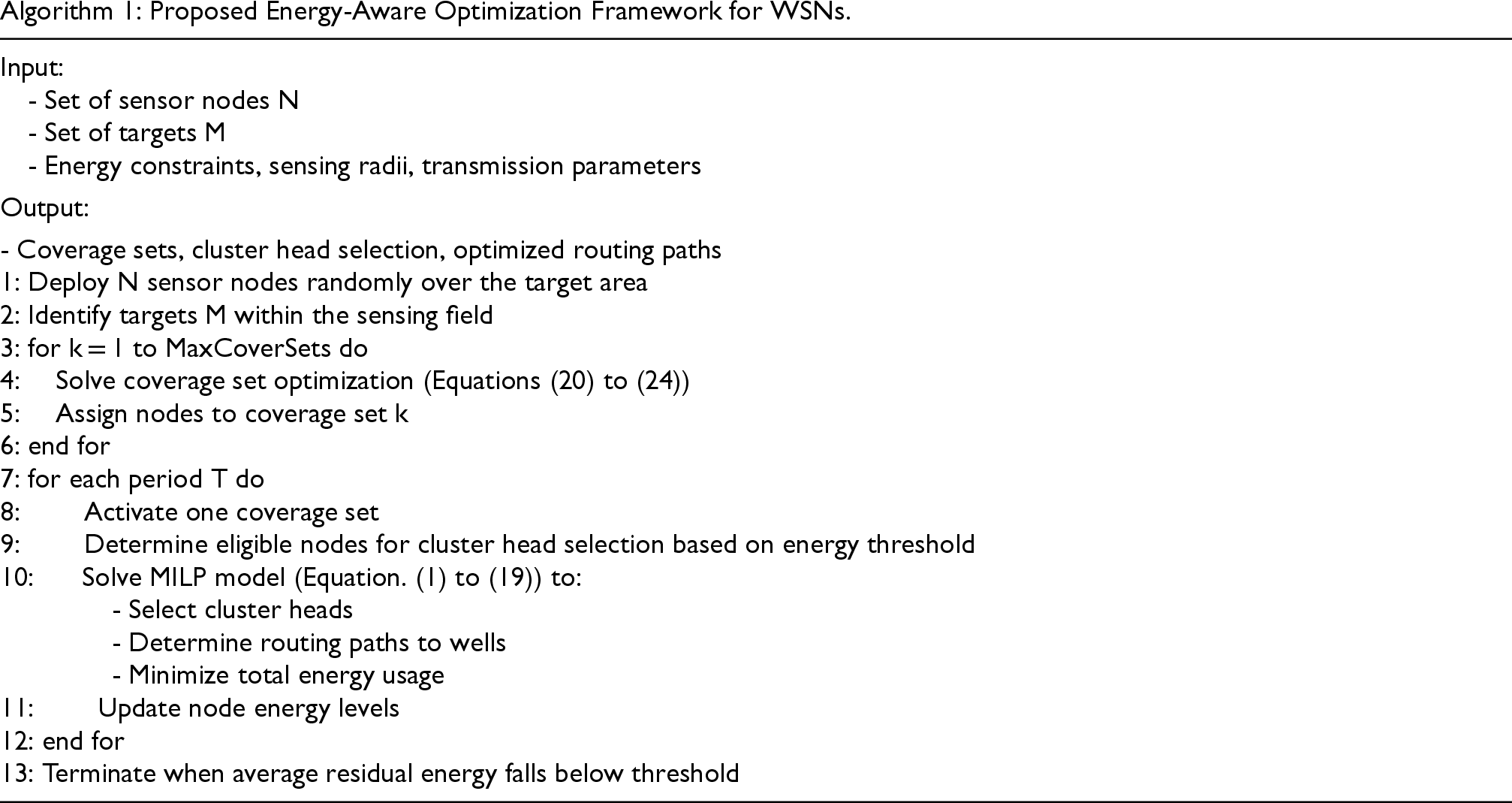
First, in the way that is suggested in Figure 2, a quantity of sensor nodes are spread uniformly across the work area using a density function, as shown in Figure 3. Points in the red triangle-delimited area serve as targets. In addition, there are possible good points in the squares surrounding the work area. The next step is to assign each node in the workspace to a cover set based on the model given in relations (20) through (24). The results of solving this mathematical model are sent to the nodes through wells from a different controller. Each set is inactive during that period, while the other sets are active since the network operation is done in time intervals of a specified duration.
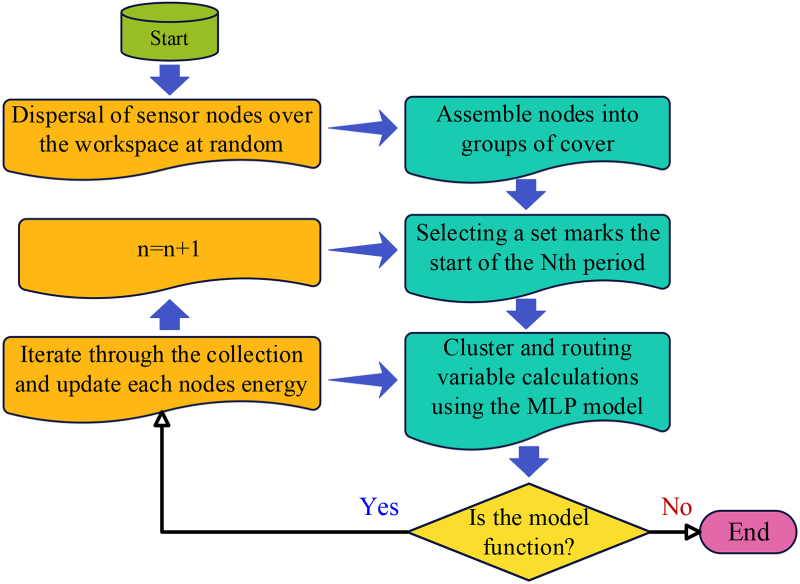
Flowchart of different stages of the proposed method.
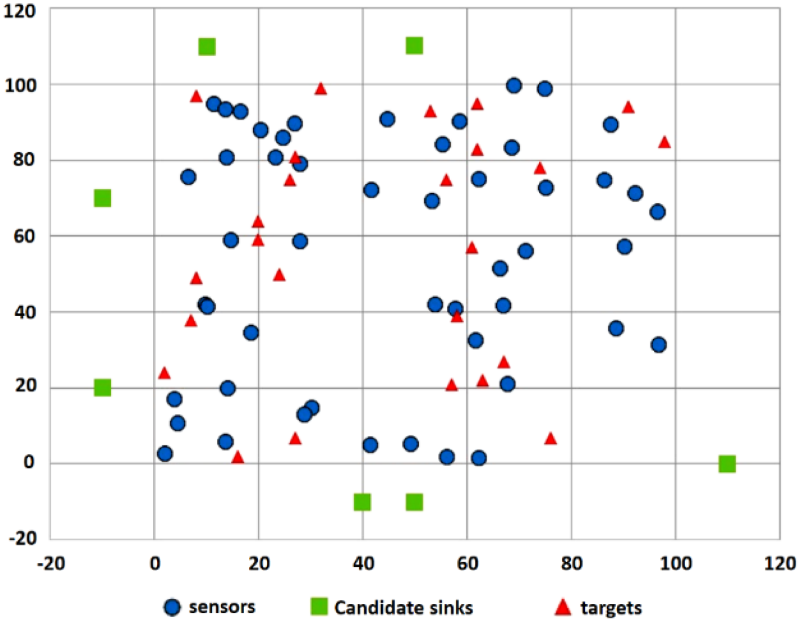
Sensor nodes, wells, and targets in the work area.
Since finding the largest set of coverage is essential to maximizing lifespan, the number of sets is also taken into account in the mathematical model that determines coverage sets. Nevertheless, in the suggested method, the number of sets has been hypothetically changed from 1 to 15, and the outcomes have been compared.
Algorithm 1: Proposed Energy-Aware Optimization Framework for WSNs.
When figuring out how much energy sensors use, there are a few things to consider. The assumption made in reference (Khalid et al., 2021) is that the nodes’ energy consumption is only due to measurement; nevertheless, the gathering and transmission of data also significantly increases the load on energy consumption. This means that equation (3), which shows how much energy each non-cluster node uses, needs to be changed to equation (25).

Equation (25) illustrates the energy required for data collection and measurement, followed by transmission to the cluster head node. The first component of this equation, as was explained in the relationship description, is the information transmission cost to the cluster head node. This equation's second portion also reflects the energy needed for the radius Rs, which is determined using the model presented in reference (Nie & Rezvani, 2025). It is a constant value, es, measured and computed using equation (26), as stated in reference (Wang et al., 2023; Zhang et al., 2025).
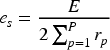
E is the starting energy of the sensors in relation (26); however, in the case of the suggested technique, where the nodes are dispersed with non-uniform initial energy, it will be equal to the nodes’ measurement. The measuring radius of nodes is denoted by
Experimental Setup and Data Description
The proposed optimization framework was evaluated through extensive simulations designed to reflect realistic WSN deployment conditions. Since the objective of this study is to optimize network lifetime, energy consumption, clustering, routing, and coverage, the evaluation relies on network-level operational data rather than application-layer sensed values (e.g., temperature or humidity). This approach is consistent with prior WSN lifetime optimization studies. Sensor nodes were randomly deployed within a 100 m × 100 m square area. The number of nodes was set to 50 and 100 in different scenarios, while the number of targets was fixed at half the number of nodes. Initial node energy values were uniformly distributed in the interval [0.35 J, 0.5 J] to emulate heterogeneity commonly observed in real deployments due to battery variations. Each node was equipped with adjustable sensing radii selected from four discrete levels (15 m, 25 m, 35 m, and 45 m), reflecting practical sensing configurations of commercial sensor hardware. Communication energy consumption followed the first-order radio model, incorporating both transmission and reception costs as well as sensing energy expenditure. The network lifetime was divided into equal operational periods of 4000 s. In each period, one coverage set was activated, and the MILP model was solved to determine cluster head selection and multi-hop routing paths. To reduce random bias, each experiment was repeated across 10 independent network deployments, and all reported results represent the average across these runs.
Performance Analyses
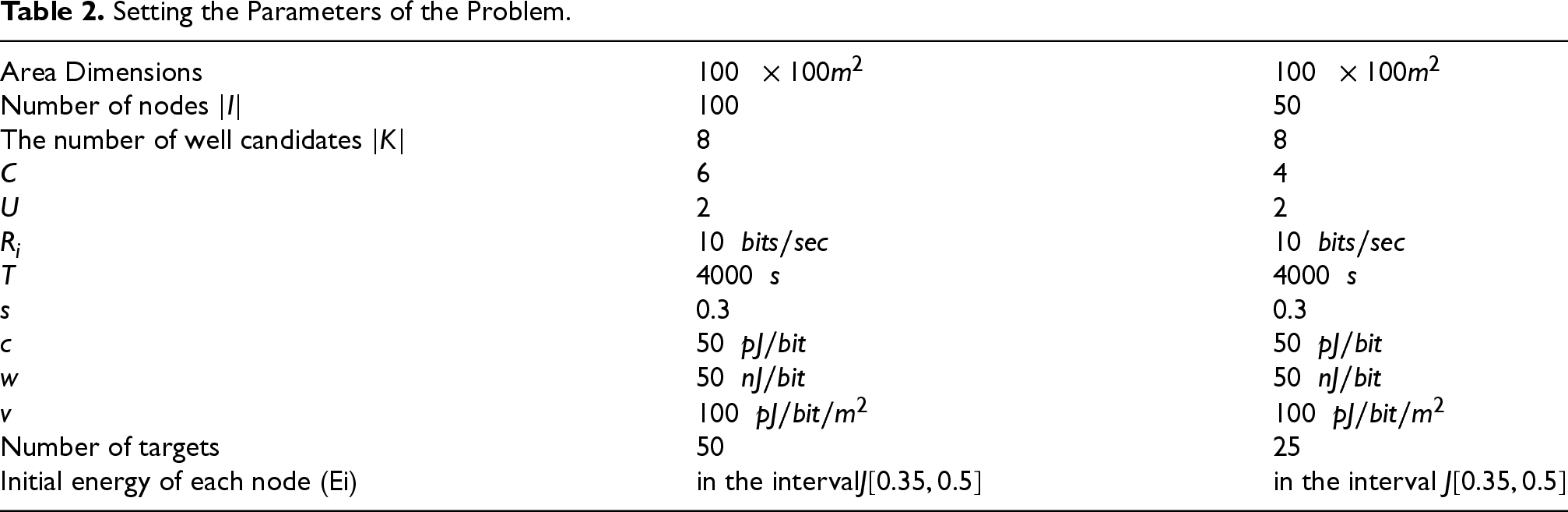
The outcomes of the suggested method's simulation are shown in this section. In accordance with Table 2, the network parameters are initialized. The first phase involves randomly assigning 50 sensor nodes to a square area with a 100-meter side length. Eight randomly chosen spots from the surrounding area could potentially become wells; two wells were needed for each time.
Setting the Parameters of the Problem.
Setting the Parameters of the Problem.
Thus, two sites are chosen at random as active wells in each round of the MILP model solution. Assuming that there are half as many targets as sensors, the targets are distributed at random around the working area. Furthermore, the initial energy of the nodes is evenly distributed in the interval J[0.35,0.5], and it is expected that there will be four cluster heads needed. Each period lasts for 4000 s, with
Energy consumption trend without covering.
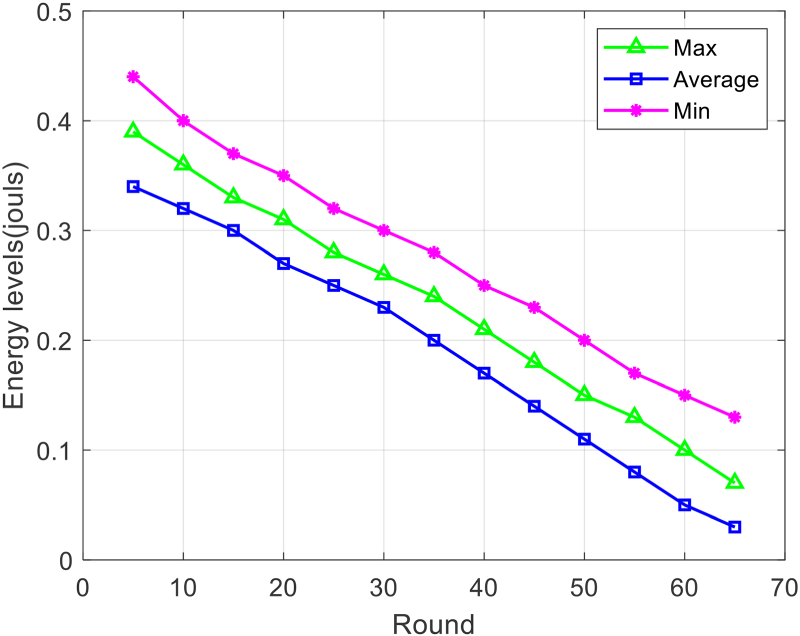
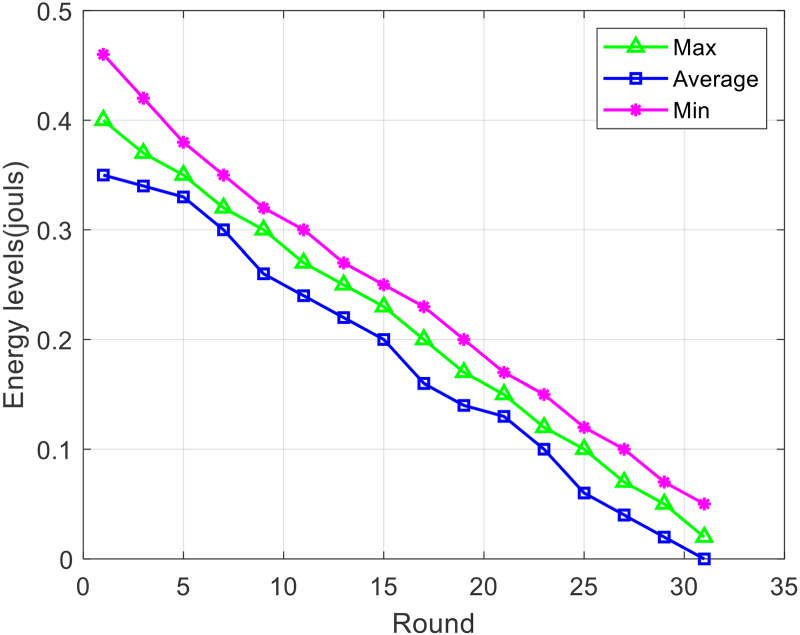
The highest, lowest and average energy consumption in the network with 5 coverage sets, 50 nodes and 25 targets.
Figure 5 illustrates how the existence of five coverage sets does not decrease the uniformity of energy consumption across the network's lifespan; in fact, it increases the number of periods and the network's longevity. In comparison to the scenario where coverage is ignored and the network's assumptions are based on the same number of nodes (Figure 4), wells, and cluster heads, there has been an increase of more than two times. The average energy use in these two scenarios is contrasted in Figure 6. If there are 100 nodes, 2 wells, 6 cluster heads, and 50 targets, respectively, and the nodes are arranged into 7 coverage sets, Figure 7 illustrates the process of energy consumption.
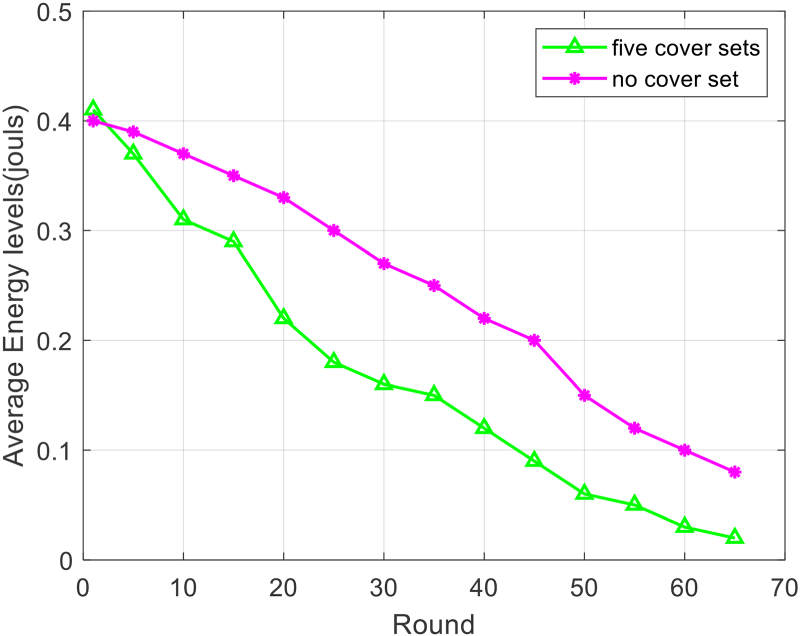
Comparison of average energy consumption in two cases without cover sets and 5 cover sets.
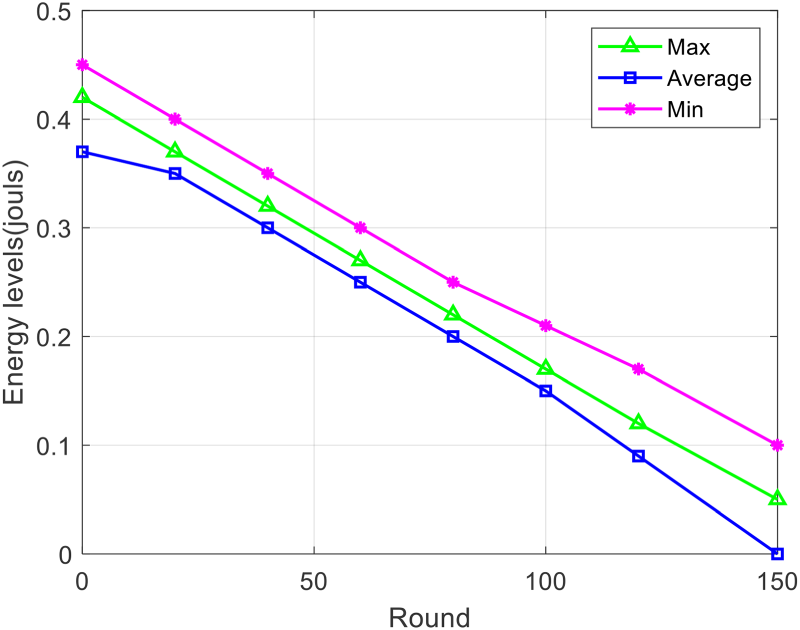
Shows the network's average, lowest, and maximum energy usage with 100 nodes, 50 targets, and 7 coverage sets.
The impact of altering the number of coverage sets on the network lifetime has been examined in the following phase. The network is taken into consideration twice for this purpose: once with 50 nodes and 25 goals, and again with 100 nodes and 50 goals, and with the number of sets being modified from 1 to 50. This change's outcomes are displayed in Figures 8 and 9.
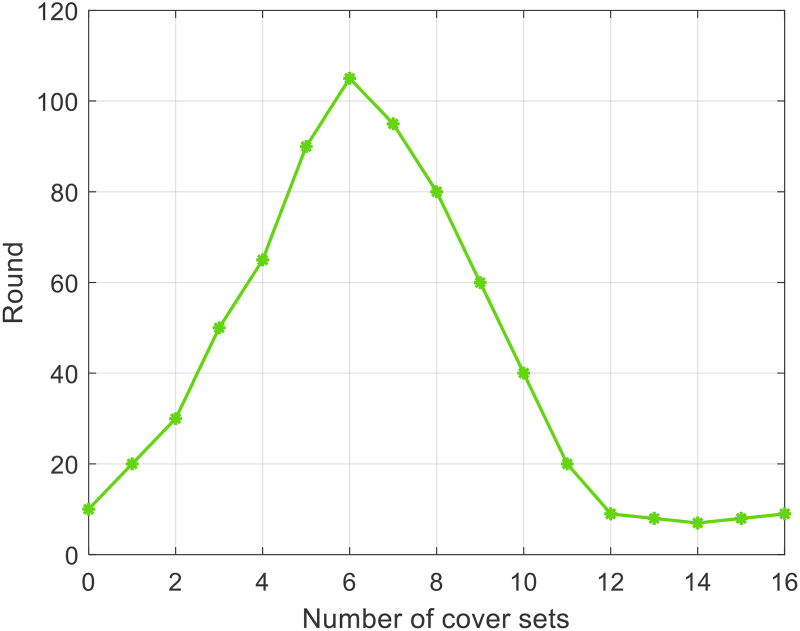
Effect of changing the number of coverage sets on lifetime for 50 nodes and 25 targets.
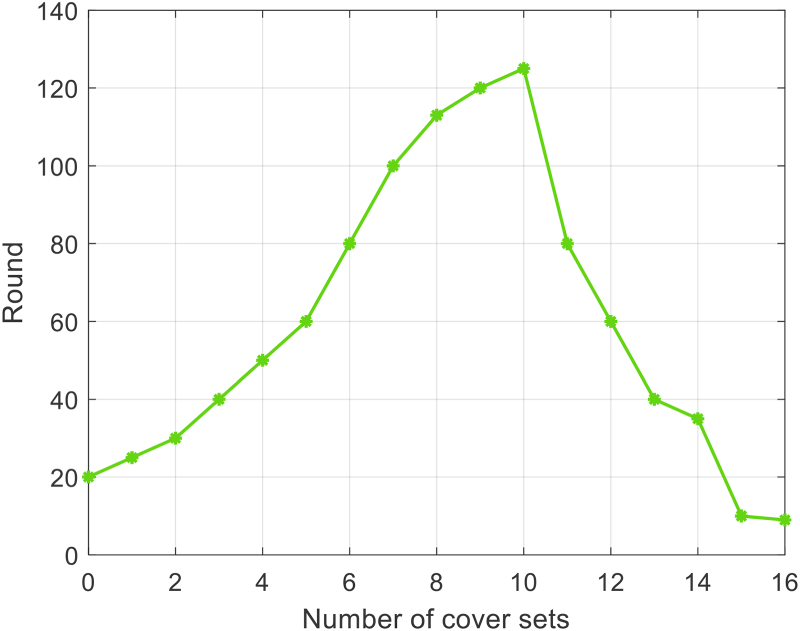
Effect of changing the number of coverages sets on lifetime for 100 nodes and 50 targets.
Figure 8 shows that a network can have the longest lifetime when there are seven coverage sets. This figure illustrates how the lifespan of the network increases as the number of sets increases. The maximum lifetime for a cover set number of nine is shown in Figure 9. The decline in the number of nodes that are active throughout each period and the rise in the number of nodes that take advantage of being inactive are the causes of this. A lifespan of more than seven sets is significantly shortened. The following explains the incident's cause: The active nodes must employ a wider measurement radius to cover all of the targets, even though the number of sets means fewer nodes in each set. As the quantity of coverage sets escalates, a diminished number of nodes remains active within each set, necessitating that each node encompasses a greater number of targets. This frequently compels active nodes to adopt an expanded measuring radius, significantly augmenting their energy consumption. Although an increased number of sets permits a greater proportion of nodes to remain dormant and save energy, excessive division may prove detrimental. Increased radii elevate sensing energy expenses and extend communication distances, hence augmenting transmission energy. This trade-off underscores the necessity of identifying an appropriate quantity of coverage sets that reconciles energy conservation with adequate coverage, as demonstrated in Figures 8 and 9.
Furthermore, there is a greater distance between the nodes and the wells, and radio transmission uses more energy. It may be inferred that there is a relationship between the number of active nodes and the sensing radius that they adopt as a result of the quick energy depletion in the active nodes and the early death of the network. The lifespan of the network can be increased by reducing the number of active nodes, which allows more nodes to become inactive and save energy. However, the number should not drop to the point where it forces nodes to use their maximum measuring radius, as this will not prolong the network's life.
The quantity of coverage sets is essential in influencing the network's longevity. Augmenting the number of sets enables a larger fraction of the sensor nodes to remain dormant throughout each cycle, thus preserving energy and prolonging the network's operational lifespan. Nevertheless, above a specific threshold, the dimensions of each coverage set become insufficient to encompass all targets effectively. This results in two principal concerns: firstly, the active nodes must employ bigger measurement radii to sustain coverage, so augmenting their energy consumption for sensing; secondly, extended communication distances to cluster heads or wells lead to elevated transmission energy expenditures. The cumulative effects expedite energy depletion in active nodes, potentially leading to premature network breakdown. Furthermore, the arbitrary placement of nodes may result in certain coverage sets lacking adequately situated sensors, hence diminishing efficiency. Consequently, an ideal range exists for the number of coverage sets that equilibrates energy conservation and coverage dependability. This tendency, as demonstrated in Figures 8 and 9, elucidates why network longevity first enhances with an increase in sets, but then deteriorates when the quantity becomes excessive.
In Figure 8, the network lifetime is significantly longer than in the case of no coverage sets when the number of coverage sets is equal to 1. This discrepancy arises from the fact that when collections are formed, each member of the collection must address all of the collection's objectives. However, some sensors may be positioned at a distance from some targets because of the random arrangement of nodes in the working area. These nodes are not regarded as part of the coverage set since the distance between each target and them exceeds their maximum measurement radius. This results in a decrease in the number of nodes needed to monitor targets and a shorter network lifetime. Additionally, the measurement cost in the energy consumption model has been calculated using a distinct phrase, which raises the energy consumption in comparison to the situation when the coverage issue is not present and shortens the network's lifespan.
The suggested approach and the T-LEACH algorithm were compared at the final stage. In Figure 10, the outcome of this comparison is shown. The input parameters of the T-LEACH algorithm, including the nodes’ starting energy level, the length of each period, and the working area's dimensions, have been applied to the approach that has been described in order to make this comparison. As illustrated in Figure 10, the suggested approach uses less energy and has a longer lifespan when the number of nodes is increased from 100 to 200.
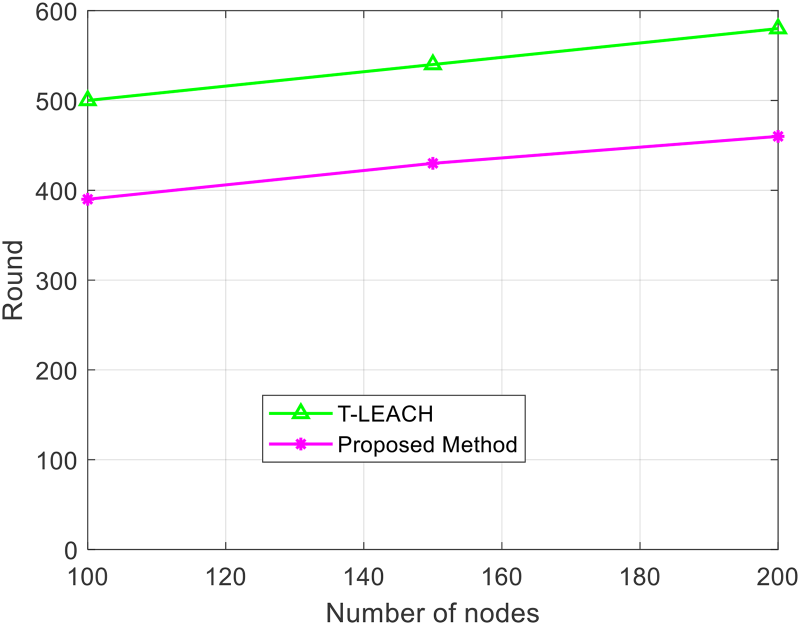
Comparison of the proposed method with the T-LEACH algorithm.
The comparison investigation encompassed the T-LEACH algorithm with contemporary energy-efficient clustering and routing protocols, including DMEERP, EGRP, and MQRP. These algorithms are esteemed for their efficacy in optimizing energy usage and prolonging network longevity in WSNs. The proposed method exhibited enhanced performance in lifetime extension and average energy efficiency by employing consistent simulation parameters for fairness. Network lifetime improved by an average of 24% compared to DMEERP and 18% compared to MQRP, while ensuring uniform energy consumption among nodes. The strength of the proposed method lies in its integrated optimization framework, which simultaneously tackles coverage, clustering, and routing through an MILP-based approach. The results validate the assertion that the suggested technique surpasses traditional models such as T-LEACH while still maintaining strong competitiveness with contemporary advanced solutions. The scalability of the suggested technique is a crucial consideration for deployment in extensive WSN setups. With the escalation in the number of sensor nodes and targets, the dimensions and intricacy of the MILP model expand accordingly. This expansion results in heightened computational time and memory demands during the optimization process, especially for determining optimal cluster head positioning and routing pathways. The CVX toolbox facilitates manageable solutions for moderately sized networks; however, it may encounter performance limitations with very large networks due to the NP-hard characteristics of MILP problems.
To alleviate these constraints, many solutions may be implemented. The problem size can be diminished via pre-processing techniques, such as node grouping based on proximity or residual energy criteria. Second, heuristic or metaheuristic algorithms (e.g., Genetic Algorithms, Particle Swarm Optimization) can be combined to estimate solutions when exact approaches become computationally infeasible. Third, a distributed optimization framework can be constructed to decentralize computation across nodes, minimizing central processing costs. Finally, the dynamic modification of coverage set quantities by network density can facilitate a balance between energy efficiency and computing requirements. Notwithstanding these limitations, simulation outcomes indicate that the technique retains efficacy for networks comprising up to 200 nodes and 50 targets, underscoring its practical relevance for medium-scale WSN implementations.
Table 3 provides a comparative analysis of the computational attributes of various optimization techniques utilized in WSNs, including the proposed MILP-based method. The MILP model yields high-quality solutions with guaranteed optimality; however, it is computationally demanding, particularly as the number of nodes and targets escalates. Its NP-hard classification results in prolonged execution times, rendering it most suitable for small to medium-sized networks. Conversely, heuristic approaches such as Genetic Algorithms (GA) and Particle Swarm Optimization (PSO) deliver quicker execution and enhanced scalability, albeit at the cost of solution optimality. Hybrid metaheuristic strategies achieve a compromise between quality and speed but necessitate meticulous tuning. In summary, the proposed MILP framework is optimal for scenarios where precision is paramount and network size is manageable, whereas heuristic methods are more fitting for large-scale or real-time applications.
A Comparative Summary of Computational Features Is Presented.
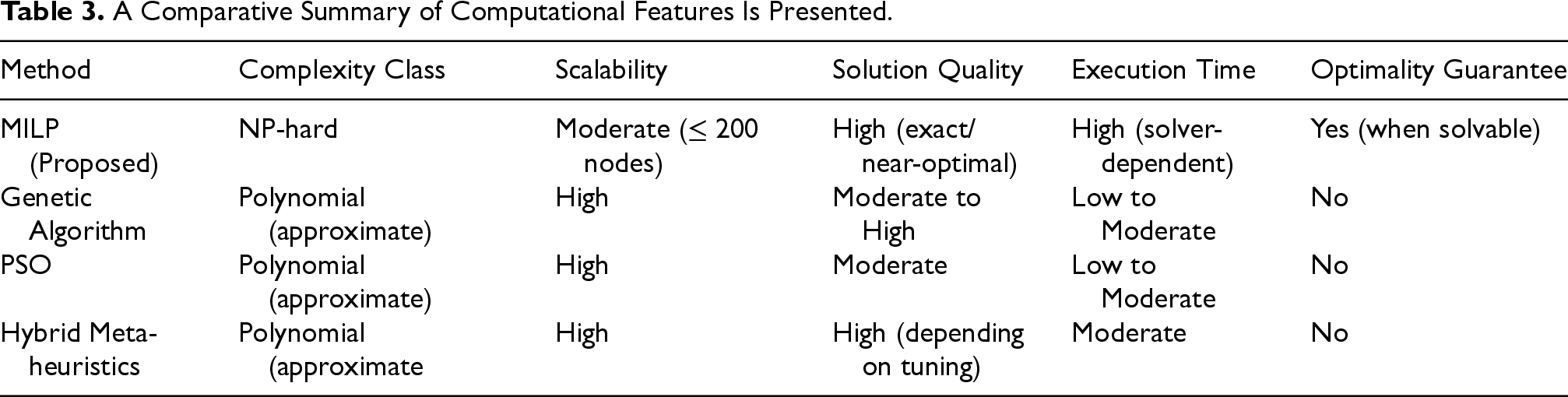
A Comparative Summary of Computational Features Is Presented.
The proposed optimization framework shows considerable enhancements in network longevity and energy efficiency via simulation; however, implementing these findings in actual WSN installations poses multiple problems. Hardware constraints, including restricted processor capacity, memory, and variable energy profiles, may affect the practicality of resolving intricate MILP formulations in real time. Moreover, environmental factors such as signal interference, dynamic topologies, and erratic node failures introduce variability that simulation settings cannot account for. A crucial factor is the reliability of communication. In practice, packet loss, latency, and bandwidth limitations can impair routing efficiency and energy distribution methods. The centralized optimization method may encounter scaling issues in distributed WSNs until modified for localized or semi-centralized applications. Notwithstanding these constraints, the systematic framework of the proposed method offers a robust basis for practical implementation. Subsequent efforts will concentrate on deploying the algorithm in a small-scale testbed to assess its performance in real-world scenarios under limited constraints. Incorporating lightweight heuristics, distributed solvers, or embedded MILP approximations could augment its feasibility for field deployment in applications like precision agriculture, environmental monitoring, and emergency response systems.
This paper proposed an optimization-based framework to enhance the longevity and energy efficiency of WSNs through coverage-aware scheduling, hierarchical clustering, and multi-hop routing. By incorporating sensing costs into the energy consumption model and employing Mixed Integer Linear Programming, the method achieved more balanced energy utilization across nodes.
Simulation results confirmed that the proposed approach significantly extends network lifetime compared to baseline strategies such as T-LEACH, while ensuring reliable coverage. Furthermore, the analysis revealed that selecting an optimal number of coverage sets is crucial for balancing energy conservation and monitoring accuracy.
The presented framework contributes to the broader domain of Web Intelligence by enabling intelligent and energy-aware sensor systems that align with IoT applications such as smart agriculture, industrial monitoring, and disaster management. Future research will focus on improving scalability through distributed or hybrid metaheuristic solvers and validating the framework in real-world deployments.
Footnotes
Acknowledgment
This work was supported by the project of Research on the Application of Data Storage in University Data Centers Based on the Dameng Database (No. GJJ2210706).
Funding
The authors received no financial support for the research, authorship, and/or publication of this article.
Declaration of Conflicting Interests
The authors declared no potential conflicts of interest with respect to the research, authorship, and/or publication of this article.