







Abstract
Language is a prerequisite for quotidian human life. For the most part, it plays an instrumental role in defining national, ethnocultural, and caste identifications in a polyglot society like India. Language shapes our views and bestows meanings to our thoughts. However, the analysis of language’s roles, functions, and usefulness, especially in studies grappling with Dalits life in Kerala, has been considerably overlooked by vernacular Dalit scholarship. Against this backdrop, the present article attempts to delve into one of the Dalit languages in Kerala, the Parayans’ language. Drawing insights from two-year-long ethnographic fieldwork, this article sheds light upon the unfolding of Parayans’ everyday life and the process of self-identification besides explicating the ontic properties of the Parayans’ language. In a subtle manner, the article adopts the methodology of ‘linguistic turn’ and urges Dalit scholarship to attune itself to afresh conceptual orientation so that it can bring the linguistic question as the central a priori of discussions in relation to life, identification, and subjectivity of Dalit beings.
Introduction
Not much has been written on the parallel linguistic tradition of communities living in various parts of the globe. 1 Regarding the Indian case, the research scholarship on esoteric or parallel language has not reached an advanced stage heretofore. 2 India is a polyglot country, where the states are organised on the basis of language. Hence, language is impregnably linked to marking ethnocultural boundaries in the context of the state’s organization in India. For example, the Malayali people of Kerala consider themselves a distinct ethnocultural group primarily based on their Malayalam language, which further helps to differentiate them from linguistic groups living in other Indian regions. Therefore, the matter of ethnocultural differentiation, to a great extent, is determined by the language people speak in the respective states/regions.
Interestingly, similar logic can be found in caste differentiation; that is to say, each caste possesses its own language as part of its unique identity. This is perhaps why Gumperz (1958) contends that the upper caste Hindus of Northern Indian societies can easily detect the identity of Dalit Chamars because they often speak a kind of distorted Hindi dialect known as the Chamar Speech. In the same fashion, one can also identify more or less the same logic in the context of the caste division in Kerala society, where the lower caste Dalits utter a dialect called Ppechu. This dialect is generally reckoned polluted and substandard and, therefore, possesses an abject status in Malayali society. For example, the Ppechu dialects, such as Parappechu and Pulappechu, are considered the scurvy ways of speaking Malayalam among the Malayalis. At present, several Parayans and Pulayans do not speak their Ppechu dialects due to the influence of Christian conversion, Dalit liberation movements, social reform project, and their subsequent educational progression. So a reflective question that appears here is: why would the Dalit Ppechu dialects possess lower status in the society and culture compared to the dialects of the upper caste beings? Here, one has to look into the gist of Gumprez’s observation again: ‘[these phenomena, that is, the already fixed hierarchical status of dialects] are not idiosyncratic as had been assumed by some but are patterned and socially determined’ (ibid, p. 668). It is in the backdrop of this postulation the present article attempts to look into the Parayans’ language, an unparallel Dalit language of Parayans in Kerala, the lowest of the lower caste in the Dalit fold.
For Kerala’s general public, the Parayans’ language is mostly unfathomable. Therefore, an attempt is made to explore the Parayans’ language based on ethnographic observations in the ensuing pages. For the convenience of understanding this unique Dalit language, this article is divided into a few inter-related sections. The first section delineates the cultural systems, practices, conventions, etc of Parayans in order to expose their uniqueness compared to other groups in the Dalit fold. The second section is more cultural-linguistic in character, focusing on the distinctive aspects of the Parayans’ language and thereby trying to analyse the conditions that make this language unique—its role in anti-caste mobilization, its emancipatory potential, and linguistic properties—morphological, semantic, and syntactic patterns. The third section deals with some critical observations concerning the way in which the interaction between the Parayans’ language, their quotidian life, and the process of Parayans’ identification unfolds. The concluding section proposes some pensive observations and arguments concerning the Parayans’ language
Anthropology of the Parayans in Kerala
Perhaps, the word Parayan (Parayar in plural) is familiar only to the people of Southern India. However, its various linguistic derivatives are known to people around the globe—for instance, the term Paria for German and French speakers and the word Pariah to the English-speaking world. According to Eleni Varikas, the word Pariah in the West, especially ‘until the mid-eighteenth century, was presented in a metaphorical sense as a synonym with “condition”, “class”, or “order”, a meaning that, far from being critical or pejorative refers to the social hierarchy seen as a harmonious, or at least natural continuum’ (2010, p. 34). The Oxford English Dictionary defines Pariah as ‘a member of an indigenous people of Southern India, originally functioning as ceremonial drummers but later [demeaned] as people of having lower caste [status]. 3 Regarding the subsequent transformation of the term Pariah, observes, Vanja Hamzić’, since early colonial times, the word ‘Pariah’ in the English language has come to denote any person or animal that is generally despised or avoided…For British colonial masters, the word ‘Pariah’ was, however, applicable to all of the lowest Indian castes, gender and human outcasts in general and, curiously perhaps, to India’s street dogs’ (2014, p. 185). ‘Pariah is a cruel word. For most speakers of English today, only the dimmest memory of what it once meant survives…Casually employed by journalists and others for whom it is just a metaphor—often in reference to a person or state that deserves to be reviled—it is a word that causes the descendants of those it once named to visibly wince’, says Rupa Viswanath (2014, p. 11). Unable to realize the meaning of this abject nuance, many South Asian scholars still use the term Pariah, thinking it is an innocuous anglicized axiom denoting the Parayans of southern India. For this reason, the present article feels that the usage of the term Parayan is politically correct, for it is more authentic and culturally inherited than the anglicized derivative, regardless of how well-known it may be.
The Parayans are one of the Dalit castes found in all South Indian states—Kerala, Tamil Nadu, Karnataka, and Andhra Pradesh, and even in the neighbouring country of Sri Lanka (See McGilvray, 1983). The Parayans are said to have a glorious cultural history in the old Tamilakam, and culturally they belonged to the Tamil country (Basu, 2011). At present, the total population of Parayans in Kerala is 232,411, of which 114,518 are male, and 117,893 are females. Moreover, based on the numerical strength, the Parayans are the third-largest Dalit community (7.44%) in Kerala, followed by Pulayars (33.34%) and Kuravans (8.76%). 4 In Kerala society, Parayans are often portrayed as mere untouchables whose cultural history is wrapped up in uncertain myths and beliefs that are couched in discourses of body impurity and serfhood. However, contrary to this common depiction, a different picture of Parayans’ cultural history is available. Few studies, for example, mentioned the tribal-animistic tradition of the Parayans of Kerala (Balakrishnan, 1983; Iyer, 1941). The work of L A Krishna Iyer (ibid) offers an exquisite, though laconic analysis of the Hinduization process of the then depressed class in Kerala, in which Parayans are the member. 5 The Parayans Hinduization, according to Krishna Iyer’s view, is presumably an old one compared to the ongoing Sanskritization process. 6 At present, Parayans of Kerala have embraced the name Sāmbavar (See, From the Pariahs of Travancore, 1914) on the ground that their traditional caste name has been stigmatised and portrayed as an abject category not only in the cultural boundaries of Southern India (term Parayar) but also in the quotidian life of the West (term Pariah).
Parayans are unique compared to other Dalits beings in Kerala. This uniqueness is primarily linked to their cultural systems, traditional practices, myths, and the Genesis Story—all these play a critical role in defining them as distinguishable folks within the Dalit fold. For example, the gist of the Genesis Story of Parayans pays an exuberant emphasis to the ontology of the term Parayan, and its kernel runs parallel to the colonialist representation of Parayanness. According to the Genesis Story, Parayans and Brahmins were the progenies of cousin sisters of the same mother. The former used to be known as the people of Thekkan Illam (Southern Illam), and the latter was named Vadakkan Illam (Northern Illam). However, their accidental encounter with the tasting of cow meat led to the expulsion of the Thekkan Illam people from the clan and branded them as ‘outcasts’. The aftermath was the break of the kinship bond between the people of Thekkan Illam and Vadakkan Illam forever. Incurred by the extreme aversion of the people of Vadakkan Illam, the Thekkan Illam cousins then became the outcasted Parayans or ‘the eaters of the carcass’ (see Appukuttan, 2015; Thurston, 1909). The central focus of the Genesis Story is the tragic fate of Parayans—tragedy gives birth to the untouchableness as well as the outcastness of Parayans. Thus, based on the gist of the Genesis Story, Parayans of Kerala propose a different ontology regarding the origin of their subjectivity and draw a history, thereby trying to differentiate themselves from their Tamil counterparts.
Similarly, one should look into the proverbial Pākkanār myth, without which any narration about Parayans of Kerala will become incomplete. Unlike other Dalit communities, Parayans possess a solid mythical character known as Pākkanār. The Parayans of Kerala are generally known as the Pākkanār vamshajar (the progenies of Pākkanār). The Aithihyamala (The Garland of Legends), one of the most famous works, sheds light upon the legendary Pākkanār as well as the proverbial Parayan myth Parayipetta Panthirukulam (The legend of 12 clans begotten by the Parayar Woman). Though Aithihyamala does not directly refer to the origin of Parayans, it does speak about two legendary Parayan characters at great length—the Parayar woman, on whose name the Panthirukulam story is based, and Pākkanār, one of her sons, an enlightened Parayan oracle. Surely an enormous cultural and historical significance has been attached to these two characters and their stories in Kerala society. One of the beliefs is that the Parayans language is as old as Pākkanār himself, and Parayans argue that Pākkanār used this same language to converse with his fellow Parayans. Therefore, the Parayans’ language occupies a sublimate position in relation to their history.
Having understood the uniqueness of the Parayans of Kerala, it is now the time to concentrate on their linguistic tradition, the central theme on which this article is based. In fact, this linguistic tradition is the most unequalled cultural trait of Parayans because it makes them a distinctive social group within the Dalit fold. The Parayans are highly protective and sensitive of their language and so much so that they will not teach or disclose anything of their language to their Dalit counterparts. In fact, their language is much more advanced than a mere caste dialect which is, however, a common thing among Kerala people—for example, several tribes and castes in India have their own caste or community dialects. But the Parayans’ language is not just a dialect. But it is rather a language with the proper syntactic structure with plenty of vocabulary. In the following section, a detailed enquiry is conducted on the Parayans’ language.
The Parayans’ Language: Some Ontic, Social, Cultural, and Political Aspects
No doubt, language makes Parayans of Kerala distinctive. The Parayans are bilingual, that is to say, they speak Malayalam and their language. The name of the Parayans’ language is Porul Bhasha or Porul language. This name is impressive because the very meaning of the term ‘Porul’ in Malayalam is nothing but the word ‘meaning’ itself. However, in some parts of southern Kerala, the Parayans’ language is also known as Parappechu. But normally, the Parappechu is the dialect of Parayans; thus, the Parayans’ language actually differs from the Parappechu. Unlike Parappechu, the Parayans’ language has a proper syntactic structure. This language is often spoken at homes, community gatherings, and places where Parayans meet each other. The Parayans’ language is, in fact, an identification marker for Parayans as they contend that they are the only Dalit beings who possess a linguistic tradition of their own.
However, the cultural significance of the Parayans’ language has been lost considerably in the present time. The educated ones (Parvenu Parayans)
7
neither pay attention to it nor do they speak this language in daily life. As a result, similar to other cultural practices of Parayans, their linguistic tradition has also become the object of caste stigma. For instance, Parayans of modern day start thinking that their language is the symbol of the then untouchable and servitude life. And for this reason, the Parayans’ language is being subjected to considerable cultural aversion within the community under the pretext of their march towards modernity. It has been conceptualised that missionary education and Christian proselytization have brought the seeds of modernity to Parayans by altering their age-old ritual and cultural practices. For example, P Sanal Mohan opined that ‘though paternalistic in character, the rudimentary form of education offered by the missionaries to those Dalit converts enabled them to reach the threshold of literacy and to use the standard form of Malayalam instead of the colloquial caste-specific variant of language that they had employed for centuries’ (2005, p. 41). In another work, Sanal Mohan writes:
In the case of certain castes such as the Parayas it has been noted that there was a particular kind of language that was more connected to Tamil that would not be understood by others. It remained as a kind of ‘hidden transcript’ that made their words appear mostly obscure to others, especially to the upper caste landlords. (2016, p. 55)
Indeed, the missionaries, as well as the colonial ethnologists, were aware of the Parayans’ language, as Edgar Thurston talks of it in his work Castes and Tribes of South India—‘the Paraiyars have a dialect of their own, with which the Pualayas are not familiar, and which would seem to be worthy of study’ (1909, p. 131). However, confusion lingers with regard to whether Sanal Mohan talks about Parappechu or the Parayans’ language while referring to the missionary contribution in connection with the teaching of standard Malayalam to Parayans . This is primarily because the Parayans’ language is neither a secret code nor a ‘hidden transcript’ looking from Parayans’ subjective vantage point. Instead of making Parayans feel proud of their unparallel linguistic tradition, the idea of modernity passed down by missionary education depicted their cultural and linguistic tradition as if it were some disgraced remainders of the guilty past that deserved to be forgotten. Hence, missionary education in this context should not be looked at in the sense of a path towards the sense of creating pride in their cultural and linguistic entities, but it should rather be looked at as a path towards the attunement of Parayans’ minds in the direction of the eschatological world of Christian religiosity.
The Parayans’ language is devoid of the scriptural system; hence, it is transmitted through oral tradition. The language learning process starts from the very realm of the family itself—a place where the first step of quotidian verbal communication learning takes place. The language learning method is identical to what Ludwig Wittgenstein has termed ‘ostensive definition’. For instance, ‘children learn their first words by way of ostensive definition. This process proceeds when a parent points to a door, says “door” and asks the child to say the same. In this way, a child learns the name of things’ (Noren, 1962, p. 93). But ordinary people generally lack the conceptual potential to understand the functioning of the Parayans’ language in the above manner. For them, the Parayans’ language is a peripheral language—a language that has no script, so much so that no body of literature is contained in it, and it is, above all, a language spoken only by former untouchable beings. Hence, one puts it in a sophisticated style that it can be called a hidden transcript or a caste-centric secret language. But both ways of reference are, no doubt, the vivid expressions of trivializing the Parayans’ language, no matter wherever it appears, be it at the ordinary level or at the academic level. Also, this kind of trivialization of the Parayans’ language is very often among the Parvenu Parayans. Thus, any attempts to make an association with the Parayans’ language is a dishonour to the Parvenus, whose belief is that the upward sociocultural mobility of Parayans in the existing caste hierarchy is possible only through cleansing their modest linguistic practices. In that sense, the Sanskritization process is a potential threat to the cultural and linguistic assertion of Parayans as it puts their sense of identification in the state of a critical impasse.
In fact, not much research has been conducted on the Dalit tongues in general, and on the Parayans’ language in particular, except for a tiny piece of monograph presented by Dileep (2009) at the students’ linguistic conference held at Jawaharlal Nehru University, New Delhi. However, Dileep’s paper does not throw any pensive insight because it principally deals with the dialectal variation of the Parayans’ language. Yet another reason for the trivialization of the Parayans’ language is the lack of awareness of social scientists and linguists. So discussions on the Parayans’ languages face serious neglect in the realm of academics. For example, bodies entrusted to take serious engagements with issues pertaining to the protection and preservation of Dalit culture at both the state and the union levels have not heard of the linguistic traditions of Dalits, particularly of the Parayans’ language. The omission of the Parayans’ language from the proverbial ‘Linguistic Survey of India’s documentation process is a good example in this regard.
Concerning the origin of the Parayans’ language, argues Dileep, ‘this language has been commonly used in relation to the paddy cultivation’ (ibid., pp. 216–217). [In addition, Parayans used] this language as code language [mainly] to escape themselves from the attacks of the dominant class’ (ibid. p. 217). Here, one needs to understand that though Parayans used their language as an instrument of tacit communication with their fellow members while working in the paddy field and other agrestic-related works, it has never evolved as a guild language. Of course, the Parayans’ language has been used as a linguistic medium to externalise the feelings of pleasure, pain, and mental torment of Parayans, who used to be agrestic slaves of the higher caste landlords in the past. But the function of the Parayans’ language is not confined to the purview of paddy fields and slave labour alone. It, on the contrary, has been widely spoken at homes and community gatherings as well. Based on the ethnographic observation, it is further identified that the Parayans’ language has also been used by Parayans to ridicule the higher castes, for the most part. This is presumably the reason why the public often terms the Parayans’ language a ‘secret language’ or a ‘code language’. In such situations, the prime intention is not to reveal the content of Parayans’ conversation to the upper castes. The reason is that ridiculing the upper castes could cause severe danger to the lives of the poor Parayans, who used to work as slave labourers till the nineteenth century. Most importantly, no spoken language of the world can confine itself to a single occupational activity unless it is a ‘guild language’ like the Shelta language in Ireland, on which MacAlister (1937) has written a brilliant work. Therefore, the Parayans’ language is neither a ‘guild language’ like Shelta and nor is it a ‘ceremonial/ritual language’ like Sanskrit for the Brahmins, for that matter. Instead, it is a spoken language of quotidian life.
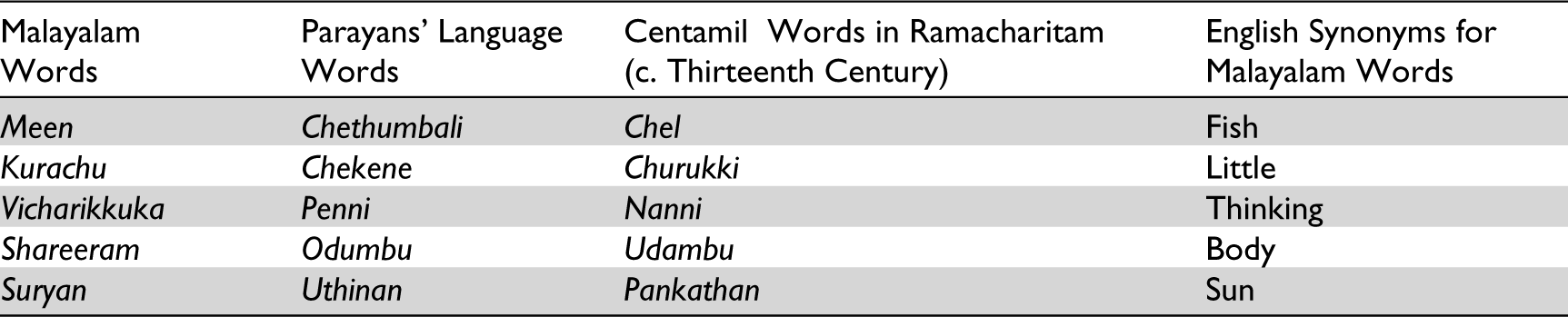
Moreover, the vocabulary of the Parayans’ language has shown an etymological resemblance with the words of Centamil—the language of the old Tamilakam, whose influence is obvious in the Pāttu Bhasha literature of the early Malayalam. Perhaps, this is a difficult fact for scholars to acknowledge because there is a common conception that Malayalam being a language, has gained an identity of its own by divorcing itself from its genealogical root (Tamil) on the one side and by adopting words as well as grammatical structures of Sanskrit on the other side. We call this structural transformation of Malayalam as ‘linguistic Sanskritization’—a process whereby [Dravidian languages like] Malayalam will divorce itself from its Tamil root and subsequently adopts and attunes itself to the direction of Sanskritized grammatical patterns in the pretext of linguistic refinement. The following vocabularies can further manifest the subtle similarity of the words of the Parayans’ language with that of the Centamil words in Ramacharitam. The Parayans’ language vocabulary similarity with the Centamil words in the Pāttu Bhasha of early Malayalam shows two crucial things. First, it puts forward an assumption that the Parayans’ language may be older than today’s Sanskritized Malayalam (Table 1). Second, it signifies the historical connection of Parayans with the Tamil country, being a community. Ramacharitham, according to Herman Gundert, ‘is probably the oldest Malayalam poem. It exhibits the earliest phase of [Malayalam] language, perhaps centuries before the arrival of Portuguese’ (1871, p. 4).
The Parayans’ Language: Etymological Resemblance with Old Malayalam in Ramacharitham.
Likewise, with regard to the linguistic properties of the Parayans’ language, there are similarities with the syntactic structure of Malayalam. For instance, ‘S-O-V (Subject-Object-Verb) is the common pattern used in Malayalam to construct sentences’ (Dileep, 2009, p. 219), and the Parayans’ language is not an exception. Generally, in all Dravidian languages, S-O-V pattern is the common law to frame meaningful sentences, be it Malayalam or Tamil. Further, a meticulous examination unveils that the S-O-V pattern is identical to those languages that belong to Indo-Aryan and Dravidian linguistic families.
Yet another distinctive feature of the Parayans’ language lies in its association with casteism and agrestic serfdom. The reason was the life of Parayans entwined with agrestic slavery and casteism in Kerala’s historical past. Throughout the eighteenth and nineteenth centuries, ‘the Parayans were bought and sold like cattle, starved, flogged, like buffaloes’ wrote Mateer (1884, p. 184). Right to life was denied to Parayans on the ground of their untouchableness. For example, ‘when an Indian of any other caste permits a Parayan to speak to him, this unfortunate being is obliged to hold his hand before his mouth, lest the Indian may be contaminated with his breath; and, if he is met on the highway, he must turn on one side to let others pass’, Thurston writes (1909, pp. 78–79). Despite this abject status and the depiction of Parayans as worthless humans, the intimate link between Parayans’ labour and the produc- tion of agricultural items is of central importance. Because the untouchable labour force was the backbone of the entire production process of cultivation in Kerala’s past. Appukuttan (2015), a native Dalit scholar whose area of specialization is Parayans folklore, chalks out a list of punitive measures used by higher caste to control the Parayans’ agrestic-slave bodies. In most cases, these punitive methods are associated with the production of physical and psychological fear, so much so that any act of untouchable aberrance can be repressed to severe bodily punishments. The intended aim of these measures is not to let Parayans speak and express their disillusionment against the system of agrestic serfdom, a lifeline system required for the operation of the local-level production process. Viewing the untouchable slavery from this lens of political economy, Rupa Viswanath writes, ‘the landowners on whom the [colonial] state depended for tax revenue [are] themselves highly dependent on the ‘Pariah’ labour, and so, therefore, [is] the colonial state’. Further, the colonial state viewed ‘Pariah’ problem as the sole matter of religion because of its ‘complex relation with agrarian slavery as well as with agrarian slave owners’ (2014, pp. 3&4). Although Viswanath’s work is solely centred on Parayan slave labour in colonial Madras state, the situation was no more different in the colonial princely states of erstwhile Travancore and Cochin in the eighteenth and nineteenth centuries. ‘Almost all historical accounts suggest that Pulayas and Paraya[n]s were the actual working slave castes in the agrarian sector in precolonial times and their status as working castes was carried over into the colonial period’ (Mohan, 2015, p. 15).
Agrestic slavery and casteism have indeed transformed Parayans into a subservient social category. As a result, registering their disillusionment and resentment was not at all possible for Parayans by any means. This is where the emancipatory potential of the Parayans’ language unfolds. Here, it is identified that Parayans are the only untouchable beings in then Kerala society who used a language system to get themselves away from the atrocities unleashed by casteism and agrestic serfdom. Considering that untouchables were incapable of registering disagreements or defending atrocities of casteism, the attempt of Parayans to use their language as a linguistic mechanism, therefore, deserves peculiar significance. Besides, Parayans were not only unable to verbally express their experience of caste atrocities that they encountered in life but also they were denied one of natural rights—the right to life, liberty, and property. So perhaps they took recourse to parallel linguistic expression that would enable them to externalize the interior, at least the cruelties of caste and agrestic slavery. In light of these situations, talking in the Parayans’ language about their lived experiences is akin to taking a liberatory or revolutionary step in life—the effort of a wretched community whose life and liberties are deprived, then any act of their talking and living by itself will become the act of liberation. For instance, when Parayans felt the possibility of physical violence against their community, they tacitly communicated about it to their fellow members in the Parayans’ language. Such communication enabled Parayans to pass information about caste atrocities occultly, thereby saving their fellow members from the clutches of caste danger. Precisely because of this occult communicative function that the Parayans’ language has performed throughout the centuries of casteism, people called it ‘code language’ (‘Rahasya Bhasha’ in Malayalam). However, in reality, the Parayans’ language is not just a ‘code language’, but the prevailing social, cultural, and political conditions that existed in Kerala’s past, in fact, prompted Parayans to use it as an ‘occult language’.
While seeing the Parayans’ language from the above historical context, one of its main functions was to create an untouchable defence against casteism and serfdom. Physically, Parayans could not defend casteism and slavery due to their wretchedness. So they did it linguistically. Perhaps, no other Dalit community of Kerala had thought the way Parayans thought concerning registering untouchable resistance/defence, and this very thought made Parayans distinctive from the rest of untouchable beings. For example, when a Parayan utters the words ‘methu thaamar kondu chonnicho’, it is meant that the ‘higher caste is approaching, so we need to run away from his sight’. Similarly, when a Parayan spoke ‘pathungiyamathi’ while working in the field, it contained an expression to their fellow members that ‘we need not have had to work fast in the field’. Here, none except Parayans themselves are incapable of understanding the meaning of the said talk because, in terms of morphology, the Parayans’ language sounds alien to today’s Sanskritised Malayalam. In addition to this, Parayans also used their language for a variety of purposes—at home, Parayans used their language as the language of their community as well as an integral cultural artefact. When one asks about their language, Parayas say it is a cultural gift of their ancestors. Therefore, the Parayans’ language is the linguistic paraphernalia and is well-knitted to the process of identification of their history.
The Parayans’ Language, Quotidian Life, and Process of Identification
It is important to understand the intimate association of the Parayans’ language with the life of Parayans. This is because the Parayans’ language is not just the medium of intra-caste communication between fellow Parayans alone. It is instead an a priori condition that not only shapes the identification process of Parayans but also of their perceivable world. For instance, ‘as a form of life, language forms life, shapes it, constitute the world of things we deal with…The world of things among which we live is seen as it is because it is framed in the language we speak…It cannot be that of subject to object, for I do not so much invent language as I find myself underway within it. I don’t create language; I learn it. It is always there already like the city in which I was born and in which I dwell’ (Smith, 1979, p. 302). By using the metaphor of fish in the water, one can better understand the necessity of language in life. When the fish is born, it is thrown into the world where the water is already there, and without it, the fish can no longer exist. In the same manner, when the newborn baby is born into a world where everybody speaks the language—people in this world certainly do not create the language they speak, but rather they are immersed in it. So when Parayans are born, they are thrown into the world of language, where their fellow members are already immersed in a perpetual conversation with the Parayans’ language and Malayalam. They live with their language, immerse in it, and carry it, so the life of Parayans is surrounded by their language speakers. Thus, the Parayans’ language shapes and frames the things associated with their childhood, conjugal world, and community life, and their very thoughts about who they are. Life, the immediate world, and the Parayans’ language are hence inherently connected to each other. Here, an example of Parayans ordinary life helps us to understand this connection more evidently—that Parayans think of themselves as the only group in Kerala with an advanced language system of their own, and they are, therefore, of a particular stock within the Dalit fold.
Another intriguing thing about the Parayans’ language is that it links Parayans as similar (the process of identification) and, at the same time, marks them as distinct (the process of differentiation) in the world of their worldly affairs. This is generally one of the complex functions the Parayans’ language does. Put differently, the Parayans’ language unites Parayans by creating the feeling of an insider in their group, and it also separates them by evoking the sense that they are an outsider of the Dalit fold. We would call this phenomenon ‘the process of identification’ and ‘the process of differentiation’. Of course, the process of differentiation is equally vital in tracing Parayans’ ontology, and it is actually a corollary to the process of identification, which nevertheless serves the same function. In simple terms, the process of differentiation is associated with the mental activity of making distinctions. It tries to track the conditions under which the thoughts of uncommonness come into existence in and through speaking language because thought, at its core, is one’s inner linguistic engagement with oneself. However, this article does not discuss the process of differentiation at great length. This is simply because if the process of differentiation has to get operationalized in full swing, the process of identification has to operationa- lized in the first place. Therefore, sufficient space has been given in this article for discussing the process of identification in detail.
Regarding the functioning of the process of identification that the Parayans’ language does, it is imperative to look into the Pākkanār myth because Pākkanār is not only considered the founder of Parayan clan but also the first speaker of the Parayans’ language, according to the community belief. Moreover, since Pākkanār is believed to be the first speaker of the Parayans’ language, their process of identification will take a different turn altogether, offering them a deep emotional attentiveness to their language and life. To Parayans, the words of their language are once spoken by Pākkanār and subseque- ntly by their great ancestors; thus, it becomes an ancestral gift. For this reason, Parayans are highly recalcitrant to teach their language or to share any information concerning the etymological, syntactic, and semantic structures of the Parayans’ language to people other than Parayans. As a result, the essential qualification one has to have to learn Parayans’ language will become the caste bond itself—that is, he/she should be a Parayan. This condition is a key indicator to show the link between the life and language of Parayans. For instance, while approaching a Parayan to take an interview on the Parayans’ language, the first question he poses to the researcher is ‘are you a Perendan, aren’t you’? 8 The Parayans ask so because their language is inexpugnably linked to their kinship system, and it is from this condition the thoughts of preserving the Parayans’ language come into being. Here, while adopting a Wittgensteinian take, one can further contend that the emotions and feelings, the most immediate elements of man’s quotidian life can be expressed through language—the semiotic sign (?) associated with the above question is the signifier that can convey Parayans’ feeling such as inquisitiveness (‘are you a Perendan’?), amazement (‘are you a Perendan’!), comfort (‘Oh! You are a Perendan’) and sometimes even statement of relation (He/she is a Perendan or I am a Perendan). All of these indicate different manifestations of the operation of mental association of Parayans, and they open up a path toward the process of identification. What is of central importance here is the contextuality of Parayans’ speech itself because whatever activity Parayans do in the context of their associational world is actually done in and through their language, and thus, becomes the ‘language games’. Hence, speaking the Parayans’ language by itself will become the activity of being a Parayan. And it is within this process of being the Parayan, the cognitive drive for tracing and experiencing commonalities for identification acquires true meanings. In that sense, language becomes the a priori condition for Parayans to experience their Parayanness because, as far as a speaker of the Parayans’ language is concerned, every utterance of words is somehow turned out to be a linguistic experience of everyday life.
We already know ‘ostensive definition’ is the method of learning the Parayans’ language. In this process, the role of kinship is an ineluctable element. Through oral tradition, children learn the Parayans’ language words from the mouth of parents or grandparents. In that way, kinship becomes the primary factor for entering the world of the Parayans’ language. Here, whatever words the children learn are, in fact, identified as those words that have already been spoken in their families or by Parayans’ neighbourhood, who are, in most cases, turned out to be their relatives, clan members, and kinfolks. This will further cement the process of identification with Parayans and their language. If a person who was born and raised in a village predominantly surrounded by the Parayans, much of his/her ordinary speech would occur in the Parayans’ language. For the most part, such speech shapes Parayans’ immediate world, conditions their views, and produces a sense of identification of who he/she is—the Parayanness.
It is further identified that Parayans’ lived experience and collective memory are intrinsically associated with the Parayans’ language. By saying so, we do not renounce that both lived experience and collective memory can facilitate the process of identification among Parayans. On the contrary, we contend that in the absence of the Parayans’ language, both lived experience and collective memory have no role in Parayans process of identification with the Parayanness. So in this article, we, in fact, strive to put into the limelight of how the Parayans’ language connects with lived experience and collective memory. We can find studies that explore collective memories, Dalit suffering and oppression, Dalit modernity, engagements of Dalit movements with civil societal space, and so on 9 in the context of Kerala. But the gist of the concerns that have been conceptualized in such studies can be possibly abstracted and pinpointed to the aspect of intentionality ascribed to the lived experience by the phenomenologists. In a strict sense, leading a Parayan life in itself is a form of lived experience. 10 And it is from this view of Dalit lived experience one should view the argument of V Dileep regarding the maturation of the Parayans’ language. To Dileep, the evolution of the Parayans’ language is associated with agrestic labour and the system of Parayans’ slavery (2009, pp. 216–217). Concerning this postulation of Dileep, it is certain that one cannot precisely trace the time under which the Parayans’ language originated, for tracing the timeline of a language is, of course, an impossible task. Instead, one can excavate the archaeological conditions under which the Parayans’ language might have evolved. This makes us arrive at two arguments: First, there is a great dearth of work in Malayalam grappling with the historical condition of Parayans in the societal system that used to exist in Kerala before the colonial encounter. Second, the available historical records one can rely on is the missionary corpus, some of which throw a pale light upon the cultural system of Parayans, but notably, they do not give any reference to drawing the link between the usefulness of the Parayans’ language in relation to Parayans serfdom. We, therefore, need to look into what Parayans have to say about it.
Conclusion
The Parayans’ language is the centre of life activity of Parayans. It is undoubtedly a unique linguistic phenomenon one can discover within the Dalit fold. However, for the last three decades or so, the Parayans’ language has been encountering a process of silencing within the community. The silence that the Parayans manifest about their language is intentional, and for the most part, it functions as the prime catalyst for the trivialization of their language. As part of this silence, deliberate heedlessness has developed, prompting Parayans not to speak their language even in the realm of their cultural domesticity. Consequently, the Parayans’ language is now left with a handful of speakers, primarily Parayans who dwell in the so-called harijan colonies 14 . They manifest a close connectedness and daily involvement with the Parayans’ language. This situation has created an ‘internal rupture’ among Parayans, dividing them into two contesting factions. Taking advantage of their linguistic leverage, Parayans who speak their language portray themselves as superior beings, notwithstanding their humble economic mobility, and think they are the guardians of the linguistic tradition of their clan. Whereas, Parayans who are silent about their language seem to have no moral compunction about identifying themselves as the descendants of Pākkanār. This non-harmonic scenario of Parayans makes their ontological problem into a linguistic one—the Parayanness can only be possessed by Parayans who can speak their language, or the Parayans’ language is not that which constituted the Parayanness. Thus, the question of who is to be called the authentic Parayans remains an issue of the linguistic contest.
Traditionally, language is an affair of a hierarchical categorization of the populace in Kerala in general and in India in particular. People who inherit Sanskrit occupy sublimate positions in social ranking, whereas people who speak the Parayans’ language carry abject status in society. In one way or another, this signifies the linguistic hierarchy, a phenomenon whereby language hailed by people is placed in a stratified assortment, categorizing it into hegemonic and polluted. Therefore, we argue that this linguistic hierarchy between the Parayans’ language and the language of the higher castes reinforces the caste divisions, no matter how hard the Dalits crusade against it. In this backdrop, the Dalit and their scholarly circle must revisit their current mental position on caste in general and the Parayans’ language in particular. They need to problematize the already established linguistic hierarchy by pointing out that there is no such single-unified hierarchy that rests deep down at the heart of the quotidian caste-driven social life. As Dipankar Gupta states, ‘it is more realistic to say that there are probably as many hierarchies as there castes in India. [So] to believe that there is a single caste order to which every caste, from Brahman to untouchable, acquiesce ideologically, is a gross misreading of facts on the ground’ (2000, p. 1). So Parayans claim that the divine intervention concerning their language’s origin must be understood in this context. In fact, Parayans claim of this sort substitutes the dominant narratives of upper caste Hindu hierarchies with their local hierarchy turning the Parayans’ language into a much more exciting topic of discussion. This aspect of the Parayans’ language somehow shows its emancipatory potential—its recklessness to question the logic and usefulness of an already well-established caste hierarchy that people generally accept.
It is an incontrovertible fact that discussions on the Parayans’ languages face serious neglect in the realm of academics. In academics, scholars, while showing a keen interest in researching on life, history, memory, and identity self of Dalit beings in Kerala, often seem to have held a presupposed perspectival position of not taking into consideration of the Parayans’ language, which however, functions in parallel to Malayalam. For the most part, they contend that the Parayans’ language is a mere ‘hidden transcript’ or ‘code language’ and nothing else. Therefore, it is not unwise to say that those Dalit scholars who refer to the Parayans’ language as an esoteric language are, in fact, [or perhaps unknowingly] subscribing to the single-unified hierarchy postulation produced by the higher caste intelligentsia. Such views of Dalit scholars are counterproductive for afew discernable reasons: First, it will resuscitate the already established linguistic hierarchy; Second, it will further accelerate the pace of the ongoing trivialization of the Parayans’ language; Third, it will not offer any space for afresh methodological orientation to Dalit Studies in a manner that it can bring the linguistic question as the central a priori of discussions in relation to life, identification, and subjectivity of Dalit beings. Here, the first reason is specific to the question of the Parayans’ language. While the second and third reasons are more methodologically oriented to the emerging discipline of Dalit studies. This is because ‘one of the great questions of the twenty-first century, not only for linguists and anthropologists, but for all those who feel concerned by the destiny of the human species as a culturally evolving project, will be the language question’ (Underhill, 2009, pp. ix–x).
The Parayans’ language, for sure, contains centuries of thoughts and speech of Parayans about themselves and of the immediate life-world within which they live and die, besides being an organic repository of internal feelings/emotions refined and expressed orally. It is true that many Parayans of contemporary Kerala have reservations about speaking and sharing anything about their language, for they have almost completely migrated to the linguistic world of Malayalam, intending to experience better social clout and cultural recognition with or without being aware of the gradual obliteration of their language. Realizing this imminent danger related to the extinction of the Parayans’ language, many of their community organizations operating in the civil society sphere started imparting language classes to Parayans through several local units comprising clusters of households. Likewise, an attitudinal change among Parayans can also be identified, accordingly, they, at present, are more welcoming to researchers who approach them in connection with studying the Parayans’ language. No doubt, the Parayans’ language should be given special status as Article 29 (1) of the Constitution of India vividly states, ‘Any section of the citizens residing in the territory of India or any part thereof having a distinct language, script or culture of its own shall have the right to conserve the same’ (2022 Ed, p. 15). Hence, it is the obligation of both the state and central governments to execute necessary measures to conserve and preserve the Parayans’ language. However, bodies entrusted to take serious engagements with surveying, documenting, and protecting Dalit linguistic traditions at both the state and the union levels have so far not made any productive involvements, particularly in connection with the Parayans’ language.
Footnotes
Acknowledgements
We are grateful to all respondents in Ernakulam district of Kerala, without whose assistance writing this article would have become a task of absolute impossibility. Also, we would like to thank Abhilash G. Nath, Shahana Sherin P. S., Karoline Höeppner, Krishnan, and office bearers of KSS Kothamangalam Unit, Ernakulam District, Kerala.
Declaration of Conflict of Interest
The authors declared no potential conflicts of interest with respect to the research, authorship and/or publication of this article.
Funding
The authors received no financial support for the research, authorship, and/or publication of this article.