







Abstract
The government has created numerous schemes for the benefit of the Scheduled Caste and Scheduled Tribe populations, yet their lifestyles have not seen significant improvement. Policymakers frequently do not consider the opinions of the target audience when drafting schemes, which causes target audiences to suffer as a result of accessing such schemes. When any plans or policies are created, the opinions of Scheduled Caste and Scheduled Tribe Communities must be taken into consideration. The major goals of this paper are to have a theoretical discussion on this, as well as to look at the rights-based approach in social work and properly comprehend its difficulty in practice. Housing schemes have been given considerable precedence in welfare programmes for disadvantaged people like Scheduled Caste and Scheduled Tribes. This research report is based on investigations made to learn about the experiences of the Scheduled Caste Community with Maharashtrian welfare schemes like the Ramai Aawas Yojana. The study’s primary goals are to investigate the difficulties beneficiaries encounter when claiming benefits from the scheme and the changes they notice in their lives as a result. It will also look at the administrative framework for scheme implementation, such as municipalities. The article aims to examine the difficulties faced by the Scheduled Caste group and their perspectives on (a) the Ramai Aawas Yojana Welfare Scheme and (b) the difficulties they encountered in receiving the Scheme’s benefits. (c) How their lives have altered as a result of using the housing program’s advantages. It is founded on an exploratory research design and qualitative approach.
Introduction
On the 26th January 1950, we are going to enter into a life of contradictions. In politics we will have equality and in social & economic life we will have inequality. In politics we will be recognizing the principle of one man, one vote, and one value. In our social & economic life we shall by reason of our social and economic structure, continue to deny the principle of one man, one value. For how long we shall continue to deny it for long we will do so, only by putting our political democracy in peril. We must remove this contradiction at the earliest possible moment.
The aforementioned passage is taken from Dr Babasaheb Ambedkar’s speech during the third reading of the drafted Indian Constitution. At first, Gautam Buddha was in excruciating pain at these people’s suffering. He brought society to the idea of ‘equality’. This was the first chance these folks had to succeed and live honourably. Later, saints like Kabir, Eknath, Tukaram and others followed his way. They actively contributed to the fight to end ‘untouchability’, a stain on mankind. The social reformers of the nineteenth century, in particular Mahatma Jyotiba Phule, Chhatrapati Shahu Maharaja and Dr Ambedkar, began a number of efforts to grant them human rights.
Following independence, Dr Babasaheb Ambedkar oversaw the drafting of the Indian Constitution, which outlined specific protections and safeguards for Scheduled Castes (SCs) and Scheduled Tribes (STs) with the aim of advancing their political, economic and educational interests. The government has so far given them opportunities to grow through a variety of initiatives and projects. It offered broad infrastructure and resource development, such as constructing communication networks and offering educational and medical facilities (Karade, 2009).
In India, the SCs make up around 16.2% of the population. Any measure of human development places SCs among the poorest and most marginalised groups in Indian society. This social group has historically suffered from caste-based discrimination, economic isolation and social exclusion.
The government has consistently established policies and programmes for enhancing their human qualities and competencies over the years in response to the group’s unique concerns.
The Indian Constitution’s provisions, which officially outlawed untouchability and the prejudice it led to Article 17, serve as the foundation for the government’s policy towards SCs. Article 14 of the Constitution ensures equality before the law; Article 330 and 335 of the 73rd Amendment Act, 1992, provides for special measures through reservation in government services and also reserves seats in democratic political organizations. The Constitution also calls for the creation of a permanent commission that will annually assess and track the social and economic development of SCs.
Government plans, particularly those that concern the welfare of SC and ST populations, are rarely taken seriously, and there are no reliable monitoring procedures in place to identify when a plan’s goals are not being met. Both resource misallocation and the schemes’ lack of value exist. As a result, the situation in these areas was still very bad. Therefore, corrective actions and useful course corrections ought to be put into practice. The majority of SC and ST communities continue to work hard to provide their most basic necessities, including food, clothing and shelter. In addition to these, they now need improved opportunity to live with dignity and respect. They should therefore be given many chances, which would guarantee them a safe and respectable life in the twenty-first century.
Directive Principle of State Policy and Welfare State
The Directive Principles of State Policy are guidelines for India’s central and state governments that must be kept in mind when enacting laws and agreements. Part IV of the Indian Constitution, or the directive principles of state organization, lists them in part. They serve as the nation’s administrative guidelines’ instruments. The directive concept outlined specific economic and social methods that the various Indian administrations should pursue. They are divided into three categories: social and economic charter, charter for Social Security and charter for community welfare. The provisions of Part IV of the Indian Constitution are not enforceable by any court, but the standards outlined there are seen as essential to the country’s administration, so it is the state’s responsibility to use these standards when enacting legislation to create a just society in the country. Therefore, taking all of this into account, research on welfare programmes for SC communities is necessary to learn more about the challenges associated with their implementation as well as how the programmes have benefited these communities.
This research should also look at how these communities have reacted to the programmes and the implementation process, as well as the changes they have noticed in their lives as a result of these welfare programmes. Article 46 is a thorough article that covers both the regulatory and developmental aspects. It reads as follows:
The State shall promote with special care the educational and economic interests of the weaker sections of the people, and particular of the Scheduled Castes and the Scheduled Tribes and shall protect them from social injustice and all forms of exploitation.
To put this article into reality, the government has chosen to use its special district officers and district authorities to carry out individual and community initiatives. Educational, economical uplift and housing are the top three priorities among the schemes. The Akola Social Welfare Department is working on the following programmes:
Hostels Run by the Government (Shaskiya Vastigurha)
These two programmes are for kids from SC attending Government Residential School (Shaskiya Nivasi Shala). Students from SCs are provided with all necessary amenities, including food and housing, through the Social Welfare Department’s support for this school and its hostels.
Government of India Scholarship Programme
All students from the SC are eligible for scholarships under this programme, and the social welfare department pays for their colleges; all students must do is submit an application.
These two programmes, Tanda Vasti Yojana and Ashram Shala, are for the benefit of the VJNT community’s members and their development. These programmes were aggressively implemented for VJNT by the social welfare department.
Council of the District (Zilla Parishad)
Dalit Vasti Sudhar Yojana
The Dalit Vasti Sudhar Yojana provides funding for different development projects in the area where Dalits make up more than 50% of the population, including building roads, providing water and electricity, building toilets and community centres and so on.
Gharkul Yojana
A housing programme for members of the SC community is called Gharkul Yojana. Ramai Aawas Yojana is another name for it. The Municipality of Akola Mahanagar Palika is investigating this plan. The SCs’ unemployment, reliance on agriculture, illiteracy and social segregation make their backwardness clear. The state of SCs’ housing, living arrangements and health is unknown. They continue to experience residential isolation and direct and indirect social boycott in many areas.
Many of them are too poor to construct their own homes. They are numerous examples, such as suffering from hunger, physical impairments and illnesses including tuberculosis, leprosy, malaria and general diseases because of their poor and unclean living conditions. Along with clothing and food, housing can be regarded as one of a person’s essential needs. Every person’s capacity for productivity is increased by good housing because a better home would better meet their needs and wants, which would then assist them to have more energy available for output. Both a forward and a backward linking effect exist in housing.
In the case of a forward linkage effect, increased housing output results in significant housing plans for every sector of the economy to meet housing demand. In the case of a backward linkage, the housing industry stimulates the growth of construction businesses, which raises the market’s demand for raw materials like cement and bricks as well as many other products. Housing is therefore referred to as a potential factor in economic growth since it enhances market liquidity.
It is also known as a balancing factor for economic growth since it both stimulates output and raises demand for consumption by improving everyone’s creditworthiness. As a result, studying the topic of housing becomes crucial because it involves so many different factors and offers so many opportunities for growth and welfare. Administrators at the Municipality of Akola had prioritized the Housing Scheme and established a distinct department to handle the Ramai Aawas Yojana.
Officials claim that this technique is producing significantly better results than other schemes. Therefore, there is a need to research this programme. Some research questions include whether the program’s goal is being met, whether the designated lump-sum amount is reaching the intended recipients, whether the beneficiaries are properly utilizing the flow of funds, whether the houses are being built in accordance with the program’s guidelines and on schedule, and whether the programme benefits communities.
Rationale to Focus on Gharkul Scheme (Ramai Aawas Yojana)
With a population that is primarily rural and dispersed among communities with marginal to low levels of economic development, India faces difficulties in providing rural poor people with cheap accommodation. The challenge is multifaceted, and variables including regional geo-climatic characteristics, the majority of rural residents’ low non-refundable income, informational and technological gaps, and insufficient delivery methods come into play. Realizing this, the Indian government has been helping the state governments through planned interventions to address the housing issues of the rural poor. Even though housing is essentially a state concern, the Indian government has been giving state governments useful advice on how to address the mounting housing crisis through regulations.
After liberalization, India enacted a more inclusive National Housing Policy in 1994 with the primary goal of increasing the supply of land served by the bare minimal services to support a healthy environment. The country’s first housing policy was created in May 1988. The National Housing and Habitat Policy, 1998, which placed a stronger emphasis on ‘habitat’ as a secondary focus to housing, was implemented by India on the basis of Habitat II.
This strategy also placed a strong emphasis on offering vulnerable groups of people decent, affordable homes. It also recognized the threat that large natural disasters posed to the housing stock and promoted pre-disaster mitigation strategies such as building homes in disaster-prone areas to prevent or reduce casualties and loss of shelter.
Research Objectives
To study experiences of Schedule Caste Community on about Ramai Aawas Yojana
To understand the nature of assistance that these beneficiaries need in order to access the scheme and the source of this help
To examine how the lives of the beneficiaries of the scheme have changed because of access to housing
Profile of Akola City
The study is conducted in Maharashtra’s Akola city. Akola is a city in the Vidarbha area of the Maharashtra state in central India. It is part of the Akola district. It is roughly 250 km west of the second capital Nagpur and 584 miles east of the state capital Mumbai. Akola, which lies in Amravati Division and serves as the administrative centre of Akola District, is managed by the Akola Municipal Corporation. Akola, one of the major cities in the Vidarbha region, is a thriving metropolis today. Akola is noted for its cotton production and has a very good grain market, oil mills and dal (pulses) mills. The IT industry is likewise expanding quickly. The Government of India founded the renowned agriculture university Dr Panjabrao Deshmukh Krishi Vidyapeeth in the area. Mr G. Sreekanth is the district collector for Akola at the moment of study.
Akola Municipal Corporation’s profile: It is Akola City’s governing body. The Mayor leads the Municipal Corporation, which oversees the city’s infrastructure, public services and police. Members of the Municipal Corporation are democratically elected. The company has elected positions filled by representatives from the major political parties in the state. The Akola Municipal Corporation can be found there. After the 2017 election, the positions of mayor and deputy mayor are currently held by Bhartiya Janta Party (BJP) members Vijay Agrawal and Vaishali Shelke. Commissioner Ajay Lahane is in charge of the organization. The BJP, Shiv Sena, Indian National Congress, Nationalist Congress Party, All India Majlis-e-Ittehadul Muslimeen, Bharipa Bahujan Mahasangh and some parties run independently in each Corporation Election in the city of Akola. Akola’s Municipal Corporation covers a region that includes 24 villages and suburbs. This increased the area to 128 km2 and the population to 537,137. Thus, the municipal region is divided into 20 wards, each with 4 members, for a total of 80 seats.
Literature Review
The government has consistently established policies and programmes for enhancing their human qualities and competencies over the years in response to the group’s unique concerns. The Constitution of India’s provisions that formally banned untouchability and the prejudice that resulted from it (Article 17) serve as the foundation for the government’s policy towards the SCs. Article 14 of the Indian Constitution guarantees equality before the law. Article 46 protects SCs from social injustice and all forms of exploitation. Article 330 and 335 of the 73rd Amendment Act, 1992, provide for special measures through reservation in government services. Article 46 also reserves seats in democratic political institutions.
The Constitution also calls for the creation of a permanent commission that will annually assess and track the social and economic development of SCs.
What are SCs? The then provincial government of Bengal introduced the term ‘Scheduled Castes’ before the Indian Franchise Committee in 1932. The Government of India Act, 1935, inserted a schedule with a list of these groups for the first time to the Indian Constitution. They had previously been categorised as belonging to the ‘Depressed Classes’.
According to Article 341 of the Indian Constitution, the President of India may notify a specific caste as a SCs after consulting with the governor of the relevant state and the Parliament then promulgates this designation. There are currently 1,231 castes added to the Scheduled as SCs list thanks to several Presidential directives issued between 1950 and 1978 in different regions of the nation. A Schedule to the Constitution is meant by ‘Schedule’. According to Article 341 of the Constitution, castes, races, tribes, or portions or groupings within castes, races, or tribes are considered SCs for constitutional reasons.
The Shudra have been abused for a very long time because of the caste system that exists in India. Since they were denied the right to an education, they were left economically and socially behind. These people fall under the SC category. Dalits and members of lower castes still rely heavily on outside sources of income. The term ‘Dalit’ does not relate to a caste but rather to a group that is oppressed, socially disabled, weak and poor. They were once known to as ‘untouchables’ because of their menial jobs as cobblers, scavengers and sweepers. In a caste-based nation like India, the Dalits are the group whose human rights have been most flagrantly abused. Only about 24% of Dalits are literate. They lack or have limited access to resources and entitlements have minimal purchasing power and have subpar housing circumstances. In rural India, they are either impoverished casual workers doing any type of accessible work or landless poor agricultural labourers tethered to wealthy landlords for centuries. They include the urban poor who work as wage labourers in the city in slums and other temporary housing without any form of social security, as well as beggars, vendors, small service providers, domestic help and so on (Karade, 2009).
SCs in Akola
According to the Akola gazetteers, only 14 of the 17 castes listed as SCs in the Akola district were included in the 1971 census. These 17 castes, which have been designated as SCs, include Basor, Bedar, Bhangi, Chambhar, Dohor, Dom, Ganda, Kaikadi, Katia, Khatik, Madgi, Mahar and others. In 1971, the remaining castes—such as the Bahna, Balahi and Sansi—did not return to the district.
In their approach to the development of SCs, the government has used a two-pronged strategy: anti-discriminatory or protective measures to provide social justice through the elimination of all forms of discrimination against socially disadvantaged groups on the strength of constitutional commitments, legislative support, affirmative action, awareness generation and the sensitization of target groups.
The government aims to address the social and economic disadvantages of SCs by applying provisions of the Indian Constitution to establish policies and legal measures, building a broad network of institutions and dedicating significant resources.
Need for Development of the Weaker Sections—The SCs, STs, OBCs and Minorities
For nearly four millennia, the SCs, STs, OBCs and minorities have been imprisoned or oppressed, making them the most and most heavily exploited groups in the nation, along with women. In the twenty-first century, in the age of rapid transportation and widespread communication, this horrible condition cannot and should not continue. To free and liberate the weaker sections from the webs of tyranny, marginalization and backwardness, the government must take specific and concrete action. They must be elevated to the status of worldly normal humans.
Similarly, the notes from the current research study were available in three different formats, including handwritten notes from in-depth interviews with Ramai Aawas Yojana beneficiaries, observations of interviewee conversations, observations of constructed homes, earlier homes, half-constructed homes and beneficiaries, as well as archival data and government documents supporting the information provided by the key informants, like officials at Municipal Corporation, who also comprised the study’s key informants.
By typing and transcribing the interviews and observations, the obtained raw data were organized into text as a phase in the data reduction process. A review of the archival data was also done to determine how the SC community’s world and way of life were socially constructed in the past in the city of Akola.
The researcher first went to the Social Welfare Department of the Akola District because the research was about welfare programmes. The researcher interacted with Social Welfare Development Officer Mr S. M. Chaudhari in the social welfare department, and from him, he learned about the many programmes the Social Welfare Department in the Akola District had put in place.
Social Welfare Department of Akola Is Working on Following Schemes
Swabhimaan Yojana
Kanyadaan Yojana
Government hostels (Shaskiya Vastigurha)
Government residential school (Shaskiya Nivasi Shala)
Government of India Scholarship Scheme
Tanda Vasti Yojana (V.J.N.T.)
Aashram Shala (V.J.N.T.)
District Council (Zilla Parishad)
Dalit Vasti Sudhar Yojana
Gharkul Yojana
The Dalit Vasti Sudhar Yojana provides funding for different development projects in the area where Dalits make up more than 50% of the population, including building roads, providing water and electricity, building toilets and community centres and so on.
A housing programme for members of the SC community is called Gharkul Yojana. Ramai Aawas Yojana is another name for it. The Municipality of Akola Mahanagar Palika is looking into this plan.
After that, researcher went to the municipality of Akola Mahanagar Palika. He met some Akola Municipal Corporation employees there, and they informed me about the Gharkul and Vasti Sudhar Yojanas for Dalits. They advised him based on the topic of his research study; it would be beneficial if the researcher focused on the Ramai Aawas Yojana. They provided him with a wealth of knowledge in addition to official documents, government GRs and other materials to review. They provide him with information about Ramai Aawas Yojana recipients. For primary data collection, he made the decision to interview residents of Bhim Nagar and Shanti Nagar.
Interviews with beneficiaries can be divided into three categories: (a) those who had their homes built in full, (b) those who had them built in part and (c) those whose home construction was still ongoing.
Research Approach
It is an analytical and exploratory study of social welfare programmes with the goal of establishing a link between social welfare programmes and experiences of members of SCs. Scholar Zikmund in 1988 states that there are three goals for exploratory research: (a) situation diagnosis, (b) alternative screening and (c) idea generation. The situation diagnosis investigates the problem’s various facets and defines its nature. New ideas are frequently generated through exploratory study.
Research Methodology
The qualitative research methodology is used in research. The recipients’ accounts of their interactions with assistance programmes are collected. For the survey, a structured interview schedule was used.
The sample size was 17. For research, in-depth interviews with ‘Ramai Aawas Yojana’ recipients have been held. Because it promotes two-way communication, the semi-structured interview was conducted. The majority of the time, semi-structured interview responses gave the answers as well as the justifications for the answers.
Universe of the Study
The focus of this study is the ‘Ramai Aawas Yojana’ participants, who are Gharkul Yojana recipients from the SC community. These folks are the study’s respondents. They are residing in Akola City neighbourhoods like Bhim Nagar and Shanti Nagar.
Target Groups: Members of the SC community who receive benefits from the Ramai Aawas Yojana.
About the Research Area
A research study was conducted in Akola, Maharashtra. Akola is a city in the Vidarbha area of the Maharashtra state in central India. It is part of the Akola district. It is roughly 250 km west of the second capital Nagpur and 584 miles east of the state capital Mumbai. Akola, which lies in Amravati Division and serves as the administrative centre of Akola District, is managed by the Akola Municipal Corporation. Akola, one of the major cities in the Vidarbha region, is a thriving metropolis today. Akola is noted for its cotton production and has a very good grain market, oil mills and dal (pulses) mills. The IT industry is likewise expanding quickly. Bhim Nagar and Shanti Nagar were chosen for the study because they are the regions where SC group members predominate.
Sample Design and Tools of Data Collection
The research makes use of snowball sampling, a non-probability sampling technique. With this sampling, the researcher starts off with a small number of known and accessible respondents. These respondents then provide more names that fit the research criteria, which prompts additional new names to be provided. Until an adequate number of people have been interviewed or no more respondents have been found, the process is repeated. The research makes use of an interview schedule.
Interview schedule, or simply schedule, is a list of well-structured questions to which the interviewer himself records the respondents’ responses. The timetable can be utilized for both illiterate and educated respondents, even if the questionnaire is only used when the respondents are educated.
Sources of Data Collection
In the study, researcher mainly utilized two types of data. Primary information were gathered from Ramai Aawas Yojana recipients. The secondary information was gathered from books, newspapers, census data and studies/records conducted in the past by other researchers for the programme, government agency records and any other written materials pertaining to the Ramai Aawas Yojana and other programmes in the region.
Plan for Data Analysis
The data were coded by the researcher, who then used it to interpret the study’s objectives. Each segment of the findings’ remaining portion has been examined in relation to its corresponding subject area, followed by analysis and discussion.
Scope of the Study
Each research study has a specific focus, one that is crucial. The following describes the research study’s scope:
It helps to understand the perspective of the socially excluded group through welfare programmes. The study’s literature review section focuses on the social welfare system’s importance in India’s unequal society. The study highlights issues people had when trying to use welfare programmes to get benefits. The study reveals changes that SC communities observe in them following the receipt of benefits.
Experiences of People with Ramai Aawas Yojana
The survey was conducted by Akola Mahanagar Palika (Municipal Corporation) in 2006–2007 of the families who comes under below poverty line and from that survey a list of families were taken out who do not have shelter, who are living in kacha/hut houses, belonging to SC/Neo-Buddhist category, and it was decided that under the Gharkul Scheme, these families will be given the help to construct the house.
The main objective of the scheme is to provide financial aid to the members of SCs or Neo-Buddhist poor below the poverty line for the construction of their dwelling units by providing them a lump-sum amount as financial assistance. This financial assistance is given to the beneficiary, as per the construction of the house. The whole amount is not given in the hands of the beneficiary, the number of instalments given to the beneficiary is four, and earlier it was eight.
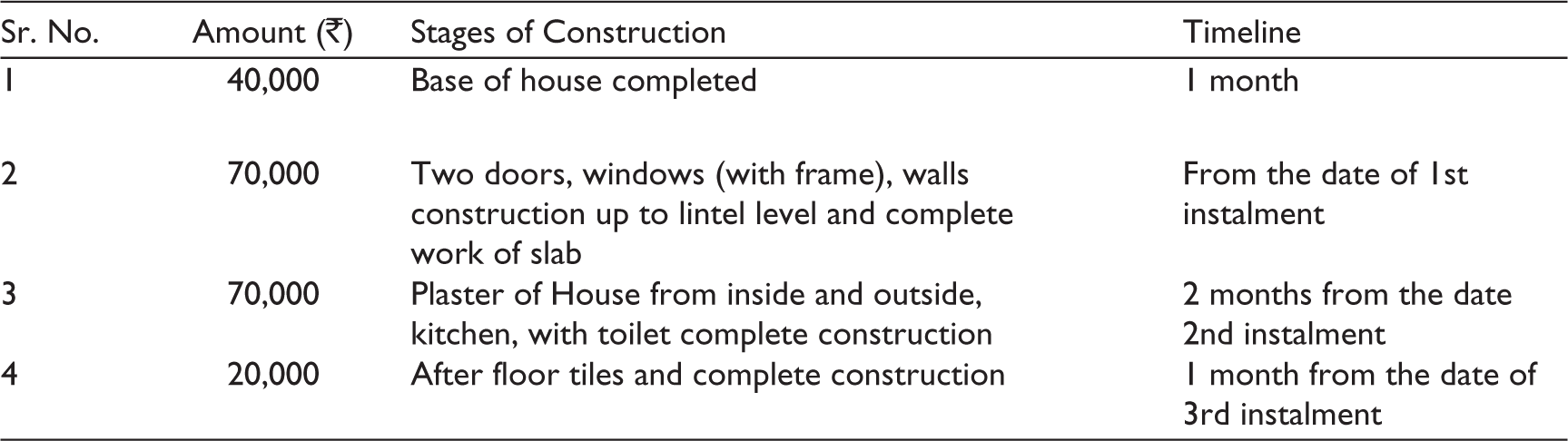
Part 1—Profile of Bhim Nagar and Shanti Nagar
The bulk of SC community members reside in Bhim Nagar and Shanti Nagar areas, where the primary data for the research study is collected, and they have benefited from the Ramai Aawas Yojana. Minorities coexist with Dalits in Bhim Nagar and Shanti Nagar.
This location exemplifies the harmony between Muslims and Dalits in Akola City. Bhim Nagar is named in honour of Babasaheb Bhimrao Ambedkar; the word ‘Bhim’ itself indicates as much. The majority of SC residents in the Mahar Community who converted to Buddhism after Dr Ambedkar’s conversion occurred reside in Bhim Nagar. They adhere to Dr Ambedkar’s philosophy, and all the families who live in Bhim Nagar were active in the Dalit cause.
Another neighbourhood chosen for research is ‘Shanti’ Nagar; this neighbourhood’s name alone indicates that it was chosen because it reflects the cultural identity of the people who live there. Shanti, the name of the Buddha’s teaching, meaning ‘Peace’. As a result, the name ‘peace’ is given to the settlement. There are two Buddha Vihars and one chowk in the heart of Bhim Nagar. ‘Ramabai Ambedkar Chowk’ is the name of this Chowk. In the chowk, there is a tiny vihar with statues of Dr Ambedkar, Ramabai Ambedkar and Buddha.
There is a little area in front of this location that is utilized for a number of events, including the celebration of Ambedkar Jayanti, Ramai Jayanti, Buddha Pournima, Dhamma Chakra Pravartan Din and so on. On Dr Ambedkar’s Mahaparinirvan Day, various programmes are held and everyone receives food. Ramabai Chowk may also occasionally hand out ‘Kheer’. People preserved Ambedkar and Buddhist culture in this way.
The research study focuses on how members of the SC community dealt with welfare initiatives. Thus, the Ramai Aawas Yojana beneficiaries’ interviews have been conducted. The majority of respondents receive a daily income working in occupations like labour, agriculture, construction and so on. These households have a range of earnings, although the average is not much more than ₹4,000.
Part 2—Profiles of Persons Who Got Benefited from the Scheme
Beneficiaries of the Ramai Aawas Yojana (Housing Scheme) are the respondents. People from the SC community who participate in the Ramai Aawas Yojana and live in neighbourhoods like Bhim Nagar and Shanti Nagar in Akola City are the beneficiaries of that programme. Wage labour provides money for many households.
Depending on the nature and sorts of employment they are employed in, wage rates among the workers vary greatly. While few people employed in non-farm activities received income of at least ₹300 per day, men and women employed in primary activities in the agricultural sector received an average of less than ₹ 100 per day.
Part 3: The Experiences of People
After the interviews of the respondents, their experiences can be categorised into broad themes as follows:
Awareness among the beneficiaries about the welfare schemes Problems occur when applying for scheme Problems occur in the process of accessing the benefits Changes people find in their life after availing the welfare scheme Suggestions or recommendations given by people to improve the scheme
Awareness Among the Beneficiaries About the Welfare Schemes
It is observed that the majority of the respondents are unaware of various other welfare schemes; they have only few information about the Ramai Aawas Yojana, when respondents were asked about the other welfare schemes like education, schemes on employment or jobs training, social security schemes and so on. The lack of awareness about social security schemes or measures and assistance for employment was greater than awareness about the schemes for educational development. While speaking about the welfare schemes one of the respondent, 29 years of old, Savitri Vairagade, living in Bhim Nagar, who belongs to ‘Matang’ community says,
I know only about the Bachat Gat, Gharkul and Sanjay Gandhi Niradhar Yojana. Beyond that I don’t know any other schemes. It will be better if you tell me about the other schemes. We are uneducated people, we don’t know how read and write, we just get information, if someday told us, like one of local leader name Jay Ramteke (Name Changed) here, told us about the Gharkul, he come to our house and told us that your name is there in B.P.L. list, you are eligible for Gharkul, do apply, it requires very few documents like voter id, ration card, etc. we applied for that scheme and submitted the required documents in Akola Municipal Corporation. Otherwise we don’t have any information about other schemes.
When I asked her did she know anything about the Atrocities Act?
She was shocked when she listened to the question and she was acting like she heard Atrocities Act for the first time. So she replied with a low voice and replied, ‘what is it? I don’t know.’ When she was told about the act, her facial expressions got changed; there was confidence in her voice when she spoke later on,
This act is very important for the people like us, who everyday had to face discrimination. Many things Dr. Babasaheb had done for us, but we don’t know. We everyday experience the caste discrimination, when we go for work at farms of Maratha community. They often don’t treat us properly. Sometimes they shout at us for not working properly. They also reduced the wages, if we don’t properly as per their wishes. This act helps very importantly, now we can at least tell them that there are punishments under this act, if you do any kind of injustice with us. But we never had the idea about this act which gives protection to us. I wish government should first aware people about such acts, it can reduced the half of our problems
Above response from Savitri shows us that as there is illiteracy in some people belonging SC community, which is also one major reason, why people are unaware about the various government schemes and various constitutional rights, provisions done for them. The Atrocities Act is the main act in the Constitution of India, according to the social security concerns and also to address the social discrimination. Still, many people from SC community are unaware of such acts and provisions. The question of lack of awareness among the people about welfare schemes is meant for them needs to be answered for the development of SC community people.
Problems Occur When Applying for Scheme
According to the reports of Akola Municipal Corporation, dated on 23 September 2014, they had the aim of 44 Gharkuls to be completed but from that 33 Gharkuls construction is done and remaining 11 Gharkuls construction is going on. Due to there being no money for one year, the Gharkul construction was affected a lot and because of that construction of new Gharkuls under the schemes, which are approved, was not started. Hence, the municipality officials are giving the reasons for improper functioning or say implementation of Scheme that there is lack of funds, and they cannot give the instalments.
Problems occur in the process of accessing the benefits: According to the respondents, many people faced lot of problems when the construction was going on, some have to live in rent house, some used to live huts, instalment money did not come on time and as they are poor, they were unable to invest, and hence construction of house remained incomplete and so they live in kacha house in the rainy season and winter season. Wage labourer, Vishnu Bude, who is a 48-year-old man. Earlier, he used to live in a very small house made up of bricks and mud. When the construction of a house under Ramai Aawas Yojana was going on, for one year his family were living on rent. ₹300 monthly rent and light bill also within it. Total amount they spent on rent was more than ₹15,000. They faced a lot of difficulties when the construction of the house was going on. Cement bags got wasted. In rainy season, water went inside the house, where they used to live. Instalment amount was not coming on time, as cheque was not issued at time when it should be given. Hence, at that time, they used to ask for money from other nearby people. He took ₹10,000 from his elder sister and also from younger sister, the same amount for construction. They have not given a contract to any builder for construction of the house. They used to give daily wages to mason and other helpers, and at the same, they themselves also used to work like labourers. Daily, they used to give ₹500 to mason, and they used to assist him and save the money which was given to helpers (other labourers).
According to him, all the members of his family work in the process of house construction. They took a loan for construction materials like sand and cement, totalling around ₹50,000. They are yet to repay back to all people from whom the money was taken.
Changes people find in their life after availing the welfare scheme: There are some positive stories, some respondents are happy with the scheme, and they find the change in their life, they also find the change in terms of social behaviour of people, their standard of living is improved according to them, now they can have social gatherings at their homes, they are getting respect within the community and now they can focus on other factors of life like education of their children, employments and so on. Rama Kharat, in her response said,
Ghar navhte hot, he gharkul bhetal mahnun ghar zale, nahi tar ghar zale naste garibache. Loka pahile tika karat hote, hasat hote kudachya gharavar. Mothya mulache lagna rahile Kudache ghar pahnun koni mulgi det navhte. Ata ghar zale tar tyale mulgi bhetu shakte. Yojane mule khoop fayda zala. Amhi ata khoop kush ahot. Building a house was impossible for the poor; just because of this Gharkul scheme we got the house. People in earlier times used to criticize us for poor living, some used to laugh at mud houses and on us that we are living in mud houses. Elder son’s marriage is still remaining. People don’t give daughter by looking at the mud house. Now, we have a house so we hope that he will get a girl and he will also get married soon. This scheme benefits us a lot. We are happy now coming from a house made up of mud and sticking to a well constructed house.
The above response of Rama Kharat tells us how marriages or relations are being made by some people, by watching the condition of the house. It also shows that earlier times, some people used to laugh at their house and make fun of them, now they are having well-constructed house; the way of looking towards them or we can say behaviour of people with them is changing.
Suggestions or Recommendations Given by People to Improve the Scheme
Majority of the responses of the beneficiaries of Ramai Aawas Yojana was that the Government should increase the amount given under the scheme, as current 2 lakh is not sufficient considering the increasing rates of construction materials.
Wage labourer, 54 years of age, Gautam Chakranarayan gave the following response when asked about the suggestions to improve the scheme,
Paise vadhavale pahjije, Ghar changale banavata yenar tyamule. Aamhi sarkarche aabhari rahu. Asha navin Yojana aalya pahijet ani tyacha labh ha dalitana zala pahije. Jasa mala labh zala tasa sarvana labh zala pahije’ (‘Money should be increased. So, that house can be well constructed. We will be very thankful that the Government did these things. More schemes like this should be there and its benefits should reach the Dalits. Just I got benefited in the same manner; everyone should also get benefits of scheme.’)
Above suggestions show that people are happy with one scheme, but they also want some more schemes which will be for the development of the SCs communities.
Conclusion
The welfare state is in charge of implementing social welfare programmes and services for the SC. Multiple schemes are implemented for the welfare of SC communities by the Department of Social Welfare and Scheduled Caste Welfare Division of the Ministry of Social Justice and Empowerment. The primary duty is to coordinate and monitor other departments’ efforts to carry out various government schemes intended to advance and protect the interests of SCs.
According to the majority of recipients who responded to the research study, they had to take out loans to pay for the construction of their homes because the municipality’s funding was insufficient and did not arrive in a timely manner. The ₹2 lakh instalment amount provided under the scheme has to be increased. Beneficiaries occasionally request a change in the four-part payment schedule, and occasionally people express the opinion that the government should not provide financial aid but should instead provide built-in housing, which would lessen issues with beneficiaries being able to access the program’s benefits.
It has been noted throughout the data collection process that Ramai Aawas Yojana participants only know about this one programme; they are still uninformed of the numerous government programmes and benefits available to SC communities. Therefore, the SC community lacks knowledge of social welfare initiatives which is not ideal from the perspective of the SC community’s development. According to some of the recipients’ comments, caste prejudice still exists in India, but as people get more educated, they are tackling it. According to the beneficiary’s experiences, gaining access to the assistance programme caused a lot of changes in their lives.
The vast majority of beneficiaries gave favourable feedback, stating that the Ramai Awas Yojana was extremely helpful; without the programme, they may not have considered building houses and their desire of owning a home may have remained unfulfilled. They are feeling satisfied and happy with the scheme’s results, and they are also noticing changes in their daily lives. They are now respected both inside and outside of the community, and they are free to focus on other aspects of their own development, such as raising their children, finding work, getting married and so on. They used to live in extremely poor conditions, but today they have well-built homes, and their standard of living has improved.
When creating new welfare programmes, the beneficiaries—who are the welfare program’s primary participants—should have their input taken into account. Experts should conduct more evaluations to gather public feedback and understand how assistance programmes are actually being implemented. Therefore, those modifications to the implementation process are possible, and they will benefit the recipients. Everyone, including members of the community, local officials, and ward members, but notably the Municipality and Social Assistance Department should raise awareness of other social assistance programmes in order for the populace to benefit from progress and to ensure the welfare of society’s marginalized groups.
Footnotes
Declaration of Conflicting Interests
The author declared no potential conflicts of interest with respect to the research, authorship and/or publication of this article.
Funding
The author received no financial support for the research, authorship and/or publication of this article.