






Abstract
Introduction
Rhegmatogenous retinal detachments (RRDs) are a bilateral process in 10% to 20% of cases. However, bilateral simultaneous RRDs occur much less frequently, accounting for 1% to 4.6% of all RDs.1–3 The natural history of retinal breaks and RRDs has been well-characterized.4–10 Visual and anatomical outcomes following surgical repair of RRD have, for the most part, suggested that determining when to operate on a unilateral detachment depends primarily on the attachment status of the macula and the chronicity of the detachment or symptoms.1,3,11–17 Acute, macula-attached RRDs are generally repaired within 24 hours.1,15
With macula-detached RRDs, multiple studies have described that patients had equivalent visual outcomes if operated on within 7 to 9 days, compared with repair within 24 hours.11,17 However, a recent meta-analysis suggested that visual outcomes may be better for macula-detached RRDs if they are repaired within 3 days. 18 Based on reported outcomes, the conventional approach for a patient presenting with bilateral simultaneous RRDs, with 1 eye having an attached macula and the other eye having a detached macula, would be to first repair the eye with the attached macula, and then repair the eye with the detached macula within 7 days.1,19 We describe a modified approach to this problem based on the unique characteristics of RDs in the setting of bilateral simultaneous RRD, which includes factors other than macular status alone.
Methods
In compliance with the Institutional Review Board of the University of Cincinnati, we performed a retrospective review of medical records at the Retina Service at the Cincinnati Eye Institute from January 1, 1989, to December 31, 2023. The research adhered to the tenets of the Declaration of Helsinki.
Inclusion and Exclusion Criteria
Patients who presented at the Cincinnati Eye Institute between 1989 and 2023 were included in the study based on the following criteria: 1) age older than 18 years; 2) confirmatory diagnosis of bilateral simultaneous RRD; 3) no history of globe rupture, phthisis, retinopathy of prematurity, familial RD syndrome, or previous RD in either eye. Patients were excluded if they had exudative, tractional, and subclinical detachments. Patients treated nonsurgically with laser retinopexy in either eye were also excluded.
Data Variables
Data obtained from the medical records included age at presentation; sex; ocular history; duration and type of symptoms, with attention to symptomatology relating to macular detachment duration; preoperative and postoperative logMAR visual acuity (VA), RD geometry (clock hours and number of breaks) as determined by indirect ophthalmoscopy at the initial examination, macular involvement of the RD as determined by examination and imaging, presence of a posterior vitreous detachment (PVD), period between presentation and surgery on each eye, surgical method of repair, complications, and timing of subsequent surgeries. The selection of surgical repair methodology was at the attending surgeon’s discretion.
Study Cohorts
Patients presenting with bilateral simultaneous RRD were divided into 3 cohorts based on macula status: 1) macula attached in both eyes (AA); 2) macula detached in both eyes (DD); and 3) 1 eye with the macula attached and the other with a detached macula (DA). Patients in cohort DA were further divided into 2 groups based on which eye was operated on first: the detached-macula eye (group 3D) or the attached-macula eye (group 3A).
Surgical Planning
For all eyes in all cohorts, a careful history with attention to the duration of RRD symptoms was obtained, and a complete ophthalmic examination with meticulous scleral depression was performed. The factors affecting decision-making for choosing the first vs second eye to operate, and the timing of each surgery, included the presence of symptoms, signs of chronicity (such as a demarcation line, subretinal strands, proliferative vitreoretinopathy [PVR] changes, and retinal thinning) on examination, duration of the symptomatology, and size of the RRD.
All eyes of all patients underwent retinal reattachment surgery with either primary pars plana vitrectomy (PPV), scleral buckle with an intraocular tamponade (SB), combined SB-PPV (SB/PPV), or pneumatic retinopexy (PR).
Outcome Measures
The variables reported included RRD baseline characteristics, duration of signs and symptoms at presentation, mean baseline and final logMAR VA, time from presentation to operation in each eye, anatomic outcomes, and type of surgery performed. The primary outcome measure of the study was best postoperative VA, as reported between 3 and 6 months after surgery.
Statistical Analysis
Snellen VA was converted to logMAR for all statistical comparisons. Numerical variables are reported as mean ± SD. The Student t test was used to compare the mean values between groups, as the primary outcome variable, postoperative logMar VA, is continuous and assumed to be normally distributed. The t-test was used to assess differences in visual outcomes of 2 independent groups. Patients were categorized, based on macular status, into the 3 primary cohorts (AA, DD, and DA). Further subgrouping of cohort DA (3D and 3A) was necessary to evaluate whether the order of surgery affected visual outcomes.
Microsoft Office Excel 2019 was used for statistical calculations. A P value of <.05 was considered significant.
Results
Baseline Characteristics
A total of 47 patients (94 eyes) with bilateral simultaneous RRD were operated on at the Cincinnati Eye Institute between 1989 and 2023. Table 1 shows the summary of patient characteristics among the 3 cohorts, excluding those patients who underwent bilateral same-day surgeries. Twenty-three patients (49%) were in cohort AA, 10 (21%) in cohort DD, and 14 (30%) in cohort DA. The mean age across all cohorts was 48.8 ± 16.1 years (range, 18-75). There were 27 men (57%). Surgical repair was PPV in 23 eyes (24%), SB in 53 eyes (56%), SB/PPV in 13 eyes (14%), and PR in 5 eyes (5%). Seven patients (15%) underwent bilateral same-day surgeries. Single-surgery long-term anatomic reattachment was achieved in 82 (87%) of 94 eyes.
Patient Characteristics by Study Cohort or Group.

Abbreviations: PPV, pars plana vitrectomy; PPV/SB, combined PPV and SB; PR, pneumatic retinopexy; SB, scleral buckle with an intraocular tamponade.
Cohort AA: Both Maculas Attached
Twenty-three patients (49%) presented with both maculas attached. The mean age at presentation was 46.9 ± 14.5 years (Table 1). The mean time to operate on the first eye was 1.9 ± 4.4 days, and the mean time to operate on the second eye was 20.0 ± 18.2 days. The mean intraoperative interval was 18.1 ± 14.8 days. The overall preoperative and postoperative VA for patients in this cohort was 0.3 and 0.1, respectively (P = .06). The preoperative VA of the first (0.4) and the second eye (0.2) was not statistically different (P = .16). Similarly, the postoperative VA improved to 0.1 for both first- and second-operated eyes and were not statistically different (P = .90). There was also no statistical difference between the preoperative and postoperative VA for the first- and second-operated eyes (P = .16 and P = .42, respectively) (Figure 1A).
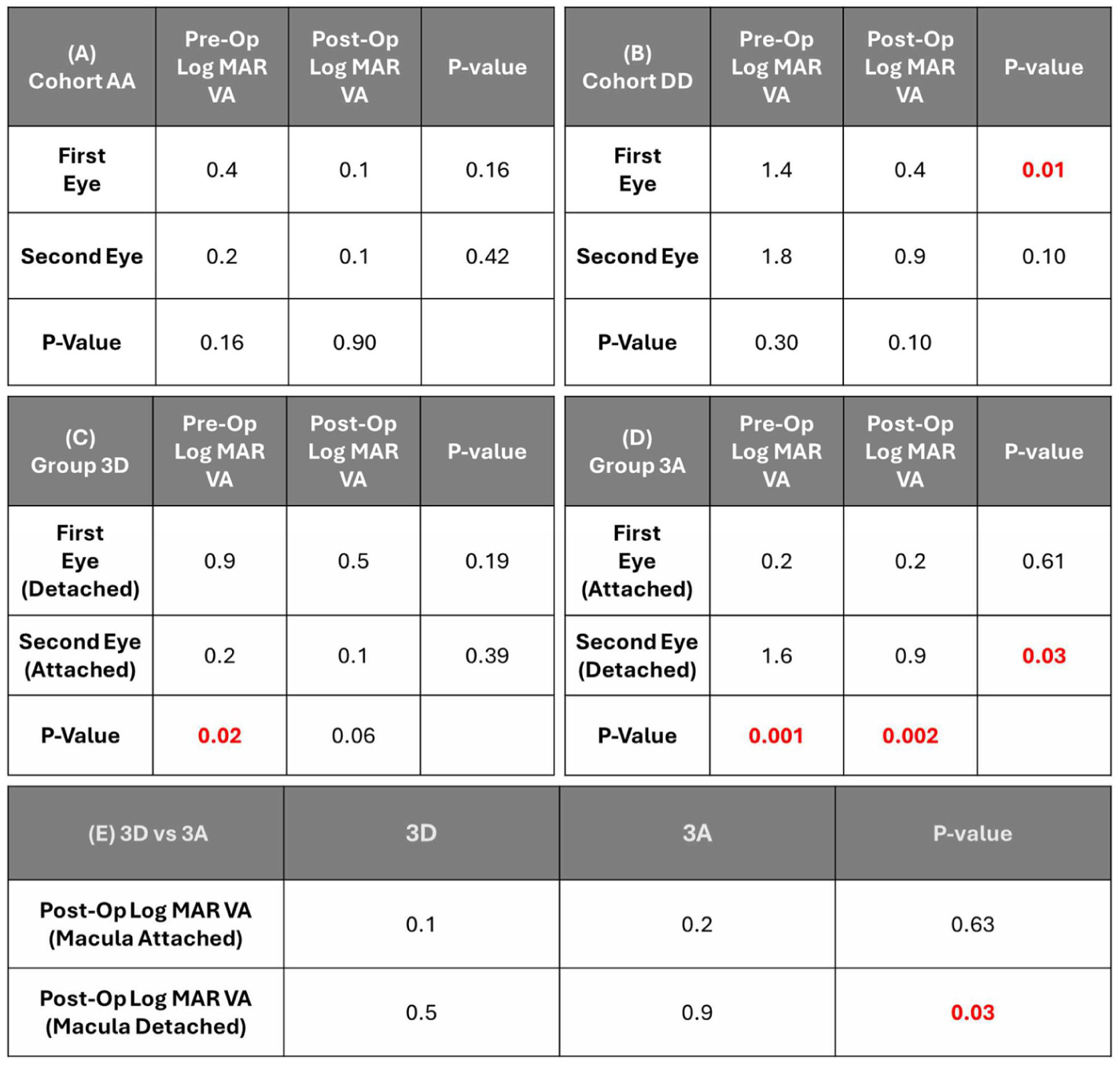
Comparison of the mean logMAR visual acuity (VA) and corresponding P values for the various study cohorts and groups. (A) In cohort AA, there was no significant difference between preoperative and postoperative VA for either eye. (B) In cohort DD, there was significant improvement in postoperative vision for the first-operated eye (P = .01). No significant difference was observed in pre- vs postoperative VA for the second eye. (C) In group 3D, no significant difference was seen between pre- and postoperative VA for either eye. (D) Group 3A had significant improvement in VA for the second eye (1.6-0.9, P = .03). (E) In groups 3D and 3A, there was no difference in postoperative VA for macula-attached eyes (P = .63); however, macula-detached eyes had better VA in group 3D (0.5 logMAR) than in group 3A (0.9 logMAR) (P = .03).
The type of surgical repair performed in cohort AA was PPV in 7 eyes (15%), SB in 30 eyes (65%), SB/PPV in 7 eyes (15%), and PR in 2 eyes (4%) (Table 1). Single-surgery anatomic reattachment for cohort AA was achieved in 43 (93%) of 46 eyes.
Excluding the patients who underwent bilateral same-day surgeries (2 patients) and 1 patient who had amblyopia, 11 patients in cohort AA presented with unilateral symptoms, 4 patients presented with bilateral symptoms, and 4 patients presented with no symptoms. Among the 11 patients presenting with unilateral symptoms, the symptomatic eye was operated on first in all cases. Nine of these 11 patients had either signs of chronicity and/or had smaller RRD size, and/or had longer RRD duration in the second-operated eyes.
Of the patients with bilateral symptoms (4 patients), 3 had signs of chronicity and/or smaller RRD size, and/or longer symptom duration in the second-operated eye. One patient had similar RRD sizes and symptoms in both eyes, but 1 eye had retinal dialysis–associated RRD, which was selected for later surgery.
For patients who had no symptoms at presentation (4 patients), all of the second-operated eyes had signs of chronicity, and/or had smaller RRD size, and/or had longer symptom duration. All second-operated eyes were monitored at every first eye postoperative visit. There were no cases in which the second-operated eye converted to a macula-detected RRD.
Cohort DD: Both Maculas Detached
Ten patients (21%) presented with both maculas detached. The mean age at presentation was 57 ± 13.4 years (Table 1). The mean time to operate on the first eye was 3 ± 4.3 days, and the mean time to operate on the second eye was 10.7 ± 12.1 days. The mean intraoperative interval was 7.7 ± 8.2 days. The overall preoperative and postoperative VA for patients in this cohort was 1.6 and 0.7, respectively (P < .01). The preoperative VA of the first (1.4) and the second eye (1.8) was not statistically different (P = .30).
Similarly, postoperative VA improved to 0.4 in the first eye and 0.9 in the second eye and was not statistically different (P = .10). For the first eye, the difference between preoperative and postoperative VA (1.4 vs 0.4, respectively) was statistically significant (P = .01). However, there was also no statistical difference between the preoperative and postoperative VA for the second-operated eye (P = .10) (Figure 1B).
The surgical repair performed in cohort DD was PPV in 10 eyes (50%), SB in 7 eyes (35%), and SB/PPV in 3 eyes (15%) (Table 2). Single-surgery anatomic reattachment for cohort DD was achieved in 15 (75%) of 20 eyes. One patient underwent bilateral same-day surgeries, and 1 patient had amblyopia in 1 eye, which was operated on second.
Characteristics of Patients Who Underwent Bilateral Same-Day Surgeries.

Abbreviations: PPV, pars plana vitrectomy; PPV/SB, combined PPV and SB; PR, pneumatic retinopexy; SB, scleral buckle with an intraocular tamponade.
Excluding the patient who underwent bilateral same-day surgery and the 1 who had amblyopia, in the 5 remaining patients, we identified the eye with more recent symptoms, which was operated on first. For the second-operated eye of these patients, 4 of 5 patients had signs of chronicity and/or smaller RRD size, and/or longer symptom duration. The intraoperative interval for 1 patient without clear signs of chronicity and/or smaller RRD size, and/or longer symptom duration, was 1 day; this patient received bilateral SB surgeries.
Among the patients who could not clearly identify the eye with more recent symptoms (3 patients), the second-operated eye was chosen based on signs of chronicity and/or smaller RRD size. None of the second-operated eyes had progression of the RD between surgeries.
Cohort DA: 1 Macula Detached and 1 Attached
Fourteen patients (30%) presented with 1 macula detached and 1 attached. The mean age at presentation was 46.1 ± 19.1 years. In cohort DA, the detached macula eye was operated on first (group 3D) in 6 patients (43%); an attached-macula eye was operated on first (group 3A) in 4 patients (29%); and same-day bilateral surgery was performed in 4 patients (29%).
Group 3D: Detached-Macula Eye Operated on First
The mean age at presentation for patients in this group was 40.8 ± 21.6 years (Table 1). The mean time to operate on the first eye was 2.2 ± 3.4 days, and the mean time to operate on the second eye was 33.8 ± 67.7 days. The mean intraoperative interval was 31.7 ± 64.3 days. The preoperative VA was, as expected, significantly different between the first-operated eyes (0.9) and second-operated eyes (0.2) (P = .02). However, the mean postoperative VA was not significantly different between the first-operated eye (0.5) and the second-operated eye (0.1) (P = .06). There was no statistical difference between preoperative and postoperative VA for the first- and second-operated eyes (P = .19 and P = .39, respectively) (Figure 1C).
The type of surgical repair performed in group 3D was SB in 9 eyes (75%), SB/PPV in 2 eyes (16.7%), and PR in 1 eye (8.3%). Single-surgery anatomic reattachment was achieved in 11 (92%) of 12 eyes.
The second-operated eyes (macula attached) had signs of chronicity and/or smaller RRD, and/or longer duration of symptoms in 6 of 6 patients. All second-operated eyes were monitored at every first eye postoperative visit. There were no cases in which the RRD in the second-operated eye progressed or converted to a macula-detected RRD.
Group 3A: Attached-Macula Eye Operated First
The mean age at presentation for patients in this group was 43.3 ± 22.4 years (Table 1). The mean time to operate on the first eye was 18.0 ± 32.7 days, and the mean time to operate on the second eye was 34.3 ± 45.4 days. The mean intraoperative interval was 16.3 ± 13.2 days (including 1 outlier patient who had the first eye operated on 67 days after presentation and the second eye operated on 102 days after the first).
There was a statistically significant (expected) difference in the mean preoperative VA for the first-operated eye (0.1) and for the second-operated eye (1.6) (P = .001). Similarly, there was a statistically significant difference in the mean postoperative VA for the first-operated eye (0.2) and for the second-operated eye (0.9) (P = .002). There was no statistically significant difference between the pre- and postoperative VA for the first eye (0.2 vs 0.2, respectively) (P = .61). However, there was a statistically significant difference between the pre- and postoperative VA for the second eye (1.6 vs 0.9, respectively) (P = .03) (Figure 1D).
The type of surgical repair performed in group 3A was PPV in 4 (50%) of eyes and SB in 4 (50%) of eyes. Single surgery anatomic reattachment was achieved in 7 out of 8 eyes (88%).
All of the second-operated eyes (macula detached) in this group had signs of chronicity and/or longer duration of the symptoms.
Group 3D vs Group 3A
When comparing the groups 3D and 3A, the postoperative VA for the eyes with attached maculas at the time of surgery (second-operated eye in 3D and first-operated eye in 3A) was not statistically different (0.1 vs 0.2, respectively, P = .63) (Figure 1E). However, the postoperative VA for the eyes with detached maculas was better in the 3D group (first-operated eye, 0.5) compared to the 3A group (second-operated eye, 0.9) (P = .03) (Figure 1E).
Bilateral Same-Day Surgery
There were 7 patients in the study who underwent bilateral same-day surgery. Two patients were in cohort AA, 1 in cohort DD, and 4 in cohort DA. The mean time to operate on these patients was 1 ± 1 day (Table 2).
Postoperative VA in the bilateral same-day surgery group was compared with that of groups 3D and 3A (Figure 2). The postoperative VA for the patients who had attached macula in the bilateral group (0.1) was not statistically different from the postoperative VA of the macula-attached patients in the 3D group (0.1) (P = .56). Similarly, there was no difference in the postoperative VA of the patients who had macula detached in the bilateral group (0.4) and 3D group (0.5) (P = .74).
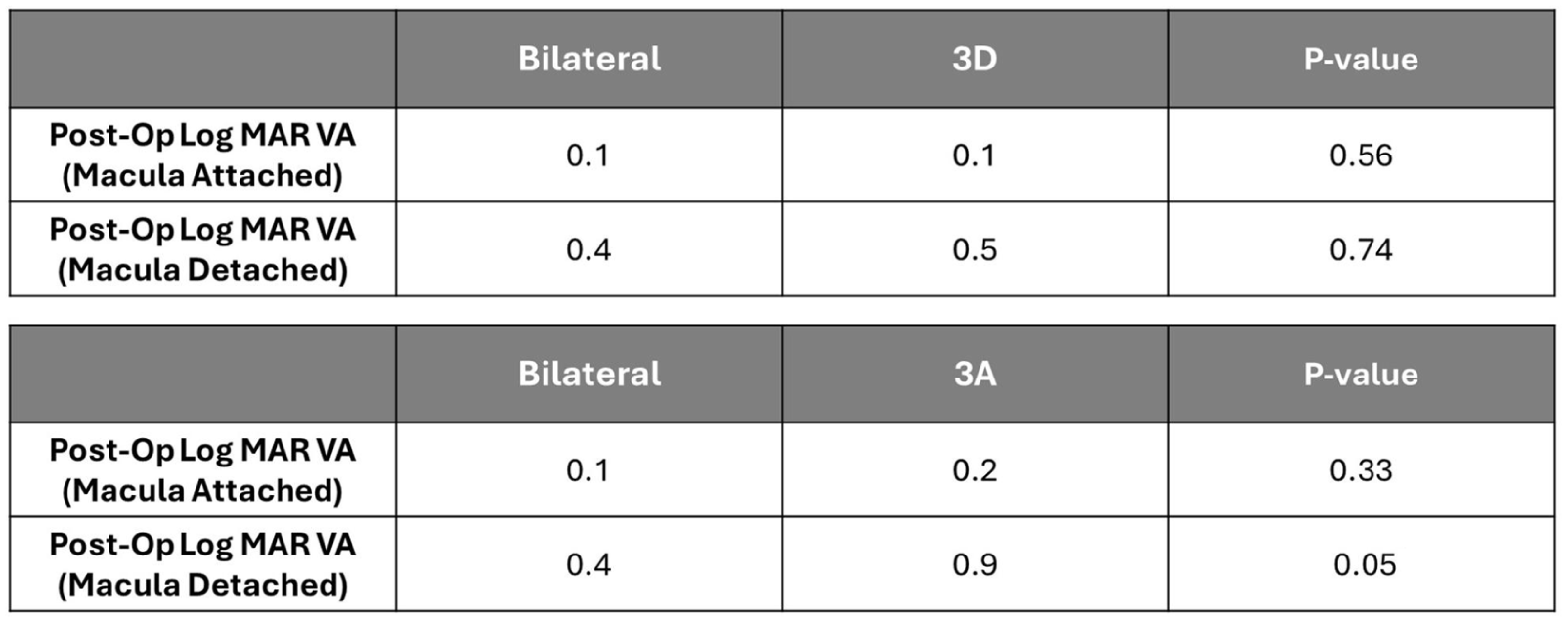
Comparison of postoperative mean logMAR visual acuity between bilateral same-day surgery patients and groups 3D and 3A. Postoperative VA for macula-attached and macula-detached eyes in the bilateral group was not significantly different than that of group 3D (P = .56 and P = .74, respectively). Compared with group 3A, macula-attached eyes showed no difference in VA(P = .33), while macula-detached eyes had better VA in the bilateral group (0.4 vs 0.9 logMAR); with borderline statistical significance (P = .05).
When comparing bilateral same day surgery group against the 3A group, the postoperative VA for the macula attached patients in these groups was not significantly different (0.1 vs 0.2, respectively) (P = .33). The postoperative VA for the macula-detached patients in the bilateral group was better (0.4) compared with the 3A group (0.9) but failed to achieve statistical significance (P = .05). No signs of RD chronicity were recorded in any eyes of patients who underwent bilateral same-day surgeries.
Recurrent Detachments
Twelve eyes (13%) developed recurrent RRDs. The average age of patients with recurrent RRDs was 55 ± 13.8 years. Five eyes with recurrent RRDs had initially undergone PPV, 3 eyes had undergone SB, 1 eye had undergone PPV/SB, and 3 eyes had undergone PR. Six (50%) of the recurrent RRDs were due to PVR. The remaining 6 re-detachments (50%) were due to new retinal breaks. Six eyes with recurrent RRDs were from the DD cohort, 4 were from the DA cohort (1 from 3A,1 from 3D, and 2 from the bilateral same-day surgery group), and 2 were from the AA cohort. Ten eyes (11%) underwent reoperation (1 patient died of unrelated medical complications). Nine of 10 reoperations were PPV, and 1 was laser retinopexy. All reoperations were successful.
Conclusions
Bilateral simultaneous RRDs are uncommon among patients with RDs, and no consensus exists regarding their management. Our study describes a modified approach based on factors beyond macular status at presentation, including presence, laterality, symptom duration, and signs of chronicity. Our data suggest that spontaneous bilateral simultaneous RRD (in the absence of precipitating events) might follow a more chronic or slow-progressive course, allowing for less urgent surgical repair.
The first case of bilateral RD was reported by Schepens et al in 1962 in patients with giant retinal tears. 20 Following that, Folk et al reported 39 bilateral simultaneous RRD cases (4.6%) in 850 phakic patients with RRD. 3 Since then, there have been limited data regarding the management of bilateral simultaneous RRD. Table 3 summarizes the results from major studies discussing management options used for patients with bilateral simultaneous RRD. Most of the authors cited frequently used primary SB as the major surgical repair approach in their patients. Likely reasons for this include the usage of older data from the 1990s, when SB surgery was more common, or data from a younger patient population or populations from developing countries, where socioeconomic factors may guide treatment options for RRD.1,2,21,22 In contrast, our study, similar to that of Finn et al, included a broader spectrum of surgical techniques, including PR. 23
Choice of Surgical Treatment and Anatomic Success for the Current Study and Previously Published Literature of Bilateral Simultaneous Rhegmatogenous Retinal Detachment.

Abbreviations: PPV, pars plana vitrectomy; PPV/SB, combined PPV and SB; PR, pneumatic retinopexy; SB, scleral buckle with an intraocular tamponade.
The timing of RRD repair remains a subject of debate. Although the original guidance was to repair the macula-detached RRD within 1 week, recent studies have challenged this notion. A meta-analysis found that SB within 3 days of macular detachment significantly improved the odds (odds ratio, 2.86) of achieving a final VA of 0.4 logMAR or better compared with those who were operated on between 4 and 7 days. 18 Both Lee et al and Miyake et al showed that visual outcomes are better when the duration of macular detachment is 3 days or less compared with longer durations.24,25 These studies underscore the importance of operating on macula-detached RRDs as soon as possible.
Although we did not have exact information available for all the patients regarding the duration of their macular detachment, our study showed similar trends. In the DD cohort, the eyes operated on first achieved a significantly better postoperative VA than preoperative; however, this was not true for the eye operated on second. The difference in postoperative VA between the first- and second-operated eyes failed to achieve significance because our study was not sufficiently powered to detect such a difference.
Similarly, in group 3D (macula-detached eye operated on first), there was a significant difference in the preoperative VA between detached (first) and attached (second) eyes; however, owing to the greater improvement in postoperative VA in the detached group, there was no difference in postoperative VA between the detached and attached eyes. Conversely, a similar comparison in group 3A (macula-attached eye operated on first) showed that this difference persisted for both pre- and postoperative VA because the macula-detached eye failed to significantly improve vision as it was operated on later.
Furthermore, when comparing group 3D and 3A, the postoperative VA for macula-detached RRD was significantly better for the 3D group, in which the detached macula was operated on first, compared with the 3A group, in which the detached macula was operated on later. This is in contrast to the study by Sign et al, which reported no effect of the timing of surgery on final visual outcome. 21 However, this could be because in their study, the division of the eye was not based totally on macular status, but rather on the surgeon’s selection of the better-seeing eye. Additionally, the time interval for comparison between surgeries was selected as less than or greater than 15 days, and it is known that visual outcomes after 7 days from presentation tend to be significantly worse. 17
Seven patients in our study underwent bilateral same-day surgery. We compared the visual outcomes in these patients with those of patients who underwent staged repair in group 3D (macula-detached eye first) and group 3A (macula-attached eye first), and found no difference in postoperative VA for both macula-detached and macula-attached RRDs. Finn et al also showed no difference in visual outcomes for second eyes of a staged intervention when compared with macula-detached RRD with bilateral same-day surgery. 23 Therefore, while bilateral same-day surgeries are not unreasonable, staged surgeries may be preferred due to postoperative vision issues, fall risk, and positioning challenges.
Across all cohorts, none of the eyes that had an attached macula at presentation, but were operated on later, progressed to a detached macula between surgeries; and none of the second-operated eyes had any progression of RRD. This suggests that in the absence of trauma, bilateral simultaneous RRD may be a chronic or subacute disease process. Symptoms and signs of chronicity should guide prioritization. Features such as demarcation lines, thin atrophic retina, retinal cysts, PVR membranes, and formed vitreous without PVD may indicate less urgent repair.
Based on the findings of our study, we propose the following “Cincinnati” decision matrix for management of patients with bilateral simultaneous RRD:
In patients with macula-attached RRD in both eyes, the more symptomatic eye should be treated first. If both eyes are similarly symptomatic, the eye with the larger RRD, that is closest to the macula, and/or has fewer signs of chronicity, should be treated first.
In patients with macula-detached RRDs in both eyes, the eye with a shorter duration of symptoms should be treated first because it would likely have a shorter duration of macular detachment. When the duration of symptoms cannot be determined in 1 or both eyes, eyes with signs of chronicity and/or smaller RRD should be operated on after eyes with acute RRD and/or larger RRD.
In patients with 1 macula attached and 1 macula detached, the macula-detached eye should be operated on first if the other eye is asymptomatic, has a shorter symptom duration, or has signs of chronicity. However, in patients with a longstanding macula-detached RRD, with more recent symptoms in the macula-attached eye, the macula-attached eye should be operated on first.
Patients with bilateral simultaneous RRD may have a higher likelihood of longstanding RD with thicker, more chronic, and slower resorbing subretinal fluid. Pneumatic retinopexy should be used with caution in these patients.
The presence of bilateral simultaneous RRD may correlate with slower progress or even a chronic RRD; thus, staged repairs are often preferable to same-day surgery.
While we have compiled the largest series of patients with bilateral simultaneous RRD in a diverse North American population, our study has its limitations. It is retrospective in nature, which introduces inherent biases, including potential inaccuracies in system recall and clinical documentation. The sample size is still relatively small, limiting the statistical power of our data, especially the ability to draw negative conclusions.
The occurrence of trauma may have been underreported by our patients. Additionally, the absence of standardized treatment guidelines for bilateral simultaneous RRD led to variability in surgical decision-making, as management was based on the individual surgeon’s preference. Finally, the statistical analyses did not adjust for intereye correlation, which could influence the independence of outcomes in patients with RRD.
In conclusion, RRD requires individualized planning that accounts for more than macular status. In spontaneous RRD, slow progression may allow nuanced timing. Clinical history and chronicity signs should guide treatment. Staged surgeries are reasonable for most patients with RRD.
Footnotes
Authors’ Note
Drs. Saeed and Hassan contributed equally to this study and manuscript.
Data Availability
Data are available from the authors upon request.
Ethical Approval
This study was performed in compliance with the Institutional Review Board of the University of Cincinnati, in adherence to the tenets of the Declaration of Helsinki.
Statement of Informed Consent
Informed consent to treat was obtained from all patients included in this study.
Declaration of Conflicting Interests
The authors declared no potential conflicts of interest with respect to the research, authorship, and/or publication of this article.
Funding
The authors received no financial support for the research, authorship, and/or publication of this article.
