






Abstract
The present study focuses on the Epitaph of Xiao Hanning Prince of the Xi in Khitan large script, and examines the phonological and semantic issues of a selection of Khitan large script graphemes attested in the epitaph. In previous scholarship, various interpretations have been proposed concerning the identification of individual grapheme forms, textual decipherment, and the correspondence between the Khitan and Chinese texts. Based on previously published transcriptions and related studies, this article presents a preliminary collation of the Khitan large script text and further analyses and discusses the phonology and semantics of relevant words and graphemes by combining Chinese epigraphic documents with other contemporary Khitan large script epitaphs. Through the comparison of problematic grapheme forms and divergent decipherment views, this article puts forward some tentative understandings on the phonology and semantics of several Khitan large script graphemes, which may serve as a basis for further new decipherment of the Khitan large script.
Introduction
The Epitaph of Xiao Hanning Prince of the Xi (hereafter abbreviated as Han) was unearthed in July 2014 in Huijiashan (灰甲山) Village, Chengzi (城子) Township, Songshan (松山) District, Chifeng (赤峰) City, Inner Mongolia Autonomous Region. Based on the excavation context and related materials, Liu (2022) argues that the exact findspot of this epitaph was likely near the site where the Epitaph of Shagu Fuma Posthumously Enfeoffed as Prince of Wei (hereafter abbreviated as Wei) was unearthed in 1954. The epitaph stone has an arched top, and is inscribed on both sides: one side in Khitan large script and the other in Chinese. The present author conducted an on-site inspection of the original stone at the Songshan District Cultural Relics Management Office in March 2026. According to Director Huang Li, the stele was lifted out by crane during excavation in 2014. The Chinese side faced upward, and the Khitan large script side faced downward, resulting in severe abrasion and damage to the Chinese inscribed side.
The stone measures 158 cm in length, 90 cm in width, and is 20 cm thick. It is currently preserved at the Cultural Relics Management Office (Songbei Comprehensive Stadium) of Songshan District, Chifeng City.
Xiao Hanning, the tomb occupant, was born in the eleventh year of the Baoning era (also the first year of the Qianheng era, 979 AD) and died in the tenth year of the Taiping era (1030 AD), at the age of 52. He was a great-grandson of Telin Khaan. His entire official career took place during the era of Emperor Shengzong of the Liao Dynasty, and he was eventually enfeoffed as the prince of the Xi.
The rubbings and full transcription of both the Khitan large script and Chinese texts of Han were first published in Qidan Wenzi Bianweilu by Liu et al. (2022). This work provided preliminary interpretations of several Khitan large script words in the epitaph and suggested that the content of the epitaph is related to that of the Epitaph of the Grand Prince of the North (hereafter Bei) and the Wei. Tao (2023) further interpreted several words in the Han and, through comparison with relevant historical sources, argued that the Han has mutually corroborative relationships with the Bei and the Wei. In addition, Chen (2025) published The Liao ‘Xiao Hanning Muzhi’ on his WeChat public account Fengyu Jinxing (风雨进行), providing a collation of the Chinese text.
In recent years, substantial advances have been made in the discovery of new Khitan large script materials. Jiruhe et al. (2025), Li and Tao (2025), Sulongga (2025), and Wen (2023) have identified textual correspondences and mutual corroboration between the newly unearthed Epitaph of Yelü Zaixiang (hereafter Zai) and the Han. Furthermore, Kang (2025) discusses several individuals mentioned in both epitaphs from a genealogical perspective. The discovery and decipherment of these new materials provide important cues for the re-evaluation and systematic decipherment of the Han. At the same time, further research on the Han may also contribute new linguistic data and examples for the study of Khitan large script decipherment.
Drawing on previous scholarship and relevant historical sources, this article undertakes further examination and decipherment of the epitaph text. Building on extant research, this study first provides a reconsideration of words, phrases, and passages in the Han that are understudied or disputed. The discussion below follows the original sequence of the epitaph and is divided into several sections according to content. The first section examines the identity of the calligrapher of the epitaph and related issues; the second outlines the background and lineage of the tomb occupant; the third supplements the tomb occupant's official career and the development of his titles; the fourth discusses the tomb occupant's consorts and related records; the fifth interprets the information concerning the tomb occupant's children and descendants; the sixth examines references to the tomb occupant's younger brother; and the seventh addresses the circumstances of the tomb occupant's burial.
The calligrapher of the epitaph
In the production of epitaphs, a distinction is usually made between the author (who composes the text), the calligrapher (who writes the text in ink on the stone surface), and the engraver (who carves the characters), each fulfilling a different role. The Khitan large script sequence  < ci6-er>
1
has been commonly deciphered as “to write or inscribe”, designating the physical act of transcribing the epitaph text onto the stone surface. In the present context, the phrase “to write/inscribe” should be understood as referring to the work of calligraphy, that is, the preparation of the text for engraving.
< ci6-er>
1
has been commonly deciphered as “to write or inscribe”, designating the physical act of transcribing the epitaph text onto the stone surface. In the present context, the phrase “to write/inscribe” should be understood as referring to the work of calligraphy, that is, the preparation of the text for engraving.
The first line of the Han not only records the identity of the tomb occupant, Xiao Hanning, but also contains critical information regarding the epitaph's calligrapher. Concerning the statement that Xiao Hanning was “a member of the Telin Khaan tent of the six Tribes”, Tao (2023) has already provided a detailed discussion, and it will not be repeated here. The portion concerning the calligrapher can be read as follows:
(1)  2
2
 (Han 1)
cud-er beqo tem-er eur jur2 naim-de ci6-er
第二 子 特末 岁 二十 八于 书
second son Temo age twenty eight inscribe
The words in (1) have been deciphered by previous researchers and can be translated as follows: “The second son, Temo (特末), calligraphed (this) at the age of twenty-eight”. From this, it can be inferred that the writer of the Han was Xiao Hanning's second son,  < tem-er > (特末里 or 特末), who was 28 years old at the time he calligraphed the epitaph. This conclusion is further corroborated by later passages in the same inscription. Lines 17–18 of the Han enumerate the children of the tomb occupant. Line 18 explicitly records that Xiao Hanning and Yilinmian
3
(乙林免) had “five sons and two daughters”, listing them in order of seniority. This information corresponds with the record in line 1 and further confirms the identity of the calligrapher.
< tem-er > (特末里 or 特末), who was 28 years old at the time he calligraphed the epitaph. This conclusion is further corroborated by later passages in the same inscription. Lines 17–18 of the Han enumerate the children of the tomb occupant. Line 18 explicitly records that Xiao Hanning and Yilinmian
3
(乙林免) had “five sons and two daughters”, listing them in order of seniority. This information corresponds with the record in line 1 and further confirms the identity of the calligrapher.
(2) 
tai ong ilmian em-n bahu-an dol ai2-d tau° em-t jur2 mo beqo dur°-ir2
大 王 乙林免 妻之 孩子 七 诸男 五 诸女 二 长 子 突吕不
prince Yilinmian wife of child-PL 4 seven sons five daughters two eldest son Tulübu
 …… (Han 17–18)
cud-er tem-er hut-er pong-liu tud-er tau-su-o-or3 tat-or3 süe-□ 5
第二 特末 第三 (人名) 第四 (人名) 第五 (人名)
second Temo third (name) 6 fourth (name) fifth (name)
The phonology and semantics of (2) have already been interpreted with considerable consensus in previous scholarship; therefore, this article accepts these established readings without further comment. According to existing research, the Han records that Xiao Hanning was buried in the tenth year of the Taiping (太平) era (1030 AD), when he was 52 years old. If, as the epitaph states, the second son  < tem-er > was 28 at the time of the burial, his birth year may be estimated to be around the twentieth year of the Tonghe (统和) era (1002 AD). This further implies that Xiao Hanning was approximately 23 years old when
  <tem-er > was born. These chronological calculations are consistent with the dates and familial relationships recorded in the epitaph and are therefore logically coherent.
Background of the tomb occupant
Lines 2 to 5 of the Khitan large script Han record the lineage of Xiao Hanning from his great grandfather to his parents, describing the background and family origins of the tomb occupant.
1. The great grandfather and grandparents of the tomb occupant Xiao Hanning's ancestral lineage can be traced to Telin (忒邻) Khaan, according to current epigraphic research.
Tao (2023) pointed out that the Suohu (Shagu) (索胡、沙姑) imperial son-in-law was a descendant of Telin Khaan. In subsequent studies on the supplementary interpretation of the Zai, Wen (2025), Jiruhe et al. (2025), and Li and Tao (2025) further clarified that Suohu imperial son-in-law, was the second son of Telin Khaan. It can therefore be inferred that Xiao Hanning's great grandfather was Telin Khaan, and his grandfather was Suohu imperial son-in-law.
Scholars interpreting the Khitan large script the Zai have also noted that the ancestors of Madame Wushi (吴氏), the second wife of Yelü Zaixiang (耶律宰相) (the prime minister), were likewise Suohu imperial son-in-law and princess Niaohu (袅胡). Since the ancestral lineage recorded in the Han and the Zai is identical, the two epitaphs should constitute direct mutual corroboration in this respect.
More specifically, the passages concerning the ancestors in lines 2–3 of the Han and lines 8–9 of the Zai are very similar in both content and structure. They can therefore be used as mutual references, providing reliable evidence for the collation and interpretation of the relevant passages in the Han.
(3) 
te-li-ñ2 qa til-én □ li3 bahu-an3 jur cud-er beqo abu ai2 pu ma seng gung
忒邻 可汗 敌辇 孩子 二 第二 子 祖父 驸 马 相 公
Telin Khaan Dinian child-PL two second son grandfather imperial son-in-law Xianggong

megu-em niau-qó gung ciú2 ta-lis qa □ em jur2-en beqo □ em noue hie
祖母 袅胡 公 主 挞里斯 可汗 嫡 妻 二之 女 嫡 妻 耨斡么
grandmother NiaoHu princess Talis Khaan legal wife two of daughter legal wife NouWomo
 7
□ □ (Han 2)
7
□ □ (Han 2)
delehu-en□ noue hie □ □ □
胞 耨斡么
uterine Nouwomo
(4) 
tuh-li □-is-óui auui pu2-un beqo po2-□-hai eur-ɡeén sh2-ang gui gung ciú2 gej uúr-ge-en
养 子 成为 供养 尚 国 公 主 封
adopted daughter become support Shang Guo princess enfeoff
 (fragmentary) (Han 3)
great qid-i gúr-en qa-han em beqo-i  -ai gúr-de uul-
 -li gung ciú2-en iri
大 契丹 国之 可汗之 女 孩子 成为 国于 送养?公 主之 号
great Khitan kingdom's khaan's daughter become to kingdom fosterage? 8 princess's title
In example (3), the graphemes  seen in line 2 of the Han should be a personal name; that is to say, Telin Khaan had another name: “Dinian?”. The grapheme
  cannot be deciphered in this study. Nonetheless, it is certain that another name of Telin Khaan quoted in the epitaph definitely includes
  “Dinian”.
The name of Telin Khaan's second son, the grandfather of Xiao Hanning, appears in the eighth line of the Zai as  <siauqú>, translated as Suohu (索胡)
9
, this onomastic identification has been established in previous scholarship. The
<siauqú>, translated as Suohu (索胡)
9
, this onomastic identification has been established in previous scholarship. The  <siauqú > recorded in the third line of the Bei and the second line of the Epitaph of Changgun Yelü Zhun of Great Liao (hereafter abbreviated as Zhun), refers to different individuals. Existing research has confirmed that Princess Niaohu was the grandmother of Xiao Hanning. Furthermore, Sulongga (2025) and Li and Tao (2025) have newly identified
  < megu-em > as denoting “grandmother”.
In example (3), the grapheme  is worn and illegible on the original stone. Based on residual strokes, the author suggests its tentative collation as
  . The word
  previously deciphered to mean “snake”, occurs in the Han in the same context as the word
  in line 8 of the Zai. Scholars have deciphered
  as “legal”. If the present collation is correct, the grapheme
  may be read as *noro. The grapheme
  corresponds to the Khitan small script
  , and vowel reduplication is a common orthographic practice in Khitan scripts. Accordingly, the word for “snake”
  also carries the semantic sense of “legal”. However, relevant parallel examples remain insufficient, and further verification is still required.
In example (4), the phrase  <□-is-óui auui > corresponds to
  <□-is-óui auui > in line 9 of the Zai. Li and Tao (2025) have identified that
  <□-is-óui auui > and corresponds to the Khitan small script
  < ja-is-ó-ui au-ui >, whose meaning remains undetermined. Hongger (2025) noted in her dissertation that the graphemes
  , and
, and  are graphic variants of one another. Combining these observations, we may conclude that
  is also a variant form of
  , and
, and  . Jiruhe et al. (2025) has newly interpreted
  < pu2-un beqo > as “foster daughter, adopted daughter” and
  < eur-ɡə-en > as “to support, to provide for”, corresponding to the Mongolian form ᠡᠷᠭᠦᠬᠦ < erɡüχü > .
The second grapheme of  <uul-□-li > remains uncollated. It shares the same stem with the Khitan words identified as meaning “to marry” or “to give” (e.g.,
  <uul-ge-ñ2>), but in example (4), it means “to give up a child for adoption” rather than “to marry” or “to give” in a marital context. Previous scholars considered it to be cognate with Mongolic ᠦᠭ <ög > (“to give”), which also extends to “to give up for adoption”. Thus, this article interprets
  <uul-□-li > here as “to give up for adoption; to give”.
To sum up, the Han and the Zai contain consistent evidence concerning the origins of Suohu imperial son-in-law and princess Niaohu. Previous scholarship has established that Xiao Hanning's grandfather was Suohu imperial son-in-law, and his grandmother was Princess Niaohu, an adopted daughter of emperor Shengzong (圣宗). Li and Tao (2025), as well as Kang (2025), argued that the word The parents of the tomb occupant <ta-lis > refers to Talis (挞里斯) Khaan, who is likely identical to Anduan (安端), the Ming (明) Khaan. Princess Niaohu was originally the daughter of Ming Khaan. Since relevant issues have already been discussed by previous scholars, they will not be dwelt on in this article.
Lines 4–5 of the Han list the children of Suohu imperial son-in-law and Princess Niaohu, the parental generation of Xiao Hanning.
(5) 
pu ma seng gung niau-qó gung ciú² jur²-en bahu-an six ai²-d xa-rɑ em-t dur mo
驸 马 相 公 袅胡 公 主 二之 孩子 六 诸男 二 诸女 四 长
imperial son-in-law Xianggong Niaohu princess two-of child-PL six sons two daughters four eldest
 …… (Han 4)
beqo tat-ar □ ui2 cud-er süe-han tai pu2 tud-dor-an3 is ai2
子 达妲 次 太 傅 保宁 九 年
son Dada second (name) Taifu Baoning nine year
Tao (2023) pointed out that Suohu imperial son-in-law and Princess Niaohu had six children in total: two sons and four daughters. Their eldest son was Dada Abo (达妲阿钵), and their second son was Tulusi Abo (徒鲁斯阿钵). During the textual collation, the author observed that a grapheme after  < tat-ar > in line 4 of the Han is damaged. Hongger and Wu (2025) interpreted
  as “Dada” (鞑靼), with the reconstructed pronunciation *tɑdɑr ∼ *tʰɑdɑr. On this basis,
  <tat-ar > in example (5) should be the personal name “Dada”. Combining relevant historical sources, this article argues that the expression
  □
□ < tat-ar □ ui2> here refers to the eldest son of Suohu imperial son-in-law and Princess Niaohu, namely “Dada Abo”, which is also consistent with the Chinese inscription of the Wei.
As for the second son, the Khitan large script the Han writes  < süe-han tai pu > ? Taifu (太傅) (grand mentor), while line 10 of the Zai writes
  < süe-han tai pu >; both refer to the same individual. Li and Tao (2025) have pointed out that “? Taifu is Tulusi Abo, the second son of Suohu imperial son-in-law. According to Chen's (2025) collation of the Han Epitaph, his Chinese name is Xiao Zheng (萧正). The phonetic values of the two graphemes
  <süe>and
  <HAN= have been firmly established in previous scholarship. The author has not yet found his Chinese personal name corresponding to
  <süe-han > in surviving historical sources. These issues still require further verification with additional historical materials.
Based on previous scholarly interpretations of the Han and the Zai,  < süe-han > (Tulusi Abo, Chinese name Xiao Zheng) was appointed Jianjiao Taifu and Zuo Shenwu Dajiangjun (左神武大将军) (general of the left divine martial guards) in the ninth year of the Baoning (保宁) era (977 AD), and was granted a fief of 500 households in the first year of the Qianheng (乾亨) era (979 AD).
The final part of line 4 to the beginning of line 5 in the Han also contains his official title. In line 5, Tao (2023) identifies  □ □
□ □  <so isen ui □ □ seng gün2> as Zuo Shenwu Dajiangjun (general of the left divine martial guards). Based on the rubbing and existing research, the two middle graphemes can be collated as
  <dai₂-i > (corresponding to Khitan small script
  <t-ai-i>).
In line 10 of the Han Epitaph,  <dai₂-i seng gün2-un pin-er > (phonetic and semantic values established) means “the rank of general-in-chief”, also written as
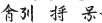 <dai₂-i seng gün2>.
Similarly, line 6 has  <si shui° ui gün2 pu-iseñ > . Based on orthographic characteristics (especially
  <UI= and
  structural similarity), it may be read as Qishui prefecture madame; Qishui Wei prefecture madame is possible but unconfirmed and requires further verification.
Line 5 of the Han lists the consorts and offspring of  <süe-han > Taifu (grand mentor). Previous studies have confirmed that Xiao Hanning's father had two wives, but the specific records of his sons have not yet been thoroughly examined.
(6) 
em-t par jur2 sui-il-□ em giu hôui bahu-an jur2 ai2-d xa-rɑ em □ □ beqo ngu liu
女 眷 二 生 母 九? 娘子 孩子 二 诸男 二 女 无?长? 子 吾 留
wives kin two birth mother Jiu? royal lady child-PL two sons two daughter son Wuliu  (Han 5)
cud-er da-aju
次 达骨只?
second Daguzhi?
The sentence (6) has already been deciphered by previous scholars. This section records the tomb occupant's mother and her children. According to the corresponding Chinese text of the epitaph, Xiao Hanning's father had two consorts: the primary consort gave birth to three sons, and the second consort gave birth to two sons; Xiao Hanning was the eldest son of the secondary consort. Accordingly, it is inferred that royal lady Jiu? (九) refers to the secondary consort, who bore two sons together with  < süe-han > Taifu (grand mentor).
The words  < ngu liu > (吾留) in the text refer to Xiao Hanning. His younger brother is recorded as
  <da-aju>, tentatively read as Daguzhi? (达骨只) or Diji? (迪佶). No corresponding Chinese personal name has yet been identified, and these issues require further investigation based on additional historical materials in future research.
Official career of the tomb occupant
Beginning with line 7, the Han turns to a narrative of the tomb occupant's official career, systematically recording his important appointments and enfeoffments from the age of 10 until his death at 52. This section focuses on supplementary textual research on parts of the original epitaph that have not been fully deciphered or investigated. (7) ……
 (Han 7)
jur2-en ger eur ab-bul2-de kem dai-ri zha-l-□
二之 家 岁 十于 敕 奉 承祧
Two-of family year ten-at imperial-order serve to-heir
Except grapheme  , all the words in example (7) have been deciphered by previous scholars. Line 7 of the Han records that the tomb occupant inherited and managed his grandmother's camp at the age of 10. The records in the Khitan large script correspond to the relevant description in the Chinese version of the Han, which has: “公九岁,奉宣知祖母耶律夫人帐……” (gong jiu sui, feng xuan zhi zumu yelü furen zhang…).
The one-year discrepancy in age between the Khitan and Chinese versions probably stems from different calendrical reckoning systems used in the Liao (辽) dynasty and the Central Plains. Similar one-year chronological divergences appear in the History of Liao (《辽史》) and Record of the Khitan State (《契丹国志》), and the age difference here is attributable to the same cause.
Grapheme  is a variant form of
  . Yasunori Takeuchi (2025) argued that the grapheme
  corresponds to the Khitan small script
  <b-u-ul> and
  <búl-ul>. Based on the interchangeable usage of
  and
and  after the numeral “ten” in Khitan large Script materials, and following Jiruhe and Masami Otake, who read
  as *bəl, he reconstructs the phonetic value of
  as *bul.
Furthermore,  also appears in line 14 of the Han.
(8)  (Han 14)
eur fourty gor-de xeri-bul₂ em₂-en dor ir □ er iri-de six ai₂-s
岁 四十 三于 州之 号于 六 诸年
year forty three-at prefecture-of title-at six years
(9)  (Chang 15)
delehu u-ud lém-ha-an₂ ui₂ manage-er xeri-bul em₂ yeu-ji
南 院 林牙之 事 知 州 迁
south academy Linya-of affair know prefecture promotion-to
The usage of  < xeri-bul₂> in example (8) and
  < xeri-bul > in example (9) is similar, which can provide further support for Yasunori Takeuchi's reconstruction of the pronunciation of
  . However, this article argues that the pronunciations of,
  , and
, and  should be reconstructed as *bul∼*bur. There exists an l/r alternation in Altaic languages, and the nuclear vowel is not fixed and can be realized as any vowel. It is likely that
  is a graphic variant of
  and
and  , but this still requires further verification.
Lines 8–9 of the Han refers to the service of Xiao Hanning as northern bureau imperial decree clerk at twenty-eight.
(10)  (Han 8–9)
eur jur2 □-de …… tau-su-ul-hai aju or u-ud kem tou zï-de □-l-er
岁 二十 六于 在 北 院 圣旨 头 子于 知
year twenty-eight-at …… at northern bureau imperial decree clerk manage
The sequence  < or u-ud kem tou zï > in line 9 can be interpreted as the northern bureau imperial decree clerk (Fu and Qi, 2023). Tao (2023) previously interpreted this passage as “manage □□ Xuan Touzi (宣头子)”. On the basis of the Khitan large script text, this official title can be supplemented and revised as northern bureau imperial decree clerk.
Line 10 of the Han records the official appointment of the tomb occupant at the age of 33. Tao (2023) has already identified that he served as junior Changgun (常衮) at the age of 33. The corresponding Khitan large script text further indicates that his tenure as junior Changgun of the Five Camps lasted for one month.
(11)  (Han 10)
eur thirty gor-de hu qa-□ tau énu-ui2-en ucu-qu cang-un po-ir ne month
岁 三十 三于 今 诸汗 五 帐之 小 常衮 成为 一 月
year thirty-three-at Khaans five camp-of junior Changgun become one month
In example (11), all the words except  have been deciphered by previous scholars. The two graphemes immediately following the grapheme for “five” are relatively indistinct. Following Jiruhe et al. (2025) new reading of
  <énu-ui2-en > as “camp”, corresponding to Khitan small script
  <én₂-u-ui>, the damaged segment can be read as
  < hu qa-od tau énu-ui2-en ucu-qu cang-un > . The phrase can thus be interpreted as “junior Changgun of the five camps of Xi Royal Mansion”. This reading is corroborated by the corresponding Chinese text of the Han: “半年,旋為小常袞,轄五帳” (ban nian xuan wei xiao changgun xia wu zhang). Furthermore, in light of the record in History of Liao, juan 33 (奚王府六部五帐分 xi wangfu liubu wuzhang fen), it is clear that the so-called Five Camps constituted the branch camp system under the Xi Royal Mansion. The term
  is therefore likely an alternative designation for this institutional unit.
Lines 10 to 11 of the Han further record that after serving one month as Junior Changgun of the five camps, Xiao Hanning was promoted to general-in-chief and Taibao (太保) (grand guardian). This is consistent with the corresponding Chinese Han passage “担任月餘,俄拜大將軍、太保” (danren yueyu ebai dajiangjun taibao).
Line 11 of the Han also records his subsequent career advancement. One year after holding the office of Taibao (grand guardian), Xiao Hanning was transferred to the position of Zhuan Yunshi (转运使) (transport commissioner) of the Northern Bureau. Chronologically, the tomb occupant was 34 years old at that time.
(12) 
tai b gej tem-l-ge3-er tai b-en iri hu e xa-is □ iri-de ne ai2 sa-ai isid-□ tau-su
太 保 封 太 保之 号 时 号于 一 年 在
Taibao enfeoff Taibao-of title time title-at one year at
 (Han 11)
-óul-hai aju or u-ud dzüe-üen ün-en iri-de til-e month-s ai
在 北 院 转 运之 号于 七 诸月 在
northern bureau Zhuanyun-of title-at seven months at
The words in example (12) have been deciphered in previous scholarship. According to the Han inscription, at age 33 Xiao Hanning was successively appointed junior Changgun (常衮) of the Five Camps and then promoted to General-in-Chief and Taibao (grand guardian). One year later, at the age of 34, he briefly served as Zhuan Yunshi (transport commissioner) of the Northern Bureau, after which he was soon reassigned.
The sequence  <dzüe-üen ün > represents the Chinese loanword Zhuanyun 转运 “transport”. The suffix
  <EN= is a genitive suffix. Former researchers have completed the phonological reconstruction of the relevant graphemes. This interpretation accords with the corresponding Chinese Han passage: “方居一載,累沐故家。可弘北靣轉運使” (fang ju yi zai lei mu gu jia ke hong bei mian zhuan yun shi).
Lines 12–13 of the Han further record that at the age of 35, Xiao Hanning served for one year as Vice Commander of the Jiqing Palace (积庆宫). This passage has been reliably deciphered in previous scholarship and will not be repeated here. Subsequently, the inscription notes that at the age of 36, he was transferred to the post of Xi Sheli Jun Xiangwen (奚舍利郎君军详稳) (General-in-Chief of the Xi SheLi Army). The corresponding Khitan large script is provided below.
(13)  (Han 12)
six ñ-ô-li₂ gúr-en sha₂-rí cau-ir₂ seng-un iri-de pɑt-ha₂-al
六 部 国之 舍利 军 详稳 号于 任
six tribes kingdom-of Sheri army general-in-chief title-at hold
From the end of line 12 to the beginning of line 13, the Han further records that Xiao Hanning proceeded from the Southern Capital to Dongping (东平) prefecture, concurrently serving as overall governor of various prefectures. The corresponding Khitan large script passage is presented as example (14).
(14)  (Han 12–13)
d-eri ging-de-i omud ping cieu xa-is hib hu₂-ú □-er
南 京从 东 平 州 时 均 统 知
southern Jing-from Dongping prefecture-at time administer govern manage
The words in example (14) have already been deciphered in previous scholarship. Wen (2023) has identified graphemes  and
and  as graphic variants; this will not be discussed here.
Line 13 of the Han further records that Xiao Hanning remained in Dongping prefecture for four years. This is corroborated by an entry dated to the 3rd month of the 8th year of Kaitai (开泰) era (1019 AD) in the History of Liao, Juan 16:
“乙亥,
The “Xiao Hanning, Prince of Dongping” mentioned here must refer to the tomb occupant Xiao Hanning. He was 40 years old in the eighth year of Kaitai (1019 AD), which corresponds precisely to the period of his service in Dongping.
Line 13 of the Khitan large script Han records that after completing his four-year term in Dongping, Xiao Hanning served as Yilibi (夷离毕) of the Tianjiang (天疆) state for two months. It is consistent with the records in the Chinese Han. The corresponding original text is given in (15):
(15)  (Han 13)
heaven □-an gúr-en ilibir₂-en cu-n cias-a-iu xa-ra month-s ai
天 疆 国之 夷离毕 权 政于 二 诸月 在
heaven borderland kingdom-of Yilibi-of administer govern-at two months-at
Sulongga (2025) interpreted  < heaven □-an gúr > as “Tianjiang (天疆) state”, with
  <□-an > corresponding to Khitan small script
  < ja₂-a-an >. The phonetic values and meanings of the other relevant words have already been established by previous scholars.
Combining the above records, we may conclude that Xiao Hanning assumed the position of Yilibi of the Tianjiang state after the third month of the 8th year of Kaitai (开泰), at the age of 40.
As for  < heaven □-an gúr > “Tianjiang State”, it may be a native term referring to the administrative system under the direct rule of the Son of Heaven.
In addition, previous studies have identified that  < cias-a-iu > “to govern” corresponds to the Khitan small script
  < ci-as-a-iú > .Based on its usage in example (15), this article holds that
  < cias-a-iu > “govern-at”,
  < iri-de > “title-at”, and
  < pin-er > “rank-by” should all be regarded as classifying markers for official titles. These three words share similar core meanings but differ in practical usage, a phenomenon closely associated with the official institution of the Liao Dynasty. However, given the currently available materials, the precise semantic differences among the three remain unclear, and further investigation with more textual examples is needed in future research.
Line 14 of the Han records that Xiao Hanning was enfeoffed as prince of the Xi at the age of 41, and at 43 he was transferred to another office where he served for six years. This passage has already been deciphered by Tao (2023). Furthermore, line 14 records his grants: he was entitled to feed off a fief of 5000 tax households, with an actual enfeoffment of 500 households. By contrast, the Chinese text of the Han records that he was entitled to feed off a fief of 1000 tax households, with an actual enfeoffment of 100 households. The discrepancy in the numerical figures between the two inscriptions may reflect the actual enfeoffment granted at different stages. The original text is shown in example (16).
(16)  (Han 14)
six ñôli₂ gúr-en dai ong p-ol₂-□ p-a-ar p-in tau ming □ p-in tau jau
六 部 国之 大 王 成为 食 邑 五 千 实封 食 五 百
six tribes kingdom-of prince become tax household five thousand actual enfeoffment five hundred
The Khitan large script in example (16) has already been deciphered by previous scholars; this study adopts the established readings without further elaboration. Sulongga (2025) interpreted  <p-a-ar p-in> as “tax household”, corresponding to Khitan small script
  <p-a-ar p-in>. On this basis, the sequence
  in the present text should be deciphered as “actual enfeoffment”. Similar usages also appear in Khitan small script texts:
(17)  (Jue 21)
p-a-ar p-in jur ming tau jau y-al-ha-al p-in jur jau fifty
食 邑 二 千 五 百 实封 食 二 百 五十
tax household two thousand five hundred actual-enfeoffment tax household two hundred fifty
(18)  (Zhuo 2)
ming tau jau y-al-ha-al p-in
千 五 百 实封 食
thousand five hundred actual-enfeoffment tax household
(19)  (Nan 1)
p-a-ar p-in jur ming p-or p-in jur jau
食 邑 二 千 实封 食 二 百
tax household two thousand actual-enfeoffment tax household two hundred
These examples demonstrate that two different expressions for “actual taxable allotment” occur in the Khitan small script:  <y-al-ha-al > and
  <p-or >. Consequently, it remains unclear to which of these Khitan small script words the Khitan large script grapheme
  corresponds. Its phonetic value therefore cannot yet be securely reconstructed and requires further investigation.
Line 15 of the Han records that Xiao Hanning was appointed Du Zhaotao Shi (都招讨使) (military commissioner for pacification) of the Southwest and An Fushi (安抚使) (pacification commissioner), supreme military commander of troops. At the same time, he concurrently held the civil title Tong zhengshi Menxia Pingzhang Shi (同政事门下平章事) (jointly manager of affairs with the political affairs-chancellery). He served in these posts for two years. This record corresponds to the Chinese Han text:  (feng xinan mian duzhaotaoshi anfu xunjianshi jian bingma du qianxia). The original Khitan text is presented below:
(20) 
delehu jut ñóur púr-sen ri2 □ □ □ □ jau tau an pu shï tal hu2-ú □-er
南 西 面 招 讨 安 抚 使 统 知
south west region Zhao tao An fushi command manage
 (Han 15)
megu-uji cau-ji hu2-ú □-□ tong jï-□ shï □ xa ping jiang shï podul-er
马 军 统 知 同 政 事 门 下 平 章 事 成为
troops army command manage Tong zhi-□ Shi Men Xa PingZhang Shi become
In example (20), the word  was newly deciphered by Sulongga (2025) as corresponding to Khitan small script
  <p-úr-s-en> . In addition, the present study observes that the sequence
  <□-uji cau-ji hu2-ú □-□> in line 15 of the Han should correspond to the Chinese official title Bingma Duqianxia (兵马都钤辖) (supreme military commander of troops). In Khitan large script, this title is expressed as “horse-troops command-manage”. According to previous studies,
  <cau-ji > can be interpreted as the plural form of “troops”. Sulongga (2025) identified
  as corresponding to Khitan small script
  <m-g > . Combining this with the Chinese context, the author suggests that
  (corresponding to Khitan small script
  <M-g-u-ji=) may be the plural form of “horse”, a hypothesis requiring confirmation from further materials.
Furthermore, the words  <tong jï-□ shï □ xa ping jiang shï> in line 15 of Han correspond to the Chinese title Tong Zhengshi Menxia Pingzhangshi (jointly manager of affairs with the political affairs-chancellery). The phonetic and semantic values of all graphemes except
  have been established by previous scholars. The grapheme
  can be newly deciphered as corresponding to Khitan small script
  <m-en>, with a provisional phonetic reconstruction of *mən. The Chinese loanword “Zheng” (政) is indistinct and cannot yet be collated precisely, pending further decipherment.
Line 16 of the Han records the tomb occupant's death due to illness. He fell ill at the age of 51 and died at 52, on the ninth day of the first lunar month in the tenth year of the Taiping (太平) era (1030 AD), as already deciphered by previous scholars.
The consorts of the tomb occupant
Line 17 of the Han records that one of the Consorts of Xiao Hanning was Shi Po (石婆) Yilinmian, daughter of the Ugulin (于骨邻) Great Prince and Uguli? (于骨里) Yilinmian. The epitaph also mentions details concerning the marriage between Shi Po Yilinmian and Xiao Hanning, which the author has not yet fully deciphered. The epitaph further states that the couple had seven children.
(21) 
no shï po ilmian em-n sui-l-ha₂-aju ai₂ em uhul-ñ₂ tai ong uhul □ ilmian em jur₂-en
配偶 石 婆 乙林免 妻之 生 父 母 于骨邻 大 王 于骨里?乙林免 妻 二之
Consort Shï Po Yilinmian Wife of Born Father Mother Ugulin Great Prince Uguli? Yilinmian Wife Two of
 (Han 16–17)
beqo ilmian em ñer-□ tau ai₂-s o3-an₃ tai ong ilmian em-n bahu-an dol
女 乙林免 妻 五 诸年 大 王 乙林免 妻之 孩子 七
Daughter Yilinmian Wife … five years Prince Yilinmian Wife's Child-PL Seven
Sulongga (2025) deciphered  < no > as corresponding to the Khitan small script
  < n-o > ”consort”. For the remaining words in this section, scholarly interpretations have reached a general consensus. Clear traces of engraving alteration are visible in line 17. In the personal name “Ugu□ Yilinmian”, the second grapheme also shows signs of later engraving. Aisin-Gioro Ulhicun (2009) have noted the phenomenon of “wives adopting part of their husbands’ names” among Khitan personal designations. On this basis, we infer that the name should read “Uguli Yilinmian”. Due to unclear grapheme shapes, the specific Khitan large script forms used in the inscription cannot be collated with certainty. This study suggests that Xiao Hanning had another wife, whose name still remains undetermined.
Descendants of the tomb occupant
Line 18 of the Han records that Xiao Hanning and Shi Po Yilinmian had five sons and two daughters. According to the epitaph :the first son was  < dur°-ir₂ > Tulübu (突吕不); the second son was
  <tem-er > Temo; the third son
  < pong-liu > Fangliu? (方留?) or Fengliu? (冯六) remains unidentifiable; the fourth son was
  <tau-su-ô-or3> Taosuwo? (陶苏斡) tentatively deciphered as “Taosuwo?”. This name Taosuwo appears in the History of Liao but refers to a different historical figure; the fifth son was
  <süe-xa > (unidentified).
The two daughters were Madame  < juruh-ñ₂ pu-iseñ >Zhiyigun (只倚衮) and Madame
  <cauang-ge pu-iseñ > Zhongge (中哥). The names of both daughters are corroborated by the Chinese version of the epitaph.
Notably, all the seven children (five sons and two daughters) are explicitly mentioned as having been born to Yilinmian. However, the Chinese epitaph states that Xiao Hanning “fathered nine sons and five daughters”. (生九子……五女 sheng jiuzi…… wu nü). It can therefore be inferred that Xiao Hanning had four more sons and three more daughters by another consort.
The end of line 18 of the Han records:
(22)  (Han 18)
juruh-ñ₂ pu-iseñ cauang ge pu-iseñ a or₃ ha □ mirg-ir₂ sar-an3 □ xa-rɑ
只倚衮 夫人 中 哥 夫人 ? 梅里急 撒懒? 二
Juyigün madame Zhongge madame Meiliji Salan two
In example (22), the grapheme  has not been deciphered; the other words have been successfully read by previous scholars. According to earlier studies,
  denotes the masculine numeral “two”. The author therefore argues that this passage refers to two more sons born to another consort of Xiao Hanning: the elder son
  <a or₃ ha □>, and the younger son
  <mirg-ir₂ sar-an3 > Meiliji Salan?(梅里急·撒懒?). Since the beginning of line 19 is damaged, the birth mother of these two sons and the identity of the second consort cannot be determined.
However, based on the current decipherment of the Khitan large script Han, only seven sons of Xiao Hanning can be clearly identified in the records; information about the remaining sons cannot be confirmed at present due to damage to the inscription or lack of explicit evidence. This discrepancy may be explained by the early death of the two missing sons, who were thus not included in the epitaph. Similarly, the number of daughters is three fewer than in the Chinese epitaph; this may also be attributed to early death, or their names may have been recorded in the damaged portion of line 19, which the present author has not been able to read.
It is thus evident that the Khitan large script and Chinese versions of the epitaph do not present an identical list of offspring. A comparison of the offspring recorded in the two texts is shown in the table below.
It can be seen from the Table 1 that the personal names recorded in the Khitan large script epitaph and the Chinese epitaph are not completely consistent. This discrepancy mainly stems from the Khitan custom of using multiple personal names for one individual: the same person often appears under different names in different contexts or texts, making one-to-one correspondence difficult.
Comparison of Xiao Hanning's descendants recorded in the Khitan large script and Chinese epitaphs. a
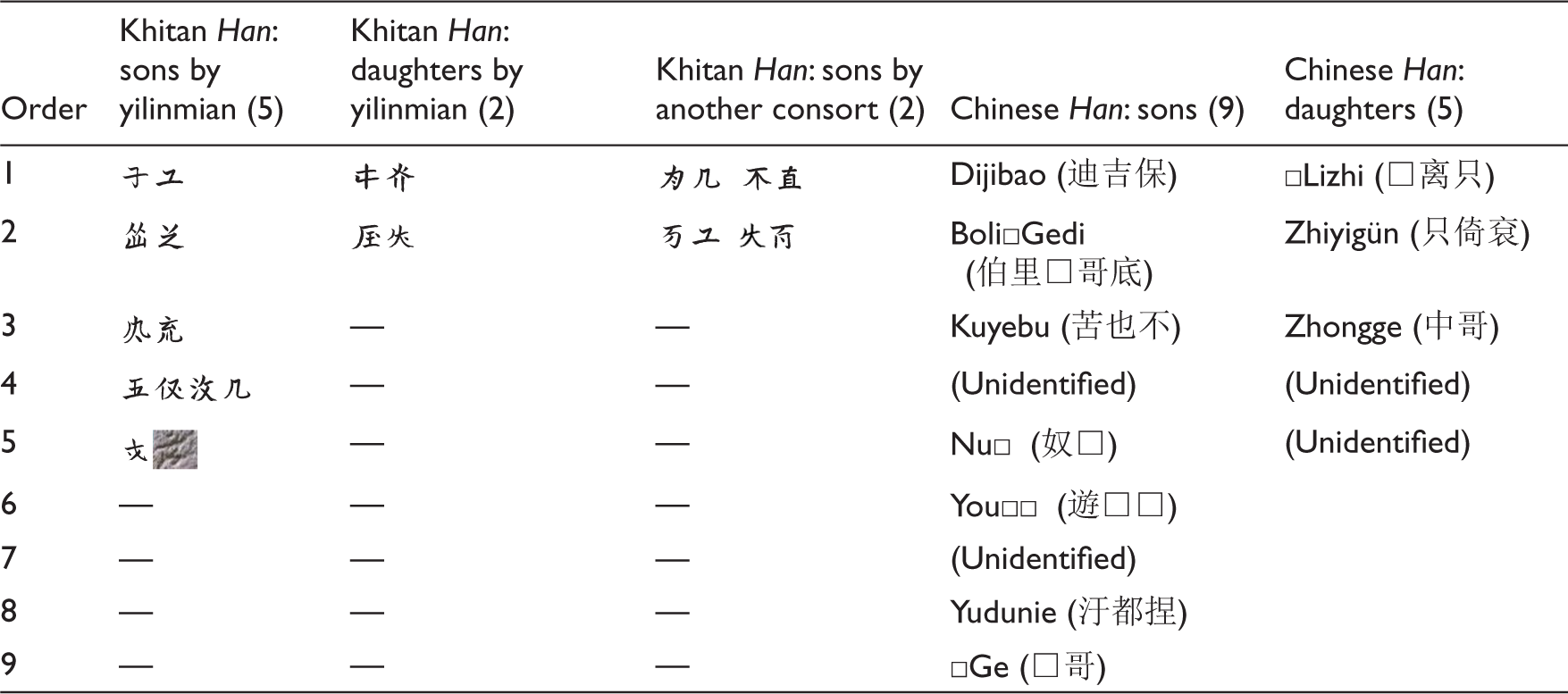
Nevertheless, the two personal names Zhiyigun and Zhongge can be clearly matched between the Khitan and Chinese versions, which shows that the two inscriptions still contain verifiably consistent information for certain individuals.
Line 19 of the Han inscription has:  <beqo-i bahu-an ai2-t tau° em ne>. The words in this line have already been deciphered by scholars, meaning: “Child's children: five grandsons; one granddaughter”.
It is thus known that at the time of Xiao Hanning's death, he had a total of six grandchildren: five grandsons and one granddaughter.
The younger brother of the tomb occupant
Starting from the latter part of line 19 in the Han, it records the affairs of  < da-aju > (达骨只?迪吉?) Xiangwen (详稳), younger brother of Xiao Hanning.
  < da-aju > Xiangwen inherited the household of his birth father
  <süe-haan > Taibao (grand guardian). The epitaph also notes that he assumed the office of Xiangwen at the age of 35.
In line 20 of the Han, according to previous decipherments of the Khitan large script, this section records that the wife of (23)  < da-aju > Xiangwen was
  < du-ung □ giu>, whose name should be “Dongjiu” (冬九). The relevant graphemes have all been deciphered by earlier scholars. The epitaph also records her lineage: she was the daughter of a certain Langjun (郎君) of the secondary father branch of the imperial clan tents and royal lady Yanshou (延寿).

du-ung □ giu em sui-li-ha₂-aju ai₂ em ia deu-en □-dû ai₂-en abu-□ sha₂-rí
冬 九 氏 生 父 母 兄 弟之 仲 父之 (人名) 郎君
Dongjiu lady birth father mother of brother's secondary father's (name) Langjun

yien sheu auúi jur₂-en beqo eur fourty tau-de great □ is ai₂ □ month-de ñiau cieu-de-i
延 寿 娘子 二之 女 岁 四十 五于 太 平 九 年 月于 州
Yanshou lady two-of daughter age forty-five Taiping era ninth year ninth month prefecture
 (Han 20–21)
iu □-ol₂-beñ
无 成为
deceased become
Lines 20 and 21 of the Han both contain the name of lady Dongjiu (冬九). Line 20 writes it as  <du-ung □ giu>, where a small added grapheme
  appears to the right of
  . Line 21 writes it simply as
  <du-ung giu>. Both refer to the same person. Line 18 of the Zai also lists
  < da-aju > (Xiangwen) and lady
  <du-ung □>, saying that they both attended the funeral of prime minister Tulukun (屠鲁昆) in the seventh year of the Taiping era (1027 AD). Previous scholars have reconstructed the phonetic value of
  as *ngiu.
Looking at these examples, we can see that  and
and  are used interchangeably. The sounds *ng and *ɡ both are velar (root-of-tongue) sounds. This likely means that in Khitan, the Chinese loanwords “ɡiu” (九) and “ngiu” (御) sounded quite close to each other. The same kind of substitution shows up in Chinese transcriptions of Khitan names: the Khitan name
  sometimes gets written as “Chubuning” (楚不宁) and other times as ”Shubaoli” (术保里). Therefore, this article suggests that the interchange between
  and
and  , should be explained by their similar pronunciation due to the same articulatory place, which led to substitution in writing and transcription.
Among the Khitan large script in example (23),  10
10
 <□-dû > should probably be interpreted as “secondary”, an alternative combined writing form of “secondary”. Wu (2011) pointed out that the Khitan expression “of brothers” refers to the “imperial clan tents”. It can therefore be concluded that example (23) records that lady Dung Giu's father was a member of the secondary father branch of the imperial clan tents.
Notably, this is the first attested example of “secondary” written as  <□-dû > . In the present article, the first grapheme is provisionally collated as
  . In previously excavated Khitan large script materials, “secondary” is written as
  <dau₂-dû > (e.g., Xi line 1, Gong line 3). Here,
  corresponds to Khitan large script
  <dau₂> and Khitan small script
  <dau>, on the basis of which its phonetic value can be reconstructed as *dɑu. Deligerihu (2024) has deciphered the Khitan large script
  <□-i > to correspond to Khitan small script
  <232-i > and
  <232-y>, signifying the meaning of “govern”. It thus follows that the grapheme
  also correspond to the glyph
  , and its phonetic value can be reconstructed as *dɑu. Nevertheless, whether there exists a correspondence between Khitan small script
  and
and  still requires further verification.
Lines 20–21 of the Han record that Lady  < du-ung giu > (Dongjiu)(冬九) died in the ninth month of the ninth year of the Taiping (太平) era (1029 AD), at the age of 45.
Lines 21–22 of Han indicate that  <da-aju > Xiangwen and lady
  <du-ung giu > had seven sons and one daughter, with the names of all eight children listed.
(24) 
da-aju seng-un du-ung giu em jur₂-en bahu-an ai₂-de tile-e □ em ne
达骨只?详稳 冬 九 氏 二之 孩子 诸男 七 有 女 一
Daguzhi Xiangwen Dongjiu lady two-of child-PL sons seven have daughter one

mo ma-liu cud-er beqo ju-□ nu kem dai-ri abu ai₂ süe-haan giu pu-en ger ja3-ar hut-er
长 马留 次 子 稚? 奴 敕 奉 祖父 九 家 承祧 第三
first Maliu second son Zhi-nu? imperial order grandfather SuehanTaifu-of house heir third

liu gia nu tud-er siu gia nu tat-or₃ □ megu-jï jur-□-er ñie-em₂-uul da-lu-er til-t em
刘家奴 第四 苏家奴 第五 ? 第六 (人名) 第七 迪烈 女
Liujianu fourth Sujia-nu fifth sixth Ñie-em₂-uul seventh Dilie daughter
 (Han 21–22)
beqo ha ñer tuh jur₂ □-ar liu gia niu
孩 刘家女
child Liu jia niu
Clear traces of supplementary carving are visible on line 21 of the Han: the grapheme was added after
  <tile-e>. The decipherment of the relevant words have been confirmed in previous scholarship. Based on current decipherment, the eldest son is
  <ma liu > Maliu (马留); the second son is
  <ju-□ nu > Zhi?-nu (稚?奴), who inherited his grandfather's household as the heir. The third son is
  < liu-gia-nu >; the fourth son is
  <siu gia nu > Sujia-nu(苏家奴); the fifth son is
  <□ megu-jï > ? (unidentified), whose first grapheme remains unidentified. The sixth son is
  < ñie-em₂-uul >?; the seventh son is
  <til-t > Dilie (迪烈). The single daughter is
  <liu gia niu > Liu-jia-niu (刘家女). The author has not yet fully deciphered the relevant passages concerning the daughter.
The inscription thereafter likely lists the grandchildren of the Daguzhi Xiangwen and lady Dongjiu, probably two granddaughters; however, severe damage at the beginning of line 23 makes it impossible to confirm their exact number.
Notably, “sixth” in (24) is written as  <jur-□-er > . Although the author has not been able to read the second grapheme, this writing provides reliable evidence for reconstructing the phonetic value of the feminine numeral
  (corresponding to the small script
 ) “six”.
Tao (2022) has identified  <jur> as corresponding to the Khitan small script
  <zhul>. Shen (2009) also discussed the rhyming relationship among several glyphs in the Khitan small script, such as
  <six>,
  <zhul>, and
  <ur>.
<ur>.
In line 22 of the Han,  <jur-□-er> should be the separated writing form of the large script
  <six-er>. Therefore, the pronunciation of the large script
  <six> and the Khitan small script
  <six> should be reconstructed as *jur, based on the sounds of the large script
  <jur> and the small script
  <zhul>.
On this basis, the author further offers a tentative hypothesis: the suffixes of ordinal numerals in Khitan may be divided into two types: those with a d-initial consonant + -ər, and those with an r-initial consonant + -ər (Takeuchi, 2025).
It may therefore be further inferred that the second grapheme in  <jur-□-er > represents either a d-type or r-type consonant. These issues will be explored in greater detail later.
Burial of the tomb occupant
Line 23 of the Han provides information concerning Xiao Hanning's funeral. His children and numerous relatives were present at the ceremony. The line also refers to the location of his burial.
(25) 
ilmian em bahu-□ ol ci₄-is bas te ai ab month jur₂ is day-de ñar-t □-an-ar bai-de
乙林免 妻 孩子 众 亲 又 那 在 十 月 二十 九 日于 松 山以
Yilinmian wife child-PL numerous kin also there at ten month twenty nine day-at pine mountain
 (Han 23)
da-haar ol₂-ha₂-aju
掩闭
buried
Wen (2023) has deciphered  <ñar-t har₂>as Song (松) Mountain. The Chinese Han records that Xiao Hanning was buried at Song Mountain. Accordingly, the place name in example (26) also refers to “Song Mountain”, but the grapheme for “mountain” is not
  , but
, but  . The graphemes
  <an> and
  <ar> have both been deciphered in previous scholarship.
First, it may be considered that  represents a form of the Chinese loanword Shan (山) (mountain). In Khitan small script, the Chinese loanword “Shan” is usually written as
  <sh-a-an>(Lang 2). Corresponding forms also appear in Khitan large script personal names, such as
  shan (Shan 20) and
  <sha₂-an₂ >(Shan 15). On this interpretation,
  correspond to
  < sha₂> in
  <sha₂-an₂> and to the Khitan small script
  <sh-a>. The grapheme combination
  as a whole may represent the lative form of the Chinese loanword “shan”, with its phonetic value provisionally reconstructed as *ʃɑ. Its precise form and phonetic value awaits further verification with more examples.
Conclusion
Based on the results obtained by previous scholarship, this article provides an additional interpretation of several key issues in Han, notably the identity of the calligrapher of the epitaph, the lineage of the tomb occupant, and his official career, combining the Khitan large script Han Epitaph, the Chinese version of the epitaph, and historical documents such as History of Liao.
Regarding script forms and phonetic values, this article proposes supplementary reconstructions for several large script graphemes: Grapheme The meaning of the grapheme The numeral Another new grapheme
 is regarded as a variant form of
  (or
(or  ), with a reconstructed pronunciation *bul.
 is interpreted as “actual enfeoffment”.
 is reconstructed as *mən, corresponding to the small script
  <m-en >.
 is interchangeable with the large script
  , with a reconstructed pronunciation *nɡiu∼*ɡiu.
 and
and  both express “secondary”, and
  correspond to glyph
  , whose phonetic value can be reconstructed as *dɑu.
 (corresponding to the small script
  ) is reconstructed as *jur.
 is reconstructed as *ʃɑ, corresponding to the Khitan small script
  and the large script
  .
.
These decipherments still require further verification materials.
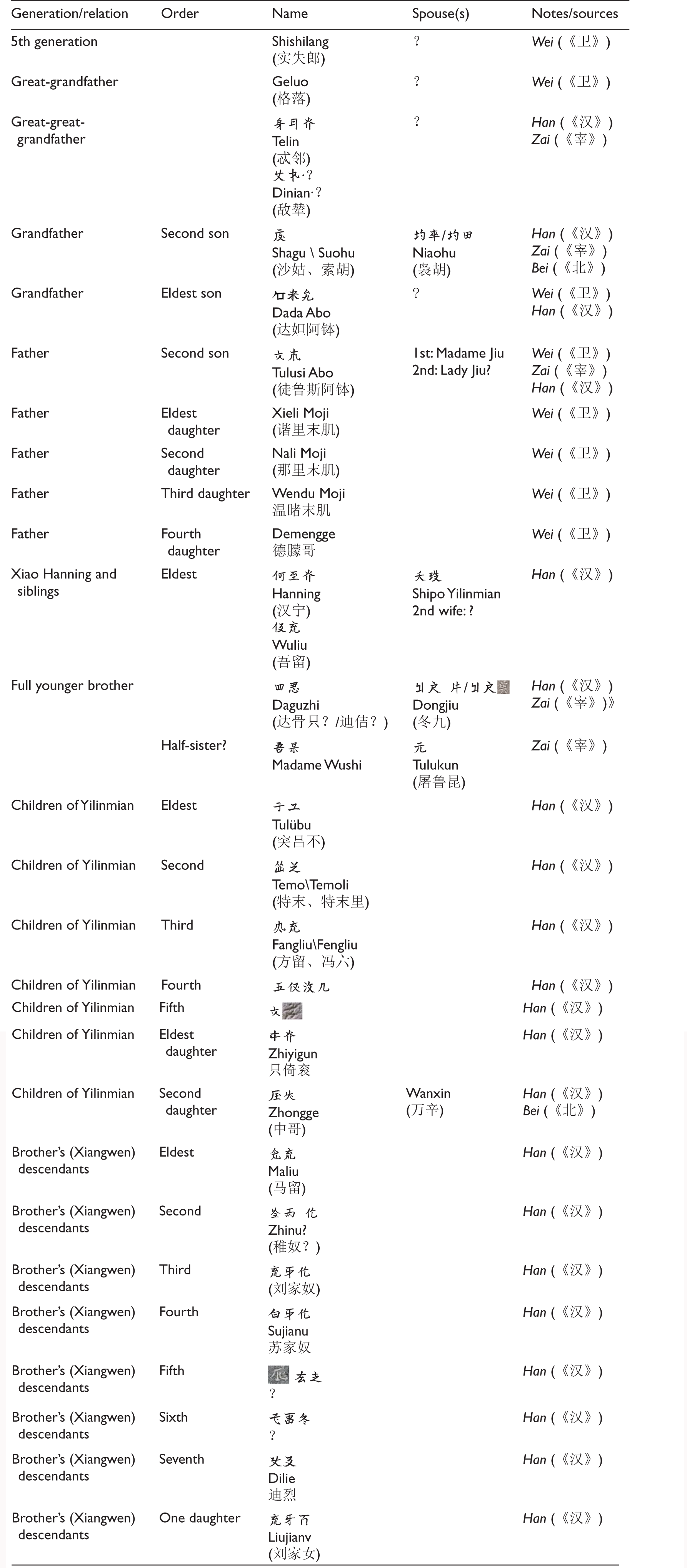
There are still a lot of problematic issues related to the present topic: first, there are many unclear points regarding the lineage related to Xiao Hanning; second, there is no reliable Chinese transcription for some personal names, which need to be clarified by expanding the scope of textual comparison; third, parts of the epitaph are damaged, and therefore some interpretations may be regarded as mere; fourth, the explanation of some words may still be incorrect, and the identification of relevant graphemes may lack conclusive evidence, requiring further verification. The above issues may be solved after the discovery of new materials and the deepening of research methods in the future. Any improper conclusions made in this article are sincerely welcome to be corrected by scholars in the field (Table 2).
Preliminary compilation of the lineage of Xiao Hanning.
Abbreviations and full names of Khitan large script, Khitan small script, and Chinese materials
Abbreviations and full names of Khitan large script materials
Han 汉: Epitaph of Xiao Hanning Prince of the Xi (《萧汉宁奚国王墓志》)
Zai 宰: Epitaph of Yelü Zaixiang (《耶律宰相墓志铭》)
Chang 昌: Epitaph of Yelü Changyun (《耶律昌允墓志铭》)
Bei 北: Epitaph of the Grand Prince of the North(《北大王墓志铭》)
Zhun 凖: Epitaph of Changgun Yelü Zhun of Great Liao(《耶律凖常衮墓志铭》)
Shan 赡: Epitaph of Wei Nan Shan Bu Zhou Da Liao Guo Ming(《维南赡部洲大辽国铭》) Abbreviations and full names of Khitan small script materials
Jue 玦: Epitaph of Xiao Yelü Changwen(《耶律玦敞稳墓志铭》)
Zhuo 涿: Demaged Epitaph of the Prefect of Zhuozhou (《涿州刺史墓志》)
Nan 南: Epitaph of the Late Dilie Prince of Great Liao of Jambu-dvipa (《南赡部洲大辽国故迪烈王墓志文》)
Wu 兀: Epitaph of Yelü Wumo Fushu(《耶律兀没副署墓志铭》)
Lang 郎: Record of the Journey of the Younger Brother of the Emperor of the Great Jin Dynasty(《大金皇帝都统经略郎君行记》)
Guang 广: Epitaph of Prince of Guangling of Great Khitan(《大契丹国广陵郡王墓志铭记》)
Xuan 宣: Eulogy for Empress Xuanyi(《宣懿皇哀册文》)
Tai 太: Eulogy for the Late Imperial Grand Uncle(《太叔祖哀册》) Abbreviations and full names of Chinese materials
Han 汉: Epitaph of Xiao Hanning, Prince of the Xi(《奚国王萧汉宁墓志》)
Wei 卫: Epitaph of Shagu Fuma Posthumously Enfeoffed as Prince of Wei(《驸马赠卫国王沙姑墓志》)
Footnotes

Funding
The author disclosed receipt of the following financial support for the research, authorship, and/or publication of this article: This work was supported by the Key Project of the National Social Science Fund of China (grant number 21AYY023).
Declaration of conflicting interests
The author declared no potential conflicts of interest with respect to the research, authorship, and/or publication of this article.
Notes
Appendix
Preliminary transcription of the Epitaph of Xiao Hanning Prince of the Xi in Khitan large script
1.
six ñ-ô-li2 gúr-en te-□-ñ2 qa-han ger-en qa-an2-ñ2 □ dau seng gung-un o3-an3 em-er □-□-én
六 部 国之 忒邻 可汗 家之 汉宁 道 相 公之 行 道
six tribe kingdom-of Telin Khaan-of house's Hanning Xianggong's
cu-der be-qo tem-er eur jur2 naim-d ci6-er
第二 子 特末 岁 二十 八于 书
second son Temo age twenty eight-at inscribe
2.
te-□-ñ2 qa til-én □ li3 bahu-an3 jur cud-er beqo abu ai2 pu ma seng gung megu em ñau-qó gung
忒邻? 汗 敌辇? 孩子 二 第二 子 祖父 驸 马 相 公 祖母 袅胡 公
Telin Khaan Dinian? child-PL two second son grandfather imperial son-in-law Xianggong grandmother NiaoHu
ciú2 ta-□ qa □ em jur-en beqo □ em noue hie delehu-en □ noue hie sui □ □
主 挞里斯 妻 二之 子 妻 耨斡么 胞 耨斡么
princess Talis Khaan legal wife two-of duaghter legal wife NouWomo uterine Nouwomo
3.
tuh-□ □-is-óui auui pu2-un beqo po2-□-hai eur-ɡeén sh2-ang gui gung ciú2 gej uúr-ge-en great qid-i
养 女 成为 供养 尚 国 公 主 大 契丹
adopted daughter become support Shang Guo princess enfeoff great Khitan
gúr-en qa-han em beqo-i podul-ai gúr-□ uul-oh-□ gung ciú2-en iri
国之 可汗之 女 孩子 成为 国于 送养? 公 主之 名
kingdom's khaan's daughter become to kingdom fosterage? princess's title
4.
ar noue hie ja3-□ huiri-ger2 □-ñ2 pu ma seng gung ñau-qó gung ciú2 jur-en bahu-an3 six ai2-d xa
至 驸 马 相 公 袅胡 公 主 二之 孩子 六 诸男
arrive imperial son-in-law Xianggong Niaohu princess two-of child-PL six sons
-rɑ em-t dur mo beqo □-ar □-ui2 cud-er süe-han tai pu2 tud-dor-an3 is ai2
二 诸女 四 长 子 达妲 阿钵? 次 太 傅 保宁 九 年
two daughters four eldest Dada Abo? second(name)Taifu Baoning nine year
5.
□ gém giau tai pu2 so isen ui dai2-i seng gün2 podul-er em-t par jur2 sui-□-□ em giu hôui bahu-an
于 检 校 太 傅 左 神 卫 大 将 军 成为 诸女 眷 二 生 母 九 娘子 孩子
at Jianjiao Taifu Zuoshenwei great general become wives kin two birth mother Jiu? royal lady child-PL
jur2 ai2-d xa-rɑ em □ □ beqo ngu liu cud-er da-aju li so-t dai tu
二 诸男 二 女 长?子 吾 留 第二 达骨只? 配偶 人名?
two sons two daughter eldest? son Wuliu second Daguzhi? (name)?
6.
ñ2 pu-iseñ ui □ ai □ shui°-ui gün2 pu-iseñ po2-du2-□-ñ2 mo udu □ un har □-ñ2 abu □-ol2
夫人 漆 水 郡 夫人 成为 贤
Madame Qishui prefecture Madame become virtuous
em jur-n beqo □ xa □ cau ji-ñ2 jur2-n beqo ñer-li4 iu po2-□ tau° ai
妻 二之 女 二之 子 卒 成为 五 年
wife two-of daughter two-of son died become five year
7.
ai2-□ □ □ beqo ca-ar-i □ eu-ui2 gej □ □ □ □ cau ji-ñ2 jur-en ger eur ab □-de kem dai-ri4
诸男 子 无 中 二之 帐 岁 十于 敕 奉
sons son died middle two-of house age ten-at imperial-order serve
ja3-□-er ciauqú-ui2 gúr rí-én cau tuh-i yien-ñ2 tai ong ñóur □ □
承祧 汉儿 国 燕隐 大 王 部
to-heir Haner kingdom Yanyin prince tribe
8.
□ ô uji □ ai du4-óui-ñ2 beqo ia deu-de □ pul-û-ji ar k-y eur jur2 six-de □ a □ □ □
兄 弟于 谓 岁 二十 六于
brother to-younger brother called age twenty six-at
□ ja3-□-er eur jur2 □-de pu2-û ai tau-su-oul-hai aju or u2
承祧 岁 二十 八于 副? 在 在 北 院
to-heir age twenty eight-at? at at northern bureau
9.
-ud kem tou zï-de □-□-er jur2 ui2 □ □ □ po2-□-□ ji-ñ2 jau-ji-en ngiú2 shï po2-□ □ eur thirty
圣旨 头 子于 知 之 御 史 拜 岁 三十
imperial decree clerk manage Yushi become age thirty
gor-de ir2-én □-li-ñ2 qa-han ger-en □ shï2 po2-ri4 tau° month-s
三于 忒邻 可汗之 帐之 敞 使 拜 五 诸月
three-at Telin Khaan's camp's Changshi become five manths
10.
ar eur thirty gor-de hu qa-□ tau énu-ui2-en ucu-qu cang-un po2-ir4 ne° month ar cang-un ai dur dau
在 岁 三十 三于 诸汗 五 帐之 小 常衮 成为 一 月 在 常衮 在 四 道
at age thirty three-at Khaans five camp-of junior Changgun become one month at Changgun at four virtue
jur-han em-er es ci6-er gej dai-□ dai2-i seng gün2-en pomud-er □ gej tai
六? 道 未 在 大 将 军之 品以 太
six? realm? not at great general rank-of Tai
11.
b gej tem-□-ge3-er tai b-en iri hu e □ □ iri-de ne ai2 sa-ai isid-□ tau-su-óul-hai aju or u2-ud
保 封 太 保之 该 时 号于 一 年 在 在 北 院
Bao enfeoff Taibao-of this time title-at one year at at northern bureau
dzüe-üen ün-en iri-de til-e month-s ai eur thirty tau-de ciauqú
转 运之 名于 七 诸月 在 岁 三十 五于 汉儿
Zhuanyun-of title seven months at age thirty five-at Haner
12.
ui2 □ h-ing pu3-oi2-en pu pu2 shó po2-ri4 iri-de ne ai2 ai eur thirty six-de six ñ-ô-li2 gúr-en sha2-rí
积 庆 宫之 副 部 署 成为 号于 一 年 在 岁三十 六于 六 部 国之 郎君
Jiqing Palace's vice commander become title-at one year at age thirty six-at six tribe kingdom's Sheli
cau-ir2 seng-un iri-de pɑt-ha2-□ □-er □ □ ging-de-i omud ping
军 详稳 号于 担任 南 京从 东 平
army general-in-chief title-at hold southern capital-from Dongping
13.
cieu □ hib hu2-ú □-er cau □□□ dur ai2-s ai qó-haar tau-su-óul-hai □ □□□de heaven ha3-an gúr-en
州 时 均 统 知 四 诸年 时于 天 疆 国之
prefecture-at time administer govern manage four years time-at heave borderland kingdom's
ilib-ir2-en cu2-n cias-a-iu2 xa-ra month-s ai eur fourty
夷离毕 权 政于 二 诸月 在 岁 四十
Yilibi-of administer govern-at two months at age forty
14.
ne-de six ñ-ô-li2 gúr-en dai ong po2-□-□paar pin tau ming□pin tau jau eur fourty gor de xeri-□ em2
一于 六 部 国之 大 王 成为 食邑 五千 实封 实 五 百 岁四十三于 州
one-at six tribe kingdom's prince become tax household five thousand actual enfeoffment five hundred age forty three-at prefecture
-en □-rí-□-er iri-de six ai2-s □ □ □ en qó-haar tau-su
之 号于 六 诸月 五十 时
of title six months fifty at
15.
óul-hai aju delehu jut ñóur púr-sen ri3 □□□□ uji jau tau an pu shï tal hu2-ú □-er megu-uji cau-ji
在 南 西 面 招 讨 安 抚 使 统 知 马 兵
at south west region Zhao tao An fushi command manage troops army
hu2-ú □-□ tong jï-□ shï □ xa ping jiang shï podul-er iri-de jur
统 知 同 政 事 门下 平 章 事 成 号于 二
command manage Tong zhi-□ Shi Men Xa PingZhang Shi become title-at two
16.
ai2-s sa-ai sem-li eur □ ne-de úur □ □ □ ji en ja3-□-haar aju great yieraiú ab ai2 nai month
诸年 在 病 岁 五十 一于 太 平 十 年 正 月
Years at illness age fifty one-at Taiping ten year first month
is day eur □ jur-de □ em2-de-i sul ar □ □ i iu po2-□-bir no
九 日 岁 五十 二于 州从 无 成为 配偶
nine day age fifty two-at from-prefecture died become consort
17.
shï2 po ilmian em-n sui-l-ha2-aju ai2 em uhul-ñ2 tai ong uhul □ ilmian em jur2-en beqo ilmian em
石 婆 乙林免 妻之 生 父 母 于骨邻 大 王 于骨乙 林免 妻 二之 女 乙林免 妻
Shipo Ylimian wife's birth father mother Ugulin prince Uguli Yilinmian wife two-of daughter Yilinmian wife
ñer □ ab six-de □-ñ2 deu-úr ir2 tau ai2-s o3-an3 tai ong ilmian em-n bahu-an dol
十 六于 五 年 大 王 乙林免 妻之 孩子 七
ten six-at five year prince Yilinmian wife's child-PL seven
18.
ai2-□ tau° em-t jur mo beqo dur°-ir2 cud-er tem-er hut-er pong-liu tud-er tau-su-ô-or3 □-or3 süe □
诸男 五 诸女 二 长 子 突吕不 次 特末 第三 方/冯留 第四 第五
sons five daughters two eldest son Tülvbü second Temo third Fang/Fengliu fourth fifth
juruh-ñ2 pu-iseñ cauang-ge2 pu-iseñ a or3 □ □ □-ir2 □-an3 xa-rɑ
只倚衮 夫人 中哥 夫人 弥里急 撒懒? 二
Zhiyigun Madame Zhongge Madame Miliji Salan? two
19.
en uul ir □ □ □ □ qó pu sa niu tud sin □ beqo-i bahu-an3 ai2-t tau° em ne deu da-aju seng-un
之 菩萨女 子之 孩子 诸男 五 女 一 弟 达骨只?详稳
of Pusanv child‘s child-PL sons five daughter one younger brother Dauguzhi? Xiangwen
sui-□-ha2-aju ai2 em süe-□ tai-b jur-en ger ja3 -□-□ sha2
生 父 母 太保 二之 家 承祧
birth father mother Taibao two-of house to-heir
20.
sa-ai eur thirty tau □ □ □ □ seng-un podul-er du-ung-□ giu-en sui-□-ha2-aju ai2 em Ia deu-en □-□
在 详稳 成为 冬 九之 生 父 母 兄 弟之 仲
at Xiangwen become Dongjiu's birth father mother brother younger brother's secondary
ai2-en abu-□ sha2-rí yien sheu auúi jur-en beqo eur fourty tau-de great yieraiú
父之 郎君 延寿 娘子 二之 女 岁 四十 五于 太 平
father's Langjun Yanshou royal lady two-of daughter age forty five-at Taiping
21.
is ai2 is month-de ñiau cieu-de-i iu □-□-beñ da-aju seng-un du-ung giu em jur-en bahu-an3 ai2-□ til-
九 年 九 月于 州从 无 成为 达骨只 详稳 冬 九 氏 二之 孩子 诸男 七
nine year nine month-at from-prefecture died become Daguzhi Xiangwen Dongjiu lady two-of child-PL sons seven
e □ em ne mo ma liu cud-er beqo ju-□ nu kem dai-□ abu ai2 süe
有 女 一 长 马 六 次 子 稚奴 敕 奉 祖父
have daughter one eldest Maliu second Zhinu imperial decree receive grandfather
22.
han giu pu en ger ja3-ar hut-er liu-gia-nu tud-er siu-gia-nu □-or3 □ megu-□ zhul-□-er ñie-em2-uul
九 之 家 承祧 第三 刘家奴 第四 苏家奴 第五 第六
Jiu of house to-heir third Liujianu fourth Syjianu fifth sixth
da-lu-er til-t em beqo □ ñer tuh jur □ ar liu-gia-niu beqo-i
第七 迪烈 女 子 刘家女 子 之
seventh Dilie daughter Liujianv child's
23.
bahu-an3 em-t jur □ □ □ □ hai ilmian em bahu-an3 ol ci4-is bas □ ai ab month jur2 is day-de
孩子 诸女孩 二 乙林免 妻 孩子 众 亲 又 那 在 十 月 二十 九 日于
child-PL daughters two Yilinmian wife child-PL numerous kin also there at ten month twenty nine day-at
ñar-□ □ an-ar bai-de da-haar □-ha2-aju
松 山 掩闭
pine mountain buried
24.
great yieraiú ab ai2 ab month jur2 is day
太 平 十 年 十 月 二十 九 日
Taiping ten year ten month twenty nine day