






Abstract
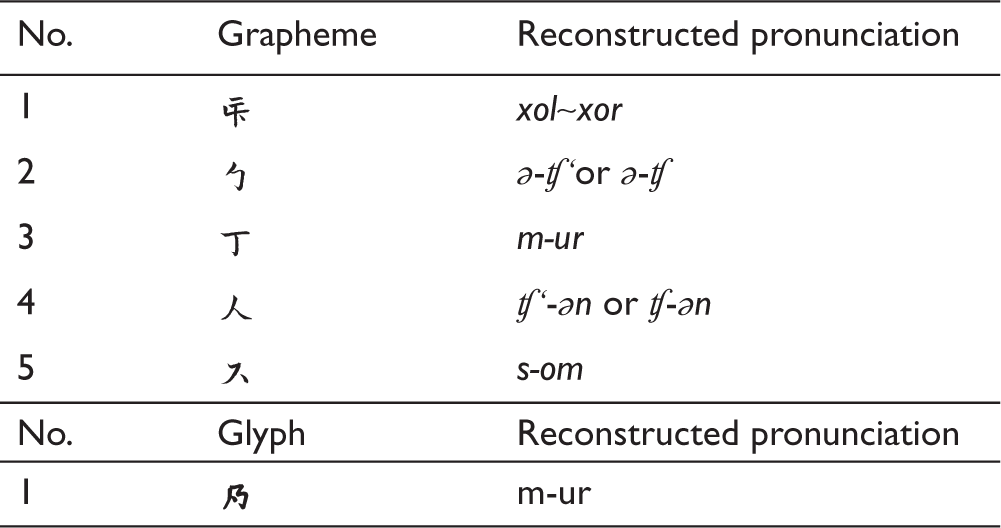
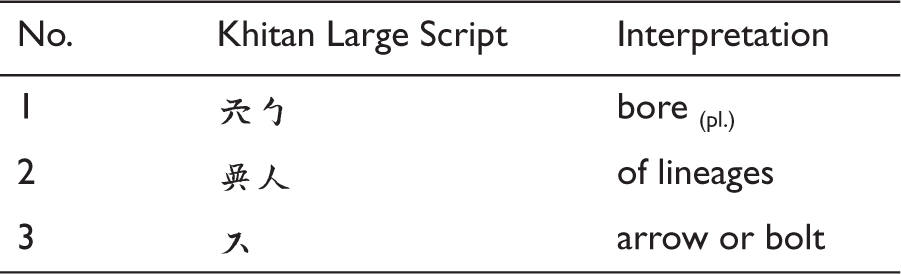
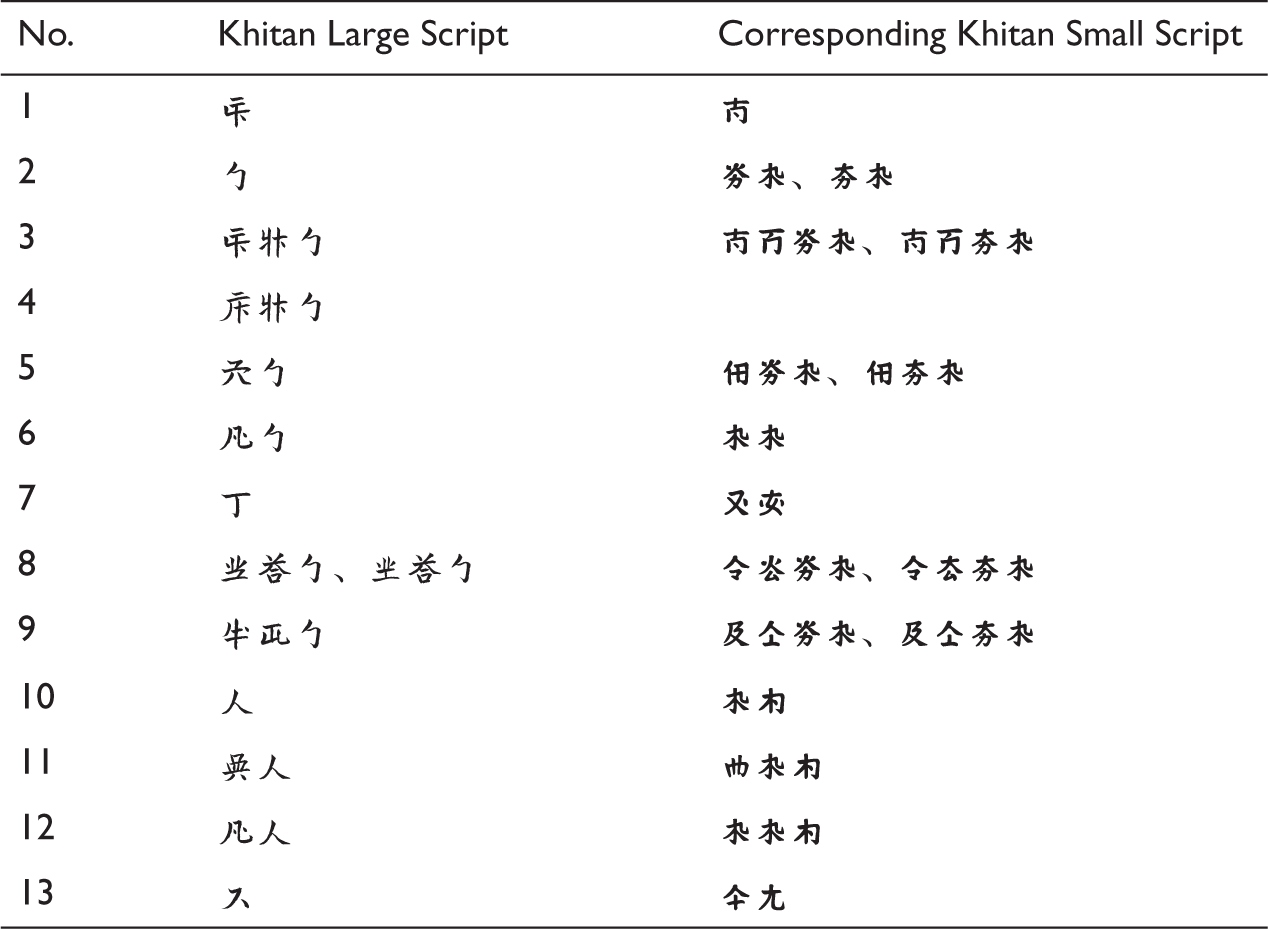
The Stele of Yelü Tulibu Langjun in Khitan Large Script commemorates a seventh-generation descendant of Yelü Yuzhi. The decipherment of this stele is of great importance for advancing research on the Yelü Yuzhi lineage. To date, numerous graphemes in the stele remain undeciphered. Among them, several occur with relatively high frequency. The reconstruction of their pronunciations is crucial for further elucidating the meanings and grammatical functions of Khitan Large Script compounds containing these graphemes. Through a comparative study of the Khitan Large and Small Scripts, this study offers new insights into the phonetic and semantic interpretation of previously uninterpreted graphemes found in the stele. The key findings are as follows: In terms of form, a set of variant forms of the same grapheme has been identified. In terms of pronunciation, the pronunciations of four graphemes have been reconstructed, and a revision to the previously reconstructed pronunciation of one grapheme and its corresponding glyph is proposed. In terms of semantics, two Khitan Large Script compounds have been interpreted, one expressing the plural meaning of ‘bore’ (sheng) and the other denoting the plural meaning of ‘of the lineage’ (fang zhi). Furthermore, several correspondences between Khitan Large and Small Script forms have been established, providing new clues and evidence for the further decipherment of the Khitan scripts.
Introduction
The exact date and location of the excavation of the Stele of Yelü Tulibu Langjun in Khitan Large Script (hereinafter abbreviated as Tu) remain unknown. According to Liu (2014), the stele is thought to have been unearthed in the 1990s or early 2000s from the Yelü Yuzhi family cemetery in Ar Horqin Banner, Inner Mongolia Autonomous Region. The original stele is currently housed in the Ar Horqin Banner Museum, Inner Mongolia.
According to the stele, Tu was engraved on the fifteenth day of the third month in the seventh year of the Dakang reign period of the Liao Dynasty (1081 CE). The tomb occupant, Temian Tulibu, was a seventh-generation descendant of Yelü Yuzhi. Yelü Yuzhi, whose infant name was Wuli and courtesy name Yindishen, was appointed Right Vice Chancellor of the Central Secretariat of the Dongdan State in the first year of the Tianxian reign (926 CE). He later rose to the position of Taifu of the Eastern Capital, earning a reputation for both authority and integrity, and achieving notable political accomplishments. Yelü Tulibu, whose courtesy name was Temian, hailed from the Puguzhi Yilijin lineage of the Six Tribes of the Khitan, and served as Langjun. The decipherment of this stele holds significant epigraphic value for in-depth investigation of the lineage, social status and broader socio-political context of the Yelü Yuzhi family, as well as for advancing our understanding of Liao-Dynasty history and culture.
Previously, scholars including Cong et al. (2005), Aisin Gioro (2006), Aisin Gioro and Yoshimoto (2012), and Liu et al. (2014), as well as Wurenchaolumen (2016), have provided systematic accounts of the stele's discovery, physical dimensions, excavation site, current collection status, and key information regarding the tomb occupant's clan affiliation, dates of birth and death, official appointments, spouses, offspring, and family lineage. However, a considerable number of Khitan Large Script graphemes in the stele remain undeciphered, and therefore require further research.
In recent years, the successive publication of newly unearthed Khitan-script epitaphs has provided fresh textual materials that enable new interpretations of previously obscure graphemes and allow for critical reassessment of earlier reconstructions. Building upon prior research and incorporating recent scholarly advances, this article focuses on uninterpreted graphemes in Tu, and proposes new reconstructions and interpretations, with the aim of providing additional insights and references for the ongoing research in Khitan script studies. The grapheme
 1
1
The grapheme  appears 20 times in extant Khitan Large Script inscriptions. In line 16 of Tu, it occurs in a list of mourners attending the funeral:

 (Tu 16
生 心 亲属 地之 在 知
bore ? 4 heart relatives ? of the land be in charge of
Here,  denotes ‘bore’, corresponding to
  in Khitan Small Script, pronounced as sui5-ir;
  denotes ‘heart’, corresponding to
  in Khitan Small Script (Tao, 2022);
  means ‘relatives’, and corresponds to the Small Script form
  , read as ʧʻ-i-is;
  can be transcribed as
  in Khitan Small Script, read as x-s;
  means ‘of the land’, and corresponds to
  in Khitan Small Script;
  denotes ‘be’, corresponding to
  in Khitan Small Script, read as ɑ-ɑі-ər;
  means ‘be in charge of’, and corresponds to the Small Script form
  .
.
In this context,  appears as the final grapheme in
  . Although
  is known to correspond to the glyph
  (i ∼ j), both the initial grapheme
  and final one
  remain uninterpreted. Notably, a semantically identical text appears in line 21 of Shan:
(2)  (Shan 21)
生 心 亲属 地之 在 知
bore ? heart relatives ? of the land be in charge of
Comparing (1) and (2):  (in
(in  ) and
) and  (in
(in  ) are allographs;
  (in
(in  ) and
) and  (in
(in  ) are allographs. Most importantly,
  and
and  occupy identical syntactic positions and serve the same grammatical function. This strongly suggests that
  and
and  are variant forms of the same grapheme.
Further investigation shows that  also appears as
  (Chen 4, 20). Since
  corresponds to the glyph
  , read as xol∼xor (Sulongga, 2021: 76), both
  and
and  may reasonably be reconstructed as xol∼xor.
Thus,  and
and  correspond to the Small Script form
  .
6
.
6
Although no exact parallel has yet been identified in Khitan Small Script epitaphs, a highly comparable text appears in line 19 of Tie, whose tomb occupant was the father of Shan's tomb occupant:
(3)  (Tie 19)
sui-ir2 hor-y-e-ci s-a-ar ci-i-is h-s 239-en a-ai-er manage-er 7
生 在 亲属 地之 在 知
bore be relatives ? of the land be in charge of
Except for the presence of  (‘be’), the core structure of example (3) aligns precisely with examples (1) and (2), confirming to the expected pattern
  . This supports the tentative identification of the Large Script compounds
  and
and  with the Small Script form
  , in which the final grapheme
  corresponds to
  in Khitan Small Script, reconstructed as ə-ʧʻ or ə-ʧ.
Moreover, it is well attested in Khitan Small Script inscriptions that the glyphs  and
and  are frequently interchangeable. A search for contexts containing
  yields a matching instance in line 18 of Gu:
(4)  (Gu 18)
h-s 239-en ia deu s-a-ar hor-y-e2-ci 316 ci-i-is ci-eu a-ai
地之 兄 弟 在 心 亲属 在
? of the land elder brother younger brother beheart relatives? be
Here,  corresponds exactly to
  in example (1) and
  in example (2), with fully consistent word order and semantics. This further confirms that the grapheme
  corresponds not only to
  , but also to
  in Khitan Small Script.
The grapheme  also appears in
  (Chen 15):
(5)  (Chen 15)
于越从 生 孩子 二 长 次
from Yuyue bore children two eldest … second …
This line records the two daughters born to the tomb occupant and her second husband, Hudugun Yuyue. Here,  means ‘from Yuyue’.
  means ‘bore’, with the grapheme
  corresponding to
  or
or  in Khitan Small Script, read as sui, and the grapheme
  corresponding to
  and
and  in Khitan Small Script, reading ə-ʧʻ or ə-ʧ. Thus,
  can be transcribed as Small Script form
  or
or  . No instance of Small Script
  followed by
  or
or  has yet been identified in extant Khitan Small Script inscriptions.
  means ‘children’, corresponding to
  in Khitan Small Script, read as p-ɣ-ɑn;
  is the feminine cardinal numeral ‘two’, corresponding to the glyph
  and
and  are feminine ordinal numerals meaning ‘eldest’and ‘second’, corresponding respectively to
  and
and  in Khitan Small Script.
Further examination of Small Script inscriptions reveals three closely parallel passages in Jue 10, Nu 9, and Yong 15:
(6)  (Jue 10)
dol˚ l-ing g-ung-un sh-a-rí a-án na-as-s-li2 sui-e2-ci b-hu-án gor great ci-ud2-én hu-od-én
敌烈 令 公之 郎君 在 续婚后 生 孩子 三 长 次 第三
Dilie Linggong's Langjun be after remarrying bore children three eldest … second … third …
(7)  (Nu 9)
l-iu-ñ di-ge-in em ku ci-en g-e em-de na-as-s-li2 sui-e-ci b-hu-án jur m-o small-qó
留你 惕隐 妻 陈 哥 于 续婚后 生 孩子 二 长 幼
Liuyin Tiyin wife Chengeto after remarrying bore children two eldest … youngest …
(8) 
ci-ud2-én ó-ui-i t-ul-u-én 210-ui deu qa-an g-iu sh-a-rí-de na-as-s-li2 sui-e-ci b-hu-án
次 乌隈 娘子 弟 韩 九 郎君于 续婚后 生 孩子
second WuweiNiangzi … younger brother Hanjiu Langjun to after remarrying bore children
 … (Yong 15)
jur°
二
two …
All three examples follow the formula: ‘[subject] after remarrying [someone] bore children [number]’. Crucially, the verb ‘bore’ is consistently rendered as  or
or  , directly corresponding to
  in example (5); the noun ‘children’ always appears in its plural form
  ; and it is followed by numerals (‘
 ‘three’ [feminine],
  ‘two’ [feminine],
  ‘two’ [masculine]) accordingly. This consistent cross-epitaph usage further corroborates the correspondence between the grapheme
  and
and  in Khitan Small Script.
Ōtake (2016b) proposed that  functions as a plural participle suffix. The present study concurs, and accordingly infers that the corresponding Large Script grapheme
  likewise functions as a plural participle suffix.
Additionally, the grapheme  appears in the form
  (Chang 30, Qi 10, 15; Xi 9, 15; Liu 6, Yan 4, 6, 25). Notably,
  occurs three times (Yan 6; Xi 15; Liu 6). Taking line 6 of Yan as an example:
(9)  (Yan 6)
诸号以 迁
? ? titles transfer
In this line,  , the locative-directional form of
  ‘titles’, corresponds to
  , read as i-ri-s-ər;
  means ‘to transfer’, and should correspond to
  in Khitan Small Script. Although
  itself is unattested, its cognates
  (Zhen 31, 49; Hong 3, Di 20) and
  (Di 8) are well documented. In
  is generally interpreted as ‘river’ (Aisin Gioro and Yoshimoto, 2015: 264), corresponding to Small Script
  , traditionally reconstructed as mor; however, its semantic role in this context remains unclear. Based on the earlier findings,
  should correspond to the Small Script form
  or
or  . Yet, no attested instance of either form has been identified in the currently published Small Script corpus. Instead, a phonetically similar form,
  occurs 42 times in extant inscriptions.
Crucially, line 20 of Di provides a near-identical parallel:
(10)  (Di 20)
m-úr ci-ci i-ri-s-er y-eu-ud2-te2-i
诸号以 迁
? ? titles transfer
Aside from the final suffix  in
in  , which corresponds to the grapheme
  or
or  rather than
  , the remainder of the line matches example (9) exactly. This correspondence leads to two conclusions:
1.  corresponds to
  in Khitan Small Script, reconstructed as m-ur.
2.  corresponds to
  in Khitan Small Script, reconstructed as ʧ-ʧ.
The first conclusion raises a critical phonological issue: earlier analysis indicated that  corresponds both to
  (mor) and to
  (m-ur), yet these two Small Script forms exhibit a clear vowel discrepancy. It is therefore essential to determine which reconstruction is more accurate.
Regarding  , its component glyphs
  and
and  are uncontroversial among scholars, with readings m and ur, respectively. In contrast, the reconstruction of
  as mor originates primarily from Ji's (1996) study. Ji argued that
  means ‘river’ and identified the ‘Shi Moli’ recorded in the History of Liao as a corruption of ‘Shili Moli’, also known as ‘Niaoluoge Moli’, which corresponds to the present-day Xilamuren River. On this basis, he proposed the reading mor.
8
Subsequently, Chinggeltei, Wu and Jiruhe (2017) reinforced this interpretation by citing the New History of the Five Dynasties. The Biography of the Khitan, which states: ‘They dwell at Niaoluoge Moli; Moli means river’, along with newly unearthed epitaph materials. It can thus be seen that prior reconstructions of
means ‘river’ and identified the ‘Shi Moli’ recorded in the History of Liao as a corruption of ‘Shili Moli’, also known as ‘Niaoluoge Moli’, which corresponds to the present-day Xilamuren River. On this basis, he proposed the reading mor.
8
Subsequently, Chinggeltei, Wu and Jiruhe (2017) reinforced this interpretation by citing the New History of the Five Dynasties. The Biography of the Khitan, which states: ‘They dwell at Niaoluoge Moli; Moli means river’, along with newly unearthed epitaph materials. It can thus be seen that prior reconstructions of  have relied largely on the transcriptions of the term ‘Moli’ in Chinese historical texts.
However, a closer survey of Small Script inscriptions reveals that ‘Moli’ frequently occurs in personal names, providing more direct linguistic evidence. For instance, the name ‘Tu Moli Tong’a’ appears in two forms:  (Yu 47) tʻum-ur tʻ-uŋ-ɑ and
  (Yu 48, 51) tʻum-ur tʻ-oŋ-ɑ; the name ‘Hu Moli’ is written as
  (Qing 3; DI 2; Hu 2; Hui 2), read as ɣ-mu-li or ɣ-mu-ri. In these examples, the segment corresponding to ‘Moli’ is rendered as -um-ur or -mu-li/ri. Moreover, the Hua-Yi Yiyu. Geography Section records the word for ‘river’ as ‘木舌连’ (müren) (Kuribayashi, 2003), and The Secret History of the Mongols similarly gives ‘沐舌漣’ (müren) (Kuribayashi and Choijinjab, 2001), both phonetically closer to m-ur than to mor.
Taking all this evidence into account, the author tentatively concludes that ‘Moli’ in Khitan was likely pronounced m-ur or mur. Consequently, the Small Script form  may represent a spelled-out form of
  , although this hypothesis requires further textual verification.
Additionally,  combines with
  to form
  , attested twice (Xi 9; Yan 4). Corroborating evidence exists in the Small Script corpus: the corresponding form
  appears in Xu 50, Guang 18, and Xiang 17.
At this stage, it can be established with confidence that the Large Script grapheme  corresponds to
  and
and  in Khitan Small Script. On this basis, the following equivalences are further proposed:
  (Bei 3),
  (Bei 25) correspond to
  (Nan 34; Yong 37),
  (Zhi 22) in Khitan Small Script;
  (Ming 21) corresponds to
  (Tu 18),
  (Yu 62) in Khitan Small Script.
Other forms, including  (Bei 18),
  (Xi 9),
  (Yan 30),
  (Tong 12), and
  (Yan 26), remain to be investigated.
Finally, one unresolved question persists: why does the grapheme The grapheme  correspond to
  /
/ , whereas
  corresponds to
  ? In other words, what phonological or morphological process led to the apparent loss of the initial ə- (or the segment
  /
/ ) in ə-ʧ (or
  /
/ )? This issue warrants further investigation.

The grapheme  appears three times in the extant Khitan Large Script inscriptions: in
  (Qi 17) and
  (Shan 11; Zhun 5). In line 11 of Shan, which records the lineage of the tomb occupant's second wife, the following text occurs:
(1) 
次 妻 篾古乃 宰相(复) 曷鲁隐 磨鲁古太尉 乙室 祥女 夫人
second wife … Miegunai chacellors Heluyin Molugu Taiwei Yishi Xiangnü Furen
 (Shan 11)
二之 女
two (people's) daughter
Here,  is the plural form of
  ‘chancellor,’ corresponding to
  (Nan 30) in Khitan Small Script. Other attested plural forms of ‘chancellor’ in Small Script inscriptions include
  (GU 9; Gu 9, 14, 16, 17; Jue 18),
  (Xu 49; Yu 14, 35), and
  (Pu 16; Ni 33). In
  , the initial grapheme
  is known to correspond to
  (Han 8;
9
Zhen 16) or
(Han 8;
9
Zhen 16) or  (Gao 9) in Khitan Small Script. Thus,
  may provisionally be transcribed as Small Script form
  or
or  .
.
Examination of the Khitan Small Script corpus reveals several instances with closely parallel syntax and meaning:
(2)  10
10
 (Xu 49)
em ku eu-uh-ñ-ir2 ja-ri-qu-od go-ci-en -or-qó go-n ca-an b-qo
妻 欧昆 宰相(复)房之(复)(男名)观察之女
wife Oukun chancellors of lineages (male name) Guancha's daughter
(3)  (Gu 9)
em ku ui-én2 pu-is-ñ eu-uh-ñ-d ja-ri-hut go-ci-en p-y-én gú-u tai shï-en b-qo
妻(女名)夫人 欧昆 宰相(复)房之(复)北衍骨欲太师之 女
wife (female name) Furen Oukun chancellors of lineages Beiyan Guyu Taishi's daughter
(4)  (Gu 14)
ci-ud2-én2 go-n-m 210-ui eu-uh-ñ-i ja-ri-hut go-ci-en uh-ul-n il-bir-en b-qo
次 (女名)娘子 欧昆 宰相(复)房之(复)于骨邻夷离毕之女
second (female name) Niangzi Oukun chancellors of lineages Yugulin Yilibi's daughter
(5) 
(Pu 16)
young-qú em ku pu-is-ñ u-ud2 eu-uh-ñ-er ja-ri-qu-od go-ci-en uh-ul-n il-bir-en b-qo
次 妻 夫人 院 欧昆 宰相(复)房之(复)于骨邻夷离毕之女
second wife? Furen? administer Oukun chancellors of lineages Yugulin Yilibi's
daughter
All four examples above record the lineage of someone's wife, each identified as the daughter of a certain Guancha, Taishi, or Yilibi from a chancellor's lineage. Critically, the phrase ‘of chancellors’ lineage’ consistently appears as  , or
, or  , precisely matching the expected pattern ‘chancellors +
  ’.
’.
The Large Script form  also occurs in line 5 of Zhun, which records the marriage of the daughter of Fangjin Taibao, the fifth son of Xiyin Gaoliu Shizhong and Niaohu Furen:
(6)  (Zhun 5)
第五 雱 金 太 保 女 孩 氏 国舅夷离毕(复) 韩 敞史于 嫁
fifth Fangjin Taibao daughter (female name) imperial uncle Yilibi(pl.) of lineage Han?
Changshi to marry
It states that the daughter  married a certain Changshi surnamed Han. His lineage is given as
  means ‘imperial uncle’, corresponding to
  in Khitan Small Script, read as nɑ-ɣɑ-ɑn-ər;
  means ‘Yilibi(pl.)’, corresponding to
  or
or  (Ōtake, 2016a: 3), read as il-p-ʧ.
Notably, structurally identical phrases also appear in the Small Script corpus:
(7)  (Gao 11)
em ku ñ-mú-qó-ñ 210-ui na-ha-án-er il-b-ci go-ci-en hu-oh em-n b-qo
妻 拈母浑 娘子 国舅 夷离毕(复)房之(复) 之 女
wife Nianmuhun Niangzi imperial uncle Yilibi(pl.) of lineages (person name) daughter
(8)  (A 20)
na-ha-án-er il-b-ci go-ci-en ku-su u-ul-g e4-g-e2 compose-a-al ci-er
国舅 夷离毕(复)房之(复) 制 题
imperial uncle Yilibi(pl.) of lineages???compose inscribe
Both examples (7) and (8) contain  ‘imperial uncle – Yilibi(pl.) – of lineages’, which precisely matches the expected structure
  .
.
Based on this cumulative evidence, it can be concluded that the grapheme  corresponds to
  in Small Script, reconstructed as ʧʻ-ən or ʧ-ən.
The grapheme The grapheme  also appears in
  (Qi 17). As established above,
  corresponds to
  in Khitan Small Script, which occurs 15 times in the extant corpus: Zhong 3, 6; Xu 23; Yu 52; Zhen 11, 14; Nan 10; Han 25; Wu 11, 21; Xian 12; Jue 29; Zha 12, 22; and Tie 22. This provides further corroboration for the correspondence between the grapheme
  and
and  in Small Script.

The grapheme  appears 26 times in the extant corpus of Khitan Large Script inscriptions. In line 9 of Shan, which records the deeds of the tomb occupant's father, Gongyin Tibuli Taishi, during the Chongxi reign period (1032–1055 CE), the following passage occurs:
(1) 
重熙 中 子嗣之度 使之 诸号以 众 迁? 岁 七十 时于?
Chongxi during of offspring of Dushi courtesy titles many transfer age seventy at
 (Shan 9)
见 去 在 七十 七于 薨
meet go? be seventy seven at died
The ‘Tibuli Taishi’ mentioned here is identical to the tomb occupant of Tie. His career during the same period is recorded in greater detail in Tie:
(2) 
heaven ú-dû-l-ha-a-ar ai-s-er g-ui ci-eu-un go-n ca h-ie-gu t-k ñ-ó-úr d-qó sh-i t-ad-i
重熙 年间以 归 州之 观 察 颉 的 部 度 使 塔古里
Chongxi during the years Guizhou's Guancha Jiedi tribe Dushi Taguli

tu-ul-bir ñ-ó-úr d-qó sh-i six u-ud2 n-i-gu ñ-ó-úr cu-n uh-ul n-e2-er ñ-ó-úr d-qó sh-i
突吕不 部 度 使 六 部 女古 部 权 乌古 涅剌 部 度 使
Tulübu tribe Dushi six tribes Nügu tribe act Wugu Niela tribe Dushi

t i-ri-s-er a-ai jau-ul-ha-ai od2-i s-om au-a-iú s-a-ai heaven as-ar naim ai-de eu-úr seventy dol-de
这些 诸号以 在 见 去 矢 在 清宁 八 年于 岁七十七于
these titles at meet go? be Qingning eight year age seventy seven at
 (Tie 10)
s-em2-li2-er tu-úr-bir
病以 薨
due to illness died
These two examples record the experiences of the same individual (Tibuli Taishi) during the Chongxi reign period, offering mutually complementary and corroborative evidence:
1.The phrase ‘various titles of Dushi of offspring’ (子嗣之度使之诸号) in example (1) corresponds to the specific official positions listed in example (2): Guancha of Guizhou (归州之观察), Dushi of Jiedi Tribe (颉的部度使), Dushi of Taguli Tulübu Tribe (塔古里突吕不部度使), acting official of Nügu Tribe (六部女古部权), and Dushi of Wugu Niela Tribe (乌古涅剌部度使).
2.Example (1) notes that  (corresponding to
  in Small Script) occurred when the individual was ‘at age seventy’. Given that Tie records the tomb occupant's birth year in the fourth year of the Tonghe reign period of Emperor Shengzong of Liao (986 CE), death in the eighth year of the Qingning reign period of Emperor Daozong of Liao (1062 CE), and lifespan of 77 years, this event can be dated to the first year of the Qingning reign period of Emperor Daozong of Liao (1055 CE).
3.Example (2) records the cause of death of Tibuli Taishi.
A closer comparison of the underlined segments in both examples reveals near-identical wording, with the only discrepancy being  (corresponding to Small Script
  ) versus
  , a minor variation in suffix form. Crucially, as previously demonstrated, the bold grapheme
  and the Small Script form
  occupy identical syntactic positions and serve the same grammatical function in both contexts, confirming their equivalence. Chinggeltei, Wu and Jiruhe (2017) interpreted
  (Yu 30) as ‘bow-arrow’, taking
  to mean ‘arrow’ or ‘bolt’ and reconstructing its pronunciation as s-om. Accordingly, the pronunciation of
  may be reconstructed as s-om, with the meaning ‘arrow’ or ‘bolt’.
Additionally, line 6 of Tu contains the phrase  . Following the above analysis, this likely corresponds to the Small Script form
  . Although
  has not yet been attested, semantically comparable forms do occur:
  (GU 6),
  (Liang 5; Xiang 28; Ni 15; Tie 10), and
  (Jue 7). Among these, line 15 of Ni reads:
(3) 
dor ai-de t-le ju-ur-n s-eng-un p-o-ri5 jau-ul-ha-ai od2-i sh-ang z-iang g-ün-en i-ri t-em2-l-ge-y
七 年于 南 女直之 详稳 成为 见 去 上 将 军之 号 封
seven year at of Southern Jurchen Xiangwen became meet go of Shangjiangjun title granted
 (Ni 15)
s-om au-a-iú o-oi2
于 授
arrow ? to bestowed
This passage records the appointment of the tomb occupant's younger brother, Hudujin Xulie, as Xiangwen of the Southern Jurchen in the seventh year, upon which he was granted the title of ‘Shangjiangjun (Upper General)’ and conferred  . Here,
  is the locative-directional form of
  , suggesting that
  likely denotes an official title related to ‘arrows’ or ‘archery’.
Concerning the meaning of  , Aisin Gioro and Yoshimoto (2011) argue that it is cognate with the Mongolian word for ‘arrow’, and when used as an adjective, it means ‘long’. Tao (2015) proposes that it could also mimic Chinese reduplicative words to modify ‘mountain’ and ‘dragon’, and on this basis speculates that when modifying temporal nouns, it might carry connotations of ‘unceasing’ or ‘perpetual’. Specific examples of reduplication of
  in Khitan Small Script are as follows:
(4)  (Qing 30)
s-om DITTO har3-en
山之地
□ □ mountain's land
(5)  (Gu 30)
s-om DITTO har3-en ñ-qó-l2
山之 穴
□ □ mountain's cave
Further examination of the usage context of the grapheme  reveals a reduplicated instance in Ning:
(6)  (Ning 35)
月
moon
Given earlier conclusions,  in example (6) corresponds to the Small Script form
  , while it has already been established that
  matches
  . The parallel reduplication in both pairs suggests a structural and semantic correspondence. Indeed, the Small Script corpus contains a direct parallel:
(7)  (Dao 33)
naim a-s2 sh-i-m sh-i-m dur dol-ñ s-om s-om
八 四 海
eight four seas
Moreover, the grapheme  frequently co-occurs with terms denoting moral virtue, such as:
  (Zai 29; Qi 11), corresponding to the Small Script form
  (Ling 29; Yu 62; Tu 21; Liang 16; Jue 22, 31; A 15; Lin 18);
  (Yan 15), corresponding to
  (Yu 61). Such collocations suggest that
  (i.e.
(i.e.  ) may also denote a commendable personal quality, possibly ‘integrity’, ‘steadfastness’, or ‘loyalty’, extending its semantic range beyond the concrete meanings of ‘arrow’ or ‘unceasing’.
Conclusion
Based on previous research, this article examines the phonetics and semantics of three previously undeciphered graphemes in Tu, namely Form and
and  . In the course of the investigation, a set of variant forms in Khitan Large Script was identified; existing phonetic reconstructions of relevant glyph and grapheme were critically reviewed, with revisions proposed; and the lexical meanings of Large Script forms containing
  and
and  were interpreted. The findings are summarized below in four categories: form, pronunciation, meaning, and correspondences between Large and Small Script forms:

Pronunciation
Meaning
Correspondences between Khitan Large and Small Script forms
Footnotes
Abbreviations of Khitan Large Script inscriptions and full titles

Funding
The author disclosed receipt of the following financial support for the research, authorship, and/or publication of this article: This work was supported by the National Social Science Fund of China, ‘Research on the Annotation and Interpretation of Khitan Large Script and Chinese Inscriptions from the Liao and Jin Dynasties’ (grant number 23BYY083); Youth Project of the Humanities and Social Sciences Research Program of the Ministry of Education, ‘Collation of Newly Discovered Khitan Large Script Materials and Research on Phonetic Correspondences between Khitan Large and Small Scripts’ (grant number 21YJC740045); and Key Project of the National Social Science Fund of China, ‘Interpretation of Newly Discovered Inscriptions from the Liao Imperial Consort Clan and Research on Khitan Small Script Orthography’ (grant number 21AYY023).
Declaration of conflicting interests
The author declared no potential conflicts of interest with respect to the research, authorship, and/or publication of this article.