






Abstract
This study combines historical comparative linguistics with the analysis of Khitan Small Script textual materials to examine the semantic functions of the word m-er and its plural form m-ci, which correspond to the Chinese concept of Dao (dao 道). Through a systematic collation and contextual analysis of examples from Khitan Small Script epitaphs and related literary sources, this article argues that m-er and m-ci exhibit layered semantic features in the Khitan Small Script corpus, characterized by the coexistence of abstract and concrete meanings. Furthermore, through a comparison of interchangeable usages of sh-al-s and m-er in Khitan Small Script texts, this study examines their semantic layers, investigating both their shared core meanings and semantic distinctions.
Introduction
In the Khitan Small Script corpus, the term  m-er has previously been identified by scholars as corresponding to Dao (dao 道). Ji (2012) proposed that
  l-un ng-iú-de t-gu gor ai-s ji-en ai-en y-au a-án m-er ul₂ au-ul-u-ul-g ci-i-is-d-b-ñ m-er k-li₂-û-ji (lines 25–26 of Qing 清) could be interpreted as a rendering of a passage from the Confucian Analects: (San nian wu gai yu fu zhi dao, ke wei xiao yi 三年无改于父之道,可谓孝矣) ‘If for three years he does not alter from the way of his father, he may be called filial (Legge, 1861)’, and offered the following literal translation: (San nian jian xing fu dao er shan bao ji xiao zhi guang ye 三年间行父道而善保即孝之光也) ‘For three years, practising the father's way and preserving it well – this is the light of filial piety’. In this interpretation, he explained
  m-er as ‘light’ or ‘lustre’.
Building on this interpretation, Ji (2017) argued that  m-er should be interpreted as Dao (dao 道) instead. He further suggested that
  m-er is cognate with Middle Mongolian 抹児mör, 抹舌児mör and 抹舌里 möri, which appear in The Secret History of the Mongols with the meanings ‘trace’ or ‘path’. The derivative form 抹児台 mörtei is glossed as ‘having a path (dao zi you de 道子有的)’.
In Middle Mongolian, the noun 抹児 mör (dao 道) later underwent a semantic shift, coming to primarily denote ‘trace’ or ‘footprint’. However, in the compound expression ᠵᠠᠮ ᠮᠥᠷǰam mör ‘road’, the term preserves its original sense of ‘path’ or ‘way’.
Across other Mongolic languages, reflexes denoting ‘road’ or ‘way’ remain phonologically close to the Middle Mongolian form. This continuity is evident in Bao’an [moːr], Eastern Yugur [mer], the Minhe dialect of Tu [mor] and the Huzhu dialect of Tu [moːr]/[muər] (Jiang, 2016), among others.
Based on a review of the extant sources and earlier studies, the basic meaning of  m-er may now be regarded as relatively well established. The present study therefore examines
  m-er alongside its plural form
  m-ci, as well as another semantically related term,
  sh-al-s, which likewise appears to convey a meaning close to that of Dao (dao 道), and further to explore the semantic relationships and distinctions among these forms.
 m-ci and
  m-er
m-er
Chinggeltei et al. (2017) previously identified the glyph  ci as a plural suffix. Further supporting evidence came from Sulongga's doctoral dissertation, in which she showed that the plural form of
  go-er ‘house’ is
  go-ci ‘houses’ (Su, 2021). Following the same logic, this study argues that
  m-ci can be understood as the plural form of
  m-er, used to express the meaning ‘Dao (pl.)’ (zhu dao 诸道). In Khitan Small Script documents, we find examples such as
  gor m-ci,
  m-ci gor and
  tau m-ci. These forms all exhibit ‘Grammatical Number Agreement’ (shu he xie 数和谐), a characteristic feature of the Khitan language, and in each context can be interpreted as plural forms of ‘Dao’ (dao 道).
For example: (1)
ci-i-is-d-b-ñ jau y-au-ul-hu-an nai sh-em₂-qú gor m-ci-en om-úr
孝 百 行之 首 善 三 道之 元(始)
 Zhi 智-17
Filial piety hundred of conducts foremost goodness three of Dao (pl.) origin
The sentence in line 17 of the Zhi 智 falls neatly into two parallel parts. Building on Fu's (2021) reading of ‘ ‘ ‘ ‘ ‘ ‘ m-ie-ra-d y-iau-qú cau-úr as ‘cavalry and infantry’ (ma bu jun马步军), and his suggestion that
  y-iau-qú[jɛuχu] is cognate with a Mongolian word meaning ‘to walk’ or ‘to go on foot’, the present study regards
  y-au as equivalent to
  y-iau,
1
both carrying the meaning ‘to walk’ or ‘to proceed’. This is further supported by the view that -
y-iau,
1
both carrying the meaning ‘to walk’ or ‘to proceed’. This is further supported by the view that -  -ul-hu represents a variant of the gerundive suffix
  -l-hu (Sun, 2025), leading us to interpret
  y-au-ul-hu-an as meaning ‘of walking’ (xing zhi 行之). The pattern whereby a gerundive is nominalized and subsequently takes a genitive suffix is well attested across Altaic languages. On this basis, the first phrase
  ci-i-is-d-b-ñ jau y-au-ul-hu-an nai, may be interpreted as ‘Filial piety is the foremost of all conducts’ (xiao, bai xing zhi shou 孝,百行之首). This interpretation not only fits the context well, but also finds direct parallels in classical Chinese sources:
In the second part, the glyph - ‘ ‘ -en attached to
  m-ci functions as a genitive suffix, corresponding to the genitive meaning ‘of’ (zhi 之). If, according to our earlier reasoning,
  m-ci is understood as the plural form of
  m-er, then the phrase
  sh-em₂-qú gor m-ci-en om-úr may be rendered as ‘Goodness is the origin of the three Dao’ (shan,san dao zhi yuan/shi 善,三道之元/始). A close textual parallel can be found in the Liji 礼记:
Although the phrasing is not identical, the contextual meaning, the semantic value of the relevant terms and the balanced parallel structure of the two passages all support the interpreting of  m-ci as a plural form of Dao (dao 道) in this instance.
Another instance occurs in line 24 of the Zhi 智, where the phrase (2)
ui-fourty na₂-li₂-ir₂ m-ci gor sui-ji eu-úr-ge-er ci-i-is-d jur
诸道 三 生 血亲 二 m-ci gor appears, with
  m-ci functioning as the plural form of Dao (dao 道):
 Zhi 智-24
Dao (pl.) three born blood relative two
In epitaphs, the inscribed verse (Ming 铭) typically serves to summarize and condense the prose preface (Zhi 志), outlining its essential content in a rhymed form – hence the dictum: ‘The Zhi narrates the events; the Ming extracts the essentials and sets them into rhyme’ (Zhao, 2010). In the present case, the phrase  m-ci gor ‘the three Dao (pl.)’ appears in parallel construction with
  ci-i-is-d jur ‘the two blood relatives’.
2
This present study therefore suggests that the former refers to the aforementioned ‘three Dao of the filial son’ (xiao zi san dao 孝子三道).
ci-i-is-d jur ‘the two blood relatives’.
2
This present study therefore suggests that the former refers to the aforementioned ‘three Dao of the filial son’ (xiao zi san dao 孝子三道).
The same pattern is also attested in line 26 of Liang 梁, where the phrase (3)
tau m-ci ci-eu y-au-o-ón ming n-on-en lu3-úr □
五 诸道 行 千 代之 盛名 tau m-ci occurs – again within the verse portion(ming 铭) of the epitaph:
 Liang 梁-26
five Dao (pl.) conduct thousand generation's reputation
In the prose preface of Liang 梁, further expressions occur, namely  t m-ci ci-eu p-o-ri₅ (line 12 of Liang 梁) and
  tau sh-ha-ad-en ci-eu hu-204-is-ó-ui (line 14 of Liang 梁). The present study argues that expressions such as
  tau m-ci,
  t m-ci and
  tau sh-ha-ad all refer to the same underlying concept. Based on the content of the prose section, they most likely denote five forms of virtuous conduct associated with the tomb occupant. Among these, the previously mentioned phrase
  ci-i-is-d-b-ñ m-er ‘the Dao of filial piety’ represents one such virtue. Moreover, both the context in which
  tau m-ci appears in line 26 of Liang 梁 and the phenomenon of grammatical number agreement support the inference that
  m-ci here functions as the plural form of
  m-er.
m-er.
Taken together, these examples support the conclusion that  m-ci can be regarded as the plural form of
  m-er ‘Dao’ (dao 道), denoting ‘Dao(pl.)’ (zhu dao 诸道).
Some studies have suggested that  m-ci might be the plural form of a word meaning ‘river’ or ‘water’. This suggestion may have arisen from the phonetic resemblance between
  mor ‘river’ and
  m-er ‘Dao’. However, when tested against the regular patterns of nominal inflection in Khitan – specifically, the formation of plural, genitive and dative forms – this interpretation proves difficult to sustain. Table 1 illustrates the regular and distinct inflectional patterns for these nouns.
Comparison of plural, genitive and dative forms of nouns.
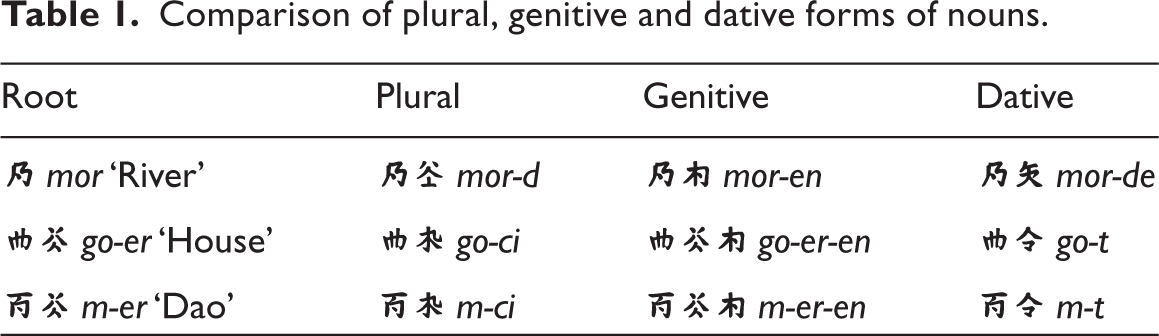
Since  m-er follows the same inflectional pattern as
  -go-er, with both taking
  ci as the plural suffix rather than -
  -d, which marks the plural of
  -mor-, it becomes clear that
  m-ci cannot be used interchangeably with
  mor-d. The consistency of these inflectional forms therefore supports the view interpreting
  m-ci as the plural of
  m-er ‘Dao’ (dao 道).
Semantic analysis of  m-er ‘Dao’ (dao 道) and
  m-ci ‘Dao (pl.)’ (zhu dao 诸道)
In Chinese, the word Dao (dao 道) can convey a variety of meanings – such as ‘path’, ‘filial piety’ (xiao dao 孝道) or the ‘Confucian Way’ (ru dao 儒道), to name but a few. Now that the Khitan Small Script terms  m-er and its plural form
  m-ci have been identified as corresponding to this concept of Dao (dao 道), a further question arises as to whether these Khitan terms exhibit similar polysemy, with multiple or extended meanings analogous to those of their Chinese counterpart. In certain contexts, however, the precise meanings conveyed by these terms remain open to interpretation and require closer scrutiny.
In Khitan Small Script documents,  m-er and its plural form
  m-ci most frequently denote Dao (dao 道) in abstract or figurative sense. In addition to the examples discussed above – such as
  ci-i-is-d-b-ñ m-er ‘the Dao of filial piety’ and
  y-au-a-án m-er /
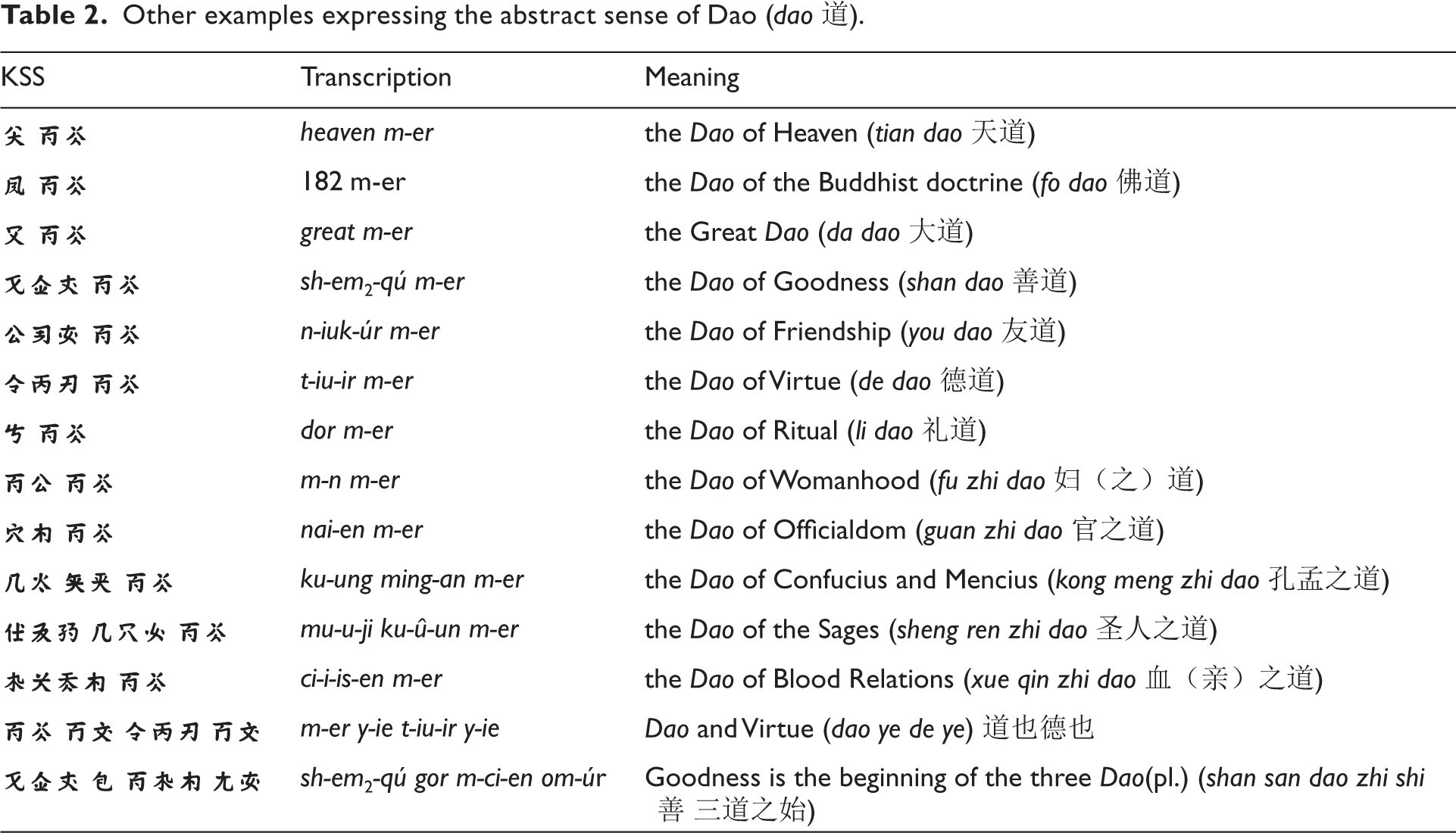
  y-au-o-ón m-er ‘the Dao of conduct’ – further examples are listed in Table 2.
Other examples expressing the abstract sense of Dao (dao 道).
In all of the examples cited above, (4)
b-as eternal-ia-23 l-i-in cau-ji hu-üen-is-ó-o-ón po-do em₂-d-er 239 m-er or-l-ir₂
又 诸军 时于 诸城以 地 道 m-er and its plural form
  m-ci denote Dao (dao 道) in its abstract or figurative sense. However, the Khitan Small Script corpus also contains instances in which these terms appear to convey different meanings. Consider the following examples:
 Chao 抄-9
Moreover armies at time with cities land Dao (5)
t-iu-ir-ñ ong ku hor-en kú₂-su ci-ie-271-i 239 m-er hu-she-378.1-en co-do-i
乣邻 王 人 民之 地 道
 Yu 于-19
Jiulin king person populace's land Dao
Although these two examples have not yet been fully deciphered, in both cases (6) [...]  m-er Dao (dao 道) appears in collocation with the noun
  239 ‘land’. The context suggests that they form a parallel construction, pointing to a semantic usage distinct from that found in the previously discussed examples.
 Yu 于-22
227 o-l₂-hu-ad m-ci 239-d jur-i ja-as-li₂ n-ai₂-ri k-li₂-ge-l-ñ 诸道 诸地 二 谓
Dao (pl.) lands two said (7)
m-ci m-ri-ci-en pu-is gor° ai-d-en du g-ia-ém ir-y-li₂ o-ri₅-i
诸道 诸弥里之 副使 三 诸父之 都 监 再 授
 Yong 永-16
Dao (pl.) Mili (pl.) Fushi three father's Du Jian again give
In examples (6) and (7), the plural form  m-ci appears in parallel with the plural forms of
  239-d ‘lands’ and
  m-ri-ci ‘Mili (pl.)’, respectively, while maintaining the grammatical number agreement characteristic of the Khitan language. This further suggests that
  m-ci here functions as a concrete noun rather than an abstract one.
The fact that (8)
ol month-s ji₂-en cau-ji y-au-ul-ó-ji₂-d m-ci ja-l-ha-ai …
众 诸月 中 诸军 行的(复) 诸道 使主 m-er and its plural form
  m-ci, both denoting Dao, appear in parallel with nouns such as
  239 ‘land’ and
  m-ri-ci ‘Mili(pl.)’ suggests that in these contexts they may express a more concrete sense, referring to a physical ‘path’, ‘road’ or ‘circuit’.
 Yu 于-22
many months among armies travel Dao (pl.) lead (9)
ui-u-ji-d k-li₂-g-d m-ci-er m-ha-as cau-ji-er ri-u-ui s-a-ad-bir …
诸道以 大(复) 诸军以
 Yu 于-49
with Dao (pl.) great by armies
In example (8), the phrase  cau-ji y-au-ul-ó-ji₂-d m-ci may be interpreted as a plural form referring to ‘military roads’ or ‘army routes’ (xing jun dao 行军道). In example (9), although the meaning of the first two words remains uncertain, the principle of grammatical number agreement suggests that they function as modifiers of
  m-ci. Later in the same sentence, the plural form
  m-ha-as cau-ji ‘great armies’ appears. In both instances,
  m-ci ‘Dao (pl.)’ occurs in collocation with
  cau-ji ‘armies’, suggesting that here it denotes physical ‘roads’ or ‘routes’ in a military context.
In conclusion, the Khitan terms  m-er ‘Dao’ (dao 道) and
  m-ci ‘Dao (pl.)’ (zhu dao 诸道) are most frequently attested in the abstract sense – as in ‘Dao of the Buddhist doctrine’ (fo dao 佛道), ‘filial Dao’ (xiao dao 孝道) and ‘Dao of womanhood’ (fu dao 妇道). In certain contexts, however, they appear to refer to more concrete notions, namely physical ‘road’ or ‘path’ or a military circuit.
The semantic relationship between  sh-al-s and
  m-er
m-er
The three glyphs that constitute (10) [...]
a-án m-er-er y-al-ha-al record -g-er record -g-én t-gu
在(的) 道以 志 志 曰 sh-al-s, namely
  sh,
sh,  al and
  s, have each been assigned relatively well-established reconstructed readings, allowing the pronunciation of the full term to be provisionally reconstructed as /ʃ-ɑl-s/. Its meaning, however, has not yet been established with certainty. Recently, Shen (2025) has proposed an interpretation by linking the phrase
  gor sh-al-s-d in Line 17 of Xu 许 with the Confucian concept of the ‘Three Bonds and Five Constants’ (san gang wu chang 三纲五常), suggesting that
  sh-al-s corresponds to ‘bond’ (gang 纲). This interpretation has some merit and offers valuable insights for this study. However, we observe that in numerous Khitan Small Script texts, particularly within the verse sections of epitaphs,
  sh-al-s and
  m-er appear to be used interchangeably. In some instances, the two terms even substitute for each other in otherwise identical contexts.
 Nan 南-36
at by Dao record record say
(11) [...]
a-án sh-al-s-er y-al-ha-al record -g-er record -g-én₂ t-gu
在(的) ?以 志 志 曰
 Gu 姑-24
at by ? record record say (12) [...]
a-án sh-al-s-er y-al-ha-al record -g-er … record -g-én t-gu
在(的) ?以 志 志 曰
 Tian 天-36∼37
at by ? record record say (13) [...]
a-án m-er y-al-ha-al record -g-er n-ra-en car°-a-iú record -g-én t-gu
在(的) 道 志 墓之 石于 志 曰
 Qing 清-28
at Dao record tomb's on stone record say (14) [...]
a-án sh-al-s-er y-al-ha-al record-g-er m-ing t-g
在(的) ?以 志 铭 曰
 Nu 奴-41
at by ? record verse say
In examples (10) through (14),  sh-al-s and
  m-er can be used entirely interchangeably within their respective contexts. This pattern suggests that in these instances the two terms share the same or closely related meanings.
Beyond their interchangeability after (15)
tai-b-en emu sui-én₂-de y-au-o-ón m-er record -g-én 317-ú ul₂ compose-l-ha-as-li₂…
太保之 一 生于 行(的) 道 志 铭 未 制 a-án, terms
  sh-al-s and
  m-er can also be used interchangeably when they appear after
  y-au-o-ón.
 Gu 姑-23
Taibao's one at lifetime tread Dao record verse not compose
The sentence cited above appears to express a meaning roughly equivalent to: ‘(Because) the epitaph recording the Dao trodden by Taibao (tai bao太保) throughout his life has not yet been composed.’ This statement explains the motivation or occasion for composing the epitaph. (16) [...]
y-au-o-ón sh-al-s tum n-on-en t-as-bod manage-l-ó-ji₂-en record₂-g-én t-gu₂
行(的) ? 万 代之 使知 志 曰
 Di 敌-40
tread ? ten thousand generation's let know record say
Although (17)
ai ku-û-un y-au-o-ón m-er ai-d aju-uh-ud3 hu-mú-úr-én sh-al-s
丈夫之 行(的) 道 诸父 诸翁 ? y-au-o-ón m-er in example (15) denotes ‘the Dao that one treads’ (suo xing zhi dao 所行之道), the phrase
  y-au-o-ón sh-al-s in example (16) appears, from the context, to convey a similar meaning. It may be roughly understood as ‘to make the Dao trodden by (the tomb occupant) known to future generations’. This again points to the commemorative purpose of the epitaph.
 Chao 抄-20∼21
husband's tread Dao fathers seniors ? (18) [...]
… emu sui-én hu-aju-u-un m-er-er p-ul-ô-ji₃ na-ai-er y-au-o-ón sh-al-s m-ir-ci-i
一 生 道以 行(的) ?

one lifetime by Dao tread
 Hu 胡-30∼31
dau-a-ar
Example (17) presents two parallel expressions: ‘the Dao trodden by the husband’ and ‘the  sh-al-s (n.)
  hu-mú-úr-én (v.) by the fathers and seniors’. This suggests that
  sh-al-s shares the same grammatical status as
  m-er ‘Dao’ (dao 道) and that the two are either closely related or possibly even antithetical in meaning.
And in example (18), following the phrase  emu sui-én ‘a lifetime’, two expressions appear:
  hu-aju-u-un m-er-er and
  y-au-o-ón sh-al-s. A comparison of the two examples shows that
  m-er and
  sh-al-s are again used interchangeably after
  y-au-o-ón, further supporting their semantic proximity. Notably, the first glyph in
  hu-mú-úr-én and
  hu-aju-u-un is identical, and both end with a genitive suffix. This points to a shared grammatical function and suggests that their meanings may also be related.
Beyond the examples discussed above, the interchangeability of (19)
ol month-s ji₂-en cau-ji y-au-ul-ó-ji₂-d m-ci ja-l-ha-ai …
众 诸月 中 诸军 行的(复) 诸道 使主 sh-al-s and
  m-er is also reflected in their plural forms.
 Yu 于-22
many months among armies travel Dao (pl.) lead (20) [...]
cau-úr y-au-ul-ó-ji gor sh-al-s-d m-350-en ci-er 227 …
军 行的 三 诸道
 Xu 许-17
army travel three Dao (pl.)
As noted earlier,  cau-ji y-au-ul-ó-ji₂-d m-ci in example (19) represents the plural form of ‘route for armies’ (xing jun dao 行军道). Turning to example (20), the presence of the numeral
  gor (‘three’), in parallel with historical texts mentioning ‘military roads’, provides valuable clues for interpreting the phrase
  cau-úr y-au-ul-ó-ji gor sh-al-s-d.
‘窦建德引兵趣卫州。建德每
‘Dou Jiande led his troops towards Weizhou 卫州. Whenever his
‘夏五月,辽分
‘In the summer, in the fifth month, the Liao divided their forces into
‘春正月,宋曹彬等分
‘In the spring, in the first month, the Song generals, led by Cao Bin 曹彬, divided their army into
‘既入南界,分为
‘Once they had entered the Southern (Song) territory, they divided into
The historical sources cited above contain recurring expressions such as ‘when marching, they invariably divided into three routes’ (xing jun,chang wei san dao 行军,常为三道), ‘to dispatch troops by three routes’ (qian bing san dao 遣兵三道), ‘the troops of the three routes’ (san lu bing 三路兵) and ‘the great army of the three routes’ (san lu da jun 三路大军). In light of this, we propose that the phrase  cau-úr y-au-ul-ó-ji gor sh-al-s-d in example (20) may be rendered as ‘three routes of military march’ (xing jun san dao 行军三道or xing jun san lu 行军三路).
The analysis of the examples above reveals that at least in certain contexts,  sh-al-s and
  m-er are interchangeable, share the same grammatical function and express closely related meanings. On this basis, we propose that
  sh-al-s may also denote Dao (dao 道), with
  sh-al-s-d functioning as its plural form. Additionally, we do not exclude the possibility that, in some cases,
  sh-al-s may refer to military administrative divisions.
Conclusion
To summarize, this study proposes that  m-ci functions as the plural of
  m-er. In most contexts,
  m-er and
  m-ci denote the abstract sense of Dao (dao 道), referring to ethical or conceptual notions such as ‘filial piety’ (xiao dao 孝道) and ‘Confucian way’ (ru dao 儒道). In certain contexts, however, they can also refer to a concrete ‘road’ or ‘circuit’ associated with military and administrative divisions.
  sh-al-s is semantically close to
  m-er and likewise can express the meaning of Dao (dao 道). Based on the textual evidence,
  m-er and its plural form
  m-ci are predominantly used in their abstract or figurative senses, whereas
  sh-al-s and its plural form
  sh-al-s-d tend to denote concrete roads or military-administrative circuits. The occasional interchangeability of these two sets of terms in specific contexts further suggests a shared semantic core.
Footnotes
Author note
The author's name is ᠰᠥᠮᠪᠥᠷ Сүмбэр (Sumber) in Mongolian and 孙布勒 (Sun Bule) in Chinese.
Funding
The author disclosed receipt of the following financial support for the research, authorship and/or publication of this article: This work was supported by the Key Project of the National Social Science Fund of China, ‘Interpretation of Newly Discovered Inscriptions from the Liao Imperial Consort Clan and Research on Khitan Small Script Orthography’ (grant number 21AYY023).
Declaration of conflicting interests
The author declared no potential conflicts of interest with respect to the research, authorship and/or publication of this article.
