







Abstract
This article tracks ongoing attempts to ameliorate the position of peatland carbon credits within the categorical and calculative structures of emergent natural capital markets. The restoration of drained peatlands through soil rewetting is a key form of climate mitigation within UK efforts to achieve net zero greenhouse gas emissions. As such, expert advisers and policymakers have called for an unprecedented scaling-up of peatland rewetting, even as landowners and conservation organisations are increasingly expected to fund restoration through private finance, particularly the sale of carbon credits. Peatlands, however, enter carbon markets already structured by crucial distinctions between credits which represent the active removal of carbon dioxide from the atmosphere, and those which reflect only the prevention of new or further emissions into the atmosphere. These distinctions constitute a categorical regime which valorises and disproportionately fuels demand for removal credits, thereby incentivising forms of environmental management which promise to deliver carbon dioxide removal. Under existing regulatory frameworks, however, peatland restoration is deemed to generate carbon credits linked only to the prevention of new or further emissions. Drawing on semi-structured interviews and documentary analysis, we show how protagonists in these debates argue that the prevailing carbon market categorical regime represents a major barrier to the national scale-up of peatland restoration, such that it counterproductively discourages external investment. Moreover, we show how protagonists have sought to improve the position of peatland carbon credits, either by redrawing the causal pathways through which responsibility for peatland emissions is assigned, or by reinterpreting the admissibility of specific fluxes of GHG within peatland carbon accounting itself. Unpacking these debates, the article exposes a pernicious and unintended consequence of market-driven environmental governance more broadly, wherein the social, cultural and ecological value of peatland landscapes is subordinated entirely to the rationale of market expansion, and attendant logics of offsetting.
Introduction
The intensifying climate crisis is driving public and policy enthusiasm for “nature-based solutions”, predicated on the conservation, restoration, optimisation or imitation of natural ecosystems (Osaka et al., 2021; see also Cox et al., 2025; Griscom et al., 2017; Seddon et al., 2021). The “rewetting” of drained peatlands represents one such solution, with a rapid scale-up in peatland restoration activities—from an annual rate of just 130km2 in 2023 to nearly 500km2 per year from 2030 onwards (CCC, 2025: 108)—viewed by the UK Climate Change Committee (CCC, 2025) as key to delivering over half of all land use emissions mitigations required to reach “Net Zero” by 2050. In the UK, efforts to scale up these solutions have encountered a post-Brexit agri-environmental governance regime centred around “blended finance”, wherein restoration organisations must marshal public funding to stimulate more generous injections of private investment (Moxey et al., 2021). So too for peatland restoration, wherein a purported “funding gap” of £500 million (IUCN, 2018, 2) between available public funds and ambitious restoration targets, is expected to be addressed through private finance, notably carbon credit markets. Indeed, environmental non-governmental organisations (eNGOs) such as the IUCN Peatland Programme, and the Wildlife Trusts, have rapidly established themselves as major players in nature-based carbon credit markets, via the Peatland Code, and the Wilder Carbon Standard, respectively.
Yet peatlands—widely recognised as vast carbon stores which normally accumulate very slowly, over centuries to millennia, but can degrade rapidly—do not fit seamlessly into the categorical frameworks that shape existing carbon market rules. On one level, these frameworks hinge around a binary distinction between carbon credits arising from the direct removal of carbon dioxide from the atmosphere (Carton, 2021; McLaren et al., 2019) and a longer-standing suite of credits, which rely instead on activities that prevent emissions from reaching the atmosphere in the first place (Humphreys, 2008). As our analysis will emphasise, these longer-standing credits can themselves be split into those arising from activities which claim to reduce emissions already emerging from a particular site or ecosystem, or from initiatives which instead profess to avoid the creation of new sources of emissions altogether. In this context, our core aim in this paper is to examine how advocates of rapidly expanded peatland restoration in the UK have sought not merely to navigate, but to strategically re-interpret these inherently contestable categorical distinctions—with consequences for how peatlands are managed as natural climate solutions, as well as for the broader politics of carbon offsetting and net zero governance. In the latter sense, this means that market-driven hierarchies of climate mitigation activities tend to reflect internal market regulation, rather than the capacity of mitigation activities to actually sustain positive social, ecological or atmospheric outcomes over time.
The hydrological and biophysical characteristics of peatlands implicate these landscapes in global carbon cycles, as well as national net zero strategies (Bruisch, 2025). Peat forms gradually as the decomposition of organic material, generally plants, is arrested by anoxic conditions underwater (Page and Baird, 2016; see also Hingley and Ingram, 2002). While some of this submerged material eventually decomposes anaerobically (releasing moderate quantities of methane), at millennial timescales intact peatlands act as “carbon sinks”, currently estimated to contain at least as much carbon as all the world's above ground vegetation (Page and Baird, 2016, 35). However, when these landscapes are drained, to facilitate specific orders of human habitation and pastoral, and particularly arable, agriculture, the carbon within the peat oxidises, producing carbon dioxide emissions. Drained peatlands currently account for c.3.5 percent of the UK's annual anthropogenic GHG emissions (Evans et al., 2017, 4). Given this, the UK Climate Change Committee's “Balanced Pathway” for reaching “Net Zero” by 2050 recommends drastically increasing the proportion of lowland peat in “natural” or “rewetted” condition, from just 9 percent in 2025, to 56 percent by 2050 (CCC, 2025, 191). Both ‘rewetting’ and ‘restoration’ involve the conversion of a peatland to an alternative hydrological regime, with characteristically higher water tables, often via the blocking of drainage ditches. However, the fact that drained peatlands are already emitting carbon dioxide—and the prospect that rewetting might enable them to absorb further carbon dioxide in the future—makes peatland restoration challenging to reconcile with existing accounting conventions and market-making logics for carbon offsetting, especially compared to alternative “natural climate solutions” such as afforestation (Cox et al., 2025). This paper shows that these complexities have led many protagonists of peatland restoration to attempt to redraw the boundaries of (or, re-bound) peatland gaseous fluxes themselves (Robertson et al., 2023b), that they might be rendered more intelligible and investable within prevailing carbon market logics.
Despite early enthusiasm about the potential for peatland restoration to actively remove carbon dioxide from the atmosphere (Royal Society and Royal Academy of Engineering, 2018, 96), today there is wider recognition that even reducing ongoing emissions from drained peat soils would be a significant achievement. Future UK emissions scenarios compatible with net zero, many of which rely on mathematical modelling, tentatively predict modest removals of carbon dioxide linked to peatland restoration, but nonetheless caution that “changes in peatland emissions are likely to mean peatland restoration represents emission reduction, rather than GGR (greenhouse gas removal)” (Vivid Economics, 2019, 11, emphasis added). This judgement is contentious within a political economy of climate mitigation where efforts to expand carbon offsetting and trading schemes have increasingly privileged removal credits, which currently attract wider markets, and higher average prices, than credits derived from interventions which either reduce existing emissions or avoid the creation of new emissions sources altogether. In this context, this paper scrutinises how certain UK actors have sought to navigate and reconfigure carbon market rules as a means of securing greater private investment for peatland restoration. Empirically, our analysis focuses on lowland peatlands in the UK, where regulatory imperatives call for a massive scale-up of soil rewetting, even as farmers, other landowners, and conservation organisations are increasingly expected to obtain funding for these activities from beyond the public purse (Palmer et al., 2025). The stakes of these reconfigurations, however, exceed the scope of UK voluntary carbon markets. Indeed, as peatlands across the UK come to be seen as a new “carbon frontier” (Helmcke et al., 2025), some influential actors have lobbied international arbiters of corporate net zero targets, as well as seeking the integration of peatland carbon credits into national compliance mechanisms, such as the UK's post-Brexit successor to the EU Emissions Trading System.
Our analysis is based on 28 semi-structured interviews, conducted between October 2023 and May 2025 with key UK actors, including 4 peatland agriculturalists, 5 carbon market professionals, 7 peatland restoration professionals from UK conservation organisations, 9 peatland scientists within assorted subfields, and 3 others in the broader field of peatland restoration. All interviews lasted between 1 and 2.5 hours. To preserve the anonymity of our interviewees, all names have been pseudonymised. Interview data is complemented by close analysis of government white papers, expert advisory and consultancy reports, newspaper articles, and published scientific research. The remainder of this paper proceeds as follows. Section two situates our analysis between two bodies of existing scholarship – the political ecology of market-based climate governance, and the politics of carbon dioxide removal. While several recent interventions have emphasised processes of value enhancement, or “enrichment”, within specific categories of carbon credit (Lock, 2024, 1736; see also Stanley, 2024; Valiergue and Ehrenstein, 2023), our work focuses instead on boundary-making processes, around the causal pathways, and the “calculative frame[s]” (Lansing, 2012) which underpin peatland carbon credit creation, and through which fundamental categorical distinctions between different types of carbon credit are produced, sustained and contested. More specifically, section three examines how some actors have sought to redraw the causal pathways which attribute responsibility for emissions from peatlands, particularly in ways that could enhance the investability of peatland carbon credits within both voluntary and compliance offsetting markets. These moves rely on contestable boundary-making, wherein the contingency of all peatland emissions upon situated, large-scale and long-term interactions between anthropogenic and hydrological processes is strategically downplayed. In section four, by contrast, we examine how other actors have instead sought to reappraise the admissibility of specific GHG fluxes within prevailing carbon accounting conventions for peatland restoration itself. These reappraisals, we suggest, can be viewed as efforts to redraw the calculative frames from which the overall carbon balance of a given peatland is derived. They include the attribution of greater volumes of carbon dioxide removal to biophysical processes triggered by restoration, the tactical exclusion and inclusion of methane emissions, and finally the redrawing of temporal boundaries within which flux measurement and accounting take place.
Efforts to enhance the investability of peatland carbon credits—whether by re-bounding the causal pathways or the “calculative frames” (Lansing, 2012) which produce peatland carbon credits in the first place—can be seen as responses to the UK's post-Brexit embrace of market-based tools for achieving net zero emissions. Yet our analysis also foregrounds a pernicious dynamic whereby the capacities of ecological processes to assist climate mitigation are valued only insofar as they are deemed capable of compensating for emissions which have already been released, usually as a result of industrial activities taking place elsewhere. The paper concludes by advocating alternative funding models wherein the value of restoration's impacts on peatland emissions is assessed independently from the relational terms required by offsetting logics (Bresnihan and Brodie, 2025).
Before enrichment comes commensuration: Remaking gaseous fluxes; Making a market for nature-based carbon credits
Social studies of climate science and policy maintain that offsetting and net zero commitments depend on socially-constructed commensurabilities between GHG emissions and mitigation, embodied most obviously by the establishment of the tonne of carbon dioxide equivalent (tCO2e) as a fungible unit of comparison (MacKenzie, 2009a; see also Carton et al., 2021; Cusworth et al., 2023; McLaren et al., 2019). Such studies advance earlier analyses of the heterogenous categorical and calculative regimes which produce foundational objects of climate governance, including “sinks”, “footprints”, and even “credits” themselves (Lövbrand and Stripple, 2011, 190; see also Barry, 2002; Callon and Muniesa, 2005; Gabrys, 2009). Recent critical analyses of carbon offsetting specifically observe the “enrichment” of carbon credits (Lock, 2024; see also Valiergue and Ehrenstein, 2023)—through depicting some offsets as more “virtuous” or “boutique” than others (Huff, 2023; Paterson and Stripple, 2012)—as central to deriving increased exchange value from specific biological or ecological processes. A focus on value-enhancement within specific categories of carbon credit, however, overlooks the fundamental importance of categorical distinctions between credit types, significantly underplaying the stakes of the boundary-making processes that produce these categories in the first place. Indeed, as Lansing (2012, 208) has argued, the emergence of the carbon credit as a “semiotic-material object of exchange cannot be separated from the ongoing framing of the field of exchange itself”. In short, taking distinctions between credit types for granted risks underplaying their essential role in creating the very conditions for commensuration, and hence also for market exchange.
This paper contends that the production of categorical distinctions between carbon credit types is foundational for both establishing and contesting the ability of diverse biological and ecological processes—whether linked to wetlands, forests, or other landscapes—to generate economic value within marketised climate governance (Bridge et al., 2020; Bulkeley, 2015). The commutation of “uncooperative” natures (Bakker, 2005, 542) into forms intelligible to markets (Cusworth and Stanley, 2025; Robertson et al., 2023a; Stanley, 2024; Turnhout et al., 2014) involves strategically reducing complex and geographically-varied non-human processes into locatable, countable, and tradable emissions flows (Bridge, 2011; Ouma et al., 2018; Robertson, 2006; Sullivan, 2013). These visions are performative, as they enact specific realities, practising ontologies which are necessary preconditions to exchange (Lippert, 2015). This paper extends recent scholarship which highlights the reflexivity inherent within this performativity, which is to say that representations of the non-human are always negotiated with concrete and explicit reference to the social and economic realities they enact (Cusworth and Stanley, 2025; Cusworth et al., 2023). Yet not all credits are created equal, and—concomitantly—not all biological or ecological processes are equally amenable to being represented in ways that carbon markets can “see” (Robertson, 2006). Charting the production of credit types linked to promises of active carbon dioxide removal, as well as emissions reduction and indeed avoidance, therefore requires a preliminary archaeology (Foucault, 1970: xxi-xxiii) of the terms of art which constitute carbon accounting.
Carbon accounting involves attributing personal, organisational, and national responsibility for fluxes, traditionally emissions, of GHGs (Turnhout et al., 2015). Within the European Union, the bulk of such fluxes are covered by regulatory cap-and-trade systems, specifically the EU Emissions Trading System. While cap-and-trade systems are historically distinct from offsets, the UK government is currently considering integrating some carbon offset credits into a post-Brexit UK equivalent of the EU ETS—allowing these credits to function as allowances (DESNZ, 2024). “Offsetting”, by contrast, refers to a suite of accounting practices wherein emitters purchase proprietary rights to climate mitigating actions for which they are not directly responsible (Bumpus and Liverman, 2008; Lohmann, 2005). Sometimes, though not necessarily, these actions include the active removal of GHGs from the atmosphere (McLaren et al., 2019). These rights are an order of “carbon credit” which, under offsetting logics, can be consumed to counterbalance, or “offset”, some portion of an organisation's own emissions (Bumpus, 2011; Gifford, 2020). In any discussion of offsetting, it is imperative not to conflate—unintentionally or otherwise—reduction credits with the cessation of ongoing emissions, often described as “emission reductions”. Reduction credits emerge from specific interventions which—from the outset—are intended to compensate for GHG emissions taking place elsewhere, within wider net zero commitments.
Participation in climate mitigation, and therefore also in offsetting markets, may be undertaken voluntarily, or compelled by legislation. Voluntary offsetting occurs when private companies elect to compensate for their ongoing GHG emissions by purchasing carbon credits, often to gain reputational benefits (Axelsson et al., 2024). While voluntary offsetting by definition does not require external oversight, many organisations seek to accredit their use of offsets with international and ostensibly independent, “para-regulatory” arbiters, chief among which is the charitably-funded Science Based Targets initiative (SBTi) (Valenzuela and Lezaun, 2024, 7). Statutory offsetting, meanwhile, involves similar processes, but occurs within compliance markets created to fulfil legal obligations necessarily tethered to specific geographical jurisdictions, such as the European Union or the UK. Both independent arbiters and legislative bodies can therefore oversee corporate net zero targets, determining the applicability of specific types of carbon credits to the pursuit of those targets, thereby inadvertently assuming significant roles in structuring the demand side of emerging carbon markets more broadly.
The categories of “removal”, “reduction” and “avoidance” do not correspond to ontologically distinct forms of gaseous flux which map seamlessly onto distinct orders of carbon credit. Instead, the stabilisation of these categories of credit requires tracking causal pathways to attribute responsibility for GHG fluxes—or negations thereof—as well as the standardisation of calculative frames which then determine the magnitude and indeed nature of these fluxes, or their negations. Both causal pathways and calculative frames are inherently contestable. The production of removal credits, for example, involves contestation over which fluxes of GHG can and cannot count towards removal in the first place, as well as over the temporal thresholds which must be exceeded for those removals to count as durable. Separately, while “avoidance” and “reduction” appear to denote mitigation activities which either ensure that emissions do not occur to begin with, or which reduce GHG fluxes from an already active source (Humphreys, 2008), in practice their relationship is far more ambiguous. Indeed, as designations of carbon credit type, the terms “avoidance” and “reduction” have until recently typically been used interchangeably, both by carbon market actors and critical social scientists. For example, REDD+, an archetypal avoidance credit mechanism based on payments intended to avoid future deforestation, in fact stands for “Reducing Emissions from Deforestation and Forest Degradation” (Ehrenstein, 2018). Nonetheless, a constellation of peatland carbon market actors have sought to carve out a more appealing niche for peatland credits, posing peatland emissions “reductions” as a distinct order of carbon credit offering inherent advantages over the simple “avoidance” of emissions through schemes like REDD+.
Within voluntary markets, and within emergent compliance markets, overall demand for carbon removal credits has superseded demand for credits which hinge upon claims of emissions avoidance or reduction. Moreover, leading carbon market analysts, as well as the World Bank, have reported that removal credits continued to command higher prices than avoidance credits in 2024 and 2025 (Abatable, 2024, 31; Allied Offsets, 2025, 32; World Bank, 2025, 65). This is not to say that certain high-profile and bespoke agreements cannot lead to high prices for reduction or avoidance credits in particular circumstances, of course. Indeed, as one of this study's interviewees suggested, high prices could potentially be driven not merely by categorical distinctions but also by social factors, such as when “a landowner knows […] the head of sustainability at a big corporate”. At the aggregate scale of the market, however, the preponderance of transactions indicate significantly higher prices for removal credits. For example, for the year ending April 2025, the World Bank reported an average price of $15.50 per tonne of carbon dioxide equivalent for removal credits from forestry and land use, while avoided emissions credits from the same sectors traded at just $5.30 (World Bank, 2025).
The economically-superior position of removal credits dovetails with recent commentary on carbon offsetting wherein removal-based credits are depicted as inherently more robust than supposedly “low-quality” carbon credits arising from emissions avoidance or reduction (Axelsson et al., 2024; Boyd et al., 2023). Such binaries inevitably gloss the complexity of offsetting practices, where concrete outcomes are often contingent and unexpected (Greenleaf, 2024; Trencher et al., 2024). Indeed, this premium emerges from voluntary and statutory regulation, wherein removal credits are considered more appropriate for offsetting emissions taking place elsewhere. The value of a carbon credit is conditional upon its capacity to offset emissions in the fulfilment of net zero targets. This commensurability or incommensurability with emissions is determined by the credit's designation as representing either the active removal of carbon dioxide from the atmosphere, or merely the prevention of emissions reaching the atmosphere to begin with. Within voluntary markets, the SBTi currently allow corporations to use only removal credits, and not avoidance or reduction credits, to help meet net zero targets. One specialist in environmental governance, for example, stated explicitly in an interview that “the cap on demand in the voluntary market is [the] SBTi”. While carbon offsetting is not currently permitted within the statutory UK Emissions Trading System (ETS), preliminary consultations have clearly indicated that removal credits will be the only credits considered for integration, with a recent consultation entitled ‘Integrating Greenhouse Gas Removals in the UK Emissions Trading System’ (DESNZ, 2024).
Overall then, the designations “removal”, “reduction” and “avoidance”, and the commensurabilities which attend them, must be created and stabilised through processes of “market-making”, particularly through applying specific “calculative practices” (Lövbrand and Stripple, 2011, 189; see also Callon and Muniesa, 2005). These practices inevitably “bracket” out the complexity of the diverse ecological and socio-economic processes that shape real-world GHG fluxes, often by “bounding” characteristics of these processes in spatial, temporal, or scalar registers (Robertson et al., 2023b; see also Gifford, 2020; Stanley, 2024; Sullivan, 2013). While the “enrichment” (Lock, 2024) of credits which recent critical scholarship has highlighted (e.g., Valiergue and Ehrenstein, 2023) no doubt applies “qualities” (Callon, 2002, 197) meaningful to some buyers, at the scale of the market as a whole enrichment remains secondary to the commensurability or incommensurability of those credits with ongoing corporate emissions. As such, “avoidance”, “reduction” and “removal” must be viewed as value-bearing abstractions (Robertson et al., 2023a), which dictate the perceived commensurability of different forms of GHG flux (Cusworth et al., 2023; MacKenzie, 2009b). The next two sections investigate the strategies through which certain actors in the UK peatland restoration community have sought to reshape the categorical distinctions and attendant commensurabilities of carbon credits, as they apply within voluntary and compliance markets.
Passive avoidance or active reduction? (re)bounding the anthropogenicity of peatland emissions
This section examines how some actors have sought to re-bound the causal pathways which attribute responsibility for emissions from peatlands, aiming to enhance the investability of peatland carbon credits in voluntary offsetting contexts and future compliance markets. While the voluntary use of carbon credits by private organisations is not governed by any single authority, the pre-eminent arbiter of corporate net-zero claims is the SBTi, established in 2015. By 2023, organisations with SBTi-aligned net zero trajectories represented around 39% of total global market capitalisation (SBTi, 2024a). Moreover, certain actors working at the interfaces of science, policy, and carbon markets, are seeking to buttress demand for peatland credits through advocating their integration into statutory emissions trading schemes. In 2022, the UK ETS covered twenty-seven percent of total national emissions (ICAP, 2025). Debates about which types of credits, if any, should be capable of offsetting GHG emissions taking place elsewhere, are therefore of considerable economic significance. Yet, crucially, peatland carbon credits are not currently applicable to SBTi-aligned corporate net zero targets—nor were they considered in a recent consultation on the future inclusion of carbon credits as additional emissions allowances within the UK ETS. These actors have therefore sought to improve the position of peatland carbon credits under current and future regulation by reconfiguring the internal categorical boundaries of carbon markets themselves.
Producing reduction credits
When validating corporate voluntary net zero targets, the SBTi currently observe a two-tier classification of carbon credits; removal credits comprise the upper tier, while the lower tier consists of reduction or avoidance credits (currently treated as synonymous under SBTi rules). Reduction or avoidance credits alike are those derived from activities which prevent GHG emissions from reaching the atmosphere, for instance by avoiding deforestation through a REDD + project. A removal credit, conversely, emerges from activities which achieve the “permanent removal and storage of CO2 from the atmosphere” (SBTi, 2024b). Under the SBTi's current regime, corporations can only use removal credits to offset their so-called “residual emissions”. Residual emissions as a political construct (Buck et al., 2023) are related to the equally-nebulous “difficult-to-abate” emissions, although within the SBTi context they specifically refer to the final, ostensibly “unavoidable” (Lund et al., 2023) ten to fifteen percent of a corporation's emissions. Conversely, units of carbon dioxide equivalent which are classified as reduction or avoidance credits have no direct applicability to corporate net zero pathways under current SBTi rules (see Figure 1). Many carbon credit buyers hence prioritise removal credits above other types of credit.
Since credits arising from peatland restoration are currently classified as reduction or avoidance credits, the market for such credits today is rather anaemic. For one producer of peatland carbon credits, “the first question [buyers] ask is if there's SBTi removal”—upon receiving a negative answer, “they’ve already put the phone down”. While the SBTi encourages buyers to invest in credits without direct applicability to corporate net zero targets—such as those emerging from peatland rewetting —for those seeking to leverage carbon markets for peatland restoration, this encouragement is “not quite the same as recognising” (Fowler, 2025, 157), and hence unlikely to stimulate sufficient investment. As one interviewed actor in peatland carbon markets remarked, the SBTi's “encouragements” amount to little more than a plea for “corporate philanthropy”. In short then, the SBTi's extant valorisation of removal credits presents an existential threat to nascent peatland carbon credit markets, since peatland restoration is currently associated only with supposedly inferior credit types. For some actors, given the UK government's growing expectation for restoration projects to attain significant private funding, this represents an existential threat to peatland restoration.
Responding to this environment, a vocal group of protagonists, including peatland scientists, carbon credit producers and restoration professionals, have sought to renegotiate carbon market rules (Callon, 2009) by redrawing the boundaries of the causal pathways which produce peatland carbon credits, particularly in their relation to REDD + credits. As early as 2021, for example, one major agribusiness consultancy warned that the SBTi's “eschewing of emissions reductions offsets seems self-defeating”, limiting investment in peatland restoration “because of a rigid adherence to a dichotomous categorisation of carbon credits” (Clark, 2021). These concerns simmered until 2024, when a group including peatland carbon market actors, eNGOs and peatland scientists sent a joint letter to the SBTi, coinciding with a range of media engagements, lobbying for a formal change in the categorisation of peatland carbon credits (Keane, 2024).
Specifically, signatories to this letter argued that while REDD + credits arising from avoided deforestation rely on comparisons with an inherently unverifiable counterfactual scenario (in which future deforestation does take place) (Dalsgaard, 2013; Lohmann, 2005), peatland restoration, by contrast, incontestably reduces ongoing emissions from drained peat soils. A representative of CarbonPeat, a leading UK peatland carbon credit standard, has argued that peatland restoration does not merely avoid, but rather “actively halts emissions” (Williams, 2024). Indeed, in the same media coverage, peatland restoration was described as akin to “paying to extinguish a fire”, whereas REDD + credits were cast as “more like paying someone to promise not to start [one]” (Williams, 2024). As shown in Figures 2 and 3, signatories to the letter to the SBTi have therefore sought to isolate emissions avoidance, most closely associated with avoided deforestation via REDD + schemes, as a standalone category of carbon credit, thereby carving out a special status for peat-based credits, understood as achieving active emissions reductions. Indeed, as one prominent signatory to the 2024 letter stated in an interview, “the idea of active emissions reduction, we think, is fundamentally different [from emissions avoidance]”, and therefore the “SBTi should be making an exemption specific to peatlands”.
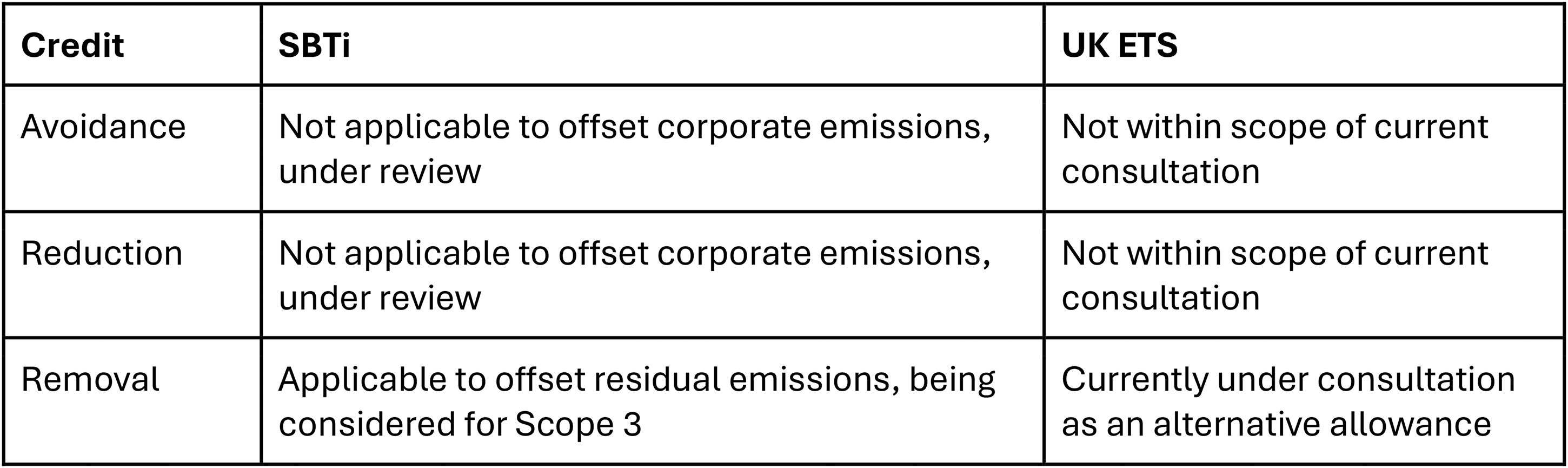
Specific commensurabilities of credits under the SBTi and the UK ETS.
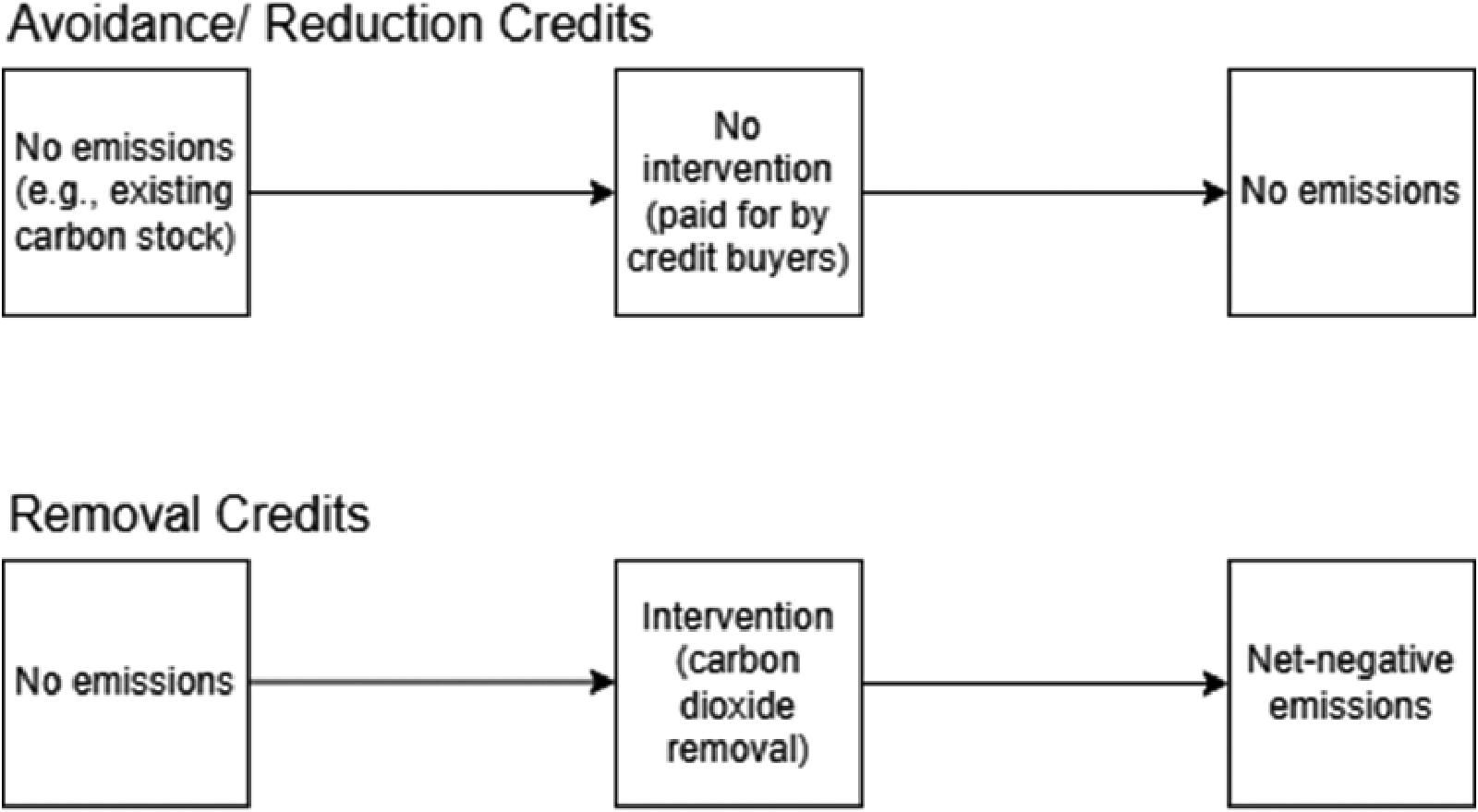
The SBTi's extant regime for classifying carbon credits 198 × 112 mm (96 × 96 DPI).
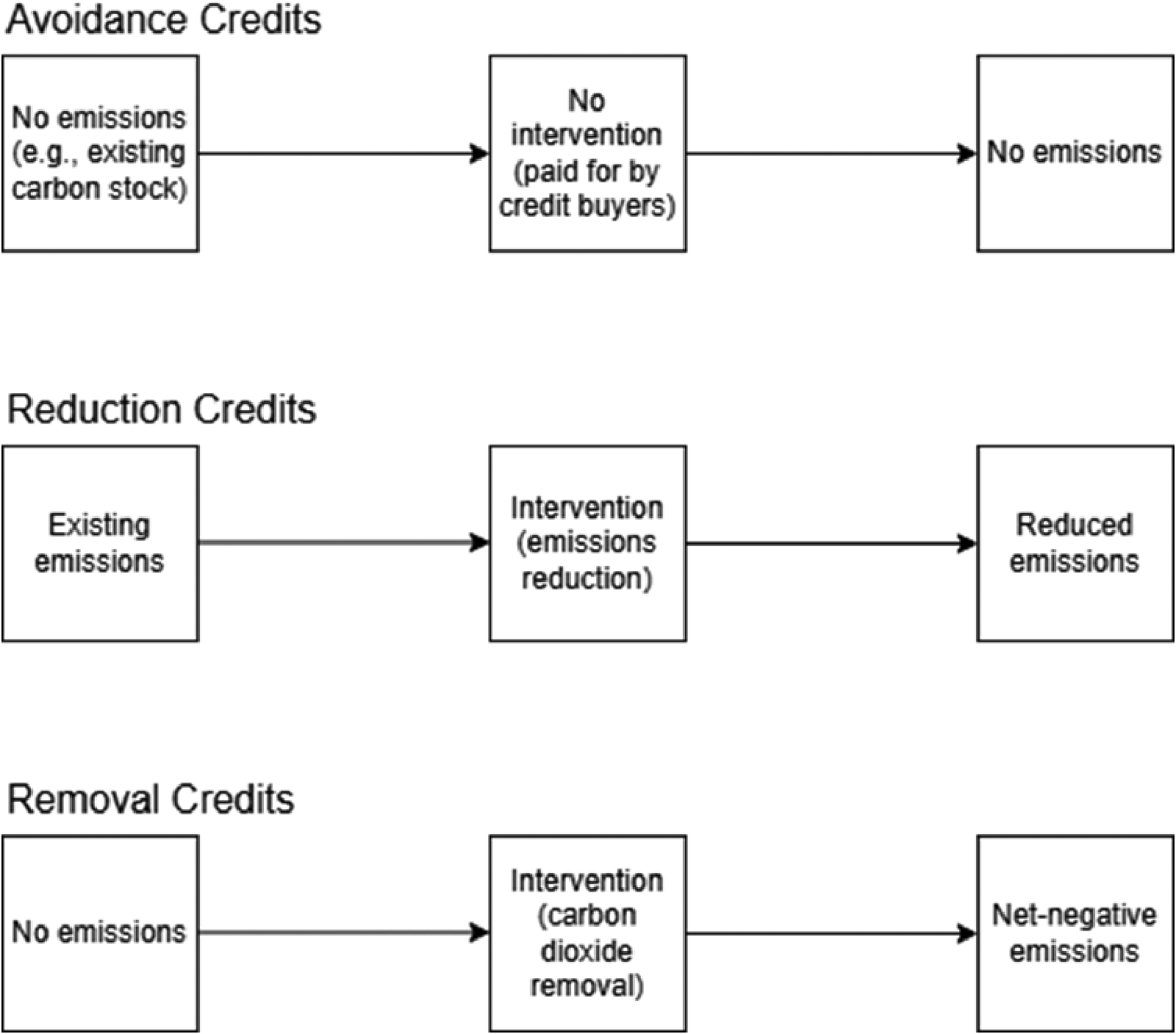
CarbonPeat's proposed model of carbon credit categorisation 198 × 177 mm (96 × 96 DPI).
Building on recent literature emphasising the performativity of environmental metrics, actors making these arguments can be seen to engage reflexively with the socially-constructive power of existing carbon credit categories (Cusworth and Stanley, 2025). That is to say, they exhibit a profound awareness of, and ground their arguments in, the present and future distributional implications (Cooper, 2015) of the fields of exchange within which these categories are rendered intelligible (Lansing, 2012). In an article from June 2024, for instance, the manager of CarbonPeat claimed to be seeing peat carbon credit “sales falling through […] because of SBTi [guidance]” (Keane, 2024). These arguments are anticipatory and performative, in the sense that they seek to establish certain categorical configurations in advance of the economic conditions which would justify them (Weszkalnys, 2011). One manager at a private peatland carbon credit producer acknowledged in an interview that the letter to the SBTi and attendant media engagements arose out of an awareness that “we actually have to do this before the carbon market explodes [i.e., rapidly expands]”. Moreover, as Cusworth et al. (2023) have observed, actors engage reflexively with the constructed, and constructive, nature of these categories. As a director of another for-profit carbon credit consultancy, also a signatory to the letter, stated at interview, peatland restoration is “an emission avoider, or a reducer as I like to refer to it as and others do in the sector. Obviously we would do, we’re biased”. In this assessment, any inherent qualities of the proposed categories are overshadowed by their anticipated social and economic effects. In short, these arguments aim to strategically re-bound (Robertson et al., 2023b, 2454) the gaseous fluxes (and negations thereof) involved in peatland restoration, to support a strategy of accumulation (Huff and Brock, 2023).
The significance of these debates potentially extends well beyond SBTi-aligned corporate net zero pathways, also anticipating future statutory regulation – most notably the UK's post-Brexit Emissions Trading Scheme. A key concern for buyers of carbon credits, and so for producers, is which credits will be countable towards legally-binding commitments under national net zero targets and associated cap-and-trade markets, such as the UK ETS. As one carbon credit producer said in an interview, a major question for buyers is “will this become a carbon tax for me in the future?”. Contemporary carbon credit buying, and so the knowledge politics of credit classification, are therefore framed convincingly by their relevance to future statutory regulation, as well as to the extant rules of voluntary markets.
The negotiated contingency of peatland emissions
Another boundary-making operation is required to sustain CarbonPeat's argument regarding the distinctiveness of peatland-based “active reductions”, relative to avoidance credits. In order for emissions from drained peatlands to be “actively halted”, they must first be designated not as the result of ongoing activities which could be avoided, but rather as inherently self-perpetuating. “Self-perpetuating” here indicates that these emissions would inevitably continue absent any further human intervention. Many of the conditions which produce carbon dioxide emissions from peatlands emerge from complex social, hydrological, and economic dynamics which transcend the decisions taken by the managers of specific tracts of peatland at a given point in time (Merrill-Glover et al., 2026). Therefore, rendering peatland emissions self-perpetuating requires the bracketing out of these large-scale, long-term causal pathways. However, such a move also risks unintentionally exonerating peatland agriculturalists of any responsibility for ongoing emissions from their own drained peat soils. Thus, this bracketing must be selectively applied to different orders of activity on peatlands, vindicating the distinctiveness of peatland emissions “reductions” achieved by restoration, while simultaneously upholding accountabilities for peatland emissions linked to agriculture.
Debates around the possible integration of peatland carbon credits into the UK ETS help to reveal the inherent contradictions of this argument, as well as its reliance on the classification of emissions from peatlands as either self-perpetuating or human-driven. One key actor in the carbon market, for example, argued in an interview that the UK government could not include peatland carbon credits as allowances in the UK ETS because peatland emissions are already “owned by somebody privately and so they are the emissions of that business enterprise”. That is, if emissions from peatlands were recognised as human-driven, then responsibility for these emissions would need to be assigned to specific land users. Any reduction in these emissions would, accordingly, constitute an organisational emissions abatement, and would not be applicable for trading as a carbon credit. Accepting that human-driven emissions on peatlands could potentially be abated merely by avoiding those specific human actions, however, would nullify CarbonPeat's proposed distinction between avoidance and reduction credits altogether. CarbonPeat's own argument therefore relies upon representing emissions from peatland restoration sites specifically, therefore, not as human-driven but as self-perpetuating, in the sense that they are already set in motion and would inevitably continue in the absence of any further human intervention. As one actor in peatland carbon markets argued in an interview, peatland emissions will “happen regardless of what we do, unless we intervene in it”. Yet the operation required to render peatland emissions from restoration sites self-perpetuating in this way also spatially and temporally bounds human action upon peatlands, thus problematically downplaying the influence of landscape scale socio-hydrological dynamics.
In reality, the temporal and spatial causal pathways that could apprehend the contingency of, or attribute responsibility for, emissions from peat soils are centennial and vast. In the East Anglian Fens for instance, thorough-going drainage via rivers, channels and ditches is the product of centuries of intervention and reintervention (Darby, 1983). These hydrological conduits convey water to pumping stations, the largest of which pump billions of litres of water a month to a terminus in the North Sea. Even if an individual farmer were moved to block drainage channels on their land, the fluvial integration of these landscapes means that in most cases, particularly in the south of England, they would either inundate neighbouring land, or they would be hindered by issues of water availability. Indeed, the prospect of peatland rewetting schemes injuring neighbouring agricultural lands is a source of constant tension between restoration organisations and surrounding farmers. One farmer bordering a restoration site said during an interview, for example, that restoration organisations ultimately “can’t affect the way [their neighbours] farm, or their water level”. Their neighbours may, of course, desire inundation, and water resources could, in theory, be diverted from elsewhere. However, the necessity of catchment-scale consensus in both scenarios demonstrates the limitations of accounting for peatland emissions on an individualised, farm-scale basis.
Despite these complexities, CarbonPeat would later draw together a submission to a consultation on SBTi standards, based on similar arguments to those outlined in the initial joint letter of 2024. The response argued that emissions from currently-emitting drained peatlands, specifically those under agriculture, forestry, or other forms of development, should be explicitly included in corporate emissions accounting. That is to say, that peatland emissions from, for instance, arable agriculture on peat, should be included directly in the carbon accounts of agribusinesses. While clearly appropriate for an organisation seeking to reduce emissions from peat soils, this argument contradicts CarbonPeat's preceding tactical operation, which sought to render peatland emissions self-perpetuating, necessary for the letter's foundational distinction between avoidance and reduction. Perhaps more importantly, it simultaneously presents a tactical liability for eNGOs and other private organisations responsible for peatland restoration. Put simply, if taking on a peatland specifically for rewetting purposes led to that peatland's emissions burdening one's own carbon budget, this would significantly disincentivise restoration itself, putting the brakes on what has been described as a “carbon rush” fuelled by the acquisition of significant tranches of peatland by speculators (Helmcke et al., 2025). The letter navigates this dilemma by arguing that, where a company “controls peatland that is not actively managed for productive agriculture”, then this should be “the only exception”. In other words, emissions from peatlands managed by any organisations pursuing restoration should not count towards their carbon budgets, such that any reductions could then be sold on the carbon market. Emissions from peatlands managed for agriculture, however, should count towards farms’ carbon budgets, irrespective of the extent or type of the emissions themselves. The redrawing of causal pathways which rendered peatland emissions self-perpetuating, and therefore valid targets for credit-producing reductions, can be seen as selectively applied only to emissions arising from certain, socially-designated segments of degraded UK peatlands (i.e., those owned by restoration organisations), rather than to all degraded peatlands, regardless of their current ownership or use.
Overall, this section has shown that the categorical and boundary-making procedures that characterise carbon accounting are more explicit, and more intensively mediated, when applied to debates about peatland restoration in the UK. These procedures, and the regimes of accumulation which they entail via credit-making, demand accountabilities apprehensible at the level of individuals or organisations. Such accountabilities, however, align very awkwardly with the storied histories and vast spatial dependencies which produce GHG emissions on peatlands in reality. As such, contests over “avoidance”, “reduction”, and indeed “removal” are particularly fraught. What results are delicate boundary-making processes which seek to render peatland emissions self-perpetuating (through discounting the spatially- and temporally-extensive causal chains which actually produce emissions), thereby sustaining distinctions between peatland reduction credits, and mere avoidance credits. Yet these boundaries must also be selectively applied to restoration sites specifically, such that they do not unintentionally absolve peatland agriculturalists— or indeed landowners undertaking forestry or other forms of development on currently-emitting drained peatlands—from responsibility for ongoing emissions from their own peat soils. The contradictions of this categorical process are in part those which inevitably attend all commutations of complex environmental phenomena into instruments of climate governance. However, the historical anthropogenicity of peatland landscapes, and the vast hydrological networks which they represent, deepen the complexities involved in attributing responsibility for peatland emissions, and therefore also responsibility for their negation, rendering the production of investable carbon credits from these landscapes particularly challenging.
From reduction to removal? (re)bounding peatlands for carbon drawdown
In contrast to the previous section, this section attends to a further set of boundary-making processes, specifically those which pertain to the calculation of the carbon balance of peatland restoration, through which some actors have sought to enhance the investability of peatland restoration as a technique capable not merely of achieving emissions reductions, but of active GGR. These bounding, or re-bounding, processes are generally performed by soil scientists working at the interface of climate science and policy. Such processes, aimed at rendering peatland carbon fluxes more amenable to market-driven climate governance, again involve strategic spatial and temporal bounding of peatland emissions. Interactions between terrestrial systems and the atmosphere are bounded and rendered admissible for inclusion within market calculations, on the explicitly tactical grounds that their inclusion supports an accumulation strategy, while other interactions are bracketed out. The emergent boundaries are inevitably transient and strategic, again evidencing reflexive performativity (Cusworth et al., 2023) around existing calculative regimes. Building on this, we also make two further arguments. Firstly, the boundaries which emerge rework the calculative frame of carbon credits, particularly those calculations which define the commensurabilities of different GHGs. Secondly, these new boundaries often only achieve “ontological stability” (following Robertson et al., 2023b, 2454) within certain epistemic communities. In peatland restoration, these shifts have their origins within a particular science–policy “boundary space” (Mahony, 2013) – one which relies upon mathematical modelling to project the contributions of different forms of GGR to fulfilling UK net zero commitments.
The UK government's climate trajectories which limit warming to 1.5 degrees above pre-industrial levels are dependent on ambitious projections of large-scale GGR (Anderson and Peters, 2016; Fuss et al., 2020). Such projections often obscure differences between biological and geological carbon, offer policymakers greater flexibility in distributing mitigation responsibilities while deferring thorny decisions around large-scale decarbonisation into the future (Carton et al., 2020). The calculative remakings of peatland restoration discussed in this section are marked indelibly by this policy environment, seeking to prevent peatlands from being stranded by a policy rush towards large-scale GGR. Furthermore, one subfield of this policy environment, focussed on modelling the future contributions of specific carbon dioxide removal technologies to the UK's net zero trajectory, has itself shaped the methodological structure of some of these attempted remakings of peatland restoration.
Reframing the methane question
Efforts to reorganise the calculative frame of peatland restoration for carbon markets draw upon and rework boundaries that have long served to delimit the ecological and biogeochemical complexity of peatlands themselves. Specifically, prevailing carbon accounting regimes act upon a stratigraphic distinction which cleaves peatlands into two apparently distinct layers (Ivanov, 1981 [1953]). The peat layer above the permanent water table – that is, the lowest point of the fluctuating water table – is known as the acrotelm, and includes all above-ground vegetation and other biomass. By contrast, the catotelm, below the water table, is regarded as anaerobic, subject to very low rates of decomposition, which acts as the peatland's long-term carbon storage mechanism. However, the anaerobic conditions found in the catotelm promote microbial communities and decomposition pathways which release another GHG, methane (Günther et al., 2020). Since methane emissions tend to rise as water levels rise, such emissions constitute a considerable inconvenience for proponents of peatland rewetting for climate mitigation.
Conventional carbon accounting for peatland restoration endogenizes a temporal politics which defines the specific commensurability of methane and carbon dioxide emissions. Attempts to reorganise restoration carbon accounting engage reflexively with this politics and thereby problematise the carbon balance of peatland restoration under existing methodologies. As part of their expected functioning, both intact and hydrologically-restored peatlands emit methane at higher rates than peatlands with lower water tables (Evans et al, 2021). While in the atmosphere, methane exerts a greater radiative force, or greenhouse effect, on the climate system than carbon dioxide. However, methane has an atmospheric lifetime of only around twelve years (Forster et al., 2021), while carbon dioxide may continue to exert radiative force for centuries. Rendering methane commensurable with carbon dioxide emissions therefore involves multiplicative factors known as global warming potentials (GWPs), which are highly sensitive to the timescales of their application. Longer timelines inflate the importance of carbon dioxide, while shorter ones inflate the importance of methane. Crucially, the recognised, though by no means uncontested standard (Cusworth et al., 2023), calculates GWPs for different GHGs over a 100-year period, a time horizon which pales into insignificance when set against the long-term and slow sequestratory power of intact peatlands. Accordingly, the long-term carbon sequestration potentials of peatland restoration are often all but cancelled out by short-term methane emissions under prevailing carbon accounting methods (ONS, 2019). Despite this, a 2022 report produced by leading peatland gas flux scientists for the UK Department for Environment, Food, and Rural Affairs (Defra) identifies opportunities for categorising peatland rewetting as a form of GHG removal, explicitly framed as a means of securing “greater private investment” into restoration itself (Evans et al., 2023 [2022]: 37). Crucially, this report contends that present understandings of methane emissions as a potential problem only hold true “on the relatively short time horizons implicit in the use of 100-year GWPs” (Evans et al., 2023 [2022]: 37). This reflexive engagement with GWP metrics, moreover, is not the only route by which proponents of peatland restoration have sought to reframe peatland carbon accounting to help mitigate the methane problem.
Additional attempts to address the methane question disrupt ostensible continuities between peatland restoration for climate mitigation and longer histories of nature conservation. These remakings of calculative practice rely on the naturalisation of methane emissions from intact or restored peatlands, representing them as part of pre-human biogeochemical configurations. During an interview, one specialist in peatland carbon flux argued that any increase in methane emissions from restoration would constitute merely a return “to the background methane cycle”. As this specialist continued, wetlands “have the right to emit a bit of methane […] that's how they exist”. Such depictions are advantageous for advocates of peatland restoration projects which aim to rehabilitate pre-existing biogeochemical processes – of which methane emissions are an unavoidable component. However, they become increasingly tenuous when set against trials of more innovative biophysical techniques, such as gypsum application, aimed explicitly at suppressing methane emissions from restored peatlands (IUCN, 2025). As one specialist in peatland restoration for GGR noted in an interview, “if we can suppress those methane emissions then we get higher removals”. Such developments highlight tensions in the reflexive performativity of these actors’ engagements with the methane question (Cusworth and Stanley, 2025; Cusworth et al., 2023), driven ultimately by demands for peatland restoration to act as a “legible” (Nelson and Bigger, 2022, 87), “rational” (Carver, 2023, 2196), and ultimately “investable” (Ouma et al., 2018, 50; Stanley and Cusworth, 2025; Sullivan, 2013) natural climate solution.
Unlocking “transitional” carbon gains
UK policy communities have extensively deployed integrated-assessment models to evaluate the potential contributions of different forms of GGR to net zero pathways. Many of these models envisage bioenergy with carbon capture and storage (BECCS) as the most viable means for the UK to achieve GGR at scale (Malm and Carton, 2024; Workman et al., 2020). Indeed, one prominent analysis prepared for UK policymakers in 2019 expected BECCS to be implemented in the UK throughout the 2030s, accounting for up to 62 percent of all GGR by 2040, and facilitating around 50 million tonnes of carbon dioxide removal per year by 2050 (Vivid Economics, 2019, 10). Integrated assessment models present national policymaking communities with promises of significantly increased future removals via both white papers and scientific reports. But this policy landscape has also given methodological and ontological structure to proposed remakings of carbon accounting for peatland restoration specifically, by stimulating novel efforts to identify GGR on peatlands, known as “transitional carbon gains”.
“Transitional carbon gains” constitute a route by which some actors have sought to refine conventional peatland carbon accounting (Evans et al., 2023 [2022]). In short, this route attributes significant and rapid GGR to the process of acrotelm formation which would hypothetically occur immediately following restoration interventions in particularly damaged peatlands. The basis for these ideas first achieved a measure of formal stability in a 2021 report prepared for the UK Department for Business, Energy and Industrial Strategy (BEIS) (Simon et al., 2021). While not using the term “transitional carbon gains” directly, this report criticised some of the assumptions made by two previous reports assessing hypothetical GHG removals from UK peatlands, including a Royal Society and Royal Academy of Engineering (2018) analysis which had suggested a maximum potential GGR rate for peatland restoration of 1tCO2ha−1yr−1. Operating within a “boundary space” (Mahony, 2013) between UK climate science and policy, the 2021 report claimed to address inaccuracies in previous studies, but also proposed more radical refinements to the spatial and temporal boundaries of peatland carbon accounting.
Specifically, the BEIS report drew upon mathematical models of peatland ecosystem function to propose adjustments to the calculative norms of peatland carbon accounting. These models were based on simplified versions of a process-based peatland development model known as DigiBog (Young et al., 2017; see also Belyea and Clymo, 2001). This “new model-based assessment for the GGR potential” (Simon et al., 2021, 59) of peatland restoration can be interpreted, we contend, as a tactical response to the broader policy context from which it emerged. Indeed, the BEIS report ultimately suggested that “very high rates of GGR per unit area are attainable in the period following effective peat restoration, with an average of 8.6tCO2ha−1yr−1” (Simon et al., 2021, 61). This rate of course represents a dramatic increase over the implicit maximal rate of 1tCO2ha−1yr−1 suggested by the Royal Society and Royal Academy of Engineering (2018) report. Indeed, these numbers, produced though mathematical modelling, and using parameters derived from the scientific literature, put peatland restoration onto even methodological, and quantitative, footing with the current darlings of net zero modelling, particularly BECCS. These shifts can be viewed as attempts to improve the calculated carbon balance of peatland restoration, in order to optimise this balance for an environmental sector increasingly focussed on market-driven GGR.
The specific term “transitional carbon gains” can be traced to a later, 2022 report to Defra, emerging from expert-led efforts to align carbon accounting conventions in the UK Peatland Code—administered by the IUCN UK Peatland Programme—with the UK's national GHG inventory (Evans et al., 2022). The report invokes the idea of transitional carbon gains to highlight a perceived inequality between woodland and peatland carbon accounting. Specifically, its authors argue that carbon dioxide removed via woodland creation constitutes an entirely “transitional” gain, as it involves carbon sequestered in the transition from a previous land use to woodland. Accordingly, woodland carbon accounting produces asymptotic curves of carbon sequestration over time, with steep initial slopes which flatten as tree stands approach their carbon sequestration limit (see Figure 4). By contrast, in conventional peatland carbon accounting, healthy peatlands may appear as a potentially limitless source of carbon removals, but the fact that those removals can only be achieved much more slowly compared to tree planting constitutes a considerable problem for efforts to attract private investment in large-scale peatland restoration, effectively rendering this method redundant in the face of the decadal timeframes required to meet net zero targets. Produced as abstract heuristics, rather than by plotting of observed environmental data, graphs such as those depicted in Figure 4 thus constitute “conceptual curves”, arising from the “hypothesised response of a dependent variable to changes in an independent variable” (Robertson et al., 2023a, 2523). Crucially, while for scientists conceptual curves form visual hypotheses for empirical investigation, when conveyed to policy communities, they can function as influential simplifications of real-world biophysical processes.
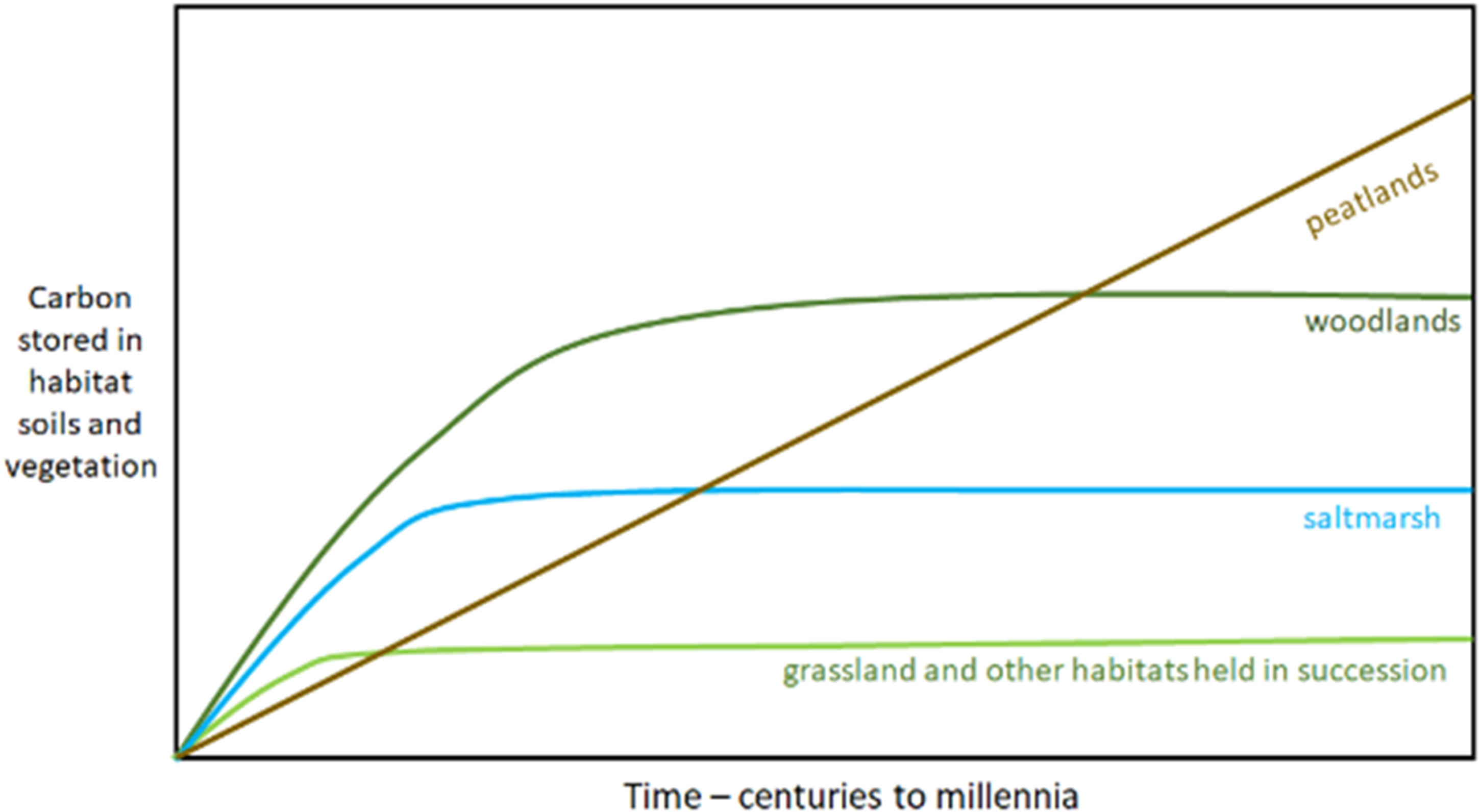
Conceptual model of habitat trajectory towards carbon stock equilibrium, from Gregg et al. (2021) 222 × 119 mm (96 × 96 DPI).
Efforts to append “transitional carbon gains” to carbon accounting for peatland restoration can be viewed as attempts to compensate for the perceived slowness of this GGR method when compared to other natural climate solutions. By arguing that orthodox calculation methodologies erroneously fail to account for the carbon gained in the rebuilding of the acrotelm—that is, the peatland's surface layer and all above ground vegetative biomass—the 2022 report to Defra seeks to displace the gradual, linear functions of carbon sequestration depicted by conventional peatland carbon accounting. Indeed, the report argues for the inclusion of carbon sequestered by acrotelmic biomass explicitly on the grounds that initiating this vegetative growth is “analogous to planting a forest” (Evans et al., 2023 [2022]: 38). Such persistent comparison with afforestation demonstrates a profoundly reflexive engagement with public discourses of GGR technologies wherein tree planting is an unavoidable benchmark (Cox et al., 2025). As another peatland scientist stated in an interview, for example, there is potential for newly-restored, or ‘transitional’ peatlands “to behave like teenagers, so accumulate a lot of growth”. Theoretically at least, including acrotelmic biomass formation would rapidly accelerate calculated peatland carbon sequestration, until this biomass reached equilibrium, whereupon the peatland would resume its gradual and linear trajectory. By incorporating acrotelmic formation into the calculated carbon balance of peatland restoration, therefore, advocates of “transitional carbon gains” seek to tactically reconcile peatland carbon fluxes with market demands for large-scale GGR achieved over decadal, rather than millennial timescales.
Accounting for potentially rapid acrotelmic carbon sequestration and storage thus temporally harmonises peatland gaseous flux with the market-oriented logics and demands of contemporary climate mitigation. Until recently, the limited proportion of acrotelmic carbon which passed into the catotelm was a liability for the carbon balance of peatlands, and so peatland restoration. As one peatland scientist said at interview, only between “a half millimetre and a millimetre” of peat passes into the catotelm per year, “so not a huge amount”. This constraint can be circumvented by introducing acrotelmic carbon itself as a standalone category – held in the above-ground biomass and the surface peat layer – as an additional element within the calculated atmospheric impact of peatland restoration. This move involves explicitly strategic and reflexive engagement with the temporal boundaries of contemporary climate governance. As the same interviewee went on to explain, the question for peatland scientists becomes “how long does any quantity of carbon within the acrotelm remain in the acrotelm before it either passes into the peat or goes into the atmosphere? And the general figure is about one hundred years”. As the same interviewee continued, if “working just on the UNFCCC timescale, then it's perfectly valid to take the amount of carbon held in the acrotelm and say, ‘Well, there you are, that's carbon storage’”. Not dissimilarly, the 2022 report also suggests that high rates of carbon dioxide uptake in the acrotelm would be “likely to persist for at least 50 years (i.e., beyond the 2050 target of the Paris Agreement and UK Net Zero strategy)” (Evans et al., 2023 [2022]: 38). Overall, these arguments aim to reflexively re-bound the calculative frame of peatland carbon fluxes, rendering peatland restoration itself more amenable to the demands of contemporary, market-based climate governance for measurable and immediate GGR.
Peatland scientists are reflexive about the role which their guidance plays in policy and market formation. The proposal of alternative calculative frames foregrounds their future socio-economic implications, rather than purporting merely to more accurately reflect GHG fluxes. Moreover, several interviewees displayed marked caution around the concept of transitional carbon gains; one scientist for example making clear in an interview that they were “a bit more on the fence about those transitional carbon gains”. To a large extent, these reservations may stem from the fact that the boundary redrawings which produce transitional carbon gains only maintain ontological stability within a very specific boundary space —that is, the mathematical modelling-oriented UK climate science–policy interface centred around the role of diverse GGR techniques in meeting UK net zero targets. Despite these esoteric origins, however, the transitional carbon gains concept has already found significant purchase in policymaking debates, with potential implications for the future economic viability of scaled-up peatland restoration in the UK.
Conclusions
This paper has shown how advocates for UK peatland restoration have deployed two distinct sets of arguments – in the context of wider market and regulatory regimes which favour “removal” credits – to prevent peatland credits from being stranded and deemed unworthy of further investment. In the UK, removal credits are in greater demand, we suggest, partly because the prospect of large-scale GGR provides a means of deferring action to significantly reduce GHG emissions taking place elsewhere, whether at the level of national net zero policymaking, or indeed through the logics of private carbon offsetting (Carton, 2019; Markusson et al., 2024). Peatland specialists working at the interface of science and policy and eNGOs involved in restoration are likewise cognisant that peatland restoration will be increasingly reliant on private finance in the future. This impending economic context is perceived to present a serious threat for peatland restoration, a critical form of climate mitigation, but one centred around the prevention of ongoing emissions, rather than direct removal of atmospheric GHG. This is paradoxical, of course, as not emitting GHG should result in less net warming than first emitting and later removing that quantity. Nonetheless, within current market logics, neither “reduction” credits nor “avoidance” credits offer the same latitude to defer significant GHG emissions abatements elsewhere, and are therefore increasingly marginalised. Without a significant policy shift, which would allow for restoration funding beyond a removals-focused market governance regime, peatlands are considered at risk of being left behind in the rush for natural climate solutions. Responding to this threat, policy-oriented peatland scientists and peatland carbon market professionals have sought to redraw the boundaries which define peatland gaseous fluxes—with reference to their causal pathways, or the calculative frames which identify them—such that those fluxes, their anthropogenicity, and indeed their negation, can be more easily accounted for under prevailing carbon market rules.
The reorderings of peatland GHG fluxes charted in this paper rely upon boundary-making practices, as described by Robertson et al. (2023a, 2023b). These boundaries stabilise the complexity of peatland GHG fluxes (Lövbrand and Stripple, 2011), and the role of humans therein, in the service of a state of “temporary ontological stability” (Robertson et al., 2023b, 2454). This, protagonists hope, will then permit a specific strategy of accumulation. Specifically, some actors have sought to redraw the boundaries of the causal pathways which produce ongoing emissions from restoration sites. These new boundaries permit the designation of such emissions as self-perpetuating or “inevitable”, such that they can then be “actively halted” by restoration itself, thereby emphasising a previously underappreciated distinction between peatland-based emissions reductions and mere emissions “avoidance” achieved in other nature-based contexts. However, these new boundaries must then be selectively applied to avoid unintended consequences, most notably to ensure that agricultural peatland emissions are recognised as neither self-perpetuating nor inevitable. In contrast to this approach, other actors have instead sought to redraw the calculative frames which produce peatland carbon balances, for example through the tactical inclusion and exclusion of methane emissions, but also through the demarcation of acrotelm formation as a legitimate but previously unacknowledged source of rapid carbon dioxide removals. While this last attempt to redraw peatland carbon balance boundaries – described by key actors as a source of “transitional carbon gains” – was initially articulated only within a very specific science–policy “boundary space” in the UK (Mahony, 2013), this has not prevented it from being taken up by actors involved in wider discussions, including about the potential inclusion of peatland carbon credits within the UK's post-Brexit successor to the EU ETS. Whether they address the causal pathways leading to peatland GHG emissions or the calculative frames which are used to quantify them, however, all of the boundary-making processes examined in this paper are both performative, bringing new realities into being (Lansing, 2012; Lippert, 2015), and reflexive, since they form explicit responses to a political economy of climate mitigation which increasingly relies on promises of future carbon dioxide removal to help justify continued high levels of GHG emissions in the present.
For many of our participants, these debates constitute a fractious, high-stakes proving ground where the future viability of UK peatland restoration as a potentially-investable proposition will either be forged or lost. Under prevailing market-making logics, economically-viable peatland restoration requires peatland carbon credits to be regarded as a legitimate and robust basis for offsetting other GHG emissions, whether in the fulfillment of voluntary or statutory net zero goals. These debates contribute to a wider conversation, the potential implications of which extend well beyond voluntary markets. Indeed, our analysis ultimately foregrounds a pernicious dynamic, through which the capacities of distinct ecological processes and ecosystems to help mitigate climate warming are valued only in so far as they are deemed – within prevailing market logics – to be capable of compensating for GHG emissions which have already been released, usually as a result of industrial activities taking place elsewhere.
A focus on which kinds of carbon credits can help large corporations or indeed governments to meet their net zero goals, however, distracts from a more fundamental question – whether carbon credits should be part of climate mitigation policy at all. What is at stake, in a sense, is not just the investability of peatland restoration, but the very definition of legitimate climate mitigation activity. We therefore assert the need for efforts to scale up peatland restoration, whether in the UK or elsewhere, to be decoupled from prevailing logics of compensation and offsetting associated with the concept of net zero. Instead, we advocate future governance and funding models in which the value of restoration's impacts on peatland carbon emissions is not dependent upon their commensuration with other gaseous fluxes, but rather upon systematic monitoring, and the maintenance of positive outcomes over time.
Highlights
Peatland restoration is disadvantaged by increasingly market-driven environmental funding models which prioritise “removal” credits over and above other forms of credit
Specialists in peatland restoration are seeking to reconfigure carbon markets and peatland carbon accounting in order to ameliorate the position of peatland restoration.
This highlights a dynamic wherein landscapes are valued only according to the rationales of market-driven environmental governance.
Footnotes
Acknowledgements
This paper would not have been possible without generous funding provided by the Leverhulme Trust. We are further indebted to the scientists, restoration practitioners, and farmers who gave up their time and their expertise in order to be interviewed. The ideas behind this paper were developed in conference with a broad array of international scholars, in particular those in attendance at the ‘Politics of carbon sinks’ panel at EASST-4S 2024.

Ethical approval
The study has been approved by the Research Ethics Committee of the School of Geographical Sciences, University of Bristol.
Funding
The author(s) disclosed receipt of the following financial support for the research, authorship, and/or publication of this article: This work was supported by the Leverhulme Trust [RPG-2022-345].
Data availability statement
Owing to ethical considerations and the nature of the data employed in this study, it is not possible to make the data available to other researchers.