







Abstract
Introduction
With nearly 140 million orphans worldwide, Sub-Saharan Africa alone is home to 52 million children under the age of 18 who have lost at least one parent (UNICEF, 2017). An estimated 10% of the overall child population is considered vulnerable, lacking adequate care and protection or being at high risk of losing it (SOS Children’s Villages International, 2013). Many low- and middle-income countries find themselves overburdened with this high number of orphans and vulnerable children (OVC) resulting from poverty, natural disasters, the HIV/AIDS epidemic, or political conflicts (Better Care Network, 2015; UNICEF, 2014). An increasing number of children are placed in institutional care (Better Care Network, 2015).
Though child care institutions are intended to offer shelter from poverty and maltreatment, children often find themselves in an environment lacking in safety and resources, in which they are (again) exposed to violence, abuse, and neglect (Sherr et al., 2017). Child maltreatment includes severe and less severe forms of maltreatment such as physical violence, emotional violence, and neglect (Leeb et al., 2008; WHO, 1999). Children are exposed not to single acts of violence or neglect that occur in isolation but rather make experiences that accumulate over the course of time (The Allience for Children Protecction in Humanitarian Action, 2019). Therefore, independent of the severity of a single action these experiences of children are considered as maltreatment to account for the frequency, variety, and continuance of violence and neglect.
In a study that included children in orphanages in Tanzania, 97% of the orphans reported exposure to at least one type of abuse during lifetime and 56% reported of having experienced neglect (Hermenau et al., 2015a). Children at high risk experience a broad range of different maltreatment types. In addition to that, exposure to maltreatment is often ongoing with an early onset, as orphans experience maltreatment in their family of origin, on the streets, and in institutional care (Hermenau et al., 2014; Young, 2004). Frequent and ongoing exposure to violence can have detrimental effects on children’s physical and cognitive development, attachment and mental health (Study et al., 2015; Whetten et al., 2011).
Although numerous studies have documented the harmful potential of maltreatment (Hermenau et al., 2014; Study et al., 2015), little is known about caregivers’ specific factors and their working environment (Hermenau et al., 2015a). However, this knowledge could be essential in revealing factors that potentially contribute to the ongoing or substantial maltreatment. The few existing studies on caregivers indicate an interplay of several variables that can be differentiated on structural and individual levels. Nthenya and Mutiso and Mutukt Mutie (2018) showed that children living in childcare institutions suffer from structural neglect, which combines environmental challenges, including minimum physical resources, challenges with staff divisions, and a paucity of quality caregiver-child interactions. The construct structural neglect is characterized as a result of the poor working conditions and low resources in orphanages (Van Ijzendoorn et al., 2011). Structural factors may thereby be classified as variables resulting from the organization’s style, rules, responsibilities, and facilities, among others. Many child care institutions, including those found in Tanzania, operate without registration and are unmonitored and unsupported by national social welfare or social services departments (SOS Children’s Villages International, 2013). Caregivers often face unfavourable caregiver-child ratios, work long shifts, and receive low salaries (Van Ijzendoorn et al., 2011). Following such conditions, caregivers spend most of their working hours on the supply of children’s physical needs (e.g., feeding, changing or cleaning children) or with domestic activities (e.g., preparing food or cleaning) rather than on emotional interactions (Van Ijzendoorn et al., 2011). Direct caregiving duties are thereby often acted out in a distant, business-like manner lacking sensitivity and warmth (Levin et al., 2007; Muhamedrahimov et al., 2004), possibly resulting in the emotional neglect of children (Oliveira et al., 2012; Vashchenko et al., 2010). One factor contributing to this, is the fact that caregivers lack childcare specific education and there is no authority to screen or evaluate the suitability of caregivers (Hecker et al., 2017; Karageorge & Kendall, 2008). Additionally, in most institutions caregivers receive few, if any, opportunities for supervision and professional advancements (Rather & Margoob, 2006).
The poor working conditions and regulations for caregivers might contribute to high staff turnover, creating an environment for children characterized by inconsistency and instability (Wright et al., 2014). However, it is possible that the structural deficiencies are not only related to neglect but also to increased levels of violence. Different studies in families could show a relation between socio economic status and maltreatment. In the context of childcare institutions, variables like the caregiver-child ratio, working hours, and other working regulations are also of interest in further clarifying the potential link between these factors and levels of violence in caregiving institutions.
Caregivers’ individual factors that contribute to the maltreatment of children are mental health, stress, attitudes towards the use of violent punishments, difficulties in relating with children, and lack of professional training (McCall & Groark, 2013; Muhamedrahimov et al., 2004; Raskin et al., 2015). Caregivers’ own experience of maltreatment during childhood can explain their current behaviour towards children. The cycle of violence describes the relation between own experiences of violence and its influence on the behaviour in adulthood. Furthermore, it explains how the cross-generational transition of violence can result in socially accepted and normative violence against children, which shapes the caregivers’ attitudes towards violence (Masath et al., 2021; Widom & Wilson, 2015). In addition to the socialisation in a violent environment, caregivers lack specialized child care knowledge and report both high workload and high levels of stress (McCall & Groark, 2013; Muhamedrahimov et al., 2004; Raskin et al., 2015). These variables are associated with poorer quality childcare and higher levels of maltreatment (Hermenau et al., 2011; Widarsson et al., 2013). Many children in orphanages suffer from attachment and behavioural problems like internalizing problems such as depression, anxiety and social withdrawal and externalizing problems such as aggression, defiance, hostility and poor impulse control (Adler et al., 2020; Brown et al., 2015; Huffhines et al., 2020). Due to the lack of knowledge, children’s behaviour is often misunderstood by caregivers, which in turn can lead to more maltreatment of children (Smyke et al., 2002; Wade et al., 2020). Violent disciplinary methods are extremely widespread and due to their social acceptance, caregivers’ positive attitudes towards such methods, and lack of caregiver knowledge they are the most common form of violence experienced by children (Lansford et al., 670; UNICEF, 2010, United Nations Children’s Fund, 2014). Caregivers’ high levels of stress may contribute to the frequent use of violent discipline. The high demands exceed caregivers’ ability to cope satisfyingly and effectively with the stressors, likely resulting in feelings of frustration (UNICEF, 2017). Based on the frustration-aggression hypothesis (WHO, 2006) permanent stress without any hope for improvement can lead to aggressive behaviour, hence maltreatment of children.
Children’s vulnerability, along with caregivers’ high workload, lack of time and of resources for high quality interactions with children, might result in difficulties in the caregiver-child relationship. Without a relationship that allows for understanding and interpreting the behaviour from a different perspective, children’s behaviour is likely to be misunderstood and misinterpreted by caregivers. Instead of addressing children’s need for secure and stable attachments, understanding, and stabilizing interactions - children instead face violent discipline (Hermenau et al., 2017). As a result, children in institutions suffer from continuing exposure to maltreatment, including extreme forms of violence and abuse (Rimal & Pokharel, 2013).
Effective and theory-based interventions for caregivers focusing on the prevention of maltreatment in low resource settings are still very rare (Hermenau et al., 2017), but the few existing studies show a significant improvement in caregiving strategies and a significant decrease of maltreatment (Browne, 2017; Hecker et al., 2021). However, a huge gap in research remains concerning orphanage-context and caregiver-specific factors and their association with the maltreatment of institutionalized children. Considering the high and increasing number of OVC at constant risk of experiencing maltreatment and the associated detrimental consequences for their development, a clear and urgent need emerges to further investigate these factors.
Objectives
The present study sought to fill this gap and provide information about the prevalence of maltreatment in Tanzanian childcare centres from the caregivers’ perspective. Further, due to the heterogeneity of the childcare institutions regarding the maltreatment level, we described the individual and structural aspects of caregivers’ working conditions stratified by maltreatment level. In a third step, we investigated caregiver-specific factors that contributed to child maltreatment of orphans with a multilevel analysis controlling for the differences between the orphanages. We expected more reported maltreatment to be related to caregivers’ shorter duration of childcare-specific education and to more work-related stress, more relationship difficulties with children, and more positive attitudes towards violent discipline. We further aimed at exploring factors at the orphanage level that were significant at the individual level, to explain variance of maltreatment between the orphanages. Additional predictors of maltreatment at the orphanage level were the caregiver-child ratio and the economic status of the orphanage.
Method
Design and Sampling
Aiming to involve all orphanages accommodating school-aged children in Dar es Salaam, we contacted every welfare office in all districts of Dar es Salaam. Additionally, all childcare centres and sponsors were asked about any further unregistered orphanages. In total, out of 25 childcare centres that were approached, 24 childcare centres with 227 caregivers in total were included in this study. All caregivers of the identified centres were invited to participate in the survey. Inclusion criteria required caregivers be of legal age (>18) and provide written informed consent. All caregivers met the inclusion criteria and agreed to participate.
Procedure
The research team visited each centre prior to the assessment to explain the study’s purpose and procedure to the institutions’ heads and caregivers. Data assessment was carried out at the childcare institutions by three Tanzanian psychologists and six research assistants from August to October 2018. Research assistants were trained for 5 days in interview skills, concepts of child maltreatment, and mental health. Instruments were available in Kiswahili (Hecker et al., 2017; Hermenau et al., 2015a) or translated from English to Kiswahili according to recommended procedures in transcultural research (Brislin et al., 1973), and were applied as structured interviews. The structured interviews took an average of 30 minutes.
Due to support letters from the government, motivated head of institutions and the personal perceived high relevance of caregivers concerning this project informed consent was obtained from all eligible participants. Caregivers’ participation was voluntary and without remuneration. Participants were informed about possible risks and discomforts and were encouraged to bring up any concerns or questions while participating in the study. In case of severe psychological distress, caregivers were reassured of psychological support. The study was approved by the Ethical Review Board of the University of Konstanz and the University of Dar es Salaam on behalf of the Tanzanian Commission for Science and Technology. The data presented here was part of cluster-randomized controlled trial to prevent maltreatment. The trial was registered with ClinicalTrials.gov, number NCT03594617.
Measures
In the first part of the interview, caregivers were asked about sociodemographic details, including age, gender, living conditions and work experience.
Maltreatment by caregivers
Caregivers’ self-report about violent discipline and neglect was assessed with the Conflict Tactics Scale Child-Parent version (CTSPC; Straus et al., 1998). It has the subscales emotional violence (5 items e.g. yell/scream/shout, swore or curse, calling names), physical violence (13 items less severe e.g. spank on buttocks, slap on the hand or pinch and severe e.g. kick, burn), and neglect (8 items e.g. lack of supervision, food or medical care). The scale has been used in several studies to report less severe, severe and very severe forms of child maltreatment (Cui et al., 2016; Hermenau, Eggert, et al., 2015; Leung et al., 2008; Straus et al., 1998). The CTSPC has demonstrated good cross-cultural reliability and validity and good internal consistency (Cui et al., 2016; Lee et al., 2012; Nkuba et al., 2018; Ssenyonga et al., 2018; Tonmyra et al., 2011). Prevalence and frequency of maltreatment was assessed on a 7-point scale and after converting it, ranging from 0 = “never” to 25 = “more than 20 times in the past month”. The internal consistency was acceptable, α = .71 for the total score of maltreatment.
Attitudes towards violent discipline
Caregivers’ attitudes towards violence were assessed with an adaptation of the CTSPC including the physical and emotional violence subscales (Nkuba et al., 2018). Ratings were made on a 4-point scale (0 = never okay to 3 = almost always okay). Cronbach’s alpha coefficient was at α = .65.
Stress
Caregivers’ work-related stress was assessed with the Copenhagen Burnout Inventory (CBI; Kristensen et al., 2005). The 19-item instrument measures the risk and extent of physical and psychological exhaustion (here: fatigue related to caregiver-child interactions) in the past month on a 5-Likert scale (0 = never to 100 = always). The CBI demonstrates good internal consistency, test-retest reliability, and concurrent validity, and appears to be a valid and reliable measurement tool of burnout in several countries and for various populations (Kristensen et al., 2005; Winwood & Winefield, 2004). CBI items were combined to an average score ranging from 0 to 100, with values greater than or equal to 50 indicating high stress (Borritz et al., 2006). The Cronbach’s alpha coefficient for the sum score was excellent α = .91.
Difficulties in the caregiver-child relationship
Caregivers’ relationship with the institutionalized children was assessed with an adapted questionnaire for caregivers based on items of the Student-Teacher Relationship Scale (STRS) and a short form of the Child-Parent Relationship Scale-Short Form (CPRS) by Pianta (1992). For further details on the adaption, see SF 1.1. Caregivers rated their relationship on 15 items with a 3-point scale (not true, somehow true, or certainly true). The adapted questionnaire revealed an internal consistency of α = .65.
Individual and structural working conditions
Caregivers’ working environment was assessed with a purpose-built questionnaire based on previous experiences (Hermenau et al., 2011, 2014, 2015a). Questions about caregivers’ childcare-specific education and job satisfaction were asked. Further questions assessed structural factors like employment status, payment, workload (working hours and days of leave entitlement), and age of the children living in the institution. To assess the size of the orphanages and caregiver-child ratio, we relied on the information provided by the heads of the institutions.
Data analysis
Data analyses were performed with IBM Statistics SPSS 25. Descriptive statistics are presented separately for orphanages grouped by their different levels of maltreatment. Based on the average maltreatment score at the orphanage level, orphanages were categorized into quartiles (low, low-middle, middle-high and high). Because of the high intra class correlation no inferential statistical analyses were made to compare the orphanages.
Multilevel modelling
Substantial differences in the outcome between the orphanages, indicated by a high Intra-Class Coefficient of 0.228, required multilevel analyses. Primarily, we were interested in the caregiver-specific predictors (level 1) of maltreatment. In this study, we included the level 1 predictors as fixed effects: childcare specific training, stress, relationship difficulties with children, and attitudes towards violent discipline. To rule out the influence of the Level 2 variance we centered all level 1 predictors on the group mean. In a second step, we wanted to investigate the contribution of predictors on the orphanage level (level 2). Level 2 predictors were: significant level 1 predictors, socioeconomic status, and caregiver-child ratio. Level 2 predictors were centered on the grand mean. Chi-square test of the maximum likelihood indicated the model fit, with an adjusted alpha-level of 0.025. Effect sizes f 2 of the predictors were calculated according to Aiken and West (Aiken & West, 1991) and are considered as small at 0.02, moderate at 0.15 and large at 0.35 (Cohen, 1992).
Results
Maltreatment and working conditions in orphanages
Caregivers
A total sample of 227 caregivers (67% female, 152 of 227) participated in the study, with an average age of 36.84 years (SD = 12.19, range 18 - 77). A majority of caregivers had children of their own (69%, 157 of 227) and lived on average with 4.74 other people in one household, (SD = 3.12, range 0–18, n = 172), which spent 195.65 USD per month on average. Sixty-seven percent of the caregivers claimed another source of household income. The average duration of work experience was 6.59 years (SD = 6.96, range = 0 – 38). In total, 97.8% of caregivers (n = 227) reported having used at least one form of physical or emotional violence or neglect in the past month. The prevalence of physical violence was at 68.3%, 94.7% for emotional violence, and 47.6% for neglect. For details of the prevalence on item level, see supplementary files 2. Only 10.1% of the participating caregivers, n = 23 of 227 indicated their rejection of any form of violent discipline. Out of all caregivers 10.6%, n = 24 of 227 reached the cut-off score for burnout. Mean caregiver work satisfaction was 2.26 (SD = 0.97). Caregivers reported average weekly working hours of 97.72, (SD = 57.76), range (8–168), n = 218, with 85 of the caregivers living at the orphanages. Excluding caregivers living at the orphanage, the average working hours was 62.95 (SD = 35.80). On average respondents had worked as caregivers for 6.59 years (SD = 6.96, range (0–38), n = 222). Only 28%, n = 55 of 222, had a formal contract of employment. On average, caregivers earned 74.90 USD (SD = 91.75) per month, 50% earned less than 43.00 USD per month and only 25.5% earned more than 100 USD per month, n = 216. Many of the caregivers, 40.1%, n = 73 of 182, reported having no holiday leave from work.
Orphanages
Means for maltreatment scores presented for the full sample and separately for orphanages with different levels of the overall maltreatment score.
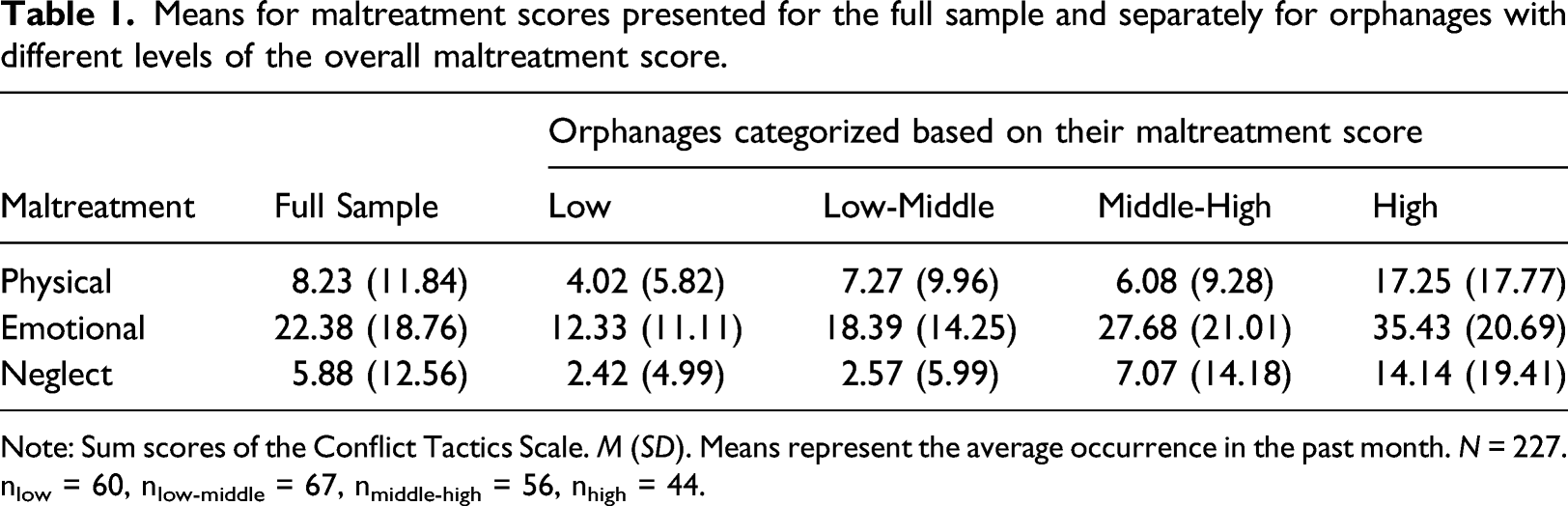
Note: Sum scores of the Conflict Tactics Scale. M (SD). Means represent the average occurrence in the past month. N = 227. nlow = 60, nlow-middle = 67, nmiddle-high = 56, nhigh = 44.
Individual and structural factors in relation to the maltreatment level of the orphanages
Childcare training
In orphanages with low levels of maltreatment (henceforth referred to as LowMO), the average training duration of those who had previously received training was 12.86 weeks (SD = 14.4). In orphanages with high levels of maltreatment (henceforth referred to as HighMO) the average training duration was 6.75 weeks (SD = 9.85). Orphanages differed significantly concerning the duration of childcare specific trainings (for details see supplementary files 3).
Attitudes towards violence
Descriptive statistics of individual factors separately for orphanages with different levels of maltreatment.
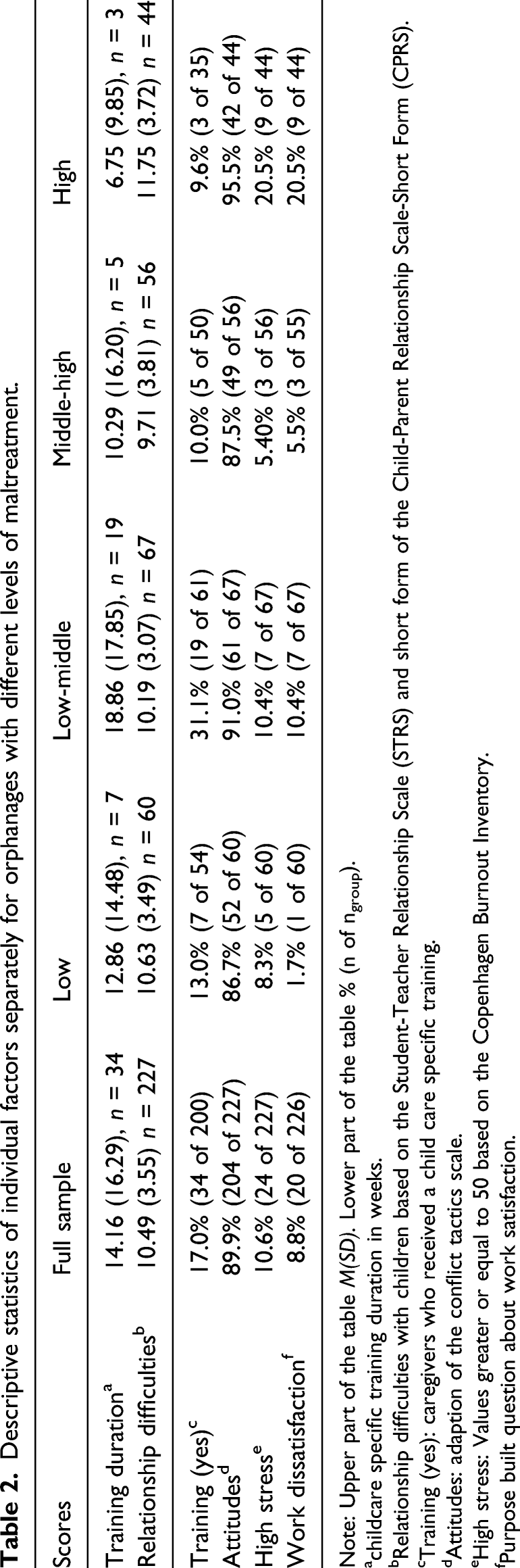
Note: Upper part of the table M(SD). Lower part of the table % (n of ngroup).
achildcare specific training duration in weeks.
bRelationship difficulties with children based on the Student-Teacher Relationship Scale (STRS) and short form of the Child-Parent Relationship Scale-Short Form (CPRS).
cTraining (yes): caregivers who received a child care specific training.
dAttitudes: adaption of the conflict tactics scale.
eHigh stress: Values greater or equal to 50 based on the Copenhagen Burnout Inventory.
fPurpose built question about work satisfaction.
Stress
In HighMO, more than one out of every five caregivers reached the cut-off for burnout (20.5%). However, orphanages with lower levels of reported maltreatment also showed a high percentage of caregivers reporting high scores of work-related stress (see Table 2).
Work satisfaction
In LowMO 1.7% of the caregivers were not satisfied with their work at all. This was the case for 20.5% of the caregivers in HighMO (see Table 2). There was a significant difference between the orphanages concerning caregivers’ work satisfaction (for
Structural factors
Descriptive statistics for the working conditions separately for orphanages with different levels of maltreatment.
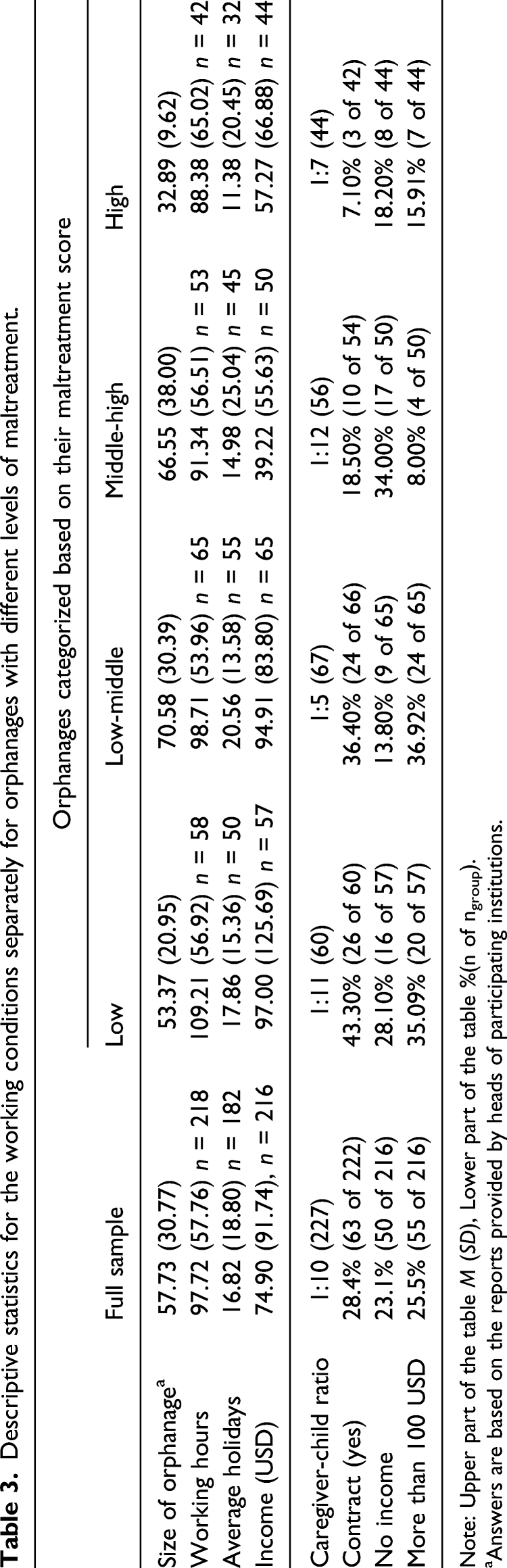
Note: Upper part of the table M (SD), Lower part of the table %(n of ngroup).
aAnswers are based on the reports provided by heads of participating institutions.
Individual and structural factors contributing to maltreatment: A multi-level model
Fixed effects estimates (top) and variance-covariance estimates (bottom) for models of the predictors of use of maltreatment.
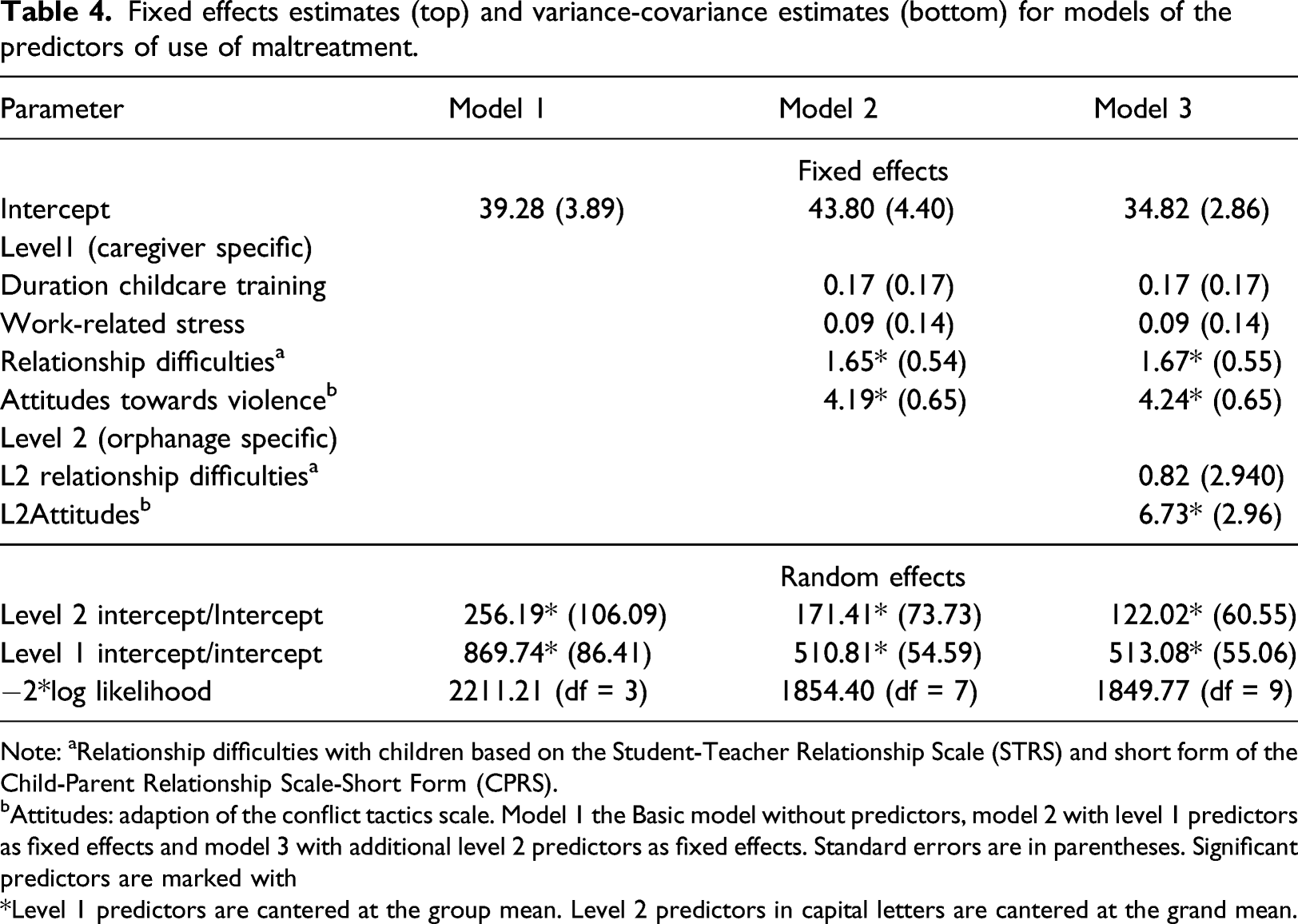
Note: aRelationship difficulties with children based on the Student-Teacher Relationship Scale (STRS) and short form of the Child-Parent Relationship Scale-Short Form (CPRS).
bAttitudes: adaption of the conflict tactics scale. Model 1 the Basic model without predictors, model 2 with level 1 predictors as fixed effects and model 3 with additional level 2 predictors as fixed effects. Standard errors are in parentheses. Significant predictors are marked with
*Level 1 predictors are cantered at the group mean. Level 2 predictors in capital letters are cantered at the grand mean.
In Model 2, the predictors at level 1 relationship and attitudes were added to the model. They significantly predicted maltreatment, with a small effect size, ƒ2relationship = 0.05 and a moderate effect size, ƒ2attitudes = 0.19. Within an orphanage, a difference of one unit in the attitudes score led to an average difference of 4.19 points in the maltreatment score. We extended the model with the fixed effects duration of childcare specific education, work related stress, difficulties in the relationship with children, and attitudes towards violent discipline. The model fit (-2LL) improved significantly, Δχ2 = 356.81, Δdf = 4, p < .001 (see Table 4).
In Model 3 the level 2 predictor attitudes was significant, with a small effect size of ƒ2L2attitudes = 0.07 (see Table 4). A difference of one unit in the level 2 predictor attitudes towards violent discipline between the orphanages leads to an expected difference in the maltreatment score of 6.73 points. However, there was no significant improvement in the model fit. The level 2 predictors socioeconomic status and caregiver-child ratio did not lead to a significant improvement of the model fit.
An exploratory multilevel mediation was conducted to explore whether the association between work-related stress and maltreatment was mediated by relation difficulties and positive attitudes towards violent discipline. Both indirect effects of work-related stress via relationship and attitudes toward violent discipline were significant at level 1 (relationship: Z = 2.40, p < 0.05, 95%-CI; 0.30 – 0.24, attitudes: Z = 5.72, p < 0.0001, 95%-CI: 0.34 – 0.68) (for details see supplementary files 3).
Discussion
The present study investigates individual caregiver factors and structural factors which may be related to child maltreatment in an extensive sample of Tanzanian orphanages from the caregivers’ perspective. It describes the current state of the working conditions and challenges caregivers face in Dar es Salaam – on both an individual and structural level - and these factors’ contribution to maltreatment. It draws a picture of the dramatic situation in many orphanages and calls for further investigations and efforts to improve the situation of orphans and their caregivers.
We found very high levels of maltreatment in the participating orphanages and almost all caregivers reported that they maltreated children in the past month. This is in line with previous studies in Tanzania (Hermenau et al., 2015a; UNICEF, 2012). Overall, maltreatment was present in every orphanage. However, we found that there was considerable heterogeneity between the institutions in the prevalence of maltreatment. By comparing the orphanages with the highest and the lowest level of maltreatment, we gained insights into possible predictors of maltreatment, such as caregiver income, contracts, and leave regulations – though at this point no definite conclusions can be drawn.
In low- and middle-income countries like Tanzania, there are often no legal requirements for working in childcare institutions. As a result, it is possible to work as a caregiver without any professional training. In this sample, an alarmingly low number of caregivers received any training specific to childcare at all. Out of those who received training, the average training duration was less than 3 months. Even short caregiver trainings could improve the quality of care (Hermenau et al., 2017) and significantly reduce maltreatment (Hermenau et al., 2015a; McCall, 2013; Muhamedrahimov et al., 2004). Yet, we could not find a significant association between the length of training and the use of maltreatment. However, this might be due to a lack of power. Floor effects might play a role. It may also be an indication that a brief training could be as effective as a lengthier, costlier training. The average training duration significantly differed between the orphanages and the trainings were very heterogeneous ranging from bachelor’s degrees in social work to some short church- or NGO- based trainings covering different topics.
We found that positive attitudes towards violent discipline were very widespread among caregivers, with almost 90% endorsing the use of corporal punishment. In orphanages with the highest maltreatment scores, over 95% of the caregivers were supportive of using violent discipline methods. This is in line with the high social acceptance of violent disciplinary methods and prevalence of maltreatment found elsewhere in the literature (Rimal & Pokharel, 2013). Caregivers’ attitudes towards violent discipline and relationship difficulties with children significantly predicted maltreatment. This is an important finding as it underlines possible starting points for interventions improving the situations for children in institutional care where maltreatment is very prevalent. An outstanding example in this context is the preventative intervention Interaction Competencies with Children (Hecker et al., 2017). Its effectiveness has been shown for teachers in school settings (Hermenau, Kaltebach, et al., 2015; Nkuba et al., 2018) and recently also for caregivers (Hecker et al., 2021). Interaction Competencies with Children focuses on fostering positive interactions with children by establishing a reliable, warm and sensitive relationship between the caregiver and the child, and additionally actively reduces maltreatment by changing personal attitudes towards violence and practicing alternative discipline methods.
In addition to the individual-level factors, the extremely poor working conditions served to exacerbate the risk levels for the use of violent disciplinary methods. Very long working hours without any or enough leave entitlement, high caregiver-child ratios (with ratios up to 1: 23), low income, partially no income at all, and no working regulations in the form of a contract for a majority of caregivers, are just the tip of the iceberg. These factors indicate the dramatic situation and overwhelming challenges many caregivers and orphanages face. Further analyses revealed that orphanages differed concerning structural aspects, which is reflected by the multilevel structure of the data and is in line with our impression when collecting data at the orphanages. Several studies showed that environmental factors determine individual attitudes towards violence and violent behaviour. Linos et al. (2017), for example, concluded that social and contextual determinants are crucial in ending violence against women. The immediate social surrounding seems to have a great impact on attitudes towards violence (Uthman et al., 2011). Thus, the changes in caregivers’ attitudes or behaviours are likely to be influenced by factors on the orphanage level.
With regard to the extreme working conditions, it is not surprising that more than 10% of the caregivers reported many symptoms of high work-related stress, indicating a potential burnout. In orphanages with the highest level of maltreatment, this applies to every fifth caregiver. In the present study, we were interested in the relation between work-related stress and maltreatment. We could not show a direct relationship between stress and maltreatment, in contrast to previous findings where the stress of authority figures was related to violence against and neglect of children (Hecker et al., 2018; Mikolajczak et al., 2018). However, we found that stress significantly predicted maltreatment when mediated by attitudes or relationship difficulties. High workload and poor working conditions like high caregiver-child ratios, long working hours, and little leave entitlement may lead to increased levels of stress.
Increased stress has an influence on the attitudes towards violence, as well (McCurdy, 2005; Ssenyonga et al., 2018). A lack of time and resources to meet children’s needs, and no sufficient opportunity for recovery might serve as an explanation for the use of violent discipline. Further, higher stress levels might lead to more difficulties in the relationship with children (Dennis et al., 2018), which in turn can explain higher levels of maltreatment. Despite poor working conditions, caregivers stated to be very satisfied with their work on average. Nevertheless, orphanages significantly differed concerning caregivers’ work satisfaction, with one fifth of the caregivers not being satisfied in orphanages with high levels of maltreatment. Job satisfaction in turn seems to be related to work performance (Judge & Bono, 2001), and may be a contributing factor to the maltreatment of children.
Taken together, the findings show that children living in institutional care facilities in Dar es Salaam live in harmful circumstances. This is of great importance as reports support the idea of deinstitutionalization to improve the wellbeing of children (UNICEF, 2018). These and previous findings encourage efforts at minimizing the number of children living in institutions (van IJzendoorn et al., 2020). The problem faced by low- and middle-income countries such as Tanzania is that in the foreseeable future transitions to alternative care are impossible due to the large number of orphans and lack of viable alternatives (Mccall & Groark, 2015). Further, poor quality of care is also prevalent in foster families and kinship care, where children experience maltreatment and a paucity of life opportunities (Agnes & Eleanor, 2018; Losioki, 2020; Omari et al., 2021; Study et al., 2015). Based on this view, we emphasize the urgent need to improve the quality of care and reduce maltreatment in available institutions in order to promote current wellbeing of children. Effective trainings for caregivers, which are tailored to low resource settings, are promising pathways to addressing factors on both individual and structural levels. Finally, our results suggest a crucial role of interactions between context and caregiver specific factors to fully understand the dynamics and prevention of maltreatment to provide recommendations for policy.
Implications for future research and policy recommendations
A more comprehensive assessment of the SES of orphanages, and additional structural factors, like the administrative status (e.g., availability of health insurances, monitoring the development of children, primary caregiver concepts, employing interdisciplinary teams etc.) and orphanage climate could offer deeper insights to better understand which structural factors contribute to a better quality of care. Collecting comprehensive data about contextual factors could foster an understanding of aspects that are important for high childcare quality and their association with work-related stress and maltreatment. Deficiencies in factors like staff recruitment, training, and supervision were associated with abuse in residential care (Colton, 2002).
The development and scientifically rigorous evaluation of structured and comprehensive theory-based caregiver trainings would allow for identifying components that are crucial in increasing the quality of childcare and reducing maltreatment. Gaining a deeper understanding of which factors at the individual and orphanage level, as well as their interactions, are fostering and maintaining or hinder and provoke a relapse in the change of maltreatment might be crucial to achieving long-term changes. This could be an important step in advancing caregiver policies, the formulation of guidelines, and minimum requirements for institutional care in low- and middle-income countries. These requirements should include regulations about a minimum required of necessary facilities, access to education and health care, and appropriate child-care ratios. Further, regulations regarding conditions for running a childcare centre should be developed, which include a minimum level of work qualifications for leaders and staff. Finally, a structure for external monitoring and supervision should be established to secure and support the implementation of the requirements. Child-care institutions should no longer be able to operate without registration and appropriate oversight. To effectively achieve such goals, however, ways to facilitate a smooth transition towards the requirements are necessary to prevent an extinction of existing institutions. Further research is required to find viable solutions despite low resources.
Strengths and limitations
The results of the present study do not allow for generalization of the findings across all orphanages. Nevertheless, to our knowledge this is one of the most comprehensive investigations of orphanages in Tanzania. All orphanages in Dar es Salaam were contacted and all but one participated. Because of the high diversity in Dar es Salaam this data is likely to reflect the current situation in Tanzania childcare centres. The different levels of maltreatment might arise from a reporting bias, in which caregivers in orphanages with higher levels of maltreatment in general show a greater openness in responding. We believe that this reporting bias can be ruled out, because orphanages also differed concerning more objective measures like contracts or payment rates. Moreover, we did not assess caregivers’ maltreatment to their own children, which could have allowed us to compare it with their behaviour towards orphans.
In this study, we operationalized the economic status with the average payment rate. This might not be sufficient as other aspects, such as the number of children per room and bed, sanitary situation, electricity, and other equipment, nutrition, access to health care etc. may all be important aspects of the SES of the caregivers and their institutions (Pappin et al., 2015). A major aim of the study was the description of the current state in Tanzanian orphanages. Concerning many aspects this study does not allow for conclusions based on interference statistical analyses. Nevertheless, it is an important contribution to the current knowledge as this study explicitly focuses on the caregivers’ perspective and their working conditions. Our findings call for further in-depth investigations. Unfortunately, due to the multilevel structure of the data a comparison of different groups was not possible. There was not enough power to investigate level 1 and level 2 predictors fully. We argue that it is important to consider the multilevel structure to avoid drawing conclusions that are distorted by cluster effects. In spite of potential power issues, we could detect significant predictors of maltreatment and additionally make preliminary assumptions that inform future research. The cross-sectional design, though, does not allow us to draw causal conclusions. Larger prospective designs are needed to better understand the underlying mechanisms on different levels of effect.
Conclusion
This study shows the high prevalence of maltreatment of orphans, as well as the poor and overwhelming working conditions of caregivers in Tanzanian orphanages. We showed a significant association between individual attitudes towards violent discipline, relationship difficulties, and caregivers’ use of maltreatment. Further, we discussed possible structural predictors of maltreatment. Our findings underline the urgency of developing national guidelines demanding basic training of caregivers and a structural organization of childcare institutions that ensures the quality of care and thus facilitates the healthy development of vulnerable children.
Supplemental Material
Supplemental Material - Caregiver-specific factors and orphanage-context factors contributing to maltreatment of children in institutional care: A multi-level analysis of 24 orphanages in Tanzania
Supplemental Material for Caregiver-specific factors and orphanage-context factors contributing to maltreatment of children in institutional care: A multi-level analysis of 24 orphanages in Tanzania by Getrude Mkinga, Anette Kirika, Mabula Nkuba, Simeon Mgode, Mira Huth, and Tobias Hecker in Developmental Child WelfareAcknowledgements
Footnotes
Acknowledgement
We would like to express our sincere gratitude to the management Dar es Salaam University College of Education (DUCE) for allowing us use one of their offices for our activities. We are also very thankful to our research assistant team in Tanzania, without them would not get the data for this amazing study.
Author Contributions
We believe that this research represents a significant contribution to the field of child abuse and neglect and will be of interest to researchers in other fields (e.g. prevention, developmental psychology, public health, child and adolescent psychiatry). We thank you for considering this manuscript for publication in Child Abuse and Neglect and we look forward to hearing from you.
Declaration of conflicting interests
The author(s) declared the following potential conflicts of interest with respect to the research, authorship, and/or publication of this article: Our material has neither been published previously nor has it been submitted for publication elsewhere. There is nothing in the professional or financial affiliations of any of the authors that may have biased the presentation of material in the paper. All the authors have consented to the content of the manuscript and accepted its submission to Child Abuse and Neglect.
Funding
The author(s) disclosed receipt of the following financial support for the research, authorship, and/or publication of this article: This work was supported by the study was funded by the Young Researchers’ Fund of Bielefeld University. It was funded to Tobias Hecker who is the supervisor and coordinator of the study project.

Supplemental Material
Supplemental material for this article is available online.
References
Supplementary Material
Please find the following supplemental material available below.
For Open Access articles published under a Creative Commons License, all supplemental material carries the same license as the article it is associated with.
For non-Open Access articles published, all supplemental material carries a non-exclusive license, and permission requests for re-use of supplemental material or any part of supplemental material shall be sent directly to the copyright owner as specified in the copyright notice associated with the article.
