







Abstract
The role of faculty in making a university Entrepreneurial is crucial, so is the research on what motivates the faculty to be entrepreneurial. This article is a Systematic Literature Review (SLR), done to find out factors motivating faculty to be ‘entrepreneurial’. Initially bibliometric analysis was done to understand the extent at which research is done on the topic. In all, 59 relevant articles (1995–2023) were selected for SLR. ‘Entrepreneurial motivation’ of faculty is considered to be a niche and less explored area of study due to which building strong propositions becomes a challenge. Majority of studies are of advanced and resource rich economies and applying those to resource constraint situation cannot be considered as an ideal situation. These research gaps are located by this article. Factors motivating faculties to get engaged in entrepreneurial activities were analysed. Existing research has classified motivational factors as intrinsic and extrinsic, in ‘resource constraint’ (push forces) and ‘resource-rich’ (pull forces) environment. The literature states that academicians tend to do explorative activities rather than commercialization related activities. This study has informed about various factors of entrepreneurial motivation which can be used for building instruments for measuring motivation of academic entrepreneurs. The study findings have a strong proposition for the need of empirical research on entrepreneurial motivation of faculty members which is the future scope of research.
Introduction
In the modern era with growing need of competitive world to bring in continuous invention and innovations (Aparicio et al., 2016) in products, services and processes, expectations from knowledge-creating entities—universities or Higher Educational Institutions (HEI’s) increased. Now these knowledge-creating entities are expected to take their knowledge/research further and convert that into ‘companies’ popularly known as ‘spin-offs’ (Landry et al., 2006; Meyer, 2003) which create wealth, increase jobs and lead to social and eventually the country’s development (Ben Youssef et al., 2018; Shane, 2004). This need of industry and society got reflected in changes in policy framework. The first step was taken by USA through introducing Bayh-Dole Act in 1980, (Mowery & Sampat 2005; Valentin & Jensen, 2007) followed by other countries and introduced a new concept of ‘entrepreneurial universities’ to the world. Now HEI’s are expected to perform on three levels—teaching, research and entrepreneurship (Etzkowitz et al., 2000). The third addition to its role, entrepreneurship, is its ‘third mission’ (Etzkowitz, 1983) and the entity which adopts it becomes entrepreneurial university or HEI. Government policies world over are encouraging HEI’s and industry to get into partnership or collaborated research projects, at private as well as university level, knowledge as well as technology transfer activities by declaring funding for the projects, setting up academia-industry centers, science parks, Technology Transfer Offices (Adams et al., 2001; Hall et al., 2000; Kirby, 2006; Siegel & Zervos, 2002; Siegel et al., 2003; Woolgar, 2007). In India though the change came little late, almost from the year 2014, numerous policy initiatives through ‘Make in India’, ‘Start-up India’, through the formation of Ministry of Education’s Innovation Council (MIC), are taken for building entrepreneurial culture at HEI campuses. All these efforts will bear fruits of success only when faculty members of these organizations get entrepreneurially engaged. Along with teaching and research, academic are expected to bring together science and technology for commercial benefits (Clark, 1998; Etzkowitz, 2003; Shane, 2004). This is a challenging task and can be done successfully only by motivated faculty. So ‘faculty motivation’ is an antecedent for a successful entrepreneurial university. Faculty motivation will lead to fast growth of entrepreneurial universities, generation of a large number of spin-offs, better employment and higher growth. However, lack of faculty motivation will be the biggest barrier to growth. What is essential here is to understand whether the policies framed and actions planned to encourage faculty engagement, are based on research findings regarding motivational factors for faculty’s entrepreneurial engagement? If yes, what are the factors that will motivate greater faculty engagement in entrepreneurial activities. This article revolves around these issues and tries to find answers to the following research question.
R1: How strong is past world research on factors that lead to faculty motivation for entrepreneurial engagement?
R2: How much is India’s contribution to the research on faculty’s entrepreneurial motivation?
R3: What are different dimensions and factors that affect faculty’s motivation for getting engaged in entrepreneurial activities?
Methodology
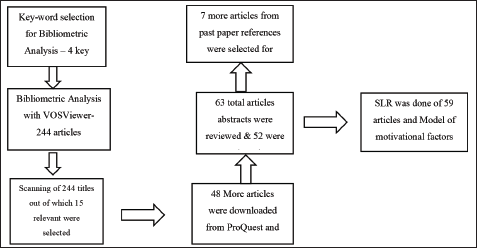
Few papers dealing with academic entrepreneurship were found in the Scopus database. Thus bibliometric analysis was done with the help of VOSViewer software by analysing Scopus data, through which, answers to the first two research questions are derived. Answers for third research question are derived though systematic review of past literature. Steps undertaken to do this research are as follows
Step one—Bibliometric Analysis: Bibliometric analysis helps researcher to deal with large amount of data and get quick access to specific body of knowledge. Since the concept of the entrepreneurial university and academic entrepreneur was originated in 1980s in the United States, a large amount of past research was expected. In order to get specific data on faculty motivation, develop an understanding of the volume of research in all countries of the world and also India, it was decided to do bibliometric analysis.
Step two—Keywords selection: The authors had done an exploratory study on evolution of the concept of ‘Academic Entrepreneurship’ and SLR on faculty engagement in entrepreneurial activities. During the previous research, two articles on academic entrepreneurship and faculty entrepreneurial motivation were located from the Scopus database. On the basis of previous readings of the authors, keywords for this article were selected. Those four keywords are—‘Motivation’, ‘Faculty’, ‘Entrepreneurial,’ and ‘Engagement ‘.
Step three—Bibliometric analysis: VOSViewer software was used for bibliometric analysis in order to derive answers for the first two research questions. VOSViewer mainly deals with ‘Scopus’ or ‘Dimensions. Since initial review articles were from the Scopus database, it was decided to do a bibliometric analysis using the Scopus database. The software generated data of 244 articles and data on number of articles, citation analysis of the articles, country-wise analysis of publications and type of publications was gathered to be presented.
Step four—Scanning the publication titles: Since the research needed to be specifically about the motivation of academic entrepreneurs, the list of articles generated by VOSViewer was downloaded and all article headings were scanned. We got the following result (Table 1).
Result of Title Scanning.

Step five—Getting more articles: 15 articles was too small data for SLR, especially for locating answer for the third research question. Thus by making more specific keywords—Motivation, Entrepreneurial, Academic Entrepreneur, Faculty Engagement, 48 more articles were downloaded from ProQuest and Google Scholar.
Step six—Data Inclusion: Considering the low number of publications, though the time period decided was 1995 to 2023, few relevant articles prior to 1995 were selected.
Step seven—Abstract scanning: Abstracts of all 63 articles were reviewed and 52 articles were selected which was combination of research articles, working papers, book chapters. Since topic of motivation can be a ‘social’ as well as ‘psychological ‘issue, seven more articles located from past paper references were included for the study. Thus the analysis of the third research question was based on 59 articles.
Step eight—Data analysis: The data was analysed and a model was constructed regarding motivational factors for academic entrepreneurs (Figure 1).
Data Cleaning and Inclusion–Exclusion Criteria.
Results
With the help of bibliometric analysis now the article finds answer to first research question, R1: How strong is past research on factors that lead to faculty motivational for entrepreneurial engagement?
Past Research on Faculty Motivation—All Countries Analysis
On the basis of previous research done on entrepreneurial engagement of faculty, four keywords—Motivation, Faculty, Entrepreneurial, and Engagement—were chosen. All published literature on these keywords from the Scopus database was captured on VOSViewer to get country-wise research publications data. In all, just 244 documents were obtained, which indicates that research on the ‘motivation’ of faculty’s entrepreneurial engagement is less. The following is result of the bibliometric analysis.
Number of Publications and Citations
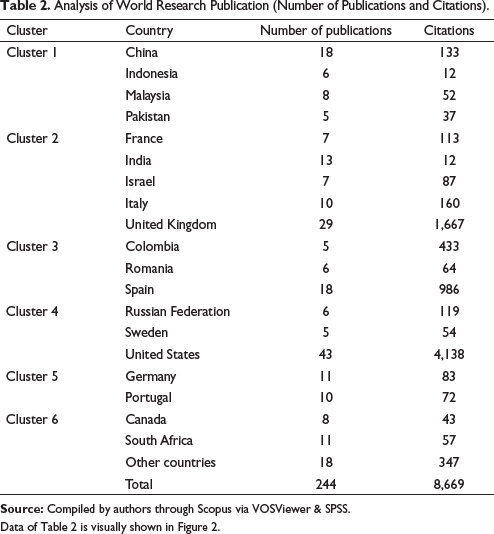
To contain large country-wise publication data, countries were distributed in clusters. The clusters were formed by the in-built technology of VOSViewer. The result is displayed in Table 2.
Analysis of World Research Publication (Number of Publications and Citations).
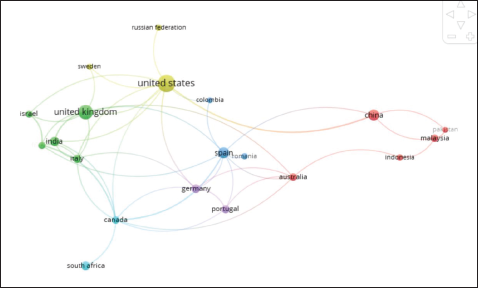
The findings of the analysis are as follows:
The analysis shows that past research on faculty entrepreneurial motivation is stronger in the United States, the United Kingdom, Italy, Spain, France, and Columbia.
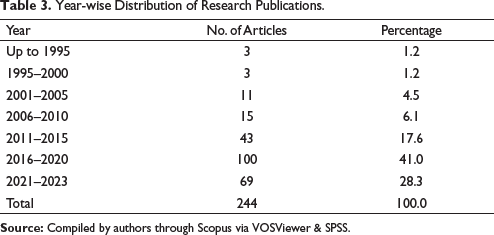
Year-wise Distribution of Publications
It gives a better idea of research efforts and trends.
Table 3 indicates that significant research contribution is seen after 2011 and growing with every passing year. This might be due to rising awareness about entrepreneurial universities in a greater number of countries of the world.
Year-wise Distribution of Research Publications.
Type of Research Publications
The analysis of the type of research publications is presented in Table 4.
Type of Research Publications.
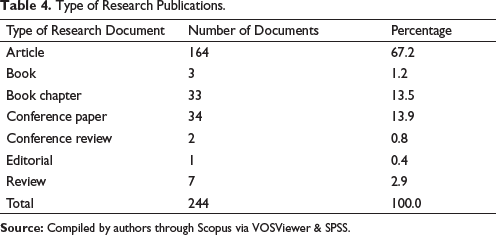
As seen in Table 4, maximum research contribution is presented in the form of research articles. On the basis of this analysis, further more publications other than article too were considered for review.
The analysis of research publication based on four keywords clearly indicates that 244 research papers over the time period of 28 years is scanty. At the same time, all publications were about motivation which can be the motivation of students or other stakeholders of university and not specifically about faculty. Thus titles of 244 publications were scanned and the result strongly indicated dismal research contributions in the area of motivational factors for faculty entrepreneurial engagement. Out of 244 publications, only 36 speak about entrepreneurial faculty and only 15 speak about faculty entrepreneur’s motivation. If entrepreneurial university is the need of countries and the world, making its academic entrepreneurial, is imperative for which academic need to be motivated. Thus we need more conceptual as well as empirical research that gives a clearer idea about ‘what motivates an academic to be entrepreneurial’. This article tried to consolidate past research for understanding motivational factors for entrepreneurial academics and also brings out ‘empirical research in the area as the scope of future research.
Research Contribution of India
After analysing past research on faculty motivation in other countries of the world, it was essential to investigate this issue in the Indian context since though recently, India too is pushing hard its universities to be entrepreneurial. The article further analysed research question two.
R2: How much is India’s contribution to the research on faculty’s entrepreneurial motivation?
As shown in the Table 2, India has contributed only 13 publications with 12 citations on the subject matter. This data indicates a huge research gap where Indian research on motivational factors of faculty entrepreneurial engagement is concerned.
Most Contributing World Authors
Researchers gathered the data on authors whose publications have stronger citation index and thus considered as significant. The result is shown in Figure 3.
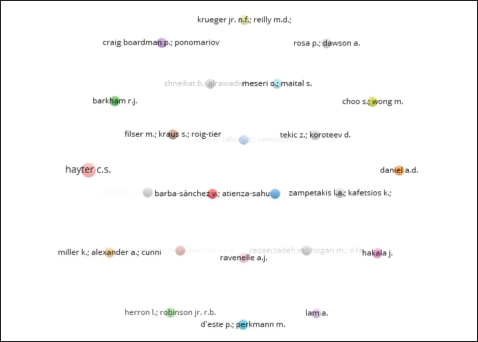
Figure 3 does not have even a single Indian author which clearly indicates a research gap where Indian faculty entrepreneurial engagement-related research is much less. Research studies are most required because these provide stronger rationale for policy formation. This analysis indicates that empirical research on motivational factors for faculty’s entrepreneurial engagement, mainly in Indian context is needed. The third research question was needed to be analysed here.
Factors Motivating Academic Entrepreneurship
Here the third research question which was analysed.
R3: What are different dimensions and factors that affect faculty’s motivation for getting engaged in entrepreneurial activities?
In the first part of the article, it was observed that past research related to different factors that lead to motivation of faculty’s entrepreneurial engagement is less. The main reason behind it may be the ‘newness’ of the concept of entrepreneurial HEI’s or academic being entrepreneurial. It takes time to adopt as well as get adapted to the radical change especially in developing countries like India where originally lack of basic campus infrastructure, lack of awareness among faculty members regarding changes in business environment was an issue. Government, policymakers are trying to bring the change. Infrastructure can be built but making the human capital, the ‘academician’ aware of the need, and convincing and motivating them to accept the change is the hardest part. In short, making HEIs entrepreneurial is an action-oriented goal. It can be best achieved only when its academic becomes entrepreneurial and adopts ‘entrepreneurship’ as its third mission. Stimulating and maintaining faculty’s participation in entrepreneurial activities can be a challenging task. For which, it is essential to study the possible motives a faculty can have to be entrepreneurial. With a better understanding of motivational factors that encourage faculty to be entrepreneurial, universities, Governments, policymakers, and industry professionals can provide required interventions to sustain the interest (Adelowo, 2021). This article addresses this vital issue by consolidating past literature about motivational factors for faculty’s entrepreneurial engagement and also locates the future scope of the research.
What Is Motivation
Motivation is a cognitive process where action is the product of goal-oriented decision-making which is initiated, developed and maintained (Huczynski & Buchanan 2007). Where faculty’s entrepreneurial motivation is concerned, according to Balven et al. (2018), it is an intraindividual-based micro process that helps faculty in identifying opportunities and acting for capitalizing on those (Ambos et al., 2008; Shane et al., 2003) by getting engaged in more innovative and entrepreneurial activities. Pinder (1998) calls motivation as ‘a set of energetic forces’. These forces or drives can be internal, generated within individual through the change in their own thought process (Ryan & Deci, 2000) or external, generated due to changes in environment (Lowenthal et al., 2013). Past literature has located two forms of motivation by and large and entrepreneurial faculty motivation to be more specific.
Forms of Motivation
Motivation can be of two forms—‘intrinsic’ and ‘extrinsic’ (Gerhart & Fang, 2015). Intrinsic motivation comes from the individual itself where ‘satisfaction’ derived from some external activities, called as extrinsic factors can be the trigger (Ryan & Deci, 2000). In fact, as stated by Lowenthal et al. (2013), extrinsic motivational factors can be the prominent motivational factors in faculty’s professional development participation. For Jackson, (2021), where entrepreneurial engagement of academic is concerned, it may be a combination of internal conviction of the faculty and ‘extrinsic motivation of ‘Technology Transfer Officers’.
Intrinsic Motivational Factors
Faculty are self-motivated due to their perception of getting a chance—(a) to work in the area of personal interest, (b) collaborate and work with colleagues, (c) remove boredom enjoy more freedom (Doutriaux & Peterman, 1982; Shane, 2004), and (d) chance to improve teaching efficiency (Bouwma-Gearhart, 2012; Harnish & Wild, 1992; Schieb & Karabenick, 2011). Past research contributions have given different reasons for intrinsic motivation of entrepreneurial academics. For Chaney (2003), intrinsic motivation comes from a chance of gaining experiences which are learnings that are relevant to teaching. For Raneri (2017) faculty’s own confidence and the perception that they are ‘helping’ student’s development including better employment opportunities, is the reason. Jackson (2021) says that intrinsic motivation revolves around four constructs—enjoy what you are doing, competence perceived by the person (Lian, 2014), how useful the contribution is, and what is the significance of the activity. However, one needs to be careful while dealing with intrinsic motivation since receiving external rewards for intrinsically motivated activities may reduce an individual’s intrinsic motivation (Deci et al., 1999). Research indicates that extrinsic factors may be the real drivers (Lowenthal et al., 2013) where faculty motivation is concerned. That is why it becomes essential for HEI’s to build a stronger start-up ecosystem which provides enough amount of extrinsic motivational factors for academic.
Extrinsic Motivational Factors
Extrinsic motivation comes from some outside element (Ryan & Deci, 2000) like a Technology Transfer Officer might get motivated by a chance to earn less risky income through sharing royalties from formal licensing agreement and in return may encourage more faculties for such agreements. As observed by many studies, there can be many extrinsic factors like stipend, release time of the grant, desire to visit some good location, and others (Chaney, 2003; Harnish & Wild, 1992; Lowenthal et al., 2013; Schieb & Karabenick, 2011). Along with these ‘forms’ of motivation, past literature speaks about two main driving forces that provide numerous motives for an academic to adopt the ‘third mission’. These driving forces are regarding ‘the availability of resources on and off the campus for students and academicians mainly.’ Interestingly, both availability and nonavailability of resources become the ‘drivers’ of motivation for faculty to be entrepreneurially engaged.
Driving Forces Behind Motivation of Academic Entrepreneur: PUSH Causation and PULL Effectuation
The resources that are available with HEI’s or faculty members, becomes an important motivational factor for getting engaged in entrepreneurial activities (de Silva, 2011). The past research reveals that it is not just ‘resource richness’ of HEI, but ‘resource scarcity’ (Adelowo, 2021; Busch & Barkema, 2021; McGowan et al., 2012) to become a motivational factor for academic to get engaged in entrepreneurial activities. Resource richness becomes a ‘pull’ factor (Fisher, 2012; Jiang & Rüling, 2019) and resource constraints become a ‘push’ factor, resulting into motivating academics to be entrepreneurial or innovative first in teaching, further leading to research work and entrepreneurship (de Silva, 2011). ‘Limited resources’ motivate or become a cause’ for faculty to get engaged in different innovative or entrepreneurial activities so that these activities get them the required resources (Rizzo, 2015; Hayter, 2015). ‘More resources’ motivates them to use those for the betterment of their careers, HEI profile, student’s knowledge, and society by and large (Adelowo, 2021). In this case, faculty’s entrepreneurial engagement becomes as a continuous, dynamic and diversified process where faculty engagement begins from less entrepreneurial activities and get diversified in more entrepreneurial activities (Tijssen, 2006), for varied motivational factors (Shane et al., 2003). Academic entrepreneurial engagement becomes self-sustainable process where faculty is first motivated in doing teaching related innovative activities in order to get better resources (PUSH factor) and use these resources in better manner (PULL factor). Further it is the combination of ‘PUSH and ‘PULL’ factors that makes them move ahead and not keep activities limited just to teaching but to take those further to research (de Silva, 2011). Even in research it is initially ‘PUSH’, factors then ‘Pull’ and further a combination of both becomes the motivational forces. Success in research activities motivates them to diversify into ‘entrepreneurial activities’ where faculties start working towards ‘company’ formation and in the process fulfill all three missions of entrepreneurial HEI. Observations by de Silva (2011) are supported by many studies like (Snyder, 2004; Tagiuri & Davis, 1992). Study by Morales-Gualdrón et al. (2009) supports observation regarding combined effect of push and pull forces. However, some studies have different views about ‘push’ and ‘pull’ forces, there comparative degrees, and significance. For Bosma and Harding (2006), the degree of these motivational forces will differ in low-income and high-income countries. Low income or developing countries of the world face a lot of resource constraints, be it skilled personnel (Alexander & Andenas, 2008; Griffith-Jones et al., 2003), investible funds, infrastructure, technology or other institutional resources. It is often observed that resource constraints may become a major motivational factor for faculty in developing countries to get engaged in entrepreneurial activities (Erdıs & Varga, 2009), whereas pull forces work in developed or high-income countries. However, Hessels et al. (2008) warns that academic entrepreneurs motivated by PUSH factors may not be able to make great contributions to the economy. Considering this point, it becomes essential that HEI’s need to take extra care that faculty’s entrepreneurial motivation has minimum amount of ‘PUSH’ element. Wright et al. (2004) observed higher degree of company formations in the universities located in the region with high level of innovations. Tagiuri and Davis (1992) highlighted that entrepreneurs are motivated by multiple motivating factors rather than one single factor. Morales-Gualdrón et al. (2009) listed six dimensions of motivation for faculty entrepreneurial engagement: (a) personal motivation, (b) entrepreneurial opportunity, (c) scientific knowledge, (d) availability of resources, (e) incubator organization, and (f) social environment. All the dimensions of motivations are further elaborated as shown the Figure 4.
Dimensions of Faculty’s Entrepreneurial Motivation.
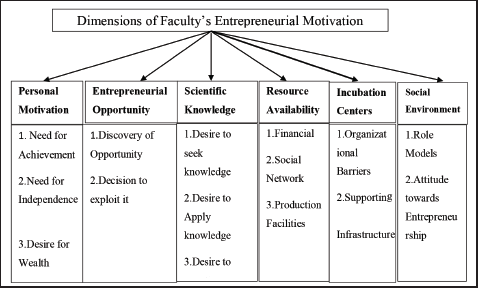
Morales-Gualdrón et al. (2009) has constructed this multidimensional approach where faculty entrepreneurial motivation is concerned. The research has given thirteen constructs which are the reasons for which faculty gets motivated to be entrepreneurial. Many other studies have confirmed these dimensions of faculty motivation. Personal motivation also can be called as intrinsic motive, where faculty’s own desires compel them to be entrepreneurial academic. A study by Durieux and Peterman (1982) indicated desire to do something different as well as desire to have better freedom of decision-making motivate academic to participate in innovation and entrepreneurial activities. For Shane (2004), chances of earning additional income and independence are personal driving forces. Where dimension of entrepreneurial opportunity is concerned, Morales-Gualdrón et al. (2009) say that awareness of the availability of entrepreneurial opportunity required handholding and infrastructure motivate faculty members to plan their own venture. This observation indicates the significance of a strong entrepreneurial ecosystem in the country (Etzkowitz & Leydesdorff, 2000).
Third dimension of motivation is desire of faculty for acquiring, applying and transferring scientific knowledge. In fact, D’Este (2011) discovered that chances of applying scientific knowledge is the most dominant motivational factor for academic entrepreneur. Where the fourth dimension is concerned, faculty is motivated to get engaged in entrepreneurial activities either due to lack of resource or because resources are ample and need to put them to use (Busch & Barkema, 2021; Jiang & Rüling, 2019; McGowan et al., 2012). For Landry et al. (2006), Incubation organization by faculty naturally motivates faculty to plan own venture which might be similar or extension of ventures incubated. The social environment that faculty experiences have greater influence where faculty entrepreneurial engagement is concerned. Social networks always seem to have greater influence where faculty is concerned (Ding & Stuart, 2006). Morales-Gualdrón et al. (2009) observe that the existence of role model greatly motivates entrepreneurial academician.
After reviewing different observations of past studies regarding the factors motivating faculty’s entrepreneurial engagement, the articles consolidate all these findings and constructs a model that gives bird’s eye view of different roles played by faculties, actions taken to fulfil the role and motivational factors behind the action as shown in Figure 5.
Model of Role, Action, and Motivations of Faculty’s Entrepreneurial Engagement.
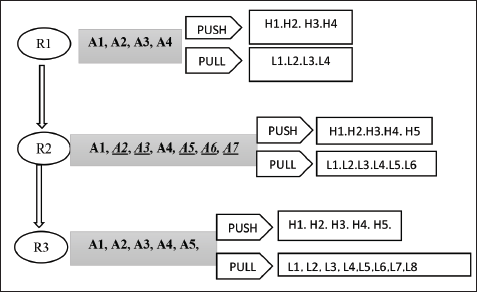
The above model shows roles that faculty entrepreneurs are expected to play. The role is depicted by ‘R’. R1 is single and fundamental role played by faculty, in innovative way and that is teaching. R2 signifies the dual role, of a teacher and researcher played by faculty entrepreneur and R3 signify the triple role, teacher, researcher, and entrepreneur played by academic. Activities performed by faculty differs with the role. Each role has role-specific actions codified as A1, A2, and others, which describe the activities that can be done by faculty in order to perform the role. This list gives clear indication to faculty of what is expected from them as an academic entrepreneur. Each action of a faculty has a motive. Either the motive is guided by resource-rich situation providing ‘pull’ factor or resource scarce situation providing ‘push’ factor, thus all ‘pull’ factor under each role are represented as L1, L2, and others and all ‘push’ factors are represented as H1, H2, and others.
R1: Generally, it leads to four actions which include development of new contemporary courses, conducting seminars, guest sessions for communities, and helping student’s placement through their industry connects. Where motivational factors are considered, under resource scarcity scenario, faculty gets engaged in innovative activities so that their activities can attract more income (Weatherston, 1995), better industry connects (de Silva, 2011), which may provide industry exposure to students for skill development and also improve demand for courses (de Silva, 2011). In case of resource rich environment, motivational factors are to get better recognition (Shane, 2004), bring placements for students, better use of knowledge and skills and to be able to identify industry–academia gap (Morales-Gualdrón et al., 2009).
R2: Success at innovative teaching encourages faculty to get into more research-oriented activities like research-based consultancy with industry either through university of privately, acquiring Governmental, non-Governmental research funding, doing collaborated research projects and developing products or services that can be commercialized in future. Where motivational factors are considered, in case of resource constraints are concerned, faculty’s actions are oriented towards overcoming problems of less publications, less resources, less industry connects and lower incomes as well as improving work environment (Chiesa & Piccaluga, 2000; Morales-Gualdrón et al., 2009; Weatherston, 1995). In the case of resource-rich situation, the motivational factors are satisfaction of faculty about their own work (Autio & Kauranen, 1994), better exposure, better placements for students, advancement of science, more freedom, and so on (Doutriaux & Peterman, 1982; Samsom & Gurdon, 1990; Shane, 2004).
R3: Faculty’s success in getting better recognition, development of innovative products, more research exposure motivates faculty to get in the triple role by being truly entrepreneurial academic. Now the span of activities become broader and more serious like formation of joint venture with university and industry or privately with industry, formation of spin-off companies, setting up and running incubation centers or formation of own start-up. Where motivation in resource scarce situation is concerned, faculty get into entrepreneurial activities for freedom from rigid regulations (Morales-Gualdrón et al., 2009), solving the problem of commercialization barriers, scarce resources with universities, lack of faith on others for effective implementation of the research (Doutriaux & Dew, 1992; Shane, 2004; Weatherston, 1995). In case of resource-rich atmosphere, motivational factors are chance to earn more money, exploit own knowledge, securing intellectual property and monetize it (D’Este, 2011), personal satisfactions, becoming an entrepreneur and making money, better use of finance facilities, exploiting market opportunities, and have better control over own invention (Autio & Kauranen, 1994; Chiesa & Piccaluga, 2000; Shane, 2004).
Among this wide range of activities and motivations, surprisingly, it was observed that the greatest motivational factors are not the formation of companies, getting IPR or earning money. The strongest motivation was ‘research-oriented’, like faculties are motivated because the entrepreneurial activities lead to ‘better applicability of research, getting research funding from industry or Government and opportunity to understand industry’s problems (D’Este, 2011).
Findings
This article has brought important issues to the forefront where research regarding motivational factors of faculty’s entrepreneurial engagement is concerned. Scanty research world over on the topic of faculty motivation was the crucial finding of this article. If universities need to be entrepreneurial, faculty need to adopt the new role fast and thus faculty motivation becomes the most important element. Thus research regarding what motivates faculty to be entrepreneurial becomes important from a policy formation perspective.
The research in Indian context is negligible which needs to increase since India is at the brink of the transformation of universities from research entities to entrepreneurial organizations.
Where faculty motivation is concerned, internal as well as external factors motivate faculty members to be entrepreneurial, among which external factors are more significant. Faculty gets motivated in resource-rich as well as resource scanty situation. However, past research indicates that motivation from resource rich situation will bring revolutionary changes in the academic entrepreneurship arena. Though the number of academic entrepreneurs is growing, academic give more importance to research and entrepreneurship is simply an extension of research.
Research Implications, Limitations, and Future Scope
Considering the findings of the research, faculty motivation becomes a complex phenomenon which is affected by internal as well as external factors. Faculty’s own knowledge, personality, and perceptions are the internal factors which are dependent on many external socioeconomic factors like social environment, opportunities, resource availabilities, and others. Deeper knowledge of all these factors and their interactions is essential to develop a better understanding on ‘factors affecting motivation’.
Research Implications for HEIs or Universities
This study throws light on the fact that HEIs will need to build a robust start-up ecosystem with appropriate policies, infrastructures, industry–Government linkages which generates interest in faculties to be a part of the ecosystem, improve their socioeconomic status, and the same derive satisfaction at the same. The study clearly states that resource rich situation is preferred over resource scanty one.
Limitations of the Study and Future Scope of the Research
As observed in sections Past Research on Faculty Motivation—All Countries Analysis and Research Contribution of India, the past research on motivational factors is insufficient for building basic models of motivations. The majority of the research works are done by ‘resource-rich countries/universities’ where motivational factors are different than factors of ‘resource-scarce’ countries/universities. This is the limitation of the study and also its future scope. There are two areas where future research is most needed. The first area located is research on entrepreneurial ecosystem preparedness of universities. Faculties thrive on research rich environment and are influenced by external factor. Knowing these issues, stronger ecosystem is essential to ensure faculty motivation. The future research on the mentioned topic can be initiated with literature review. The second area where future research is needed is empirical research on motivational factors that are located through the literature review so that policies can be framed on the basis of the findings.
Conclusion
Entrepreneurial universities play an enabler for innovation and entrepreneurial ecosystem building in all types of economies, and there is an increasing focus on the entrepreneurial engagement of academics. Academics engage in a variety of entrepreneurial activities as part of HEI’s third mission objective. Academics in entrepreneurial universities are knowledge creators and largely engage with industry for knowledge generation and transfer-related assignments. However, an entrepreneurial and innovative ecosystem in HEIs emerges and grows faster when the faculties are motivated. Therefore, the motivation of academics is an important element for better engagement in entrepreneurial activities, but research on the topic is scarce in the world and also in India. Faculty motivation is a dynamic process that depends on various individual, organizational, and institutional factors. Amidst the transition of the Indian economy from a developing to a developed one, Indian HEIs are striving hard to become entrepreneurial and innovative. Thus this thrust area of academic entrepreneurship ecosystem development needs further in-depth and empirical studies to better understand motivational factors and their influence on entrepreneurial engagements in a mixed resource-abundance and constraint economy context, which holds strong policy implications.
Footnotes
Declaration of Conflicting Interests
The authors declared no potential conflicts of interest with respect to the research, authorship, and/or publication of this article.
Funding
The authors received no financial support for the research, authorship, and/or publication of this article.
