







Abstract
Bibliometric analyses shed light on domain-specific research trends such as leading contributors and geographical distribution. This article examines these aspects in the context of stroke thrombolysis research over the past decade. Our review highlights the United States as the most prolific contributor with significant input from organizations in China, Sweden, and other countries. Overlay visualization further elucidates focus areas such as thrombolysis pharmacological agents, stroke risk factors, and advancements in assessment and diagnostic techniques.
Introduction
Ischemic stroke is a significant cause of mortality and disability across the globe. 1 The increasing prevalence of non-communicable diseases and stroke risk factors is also a concern among all nations. Neuronal damage is irreversible, and the best option to save the victim is to prevent a stroke by controlling the risk factors. However, during a stroke, the best effective treatment is revascularization during the early hours of the onset of a vascular blockade. Only a few treatment options are available for the vascular blockade’s revascularization. One of the most effective, less expensive, and less resource-demanding treatment modalities is thrombolysis with pharmacological agents. The most commonly used drug for stroke thrombolysis is rtPA (recombinant tissue Plasminogen Activator). 2 Being a lifesaving and unique treatment, extensive research is ongoing across the globe to understand the efficacy, outcome, and risks associated with various communities, age groups, co-morbidities, etc. Another critical research interest related to stroke thrombolysis is the acceptability and awareness of the treatment modality among multiple communities and factors associated with delayed or missed Golden Hour treatment.
This bibliometric review is conducted to understand the research trends in stroke thrombolysis in the last decade. Documents from SCOPUS are the source of information, including geographical distribution of research, best organizations, authors, and publishers in the domain.
Methodology
To analyze and visualize research trends in various domains relating to thrombolysis in stroke, this research is conducted using VoS viewer software. This tool allows data capture from multiple platforms, including SCOPUS, Web of Science, and PubMed, and provides insights into research trends, the geographical distribution of researchers, leading scientists, and citation trend analysis. 3
For this study, we extracted documents about stroke thrombolysis from SCOPUS using the search terms “stroke” and “thrombolysis”. The data extraction was completed on June 15, 2023 and included publications between 2013 and 2023. This search yielded 10,078 documents.
In the next stage, we narrowed our focus to journal articles only, excluding reviews and other formats such as books and letters. We also limited our inclusion to documents published in English. This resulted in a final total of 7,381 records for analysis.
Our analysis primarily presents the countries producing the most documents in this domain alongside the most contributing organizations, authors, source journals, and publishers. The keyword connectivity graph offers predictions on future research trends in the field. Additionally, our clustering process groups keywords that align with a specific research pattern, thereby providing a global snapshot of emerging trends in stroke thrombolysis.
This study uses secondary data accessed through SCOPUS; hence, ethics committee approval and patient consent forms were not required.
Results and Discussion
Research Trend
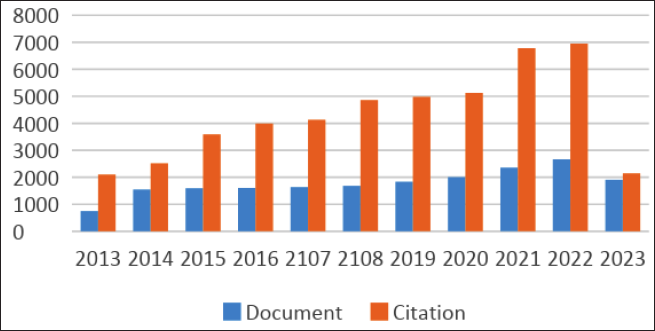
This study displayed a decade’s research trend related to thrombolysis in stroke based on the number of documents and citations (Figure 1). It is noticeable that there has been a steady increase in the number of research documents and citations in the last decade. There is a substantial increase of 751 documents in 2013 to 2661 in 2022. This indicates the increasing interest and importance of the research domain. 4
Trends in Stroke Thrombolysis Research from 2013 to 2023.
Dominant Contributors by Country
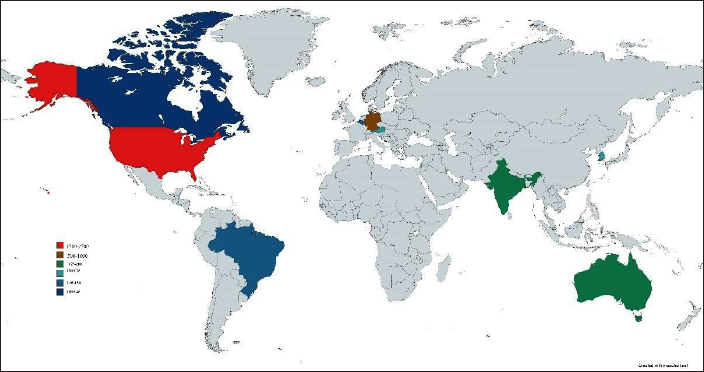
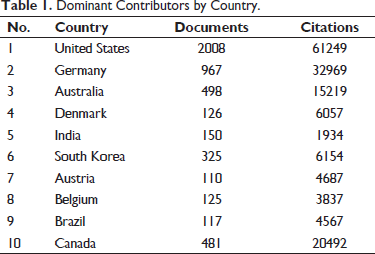
The United States (USA) has emerged as the prominent contributor to stroke thrombolysis research regarding the volume of documents and the number of citations. The USA, Germany, Australia, Denmark, and India have significantly contributed to this field (Table 1). Interestingly, countries outside the USA and Europe, notably India and Brazil, show an appreciable uptick in research activity. However, the USA maintains considerable dominance, holding a significantly higher number of documents (2008) and citations (61249) than any other nation worldwide (Figure 2).
Geographical Heat Map of the Most Productive Countries.
Keyword Overlay Mapping and Connectedness Analysis
Our bubble mapping (refer to Figure 3) highlights the most frequently associated keywords with stroke thrombolysis, including “male,” “female,” “adult,” “brain ischemia,” “aged,” “middle-aged,” and so forth. These terms, typically linked to stroke incidence or broadly related to stroke, are primarily employed as search keywords.
Clustering of Citations Based on Index Keywords.
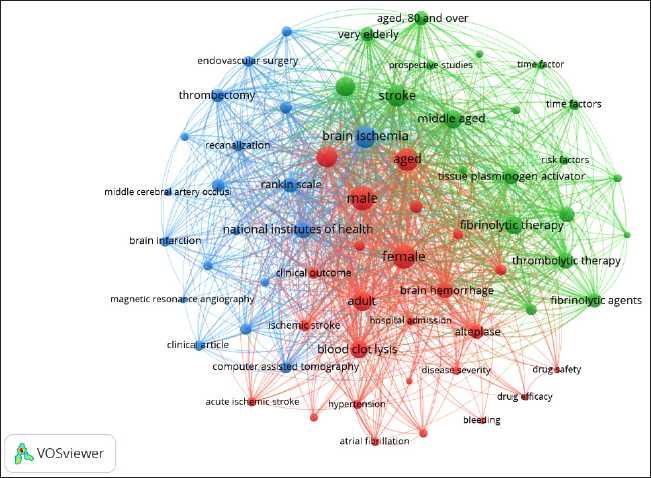
VoS viewer software has identified three color-coded clusters: blue, red, and green.
The green cluster comprises terms most associated with pharmacological agents used in stroke thrombolysis (“fibrinolytic agents,” “tissue plasminogen activator,” “thrombolytic therapy,” and “fibrinolytic therapy”) and related terms. This cluster also includes other important terms such as “time factor,” potentially emphasizing the crucial aspect “Golden Hour treatments” and age-related terms (“age above 80,” “middle age,” and “very elderly”). 5 These suggest that studies focus on investigating the safety and efficacy of these pharmacologic agents across diverse age groups. 6
The red cluster primarily displays gender-based terms (“male” and “female”) connected to treatment outcomes (“severity,” “hospital admission,” and “clinical outcome”). Furthermore, risk factor-related terms such as atrial fibrillation and hypertension are linked within the red cluster. “Alteplase,” an essential term within the red cluster, appears near the green cluster. This cluster signifies research on the outcome of stroke thrombolysis, risk factors, and their correlation with these outcomes.
The blue cluster majorly correlates with the diagnosis or assessment of stroke and its symptoms (“National Institutes of Health,” “Rankin Scale,” “computer-assisted tomography,” and “magnetic resonance imaging”). It also visualized terms related to advanced treatment options such as “recanalization,” “thrombectomy,” and “endovascular surgery.” This cluster emphasizes research on various advanced diagnostic modalities and the benefits of their integration into stroke treatment protocols. 7
Top Articles Based on Co-citation
Tissue plasminogen activator for acute ischemic stroke, N Engl J Med, 333, pp. 1581–1587, (1995) (Citations:486)
Goyal M., Demchuk A.M., Menon B.K., et al., Randomized assessment of rapid endovascular treatment of ischemic stroke, N Engl J mMd, 372, pp. 1019–1030, (2015) (Citations: 395)
Jovin T.G., Chamorro A., Cobo E., et al., Thrombectomy within 8 hours after symptom onset in ischemic stroke, N Engl J Med, 372, pp. 2296–2306, (2015) (Citations: 340)
Hacke W., Kaste M., Bluhmki E., et al., Thrombolysis with alteplase 3 to 4.5 hours after acute ischemic stroke, N Engl J Med, 359, pp. 1317–1329, (2008) (Citations: 330)
Berkhemer O.A., Fransen P.S., Beumer D., et al., A randomized trial of intraarterial treatment for acute ischemic stroke, N Engl J Med, 372, pp. 11–20, (2015) (Citations: 311)
Saver J.L., Goyal M., Bonafe A., et al., Stent-retriever thrombectomy after intravenous t-pa vs. t-pa alone in stroke, N Engl J Med, 372, pp. 2285–2295, (2015) (Citations: 292)
Campbell B.C., Mitchell P.J., Kleinig T.J., et al., Endovascular therapy for ischemic stroke with perfusion-imaging selection, N Engl J Med, 372, pp. 1009–1018, (2015) (Citations: 273)
Nogueira R.G., Jadhav A.P., Haussen D.C., et al., Thrombectomy 6 to 24 hours after stroke with a mismatch between deficit and infarct, N Engl J Med, 378, pp. 11–21, (2018) (Citations: 190)
Albers G.W., Marks M.P., Kemp S., et al., Thrombectomy for stroke at 6 to 16 hours with selection by perfusion imaging, N Engl J Med, 378, pp. 708–718, (2018) (Citations: 175)
Top Contributing Organizations
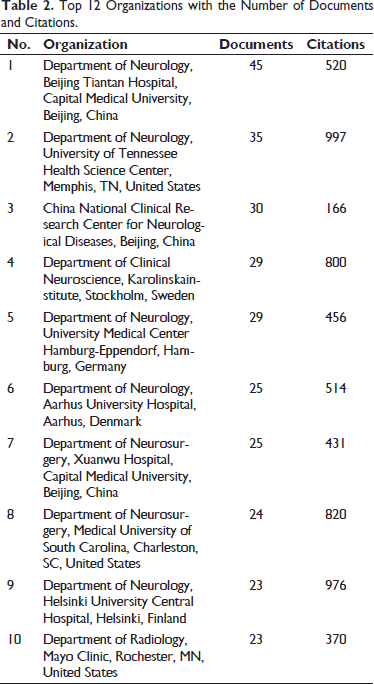
In the stroke thrombolysis domain, the most productive organizations are located in the United States and China with three organizations from each country featuring in the top 10 contributors (Table 2). The remaining organizations hail from Sweden, Denmark, Germany, and Finland. Notably, contributions from regions outside the United States and Europe are relatively lower, predominantly represented by institutions from the People’s Republic of China.
Leading Authors Based on Citation and Co-citation Connectedness
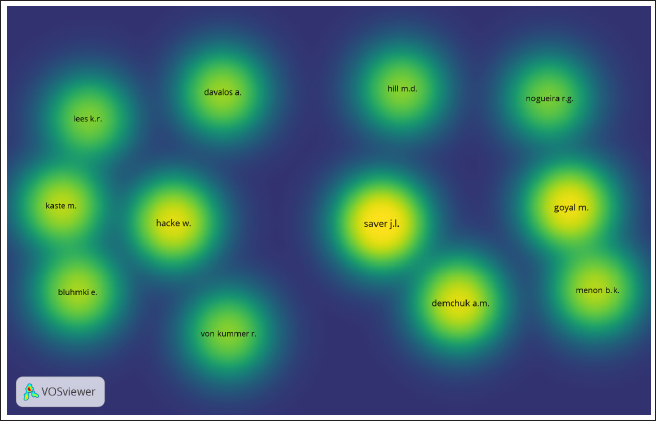
In stroke thrombolysis research, VoS intensity mapping visualizes the top 12 authors garnered 2000 or more citations. Prominent among these are Saver J.L. (USA), Demchuk A.M. (Canada), and Hacke W. (Germany). Other notable researchers include Goyal M., Menon B.K., and Kaste M. Most distinguished contributors originate from the USA and Europe (see Figure 4). However, it is important to note that the full breadth of information from this analysis may be somewhat constrained due to the software’s visualization limitations, specifically the use of initials in place of full names. This could lead to overlaps in the database due to similar initials or names.
Leading Authors in Stroke Thrombolysis Research.
Prominent Sources and Publishers in the Domain
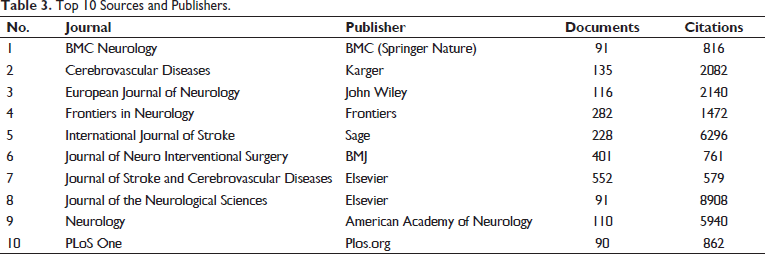
This analysis included the top 10 sources published 80 or more documents about stroke thrombolysis. As observed in the categories of top authors and organizations, American and European publishers are dominant within this domain. Notably, BMC, Karger, Elsevier, and Sage emerge as the leading publishers, with many documents and citations to their credit (refer to Table 3).
Dominant Contributors by Country.
Top 12 Organizations with the Number of Documents and Citations.
Top 10 Sources and Publishers.
Conclusion
This bibliometric study quantitatively maps the global distribution and key research trends associated with stroke thrombolysis, visualizing a robust research dominance within the United States. From 2013 to 2023, there was a noticeable rise in the number of publications and the frequency of citations, emphasizing increased research activity within this field. Overlay visualization illuminated core research interests, such as pharmacological agents utilized in thrombolysis, treatment outcomes, the correlation between risk factors and outcome of thrombolysis, and developments in stroke diagnosis and treatment. Leading contributors include organizations from the USA, China, Sweden, and significant publishers include Springer, Karger, Elsevier, John Wiley, and Frontiers. This bibliometric review is a comprehensive guide to understanding the diverse research information associated with stroke thrombolysis. It pinpoints vital information sources―from prolific authors and organizations to high-impact journals.
Footnotes
Declaration of Conflicting Interests
The authors declared no potential conflicts of interest with respect to the research, authorship, and/or publication of this article.
Ethical Approval and Informed Consent
This study is solely based on secondary data. As it is a literature review, ethics committee approval and patient consent are not required.
Funding
The authors received no financial support for the research, authorship and/or publication of this article.
