







Abstract
The entire gig ecosystem is pioneering the evolution of a workforce based on a simplistic business model of Flexing; of flexible talent or freelancers. Talent and valued skills are made available on free will by the service provider for a task specified by the service seeker. The sentiment of ‘being your own boss’ plays a crucial role in such an economy. The advent of digital technology has not only multiplied its outreach potential but also carved a way for the emergence of growth opportunities across businesses. However, ensuring the sustainability and security of employment is a challenge. The dexterity of gig workers is to be channelised for a secure future for the informal workforce, which is occurring on an incremental basis with small steps in all major industries, shaping the future trends of workforce formalisation. The recomposition of the workforce is underway with government interventions to provide social security. In this article, we aim to furnish insights on the need for formalisation and its impact on India Inc. We focus on areas like employment of women in the formal sector, the role of new-age start-ups, the implications of newly formed labour codes, the point of view of unions and others that are part of this ecosystem. We explore the potential upgrades on policy changes and industry-specific insights on the gig world covering all the major industries. We propose that it is imperative to deliberate the policies required for ensuring the sustainability of this ecosystem.
Keywords
Introduction
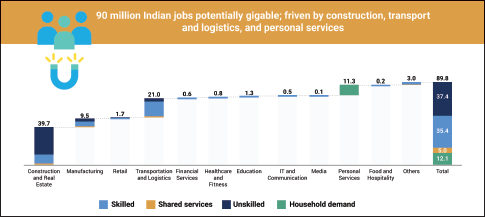
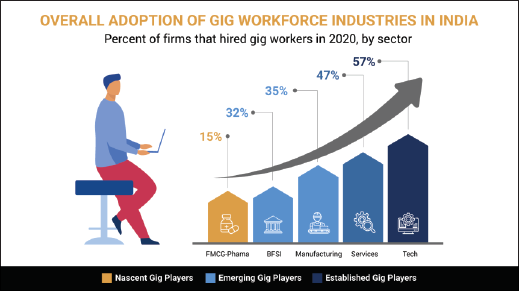
The entire gig ecosystem is pioneering the evolution of a workforce based on a simplistic business model of Flexing; of flexible talent or freelancers. Talent and valued skills are made available on free will by the service provider for a task specified by the service seeker. The sentiment of ‘being your own boss’ plays a crucial role in such an economy. The gig economy can serve up to 90 million jobs in the non-farm sectors in India, with the potential to add 1.25% to the GDP over the long term. A report by BetterPlace suggests that the gig workforce is likely to increase to 175% of 2020 numbers. The gig hiring is expected to be driven by the push from companies primarily in FMCG, FMCD, Healthcare, Pharma, telecom, IT, hospitality and BFSI, to name a few.
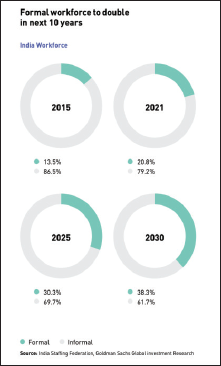
However, ensuring the sustainability and security of employment is a challenge. The dexterity of gig workers is to be channelised for a secure future for the informal workforce, which is occurring on an incremental basis with small steps in all major industries, shaping the future trends of workforce formalisation. The pandemic has opened global doors, eliminating location as a hindrance and embracing the highly skilled of pieceworkers.
Challenges Faced by Gig Workers
While gig jobs provide more freedom and discretion for professionals, there are multiple issues like low wages, lack of social security, working conditions and employee rights that need active governmental intervention. The workforce in the gig economy is based on the segment of the industry that they belong to, we may see more participation in the FMCG, retail and consumer segments than those in BFSI, manufacturing, etc.
Some of the key pain points for workers working in the gig economy revolve around the formalisation of the workforce. They have no job security, they are not covered under any labour codes, they have no bargaining power except when a person is extremely talented and there is no formal pay structure. Earnings may vary based on your engagement as there is no ceiling on potential income and a formal structure in place. Flexibility in engagement is a major cause for concern, and there is pressure on workers to complete difficult targets, risking their lives, for a nominal amount of incentive.
Access to financial services for workers employed in the gig economy has proven to be a challenge. With no stable income to show for, the workers find it difficult to get any loans from financial institutions for emergencies, marriage expenses, hospitalisation expenses, etc. Workers are not eligible for social security benefits, maternity benefits, accident and health benefits, and there is no mechanism in place to cover their family members. The workers have to ensure the health and other facilities for their family members at their own cost. Gig workers have to invest in upgrading their skills at their own cost. The market is unregulated and offers no legal protection − Workers are treated as independent contractors, not employees.
A recent report by Boston Consulting Group has identified work assurance, timely payments, learning and personality development and regular salary increments as the major causes of dissatisfaction among gig workers (BCG Report, 2021). The prospect of earning higher incomes by taking up gig work has been one of the major factors that have been driving the interest levels among skilled workers. However, factors such as regular increments, timely payment of salaries and employee benefits have been detrimental to the push for the adoption of the workforce in the gig economy.
If steps are taken to actively address these concerns, the gig economy could be a significant driver of growth for India. By exploiting economies of scale, digital platforms can match demand and supply in the most cost-effective manner. This translates to lower unit costs for platforms and higher unit pay for workers. India has also built a strong public digital infrastructure, which is a key component of the gig ecosystem.
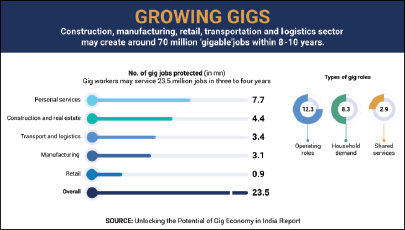
The pandemic has opened global doors, eliminating location as a hindrance and embracing the highly skilled pieceworkers. Sustainability and security in a dynamic economy as such will be a grey area, but the pros of women’s inclusion and work−life balance outweigh the cons of concern. The gig economy has the potential to generate nearly 24 million jobs in skilled, semi-skilled and shared services roles in the short-to-medium term, including nearly 3 million shared services roles and around 8.5 million roles meeting household demand.
Women’s Participation in Gig Economies
According to the World Bank, doubling the percentage of women in the workforce would boost India’s growth rate from 7.5 to 9% and raise the country’s GDP to US$700 billion by 2025 (Morgan, 2021). The focus of putting India to work is not limited by gender biases and we need to have special programmes in place to ensure that we enable women to lead across our three pillars of employment, employability and ease of doing business. We at TeamLease have 20% female associates and are working towards our approach for empowering diversity and inclusion. While the shift of work to digital space is at an all-time high, there exists a huge gender gap when it comes to access to mobile phones and the internet in the country. India’s fifth National Family Health Survey (NFHS) 2020 revealed that there is a significant digital divide in the country, with rural women least likely to have internet access.
While technology is expected to show a bias, the demand for worker who can work from home is pushing more women into the workforce. The increased inclination of companies in the sales and distribution jobs towards work for home setup could open up opportunities for women in the workforce. Moreover, new gig economy jobs and the easing of transactional economies can also push women to pursue their careers. An IWWAGE study of women service providers or gig economy workers on an aggregator service platform showed that 85% of respondents were satisfied with flexible timings, and considered it the most attractive feature of gig work, along with the earning potential.
The increased flexibility in terms of work is expected to bring more women into the workforce, especially those who leave due to increased caregiving responsibilities. As women age, they tend to prioritise flexibility over career progression. With employers embracing the new model openly, women can be expected to face greater acceptance while making such choices. The government’s push to include more women in the workforce through its schemes like the new science and technology policy, Occupational Safety, Health and Working Conditions Code – 2020, envisioning the employment of women in all establishments covering all types of work, skills development and self-employment through STEP (Support to Training and Employment Programme for Women), financial inclusion (180 million women under PM Jan Dhan Yojana), etc., has given the much-needed impetus required to drive women’s participation in the gig workforce.
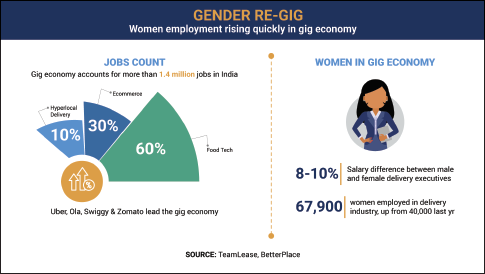
The pandemic has improved the adoption of technology, pushing firms to create a dynamic model of the working environment that is conducive to their employees. Companies have introduced flexible working hours, and with location no longer being a constraint for employment, the gig workforce is expected to witness increased participation of women. Sustainability and security in a dynamic economy as such will be a grey area, but the pros of women’s inclusion and work−life balance outweigh the cons of concern. As per the EOR-Q2 report by TeamLease, the pandemic has provided an impetus to the expansion of telemedicine and home healthcare, which has the potential to create 12.5K jobs for women on a quarterly basis, in nursing as well as attendant/caregiver roles (TeamLease Services, 2021, July). E-commerce firms backed by a boost in demand have increased their hiring; Zomato has plans to improve its participation in women delivery by almost 10%.
Formalisation of Gig Workers
Though the country accounts for ∼13.9% of the world’s labour force, nearly 88.1% (as of 2019) of the entire workforce is categorised as ‘unorganised’, making this one of the highest in the world. The pandemic highlighted the need for social security cover and exposed the vulnerabilities faced by informal workers. Informal workers are not eligible for standard employee benefits like ESIC, PF, minimum wages, etc., and they do not have a standardised payroll and query resolution process. With the adoption of technologies and gig platforms, we have been able to provide digital identity, verification, timely payments and create formalisation to some extent. The labour codes need to be refined to cater to the needs of informal workers who are still not covered under the labour laws and are thus devoid of any benefits. Gig platforms like Uber, Ola, Airbnb and Upwork have provided gig workers with on-demand hire services.
There is a need for the formalisation of the gig economy. It is imperative to deliberate on the policies required for ensuring the sustainability of this ecosystem. The policies have to be dovetailed specific to the specific industry and new labour laws (codes) have to be emphasised as conducive laws promoting the inclusion of gig workers.
Rights of Gig Workers
Gig workers are not engaged as employees by any aggregator. They are treated as independent contractors and hence their legal rights, matters related to grievance redressal and dispute resolution are solely governed by the individual contracts the gig workers enter into with the aggregators. Aggregators have a free hand to stipulate the terms and conditions of engagement, and gig workers are bound to accept the terms and conditions stipulated by the aggregators. Hence, most of the terms and conditions of the agreement would be one-sided.
Laws and Regulations Applicable to Gig Workers
For the very first time, we have taken a fundamental look at all our labour laws and rationalised them. The Code on Wages was passed in 2019 by both houses of Parliament. This was followed by the tabling of three other labour code bills during the 2020 monsoon session.
However, there are no laws currently applicable to gig workers. The Unorganised Workers’ Social Security Act 2008, (Act) does not define the terms ‘gig worker’ and ‘aggregator’. However, gig workers can be treated as ‘self-employed persons’ under this Act. There were no registration procedures or provisions for making contributions to any Social Security Fund framed under this Act by gig Workers and aggregators. Hence, gig workers could not avail of any benefits under the schemes that are applicable under this Act. Gig workers are being engaged as independent contractors by the aggregators and, hence, the obligations of employers that are applicable under this Act do not apply to the aggregators.
The Code on Social Security 2020 widened coverage by including unorganised sectors such as platform workers, gig workers and inter-state migrant workers. The code has well-recognised gig and platform workers, but a diverse majority of migrant workers are sidelined. Only 19% had a written job contract, and 29% were eligible for paid leave. In terms of social security provisions, only 26% of the workers were eligible for social security benefits − 35% of workers in urban areas and 17% of workers in rural areas were eligible to avail of social benefits. The code does not enable the portability of social security benefits to a greater extent, which significantly benefits migrant workers. The large number of migrant workers from the micro-units could have accessed social security benefits had the code provided a social security floor for all workers.
Data Policy
Data policies framed by the aggregators for adherence by the gig workers differ according to the nature of aggregators’ business. In India, there is no robust personal data protection legislative framework. The draft rules on the Social Security Code, 2020, have proposed the creation of a centralised database of platform and gig workers. Enrolment on this database takes place through two routes − self-registration using Aadhaar authentication and periodic sharing of worker data records by platform aggregators. The data fields range from address, mobile number, number of workdays, skill-sets to any other particulars that the Centre chooses to add. The onus of updating the records fully falls on the shoulders of the individual gig workers. In the absence of such an update, the rules provide that they would not be eligible for benefits. The personal records of the gig and platform workers may be used by the aggregators, without their knowledge, for any business gains.
Industry-specific Gig World
As the Covid-19 pandemic induced constraints and restrictions squeezed company budgets, the demand for temporary staffers started increasing. Though the restrictions have been relaxed, the uncertainty persists as the industry braces for the new mode of engagement, which is driven by digital technology and offerings. If the trends of the past few months are anything to go by, the hiring trend will continue to grow and drive the gig economy.
Going by the trends observed in FY 2020−21, high expertise-based job profiles have steadily grown in criticality over the last 12 months and are seen by employers as indispensable. These attract around 11% salary increment or more, as compared with market averages ranging between 1.73% (minimum) and 14.07%. Super-specialised job profiles like Banking Trainer– (Banking, Financial Services and Insurance) have exhibited a growth of 11.32%; Compliance Officer (Construction & Real Estate) has exhibited a growth of 11.1% and Software Test Specialist (Information Technology and Knowledge Services) has shown growth rates of 10.58%. Banking, Financial Services and Insurance, Healthcare and Allied Industries & Information Technology and Knowledge Services exhibited growth of over 10%. The hiring in the Healthcare & Pharmaceuticals sector in Delhi has shown a maximum growth rate of 10.33%, whereas, the Banking, Financial Services and Insurance sector in Bengaluru have shown a maximum growth rate of 10.03% (TeamLease Services Limited, 2021, July).
We are expecting a 35−40% shoot-up in the demand for gig workers, with sectors like FMCG, retail, consumer, telecom, hospitality and IT hiring showing a positive trend. TeamLease is expecting to add 1 million jobs in the gig space, which will be driven by demand in the logistics sector and boosted by the seasonal-festivities-driven hiring in September, October and December.
The demand for gig workers in the
In the
The
In the
The
Employers in the
Skills in Demand
As per research, the overall demand for jobs in 2020 was 1.4 million, and the gig economy accounted for 80% of the demand. India’s gig economy is still at a nascent stage, but the young and not-so-skilled flexi workforce will gradually shift to better-paid and more productive work. The gig economy will comprise both existing jobs that migrate to gig platforms as well as new jobs that will be created in the economy. The post-pandemic relaxation followed by the festive season will provide the necessary impetus to drive hiring. Firms will, however, retain a good chunk of their gig workers due to upcoming festivities and year-end sales.
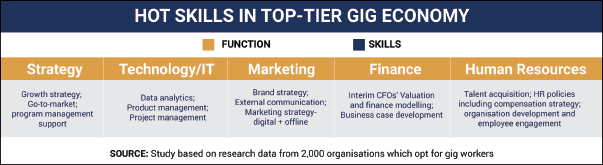
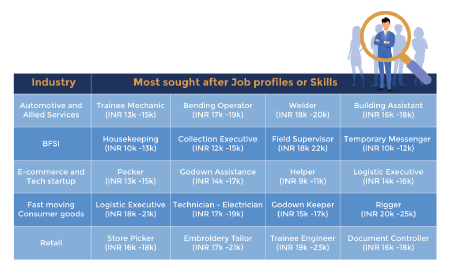
The skills to digitise and automate processes have generated a growing demand for professionals with specialised skills such as digital adoption, data analysis, AI know-how and automation plus delivery agents and warehousing managers on the delivery front. In the digital banking domain, blue-collar workers find the major skills in demand are on block-chain, artificial intelligence, machine learning, cloud computing, robotic process automation, financial data analysis and cyber-security. Post-pandemic hiring has also witnessed an increase in hiring in the IT and Sales profiles.
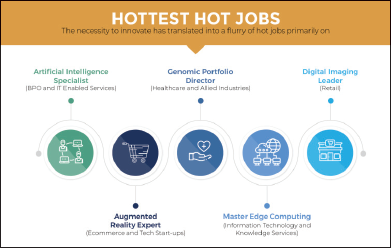
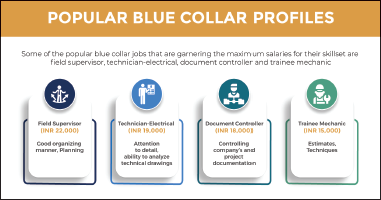
Some of the most sought-after skills based on industries along with their average salary composition have been mentioned below:
Role of Startups
We are witnessing a rise in start-ups that are outsourcing many activities to expert service providers on a contractual basis. The Indian start-up ecosystem has evolved remarkably over the last few decades and is now home to an estimated 38,000 start-ups, making India the third-largest start-up ecosystem in the world. 1 As the nation is still recovering from the COVID-induced lockdown, there are encouraging signs, which have been further substantiated by the buoyant market and growth projections over the next couple of years. The entire tech and digital universe have taken off on a trajectory that has been exponentially boosted by the pandemic. In recent years, tech start-ups have impacted lives not just in the area of technology but all across. Many start-ups have enabled the formalisation of the workforce.
In the fintech industry, with the advent of new tech start-ups, there is an emergence and resurgence of a great many organisations. It augurs well because we need this pipeline of start-ups. We know that there would be a certain percentage of failure, but it is leading to innovation. With the emergence of the start-up ecosystem, it’s not just about the number of jobs but quality as well. Youth are now finding the flexibility as well as the opportunity to earn much higher than what they used to. Some of the start-ups are impacting the smaller cities as well. Some of the ideas are promising and would probably impact the youth even in the rural setup. We will see an increase in opportunities for the youth. This will not only be limited to the technology front, but will also impact and transform the lives of people on the ground.
With most of the sectors and establishments getting back on their feet, the intent to hire also seems to be regaining. As per the recently launched ‘TeamLease Employment Outlook Report’, which indicates that the hiring intent for entry, mid and senior talent has risen by 2%, 4% and 2% points, respectively, the intent for hiring junior talent has increased by 7%, indicating Ache Din for talent with a work experience of 2−5 years (TeamLease Services Limited, 2021, June). As per the report, the intent to hire has registered a 6% point increase in the period January−March 2021 compared to the previous quarter. The positivity in the job market is attributed to business recovery, strong FDI inflows as well as the thrust from the government towards creating a positive regulatory ecosystem. We have started seeing increased investments in the start-up sector; We Founder Circle invested around ₹190 million in various start-ups in technology, rural distribution and business development, etc., and BASF Venture Capital GmbH invested in agri-tech start-up UrbanKisaan for deploying farming technology and expanding its market presence in India.
From an employment perspective, the employees are gaining valuable experience by doing their jobs. They are also able to enjoy a certain wage premium which they may not have enjoyed if they had stuck to an informal sector job. This also improves the purchasing power capacity of a wider range of our youth today. And all of that ploughs back into the economy. When the e-commerce resurgence happened, there were many organisations in that space. We had delivery agents and boys deployed all over. Consolidation has set in now, but we are yet to find an unemployed delivery boy. If anything, they have only actually moved on to work for larger organisations, maybe more stable organisations. But start-ups are where they have started earning. Startups were among the early adopters of local talent, however, large corporates and professionals are the ones that are driving the demand.
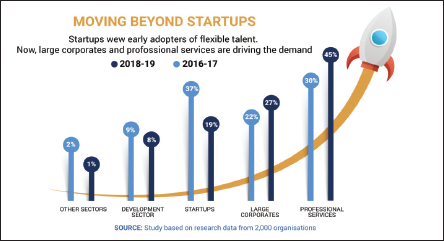
The growth is encouraging. With time, the ecosystem will mature and a large number of start-ups will have the set formulae for success, thereby further reducing the dropout rates and increasing the creation of new jobs. Being one of the largest consumer/retail markets in the world, India can be the hotbed for testing innovation and start-ups in the future.
Future Landscape of Gig Economy
There has been a considerable increase in employment through the gig economy over the last couple of years; it has increased from 8.5 million workers in 2016 to nearly 17 million workers currently and is expected to reach 24 million jobs in the non-farm sector in the next 3−4 years. The gig economy-can serve up to 90 million jobs in the non-farm sectors in India, with a potential to add 1.25% to the GDP over the long term. In the short-to-medium term, nearly 24 million jobs in skilled, semi-skilled and shared services roles could be delivered via the gig economy, including nearly 3 million shared services roles and around 8.5 million roles meeting household demand. A majority of 70 million ’gigable jobs’ are in the construction, manufacturing, transportation and logistics and personal services sectors. The gig economy-could create about one million net new jobs over the next 2−3 years by aligning the near-term incentives of employers and workers.
The future of the gig economy is yet to be seen, but experts have already anticipated a multifold rise in freelance assignments in the years to come. Although it is difficult to estimate just how many Indians make a living from the gig economy, given the unorganised nature of some of the above industries, according to a Boston Consulting Group study, more than 8 million Indians are gig workers, which is expected to grow to 24 million by 2023−24 and 90 million before the end of the decade (BCG Report, 2021). Predictably, the ripple effect will continue to expand beyond the urban areas, and an increasing number of women will be adopting the gig scheme of things.
As tech platforms, marketplaces and aggregators continue to achieve scale, gig hiring will rise multifold. The very nature of gig workers has proven appealing to companies who are seeking a short-term, risk-averse, cost-effective employment option during uncertain economic times. As voiced by one of the gig platform founders, ‘if automation and robotics are seen as a threat to jobs, then gig economy, is the saviour’. Gig economy platform founders believe that 90% of the problems related to employee benefits will be solved once the Code on Social Security is implemented. The best way forward in such a scenario would be to bring policymakers and platforms together to discuss the pressing issues related to platform work and ensure access to decent work for these workers in the gig space. Once income stability is offered through provident schemes or minimum guarantees, most workers will take up gig work because of the inherent flexibility. Right now, it is like a full-time job but with none of the employee benefits. The demand for productive employees will see a rise in companies as they try to complete their projects with minimal cost.
Bridging the sizeable and glaring gaps present in the gig ecosystem will motivate people to adopt freelancing and work on a project-to-project basis. The gig worker ripple effect is expected to have higher adoption rates once the new labour codes are rolled out. This is going to be a step in the right direction for the job market by moving away from the perils of employed poverty. All in all, it culminates in the fact that economies are rivers, not ponds; the hotspots for job creation keep changing with trade, technology, tastes and much else.
Footnotes
Declaration of Conflicting Interests
Funding
The authors received no financial support for the research, authorship and/or publication of this article.