







Abstract
We sought to develop a tool designed to measure psychosocial reintegration outcomes among military veterans. We used a sequential mixed-methods study design for this research project. We conducted semi-structured interviews about veteran reintegration with 30 veteran members of The Mission Continues (TMC). Transcripts were coded/thematized based on three TMC program areas: personal growth (PG), connectedness (C), and community impact (CI). We developed/pilot-tested 65 Likert-scale items across three constructs. We collected survey data (n = 851) and performed exploratory factor analysis. Cronbach’s alpha was used to measure internal consistency reliability. Results showed that the three-factor model was satisfactory, with eigenvalues of 8.11, 5.50, and 4.92, respectively, on the PG, C, and CI constructs. Model fit indices were also acceptable (RMSEA = 0.06) and Cronbach’s α’s were >.90. This study provided initial validity and reliability evidence for a tool that can be used to assess psychosocial reintegration outcomes among veterans.
Keywords
Although many veterans successfully transition to civilian life without experiencing long-term readjustment difficulties (Bonanno, 2004), a considerable number of those returning face psychosocial challenges and stressors related to reintegration, especially in rural areas (McDaniel et al., 2023). In a national survey of combat veterans, 25% reported experiencing varying levels of difficulty in multiple domains of functioning and community involvement following deployment (Sayer et al., 2011). Unaddressed, these reintegration challenges result in negative consequences, preventing veterans from resuming (or redefining) their roles in the family, community, and workplace. While veteran reintegration research has largely focused on mental and physical health outcomes, psychosocial outcomes—the focus of this review—have begun to receive specific consideration and attention as these factors may also impede full reintegration. Indeed, research has shown that it is possible to prevent downstream problems, such as suicidal ideation, when reintegration stress is mitigated through meaningful community engagement and friendship development following military retirement (Haller et al., 2015). As such, the topics examined in this paper could have potentially important prevention and health promotion implications, particularly among the military veteran population.
This review provides a theoretical justification for the Empowered Veteran Index (EVI)—a framework to measure and assess veteran experiences in three domains: (a) personal growth, (b) connectedness, and (c) community impact. The previously listed domains are programmatic priorities for The Mission Continues (TMC), a 501(c)(3) non-profit organization in the United States serving military veterans and their families. These domains are specific and unique to TMC, and they collectively represent a reintegration construct that is unlike other validated measures in use by other veteran-serving non-profits (i.e., the Enriched Life Scale used by Team Red, White, and Blue; Angel et al., 2019). TMC, which was founded in 2007, has enlisted 93,600 veterans in 8,650 service projects, primarily in underserved areas throughout the United States, having operations in 40 cities. These operations seek to help veterans find friends through the completion of community revitalization projects, as well as to assist veterans in obtaining new skills. At present, TMC does not have a validated measure for evaluating outcomes in these areas among veteran participants.
Personal Growth
Veterans often experience personal growth after retiring from the military (Adler et al., 2011; Benetato, 2011; Tsai et al., 2015). Regarding positive change, research with Afghanistan and Iraq combat veterans found that a majority of respondents reported post-traumatic growth as a result of their combat experience, including endorsing changing priorities about what is important in life (Pietrzak et al., 2010). Additionally, research has shown that military experience may have varied outcomes. In particular, military stressors can correlate with both post-traumatic stress disorder and post-traumatic growth (Park et al., 2008). Accordingly, increased recognition exists among mental health professionals that the post-traumatic growth and positive benefits associated with combat experience warrants particular attention in addition to the negative costs of military service and reintegration (Tedeschi & Calhoun, 1996).
The post-traumatic growth model is a strengths-based approach whereby traumatic events, such as combat exposure, are viewed as having mixed effects on veterans and can influence positive psychological outcomes (Tedeschi & McNally, 2011). Proponents of the post-traumatic growth model posit that traumatic events can be opportunities for personal growth. The post-traumatic growth model is an alternative approach to pathology-based treatment and deficit-based programming and offers a more holistic view of potential reintegration services. Thus, researchers are beginning to express support for the examination of ways to facilitate post-traumatic growth (Benetato, 2011; Tsai et al., 2015; Tsai & Pietrzak, 2017).
Another important domain of psychosocial functioning is a sense of purpose; however, little research has specifically addressed this topic among veterans. Some studies have revealed that military service provides individuals with a profound sense of purpose. Service members have reported feeling part of something bigger than themselves as well as meaningfully contributing to a worthwhile cause (Kukla et al., 2015). Consistent with this literature, there is also evidence to support that returning to civilian life may be accompanied by a loss of sense of purpose and meaning (Ahern et al., 2015; Gregg et al., 2016; Herman & Yarwood, 2014; Kukla et al., 2015; Naphan & Elliot, 2015). Veterans who are able to find a sense of purpose following their military service are less likely to exhibit suicidal ideation (Kachadourian et al., 2019; Pietrzak et al., 2009). Studies have also shown that a greater sense of purpose predicts higher levels of resilience, thus acting as a protective psychosocial factor (Isaacs et al., 2017; Pietrzak & Cook, 2013; Southwick, 2011). Research on reintegration and gains in sense of purpose with lower suicidal ideation and higher resilience underscores the need for continued research in this area, as well as programming that increases sense of purpose.
Because veterans may experience multiple stressors upon return to civilian life, resilience is a significant protective factor against mental health problems. For instance, levels of resilience in veterans have been found to moderate the relationship between combat exposure and post-traumatic stress disorder (PTSD) symptoms (Blackburn & Owens, 2015), and research suggests that veterans with a “resilient personality prototype” experience less stress during reintegration (Elliot et al., 2015). Furthermore, developing ways of coping adaptively with stress and in effect buffering the impact of stress through participation in resilience-based preventative early interventions have been shown to influence individual level resilience-based outcomes, including social and emotional fitness (Lester et al., 2011; Thomas & Albright, 2018; Thomas, McDaniel et al., 2018). Although the effects were moderate, the outcomes of other training programs have affirmed the integration of positive psychology and cognitive behavioral therapy in resilience intervention programming (Meredith et al., 2011). Some research has found that resilience interventions increase resilience outcomes and related competencies (Tenhula et al., 2014; Thomas & Plummer Taylor, 2015; Thomas et al., 2015), while other research has shown no significant changes on measures of resilience following the intervention (Sylvia et al., 2015).
As veterans transition to civilian employee roles, it is critical to examine job readiness because reintegration challenges in this area are common. Sayer et al. (2011) showed that unemployed veterans, compared to employed veterans, reported more difficulty adjusting to post-deployment life. Sex and race have also been found to have a differential impact upon unemployment rates. Female veterans, for example, experience higher unemployment rates than male veterans (Thomas, McDaniel et al., 2017), and Black veterans experience lower unemployment rates than White veterans. Although deployment is not negatively associated with job performance (Erbes et al., 2011), prominent work barriers for veterans have been documented, including psychological stress (Kukla et al., 2015). Also, veterans with mental and physical health diagnoses and disorders may have increased challenges related to employment adjustment (Glover-Graf et al., 2010). Alternatively, veterans have reported the following as employment facilitators: motivation, self-confidence, job match, supported employment services, and social support (Campbell & Riggs, 2015; Kukla et al., 2015). It is evident that access to vocational rehabilitation, including supportive employment opportunities, may improve workplace reintegration experiences.
Regarding employer perceptions, research suggests that employers are willing to hire veterans, perceive benefits to doing so, and believe that veterans will perform comparably to nonveterans. However, employers have also reported a lack of knowledge about accommodating veterans with PTSD and traumatic brain injury as well as neglecting veteran-specific recruitment strategies (Harrell & Berglass, 2012). Findings further reveal that the most common reason for hiring veterans is the perceived leadership skills they possess (Harrell & Berglass, 2012). Additional research is needed to more closely examine the leadership development of service members and the influence this has upon job readiness.
Little research has focused on empowerment as a psychosocial factor related to veteran reintegration. However, there is research that shows that stigma, the antithesis of empowerment, is a hindrance to community reintegration. Studies have documented the association between successful reintegration and low stigma (Fink et al., 2014; Hawkins et al., 2015). Help-seeking behaviors are limited among veterans who perceive stigma around mental health treatment (Hoge et al., 2004; Stecker et al., 2007). To reduce stigma and increase empowerment, researchers have suggested implementing self-stigma reduction strategies to reappraise negative, inaccurate stereotypes (Stecker et al., 2007), bolstering capacity within entities like postsecondary institutions to promote veteran health (Albright et al., 2017; Albright, Landor et al. 2019), and training military leaders to engage in educational efforts to inform service members about the consequences of stigma. Exploring interventions to increase empowerment among veterans is a promising area for research as help-seeking is related to successful community reintegration.
Connectedness
Connectedness is central to successful reintegration (Lee & Robbins, 1995; Thomas, Haring et al., 2017). Reintegration into civilian life provides unique challenges for veterans. Many report difficulties establishing new friendships and connecting with others through the sharing of personal thoughts and feelings (Brown et al., 2016). A 2016 study found that almost half of the post-9/11 veterans felt disconnected from the world and were unable to identify a sense of togetherness with peers (Kintzle et al., 2016). Upon returning from deployment, withdrawal from social networks is common among veterans, especially as their sense of belonging bound by the unit cohesion diminishes (Bryan & Heron, 2015; Finley et al., 2010). Those who were not deployed may experience exacerbated isolation due to guilt, anger, and internal feelings of being devalued (Hoopsick et al., 2018).
The sense of belonging one may experience as a service member is negatively associated with depression and PTSD symptomology, and veterans who are able to form social connections while maintaining a lower perception of burden on others experience decreased rates of suicidal ideation (Allan et al., 2018; Bryan & Heron, 2015; Kintzle et al., 2018). In turn, deepening these relationships and developing secure attachments nourishes resilient characteristics (Pietrzak & Cook, 2013). Family and social support increase the likelihood that one will seek treatment for mental health concerns (Albright et al., 2017). It also has the potential to facilitate post-traumatic growth among those with trauma exposure (Bloeser et al., 2014; Borowa et al., 2016). Virtual social capital, in the form of social networking sites, may increase connections among veterans and assist in building ties to the civilian workforce ( Weinburger et al., 2015).
The current U.S. veteran population is expected to decline from 20 million in 2017 to approximately 13.6 million by 2037. Only 33% of 18–29-year-olds have an immediate familial relationship to a veteran compared to 79% of 50–64-year-old residents (Pew Social and Demographic Trends, 2011; United States Department of Veterans Affairs, 2016). Some research has even shown that veterans and civilians are residentially segregated (McDaniel, Albright et al., 2019; McDaniel, Mayer et al., 2019). Reintegration is heavily influenced by the gap that exists between military personnel and civilians, and the cultural norms of each group. Veterans often embody a “warrior identity” and possess a perspective that is unfamiliar to civilians (Atuel & Castro, 2018; Thomas, 2016). Veterans have described their transitions to civilian culture post-military service to include experiences of personal struggle, personal growth, and continuity of military culture after separation from service (McCormick et al., 2019).
The gap between veteran and civilian life has widened due to media portrayal of veterans, with mass media providing a narrow representation of what it means to be a veteran (Parrott, Albright, Dyche, 2019; Parrott, Albright, Steele, 2019; Parrott et al., 2021). While military members are framed as deserving of benefits for their service, reports victimize veterans and often singularly focus on the negative outcomes of their service (Kleykamp & Hipes, 2015). The general public translates coverage of veterans into support for those who saw combat but only with the expectation of problematic behavior by those returning (MacLean & Kleykamp, 2014). In a therapeutic manner, storytelling by veterans to public audiences may facilitate changes in civilian perceptions; however, training veterans in this method and locating the setting presents a challenge (Mamon et al., 2017). Academic environments do provide a setting where veterans and civilians interact and may be a suitable setting for story telling (Smith, 2018). Among veterans who attend college, the military-civilian gap remains. Civilian students are unfamiliar with military culture and are often perceived as “anti-military” in classroom settings, leaving student veterans hesitant to disclose their military history (Osborne, 2013). The campus as an institution may not understand the struggles related to transitioning into civilian life, but the addition of student veteran peer support facilitates more successful academic outcomes (Osborne, 2013; Smith, 2018; Thomas, Albright et al., 2018).
The effect of peer support on veteran functioning, adjustment, mental health, and relationship building is positive in terms of fostering connectedness during reintegration. Through peer support programs, isolated difficulties become a collective challenge to face and overcome. Checking-in with others through mission-specific work builds the ability to connect with veterans in a comfortable environment and improve communication skills (Brown et al., 2016). Involvement with these programs builds positive social connections that can facilitate resiliency through later life (Knudsen & Wingenfeld, 2016; Pietrzak & Cook, 2013). Those who reintegrate find that services and institutions meant to ease the transition are often unsupportive and ineffective, yet peer support provides invaluable resources to guide them through this process (Ahern et al., 2015; Keeling et al., 2018). Among veterans who are in dyadic relationships, an increase in social support can positively affect the relationship functioning and the mental health outcomes of their partners (Cederbaum et al., 2017). Peer support programs allow for greater trust in formal and informal systems (Bowen et al., 2016). Receiving and providing support to peers during job training is valuable and can help in obtaining personal and professional goals (Cooper et al., 2016).
Community Impact
Community is a frequent topic in reintegration research, yet conceptualizations of how it functions vary greatly. The physical features of the community, services provided within them, socio-cultural features of a community, and the individuals residing within the community impact the returning veteran (Macintyre et al., 2002). As service members adjust to life in a civilian setting, they commonly feel that they are not needed (Bowling & Sherman, 2008; Laffay et al., 2008). Counteracting negative cognitions and psychological symptoms through community support mechanisms has been shown to be effective (Beehler et al., 2017; Conforte et al., 2017).
Volunteerism and community work are effective tools in building a sense of community, as well as in positively impacting underserved areas of one’s place of residence. Veterans who participate in community-based volunteer programs boost their sense of social connectedness and purpose (Albright, McDaniel et al., 2019; Miller et al., 2002). This work bridges the military-civilian gap by allowing veterans and civilians to share their similarities and differences (Kaplan, 1997; Sippel et al., 2015). Community empathy and a sense of community responsibility are developed through service work (Miller et al., 2002).
Study Aims
The purpose of this study is to develop an evaluation tool/survey capable of measuring three constructs among military veterans: personal growth, connectedness, and community impact. The existing literature supports these three program areas, but there is clear need for a three-pronged cohesive tool, especially for use in program evaluation efforts at TMC—an agency that provides services to nearly 100,000 veterans throughout the United States. In order to accomplish this aim, we conducted two studies. First, in study one, we conducted an interview-based qualitative study with veterans in order to learn more about veteran perceptions of the three domains of interest. Second, in study two, we developed Likert-scale items based on the results of study one in order to examine the psychometric properties of a quantitative measurement tool.
Study One
Methods
Sampling
The protocol in this study was reviewed and approved by the Human Subjects Committee of a Midwestern University. The researchers randomly selected 30 military veterans from a list of 1,313 email addresses, which were obtained by TMC through their member database. Participants were given an informed consent document and, upon agreement to participate, were asked to schedule a time for an Internet-facilitated video call. Demographic characteristics of the participants are shown in Table 1.
Demographic Characteristics of the Study Sample a
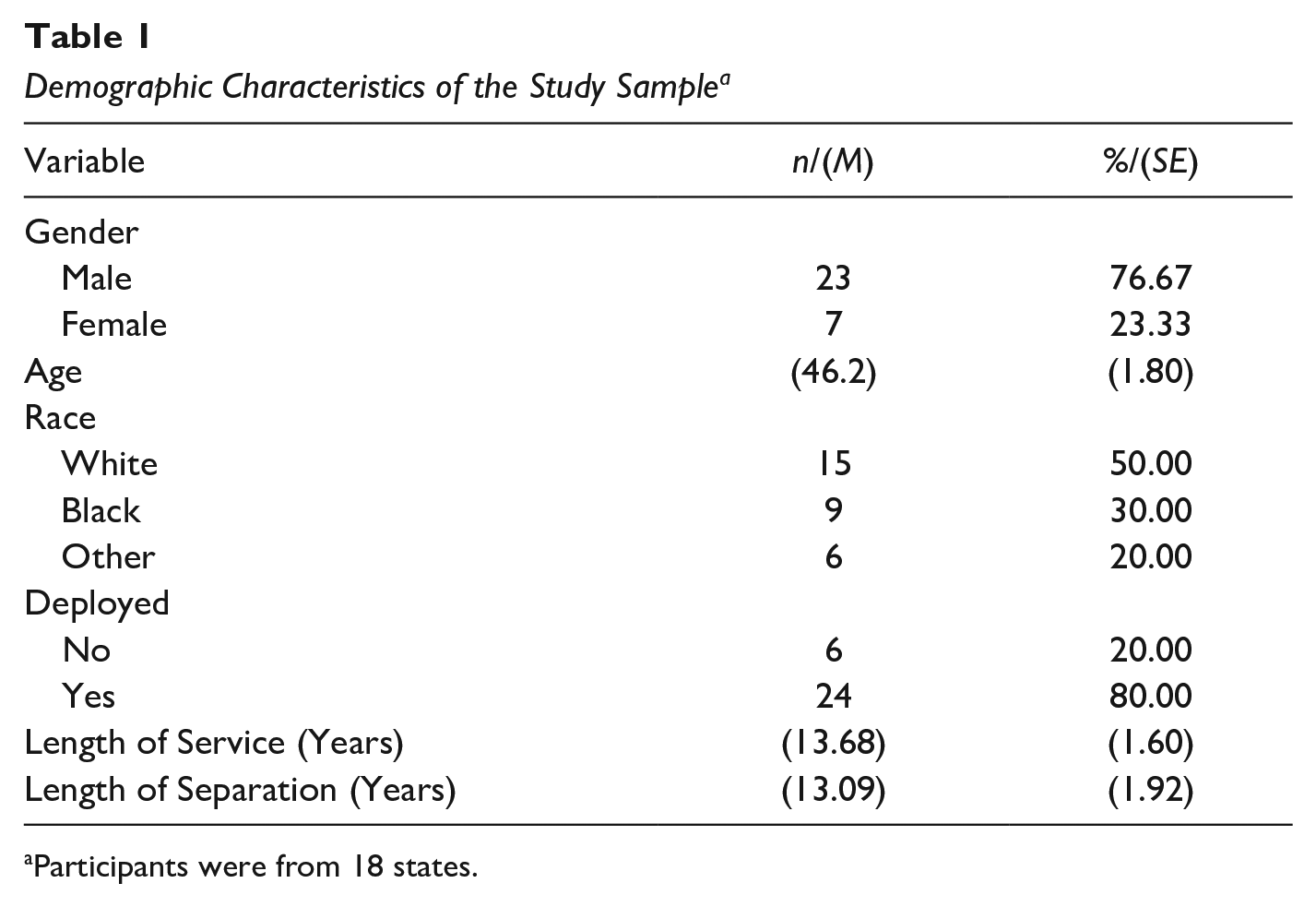
Participants were from 18 states.
Study Design and Procedure
Data for this qualitative, instrumental case study were collected through semi-structured interviews. As in Stake (1995), we adopted a constructivist paradigm as a philosophical underpinning for our case study, which permits the allowance of “truth” as relative to the participant. The purpose of this study was to determine veterans’ perspectives regarding the meaning of “personal growth,” “connectedness,” and “community impact” in their civilian lives, which are the three components of the TMC programmatic mission. The end goal of this qualitative case study was to develop a quantitative data collection instrument centered on these constructs. As such, the interview questions were developed via a thorough review of literature on these three topics.
In total, each participant was asked 21 standard questions by two graduate students. For example, within the personal growth category, participants were asked, “How would you define or describe personal growth?” Within the connectedness category, participants were asked, for example, “What does connectedness look like in your post-service life?” Finally, within the community impact category, for example, participants were prompted to respond to the following: “Thinking about your role in your community, please tell me about the ways in which you contribute to or provide service to your community.” All interviews were audio-recorded and transcribed verbatim. Interviews ranged in length from 30 to 60 min.
Data Analysis
Using the three primary programmatic components of the TMC (e.g., personal growth, connectedness, and community impact), we engaged in protocol coding (Saldaňa, 2012) in the first stage of our analysis. Protocol coding is an appropriate procedural method when a researcher uses a pre-established or standardized framework for coding data (i.e., in our case, the three previously described domains, personal growth, connectedness, and community impact). Through this process, we categorized sections of transcript text into the aforementioned domains. Following our first stage protocol coding process, we engaged in holistic “lumper” coding—which captures the gestalt of a transcript excerpt (Saldaňa, 2012). Our holistic coding approach resulted in the codes beneath each of the three protocol codes. In our third stage of qualitative analysis, we engaged in pattern coding (Saldaňa, 2012) in order to generate themes within each of the three TMC programmatic components. That is, holistic codes were pattern coded so as to generate, for example, themes within the personal growth protocol code.
Credibility of the study results were ensured through various means. First, one researcher conducted member checks (Creswell & Miller, 2000) with 10% of the study sample so as to ensure that the researchers’ interpretations of participants’ expressions were accurate. This process yielded researcher–participant agreement in each case. Second, following the analysis of data by one researcher, another researcher coded the transcripts using the previously described data analysis approach. To ensure consistency of coding, inter-rater reliability (IRR), which is assumed to be present when IRR is ≥80%, was calculated between two coders. Following Miles and Huberman’s (1994) formula for calculating IRR, where reliability is equal to the number of agreements divided by the number of agreements and disagreements, the researchers determined the IRR for this study to be 85%.
Results
The 30 interview transcripts yielded a median of 4,344 words per transcript. The three major themes in our analysis included the three TMC programmatic components (i.e., personal growth, connectedness, and community impact). Within each of these three major themes, sub-themes were developed based on interpretations of participants’ experiences. Results showed that (a) personal growth comprised four sub-themes; (b) connectedness comprised five sub-themes; (c) community impact comprised four sub-themes.
Personal Growth
Results showed that personal growth, from the perspective of military veterans, included the following four sub-themes: self-improvement, providing for one’s self, learning and skill acquisition, and staying healthy. Veterans indicated that self-improvement depends on being resilient during difficult times and, overall, becoming a better person. However, the veterans in our study indicated that improving one’s self depended primarily on one’s ability to set challenging goals and attempt to achieve them. For example, one participant stated that, in order to experience personal growth, a veteran must identify their strengths and weakness and set goals in order to capitalize on them or make improvement.
That’s when you look at yourself and say okay, I have these strengths but how can I do better. How can I improve on who I am now for the future? You can reflect on things you can change, as well as if you have any weaknesses. You can look at those. Maybe you aren’t good at speaking, so you join toastmasters . . . Always setting goals. (Participant 415)
Veterans also indicated that providing for one’s self was integral to personal growth. They described securing an enjoyable, meaningful, challenging, and steady job as essential to personal growth following military service. They also commented on how finding a job that aligns with previous training was important for stability. Consistency and growth in income was noted as significantly contributing toward personal growth. For example, participant 635 said: Had a bunch of different jobs when I got out because they were just a paycheck. There was no growth and nothing there. Unemployment office sent me to McDonalds and that was the worst job I ever had. I had people younger than me supervising me that only did what the book said to do. Getting a job with NYC EPA was my first uniform job that was similar to the military. There was a shift, regular pay, clean uniform required. (Participant 635)
Personal growth, according to the veterans in our study, also involves learning and skill acquisition—in both formal and informal ways. Veterans, following their return from military service, stated that they enrolled in a college degree program, a vocational rehabilitation program, learned a trade, or obtained a certificate. For example, during a transition from military service to civilian life, Participant 328 indicated that attending a graduate school was a priority and was made feasible due to the financial assistance he got from his military service: “[I] went to graduate school after leaving service. The education benefits from service took away a lot of financial barriers to school.”
Finally, participants noted that personal growth was linked to their mental and physical health. They indicated that personal growth depended on their ability to manage their mental health problems and stay physically fit. Others noted that satisfaction with healthcare providers was associated with improved capacity for managing health issues, especially those directly linked to their military service (e.g., PTSD, pain). Important physical and behavioral health issues cited by veterans included maintaining a healthy diet and consuming alcohol at safe levels, as exemplified by a remark from Participant 644: “I’m a social drinker, for example, so I know that’s not the healthiest thing but, you know, it’s been a while since I’ve even done that.”
Veterans also noted that managing pain was important as a component of personal growth, especially since it has an impact on one’s ability to remain physically active, maintain a healthy weight, and keep blood pressure readings at appropriate levels.
I lost part of my foot. So, I’ve lost two toes and half into the third toe. The doctor said that if the blade had hit my foot a half inch further towards the ankle I would have lost the entire foot. So, I can still walk. I didn’t have to learn how to walk again. I can run now, okay, but I got so out of shape in the one year recovery of it that I developed high blood pressure. (Participant 643)
Connectedness
Results showed that connectedness, from the perspective of military veterans, included the following five sub-themes: relating to another person, avoiding isolation, joining an organization, neighborhoods, and professional networking. Regarding relating to another person, veterans cited that they felt a sense of connectedness by communicating with their family members, coworkers, and veteran or nonveteran friends. For example, Participant 25 talked about the importance of his work colleagues and Participant 889 talked about the importance of interacting with nonveterans: My work family, we are a very close group. You know, I know that if I need anything I can go to any one of my co-workers and say, hey, this is what I need, and they would find a way to help me or get me connected to someone that can help. (Participant 25) I try to tell people like, hey, you need to have as many possible ways of interacting with people from different groups and different areas. Like sometimes, it’s not always good to have them just through veteran organizations. You shouldn’t, it’s not healthy to just interact with only veterans. You need to have people in all aspects of life so that you can get a good sense of balance. (Participant 889)
Another sub-theme within the “connectedness” theme included “avoiding isolation.” Veterans identified social isolation habits following military service. They expressed that extended bouts of isolation can lead to mental health problems and feelings of disconnectedness from their friends, family, and community. As such, veterans indicated that avoiding isolation was integral to feeling connected. For example, in response to a question about what connectedness looks like for a veteran following military service, Participant 654 stated the following: “I’m disconnected. I do live isolated. I don’t have a local circle or church or attend a community group.”
Additionally, joining organizations following military service was noted as a meaningful way to develop a sense of connectedness. Veterans described joining an organization to interact with other like-minded individuals, such as those who were demographically similar or who had similar military experiences. Veterans noted that joining these organizations could be beneficial if they meet in a face-to-face format or an online format. For example, one veteran described a social media page that she relates to in her community.
We have a really nice Facebook forum and people are really active. If somebody sees a dog that they’re pretty sure belongs to someone they’ll post it, like, hey, I just saw this dog on the corner of the street. Is it yours? I mean there’s a ton of stuff like that here. (Participant 562)
Neighborhoods also emerged as a significant venue for developing a sense of connectedness. Veterans stated that feelings of community connectedness are developed when they get to know their neighbors, go to neighborhood events, or live near a military base. They noted the positive nature of living in a neighborhood that was composed of both veterans and nonveteran civilians. For example, Participant 654 stated the following about the neighborhood that he lives in and the sense of community within it: This is the first time I’ve lived in a house in 15 years, which means different neighbors. Just looking at vehicles, I would estimate about 40% [are veteran] . . . I feel community, it’s a good feeling. A sense that these people are ones you can turn to and have a certain bond and trust right away. (Participant 654)
Finally, professional networking was mentioned by participants as a means of feeling connected within a community during the transition from military service to civilian life. Because veterans do not often have community contacts when they immediately return from active duty service, they must be strategic and creative about how to network in order to obtain a job. For example, one older, retired veteran (Participant 654) described professional networking thus: I have extroverted friends, and I think of them with networking. They reach out and talk with others to make connections. I’ve seen friends who lost jobs and reach out on LinkedIn with their qualifications and ask about job openings. (Participant 654)
Community Impact
Results showed that community impact, from the perspective of military veterans, included the following four sub-themes: improving a city, volunteering in the community, collective focus, and making an impact in a virtual community. Regarding city improvement, the veterans in this study indicated that community impact occurs when someone assists others in fixing or rebuilding things in a community, helps neighbors with household tasks, supports populations living in vulnerable areas of a city, and serves on community committees or advisory boards. For example, Participant 415 described making an impact in her community by serving on committees that assist immigrant children: Anything that helps our kids that don’t have the opportunity that middle-class kids have or immigrant kids. They don’t have the same opportunity, so I want them to be part of the American dream too. So, I’m on all these committees to do my part. (Participant 415)
Often via veteran service organizations that veterans were involved with, participants expressed that volunteering in a community was a significant way to make an impact. They described their experience volunteering to keep a park clean or helping at a local food bank. Veterans discussed community gardens as a significant focal point for volunteerism. For example, Participant 289 stated the following about his work with a community garden.
One of the first things I did around here was a community garden in the housing project that my dog and I walked past every day. There were some kids being harassed and I walked down there and saw it was overgrown where they hung out. I asked if people would use it if it were cleaned up and a lad said it would be great. I set a date three weeks out to clean it and asked everybody to come help. When I got there, it was one lady and we cleaned it up. I asked if there were any plants and she said no so I went and got plants for it. (Participant 289)
Additionally, veterans described having a collective focus as a significant means by which a group of people can make an impact in a community. Participants described donating money as a way to contribute toward a community goal, or they noted that—more generally—being a part of something larger than one’s self was important in order to make an impact in a community. Veterans, such as the one quoted below, indicated that being a part of something larger than one’s self could involve focusing on raising or taking care of a family.
If you can focus on others or something larger than yourself, I think it’s a win. I haven’t done as much community stuff since I have a wife and a daughter now, but like I’m focused on them. But like it’s still outside of myself or I’ve taken care of my mom. Like that kind of thinking I is just beneficial in general. (Participant 853)
Veterans, especially those in younger age categories, stated that community impact could occur virtually. They described being active on social media and assisting other veterans with their reintegration period via social media. For example, Participant 549 described giving online advice to other veterans about the construction of their resumes or professional social media pages: When I’m online people are like . . . I’d like you to help me with my LinkedIn profile and help me with my resume and let’s do some mock interviewing. Oh man, I’m busy every day doing that stuff. So, yeah, my contributions to the virtual community are much more. (Participant 549)
Study Two
Methods
Expert Panel Review and Cognitive Interviews
Two authors (JTM, DLA) developed Likert-type instrument items based on the qualitative interviewing conducted in the first study. The first draft of the instrument contained 60 items. The items developed by the authors were then reviewed by a panel of three experts for clarity and readability. After an initial draft of items were written, we followed Peterson et al.’s (2017) procedures for cognitive interviewing. Cognitive interviewing includes “the administration of draft survey questions while collecting additional information about the survey responses, which is used to evaluate the quality of the response or to help determine whether the question is generating the information that its author intends” (Beatty & Willis, 2007, p. 287). In particular, we emailed seven military veterans a draft of the survey and asked them to provide written feedback on the items as it pertained to readability, response option appropriateness, content clarity, construct cohesion, comprehensiveness, and military cultural appropriateness. Items were revised based on the feedback received, which included the addition of five items. The revised survey [called the “Empowered Veteran Index (EVI)”] is shown in the Appendix.
Sampling and Study Design
Inclusion criteria for the quantitative survey portion of this project included individuals who were aged 18 years or more and who served in the United States Armed Forces. Qualtrics facilitated recruitment of 851 individuals who met the aforementioned criteria. Qualtrics respondents were recruited during the month of August 2020 by way of email. The sample included 108 females (12.69%). Furthermore, a total of 656 (77.08%) were aged <55 years, while 125 (14.69%) were aged >54 years. The predominant race in the sample was White (n = 671, 78.85%), followed by Hispanic (n = 102, 11.99%), Black (n = 39, 4.58%), Asian (n = 25, 2.94%), and Other (n = 14, 1.65%).
Measures
In total, 65 items were developed across three constructs: personal growth (26 items), connectedness (22 items), and community impact (17 items). Items were developed within the aforementioned constructs because these constructs are primary to the mission of TMC. Although other factors could have been tested psychometrically, such as physical health, we limited the constructs in this study to the aforementioned three to ensure that the instrument was germane to the programming of TMC.
Personal growth, for example, was measured with items such as “I like to try new things even if they are hard,” and “I like to set goals for myself.” Connectedness was measured with items such as “I get along with my friends” and “I use social media to connect with others.” Items such as “I volunteer in my community” and “I donate time to community projects” were used to measure community impact. The response options for all questions in the survey were as follows: strongly disagree, disagree, somewhat disagree, neutral, somewhat agree, agree, and strongly disagree. We adopted a 7-point Likert scale for two reasons. First, Symonds (1924) showed that scale reliability is optimized when 7-point scales are used. Second, Miller (1956) suggested that the human mind is only capable, on average, of distinguishing between seven different response options in terms of a magnitude of difference.
Data Analysis
Following the collection of survey data from 851 military veterans, we performed an ordinary least squares (OLS) exploratory factor analysis (EFA) with promax rotation in order to determine an optimal set of items for construct measurement. This analysis was conducted using the “fa” function in the “psych” package in R Studio version 3.6.1. Lee et al. (2012) showed that OLS EFA is most appropriate for ordinal response scales. OLS EFA was conducted iteratively until all items within a particular construct exhibited loadings of ≥0.40 (Knekta et al., 2019). Scale refinement is often driven by the observation of factor loadings when working with military veteran populations (Angel et al., 2019). Cronbach’s (1951) alpha was used to measure internal consistency reliability on the final set of construct items.
Following the validation of items, we estimated three multivariate analysis of variance (MANOVA) models (Smith et al., 1962), where the dependent variables in said models included the total scores for each participant on the three validated constructs (i.e., personal growth, connectedness, and community impact). The independent variable in model one was sex, while the independent variables in models two and three where age and race, respectively. The age (i.e., <55 years, >54 years) and race (i.e., White and Other) variables were coded dichotomously in order to achieve better balance in frequencies across categories.
Results
Factor loadings for the initial EFA on the originally drafted 65 items of the EVI are shown in Table 2. Results showed that although the three-factor model provided a good fit to the data, with eigenvalues of 12.96, 7.75, and 6.39 among the three factors (standardized root mean square residual [SRMR] = 0.03; RMSEA = 0.06), many item factor loadings either (a) cross-loaded on a different construct or (b) exhibited a factor loading <0.40. As such, a second round of analysis was conducted.
Factor Loadings in Two Rounds of Exploratory Factor Analysis With the Empowered Veteran Index
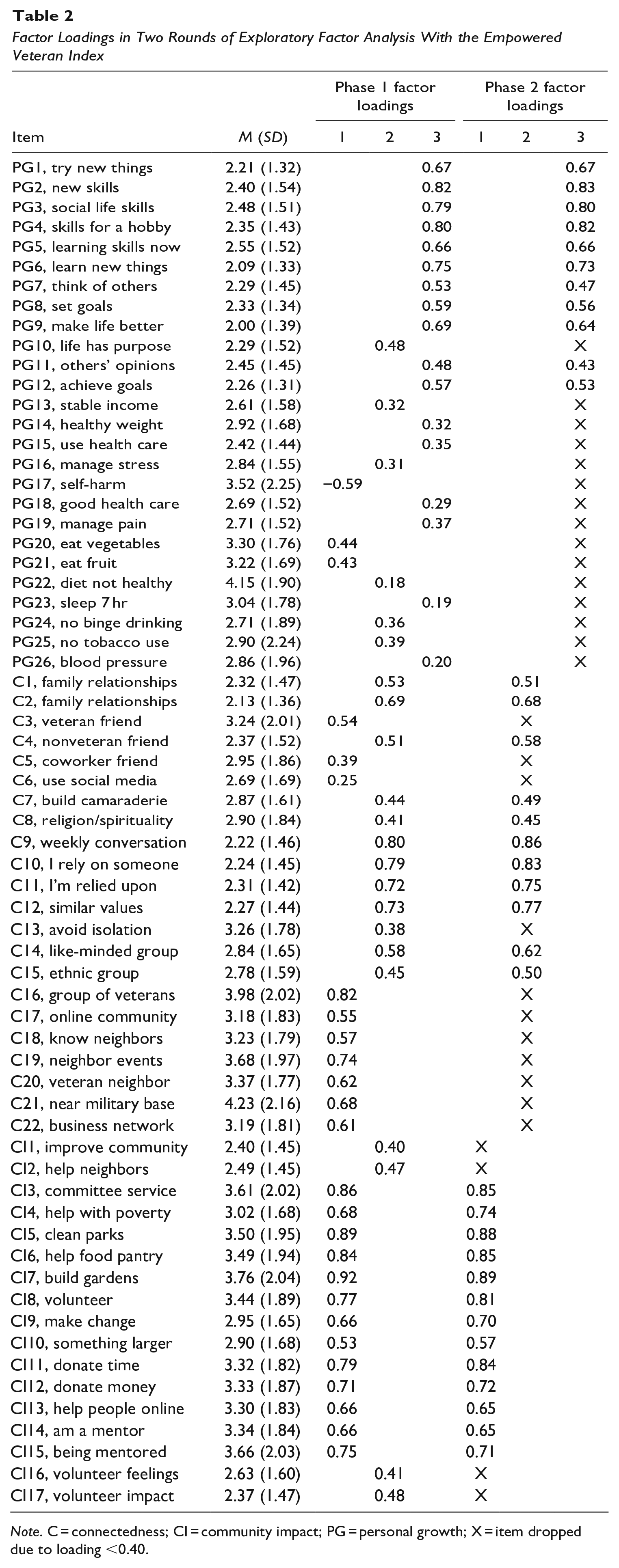
Note. C = connectedness; CI = community impact; PG = personal growth; X = item dropped due to loading <0.40.
After removing items that cross-loaded onto an incorrect construct and items that exhibited a factor loading of <0.40, OLS EFA was conducted again. Results showed that the model was a good fit to the data, with eigenvalues of 8.11, 5.50, and 4.92, respectively, on the personal growth (PG), connectedness (C), and community impact (CI) constructs. Model fit indices were also acceptable for this model (SRMR = 0.03; RMSEA = 0.06). In the second round of OLS EFA, all factor loadings were ≥0.40, providing initial evidence of convergent validity. Reliability evidence was provided by Cronbach’s alpha’s of >.90 for each construct separately and for the full instrument.
As shown in Table 3, intercorrelations among the final constructs of the EVI were statistically significant. In total, 35 items were retained for the final instrument, with 11 items in the personal growth category, 11 items in the connectedness category, and 13 in the community impact category. Individual scores on the final EVI, when summed across items and constructs, range from 35 to 245. Higher scores on the instrument indicate higher amounts of “veteran empowerment.” An individual with a score of 35 would have no empowerment while someone with a score of 245 would have extremely high empowerment.
Intercorrelations, Means, and Standard Deviations for the Final Version of the Empowered Veteran Index
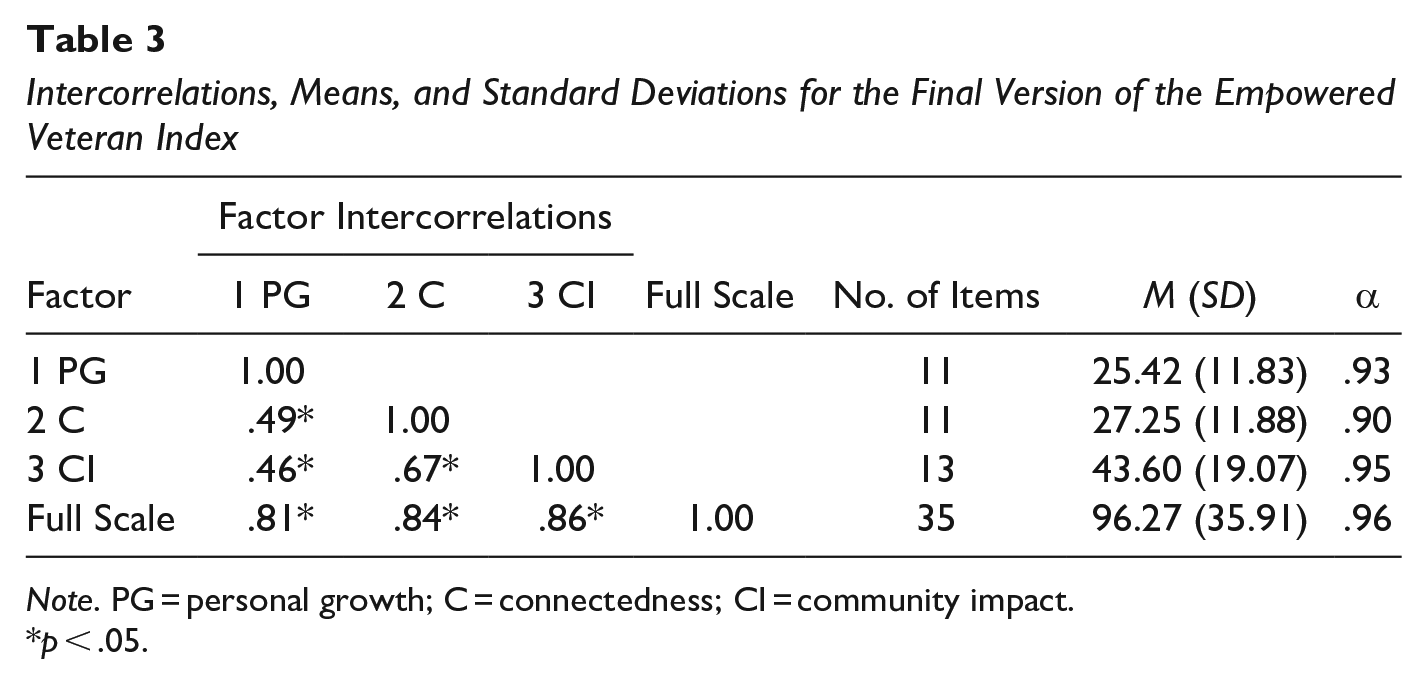
Note. PG = personal growth; C = connectedness; CI = community impact.
p < .05.
Table 4 presents the results of the three MANOVA models, where total scores on the three validated constructs (i.e., PG, C, and CI) were regressed—in separate models—on sex, age, and race. Results of the omnibus models revealed no differences on any of the dependent variables according to sex, age, or race.
MANOVA Results for Differences in the Empowered Veteran Index Constructs—Personal Growth, Connectedness, and Community Impact–by Sex, Age, and Race
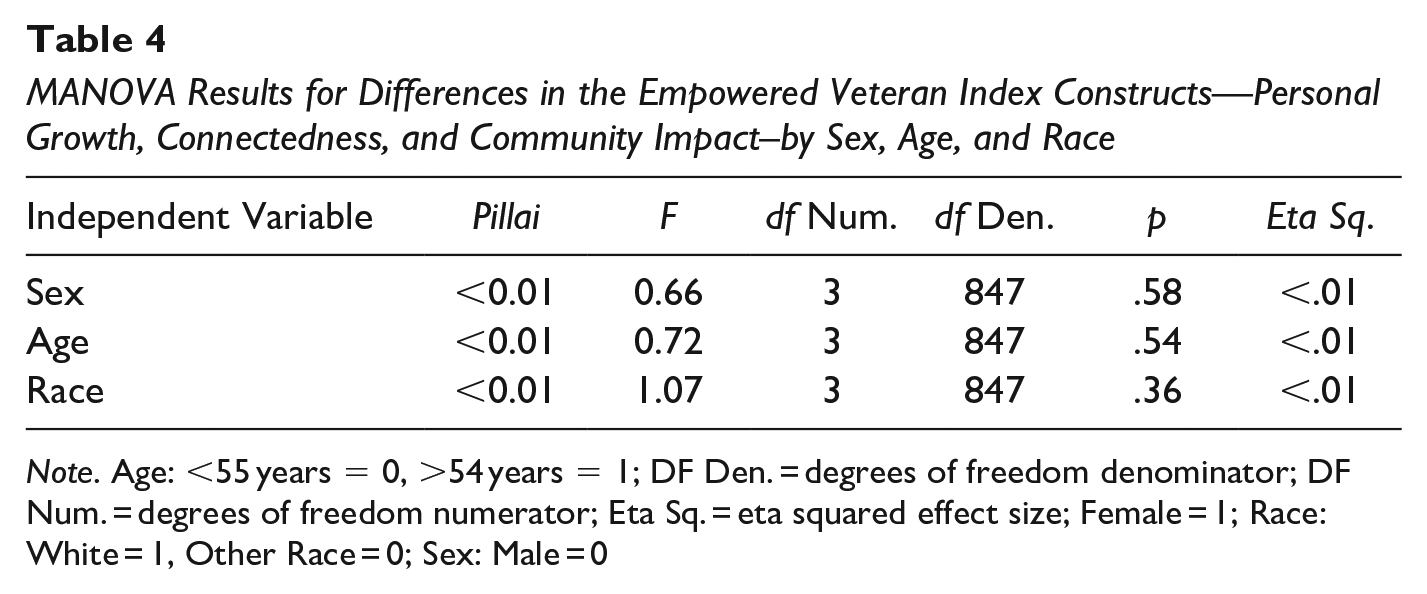
Note. Age: <55 years = 0, >54 years = 1; DF Den. = degrees of freedom denominator; DF Num. = degrees of freedom numerator; Eta Sq. = eta squared effect size; Female = 1; Race: White = 1, Other Race = 0; Sex: Male = 0
Discussion
Following a literature review, completion of an instrumental case study in which semi-structured interviews were conducted with 30 military veterans, the development of 65 draft survey items via cognitive interviews with seven military veterans, and the psychometric testing of those items among a sample 851 military veterans, we present the EVI in the Appendix. The EVI contains 35 items with 7-point Likert-scale response options. Our analysis showed that the EVI is both valid and reliable. Use of the instrument may provide an opportunity to measure empowerment among military veterans, particularly those who have served in the United States Armed Forces.
Several instruments have been developed to measure outcomes among military veterans, specifically. Given the unique experiences akin to the military (Strom et al., 2012), there is a need for tests, questionnaires, and survey instruments that are tailored for military veterans. For example, Team Red, White, and Blue recently developed an instrument called the “Enriched Life Scale” (Angel et al., 2019), which assesses military veteran outcomes in five domains (i.e., genuine relationships, sense of purpose, engaged citizenship, mental health, and physical health). The Veterans RAND 12-Item Health Survey is another veteran-specific instrument, which has been shown to have validity and reliability in assessing physical and mental health functioning (Schalet et al., 2015). Collectively, these instruments comprise a catalog of instruments that can be used to assess baseline and follow-up outcomes in programs that target military service members.
Of particular importance regarding the use of measures like ours, and those cited above, is the prevention possibilities. As discussed in Haller et al. (2015), reintegration stress is an important predictor of suicidal ideation among military veterans. Importantly, however, reintegration can be facilitated with programming centered on personal growth, connectedness, and community impact (Thomas et al., 2021). When veterans find a sense of purpose and connection through which they can grow following retirement from the military, they are far less likely to consider life-threatening activities. Deploying this instrument before and after a program, as well as longitudinally after the completion of a program, could yield important data. Said data could be monitored in order to trigger additional services, when necessary and, thereby, prevent future life-threatening incidents.
Around 2013, TMC started their Service Platoon program, which solicits the participation of 40-100 “Platoon Members” who organize and mutually work on a significant community problem in their local area (Thomas et al., 2021). Platoon Members are military veterans of any era and service branch. All Platoons have a designated “Platoon Leader,” a post-9/11 military veteran chosen and educated by TMC team members to work as the main leader of the Platoon’s actions in a neighborhood. Following a 3-day training course, Platoon Leaders organize and work in partnership with community non-profit groups and enlist Platoon Members to volunteer for scheduled service events. Platoon Leaders additionally manage social events to develop professional networks between Platoon Members and resource events that connect participants with veteran-centered services in the local area. Each of these endeavors is meant to promote the Service Platoons’ aim to assist veteran reintegration. Moving forward, the presently developed instrument will be used to examine programmatic outcomes.
Features of the constructs in this newly developed instrument are comprehensive. First, regarding personal growth, issues such as acquiring new work or social skills, finding a new hobby, learning new things, setting/achieving goals, and being open minded are measured; however, our psychometric analysis did reveal that issues centering on physical health and health care were not relevant to personal growth among our sample of veterans. Second, regarding connectedness, our analysis showed that salient features of this construct among veterans included getting along with friends/family, finding a nonveteran friend, finding meaning in religion or spirituality, finding someone to rely on, and being incorporated into like-minded groups; however, issues that did not perform well in our analysis of this construct included finding a veteran-specific friend, connecting with people on social media, or living near a military base. Third, regarding community impact, we found that revitalizing a community, donating time/money, and engaging in mentor/mentee relationships were important features; however, our analysis showed that volunteering and vaguely worded items, such as “I like to improve my community” were not good fits to the model.
Some limitations accompanied the collection and analysis of data in this study. First, the military service members included in the qualitative data collection phase of the project constituted a convenience sample of members from TMC. Second, the sample for the qualitative and quantitative phases of the study were biased in terms of their overrepresentation of males and individuals who reported White race, which is not necessarily a reflection of the broader membership structure in TMC. Third, data collected in this study could have been influenced by social desirability bias, given that some of the questions included sensitive information (e.g., alcohol consumption). Fourth, our quantitative data analysis (i.e., EFA) was limited to one sample that may have espoused particularly homogenous feelings about certain items that were ultimately dropped from the final instrument. Future research should seek to further examine the psychometric characteristics of the instrument, potentially with confirmatory factor analysis techniques. Other psychometric analyses, both cross-sectional and longitudinal, should examine the validity of the EVI in light of instruments that measure wellbeing.
Despite these limitations, the preliminary version of the EVI provides important contributions to the literature on military veteran experiences as they relate to personal growth, connectedness, and community impact. Given that TMC regularly provides programming for their members in the aforementioned three areas (Matthieu, 2016), a need exists to disseminate this survey, in particular, to their membership in order to evaluate programmatic outcomes and establish an evidence basis for their work. There is also a need to conduct a follow-up study with a new veteran sample in order to examine the model from a confirmatory factor analysis approach. Future cross-sectional work may also examine factors associated with the three domains developed in this study, as well as determine optimal levels of the three sub-scales such that certain cut-points may be recommended as being associated with positive reintegration outcomes.
Footnotes
Appendix
Declaration of Conflicting Interests
The author(s) declared no potential conflicts of interest with respect to the research, authorship, and/or publication of this article.
Funding
The author(s) disclosed receipt of the following financial support for the research, authorship, and/or publication of this article: This work was supported by a grant from The Mission Continues.
