






Abstract
Aboriginal and Torres Strait Islander peoples are substantially overrepresented in Australian prisons, and their unique needs have often been overlooked when establishing rehabilitation programmes. The Explore, Question, Understand, Investigated, Practice, Succeed (EQUIPS) suite of behaviour change programmes, offered by Corrective Service New South Wales (CSNSW), aims to reduce recidivism in custodial and community settings. This study examines the individual- and operational-level factors associated with completion of EQUIPS programmes amongst Australian Aboriginal and/or Torres Strait Islander people (hereafter Aboriginal) completing correctional orders. Using CSNSW administrative data, four cross-classified stepwise logistic regression models were used to analyse EQUIPS referrals across custodial and community corrections settings from 4,666 Aboriginal participants. Individual-level factors affecting completion varied by correctional setting, with family/marital criminogenic needs and age influencing programme completion in custodial settings, and age, sex, relative social advantage, remoteness, criminal history, number of programme commencements and cumulative time in prison influencing programme completion in community settings. Operational-level factors affecting completion for custodial populations included having at least one other Aboriginal person in the programme group (odds ratio = 1.94), employment at referral, and timing of referral. In a community setting, operational factors included parole attached to sentence, needing to move location, and EQUIPS programme type. Understanding these factors, and implementing cultural considerations to enhance cultural safety, can enhance EQUIPS programme completion for the overrepresented and vulnerable Aboriginal population completing orders.
Keywords
Introduction
Despite what is currently understood about effectively reducing recidivism, little is known regarding the particular criminogenic needs of vulnerable subgroups, such as incarcerated Indigenous people (Day et al., 2008). Australia's Indigenous peoples, the Aboriginal and/or Torres Strait Islander peoples, represent approximately 3.8% of the general population (Australian Bureau of Statistics, 2024), however, represent approximately 37% of the prison population (ABS, 2025) (for the purposes of this article, we hereafter use the term “Aboriginal” to refer to all Aboriginal and/or Torres Strait Islander peoples). In New South Wales (NSW), 32.3% of the incarcerated population are Aboriginal (Corrections Research Evaluation Statistics [CRES], 2025), even though only comprising 3.4% of the general population (ABS, 2022). International literature shows that the unique needs of Indigenous populations have historically been overlooked when establishing rehabilitation programmes (Baldry et al., 2016; Shepherd & Phillips, 2016). This is despite these groups being substantially overrepresented in prisons throughout many countries including Aotearoa New Zealand, Canada and the United States (Baldry et al., 2016; Gutierrez et al., 2018). The difference in proportions of Aboriginal peoples between the general and incarcerated population in NSW indicates a significant systemic issue that needs to be addressed.
Factors affecting programme completion for Aboriginal people
Previous research has highlighted that many of the pathways to participation in offender treatment programmes may be ill-fitted for Aboriginal people (Shepherd & Phillips, 2016). For example, research has noted that the risk assessment principles and measures commonly used in such treatments have been developed through evidence from White populations (Shepherd & Phillips, 2016). Whilst some of the generic risk factors identified, such as substance dependency, previous offending and unemployment (Wormith & Olver, 2002), are common in the majority of high-risk offenders, Aboriginal people likely have additional criminogenic risk factors due to historical injustices and intergenerational trauma, including pervasive discrimination, cultural genocide and the forced removal of their children (Shepherd & Phillips, 2016). Continuing, risk factors, as they are currently defined, may not translate to common Aboriginal experiences. For example, childhood care experiences and the concept of the nuclear family is not translational to either Canadian or Australian Aboriginal communities, as it is common for children to be raised by members of the extended family (Justice Health & Forensic Mental Health Network [JH&FMHN], 2017; Shepherd & Phillips, 2016).
Successful completion of a rehabilitation programme in a correctional setting depends on the relevance of the treatment to its audience. Evidence suggests that the content of offender therapeutic programmes may not be well-suited to Aboriginal populations. For example, research found that rehabilitation programmes addressing anger management were ineffective for Aboriginal people (Day et al., 2008; Shepherd et al., 2016). Anger is a highly contextualised emotion that in Indigenous cultures cannot be thought of in isolation, but instead as significantly related to intergenerational trauma (Gutierrez et al., 2018). The Aboriginal cultural identity has been disrupted by the Stolen Generations, 1 the effects of which are still experienced today through intergenerational trauma and associated social, educational, and mental health inequalities (Darwin et al., 2023). Without understanding these underlying cultural contributions to anger and its development into a maladaptive coping mechanism for trauma, effective treatment of anger will be inhibited (Day et al., 2006; Day et al., 2008). As such, The Mental Health Commission of NSW (2017) has stressed the importance of culturally and trauma-informed services to fully address these issues.
Continuing, there is a significant difference in the prevalence of mental health conditions for Aboriginal people compared to non-Aboriginal people (JH & FMHN, 2017; Perdacher et al., 2019). Aboriginal people have been subjected to a range of historical, social and structural inequalities stemming from colonisation and continuing colonial policies, which impact their mental health. As such, Aboriginal people are disproportionately affected by mental health conditions, such as schizophrenia and substance use disorders, which in turn act as barriers to participation in programmes (Darwin et al., 2023; JH & FMHN, 2017; Ogloff et al., 2017). For many Aboriginal people in the criminal justice system, the therapeutic experience is affected by the compounding presence of both cognitive impairments and mental illness (McCausland et al., 2018; Ogloff et al., 2017), with research revealing that cognitive impairment is relatively higher among Aboriginal people with mental illness in the criminal justice system (Baldry et al., 2016; Ogloff et al., 2017). Non-completion of programmes has been attributed to such impairments, as initial and sustained motivation to change throughout programmes may be inhibited (McMurran & McCulloch, 2007a), yet screening for mental health and cognitive impairment together prior to treatment programme entry does not appear to be widespread.
Beyond the range of individual-level factors (factors which differ between individuals – including those that may result from complex inter-relationships between the person and the wider context) that can influence the likelihood of programme completion for Aboriginal participants, there are a variety of operational/system-level factors that may also facilitate or impede programme completion. For example, qualitative research has identified that therapeutic groups with more than one Aboriginal participant can increase the likelihood of retention of Aboriginal participants, with Aboriginal men stating that they have an initial distrust of non-Aboriginal men unless they knew them before the prison-based treatment programme started (Doyle et al., 2020; D'Souza et al., 2023). Such research found they can get to know and trust non-Aboriginal men if the programme “lasts long enough”. Having at least two Aboriginal participants in a group may mean they have another person in the group they can trust, which could mean they stay longer in a group, giving them the opportunity to then get to know the non-Aboriginal participants. Relatedly, having other Aboriginal participants in a group likely provides greater cultural safety, allowing Aboriginal participants to feel their identity is respected and their cultural interests represented.
Conditions attached to a sentence may also impact on one's ability to complete programmes, with additional logistical and administrative burdens reducing the capacity to meaningfully engage and complete programmes. For example, factors such as the conditions attached to post-release parole as compared to community orders, employment and educational commitments may reduce the ability and time available to commit to programme requirements. Conversely, parole conditions may enforce requirements, or provide added motivation or supervisory assistance, to complete programmes. Additionally, the skillsets involved in maintaining employment and engaging in education are compatible with the cognitive, organisational or motivational factors necessary to complete programmes and may hence improve the likelihood of programme completion. For example, Brunner et al. (2019) found unemployment significantly predicted treatment dropout, suggesting employment is a facilitator of programme engagement.
Treatment context – EQUIPS programmes
The Explore, Question, Understand, Investigate, Practice, Succeed (EQUIPS) suite of programmes run by Corrective Services NSW (CSNSW) were developed with the aims of teaching practical strategies promoting prosocial behaviour and reducing antisocial behaviour, grounded in a Cognitive Behavioural Therapy framework. The EQUIPS suite is comprised of four programmes; one non-offence-specific programme, EQUIPS foundation, and three needs- and offence-specific programmes; EQUIPS addiction, aggression, and domestic abuse. Each programme has five modules with four sessions of 2hr each (40 hr combined). While each programme can be delivered as a stand-alone intervention, individuals can participate in multiple EQUIPS programmes, in accordance with their identified criminogenic needs and case management pathway. The offence-specific programmes cover identifying and managing emotions, offence mapping, developing alternate self-management plans, reflecting on beliefs and values, developing relationship skills, and exploring victim impact (Bower et al., 2023). Completion of EQUIPS domestic abuse has been found to significantly lower the hazard of violent and domestic violence reoffending, and completion of EQUIPS aggression has shown to significantly reduce the hazard of any reoffending (Zhang et al., 2019).
Current study
Whilst a number of studies have considered the individual-level factors associated with behaviour change programme completion (Bosma et al., 2014; Silver et al., 2020; Ternes et al., 2020), the current study moves beyond reporting on criminogenic and offence type factors, and aims to extend the literature by examining operational and contextual factors in addition to individual characteristics, specifically for Aboriginal people. The research question, “which individual- and operational-level factors influence the likelihood of Aboriginal participants completing EQUIPS programmes, for those completing sentencing orders in custody and in the community”, is the first to consider cultural group composition in a large-scale quantitative analysis, an important consideration for culturally inclusive best practice. An improved understanding of the factors associated with Aboriginal completion of programmes will provide critical knowledge for policy and practice, particularly in relation to maximising throughput of these programmes for Aboriginal people.
Methods
Study population
A cross-sectional study of administrative data obtained from the Offender Integrated Management System (OIMS), collected routinely by CSNSW, was conducted. Data was obtained for all adults managed by CSNSW who had been referred to an EQUIPS programme in custody or in the community between January 2015 (the implementation of EQUIPS) and December 2018. And 33.0% of the total referrals made in this period were for Aboriginal people completing orders.
Only participants who had adequate time to be referred to and completed programmes were utilised in the current sample. This meant avoiding incorrectly coding individuals as not completing programmes in an incarceration episode that they may have later gone on to achieve. For analysis on programme completion, only people who had been referred to and had participated in at least one session of an EQUIPS programme in the specified time period were included, resulting in a sample size of 2,098 for the custodial sample and 2,568 for the community sample.
Variables
Outcome variable – Programme completion
Programme completion is routinely recorded by CSNSW programme staff within the OIMS database. Generally, people were considered to have “completed” an EQUIPS programme after participating in 40 hr of sessions. Irrespective of participation, there were also individual cases where people were considered as having completed the programme based on therapeutic reasons.
Individual-level independent variables
Demographic factors: age at time of referral, sex, relationship status.
Socioeconomic factors: the Socio-Economic Index for Areas Index of Relative Socio-Economic Advantage and Disadvantage (SEIFA IRSAD) ranks geographical areas by their overall socio-economic conditions using Australian census data, with a lower score indicating relatively greater disadvantage in terms of income, occupation, education and even internet connection (ABS, 2023). Remoteness was measured through the Australian Statistical Geography Standard-Remoteness Area classification which defines locations in terms of the physical distance of a location from the nearest urban centre (and therefore relative access to major services). Remoteness was categorised as either major cities, inner regional, outer regional, remote and very remote (ABS, 2023b).
Criminogenic factors: The Level of Service Inventory – Revised (LSI-R; Andrews & Bonta, 2001), is an actuarial risk assessment tool designed to classify an individual's risk of re-offending and identify criminogenic needs. The LSI-R has 54 items grouped into 10 subscales: criminal history, education/employment, finances, family/marital, accommodations, leisure/recreation, companions, alcohol/drug, emotional/personal and attitude/orientation. LSI-R total scores are used to predict general recidivism risk whereas subscale scores are used to identify criminogenic needs.
“History of contact with the criminal justice system” factors: accumulated conviction count over the lifetime, cumulative time in prison, and most serious offence category (serious violent offence, nonserious violent offence, property offence, breach of court order, driving offence, drug offence).
Programme engagement: the number of instances a person had either been referred to or participated in an EQUIPS programme in the relevant correctional context.
Operational-level independent variables
Fixed effect variables: whether parole was attached to the index sentence, needing to move between correctional centres/community corrections offices to participate in a programme, months prior to sentence end when first started participating in programme, and months since sentence started when first started participating in programme. In models addressing custodial pathways, concurrent employment or education at the time of referral was also included.
Programme type: EQUIPS Foundation, Aggression, Addiction, or Domestic Abuse.
Group cultural composition: Whether or not there was at least one other Aboriginal person within a participant's index EQUIPS programme cohort, and the full number of participants within their programme group (or “class size”). This second variable was included as a covariate to account for the wide variation in the total number of group members in each EQUIPS cohort, which ranged from one to 20.
Analytical approach
The analyses were carried out in multiple stages, with independent models for correctional context (custodial or community) and factor type (individual-level or operational level). This resulted in four cross-classified multilevel logistic regression models being completed (individual/operational × custodial/community). Cross-classified modelling was used to account for the non-hierarchical clustering of observations within individuals and within programme types or locations.
All analyses were conducted using the xtmelogit command in STATA software package 16 using a maximum likelihood estimation procedure. Odds ratios (ORs) and p-values are presented for fixed effects. ORs and 95% confidence intervals (CI) are presented for random effects. Statistical tests were performed with a two-sided alpha level of .05.
For individual-level analyses, model specification began with estimation of an empty “unconditional” model, without any predictors and including only crossed random-level predictors (model zero), which was used to assess the variance attributable at an individual-level and at a programme or location level (depending on the model). In the event that this model suggested no significant variance at the programme or centre level, these random effects were removed from subsequent models, and models instead estimated with referrals nested within a single variable, individual-level variance or programme/centre level variance, depending on which random effect made the strongest contribution to the model. Next, blocks of variables were added to examine the impact of relevant level one predictors, adjusted for this variance at the individual-level and the centre/programme level. Block one contributed demographic factors, block two socioeconomic factors, block three criminogenic factors, block four History of contact with the criminal justice system factors, and block five was the “programme engagement” factor. A Likelihood Ratio (LR) test was used to assess the statistical significance of each block of variables, after accounting for variables entered in previous blocks. For the operational-level analyses, block modelling was also used, where model one comprised the fixed effects and programme type factors, and model two added the “group cultural composition” factors.
Results
A full summary of all results can be found at Table A in the appendices.
Custodial referral pathway
Individual factors associated with programme completion in custody
A stepwise logistic regression was run with the binary outcome variable of programme completion to assess individual factors associated with programme completion in custody. Each of the five blocks of factors reached statistical significance compared to the null model, however only certain blocks were significant (via an LR test) after accounting for variables entered in previous blocks. The final model is shown in Table 1, and the full blocked analysis can be found in the appendices (Table B).
Final model – Individual factors associated with completion amongst Aboriginal people – Custodial and community.
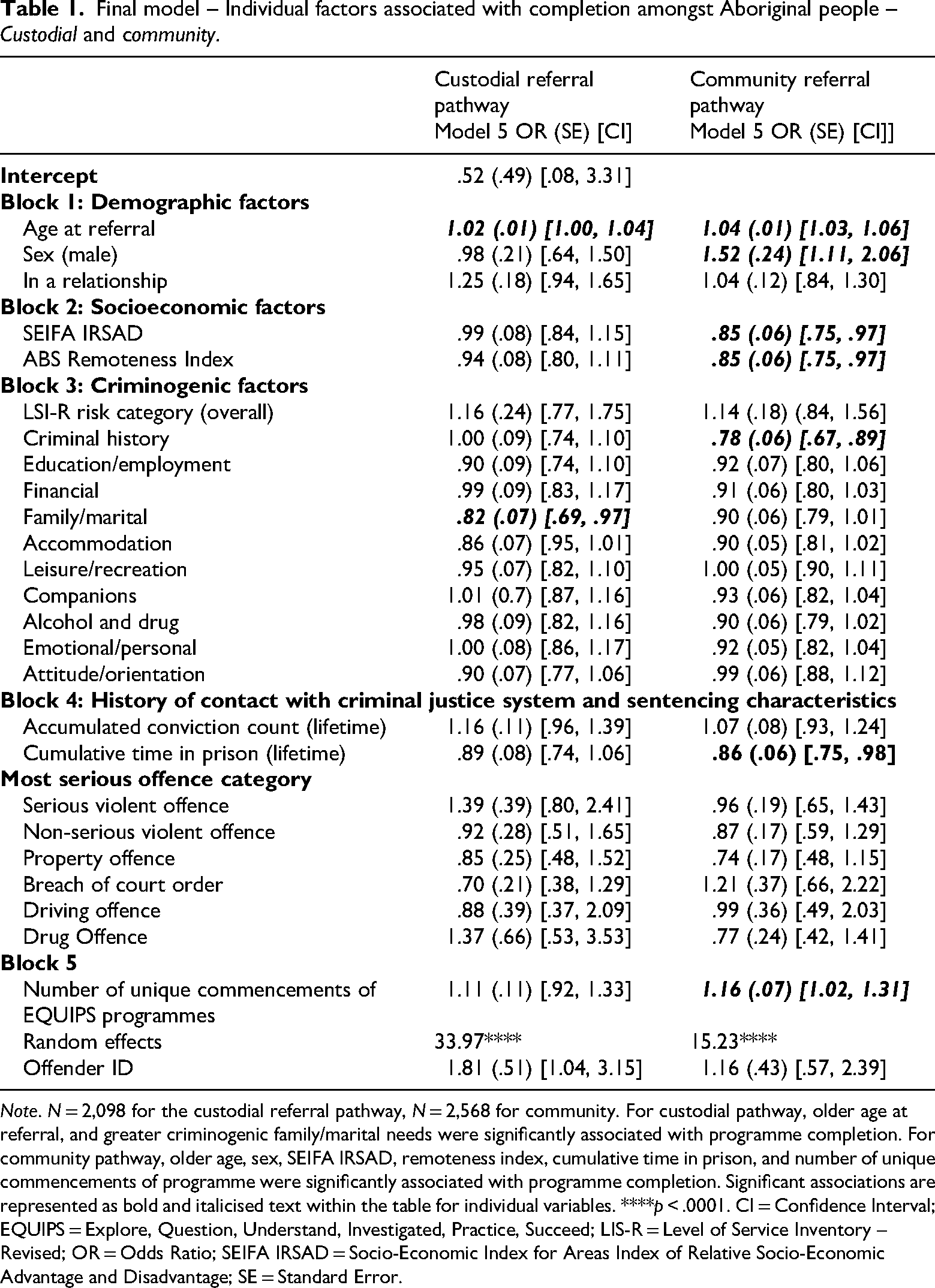
Note. N = 2,098 for the custodial referral pathway, N = 2,568 for community. For custodial pathway, older age at referral, and greater criminogenic family/marital needs were significantly associated with programme completion. For community pathway, older age, sex, SEIFA IRSAD, remoteness index, cumulative time in prison, and number of unique commencements of programme were significantly associated with programme completion. Significant associations are represented as bold and italicised text within the table for individual variables. ****p < .0001. CI = Confidence Interval; EQUIPS = Explore, Question, Understand, Investigated, Practice, Succeed; LIS-R = Level of Service Inventory – Revised; OR = Odds Ratio; SEIFA IRSAD = Socio-Economic Index for Areas Index of Relative Socio-Economic Advantage and Disadvantage; SE = Standard Error.
The first model represented demographic factors and was significant compared to the null model (p = .002). “Age at referral’”(OR 1.03, 95% CI [1.01, 1.05]) was significant and maintained significance in the final model (model 5). Model 2 added socioeconomic factors and did not significantly increase model fit compared to model 1 (p = .605). Model 3 added criminogenic factors, and whilst not significant in improvement of fit compared to model 2 (p = .065), it added significant individual variables; the family/marital criminogenic need (OR .83, 95% CI [.70, .98]), which remained significant in model 5, and the accommodation criminogenic need (OR .85, 95% CI [.73, 1.00]), which was not significant in the final model. Model 4 added history of contact with the criminal justice system and sentencing characteristics, and while it provided significantly better model fit than the previous model (p = .033), the block did not contain any significant individual variables. Model 5 did not add any significant individual variables or provide significantly better model fit than the previous model (p = .286).
To summarise, only older age at referral and the criminogenic factor of family/marital needs were statistically significant in the final model. For every year older an Aboriginal person was at referral, there was an associated 2% increase in likelihood of completion (OR 1.02, 95% CI [1.00, 1.04]), and the likelihood of programme completion reduced by 18% for every standard deviation increase in an Aboriginal person's family/marital needs (OR 0.82, 95% CI [.69, .97]).
Operational factors associated with programme completion in custody
In terms of operational factors associated with programme completion in custody, model 1 (fixed effects and programme type) provided a significantly better model fit compared to the null model (p < .001). Model 2 (Group Cultural Composition variables; final model) was also significant compared to the null model and also provided significantly greater explanatory power than model one (p < .001).
Looking toward model 1, employment at referral (OR 1.48, 95% CI [1.11,1.98]), months prior to sentence end when referred to programme (OR 1.04, 95% CI [1.02,1.05]), and months since sentence started when referred (OR 1.01, 95% CI [1.00,1.03]) emerged as having significant positive associations with programme completion, and maintained significance in the final model.
When looking at specific variables in the final model, having two or more Aboriginal people in a programme group was associated with a 94% increase in likelihood of an Aboriginal participant completing the programme (OR 1.94, 95% CI [1.33, 2.83]). Employment at referral was associated with a 47% increase in an Aboriginal person's likelihood of completing a programme. Timing of referral and programme participation were also found to have significant effects of programme completion. For every extra month an Aboriginal participant had left on their sentence when they were referred to the programme, their likelihood of completion increased by 3%. Each month earlier that an Aboriginal person was referred to a programme in their sentence was associated with a 2% increase in their odds of programme completion. A summary of model 2 can be found in (Table 2 and Figure 1).
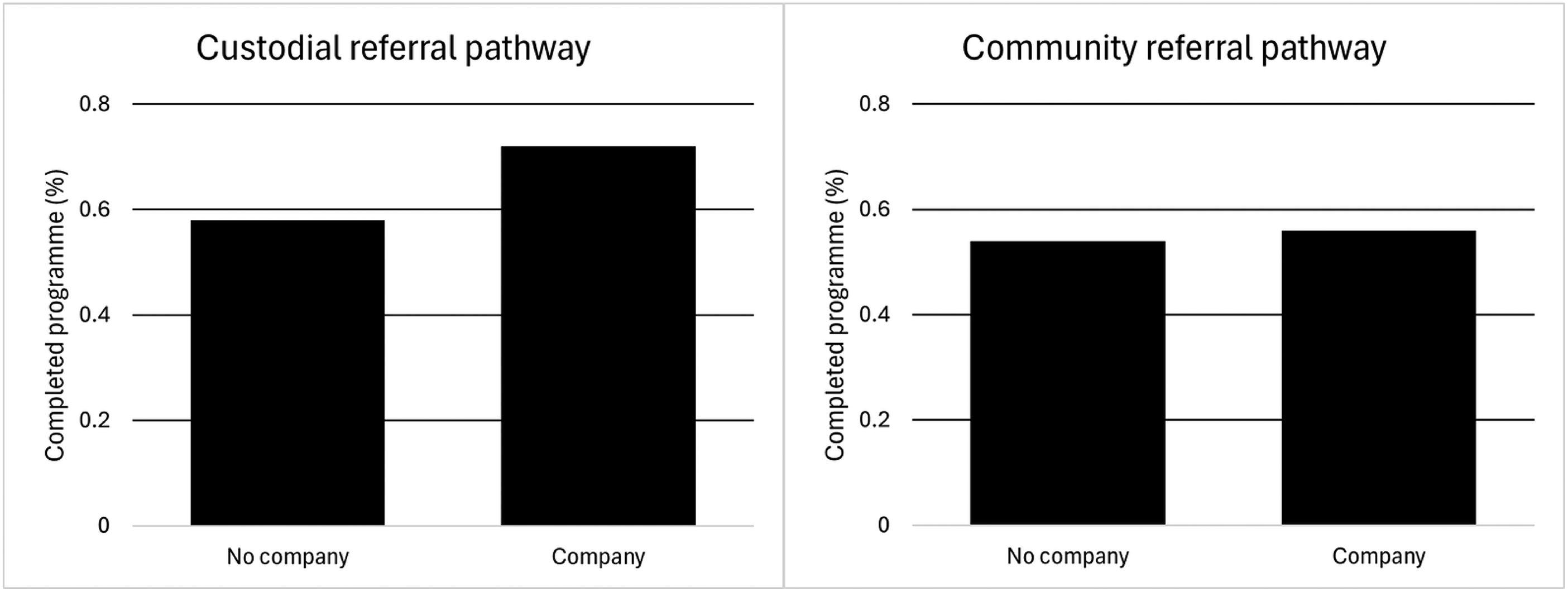
Rates of programme completion among Aboriginal people completing orders with and without Aboriginal companionship.
Final model – Operational factors associated with completion amongst Aboriginal people – Custody and community.
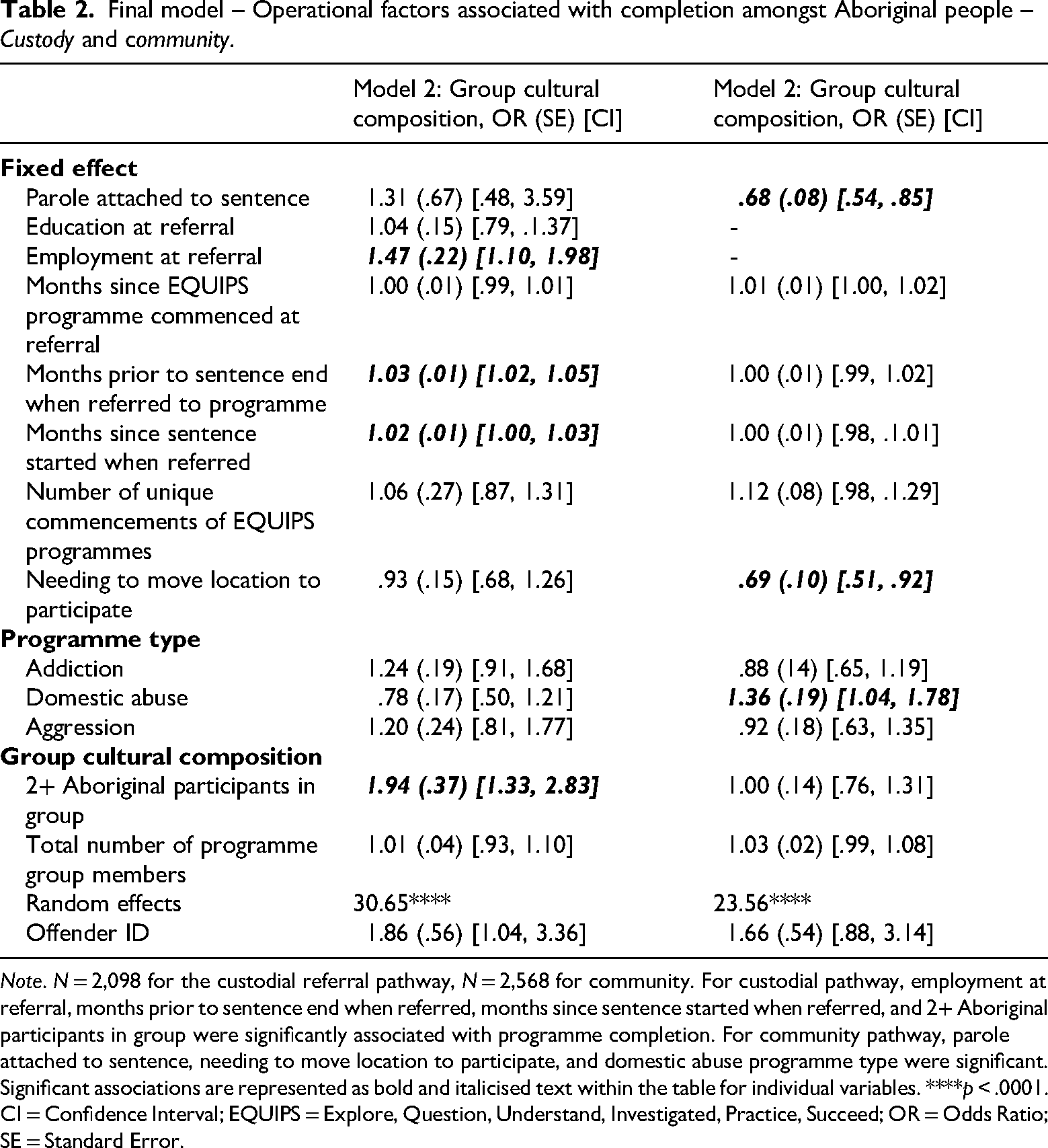
Note. N = 2,098 for the custodial referral pathway, N = 2,568 for community. For custodial pathway, employment at referral, months prior to sentence end when referred, months since sentence started when referred, and 2+ Aboriginal participants in group were significantly associated with programme completion. For community pathway, parole attached to sentence, needing to move location to participate, and domestic abuse programme type were significant. Significant associations are represented as bold and italicised text within the table for individual variables. ****p < .0001. CI = Confidence Interval; EQUIPS = Explore, Question, Understand, Investigated, Practice, Succeed; OR = Odds Ratio; SE = Standard Error.
Community referral pathway
Individual factors associated with programme completion in the community
Likelihood ratio tests of sequential blocks of predictors identified that criminogenic needs made the strongest contribution to the likelihood of programme completion amongst Aboriginal people completing orders in a community setting, followed by demographics characteristics. Socioeconomic factors and previous engagement with EQUIPS (block 5) made smaller but significant contributions to the likelihood of programme completion. The final model is shown in Table 1, and the full blocked analysis can be found in the appendices (Table C).
Specifically, the first model represented demographic factors and was significant compared to the null model (p < .001). “Age at referral” (OR 1.02, 95% CI [1.00, 1.04]) was significant and maintained significance in the final model (model 5). Model 2 added socioeconomic factors and significantly increased model fit compared to model one (p < .05). Both “SEIFA IRSAD” (OR .86, 95% CI [.76, .98]) and “ABS Remoteness Index” (OR .88, 95% CI [.77, 1.00]) were significant individual predictors of programme completion and maintained significance in the final model. Model 3 added criminogenic factors and was significant compared to the previous model fit (p < .001), including the significant individual predictor “criminal history” (OR .75, 95% CI [.66, .86]) which maintained significance in the final model. Model 4 added history of contact with the criminal justice system and sentencing characteristics, and while it did not provide significantly better model fit than the previous model, the individual variable “Cumulative time in prison (lifetime)” (OR .86, 95% CI [.76, .98]) was significant and maintained significance in the final model. Model 5 provided significantly improved model fit compared to the previous model (p < .05) and “number of unique commencements of EQUIPS programmes” (OR 1.16, 95% CI [1.02, 1.31]) was a significant individual predictor of programme completion.
To summarise significant individual variables in the final model, the likelihood of programme completion was reduced by 22% per standard deviation increase in the criminal history domain, males were 52% more likely to complete programmes than females, and each year older a participant was at referral increased the likelihood of completion by 4%. The likelihood of programme completion reduced by 15% with each standard deviation increase in an Aboriginal participants’ relative social advantage, and also reduced by 15% with each incremental increase in remoteness of an Aboriginal participants’ living arrangements (e.g., from remote to very remote). For each unique commencement of an EQUIPS programme in the community, there was a 16% increase in the likelihood that an Aboriginal person would complete an EQUIPS programme. Likelihood of completion decreased by 14% for each standard deviation increase in time spent in prison over an individual's lifetime.
Operational factors associated with programme completion in the community
Model 1 provided significantly greater model fit than the null model (p < .001). Within this model, parole attached to sentence (OR .67, 95% CI [.54,.83]), needing to move location to participate (OR .73, 95% CI [.55, .97], and the domestic abuse programme type (OR 1.36, 95% CI [1.05, 1.76]) emerged as having significant associations with programme completion, and all maintained significance in model 2. Model 2 did not have significantly greater model fit than model 1, and no further variables emerged as significant in this model.
When looking at specific variables in the final model, Aboriginal participants who had parole attached to their sentence were 32% less likely to complete programmes than those who did not, Aboriginal participants who did not have to move offices in order to participate in their EQUIPS programme were 31% less likely to complete programmes than those who did have to, and Aboriginal participants in EQUIPS domestic abuse were 36% more likely to complete their programme than those in EQUIPS foundation. A summary of model 2 can be found in Table 2.
Discussion
Historical and contemporary structural inequalities disadvantaging Aboriginal people within Australia contribute to their continued overrepresentation in the criminal justice system. Considering this overrepresentation, and that failing to complete rehabilitative programmes can have adverse outcomes comparable to not commencing treatment at all (McMurran & McColloch, 2007), it is vital to consider factors that may impact completion of EQUIPS programmes for Aboriginal people. Four cross-classified multilevel logistic regression models were run to analyse factors for EQUIPS participants serving orders in custodial and community correctional climates.
Individual-level factors for people in custody
Criminogenic factors were the strongest individual-level 2 predictors of programme completion amongst Aboriginal participants in a custodial setting, followed by offence characteristics and demographic factors. That criminogenic needs made the strongest contribution to Aboriginal participants’ likelihood of completion implies that higher risk individuals are more prone to attrition. Whilst an individual-level factor, this finding should be interpreted within the wider cultural and socioecological context, whereby Aboriginal participants deemed higher risk are likely to have had more extensive historical involvement in the criminal justice system. In this regard, higher risk may be considered a function of accumulated cultural disadvantage, experiences of marginalisation and potentially structural biases in the administration of criminal justice frameworks. With this context in mind, it stands to reason that such a cohort may have a decreased perceived viability or legitimacy of correctional programmes (see Shepherd & Phillips, 2016). This finding speaks to the greater focus needed on tailoring rehabilitative programmes for Aboriginal participants to better reflect the Aboriginal context and culture-specific experiences and expressions of risk factors associated with colonisation and institutional racism (Doyle et al., 2020).
Aboriginal people who were older were more likely to complete programmes. Older participants may have greater emotional regulation, impulse control and future orientation, in line with the age-crime curve, increasing their capacity to complete programmes (Burr et al., 2021; Farrington, 1986).
The number of prior engagements with EQUIPS programmes was not associated with an increased likelihood of current programme completion amongst Aboriginal participants. This implies that prior exposure to EQUIPS programmes does not significantly improve motivation or ability to complete later programmes, yet also implies that prior engagements do not significantly reduce the likelihood of completion; for example, by exacerbating a sense of hopelessness or perceived inability to complete. “Readiness” may be an unmeasured mechanism of change that explains this non-significant finding, such that prior EQUIPS participation by people who were not ready to engage in processes of prosocial change correspondingly did not experience benefits that transferred to their later experiences of the programme.
Operational-level factors for people in custody
Having at least one other Aboriginal person participate in the programme increased the likelihood of programme completion by 94% for Aboriginal custodial participants. As discussed earlier, qualitative research has shown that Aboriginal men have an initial distrust of non-Aboriginal men, which can dissipate with enough programme engagement (Doyle et al., 2020; D'Souza et al., 2023). The presence of other Aboriginal participants may increase initial trust in the programme group, increasing engagement and allowing for the gaining of trust with non-Aboriginal participants, facilitating programme completion. This finding may also be associated with a sense of belonging, and the wider concept of cultural safety, whereby recognising cultural similarity with other participants may foster a sense of belonging and respect, encouraging further participation and the belief that the programme is beneficial for a participant of that culture. These accounts highlight that when programmes are designed with cultural consideration, and with the specific needs of participants, they are more likely to be engaged in and completed (Trudgett et al., 2023). In addition, there is the implication that beyond correctional resourcing to develop culture-specific programmes, it is possible to implement relatively simple operational changes to support cultural safety and improve rehabilitative programme completion outcomes for Aboriginal participants. Overall, this finding provides further evidence towards the benefits of culturally considered programme design, and to our knowledge, this study represents the first quantitative indication of how such group membership may contribute to the likelihood of programme completion among Aboriginal people in custody.
Aboriginal people who were employed at the time of referral were more likely to complete programmes. This may represent a skillset associated with employment (e.g., following instructions and discipline) that shares common characteristics with those required for programme completion. It may also be that the structural determinants facilitating employment in custody parallel those facilitating programme completion. Continuing, the timing of referral was also significant, with every extra month an Aboriginal person had left on their sentence when they were referred to the programme, and every month earlier that an Aboriginal person was referred to a programme in their sentence, increasing the likelihood of programme completion. A greater period of time to complete programmes likely mitigates other structural or administrative barriers to participation, such as cancelled sessions due to centre lockdowns. Given agency priorities to increase the engagement and benefit of EQUIPS programmes for Aboriginal people, operational processes which streamline their early referral and access to programmes sooner in their custodial episodes may be supported, representing how institutional decision making can influence programme throughput.
Individual-level factors for people in the community
Like the custodial pathway, Aboriginal participants’ criminogenic needs were the strongest predictors of programme completion in the community referral pathway, followed by demographic characteristics. Aboriginal participants with a higher “criminal history” needs score were less likely to complete programmes they commenced than those with lower scores. This suggests that those who are entrenched in criminal behaviour and lifestyles may be missing out on the therapeutic benefits that completing programmes may provide (Sheldon et al., 2010; Sturgess et al., 2015). Again, it is important to note that more extensive historical contact with the criminal justice system is likely to reflect cultural experiences of cumulative disadvantage and systemic bias within that system, which could influence the perceived viability of therapeutic programmes (Day, 2003).
Aboriginal participants who lived in more remote regions were significantly less likely to complete programmes they were referred to. Within Australia, individuals within more remote regions sit at the intersection of various risk factors and experience greater structural inequalities (AIHW, 2026; Weatherburn et al., 2024). These risk factors and inequalities are compounded by fewer opportunities for tailored service provision, with those in remote regions having decreased access to programmes, including culturally appropriate ones (Dawes & Davidson, 2019; Doyle et al., 2020). Continuing, Aboriginal people living in remote areas have little access to public transport and many have no access to a car, which can greatly disadvantage them in their access to programmes and services even when they are available (Rosier & McDonald, 2011). Indeed, issues around the difficulty of service provision for those in more remote areas sits at the nexus of issues facing Aboriginal participants, who are more likely to live in such areas (ABS, 2021).
Finally, Aboriginal participants with higher relative social advantage were less likely to complete than those with lower relative social advantage. It may be that programme content is more aligned with the needs of individuals facing greater disadvantage, inadvertently making programmes more relevant and engaging to that cohort. However, this explanation appears to conflict with other findings that those with higher criminogenic needs face higher programme attrition. Alternatively, individuals with relatively greater social advantage may perceive rehabilitative programmes as less relevant for rehabilitation compared to other housing, employment or external support systems that are less accessible to those with comparatively less social advantage.
Operational-level factors for people in the community
Aboriginal participants who had to move between different community corrections offices to participate in a programme were more likely to complete. Particular office locations may have better suited the location and needs of the participant, which improved their likelihood of participation.
Aboriginal participants who had parole attached to their sentence were less likely to complete programmes than those who were serving a community sentence only. This could be reflective of the experience of participating in a programme post-incarceration during a parole/conditional release period. For these individuals, the often-tumultuous experiences of “getting back to normal” after release from prison may be a barrier to completing a programme (Carlton & Segrave, 2016). Alternatively, there may be unmeasured differences in the people who receive community orders compared to those who have parole attached to their sentence. More research is needed to develop a better understanding of why this difference occurs.
Comparing custodial and community referral pathways
Although the current study used models that did not make direct comparisons between different referral pathways, we can make general inferences based on the factors that were associated with variance in programme completion. At the individual level, criminogenic needs were the most significant predictors of programme completion for both correctional settings, with higher risk individuals more prone to programme attrition. Socioeconomic factors played a significant role in community programme completion, but not custodial completion, likely as the influence of socioeconomic factors is reduced and directly controlled for in a custodial setting. The authors do however acknowledge that socioeconomic factors may have a distal influence on the custodial experience.
The finding in general that individual-level factors had a stronger impact on Aboriginal programme completion in community, but not in custodial settings, suggests that aspects of the custodial pathway may reduce some of the individual-level barriers to programme engagement. Other research has also identified the way that people undertaking programmes in the community have more obstacles and competing concerns to negotiate, such as employment, family obligations and transport, which pose less of an obstacle in prison settings (McMurran & Theodosi, 2007). In a similar vein, Aboriginal women were less likely to complete programmes in community settings, but not custodial settings, which suggests that other external pressures within the community, such as caring roles, rather than motivation, may pose a barrier to Aboriginal women in the community participating in programmes.
Finally, this article identified how a simple change, such as altering the composition of programme groups in custodial settings, could strengthen the likelihood that Aboriginal participants would complete the programmes they commenced. We found that Aboriginal people referred through the custodial pathway who were participating in groups that included two or more Aboriginal persons were almost twice as likely to complete these programmes compared to when they were the only Aboriginal group member. Interestingly, this same effect did not occur in the community referral pathway. It may be that factors such as safety, group solidarity and cohesion among cultures are more relevant and important within the custodial context compared to the community. Further research could be conducted with Aboriginal people referred across both pathways to elucidate potential mechanisms for this association.
Implications
Programme completion is an important objective of correctional interventions, as is reducing reoffending behaviour in the case of the EQUIPS suite of programmes. It is a consistent challenge for correctional agencies to manage programme engagement and completion, with only 28% of inmates completing their primary intervention pathways in prisons within NSW (Mahajan et al., 2024). In the context of developing programmes for Aboriginal participants, it is also important to recognise the intersection of risk factors present for Aboriginal people as a result of structural inequalities that stem from historical and persistent colonial practices, including the increased exposure Aboriginal people have with a criminal justice system which has not historically prioritised or adequately considered their unique strengths, needs and context. Considering this, the current study suggests ways to further support Aboriginal peoples to complete programme in custody and in the community. This could include encouraging programme referrals of Aboriginal people to occur earlier within custodial sentences, and ensuring multiple Aboriginal people in group composition for custodial settings. This study also reveals opportunities to provide further support to Aboriginal participants living in more remote areas to complete EQUIPS programmes through the community referral pathway. Community consultation with Aboriginal communities in remote NSW could provide enhanced understanding of the barriers to programme completion, and also result in co-produced strategies to facilitate better treatment access. For example, it is possible that creating more flexible means of programme participation (e.g., virtual participation) or more flexible timing and appointment structures may go some way towards bridging this gap. Extending this, further consideration could be given to the distribution of programmes within our geographically dispersed community, as those in more remote regions, who are also more likely to be Aboriginal, have limited practically available programmes to participate in. That group cultural composition is significantly associated with programme completion indicates a broader opportunity for cultural sensitivity in programme implementation, whereby cultural considerations and a focus on improving cultural safety can enhance throughput outcomes. Future studies could consider the specific functions of cultural features of programme content, context, facilitators and participants in outcomes for Aboriginal people, and may benefit from qualitative research to include and prioritise Aboriginal people's opinions.
Whilst a deeper exploration of the EQUIPS programme content or delivery is beyond the scope of this article, international research tells us that changing the delivery of programmes to be more culturally appropriate can have a beneficial effect on Aboriginal participants’ programme throughput. For example, we know that Indigenous participants often prefer Indigenous facilitators to allow for greater communication and cultural competency (Cabral & Smith, 2011; Mals et al., 2000; McMurran & McCulloch, 2007a). With informed facilitators leading programmes, a more focused approach can be taken towards tailoring programmes to overcome factors that can lead to non-completion, including approaches that incorporate understandings of intergenerational trauma and social and emotional wellbeing (Heffernan et al., 2014).
Strengths and limitations
A major strength of this study was the large, comprehensive dataset which allowed for the examination of multiple predictors in understanding programme completion among Aboriginal people completing orders. However, we note that due to the large sample size, the study is sensitive to detection of small effects, which may not necessarily correspond to a meaningful effect. A sophisticated cross-classified statistical approach was employed to address the complex nature of this administrative dataset, and to consider intersecting sources of variance. Accordingly, the analysis was able to account for the effects of multiple referrals, location of programme delivery, and different programmes on participation outcomes.
The reliance on administrative data limited the selection of predictors to those readily available and meant that proxies were used to approximate outcomes of interest. There could be important psychological factors that account for programme completion that were not available to include in the current analyses. Moreover, measurement tools, including the LSI-R, rely on Western conceptions of criminological needs and risk, which have been identified as being potentially inappropriate for the Aboriginal population (Hsu et al., 2010; Venner et al., 2023). The study was also cross-sectional in nature, meaning causal relationships could not be established. Future research would benefit from qualitative interviews with Aboriginal participants at each stage of the referral process for a more nuanced understanding of the subjective barriers and drivers to programme participation and completion in the context of EQUIPS; leveraging off existing Aboriginal leadership and expertise in this area to co-design and redevelop programme design and delivery.
Conclusion
In this study, a range of individual- and operational-level factors were considered and shown to be statistically significant in facilitating or impeding rehabilitative programme completion for Aboriginal people completing orders. These factors were assessed in robust models for both custodial and community corrections settings. Predictors included demographic, socioeconomic, criminogenic and offence category factors. Notably, at an operational level, Aboriginal group membership significantly predicted programme completion in a custodial setting, providing a relatively simple operational consideration to increase EQUIPS programme completion for Aboriginal and/or Torres Strait Islander participants.
Footnotes

Author Contributions
MD, MB, EB, NN and MH led the conception of the study and MB and MD the analyses and interpretation of the data, with assistance from MH, LS, NN and EB. All authors contributed to and approved the final version of the manuscript.
Ethical Considerations
Ethical approval to conduct this research was obtained from Corrective Services NSW, The University of Sydney Human Research Ethics Committees (HREC) (2019/730), and the Aboriginal Health and Medical Research Council (AH&MRC) HREC (1560/19).
Funding
The authors received no financial support for the research, authorship, and/or publication of this article.
Declaration of Conflicting Interests
The authors declared the following potential conflicts of interest with respect to the research, authorship, and/or publication of this article: MB, EB and NN were commissioned to undertake this work by Corrective Services New South Wales (CSNSW). MH and RH are employees of CSNSW.
Data Availability Statement
The dataset analysed in this study is not publicly available. Access is controlled by Corrective Services NSW and may be granted to qualified researchers on request and subject to approval.