






Abstract
Researchers have increasingly explored the negative consequences of Non-Consensual Sharing of Intimate Images (NCSII) for victims, though less work has considered the factors associated with offending, particularly among youth populations. Few have explored offending using criminological frameworks, calling to question how well existing models of offending may account for this behaviour. This study attempted to address this gap in the literature through an assessment of youth participation in non-consensual sharing of images in a sample of 864 South Australian youth. Using binary logistic regression modelling, this study examined the relationship between self-control, opportunity and youth involvement in NCSII. The implications for our understanding of both image abuse and criminological theory were examined in detail.
Technology and digital communication have become integral to the social lives of adolescents, continuously shaping the ways that they learn, practice and engage in sexual activity and communication (Wachs et al., 2021). These skills are necessary to form peer networks, engage in social and emotional relationship growth, sustain and reinforce existing romantic relationships, or to seek out or establish new ones (Mathews & Jayabal, 2016). One of the social and sexual behaviours in which youth may engage is sharing intimate images, commonly referred to in earlier literature as “sexting”, a portmanteau of “sex” and “texting”, defined as sending, receiving or forwarding intimate or sexually explicit messages, images or videos to others through electronic means (Klettke et al., 2014; Marume et al., 2018; Wolak et al., 2012; Ybarra & Mitchell, 2014).
The practice of sharing intimate images is increasingly considered to be a normative behaviour among young people and emerging adults (Budde et al., 2022; Levine, 2013; Strasburger et al., 2019; Thorne et al., 2024). Youth who engage in sharing intimate images are more likely to have attitudes and beliefs supportive of sending and receiving these images and content and are more likely to report that they are sexually active (Doyle et al., 2021; Lucić et al., 2020). There is also a recognition that sharing images can increase the risk of harm for those featured in the images (Doyle et al., 2021; Nygård et al., 2025). Sexually suggestive and explicit photos, videos and text messages may be shared without consent to third parties who were not intended recipients (Mitchell et al., 2012; Schmidt et al., 2024; Villacampa, 2017).
This is referred to as the Non-Consensual Sharing of Intimate Images (NCSII, see Nygård et al., 2025) and has been framed in various ways by researchers, whether as revenge pornography (Walker & Sleath, 2017), or within the broader category of Image-Based Sexual Abuse (IBSA; Henry & Beard, 2024; Henry et al., 2019). These frameworks describe the context in which NCSII can occur, such as following the deterioration or end of a relationship, as a means of exerting control, coercing others or engaging in extortive behaviours over a victim (Eaton et al., 2017; Henry & Beard, 2024; Henry et al., 2023; McGlynn et al., 2017; Walker & Sleath, 2017; Van Ouytsel et al., 2021). These studies also demonstrate the negative psychological consequences of NCSII for the individuals featured in the images, including anxiety and depression, post-traumatic stress disorder, a sense of betrayal and inability to trust others and suicidal ideation (Bates, 2016; Lan et al., 2022; Wachs et al., 2021).
The extant literature has focused with less specificity on the risk factors for the perpetration of NCSII behaviours using traditional criminological frameworks (see Nygård et al., 2025; Walsh et al., 2025). A recent meta-analysis noted that much of the prior literature approached the issue atheoretically, identifying covariates and risk factors, as well as testing motives for offending (Nygård et al., 2025). Synthetic results from that study noted individuals who engage in various forms of intimate-image and video sharing tend to be both victims and perpetrators of NCSII (Nygård et al., 2025).
As a result, there is a need for more systematic attempts to explore NCSII through a lens of criminological theory, calling to question how traditional frameworks can account for this behaviour. Research has noted a relationship between the general theory of crime and involvement in sexting or sharing images (e.g., Holt, Cale, et al., 2021; Lee et al., 2013; Marcum et al., 2022; Reyns et al., 2013; Reyns et al., 2014; Wachs et al., 2021), whereby individuals with low self-control are predisposed to act upon opportunities to offend (Gottfredson & Hirschi, 1990). Given that NCSII can stem from sharing of intimate images and content, research has begun to explore whether low self-control may be a predictor for involvement in NCSII behaviours. This theory offers an empirically supported framework that measures impulsivity and risk-oriented behaviours, and these may be especially prevalent in young people as they develop during adolescence. There is a dearth of literature on this relationship, with mixed evidence regarding the association between NCSII and self-control (Holt, Holt, et al., 2021; Morelli et al., 2024).
Further research is needed to assess this relationship, and better control for the opportunity structures that may shape the likelihood of offending. Gottfredson and Hirschi (1990) noted that opportunities are variable to the offence (see also Hay & Forrest, 2008; Hoeben & Weerman, 2016; Reyns et al., 2014) and less is known about the technical and situation factors that may shape participation in NCSII (see Holt, Holt, et al., 2021). This calls to question how low self-control and opportunity may affect offending in this context.
The current study attempted to address this gap in the literature through an analysis of involvement in non-consensual image sharing among a sample of 864 South Australian youth using Gottfredson and Hirschi's (1990) general theory of crime. This analysis estimated a binary logistic regression model to explore the extent to which self-control and opportunities for online harmful behaviour, measured through engagement in general online activities and specific forms of online deviance, including sexual, fraud and hacking behaviours, are associated with non-consensual sharing of intimate images. The results demonstrate that self-control is non-significant in the presence of opportunity factors, with online sexual activities predicting individuals’ risk for perpetrating NCSII. These findings have direct implications for the understanding of youth sexual behaviour, both normative and harmful, through the lens of opportunity and access.
Non-Consensual Sharing of Intimate Images (NCSII) dissemination
Young people regularly engage in the creation and sharing of sexual or intimate images and video as a performative aspect of romantic or sexual relationships in online spaces (Budde et al., 2022; Gámez-Guadix et al., 2017). This content may be used for flirtation, sexual intimacy and pleasure, and facilitating feelings of closeness, connectedness and intimacy (Budde et al., 2022). In fact, normalisation and willingness are two of the strongest motivating factors for adolescents to share sexual content (Gámez-Guadix et al., 2017; Strassburger et al., 2019).
Despite the extent to which sending sexually explicit content may be normalised, the practice creates opportunities for individuals to have this content misused or abused by others (Holmes & Babchishin, 2024). For instance, individuals are no longer able to control who has access to an image once it has been sent. Sending identifiable sexual images that include the person's face increases their visibility to others and may drive feelings of shame, in addition to further requests for content from strangers (Döring, 2014; Henry & Beard, 2024; Otteren & Gynnild, 2021; Schmidt et al., 2024). Looking solely at involvement in image-sharing behaviours as a risk for NCSII unfairly places the blame on victims and limits our understanding of what other factors may increase risk (Dobson & Ringrose, 2016; Nygård et al., 2025).
Rather, there is a need to consider what behavioural and social factors affect the likelihood of engaging in NCSII (Michie et al., 2011; Nygård et al., 2025). To date, researchers exploring this phenomenon have largely assessed the issue using demographic factors, like gender and age, as well as involvement in image sharing behaviours, including sharing and receiving content (see Nygård et al., 2025 for review). A smaller number of studies have examined psychological factors such as personality characteristics, like narcissism, empathy and dark triad traits and involvement in image sharing (see Nygård et al., 2025 for review). Additionally, there is an emerging body of qualitative literature around NCSII perpetration, highlighting individuals’ perceptions of image sharing.
Consequently, there is a need for a more robust, theoretically driven approach to understand NCSII to better understand risk factors for beyond individual involvement in image sharing behaviours generally (Gavey et al., 2024; Schmidt et al., 2024). To that end, one potential criminological framework to understand NCSII may be the general theory of crime (Gottfredson & Hirschi, 1990). This neoclassical theory argues that crime is not complex, rather, individuals who engage in crime are more likely to be impulsive and attracted to risk-taking behaviours that provide immediate gratification and pleasure. Specifically, those individuals have lower levels of self-control as they are more likely to recognise and act upon situational opportunities to engage in crime and analogous behaviours, which include risky or dangerous activities like substance abuse and thrill-seeking activities. Those with low self-control are unable to resist temptation when an opportunity presents itself, as they do not consider the long-term consequences of their behaviour.
NCSII behaviours may be explained within the context of this theory, as sharing content requires no real skill or access to specialised tools on the part of the individual, only access to the Internet and the content to share. Furthermore, NCSII provides the person with a sense of immediate gratification for various motivations, such as revenge against a former intimate partner, social status, or behavioural control (Hall et al., 2022; Henry & Flynn, 2019; Johnstonbaugh, 2021; Otteren & Gynnild, 2021). In addition, there is evidence that behaviours related to NCSII are associated with low self-control: there is substantive evidence that youth with low self-control are more likely to engage in sharing images, as the act requires no specialised skills or tools, and can be considered an impulsive behaviour (e.g., Holt, Holt, et al., 2021; Lee et al., 2013; Marcum et al., 2022; Reyns et al., 2013; Reyns et al., 2014; Wachs et al., 2017).
There is less research regarding low self-control and NCSII, although it may be that the same relationships would be evident given that individuals need only have access to an image and a motivation to share it with others. To date one study found no relationship between NCSII and self-control (Morelli et al., 2024), while another found low self-control to be a significant predictor when controlling only for self-control and demographic factors (Holt, Holt, et al., 2021). The inclusion of opportunity factors within the model rendered self-control non-significant in relation to involvement in NCSII.
It is critical to note that low self-control is not the only factor evident within the general theory of crime, as Gottfredson and Hirschi (1990) note that opportunities to offend must also be present for those with low self-control to recognise and act upon. Opportunity is not constant and is shaped by various social and situational factors that provide cues that an individual or piece of property is a suitable target (Hay & Forrest, 2008). Historically, opportunities for criminal or deviant behaviour in physical space have been conceptualised through unsupervised time with peers, lack of parental monitoring, and time spent outside of the home (Hay & Forrest, 2008; Hoeben & Weerman, 2016; Reyns et al., 2014).
These elements may be less relevant to cybercrime and deviance, particularly NCSII, as individuals frequently engage in sexual activities while alone and depend on technological access and online activities rather than physical locations in to create opportunities to engage in deviant, abusive, or criminal acts (Holt, Holt, et al., 2021; Powell & Henry, 2014; Reyns et al., 2014; Wolfe et al., 2016). To that end, time spent online and being unsupervised while online, should be significant opportunity factors that create opportunities to engage in NCSII behaviours (Holt, Holt, et al., 2021; Gamez-Guadix et al., 2022; Powell & Henry, 2014). This relationship is similar to some forms of sexual abuse in physical spaces, where access to a victim and an absence of guardians, whether personal or social, drives the opportunity to offend (Cook et al., 2020; Franklin et al., 2012; Hayes & Maher, 2024; McKillop et al., 2015).
The kinds of activities individuals engage in online are generally associated with increased opportunities for image sharing behaviours among youth (DeHart et al., 2017; Holt, Holt, et al., 2021; Reyns et al., 2014) and should influence NCSII behaviours as well. Prior evidence suggests that activities such as time spent on social media, forums, and viewing images may increase offenders’ access to potential victims and create conditions for youths to receive requests to share images, or engage in provocative behaviours that may increase the perception that they may be targeted for requests to share images (DeHart et al., 2017; Hall et al., 2022; Holt, Holt, et al., 2021; Nygård et al., 2025). Additionally, especially for young males, forums and gaming platforms may increase individuals’ exposure to messaging that NCSII behaviours are hetero-normative and a way to reflect one's masculinity and gain status (Hall et al., 2022; Henry & Flynn, 2019; Johnstonbaugh, 2021; Otteren & Gynnild, 2021). Thus, time spent in these online environments may increase the risk of engaging in NCSII behaviours.
Individual involvement in various forms of sexual behaviours online has also been identified as a consistent risk factor for both sharing images and NCSII behaviours (see Nygård et al., 2025 for review). In particular, having immediate access to others’ sexual content through their own sending and receiving of images would create greater opportunities to share this content with others, whether for revenge against an ex, social gain, a form of entertainment or for other motives (e.g., Barrense-Dias et al., 2020; Clancy et al., 2019; Clancy et al., 2021; Nygård et al., 2025). Previous research has also demonstrated a correlation between viewing pornography and image sharing behaviours (Casas et al., 2019; Maas et al., 2025; Raine et al., 2020; Van Ouytsel et al., 2014), and that both behaviours are correlated with non-consensual dissemination of sexually explicit content (see Casas et al., 2019; Holt, Holt, et al., 2021; Nygård et al., 2025).
Qualitative studies on NCSII also demonstrate that for young males may engage in NCSII as a practice to bond with other males, as a form of bullying and intimidation against both men and women, and as a commodification of women in an attempt to gain status (e.g., Hall et al., 2022; Johnstonbaugh, 2021; Van Ouytsel et al., 2021; Otteren & Gynnild, 2021). In these contexts, NCSII may occur as a result of individuals directly targeting certain individuals to obtain content in ways that extend beyond simply sharing images that were originally shared with them. Individuals can also gain the opportunity to access self-generated nude images and video in the context of cyberbullying, where fictitious online identities may be used to obtain and share information and media received from others (Patchin & Hindjua, 2021; Washington, 2015).
Additionally, there have been several high-profile cases where hacking was used to gain access to cloud storage of nude photos and videos of celebrities and non-public figures alike (Lawson, 2015). Once the attacker gained access through password guessing and other methods, sensitive images were then released to the public through forums and websites (Hall & Hearn, 2019; Otteren & Gynnild, 2021; Storrod, 2024). It is unclear how frequently such behaviours may occur among youth, but is salient to understand the extent to which misrepresentation and hacking behaviours may influence the dissemination of non-consensual shared images.
Beyond opportunity factors, it is also essential to control for demographic factors and the risk of NCSII, though the literature is mixed as to their impact (e.g., Henry & Beard, 2024; Nygård et al., 2025). Only three studies have found a relationship between ethnicity and perpetrating NCSII, while most empirical studies have observed no relationship (Nygård et al., 2025). Similarly, research on gender is mixed, with 28 studies reporting that being male is associated with NCSII behaviours, while 21 studies found no significant difference between gender in terms of risk (Nygård et al., 2025). As a result, it is essential to include these factors to further our understanding of the relationship between demography and offending.
The present study
Given the current body of research related to NCSII perpetration, it may be that the general theory of crime (Gottfredson & Hirschi, 1990) can account for individual involvement in the non-consensual sharing of images. Four hypotheses guided this analysis: H1: Those with low self-control should be more likely to engage in NCSII. H2: Technology use measures, particularly social media, pornography use, and sharing images should be associated with NCSII behaviours. H3: Engaging in misrepresentative behaviours online and accessing others’ accounts without permission should increase the likelihood an individual has access to sexual content, thereby increasing their odds of NCSII. H4: Self-control will be rendered non-significant when controlling for opportunity measures.
These relationships were tested using both univariate and multivariate statistics, particularly binary logistic regression models, using a population of youths from South Australia.
Data and methods
A quantitative data set was generated from a survey of adolescents living in the Adelaide Metropolitan Region in the state of South Australia, Australia in 2021. The cohort was comprised of Grade 11 students (n = 1,012) among 17 public schools participating in the project across the Adelaide Metropolitan Region (i.e., within 100 km of the Adelaide city centre) selected using a multistage sample framework based on a fixed-panel design. The sample consisted of students who were largely between the ages of 16 and 17 at the time of data collection.
The research team contacted all public high schools across the Adelaide Metropolitan Region (n = 55) and invited them to participate in the study (total population n = 8,727 students enrolled at all 55 schools). The research team followed up with each school until the invitation was either accepted (16 schools) or formally declined (39 schools). Ethics approval was obtained through the host University Human Research Ethics Committee. Further approval was granted by the State Government, the Principals (or delegate) at each School, as well as individual classroom teachers. Participants were assured that their responses would remain confidential and instructed that they could withdraw from the survey at any time without prejudice.
Students who were physically present on the day of data collection (from 94.6% with a 5.4% opt-out rate) were provided with a paper-based survey for data collection. The final sample population for this study was 864 respondents due to listwise deletion of missing data (see Table 1), constituting a 14.7% reduction in the overall population. The final sample was demographically similar to the full population within the state based on both gender (51% male compared to 50.8%) and racial composition (78.3% white compared to 74.5%). As a result, the reduced sample was reflective of the full population of students within the state, and was appropriate for statistical analyses.
Descriptive statistics (n = 864), Clustered by school (n = 16).
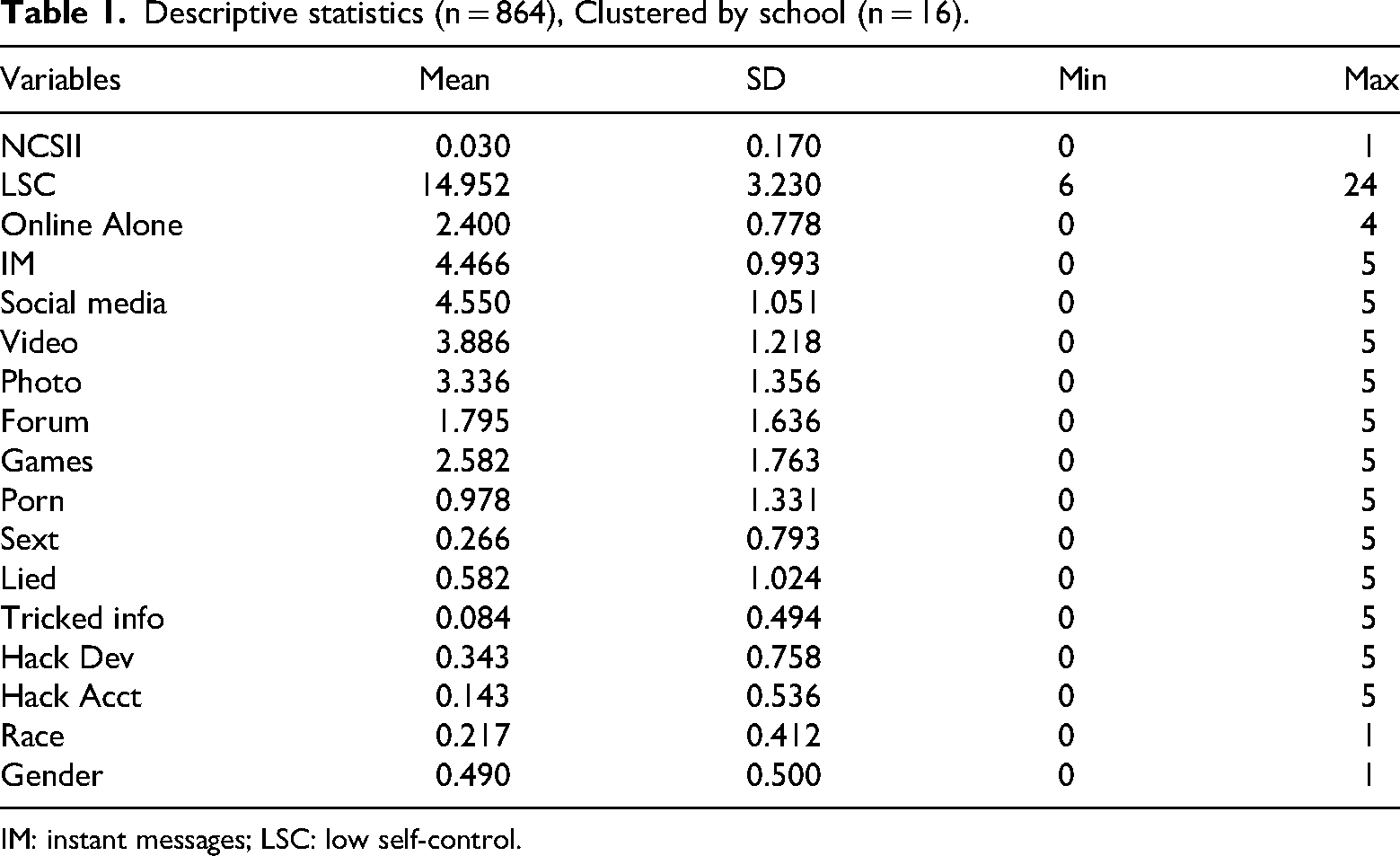
IM: instant messages; LSC: low self-control.
Dependent variable
A binary variable explored the predictors for non-consensual image sharing behaviours among youth. In the survey, respondents were presented with the following question asking them to assess how often over the last 12 months they had ‘shared sexual content (e.g., text, images or videos) of someone else without their consent’ and respond on a Likert scale from never (0) to several times a day (5). This measure closely mirrored operationalisations of NCSCII captured in prior research (Henry & Beard, 2024; Nygård et al., 2025), though 3% of respondents reported engaging in any of these behaviours (see Table 1). This rate is somewhat lower than identified in some prior sample populations, but in line with overall rates given the temporal bounding of the question used in this study (Nygård et al., 2025). Due to limited variation in responses, particularly at higher rates of perpetration, the item was collapsed into a binary variable reflecting either no activity (0) or involvement (1) in Non-Consensual Sharing of Intimate Images (NCSII).
Independent variables
Individual self-control was measured using a six-item scale derived from the National Longitudinal Survey of Youth. This scale has been widely used in prior research as these parsimonious measures reflect the underlying characteristics of self-control (e.g., Holt et al., 2024; Turner & Piquero, 2002). Respondents were asked to rate their agreement with the following six statements: (1) “Planning takes all the fun out of things”; (2) “I enjoy taking risks”; (3) “I often get in a jam because I do things without thinking”; (4) “I enjoy new and exciting experiences even if it is a little frightening”; (5) “Life with no danger in it would be too dull for me”; and (6) “I have to use a lot of self-control to keep out of trouble”. Responses ranged from strongly disagree (1) to strongly agree (4) and were summed to create a composite scale (LSC, α=.722) where higher scores indicated lower self-control.
Opportunities to engage in non-consensual image sharing were measured through a series of questions based on both access to and use of various technologies, web sites and services in the last 12 months. To assess unsupervised time online, respondents were asked ″On average how often are you by yourself when you are online″ and asked to identify their answer on a Likert scale from never (0) to all the time (4; online alone). Similar measures have been used in studies of online behaviour, providing a valid measure for unsupervised time online (see Holt, Holt, et al., 2021).
To assess opportunities to gain access to potential victims and exposure to messages supportive of NCSII via online activities, a series of six measures were included asking respondents how often they have: (1) “sent instant messages (SMS, iMessage, Facebook messenger, etc.)” (IM); (2) “browsed social media (Facebook, Instagram, Twitter, etc.)” (social media); (3) “watched videos or movies (outside of your social media feeds)” (video); (4) “looked at photos or images (outside of your social media feeds)” (photo); (5) “browsed or posted to an online forum” (forum) and (6) “played games online” (gaming). Participants responded for each activity with a rating from never (0) to several times a day (5), similar to prior studies of both youth and young adult samples (see Brewer et al., 2018; Holt, Holt, et al., 2021; Marcum et al., 2022; Reyns et al., 2014).
Respondents were also asked about their involvement in sexual activities online. Specifically, participants were asked how often they had: (1) “seen pornography on a website” (porn) and (2) “shared sexual content (text, images or videos) of yourself” (sext), again rating their response on a Likert scale from never (0) to several times a day (5). These measures were derived from prior studies using similar measures (e.g., Brewer et al., 2018; Holt et al., 2012; Holt, Holt, et al., 2021; Marcum et al., 2022; Reyns et al., 2014), and were included to assess the extent to which one's engagement in sexual behaviours online created unique opportunities or situations that increased an individual's willingness to share sexts without the creator's consent.
Respondents were also asked about their involvement in deceptive behaviours that may increase their opportunities to access or obtain sexual content without others’ consent. Participants were asked how often they have: (1) “lied about your identity online” (lied) and (2) “tricked another person into sending you their personal information” (tricked), rating their response on a Likert scale from never (0) to several times a day (5). These measures were included to assess the extent to which one's attempts at misrepresentation may affect their exposure to content, based on prior studies exploring youth fraudulent behaviours online (Brewer et al., 2018; Holt et al., 2024).
Respondents were also asked about their involvement in behaviours that may provide them with access to others’ sexual images without their consent. Specifically, participants were asked how often they have: (1) “accessed another person's device without their permission to look at information, photos, videos, or other files” (hack dev) and (2) “accessed another person's online account without their permission to look at information, photos, videos, or other files” (hack acct), rating their response on a Likert scale from never (0) to several times a day (5) These measures were included to assess the extent to which attempts to access accounts without permission increase the likelihood of disseminating content, and were based on prior studies of hacking behaviours (see Brewer et al., 2018; Holt, Holt, et al., 2021; Holt, 2023).
Finally, a binary variable was also included to control for race (0 = White; 1 = non-White) and gender (0 = female, 1 = male) to assess their relationship to NCSII.
Results
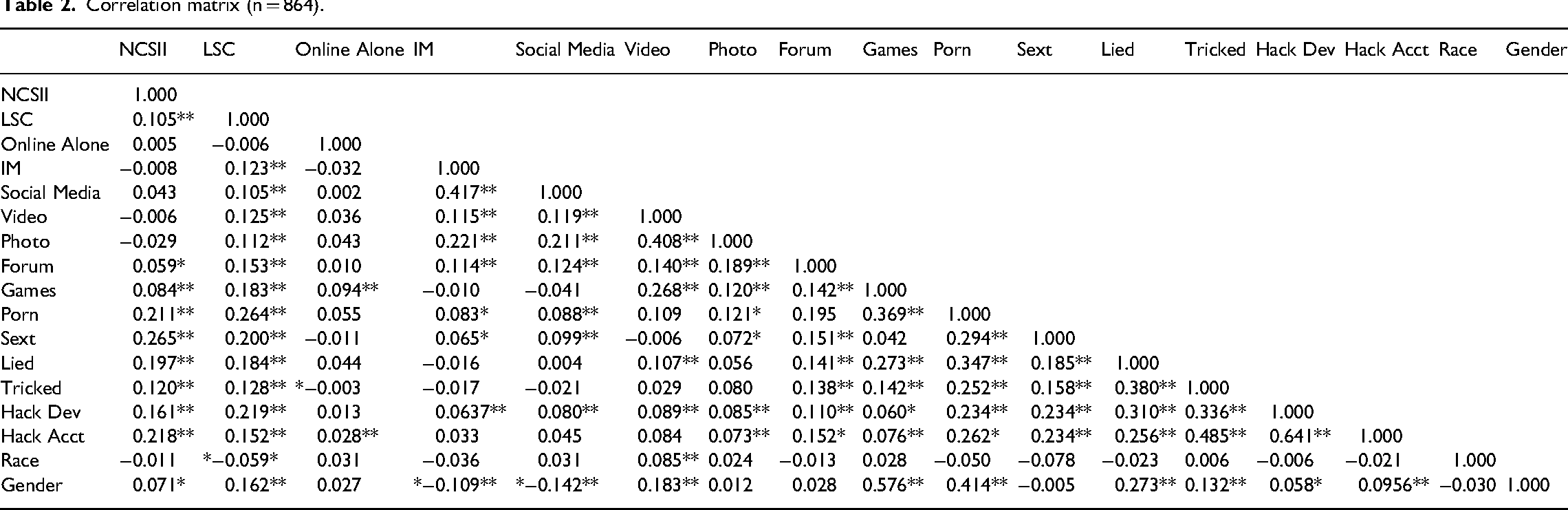
To examine the relationship between non-consensual sharing of images, low self-control and opportunities to access and use technology, a correlation matrix was estimated to assess the relationships between the dependent and independent variables (see Table 2). The results indicated significant relationships between non-consensual sending of images and low self-control (.105**), time spent in forums (.084*) and all forms of online deviance. Viewing pornography (.211**), sending images of oneself (.265***), lying about your identity (.197**), tricking people into sharing information (.120**), accessing other's devices (.161**) and accessing online accounts without permission (.218**) were all associated with non-consensual sharing of images. Lastly gender (.071*) was correlated with non-consensual sending, particularly being male. These effects sizes were all small (Cohen, 1988), though supportive of multivariate statistics.
Correlation matrix (n = 864).
A binary logistic regression model was estimated in STATA 13 statistical software. Variables were entered in blocks to first examine the effects of low self-control in block one, then in block two to explore the effects of opportunity factors, and finally in block three to examine all factors simultaneously. There was no evidence of multicollinearity: no VIF was higher than 1.937, while no tolerance was below 0.516. To control for the clustered nature of the data as a function of students being differentially situated within and across the schools sampled, each regression was estimated using the cluster command (vce(cluster clustvar)) by schools (n = 17). This method reduced the size of both intracluster correlations and standard errors within the models. All results for the multivariate analysis were displayed in Table 3.
Binary logistic regression model for Non-Consensual Image Sharing (n = 864), Clustered by school (n = 16).
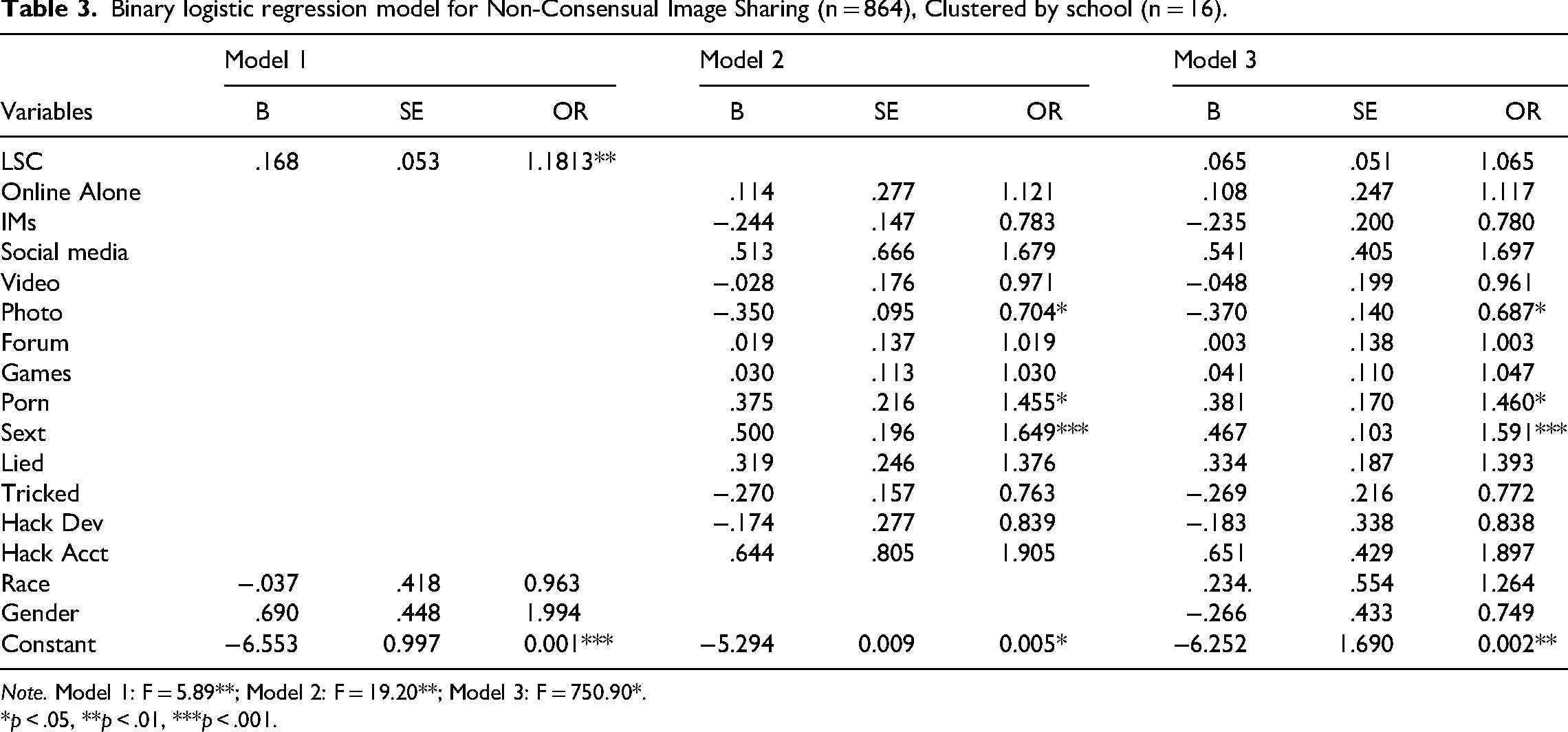
Note. Model 1: F = 5.89**; Model 2: F = 19.20**; Model 3: F = 750.90*.
*p < .05, **p < .01, ***p < .001.
The first model included only self-control and demographic variables and found that individuals who engaged in NCSII were more likely to have low self-control (OR = 1.183**). Both race and gender were non-significant. Model 2, which included only the technology opportunity measures, demonstrated that youth who spent less time looking at photos outside of social media (OR = .704**), while spending more time viewing pornography (OR = 1.455**) and sending sexts of themselves (OR = 1.649***) were more likely to share images without the creator's consent.
Model 3, which included all variables together simultaneously, demonstrated that self-control was rendered non-significant by the inclusion of opportunity factors. Only three variables had significant effects. This included those who spent less time viewing images outside of social media (OR = .671*) having an increased risk of NCSII behaviours. Furthermore, youth who more frequently viewed pornography (OR = 1.460*) and shared images of themselves (OR = 1.591***) were more likely to share content of others without their consent. Neither race nor gender was significant.
Finally, to assess the validity of the model given the low response rate for the dependent variable, a Receiver Operating Characteristic (ROC) model was estimated to consider the validity of the findings (Pencina et al., 2008). The area under the curve was .862 (sig. = 0.000), which demonstrated that the model was able to classify individuals with accuracy, and was not random.
Discussion and conclusion
There is a burgeoning body of research literature on sharing images and NCSII behaviours (Henry & Beard, 2024; Nygård et al., 2025). Further empirical study that identifies clear risk factors for perpetration and draws from theoretical frameworks can provide direction for policymakers and practitioners alike (Michie et al., 2011; Schmidt et al., 2024). This study attempted to address this issue using a sample of 864 adolescent students between the ages of 16–17 in the Adelaide Metropolitan Region in the state of South Australia, Australia.
The bivariate correlations suggested that non-consensual dissemination of images was meaningfully related to self-control, and all online opportunity factors, including activities and deviant behaviours included in the study. However, these relationships did not remain significant in multivariate statistical analyses. Specifically, self-control was significant when included individually, though this relationship was mediated by the presence of opportunity factors. This finding supports the first and fourth hypotheses of this study and reinforces the limited prior research on NCSII and self-control (Holt, Holt, et al., 2021; Morelli et al., 2024), as well as the literature on youth's sharing of images (e.g., Marcum et al., 2022; Reyns et al., 2014; Wachs et al., 2017). Opportunity factors mediate the relationship between self-control and perpetration. Together, these findings suggest that low self-control is not as pertinent to understanding NCSII behaviours compared to the various situational factors that may enable perpetration.
This analysis also partially supported the second hypothesis that opportunity factors are more salient predictors for the non-consensual dissemination of images than self-control. It is unclear as to why less time spent looking at images outside of social media were associated with NCSII behaviours, though it may be that youth who are interested in intimate content may spend less time with the content once obtained. Instead, they may be more interested in obtaining new content as a means to further objectify others, or simply build a collection of content (e.g., Johnstonbaugh, 2021; Otteren & Gynnild, 2024).
Extant research on IBSA has demonstrated that while the prevalence across gender may be similar, the patterns, context and impacts are gendered in nature, with girls and women far more likely to experience IBSA as part of intimate partner violence (Alsawalqa, 2021; Brown et al., 2020). Further study is needed to explore these patterns, including how this content is obtained, the context of the relationship, and the consequences of victimisation. Additionally, the location where content may be stored, whether locally or in the cloud, can help to elucidate the dynamics associated with the ability to perpetrate IBSA and NCSII and the experiences of victimisation for those impacted. Further study is needed to explore the use patterns individuals have with general image content and sexted content specifically that may be stored locally or in the cloud to better understand its relationship to NCSII offending.
Those who viewed pornography and were involved in sending images frequently were more likely to engage in NCSII, consistent with prior research (see Clancy et al., 2019; 2020; Maas et al., 2025; Nygård et al., 2024; Raine et al., 2020). These results reinforce the salience of sexual activities online as a predictor for NCSII and are similar to that of research on contact sexual abuse, as situational conditions that increase victims’ exposure to motivated offenders in an environment with minimal guardianship increase the likelihood that an offence occurs (Hayes & Maher, 2024). Opportunities are increasingly common online and may be more persistent to engage in NCSII behaviours, thereby reducing the importance of self-control (see also Reyns et al., 2014). Further research is needed to clarify how these conditions operate and the extent to which they are relevant across different forms of IBSA in general.
There were no significant relationships observed between NCSII and youth involvement in cyberdeviant behaviours such as fraud and hacking behaviours. Though these variables were correlated in the univariate analysis, this relationship did not hold in multivariate analyses, rejecting the third hypothesis of this study. It may be that these behaviours are relatively uncommon among large samples of youth and may only be evident in purposively designed qualitative sample populations. Further research is needed with both youth and adult samples to better examine these relationships (see Nygård et al., 2025). It should also be noted that there was no relationship observed between race and gender, reflecting the generally mixed literature regarding the relationship between demographic factors and NCSII offending (see Nygård et al., 2025).
There are several limitations with this data that must be addressed in future research in order to improve our understanding of youth involvement in NCSII. First, this study was based on a large population of youth in a single Australian city, though the sample excluded students who were not present on the day of survey administration or those in trade schools or being taught at home. The respondents mirror the overall population of the state, and the findings are likely generalisable to urban and suburban areas of Western nations like the United Kingdom, United States, and Canada. However, they may not be extensible to Asian nations, as well as individuals living in rural areas of Western nations, or in socioeconomic groups and places without consistent access to the Internet (see also Wachs et al., 2017). Additionally, this study did not include measures for other dating behaviours, limiting our understanding of the extent to which these factors may affect involvement in NCSII.
An additional limitation lies in the operationalisation of the dependent variable, as text-based content was included along with images and videos. It is possible that the use of such a measure could have influenced the results. The law and criminal justice system response to images differs from text-based sexual content. Future researchers should separate text and image or video focused content into two distinct measures. Such measures will provide greater clarity as to variations in the correlates of offending related to text and image-based materials, as well as the potential policy applications.
The researchers did not collect data that moved past gender as a binary and could not capture other gender identities. The same is true for individuals’ sexual orientation, or their relationship status, whether dating or single. Thus, these variables were not included in the analysis. The broader extant literature on NCSII suggests there is no consistently significant association between relationship status or any one sexual identity, whether straight, lesbian, gay, bisexual, pansexual, asexual and other non-straight sexual orientations (see Nygård et al., 2025 for review). Future research is needed to explore these issues in detail with youth samples to better understand how they may factor into the risks for NCSII offending among different identity affinity groups and relationship preferences.
Despite these limitations, the findings have direct implications for our understanding of youth involvement in NCSII. This analysis suggests that criminological theories of sexting and the perpetration of NCSII among youth may have some utility but require reconsideration. For instance, the lack of significance of self-control when simultaneously controlling for opportunity factors reflects an immediate potential causal explanation. Situational opportunities, such as immediate access to sexual content and individual involvement in sexting behaviours, may increase an individual's willingness to share content without consent in the moment, regardless of their level of self-control (see also Holt, Holt, et al., 2021; Reyns et al., 2014). From this perspective, there may be greater value in exploring NCSII and other forms of IBSA from a similar context to that of offline sexual offending (e.g., Cook et al., 2020) as guardianship factors and exposure may be more relevant predictors for offending.
These findings also highlight the potential value in exploring the ways in which situational factors may shape an individual's likelihood of offending despite their level of self-control (see Burt, 2021). Specifically, research notes that situational factors such as one's emotional state, drug and alcohol use, and other factors may produce variations in the way in which self-control is experienced in that person's state relative to their stable trait level of self-control (Baumeister et al., 2018; Burt, 2021). Research is needed to capture the emotional and technological factors that may influence individuals’ decisions to engage in NCSII and other forms of cybercrime. Such work would better explicate our understanding of self-control and its dynamics in both the moment and in general across different forms of crime.
There is also a need for more exploratory work that considers the extent to which NCSII can be explained through multifactor theoretical models that include opportunities to engage in sexting and sext dissemination. For example, prior research notes the substantive influence of delinquent peers as an opportunity factor that directly affects the likelihood of individual participation in crime, particularly cybercrimes (see Holt, 2023). Additionally, involvement in NCSII may be driven in part by peers’ perceptions of the value of the behaviour, or their ability to justify involvement in NCSII through neutralising beliefs about those appearing in the images (Hall et al., 2022; Henry & Flynn, 2019; Johnstonbaugh, 2021; Otteren & Gynnild, 2021; Van Ouytsel et al., 2021). Applying a social learning model to individuals’ involvement in NCSII may improve our understanding of the ways that this form of IBSA is a learned behaviour shaped by peer influences on and offline.
Additionally, the psychological literature has incorporated Gottfredson and Hirschi’s (1990) general theory of crime into process models to understand sexual offending, both on and offline, among adults. Seto's (2019) motivation–facilitation model integrates the general theory of crime (Gottfredson & Hirschi, 1990) with theories of sexual offending to explain how motivation works in concert with state and trait factors to increase the likelihood of perpetrating sexual abuse. There may be inherent value in extending this model to account for sexually abusive behaviour among youth to better explain offending overall. Future studies are needed that incorporate these measures to understand both normative and criminal sexual behaviours.
Additionally, the relationships observed between sexual behaviours and NCSII illustrate the need to engage in careful interventions. Rather than engage in fear-based discourse, teaching young people about the risks of sexting at a developmentally appropriate level is more likely to result in the practice of responsible explorations and safe online sexual practices (Dobson & Ringrose, 2016; Döring, 2014; Michie et al., 2011; Patchin & Hindjua, 2020). Sexual education must facilitate the development of practice and skills to allow youth to become critical consumers and producers of media (Budde et al., 2022; Ragonese et al., 2016).
Conclusion
This study noted that self-control alone is not significant when examining NCIIS, rather it is the access and opportunity that is salient. Prevention policies and programmes that focus solely on individuals’ activities will not be sufficient in reducing these behaviours. Structural interventions through technological platforms may also reduce the opportunities for harm. Specifically, improved privacy settings, detection measures and reporting frameworks may remove barriers for those who have experienced NCSII.
Such structural interventions, coupled with digital literacy, can offer more effective approaches to reducing non-consensual sharing of content. Given the nature of youth sexual development and the fact that it is now occurring in tandem with engagement in online environments through which this now occurs, overly punitive frameworks and social media bans may not represent best practices and may fail to reduce victimisation among young people. It is essential that policymakers and practitioners recognise both the human and technical elements at play in NCSII and attempt to affect both dimensions in order to reduce the risk of harm.
Footnotes

Ethical Consideration
This work was approved the Ethics Committee at Flinders University.
Funding
The authors disclosed receipt of the following financial support for the research, authorship, and/or publication of this article: This work was supported by the Australian Research Council (Discovery Project 170103538).
Declaration of Conflicting Interests
The authors declared no potential conflicts of interest with respect to the research, authorship and/or publication of this article.