






Abstract
Grading is a common practice in general education settings. Few teachers, however, are clear about how they should grade students with significant cognitive disabilities when those students are included in the general education classroom. Unfortunately, existing research provides minimal information to aid teachers and education leaders as they consider fair and equitable grading practices for these students. In this article, we examine the four criteria for high-quality inclusive grading outlined by The William & Mary Training & Technical Assistance Center for grading within the inclusive classroom: (a) grades are accurate, (b) grades are meaningful, (c) grades are consistent, and (d) grades are supportive of learning and discuss how these criteria could be applied to provide a more fair and equitable grading system for students with significant cognitive disabilities.
Keywords
More students with disabilities, including those with significant cognitive disabilities (also referred to as students with extensive support needs; identified as a student with an intellectual disability, multiple disabilities, deaf-blindness, or autism), are being included in general education classrooms each year (National Center for Education Statistics, 2021). Research has shown that students with disabilities in inclusive general education classrooms have better academic, behavioral, and social outcomes (Gee et al., 2020). Grading, a common practice in most general education classrooms, is one area in particular that requires more thought as these students are included. Typically, general education and special education teachers determine how they will grade their students under the guidance provided by the school or district as well as the documentation within the student’s Individualized Education Program (IEP) if appropriate. Few teachers, however, are clear about how they should grade students with significant cognitive disabilities. Unfortunately, existing research provides minimal information to aid teachers and education leaders as they consider fair and equitable grading practices for these students. What is known can serve as a strong foundation for building more equitable grading policies and procedures. This foundation includes establishing what a grade “means’’ for students, including students with significant cognitive disabilities.
Designing and implementing a fair and equitable grading system for all students in inclusive classrooms require collaboration. General and special educators together must first determine what the purpose of grading is, then decide what is to be graded, and finally identify what adaptations may be needed to make grades meaningful for each student. The William & Mary Training & Technical Assistance Center (2015) outlined four quality considerations for grading within the inclusive classroom: (a) grades are accurate, (b) grades are meaningful, (c) grades are consistent, and (d) grades are supportive of learning. The authors suggest that these conditions must be in place for all students in inclusive classrooms. In this article, we examine the four criteria for high-quality inclusive grading from the research literature and discuss how these criteria could be applied to provide a more fair and equitable grading system for students with significant cognitive disabilities.
Accuracy
Accurate grades are essential if one of their purposes is to communicate information about student performance. Teachers can ensure accuracy of grades in several ways. It is important to separate behavior and participation scores from academic standards mastery. Keeping these types of scores separate in grading provides a way to measure student learning so that it does not become muddy when multiple considerations are included in one average score. Teachers must work collectively to determine exactly what the grade represents. It is necessary to avoid the practice of general education teachers grading content work and special education teachers grading work on IEP goals (Guskey & Jung, 2009). Effective grading establishes clear standards for how learning is measured for three types of learning criteria: product (cumulative demonstration of learning such as final projects or reports), process (effort, behavior, work habits), and progress (gains in learning such as pre- and post-tests) (Jung & Guskey, 2010). Grades for each type of learning criteria should be separate to eliminate having one grade reflect a combination of the types of evidence (Jung & Guskey). This separation is especially important for students with significant cognitive disabilities.
One consideration in developing a grading approach that provides an accurate representation of student learning is standards-based grading. Standards-based grading practices are recommended for use with all students, including students with significant cognitive disabilities. Standards within standards-based grading are broken down into smaller concepts or learning targets and teachers record student progress on each of the smaller targets. For example, instead of listing a grade in English Language Arts as a single number (i.e., 85%) for the quarter, progress toward each learning target is reported (e.g., identify characters across texts—3; diagram the plot of given texts—2; describe the relationship of events in a text in sequence—4). Standards-based grading requires alignment with grade-level content standards and either grade-level or alternate performance expectations (Guskey & Bailey, 2001, 2010; Muñoz & Guskey, 2015; Wormeli, 2006). This alignment improves accuracy, consistency, and meaningfulness of grades (Jung & Guskey, 2010, 2012) In standards-based grading systems, a 4- or 5-point rubric forms the basis for grading instead of a 100-point scale that produces numerous grade categories (e.g., A+, A, A-, B+, B, B−). Fewer grade categories are generally viewed as more accurate (Guskey, 2015). Standards-based grading helps avoid some pitfalls in traditional grading systems, including interpretation of what the grade actually represents (Guskey & Jung, 2009). Standards-based grading also separates the evaluation of performance on content standards from the evaluation of work habits.
Meaningful
Grades are meaningful when they are based on specific skills aligned with academic standards and when they indicate student strengths and needs in relation to specific skills. Establishing what a grade “means” for a student leads to increased student, parent, and teacher satisfaction in an inclusive classroom (Munk & Bursuck, 2004). Meaningfulness is crucial in terms of fairness because it is interpreted in terms of how appropriate the practice of grading is within the given context. Designing grades that are meaningful is a challenge when grading students with significant cognitive disabilities as it requires schools and teachers to think outside of the traditional grading box. Grades that only represent mastery of grade-level standards may not be appropriate for students who need modifications, but convoluting other factors such as effort and completion within grades only for some students detracts from what a grade means (Guskey & Jung, 2009). The collaboration between teachers within and across classrooms helps establish clarity in what grades represent.
When communication occurs with all stakeholders—parents, guardians, and students—about what the grade or grading system means, the fairness of the grade is more readily established. For example, if a child earns an “A” in math, does it refer to criteria based on the product (e.g., sum of scores on assignments), process (e.g., how student did assignments), or student progress (e.g., change in performance)? Merging these criteria into a single grade can cause confusion for parents or guardians and students because it is difficult to determine which criterion carried more weight in the total grade (Jung & Guskey, 2007). IEP teams, including parents or guardians and students, must have frequent discussions about grades and what they mean for students with significant cognitive disabilities. When the team decides to use different performance standards, those standards must be agreed to and frequently reviewed with parents or guardians and students. These conversations are crucial for clarity about student progress and any changes to the supports and services being provided (Jung & Guskey, 2010; William & Mary Training & Technical Assistance Center, 2015).
Consistent
Equity in grading means the grades are fair and impartial. Equity is truly a challenge when grading practices and systems are not consistent across teachers, a particular issue in middle and high schools. Defining what mastery means can support consistency and help ensure that grades have a clear and stable meaning for all stakeholders, including families. Schools ensure their grading practices are consistent by outlining performance standards for mastery and by having similar mastery expectations for students across teachers. It can be very confusing when teachers within the school use different standards and grading practices for the same student. A grade in one classroom should represent the same expectations and have the same meaning as in another. One consideration for creating consistency in grading is to develop commonly adopted grade adaptations for a student with significant cognitive disabilities. Silva et al. (2005, p. 89) identified five types of grading adaptations that involve basing all or part of a student’s grade on the following criteria:
1. Progress on IEP objectives—For use when a student is making progress on an IEP goal that relates to the context of content assignments in a general education classroom.
2. Improvement over past performance—For use when a student has shown progress since the initial assessments but is still not reaching high levels of mastery with the skill.
3. Prioritization of educational content and assignments—For use when a student requires more time in the acquisition of content than pacing in the general education classroom allows.
4a. A balanced grading system: Processes—For use to give credit when a student is able to apply a new learning strategy or process.
4b. A balanced grading system: Effort—For use when a student benefits from external motivation to complete academic work.
5. Modified weights and scales—For use when a student uses supports to complete assignments or participate in the general education classroom independently.
Adaptations to grading are possible regardless of whether the learning criteria are based on product, process, or progress. They can be applied by multiple teachers across content areas and across time to promote consistency. A rubric that is designed to be standards-based to evaluate student performance could include multiple adaptations. For example, for Progress on IEP objectives, an adaptation might be “Given text or activities and higher order comprehension questions that require comparison, analysis, or summarization, the student will use strategies and supports (e.g., highlighting text, guided notes, graphic organizers) to correctly answer 8 out of 10 questions over three consecutive units.” For Improvement over past performance, the rubric might be applied at various stages within the learning process or across units. For A balanced grading system for processes, an adaptation could involve “applying a learned strategy to novel contexts,” or for effort might be “completion of activities or steps with activities to meet deadlines.”
Munk and Bursuck (2004) outlined how to implement grading adaptations for students with disabilities. We extended their ideas in Table 1 to provide an example for consideration of how their steps could be used by a collaborative team to plan for effective grading of students with significant cognitive disabilities in inclusive settings.
Example of the Grading Adaptation Implementation Process.
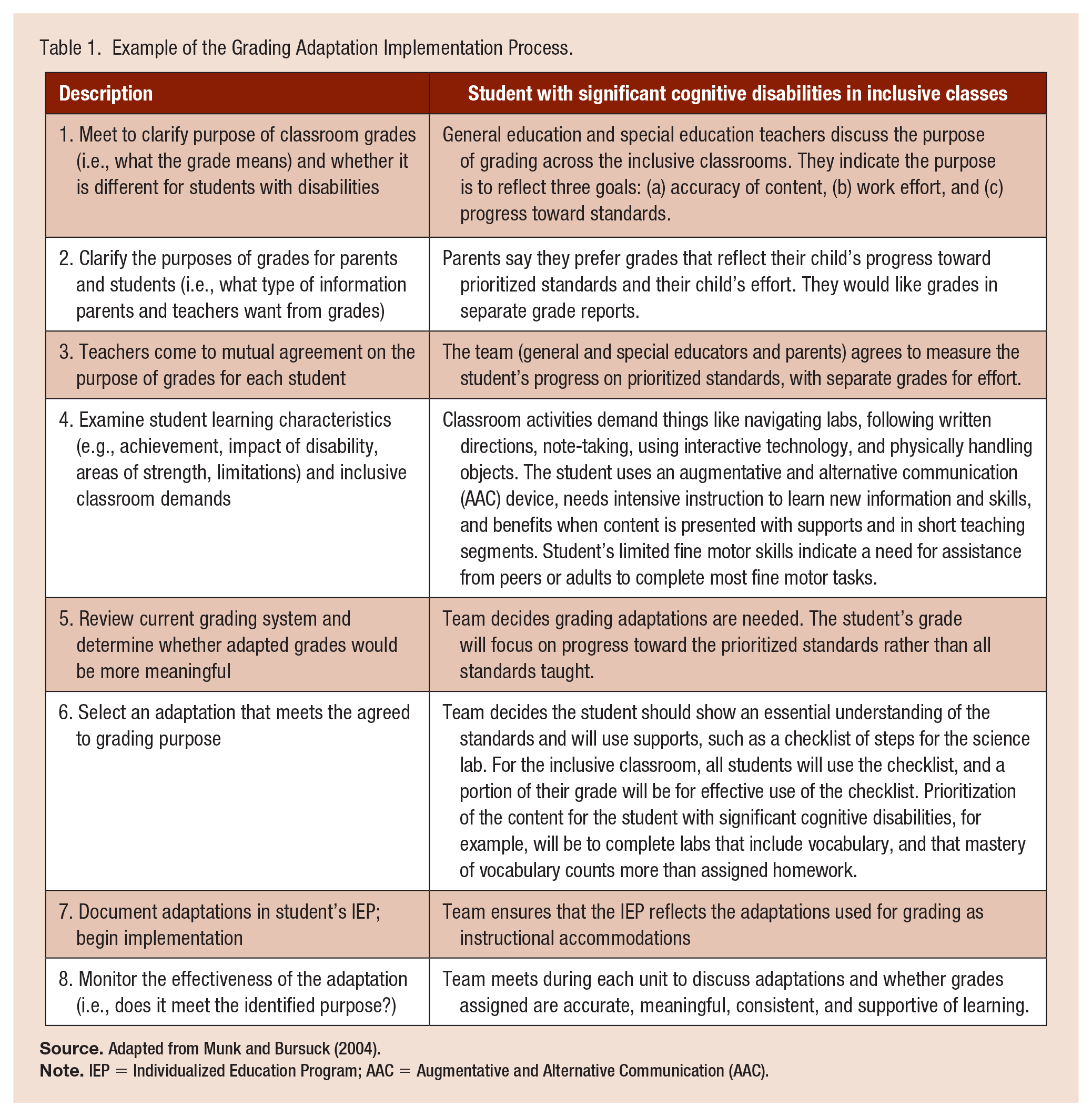
Source. Adapted from Munk and Bursuck (2004).
Note. IEP = Individualized Education Program; AAC = Augmentative and Alternative Communication (AAC).
Support Learning
The use of grades to support future learning may be one of the most important but overlooked purposes for assigning grades. Grades support learning whenever they include summative measures of student learning across time, weigh current evidence of mastery more heavily than previous measures indicating a lack of proficiency, and involve students in assessing their own learning using clear criteria for mastery. When considering a formative approach to grading, teachers can create a learning culture that pushes students to move from “not yet” meeting a standard to achieving a grade that shows mastery (Venables, 2020). Teachers can collaboratively decide the skills and knowledge that represent the progressive steps within a standard starting where the student may be and ending at the standard. This type of growth mindset could be the most meaningful way to assign grades for students with significant cognitive disabilities.
Standards-based grading focuses on assessing the student’s current level of performance relative to the learning targets within grade-level standard. This not only provides needed information about mastery, but also promotes analysis for how to better support student learning within instruction. For students with significant cognitive disabilities who may not yet demonstrate the performance standard for a particular grade, a vertical alignment of standards across grades allows the team to select the vertically aligned foundational skill closely related to the grade-level standard. Within these vertically aligned content standards, it is possible to deconstruct the standard and focus on a single skill at a time, allowing grading to be more meaningful, accurate, and supportive of future learning. For example, a reading standard for Grade 2 might include four separate skills that could be graded separately (e.g., uses basic reading skills to read fluently, uses key ideas and details to comprehend passages, uses vocabulary and structure to read passages, and uses knowledge and ideas from multiple sources to comprehend reading passages).
Conclusion
The four considerations within grading outlined by William & Mary Training & Technical Assistance Center (2015) provide a basis for developing a fair and equitable grading system that includes all students, including those with significant cognitive disabilities, in inclusive classrooms and schools. This is necessary as more students with disabilities are included in general education classrooms (National Center for Education Statistics, 2021). Educators are challenged to develop and enact a grading system that is accurate, meaningful, consistent, and supports learning, particularly for students with significant cognitive disabilities. Collaboration between these educators to ensure these considerations are included in the grading system is fundamental.
Footnotes
Conflict of Interest
The author(s) declared no potential conflicts of interest with respect to the research, authorship, and/or publication of this article.
Funding
The author(s) disclosed receipt of the following financial support for the research, authorship, and/or publication of this article: The content included here is supported primarily through a Cooperative Agreement (#H326Y170004) with the Research to Practice Division, Office of Special Education Programs, U.S. Department of Education for the TIES Center. The TIES Center is affiliated with the National Center on Educational Outcomes in the Institute on Community Integration at the College of Education and Human Development, University of Minnesota. Opinions expressed on this website do not necessarily reflect those of the U.S. Department of Education or Offices within it.
Author Biographies
Dr. Shawnee Y. Wakeman is a Clinical Associate Professor in the Department of Special Education and Child Development at the University of North Carolina at Charlotte. Her research interest includes access to the general curriculum and how it is enacted for students with significant cognitive disabilities in a variety of settings and special education teacher preparation including edTPA.
Dr. Martha Thurlow is a Senior Research Associate at the National Center on Educational Outcomes. Dr. Thurlow has conducted research and technical assistance for the past 45 years in a variety of areas, including assessment and decision making, learning disabilities, early childhood education, dropout prevention, effective classroom instruction, and integration of students with disabilities in general education settings.
Dr. Elizabeth Reyes is a Clinical Assistant Professor at the University of South Carolina. Previously Dr. Reyes was a Research Associate for the TIES Center: Increasing Time, Instructional Effectiveness, Engagement, and State Support for Inclusive Practices for Students with Significant Cognitive Disabilities. Her current research interests include training a variety of interventionist in effective implementation of Evidence-based Practices in inclusive settings for students with disabilities.
Dr. Jacqueline Kearns directs a number of Projects at the University of Kentucky Human Development Institute. With expertise in serving students with significant disabilities, she supports professional learning for educators in the areas of communication, inclusive education, and assessment and accountability. As the parent of school-aged children, Dr. Kearns has experienced standards-based grading at all three levels and served on a middle-school grading task force.