







Abstract
In refugee and migration studies, education has been situated as both a marker of integration and a facilitator of progress in other domains. This paper draws on the accounts of three highly skilled women who have experienced forced migration to highlight some of the ambiguities of education’s role in pathways to social and economic inclusion. A case study approach allows for a detailed and contextual exploration of how intersections of age, caring responsibilities and immigration status influence women’s ability to engage with education. Participants’ accounts confirm that accessing desired and appropriate educational provision can propel people towards their longer-term goals. However, provision that is inaccessible or perceived to be below women’s skill levels can be experienced as exclusionary and demoralising, with attendant impact on women’s perceptions of integration and hopes for the future. Women deploy several strategies to overcome these obstacles, including leveraging existing social connections and re-evaluating their future career pathways. Yet these strategies are not always fully successful. Our findings point towards the need for improved provision for adult refugees and a concerted effort by educational institutions to tackle continuing systemic barriers to education.
Introduction
The movement across borders of people fleeing persecution is a global phenomenon, with upwards of 117 million people estimated to be displaced worldwide. 1 Education has been recognised as a key component of a ‘post-migration ecology’: the multi-level systems in receiving nations that can offer care, safety and opportunity to refugees (Arar and Orücü, 2022). However, the focus of much policymaking and scholarship has been on the educational aspirations and needs of children and younger students. This paper aims to redress this balance. We focus on the experiences of highly educated women refugees living in Scotland to build an improved intersectional understanding of the substance and meaning for women of their engagement in education post-migration.
People seeking asylum in the United Kingdom bring with them life histories replete with educational aspirations and employment experiences. These can vary from younger adults whose education has been interrupted by the circumstances of their migrations (Morrice et al., 2020) to older professionals with decades of experience behind them (Eggenhofer-Rehart et al., 2018). Regardless of their previous status or ambitions, most people going through the asylum process are debarred from working and have only limited access to education. 2 The negative impact of this time spent in limbo on people’s physical and mental health, and their future employability and educational trajectories, has been extensively studied elsewhere (Gleeson et al., 2020; Mulvey, 2015). If recognised as refugees by the UK government, and in contrast to their time as asylum seekers, people have permission to work and access to public funds. In Scotland, time spent in the asylum process can be counted towards residency rules that enable people who wish to pursue further or higher education to benefit from home student fees and funding. Yet evidence suggests that even once they have secured relatively stable immigration status, some adult refugees struggle to join or re-enter education and employment settings (Campion, 2018).
In this paper, we draw upon a subset of interviews undertaken as part of a wider project exploring the role of social connections in refugees’ pathways to social and economic inclusion in Scotland (Baillot et al., 2022; Kerlaff et al., 2023). Taking a case study approach, we explore the accounts of three women aged between 35 and 55 to highlight the impact of their migration experiences, age and family care obligations on their educational achievements and aspirations. The paper confirms that while previous education and language ability may improve employment prospects (Cheung and Phillimore, 2014), these same skills can make it harder for refugee women to feel satisfied with their education and career pathways (Mozetič, 2022). The practicalities of caring for young children can prevent women from engaging in education, although their perceptions of improved educational prospects for children can generate offer hope for the future (Larsen, 2018). In navigating these obstacles, women deploy a wide range of strategies, within which social connections forged in educational settings play a vital role (Morrice, 2007). Despite this, women’s perspectives illustrate that engaging in education can be experienced as a backwards step. Negative experiences of exclusion from educational provision or feeling forced into pathways that do not correlate with women’s own aspirations can undermine hope and lead to disillusionment. As such, we argue that for the adult women whose accounts shape this paper, education’s role in integration is at best ambiguous. Tackling this requires a multi-directional approach to integration that engages institutions as well as individuals in ongoing processes of adaptation and change.
Education and its role in integration
The interviews that form the principal dataset for this paper were undertaken as part of a mixed methods research study focussing on the role of social connections in integration. 3 The primary theoretical framework for the study has been the Indicators of Integration Framework (Ager and Strang, 2008; Ndofor-Tah et al., 2019). Our study has sought to expand the social connections layer of that Framework, extending understandings of integration from the perspective of refugees and longer-term residents. As we outline elsewhere (Baillot et al., 2022; Käkelä et al., 2023; Kerlaff et al., 2023), the work has been undertaken with an awareness that integration is a contested concept, for reasons including its reliance on colonial notions of an ethnically and socially homogenous receiving society (Schinkel, 2013) and the ways in which integration has become bound up in public consciousness with concerns around migration and social (in)cohesion (Casey, 2016). Yet our work with refugees, practitioners and policymakers confirms that integration continues to be a pre-eminent framing of the real-world impacts of migration, which can create productive common ground for discussion (Ager and Strang, 2008).
Within this framing, education plays a critical role. Education is identified within the Indicators of Integration framework as one of the means and markers of integration (Ndofor-Tah et al., 2019). Ager and Strang (2008) explain these means and markers as being ‘areas of activity in the public arena’ (Ager and Strang, 2008: 169) which both indicate successful integration and can facilitate progress in other domains. Education can also be a site for ‘boundary crossing’ – moments when refugees are able to cross over into wider society and where longer-term residents can meet, debate and share knowledge with newer arrivals (Olsson et al., 2023). Despite its important place in the framework, previous research exploring the intersections between education and integration has tended to focus on children and young people rather than adult learners (Bouttell, 2023; Morrice et al., 2020). While transnational policies explicitly note a commitment to holistic, lifelong education for refugees and migrants, discussion of adult education is often limited to means of language acquisition within receiving countries (Morrice et al., 2020). Access to broader higher education provision is recognised as important for mature learners as well as for young people (Olsson et al., 2023) but typically receives less intense scrutiny. Morrice and colleagues (2020) also critique the deficit discourse that dominates framings of adult education. Policymakers, funders and programme designers identify what adult refugees might lack in terms of educational capacities rather than the linguistic, intercultural and professional skills they have to offer. Discussions of the intersections between education and integration can tend towards a functional, normative view of the value of education rather than focussing on what access to education means to refugee adults navigating settlement in new country contexts (McPherson, 2010). Our case study approach aims to address these gaps.
Refugees’ access to education and employability in high income contexts
For refugees settling in new country contexts, a common set of challenges of engaging with education and rebuilding careers becomes apparent. These include language skills (Akkaymak, 2017), insecure immigration status (Bajwa et al., 2018) and transferring different forms of capital across borders (Akkaymak, 2017). Existing scholarship on refugee resettlement is unanimous that having a relatively strong command of the dominant language of the receiving country is necessary for meaningful progress towards educational and employment aspirations, and by extension, integration (Akkaymak, 2017; Cheung and Phillimore, 2014; Eggenhofer-Rehart et al., 2018). 4 At the most basic level, language skills are needed to read, write and communicate. Language also facilitates the development of social networks (Cheung and Phillimore, 2014) which can in turn act as social capital, leading, directly or indirectly, to educational or employment outcomes (Eggenhofer-Rehart et al., 2018). In Western nations, as elsewhere, jobs are ‘filled via connections or word of mouth’ (Akkaymak, 2017: 664). A stronger command of a country’s dominant language is required to gain entrance to courses where educational or occupational qualifications can be earned or revalidated (Eggenhofer-Rehart et al., 2018; Mozetič, 2022). However, standard language courses may not be sufficient to help people reach the level required to re-enter previous professions or pursue higher education (Mozetič, 2022). Highly skilled workers with established careers, who tend to be older and have stronger occupational identities, may be reluctant to re-enter education or retrain in other domains, as this can signify the sacrifice of large investments of time, money and energy they have expended on their education and professional lives prior to migration (Zikic and Richardson, 2016).
Forced migration can carry additional limitations. People claiming asylum often wait for significant periods for their asylum claims to be recognised (Bajwa et al., 2018). Opportunities to access higher education are limited during this time by complex state funding rules which can shut out refugees and asylum seekers (Akkaymak, 2017). The nature of forced migration means that some people are unable to retain educational and vocational paperwork earned prior to migration (Eggenhofer-Rehart et al., 2018). This can add an additional burden to the already complicated issue of accessing further or higher education.
Akkaymak (2016), drawing from Bourdieu (1986) explains that capital also plays an important role in the achievement of employment and educational goals. This can take the form of economic capital to pay for education fees, the institutionalised capital gained from education or the social capital in the form of networks cultivated during time in education (Akkaymak, 2017). The value of institutionalised capital is linked to the country and institution where it was earned, and this can shift throughout the migration journey, resulting in the devaluation of educational credentials in a new country context (Koskela, 2019). The hierarchical nature of value attached to nationality, ethnicity and gender, can positively or negatively affect the status of a migrant who finds themselves having to adapt to a different societal positionality as they cross borders (Anthias, 2008). This is not helped by the fact that processes such as applications and interviews can have quite sharp distinctions in different countries (Eggenhofer-Rehart et al., 2018). In a similar vein, refugees may face stigmatisation in their search for education and employment opportunities based on both their country of origin and their migration history (Eggenhofer-Rehart et al., 2018), to the extent that the label of ‘refugee’ can overshadow entire skillsets and occupational histories (Mozetič, 2022).
Refugee women
Women may face additional obstacles as they rebuild their lives post-migration (Kofman et al., 2015; Koskela, 2019). Habti (2014) points to the complexities faced by ‘dual-career women’ (Habti, 2014: 95). These are women who must negotiate the demands of their roles as mothers and spouses and the complexities of rebuilding careers in countries of destination. This endeavour is impacted by the family-friendly (or otherwise) policies within receiving countries that facilitate or impede mothers’ access to the labour market or onwards education. Liversage cements understandings of migration as being a ‘vital conjuncture’ in women’s lives (Liversage, 2009: 132). The circumstances of women’s migrations – for example, following a husband as an accompanying spouse on a work visa or seeking asylum as part of a family unit – can remove women from their identities as students or workers and thrust them back into more traditionally gendered roles as housewives and mothers. As we explore elsewhere (Baillot, 2023), this is at least in part because in societies across the world, women continue to be primary carers, whether this be for children or older family members (Scuzzarello, 2009). The obligations and joys of this care profoundly affect women’s lives, perhaps even more so when they are navigating the ruptures in time, space and experience represented by forced migration (Liversage, 2009).
Substantial scholarship illuminating the specificities of refugee women’s experiences (Baillot et al., 2014; Dauvergne and Millbank, 2016) has drawn on Crenshaw (1991) seminal exploration of the ways that black women’s lives are impacted by structural disadvantage conferred by both race and gender rather than by one of these factors in isolation. However, in seeking to highlight the intersectional disadvantages faced by refugee women, refugee women can be represented by discourses of vulnerability and victimhood (Gedalof, 2007). This is particularly the case, in McPherson’s telling, in discourse around integration where an over-emphasis on ‘culturally dominant and patriarchal notions of citizenship, work and social connection’ situates refugee women as problems to be solved rather than people full of plans, agency and potential (McPherson, 2010: 548). In this paper, we endeavour to offer a rounded view of women’s experiences that encompasses both structural and personal barriers but also the strategies women deploy to overcome and surmount these.
Taken together, we therefore situate our analysis within a socio-ecological understanding of integration (Arar and Orücü, 2022; Spencer and Charsley, 2016) and adopt an intersectional, feminist lens to draw out how women’s overlapping identities as mothers, professionals and refugees shape their engagement with the education systems and the resulting impact on their integration experiences.
Methodology
The three cases studies used in this paper are drawn from semi-structured qualitative interviews conducted with women who had been granted refugee status through the UK asylum process. These interviews were part of a wider practice-research engagement project (Brown et al., 2003) undertaken from 2020 to 2022 with three voluntary sector agencies. Through this partnership, the research team explored the role of social connections in integration using a mixed methods Social Connections Mapping Tool. The tool combines a quantitative online survey with qualitative interviews and workshops (Baillot et al., 2022). Ethical approval for the study was granted by the Queen Margaret University Ethics Committee REP/IGHD/01/23. Potential participants were approached by third sector partners. For people who agreed to share contact details with the research team, a researcher then arranged an initial discussion to provide further information about the study. If people were still happy to participate, a longer interview was arranged with. Professional interpreting support if required. At the outset of each interview, people were taken through a verbal informed consent protocol. This highlighted the research team’s independence from practice partners and assured participants that their participation, or decision not to participate, would not impact their relationships with practice partners or any other service providers. Interviews were audio recorded and sent to professional transcription services for verbatim transcription.
The interview schedule deployed a visual bullseye mapping tool, amended from the ranking exercise used by Pittaway and colleagues (2016). Participants were asked to outline all the people and organisations who had been important to their lives in Scotland including in relation to their employability. These connections were mapped onto the blue outer section of the bullseye. Participants were then asked to identify which people or organisations had been most important to them, and these were moved into the centre of the diagram. An example of the bullseye is given at Figure 1. Ana’s bullseye.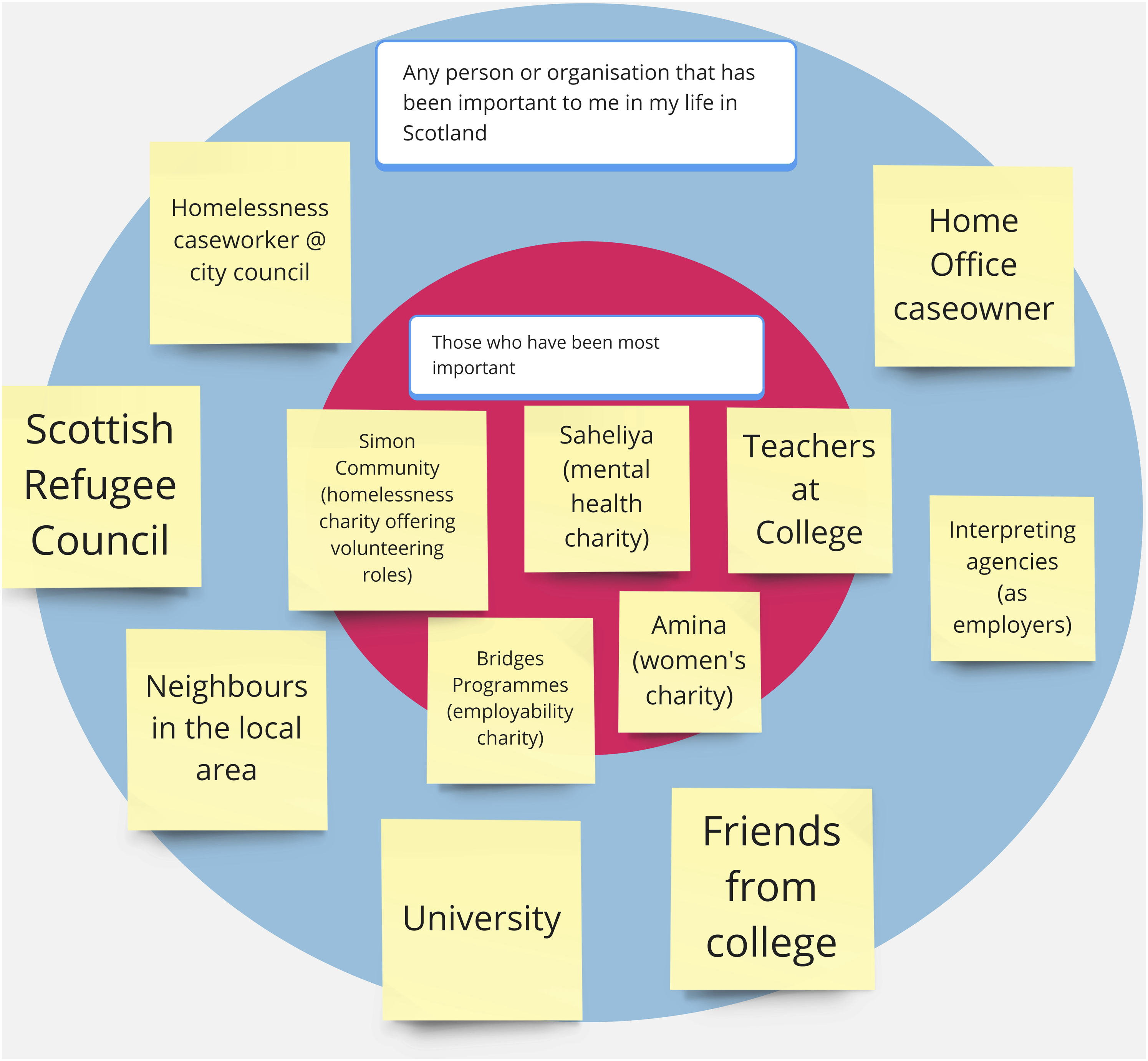
During the transcript correction process, a member of the research team created a pathway map for each participant, visualising the links between important connections. Participants were invited to take part in a second interview, 6 months after the first where they were shown the pathway map and asked to correct and confirm it. This allowed women to engage with the visual, and for researchers to discuss any changes to women’s lives in the time between interviews. Figure 2 shows Hena’s pathway diagram with associated key. Hena’s pathway map.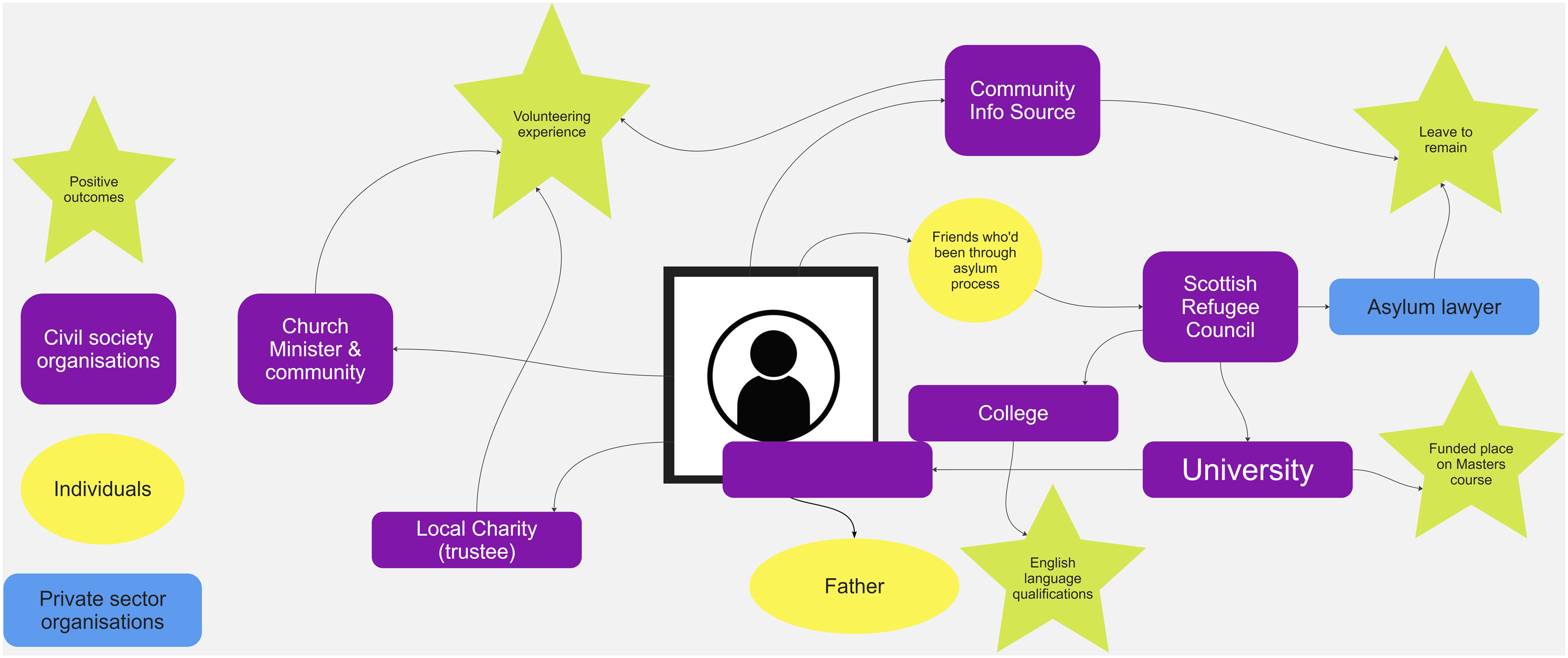
Interviews were informal in style, and the use of visual, interactive tools meant that rather than following a pre-determined script, interviewers were able to respond to participants’ own choice of topics as they emerged in conversation. While none of the research team have personal experience of the asylum process in the United Kingdom, we have collectively many years of experience of research and practice with people seeking asylum. We drew upon this experience to conduct our work with careful recognition of the power differentials in work with refugee populations (Mackenzie et al., 2007) but are aware that participants may have been unwilling or felt unable to share certain aspects of their experiences with us.
Analysis
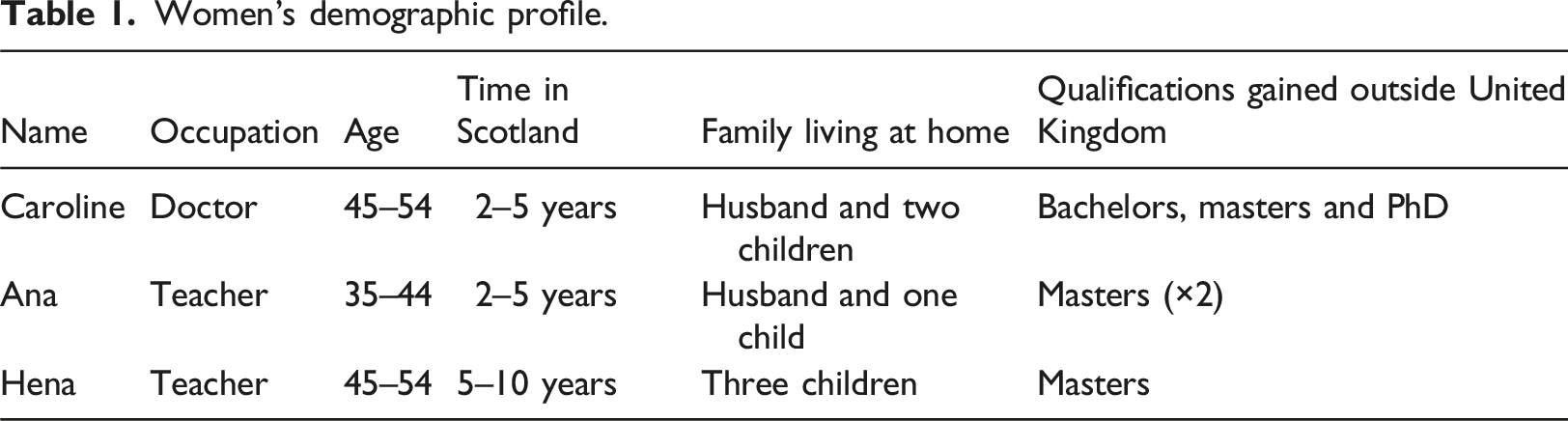
In our analysis, we deployed an interpretative phenomenology approach (Matua and Van Der Wal, 2015) to capture not only a descriptive view of our data but a deeper understanding of the personal and environmental factors shaping each participant’s experiences. To do so, each team member corrected a selection of transcripts including but not limited to those from interviews they had personally conducted. The correction process and concurrent creation of individual pathway maps enabled us to spend significant time listening back to the audio recordings and confirming understanding of each person’s narrative before proceeding to a more traditional inductive coding phase. In this second phase, transcripts were uploaded to Dedoose software, through which the team generated an initial descriptive coding framework. We met jointly to discuss and refine this, before proceeding to a second phase of interpretative coding. Whilst not initially designed as a case study research project, it was during this second phase that we became increasingly aware of the individual specificities of women’s circumstances, and how age, care and immigration status influenced their integration pathways. We identified Ana, Caroline and Hena’s accounts as sharing important commonalities relating to their identities as older, well-educated, professional mothers with strong English competency. Focussing on their accounts, following Stake, allows for a holistic view that privileges women’s own explanations of their educational aspirations and the circumstances that affect their achievement (Stake, 1995 quoted in Yazan, 2015). In so doing, we do not purport to represent the experiences of all women refugees. Instead, we seek to deepen emic understandings of the role of education in integration and its multiple meanings. Pseudonyms were agreed with each of the women and are used throughout.
Case study data
Women’s demographic profile.
Findings
Three core themes emerged in our analysis, which illuminate the intersecting factors that can shape women’s experiences of engaging with education. These are explored sequentially, covering systems and structures; age and time and caring responsibilities. We conclude by highlighting women’s strategies to overcome obstacles in their educational and professional pathways.
Navigating systems post-migration
Although Hena, Caroline and Ana arrived in the United Kingdom with strong English language skills, all three women had had to validate these in educational settings before accessing other educational opportunities. While Ana spoke highly of her time as an English language student, Caroline, whose medical degrees were taught in English, felt that the obligation to return to more basic English language classes stunted progress towards her other goals.: ‘Can you imagine if I’ve spent three years just in the language for ESOL, that is unlogic[al]’
Waiting lists for the specialist occupational English classes she required to register as a doctor in the United Kingdom were long and she had not been able to make progress as rapidly as she had hoped. These frustrations compounded Caroline’s sense that because her degrees were from a non-English speaking nation, they now counted for nothing. ‘At some points you feel awful to do it because you are going to start again because they didn’t accept your master’s, your bachelor’s, your experience. So, once you finish these exams you have to start like any junior coming out from his bachelor’s degree’.
Caroline’s perceptions echo existing critiques of an over-emphasis on language acquisition and a failure to acknowledge skills that refugees already possess (Morrice et al., 2020). Hena, who spent a long time waiting for a decision to be made on her case, felt the implications of her immigration status play out in her search for education and employment opportunities: ‘I was not supported through the Uni for any funding. Three times I applied and I had to drop it because they said that you have to either be considered as an international student and you have to pay your full fees or you arrange some funding or grants’.
It was only through her own self-motivation and 3 years of trying that she eventually managed to secure funds directly from her university. This confirms previous evidence that pathways through the education system are often complex for refugees to navigate (Bajwa et al., 2018). This can be because of funding requirements and barriers, or simply because of a lack of reliable information – Caroline described seeking out educational pathways as a process of ‘jumping from place to place…but you don’t have the map’. Ana, on the other hand, appeared to have found it relatively straightforward to revalidate her institutionalised capital, explaining that support from a network of third sector organisations had enabled her to progress her educational aspirations: ‘They converted my certificate [...] sent it to higher education, I don’t know the Minister of Education, something like that, to convert my certificate. After that I could apply to the university by this certificate’.
As a result, at the time of her interviews, Ana was optimistic for her prospects when she planned to work as an immigration lawyer and help others to navigate the asylum process that she had only recently exited.
Age and time
Time influences integration across all domains (Tefera, 2021), with increased time spent in a country generally associated with positive integration outcomes (Cheung and Phillimore, 2014). However, Hena, Caroline and Ana all reflected on the role of time in different, more ambiguous ways: as it pertains to their age at the point of migration; their age during our interviews and the length of time it has taken them to identify and work towards realistic educational and employment ambitions. A visual representation of the different forces that had shaped Hena’s aspirations and experiences since arrival in the United Kingdom is shown at Figure 3. Each parallel line represents different time-bound experiences. These periods overlapped in sometimes contradictory ways. For example, while Hena had been engaged in family life and in seeking funding for education over periods represented by the red and green lines, she still felt that overall, much of this time had been ‘wasted’ (grey line) as immigration restrictions (blue line) and difficulties accessing funding (green line) meant she had not been able to pursue her studies. Hena’s timeline.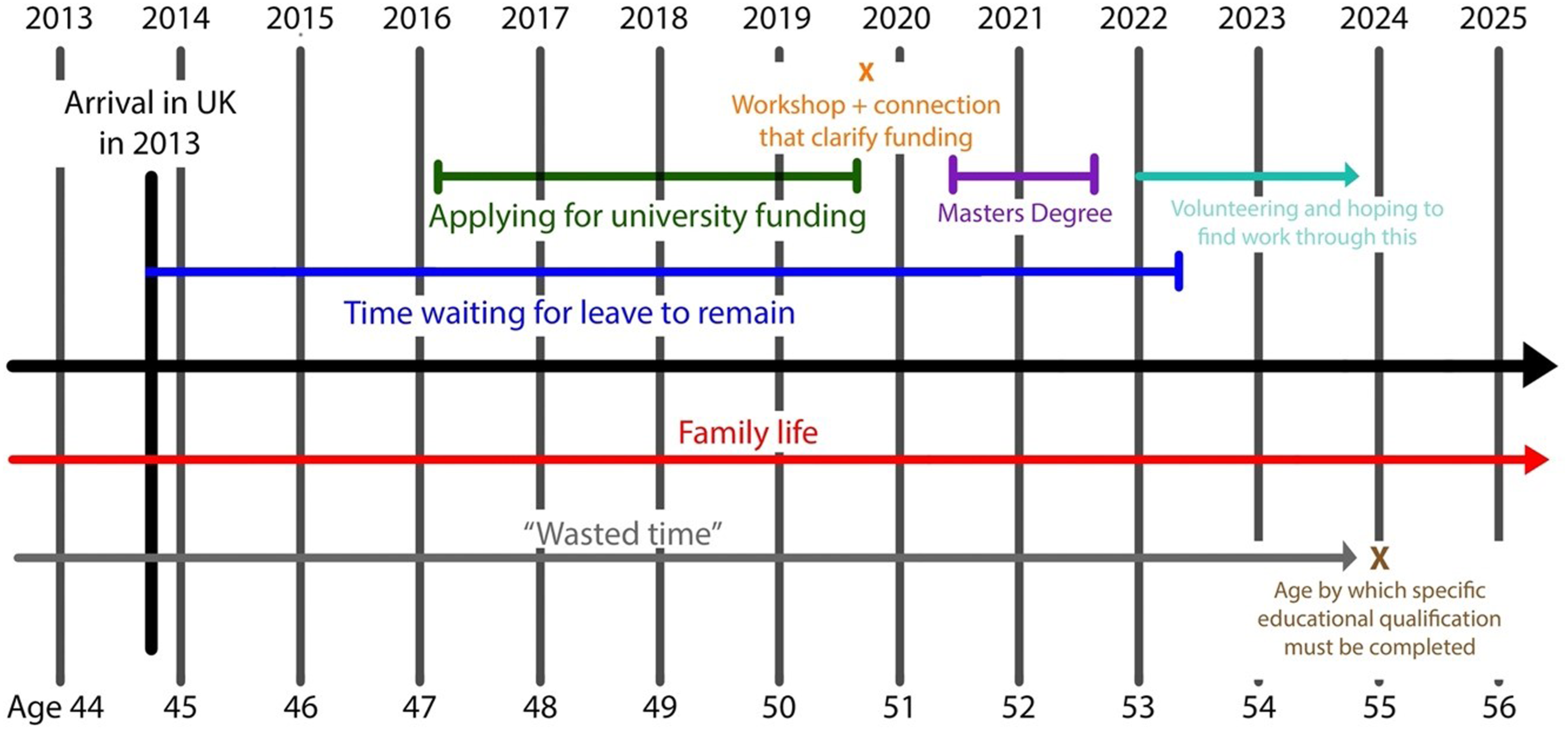
During this wasted time, Hena had also aged physically. As a result, she no longer felt sure of herself or her capacities to work and contribute to UK society. ‘the [asylum] decision took too long to be able to live my life here… I was in my forties and now I am in my fifties so that makes a difference […] I feel physically I am now weak and old and I don’t feel like I have the same strength in me as I had before so feeling like I’m running short of time’.
In Hena’s case, the impact of ageing was felt even more keenly because she was about to age out of eligibility for the postgraduate course she had aspired to follow. She had now decided to ‘change track’ and move into community work rather than putting her previous qualifications to use. This decision represented a tactical move grounded in resignation to her situation and recognition of what Hena described as being the many ‘disappointments’ she had already faced in her education and employment pathways (Liversage, 2009).
Caroline discussed her sense of being stuck in a loop, trying to decide whether to try to re-enter her previous career as a consultant or taking a new direction. Both options felt hard, as ‘starting again’ at her age was exhausting and humiliating. She spoke for herself and her husband, both highly qualified people, when she explained: ‘you know, if he was young it didn’t matter he would go through the system but you already are skilled how are you coming from the bottom again, how many 20 or 30 years in my life to spend it again in the same study. I don’t want it’.
She and Hena both explicitly contrasted their own situations, as older women, with those of people who migrated at a younger age, including their own children. Youth, in their telling, was an advantage when finding one’s way through the maze of educational and career possibilities in countries of settlement. Time wasted was keenly felt, and the idea of spending even more time studying towards an uncertain professional future was also daunting. With this said, during the period that Hena described as wasted time, represented as the grey line on Figure 3, she had nonetheless kept herself busy. Education played a key role in this: ‘I started studying and that was quite helpful as it was the one thing that kept me engaged. Because the first ten days were quite hard, living doing nothing, but when I started studying that was helpful. I met new people and the teachers were also helpful and good and guiding at the end of the course’.
Ana, the youngest of the women whose accounts are narrated in this paper, spoke even more positively about the way she had proactively engaged in educational opportunities from the point of arrival. At the time of the interview, she was studying for a Masters course with the objective of becoming an immigration lawyer. Like Hena, this represented a shift in her occupational identity from her previous role as a teacher in her country of origin. But Ana framed this as a positive opportunity. ‘I didn’t waste the time because I’m an active person I always could find the best way to not waste the time to improve my English language and contact the organisations in order to get ready before the university’.
Education and time then intertwine in different ways. Being forced back into education due to barriers to recognising previous qualifications obtained outside the country of settlement is a source of frustration. But education offers respite from other barriers erected by immigration processes, allowing women to keep busy while their asylum claims are being considered.
The ambiguous impact of care
Caroline, Hena and Ana all discussed how their identities as mothers, and the care this involved, overlapped with other identities they had chosen or found thrust upon them. Hena explained that prior to migration she had three careers which ran concurrently (Habti, 2014). In migrating, she had moved from working full-time to studying full-time, but her work within the home did not cease. ‘I had been in full time job, full time housewife, full time mother and doing my job and when I came here I went back to studying education’.
Caring involved not only the practical demands of ‘caring for’ but the emotional labour of ‘caring about’ young children (Scuzzarello, 2009). Both elements had an impact on women’s perceptions of and engagement with education and their aspirations for skilled employment. Ana portrayed her juggling of multiple roles with pride. Her ability to maintain studying, work, home and childcare responsibilities gave her a sense of completeness and satisfaction that resonated across both her interviews. ‘I have a lot of responsibilities, family responsibilities, kids, jobs, home, making food, university, study, I don’t know how to describe it. But I’m happy because I could manage to all – each part, I could manage and find the time for each part of my life’.
However, on occasion the logistics of caring obligations clashed with women’s other ambitions. Even though Hena’s children were now grown up, they still lived with her meaning she had to ‘care for them and do things’ even as she struggled to rebuild her professional life. Caroline worried that she had lost her place on a training course because she had been unable to complete the in-person teaching due to childcare duties: ‘I thought that maybe [they cancelled my place] because there is the last day which I joined them, […] that day my son I have to see him early, so […] I go home early before the class was finished’.
Women were also aware of the impact on their children of the decisions they took. Ana had had to change her daughter’s school in order to access after-school care. Although changing school made her daughter ‘sad’, this was the only way that Ana could realise her ambitions to follow a university course. ‘After that I moved her to another primary school because the previous one didn’t have after school care, because I’m still at university I need the school to have after school care to take care of my daughter whenever I will be at the university. That’s why I moved her to another one, that one she started now is 30 minutes’ walk from the home’.
Indeed, while this paper focuses on women’s own educational and employment aspirations, Caroline and Ana both emphasised that their decisions were strongly influenced by concerns around their children’s educational pathways. Ana explained: ‘you have to live for your kids not for yourself’, resonating with work that highlights the primacy of children’s achievements post-migration (Larsen, 2018). Caroline spoke at length about ‘campaigning’ for her daughter to be able to access university. Women may be navigating systems not just on their own behalf but for their children as well. ‘I contacted many, many organisations, you know. […] We got her residency before one week of the [student funding] deadline and then we sent to the MP, our MP that she got her residency and he contacted the Student Award Agency for Scotland […] she got the scholarship from the Sanctuary, she was lucky also’.
Caroline’s energy and passion for assisting her daughter contrasted strongly with what she described as her loss of passion for her previous career, and her occasional despair at progressing with her own ambitions. The demands of navigating new educational and employability systems had worn her down to the extent that she sometimes felt she should stop struggling: ‘Every step you have to do a legal certificate, a legal permission. I find it difficult. Sometimes I said, what are you doing, can you please stop, don’t waste your time in thinking, can you stop and be a mother and housewife and that’s it’.
Caroline ultimately decided to pursue a different path. However, her account of the decisions and dilemmas she faced along the way echoes the ways that women can find themselves, in a post-migration setting, sometimes obliged by circumstance and logistics, to renounce their previous lives as workers and students, and accept new, gendered roles within the home (Liversage, 2009).
Education as a node in a network
Although Caroline and Hena both described being confronted with significant barriers when trying to access education, there was evidence of educational settings playing a positive role in women’s lives as nodes in a network that connected them onwards to new relationships and opportunities. Ana’s pathway map at Figure 4 illustrates this point. Ana had made a multitude of positive social connections since arriving in the United Kingdom, leading her towards the positive outcomes represented by green stars. These included making new friends, obtaining a place at university and finding self-employed work. Central to her pathway were named teachers at college, highlighted as one yellow individual connection within the red box area in Figure 4. She spoke fondly of both women. As well as facilitating her English classes, they had helped her to access digital devices during Covid-19 lockdown and had signposted her to a local charity for help converting her qualifications. In Ana’s telling, her college teachers were a vital links in a chain that had led her to achieve her most important aspiration of studying an immigration law course. Ana’s pathway map.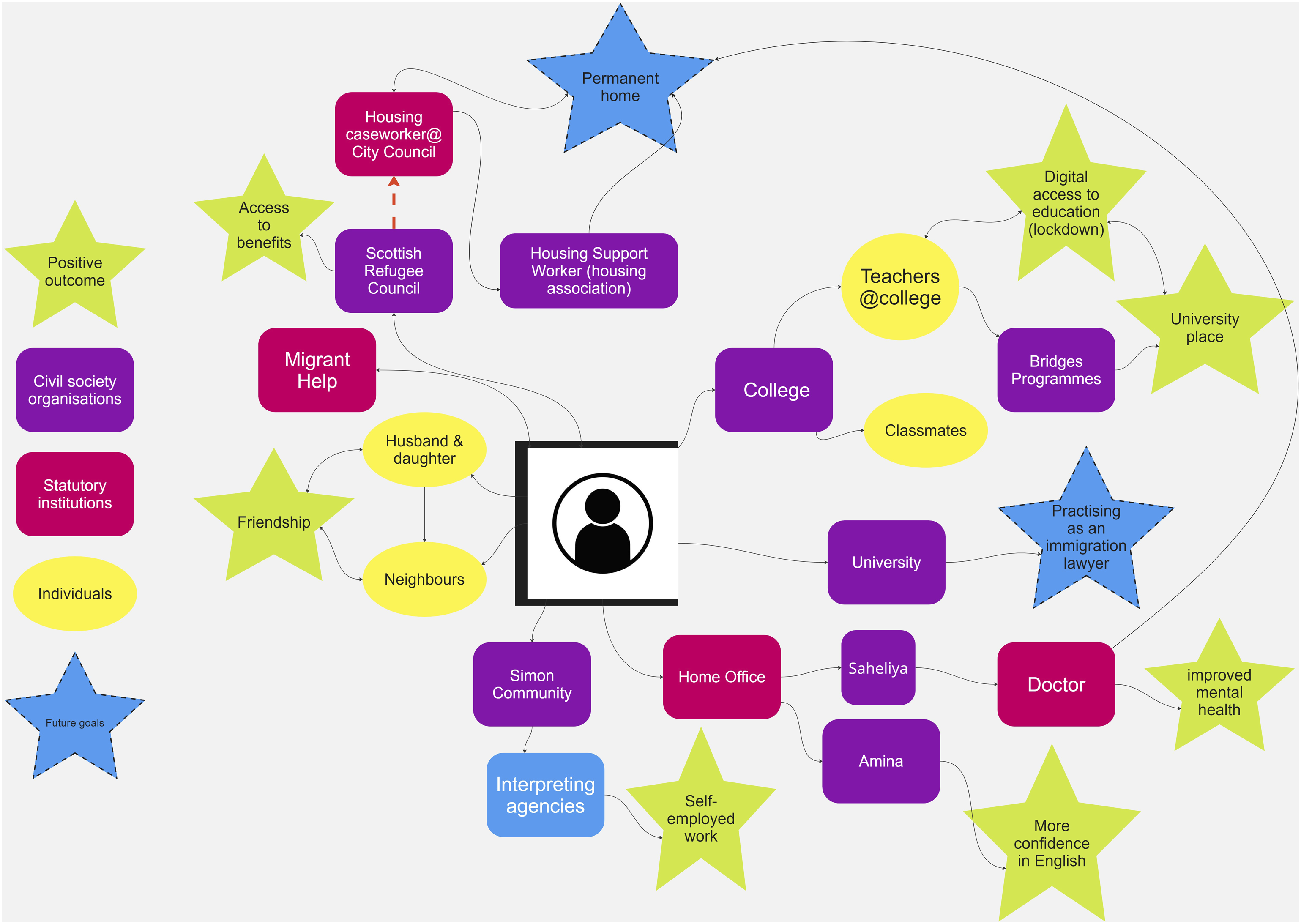
Hena too had actively engaged and leveraged social connections in her search for educational progress. Through involvement with Scotland’s national refugee charity, Scottish Refugee Council, Hena had taken part in a workshop on education and employability. There she met someone from a university who was instrumental in helping her to overcome what had appeared to be insurmountable barriers to pursuing her course of study: ‘in that workshop […] one person from the university came […] I told him that I applied for funding several times but I was never given that support which was very disappointing […]I contacted [Scottish Refugee Council worker] and asked about that person’s name and she gave me the name and the contact details and I emailed him and then he referred me to the relevant department. And then that was how I achieved that grant or funding and I completed that course successfully’.
Caroline had met a classmate while studying for exams at college, and it was this informal connection who had shared details of an employment opportunity. As a result, she had finally been able to obtain paid employment in a field where she was qualified and interested albeit on a zero-hour basis. This accidental encounter during her studies had proven more productive than some of the more formal supports Caroline had accessed. It had also overcome some of the barriers Caroline faced not only in re-validating her experience as a doctor but in attempting to enter academia as an employee rather than as a student.
Discussion
Hena, Caroline and Ana’s accounts of accessing education after a grant of leave to remain in the United Kingdom allow for a contextualised understanding of the different, sometimes ambiguous roles played by education in integration. All three women arrived in the United Kingdom with a good command of English and pre-existing educational qualifications and career experience. Yet these advantages did not always translate into improved social or educational capital (Akkaymak, 2017). Both Hena and Caroline described an uphill struggle as they fought to find a productive pathway through inaccessible higher education systems. In the end, both women decided to adopt different paths, resigned to not regaining their previous status as a doctor and a teacher respectively. Although they had nonetheless achieved some measure of success in Scotland – both were in paid employment by the time of their second interview with the team – they reflected at length on the negative impact these barriers had had on their self-worth. For Caroline this explicitly included fearing discrimination in the closed systems she had encountered in the United Kingdom. As such, their accounts tend to confirm the difficulties faced by highly skilled migrants who seek to assert their existing educational and career skills in new country contexts: ‘Rather than being a positive resource and facilitating moves between social fields, institutionalized capital becomes more of a burden to the highly qualified who desperately stick to their occupational identities’ (Eggenhofer-Rehart et al., 2018: 41).
Ana, the youngest of the women, had thus far had more positive experiences. This could be attributed to factors specific to her situation. She had obtained one of her postgraduate degrees at a European institution, which may have facilitated the translation of her existing education to a UK context. In explaining her choice of educational pathway, and the ways that this was explicitly tied to her projected new career in Scotland, she also illustrates the career adaptability described by Campion (2018). This adaptability, defined as the readiness and willingness to adapt to challenges faced in work and working conditions – has been suggested as offering greater subjective resettlement success (Campion, 2018). Certainly, solely in terms of how women felt about their careers and education, Ana expressed satisfaction and optimism absent from Caroline and Hena’s accounts.
Ambiguity around the role of education in integration was evident when women spoke of time and age. Educational settings were both places where women could fill their time and keep busy (Ana), and spaces where time was being wasted (Caroline). Spending hours in classrooms re-learning English or re-validating qualifications were, in Caroline’s account, moments where she was keenly aware of the impossibility of regaining her previous social and educational status. Interventions open to her in educational settings were more of an insult than an assistance. The sheer burden of engaging with the system meant she had lost her motivation and her passion for her career (Mozetič, 2022). Hena situated her wasted time as an artefact of her long journey through the asylum process and resulting limits on her eligibility for education and funding. With some sadness she noted that the transition from her forties, when she first claimed asylum, to her fifties, when she was finally granted leave to remain, had closed certain educational and employment options off to her forever. Time cannot always be regained.
The original interviews were conducted with an approach which centred social connections as a key tool in people’s settlement journeys. The importance of social connections is highlighted once again in this reading of three highly skilled women’s journeys through educational systems. Though often slow and difficult, it was commonly one positive connection within a wider social network, which led women to progress their educational ambitions. For Hena, a connection facilitated by Scottish Refugee Council assisted her to secure funding and pursue an educational opportunity. Caroline found an employment opportunity through an informal connection made on a college course. Ana’s positive relationships with college staff and an integration support service, lead to the fulfilment of educational goals and to paid employment. On the one hand, the positive and productive role played by these connections echoes previous work around the importance of social connections in integration, including informal relationships with friends and acquaintances (Ryan, 2018; Wessendorf and Phillimore, 2019). However, Caroline and Hena’s accounts give rise to questions around the sustainability of relying on personal connections and an element of luck to achieve one’s integration goals. Connections can mitigate systems barriers, but this does not absolve institutions from adapting to meet the needs and recognise the talents of diverse populations (Baillot et al., 2022). Integration is often situated as uniquely personal experience, yet Hena, Caroline and Ana’s accounts highlight that they are taking decisions with a wider context framed by structural opportunities (or lack thereof) and the lives of their significant others. On this final point, ambiguity is present not only in the role of education but also in the balancing of education and career with caring responsibilities. Women’s lives were intertwined with those of their familial others (Klok and Dagevos, 2023) and their ability to pursue their own educational goals was sometimes subsumed by the efforts they put into advocating for their children’s educational progress. While for Caroline and Hena this was experienced as a burden of responsibility that at times clashed with their own ambitions, Ana’s identity was partly defined by her success in juggling these important roles. Where children were successful or happy in their lives, mothers found some solace from disappointments in their own educational or professional trajectories (Larsen, 2018).
Conclusion
This paper’s empirical focus on the lives of highly skilled women sheds new light on the substance and meaning of refugee women’s engagements with educational provision in high income contexts. As part of a wider post-migration ecology (Arar and Orücü, 2022), education can play multiple roles in wider integration, offering spaces where positive social connections can be forged, as well as providing the administrative validation required for women to rebuild their professional lives. As such it represents a critical ‘opportunity structure’ that reminds us that integration is not just a personal but instead a societal endeavour (Phillimore, 2021). However, where education systems are not receptive, the sometimes bruising experience of having one’s skills go unrecognised and feeling stuck in a constant struggle to prove one’s worth can damage women’s confidence and affect their sense of belonging and welcome. Conceptually, the paper therefore questions assumptions that education will be a positive precursor to and an indicator of ever deeper integration (Ager and Strang, 2008; Ndofor-Tah et al., 2019). Instead, when women are impacted not only by education systems but their own familial caring responsibilities, the struggle to access and find fulfilment in educational settings can generate feelings of disappointment and disillusionment. This is particularly the case where women have waited for long periods to have their refugee status recognised, where the ageing process combines with statis in other areas of life to create a sense of time wasted or lost.
Yet, in line with McPherson (2010), women’s accounts underscore their capacities as active protagonists whose self-generated strategies enable them to make progress towards their aspirations. Women do not always need formal assistance to find pathways through the obstacles they face. But without a network of connections, finding these pathways would be more difficult. This does not absolve educational institutions from their responsibilities as actors in the multi-directional processes of integration. Rather, the accounts presented in this paper present a clear challenge for educational settings which, over 20 years after the first people seeking asylum were sent to Scotland by the UK government, still appear to have work to do. From admissions policies to the substance of provision for recently recognised refugees with existing skills, institutions at all levels of education should actively seek to harness women’s energies and passions. The focus of work at the nexus between education, migration and integration continues to be on young people within school systems. As part of a wider feminist endeavour to recognise, value and address the specificities of women’s lives and experiences, programmes need also to recognise what older women can contribute to classrooms, workplaces and communities if there is a concerted effort to ensure their access to these spaces.
Footnotes
Declaration of conflicting interests
The author(s) declared no potential conflicts of interest with respect to the research, authorship, and/or publication of this article.
Funding
The author(s) disclosed receipt of the following financial support for the research, authorship, and/or publication of this article: This work was supported by the Asylum, Migration and Integration Fund (UK2020PR0104).
