







Abstract
“Black Excellence by Design: A Radical Manifesto for Transforming Education and Liberating Society” presents an autoethnographic account that weaves personal reflection with scholarly literature to articulate a bold vision for reimagining educational practices through the lens of Black Excellence. This manifesto draws from my experiences as a Black student, beginning in third grade at the age of 8, to challenge prevailing narratives that marginalize Black identities and contributions. It advocates for a transformative approach that integrates culturally relevant pedagogy, antiracist frameworks, and holistic development. By centering on joy, resilience, and collective power, this work highlights the importance of creating educational spaces that affirm the brilliance of Black students and empower them to become architects of their own futures. The article illustrates how educators can cultivate environments that celebrate cultural pride and foster critical consciousness through compelling examples and actionable strategies. Ultimately, this manifesto serves as a call to action and a roadmap for educators, policymakers, and community leaders committed to dismantling systemic inequities and uplifting Black voices in the pursuit of liberation and social change.
Keywords
Introduction (A biographical sketch)
The roots of inspiration
My journey with Black Excellence began in the third grade at Paul Robeson Elementary in Detroit, Michigan, when I was 8 years old. Under the nurturing guidance of Mrs. Elmore, an African American teacher, I found warmth, strength, and determination reminiscent of my mother. Mrs. Elmore introduced us to the Black National Anthem, Lift Every Voice and Sing, and the empowering ballad, The Greatest Love of All. These songs were far more than melodies; they were profound affirmations of identity, resilience, and pride. Through her teachings, I came to understand that education transcends academics—a transformative force that encompasses culture, spirituality, and personal growth (Johnson and Johnson, 1900; Masser and Creed, 1977).
This account is an autoethnographic reflection that intertwines my personal experiences with scholarly insights, illustrating how my educational journey has shaped my understanding of Black Excellence.
A sanctuary of learning
Mrs. Elmore’s classroom was a sanctuary that celebrated our heritage and affirmed our identities. She skillfully wove art, music, and spirituality into rigorous academics grounded in Black studies. Her lessons provided mirrors reflecting our beauty and radiance, windows that revealed our boundless potential and connections to other cultures, and sliding glass doors that encouraged us to step boldly into our futures (Bishop, 1990). Her love and dedication were evident, not only in her words but also in the respect and care she showed for our identities and histories. Through her guidance, I realized that education could be a powerful and liberating force.
A call to action
In fifth grade, at the age of 10, Mr Green, a Black man, took up the torch of inspiration. Towering at 6 feet 3 inches, he commanded respect not only through his stature but also through the passion and conviction he brought to teaching. His classroom walls were a testament to Black Excellence, adorned with images of luminaries like Frederick Douglass, Paul Robeson, James Baldwin, Toni Morrison, Maya Angelou, and Malcolm X. “Excellence is in your DNA,” he would declare, locking eyes with each of us. Those words resonated deeply, planting a seed of purpose within me long before I could fully comprehend their profound significance.
Navigating loss and finding new paths
Tragedy struck when I was 10 years old; my mother lost her courageous battle with breast cancer at the young age of 35. In the aftermath of this profound loss, my father made the difficult decision to send me to live with my paternal grandparents, Nancy Mae and Jesse, in Chicago. There, at Benjamin Banneker K-8 School in the Englewood neighborhood on the South Side, I encountered another powerful embodiment of Black Excellence: Ms Calhoun, my eighth-grade teacher, when I was 13. A proud Black woman and an extension of my family, Ms Calhoun balanced nurturing care with unapologetic firmness. She cultivated in me a profound love for learning and an unshakable sense of dignity, encouraging us to carry ourselves with pride and purpose in every aspect of life.
Englewood, a neighborhood with a rich yet complex history, began as a railroad junction known as Junction Grove in the 1850s. Initially settled by German and Irish immigrants, it transformed into a predominantly Black community by the 1940s (2012). At its peak, the commercial district at 63rd and Halsted was the second busiest in Chicago, bustling with shoppers and businesses (WTTW, n.d). However, systemic injustices, such as redlining and white flight, led to significant economic decline and disinvestment in the latter half of the 20th century (South Side, 2014).
Despite these challenges, Englewood has demonstrated remarkable resilience. Community-led initiatives, the relocation of Kennedy-King College in 2007, and the opening of Englewood STEM High School in 2019 exemplify ongoing efforts to revitalize the area (WTTW, n.d). Local events, like the Englewood Jazz Festival, further enhance community engagement and pride, showcasing the neighborhood’s enduring spirit and commitment to a brighter future (WTTW, n.d).
Ms Calhoun encouraged us with the motto, “I Can and I Will,” a powerful affirmation that became my mantra for resilience. Years later, as a teacher at Benjamin Banneker Charter Public School in Cambridge, Massachusetts, I carried her legacy forward by adopting this motto in my own classroom. I even held a symbolic ceremony where my students and I banished the word “can’t” from our vocabulary. Ms Calhoun’s lessons transcended the classroom, instilling in me a profound understanding that Black Excellence is not just an ideal but a way of life.
Expanding horizons
When I entered high school at the age of 14, my family ensured that I continued to experience Black Excellence through the Paideia Honors Program at Roger Sullivan High School on the North Side of Chicago. Here, Black Excellence was more than a theme—it was a guiding principle woven into every opportunity I encountered. Dr. Robert Brazil, a visionary Black principal, led the program. It included many Black educators, both men and women, who skillfully guided us through transformative Socratic dialogues, alongside several white teachers who also contributed meaningfully to our learning. These educators, teaching at the intersections of race, class, and gender, brought depth and richness to our learning. Rooted in Mortimer Adler’s Paideia Proposal, the program championed a democratic education system that prioritized a well-rounded liberal arts curriculum accessible to all students, regardless of socioeconomic background (Adler, 1982). Central to its philosophy was the conviction that every individual deserved rigorous intellectual engagement, opportunities for critical thinking, and preparation for active, informed citizenship.
The Socratic method was central to the program, emphasizing collaborative dialogue and critical questioning as pathways to deeper understanding and intellectual humility (Adler, 1982). This approach challenged students to critically examine assumptions, engage with complex ideas, and cultivate a genuine passion for learning. By fostering these skills, the program honed our intellectual abilities and reflected the essence of Black Excellence. It reinforced our inherent capacity to thrive in environments of high expectations and academic rigor, demonstrating that excellence is attainable and transformative.
During my high school years, my two older female cousins, Katrina and Diane, became my legal guardians and played a pivotal role in shaping my educational journey. They facilitated my participation in enriching after-school and summer programs on college campuses, including Loyola University, Northwestern University, and the University of Illinois at Urbana-Champaign. These transformative experiences broadened my perspective and solidified my aspirations for higher education. At the same time, I worked as a dental assistant for Dr Kim, an accomplished African American woman and a close friend of my cousins, whose professional achievements and mentorship inspired me. Her example instilled a profound appreciation for scholarship, dedication, and excellence in any field.
During this time, I also began washing windows for family and friends to earn additional pocket money. One of my clients was Mrs. Michelle Obama, whom I met through one of my cousins who worked at Bloomingdale’s in Chicago. Mrs. Obama became both a mentor and a friend, guiding me through the college application process and encouraging me to dream bigger than I ever thought possible. Her support—and the foundation laid by the teachers and mentors who came before her—ultimately led me to Boston University at the age of 18, where I had the privilege of learning from professors, academic advisors, mentors, and academic deans who provided immeasurable support and resources. These individuals, diverse in terms of race, gender, class, and perspective, played a crucial role in my journey and contributed to my acceptance into the Harvard Graduate School of Education for my Master’s degree in Education. Many of these relationships have continued to flourish, and these individuals remain pivotal in my life, both as mentors and friends—a lesson I have learned: close friends are the family we choose.
The transformative power of mentorship
My educational journey—from Mrs. Elmore and Mr Green in Detroit to Ms Calhoun in Chicago—was profoundly shaped by mentors and family who embodied the essence of Black Excellence. Chief among them were my legal guardians: my grandparents, Nancy Mae and Jesse, along with my two older female cousins, Katrina and Diane. They exemplified Black Excellence through their unwavering dedication, resilience, and personal sacrifices to support me. Adding to their influence was my older male cousin, Leon, a chemical engineer and educator, who became a father figure to me. His remarkable achievements and steadfast support were a powerful source of inspiration, reinforcing my belief in the transformative power of education and perseverance.
This journey was further enriched by the support of mentors like Mrs. Michelle Obama, who became a guiding presence during my senior year in high school when I was 18 years old. Her mentorship extended beyond encouragement—she played a crucial role in helping me navigate the college application process, including providing valuable feedback on my statement of purpose. Her belief in my potential, combined with the influence of teachers and family members, inspired me to dream beyond perceived limitations and pursue opportunities I once thought unattainable. This support exemplified culturally responsive pedagogy (Gay, 2018) and culturally relevant teaching (Ladson-Billings, 1995) in action, as it was tailored to my unique background and experiences. By integrating art, music, history, and spirituality into rigorous academics, my mentors created educational experiences that centered on Black identity, racial development, resilience, and pride. They offered mirrors to reflect my identity, windows into new possibilities, and sliding glass doors to my full potential—core components of an education rooted in Black Excellence (Bishop, 1990).
Reframing Black Excellence as collective liberation
Black Excellence transcends individual achievement; it embodies a radical affirmation of dignity, a resilient defiance against systemic inequities, and a transformative blueprint for liberation. This perspective aligns with bell hooks' (1994) assertion that education should be a practice of freedom, enabling individuals to engage with their realities and challenge oppressive structures critically. Furthermore, the Combahee River Collective (1977) emphasized the importance of recognizing the interconnectedness of various forms of oppression, advocating for a collective approach to liberation that centers Black women’s experiences.
This understanding is deeply rooted in our heritage, where Black Excellence is not merely an aspiration but a legacy forged through the struggles and triumphs of our ancestors. As we navigate the ongoing challenges of systemic oppression, anti-Black racism, and white supremacy culture, it is imperative to sustain Black Excellence by centering the Black gaze and embracing traditional African communal values, fostering unity in diversity, and coalition-building. Never forgetting our history, we draw strength from our collective remembrance, which fortifies our commitment to excellence.
Ubuntu: The philosophy of interconnectedness
Ubuntu, a philosophy originating from Southern Africa, translates to “I am because we are,” emphasizing the interconnectedness of humanity and the significance of community in shaping individual identity (Tutu, 1999). This philosophy underscores that individual successes are deeply intertwined with the collective experiences and struggles of our communities. As Nussbaum (2003) articulates, Ubuntu fosters a sense of shared humanity, promoting values of compassion, respect, and communal responsibility. Thus, Black Excellence becomes a communal legacy—a testament to the resilience and strength passed down through generations, reminding us that our journey as Black people is to realize our inherent excellence despite the systemic barriers we face.
Empowerment through critical pedagogy
Mentors who embody the principles of critical pedagogy do more than teach; they empower. Freire (1970) posits that education should be a practice of freedom, encouraging learners to examine their world and engage in transformative action critically. This approach aligns with the experiences of educators who, through culturally responsive pedagogy, create environments where Black students can thrive and recognize their inherent excellence (Ladson-Billings, 1995). By centering Black voices and experiences in educational spaces, we honor our ancestors and pave the way for future generations to continue the pursuit of liberation and equity.
Carrying this legacy forward is both my responsibility and my purpose. Through teaching, educational and social justice activism, and mentorship, I aim to disrupt the status quo of educational inequities. By centering Black Excellence and antiracist pedagogy in classroom instruction, I strive to create liberatory learning spaces that challenge oppressive systems, empower students to embrace their identities, and inspire them to transform the world. Rooted in culturally responsive teaching (Gay, 2018) and antiracist educational practices (Kendi, 2019), my approach integrates Black history, identity, and excellence into rigorous curricula. These spaces are not just sites of academic success; they are radical acts of resistance and hope, cultivating the critical consciousness that students need to envision and enact transformative change (Freire, 1970).
Decentering whiteness and centering Black Excellence in racial discourse
This paper adopts specific capitalization for racial terms to challenge the normalization of whiteness and foster equity, respect, and accuracy in racial discourse.
Similarly,
In contrast,
Defining whiteness and white supremacy
Whiteness is a socially constructed system that grants unearned advantages to white individuals while marginalizing people of color (DiAngelo, 2018; Frankenberg, 1993; McIntosh, 1989). It operates as both an identity and an institutional norm, embedded within legal, cultural, and educational systems that normalize white dominance (Giroux and McLaren, 1994). Battalora (2013) traces the legal invention of whiteness in 17th-century colonial America, revealing how race was codified into law to secure privileges for European settlers while oppressing Black and Indigenous communities.
White supremacy refers to the systemic and institutionalized mechanisms that maintain and reinforce this racial hierarchy. It manifests not only through explicit racism but also through deeply embedded practices that perpetuate white advantage across various domains (Gillborn, 2005; Leonardo, 2004). Kivel (1996) describes whiteness as a dangerous fiction, enforced through violence and power, while Okun (1999, 2021) identifies traits of white supremacy culture—such as perfectionism, urgency, individualism, and binary thinking—that shape organizational life and educational spaces.
Peggy McIntosh (1989) conceptualizes these unearned advantages as an “invisible knapsack” of privileges that white people carry unconsciously, highlighting the everyday ways in which white supremacy is reproduced. Gorski (2019) critiques how even equity efforts can be co-opted by white comfort, stressing the importance of directly confronting racial injustice.
Crucially, these systems rely on what Love (2019) calls “weapons of white supremacy”—tools like tracking, exclusionary discipline, Eurocentric curricula, and high-stakes testing—that criminalize and pathologize Black students while reinforcing whiteness as the norm. These ideological and material tools work in tandem to suppress resistance, devalue non-white cultures, and maintain racial hierarchies under the guise of objectivity and meritocracy.
Understanding these dynamics is essential for dismantling the structural foundations of racism and building more liberatory, justice-centered educational systems.
Black Excellence unleashed: A bold vision for equity in education and society
Black Excellence defined
Black Excellence is a radical act of resistance and a transformative pathway to liberation. It unapologetically affirms the brilliance, resilience, and cultural contributions of Black individuals and communities. Far more than a celebration of success, Black Excellence dismantles deficit-based narratives and reclaims education as a powerful site for empowerment, healing, and justice. It boldly confronts systemic racism and anti-Blackness by centering Black identity and fostering holistic growth. Black Excellence challenges societal norms at its core by envisioning a world where Black humanity, dignity, and potential are recognized and celebrated as essential to collective liberation (Freire, 1970; hooks, 1994; Kendi, 2019; Love, 2019).
However, Black Excellence also bears the weight of perfectionism, a characteristic deeply rooted in white supremacy culture (Okun, 1999). This perfectionism imposes unrealistic expectations on Black individuals and all-Black organizations to perform flawlessly, perpetuating the harmful belief that their value is contingent on exceeding unattainable standards. Such pressures deny Black individuals and institutions the grace afforded to others (Noguera, 2003), further entrenching systemic inequities. Acknowledging and confronting this tension is vital to fully embrace Black Excellence as a liberatory framework that prioritizes authenticity, collective well-being, and dismantling oppressive systems.
Black Excellence is not merely an individual achievement but a communal legacy that demands systemic change. It integrates antiracist pedagogy (Gay, 2018; Ladson-Billings, 1995) and abolitionist teaching (Love, 2019) to create liberatory educational environments. These spaces cultivate critical consciousness (Freire, 1970) and equip Black students with the tools to navigate and transform oppressive systems while affirming their identities and fostering cultural pride.
Black Excellence: A manifesto for liberation
Black Excellence is more than a celebration of achievement; it is a radical manifesto for education and liberation that disrupts oppressive paradigms and redefines societal norms. Rooted in an unwavering belief in the inherent brilliance, resilience, and humanity of Black people, Black Excellence challenges deficit-based ideologies that have historically marginalized Black students and communities. It insists on centering Black identity, culture, and intellectual contributions as the foundation for education rather than an exception to it. This framework is radical because it does not merely seek inclusion within existing structures but calls for deconstructing and reimagining those systems to ensure equity and justice. It confronts systemic racism and anti-Blackness in education by demanding that schools move beyond token gestures of diversity toward substantive practices that honor and amplify Black voices.
As a manifesto, Black Excellence advocates for the holistic development of Black students, nurturing their intellectual, emotional, and cultural growth. It aligns with abolitionist teaching (Love, 2019) by rejecting compliance with systems that perpetuate harm and instead fostering liberatory learning environments where Black students are empowered to thrive. This vision encompasses culturally relevant and responsive pedagogies (Gay, 2018; Ladson-Billings, 1995), which validate and integrate students’ cultural backgrounds into the curriculum, as well as antiracist teaching practices (Kendi, 2019; Williams, 2025) that actively dismantle inequities in classrooms and beyond. At its core, Black Excellence reclaims education as a transformative tool for liberation, preparing Black students to navigate oppressive systems and reimagine and rebuild those systems for a more equitable future.
Black Excellence in K-12 education—defined as the educational system serving students from kindergarten through 12th grade, encompassing public, private, charter, and alternative schools—is the intentional creation of liberatory spaces where Black students experience joy, cultural pride, and empowerment as integral parts of their educational journey. Drawing from Gholdy Muhammad’s (2020) framework for cultivating genius, Black Excellence recognizes joy not as a trivial or optional experience but as a fundamental right of all students. Joy in learning fosters engagement, builds community, and affirms the humanity of Black students by creating environments where they feel valued, seen, and celebrated.
Liberatory spaces that exemplify Black Excellence prioritize the intellectual, emotional, and cultural needs of Black students. These environments intentionally reject punitive discipline practices rooted in white supremacy and carceral logic—systems that criminalize Black youth and replicate the structures of incarceration within schools (Meiners, 2007; Okun, 1999). They implement restorative justice frameworks that promote healing, accountability, and community-building over punishment (Gregory and Evans, 2020; Winn, 2018).
Culturally affirming classrooms within these spaces highlight the contributions of the African diaspora across disciplines through Black-centered pedagogy (Gay, 2018; Ladson-Billings, 1995; Williams, 2025). They elevate student voice, nurture critical consciousness, and support holistic development, empowering Black students to see themselves as agents of change capable of confronting injustice and reimagining a more equitable world (Freire, 1970; Love, 2019).
Tenets of Black Excellence: The Following Principles Guide Black Excellence as a Manifesto.
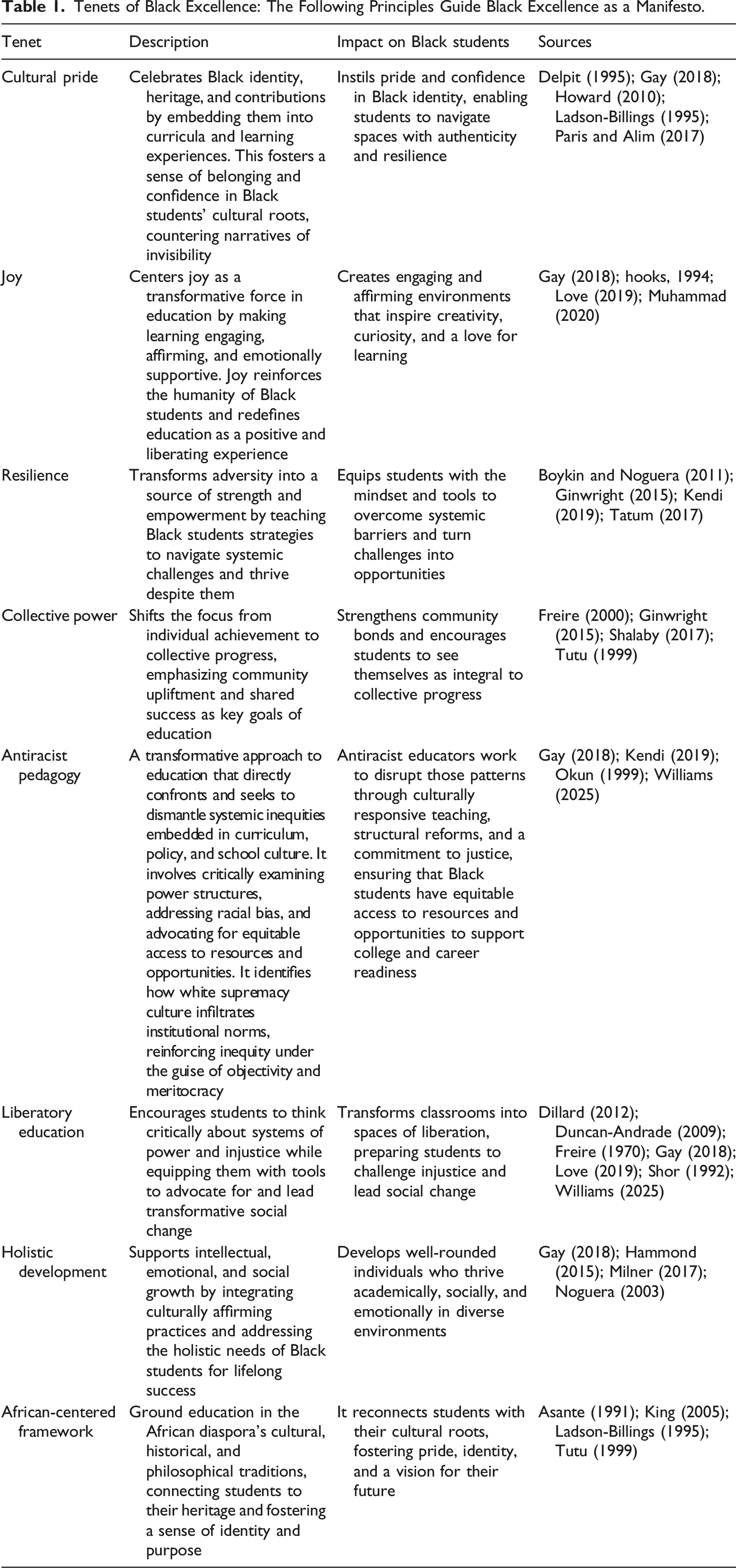
Together, these tenets create an educational model that reclaims education as a transformative tool for liberation, joy, and justice. By centering Black Excellence, we can reimagine K-12 education as a system that affirms the dignity and humanity of all students, empowering them to shape a more equitable and just society.
Demanding action: A vision for Black Excellence
As educators, policymakers, and community members, we share a profound responsibility to dismantle the systems of oppression that continue to criminalize, dehumanize, and marginalize Black students, perpetuating deeply rooted inequities in education such as disproportionate disciplinary actions (Skiba et al., 2011), underrepresentation in gifted programs (Ford, 2010), inequitable school funding (Kozol, 2005), culturally irrelevant curricula (Ladson-Billings, 1995), and opportunity gaps in advanced coursework and college readiness (Darling-Hammond, 2010). The promise of Brown v. Board of Education (1954)—that separate educational facilities are inherently unequal—remains largely unfulfilled. Structural racism, school segregation, and inequitable resource distribution persist, denying Black students the quality education they were promised over 70 years ago (Bell, 1992; Ladson-Billings, 2006; Noguera, 2003; Orfield and Frankenberg, 2014).
Dr Martin Luther King Jr. poignantly captured this betrayal in his I Have a Dream speech, asserting that America has defaulted on its promissory note to Black citizens—a check marked “insufficient funds” (King, 1963). Today, we stand resolute in our demand to “cash that check,” seeking the justice, opportunity, and dignity that our children have long been denied.
Let us boldly commit to implementing the principles of Black Excellence in our schools, classrooms, and communities. This commitment means creating liberatory spaces that affirm Black identity, foster joy, and empower students to see themselves as architects of their own futures (Love, 2019; Muhammad, 2020). It requires us to confront and eradicate systemic racism and white supremacy culture (Okun, 2021), dismantling the harmful narratives that devalue Black lives and contributions.
By fostering environments where Black students can thrive academically, socially, and emotionally, we not only elevate their voices but also enrich the very fabric of our society. We must ensure that the brilliance, resilience, and humanity of Black students are acknowledged, not as exceptions but as essential to the educational landscape. This work demands courage and intentionality, challenging us to reimagine education as a tool for liberation and justice, rather than conformity and compliance (Freire, 1970; Williams, 2025).
Together, we can transform Black Excellence from a lofty aspiration into a lived reality for all students. This is not merely a call for reform; it is a radical demand for justice, an urgent invitation to action that compels us to stand together in solidarity. Let us rise to this challenge, driven by hope, determination, and an unwavering belief in the power of education to forge a brighter future.
Black Excellence: A testament to resilience, innovation, and triumph
The resilience of Black people and the triumph of Black Excellence
When reflecting on Black Excellence, it is crucial to acknowledge the extraordinary resilience of Black communities, which have thrived despite pervasive and systemic barriers. Modern Black people are descendants of individuals who were never intended to survive centuries of enslavement, the brutal enforcement of Jim Crow laws, the terror of lynchings, and the disproportionate burdens of mass incarceration (Alexander, 2010; Angelou, 1969; Equal Justice Initiative, 2017). Yet, despite these systemic obstacles, Black people have repeatedly overcome adversity and risen to greatness, echoing the indomitable spirit captured in Maya Angelou’s (1978) poem And Still I Rise.
This legacy of triumph is a testament to individual willpower, collective perseverance, and community-based survival strategies. Civil rights movements, grassroots activism, and educational advancement efforts have fortified the resilience of Black communities (Gates, 2019). As a result, Black innovators continue to shape and transform a vast array of sectors—including science, technology, medicine, business, education, art, entertainment, and sports—proving unequivocally that Black Excellence is not just a hallmark of achievement but the very cornerstone of social progress and cultural evolution.
Defining contributions across industries
Black Excellence is not an abstract ideal—it is a tangible, enduring force that has shaped every facet of modern life. From everyday conveniences to groundbreaking scientific advancements, Black innovators have consistently driven societal progress, often overcoming systemic barriers along the way.
Public safety and infrastructure
Garrett Morgan revolutionized public safety with his invention of the three-position traffic signal, patented in 1923. By introducing a warning light to prevent accidents during traffic flow transitions, Morgan significantly enhanced road safety (Biography.com, n.d.-a; DeLuca, 2021; Morgan, 1923). Additionally, his 1914 invention of the safety hood—a precursor to the modern gas mask—provided critical protection for firefighters and was later utilized during World War I (Biography.com, n.d.-a; DeLuca, 2021; Morgan, 1914).
Electrical engineering and illumination
Lewis Howard Latimer played a pivotal role in the development of electric lighting. His invention of a durable carbon filament significantly improved the longevity and affordability of incandescent light bulbs, making electric lighting more accessible to the public (Biography.com, n.d.-b; Jones, 2023; Latimer, 1882). Latimer’s contributions helped illuminate homes and streets, fundamentally changing daily life.
Women’s health and hygiene
Mary Beatrice Davidson Kenner made significant strides in women’s health with her 1956 patent for the adjustable sanitary belt, a forerunner to modern menstrual products. Despite facing racial discrimination that delayed her patenting process, Kenner secured five patents throughout her career, more than any other Black woman inventor (BlackPast.org, n.d; Kenner, 1956; Lemelson-MIT Program, n.d). Her innovations have empowered women and improved health and hygiene standards.
Culinary innovation
George Crum, a chef of African American and Native American descent, is often credited with inventing the potato chip in 1853. While working at Moon’s Lake House in Saratoga Springs, New York, Crum created this beloved snack in response to a customer’s complaint about thick-cut fries, leading to a culinary staple enjoyed worldwide (BlackPast.org, 2021; Lemelson-MIT Program, n.d).
Medical advancements
Dr Patricia Bath broke new ground in ophthalmology with her invention of the Laserphaco Probe in 1986, a device that uses laser technology to remove cataracts, restoring sight to millions worldwide. Bath was the first African American woman to receive a medical patent, marking a significant milestone in medical innovation and highlighting the critical role of diversity in healthcare (Bath, 1988; Biography.com, n.d.-f; National Library of Medicine, n.d).
Telecommunications and physics
Dr Shirley Ann Jackson’s research in theoretical physics at Bell Laboratories led to advancements in telecommunications, including the development of touch-tone telephones, fiber-optic cables, caller ID, and call waiting. Her work laid the foundation for the modern telecommunications infrastructure, showcasing how Black Excellence drives technological evolution (Federal Communications Commission, 2023, 2017).
Computing and technology
Dr Mark Dean, a computer scientist and engineer, played a pivotal role in the development of the personal computer. He holds three of IBM’s original nine PC patents and led the team that developed the first gigahertz microprocessor, enabling faster computing speeds and influencing the evolution of modern computers (Biography.com, n.d.-c; Brown, 2015; Dean, 1981). His contributions continue to shape the technology we rely on today.
Further trailblazers of Black Excellence
Outside the realms of science and technology, Black innovators and cultural leaders have redefined industries and reshaped society through entrepreneurship, invention, scholarship, and the arts.
Entrepreneurship and innovation
Madam C. J. Walker, widely recognized as the first self-made female millionaire in the United States, built a cosmetics empire centered on the hair care needs of Black women. Her business success not only transformed the beauty industry but also empowered Black communities economically and socially, paving the way for future generations of entrepreneurs (Biography.com, n.d.-d; Bundles, 2001).
Similarly, Lonnie Johnson—an engineer, inventor, and entrepreneur—revolutionized play with the Super Soaker, a water gun that became a cultural phenomenon. He also made significant contributions to thermoelectric energy innovations through his company, Johnson R&D, showcasing how innovation can intersect with environmental progress (Biography.com, n.d.-e; Johnson, 2023).
Literature and cultural expression
Black writers and intellectuals have used their voices to center Black life, beauty, and struggle, enriching the American literary landscape. James Baldwin’s powerful critiques of race, morality, and identity remain essential for understanding American society and its complexities (Baldwin, 1985). Langston Hughes and Maya Angelou infused poetic depth into the themes of Black resilience and pride, celebrating the richness of the Black experience (Angelou, 1978; Hughes, 1994).
Toni Morrison and August Wilson crafted compelling characters and narratives that not only redefined literary excellence but also preserved cultural memory (Wilson, 2006), ensuring that the stories of Black lives are told and celebrated (Morrison, 1987; Wilson, 2007a, 2007b). In his novel The Coming (2015), Dr Daniel Black presents a profoundly spiritual and humanizing portrayal of enslaved Africans, reframing historical trauma through themes of dignity, legacy, and communal resilience. His work insists on the sacredness of Black life and our ancestral connection to liberation.
Education and intellectual legacy
Educational visionaries like Asa G. Hilliard III and Anthony B. Browder have championed African-centered education, affirming the brilliance of Black students by connecting them to historical truths, cultural pride, and academic excellence (Browder, 1992; Hilliard, 1998). Their pioneering work continues to challenge Eurocentric narratives in curriculum and policy, insisting that education must serve as a tool for liberation and empowerment. They remind us that a truly equitable education system must reflect the diverse histories and contributions of all its students.
Why Black Excellence matters
These achievements—and countless others—underscore a fundamental truth: Black Excellence is not a mere footnote in history, it is central to the progress of modern society. From the lifesaving medical innovations of Dr Patricia Bath to the transformative literary voices of James Baldwin and Maya Angelou, Black contributions have profoundly shaped the social, cultural, and technological fabric of our world.
Posing the question, “What if there were no Black people in the world?” reveals an unthinkable reality: a world devoid of innovations in light bulbs, traffic safety, vital medical devices, rich literary traditions, and global music genres such as gospel, jazz, hip-hop, and soul (Hilliard, 1995; Ladson-Billings, 1995; Mauricette, n.d). The absence of these contributions would render our society unrecognizable—less just, less creative, and far less humane.
What makes these accomplishments even more powerful is the context in which they emerged. Black Excellence has persisted not because of a fair playing field but despite entrenched systems of white supremacy, exclusion, and racialized violence (Baldwin, 1985; Kendi, 2019; Love, 2019; Perry et al., 2003). These achievements are testaments to generational resilience, collective struggle, and an enduring belief in self and community (Angelou, 1978; Black, 2015; Hilliard, 1995).
To normalize and elevate Black Excellence is to reject deficit narratives and affirm the humanity, creativity, and brilliance of Black people. It demands an education system and a society that not only acknowledges this truth but also actively works to dismantle the barriers that obscure it (Gorski, 2019; Muhammad, 2020; Okun, 2021). By embracing Black Excellence, we cultivate a more prosperous, more equitable future for everyone, one that honors the contributions of all its members and recognizes the value of diversity in shaping our collective destiny.
Conclusion
As we reflect on the myriad contributions of Black individuals across science, education, politics, literature, and the arts, we must confront an enduring and uncomfortable truth: the promise of equal education articulated in Brown v. Board of Education (1954) remains largely unfulfilled. Dr Martin Luther King Jr. poignantly described this betrayal as America giving Black citizens “a bad check,” one that came back marked “insufficient funds” (King, 1963). In the face of these broken promises, Black communities have continued to organize, innovate, and fiercely love themselves into liberation.
Two cultural anthems encapsulate the spirit of this struggle and triumph: “The Greatest Love of All” and the Black National Anthem, “Lift Every Voice and Sing.” The former asserts that Black Excellence already resides within us, emphasizing that self-love, rooted in Black identity, culture, and history, is both a form of resistance and a pathway to liberation (Brown, 2013; hooks, 1994). The latter, penned by James Weldon Johnson, speaks to generations of sacrifice and perseverance, reminding us that the path to justice has always been paved with courage, dignity, and collective resolve.
To realize the full potential of Black Excellence, we must act with intentionality, courage, and unwavering commitment. This endeavor transcends merely improving schools; it is about reimagining education as a vehicle for liberation, justice, and joy (Givens, 2021). Let us not simply celebrate Black Excellence—let us actively build institutions, policies, and communities that truly deserve it.
Footnotes
Acknowledgments
I would like to express my gratitude to my senior advisor for her invaluable guidance and support throughout the preparation of this manuscript. Special thanks to my colleagues and peers at Lesley University for their encouragement and insightful feedback. I also acknowledge the Black educators and administrators, past and present, who inspired this production. I honor my mother, whose enduring spirit continues to guide me, as well as the strength I draw from my ancestors. Additionally, I am grateful to the teachers, academic advisors, and mentors who have given me the resilience to persevere. Lastly, I would like to extend my appreciation to my family and friends for their unwavering support and belief in my work.
Declaration of conflicting interests
The author(s) declared no potential conflicts of interest with respect to the research, authorship, and/or publication of this article.
Funding
The author(s) received no financial support for the research, authorship, and/or publication of this article.
