







Abstract
This paper explores students’ perspectives on divisive concepts. Divisive concepts is a term recently used by legislators to describe coursework and training that address the experiences of race, gender, and sexuality among marginalized groups from the perspective of systemic oppression and marginalization. Federal, state, and local leaders have moved to regulate the discussion of these concepts in U.S. classrooms and workplaces. Legislators argue that these concepts lead to negative feelings of guilt, blame, and discomfort for students—specifically White students. Recent research suggests that these legislative challenges have impacted classroom instruction. Some states have also attempted to regulate divisive concepts in higher education, but there is little evidence of this concern among college students. This study focuses on the following research questions: “How do college students perceive divisive concepts like privilege and oppression? What are the key predictors of these attitudes?” To address these questions, I collected opinion data from college students in introductory American Government courses from 2022 to 2024 (n = 2487). The findings suggest that, in general, college students support discussions of divisive concepts but note the difficult environment it may create. The data show that student attitudes vary across demographic groups.
Introduction
Since 2021, there has been an ever-emerging movement by state and local policymakers to enact policies regulating “divisive concepts” in US classrooms and workplaces. Divisive concepts are topics that address the experiences of race, gender, and sexuality among marginalized groups from the perspective of systemic oppression and marginalization. Most laws define divisive concepts as ideas or concepts that theorize racial superiority as engrained in society, meritocracy as a myth, and systemic oppression as inherent (see Appendix Tables). In this paper, divisive concepts refer to terms used to address the historical and social implications of race and power. Specifically, I use the term divisive concept to reference ideas espoused by political leaders as divisive: privilege, oppression, and systemic racism. 1
Divisive concept legislation does not explicitly restrict course instruction around the concepts that policymakers label divisive. The legislation prohibits colleges and universities from requiring students and employees to attest or affirm divisive concepts as a requirement for educational or professional success. However, in many ways, attempts to regulate around these topics seem counterproductive to general pedagogical goals like equipping students with knowledge, developing critical thinking skills, and cultivating empathy. For example, in political science education, regulating divisive concepts could potentially hinder goals like practicing civil debate, creating an active and informed citizenry, and preparing students for careers in diverse spaces. Contrarily, legislators argue that these policies serve a public good by protecting students from the negative effects of divisive rhetoric and compulsory affirmation of controversial ideas. While these laws are less prevalent in higher education, this idea is still the guiding principle for the legislation designed to regulate—and some detractors would argue potentially censor—the college classroom. Interestingly, college students are key stakeholders in divisive concept legislation, but little research has gauged students’ perspectives on these ideas. Do students find discussions on privilege or oppression divisive? Do they experience negative feelings as a result of these discussions? In this paper, I will explore these ideas. I will investigate students’ views on discussions of divisive concepts, as outlined in political rhetoric and policymaking.
Literature review
There have been over 200 proposals at the local, state, and national levels of government to regulate divisive concepts in public institutions; a much smaller share has been targeted towards higher education institutions (Lantz and Carter, 2024. As of January 2025, Divisive concepts legislation has been proposed in 42 states and passed in 18 states 2 for K-12 education. Ten states have included provisions that apply to colleges and universities (Lantz and Carter, 2024).
One consistent theme in the divisive concept rhetoric is the belief that exploring these topics could harm students. Seven of the 10 laws regulating divisive concepts in higher education mention specific effects like blame, guilt, anguish, and discomfort, but it is unclear if these claims are factual. While these policies are designed to protect the college student population, no study has attempted to understand college students’ perspectives on divisive concepts and their perceived impact.
Most of the laws explicitly state that they are not intended to limit the academic freedom of faculty. As such, no legislation directly restricts curriculum or instruction on these topics. Instead, legislators prohibit institutions from requiring affirmation or attestation to divisive theories by students or employees. It is unclear if required attestations have previously been an issue in post-secondary education, however. While not explicitly targeted at curriculum matters, these laws could alter the college classroom. Divisive concept legislation could incentivize educators to self-censor classroom instruction due to fear and uncertainty (Dee, 2022). While the current higher education legislation is focused on required affirmation, the potential for further regulation in the college classroom is possible.
Opinions on the intent of laws vary. One scholar suggests that supporters of the laws believe that the laws are designed to support a central American value, individualism (Stitzlein, 2022). The idea that people should be assessed by their character rather than their group membership is at the forefront of this viewpoint. Whereas others argue that the provisions are designed to create assimilation in thought and prevent discourse on topics that may be contentious (Stitzlein, 2022). Kitching et al. (2025) argue that regulating education around topics like race serves as a tool to “dismantle race-related obligations” in schools under the guise of focusing on traditional values of individual character and family values (p. 74). Their analysis revealed a pattern of policies narrowing speech on racial concerns while cultivating policies on individual character development and resilience in the United Kingdom. The authors contend that this approach diverts attention from race’s broader societal impact and instead emphasizes individual efforts.
In either case, regulating dialogue in educational institutions has the potential to not only censor discussions but also prevent students from practicing a valuable skill: civil debate and discourse. Smith and Stitzlein (2023) articulate this well: Engaging differing interpretations on open issues, accompanied by high-quality supporting evidence, offers students an opportunity to carefully consider and resolve competing perspectives. Even noxious historical concepts can and should be taught in schools – with appropriate context – to give students realistic, holistic, and robust understandings of history. This is at the very heart of democracy. Banning evidence- based historical interpretation as ‘too divisive’ limits, rather than cultivates, students’ civic skills. (Smith and Stitzlein, 2023, p. 39)
Developing sound reasoning and communicating opinions is a broad competence that facilitates deliberative discussion and critical thinking. Because the classroom is often a space where young adults express, develop, and challenge ideals, regulations of any kind in that space seem counterproductive for educational and societal goals.
There may be professional implications across disciplines, too. As Lantz and Carter (2024) argue, the consequences of divisive concept legislation could have long-term effects on students and the workforce. They believe these policies could lead to ill-prepared practitioners who are training to grapple with the real-world challenges of their work in fields like education, public service, public policy, social work, and nursing. Discussing differences among groups without theory and reasoning for those differences places students in a position to enter professions with incomplete information on the populations served. As demonstrated by Dunn (2024), constraining classroom dialogue can have a negative impact on educators that trickle down to students. In this study, teachers were interviewed regarding their ability and willingness to address traumatic events using a justice-oriented pedagogical approach. The findings indicate that many educators feel fearful of repercussions, unprepared to fully engage in dialogue, and discouraged from engaging in these conversations at their schools. The study suggests that when social justice-oriented approaches to education are restricted, neither students nor teachers benefit.
Clearly defining which concepts are divisive has yet to be parsed out. Legislators have defined them as the ideas articulated in the laws. However, Barnes and Grayer (2023) found that the terminology used to educate or train on topics related to race and other points of marginalization is received differently, even if the instructional content is the same. Specifically, that research shows evidence that words like “oppression” elicit different attitudes toward training than other words like “experiences of diverse groups.” Put another way, word choice impacts perceptions of divisiveness.
That study did not indicate that differences in preferred terminology harmed those engaging with the teachings, but recent legislation suggests otherwise. These laws express specific concerns about feelings of guilt, blame, and discomfort amongst students and professionals. Scholarship on divisive concepts does support the notion that the laws impact educators and administrators, however (Barnes and Grayer, 2025). In this study, the researchers found that educators felt limited in their administrative discretion by divisive concept laws. However, there is no evidence suggesting that concepts negatively impact students. Student perceptions of divisiveness have been underexplored since the enactment of the legislation.
Divisiveness is not a new concept in higher education. As Sue (2013) notes, discussions of race or “race talk” are often viewed as divisive and inappropriate. It can trigger uncomfortable emotions in Whites, like blame and defensiveness. The resistance to race talk (whether legal or social) is influenced by prevailing norms of politeness, academic inquiry, and the ideology of colorblindness (Sue, 2013). As a society, we are socialized to perceive race talk as impolite, to view race as a meaningless concept, and to delegitimize it as a form of intellectual inquiry. While race talk has many constructive benefits in the classroom (i.e., reducing prejudices, correcting misinformation, and increasing racial literacy) institutional, social, and legal barriers make it difficult to engage in successful dialogues (Sue, 2013).
Current research on divisive concept legislation almost exclusively focuses on K-12 institutions (Lantz and Carter, 2024). Most studies related to topics identified in divisive concept legislation and political rhetoric in higher education centers on disciplines like English and Sociology. Little attention is given to students in other foundational courses. To address these gaps in scholarship, this study raises the following research questions: How do college students perceive divisive concepts in the classroom? What are the predictors of these attitudes? This study seeks to engage students in a different area of post-secondary competence: U.S. Government.
College students and racial ideas
Differences in attitudes towards race and racial topics across student groups are well documented in public opinion, education, and social psychology literature. Martin (2010) conducted a study wherein students’ pre- and post-test attitudes towards sensitive topics like race and gender were evaluated. The survey results indicated that following the course completion, most students with uncertain attitudes about racial issues shifted to more supportive attitudes. The course engaged in a confluent education framework that requires students to engage in multiple levels of learning through an active learning process (Martin, 2010).
When examining African American students specifically, studies have found that attitudes toward diversity courses are more nuanced for these students than expected. Ervin (2001) found that these students have positive and negative views on courses covering diversity. The findings from a survey of African American college students indicate that the students perceive these topics as a necessary component of a college education, but also believe that these courses are biased against African Americans. These students question the impact of the coursework on real-world interactions. However, it is unclear if the courses included in the course belonged to a central discipline or how a diversity course is operationalized within this study. These views may apply to the divisive concepts outlined in recent legislation. Exploring these attitudes among college students in a general education course, rather than those in courses specific to diversity, would help to provide broader conclusions on attitudes in this demographic group.
In political science education scholarship, few studies tackle the topic of divisive concepts or teaching race. Recently Watson (2021) provides a reflective assessment of teaching introductory American government courses with a focus on race. In this essay, the author explains how students perceived the course and its impact. The data collected from student assignments indicated that this course was most students’ first exposure to these topics. These classes were predominantly White in composition. Watson (2021) reports receiving no negative feedback on having a racial focus in the course.
This is one of the few studies centering race in a general education course other than English or sociology. While it provides insight into the evolution of student attitudes after engaging with topics that could be deemed divisive, the study does not provide general trends in attitudes among students. Put another way, this study provides depth and breadth of information but no generalizable findings on student attitudes. Additionally, the data presented in the paper was collected in 2013-prior to many racially centered political events like the rise of the Black Lives Matters (BLM) movement and the murder of George Floyd. It is possible that attitudes could have shifted after such a prolific era in race politics. 3 This gap in the literature leaves much to be understood about student perspectives on race in college courses.
Explaining attitudes associated with viewpoints on race
Research on political opinions and attitudes has articulated differences amongst racial groups for decades (Dawson, 1995; Kinder and Sanders, 1996; Riek et al., 2006). Much of the research supports the idea that differences in attitudes and opinions on social issues are often related to group identity and group threat. Dawson (1995) suggests that African Americans tend to hold opinions supporting African Americans because they believe in linked fate, or the connected nature of the collective African American identity to lived experiences. Kinder and Sanders (1996) support the idea of solidarity amongst African Americans, but also note that prejudicial ideas amongst Whites are less overt but still reflect bias against African Americans. Bonill-Silva and Forman (2000) research supports this premise among students. In this study, the researchers found that White students were not likely to agree with overtly racist ideas on surveys, but when allowed to discuss their views in interviews, their comments reflected a color-blind ideology. Many white students believed that differences between racial groups are rooted in individual work ethic, family structure, or culture. Because colorblindness ignores race completely, those who follow this line of thinking do not attribute differences in lived experiences to racism.
Stephan et al. (2002) explain oppositional attitudes to policies that support different racial groups as a symbolic threat—a key component in intergroup threat theory. Intergroup threat theory posits that members of one group believe that members of another racial group will “behave in ways detrimental to the ingroup member” (Stephan et al., 2002, p.124). This belief leads members to perceive threats-symbolic in nature-that could endanger the ingroup’s worldview or system of values. Put simply, an ingroup may find it difficult to support teachings that explain group success as being attributed to systemic racism, privilege, or oppression because it threatens the group’s worldview and could deter the success of the ingroup if the value system of meritocracy is dismantled. The prevalence of these ideas has been documented across racial groups. Stephan et al. (2002) found that feelings of threat were major predictors of negative attitudes toward outgroups for African Americans and Whites. Putting these findings into the context of attitudes towards divisive concepts, African American and White students could perceive divisive concepts differently. African American students may view the restriction of divisive ideas as invalidating the experiences of African Americans and a threat to the success of the group. White students may view the inclusion of divisive concepts as a threat to a belief system that supports merit and a colorblind society. For these reasons, these feelings of threat could lead to feelings of discomfort, blame, and guilt that legislators say are issues in higher education.
DiAngelo (2016) explains these experiences for whites as white fragility. White fragility is a condition in which dialogue or events that trigger racial stress cause defensive behaviors in Whites. In turn, Whites attempt to relieve this stress and return to a state of racial equilibrium in their responses. This may include engaging in behaviors like crying, withdrawal, arguing, and defensiveness. The author also notes that for whites, receiving information that centers on people of color may serve as a trigger of racial stress. The author argues that these experiences take place in both classroom and workplace settings. Within this theoretical framework, the discomfort cited by legislators may be understood as an expression of white fragility, as conceptualized by DiAngelo (2016). Divisive concept legislation may be the mechanism used to return to racial equilibrium. Exploring college students’ feelings on this topic will further illuminate the presence of the fragility outlined by scholars like DiAngelo (2016).
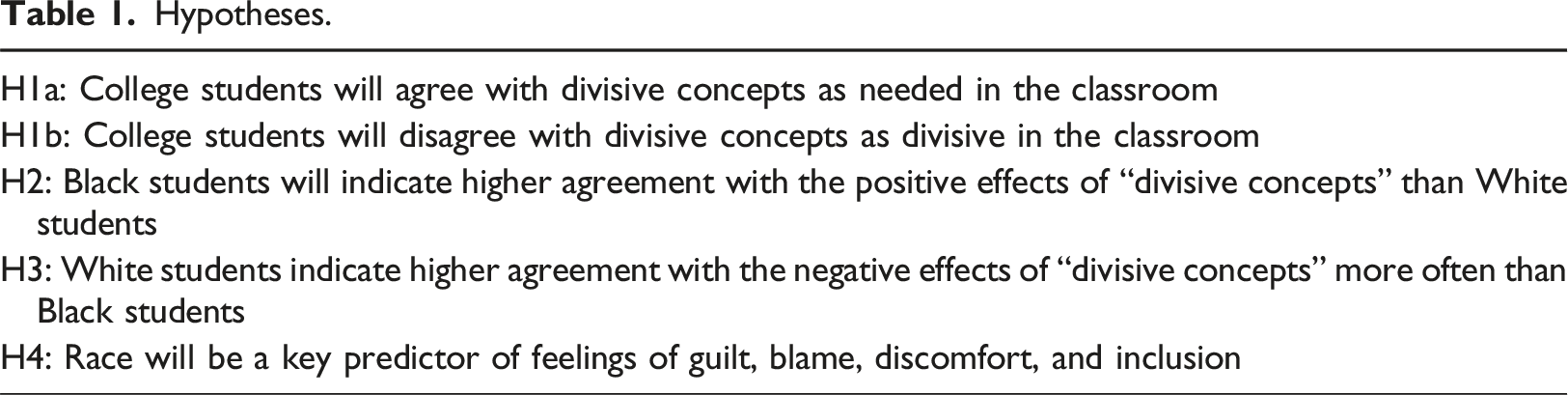
Hypotheses.
Positionality statement
As a political science professor and quantitative researcher, I recognize that my positionality shapes both the questions I pursue and the way I interpret data. I identify as a Black scholar from an urban background, and these lived experiences inform my interest in questions of representation, equity, and political behavior, particularly for communities that have historically been marginalized in American politics. While I often employ statistical and data-driven methods, I acknowledge that my perspective is informed by personal experience and professional commitments to addressing structural inequities. My position as a faculty member allows access to academic tools and authority that may create distance from the communities at the center of my research. To mitigate this, I ground my work in transparency, methodological rigor, and reflexivity. I remain attentive to the ways my background and scholarly lens influence the production and interpretation of knowledge.
Research design and methodology
To explore the research questions, I constructed a repeated cross-sectional survey design. I developed a 24-item survey instrument to gauge opinions on the divisive concepts in the classroom. Repeated cross-sectional surveys allow the researcher to collect data on different groups at different periods. This method allows for data collection over time without the attrition issues of longitudinal studies and panel data (Pan, 2021). Since the focal point of this study is to gain a general understanding of the opinions among college students, collecting the data from the same participants over time was not necessary.
The survey items incorporated in this study consist of 14 statements specific to the topics mentioned in divisive concept legislation: guilt, blame, and discomfort. I also included items on inclusion and divisiveness to gauge support for the concepts. The items used in this study were developed using central themes articulated by policymakers. For example, both (Executive Order, 2020) and South Dakota Codified Laws §§ 13-1-67 to 13-1-71 (2022) mention that divisive concepts leave individuals with feelings of guilt. So, in the study, participants were asked if courses discussing divisive concepts leave them with feelings of guilt. Two items on discussions on race and ethnicity were also included to gauge general dispositions towards the ideas. The respondents were asked to rate their agreement with all survey items on a five-point Likert-type scale from strongly disagree (1) to strongly agree (5). See Appendix Tables.
The items were embedded in a survey given to college students taking a required general education course-Introduction to American Government-at a large university in the southeastern region of the United States. The items were included in a broader student survey project across all course sections in December 2022, December 2023, and May 2024 waves of data collection. Demographic information was also collected for all participants. The survey sample consisted of all students enrolled in the American Government course. Survey invitations were sent to all classes via their instructors. Instructors were given the option to provide incentives like extra credit for participation; this was not a requirement, however. 4
Survey indices
Three survey items were included in the index for each concept under investigation: blame, guilt, discomfort, and inclusion. Each item was targeted toward one of three divisive concepts in the classroom: race in general, privilege and oppression, and systemic racism. These terms were included as separate items because previous research suggests that they elicit different attitudes and responses from participants when instructing on the topic (Barnes and Grayer, 2023). The items were then compiled as an index and used to measure feelings of guilt, blame, and discomfort among the participants. Scores across the items were combined and averaged to generate a composite score for each index.
To ensure that the items could be used as an index, I performed a confirmatory factor analysis on the proposed indices. 5 The Cronbach Alpha measure determined that the indices were internally consistent and a reliable measure of each underlying concept. In general, alpha values of .70 or higher are considered acceptable. The reliability tests for this study concluded that the index for feelings of guilt (α = 0.84), blame (α = 0.86), discomfort (α = 0.85), and inclusion (α = 0.92) were reliable measures of their underlying concepts.
Descriptive statistics of the sample
The survey was distributed to 2872 students in the three data collection periods. Of that total, 2487 students responded to this battery of questions. The descriptive statistics indicate the sample includes a diverse student population. Racially, all major groups are represented. 46.7% of the respondents identify as White, and 26.7% identify as Black or African American. Asian American or Pacific Islander (AAPI) students’ make-up 8.8% of the sample. An additional 1.7% of students identified as Native American. The final group, Some Other Race, accounts for 1.9% of the sample. 69.6% of students reported being non-Hispanic and only 14.8% identified Hispanic as their ethnicity. Women (47.6%) account for a larger portion of the sample than men (34.2%). 3% of the students identify as nonbinary individuals. Politically, more students identified as Democrats (31.1%) than Republicans (17.4%). Another 24.4% report being independent, while 11.7% report belonging to some other party. Most respondents (79%) fell into the 18–25 age category. The next category, 26–40, accounts for 3.6% of the sample. Less than 1% of students reported being over 40 years old. Regarding income, most students indicate a household income between $45,000–$85,000 per year. 17.1% of students have a household income between $85,000–$125,000 annually. 14.9% of respondents report incomes between $125,000–$200,000 and 7.4% indicate incomes above $200,000 a year. 4.4% of students selected the lowest household income category, under $15,000.
Information on student classification and major was also collected. At the time of the study, 48.3% of respondents were freshmen, 25.6% classified as sophomores, 7.6% indicated being juniors, and 3.1% of the sample were seniors. Less than 1% of the sample were declared political science majors; 82.3% reported some other major.
Results
The survey data were evaluated in several ways. First, I reviewed the general items' descriptive statistics to determine the general level of agreement with discussions in political science classes. Next, the survey items were used to create indices for guilt, blame, discomfort, and inclusion. The means were compared to determine group differences. Finally, the data were used to fit a regression model for key predictors of feelings of guilt, blame, discomfort, and inclusion. I used demographic information collected in the survey to determine if there were social or political variables that could help explain attitudes toward divisive concepts. The key independent variable is race, as it is suspected to be the driving factor of attitudes towards divisive concepts. I also controlled for factors like income and partisanship, which could influence perceptions. This information was included in the model as a series of dummy variables. Years are included in the model as controls for the different data collection periods. It is possible that the dependent variable, attitudes towards divisive concepts, may be explained by other variables like gender identity, income, and age.
Need and divisiveness
To address hypothesis 1, I reviewed the descriptive statistics of two items on courses discussing race: • Political Science courses discussing race and ethnicity are divisive. • Political Science courses discussing race and ethnicity are needed.
I analyzed the percentage of agreement and disagreement. If hypothesis 1 is correct, the data should indicate more support for the discussions on race and ethnicity and disagreement with the idea that the discussions are divisive. The modal category and mean score were calculated to determine support and disagreement with divisive concepts.
The data on these items suggests that most students believe that courses on race and ethnicity are needed. When asked about the need for courses on race and ethnicity, over 60% of the students agreed or strongly agreed with the statement. The modal response to the statement is “agree” with 31.9%. 29.70% of students selected strongly agree. Only 1.6% of respondents strongly disagreed with the statement. 3.4% disagreed, however. In general, these numbers indicate that most college students support these discussions in political science courses
Opinions on the divisiveness of these courses were more variable. The modal category for this item is “neither agree nor disagree” with 38.1%. The next highest response group is students who disagree with this statement. 18.5% of students selected this response. Over 13% of the students who responded to the prompt agreed that courses discussing race and ethnicity are divisive. An additional 14% strongly disagreed with the statement. It appears that most students believe that the courses are needed but are not sure if the courses cause division among students.
A review of the mean scores on these items specifically for African American and White students shows that these students have notable differences in their general dispositions toward course discussions on race. The t-statistic indicates that African American (M = 4.24, SD = 8.62) and White (M = 3.86, SD = 0.984) students have no real difference in opinion on the need for these courses, but African American (M = 3.45, SD = 1.041) and White (M = 3.29, SD = 1.004) do hold significantly different feelings on the divisiveness of course discussions on race, t (1964) = 3.37, p < .01. Here, Ervin’s (2001) conclusions on African American students and perceived divisiveness were supported. On average, African American students indicated higher agreement with the statement than white students.
As a result, hypothesis 1 is partially accepted. Here, the utilization of the neutral option could be an indication of the issues outlined by Bonill-Silva and Forman (2000) in student survey research on racial attitudes. Neutral responses may allow respondents to mask controversial attitudes on racial topics.
Index mean scores
The average scores across each index indicate the level of agreement with the statements provided in the survey. The scores range from 1 to 5, with 5 indicating strong agreement and 1 indicating strong disagreement. The mean scores indicate that students agree most with statements stating that divisive concepts create feelings of inclusion in the classroom. The mean score for that measure is 3.52 on the 5-point scale. On the other hand, students rated statements about creating feelings of blame lowest at 2.673. Statements suggesting that divisive concepts cause feelings of guilt were rated 2.675, slightly higher than feelings of blame. Students rated feelings of discomfort second highest at 2.83, indicating that while inclusive, there is a level of unease that surrounds these discussions.
Group mean scores
To compare the differences in attitudes between White and African American students, I conducted an independent samples t-test for feelings of guilt, discomfort, blame, and inclusion. An independent samples t-test compares the means of two unrelated groups of scores. The results indicate that African American and White students rated all four categories differently. Guilt, t (1957) = 3.17, p < .05, 95% CI (−0.2348, −0.0553), inclusion, t(1961) = 7.75, p < .001, 95% CI (0.2783, 0.4667) and blame, t(1962) = 3.03, p < .05, 95% CI (−0.-.2428, -0.0519) were the only categories to reach statistical significance. African American and White students had substantively different means for discomfort, but that category was not statistically significant. Black students rated feelings of inclusion significantly higher and feelings of guilt and discomfort significantly lower than their white contemporaries. As such, hypothesis 3 is partially upheld, and hypothesis 2 is accepted.
Ordinal regression analysis
To better understand the factors that shape or influence attitudes toward divisive concepts, I conducted a regression analysis using the key variable of interest-race- and other control variables. As suggested in the literature, race may be a key factor in developing these attitudes. Since the items are scored on a rank-order scale, ordinal regression is the most appropriate method of analyzing the data.
Blame
Race was not a key predictor of attitudes toward blame in this model. Instead, the regression model estimates that gender, party identification, and income are key predictors of feelings of blame. Women (β = −0.212, p < .05) and nonbinary students (β = −0.709, p < .001) were less likely to agree with statements indicating that discussing divisive concepts results in feelings of blame. Students from families earning less than $15,000 a year (β = 0.479, p < .05) would disagree, however. Respondents in this category rank the statements higher in agreeableness than any other income group.
Guilt
The model on feelings of guilt indicates that race, age, and party identification were associated with greater agreement. African American (β = −0.202, p < .05) and Native American (β = 0.577, p < .05) students were less likely than White students to agree that divisive concepts result in feelings of guilt. Additionally, Democrats (β = −0.358, p < .05) and Independents also report lower agreement. Age (β = −0.36, p < .05) was the final predictor to reach the level of significance. Independents were only marginally significant, having narrowly missed the 0.05 level of significance.
Discomfort
Feelings of discomfort had few significant predictors in the model. Identifying as a Democrat (β = −0.302, p < .05) or Native American (β = −0.551, p < .05) was a key predictor of these attitudes. Notably, students identifying with some other political party is marginally significant at the 0.10 level.
Inclusion
Significant predictors of feelings of inclusion were race, ethnicity, gender, age, party ID, and income. When compared to their White non-Hispanic peers, African American (β = −0.364, p < .001), Hispanic (β = −0.286, p < .05), and Asian American/Pacific Islanders (β = 0.335, p < .05) all indicated more agreement with the statements on divisive concepts creating a sense of inclusion in the classroom. Women (β = 0.795, p < .007) and nonbinary (β = 1.803, p < .001) individuals also indicated more agreement. Here, nonbinary students rated these statements 1.803 higher than male students. Party identification with a party other than the republican party was statistically significant at the 0.001 level. This effect size was largest for those who identify as democrats (β = 1.394, p < .001). Age (β = 0.022, p < .05) and income between $85,000–$125,000 (β = −0.458, p < .01) were also notable predictors in attitudes towards these statements in opposite directions. A one-unit increase in age increased the likelihood of agreement with divisive concepts as facilitating inclusion. Whereas the lowest household income category (β = −0.799, p < .001), less than $15,000 annually, was far less likely to agree with these statements than more affluent students. Race was a key predictor of attitudes concerning inclusion, discomfort, and guilt (as indicated by the regression models). This finding aligns with the notable mean score differences observed between the two largest racial groups. However, the relationship is not supported for feelings of blame. Therefore, Hypothesis 4 is only partially upheld
Limitations
While this study fills a notable gap in the literature on discussions of race in the classroom, there are some important limitations. First, the study’s generalizability beyond the southeast should be noted. While the sample does represent a diverse segment of the target population, it over-represents African Americans and under-represents Whites and Hispanics. This could be an artifact of the study location. The opinions generated here may not reflect the ideas of students in other regions.
Second, the study was conducted in a state that had not enacted higher education legislation at the time of data collection. In 2022, the state proposed but did not pass provisions applicable to colleges and universities. A great next step would be surveying students in a university setting under enacted divisive concept legislation. Students with direct experience with regulations on divisive concepts could provide additional insight into feelings of guilt, blame, and discomfort.
Using a required general education course like American Government allows for generalizable results across students. These students represent various disciplines across the university. As such, the findings can be applied to students across university programs. The study could not provide detailed information on the students in specific majors, however. Examining the attitudes of those students who take multiple political science courses, like political science majors and minors, could speak more to the applicability of the findings to students within a specific discipline. Additionally, the survey asked respondents specifically about divisive concepts in political science, which limit subject-area generalizability. Students may believe these ideas are more or less divisive in other fields.
It should also be noted that divisive concepts, as outlined by legislators, extend beyond the concepts of race, privilege, oppression, and systemic racism. Theories and ideas on gender and sexuality are also prevalent aspects of the political discourse on teaching and training in higher education. This study only examines perspectives on racially focused ideas and theories. Previous scholarship on language in training does support ideas in feminist theory, like patriarchy, as controversial (Barnes and Grayer, 2023). Future studies on perceptions of divisiveness in higher education should explore the possibility of these attitudes amongst students.
Another limitation of this study is the dichotomous treatment of race. For methodological purposes, the study compares groups of African American and White student responses. These categories do not imply a strict Black-versus-White binary in student perspectives. Rather, even when accounting for other factors, race is associated with significantly different views on ideas legislators have labeled as divisive concepts. Race is not monolithic: White students may demonstrate racial literacy, and African American students may hold beliefs shaped by internalized hierarchies. This study also does not examine nuances within subgroups, such as White liberals or Black conservatives, and the findings should not be interpreted as representing uniform viewpoints within any racial group.
Finally, there is always a concern with the validity of survey responses due to response bias. When asking participants about sensitive topics like race, some respondents could potentially acquiesce to survey statements or withhold their true feelings. As such, social desirability is a concern. To minimize the likelihood of this occurring, respondents were assured of anonymity, and no identifying information was collected. Participants were allowed to self-select into the study. In many cases, course instructors provided class incentives like extra credit for participation. This was optional for each instructor. Class incentives could mean that students who experience challenges in their courses may be more likely to respond to the survey.
Considering all things, this study still provides much insight into how college students perceive topics coined as “divisive” by legislators. Based upon these findings, it seems that divisive concepts may not have the detrimental impact on students that legislators currently anticipate.
Discussion and conclusion
This project had two primary objectives. First, it explored attitudes among college students during a period when discussing race can be viewed as divisive and counterproductive. The study sought to understand if students identified with those feelings of blame, guilt, and discomfort that policymakers argue are prevalent. Second, the study examined the key predictors of negative and positive feelings associated with discussing these topics. The models estimated which points of identity are most associated with different attitudes towards “divisive concepts.” The results suggest that while feelings of discomfort, blame, and guilt occur at higher rates for white students, feelings of inclusion scored higher overall for all student groups. The findings also indicate that social and political identities influence attitudes toward discussions of race, privilege, oppression, and systemic racism. Except for feelings of blame, racial identity was a significant factor in these attitudes.
Existing research on critical dialogue and race talk theorizes that the benefits of these discussions in the classroom are twofold. First, it exposes students to a wealth of information early in their academic careers that they may never be exposed to otherwise. Second, it serves a broader goal within higher education to encourage civility, critical thinking, and citizenship skills. Facilitating these classroom discussions allows perspectives to be shared, differences to be better understood, and outgroups to be humanized.
Based on the results, it is evident that discussion of concepts called divisive by legislators may create discomfort, but for the key stakeholders—college students—it is needed and supported.
As a scholar in critical pedagogy, bell hooks (1994) offers some insight into this process. hooks (1994) argues that discomfort can be a praxis mechanism for students and faculty. Covering these topics could lead to students not enjoying the class, which could be counterintuitive to instructors. However, moments of discomfort could lead white students to an “interrogating habit of being as well as ideas” (hooks, 1994, p.43). Put simply, it opens the door for students to critique patterns of behaving and thinking that they may have never considered problematic before. Developing these tools of critical inquiry skills is foundational to higher education.
Footnotes
Declaration of conflicting interests
The author declared no potential conflicts of interest with respect to the research, authorship, and/or publication of this article.
Funding
The author received no financial support for the research, authorship, and/or publication of this article.
Ethical approval
This study was conducted with approval from the Kennesaw State University, IRB Approval #: IRB-FY23-183, IRB-FY24-233, IRB-FY24-497.
