






Abstract
To effectively teach music from cultures beyond their own, teachers are encouraged to adopt a thoughtful and nuanced approach that goes beyond superficial representations and respects the uniqueness of each musical tradition. The key to successfully teaching music from diverse cultural traditions lies in embracing humility, openness, and a commitment to lifelong learning. By adopting this humble mindset, teachers can help students develop a deep appreciation for the rich cultural heritage embedded in these musical traditions. This article presents various strategies for honoring the distinct characteristics and core values of each musical tradition, even when the music’s original context cannot be fully preserved. Additionally, a checklist is provided as a practical tool to guide teachers in maintaining respect for each musical tradition.
Keywords
In my teaching experience, I have observed that many U.S. pre- and in-service music teachers are hesitant to teach musics from cultures beyond their own ethnicity, often due to concerns about presenting inaccurate information about the pieces. When teachers avoid teaching musics from diverse cultural heritages, they leave many students and cultures out of the conversation about whose music, perspectives, and experiences are valued (Montemayor et al., 2018). While teachers should not overlook the cultural heritage embedded in these musical traditions (Koops, 2010), they need to recognize fully preserving the original context is impossible when musics from different traditions have been removed from their original cultural context and placed within a U.S. music classroom (Abril, 2006).
One key to teaching musics from cultures outside one’s own ethnicity lies in approaching it with openness, respect for the uniqueness of each musical tradition, a genuine willingness to learn, and a commitment to lifelong learning—principles grounded in humility (Coppola, 2021; Yoo, 2023). By adopting this mindset, teachers can offer students the opportunity to cultivate a deep appreciation for the rich cultural heritage embedded in these musical traditions. Furthermore, this approach liberates teachers from the pressure of fully preserving the music’s original context, enabling them to draw on their innate creativity to craft meaningful educational experiences firmly grounded in the cultural tradition of the music being taught (Coppola, 2021). Though it may seem like a subtle nuance, this approach can have a profound impact on how teachers prepare and integrate musics from diverse cultural traditions into the school music curriculum. In essence, this humble attitude helps teachers establish manageable expectations for students’ success in their classrooms and create learning experiences that honor the sociocultural origins of a particular music.
In light of this, I offer teachers lesson ideas that honor the distinct characteristics and core values of each musical tradition with a humble approach, despite not fully preserving the music’s original context. The suggested lessons are designed to align with the Core Music Standards, which are organized around four artistic processes: Connecting, Performing, Creating, and Responding. For these lessons, I use the traditional Korean folk song (Arirang) as an example, as I am a culture bearer of Korean music. Teachers can adapt these lesson ideas to incorporate other musical traditions in their own classrooms. Additionally, in Appendix A, I provide a checklist that teachers can use when preparing or teaching musics from cultures outside one’s own ethnicity, helping to ensure they respect the uniqueness of each musical tradition. Teachers can start with one item from each category and gradually expand their scope, alleviating the pressure to implement all items simultaneously.
Honoring Cultures Through Connecting
Recognizing and Avoiding Cultural Appropriation in Music Education
When teaching lessons related to Connecting, teachers need to be mindful that the music experience is intricately intertwined with language, geography, history, and politics, which highlights the complexities and nuances within each tradition (Montemayor et al., 2018). Thus, teachers should carefully consider music’s specific social, historical, and cultural contexts to avoid cultural appropriation. Cultural appropriation is defined in various ways; Han (2019) describes it as occurring “when people within a dominant culture use objects from another culture without thorough research, and remain ignorant of the cultural context” (p. 9). In music education, cultural appropriation typically features when teachers use musics from less-represented cultural traditions, carrying connotations of dominance and exploitation, without demonstrating an understanding of the historical and emotional significance embedded in the music (Hess, 2015; Howard, 2020).
For instance, Arirang is a well-known traditional Korean folk song, commonly featured in music series books and frequently arranged as an ensemble piece in the United States. If Arirang is taught without discussing how it symbolizes a longing to transform despair into hope, students will miss out on its deeper meaning. Originally, Arirang was a work song sung during tasks like farming in Korea’s agricultural society, but, over time, it evolved into much more than a simple folk song. During the Japanese colonial era (1910–1945), Arirang became a unifying symbol of resistance against Japanese rule, expressing the suffering of the Korean people. Beyond being just a song, Arirang embodied the spirit of the nation (Yoo, 2021b). Focusing solely on the sonic aspects of the music without engaging in an in-depth discussion prevents students from exploring the full breadth of its meaning and understanding its historical, cultural, and contextual interconnections. This can model a lack of respect and can lead students and teachers to develop social biases that perpetuate forms of prejudice and discrimination.
Preparing for Complex Conversation about Cultural Topics
Each musical tradition carries its own unique values, norms, and customs. When students learn musics from diverse cultures, they may question or comment on practices that differ from those in the dominant U.S. culture—especially regarding gender roles, race, religion, or access to musical traditions. These discussions can be both thought-provoking and challenging; thus, teachers should be prepared to handle nuanced conversations. For instance, in Iran, strict religious and cultural norms have historically imposed restrictions on women performing music publicly, particularly solo singing in front of mixed-gender audiences (DeBano, 2005). Additionally, in Native American cultures, some songs were intended for communal ceremonies open to all members of the group, while others were more private, reserved for specific rituals or for individuals such as initiates or community leaders (Library of Congress, n.d.). While fostering curiosity and critical thinking is important, conversations should be guided carefully to avoid reinforcing stereotypes or marginalizing any group. The ultimate goal is to create a safe, inclusive space where students feel comfortable learning, asking questions, and deepening their cultural understanding.
Honoring Cultures Through Performing
Active Learning With Handmade or Classroom Instruments
To create a Performing lesson with Arirang that honors the cultural traditions of the music while remaining manageable in the classroom, it is important to understand some key characteristics of this folk song (Park, 2013). Most Korean folk songs are accompanied by recurring rhythmic patterns, similar to ostinato, known as Jangdan (literally “long-short” in Korean). Among a variety of rhythmic patterns, Arirang is performed with semachi jangdan, a 9/8 m rhythm with stresses on the first and sixth beats. This rhythmic accompaniment is typically played on a janggu (hourglass drum). The recurring rhythmic pattern (semachi jangdan) has been passed down orally and aurally by using Korean verbal syllables (“dung dung duck kung duck”). In playing the Korean hourglass drum, “dung” indicates hitting both sides simultaneously with both hands, “duck” means striking the right side with the right-hand bamboo stick, and “kung” represents hitting the left side with the left-hand mallet (Figure 1). Although Western notation of semachi jangdan is provided, it is recommended not to present students with the music score.
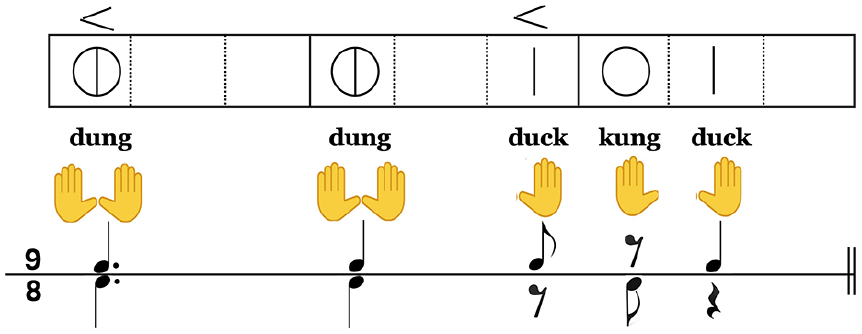
Semachi jangdan (recurring rhythmic patterns).
In situations where janggu (hourglass drum) is not available, teachers can use classroom or handmade instruments that closely resemble the appearance and sound of the original instruments (Anderson & Campbell, 2011). For example, a janggu can be substituted with two hand-drums attached to a box or a plastic bucket with drumheads, as the mechanism and vibrations of both are similar (Figure 2). The key is that, instead of accompanying Arirang with a piano, students are encouraged to sing the song while playing the recurring rhythmic pattern (semachi jangdan) with appropriate playing techniques.

(A) Janggu (an hourglass drum) and (B) Plastic buckets with drum head.
In the absence of a physical ethnic instrument, it is important for students to listen to the sounds of the acoustic instruments, allowing them to connect these sounds with those produced by substitute instruments. Without this exposure, students may not fully appreciate the nuances of the music and could mistakenly assume the substitute instrument’s timbre is identical to the original version (Yoo, 2021b). Providing context about the music’s genuine origins deepens students’ appreciation and helps them make more informed musical decisions. The detailed lesson is provided in Appendix B.
Active Learning With Virtual Instruments
Technological advancements also open possibilities for creating hands-on experiences without requiring an enormous budget for instruments from various cultural origins (Bauer, 2020; Yoo, 2021a). Some scholars consider virtual musical instruments to be legitimate musical instruments (Bauer, 2020; Randles, 2013; Yoo, 2024) since they can “help performers develop musicianship” and showcase musicality (Williams, 2014, p. 94). As mentioned earlier, when a physical instrument is unavailable, it is essential for students to listen to acoustic instruments to connect their virtual instrument sounds with those of the original acoustic instruments.
To effectively deliver cultural knowledge through virtual instruments, it is crucial to discuss how the music’s unique characteristics—such as mode, vibrato, and ornamentation—can be expressed (Kang et al., 2024). For example, Arirang is traditionally performed using various instruments, including the hyang-piri (a double-reed woodwind instrument). When playing Arirang on the hyang-piri (https://www.youtube.com/watch?v=k4yW1pfTQ0o&t=24s), an important technique for students to develop is creating quivering ornaments similar to vibrational sounds (Kang et al., 2024). To produce vibrato sounds on virtual instruments (https://www.youtube.com/watch?v=y4nYuVt2mRI), students begin with their arms outstretched holding the tablet-based instrument with both hands. Then, students are encouraged to make subtle vertical arm movements while using their fingers to play the virtual instrument, focusing on the note G. Furthermore, to replicate hyang-piri’s Arirang ornamentation, students should produce dropping sounds on notes A and E by lowering the tablet (see Kang, 2019).
One effective way to ensure the cultural validity of instruments’ techniques is by consulting directly with cultural insiders or culture bearers (Howard & Kelley, 2018). Teachers can achieve this by engaging with parents, colleagues, students, or members of the wider music community. Attending conferences and workshops also offers valuable opportunities to network with culture bearer-educators. These culture bearers can assist teachers in acquiring the cultural knowledge and experiences necessary to support their students (Campbell, 2017). While face-to-face consultations are typically the most effective, technological advancements have opened up new opportunities for collaboration that were previously impossible—such as through Facebook groups or videoconferencing with experts. Additionally, teachers can access printed and digital materials collaboratively developed by music educators and culture bearers. Examples of such resources include the world music pedagogy series (Montemayor et al., 2018) and well-known electronic platforms like Smithsonian Folkways and the Global Jukebox.
In summary, while virtual and classroom instruments may not fully replicate the original sounds, teachers can still design affordable lessons that honor the music’s in-depth heritage. Additionally, these instruments enable students to engage more actively in the learning process, encouraging them to “do” rather than merely “listen” to music in class.
Honoring Cultures Through Responding
Considering Performance Space and Appropriate Audience Etiquette
Teachers tend to use Eurocentric performance spaces and encourage Eurocentric audience behaviors, regardless of musical style. However, some music was originally intended to be performed in outdoor settings or informal spaces, while others may require a more intimate or enclosed space. The performance space is important as it can provide valuable insights into the social and cultural contexts of a particular music tradition. In addition to the performance space, the relationship between performance space and concert etiquette should also be considered. The choice of performance space can influence concert etiquette, as different spaces may require different levels of audience participation and behavior. Music performed in an outdoor or informal performance space may encourage a more participatory audience, while music performed in a formal concert hall may require a more passive and attentive audience (e.g., with silence during the performance and applause at the end) (Coppola, 2021; Yoo, 2023). When the performance space and its relationship with concert etiquette are considered, both musicians and audience members would “feel a deeper sense of belonging to the music experience,” and have a better understanding of music and performance styles from various cultures (Coppola, 2021, p. 5).
To foster a more culturally sensitive venue and concert etiquette in formal educational settings, teachers might consider various strategies. They could use alternative performance spaces, such as the gymnasium, school’s courtyard, cafeteria, and local community spaces, depending on the specific music tradition. While moving the performance outside a concert hall could encourage a more participatory audience, teachers could also explain the cultural norms to the audience. For instance, returning to the previous example of Arirang, it is primarily sung outdoors in the tradition of most work songs. Thus, when teachers prepare this music for a special event like “Asian Day,” choosing outdoor settings or informal spaces would be appropriate. Regarding the appropriate audience etiquette for Arirang, teachers could encourage verbal affirmations such as “good” or “that’s right” during the performance to promote more participatory behavior from the audience. This experience goes beyond a typical performance; it transforms into a communal celebration where everyone feels a deeper sense of belonging to the music.
Exploring Musical Hybrids: The Intersection of Tradition and Modern Influences
Music is a dynamic art form that evolves over time, expanding to include transformed versions of traditional ethnic musics (Howard, 2020). These adaptations modify the original form to suit new contexts and influences, blending traditional styles with modern approaches, such as Western ensemble arrangements or contemporary folk music (see Appendix B). Howard (2020) highlights the fluidity of music over time by emphasizing the coexistence of old traditions and ever-changing hybrids; this fluidity can influence how we engage with diverse musics in the classroom. By embracing diverse musical forms, teachers can help students gain a deeper understanding of the ever-evolving nature of musical traditions.
To explore this concept in the classroom, students watch or listen to recordings of three distinct musical styles: (a) the original traditional form, (b) Western ensemble arrangements, and (c) contemporary folk music. Students then reflect and discuss the following questions about the differences and similarities between the versions:
Why is it important to recognize music’s fluidity and its ability to adapt across cultures and time?
How do the transformed versions (i.e., Western ensemble arrangements and contemporary folk music) differ from the original version?
What elements of the original piece remain in the transformed versions?
What new elements have been added or altered in the transformed versions?
How does the music make you feel now compared to the traditional version?
By facilitating these discussions, students can explore the transformation process and gain insight into how musical changes affect the meaning and experience of the music itself (Yoo, 2020).
As a follow-up assignment, students can design a digital poster using Canva (i.e., a user-friendly online design tool for graphics and presentations) to explore these concepts further. If Canva is unavailable, teachers can use similar tools within Google Suite, such as Google Slides or Google Drawings. They can select a region or country and research three versions of a song from that area: the original traditional form of the song, a Western ensemble arrangement of the song, and a piece of contemporary folk music based on the song. Using Canva—a free, user-friendly graphic design platform—students can create a poster that includes labeled sections for each category (e.g., original, ensemble arrangements, and contemporary folk music). The poster could feature culturally relevant visuals, embedded video recordings for each category, and reflective comments below each recording (Appendix B). If time permits, students can present their posters in class, sharing their reflections and discoveries about how diverse musical forms from various cultures contribute to a global musical landscape, each holding unique significance. This lesson encourages students to explore and appreciate the rich diversity of musical traditions worldwide, while also understanding how these traditions evolve over time through cultural exchange, historical events, and mass media.
Honoring Cultures Through Creating
Expanding Musical Horizons: Composing Music Using a Culture-Specific Notation
Campbell (2017) emphasizes that engaging in the creative process not only serves as an artistic pursuit but also honors the rich cultural heritage embedded within it. Immersing oneself in the rhythms, melodies, and musical traditions of different cultures fosters a deeper appreciation for their unique contributions to global diversity. An activity highlighting creativity in music classes could involve having students compose a short piece using the culture-specific notation system. While a common assumption in music education is that musics from diverse cultures should only be taught aurally, this perspective is not entirely accurate (Yoo, 2023). Just as Western European music has been transmitted through both aural and notational systems, non-Western music has also used a combination of these methods.
For instance, teachers can introduce Chongganbo, a traditional Korean notation system. Chongganbo is a form of mensural notation that uses blocks of cells, each representing a unit of time. Symbols are written within each cell to depict the notes (Figure 3). Teachers could have students compose their own music using Chongganbo, followed by a discussion of the similarities and differences between Chongganbo and Western five-line staff notation. By recognizing the diversity of notation systems, students can appreciate the richness of musical languages and gain insight into the vast spectrum of human creativity and communication through music. While this composition activity may not fully replicate cultural traditions, it offers students a broader understanding of musical communication beyond the conventional Western five-line staff notation. Images of Chongganbo can be found online, and a sample lesson plan using this notation system is provided in Appendix B.

An Example of a Composition Activity Using the Chongganbo Notation System.
Cross-Cultural Soundscapes: Exploring Hybrid Music Creation
As mentioned earlier, globalization has facilitated cross-cultural musical interactions, leading to contemporary folk music that blends elements from individual cultures (Putiatytska et al., 2024). Contemporary folk music modernizes traditional sounds by incorporating popular modern elements, such as chords and melody, and modern instruments, including drums, bass guitars, electric guitars, synthesizers, brass instruments, and, in some cases, ethnic instruments. Therefore, this genre is more likely to resonate with school-age students’ musical preferences (Sutton, 2009). Introducing this genre can not only cater to students’ interests but also exposes them to diverse global sounds, broadening their musical horizons.
In the classroom, teachers can encourage students to create a hybrid music style (i.e., contemporary folk music) using Digital Audio Workstations (DAWs) like GarageBand, Audacity, or Soundtrap and the DAW’s prerecorded loops—short music clips categorized in the DAW by instrument or style. Webster’s (2002) creative thinking process offers a framework to create a hybrid music style. The first stage in Webster’s process is “Preparation.” During this stage, students would (a) select a folk song, like Arirang, and choose a preferred music style (e.g., jazz, rock, blues, and hip hop) for their hybrid creation, and (b) explore DAW-prerecorded harmonies that align with their chosen music style (e.g., drum loops, electric guitar loops, and synthesizer loops). The second stage, “Working Through,” involves students recording the melody of the chosen folk song using the DAW’s virtual instruments and layering additional tracks onto the folk melody by selecting and editing prerecorded loops from the DAW’s library. For example, students could merge different loops, such as drums, synthesizers, and guitars, onto the melody to create hybrid styles. In a world jazz style (blending folk and jazz), students might combine the folk melody with loops from the DAW’s jazz category. Finally, in the “Verification” stage, students need to review and finalize their work. For instance, they might refine their final product by adjusting the number of tracks (density) and the music’s overall intensity (dynamics) for each track. In this final stage, it is also valuable to give students the opportunity to explain the rationale behind their transformations, particularly how their arrangements respect and honor the culture of origin.
Reflection
My experiences have shown that teaching musics from cultures outside one’s own ethnic background requires a deep sense of humility. Because it may not always be possible to fully preserve the music’s original context, teachers are encouraged to foster openness, respect the uniqueness of each tradition, and have a genuine willingness to learn about each music’s distinct qualities. Adopting a humble mindset involves creating learning experiences that respect the cultural origins of a particular music, while also applying effective strategies to set realistic expectations for students’ success in the classroom. This subtle yet significant shift carries considerable weight, influencing how teachers prepare and implement musics from cultures outside one’s own ethnicity within the school curriculum. In order to honor the uniqueness of each musical tradition, continuous learning and growth are paramount. Music teachers are encouraged to remain open to feedback, engage in ongoing dialogue with culture bearers, and stay attuned to evolving perspectives and insights. This humility mindset and commitment to constant improvement ensure that the music’s traditions will remain at the forefront of a teacher’s lessons and teaching practices.
Footnotes
Appendix A: Lesson Components Checklist
With a humble approach, there are numerous ways to honor the distinct characteristics and core values of each musical tradition. This checklist describes ways you can improve your lesson materials and instruction for musics from diverse cultural heritages. You can use this checklist either as a guide before creating your lesson plans or as a tool for evaluating and refining existing ones. You do not have to implement all items simultaneously. As a starting point, you can focus on one item from each category and then later, expand your focus to other items.
Appendix B: Lesson Plans Informed by a Humility Mindset
Declaration of Conflicting Interests
The author declared no potential conflicts of interest with respect to the research, authorship, and/or publication of this article.
Funding
The author received no financial support for the research, authorship, and/or publication of this article.
