







Abstract
The purpose of this article is to discuss World Music Pedagogy and the importance of this pedagogical approach in today’s diverse music classrooms, and to describe steps music educators could take to most effectively include music of other cultures in their North American music classrooms. The cultures and music that will be highlighted and explored in the context of this article will be those that are representative of Tanzania and Uganda, both of which are East African nations.
Keywords
Introduction
The U.S. demographics are shifting in a manner that reflects the percentages of historically minoritized communities rising while percentages of the current dominant group are decreasing due to three components of change: fertility, mortality, and net migration (Vespa et al., 2018). These shifts have a direct impact on the demographics of the students who music educators are given the opportunity to teach in their music classrooms (Henninger, 2018). Scholars have predicted that racial and ethnic demographic shifts could occur between 2030 and 2050 (Mordechay et al., 2019; Vespa et al., 2018). Recent U.S. census projections also suggest that the collective percentage of individuals who identify as members of communities of color (e.g., Black, Hispanic, Asian American Pacific Islander) will surpass the percentage of individuals who identify as white Americans, which will lead to the United States being identified as a “majority-minority” nation (Craig et al., 2018). Due to the increased presence of children of diverse ethnic and cultural backgrounds in U.S. classrooms, it is important that music educators incorporate pedagogical approaches that are designed to celebrate and honor the music and cultural practices of different cultures. This can be achieved with the integration of World Music Pedagogy (WMP) in one’s music classroom.
WMP is an approach that enables music educators to “focus on how music is taught/transmitted and received/learned within cultures” (Campbell, 2004, p. 26). Within the context of this article, the authors will focus on four aspects of importance regarding the incorporation of WMP in the music classroom: (a) what WMP is, (b) why WMP is important when sharing music of other cultures in U.S. classrooms, (c) the impact of WMP on music learners, and (d) examples of how to incorporate East African music (i.e., Tanzanian and Ugandan music) into the music classroom with the use of WMP principles.
World Music Pedagogy (WMP)
WMP has been in practice for approximately 20 years, and it provides music educators with pedagogical techniques that enable them to share music of different world cultures with learners of all ages (Campbell, 2023). WMP consists of five dimensions that, when applied in an informed and culturally sensitive manner, will likely have a positive impact on the teaching and learning of world music. According to Campbell (2023, p. 42), those five dimensions include the following: Attentive Listening (i.e., directed and focused listening through the use of teacher questioning), Engaged Listening (i.e., active listening while musicking), Enactive Listening (i.e., performing the music in a manner that is “stylistically accurate”), Creating World Music (i.e., performing the music in a way that honors the culture and the music with the use of different techniques, such as composition or improvisation), and Integrating World Music (i.e., sharing of sociocultural information and the inclusion of cultural insiders/culture bearers, which may happen at any time and is designed to contribute to the “development of global citizenship”).
Why WMP is Important
The demographic shifts referenced earlier in this article are one of many reasons WMP might be included in music classrooms. It is important that music educators recognize the diverse characteristics and traits of the students who are in their classes. It is also important that music teachers effectively incorporate WMP into preservice teacher education programs so practitioners are prepared to share music representative of other cultures in a way that celebrates and honors the cultures shared. When done mindfully, sharing music of another culture can have a positive impact on students’ music learning experiences by increasing their levels of familiarity with and preferences for music that is representative of different genres (Dekaney et al., 2011; Henninger, 2018). WMP is also important because of the impact it can have on music learners. WMP enables music educators to provide representation and affirmation of their music students’ identities (Henninger & Sanchez, 2021). In other words, if classes are comprised of students who are members of a certain cultural group, WMP enables music practitioners to share music of that culture in a way that honors the culture, celebrates the culture, and affirms students’ identities.
When the aforementioned five dimensions of WMP are integrated effectively, this pedagogical approach can also enable students to have a sense of belonging within music classrooms. As U.S. classrooms are becoming more diverse, educators have a responsibility to make a concerted effort to generate a sense of belonging for each student who they are given the opportunity to teach. Incorporating culturally diverse music and experiences enables students to feel as though they are seen, heard, and understood in those spaces (Fitzpatrick-Harnish, 2015).
When incorporating WMP into the music classroom, there are several points one could include within one’s instructional approaches (e.g., Abril, 2006a; Belz, 2006; Campbell, 2004; Henninger, 2018; Teicher, 1997). Scholars recommend that music educators integrate information that provides sociocultural context while also addressing music concepts (Abril, 2006a; Aung & Campbell, 2024; Barz, 2004; Bradley, 2006; Campbell, 2023; Henninger, 2016). Abril (2006a) argued that too often music educators lean into only teaching music concepts (e.g., note accuracy, dynamics, phrasing) when sharing music of other cultures, whereas it is also important that music educators take the time to establish the sociocultural context (e.g., cultural norms, language). Music teachers also have a responsibility to represent the language of the shared culture in an accurate manner. This enables practitioners to celebrate that culture. Additionally, music educators could integrate instruments that are representative of the culture being shared.
When addressing the fifth dimension of WMP, music educators could also be diligent in their efforts to involve cultural insiders (i.e., members of a cultural group who possess a deep understanding of the culture’s beliefs and practices) and/or culture bearers (i.e., individuals who are connected with the cultural group and actively engage in the transmission of the culture’s beliefs and practices). Cultural insiders and/or culture bearers might include the teacher, colleagues, community members, and/or students and their family members/guardians.
One could also work toward establishing and maintaining a sense of “authenticity” (Abril, 2006b; Belz, 2006; Henninger, 2018). “Authenticity” can be addressed in the areas of instrumentation, as well as language (Abril, 2006b). It is important, however, to recognize that some scholars view the term “authenticity” to be problematic. Specifically, some in ethnomusicological sectors do not believe that authenticity is something that might be considered since, as some scholars argue, once you remove anything (e.g., songs, music, instruments) from its original context, you have already lost some authenticity (Abril, 2006b). Instead, Abril encouraged music educators to get as close to authentic as possible and not allow that concern about authenticity to function as a barrier that ultimately prevents them from sharing music that is representative of a variety of cultures. Therefore, music educators are encouraged to get as close to authentic as they possibly can.
Lastly, scholars recommend that music educators provide their students with several opportunities to make music (Belz, 2006; Teicher, 1997). Another term for making music is “musicking.” According to Small (2001), the term “musicking” means “to music” either through listening or performing (p. 344). The more students can engage with musicking, the better the experience may be and the more likely it may impact their future music preferences and interests. Although these important points regarding cultural insiders/culture bearers, authenticity, and active music-making can be applied to the sharing of music of different cultures, the remainder of this article will focus upon applying these techniques to the teaching and learning of East African music while also integrating the different dimensions of WMP.
WMP and Two East African Nations
Tanzania and Uganda are the two East African nations that will be addressed in the context of this article. When teaching the music of Tanzania, Uganda, or any other African nation, it is important for music educators to remain cognizant of the fact that none of the African nations are a monolith. Each African nation has its own cultural norms, values, and beliefs. Furthermore, within each nation there are several subcultures that have unique cultural norms (Barz, 2004). It is also very important for music educators to provide a positive representation of the African nation shared and to dispel any myths that might exist regarding the continent of Africa. As cultural insiders and culture bearers of Tanzania and Uganda, all three authors can attest to the fact that Africa is a large and beautiful continent that has highly developed cities, incredible national parks, and many breathtakingly beautiful tropical sceneries and beaches. East Africans in particular, and many Africans in general, also live in a variety of settings. Similar to what is found in other parts of the world, East Africans live in structurally sound homes that are well furnished and that have access to running water, electricity, and (in many cases) internet. Contrary to what images may be put forth by the U.S. media, the majority of East Africans are thriving when it comes to access to necessary resources, such as food and housing (Scott, 2017).
Each of the authors has varied connections (past and current) with the cultures and music of Tanzania and Uganda (Henninger, 2018). The lead author is an African American, former Fulbright Scholar whose Fulbright experiences occurred in Tanzania, East Africa. During that period of 2 years, the lead author taught and conducted research at Tumaini University Makumira in Usa River, Tanzania. The second and third authors are Ugandans who are currently pursuing their doctoral degrees at Texas Tech University. Based on these varied connections with two different African nations, it is important to recognize that the information shared within this article is from the perspectives of cultural insiders and a culture bearer.
Music of Tanzania – Jambo Bwana
While sharing music of Tanzania, it is important for music educators to provide learners with sociocultural information regarding East Africa and Tanzania. Sociocultural information represents the fifth dimension of WMP. Figure 1 contains a map of the continent of Africa and the geographic location of Tanzania.
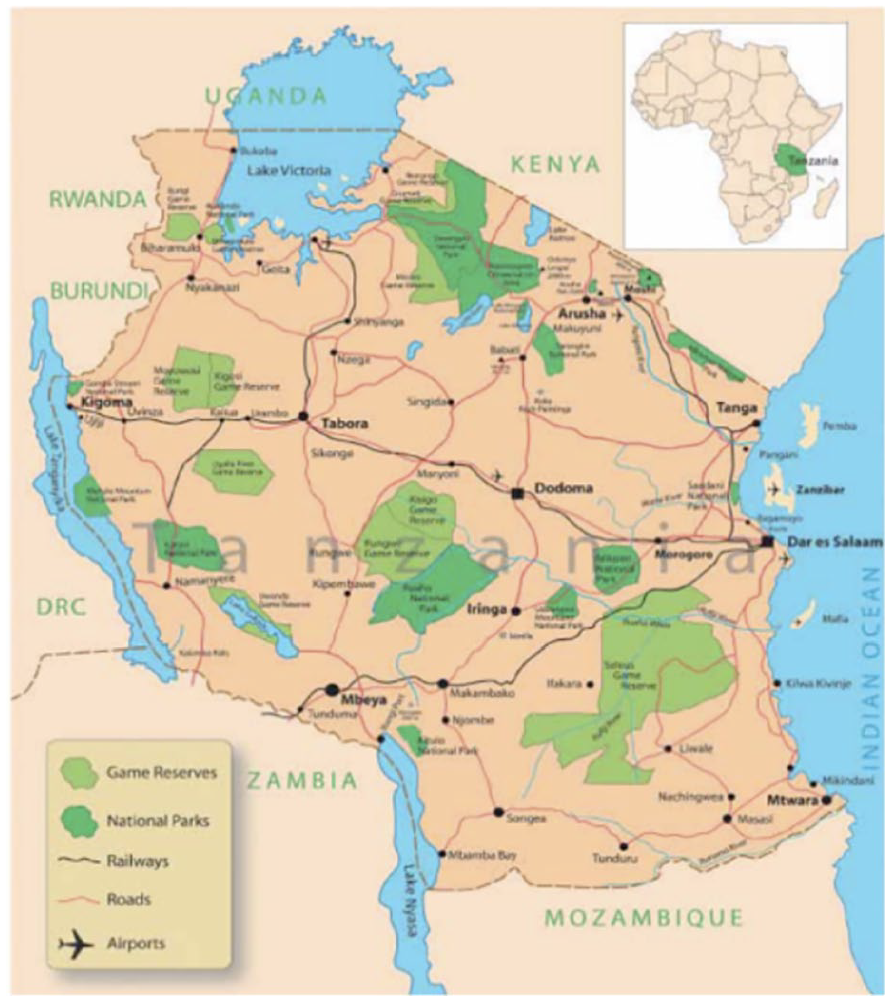
Map of Africa and Tanzania (Lwoga, 2013).
Tanzania is one of several East African nations, is the largest of the East African countries, and has an estimated population of 61 million people (Barz, 2004). Tanzania has approximately 120 different ethnic groups within the country and each of those ethnic groups has their own cultural values, norms, beliefs, and languages. Some of those ethnic groups include the Wamaasai, Wagogo, and the Wasukuma (Henninger, 2016). An interesting fact about Tanzania is that it used to represent two separate nations: mainland Tanganyika and the island of Zanzibar. However, in 1964, Tanganyika and Zanzibar merged to form the country of Tanzania. Although each ethnic group has its own language, which means there are more than 120 different languages spoken in Tanzania, the unifying language is Swahili (Pawliková-Vilhanová, 1996).
In Tanzania, the Swahili word for musicking is “ngoma.” Ngoma encompasses all things musicking, such as singing, dancing, and drumming. It is customary in Tanzania and other East African nations to music in all three forms simultaneously (Henninger, 2016). In fact, if one is singing, it is assumed that dancing and drumming are also occurring simultaneously. This is an important aspect of the culture about which one should be aware when sharing and exploring the East African music, including the song that will be highlighted within this article.
“Jambo Bwana” is an accessible and enjoyable song from Tanzania for students in grades K–5. The Swahili text within “Jambo Bwana” consists of the following:
Jambo. Jambo Bwana.
Habari gani. Nzuri sana.
Wageni mwakaribishwa.
Africa yetu. Hakuna matata.
Africa bara Mzuri. Hakuna matata.
Bara la amani. Hakuna matata.
Bara la upendo. Hakuna matata.
Bara la furaha. Hakuna matata.
In addition to teaching the lyrics, educators could provide the translations of the words while also teaching the proper pronunciation of each term. A translation of the Swahili text into American English, which appears parenthetically, appears below.
Jambo (Hello, or a reduced version of a casual greeting that has a complete form of Hujambo) Bwana (Sir) Habari gani (How is it going) Mzuri sana (Very good) Wageni mwakaribishwa (A message of welcoming visitors) Africa yetu (You are welcome to the continent of Africa) Hakuna matata (A familiar Swahili phrase, which means no worries) Africa bara Mzuri (Africa is a beautiful/good/fine continent) Bara la amani (Continent of peace) Bara la upendo (Continent of love) Bara la furaha (Continent of happiness/joy)
Please reference the following link for an audio example of the song: https://youtu.be/vUrVeRGo5IM.
When teaching singers to perform “Jambo Bwana,” consider addressing each of the five different dimensions in the following manners. Please note that these recommendations represent only a few ways that each WMP dimension could be covered while teaching “Jambo Bwana” to young music learners.
Attentive Listening: Listen attentively to a recording of “Jambo Bwana” (see above for link). Prior to and after the listening experience, ask questions regarding the melodic contour, instrumentation, and/or the familiarity of the tune.
Engaged Listening: Encourage students to feel the pulse of the song and identify the musical phrases within which the melody begins on an upbeat (e.g., measures 2, 3, and 4). Students could physically demonstrate their ability to feel the pulse by patting their legs to the beat of the song. They could also indicate their awareness of the beginning of a musical phrase by raising their hands at the start of the phrase and lowering their hands once the phrase ends.
Enactive Listening: Teach this song to students with the use of a call-and-response approach, which is consistent with the way music is shared in many African cultures. Musical content for this song could be covered in two-bar phrases (i.e., measures 1 and 2, measures 3 and 4, etc.). This would enable melodic singing to occur in smaller, successive approximations (Duke, 2009) until the entire song is taught.
Creating World Music: Provide students with an opportunity to create an instrumental (e.g., drumming) accompaniment using rhythms that will fit nicely with the melody. Students could also explore improvisation in the context of this enactive listening experience while performing music from Tanzania. The teacher could also model selected rhythms and then contingently choose students to join them on individual drums to enhance the musicking experience.
Integrating World Music: Share sociocultural information regarding the people and cultures of Tanzania (see above). Inform students about the origin of the song by discussing with them that the song was originally created in Kenya, another East African nation, but became popularized in Tanzania. Teachers could discuss the importance of greetings within the Tanzanian culture. A cultural insider or culture bearer could also be included to enrich this music learning experience (e.g., a guest speaker presentation).
Throughout this music learning experience, it is important to honor and celebrate the culture. Although referencing Western notation is not typical for the teaching and learning of music in Tanzania, the authors are sharing the notation for this song as an additional point of reference and, if necessary, an additional teaching tool. Please see Figure 2 for the lyrics and Western art notation of “Jambo Bwana.”
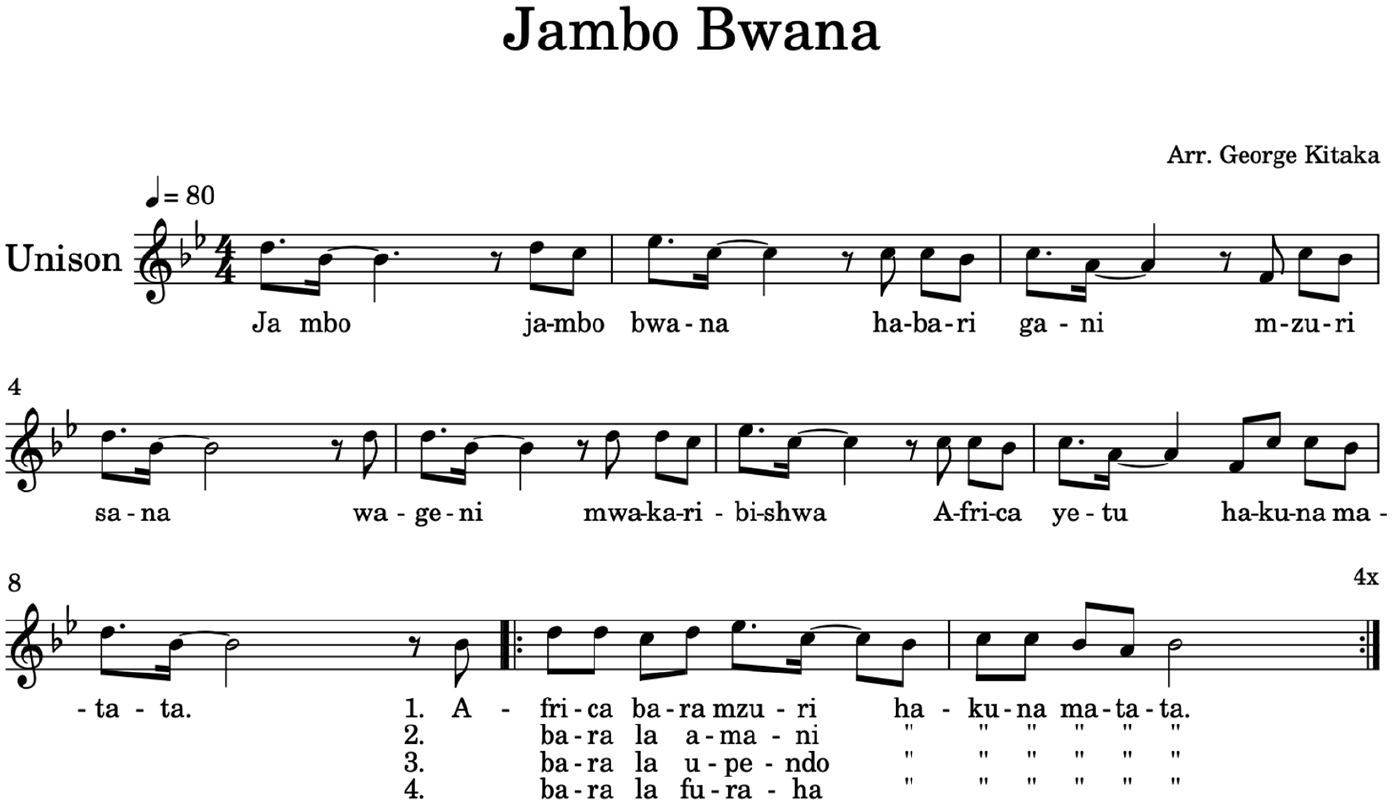
“Jambo Bwana” – Lyrics and Western Notation.
Music of Uganda – Muliraanwa
Consistent with information shared while discussing the teaching and learning of music of Tanzania, when sharing music of Uganda, it is important for the music educator to provide learners with sociocultural information regarding East Africa and Uganda. Due to the rhythmic and lyrical complexity of this Ugandan song, it would be more appropriate to share this song with students in grades 5 and above. Please see Figure 3 for a map of Uganda.
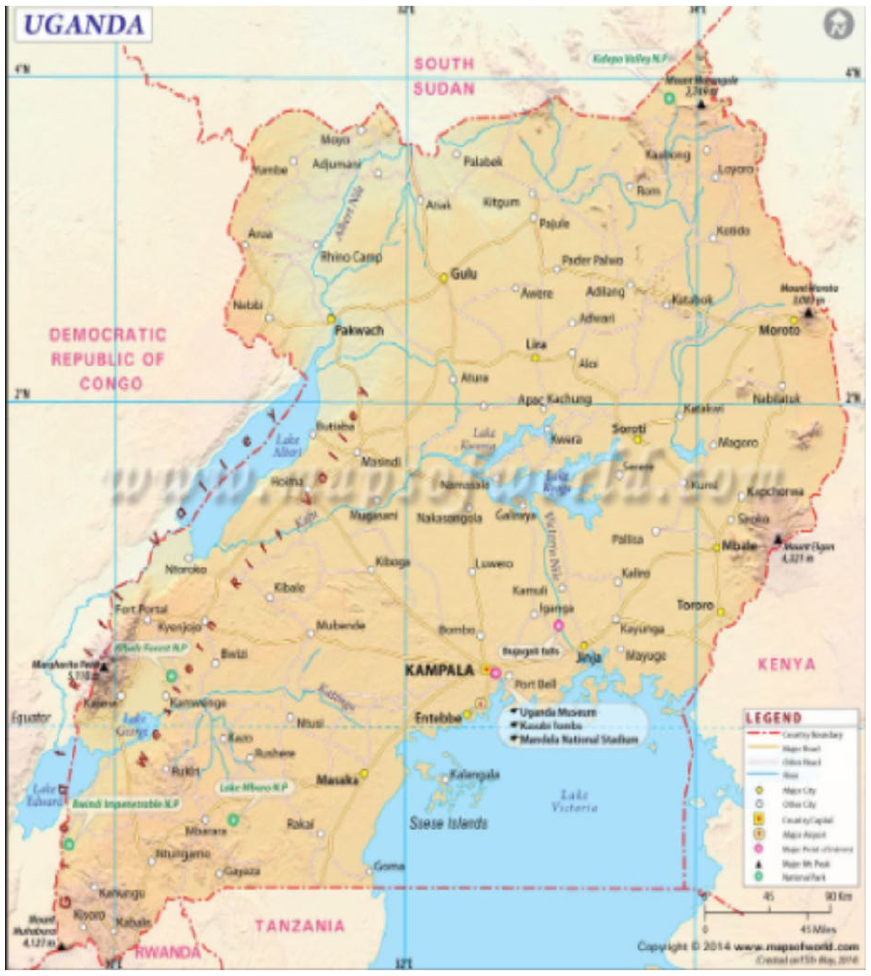
Map of Uganda (Uganda Map [2014]).
Similar to the recommended approach to the teaching and learning of “Jambo Bwana,” some of the following sociocultural information, which represents the fifth dimension of WMP and could also be included within the other four dimensions, may be shared in the context of a music lesson and might include any of the following. Uganda is one of the East African countries and is located northwest of Tanzania (Barz, 2004). The population of Uganda is estimated at 48 million people and the capital city is Kampala. Uganda has approximately 50 different ethnicities and approximately 50 different languages are spoken. For instance, although the second and third authors are both Ugandan, each of them represents different ethnic groups (i.e., Baganda and Banyankore) and speaks different languages. In addition to speaking different languages, depending on one’s ethnic group, individuals dress differently and have varying cultural norms and beliefs. Although Luganda is spoken by many Ugandans, the national language for Uganda is English due to the lasting effects of colonization (Pawliková-Vilhanová, 1996). Buganda is a geographical location within Uganda, whereas Baganda is a cultural community.
“Muliraanwa” is a Ugandan song with an accessible melody that invites dancing and drumming. Some individuals might perceive a song such as “Muliraanwa” as complex due to its lyrics and/or rhythmic figures. However, as music educators, we should be willing to encourage our students to perform music of cultures representative of different parts of the world, regardless of those initial perceptions of complexity. According to scholars, it is highly beneficial for developing musicians to engage with unfamiliar music that might appear to be complex because it “challenges the ear . . . [and] provides new musical ideas for students to experience and to consider in their own creative musical work” (Aung & Campbell, 2024, p. 4).
In an effort to improve the accessibility of the lyrics of “Muliraanwa,” please see below for the Luganda text of this Ugandan song with parenthetically placed American English translations. Additionally, please refer to the following link for an audio recording of the correct pronunciation for each Luganda word: https://www.youtube.com/watch?v=3qyCPt7wej0. Each word is presented in the order in which it is encountered within the song. This audio file is meant to assist teachers and students with pronouncing the Luganda lyrics correctly. Teachers may choose to model for their students the correct pronunciations for each Luganda word. If, however, teachers are not comfortable providing that model for their students, they are encouraged to allow the recording to serve as an aural model for their students to emulate.
Muliraanwa wange, muliraanwa ssebo, muliraanwa oliwa? (My neighbor, neighbor sir, neighbor where are you?)
Bwokyawa muliraanwa wo (If you dislike your neighbor)
Bwogenda okulima buulirako muliraanwa wo nti ngenda kulima (If you go to dig, let the neighbor know that “I am going to dig”)
Bwokyawa muliraanwa wo (If you dislike your neighbor)
Bwogenda okusaba buulirako muliraanwa wo nti ngenda kusaba (If you go to pray, let the neighbor know that “I am going to pray”)
Bwokyawa muliraanwa wo (If you dislike your neighbor)
Bwogenda okusoma buulirako muliraanwa wo nti ngenda kusoma (If you go to study, let the neighbor know that “I am going to study”)
Bwokyawa muliraanwa wo, obeera mulogo (If you dislike your neighbor, you are a witch).
To emphasize the importance of the neighbor, which is the focus of this Ugandan song, there is a Luganda proverb that articulates this point: “Amagezi muliro, bweguzikira ogujja wa muliraanwa.” The English translation for this Luganda Proverb is “Wisdom is fire, when you are out of it you get it from the neighbor.”
When teaching singers to perform “Muliraanwa,” consider addressing each of the five different dimensions in the following manners. Please note that these recommendations represent only a few ways that each WMP dimension could be covered while teaching “Muliraanwa” to music learners.
Attentive Listening: Listen attentively while also viewing a video recording of “Muliraanwa” (see below for the video link). Prior to and after the listening and viewing experience, ask questions regarding the instrumentation, the dances, and/or the rhythmic elements within the song.
Engaged Listening: Encourage students to feel the pulse of the song and identify the musical phrases within which syncopated rhythms occur (e.g., measures 1 and 2). Students could physically demonstrate their ability to feel the pulse by clapping their hands to the beat of the song. They could also indicate their awareness of the beginning of a musical phrase by standing up at the start of the phrase and sitting down once the phrase ends.
Enactive Listening: The song structure of “Muliraanwa” consists of Soloist/Leader (Akulembera) lines and Response/Responder (Abaddamu) lines. Consistent with information shared regarding the teaching and learning of “Jambo Bwana,” one of the salient characteristics of African music, and specifically music from Uganda, is the characteristic teaching and learning approach, call and response. When sharing the music of any African nation, following a call-and-response format emphasizes the aural and oral approaches to music learning. Please refer to the audio link (see above) for correct pronunciation of the lyrics for this Ugandan song.
Creating World Music: Once the song is learned (i.e., lyrics and melody), add drumming and dancing to the performance. Drumming patterns could include rhythms that fit nicely with the song. This music learning experience could also provide students with an opportunity to explore improvisation in the context of performing music from Uganda. The teacher is encouraged to model select rhythms and then contingently select students to join them on individual drums to enhance the musicking experience.
Integrating World Music: Share sociocultural information regarding the people and cultures of Uganda (see above), such as information regarding the instrumentation typically included with this song and the cultural significance of the messages conveyed within the lyrics. “Muliraanwa,” which is the Luganda word for “neighbor,” is one of the famous traditional community songs of the Baganda cultural community. The song emphasizes the imperativeness of being friendly and socially connected to one’s neighbor. Any homestead in Buganda (a portion of Uganda) is expected to be friendly and socially connected to all immediate neighbors in the nearby and extended vicinity. Given that social cohesion and friendliness among the Baganda cultural community, it is very common to run out of basic things around the home, such as salt, sugar, water, and/or fire, and to visit your neighbor for some of these items to make it through the day. A cultural insider or culture bearer could also be included to enrich this music learning experience (e.g., a guest speaker presentation).
Unlike “Jambo Bwana,” “Muliraanwa” is typically accompanied by a dance. Baakisimba is a dance style associated with the Baganda people of central Uganda (Nannyonga-Tamusuza, 2015). The instruments that can be used to accompany Baakisimba consist of four drums (embuutu, engalabi, namunjoloba, empuunyi) and a pair of maracas (ensaasi). The empunnyi is the bass drum that provides the central beat to be followed by all other performers to keep the same tempo. Both the empuunyi and the namunjoloba play the same beat throughout, unlike other instruments that may improvise other rhythms during the performance (see Figure 4).
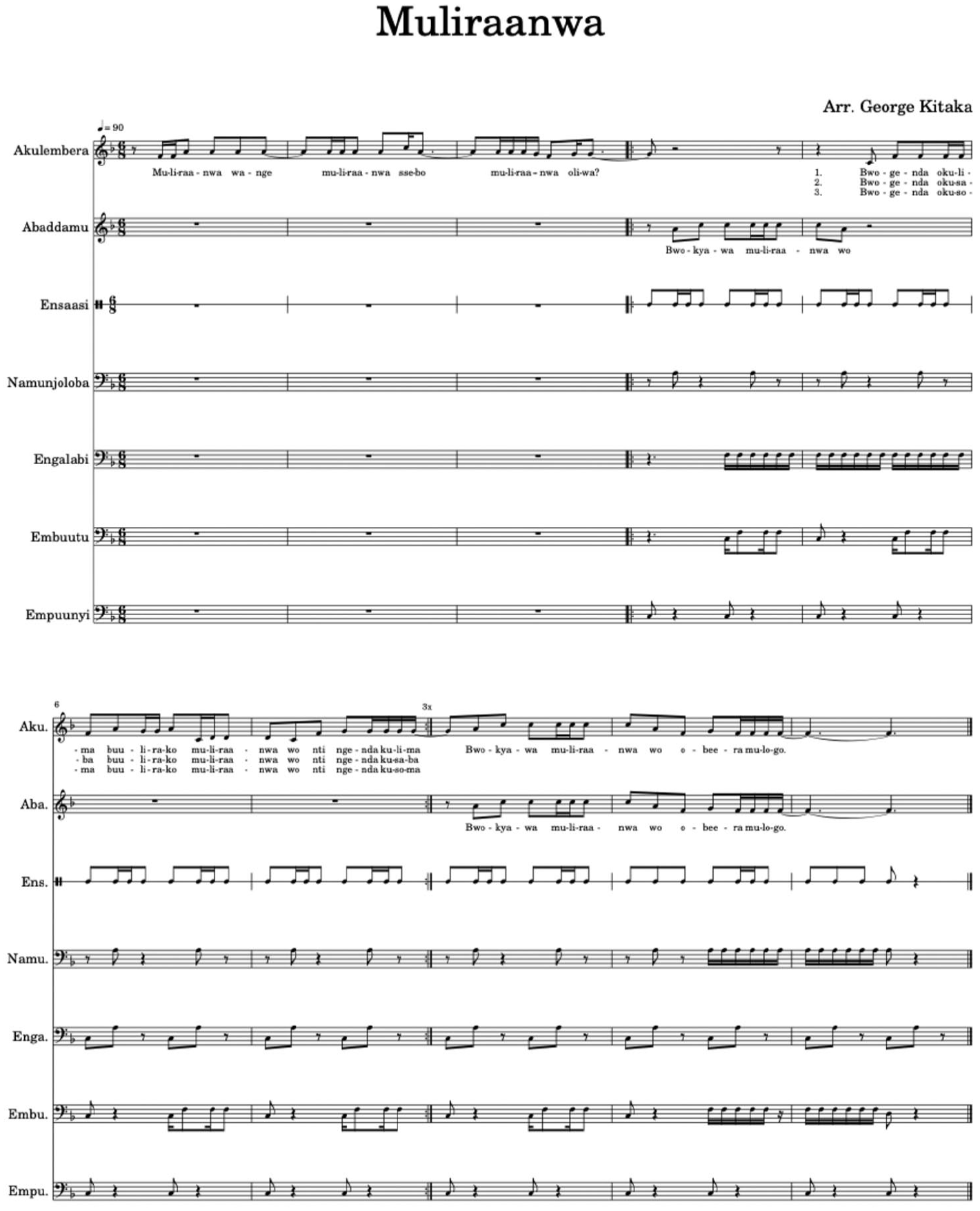
“Muliraanwa” – Lyrics and Western Notation.
Although this song should be taught primarily by rote, please feel free to refer to the Western notation (see Figure 4), which is provided as a point of reference.
Please refer to the following link for a video recording of this song: https://youtu.be/GrRGfEvY-zg.
Conclusion
In closing, there are a few points music practitioners are encouraged to keep at the front of their minds as they are thinking about effectively incorporating music of diverse cultures into their music classrooms.
Demonstrate a willingness to take the time to share sociocultural context when introducing music that is representative of different cultures (Abril, 2006a; Aung & Campbell, 2024; Campbell, 2023; Henninger, 2018).
When possible, include cultural insiders and/or culture bearers to honor and celebrate the culture that is being represented (Henninger, 2018).
Structure lessons with the five dimensions of WMP to positively impact your students’ musical and multicultural understandings (Campbell, 2004, 2023).
Plan new cultural experiences for students. Sometimes teachers may feel overwhelmed when faced with the task of sharing music that is representative of a culture with which one may not be familiar. If this feels like a daunting task, please keep the following Swahili proverbs in mind:
a. “Kidogo, kidogo, hujaza kibaba.” The English translation for this beautiful proverb is “Little by little, we fill the cup.”
b. “Haraka, haraka, haina baraka.” The English translation for this powerful proverb is “Hurry, hurry, brings no blessings.”
Music educators should not feel as though effectively incorporating music of other cultures is something that has to be included in one’s lessons on a constant basis. Additionally, developing an ability to share music representative of different cultures in one’s music classrooms is something that might take time and effort. If one chooses to rush through these approaches, one may run the risk of delivering a lesson that lacks effectiveness and cultural richness. To the contrary, sharing music that is representative of different cultures with one’s students “little by little” and embracing the amount of time it takes to do this well enables one to expand students’ musical and cultural awareness in a gradual and impactful way.
Footnotes

Funding
The author(s) received no financial support for the research, authorship, and/or publication of this article.
Declaration of Conflicting Interests
The author(s) declared no potential conflicts of interest with respect to the research, authorship, and/or publication of this article.