






Abstract
Higher education students are increasingly utilizing artificial intelligence (AI) applications such as ChatGPT for their school activities. Despite the increased adoption of such AI applications and continued concerns about how AI affects student learning, less is known about how these AI applications can affect the well-being of these students through a cultural lens. This understanding becomes particularly important in higher education settings where culturally embedded social values remain salient. Drawing on the Stimulus–Organism–Response theory and through a multidisciplinary synthesis of the literature on AI, service quality, culture and higher education, this study examines how the service performance of ChatGPT can affect the subjective well-being of students through Mianzi or face value. Results of the data collected from 128 higher education students, primarily from China and Singapore, show that Mianzi mediates the relationship between ChatGPT service quality and students’ subjective well-being. This study contributes to the literature on AI in education by identifying a culturally grounded mechanism linking AI service experiences and student well-being within this higher education Mianzi-relevant context. We offer insights that contribute to tropical higher education futures and advance the literature on student well-being through cultural systems prevalent in international higher education in the tropics.
Introduction
Since its launch in 2022, ChatGPT – an artificial intelligence (AI) chatbot – has been successfully used in numerous contexts once considered the domain of human intelligence (Rudolph et al., 2023a). Compared to other AI applications, the focus of this study is on ChatGPT as it has become the fastest-growing app and has been the most dominant chatbot in higher education (Rudolph et al., 2023b). This includes its use in research, passing exams and writing academic papers (Rudolph et al., 2023a). Accordingly, ChatGPT has disrupted academic activities (Dwivedi et al., 2023) and raised pressing questions for policymakers and administrators.
In response, research on ChatGPT in higher education has begun to address several issues, such as the impact of ChatGPT on teaching, learning and assessment methods for various stakeholders, in particular, students (Rudolph et al., 2023a; Rudolph et al., 2023b; Rasul et al., 2023). While these are important areas of research, emerging research is also investigating how ChatGPT can influence the students’ subjective well-being (Rehman et al., 2024).
Existing research has begun to examine the relationship between generative AI use and subjective well-being, but the mechanisms remain largely academically oriented. For example, Rehman et al. (2024) explain life satisfaction through constructs such as academic self-esteem, engagement and sense of control. Bagozzi et al. (2022) focus on emotional responses in AI-enabled services, while Noor et al. (2022a) examine service quality and well-being in AI service agent contexts. However, limited attention has been given to culturally embed psychological mechanisms that may shape how students interpret AI usage. Accordingly, this study extends prior research by examining Mianzi as a culturally grounded mediator linking ChatGPT service quality to subjective well-being.
Supporting the subjective well-being of higher education students remains an important research topic (Brewer et al., 2019). In the service literature, education is viewed as a service designed to stimulate people's minds (Lovelock, 1983). In the same vein, emerging research suggests that the use of AI in service can affect the user's subjective well-being (Bagozzi et al., 2022; Noor et al., 2022b). With service logic applied to the education sector, a student-oriented perspective can be adopted that focuses on service performances by ChatGPT that meet the students’ needs (Ng and Forbes, 2009).
Importantly, the experience and evaluation of AI-enabled educational services are not culturally neutral. In contexts where social evaluation, reputation and face-related concerns are salient, students may assess ChatGPT not only based on functional performance but also on whether its use preserves or enhances their social standing (Ho, 1976; Hwang, 1987). Accordingly, this study focuses on Mianzi as a culturally grounded psychological mechanism through which perceived ChatGPT service quality influences student well-being.
This study investigates an individual-level cultural mechanism within a sample of higher education students recruited through two universities in Singapore, which represents a developed economy in the tropics. The contribution lies in testing whether Mianzi explains how ChatGPT service quality relates to subjective well-being in this specific educational context.
Positioning this study within the tropics is more than a matter of geographic classification. The tropical region situated between the Tropics of Cancer and Capricorn is home to almost 3.8 billion people, encompassing some of the fastest-growing and most rapidly digitalizing economies in the world. It also overlaps substantially with the Global South, where close to 99% of the population resides in developing nations (Case et al., 2024). The tropics are expected to account for half of the world's population and the majority of its children, placing the region's large and expanding youth and student populations at the forefront of global higher education development (Case et al., 2024). It is within this demographic and developmental context that generative AI tools such as ChatGPT are being integrated into tropical classrooms at considerable speed, frequently outpacing the institutional and pastoral structures intended to safeguard student well-being (Noor et al., 2026). As a developed tropical economy and a regional education hub that enrolls large numbers of students from across the tropics and the wider Global South, Singapore offers a strategically informative setting in which to examine how culturally embedded psychological mechanisms shape the well-being implications of accelerated AI integration in higher education (Smart Nation Singapore, 2026).
Accordingly, this article draws upon the literature on service quality and culture to propose and test a novel model that aims to answer the research question of how the use of ChatGPT can affect the students’ subjective well-being through the mediating role of Mianzi or face value. Guided by the Stimulus–Organism–Response (S–O–R) theory (Mehrabian and Russell, 1974), our study suggests that the environmental stimuli (ChatGPT service quality) influence the organism cognitively or affectively (Mianzi), which then leads to responses (subjective well-being).
This study contributes by extending AI in education and AI service research beyond academically oriented mechanisms to a culturally grounded construct, namely Mianzi, and by empirically testing its mediating role in the relationship between ChatGPT service quality and student subjective well-being. In the context of the tropics, our study directly addresses the tropical higher education futures by analyzing the evolving role of universities in the tropics with the integration of AI chatbots in higher education classrooms. In addition, this study advances our understanding of how cultural systems can contribute to more sustainable international education ecosystems in the tropics by uplifting student well-being.
Literature review
Mianzi
Mianzi is a Chinese word that refers to face value, reputation and social status (Chen et al., 2019; Hu, 1944). This concept is often discussed in the context of behaviours that attempt to minimize the loss of Mianzi or actions that can increase Mianzi in the social environment (Hwang, Francesco and Kessler, 2003). Accordingly, a person's Mianzi can be accumulated as he interacts with the external environment and gets formal recognition, building upon his outward image in the minds of others.
The new learning environment with ChatGPT affects the student's Mianzi. In the past, a teacher had to carefully give calibrated comments to a student's poor performance to avoid harming the student's Mianzi, while the student remained silent in ignorance (Hu, 1944). With ChatGPT, students can receive feedback on their work from the AI without exposing their ignorance to others. ChatGPT also allows students to improve their assignment quality by accessing humanlike intelligence with its performance or service quality.
Although Mianzi is rooted in Chinese cultural traditions, the face-related social logic it embodies extends well beyond China. Concern for reputation, social standing and the avoidance of public embarrassment is a defining feature of many relationship-driven societies across the tropics and the wider Global South, where collective evaluation and relational obligation strongly shape individual conduct (Hwang et al., 2003; Hopper, 2007). Treating face as a culturally embedded organizing principle of these societies, rather than as a peripheral background variable, repositions Mianzi as a regionally salient mechanism for understanding how students in tropical higher education settings interpret and respond to AI-enabled learning services (Connell, 2007). This reframing is particularly important for the future of higher education in the tropics, as the face-sensitive dynamics that influence classroom interactions are increasingly being mediated through generative AI technologies whose adoption continues to expand across the region.
ChatGPT service quality
Service quality is the overall excellence or superiority of the service performance as perceived by consumers (Zeithaml, 1988). For services performed by AI applications such as ChatGPT, service quality consists of six dimensions: efficiency, security, availability, enjoyment, contact and anthropomorphism (Noor et al., 2022).
Evidence in the literature suggests that the service quality performed by traditional human service providers can affect Mianzi (Chen et al., 2019; Fu et al., 2021). In terms of the service quality of ChatGPT, the efficiency (speed and reliability) and availability of ChatGPT allow the student to seek help and get quality answers almost immediately, minimizing any noticeable delays and negative opinions from those who may doubt the student's abilities. The student feels a sense of security, knowing that their interaction is private and that their ignorance is free from the judgment of others. The enjoyment element of ChatGPT keeps the student calm and at ease. Contact, if needed to further troubleshoot application errors, involves external parties related to the ChatGPT application and not their teachers or peers. Anthropomorphism in ChatGPT enables the student to ask and receive answers that are humanlike while removing any perceived shame in asking a real human. Collectively, these can help preserve the student's dignity and, with quality answers from ChatGPT, can motivate the student to further achieve a sense of prestige. Therefore, we hypothesize that: H1a: The level of service quality by ChatGPT positively influences the desire to gain Mianzi. H1b: The level of service quality by ChatGPT negatively influences the fear of losing Mianzi.
Subjective well-being
Subjective well-being refers to cognitive and affective evaluations that people make of their lives (Diener et al., 1999). The enhancement of the person's sense of well-being has been an important research focus in education and has involved strategies such as peer support, mentoring and mindfulness training (Brewer et al., 2019). Most recently, researchers have studied how ChatGPT can affect subjective well-being through the mediating role of academic self-esteem, academic engagement, academic buoyancy and sense of control (Rehman et al., 2024). In this research, we investigate the mediating role of Mianzi.
Evidence in the literature suggests that a degree of Mianzi can improve the well-being of older people (Huang and Wu, 2012). In general, avoiding the loss of Mianzi means that the negative feeling of embarrassment is reduced. Accordingly, the increase in Mianzi means that prestige is increased. It is reasonable to posit that the net effect of the preservation and improvement of Mianzi can result in students who are happier and have a more positive outlook on themselves and their lives. Research also suggests that higher education students who can display better performance have higher degrees of subjective well-being (Zhang and Chen, 2018). Therefore, this study hypothesizes: H2a: Desire to gain Mianzi positively influences the subjective well-being of students. H2b: Fear of losing Mianzi negatively influences the subjective well-being of students.
Stimulus–organism–response theory
The present study is grounded in the S–O–R theory originally proposed by Mehrabian and Russell (1974). Drawing on behaviourist psychology and environmental science, S–O–R theory posits that external environmental stimuli (S) trigger internal cognitive or affective states in the organism (O), which in turn elicit specific behavioural or evaluative responses (R). The S–O–R theory acknowledges the role of internal psychological processes as mediating mechanisms that shape how individuals interpret and respond to environmental inputs.
In the context of generative AI and higher education, S–O–R theory has been increasingly adopted as a theoretical lens to explain how interactions with AI tools shape student attitudes and outcomes. For instance, Rehman et al. (2024) applied the S–O–R framework to demonstrate how ChatGPT use (stimulus) triggers internal states such as academic self-esteem and engagement (organism), which subsequently influence student well-being and life satisfaction (response). Similarly, Noor et al. (2022) employed S–O–R logic to explain how AI service quality features function as environmental inputs that shape users’ parasocial relationships and behavioural intentions. Biswas, Talukder and Chen (2025) also applied S-O-R theory to examine the relationship between students’ intention, usage and recommendation of ChatGPT in higher education settings. These studies collectively affirm the suitability of S–O–R theory for examining how AI-enabled service environments produce psychologically meaningful outcomes for users.
In the present study, S–O–R theory is applied to the cultural and educational context of ChatGPT use among higher education students in Singapore. Specifically, ChatGPT service quality serves as the environmental stimulus (S), reflecting the functional and experiential attributes of the AI tool as perceived by students. Mianzi, operationalized as desire to gain Mianzi and fear of losing Mianzi, functions as the internal organismic state (O), capturing the culturally embedded psychological processes through which students interpret and evaluate their AI interactions. Subjective well-being constitutes the evaluative response (R), representing students’ cognitive and affective assessments of their overall quality of life. By considering Mianzi as a key mediating factor, this study expands the S–O–R theory to culturally specific AI adoption research and underscores how face-related psychological processes influence student well-being in higher education settings.
Methodology
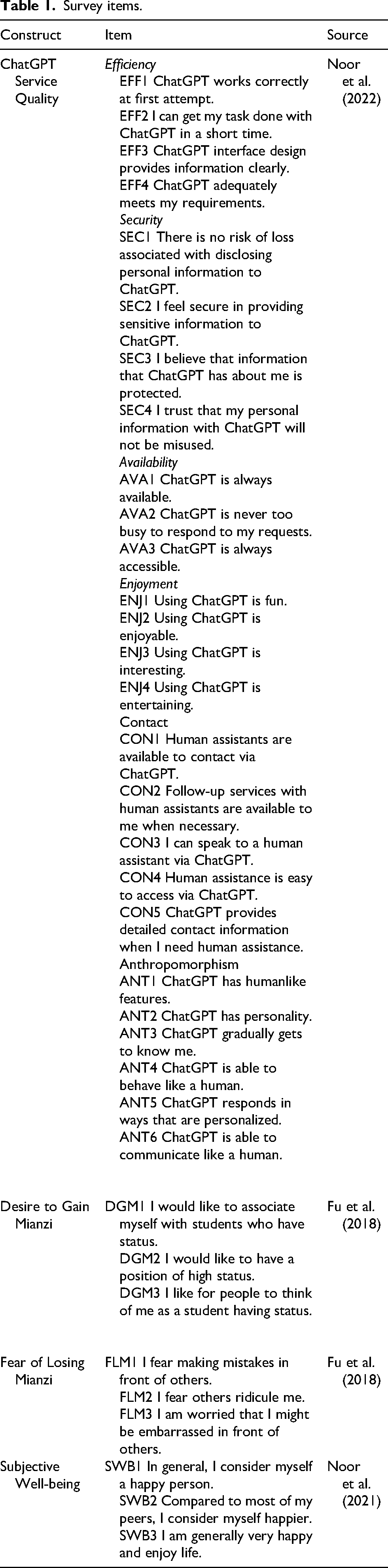
Ethics approval was obtained from the co-author's institution. The measures used in this study were adapted from existing constructs in the extant literature. The service quality of ChatGPT was measured using the service quality scale to evaluate AI service agents as developed by Noor et al. (2022). Desire to gain Mianzi and fear of losing Mianzi were measured using the constructs from Fu et al. (2018), while subjective well-being used three-item measures from a study involving AI virtual assistants by Noor et al. (2021). Table 1 details the item measures used in our study.
Survey items.
A self-administered survey was distributed to higher education students across two universities in Singapore for 4 months from April to July 2024. Purposive sampling was used, with the survey participation dependent on the students having used ChatGPT for schoolwork or any other purpose. In this study, “resided” refers to respondents’ home country or nationality rather than their physical location at the time of survey completion. Respondents who reported China on this measure are international students of Chinese nationality enrolled in Singapore-based universities. Accordingly, while the sample reflects cultural diversity in terms of national background, all participants were situated within a common institutional and educational environment in Singapore. The findings were interpreted within this higher education context, with cultural variation captured at the individual level.
The survey consisted of two sections. The first section contained demographic and ChatGPT usage questions, including a screening question to ensure that respondents met the participation criteria of having used ChatGPT. In the second section, respondents were asked to rate the measure items, shown in random order, using a 7-point Likert scale anchored from 1 = strongly disagree to 7 = strongly agree. An instructional manipulation check (Oppenheimer, Meyvis and Davidenko, 2009), which asked respondents to select “Others” for a question at the beginning of the survey, was used to improve the overall response quality.
The final sample consisted of 128 responses with 79 female (61.7%) and 49 male (38.3%) participants. The sample size of 128 met the threshold of 10 times the largest number of structural paths to an endogenous variable in our model for partial least squares structural equation modelling (PLS-SEM) (Hair et al., 2011). Most respondents were aged 18–24 (106 or 82.8%) and had a bachelor's degree (56 or 43.8%), high school diploma or equivalent (46 or 35.9%), postgraduate (21 or 16.4%) or other qualifications (5 or 3.9%). Most respondents were international students from China (63 or 49.2%), while the remaining were from Singapore (42 or 32.8%) or other countries (23 or 18%). In terms of using ChatGPT, most respondents used ChatGPT 2-3 times a month (50 or 39.1%) or weekly (37 or 28.9%) and accessed ChatGPT mostly via the website using their PC (102 or 79.7%) or mobile app (12 or 9.4%).
Results
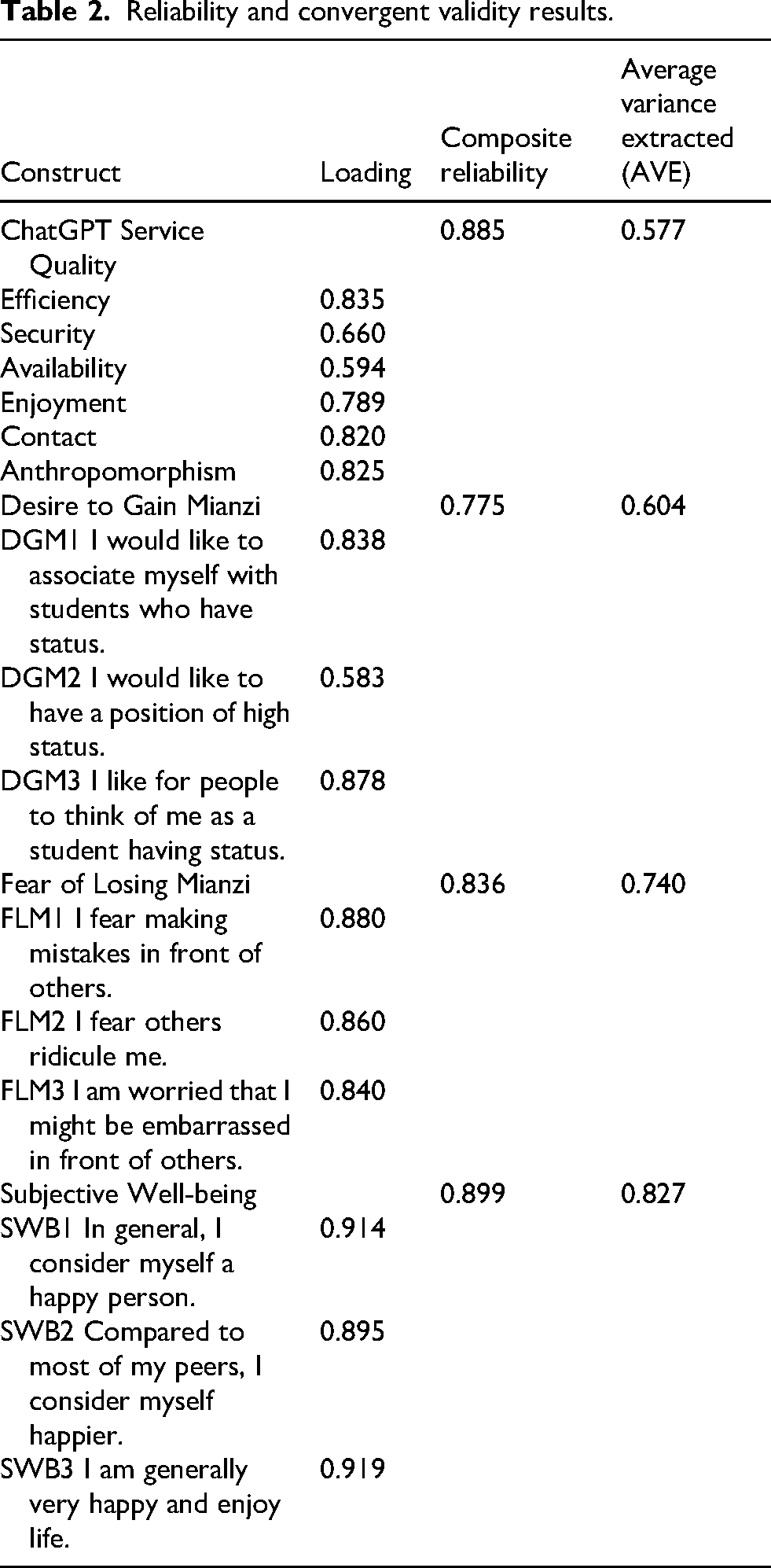
Our study model was assessed using PLS-SEM using SmartPLS 4. The PLS-SEM method is well-suited for exploring and predicting new theoretical relationships and studies with small sample sizes (Hair et al., 2019). In our analysis, ChatGPT service quality was modelled as a reflective construct with six indicators by averaging the scores of items per dimension (Noor et al., 2022). For model fit, the Standardized Root Mean Square Residual value of our model met the threshold of 0.08 (Benitez et al., 2020). All factor loadings did not fall below the absolute threshold of 0.50, signifying indicator reliability (Bagozzi and Yi, 1988). For internal consistency reliability, the composite reliability values satisfied the recommended threshold of 0.70 (Hair et al., 2011). All average variance extracted values exceeded the cut-off of 0.50 (Hair et al., 2019), indicating convergent validity. Table 2 summarizes the reliability and convergent validity results.
Reliability and convergent validity results.
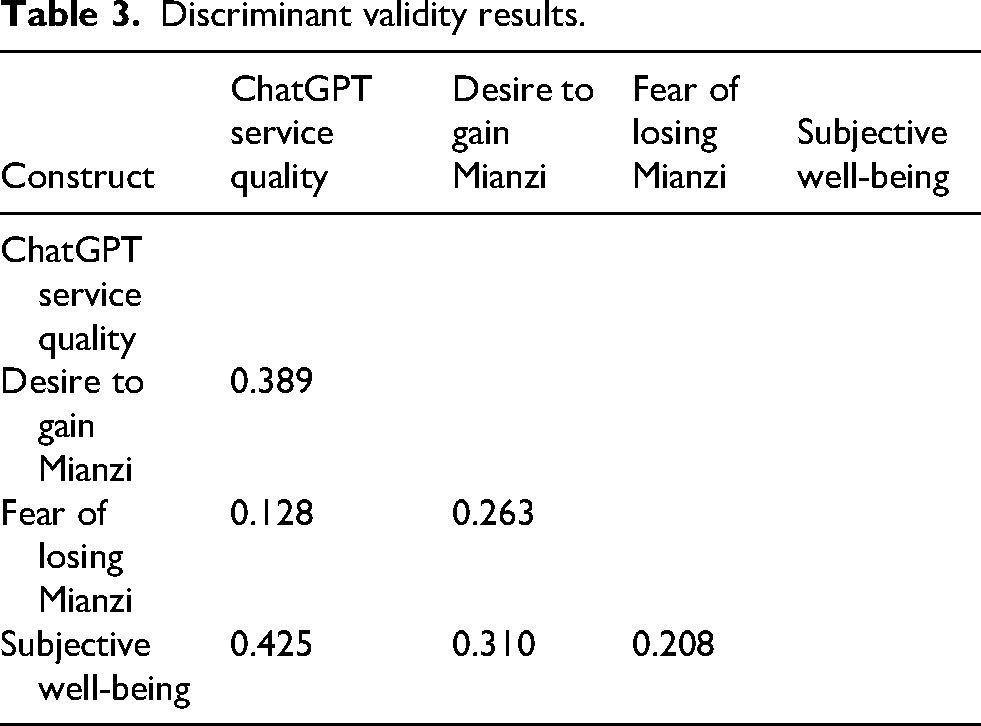
All values of the Hetero-Trait Mono-Trait ratio of correlations met the cut-off of 0.85, indicating discriminant validity (Hair et al., 2019), as seen in Table 3. Finally, the variation inflation factor values from a full collinearity test were lower than 3.3, indicating that common method bias was not detected in our model (Kock, 2015).
Discriminant validity results.
With our model assessed to be satisfactory, we conducted the hypothesis testing using a bootstrapping procedure with 5000 subsamples using a one-tailed test at the 95% significance level. There was a significant and positive relationship between ChatGPT service quality and the desire to gain Mianzi (β = 0.308, p < 0.001), thus supporting H1a. Further, there was a significant and positive relationship between the desire to gain Mianzi and the subjective well-being of students (β = 0.315, p < 0.001), thus supporting H2a. However, on the other path, there was an insignificant relationship between ChatGPT service quality and the fear of losing Mianzi (β = 0.079, p = 0.295), thus rejecting H1b. Further, the relationship between ChatGPT service quality and fear of losing Mianzi was positive and not negative as per our hypothesis. There was a significant relationship between the fear of losing Mianzi and the subjective well-being of students (β = −0.226, p = 0.035), thus accepting H2b. Finally, the specific indirect effect of ChatGPT service quality on subjective well-being through the desire to gain Mianzi was also significant and positive (β = 0.097, p = 0.031), indicating mediation. Figure 1 summarizes the results of the study.
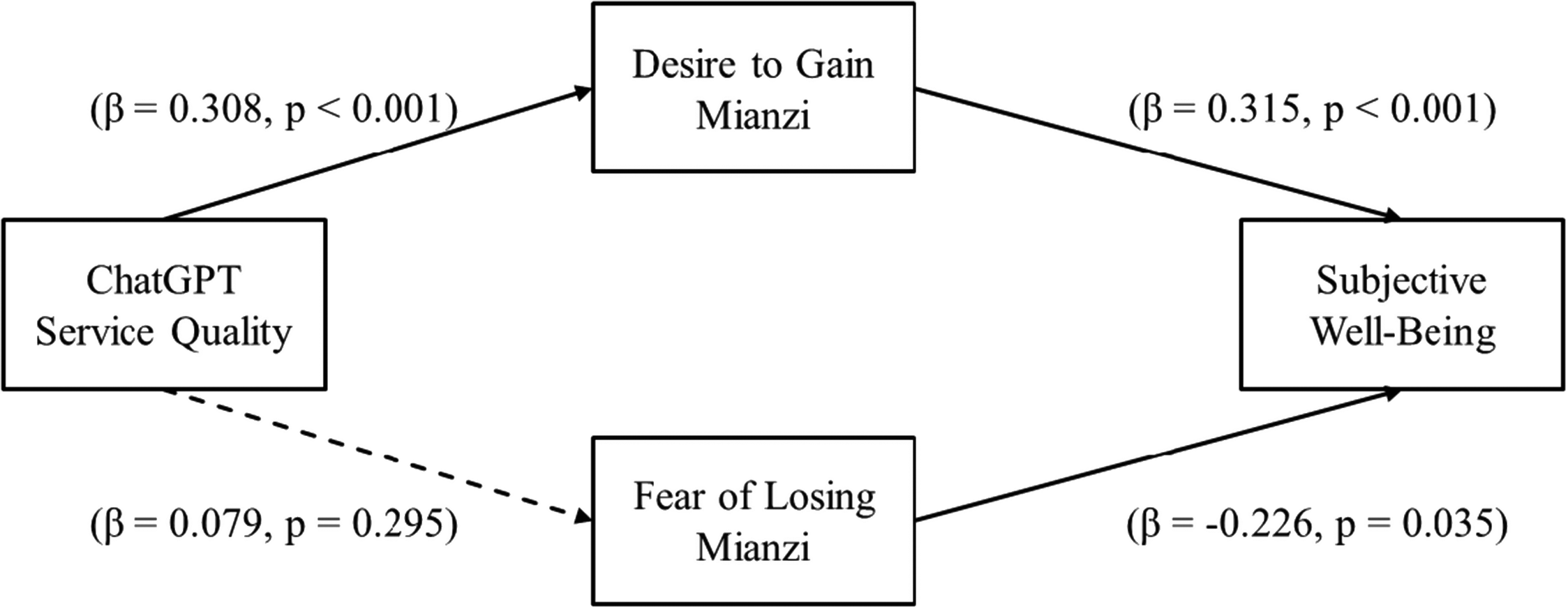
Results of our study (dashed path indicates the hypothesis is not supported).
Taken together, these findings suggest that ChatGPT service quality contributes to student well-being primarily through enhancing students’ desire to gain Mianzi rather than reducing their fear of losing Mianzi. Within tropical higher education systems characterized by rapid digitalization, growing student populations and intensifying competition for academic and employment opportunities (Marginson, 2016), this result highlights the importance of socially embedded cultural motivations in shaping students’ experiences with AI-enabled learning technologies. The findings suggest that the value of AI in tropical educational settings may extend beyond academic assistance to encompass broader psychological and social dimensions associated with status, recognition and personal development.
Discussion
This article investigated how the use of ChatGPT is associated with the subjective well-being of students in higher education through the role of Mianzi. Our results show that students who use ChatGPT and perceive the ChatGPT application to have a higher service quality are more likely to experience greater desires to gain Mianzi, which in turn is linked to enhancing their subjective well-being. While the findings are most directly applicable to students in Singapore-based universities, they also offer insights for other tropical higher education contexts characterized by rapid digitalization, dense social interaction and evolving expectations surrounding academic success and social recognition. In such dynamic cultural environments, students’ engagement with AI-enabled educational services is likely to be intertwined with concerns about social image, legitimacy and face, making Mianzi a salient psychological mechanism linking service experiences to well-being outcomes (Ho, 1976; Hwang, 1987; Connell, 2007).
Beyond the immediate educational context, the findings offer insights into the future trajectory of higher education across tropical societies undergoing accelerated digital transformation and expanding knowledge economies (Connell, 2007; Case et al., 2024). Many tropical regions continue to experience demographic growth and expanding demand for higher education, creating increasing pressure on universities to broaden access while maintaining student support and well-being (Marginson, 2016). Our findings suggest that AI-enabled educational services may contribute positively to student well-being when they align with culturally embedded expectations surrounding social recognition, achievement and belonging. Consequently, the effectiveness of AI integration in tropical higher education may depend not only on technological capability but also on how well AI systems accommodate the social and cultural realities of students across the region. The supported hypotheses H2a and H2b provide further insight into how Mianzi operates as a psychological bridge between AI service experiences and student well-being. The positive relationship between the desire to gain Mianzi and subjective well-being (H2a: β = 0.315, p < 0.001) is consistent with existing evidence that the accumulation of face and social prestige is associated with positive affect and life satisfaction (Huang and Wu, 2012). In the context of ChatGPT use, students who experience an enhanced sense of status and academic credibility through their AI-assisted work appear to derive meaningful psychological benefit from this recognition. This aligns with research demonstrating that higher education students who perform better academically tend to report higher levels of subjective well-being (Zhang and Chen, 2018), suggesting that Mianzi functions as a culturally embedded pathway through which academic achievement translates into personal flourishing. Conversely, the significant negative relationship between fear of losing Mianzi and subjective well-being (H2b: β = −0.226, p = 0.035) confirms that social anxiety and the apprehension of embarrassment in academic settings meaningfully diminish students’ psychological welfare. Together, these findings affirm that both the aspirational and protective dimensions of Mianzi are independently relevant to student well-being, and that their effects operate through distinct mechanisms that warrant separate theoretical consideration.
The significant mediation of the desire to gain Mianzi in the relationship between ChatGPT service quality and subjective well-being (β = 0.097, p = 0.031) constitutes the central theoretical contribution of this study and merits direct discussion. Within the S–O–R framework, this finding confirms that the effect of an AI service environment on student well-being is not direct but is channelled through culturally specific internal states. This extends prior mediation research by Rehman et al. (2024), who identified academically oriented internal states such as self-esteem and buoyancy as mediators of ChatGPT's effect on well-being, by demonstrating that a distinctly cultural and socially oriented construct – the desire for face and status – operates as an equally meaningful conduit. The implication is that AI service quality in education does not merely satisfy functional learning needs but activates culturally embedded identity processes that shape how students feel about themselves and their lives. The observed mediation effect is consistent with prior literature highlighting the continuing relevance of face-related norms within many Confucian-influenced educational contexts (Ho, 1976; Hwang, 1987).
From a tropical futures perspective, this mediation pathway is particularly significant because many tropical higher education systems face growing enrolments, resource constraints and increasing demands for student support services (Marginson, 2016). Under such conditions, AI tools may provide scalable forms of academic and psychological support that complement traditional student services. These mechanisms become increasingly important as universities seek scalable approaches to supporting student well-being without proportionally increasing human support resources. The findings suggest that the success of these technologies will depend not only on improving learning outcomes but also on recognizing the cultural mechanisms through which students derive confidence, social validation and well-being.
A particularly noteworthy finding of the present study is the non-significant and positive relationship between ChatGPT service quality and the fear of losing Mianzi (β = 0.079, p = 0.295), which ran counter to our hypothesized direction. Rather than treating this as a minor deviation, we argue that this constitutes a meaningful theoretical finding. One plausible interpretation is that in academic settings, a higher-performing AI tool may paradoxically elevate the social stakes for students. When ChatGPT functions well, students may become more acutely aware of peer expectations, the risk of being judged for relying on AI, or concerns about academic integrity. In this reading, better AI service quality may heighten rather than reduce fear of losing face, because the tool's visibility and capability intensify social comparison and evaluation concerns in academic environments. This finding suggests that the fear of losing Mianzi may operate as a background pressure that influences student well-being independently of service quality, rather than as a direct outcome of how well the AI performs. In this sense, the primary cultural mechanism linking ChatGPT service quality to well-being appears to be the desire to gain Mianzi, with fear of losing Mianzi playing a distinct role as a persistent socio-cultural stressor whose intensity is not straightforwardly reduced by improvements in AI functionality.
Implications
Theoretically, the study contributes to the literature on the use of AI in education by demonstrating how ChatGPT service quality can lead to subjective well-being with the desire to gain Mianzi as a conduit. In contrast to the study by Fu et al. (2020) which found that the quality of service did not have a significant relationship with the desire to gain Mianzi but instead had a significant relationship with the fear of losing Mianzi, our results run contrary to theirs. There may be several reasons for this inconsistency. While the three-item measures used to measure boat show service quality by Fu et al. (2020) relate to assurance (courteous and friendly), empathy (customized services) and reliability (impressive service), AI service quality was measured in our study using 26 items across six different dimensions. Our service context is also different from Fu et al. (2020) due to the type of service industry (tourism vs. education) and service agent (human vs. AI). Further, while Fu et al. (2020) suggest that the standardized boat exhibitions do not significantly cause any desire to gain Mianzi, the use of ChatGPT in our student context may represent higher stakes for higher education students, resulting in a significant correlation between ChatGPT service quality and the desire to gain Mianzi. These insights provide further support for researchers to investigate how AI can affect the new service environment and existing theoretical relationships with important concepts such as Mianzi. Future research can also help to clarify such discrepancies, further validate the constructs used and extend tests to include how the desire to gain Mianzi and the fear of losing Mianzi may be affected if the student's actions in using AI are associated with other factors, such as potential academic misconduct.
More broadly, the findings contribute to emerging scholarship on tropical futures and Southern perspectives on higher education development (Connell, 2007; Case et al., 2024) by demonstrating that the effects of AI technologies cannot be understood solely through technical or pedagogical lenses. As universities across tropical regions increasingly integrate AI into teaching and learning, culturally embedded social mechanisms such as Mianzi may shape how students experience these technologies and derive well-being benefits from them. This extends discussions of AI adoption in tropical contexts beyond productivity and efficiency concerns towards student flourishing, social inclusion, educational sustainability and human capital development across tropical societies (Connell, 2007; Case et al., 2024).
In terms of managerial implications, while studies on teaching, learning and assessment adjustments due to ChatGPT remain important, this study encourages the education sector to consider the integration of AI for reasons beyond the utilitarian performance of teaching and learning. Our results encourage higher education institutions to carefully implement the use of AI applications such as ChatGPT as additional teaching avenues for students who may wish to seek help in less exposed and stressful ways while increasing their sense of worthiness. Policymakers and educators across tropical regions should develop appropriate AI governance frameworks that balance innovation with concerns relating to academic integrity, data privacy and over-reliance on AI tools. Such frameworks can support the phased integration of AI into teaching, learning and assessment while helping institutions realize the educational and well-being benefits identified in this study. With the increased attention to the use of emerging technologies such as AI in the tropics to unleash the potential of the region (Noor et al., 2026), the above measures become particularly relevant in empowering individuals through international higher education with AI while preserving their well-being in relationship-driven societies.
As tropical economies increasingly invest in digital transformation and AI-enabled education, policies that recognize the cultural dimensions of technology use are better positioned to support inclusive educational development. AI strategies that focus on technical adoption risk may overlook how students use these technologies within socially embedded educational environments. The findings are particularly relevant for international education hubs in the tropics, such as Singapore, Malaysia and emerging regional centres that attract students from diverse cultural backgrounds (Knight, 2013). Universities operating in these environments should recognize that AI-enabled learning technologies may influence student well-being through culturally specific pathways that extend beyond academic performance.
Limitations and future research
Despite the significance of our findings, several limitations exist that give rise to further research opportunities. First, while our sample size was limited and taken from students studying in one country, future research should incorporate multi-country designs and explicitly test contextual differences, including cultural orientation, nationality and geographic setting, to capture broader perspectives and improve the generalizability of the findings. Second, a more probabilistic sampling method can be used to ensure that the sample is more representative of the student population. Third, changes in the research methodology (i.e., mixed-methods design to triangulate findings or a longitudinal study) as well as comparisons with other AI applications can provide richer insights and unravel possible negative impacts. Fourth, our study encourages future studies to examine other culturally related mediating factors between ChatGPT and constructs concerning the students’ well-being. One such study could be based on another face concept, Lien, which describes respect given due to the person's inner morals and character (Hu, 1944).
Given the cultural diversity across tropical regions, and in the same vein as Dillon and Tan (2024), who advocate for more cross-regional tropical research in higher education, future research could explicitly compare students from different tropical societies (e.g., Southeast Asia, Sub-Saharan Africa, Latin America) to examine how variations in relational norms and face-related values influence the mediating role of Mianzi in AI-enabled education. Such comparative work would further advance understanding of culturally contingent pathways to student well-being in tropical futures.
Future research may also investigate how AI-enabled educational services contribute to broader developmental goals across tropical societies, including educational inclusion, student resilience (Brewer et al., 2019), digital capability development and equitable access to learning support. These would help clarify the role of AI in shaping sustainable higher education futures throughout the tropics. Overall, amidst continuing debates surrounding AI in higher education, this study suggests that the future contribution of ChatGPT and related technologies in tropical universities may depend not only on their capacity to enhance learning but also on their ability to support student well-being through culturally meaningful pathways. As tropical societies continue their digital transformation journeys, understanding these cultural mechanisms will become increasingly important for building sustainable and inclusive higher education futures.
Footnotes

Ethical approval and informed consent statements
Ethics approval for this project was granted by Curtin University Human Research Ethics Committee (HREC2024-0076).
Funding
The authors received no financial support for the research, authorship and/or publication of this article.
Declaration of conflicting interests
The authors declared no potential conflicts of interest with respect to the research, authorship and/or publication of this article.
Data availability statement
Data is available upon request.