







Abstract
Residual displacement spectrum is one of the most important means to predict the permanent deformation of structures after the earthquake, and various normalizations of residual displacements have generally been used for construction of the spectrum. However, the issue regarding the merits and drawbacks of each normalization has not yet been investigated thoroughly. A comparison between two normalizations that relate the residual displacements to the elastic and inelastic displacements is made in terms of the effect of ground motion and structural characteristics by means of the results of nonlinear time history analysis. The statistical results reveal that the residual-to-peak-inelastic displacement ratios have the advantages of small dispersion, samples without any outliers, and relatively symmetric distribution, which benefits from the strong correlation between residual and peak inelastic displacements. Moreover, the residual-to-peak-inelastic displacement ratios are almost independent of site conditions, significant duration, and natural periods. Consequently, the peak inelastic displacements are superior to the elastic ones as an intermediate step for residual displacements estimation, provided that the peak inelastic displacements are estimated with a low uncertainty. For providing alternatives to estimate residual displacement demands, the constant-strength residual displacement spectra are developed for both normalizations.
Keywords
Introduction
Past earthquake reconnaissance observations (Eguchi et al., 1998; Fujino et al., 2005; Paterson et al., 2008; Ramirez and Miranda, 2012) show that the total economic losses during a damaging earthquake event include not only the direct losses associated with demolition and reconstruction of the collapsed buildings but also the indirect losses related to the costs of repairing, and even removing and rebuilding the lifelines and other essential infrastructures without collapsing but sustaining certain permanent deformations. In particular, the economic losses at the intermediate levels of ground motion intensity are often dominated by losses due to residual drifts (Ramirez and Miranda, 2012). Therefore, in addition to the collapse prevention, sufficient attention should also be paid to the post-earthquake reparability of structures. The former is mainly controlled by the peak inelastic displacement, while the latter generally uses the residual displacement as an important criterion. For example, after the 1995 Kobe earthquake (Fujino et al., 2005), as many as 88 single reinforced concrete (RC) piers were forced to replace or remove simply because of the excessive permanent deformation resulting in technical difficulties and elevated costs.
Recognizing the importance of controlling residual displacements, several investigations have focused on assessing the factors influencing the residual displacement demands, and some empirical equations have also been proposed to estimate the residual displacement demands of structures that can be simplified to single-degree-of-freedom (SDOF) systems. Mahin and Bertero (1981) found that for elastoplastic systems, the mean residual displacements are more than 40% of the peak inelastic displacements. Moreover, the coefficients of variation (COVs) of the residual displacements are nearly twice the value associated with the peak inelastic displacements. MacRae and Kawashima (1997) and Kawashima et al. (1998) statistically analyzed the residual displacements normalized by the maximum possible residual displacements of bilinear oscillators, respectively, subjected to 11 and 63 ground motions and then proposed a residual displacement spectrum to be used in the design of new bridge piers in Japan (Japan Road Association, 2002). Borzi et al. (2001) assessed the effect of the softening behavior (negative post-yield stiffness) on the ratios of residuals to peak inelastic displacements for the elastoplastic model. Christopoulos et al. (2003) investigated the effect of hysteretic characteristics, post-yield stiffness as well as maximum ductility on the residual displacements normalized by peak inelastic displacements for four SDOF oscillators representative of RC frame buildings with different stories. To facilitate the estimation of residual displacement demands, a simplified equation for the elastoplastic system was proposed by Ruiz-García and Miranda (2006b), where the residual displacements were normalized by the elastic spectral displacements. Liossatou and Fardis (2015, 2016) examined the influence of near-fault ground motions with and without distinct velocity pulses on the residual displacements of SDOF systems having various hysteretic rules representing a range of typical RC structures. The authors found that the residual displacements came out on average equal to about a constant fraction of the peak inelastic displacements, regardless of the presence of a velocity pulse in the ground motions. Recently, Guerrero et al. (2017), Ji et al. (2018), and Ruiz-García and Guerrero (2017) studied the residual displacements normalized by the elastic spectral ones for SDOF systems subjected to ground motions recorded at soft-soil sites. The spectral trend of residual displacement ratios for the soft-soil sites was found to be different from the spectral trend for firm sites. Particularly, residual displacement ratios significantly decrease when the natural period is close, or equal, to the predominant period of the ground motion recorded in soft-soil site. Very recently, Quinde et al. (2020) developed a simplified relation between the residual and peak inelastic displacement demands for soft soils. For estimation of the residual displacements of structures under the mainshock-aftershock sequences, an average residual displacement spectrum was proposed by Amiri and Bojórquez (2019), where the residual displacements were normalized with respect to the elastic spectral ones. Girija and Gupta (2020) conducted a comprehensive statistical estimation of residual displacement spectrum via normalization with respect to inelastic and elastic spectral displacements, and the expressions were proposed for both types of normalization.
From the literature survey, it is apparent that the average response spectrum has been recognized as one of the most important means to estimate the residual displacement demands to date, and mainly three different definitions of the residual displacement ratios were used in construction of the spectra, that is, the residual displacements normalized with respect to the maximum possible residual displacements (dr,m, quasi-statically unloading from the peak inelastic displacement to the line of zero lateral force), elastic spectral displacements (Sd), and peak inelastic displacements (dm), respectively. As a matter of fact, the use of various definitions of residual ratios will inevitably result in discrepancies in terms of both simplicity and accuracy in the estimation of residual displacement demands. For instance, the maximum possible residual displacements as the upper limit of residual displacements cannot be always obtained simply by linear quasi-static unloading from the peak inelastic displacements and the extra computational burden will be introduced, such as nonlinear response of structures having bilinear Takeda hysteretic rules with negative reloading stiffness parameters, or structures having smooth hysteretic models (e.g. BWBN and Ramberg–Osgood), as illustrated in Figure 1. Furthermore, the maximum possible residual displacements are unnecessary in the routine seismic design process. As a result, such normalization will evidently lead to a redundant procedure and is not recommended for residual displacements estimation. Note, however, that most of the existing studies generally state the residual displacement demands to be normalized by a certain displacement demand. The pros and cons of each normalization format used in residual displacement demands estimation have not yet been systematically reported.
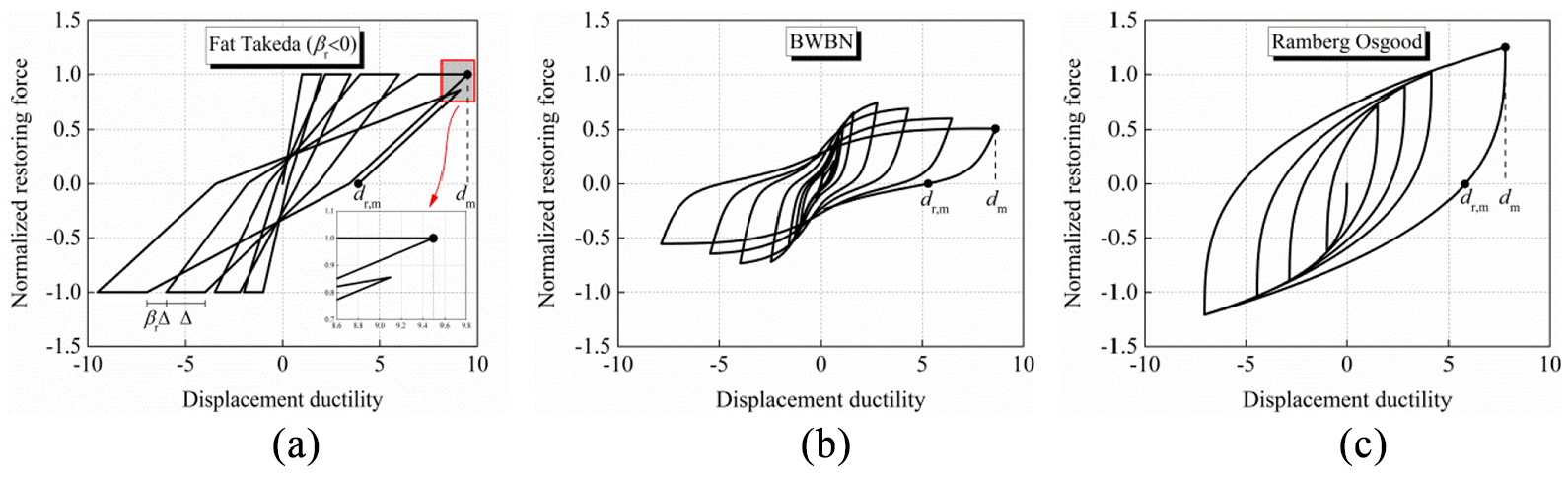
(a) Takeda hysteretic model with negative reloading stiffness parameter, (b) BWBN model, and (c) Ramberg–Osgood model.
The objective of this article is to investigate the impact of the choice of normalization parameters on residual displacements estimation. Meanwhile, the merits and drawbacks of different types of normalization used for estimation are analyzed. For these purposes, the residuals are, respectively, normalized by elastic spectral and peak inelastic displacements. A comparison of the effect of local site conditions, ground motion durations, natural periods, yield strength reduction factors, and hysteretic rules on two different definitions of residual displacement ratios is made by means of the results of nonlinear time history analysis (NTHA) under 240 ground motions. The constant-strength residual displacement spectra, which allow the estimation of residual displacement demands in terms of both elastic spectra and peak inelastic displacements, are finally constructed for three typical hysteretic models.
Earthquake ground motions
To obtain the post-earthquake residual displacement demands, an ensemble of 240 earthquake records drawn from the Ground Motion Database of the Pacific Earthquake Engineering Research Center (PEER, 2019) was used as seismic input in this study. All ground motions satisfy the following requirements: (1) surface-wave magnitudes (Ms) are greater than or equal to 5.0; (2) gathered from rock or firm sites with average shear-wave velocities (vs,30) greater than 180 m/s in the upper 30 m of the site profile; (3) at least one of the two horizontal components has a peak ground acceleration (PGA) larger than 20 cm/s2; and (4) without velocity pulse characteristics or directivity effects. Details of all ground motion records can be found in Feng and Gong (2020).
In accordance with the site classification specified in FEMA-450 (Federal Emergency Management Agency (FEMA), 2003), the records considered in this study were divided into three groups. Each contains 80 ground motions, corresponding to rock with 760 m/s < vs,30 ≤ 1500 m/s (site class B), very dense soil and soft rock with 360 m/s < vs,30 ≤ 760 m/s (site class C), and stiff soil with 180 m/s < vs,30 ≤ 360 m/s (site class D), respectively. The ranges of Ms are 5.3–7.6, 5.1–7.4, and 5.0–7.4, respectively, for site classes B, C, and D, and the average PGA for each site class is 72.33, 147.16, and 114.33 cm/s2.
Figure 2 shows the average elastic response spectra, where the spectral ordinates are computed for each earthquake record and then averaged for different components. Note that the ground acceleration of each record is divided by its PGA, which anchors the zero-period ordinate for a standard spectral shape. Evidently, the shapes of the spectra for three site groups are different in terms of the predominant periods (the period at which the maximum spectral acceleration amplitude is concentrated) and the spectral acceleration amplitudes. Figure 3 depicts the distribution of distances to horizontal projection of rupture (Rrup), surface-wave magnitudes (Ms), and peak ground accelerations (PGA) for all ground motions considered in this study. The Rrup ranges from 2.9 to 151.1 km and the PGA ranges from 15.26 to 645.38 cm/s2. About 90% ground motions were recorded from earthquake events having Ms greater than 5.5. To have a look at the distribution of ground motion duration, the significant duration defined by Trifunac and Brady (1975) is computed for all ground motions, and the histogram is presented in Figure 4. The significant duration ranges from 3.5 to 35.1 s, 2.4 to 36.4 s, and 3.8 to 34.9 s, respectively, for site classes B, C, and D. Since the dataset considered in this study does not include far-field long-duration ground motions or enough motions from large-magnitude earthquakes, the findings as well as the response spectra developed in this study cannot be reliably applied to these extreme cases.
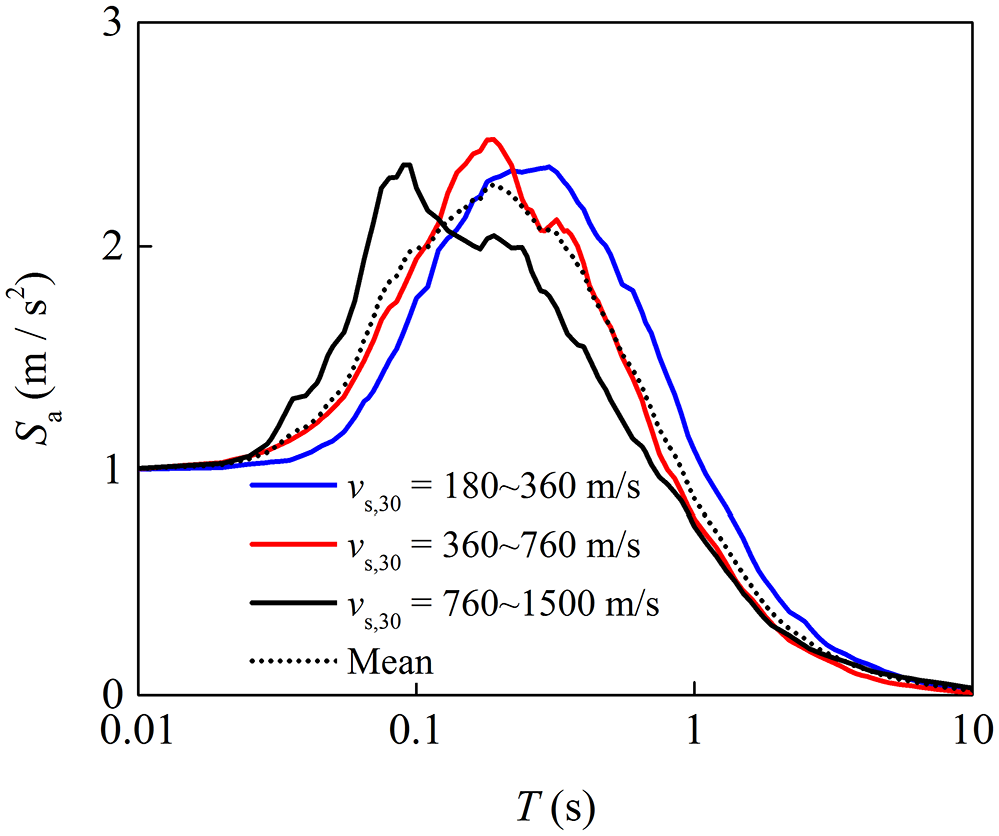
Average elastic acceleration response spectra with 5% damping ratio.
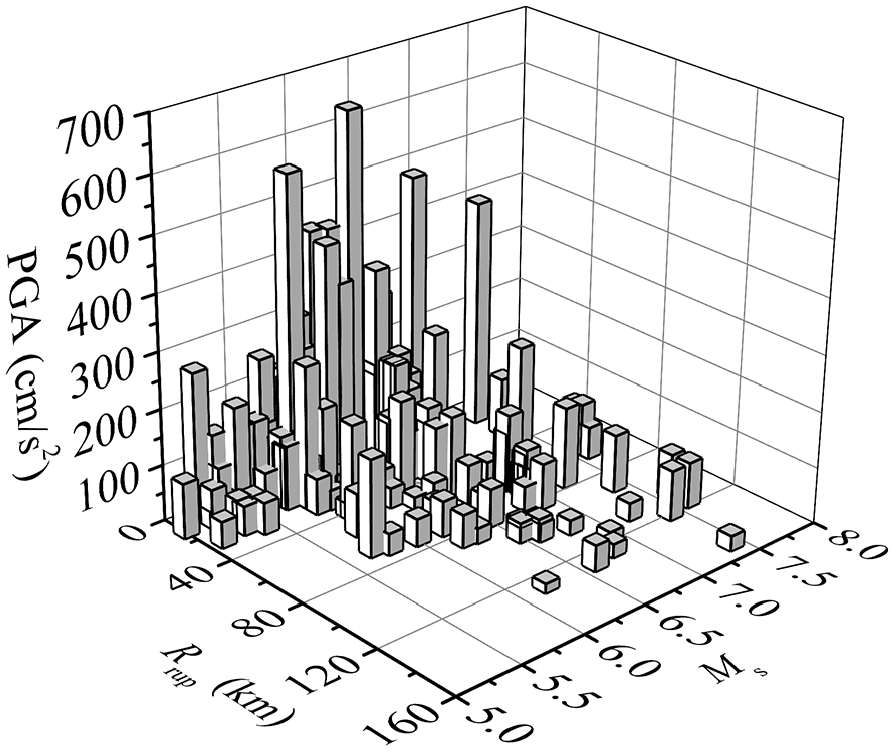
Distribution of Rrup-Ms-PGA for all ground motions.
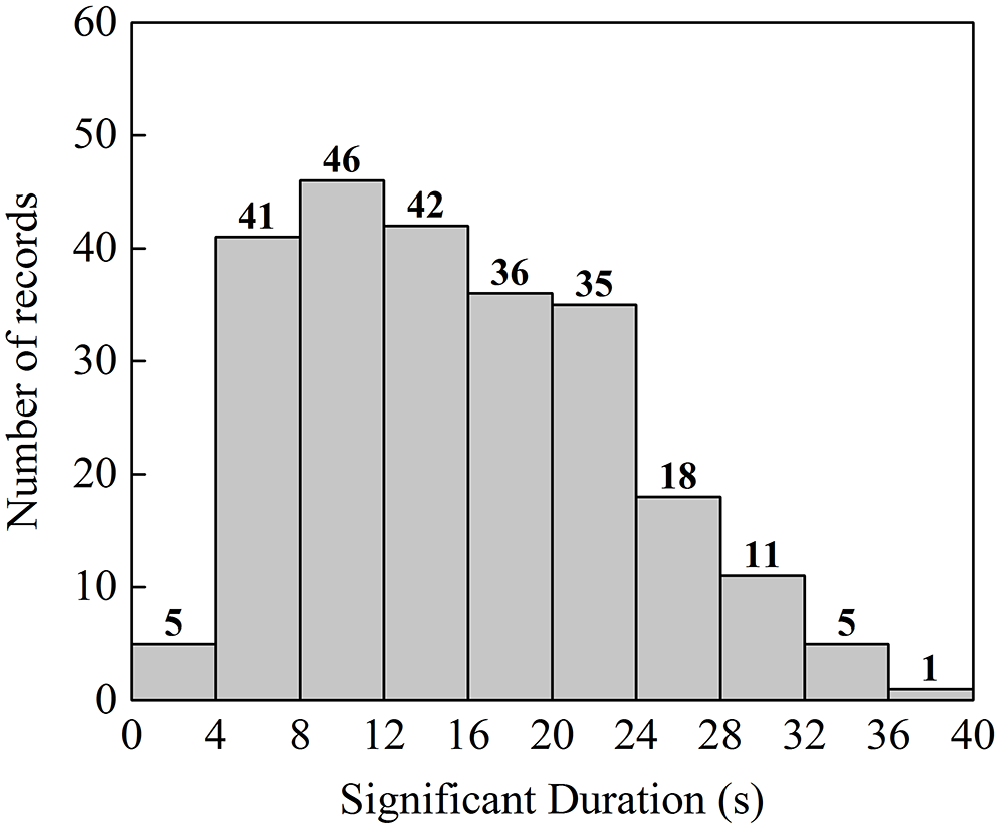
Histogram of significant duration.
Hysteretic models
The hysteretic rules have been demonstrated to be one of the most important factors affecting the residual displacement demands (Christopoulos et al., 2003; Dazio, 2004; Liossatou and Fardis, 2015). In view of this, three typical hysteretic models were selected for this study as illustrated in Figure 5. The elastoplastic model in Figure 5a can be considered an adequate approximation to the steel-framed structures and seismic isolation systems. The Thin Takeda (Otani, 1974) and Fat Takeda (Kanaan and Powell, 1973) models in Figure 5b and c represent a range of hysteresis shapes appropriate for RC and reinforced masonry structures. The former is a representative of RC members with significant axial load, such as building columns, bridge column piers, and walls (Priestley et al., 2007) and can also be used elsewhere for simulation of nonlinear dynamic behaviors of rubble-stone masonry structures (Ali et al., 2013). For this model, the unloading stiffness degrading factor (as defined in the figure) α = 0.3 is assumed as a typical value of these structures. The latter, who incorporates the former as a special case, is a representative of a series of RC beams. For well-detailed beams, the parameters α = 0.3 and β = 0.6 are generally considered to be appropriate.
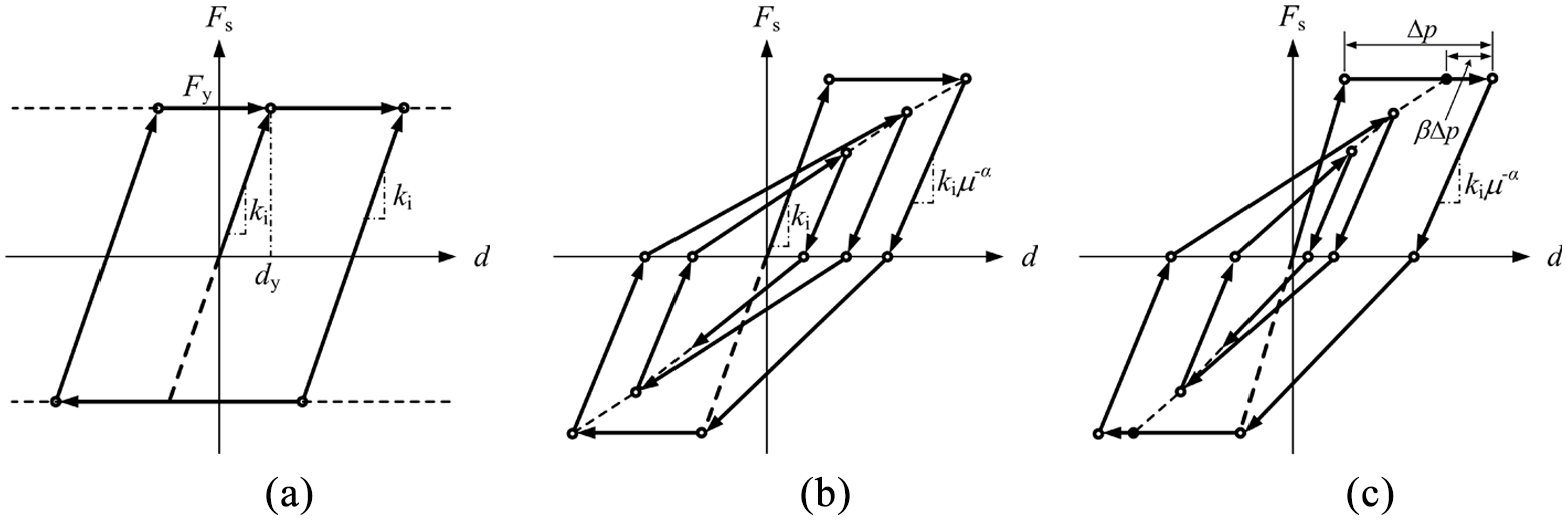
Hysteretic models used in this study: (a) elastoplastic, (b) thin Takeda, and (c) fat Takeda.
Analysis methodology
Residual displacement ratios
To investigate the impact of the choice of normalization formats on the residual displacement estimation, the residual displacement demands are normalized by two different displacements in this study, respectively, defined as follows:

and

where Sd is the elastic spectral displacement under an acceleration time history; dm and dr are the peak inelastic displacement and the residual displacement, respectively, computed using NTHA of SDOF systems with constant relative lateral strength subjected to the same acceleration time history. The relative lateral strength is measured by the yield strength reduction factor, R, which is defined as

where m and Fy are the mass and the yield strength of the structures, respectively; Sa is the elastic spectral pseudo-acceleration.
Initial viscous damping models
The NTHA has already been widely used for describing the behavior of structures under seismic actions. It is apparent that the reliability of NTHA results is largely dependent on the modeling choice, of which the modeling of viscous damping forces is a crucial aspect. To date, a great deal of research has been carried out focusing on this topic (Charney, 2008; Chopra and McKenna, 2016; Hall, 2006, 2017; Hardyniec and Charney, 2015, 2017; Jehel et al., 2014; Petrini et al., 2008; Priestley and Grant, 2005; Smyrou et al., 2011). However, even for simple SDOF systems, the modeling of damping forces is still controversial.
The initial-stiffness proportional damping (ISPD), also termed the mass proportional damping, was shown to produce unrealistically high amount of damping energy dissipation (Priestley and Grant, 2005) and large damping forces (Hall, 2006), thus resulting in an analytical results being unconservative.
The tangent-stiffness proportional damping (TSPD), advocated by Priestley and Grant (2005), was demonstrated to effectively eliminate such unrealistic response quantities. Nevertheless, this model was criticized for lacking a physical basis and having conceptual issues (Chopra and McKenna, 2016; Hall, 2006, 2017). However, in analyses performed by Hardyniec and Charney (2017), no detrimental influences associated with the conceptual issues were observed. Furthermore, the shake-table tests (Otani, 1980; Petrini et al., 2008) confirmed that TSPD provided the best agreement with the experimental observations, while ISPD would result in an underestimation of the displacement demand. Hence, the TSPD assumption has been implemented by many researchers for NTHA. In this work, the TSPD with a damping ratio of 5% was used in nonlinear dynamic analysis.
Analytical parameters
Two different residual displacement ratios, Ce and Cp as defined in Equations 1 and 2, were computed for SDOF systems having a set of 30 natural periods (T, from 0.1 to 3.0 s), three hysteretic rules (elastoplastic, Thin Takeda, and Fat Takeda), and 10 levels of yield strength reduction factors (R, from 1.5 to 10) when subjected to an ensemble of 240 ground motions recorded at three different firm sites.
Correlation analysis
Before making a comparison between two methodologies that relate the residual displacements with the elastic and inelastic displacement demands, it is desirable to first look at the correlation between residuals and each of these two intermediate demands. To this end, the residual displacement dr, elastic spectral displacement Sd, and peak inelastic displacement dm are computed for each of 240 ground motions.
As an example, Figure 6 shows the scatter plots of dr versus Sd and dr versus dm for elastoplastic systems with typical combinations of T and R. Note that the dr, Sd, and dm are, respectively, normalized by their maximum values max(dr), max(Sd), and max(dm), which allows all subplots to have the same scales. A comparison of Figure 6a and b suggests that the residual displacements have a better linear relation with the peak inelastic displacements. This reveals that the structures undergoing large peak inelastic displacements are more prone to sustain excessive residual displacements.
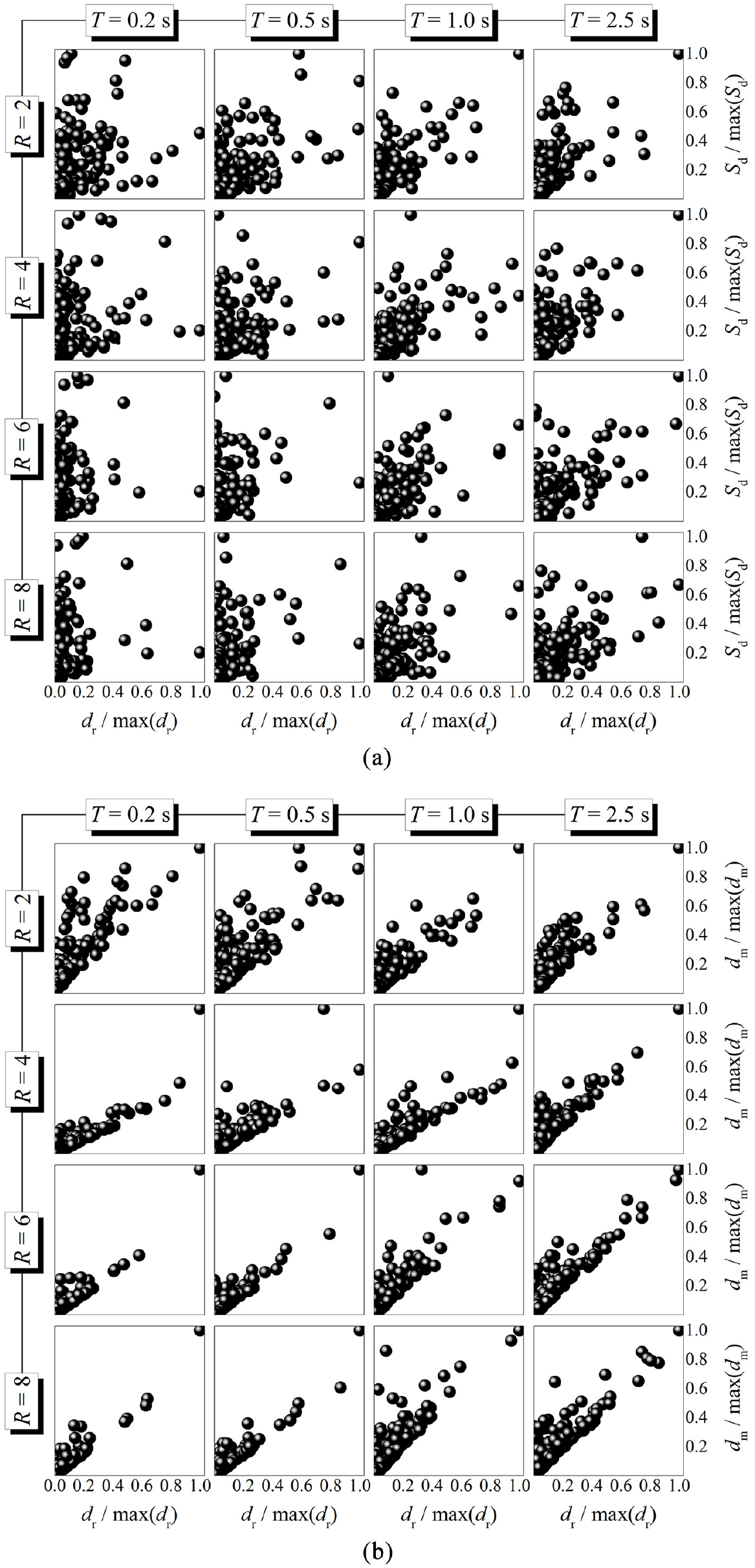
Scatter plots of residual displacements versus (a) elastic spectral displacements and (b) peak inelastic displacements.
To quantify this linear relationship, Pearson’s correlation coefficients ρ between the residual displacements and the intermediates (Sd or dm) were computed as presented in Figure 7. It can be seen that, regardless of hysteretic rules, the residual displacements have a stronger correlation with the peak inelastic displacements than with the elastic spectral ones, particularly for short to intermediate period ranges (T < 1.0 s). In general, the linear correlation between the residual displacements and the peak inelastic displacements is not significantly influenced by T and R, and the averaged correlation coefficients neglecting the effect of T and R are roughly 0.89, 0.86, and 0.76, respectively, for elastoplastic, Thin Takeda, and Fat Takeda systems. In view of this stronger correlation, the peak inelastic displacement appears to be a better intermediate step for residual displacement demands estimation, since the residual displacement normalized by peak inelastic displacement is expected to exhibit lower dispersion. To confirm this, a comparison between two residual displacement ratios in terms of their dispersion is carried out next.
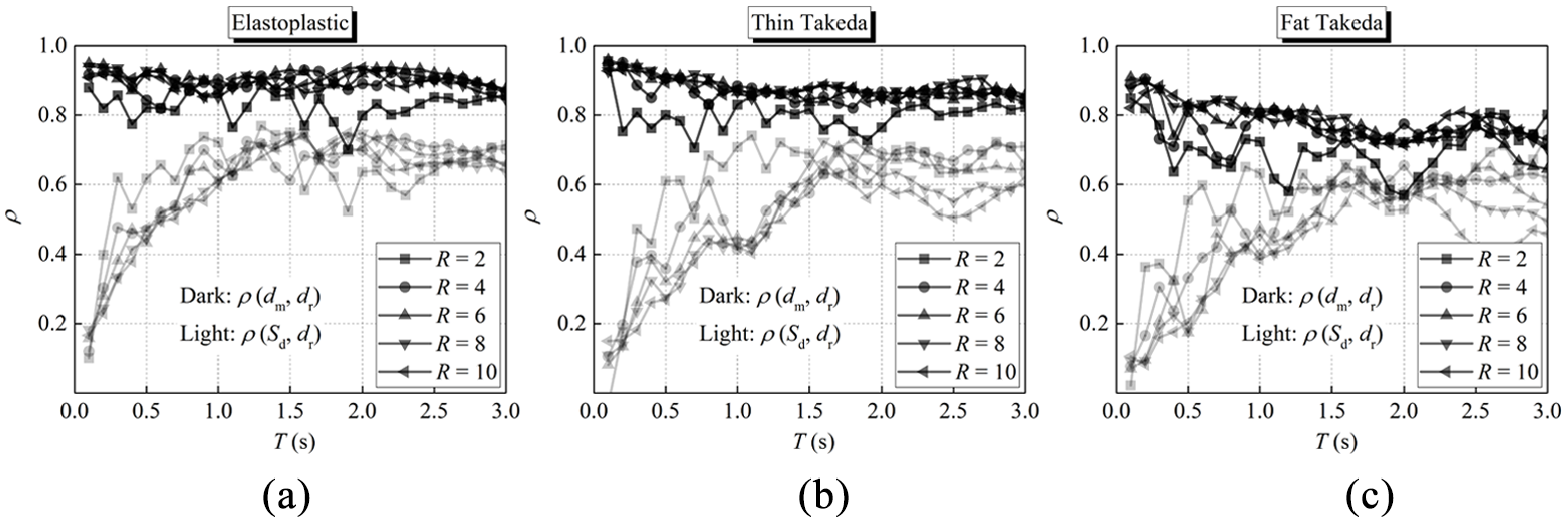
Correlation between residual displacements and elastic spectral displacements as well as peak inelastic displacements for (a) elastoplastic, (b) thin Takeda, and (c) fat Takeda systems.
Dispersion of residual displacement ratios
The dispersion of residual displacement ratios was quantified by computing their COV. Figure 8 presents the COV of residual displacement ratios, Ce and Cp, for elastoplastic, Thin Takeda, and Fat Takeda hysteretic SDOF systems under 240 ground motions.
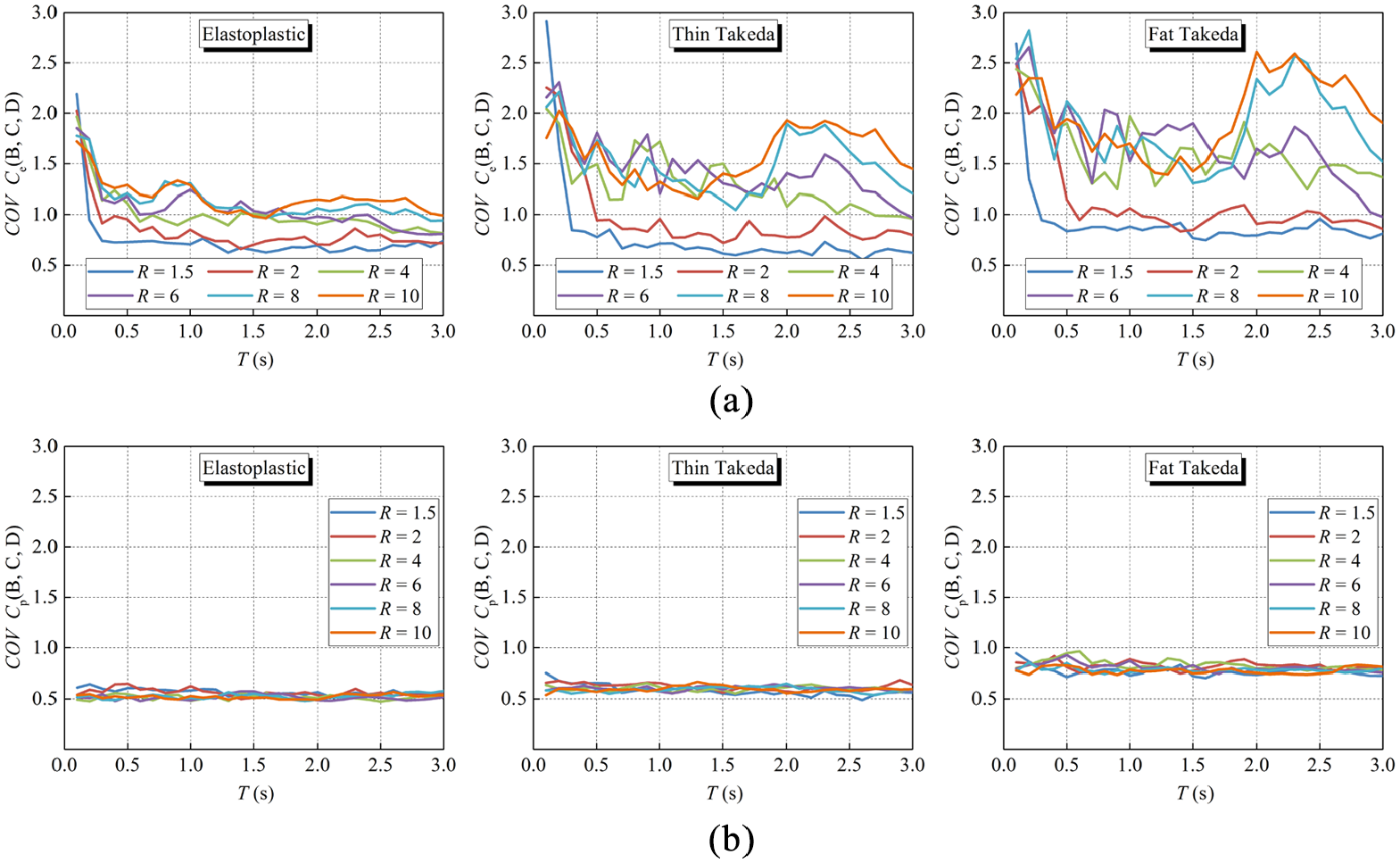
Coefficients of variation of (a) Ce and (b) Cp computed from all 240 ground motions.
By comparing Figure 8a and b, it can be observed that the COV of Ce and Cp shows different tendencies in statistical sense. In general, dispersion of Ce tends to increase as the relative lateral strength increases. For very short period ranges (T < 0.3 s), dispersion of Ce is especially high regardless of relative lateral strength. However, dispersion of Cp is almost independent of T and R, and the averaged COV of Cp neglecting the effects of T and R is about 0.53, 0.60, and 0.80 for elastoplastic, Thin Takeda, and Fat Takeda hysteretic systems. It is thus concluded that for a given T and R, the estimation of Ce involves larger uncertainty than the estimation of Cp. This is particularly true for high levels of relative lateral strength or for very short period ranges. For instance, for R > 4, the COV of Ce is more than twice the COV of Cp, and is, on average, nearly triple for T < 0.3 s.
To provide a visual representation about the variation, or spread of samples, Figure 9 shows the vertically aligned boxplots of Ce (in red) and Cp (in blue) for elastoplastic systems with combinations of R = 2, 4, and 6 and T = 0.3, 1.0, and 2.5 s. Details of a typical boxplot are illustrated in the first subplot, and its implementation is available in Montgomery and Runger (2014). It can be observed that the distribution of Ce is highly right-skewed with a considerable number of outliers, especially for short period ranges and for high levels of relative lateral strength. Nevertheless, the distribution of Cp seems to be fairly symmetric without any outliers. Note that the Cp does not follow a strictly symmetric distribution. Actually, the Kolmogorov–Smirnov (K-S) test suggests that the Cp can be reasonably characterized by a beta distribution bounded between 0 and 1, and the Ce follows a lognormal distribution, which is consistent with those in Liossatou and Fardis (2015).
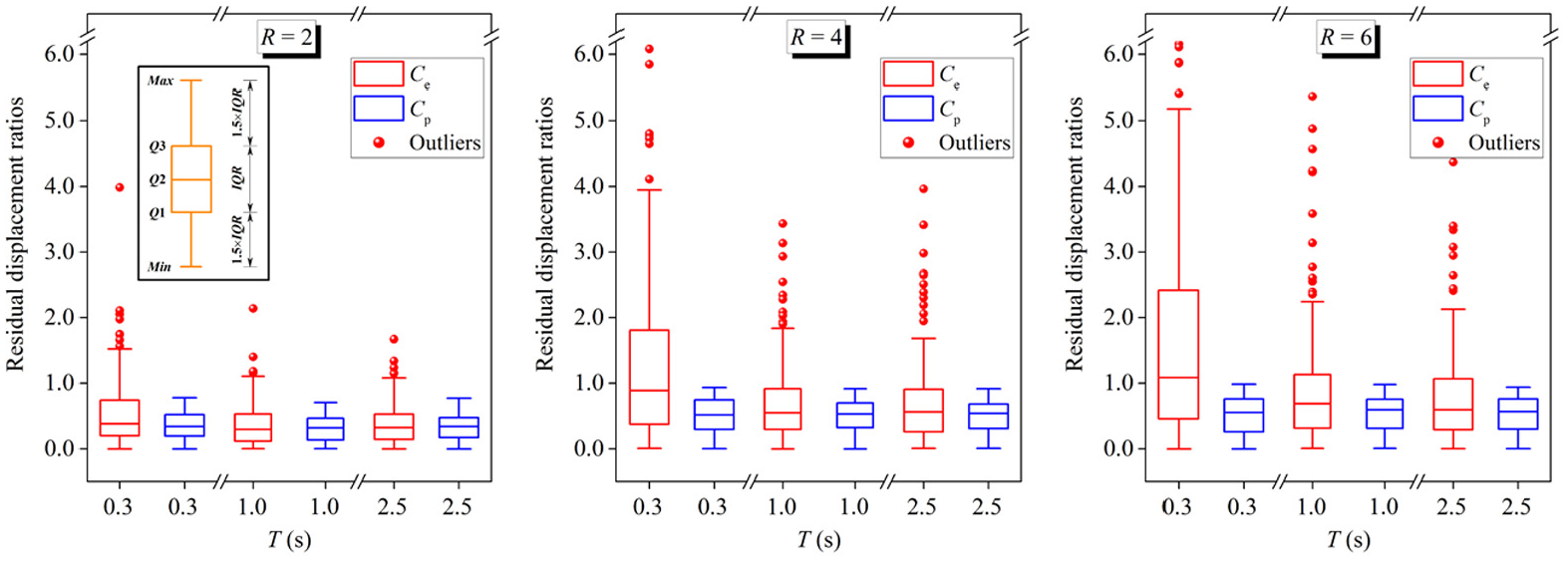
Boxplots for residual displacement ratios computed for elastoplastic systems.
Typically, the response spectrum has been recognized as a conventional approach for the estimation of residual displacement demands. However, such a response spectrum, constructed based on the statistical average of a large number of NTHA results, is particularly susceptible to the outliers, and is not an appropriate representative of the samples with large dispersion or with skewed distribution as well. As previously mentioned, the residual-to-peak-inelastic displacement ratios Cp have the advantages of small dispersion, fairly symmetric distribution, and samples without any outliers, which make Cp more appropriate for construction of the average residual displacement spectrum. This affirmation, however, is based on the premise that the dm is predicted with reasonable accuracy. Conversely, if dm is estimated with a higher uncertainty than Sd, the residual displacement ratio Cp may no longer be a preferable option.
With the objective of making a comparison between two methodologies in terms of the convenience of engineering application and thus developing reasonable response spectra, the following sections focus on the dependence of residual displacement ratios on ground motion and structural characteristics.
Effects of ground motion and structural characteristics
Effect of local site conditions
As is known to all, the local site conditions have a profound effect on the elastic response spectra (as illustrated in Figure 2). This effect is generally considered by specifying different shapes of spectra in the current seismic specifications or standards, such as ASCE 7-10 (American Society of Civil Engineers (ASCE), 2013), FEMA-450 (FEMA, 2003), and GB 50011-2010 (National Standard of the People’s Republic of China, 2010). There is, however, no consensus concerning the influence of site conditions on residual displacement demands. For instance, Kawashima et al. (1998) concluded that the residual displacements are almost independent of soil conditions. On the contrary, Ruiz-García and Miranda (2006b) suggested that such effect is large and need to be considered while estimating residual displacement demands. Therefore, a further look at the effect of local site conditions on residual displacement demands is pertinent.
Mean residual displacement ratios for different firm sites
The residual displacement ratios, Ce and Cp, corresponding to the three groups of local site conditions considered herein were computed for SDOF systems using TSPD model. Figure 10 presents the mean residual displacement ratios for elastoplastic and Thin Takeda systems. The results of Fat Takeda systems are not given, since they show a similar trend with those of Thin Takeda. As can be seen, the influence of site conditions on Ce is significantly larger than that on Cp, which is mainly embodied in two aspects.
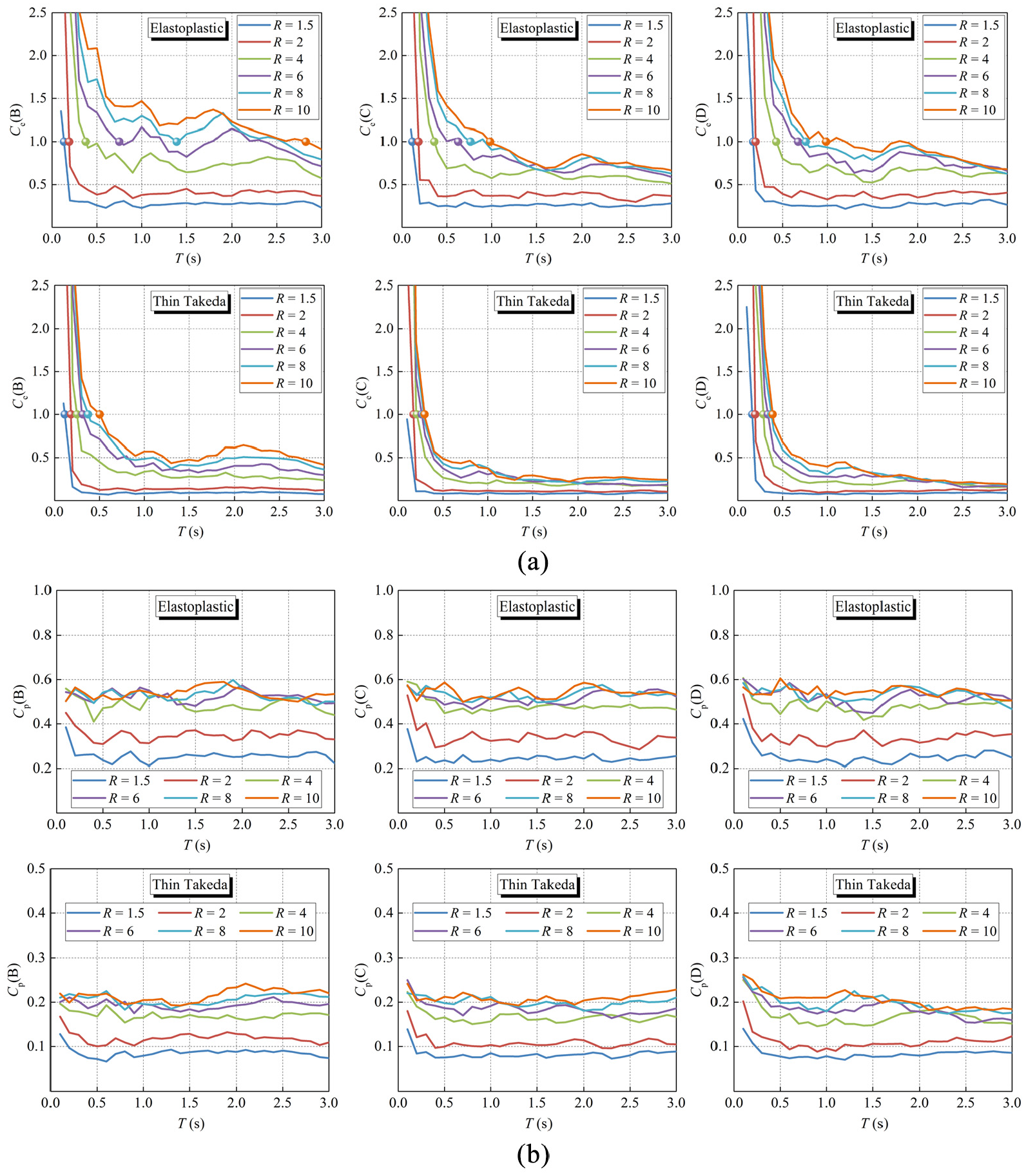
Mean residual displacement ratios (a) Ce and (b) Cp corresponding to site classes B, C, and D.
On the one hand, the limiting period, where the residual displacement exactly equals to the elastic spectral one (i.e. Ce = 1), is longer for rock sites than for soft sites, which is particularly true for high levels of R or for non-degrading hysteretic systems. For instance, for elastoplastic systems with R = 10, site class B corresponds to a limiting period of about 2.82 s, while site class C (or D) corresponds to a limiting period of merely about 0.98 s.
On the other hand, to quantify the effect of local site conditions, the mean residual displacement ratios computed from each site class are normalized by the mean residual displacement ratios computed from all 240 ground motions, and the obtained normalized residual displacement ratios are presented in Figure 11. As can be inferred, the normalized residual displacement ratio less than one implies that for a certain site class neglecting the effect of site conditions will lead to an overestimation of residual displacement demands. However, the normalized residual displacement ratio greater than one means an underestimation. Exactly, the normalized residual displacement ratio equal or very close to one indicates that the effect of site conditions may be negligible. Moreover, the greater the extent to which normalized residual displacement ratios deviate from one, the larger the errors produced by neglecting the effect of site conditions.
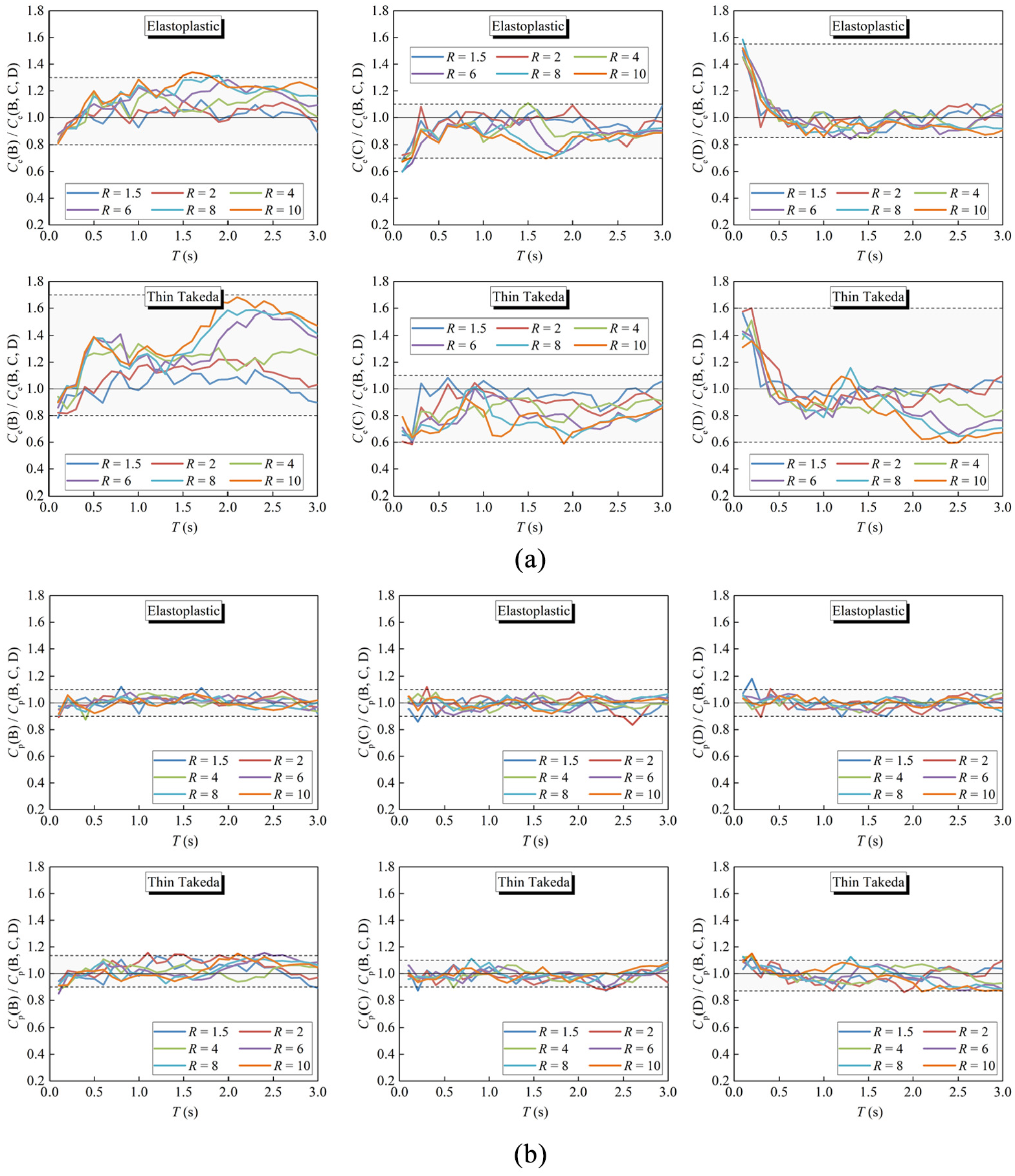
Mean residual displacement ratios (a) Ce and (b) Cp computed from each site condition normalized by mean residual ratios computed from all 240 ground motions.
A comparison of Figure 11a and b shows that, in general, the use of Ce will introduce much greater errors than the use of Cp, provided that the residual displacement demands for a certain site condition (e.g. sites B, C, or D) are estimated directly by using the results from all 240 ground motions. This observation is particularly pronounced for structures with degrading hysteretic rules (e.g. Thin/Fat Takeda) or with weak strength. A typical case is that, for very high levels of relative lateral strength (R ≥ 6), the normalized Ce spectra for Takeda systems are locally amplified over the long period range, which, however, is not observed in elastoplastic systems. In general, neglecting the site effects would, on average, result in an underestimation of residual displacement ratios, Ce, up to about 23%, 45%, and 56%, respectively, for elastoplastic, Thin Takeda, and Fat Takeda systems with R = 10 and periods larger than 0.5 s constructed at site class B. However, for residual displacement ratios, Cp, the errors (underestimation or overestimation) produced by neglecting the effect of local site conditions are, in general, smaller than 10%, regardless of the natural periods, the levels of lateral strength, and the hysteretic rules.
For practical application situations, the effect of site conditions on the mean residual displacement ratios, Cp, is relatively small and can be neglected. This observation, however, does not necessarily apply to far-field long-duration earthquake ground motions with different frequency contents, and its validity requires further investigation.
Dispersion of residual displacement ratios for different firm sites
Figure 12 presents the COV of residual displacement ratios, Ce and Cp, corresponding to site classes B, C, and D. It can be seen that the COV of Cp is almost independent of the local site conditions over the whole period range considered, while the COV of Ce is largely affected by the site conditions. In particular, for short period ranges, the Ce ratios corresponding to site class C exhibit larger dispersion. For longer period ranges, the Ce ratios corresponding to site class B tend to produce larger dispersion.
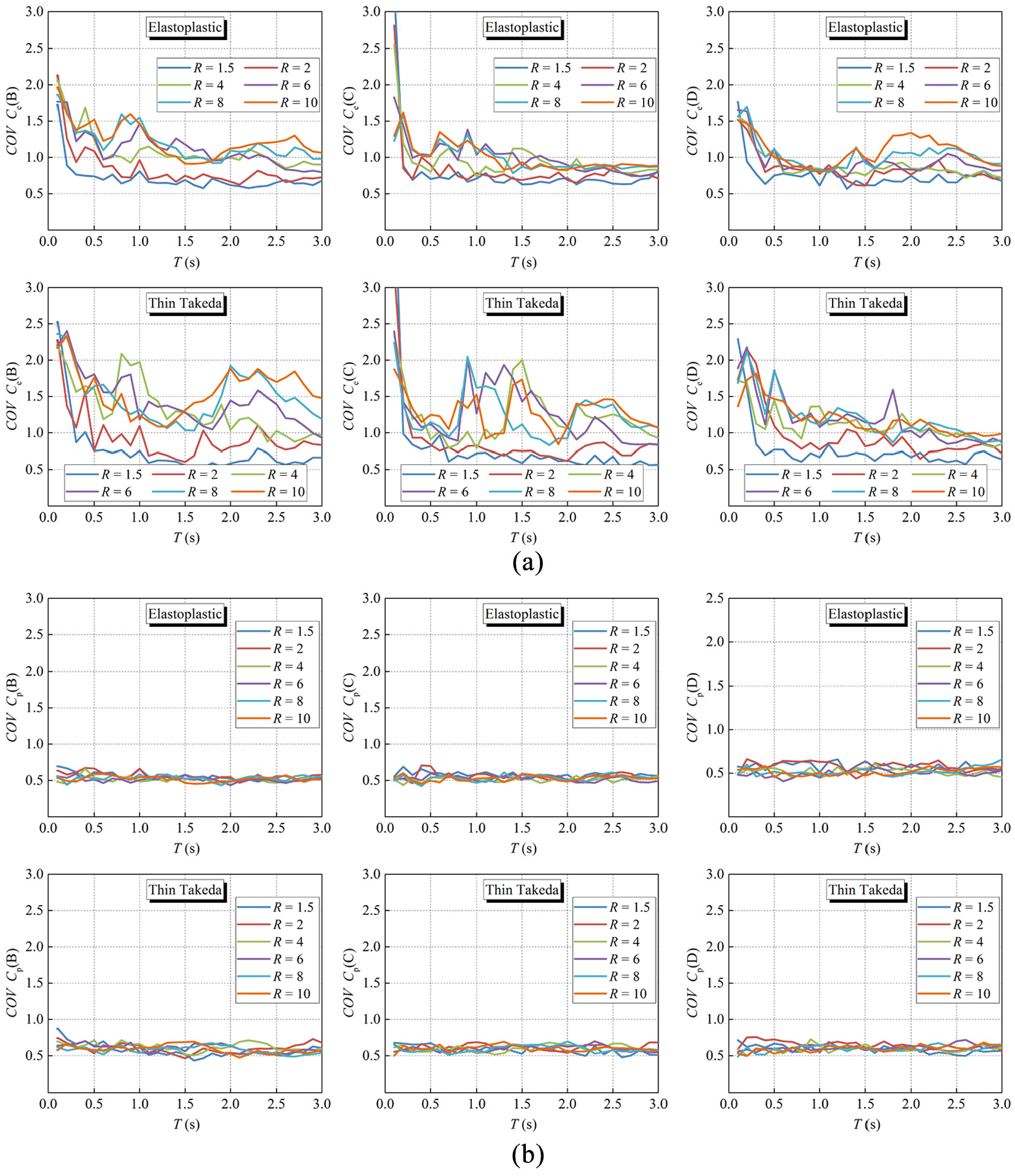
Coefficients of variation of (a) Ce and (b) Cp for systems corresponding to site classes B, C, and D.
Residual displacements, peak inelastic displacements, and elastic spectral displacements for different firm sites
From the above analysis, the effect of local site conditions is largely dependent on which intermediate is used for normalizing the residual displacement demands. To understand this dependence, a brief look at the effect of site conditions on residual displacements and on each intermediate (Sd or dm) may be helpful. To this end, the residual displacement (dr), peak inelastic displacement (dm), and elastic spectral displacement (Sd) are computed for each earthquake record, of which the ground acceleration is scaled in the same way as in Figure 2 (i.e. the PGA of each record is 1 m/s2). Figure 13 presents the counted median spectra of dr, dm, and Sd for elastoplastic systems, among which the first two spectra (dr and dm) correspond to the case of R = 6.
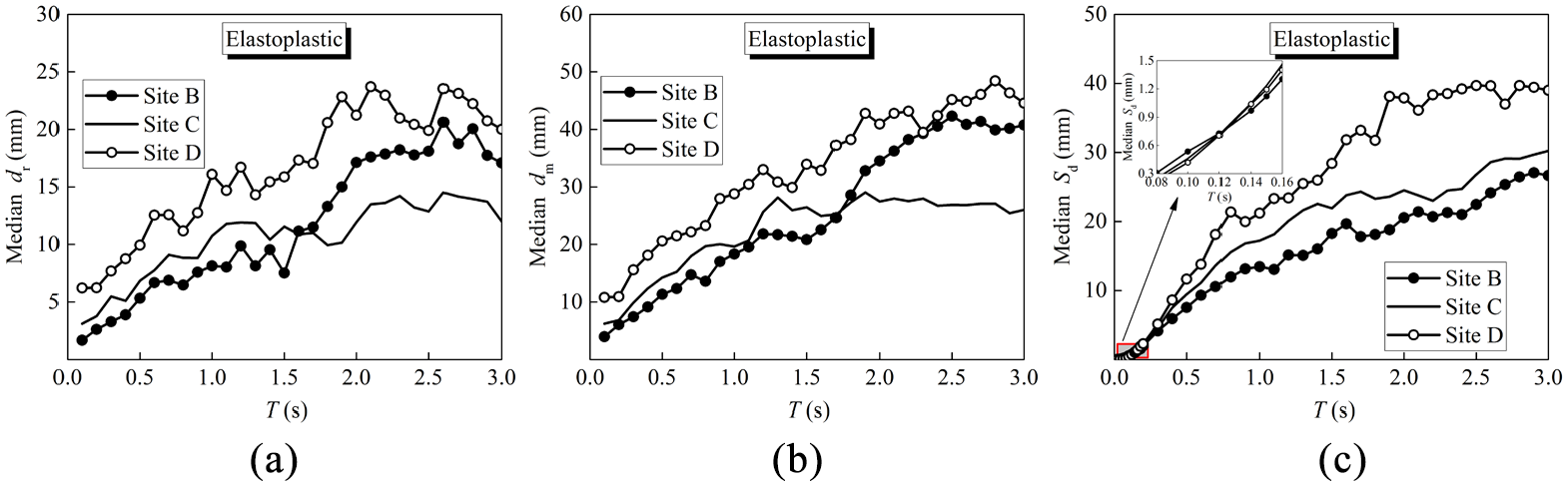
(a) Residual displacements, (b) peak inelastic displacements, and (c) elastic spectral displacements corresponding to site classes B, C, and D.
A comparison of Figure 13a and b shows that, the effect of local sites on dm spectra is very similar to that on dr spectra. For instance, for periods less than about 1.6 s, the structures on site class B tend to produce the smallest dr and dm, while for periods greater than about 1.6 s, the structures on site class C tend to produce the smallest dr and dm. Moreover, the structures located on site class D are prone to experience larger dm as well as dr than those on other sites (site classes B and C), regardless of natural periods. It appears that such similarity between dm and dr spectra would weaken the effect of site conditions on dm normalized residual displacements (i.e. Cp) in terms of not only central tendencies but also dispersions, which provides a good explanation of how the effect of site conditions depends on the normalization of residual displacements.
Estimation of residual displacements for different firm sites
In general, when Equation 1 is employed, the absolute values of residual displacements can be determined by the multiplication of Sd to Ce, both of which, however, are significantly affected by local site conditions. Therefore, the local site influence should be, respectively, taken into account while determining Sd and Ce. The current seismic specifications or standards generally specify many site classifications. For instance, up to four firm site classifications have been specified in FEMA-450 (FEMA, 2003) and ASCE 7-10 (ASCE, 2013). As a result, the approach to estimate the residual displacements using Equation 1 has to repeatedly consider the influence of local site conditions, which results in a cumbersome work. Similarly, when Equation 2 is used, the absolute values of residual displacements can be determined by the multiplication of dm to Cp, among which the Cp is almost independent of local site conditions. Consequently, only the effect of site conditions on dm needs to be considered when the residual displacements are estimated by Equation 2. To sum up, for the convenience of engineering application, the Cp is superior to the Ce for residual displacements prediction.
Effect of ground motion duration
In this section, the effect of ground motion duration on residual displacement ratios is examined using the significant duration defined by Trifunac and Brady (1975). To isolate the influence of local site conditions, the ground motions used for analysis should be recorded in the same site. As an example, the records in site class C are considered as the database. According to the computed significant duration, these records are averagely divided into two subsets (each contains 40 records), respectively, having short duration (SD), ranging between 2.4 and 11.0 s, and long duration (LD), between 11.3 and 36.4 s. A comparison of mean Ce and Cp computed from each subset is presented in Figure 14 for three levels of relative lateral strength.
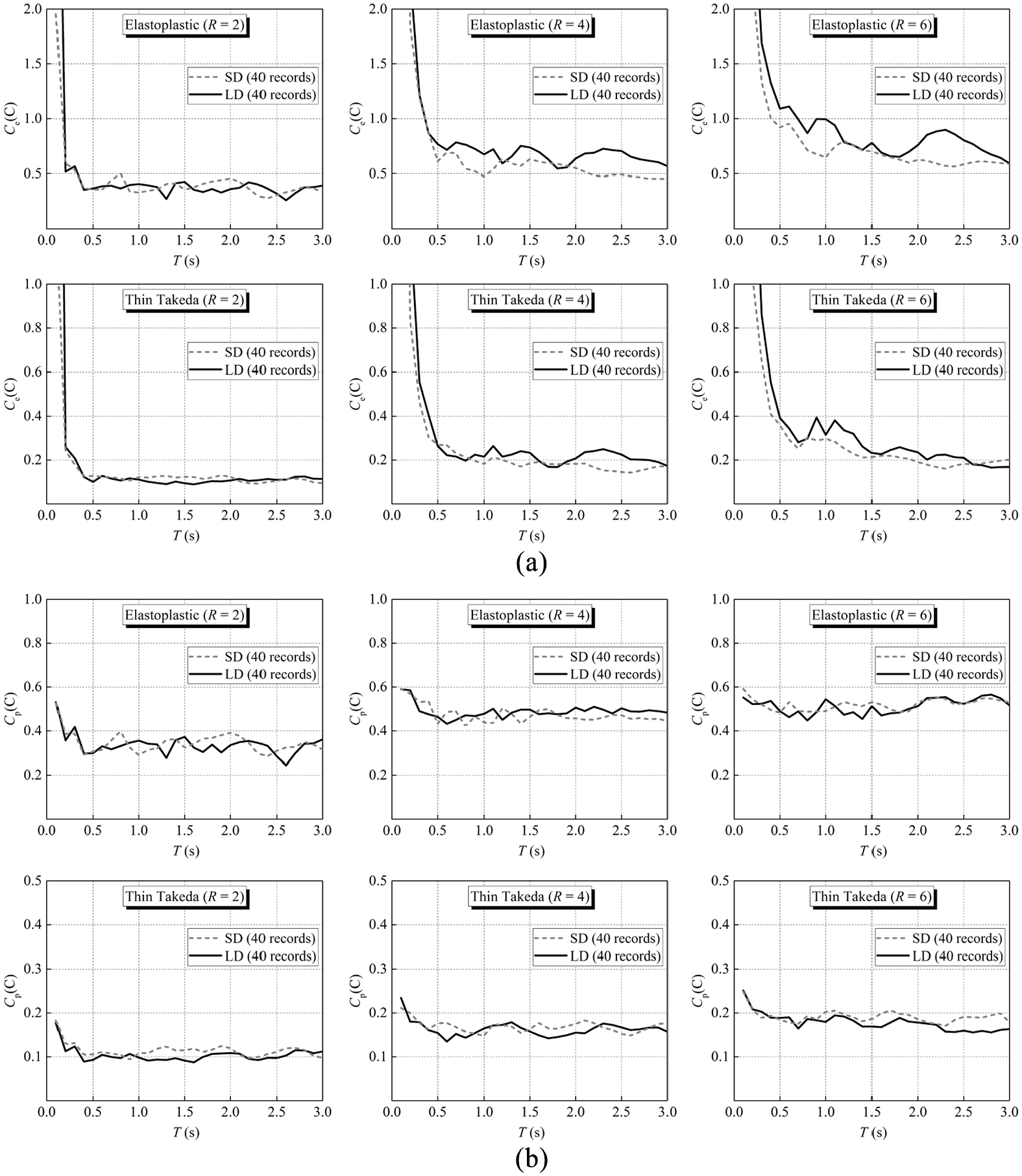
Effect of ground motion duration on mean residual displacement ratios (a) Ce and (b) Cp for three levels of relative lateral strength.
It can be seen that the influence of significant duration on Ce is larger than that on Cp. In general, the effect of significant duration on Ce depends on relative lateral strength. For low levels of relative lateral strength, ground motion duration has less effect on Ce, while for higher levels of relative lateral strength (i.e. R ≥ 4), LD ground motions will produce larger Ce ordinates than SD ground motions in the mean sense. This is consistent with the findings of Ruiz-García (2010). In addition, the effect of significant duration is larger for elastoplastic systems than for Takeda systems. For instance, for elastoplastic and Thin Takeda systems with R = 6, Ce ordinates computed from LD ground motions are on average 22% and 15% greater than those from SD ground motions, respectively. However, the mean Cp spectra computed from two sets of records (SD and LD) are fairly close to each other, regardless of relative lateral strength, and ground motion duration does not appear to have significant effect on Cp ratios.
Effect of structural characteristics
A statistical analysis is carried out to investigate the effect of structural characteristics, such as hysteretic rules, periods of vibration and relative lateral strength, on residual displacement ratios. For simplicity, the influence of ground motion characteristics is not included, and the following section focuses on residual displacement ratios computed for ground motions recorded on firm site conditions (
Figure 15 shows the mean residual displacement ratios for elastoplastic, Thin Takeda, and Fat Takeda hysteretic SDOF systems subjected to all 240 ground motions. It can be seen that the residual displacement ratios computed for non-degrading (elastoplastic) and degrading (Thin/Fat Takeda) systems show similar trends, but with the significant difference in ordinates. In particular, for a given period of vibration and yield strength reduction factor, the elastoplastic systems always produce the largest residual displacement ratios, followed by the Thin Takeda systems and last the Fat Takeda systems. Note that these observations hold true both for Ce and Cp. However, the dependence of Ce on hysteretic rules indicates that residual displacements decrease from elastoplastic to Thin Takeda, and further to Fat Takeda, which does benefit from re-centering hysteretic characteristics. This observation is qualitatively in line with those in Christopoulos et al. (2003), Liossatou and Fardis (2015), and Ruiz-García and Miranda (2006b).
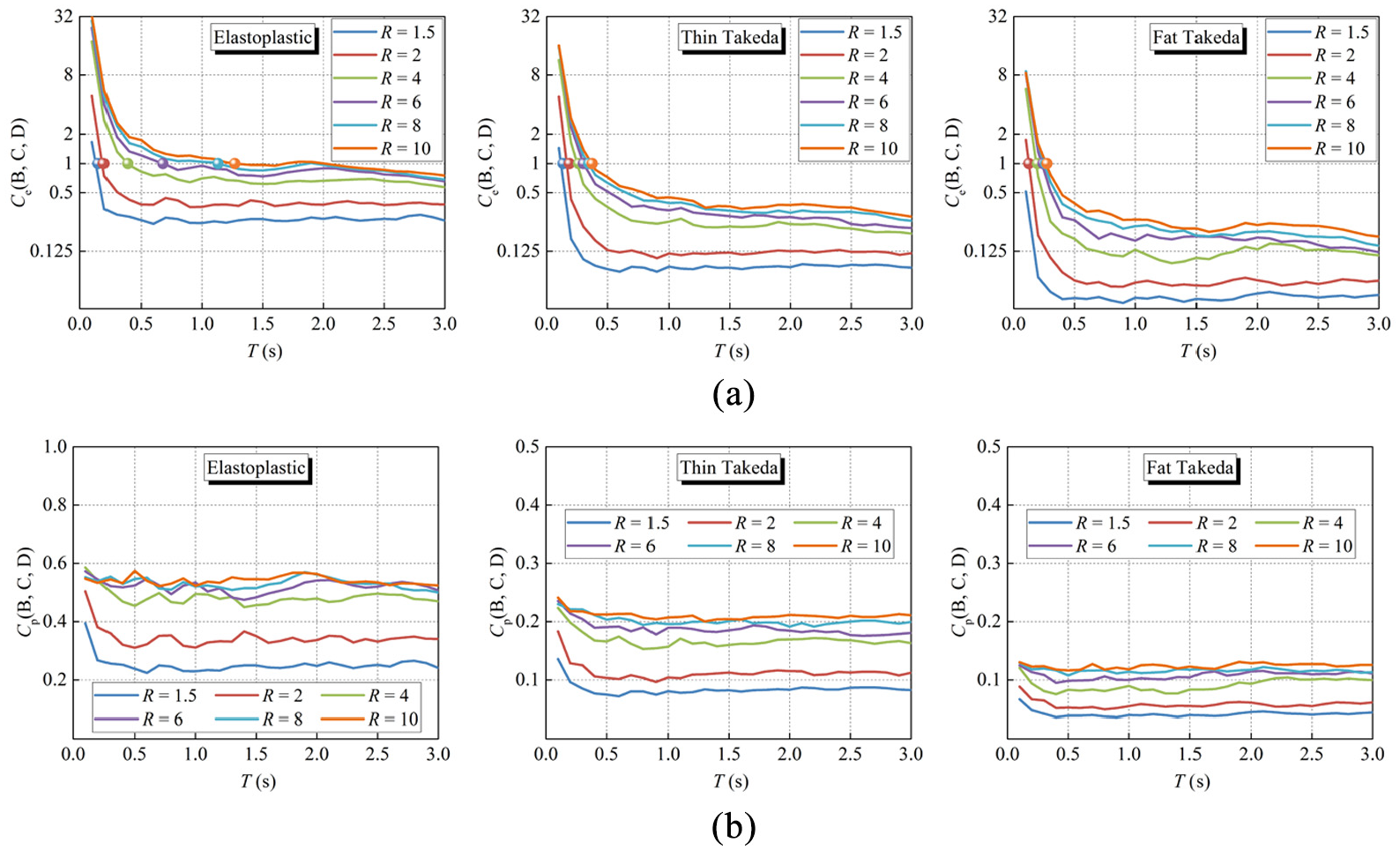
Mean residual displacement ratios (a) Ce and (b) Cp computed from all 240 records.
By comparing Figure 15a and b, it can be observed that the Ce and Cp spectra exhibit somewhat different tendencies in the mean sense. The first difference is related to the dependence of natural periods. In general, the mean Ce ordinates sharply increase as the natural periods decrease for T < 0.5 s, regardless of the relative lateral strength. For instance, for elastoplastic systems with R = 4, the mean Ce ordinate at T = 0.1 s is roughly 20 times that at T = 0.5 s. However, with the exception of strong structures with very short periods (i.e. R < 4 and T < 0.3 s), the Cp spectra are almost independent of natural periods.
Another difference between Ce and Cp spectra is associated with the dependence of relative lateral strength. To facilitate the discussion, Figure 16 depicts the mean residual displacement ratios, Ce and Cp, as a function of R for three different hysteretic models. As can be seen from Figure 16a, the longer the natural period, the slower the rate at which the mean Ce increases with the increase of R. In particular, for the long period structure (i.e. T ≥ 1.0 s), the mean Ce tends to saturate as the R increases. Note, however, that such observations do not always hold true for the mean Cp as shown in Figure 16b, where two spectral regions can be identified, regardless of natural periods and hysteretic rules. In the first region (R < 4), the mean Cp increases as the R increases. In the second region (R ≥ 4), the mean Cp is almost independent of R.
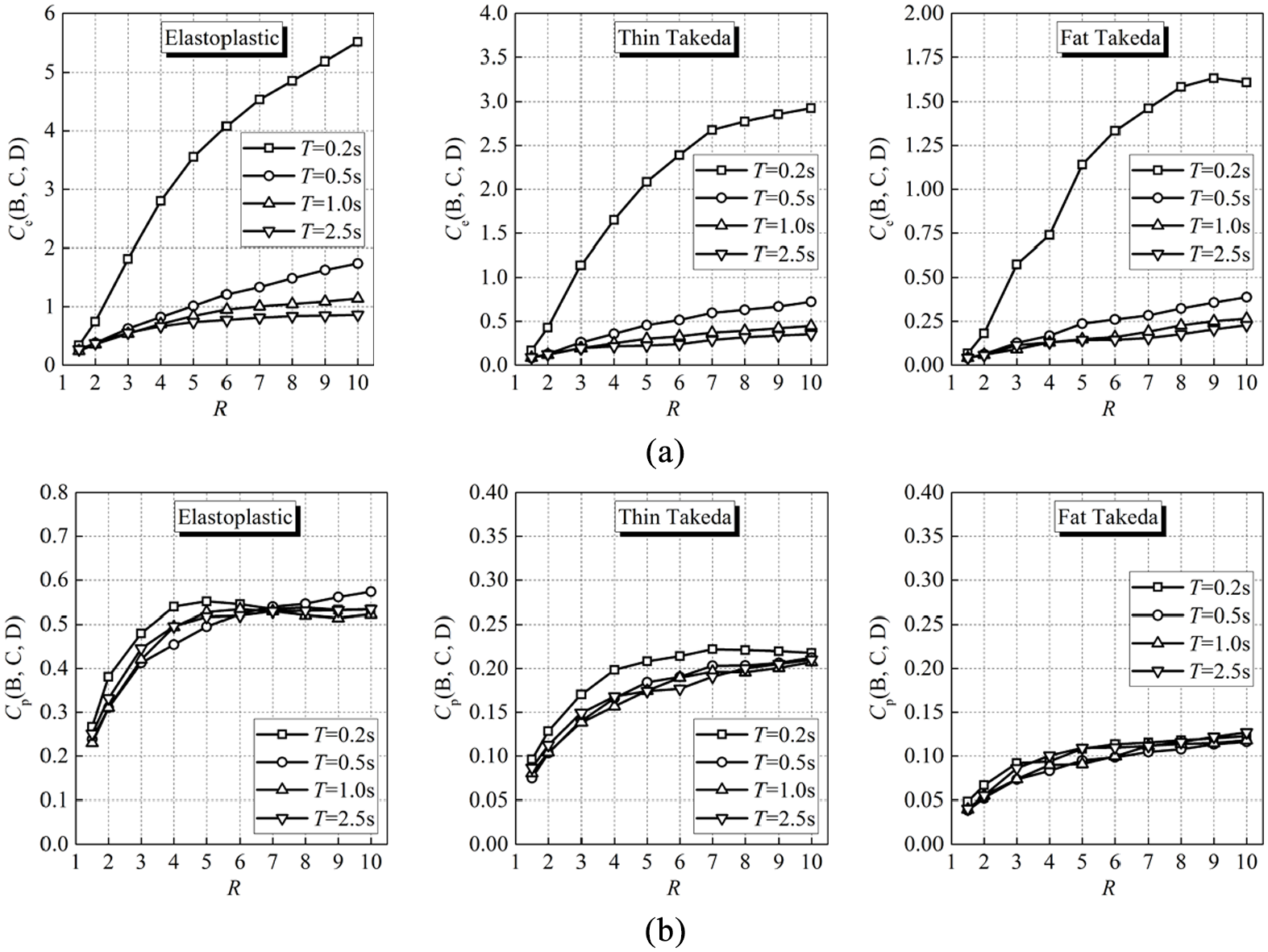
Effect of yield strength reduction factors on mean residual displacement ratios (a) Ce and (b) Cp.
Overall, the independence of residual displacement ratios Cp on T and on R beyond a value of about 4 makes Cp more convenient for engineering application. Moreover, this observation has important implications in seismic engineering. Recall that the statistical results indicate that the inelastic displacement ratios (defined as ratios of peak inelastic to elastic spectral displacements) are almost independent of T and R in certain spectral regions, which give rise to the well-known “equal displacement rule” (Veletsos and Newmark, 1960). By analogy, the residual displacement ratios Cp can relate the residual and peak inelastic displacements together without any influence of T and of R for R ≥ 4. Therefore, for medium to high values of R, the residual displacement follows the “(proportionally) equal residual displacement rule.” The similar rule has also been reported by Hatzigeorgiou et al. (2011).
Constant-strength residual displacement spectra
The Cp methodology is preferred over the Ce for the residual displacement demands estimation in terms of not only accuracy but also convenience of engineering application, provided that the peak inelastic displacement is estimated with a low uncertainty. However, if the peak inelastic displacements are indirectly estimated from elastic spectral ones (i.e. via inelastic displacement ratios) that are known a prior, additional uncertainty due to this intermediate step could be introduced. Particularly, if such uncertainty in the estimation of the peak inelastic displacements is far larger than that of the elastic spectral displacements, then the residual displacement ratios Cp may no longer be a preferred option. For providing alternatives to estimate the residual displacement demands, both two normalizations (Ce and Cp) are considered in this study for development of the average residual displacement spectra.
According to the statistical results, the following uniform functional forms, which can reasonably describe the dependence of the estimated parameters on various independent variables, are respectively proposed to predict the mean residual displacement ratios, Ce and Cp, for the three typical hysteretic systems. Note that the proposed equations for both two types of normalizations satisfy the fundamental condition of

and

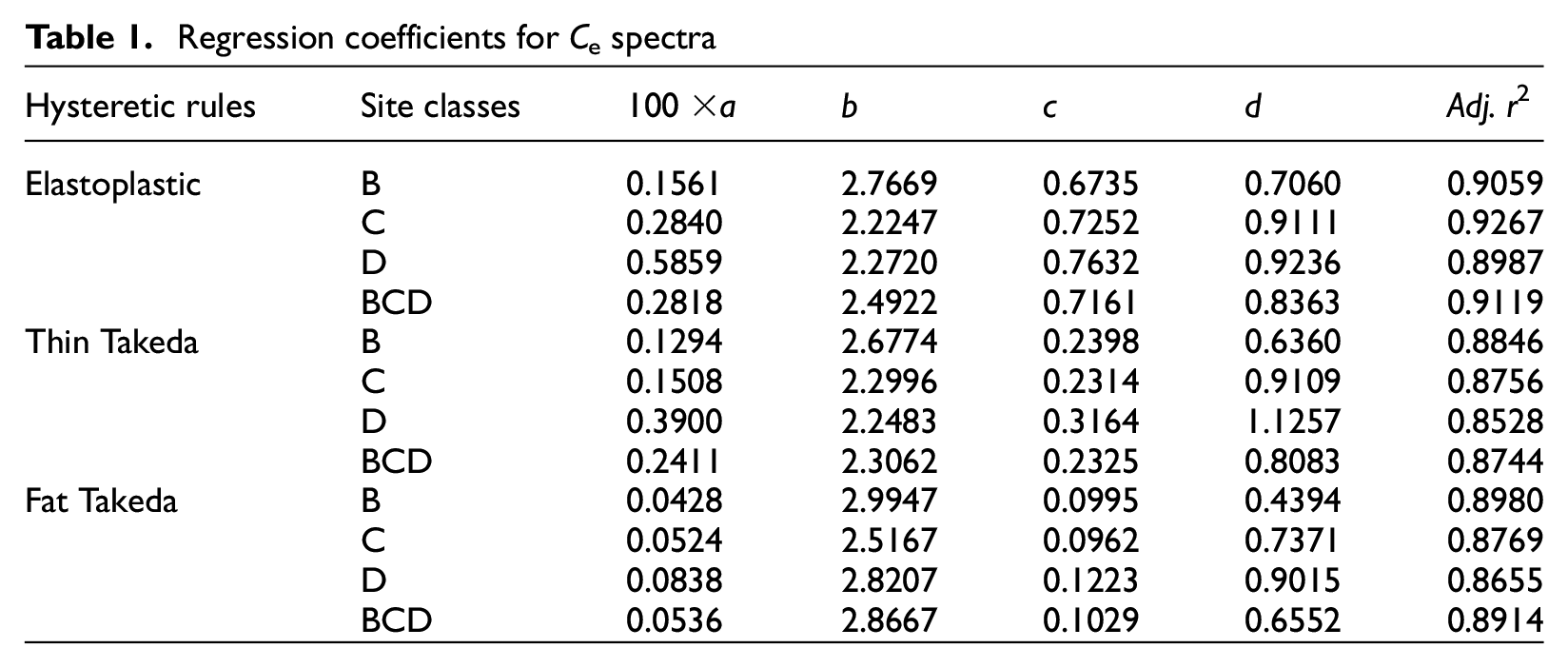
where a, b, c, and d in Equation 4 are the constants depending on the local site conditions and hysteretic rules, and the constants a and b in Equation 5 only depend on hysteretic rules. The values of these constants can be determined by the nonlinear regression analysis using the Levenberg–Marquardt iteration algorithm. The final determined regression coefficients for both two residual displacement spectra are summarized in Tables 1 and 2, where the adjusted determination coefficients (Adj. r2) are also provided.
Regression coefficients for Ce spectra
Regression coefficients for Cp spectra

A comparison of statistical mean residual displacement ratios with those computed using the proposed equations is presented in Figures 17 and 18, respectively, for Ce and Cp spectra. The figures and the Adj. r2 values all demonstrate that the proposed response spectra provide reasonably accurate estimates of mean residual displacement ratios.
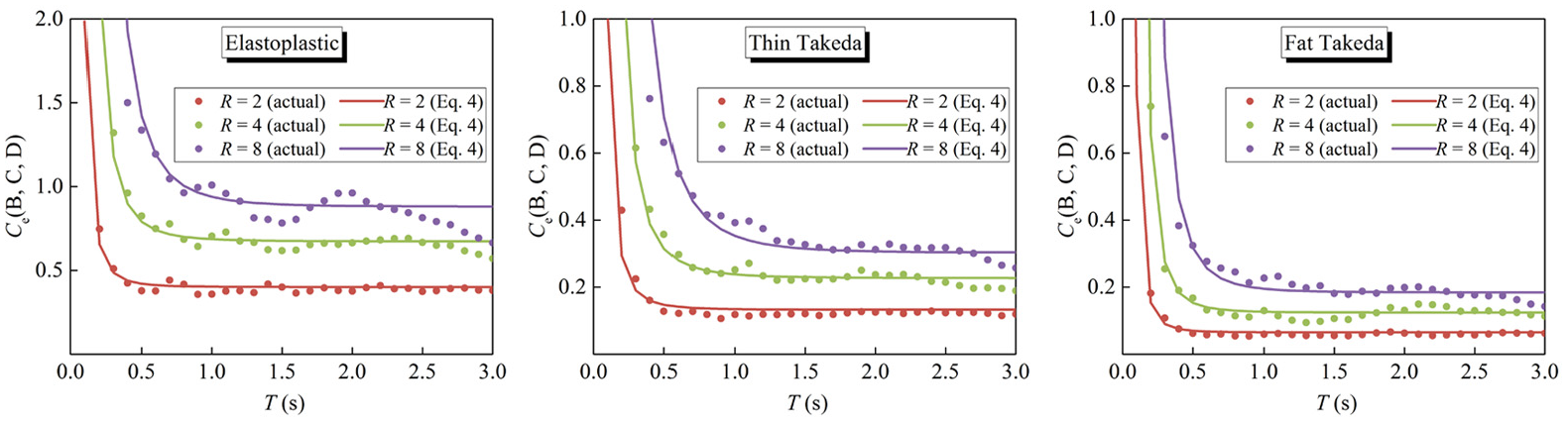
Comparison of actual (NTHA results) and estimated Ce for three typical hysteretic systems.
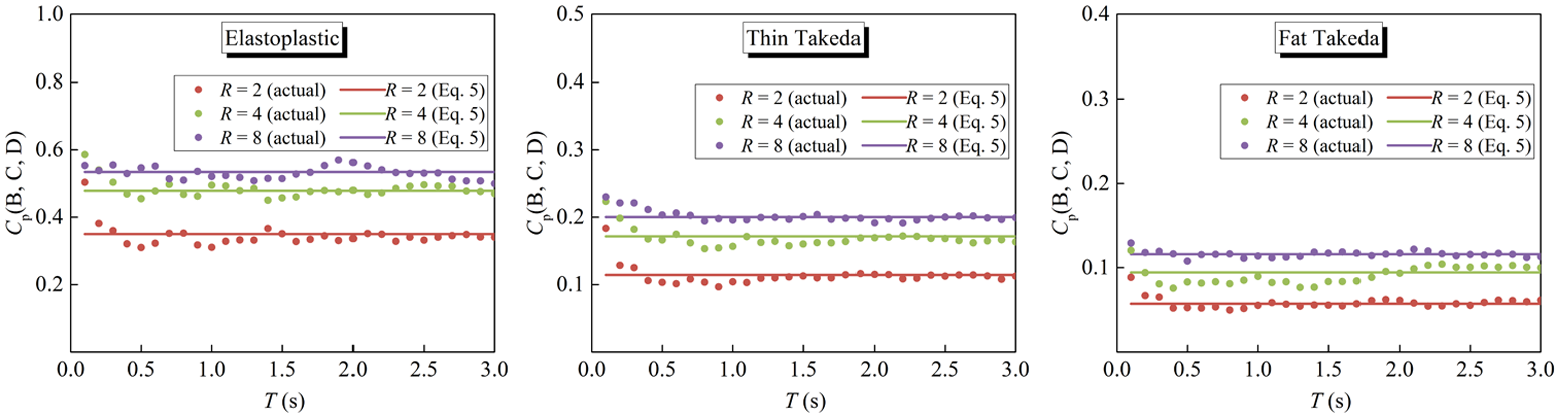
Comparison of actual (NTHA results) and estimated Cp for three typical hysteretic systems.
It is interesting to note that Ruiz-García and Miranda (2006b) proposed the mean Ce spectrum to estimate the residual displacement demands. This spectrum, however, is based on statistical results of the nonlinear dynamic analysis using ISPD assumption. Hence, with the objective of having a look at the effect of viscous damping models on residual displacement demands, a comparison of their results with those developed in this work may be helpful.
Figure 19 shows a comparison of mean Ce spectra from Ruiz-García and Miranda (2006b) with those from Equation 4 for elastoplastic systems with R = 4. It can be observed that the Ce ordinates computed from Equation 4 are larger than those from Ruiz-García and Miranda (2006b) over the whole period range considered, indicating that the TSPD will lead to larger residual displacement ratios Ce and, in consequence, in larger residual displacement demands than the ISPD. Note that Priestley and Grant (2005) obtained the similar findings in investigating the influence of damping models on peak inelastic displacements. Regarding the effect of initial viscous damping models on residual displacement demands, a comprehensive study has been carried out by Feng and Gong (2020), and further details are available in that study.
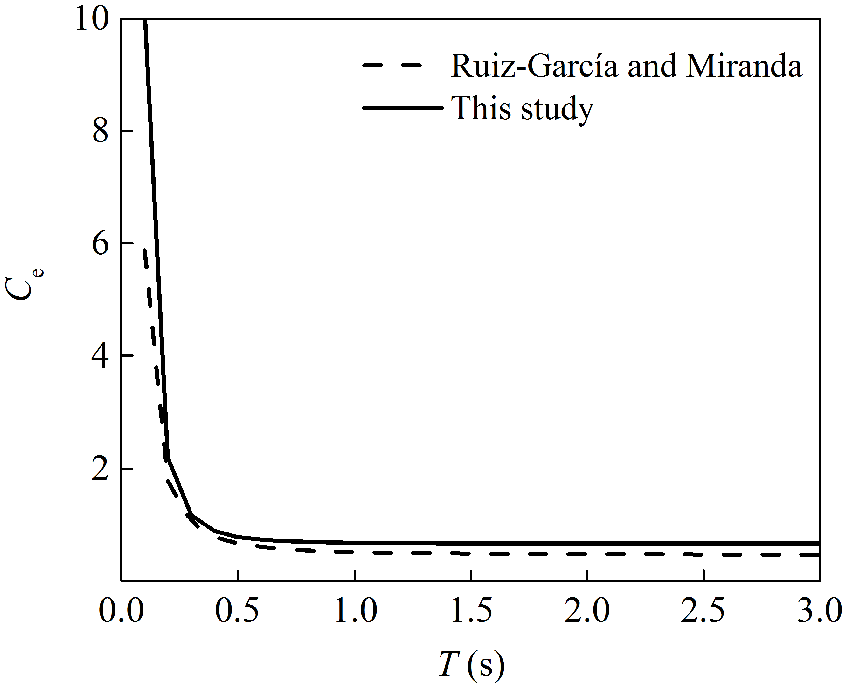
Comparison of mean Ce spectra from Ruiz–García and Miranda with those from Equation 4 for R = 4.
Discussion on extension to MDOF systems
Although this study clarifies the applicability of various normalizations and develops simple expressions, it is still restricted to the structures that can be simplified to SDOF systems. For more complex multi-degree-of-freedom (MDOF) structures, the residual displacement demands or residual story drift demands largely depend on additional factors (Christopoulos and Pampanin, 2004; Pampanin et al., 2003; Ruiz-García and Miranda, 2006a), among which the following are expected to matter more:
(1) P-Δ effects
For generic frame structures exhibiting relatively high levels of inelastic behavior, the maximum story drift demands are found to be concentrated at the bottom stories (Medina and Krawinkler, 2003). As a consequence, the structural P-Δ effects may become of particular importance to these lower stories, which can reduce the post-yield stiffness to a pretty small or even negative value, thus resulting in a large residual drift being unrecoverable.
(2) Failure mechanism
The frame structures are generally designed according to the strong-column and weak-beam philosophy. In this way, the structures are expected to adhere to an ideal beam-hinge mechanism, which would be beneficial to avoid damage on the columns or damage concentration. As a result, the beam-hinge frames are more prone to recover from inelastic excursion than frames developing other undesirable failure types such as column-hinge and full-hinge mechanisms. More specifically, it seems that the beam-hinge mechanism would exhibit the re-centring hysteretic characteristics that restrain the permanent deformations (Ruiz-García and Miranda, 2006a).
(3) Higher modes
As previously mentioned, the beam-hinge frames are expected to yield more uniform distribution of story drift along the height, whereas the column-hinge frames lead to a story drift concentration at lower stories (Medina and Krawinkler, 2003). Hence, it can be inferred that the frames developing column-hinge mechanism would be more influenced by higher modes than those with beam-hinge mechanism.
The aforementioned aspects may largely restrict the application of the observations and relations to more complex MDOF systems. However, these aspects can be approximately considered by using the amplification factors, which is analogy to those adopted for the evaluation of maximum displacement/drift demands (Gupta and Krawinkler, 2000). By this way, the proposed equations for SDOF systems can be extended to the estimation of residual drift demands of MDOF frame structures. The development of amplification factors in MDOF structures is the subject for further investigation and the results will be available in the future.
Conclusion
A comprehensive study is implemented to clarify the pros and cons of each normalization format for the estimation of residual displacements. The residual-to-peak-inelastic displacement ratios are preferred over the residual-to-elastic-spectral displacement ratios for the following reasons, provided that the peak inelastic displacement is estimated with a low uncertainty:
The residual displacements have a stronger linear correlation with the peak inelastic displacements than with the elastic spectral ones, especially for short to medium period structures (T ≤ 1.0 s).
The residual-to-peak-inelastic displacement ratios have the advantages of small dispersion, samples without any outliers and relatively symmetric distribution, which make the residual-to-peak-inelastic displacement ratios more appropriate for development of the average residual displacement spectrum.
The residual-to-peak-inelastic displacement ratios are almost independent of the local site conditions, natural periods, significant duration, and yield strength reduction factors beyond a value of about 4, which is convenient for engineering application.
The residual-to-peak-inelastic displacement ratios that allow the estimation of residual displacement demands from peak inelastic displacement demands emphasize that the post-earthquake reparability assessment should be based on the premise of no collapse, which consequently matches well with the current seismic performance assessment procedures.
However, if the peak inelastic displacement is estimated with a much higher uncertainty than the elastic spectral displacement, then the residual-to-peak-inelastic displacement ratios may no longer be a preferred option. Finally, the residual displacement spectra, which allow the estimation of residual displacements in terms of both elastic spectra and peak inelastic displacements are developed for three typical hysteretic systems.
Footnotes
Authors’ note
Any opinions, findings, and conclusions or recommendations expressed in the study are those of the authors and do not necessarily reflect the views of the National Natural Science Foundation of China.
Declaration of conflicting interests
The author(s) declared no potential conflicts of interest with respect to the research, authorship, and/or publication of this article.
Funding
The author(s) disclosed receipt of the following financial support for the research, authorship, and/or publication of this article: The authors acknowledge the financial support from the National Natural Science Foundation of China under Grant Nos 51678104 and 51978125.
