






Abstract
This qualitative study examines the motivations of 51 early-career special educators in rural districts to enter the profession, comparing fully licensed and not fully licensed teachers. Utilizing semi-structured interviews and a framework for teacher motivations to enter the field, researchers identified four primary motivational categories: socialization influences, intrinsic motivation, altruism, and life pragmatics. Results indicate that socialization influences, such as professional encouragement and prior educational roles, were the most prevalent motivators, cited by every participant. These findings diverge from existing literature identifying altruism as the primary driver. Notably, teachers without full licensure more frequently cited “needs-based entry” to fill urgent vacancies and previous paraprofessional experience as their pathways. Life pragmatics, including work–life balance and rural community ties, also significantly influenced entry. These findings suggest that rural districts may benefit from prioritizing local recruitment and accessible training pathways to address persistent staffing shortages.
Introduction
Across the nation, including in rural areas, schools struggle with special education teacher shortages. According to the Institute of Education Sciences (IES, 2022), as of August 2022, administrators in 78% of all schools with a vacancy expected that special education positions would be somewhat or very difficult to fill. Rural school districts experience acute teacher shortages, with the most remote rural districts experiencing the most challenges (Viadero, 2018). Ingersoll and Tran (2023) noted that three-quarters of principals in rural public secondary schools nationwide reported teaching vacancies in one or more of nine key teaching fields, and nearly 40% reported vacancies in special education. Vacancies and staffing difficulties, particularly in rural schools, are due in large part to teachers exiting their positions prior to retirement (Ingersoll and Tran, 2023).
Rural special educators face unique challenges inherent to working in a rural setting. In a national survey administered across 55 rural districts, rural special educators reported feelings of professional isolation, resulting in fewer opportunities for training and limited professional support available to them (Berry & Gravelle, 2013). Due to the small size of their communities, some experienced difficulties separating their personal and professional lives. Additionally, as one of the few special educators in the district, they experienced difficulties managing the diversity of student needs, as they were expected to provide services beyond their level of expertise (Berry & Gravelle, 2013; Berry et al., 2011). These challenges faced by rural special educators impact their job satisfaction and intent to remain in the field, contributing to the broader issue of recruiting and retaining special educators in rural school districts.
Faced with the open positions and limited qualified applicants, school administrators frequently fill vacancies with teachers who are not fully licensed, meaning they have not completed an approved educator preparation program in the subject area they are teaching and/or they have not successfully passed their state’s required licensure exams. In Wisconsin, for example, the number of teachers working in public schools under a Tier 1 license (for those who are not fully licensed) increased 184%, from 1,125 to 3,197, between 2012 and 2021 (Wisconsin Policy Forum, 2023). Of Tier 1 licenses, special education is consistently the most frequently requested type, with 799 special educators working with a Tier 1 license in Wisconsin during the 2024 to 2025 school year (Wisconsin Department of Public Instruction, 2026). Whether open positions are filled with educators who are newly licensed, or those who are working to obtain full licensure, early career special educators are leaving their positions at faster rates than in the past (Education Policy Innovation Collaborative, 2026; Teach Plus Illinois Policy Fellows, 2023). This continues the cycle of open special education teacher positions that need to be filled and limited pools of applicants to draw from, resulting in scores of students with disabilities being served by underprepared educators (Dewey et al., 2017).
Reviews of literature include factors that increase the likelihood of teachers leaving the field, with several factors specifically applicable to novice teachers working in rural settings: (a) holding a probationary license, (b) having less than 4 years of experience, and (c) teaching in a specialized subject (Billingsley & Bettini, 2019; Strunk & Robinson, 2006). Less well understood are special educators’ motivations to enter the field. Understanding the motivations of special educators to take positions in rural schools, both those who enter the field fully licensed and those who must seek licensure while they are already in their positions, could help rural districts to better recruit, support, and retain their early-career special educators.
Motivation for Entering the Field
Numerous studies have investigated teachers’ motivations to enter the field, recognizing the importance of understanding motivations as it relates to effective teacher recruitment, preparation, and retention (Fray & Gore, 2018; Gavish, 2017; Heinz, 2015; Kwok et al., 2022; Mobra & Hamlin, 2020; Olsen, 2008; Richardson & Watt, 2010; Watt & Richardson, 2007, 2008, 2012). Building on the work of previous reviews, Fray and Gore (2018) conducted a review of 70 empirical studies and found that researchers typically divided motivation into three main types: altruistic, intrinsic, and extrinsic. However, some prior researchers (e.g., Heinz, 2015; Watt & Richardson, 2012) identified additional types of motivations. For example, in addition to altruism, intrinsic motivation, and extrinsic motivation, in a broad international review of empirical studies of student teachers’ career motivations, Heinz (2015) also identified teaching-ability related beliefs, prior teaching and learning experiences, influences of family members and others, and the impact of socio-cultural factors.
While this body of research has expanded our understanding of why individuals choose teaching, it also indicates that motivational factors are closely connected to how teachers experience and choose to persist in the profession. Studies show that motivations centered on helping students and making meaningful contributions to society are associated with stronger commitment compared to extrinsic motivations (Heinz, 2015; Watt & Richardson, 2012). Prior research further indicates that motivations are not fixed and may shift as individuals move through teacher preparation and early career experiences, and as they encounter new work demands and evaluate their self-efficacy within their role (Fray & Gore, 2018; Wolf et al., 2021). Therefore, motivations are shaped by initial intentions and how teachers come to understand the profession in practice. This can be problematic for special education teacher candidates, whose motivations may be grounded in idealized views of the profession shaped by altruistic goals and prior experiences before entering the profession that do not accurately reflect the realities of teaching (Gavish, 2017; Kwok et al., 2022). When motivations cannot be realized in practice, they can contribute to disillusionment and influence teachers’ decisions about remaining in the field (Heinz, 2015). Based on these findings, teacher motivations need to be examined within teaching contexts, particularly in special education, where entry into the profession occurs across multiple pathways and motivations can vary across them (Fray & Gore, 2018).
This study builds on existing literature in teacher motivation for entering the field in two main ways. First, investigating the motivations of early career educators for entering the special education profession specifically, with or without full licensure, expands existing literature that has focused primarily on pre-service teachers in traditional preparation programs (e.g., Fray & Gore, 2018; Kwok et al., 2022). Second, examining special educators’ motivations to enter teaching who are specifically located in rural school districts has the potential to provide educator preparation programs and rural school districts with insights that could help minimize the special educator attrition currently experienced in rural schools and communities. This study addresses the following two research questions:
Conceptual Framework
For this analysis of rural special educators’ motivations for entering the field, we chose to utilize findings from Kwok et al.’s (2022) study of pre-service teachers’ motivations for entering the field as a conceptual framework. We selected this framework because it: (a) integrates knowledge from previous empirical studies of teacher motivations; (b) relies on data from studies conducted in the United States; and (c) was informed by a large sample (i.e., nearly 3,000 pre-service teachers). Kwok et al. (2022) contributed to previous analyses of teacher motivations by addressing the conceptual gap in how motivation is defined (e.g., the distinction and/or conflation between conceptual categories, particularly between altruism and intrinsic motivation). By comparing their findings with existing frameworks on teacher motivation, Kwok and colleagues provided a qualitatively robust and contextually bound understanding of pre-service teachers’ motivations for entering their field, specific to the United States. They identified three core categories to explain teacher motivation: (a) altruism, (b) intrinsic motivation, and (c) socialization influences. Kwok et al. (2022) further defined the categories as: motivated to, motivated by, and motivated from, respectively. Kwok et al.’s (2022) findings were utilized as a conceptual framework for our qualitative interview study as described below.
Method
This study is part of a larger project funded by the Institute of Education Sciences (IES), to develop, pilot and test a professional development intervention (PD; Wilkerson et al., 2025). The PD is designed to increase early career rural special educator retention by improving their skills in addressing students’ challenging behaviors and providing the educators with a system of support.
Participants
Recruitment
To be eligible for participation in the larger study, special educators needed to be: (a) working full-time as a special educator; (b) employed by a school district with an NCES rural classification (remote, distant, or fringe) in one of two Midwestern states; and (c) in their first 5 years of employment as a special educator. Special educators who had completed a teacher preparation program and were fully licensed, as well as those who were not fully licensed, were eligible for participation. After IRB approval, recruitment occurred from May to November 2023. The research team worked collaboratively with the two Midwestern state educational agencies, and reached out directly to rural districts, to recruit an initial pool of 55 early-career special educator participants. One district administrator did not approve participation for a prospective participant, and they were then excluded from the study. An additional criterion for the current study was that the teacher completed an individual interview upon enrollment in the larger study. Three teachers from the larger study did not complete the initial interview. Therefore, 51 teacher participants were included in this study.
Demographics
Of the 51 participants, 25.5% (n = 13) were teaching in Minnesota, while the remaining 74.5% (n = 38) were teaching in Wisconsin. Across the two states, a total of 41 rural school districts were represented. Based on the NCES rural classification, 17 of those districts were categorized as remote, 15 as distant, and 9 as fringe. Table 1 provides a summary of school district report card data from the 2023 to 2024 school year for the districts where participating teachers were employed.
Summary of Report Card Data for Participating Teachers’ School Districts.
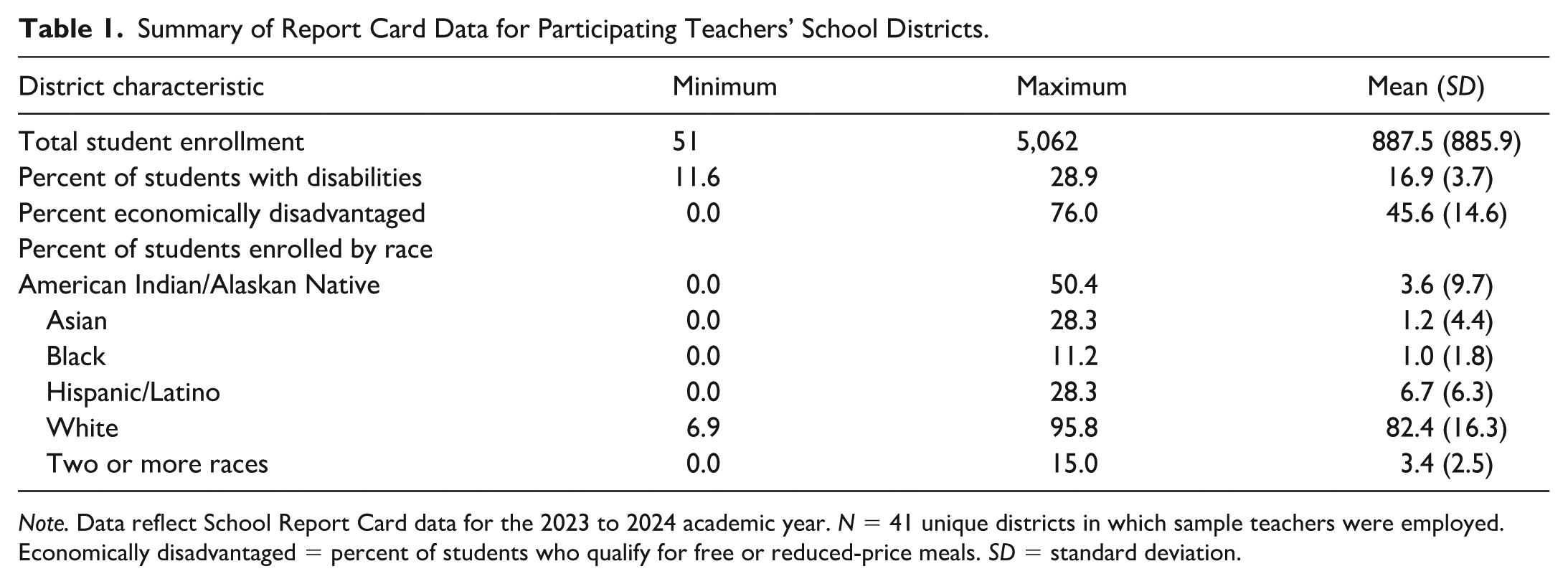
Note. Data reflect School Report Card data for the 2023 to 2024 academic year. N = 41 unique districts in which sample teachers were employed. Economically disadvantaged = percent of students who qualify for free or reduced-price meals. SD = standard deviation.
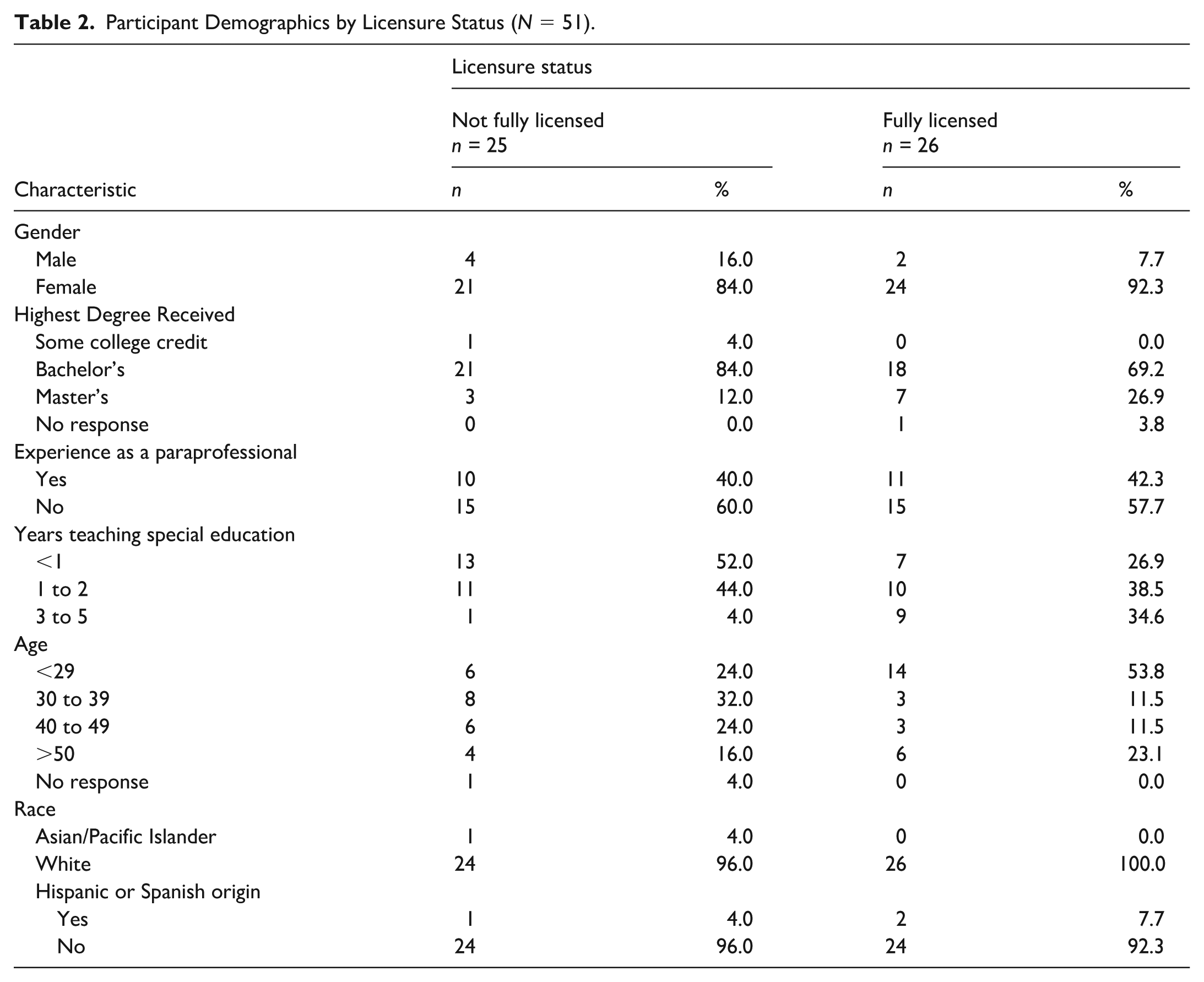
At the time of the study, 51% (n = 26) of participants held full licensure to teach special education. The remaining 49% (n = 25) were not fully licensed. Twenty-two percent (n = 11) had less than 1 year of any kind of teaching experience; 37% (n = 19) had 1 to 2 years; 26% (n = 13) had 3 to 5 years; 10% (n = 5) had 5 to 10 years; and 6% (n = 3) reported more than 10 years. Regarding special education teaching specifically, 39% (n = 20) of participants had less than 1 year of experience; 41% (n = 21) had 1 to 2 years; and 20% (n = 10) had 3 to 5 years. Additionally, 41% (n = 21) of participants reported prior roles as paraprofessionals or classroom aides. Participants ranged in age from 22 to 61 years old, with 88% (n = 45) identifying as female. One participant identified as Asian or Pacific Islander, while the remaining 50 identified as White, including three who also identified as Latino/a. Table 2 provides a summary of participant demographic characteristics by licensure status.
Participant Demographics by Licensure Status (N = 51).
Data Collection
Data were collected through 30-minute semi-structured interviews held on Zoom. Interviews were conducted in November 2023, over the course of 2 weeks, and were audio recorded with participant consent. Nine doctoral students from two universities were trained by one of the study’s co-principal investigators and the project coordinator to implement the interview protocol. Interviewers followed a script and asked clarifying and follow-up questions as needed. The interviews included 16 questions on topics ranging from participants’ decision to become a special educator, insights about their current work, and their intent to stay in the profession. For this study, participant responses to two specific questions, focused on what brought teachers into the field of special education, were analyzed. Interview recordings were professionally transcribed by an IRB-approved service.
Positionality
As teacher educators and former special educators, all of the members of our research team have familiarity with, and admiration for, special educators. Research team members also all have experience either working in, or collaborating with, rural schools and districts. Furthermore, research team members had professional relationships with several of the participants due to roles in the larger study. Our various relationships with early career rural special educators undoubtedly allowed us to have a better-situated understanding of the teachers’ responses to our interview questions.
Data Analysis
Transcripts were uploaded to the qualitative analysis application, Dedoose. Four members of the research team completed a collaborative review of Kwok et al.’s (2022) categories and findings. From this review, the team created a codebook based on three main categories of motivation to enter the teaching profession: (a) altruism, (b) intrinsic motivation, and (c) socialization influences. The team reviewed and discussed the conceptual framework to come to a collective and deep understanding of each category.
Initial Coding
Three members of the research team implemented a process of deductive coding by applying the established three codes to the interview data; inductive coding was utilized to create an additional fourth code. Intercoder reliability (ICR) was established in order to verify consistency in coding decisions and encourage active dialogue among the team about the meanings of each code (Barbour, 2001; O’Connor & Joffe, 2020). First, following the process recommended by O’Connor and Joffe (2020), one lead researcher “chunked” text from three interviews. All three researchers then independently coded the pre-chunked text. As a next step, the analysis team met to compare and discuss similarities and differences from the researchers’ initial round of coding. Based on Miles and Huberman (1994) and informed by Halpin (2024), ICR was calculated as 81% by dividing the total number of agreements by the total number of agreements plus disagreements. This calculation was selected because the codebook was simple (only four codes were applied) and the coders had established a deep understanding of each code through reading and discussion (Halpin, 2024). Each difference in coding application was discussed, and notes were made to enhance understanding of codes and their application to subsequent coding. Based on the initial level of ICR being between .8 and .9 (De Munck, 2000; Lombard et al., 2002; Saldaña, 2016), researchers each coded three interviews independently and then repeated the process of collaborative coding for a fourth interview to reassess ICR and correct any inconsistencies or drift. The recommended acceptable level of ICR is between .8 and .9 (De Munck, 2000; Lombard et al., 2002; Saldaña, 2016). Therefore, when ICR fell below .8 for the collaboratively coded interviews, the team would meet to discuss each coding disagreement and add additional clarifications to the codebook before collaboratively coding another interview. At each ICR check, reviewers continued to refine codes and notes from prior debriefings. As ICR increased, the number of independently coded interviews between ICR checks was raised to five.
For the final phase of coding, three members of the analysis team considered the codes under each of the three categories: (a) altruism, (b) intrinsic motivation, and (c) socialization influences. One analysis team member reviewed excerpts that did not fit into the three initial categories and coded them inductively by grouping codes that had similar characteristics. After all excerpts were initially coded, one team member assigned each excerpt a second-level code. Second-level codes were generated from Kwok et al.’s framework or generated inductively.
Trustworthiness and Credibility
To enhance the trustworthiness and credibility of our findings, member checking was performed by inviting seven participants (14%) to review their interview responses. We asked them if there was (a) anything else they would add to further describe their motivations, and (b) if their response, as transcribed, accurately communicated their motivations. Two participants added some additional comments to their responses. The analysis team compared the new information to the coding of their initial responses and determined that the additional information did not change the initial codes. As described previously, we also engaged in ICR for the deductive phase of our analysis.
Findings
Overall, 324 codes were identified, with socialization influences being the most common (136 instances) and altruism the least common (29 instances). Below, we describe findings from each of the categories aligned with Kwok et al.’s (2022) findings, in addition to a fourth category that was inductively derived: life pragmatics. For socialization influences, intrinsic motivation, and altruism, we describe themes that emerged within our data that align with and differ from those described by Kwok and colleagues. We then describe findings for life pragmatics and themes that emerged. See Figure 1 for an overview of the four motivation categories and themes within them.
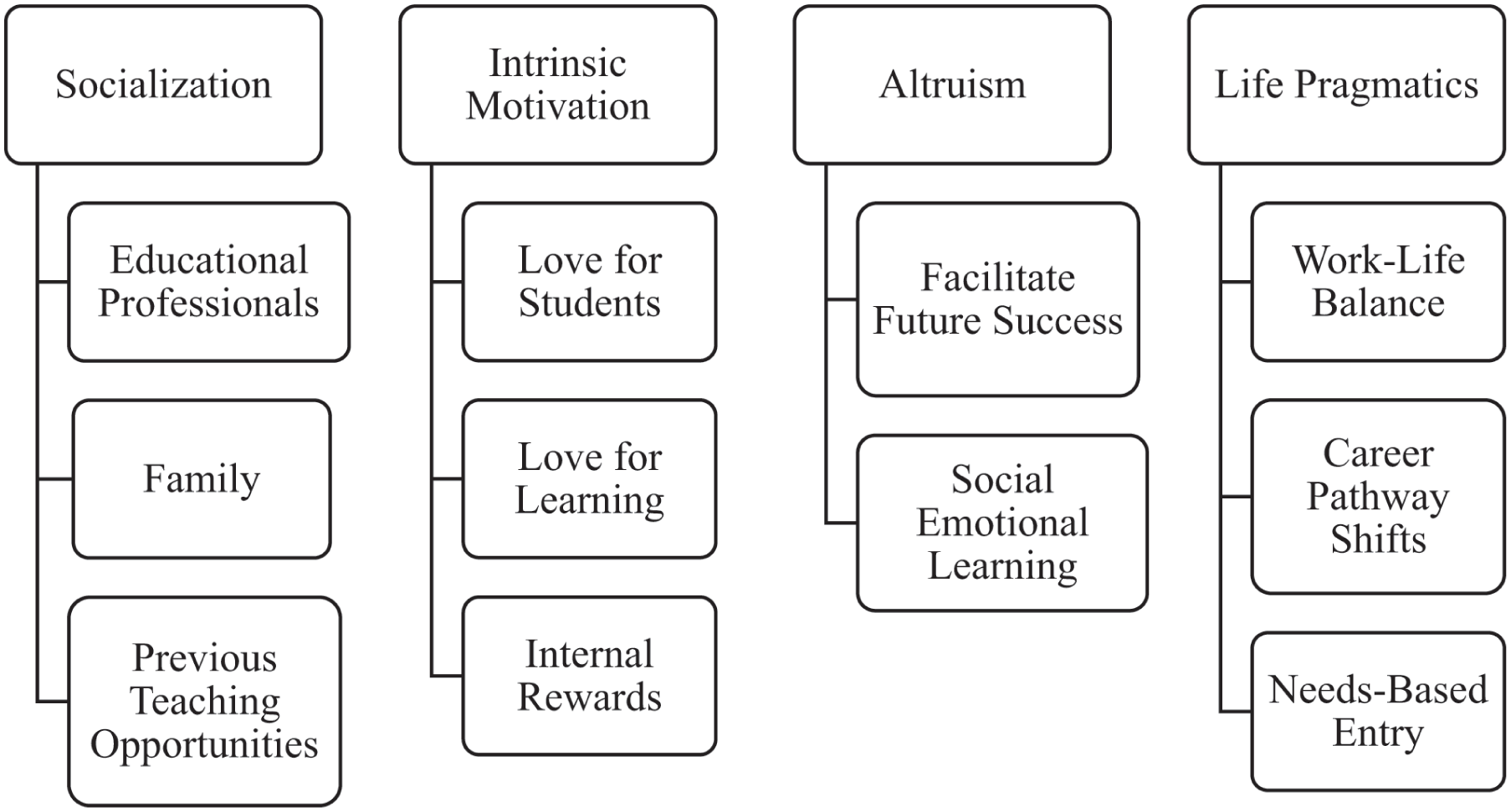
Rural special educators’ motivations for entering the field.
Reasons For Entering the Profession
Socialization Influences
Kwok et al. (2022) identified socialization influences as external forces from people and opportunities that motivated pre-service teachers to enter the field. Specifically, they identified socialization influences as coming from three main sources: (a) educational professionals, (b) family, and (c) previous teaching opportunities. Similarly, in our analysis, teachers identified the external influences of other people or experiences as motivations for entering the field. However, whereas socialization influences were the least commonly cited motivation that Kwok and colleagues (2022) identified, in our study, motivations from social influences were the most commonly cited reason among early career rural special educators. In our analysis, every teacher identified socialization influences among their reasons for entering the field of special education.
Educational Professionals
The most common social influence identified (n = 22; 43%) was other educational professionals. This included teachers with whom participants worked as well as teachers who they had as students themselves. First, teachers reflected on their own school experiences as learners in school and emphasized how formative experiences inspired them to pursue a career in special education. One teacher described how, as a second-grade student, she was struggling with challenging behaviors at school and one of her teachers made a marked difference for her, inspiring her to pursue a similar path. “She took very good care of me . . . she was very strict but also very caring. And I really needed some structure at that time so I was like, ‘I’m going to do that for everybody’.” Another teacher described her experience attending a Catholic school where a resource teacher made a big difference for her and motivated her to pursue becoming a teacher: “I mean, she got me through my own education, and she motivated me to push myself even when things were hard.”
Education professionals including administrators and other teachers also impacted teachers’ motivations to enter the field as adults by encouraging them to pursue becoming a special educator and applying to or filling a staffing vacancy. Eight teachers specifically mentioned that by taking the special education position, they were filling a need or staffing vacancy, with six teachers noting that an administrator encouraged them to pursue the special education teacher position. Relating a story common to teachers in our study, one teacher shared that he had previously been working as a behavior interventionist and was asked to take the special educator position: “So they were down a SPED teacher and about two months into the school year, the principal approached me and asked me if I had ever considered it.” Similarly, another teacher described starting work as a paraprofessional and then being approached to take the special education teaching position. “In October I was contacted by our . . . assistant director, and she was like ‘Do you want to teach?’ I’m like, ‘Sure. Let’s try that.’ And then I haven’t looked back.” Another teacher shared their experience being encouraged to fill a staffing vacancy left by a retirement:
Someone retired here and they were like, “Hey, there’s a position that’s opening, you should apply for this job.” And I was like, “Well, I’m not even a certified teacher. I can’t apply for this job.” And they were like, “No, you should apply for the job. You’ve already been here. You’re a well-known sub. You’ve already worked in this program.”
Whether because of role models from their own schooling experiences, or administrators encouraging them to apply for a vacancy, education professionals were key influencers in the decision to become a special education teacher.
Family
As in Kwok et al.’s (2022) study, family members influenced teachers to become special educators. Sixteen teachers (31%) specifically mentioned the role of family in their motivations to become a special educator. Family influences were described as either (a) having a family member who was a teacher and following in those footsteps (n = 9; 18%) or (b) having a family member who had a disability (n = 8; 16%). One teacher reflected: “I remember when I was . . . 12 years old and I asked [my dad] how his day was and he said, ‘There’s never a bad day with kids.’ So that kind of started my life.” Another teacher explained “I decided to become a special ed teacher because my mom, she was a special ed teacher, and I was in her room a lot.” Also related to family influences, the experience of having a family member with a disability significantly shaped teachers’ motivations and interests, steering them toward a career in special education. For example, one teacher stated, “my brother actually has cerebral palsy, and my mom is a speech and language pathologist . . . growing up, my life really has been around people with disabilities.” This teacher went on to say, “Everybody that talks to me after the fact, like, yeah, obviously you’re a special ed teacher,” suggesting a natural affinity toward working with children with disabilities. Having a family member with a disability inspired a strong sense of advocacy. One teacher explained, “I had a brother who needed additional services and he had a rough year, one year. And so, I just want to be the voice for those kids who can’t speak for themselves.” These responses highlight teachers’ desire to make a positive impact on the lives of children with disabilities; a motivation rooted in their personal experiences and insights.
Previous Teaching Opportunities
Previous teaching opportunities were a major motivation for teachers in this study to enter special education. Of the 51 teachers, 86% (n = 44) shared how prior professional experiences in education (e.g., roles such as substitute teachers, general education teachers, paraprofessionals, volunteering in high school, supporting students with disabilities, coursework in college) were integral in their motivations to become special educators. One teacher described how her background in special education gained in her degree program paved the way for her to transition into teaching special education later in her career after working as a general educator: “I knew that I had the special ed background, and I knew I had the licensure, and I had everything and I thought, ‘I wonder if the district would have anything for me’.” Eighteen teachers (35%) described experiences as a paraprofessional as a motivation to become a special educator. For example, one teacher described the indirect path that led her to special education. First, she started working as a paraprofessional and then when the special education teacher resigned, she served as the long-term substitute: “I ended up really loving it.” Another teacher who held a degree in economics similarly described working as a substitute teacher as her pathway: “. . . within like, three days, it was like, boom, I knew that that is what I should have been doing.” Another teacher shared that an experience volunteering helped create the path to teaching students with disabilities: “I participated in Special Olympics when I was in high school . . . I was one of the partners on a couple teams and . . . a coach for a swim team. And, I just absolutely loved working with those athletes.” Whether experiences in school or after graduation, previous teaching opportunities were a major factor in teachers’ motivations to enter the field of special education.
Intrinsic Motivation
Kwok and colleagues (2022) identified intrinsic motivations among the pre-service teachers in their study as an “agnostic calling to teaching” that often occurred at an early age (p. 587). They described intrinsic motivation as encompassing three main categories: (a) love of students, (b) internal rewards, and (c) love of learning. Similarly, in our analysis, teachers frequently identified intrinsic motivations as a reason for entering the profession and they identified motivations that fit the categories that Kwok and colleagues (2022) identified. In our analysis, love for students was the most prevalent code by far (n = 27; 53%), followed by love for learning (n = 15; 29%), and finally internal rewards (n = 7; 14%). Overall, 36 teachers (71%) identified intrinsic motivation as one of their reasons for entering the field of teaching special education. Below, we summarize salient findings from each of the pre-identified categories as well as findings within the categories that differed and could be specific to the population of rural early career special educators.
Love for Students
Kwok and colleagues (2022) identified this motivation as one that came from participants’ “hearts” (p. 587); that they entered teaching because of their desire to help and serve students. This was coupled with their desire and interest in working with and engaging children. Over half of the teachers in our study (n = 27; 53%) identified motivations that fit this category. Similar to the “innate calling” to the teaching profession identified by Kwok et al. (2022, p. 587), the teachers in our study expressed the experience of knowing that teaching was what they wanted to do starting at a young age. Some recalled wanting to become a special education teacher specifically, while for others it was a more general desire. For example, one teacher mentioned that while she was always clear she wanted to be a teacher, she was unsure of what “kind” of teacher she wanted to be: “Ever since I was in elementary school, I knew I wanted to be one. And I wasn’t entirely sure what kind.” In contrast, another teacher shared, “I think I have always known, when I was at a very young age, I wanted to be a special education teacher and work specifically with students with disabilities.” Regardless of when they recognized their innate pull toward the teaching profession, teachers emphasized their love for working with children. For example, one teacher who had entered teaching after 20 years in service in the Air Force explained that they, “. . . fell in love with the kids. And that’s how I ended up here.” Similarly, another teacher who had changed careers, shared the joy she found in working with students who had disabilities: “I worked with a lot of special needs children and I started to . . . really enjoy that work.” One teacher highlighted the significance of building relationships with students and his desire to work directly with students as opposed to taking an administrative role that was more removed: “I get 30 hugs a day here . . . that’s really what it’s about.” This teacher placed a high value on the meaningful and direct connections with his students.
Still falling under intrinsic motivation, but specific to the sample of teachers in this study, eight teachers identified specific enjoyment from working with students or people with disabilities who need additional support. One teacher described the realization that “. . . there [are] a ton of teachers who work really well with general education students . . . But I found that I really, really enjoy working with the special education students.” Another teacher described a similar motivation to work with people with disabilities “I was like, I really want to work with . . . people with disabilities, I think it’s really fun.” Another teacher who started work as a paraprofessional in special education noted that his work with students was enjoyable: “It was just a brand-new experience for me . . . never working with special ed kids, and I’m like ‘this is fun’.” Overall, the specific motivation to work with students who were struggling or who had disabilities was a nuance that emerged from the early career teachers we interviewed.
Love for Learning
As in Kwok and colleagues’ (2022) findings, teachers in our study cited a love or passion for learning and facilitating learning. Overall, 15 teachers (29%) identified motivations in this category, with the majority of those (n = 14; 93%) mentioning a specific passion or connection to the job of being a special education teacher. These teachers often described how their strengths or skill sets aligned with the job of a special educator. For example, one teacher shared her experience of student teaching in both elementary and special education: “I love the elementary portion, too, but . . . I just really felt more drawn to the special education.” Another teacher described feeling as if she had reached the limit of what she could do as a paraprofessional and wanted to take the next step. She described enjoying problem-solving and providing individualized support, “It’s easy for me to problem-solve. I love individualizing work and working with the students one-on-one.”
Teachers also shared that special educators could support students with disabilities in a different capacity than general educators. One teacher who had worked previously as a general education preschool teacher, described the difficulty of focusing on individualized needs in general education, “I just wanted a career where I could . . . focus on the students’ individual needs, where it’s very difficult to do that in the gen ed classroom with 20 students.” Similarly, another teacher who had previously worked as a preschool teacher explained, “I loved being in a small group setting, and I loved helping students more than what your general education teacher could do.” Both teachers acknowledged that special educators support students on an individualized level, and noted that it can be challenging for general educators to provide that level of support while also being responsible for an entire class.
In addition to the enjoyment of supporting students individually, teachers also remarked on how being a special educator fit them by leveraging their strengths and passions. One teacher commented, “The style I like to teach with, it kind of fits. You know, I’m a little bit more – I could be flexible and I think that’s one of the biggest things, is to be flexible.” Overall, teachers expressed being drawn to the structure and flexibility of special education that allowed them to work with students and meet their needs in different ways.
Internal Rewards
The least prevalent of Kwok and colleagues’ (2022) categories within our sample for intrinsic motivation was internal rewards. Kwok and colleagues (2022) define internal rewards as the perception among pre-service teachers that teaching would bring feelings of fulfillment and satisfaction to them as individuals. In our sample, seven teachers (14%) mentioned internal rewards as a motivation. Teachers most often mentioned fun, enjoyment, or being good at teaching special education. For example, one teacher who was originally licensed as a health and physical education teacher explained his enjoyment of teaching special education and wanting to continue: “And I would say. . . ‘That was . . . so much fun’.” Similarly, another teacher described the joy she found as a paraprofessional and how that led her to special education, “I decided to try being a paraprofessional . . . and I enjoyed that a lot and I’m kind of good at it.” Unlike typical pre-service teachers, these participants had already experienced the internal rewards of special education through prior related roles.
Overall, teachers in our sample mentioned similar motivations to those identified by Kwok and colleagues (2022). However, some important additions and differences particular to in-service, rural special educators were noted including, (a) the desire to work with and support students who are struggling or have disabilities, (b) an affinity for the specific structure and job of a special educator, and (c) internal rewards (e.g., joy, fun) as discovered on the job or in a similar position prior to entering the profession.
Altruism
According to Kwok et al. (2022), teacher motivations associated with altruism were related to teachers’ desires to impact the positive growth and development of students. Specifically, altruism was defined as “an expressed desire to make a difference and improve current and future generations of students” (Kwok et al., 2022, p. 585). In our analyses of early career rural special educators’ motivations, altruism was also a frequently mentioned motivation. However, while altruism was the most frequently identified category in Kwok and colleagues’ (2022) findings, it was the least frequent category in our analyses, with 19 teachers (37%) citing altruism as a motivation. Below, we detail findings that aligned with Kwok et al. (2022), and then briefly discuss findings specific to our analysis within these categories.
Facilitate Future Success
Kwok and colleagues identified facilitating future success as teachers’ desire to “aid, empower, and propel students towards the attainment of an ideal academic future success” (Kwok et al., 2022, p. 585). In our analysis, 16 teachers (31%) identified this as a motivation. Teachers expressed their desire to help students and families in an educational context broadly: “I felt like I can make the biggest impact” and nine teachers (18%) shared a specific desire to support students receiving special education services and students who struggle. For example, one teacher shared that he does not believe all “special ed kids” have adequate support, and so he wanted to be able to provide support for those students to succeed. He explained, “But it’s just being able to really provide for those kids and help them to . . . close those gaps.” Another teacher whose brother received special education services, realized in retrospect that her school district was not meeting the needs of students with disabilities. She explained her motivation to make sure that students with disabilities get the support they need to succeed: “I want to make sure that schools aren’t doing this, I want to make sure that kids are receiving the best education, the best things, like they aren’t just being pushed to the side.” Similarly, a former social worker turned special educator, shared her desire to support students in school and academics in a preventative manner as compared with social work: “I want to . . . be on the more preventative, restorative piece of it along with doing those academics.” Four teachers mentioned altruistic desires as they related to personal experiences with disability, as they or someone in their family had received special education services. One teacher shared her experience with her own teacher (Mrs. G.) who, while not officially providing special education services, provided support that allowed the teacher to get through school as a young person. “And I just always thought when I grow up, I want to be a Mrs. G and I want to help people. And I want to support students and do exactly what she did for me.”
Social Emotional Learning
Kwok and colleagues (2022) identified the motivation to support students’ social emotional learning as part of altruism, separate from the desire to support students’ academic learning and success. Social emotional learning included creating a safe and supportive learning environment and being a positive role model for students (Kwok et al., 2022). In our analysis, the desire to support students’ social emotional needs was identified less frequently than facilitating future academic learning and success, with seven teachers (14%) identifying providing social emotional learning as a motivation. These motivations included nurturing and helping broadly as well as advocating on behalf of students with disabilities. Overall, altruistic motivations were described in relation to making a difference for students whom teachers believed or observed could benefit from preventive measures, support, and advocacy. Teachers’ altruistic motives centered around the belief that teachers can make a difference in the lives of students. Prior personal and professional experiences were cited as reasons for feeling inspired or compelled to make a difference, suggesting altruistic motives are closely related to socialization influences.
Life Pragmatics
Some motivational influences described by our teachers did not align with the categories outlined by Kwok et al. (2022), leading us to offer further clarification and prompting a deeper examination of these responses, which we labeled life pragmatics. These motivations reflected personal and contextual factors shaped by teachers’ life experiences, career histories, and the specific teaching needs in the rural communities in which they live and work. Life pragmatics were referenced by 40 teachers (78%), and within this category of influence, we identified three themes: (a) work–life balance, (b) career pathway shifts, and (c) needs-based entry. These themes may offer new insights specific to the motivations of rural special educators by showing how their decisions are shaped by adapting to needs within their communities and making lifestyle changes.
Analyzing these additional motivational influences revealed that decisions to enter the field often emerged from the interaction of personal circumstances and broader contextual factors. Rather than following a single pathway, these motivations reflect how lived experiences and local opportunities come together in complex and sometimes unexpected ways.
Work–Life Balance
The first subcategory, work–life balance, reflects how participants pursued roles in special education based on how well the profession aligned with their personal or family needs. Many described teaching as a way to remain in a rural community or to achieve a better balance between work and life responsibilities. Ten teachers (20%) described how a career as a special educator supported their desire to stay or return to living in a rural community. One teacher shared that she liked “the small-knit communities with . . . everybody knowing each other. I grew up in a small town so I wanted to get back to that.” Similarly, another teacher stated, “we live in a rural community so there’s not really as many opportunities for full-time permanent positions . . . and my family’s here . . . so we wanted to stay in this area. So, it was just a next natural thing.” Family circumstances also played a significant role, as teachers often connected their career choices to the needs of their families, particularly around aligning work and school schedules. One reflected, “Once my kids got into school, I did more substitute teaching and then was a paraprofessional in a special education classroom, just so my schedule could kind of balance with theirs.” Another teacher noted that schedule flexibility was key when combining professional roles, “I accepted a coaching position for the high school basketball team, and I was looking for a job in the schools that would work with that schedule.” For these teachers, choosing to pursue a special education position was associated with maintaining continuity with preexisting commitments and responsibilities within a rural community.
Career Pathway Shifts
The second subcategory, career pathway shifts, includes participants who entered the field after stepping away from a previous career or educational path. These transitions were often influenced by burnout, dissatisfaction with an earlier major, or the discovery of a new interest in working with students. Participant experiences indicate that special education became a meaningful new direction shaped by reflection, working in people-oriented professions and career change opportunities. Career pathway shifts were referenced by 19 teachers (37%), who shared how special education was not their original field of study but emerged as a new path following burnout or dissatisfaction with previous careers. Twelve teachers (24%) reflected on how their perspectives toward their initial majors or degrees had shifted over time. One teacher shared, “So I actually have two undergrads that are not in education at all . . . and I was, like, I don’t want to do either of these things.” Another remarked on the limited utility of their degree: “So I actually have an economics degree and I wasn’t doing anything useful with that.” While some teachers described reevaluating their career paths after completing college, others spoke about choosing to pivot after spending time in the workforce. One teacher described wanting a change from a stagnant career, stating,
You know, you’re in the same position for 20 years. I was the deputy director there. And it was nice. It just kind of became – if you stay in the same position for a long time, I think you can become stagnant. And it was just one of those deals where I kind of thought like a change would be good.
Others shared that the emotional and logistical demands of prior roles prompted them to seek change. One said, “One of the main reasons I decided to leave the position I was in was because I was on call 24/7 . . . there was no one else trained or available to step in if I wasn’t there.” Three teachers previously worked in education but wanted a shift. One teacher explained, “I was starting to get a little burnt out with the age group, so I stepped up to middle school as more of a challenge for myself.” These narratives show how dissatisfaction with previous career trajectories prompted teachers to reconsider their professional goals and new opportunities.
Needs-Based Entry
The last subcategory, needs-based entry, refers to participants whose decisions were influenced by staffing shortages, particularly in rural and high-need areas. When employment opportunities aligned with participants’ geographic preferences or immediate need for stable employment, they became a significant factor in the decision to enter the profession. Needs-based entry was discussed by 17 teachers (33%) and related to how they acquired a position in special education. Many shared how vacancies within their rural communities influenced their path into the field. While some acted independently in responding to a district need, several teachers described their entry into the profession as initiated by an administrator attempting to fill these vacancies. One teacher shared, “I was asked by our principal if I had ever considered being a special education teacher . . . And I thought about it and said, ‘Sure, why not?’ I had no teaching degree, no teaching experience.” Another shared how changing roles was not their choice,
Well, it’s kind of an interesting story. So I am licensed K through 6 and this year I was reading intervention and there was a shortage for a special ed teacher, so I was pulled to be a special ed teacher. It was very last minute. It was a couple weeks into the school year, so I didn’t know about it at all [brief laughter].
In addition to vacant positions, teachers emphasized how existing relationships and informal networks within rural schools played a role in securing a job. One teacher described being “gifted this job,” while two mentioned the position “fell into my lap.” These accounts reveal how the rural school context, marked by close-knit relationships and staffing challenges, often created unplanned pathways into special education in their rural communities.
Comparison of Motivations by Certification Status
The focus of our second research question was to identify variations among motivations that early career special educators identified for entering the profession based on their certification status (i.e., fully licensed vs. not fully licensed teachers). Overall, at the time of the study, 51% (n = 26) of the teachers held full licensure to teach special education. The remaining 49% (n = 25) were not fully licensed. Among the three overall motivations identified by Kwok and colleagues (2022; altruism, intrinsic motivation, and socialization influences), teachers who were not fully licensed reported similar motivations as compared with those who were fully licensed at the time of the study. However, there were two differences between the groups’ motivations. First, while, both groups reported socialization influences as important motivations to enter the field, within this overall category, themes varied based on teachers’ certification status. Second, there was a greater discrepancy between motivations reported by the two groups in the life pragmatic category. We provide more details about these areas of difference below, and Figure 2 provides a summary of code counts by licensure status.
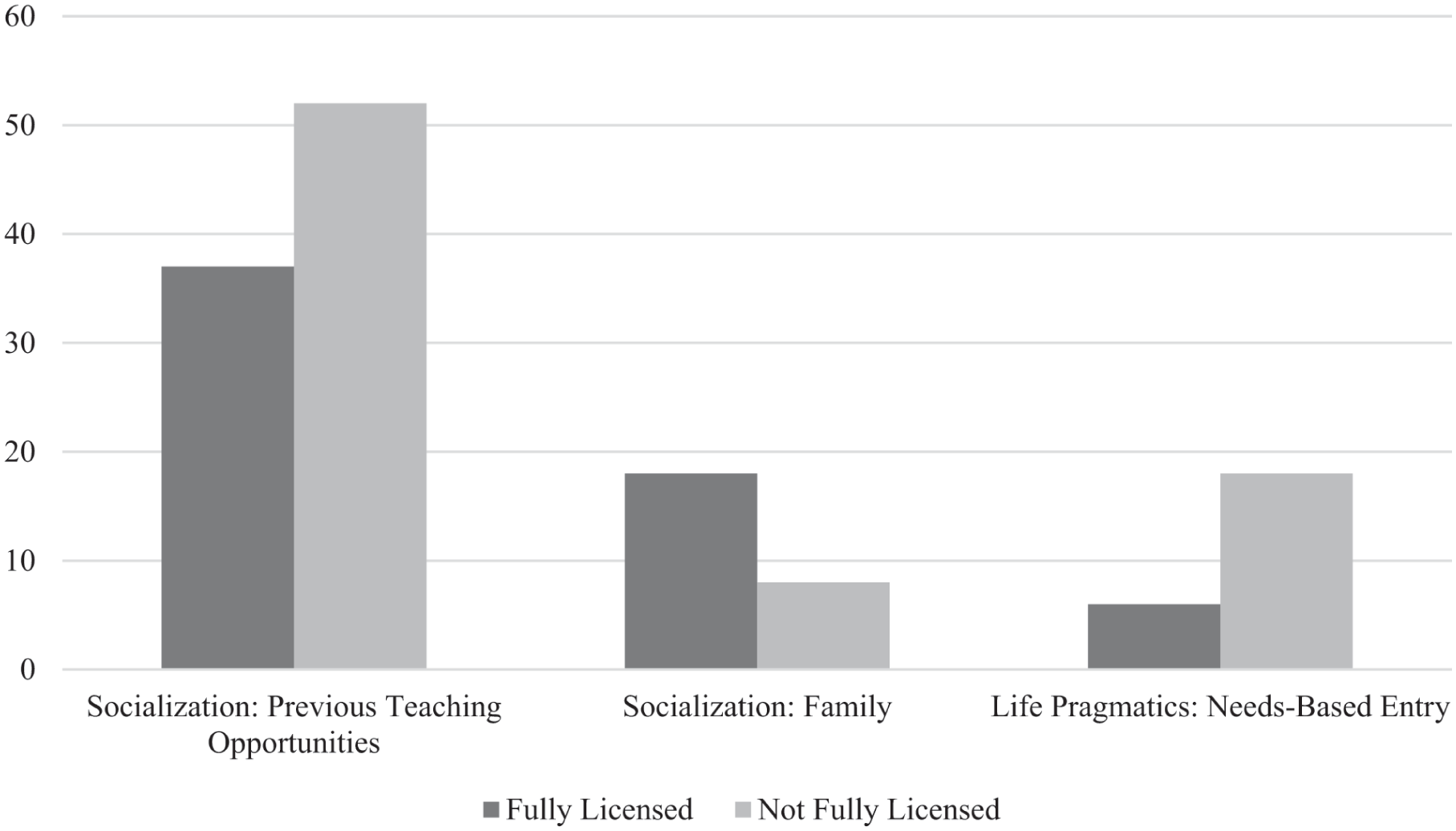
Motivational influences that differ based on licensure status.
Varied Socialization Influences and Certification Status
Overall, socialization influences were mentioned 136 times across all interviews. Of these, 73 mentions were from 25 teachers who were not fully licensed and 63 were from 26 teachers who were fully licensed, representing little difference. However, within the category of socialization influences, teachers who were not fully licensed cited previous teaching opportunities, including working as a paraprofessional and substitute teaching, as motivations more frequently. Overall, there were 89 mentions of previous teaching opportunities as a motivation, and of those, 52 or almost 60%, were mentioned by teachers who were not fully licensed. Moreover, only teachers who were not fully licensed cited work as a substitute as part of their pathway to entering the profession (12 mentions). Additionally, while there were 26 instances of participants mentioning work as a paraprofessional serving as a motivation, the majority of those (n = 16; 62%) were mentioned by teachers who were not fully licensed. See Figure 2 for a graphic display of these differences. Also within socialization influences, fully licensed teachers mentioned family, including having a family member who has a disability, as a motivation to enter the field more frequently than those who were not fully licensed. In summary, while socialization influences were important for all teachers in this study, the specific sources of these socialization influences were differently prominent for teachers with different licensure statuses.
Differences in Life Pragmatics Influences
Overall, 88 excerpts were coded as life pragmatics across all the interviews. Teachers who were not fully licensed mentioned life pragmatics more frequently; however, life pragmatics were noted as a motivation for entering the profession by an equal number of teachers who were not fully licensed (n = 20; 80%) and fully licensed (n = 20; 77%). Specific differences between the groups were in Need-Based Entry, with 18 mentions by 12 teachers who were not fully licensed, as compared with only 6 mentions by 5 teachers who were fully licensed (see Figure 2). Specifically, teachers who were not fully licensed described a pathway into special education that was not fully their own decision but was filling a need when a vacancy surfaced. Overall, this pathway was more common for teachers who were not fully licensed.
Discussion
Special educators in this study provided reasons for entering the field of teaching special education that aligned with the three broad categories of teacher motivation identified by Kwok and colleagues (2022; altruism, intrinsic motivation, and socialization influences). However, the subcategories identified in this study varied, as did the prevalence of which overall categories were identified most frequently. While Kwok and colleagues, along with previous investigations into teacher motivations (Fray & Gore, 2018), found altruism to be the most common teacher motivation, in this study, socialization influences were most common. Specifically, special educators in this study cited the importance of encouragement from others as a motivator to enter the field (e.g., colleagues, friends, parents). This connects to previous findings related to the importance of socialization influences in teacher motivation. For example, parents, past positive learning experiences, and influential teachers have been found to play a significant role in pre-service teachers’ decisions about entering the teaching profession (Fray & Gore, 2018; Ralph & MacPhail, 2015; Richardson & Watt, 2005).
Special educators in this study also frequently shared motivations that did not fit the framework as depicted by Kwok et al. (2022) but connected to elements of other previous research on teacher motivation. Citing evidence for why people may choose to enter the teaching profession, Fray and Gore (2018) posited that career choices are not only determined by the individuals making decisions but by “. . . prevailing economic and social conditions, including earnings and employment prospects” (p. 158). The life pragmatics category identified in our study aligns with some aspects of what have been identified by past researchers as one component of extrinsic motivations (e.g., quality of life, or lifestyle choices; Fray and Gore, 2018; Pop & Turner, 2009; Richardson & Watt, 2006; Watt & Richardson, 2012; Weiss & Kiel, 2013). In our study, these motivations reflected the rural special education teaching position as accommodating lifestyle priorities (e.g., schedule, rural location) or meeting community staffing needs. These motivations align with social and economic conditions specific to rural settings and follow previous findings that Fray and Gore (2018) categorized as conditions of work as a component of extrinsic motivations including job opportunities and career prospects. For example, the decision to accept a special education position may be due to the desire to live in a rural setting with limited employment prospects, or the fact that the school located within driving distance to a teachers’ home may only have a job vacancy in special education.
Teachers also mentioned finding themselves in their current special education teaching position due to unplanned circumstances. For example, they applied for other jobs and did not get them; they were burned out from another position and sought special education as a change; or an administrator asked them to take the job. These factors align with the previously identified concept of teaching as a fallback or back-up career, also a component of extrinsic motivation (Fray & Gore, 2018; Watt & Richardson, 2012). This phenomenon also aligns with data about widespread and difficult-to-fill vacancies and the need for special educators in rural schools, especially remote rural schools (IES, 2022; Ingersoll & Tran, 2023; Viadero, 2018). Specific to teachers who were not fully licensed, these extrinsic motivations were especially prevalent. Not surprisingly, rather than charting a direct path into special education, teachers described complex webs of reasons, experiences, circumstances, and opportunities as their path. For example, one teacher who was not fully licensed described her motivations as: a family member being a teacher in a nearby school, wanting to make a difference for students in a new way, needing a career change and always having wanted to work in a school, wanting to stay in the specific rural area, the position opening up, and being encouraged by others that the job would be a good fit. The confluence of factors has implications for the recruitment of special educators in rural areas.
Limitations and Implications for the Field
Some limitations of this study include (a) the team completed member checking with only a subset of participants, and (b) findings were based on two questions within one 30-min interview per participant. Additional follow-up interviews could provide an opportunity to elicit richer and more complex data from participants.
Findings from the current study have the potential to inform policy and practical recommendations related to filling vacancies in special education in rural schools and districts. First, in this study, socialization influences, specifically educational and professional experiences and relationships with others, were the most commonly identified motivations. This suggests that at a policy level, as well as a practical level for administrators, focus should be on creating high-quality pathways to enter the field within rural schools and settings, including for paraprofessionals. For example, online or hybrid preparation programs that can be accessed by those in rural settings, coupled with student teaching experiences in schools where candidates already work, their own children attend, or they themselves attended, could be an effective means to recruit and retain new special educators within geographically isolated communities.
Second, encouragement and support from others to enter the field or a specific job were also an important motivation. This aligns with the finding that exposure to special education settings within certification programs and prior work with students with disabilities are motivating factors for entering the field. Programs that provide opportunities for students in rural schools to work with people with disabilities in their schools and communities can start as early as middle school. Opportunities can continue into teacher certification programs that offer dual certification or, at a minimum, opportunities to engage in practicum experiences with students with disabilities. These experiences could be effective pathways to recruit more special educators in rural communities in the longer term.
Finally, teachers in this study shared that special education positions in rural schools can fit their specific lifestyle, schedule and preferences about where to live, especially when employment opportunities may be limited. This finding further supports the recommendation that recruitment of new rural special educators take place within the specific communities with staffing needs (e.g., Mamlin & Diliberto, 2020; Mason-Williams et al., 2019), rather than recruiting from outside. Building opportunities for engaging prospective teachers early, looking for candidates within the school community, and creating geographically accessible pathways of preparation, encouragement, and support aligns well with identifying and hiring the next generation of rural special educators.
Footnotes
ORCID iDs

Funding
The authors disclosed receipt of the following financial support for the research, authorship, and/or publication of this article: The work described here was supported by the Institute of Education Sciences, U.S. Department of Education, through Grant R324A200038 awarded to the University of Wisconsin-Madison. The opinions expressed represent those of the authors and do not represent the views of the Institute of Education Sciences or the U.S. Department of Education.
Declaration of Conflicting Interests
The authors declared no potential conflicts of interest with respect to the research, authorship, and/or publication of this article.