







Abstract
Al foams were produced by applying a powder metallurgy route. Foam expansion, cell structures and foam stability of foamed samples were investigated. The results show that larger expansion and more homogeneous cell structures were achieved due to the presence of 1·0 wt-%Mg addition. Mg addition results in the formation of spinel particles through the reaction between Mg powder and alumina on Al powder. Spinel particles show good wetting with Al melt and are fully embedded into Plateau borders and cell walls. The liquid is tightly trapped within cell walls and Plateau borders in the presence of spinel particles, preventing cell walls from thinning further and improving foam stability significantly.
Introduction
Al foams are functional materials and offer attractive combinations of high specific stiffness, low density, good energy absorption and other properties. 1 1,2 Numerous applications, including light vehicles and in aerospace, have been put into effect. 3 3,4 Among all the preparation techniques, the powder metallurgy (PM) route is a fascinating method due to the ability to produce near net shape components.5 This method involves mixing Al powder with a foaming agent, followed by pressing the mixture to a dense precursor with little or no residual porosity.6 Heating the precursor results in its expansion and the closed cell foam structures are obtained by cooling the expanded precursor.
It is known that the foaming process for the preparation of Al foams using the PM route should be extremely rapid due to the easy oxidation of the precursor materials. The rapid nature of foam expansion and collapse results in poor reproducibility of cell structures. Density gradients caused by gravity and capillarity effects are inevitable.7 These factors mentioned above are rather unfavourable for foam stability. Naturally, the means to stabilise liquid foam are studied. It has been reported that the particle stabilisation is the principal stabilisation mechanism of closed cell Al foams. 8 8,9 Ceramic particles are commonly added into the precursors before compaction in order to improve the stability of Al foams.10 Furthermore, it is noted that good wetting behaviour of ceramic particles with liquid Al melt is a prerequisite for stabilising metal foams.11 It is generally accepted that the proper oxygen content within Al powder is favourable to stabilise Al foams.8 However, alumina on Al powder is not readily wetted with liquid Al melt.12 It has been reported that trace Mg powder has a beneficial effect on the sintering of Al compacts.13 The reaction between Mg and alumina on Al powder, resulting in the formation of MgAl2O4 phases, facilitated the sintering process through modifying and rupturing the oxide film on the surface of the Al melt. Wetting is significantly improved by this reaction. Foam stability is also enhanced via Mg addition into Al–Al2O3 foams by Asavavisithchai and Kennedy.11 At present, however, little research has been done on the effects of Mg addition on foam stability of Al foams in the absence of ex situ stabilising particles. This could be helpful to reduce the manufacturing cost and simplify the technical process, which is resulting from any addition of ex situ particles.
In this research, an experiment adding a small amount of Mg powder into the precursors alone is also carried out. The aim is to investigate expansion behaviour and foam stability of Al foams.
Experimental
Foamable precursors were prepared by mixing air atomised Al powder (Al, ⩾99·0 wt-%; oxygen content, 0·34 wt-%; D50 = 117·078 μm) with 0·6 wt-%TiH2 powder (purity, 99·4 wt-%; D50 = 32·544 μm), which had been pretreated in air at 500°C for an hour. Before compaction, 1·0 wt-%Mg powder was added into the mixture. The samples without Mg powder were also prepared. Subsequently, two mixtures were cold compacted to dense foamable precursors in a 50 mm diameter, lubricated tool steel die to a pressure of 600 MPa. Then, the foamable precursors were foamed in a stainless steel mould with the diameter of 50 mm. The vertical tube resistance furnace was preheated to 800°C. The heating times for all the precursors were identical. Each foaming experiment with the same component is repeated four times to ensure reliability of the results in our observation. The foamed samples were sectioned using electrodischarge machining. Subsequently, the sections were painted in black in order to enhance the contrast of cell walls and the bottom of bubbles, followed by polishing with abrasive papers of 1000–2000 meshes. At last, cell structures of Al foams were scanned by a scanner at the resolution of 300 dpi. Microanalysis was performed using optical microscopy and scanning electron microscopy (SEM) in combination with energy dispersive spectroscopy.
In addition, the samples of Al powder with 1·0 wt-%Mg powder were prepared by uniaxial cold compaction so as to identify reaction of Mg powder and alumina on the surface of Al powder. X-ray diffraction was used to determine the formation of new phases.
Results and discussion
Figure 1 shows the top morphology and cell structures of foamed samples. It is clear that oxidation of top surfaces of foamed samples without Mg addition (see Fig. 1a) is much heavier than that of 1·0 wt-%Mg addition (see Fig. 1b). A dense oxidised layer in Fig. 1a is visible clearly. Formation of this dense oxidised layer is attributed to surface overoxidation of precursors exposed to air in the absence of Mg powder. Since alumina is wetted badly with Al melt, it is understood that alumina on Al powder was aggregated, and those within precursors are excluded outside Al melt. Top surface was oxidised further with foaming time. All these actions result in a dense oxidised layer. Dense oxidised layer is not, however, observed, and the bubbles could be seen clearly from top view of Fig. 1b. It is suggested that moderate addition of Mg powder is helpful to eliminate the dense oxidised layer.
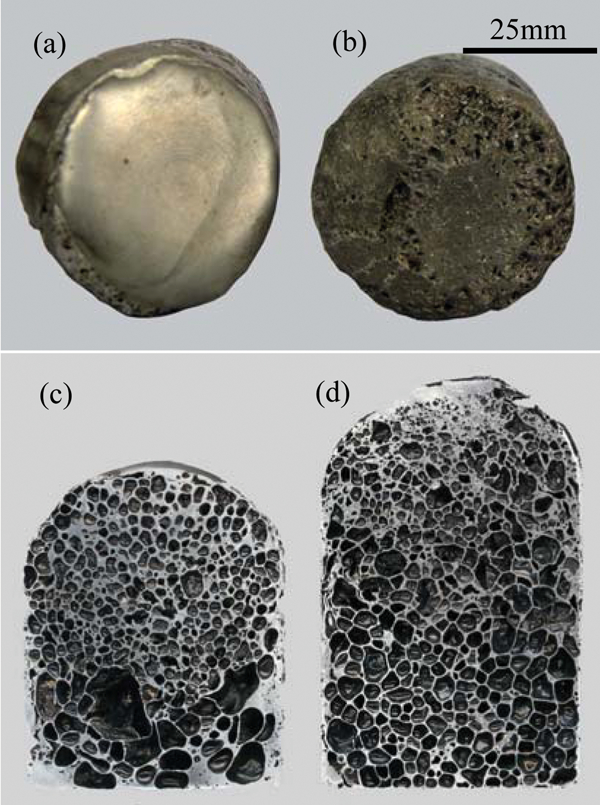
Top morphology and cell structures of foamed samples with and without Mg addition (foaming temperature, 800°C; foaming time, 160 s)
Cell structures of the sample with out Mg addition are shown in Fig. 1c, which are of the same sample to Fig. 1a. The most typical features in Fig. 1c are inhomogeneous cell structures and a dense Al layer at the bottom of the sample due to poor foam stability while these phenomena above are improved obviously in Fig. 1d. Therefore, it may be proven indirectly that gravity and capillarity effects are weakened due to the presence of Mg powder.
Expansion behaviour is another difference between Fig. 1c and d. Expansion in Fig. 1c is restricted by overoxidation of its top surface (see Fig. 1a). Mg addition results in rupture of dense oxidised layer (see Fig. 1b) on top surface, resulting in higher expansion height.
It is well known that Mg addition may result in formation of MgO and MgAl2O4 phase. The result of X-ray diffraction analysis (see Fig. 2), however, shows that MgAl2O4 phase is the only produced phase. Moreover, it has been reported that formation of MgAl2O4 phase is favoured as the content of Mg addition is ⩽1·0 wt-% for sintering of Al powder.13
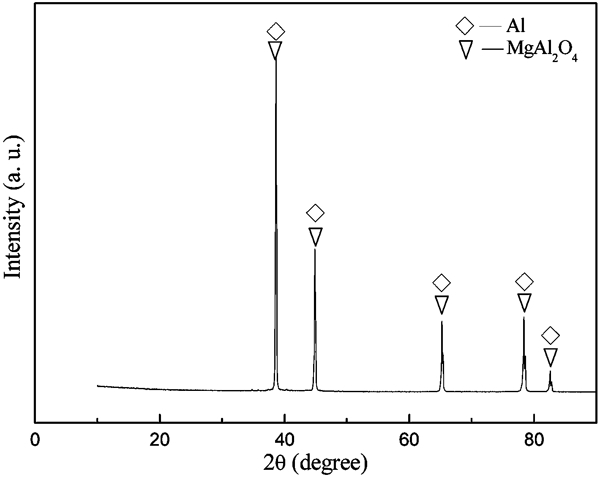
X-ray diffraction spectrum of samples with 1·0 wt-%Mg powder: samples were heated in air at 520°C for an hour
Energy dispersive X-ray analysis (EDX) is another strong evidence for occurrence of spinel particles. Figure 3 shows SEM images and EDX spectrum of cell walls with 1·0 wt-%Mg addition. As seen from Fig. 3a, stripy and punctuate spinel particles are clearly visible and imbedded in Al matrix uniformly. The white massive substance is AlN phase, depending on foaming atmospheres.
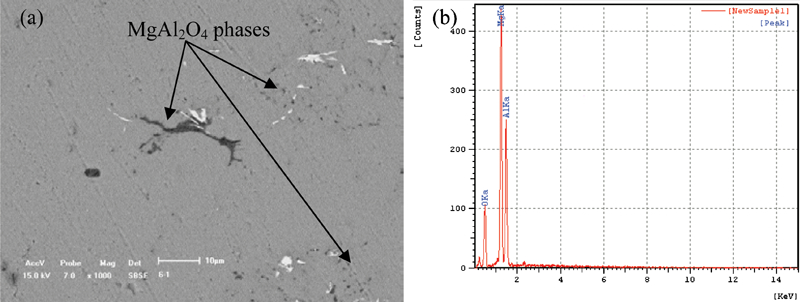
a image (SEM) of cell walls of foamed samples with 1·0 wt-%Mg addition and b EDX spectrum of spinel particles in Fig. 4a
A comparison of SEM images in Fig. 4 shows that Mg addition has a considerable effect on cell walls and Plateau borders: the sample without Mg addition shows inhomogeneous cell walls and pronounced local swellings and indents14 of cell walls, whereas the sample with 1·0 wt-%Mg addition exhibits comparatively homogeneous cell walls. As seen from Fig. 4b, swellings and indents of cell walls is weakened greatly. The reasonable explanation for this difference is that poor wetting of oxides with Al melt, in the absence of Mg addition, leads to non-uniform distribution of these oxide particles. It is concluded that swelled cell walls are formed at areas of rich oxides, while indents must appear at those of depleted oxides.15
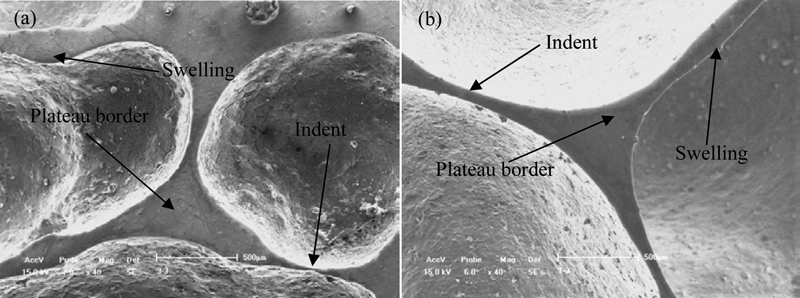
Images (SEM) of cell wall and Plateau borders: parameters of foaming process are identical with Fig. 1
It can be concluded that foam stability is improved by proper Mg addition. According to energy dispersive spectroscopy spectrum and previous research, spinel particles are the only reaction products in the presence of 1·0 wt-%Mg addition. Improvement of foam stability can be demonstrated by spinel particles of cell walls or Plateau borders. Oxide distribution of Plateau borders is shown in Fig. 5. As seen from Fig. 5a, without Mg addition, oxide agglomerations are identified clearly. The presence of depleted oxide zone, resulting from non-uniform distribution of oxide particles, is inevitable. In contrast, spinel particles in Fig. 5b are scattered uniformly, and depleted oxide zone almost disappears. Furthermore, it also can be seen clearly from Fig. 5a that oxides particles are protruded outside, whereas spinel particles in Fig. 5b are embedded in Al matrix and show a good wetting. Poor wetting of oxide particles in Fig. 5a is improved greatly. It is considerable that oxide agglomerations and depleted oxide zone result in swellings and indents respectively, which are shown in Fig. 4a.
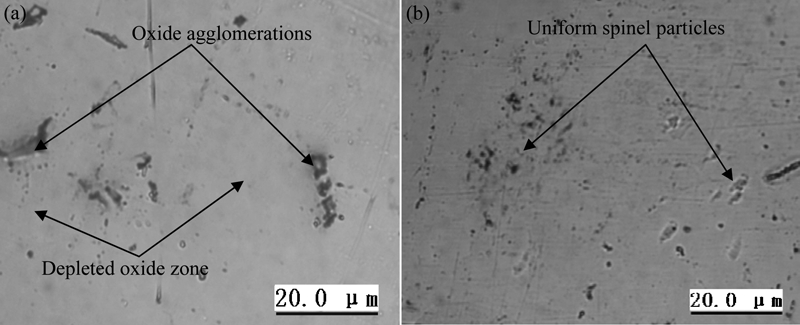
Optical micrographs of cell walls
At present, it is well known that there have existed three kinds of stability mechanism for the role of solid particles in inhibiting gravity drainage of liquid from cell walls to Plateau borders. These theories include their ability to reduce surface tension and modify the curvature of liquid/gas interface through particle aggregation at interface,9 increase the bulk and apparent viscosity of liquid16 and keep the liquid/gas interface apart by an interfacial force.8 It is difficult to imagine the obvious effect on melt viscosity and curvature of interface in the presence of 1·0 wt-%Mg addition and no ex situ particles. Moreover, the explanation for interfacial force introduced by oxide network particles, resulting in local swellings and indents of cell walls, becomes helpless. In this study, however, it is demonstrated from macro- and microstructures that Mg addition results in a decrease in gravity drainage and an increase in expansion rate.6 All these improvements are attributed to occurrence of spinel particles obtained via reaction between Mg powder and alumina on Al powder. Uniform distribution of spinel particles and good wetting with Al melt enables these oxide particles to become fully embedded into cell walls and Plateau borders. The liquid within cell walls and Plateau borders is trapped due to these spinel particles and thus prevent cell walls from thinning further.
Conclusions
Mg addition has been found to have a significant effect on foam expansion and cell structures made by a PM route when using air atomised Al powder as matrix material in the presence of oxygen content of 0·34 wt-%. Gravity and capillarity driven flow of liquid metal is reduced greatly. Larger expansion and more homogeneous cell structures of Al foams are achieved if 1·0 wt-%Mg addition is added in the foamable precursors.
Foam stability is improved apparently due to Mg addition. The reactions between Mg powder and alumina on Al powder result in the occurrence of spinel particles, which are the only reaction products. Oxide particles composing of spinel particles, which are distributed uniformly in cell walls and Plateau borders, show good wetting with Al matrix. Swellings and indents of cell walls, resulting from non-uniform distribution of oxide particles, are weakened greatly. The thinning rate of cell walls is slowed down due to the trapped liquid within Plateau borders and cell walls, and the rate of drainage via foam structure is reduced greatly.
Footnotes
Acknowledgements
The authors acknowledge the National High Technology Research and Development Program of China (project no. 2008AA03Z512) and National Natural Science Foundation of China (grant nos. 50774021 and 50704012) for financial support.